More than a decade has passed since the arrival of the last large wave of Israeli immigrants to the German capital. Will the far-right government trigger a new exodus?
Published in "Haaretz": https://www.haaretz.com/israel-news/2023-01-11/ty-article-magazine/.premium/israeli-cultural-refugees-in-berlin-things-were-always-lacking-in-israel/00000185-a00d-d1f0-ab9d-e2fdb4fb0000
BERLIN – When Yael Nachshon Levin arrived in Berlin in 2016, she wasn’t remotely thinking about staying there. At that point in her life, she was a rather well-established musician in Israel. She had recorded three albums. She had appeared with leading Israeli musician Yoni Rechter and trained other singers, among other accomplishments. But then she was diagnosed with cancer, which interrupted her musical career. Her husband – the poet and director Aharon Levin – had always wanted to travel the world, and he and their two children have German passports. That decided the matter.
“The truth is that I hadn’t been interested in moving to Berlin, but I didn’t want to be the one to say no,” she says in an interview at a café several streets north of Alexanderplatz. “I said, ‘Okay, let’s do it for two years.’” Those two years have long passed and the Levins are still in the German capital, without any intention of leaving in the foreseeable future. One of the reasons she feels comfortable in her new home is the cultural project she has launched that combines a number of her loves: music, art and good food.

In October 2016, just a few months after she and her family moved to Germany, she decided to take advantage of their newly rented spacious apartment. She invited over a friend who is involved in electronic music, another who is a photographer and another 30 guests. They included Israelis whom she knew, German neighbors and friends from her German-language class. “There was something miraculous there,” she recounts six years on. “The combination of people from all over the world and the music. Hosting them and the cooking worked great. Everything came together for me, and I had a feeling that there was a hunger for this.”
Following the success of the initial evening, others followed and the format became a monthly event (for a fee) that includes a concert, art exhibit and good food. Nachshon Levin, who paid the artists from the beginning even when there was barely any money, found a patron to help finance the venture. The venue switched from her private living room to other locations, and a graphic artist friend of hers designed a logo and helped her find a name for the project: Framed, offering an open space for creativity.
“On the one hand, it’s like a house party,” explains Nachshon Levin, who already has 73 events under her belt. “On the other, it’s a high-level combination of music and art. The artists come from all over the world. The setting is intimate, warm and not pretentious. There’s no stage or backstage, and that encourages attentiveness, listening, observation and the ability to connect – which is a rarity. It’s a dreamlike situation for performing; an attempt to create a utopia.” In addition to that venture, she hasn’t neglected her own music. She recently finished recording a second album in Berlin, “Tigers and Hummingbirds,” which includes 10 songs in English and is being released by the Berlin recording label LowSwing Records.
It’s a beautiful album that extends in spirit beyond where it was recorded. It could have been recorded in Tel Aviv, Copenhagen or New York. The melodies are interesting and the arrangements complex. Nachshon Levin’s voice is mature and precise, and hits the right spots. “When you create an album in Germany,” she says, “you don’t need to organize everything alone amid an ongoing feeling of dread and humiliation.” In general, the creative experience she encountered in Berlin was quite different from her experience in Israel.“I only understood that I had suffered in Israel after coming here. Like a child who has something bad happen to him at school but only starts crying when he comes home to Mommy, I understood that the experience of being an artist in Israel involved ongoing insult,” she says.
“The more I put down roots here, the more I receive recognition and enjoy the audience’s curiosity and openness to hear something new – it’s clear to me how abusive the attitude in Israel was. People were always asking: ‘What do you want from me?’ ‘Why should I come?’ ‘How much does it cost?’ It was a relationship of exploiter and exploited. Artists in Israel live with a sense that this is the reality, but it’s an aberration compared to the artist’s role in the world. There’s so much pressure and so little free time. There’s just no room for it in your head.
“Until I came to Berlin, I had no language to explain it,” she adds. “I didn’t know why I was feeling bad. Things were always lacking: money, space, support, as if the essence of art – the generosity – was taken from it.” Of course, not everything is rosy in Berlin. “Clearly, there are less appealing aspects here,” she concedes. “The weather, the cold, the darkness and the fact that German culture is the exact opposite of Israeli culture. There are also people who come here and don’t make it. It’s not always easy, and my choice is full of sadness. The longer I’m here, every trip to Israel is more difficult.”
And there are many trips. Despite the universal nature of her work, Nachshon Levin has her roots and doesn’t forget them. She and her husband and children insist on speaking Hebrew. She visits Israel two to three times a year. She participated in the Israeli elections and takes pride in being Israeli. Is the Israeli audience still important to her? She says that while she would really love to create what she does in Berlin “for the people whom I love in Israel, in the current situation there’s no chance. I also want my voice to be heard in Israel – but at the moment it’s only possible from here.”
In the meantime, she suffices with the community of Israeli expats also in the German capital. “There’s an amazing community here,” she says. “There are friends with whom I’ve connected in a simple and natural manner, people whom I count on. And it’s happening because, despite the fact that there are several different groups of Israelis here, there’s a filter that has brought a certain group of people here who are rather similar. It’s a group with a common language, common disappointments and common discoveries. That’s not something I felt in New York when I lived there,” says Nachshon Levin, who studied music at Manhattan’s New School. “There are cultural refugees here who create a network of Israelis. There will always be someone to provide information, to help, and there are always new waves of emigration. Probably now, after the election, a new wave will come,” she says, referring to the November 1 election that resulted in a far-right government in Israel.
Nachshon Levin is not alone in expecting a new wave of emigration following the rise to power of antidemocratic and illiberal forces in Israel.
If it actually happens, it would just be the latest round of what she calls “cultural refugees” – singers, filmmakers, television producers, poets, writers and those involved in the plastic arts – looking to make Berlin their home. The list of “refugees” is long: curators Dorit Levita-Hertman and Hila Peleg; artists Yael Bartana, Alona Rodeh and Alona Harpaz; musicians Adi Gelbart and Maayan Nidam, and the members of Jealous – Paz Bonfil and Adi Kum. There is also the opera singer and actress Ruth Rosenfeld; director Rivka Ofek; and Avichai Partok, David Elimelech and Roi Perez, who all regularly deejay at Berlin’s Berghain nightclub.
These are just some of the hundreds of Israelis in the arts for whom Berlin is seen as a magnet and home for multidisciplinary cultural activity. What brought them here and did they find what they were looking for? And are they still in a cultural dialogue with Israel? Has Berlin given them opportunities they had trouble finding in Israel? The answer is a complex web of motives and consequences that Haaretz sought to unravel.
‘Feierabend’
Tal Alon, an Israeli journalist who came to Berlin in 2009, cites a German word that sums up an aspect of life in the German capital that is apparently one of the attractions for Israelis seeking a place to engage in the arts: Feierabend. It’s a combination of the words for “celebration” and “evening,” and describes the end of the workday. “It’s the time devoted to leisure, to rest or to family,” she explains – or what many Israelis would simply call quality of life. “After work, when you take leave of colleagues or the cashier at the supermarket, you say ‘Schönen Feierabend,’ and it doesn’t just mean ‘Have a good evening.’ It’s ‘Enjoy the evening celebration,’ from the time when you’ve stopped working and sat down with a glass of wine or beer, and when no one would expect you to respond on WhatsApp.”
The glass of wine is probably a reference to a wider cultural and social phenomenon.
“There’s something about Berlin that makes choices possible. You can choose making money, dining at expensive restaurants and having a glittering lifestyle. But you can also live modestly, buy secondhand, eat simply and subsist. Even following the price increases, rents here are cheaper [than Israel]. Even after inflation, the prices at the supermarket are lower. Kindergartens are subsidized, and it’s not looked down upon to be an artist,” Alon says. “On the contrary. People who create culture and art are respected.”

Alon, who spoke to Haaretz at a bar in Berlin’s Kreuzberg neighborhood, is a key figure in Berlin’s Israeli community. Three years after her arrival in the city, she founded Spitz – a Hebrew-language independent magazine that is an integral component of the Israeli community upon which it focuses. Particularly in recent years, it has also been a bridge between the community and German society, providing coverage of municipal and national news in Hebrew. In fact, it is the first Hebrew newspaper in Germany since the Holocaust. It initially appeared in print and online. Now it’s entirely online and also has podcasts. Alon describes its development and her own in Berlin as happening simultaneously.
“At first, there was a fascination with the very presence of Israelis in Berlin,” she recounts. “There was a lot of attention to the questions of identity, history and whether an Israeli community would be created here. Twelve or 13 years ago, it wasn’t clear if it would happen or was a passing fad. Later, people became a bit sick of the subject – mainly because of its instrumentalization in the public debate in Israel, which also came here.”
What do you mean?
“Israelis aren’t really interested in the Israelis in Berlin. It’s true that a lot has been written about us, and for a while they spoke about us a lot. But it was simply a tool to advance an agenda. On the one hand, they spoke about traitors, ‘lefty weaklings’ who had thrown up their hands, and this whole schtick, which was combined with slander and fearmongering regarding antisemitism.
“On the other end of the spectrum, we had glorification and romanticization of the good life – how easy and cheap it is there and how good it is for those who had fled [Israel]. Anyone who lives in the real world, certainly anyone who has emigrated, knows that real life isn’t at either end of the spectrum.”
And is this instrumental aspect just Israeli, or does German society also play a role in it?
“With regard to the German side, there’s a theory of ‘reforestation,’” Alon says, referring to the view that after Germany destroyed its Jewish community in the 20th century, it was now replenishing it. “The establishment is rather obsessed with ‘restoring Jewish life’ in Germany, and the expectation from us is to play that role so we give it legitimacy: ‘If the Jews are again living here,’ they say, ‘we must be wonderful. We’ve changed and rehabilitated ourselves.’”
When one adds political discourse to the mix – who is allowed to criticize Israel in Germany and who is not, and Germany’s involvement in the Middle East – the issues become even more complicated. “As a journalist, I understand the fascination,” she says. “But as a person, I’ve grown tired of being a pawn in that theater.”
Weariness over such discourse motivated Alon to seek a new journalistic direction. Shortly afterward, the coronavirus pandemic hit – and provided that new direction.
“COVID-19 created a need to serve as an intermediary for Israelis – particularly those who don’t speak German – about what’s happening here,” she says. “But that was only part of the issue. The coronavirus also cut off a lot of people, including myself, from existing with one foot here and one foot there. I was still involved with what was happening in Israel, but what was local became critical. During lockdowns, reading the Israeli press didn’t help me and others understand what was happening here. And I found myself consuming more German news and wading into what was happening here.
“Spitz took on the role of mediating and translating. At the same time, for example, we also issued a daily edition – a COVID diary in which Israelis living in Berlin shared what was happening to them during the pandemic.” Spitz still occasionally deals with questions of identity, but its focus is on serving as a bridge between German society and Israelis, and all things in Berlin pertaining to Hebrew and Israelis.
There’s a “kulinarische” section on Israeli-owned restaurants; a section featuring cultural events; and a “nostalgia” section featuring online versions of prior print issues that serves as an archive of sorts for the community. Alon also published a blog and, to mark her 10th anniversary in Berlin, launched a fascinating podcast based on conversations with “10 knowledgeable female Israeli Berliners.” In the process, she has become a mainstay of the community. One Berliner even call her Israelis’ mayor of Berlin.
In the first issue of Spitz, you described the community as a community in formation. How do things look 10 years on?
“It’s clear there’s a large group of Israelis who are not here temporarily. They speak Hebrew. They have connections among themselves. They have common fields of interest and they have events in common. But unlike the organized Jewish community, it’s not institutionalized or centralized. The Israelis aren’t interested in anything official, in the formality and the public activity usually associated with it. I’ve documented that and created a situation in which I have a role,” she says.
“Spitz’s right to exist is due to its niche, and I’m a zealot when it comes to this niche: between German and Hebrew; between Berlin and Israelis living here.” Referring to the “.de” address on the Spitz portal, Alon calls it a metaphor for her Hebrew-language website, indicating its hybrid nature.
And does that hybrid nature also express your sense of belonging?
“From the standpoint of language, culture and family, I still have an Israeli [sense of] belonging. But belonging is also about values – and in Berlin, the majority shares my values: seeking equality and taking care of the weaker parts of society and planet Earth aren’t esoteric positions here,” she says.
“When this article appears in Israel, there will be hundreds of [online] comments full of contempt and swearing. In that respect, from a values perspective, this is my home. The group that holds the same opinions as me in Israel is still affected on a daily and immediate basis by what is happening in Israeli politics, but those who live here have managed to keep an esthetic distance from these things. I was shocked by the results of the last election in Israel because there had been nothing like it before. But relative to my past emotional involvement, one can say that I’ve been remote. I’ve been here.”
‘A sense of roots’
Emotional involvement is a topic that recurs with Israelis working in the cultural sphere here. If every trip to Israel becomes more difficult for Nachshon Levin and if Tal Alon has maintained a certain distance, Shani Leiderman has found a way to reconcile the two worlds. She left Israel when she was 21 to study theater and dance in Amsterdam. After eight years in the Netherlands, she moved to Berlin with her German partner, whom she met while studying.
After she had her first child, she began working at Infarm – a startup, founded by Israelis, that is involved in hydroponic urban agriculture. She has also performed as a musician and appeared with her partner, who was part of the creative aspects of the music. Her work at Infarm involved working with food, events and chefs, and that whet her appetite.
“I’ve always been interested in what we’ll eat next,” she says, half-jokingly, “and it was natural that my next step would be to open a place of my own. I left Infarm and met someone who put me in touch with the Gropius Bau museum – one of the most highly regarded for contemporary art in Berlin – and in 2019 I opened my restaurant there, Beba, named after my grandmother.”
Now, at the age of 39, after separating from her partner and meeting a new one – an Israeli who brought a daughter of his own into the family – she’s a full-time restaurateur. And as in the world of music, comparisons between Germany and Israel are in order in the restaurant business too. Leiderman says Israel has been a source of inspiration for her for its high level of service, food and operations. On the other hand, everything is easier in Germany, she says.
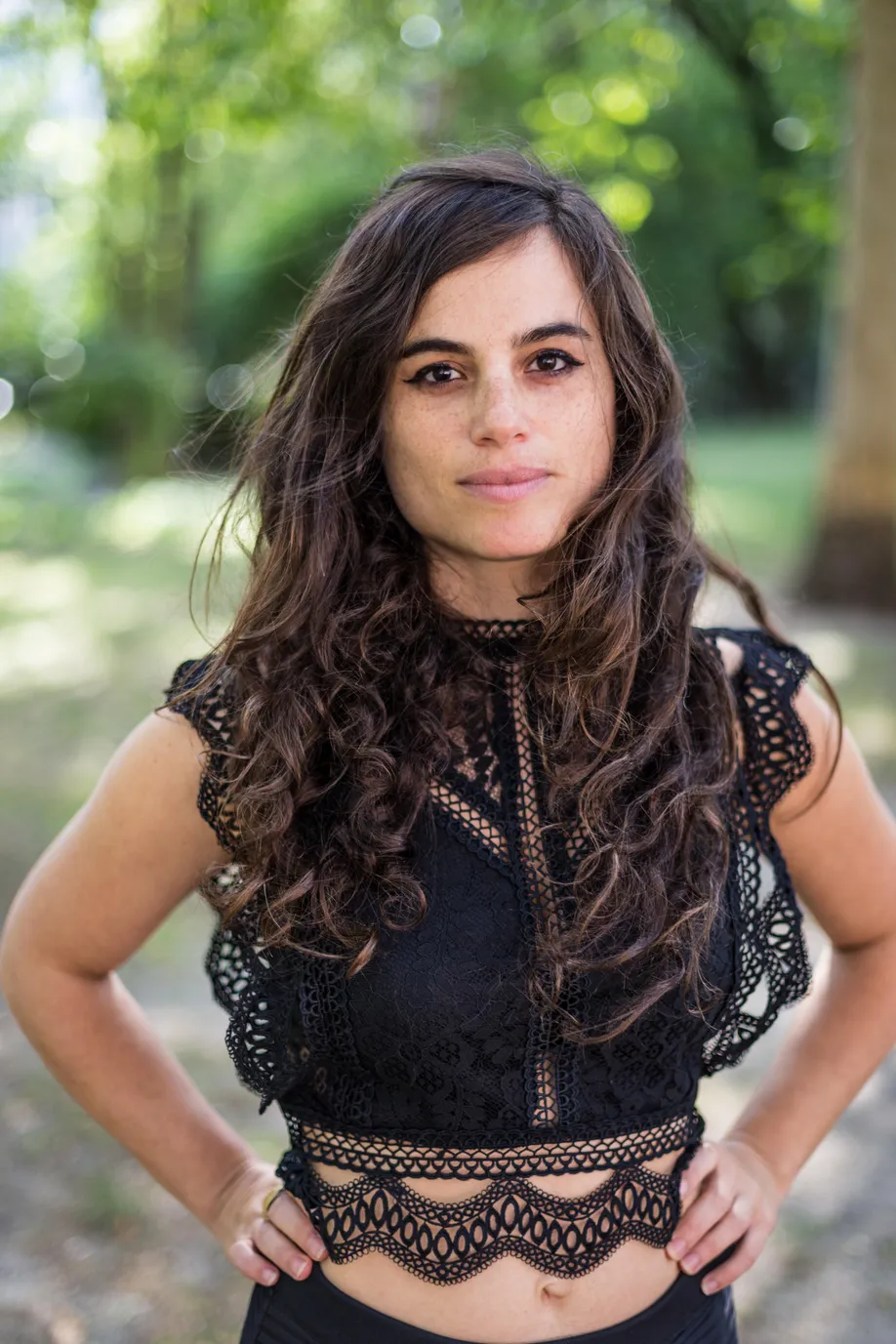
“The restaurant business is not a simple profession anywhere in the world,” she notes. “There’s a shortage of staff, costs are high, profit margins are low and there’s a very small margin for error. But during the coronavirus, for example, I felt the differences. There was a moment every day when I expressed thanks for being in Germany. I was thankful for the speed at which the government authorities worked. Also, the compensation was a reasonable sum and it arrived quickly and without complications.”
Leiderman actually had the best of both worlds. The German setting was more convenient, but the food was from Israel. “My food is Jewish and is inspired by my grandmother,” she explains. “The place that I cook and create from is a place of family, closeness and home. That’s my inspiration. The dishes, for instance, are plates that remind me of the house I grew up in. “The entire motivation,” she continues, “is to give people a sense of home – and as an immigrant, it’s most natural that I give people a sense of my home, of my places. It gives me a lot. That people are eating the same stuffed peppers that my grandmother made gives me a daily emotional connection. I’m creating a small world here with a sense of roots.”
Leiderman says she and other Israelis in Berlin aren’t cut off from their identity and actually connect with their Israeliness on a daily basis. “A lot of people have left Israel, but they don’t have anything against the language or the culture. I didn’t run away. I miss it. My life’s circumstances brought me here. I came as a result of a girl’s ambition to be a dancer. I stayed because life was pleasant and easy. And the fact that I could continue speaking Hebrew, creating the food that I create and maintaining my friends, makes it much easier. I don’t know if I could have stayed if it had been otherwise.”
Leiderman’s Beba restaurant is just one of several Israeli culinary institutions in Berlin. Just a few bus stops to the east is Goldadelux, which actually opened after other restaurants went bust: It was both during the pandemic and because of it. Goldadelux began in January 2021 as one of a series of pop-up restaurants opened by two Israelis, Yuval Tidhar and Avi Levy. Last year it began operating on a permanent basis, and is an anchor and source of solace – particularly during the winter, when the sun sets at 3 P.M. and the temperatures drop below freezing.
“The pandemic was a period of severe isolation for Israelis living in Berlin and for everyone else. We felt depressed too. We wanted the winter and the coronavirus to end,” says Levy, who arrived in the German capital a year before COVID. “This wasn’t our first pop-up, but when we posted [on social media] that we were coming back with another pop-up where this time the focus would be on our sabich [pita stuffed with grilled eggplant, hard-boiled egg and salad], there was particular enthusiasm,” he adds.
Levy and Tidhar describe the weekends that followed as a rare social encounter at a time when that was precisely what was missing. “All of a sudden, you saw a group of dozens of people, most of them speaking Hebrew, but they also brought their friends – Germans and others,” Levy says. “There were encounters, new connections. People broke the law together and didn’t keep a meter and a half apart. It was consoling and it was exactly what we wanted to do: pamper people, feed them, give them what we like.” The business grew. The sabich became their menu’s flagship dish, which quickly began to be served in paper bags decorated by tattoo artist Barak Radovich – who of course is also Israeli. The circle of customers grew. The local media gave the place enthusiastic reviews and, six months after the pop-up era ended, Goldadelux got a permanent location. “Opening a small place like this was a calculated risk,” Tidhar says. “And it was the result of what we went through during the days of the pandemic. Now people of all kinds are coming here: families with children, young people, as well as people 70 and older.”

Complex identities
The Fraenkelufer synagogue is a three-minute walk from Tidhar and Levy’s sabich place in the Kreuzberg neighborhood. It was built in 1916 and partially destroyed on Kristallnacht in 1938. It was also bombed during World War II. In the 1990s, after the Jewish community in the neighborhood had dwindled, activity at the synagogue waned. But about 10 years ago, as Jews – including young people, secular Jews and Israelis – moved into the neighborhood, something began happening in and around it. New connections were forged between German Jews and Israelis, in part through their work in the arts.
This renaissance is thanks to the efforts of Israeli Dekel Peretz, who grew up in an Orthodox home and whose life in Berlin actually began as a form of getting away from his religious background. After completing his army service, he arrived in the city in 2002, straight from Goa after a trip to the Far East.

He married a German woman who converted to Judaism, and they have a child. As part of his wife’s conversion, and because he still wanted to celebrate the Jewish holidays, he started to visit the old synagogue in the neighborhood and became program director for the nonprofit organization that supports it. At first, they organized events for families, Hanukkah celebrations and traditional events that are popular in Israel like the Moroccan-Jewish Mimouna celebration following Passover and Tikkun Shavuot.
But there is now a project in the area that spans the globe. It began in 2016 with celebrations of the synagogue’s centennial, which were organized by Peretz and his wife Nina, who is currently the shul manager. The ties that were established with local politicians led to an initiative to found an adjacent Jewish community center and cultural center. This in turn led, in 2019, to the establishment of a partnership of Jewish social organizations called ERUV, which is headed by Peretz. Another new venture is LABA Berlin, an international project that brings together Jewish artists from Germany and around the world to study Jewish texts for three months, followed by another three months of creating works inspired by their studies. These are then exhibited for a month at the independent CLB Berlin, a gallery also located in Kreuzberg.
“Every year we bring eight artists from all different fields: visual artists, theater artists, writers and musicians,” Peretz says. “The idea is for collaborations to arise that will address the question of Jewish art and also that of the Jewish voice in Germany – a voice that is not confined to issues connected to the Holocaust, antisemitism and the treatment of minorities, but takes in broader social issues as well. Every year, the studies have a different theme. In the last exhibit, which was on the theme of ‘Broken,’ the artists addressed topics like patriarchy, body, gender, disability, family relations and immigration – wider questions that are relevant to German society as a whole but were discussed from a Jewish perspective.”
Last year, half of the participants were Israelis living in Berlin: the writer, poet and translator Tomer Dotan-Dreyfus; painter Roey Victoria Heifetz; performance artist and choreographer Gal Ovadia Naor; and visual artist Ella Ponizovsky Bergelson. However, Peretz says it was not essentially an Israeli experience. He says he and his partners – artistic director Olaf Kühnemann and creative director Rachel Libeskind – are striving to create a meeting place for everyone. “We’re building a Jewish-Berliner center here,” he says. “The Israelis are part of this, but LABA Berlin is first of all a community of artists, and the identities here are more complex than that.”
Which brings us back to your identity. How do you define yourself today?
“I’m a Berliner. I’m building institutions for my daughter and my grandchildren, and for my friends’ children and grandchildren. I’m here to stay.”
And would you say the Israeli community has changed over the course of your time in the city?
“Talk about the ‘Berlin utopia’ was very prevalent a decade ago. There was a lot of talk then about the cost of living and about the escapism of the Israeli left that was fleeing to Berlin. Today, the Israelis here are not a political group, certainly not a homogenous group. A lot has changed in the past 10 years, and it’s a good thing. Jewish Berlin is a more developed place and the Israelis are a heterogenous community composed of people who came here for work, for art, for studies, for anything and everything.
“Even if there is still a ‘Tel Aviv bubble’ in Berlin, it’s only part of the picture – because all types of things are happening in this city. It’s a city of startups; it has a wide variety of cultural offerings; public transportation that functions well; and immigrants from all over the world who together create a cosmopolitan urban life that’s hard to find in Israel.”
A virtual nightclub
Berlin is not Little Tel Aviv, and it certainly doesn’t look like Tel Aviv, particularly in December when a thin layer of snow covers the sidewalks, the subway station entrances and the banks of the Spree River that crosses the city. But in the Neukölln district, the city’s general resemblance to “classical Europe” – with its tidiness and centuries-old architecture – also disappears.
Israelis who came to Berlin 20 years ago or more tried to avoid neighborhoods like this because of their image as hubs for impoverished and hostile Middle Eastern migrants. But that is no longer the case. Kreuzberg and Neukölln are now both known as a home for alternative culture and avant-garde art. And among the first-, second- and third-generation immigrants who still live there, now one also finds many Israelis living and working in an area where Arabic and Turkish are heard just as frequently as German. In this sense, too, this is no Little Tel Aviv. If anything, it is Jaffa.
One such Israeli is DJ and music producer Doron Mastey – better known by his professional moniker, Charly. “It’s not an idyllic utopia,” he says at a Neukölln coffee shop. “There are places where you feel unwanted, but it’s the closest place to Israel you can imagine. I shop at a Palestinian store and there’s a Lebanese shop in the area and Turkish supermarkets too. I feel at home here. I’m basically just a kid from Beit Shemesh who is living here and enjoying life.”
Charly, who comes from a family of Moroccan immigrants and attended boarding school in Jerusalem before serving in the paratroopers, first got into music – especially house and techno – as a kid. After his army service, he met his musical partner, Ori Itshaki, at Tel Aviv’s BPM College for sound and music production, and they forged a successful career together in the city. They also opened nightclubs, worked as DJs, organized parties and founded a pioneering record label.
In 2019, they decided to move to Berlin, which Charly calls the undisputed world capital of electronic music. It is a city where the large number of nightclubs, DJs and music producers creates an atmosphere that attracts young people from around the world who want to be part the club scene. “We were looking for career fulfillment,” he says. “We were frustrated because it was hard to get gigs in Tel Aviv. We had done deejaying gigs in Germany, Poland and Hungary before making the move, but it wasn’t a regular thing. We’re not just DJs. We also produce the music – meaning that we worked all week in the studio and on weekends we deejayed at clubs, so we were more niche than other Israeli DJs who broke the glass ceiling related to Israel. We felt we would be more accessible in Berlin, and it would be good for us.”
But the transition was not easy. Like many young immigrants from around the world, Charly also had to reinvent himself. “No one was waiting for us with flowers at the airport,” he recalls. “In Israel, we were very well known in our scene. Here we had to start from zero. We felt like we were nothing. We rented a rundown little apartment; we slept on mattresses on the floor. There was no living room or dining area. We started out from a dark place, and I felt that salvation was not going to spontaneously present itself. No nightclub was going to suddenly offer us a residence.”
But salvation did arrive, in the form of an Israeli friend who worked in a property management company in Berlin and proposed that they come up with a joint project. In turn, Charly and Itshaki proposed establishing a meeting place for people like them: people new to the city who had yet to integrate and wanted to meet others like them.
The idea was to create a virtual music platform that would enable artists to present an audiovisual taste of what they could do and to introduce them to an audience unfamiliar with their work. The property company’s director liked the idea and offered the use of a space located on the Kreuzberg- Neukölln boundary. He invested the necessary capital and Hör went live in August 2019.
Things were a little rough at first. The two Israelis were not yet well-enough connected to get big names to join their enterprise. But they managed to fill the first two weeks with music and hoped to create that important buzz. “To our surprise, we were able to fill the lineup until the end of the year,” Charly says. “The program exploded. We were in the right place at the right time with the right format. The pandemic period that began a few months into our project gave us an even bigger boost. In our scene, people did not have anything to do when all the clubs were closed. We became everyone’s virtual nightclub.”
Hör now broadcasts on a website, YouTube and Instagram channels that have close to a million users. It is not a purely Israeli project. Although Israeli DJs sometimes appear, Charly and his partners don’t give them special preference. Any affirmative action is devoted to women, the LGBTQ community and to non-whites. “DJs in Berlin have it easier,” he says. “The Israeli scene is a lot more aggressive. There are a small number of clubs and a lot of DJs. You have to really stand out in order to get gigs. And it’s also easier for us in terms of government support. Here it’s a respected profession and the government supports artists. During the pandemic, freelancers in the arts received all kinds of support – including an immediate 5,000-euros grant [$5,370] – without having to show any kind of proof. Health insurance is also 50-percent subsidized, and [there are] pensions for self-employed artists.
“Another thing is that Tel Aviv is squeezing out its cultural institutions. At Alphabet [Charly was one of the club’s founders], we paid 50,000 shekels [$14,400] rent a month for 150 square meters [1,615 square feet]. In Kreuzberg, you pay the equivalent of 8,000 shekels for a commercial space of that size.”
Is the economic side of things what’s keeping you here? Or is Berlin also an inspiration?
“It’s comfortable for me to work here because I need quiet and seclusion in order to create. Here I can earn a living doing what I love and my partner, who is also Israeli, works with me as an art director. I’m still connected to Israel. But anyone who’s here for a long time knows there’s no going back – in terms of the cost of living, and politically too.
“It’s hard to imagine returning to Israel, about working three or four jobs just to get through the month, and living in an environment where violence, hatred, aggressiveness and intolerance are rampant. But whoever says they don’t miss Israel is lying. We all miss it.”



 דיויד סטברו