Since my article about Amnesty and Swedish schools was written and published in Swedish and since the debate with Amnesty Sweden's Secretery Genral in Svenska Dagbladet was also in Swedish, I finally got round to translating the original texts into English so that non-Swedish speakers can see what the all the fuss was about…

When a Jewish woman from Umeå was featured on DN's first page after she decided to leave town, at least one writer, Göran Rosenberg, was critical. The article explained that the woman was leaving because of decades of antisemitic harassment. Still, Rosenberg wasn't impressed. "Today, DN publishes on its entire front page that a woman in Umeå (of Israeli origin) intends to leave the city because of her experiences of antisemitism ", he wrote and added that DN failed to explain the background: "consequently, we are not told that the same woman was very active in supporting Israel in the Gaza war". A couple of days later he explained in Expressen that antisemitism is being used as a political weapon. The woman from Umeå, it seems, had it coming. After all, she's not a "Swedish Jew", rather she's "a woman in Umeå (of Israeli origin)". Rosenberg's message is clear: while Antisemitism against regular Jews like himself, is despicable, Zionists and Israelis just "experience" antisemitism which is actually just good old criticism of Israel, or as Swedes elegantly call it – Israelkritik.
I thought of this when I talked to an organization called "Zikaron" last week. This small but extremely important organization offers lectures on the fates of Holocaust survivors to Swedish schools. The lectures are carried out by young people, grandchildren or great grandchildren of survivors who are taking over the historic burden of remembrance. Naturally, this has nothing to do with Israel. The Holocaust took place before there was an Israel and the victims were not "settler colonialist" or responsible for the "blockade of Gaza". And yet, it turns out that sometimes even the Holocaust is too problematic for some schools. When I talked to one of Zikaron's organizers, she told me that after the massacre of October 7th last year there were about ten schools that cancelled their lectures due to reasons like "wrong timing" or "sensitive timing" and since then, there has been less demand for their lectures. Could this also be "Israelkritik" or is it just that Swedish schools are too scared of upsetting the sensitive souls who find Holocaust education provocative. Or perhaps they don’t want to get in trouble with activist bullies who didn't get the memo saying that it's ok to talk about dead Jews from the 40s and the problem is only with the other kind of Jews, the ones with guns from the Middle-East. Whatever it is, anyone who's worried about Swedish schools being cowards can rest assured. They found their courage elsewhere.
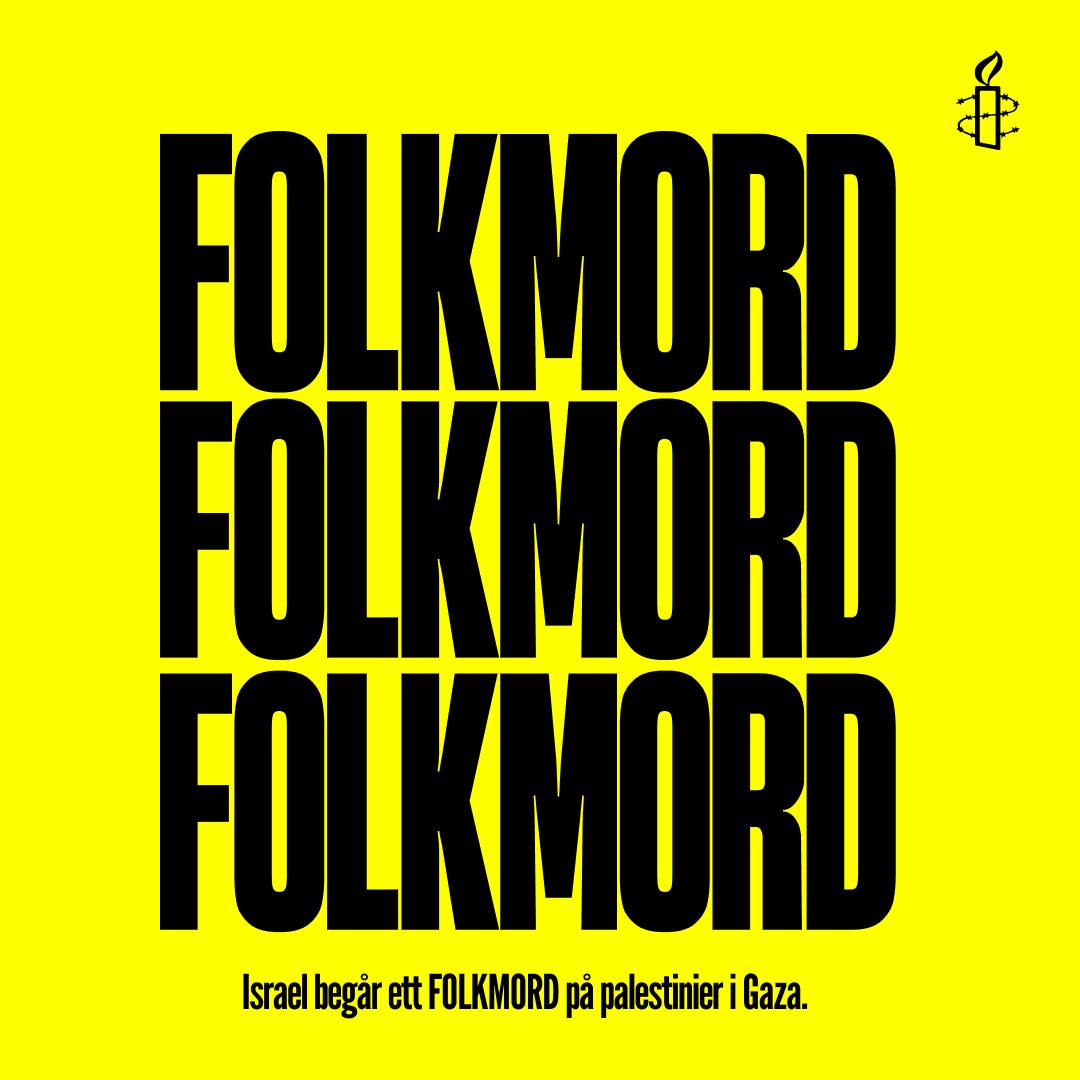
While Holocaust education may be too sensitive, foreign policy political activism seems to be no problem at all. Otherwise, how could 39 Swedish schools be "partner schools (samarbetsskolor)" of Amnesty, a political organization which is as far from mainstream as it gets. These schools use Amnesty's "Schools for Human Rights" model (skola för mänskliga rättigheter) for teacher's education, planning "theme days" (temadagar) and providing material and lectures. They even take part in global campaigns. This model may be great for highlighting human rights and democracy, but there's a serious problem when it comes to the conflict in the Middle-East, since Amnesty is anything but impartial.
In recent years Amnesty International positioned itself clearly as opposed to everything Israeli. It has disproportionately targeted Israel for years, it has supported boycott campaigns and some of its campaigners and partners have supported or even been linked to terror organization and Islamist movements (to name some: Yasmin Hussein, Saleh Hijazi and Moazzam Begg). It almost entirely ignores attacks against Israel and atrocities committed against its civilians, it bases its information about Gaza casualties on Hamas' propaganda and it makes claims which are obviously false like "Israel's military operations in Gaza continue to kill people on a scale that has never been seen before".
But it's not only talk. Amnesty Sweden actively campaigned against policies of the Swedish government, like the decision to pause funding for UNRWA (based on information that some of its employees took part in the October 7th massacre) and the decision to stop funding Swedish Ibn Rushd study circle (after accusations that the organization has ties to the Muslim Brotherhood and spreads antisemitism). In fact, whoever wants an idea of what Amnesty really supports can take a look at the kind of people it awards its prizes to. Elin Forghani, a Vänsterpartiet activist from Östersund just won Amnesty's new "Noismaker" prize after publicly claiming that: "Israel is a colonial project and an outpost of the West in the Middle East and always has been". And just to make clear what should be done with the colonizers she wrote: "we can make Israel and their sponsors sweat, tremble and fall. Liberation is in sight".
Naturally, in a democracy political activism is more than legitimate. However, it's also clear that Amnesty is in no way neutral or objective. It's a political player in global geo-politics, but it's still marching into Swedish schools, presenting itself as a non-biased public informer and bearer of a universal truth. Although political parties and organizations are allowed in Swedish schools and naturally Democracy and human rights should be part of their education, this isn't a case of mainstream education. Amnesty is getting a special "partner" status as a long-term official partner while other political actors are just guests, implying that Amnesty represents facts while the others represent opinions.
It's unclear why Swedish schools should be discussing the war in Gaza in the first place, but if they must, the material should be written and supervised carefully by serious state actors. This isn’t the place to start outsourcing. I spoke to a few parents and students in a Stockholm high school. They told me about their complaints to the school management regarding Amnesty's Gaza war education material and about lessons using material from Globalis, an organization run by "Svenska FN-förbundet" an organization which claims to "work for a better and stronger UN ". The UN in the title shouldn't be confused with impartiality. When I spoke to one student, he told me that since the lessons about the Israeli-Palestinian conflict started "it feels like I have to go to school to defend Israel twice a week. It's not that the teacher lies but it's so one-sided. For example, there were two lessons about the Palestinian Nakba and only half a slide about the expulsion of Jews from Arab countries and Iran and even that, according to the teacher, could be understood as a result of "Mossad activity". When the students were given texts on the subject, they were given guiding questions like: "what support is there for the claim that Israel is an apartheid state?". Student I spoke to talked about feeling very uncomfortable and worried about their classmates. "I feel I have to give the other side", one of them said, "because the other students in the class don't know the whole picture".
In an incident in another school, UN day was celebrated in the schoolyard by waving flags of different countries. According to one of the teachers, when some angry spectators who were passing by threatened to enter the school and remove the Israeli flag, the reaction wasn’t standing up to the threatening bullies and informing the police. Instead, the flag was removed and the person waving it was asked not to wave it again.
It seems that our schools are becoming a ridiculous case of Dr. Jackyle and Mr. Hyde. On one hand, they're wannabe rebels, dealing with the world's most complicated conflicts by employing radical political activists, while on the other hand, they're so afraid of controversy and conflict that they can't even wave a flag of a UN member country or talk about the Holocaust.
It's true, only a few schools cancelled Holocaust lectures and only some are Amnesty partners. But it's also true that only some pro-Palestinian demonstrators support violence (which is what shouting "Intifada!" means), only part of vänsterpartiet supports the PFLP and only a handful burned an Israeli flag outside a synagogue. Not to mention that just several thousand attended a Hamas conference in Malmö, and only a few hundred contribute to Islamist, antisemitic movements, and only one Imam praised Hezbollah's leader and only one or two artist spread antisemitic conspiracy theories, and only a small minority screamed at Holocaust survivors entering a memorial ceremony. How many minorities will it take to get the message? and when will our schools become part of the solution instead of part of the problem.
Amnesty Sweden's comment (originally in Swedish):
Our schoolwork is based on international conventions and Swedish school's governing documents.
On December 10th, 1948, the newly formed UN adopted the Universal Declaration of Human Rights. For the first time, the world had an agreement that viewed all people as free and equal, regardless of gender, skin color, religion or other beliefs or characteristics.
In 2011, knowledge of human rights was incorporated into the Swedish curriculum. Since 2012, Amnesty has been supporting upper secondary schools with teaching materials, lectures, and a model for working with human rights, based on both international conventions and Sweden's school governing documents.
David Stavrou, guest columnist for Svenska Dagbladet, criticizes Amnesty for supporting upper secondary schools in their work on human rights education, by making directly false accusations about Amnesty as an organization and our work. But these claims are easy to refute: No, Amnesty does not support the call for a boycott of Israel. Yes, Amnesty has condemned attacks on civilian Israelis and called for those responsible for these war crimes to be held accountable. No, our teaching materials and lectures are not about Israel and Palestine.
David Stavrou claims that we are a biased organization and that our criticism of Israel is disproportionate. This is a direct false statement that is often made by representatives of the Israeli government. Amnesty is an impartial, politically independent organization. We do not accept government funds because we want to be free to investigate human rights violations without being dependent on anyone. Our demands and criticisms are based on international law and respect for human rights. And we assess all states by the same standards.
Even though our lectures in high schools this fall did not address the war in Gaza, high school students have asked many questions about the situation in Gaza. Human rights, contrary to what David Stavrou suggests, apply both in times of peace and in conflicts. Amnesty's focus in all conflicts is the protection of civilians and their human rights.
Amnesty is not alone in criticizing Israel's indiscriminate attacks on civilians, the forced displacement of Palestinian civilians, and the denial of humanitarian aid into Gaza, three clear examples of violations of the laws of war. Knowledge of human rights is necessary. We are happy to contribute to helping upper secondary schools fulfill the curriculum, providing students with more knowledge and the conditions to protect their own rights and work to ensure that others' rights are respected, both now and in the future.
Anna Johansson, Secretary General, Amnesty International Sweden.
David Stavrou's reply:
It’s great that Amnesty Sweden takes texts which are published in Svenska Dagbladet seriously. However, it’s a bit surprising because, during the process of writing the article, I contacted their press service to ask questions that had arisen after conversations with students at their partner schools. No one responded. To avoid mistakes, I wrote again, but I was ignored once more. On the other hand, Amnesty’s response suggests it might not matter – it’s filled with answers to questions no one asked and avoids addressing the questions that were actually raised.
No one suggested that schools shouldn’t teach human rights and democracy. No one asked whether human rights are important during wartime. Even if one appreciates the Secretary General of Amnesty’s inspiring words, that wasn’t at all what the article was about. Everyone knows human rights are important. The question is whether her organization is qualified to be the one teaching our children about them.
One question that goes unanswered, however, in the one addressing Amnesty’s partners abroad that have had connections to terrorist organizations and Islamist movements. Perhaps it’s because she is aware of the collaboration with Moazzam Begg, for example. Begg, a former Guantanamo detainee, was invited to Sweden by Amnesty despite having supported the Taliban. This isn’t something I’m claiming – it’s what a senior official within Amnesty in London, Gita Sahgal, said. She argued that collaboration with "Britain’s most famous Taliban supporter" and links to groups promoting Islamic right-wing ideas damage Amnesty’s integrity and pose a threat to human rights. Amnesty’s reaction – she was dismissed.
Then there’s the claim that Amnesty doesn’t support a boycott of Israel. If that’s the case, why did Amnesty’s Regional Director for the Middle East and North Africa write the following: "We urge the international community to cease all forms of support – whether direct or indirect, through actions or omissions – for Israel’s apartheid system"? (Direct quote from Amnesty’s website).
As for Amnesty having condemned attacks on Israeli civilians, it is true that they’ve done so on certain occasions. After October 7th, it would have been absurd if they hadn’t. But anyone familiar with Amnesty’s publications knows that the Secretary General’s statement is misleading. During September and October, Amnesty International published 14 texts on their website criticizing Israel. That’s as many as the texts about Syria, Afghanistan, and Iraq – combined. Iran received seven texts during the same period, Sudan and South Sudan six in total, and Belarus only four. During these two months, 7,517 rockets were fired at Israel. Amnesty published nothing about these attacks, which kill and injure and have forced over 140,000 Israeli citizens to live as internally displaced persons for more than a year.
"We assess all states by the same standards," writes Amnesty’s Secretary General. That’s hard to believe when reading about their "regional activist seminars" in Stockholm and Malmö in November. The program begins with "Palestine then and now" and continues with "a deeper understanding of the Palestine issue through a Palestinian perspective." Then there’s a lecture on the Palestine groups in Malmö, followed by "panel discussion: Academics for Palestine." Later in the day, there’s "panel discussion: on Palestine, struggle, and conflict." It seems like the Rohingyas, Uighurs, the Belarusian opposition, and Tigrayans from Ethiopia will have to wait for the next seminar because the next workshop is "What can I do? A guide to action for Palestinian liberation." This is organized by, drumroll, BDS Sweden. Yes, BDS – Boycott, Divestment, and Sanction (remember the Secretary General’s statement: "But these claims are easy to refute: No, Amnesty does not support the call for a boycott of Israel." Does she think we can’t read?).
None of the speakers at the seminar are pro-Israel; instead, it’s full of well-known pro-Palestinian activists. And that’s entirely okay. The Svenska Dagbladet article wasn’t about whether Amnesty is right or wrong or about their right to be pro-Palestinian. It was about impartiality. I wonder if any of the young people who participated in the activist seminar are students from one of Amnesty’s 39 partner schools. I suggest that Sweden’s school principals take what the Secretary General wrote seriously. When she writes that she’s glad to "give students more knowledge," it becomes clear that their schools are her recruitment ground.
 דיויד סטברו