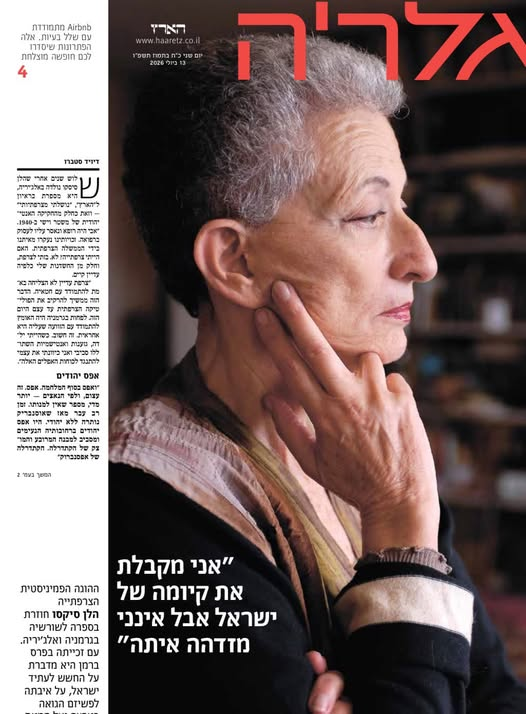
Hélène Cixous: ‘I Accept Israel’s Existence, but I Don’t Identify With It’

The pioneering French feminist thinker returns to her family’s roots in Germany and Algeria in her Berman Prize-winning book. In an interview with Haaretz, she discusses Netanyahu’s government and why she still wants Israel to survive.

Published in Haaretz: Hélène Cixous: 'I Accept Israel's Existence, but I Don't Identify With It' – Art & Culture

Three years after Hélène Cixous was born in Algeria, she recounts in an interview with Haaretz, “I was dispossessed of my Frenchness” as part of the anti-Jewish legislation of the Vichy regime in 1940. “My father was a doctor and was forbidden to practice medicine. Our rights were stripped from us by the French government. Was I French? No. I despised France, and some of my suspicion toward it still exists.

“France has still not truly managed to confront its sins. This continues to rot French politics to this day. At least Germany had the courage to confront the horror for which it was responsible. That is important. When I was a child, racism and antisemitism raged around me, and I directed myself to oppose these dark forces.”

Zero Jews

“And zero at the end of the war. Zero, that’s enormous, and according to the Nazis, too much, an innumerable number… It had been a long time since Osnabrück was without a Jew, there were zero Jews in the charming streets and around the solid, square body of the cathedral of Zerosnabrück”.

This passage from Hélène Cixous’s book Osnabrück Station to Jerusalem captures the essence of her latest work. Part memoir, part family history, the book combines the great Jewish tragedy with philosophical reflections on Jewish existence.

As is her custom, Cixous employs her creative powers in writing not only in relation to her characters but also toward language itself. Osnabrück, the German city from which her mother’s family originated, becomes “Zerosnabrück” after it is emptied of its Jews. In 1934, 435 Jews lived there, Cixous writes; after the war, the number was zero.

Both historically and magically, the city is linked to Jerusalem: both become landscapes of memory and longing, both are inhabited by the living and the dead and stand at the center of the attempt to understand what it means to be Jewish when one’s world is shaped by displacement, catastrophe and the search for a home.

Osnabrück acquires an almost mythical status throughout the book. For Cixous, it is not just “Zerosnabrück”; it is also “the Paris of Lower Saxony.” Like Jerusalem, it is both real and a surreal dream where living characters meet the dead, and where the book itself becomes a character and speaks with its author. All of this occurs across timelines and locations that jump between the Holocaust in Europe and Algeria and the Middle East, incorporating biblical references, Greek mythology, European classics and Shakespearean tragedy.

All of this greatly resonated with the Swedish Berman Prize for Literature committee, which selected Cixous and her book – published in French in 2016 and in English in 2020, and not yet translated into Hebrew – as the 2026 prize winner. The award ceremony will take place in October. It is one of the most prestigious literary prizes, including a cash award of one million Swedish kronor, approximately 320,000 shekels, and is awarded to writers whose work illuminates Jewish life while also addressing universal human questions.

The prize was founded in 2020 by Swedish philanthropists Thomas and Catharina Berman, through a private donation intended to support Jewish culture and strengthen Jewish literary tradition. Thomas Berman said that the rise in antisemitism was one of the reasons for establishing the prize.

The first recipient was David Grossman, for his body of work, and other recipients include Hungarian author Péter Nádas, Russian-Jewish author, poet and journalist Maria Stepanova, and Jewish-Guatemalan author Eduardo Halfon. This year, the prize committee praised Osnabrück Station to Jerusalem, describing it as a work that “traces the void left by the displaced, maps absence and gives voice to those who can no longer speak.”
A Wonderful, Mysterious Place

“Osnabrück is like Jerusalem: one must go there, one must present oneself before its faces, one must let it speak and advance toward its language as before the monster Behemoth about which God boasts to Job, one must touch it with one’s fingers, one’s feet; one cannot know it from a distance. It’s like the sea: even from two yards away one doesn’t know it, one must throw oneself into its arms yelling.”

Cixous was born in Oran, Algeria, in 1937 to a German-Jewish mother who was a midwife and a Sephardi-Jewish father. For more than six decades, she has addressed questions of identity, language and memory. She is best known as the author of the essay The Laugh of the Medusa (1975), one of the foundational texts in modern feminist literary theory, which established her status as an influential thinker and one of the mothers of post-structuralist feminism.

Cixous worked closely with Jacques Derrida, who referred to her as “the greatest living writer in our language.” In her early 30s, in 1968, she participated in the Paris student revolt and in the founding of Paris 8 University, an institution intended to serve as an alternative to the traditional French academic environment. In 1974, the university became home to a center for women’s studies founded by Cixous, the first of its kind in Europe. She also maintained a lifelong interest in questions concerning her Jewish history. These questions are at the heart of Osnabrück Station to Jerusalem.

Is her book intended to give voice to those who can no longer speak? “When I write, it’s not I who has intentions, it’s the book,” she replies. “The book has its urgency and it doesn’t aim at this or that consideration. It’s true that it gives a voice to the void, like everything else that has been written, because of the huge field of tragic events. But writing is always giving a voice.

“In this case, it’s all somehow in the title, it’s a singular experience, of my relation to history, to politics, to tragedy. The voice of my writing is a mixture of tragedy and comedy and my material is partly autobiographical, partly theater and the obsession that led me to the book was going to Osnabrück.”

The obsession she describes is preservation through family dialogue, fantasy and therapy. Throughout Osnabrück Station to Jerusalem, the dead refuse to disappear, and the book seems full of ghosts – mothers, grandmothers, murdered relatives and those born long after the war, vanished neighbors and destroyed communities. All reappear in dreams, conversations, fragments of language and works of art. The living and the dead merge into one another. The visit to Osnabrück thus becomes not only a journey to a specific place but an encounter with the voices of a lost world.

The city that gives the book its title occupies a remarkable place in Cixous’s imagination. “It’s a place that no one knows. Even the Germans don’t know it,” she says, “but it’s a historic city, one of the two where the Treaty of Westphalia was signed in 1648, ending the Thirty Years’ War. It’s a wonderful, mysterious, fantastic place which fascinated me as a child. I was born to a mother who came from Osnabrück and lived in Oran, an Algerian city which was then part of a French colony. I saw Osnabrück as kind of a light in the distance, just like Jerusalem is seen by so many people.”

She recalls visiting Germany repeatedly with her mother and grandmother while carefully avoiding the city itself. “We went to Berlin, to Cologne, to Bonn, but never Osnabrück. It became something I wondered about – what’s wrong with Osnabrück? Why do we never go there?” She remembers how an official invitation from the city itself arrived for her mother and aunt to come back to the city for a visit. A discussion then began between the two women, which started as a conversation about hotels but became an argument about history and forgiveness.

Eventually, her mother decided to go. “This generation is not our enemy,” Cixous recalls her mother saying. “We don’t have to forgive them. We have to go on and accept the reality of history”. Years later, when Cixous suggested to her mother that they return to Algeria together, her mother refused, explaining: “In Germany, they invited me and asked me for forgiveness. In Algeria, I was kicked out after helping thousands of Algerians come into this world as a midwife.” Only after her mother’s death at the age of 103 did Cixous herself finally travel to Osnabrück.

Since then, she says, she has become “a kind of honorary citizen” there. When she spoke there, she reminded the city’s residents that peace itself can never be taken for granted, and that her own presence is conditional. “If in twenty years you become Nazi, as it sometimes happens,” she said, “it won’t be possible.” This remark captures the central tension in her book: the best and worst possibilities remain simultaneously present.

Does the book represent a return to Jewish roots after decades primarily spent on gender and feminist theory?

“Things are not that simple. The Jewish theme has always been there in a way,” she says and adds, smiling, that “I have a history in resisting the forces of evil. I grew up in colonial Algeria in a family opposed to racism and colonialism, while simultaneously becoming victims of antisemitism. I have, of course, always been on the side of the colonized.

“This wasn’t easy in Algeria where the colonizers were French. I hated the French since I was born. My family was in a situation of being part of a small minority of those who were strictly hostile to racism and colonialism. But this was not perceived in Algeria. From their perspective, we were supposed to be French.

“Later, when I was 18, I arrived in France, and I became ‘re-Frenched,’ although I doubt if one can really become re-Frenched and the truth is that I feel like I never really arrived in France. Then the social and political landscape changed, it was totally foreign, and gradually in two or three years, I started to think that antisemitism isn’t the question any more. On the other hand, I got this horrible feeling that they hate women here".

“It wasn’t an issue of class – it was men against women. Everywhere in society. The urgent fight wasn’t for Jews; it was for women. This is a fight of thousands of years. It’s still that way and it will go on. But every now and then, there’s another cause that becomes the main one for a specific period, and you have to decide, like a general of an army, where your forces are most needed. In the last few years, for example, it happened with Ukraine. And then Israel and Gaza came back again. Sometimes, you need to divide your strength.”

Hesitation Is Food for Fascism

“I can be many things, but being Jewish is always there,” Cixous says. She explains that she can easily make peace with her identity as a woman. “It may be divided into all kinds of tendencies but it’s basic, it’s primitive.” Her Jewish identity and her relation to Zionism and Israel is a different matter.

“It goes back to my mother,” she says. “She grew up in the days of a ‘beautiful Zionism’ – the dreams of young socialist Jews. But she resisted because of her story, which was against anything nationalist. Her father was enrolled in the German army and was killed as a German Jew, and so her way of looking at history was very rational.

“I was a girl when Israel was created, and I saw in Algiers the first emissaries trying to get Jews to go to Israel. I was prudent to that. I immediately thought that I wasn’t going to feel at home with a movement that unfraternally became colonialist. It was unavoidable. So, of course, I understand the creation of Israel, of course I was moved by it. But it couldn’t escape colonialism. “I came from a country where the Arabs were colonized. So, I just watched Israel. I never thought that belonging to what they called ‘the Diaspora,’ which we’re not, is negative. It is a way of being a citizen of the universe. My mother went to Israel to visit the part of her family that moved there. I refrained from doing that. I thought that I shouldn’t go if I don’t identify with Israel. I didn’t want to just be an observer. I like to be involved.”

Couldn’t what you call colonialism also be understood as Jews returning to their homeland?

“I could understand that the emissaries thought that they are returning to their homeland. I could also understand those like the members of my family who escaped the destruction of the Holocaust to Palestine which later became Israel. But for me, this wasn’t the only way. I thought we could be free and choose, and we had many ways to react to these terrible events. I accept Israel, but don’t identify with it. And this is the case for many people”.

Cixous’s attitude to Israel is complex. She doesn’t accept Jewish nationalism, but also doesn’t deny the tragic dimension of Jewish history and the antisemitism that led to Zionism and the establishment of the Jewish state. She is also well aware of how people react to disasters, and in this case, it is a central part of the story of the exodus from Europe and the establishment of Israel.

One of the most powerful themes in your book is the inability to recognize an approaching disaster – as happened in Osnabrück with the rise of the Nazis. How can this be understood?

“The hesitation when a radical change in one’s life is involved is common. In our days this mechanism of the human psyche is obvious when we’re facing the possibility that extreme right fascism will win the presidential elections in France. France is a very political place so everywhere I see people talking to each other about our next elections saying things like ‘next year in hell.’ They discuss what they will do on election day. Some say it’s not going to happen, others say it will happen if we don’t unite. All these discussions are taking place everywhere, and you can see the human soul hesitating”. For her, this hesitation is dangerous. “It’s the food for fascism,” she says.

The contrast within her own family remains instructive. “My grandmother stayed and didn’t leave Osnabrück until after Kristallnacht. My mother, who was a young woman, left the moment she smelled the stink of fascism. She never hesitated.” Other family members perished.

In Israel’s current war, there is a place where gender, sexual violence, and Middle Eastern politics collide in a tragic way: the sexual violence committed during the Hamas attacks of October 7. Many Israelis felt deeply alienated and outraged by the way parts of the international feminist movement appeared unwilling to express sympathy for Jewish victims. What do you think about this?

“This is a monstrous event. It will remain in history and the consequences go deeper and further than can be imagined. To the horror of my kind of people, it divided even the feminists. There was something hideous about the fact that when French Jews reacted passionately to that horrible event, some parts of the French feminist movement were so anti-Israeli and pro-Palestinian that they had no sympathy for the Jewish women who were affected.”

Cixous described this as a moral failure. “These are the perversions of the way people identify with one cause and exclude others. It’s horrible.” Her own position, she says, was unequivocal. “For me, of course, there were no hesitations. This was a terrible crime. Hamas is a cruel, hateful movement like many other movements in the Arab world. The whole world is a victim of Hamas. But now, so many people, countries and movements are also victims to the blindness and craziness of the Netanyahu government.

“The time has come, and it came a long time ago, to stop being colonial and accept the fact that others also have rights. History has decided that this piece of the planet Earth should be shared by Jews and Palestinians.” She worries that Israel is exhausting reservoirs of international goodwill built over generations. “They’re self-destructing and they’re destroying the capital, the inheritance of sympathy and understanding from others.”

This is criticism stemming from concern rather than detachment. “I would like Israel to survive,” she concludes, “but it’s alienating the countries that support it. It’s tragic”.

For Cixous, Israel is not only its politics; it is also the story of exile and migration. “Each migration has its own structure. It requires such courage. It requires giving up and starting again. That’s one of the reasons that I understand the creation of Israel, and literature gives these experiences their deepest human meaning. I really admire Israeli literature which deals with this and the great writers who give these events their deep humanity.” When asked for examples, Cixous says that she loves the works of Aharon Appelfeld and enormously admires David Grossman.

The Gatekeepers

Toward the end of the interview, Cixous reflects on the present moment. “Very often I think that what is happening now, I have already lived through as a young girl, in the 1930s,” she says, but adds that history never repeats itself exactly. “Obviously, technology, the fact that we may be dispossessed by ourselves with AI, is unimaginable. We – who read, who still want to think, the guardians of art – we have to strengthen that part of mankind. Whenever a European country goes the way that Hitler’s Germany went, it contaminates everything, it becomes possible, it seduces other countries. We can be thrown into a period like the one of the plague.

“People keep saying that Europe is weak, divided and ungenerous. That’s why Europe needs to have an army. In the past, it went against its humanistic principles, but this pacifism doesn’t work. It’s not enough to just be on the side of peace and diplomacy. No, when arms are used, you have to resist with arms.”

And beside an army, what’s the role of public intellectuals in such times?

“The concept of public intellectuals is a recent invention. It started with the Dreyfus affair – and it’s extinct. There are no important public intellectuals. There may be media intellectuals. It doesn’t mean that it won’t happen again. I don’t know. Something may come back, but these wonderful moments of light, like the one in 1968, are extinct.”

Cixous’s concern about recurring patterns of extremism and hatred, and the temptation to underestimate danger, runs like a thread throughout Osnabrück Station to Jerusalem, which deals with how people remember and how they forget. The Berman Prize jury praised the book for giving voice to the silenced. In fact, it does more than that. It revives lost worlds – like those of Osnabrück and Jerusalem. In doing so, Cixous poses a long series of questions about memory, reality, exile and belonging. Most remain open. At 89, she offers no definitive answers.
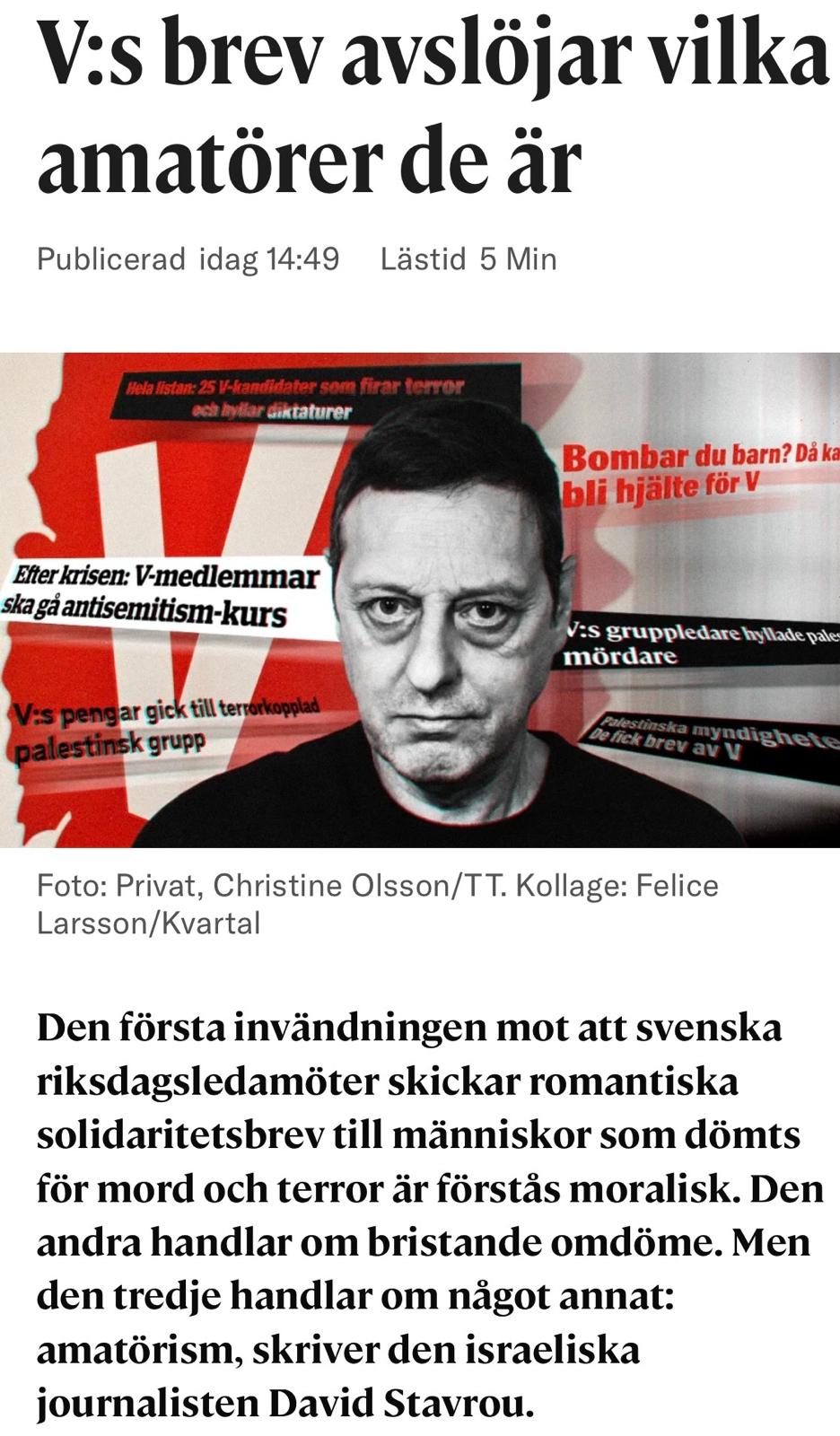
The Swedish Left Party’s letters reveal what amateurs they are

The first objection to Swedish MPs sending romantic letters of solidarity to people convicted of murder and terrorism is, of course, a moral one. The second concerns poor judgment. But the third is about something else: amateurism, writes Israeli journalist David Stavrou.

Published in Swedish in Kvartal: V:s brev avslöjar vilka amatörer de är – Kvartal

In the space of just a few days, journalists Sofie Löwenmark, Nathalie Rothschild and Inas Hamdan published investigations showing how members of the Swedish parliament had sent letters of solidarity to Palestinian prisoners convicted of very serious terrorism offenses and had participated in an organized campaign in which several of the recipients are serving life sentences for attacks against civilians.

In 2023, SVT revealed that aid money from the Left Party’s international organization had gone to a project with links to the DFLP, an organization that participated in the October 7 massacre. The following year, prominent Left Party figure Kristofer Lundberg was expelled after expressing support for the terrorist-designated PFLP. In Malmö, Orwa Kadoura left the party following criticism over antisemitic messages. In 2025, MP Lorena Delgado Varas shared a classic antisemitic conspiracy image, and as recently as June this year, the Left Party removed a large number of candidates who had praised Hamas’s October 7 attack, spread Holocaust denial and promoted antisemitic conspiracy theories.

All of this is, of course, serious. By now, it is clear that the Left Party has a problem with romanticizing terrorism and spreading antisemitism and conspiracy theories. This can no longer be dismissed as anecdotal. Every time you think rock bottom has been reached, another investigation appears with new revelations. But precisely for that reason, it is almost no longer interesting to discuss this as a question of values. Left Party members are free to believe whatever they want. The truly interesting issue is something else.

Politics is not merely an ideological arena. Politics is a profession. There are laws, practices, institutions and rules of the game. And then there is what in British politics is sometimes described as simply not done – things that may not actually be prohibited but that politicians nevertheless know not to do. It is like any other profession. Surgeons do not operate on gut feeling. Judges do not rule according to whom they instinctively like best. Even a passionate politician is expected to be able to control that passion long enough to do the job.

The first objection to Swedish MPs sending romantic letters of solidarity to people convicted of murder and terrorism is, of course, a moral one. The second concerns poor judgment. But the third is about something else: amateurism.

The Left Party’s explanation in the latest affair illustrates the problem. The party secretary has said that the names came from the Palestinian Association of Sweden and that the Left Party carried out no checks of its own. “There had been a mistake in the fact-checking,” MP Ilona Szatmári Waldau wrote. Nooshi Dadgostar has repeatedly resorted to variations of the same defense during the scandals of recent years. In June, she referred to the large number of Left Party representatives – more than 4,000 – and stressed that those exposed represented only a small proportion. She then said that “there are occasions when people turn up whom you haven’t kept track of.” She promised to tighten the party’s procedures, but that is clearly an almost impossible task, since many other Left Party members defend people who have expressed support for terrorist organizations.

If a blue-haired 17-year-old activist sends a love letter to an ideologically motivated murderer he saw on TikTok, perhaps he can get away with shrugging his shoulders or shouting along with Rage Against the Machine: “Fuck you, I won’t do what you tell me!” But members of parliament are not teenagers. They are adults, and adults are expected to evaluate their sources critically and ask questions. What does it look like when we become fixated on prisoners from a single international conflict while ignoring others? What diplomatic, trade-policy and security-policy consequences could our statements have? Which people and organizations are we legitimizing?

Is that boring? Does it involve compromise? Perhaps even moral coruption? Perhaps – if you live in a syndicalist collective, eat out of tin cans beneath posters of “freedom fighters” and say that “when the forest is felled, the chips will fly”. But the Left Party’s MPs are well-paid public officials who participate in – and enjoy all the privileges and perks that come with – professional politics.

That means it is part of the job to investigate the people and organizations you cooperate with, read court judgments, speak to embassies, diplomats, experts and lawyers, ask what is disputed and what has been established, and understand the consequences of your own symbolic politics. For example, when a professional politician becomes involved in another country’s prison system by writing a letter, they must understand how the people they are writing to are perceived by their victims, as well as understand another society’s sensitivities and collective trauma.

To a Swede, Ahmad al-Moghrabi or Ibrahim Abu Mokh may be unfamiliar names on a list of “Palestinian prisoners.” To an Israeli, those same names may signify deadly suicide attacks against civilians, murdered children or a young conscript who was kidnapped on his way home and never returned. You do not have to accept Israel’s policies in the West Bank or agree with the Israeli courts. You only need to be able to imagine the reverse situation. Imagine if foreign parliamentarians wrote to Jackie Arklöv and praised his “courage and perseverance” without checking the judgment against him. The first Swedish response wouldn't be a complex debate about Scandinavian geo-politics, it would be: Have you even bothered to find out who this person is?

This kind of disregard for the rules of politics – in which passionate conviction is allowed to cloud judgment and consequences and basic due diligence are ignored – has a name. It is called populism.

For many years, the Sweden Democrats have struggled with a similar transition – from a protest movement to a party with influence over the state. As part of that process, the party has run internal training programs under the title The Road to Power (Vägen till makten), although there is, of course, no reason to romanticize the results. SD continues to be plagued by recurring scandals. A training course cannot magically erase a political culture.

And this is where the parallel with the Left Party becomes even more uncomfortable. V has already tried the educational route. Following several antisemitism scandals, in the spring of 2025 the party invited its members to a two-hour training session on antisemitism. Every member received an invitation. Yet one year later, the party found itself with 25 candidates removed from its lists following revelations involving, among other things, precisely antisemitism. As the Swedish elections draw closer, the party is finding it increasingly difficult to convince voters that sympathy for terrorists, conspiracy theories and antisemitism among its politicians and activists is a bug. In its case, it seems much more like a feature.


Norwegian Holocaust Center Events on Nakba and Gaza War Draw Ire From Israeli Embassy

Israel's embassy in Norway condemned the events organized by the Norwegian Holocaust Center in Oslo, saying they 'legitimize antisemitism.' The center said the aim is to 'understand shadows of historical traumas without equating them'

Published in Haaretz: Norwegian Holocaust Center Events on Nakba, Gaza War Draw Ire From Israeli Embassy – Jewish World

Israel's Embassy in Norway called for an independent Holocaust studies center in Oslo to cancel two upcoming events that it claims are a "grotesque distortion of Holocaust memory."

As part of a lecture series titled "In Shadow of War – The Way Forward," the Norwegian Center for Holocaust Studies and Religious Minorities is hosting two events with the University of Oslo this spring. The first event, which took place on Thursday, was a lecture by Prof. Nadim Khoury titled "Nakba and Holocaust as cultural traumas."

According to the University of Oslo's website ahead of the event, Khoury – a Palestinian professor of international studies at the Innland Norway University of Applied Sciences – "will trace their trajectories since 1948 and explore how they are intertwined and how the tensions between them are shaping the path forward in Israeli and Palestinian lives."

A second event, scheduled for June 3, will feature Israeli historian and Brown University professor Omer Bartov, whose contributions to Holocaust scholarship were recognized by Yad Vashem in 2019.

In an April 28 X post, Israel's embassy in Norway called on the HL Center to cancel the events "immediately."

"The Norwegian Holocaust Center's decision to host events drawing parallels between the Holocaust, the 'Nakba' and the war in Gaza is a grotesque distortion of Holocaust memory," the post read. The embassy added that the center has chosen political activism over historical responsibility and it called upon it to cancel the events and stop "legitimizing antisemitism in its modern forms."

Addressing the criticism in a social media post, the HL Center explained that it invited academics from different environments and backgrounds as speakers in order to "address and reflect on challenging topics without ending up in polarized debates where constructive nuance tends to disappear."

HL Center director Jan Heiret told Haaretz that the event with Khoury was supposed to follow another event hosting Martin Auerbach, former director of the National Israeli Center for Psychosocial Support of Survivors of the Holocaust and the Second Generation (AMCHA). Auerbach couldn't come due to uncertainty around the ongoing conflict with Iran, but Heiret said the center will make another attempt to host him in the autumn.

Heiret added that both events are meant "to find a way out of a destructive spiral of hatred, dehumanization and violence."

"We must understand the long-lasting shadows of historical traumas without equating, or even putting up, the Holocaust with the Nakba – which would be a historical distortion given the events are so different in nature, course and scope," Heiret said. "We acknowledge that the consequences for the individuals and collectives traumatized by them are interconnected, and that the denial of the trauma of the other lies at the core of the dynamics of the Israeli-Palestinian conflict."

Leif Knutsen, an activist and the chair of the Jewish Community of Norway, says the academics invited to speak at the HL Center "represent a fringe element," and that it's a recurring issue.

"The center doesn't question them; it doesn't bring anyone to balance the discussion and it doesn't present their perspectives in anything like a critical light," Knutsen said. "It's always in the same direction – one that's beyond critical to Israel. Someone should be sitting on stage and presenting an alternative point of view or at least a nuanced one."

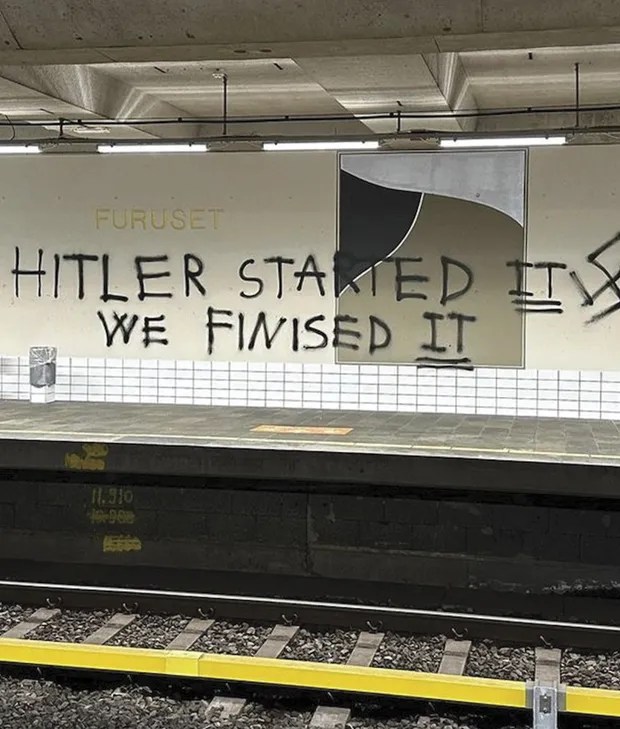
Knutsen said Norway's Jewish population of about 2,000 is particularly vulnerable due to a sharp rise in antisemitic attitudes. In its most recent report published in early 2024, the Norwegian Center for Holocaust and Minority Studies documented an increase in antisemitic attitudes among Norwegians, with 11.5 percent of survey respondents having "pronounced prejudices" against Jews.

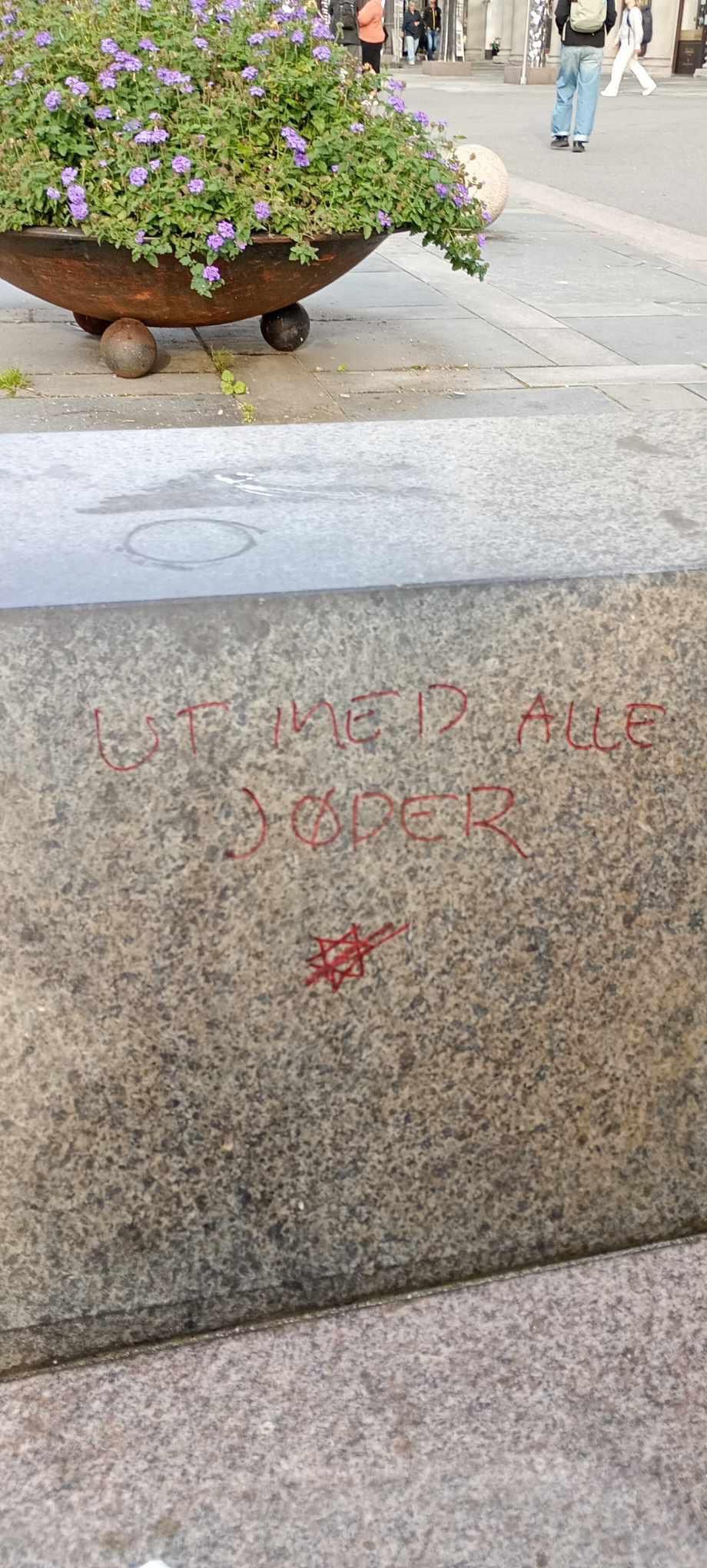
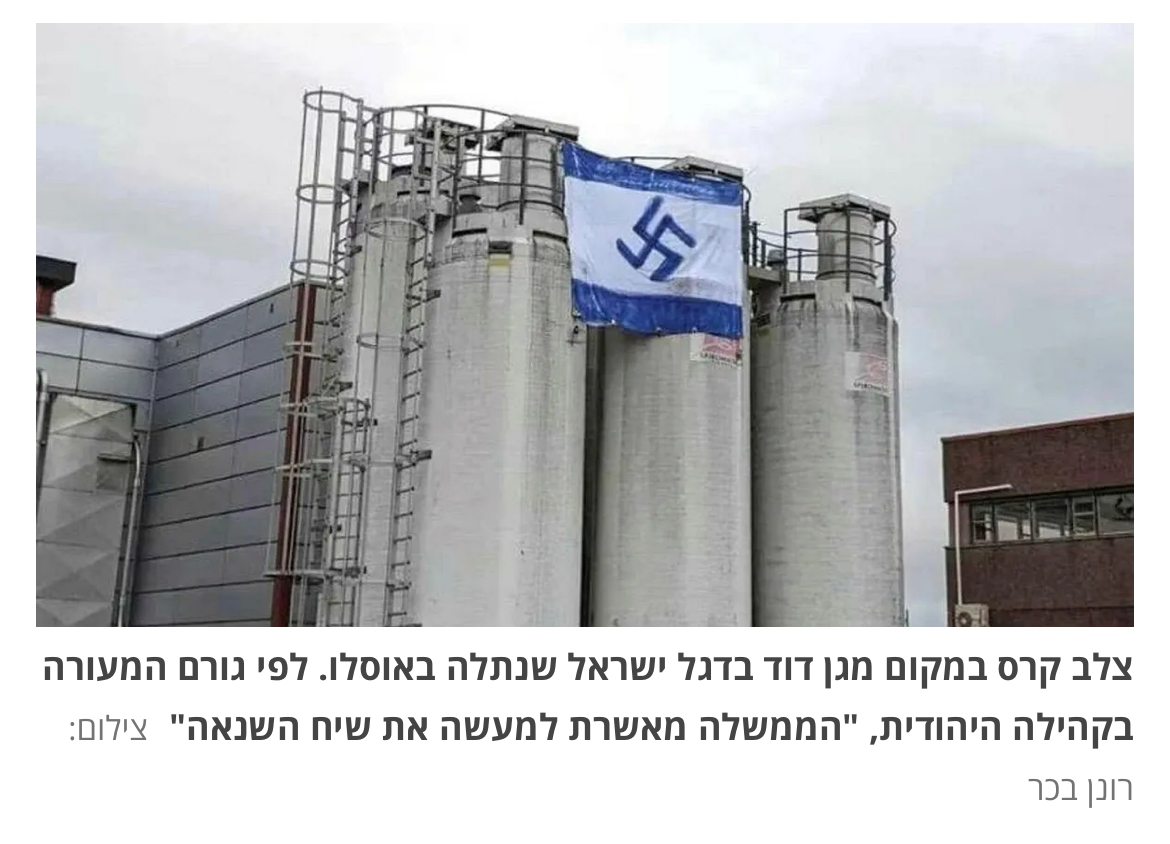
Images from Norway, 2024

"The center should be combating antisemitism rather than promoting a one-sided program," he said. "Even worse is the effect that such extreme voices have on Norwegian Jews who are being lectured about their own understanding of reality on the basis of a supposedly academic framework that completely ignores the real conditions in Norway."

According to its website, the Norwegian Center for Studies of the Holocaust and Religious Minorities is a research, education and documentation center intended to focus on the Holocaust and other genocides, as well as antisemitism and minority rights in Norway. The center's exhibitions receive roughly 50,000 visitors each year. It was established in 2001 using capital from a national restitution settlement over World War II between Norway and the country's Jewish community.

The center has previously faced criticism for its programming. In a letter sent in September 2024, more than 100 Norwegian Holocaust survivors and their descendants accused the center of failing to use "its mandate to combat the hostility we experience," and that instead of fighting antisemitism it was positioning itself as a "critic of Israel's policies and military tactics." The letter also said the center manifests "bias in its choice of experts and supporting a narrative that's negative toward Israel as a Jewish state."

In another letter from January 2025, the Norwegian branch of B'nai Brith criticized Heiret for mentioning Palestinians twice while delivering a speech on International Holocaust Remembrance Day, amid Israel's war in Gaza.

"By focusing on Gaza and Palestinian civilians who have lost their lives during the commemoration of the Holocaust and the genocide of the Jews in Europe, at a time when one-sided and anti-Israel portrayals make debates related to Israel very un-nuanced, the director has in a blatant way contributed to the tendency to relativize the Holocaust and the genocide of the Jews," the letter said.

"As the center's own research shows, demonization of Israel leads to increasing antisemitism in Norway. Trivialization of the Holocaust is, as is well-known, defined as antisemitism."

The Left Party Sees All Racism — Except Its Own

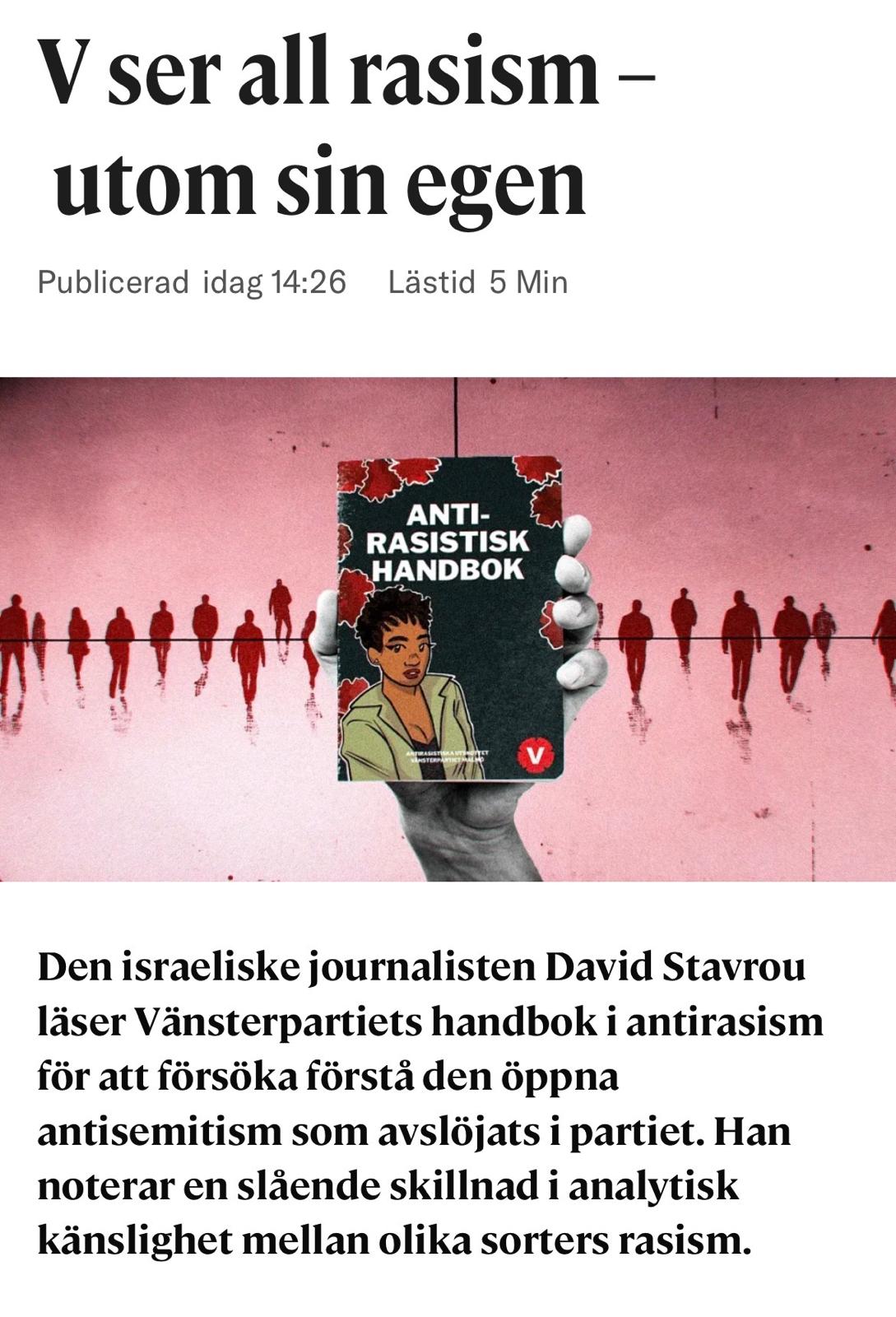
In light of Ina Hamdan's widely discussed revelations about members of Sweden's Left Party (Vänsterpartiet) who have expressed support for violent organizations or spread antisemitic propaganda, there is reason to revisit an interesting publication that the Malmö branch of the Party released in 2023 under the title Anti-Racist Handbook.

Published in Kvartal: V ser all rasism – utom sin egen – Kvartal

Vänsterpartiet's Anti-Racist Handbook is a strange document to read in light of current Swedish discourse. On the one hand, it's an ambitious text about how racism and discrimination should be fought. The reader learns about structural racism and intersectionality, Islamophobia and Afrophobia, colonialism and gender power structures and there's an almost academic overview of the various manifestations of racism in Swedish society. In light of this, the book argues that the party should actively recruit "non-white comrades," and proposes a range of symbolic, political and educational measures to combat racism.

On the other hand, there is very little about Islamism and contemporary antisemitism. This is interesting because it may be the key to understanding why people who devote their lives to "anti-racist politics" sometimes end up supporting violent, genocidal and fundamentalist movements such as Hamas and Hezbollah, while spreading propaganda against Jews and their national movement.

The point is the striking difference in how much nuance, complexity and analytical sensitivity the leaders of the Swedish Left Party in Malmö are willing to apply to different social phenomena.

When it comes to racism against Black people, the handbook explains how racism has changed form and modernized. Although African Americans are no longer sold from from one cotton plantation to another and are no longer viewed as people with smaller brains, racism still exists. In Sweden, the handbook explains, there is Afrophobia, manifested through hostility and hate crimes, insults and discrimination, exclusion and structural inequalities resulting from "norms of whiteness" and ideas of white supremacy.

But when it comes to antisemitism, the analysis seems to stop in history.

In the past, Jews were portrayed as the killers of Jesus, as people who kidnapped Christian children and used their blood, or those who started revolutions. The result was pogroms, state violence and discrimination. Twentieth-century antisemitism instead revolved around ideas of Jewish control over governments, the media and financial systems. The result was the Holocaust.

Antisemitism after the Second World War is different, and it is certainly about more than merely "racism against Jews." Christer Mattsson, one of Sweden's leading scholars of antisemitism and violent extremism, describes contemporary antisemitism as an "Israelized antisemitism," in which traditional anti-Jewish stereotypes are no longer expressed directly about "Jews" but are instead projected onto "Israel" or "Zionists."

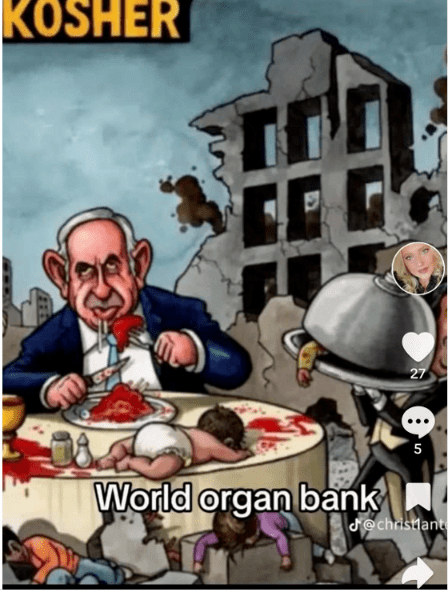
Thousands of people in the streets of Stockholm shout "No Zionists on our streets" on a weekly basis. This is just a new version of "Jews Out!". Their demonstration "street theatre" also portrays Israelis as bloodthirsty creatures who drink the blood of dead infants, or as people who secretly control governments.

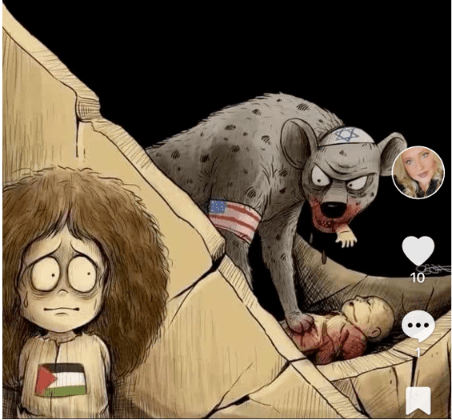
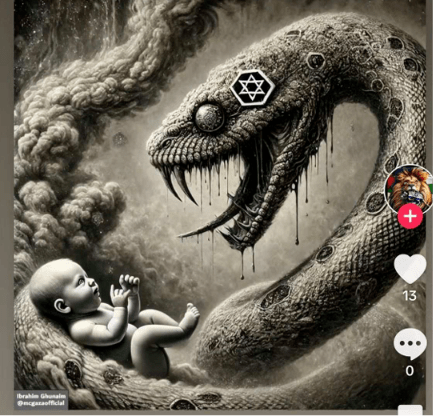
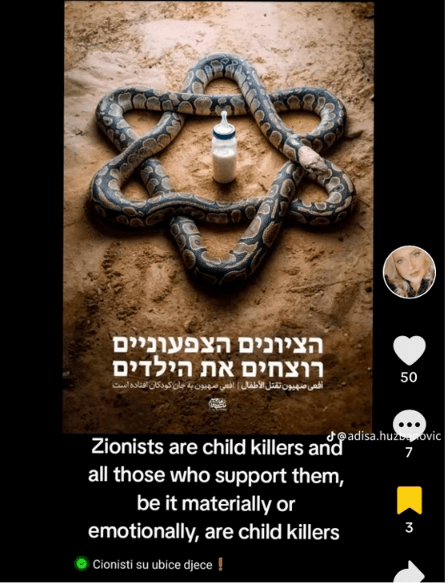
Recently we've also witnessed court cases of Swedish so-called pro-Palestinians who have spread messages on social media destorting the Holocaust and presented images of snakes and hyenas adorned with Stars of David killing Palestinian children. Their defence strategy, which actually convinced the court, was that the Star of David represent the Zionist flag rather than rabbis and synagogues.

This is where the handbook's blind spot becomes visible, and the results are obvious.

At the end of the Left Party's handbook there are quotations from representatives of the Party that reveal the same pattern: extreme sensitivity toward every conceivable form of discrimination on the one hand, and total blindness to extremism and racism when it comes to Jews and Israel on the other.

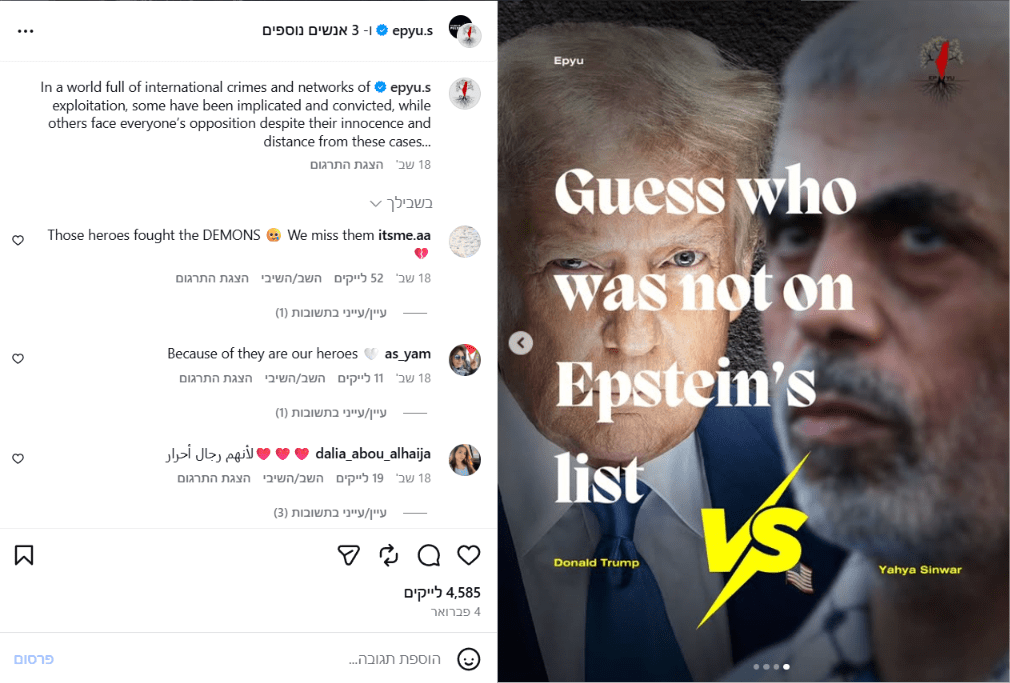
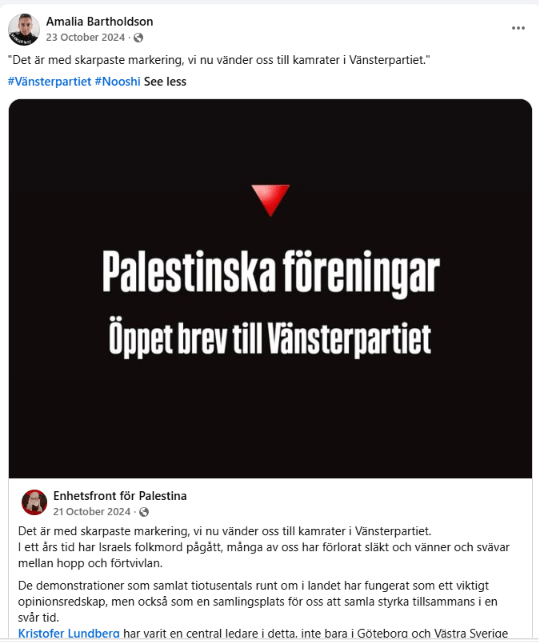
For example, Amelia Bartholdson wrote in the handbook that combating racism requires "awareness, humility and self-awareness." Yet after October 7 she shared a video accusing her own party secretary of being a Zionist because he did not regard October 7 as a legitimate act of resistance (the post came from EPYU, an organization that spreads conspiracy theories and blood libels). She also shared an open letter decorated with a red triangle (known as a Hamas propaganda symbol) supporting Kristofer Lundberg, a well-known supporter of the PFLP, one of the organizations organizations behind the October 7 massacre. Truly a fine display of awareness, humility and self-awareness.

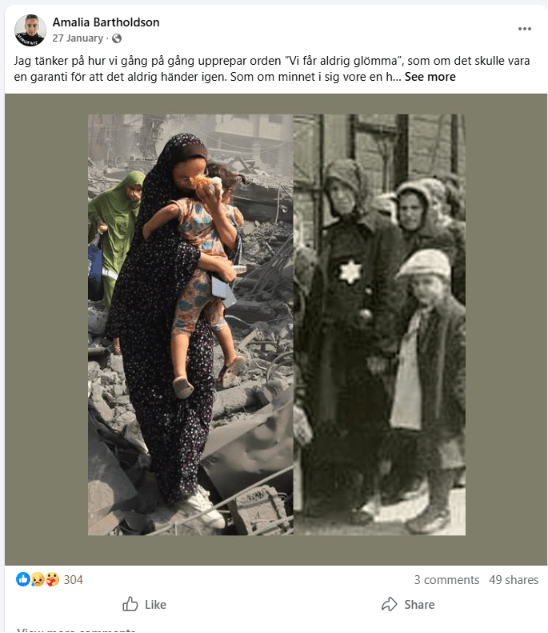
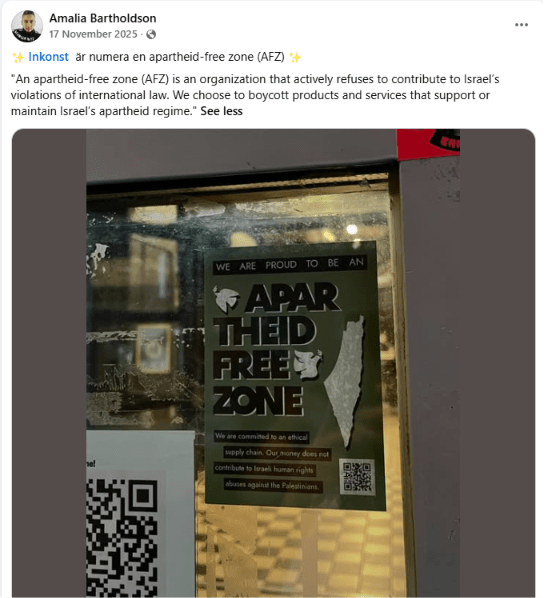
In other posts, Bartholdson compared the situation in Gaza to the Holocaust and supported boycotts and so-called "apartheid-free zones." This is an interesting point, because many of those quoted in the handbook support boycotts that are not directed at products from the West Bank or at far-right Netanyahu supporters, but essentially at anything connected to Israel. It is a bit like boycotting Bruce Springsteen or Beyoncé because of U.S. immigration policy. In an American context that would seem absurd, but when it comes to Israel everyone is lumped together. How does that fit with Sabrin Omar Högelius's statement in the handbook that people should be able to "simply exist, without having to defend their origins"?

"Anti-racism should permeate the party's politics and practice and build broad alliances with civil society," Anders Neergaard wrote in the handbook. Last week he was scheduled to lead a seminar celebrating an intifada (a term that in political contexts clearly implies violence against Israeli and Jewish targets). The other seminar leader was Orwa Kadoura, who was also quoted in the 2023 handbook condemning "racist behaviors, structures and organizations," yet in recent years he has repeatedly shared antisemitic and pro-Hamas material.

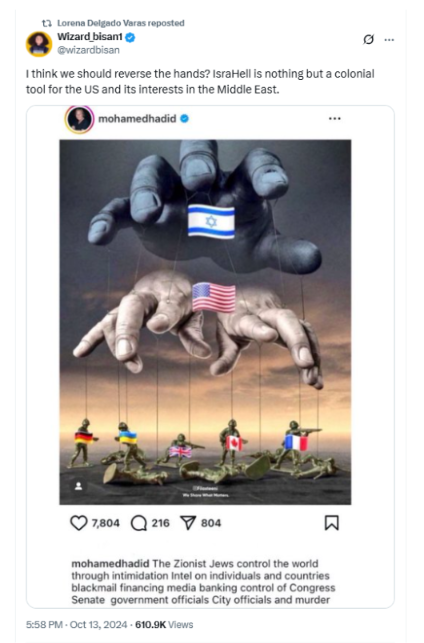
Another prominent former Left Party member quoted in the handbook is Lorena Delgado Varas. "Western anti-racism goes hand in hand with feminism and socialism," she wrote. A few years later, as is well known, there the "hand in hand" had an entirely different meaning as Delgado Varas shared an image on X showing a hand with the Israeli flag controlling a hand with the American flag, which in turn controlled soldiers carrying the flags of various other countries, accompanied by a text claiming that "Zionist Jews control the world" through threats, blackmail, the media, banks and control over the U.S. Congress, Senate and government.

These examples do not even include the individuals Inas Hamdan wrote about in Expressen, because the party's antisemitism problem extends far beyond 25, 50 or even 100 people. The most important lesson of the Anti-Racist Handbook is not what it says about racism, but what it does not say.

It's not about hating Jews. It is about a worldview that blames one people, one movement and one country for all the world's evils and fails to understand what contemporary antisemitism is. Or perhaps understands it perfectly well, but chooses to exploit it in order to win votes.

Sweden Fails to Protect its Jews From Incitement

We have spoken about hatred and threats for decades. Why is Sweden still unable to recognize them when it comes to Jews?
Published in Sweden in Svenska Dagbladet: Rättegång om hets mot judar missar målet | David Stavrou | SvD Ledare

In recent years, we have seen what hate propaganda, conspiracy theories, and dehumanizing rhetoric can lead to — especially when it concerns Jews.

A long series of arson attacks, stabbings, and shootings has made Jewish communities around the world increasingly vulnerable. In many cases, the perpetrators were influenced precisely by hate propaganda, conspiracy theories, antisemitic incitement, and Islamist ideology portraying Jews as legitimate targets of violence.

At the same time, two recent court cases in Sweden — one in Helsingborg and one in Gothenburg — concluded in a way that shows that Sweden is beginning to understand the importance of combating extremism, while still failing to fully understand it.

The Helsingborg case concerned charges of incitement against an ethnic group involving antisemitic publications on social media, Holocaust distortion, and conspiratorial content. The defendant was convicted on several counts, including Nazi salutes, publishing antisemitic images, and spreading theories like the one claiming that “4 out of 5 American slave owners were Jewish,” equating Jews with rats, and portraying Jews as a satanic force controlling the world.

At the same time, the man was acquitted on certain counts related to Holocaust distortion — a newer component of Sweden’s incitement legislation. The prosecutor argued that the man’s statements formed part of a broader antisemitic conspiracy narrative involving references to the Illuminati and Freemasons. But the district court was not convinced. During the questioning of Christer Mattsson, an expert on violent extremism and antisemitism and director of the Segerstedt Institute, the defense demanded answers to questions about the number of people cremated in Belzec, Treblinka, and Sobibor, and discussed the extent to which the Israeli government does or does not “weaponize antisemitism”.
Despite Mattsson’s clear answers, and instead of the court telling the defense attorney to stop wasting time on historical revisionism, the result was an acquittal. The defendant’s statements claiming that it would have been impossible to “dispose of 6 million bodies in the ovens,” and the publication of a video describing the figure six million as false, were not considered contrary to generally accepted historical facts and were not considered serious Holocaust distortion.

The problem with the verdict is that the court failed to see the forest for the trees, and the broader antisemitic context disappeared as the court got lost in details. No one has ever claimed that six million bodies were burned or that six million is an exact number. Six million is a widely accepted estimate, supported by millions of confirmed victim names, as well as Nazi documentation, demographic studies, transport records, camp archives, postwar investigations, eyewitness testimony, and forensic evidence.

No serious historian has argued that limited crematorium capacity would suggest exaggerated death tolls or inconsistencies in the history of the Holocaust. The entire debate is absurd. Anyone who has studied this kind of rhetoric knows that Holocaust denial and Holocaust distortion — referred to in academic literature as Holocaust distortion — are very rarely expressed by claiming that the Holocaust never happened. It is usually about relativization, contextualization, and minimization.

This kind of denial is not merely a lie about the past — it is a precondition for genocide: minimizing, justifying, or erasing the crimes and thereby continuing the dehumanization of the victims while obstructing historical accountability and remembrance. In this case, it is not only an insult — it is a call to renew the violence.

In the Gothenburg trial, a woman was acquitted on Wednesday after being charged with incitement against an ethnic group. The images she published online contained classic antisemitic symbols: a snake with a Star of David on its head and large fangs about to attack a naked child; a snake shaped like a Star of David wrapped around a baby bottle with text describing Zionists as child murderers; and an image depicting a hyena eating a child while staring at another child hiding nearby wearing a Palestinian flag on its shirt. The hyena wears a kippah with a Star of David on it.

During police questioning, the woman claimed she had nothing against Jews. “It is Zionists I am speaking against, and what is happening in Gaza is horrific. Seeing children slaughtered every day,” she said.

Christer Mattsson, who also testified in this case, explained that research has long established that snakes and the killing of children are common antisemitic symbols. Anti-Zionism, he explained, becomes antisemitism when it adopts antisemitic stereotypes, conspiracy theories, and so-called antisemitic tropes, such as the notion that evil Jews control global media and governments. Mattsson explained that in this form of “Israelized antisemitism,” “Zionists” assume the role historically assigned to Jews in classic antisemitic ideology and are portrayed as uniquely evil, manipulative, powerful, and conspiratorial.

Despite this, the court missed the point. The fact that a message is critical of Israel does not exclude the possibility that it is simultaneously antisemitic. The Star of David, the snakes, the conspiracies, and the innocent dead children should have been enough. It seems Swedish courts will not act until someone explicitly says, “I really hate Jews and now I’m going to kill a few,” or “Auschwitz is a fictional place.”

But that is not what antisemitism sounds like today. To minimize and distort the Holocaust and spread hatred against the legitimate national movement of the Jewish people is not an exercise in free speech — it is spreading hatred and encouraging violence in disguise.

Things should be called by their proper names, and words have consequences. History gives us many examples of this and they are often associated with specific names – Capital Jewish Museum in Washington DC, the Tree of Life – Or L’Simcha Synagogue in Pittsburgh, Bondi Beach in Sydney, the Krystalgade Synagogue in Copenhagen, the Hypercacher supermarket in Paris, the Jewish Museum in Brussels, Heaton Park Synagogue in Manchester, the Halle Synagogue in Germany, Chabad of Poway Synagogue in California, Golders Green Road in London, the Ozar Hatorah School in Toulouse, and the El Ghriba Synagogue in Tunisia.

All of these acts began with words.

We have spoken about hatred and threats for decades. Why is the state still unable to recognize them when it comes to Jews?

Amid Tensions, Oscar-nominated Israeli Animation Sparks Dialogue Between Jews and Muslims in Sweden

Filmmaker Tal Kantor's Israeli-French coproduction, the animated short film 'Letter to a Pig,' exploring intergenerational trauma and its potential to lead to empathy, has received numerous accolades. Now, a rabbi in Sweden has shown the film to Jewish-Muslim audiences to encourage dialogue post October 7 and the Israel-Gaza war.

Published in Haaretz: https://www.haaretz.com/jewish/2025-12-11/ty-article-magazine/.premium/oscar-nominated-israeli-animation-sparks-dialogue-between-jews-and-muslims-in-sweden/0000019a-fd77-d2e4-a1ff-fff7ab270000

Israeli animation filmmaker and visual artist Tal Kantor, 37, has taken her film "Letter to a Pig" to more film festivals, master classes, school seminars, and public screenings than she can easily remember. These events have taken place all over the world since the film was first screened in 2022, and there are more to come. From Harvard University to the Sigmund Freud Museum in Vienna, from the Academy Museum of Motion Pictures in L.A. to the Museum of Contemporary Art in Zagreb, it seems like Kantor and her film have been everywhere.

The 17-minute piece of animated art has also won Kantor multiple prizes. These include the Ophir Award, known as "the Israeli Oscar," the Best Narrative Short at the Ottawa International Animation Festival, the Excellence Award at the Japan Media Arts Festival and prizes, and honorable mentions at animation festivals in Belgium and France, and even an Oscar nomination for Best Animated Short Film in 2024.

The film itself took about five years to complete because of the meticulous hand-drawn animation style, which is combined with live action and involves visionary techniques and imagery. It was produced by The Hive Studio in Israel and Miyu Productions in France. It is based on one of Kantor's real-life childhood memories, and it depicts the way pain and collective trauma are transmitted from one generation to another, and the role they play in human history, society, and identity.

The film's main character is a girl who, together with her classmates, listens to the testimony of a Holocaust survivor in an Israeli school. Part of the testimony is a letter that the survivor wrote to a pig which, as he remembers, saved his life while he was hiding from the Nazis in a pigsty. In the film, the young schoolgirl sinks into a disturbing surrealistic dream while listening to the testimony. During the dream, new perspectives of good and evil are created in the girl's mind, and these expose her and her fellow students to the results of violence, victimhood, and trauma.

The pig's role shifts from savior to monster to victim, while the young children also go through a transformation. They start out as passive listeners and gradually become a threatening mob. The Holocaust may be the film's starting point, but "Letter to a Pig" is not a "Holocaust film." It's about universal motifs such as violence and suffering created by intergenerational trauma, which develops into a siege mentality. But it's also about empathy and the possibility to recognize other narratives through dialogue.

For Rabbi Moshe David HaCohen, 46, the narratives of pain and suffering, leading to endless conflict, actually drew him to the piece. HaCohen has just started his second term as the rabbi of the small Jewish community in Sweden's third-largest city, Malmö. In 2017, at the beginning of his first term as Malmö's rabbi (which ended in 2022), HaCohen founded Amanah, an organization based on his cooperation with a local imam to counter discrimination and build trust between the city's Jewish and Muslim populations. For a few years this worked very well, but the organization gradually dissolved as a result of the October 7 massacre, the ensuing Israel-Gaza war and the polarization caused by these events.

HaCohen is now launching a new organization named B.R.I.T – an acronym for Building Resilience, Identity, and Trust, and a reference to the Hebrew word for "covenant." He says the organization will work to counter polarization and foster relations between Jews and Muslims in several European countries. "I saw how Tal took something which is seen as almost holy like the Holocaust, and I was impressed by the way she asked complex questions that society today has to deal with," HaCohen told Haaretz in an interview in Stockholm. "The most serious question is how do we dismantle this complex conflict and create trust. Telling stories, like Tal does in her film, is a way to reach the real issue and move forward to create that kind of trust. People need hope, and I thought that during this time of conflict it would be good to create a debate based on the film."

One of the side effects of the Israeli-Palestinian conflict is the conflict in many European countries over the last two years, between Jewish Israel supporters and Muslim Palestinian supporters, who are entangled in cycles of suspicion and hostility. Jews have experienced rising levels of antisemitism, aggressive demonstrations at which protestors declare support for Hamas, and accusations of being responsible for the situation in Gaza because of their support for Israel.

Many European Muslims have found themselves on the receiving end of traditional anti-immigration and xenophobic attitudes, which are now amplified in response to the actions of elements of the pro-Palestinian solidarity movement. Even though there is now a cease-fire in the Middle East, tensions between the pro-Israel and pro-Palestinian camps and their supporters in many European countries persist.

And so Rabbi HaCohen asked Kantor to bring her film to Sweden in November to try to create productive dialogue. Kantor says that the film has taken part in about 150 festivals so far, and she has attended many of them personally. Meeting audiences together with the international crew who worked with her on the film is always important to her. "The film started from a very personal experience, and it has now become universal. Meeting audiences …. means everything to me," she says. "After screenings, people open up to me; they talk about their own experiences and their own perspectives. Some of them cry and open their hearts while talking about the multi-generational trauma they see in the film."

Still, for Kantor this wasn't just another invitation to a European cultural event. Instead of festival curators and ceremony producers, the invitation came from a rabbi who wanted to show her film as a tool for creating change and providing hope. Kantor couldn't refuse.

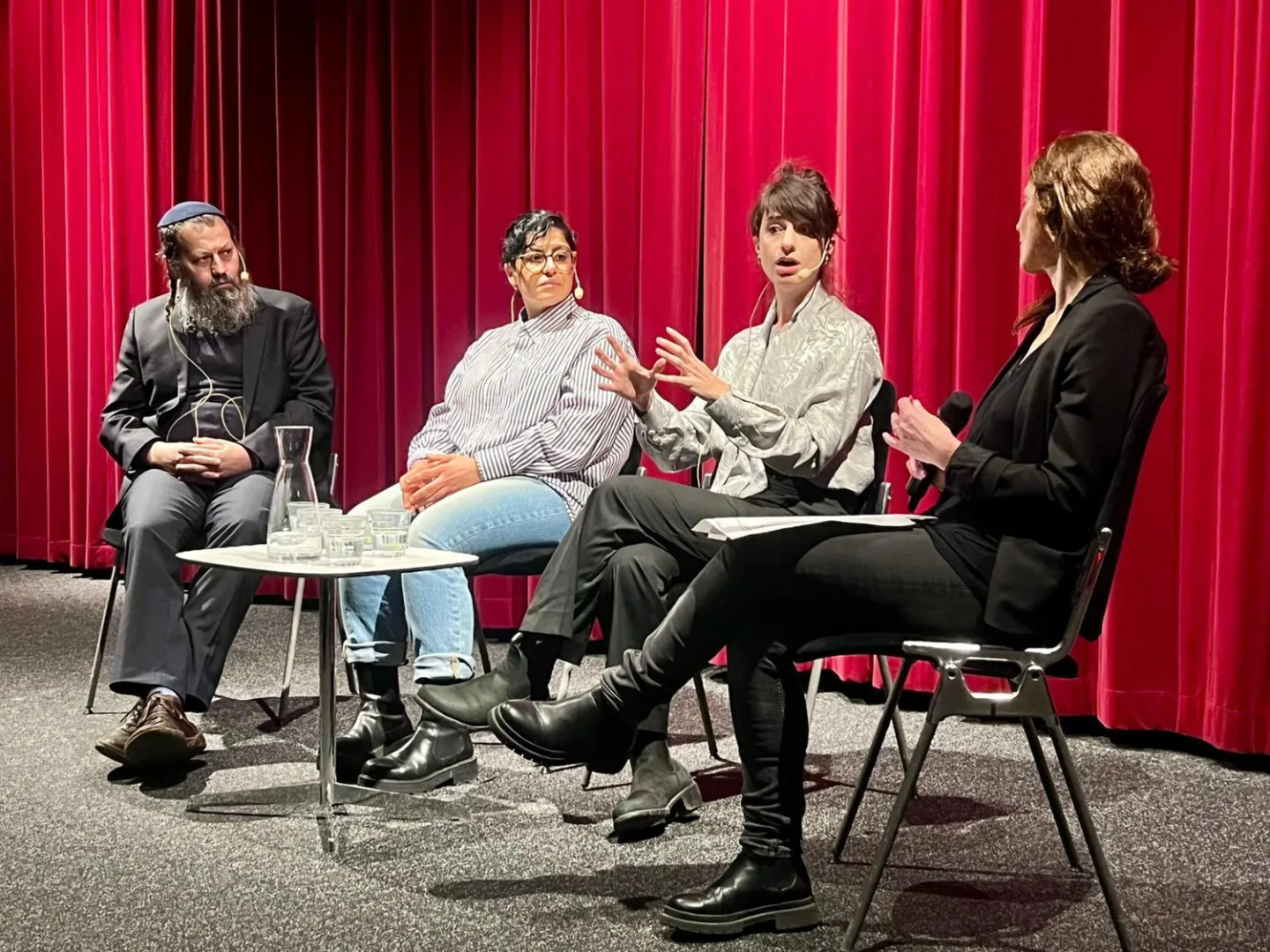
From right: Rabbi Moshe David HaCohen, Somar Al-Naher, Tal Kantor and Anneli Rådestad. Photo: Peter Lööv Roos

"Moshe David explained who he was and told me about what he does," Kantor told Haaretz in a local Stockholm café a day before she returned to Israel. "I immediately understood that he wasn't interested in the film because of its Oscar nomination or its international success. It was about the film's content…. The way he talked about it moved me deeply. He recognized its exploration of the danger of inherited trauma, fear, and narratives of cruelty, and how remaining in a place of victimhood can keep that cycle alive.

"He also saw how the film gestures toward compassion for all people [and towards] humanity and hope. It meant a great deal to me that he saw in the film a tool for opening a space for dialogue in such a polarized moment."

Rest of the article here: https://www.haaretz.com/jewish/2025-12-11/ty-article-magazine/.premium/oscar-nominated-israeli-animation-sparks-dialogue-between-jews-and-muslims-in-sweden/0000019a-fd77-d2e4-a1ff-fff7ab270000

Medelhavsmuseet's Selective History

When it comes to the past, Medelhavsmuseet (The Swedish Museum of Mediterranean and Near Eastern Antiquities) largely ignores Israel, but when it comes to the present the museum presents only different shades of the same narrative, one that excludes a balanced, mainstream Israeli perspective. This in itself is not necessarily a problem. However, since public funds are being used and this is all payed for by tax-payers money, why not invest in presenting all sides of the story? Are Israelis so dehumanized that their pain, loss, and sacrifice are not considered worthy of being told?

Published in Swedish in Svenska Dagbladet: https://www.svd.se/a/K8Bn37/medelhavsmuseets-selektiva-historia

The lecture hall at Medelhavsmuseet was full on September 4th. The evening seminar which took place there was called "Repair, Return and Reconstruction for Palestine’s Decolonized Future", and in case the message wasn’t clear enough from the name, during most of the evening there was a photograph of Gaza and a slogan in Arabic and English projected on the screen behind the panel members. The slogan read: “Glory to Gaza”.

The seminar itself wasn’t exactly intellectually challenging and the message was pretty straight forward. When Israel was mentioned by all speakers it was associated with very specific words. Genocide, occupation, oppression, destruction, starvation, ethnic cleansing, collective punishment and settler-colonialism were some of the favourites. There was also a consensus about the Palestinian reaction to the Israeli aggression. Here the popular words were: education, culture, conservation, de-colonization, renovation and restoration. Listening to the panel members it sounded like Palestinian resistance is all about Mahmoud Darwish poems, architecture podcasts and a struggle for free press.

In an hour and a half of debate there was nothing about Palestinian terror or violence, there were no suicide bombings or rockets, Hamas wasn’t mentioned and October 7th was just the date when the current Israeli offensive started. Since all panel members were engaged in architecture and restoration and apparently very well acquainted with Gaza, it was interesting that the immense military underground tunnel infrastructure, a remarkable architectural achievement in itself, was not mentioned. There was also no mention of another kind of physical destruction – the one of Israeli communities. No destroyed and abandoned kibbutzim, no apartments demolished by Qassam rockets and no homes burned to the ground with entire families still inside. There were no hostages, no executions and no organized rape and sexual violence. The whole event felt like a motivational inspirational gathering for activists, where all the speakers clearly presented a Palestinian narrative, and many in the audience were members of the so-called "pro-Palestinian" movement. Some wore kaffiyehs, a couple of them even had red triangles (a Hamas symbol) on them.

In itself, all this is completely legitimate. In a democracy, people are free to organize whatever seminar they wish. What is, however, somewhat troubling is that Medelhavsmuseet is part of a government agency (Statens museer för världskultur) funded by taxpayers, with tens of millions of Swedish Crowns each year. When Rani Kasapi, Head of Content and Learning at Världskulturmuseerna, opened the seminar, she also mentioned that other institutions were also involved in organizing it: the Swedish Institute of International Affairs (UI), the Swedish Research Institute in Istanbul (SRII), and the Swedish Arts Grants Committee. All of these are also fully or partially funded by Swedish taxpayers, raising the question – why should funds that could be spent on education and culture for the benefit of all be used for a one-sided, highly political event based on foreign policy propaganda?

Perhaps, the idea was to have another event to balance the message and show another side and a different narrative. And indeed, on October 7th, a very symbolic and politically charged date, another event was planned by the museum. This time the title was: What’s Happening in Israel Now? (Vad händer i Israel nu?). In a perfect world, this could have been the the missing piece, the event that shows that the situation is more complex than just propaganda. But the world isn’t perfect. According to publications, the event had only one speaker – Göran Rosenberg. The same Rosenberg who only a few months earlier described Israel as a "morally dead project" and questioned its future existents in its current form. It’s as if the museum invited an anti-vaxer to lecture about the importance of vaccinations. Was it really so hard to find another voice to describe the situation in Israel? One who at least believes in its future?
Medelhavsmuseet has hosted more events about the region in the last couple of years — for example, there was a book talk with Cecilia Uddén, one of Swedish media’s most critical voices when it comes to Israel. There was also a UI event featuring several Israeli left-wing activists. But the bigger picture is that, aside from rare exceptions, Medelhavsmuseet largely presents different shades of the same narrative, one that excludes a balanced, mainstream Israeli perspective. This in itself is not necessarily a problem. However, if public funds are being used, why not invest in presenting all sides of the story? Are Israelis so dehumanized that their pain, loss, and sacrifice are not considered worthy of being told?

Looking a bit deeper, it’s obvious that Medelhavsmusset doesn’t ignore the Israeli perspective only when it comes to the current conflict. For some reason, it ignores Israel’s existence all together (apart from occasionally mentioning it as a colonial bully destructing the fascinating, authentic and noble people of the orient). Israel as a modern state and the ancient Jewish entities in the Eastern Mediterranean like the Kingdoms of Jehuda and The Northern Kingdom of Israel are a treasure of history, archaeology and ancient culture. They’re the origin story of Christianity and Western civilization and a fascinating story of cultural, social and linguistic revival. Still, in the last twenty years of exhibitions, it seems like Medelhavsmuseet hasn’t had a single exhibition presenting Israeli or Jewish culture and history. I spoke with two historians who have studied this in detail. One of them said that “ancient Jewish history is almost completely erased from the museum’s portrayal of the ancient Mediterranean region”. The other said that for historical reasons, the museum focuses on Egypt and Cyprus, which is fine, but even when those cultures had strong connections to Jews in the region, those connections are usually not mentioned, and even on the rare occasions that they are the name Israel never is.

And they're right. Medelhavsmuseet has presented many exhibitions about Egypt, Greece, Rome, Syria, Cyprus, Turkey – and even non-Mediterranean countries such as Iraq. In fact, the only recent exhibition that touched on Israel was “Nakba,” which according to the Jewish Central Council was highly one-sided and sparked debate over whether the museum was pursuing a political agenda. The museum responded that “it is not a historical exhibition, but a small audio exhibition with stories”. When representatives from the Jewish Central Council met with the superintendent of Statens museer för världskultur regarding this, their concerns were not taken seriously.

There’s no doubt that the story of the Nakba should be told. It’s an important part of the region’s history. But if this was only a “small audio exhibition with stories”, where is the next audio exhibition with the other stories from the same war – for example, those about Holocaust survivors who were killed in the battle field after being freed from Auschwitz, or those about massacres of Jews that took place during the same time, or the ones about the Jordanians expelling the Jews from Jerusalem’s old town or the Egyptians illegally occupying Gaza?

During the debate with the Jewish Central Council, the museum mentioned one exhibition – Egypt’s Jews (Egyptens judar), perhaps as one with a more “Jewish narrative”. But the truth is that even when the exhibition explains how Egyptian Jews were attacked, harassed, arrested and expelled in the 1950s and 60s, it’s clear that the message is that this is a direct result of Zionism. The exhibition explains how for 3,000 years Jews were “totally integrated in the surrounding society” (helt integrerade i det omgivande samhället) and only when the UN decided to “divide Palestine” and the 1948 war broke out, Egyptians started “anti-Zionists riots” and resisted “foreign influence”. These texts are a wonderful example of verbal acrobatics. There’s no Egyptian antisemitism, no Muslim Brotherhood (the mother movement of Hamas) promoting genocidal racism against Jews, just an unfortunate mixing up (ihopblandning) of “Jews” and “Zionists”. This makes sense since one of the exhibition’s production partners was Magda Haroun, Head of the Jewish Community Council in Egypt and a vocal opponent of Israel who claims that Zionism is a racist movement. Interestingly, the exhibition which mentions the wars between Israel and Egypt, doesn’t discuss Egyptian President Saadat’s historic recognition of Israel and the resulting Israel-Egypt peace agreement. One can only assume that the reason is that if the museum tells its visitors about Egypt recognizing Israel, this may lead to a demand that Medelhavsmuseet does the same.

Zero tolerance” is no longer enough after Bondi Beach. Political action is required – and it is urgent

Published in Swedish in Kvartal: https://kvartal.se/erikhogstrom/artiklar/hur-paverkar-politiken-terrordad-mot-judar/cG9zdDozNzA5NA

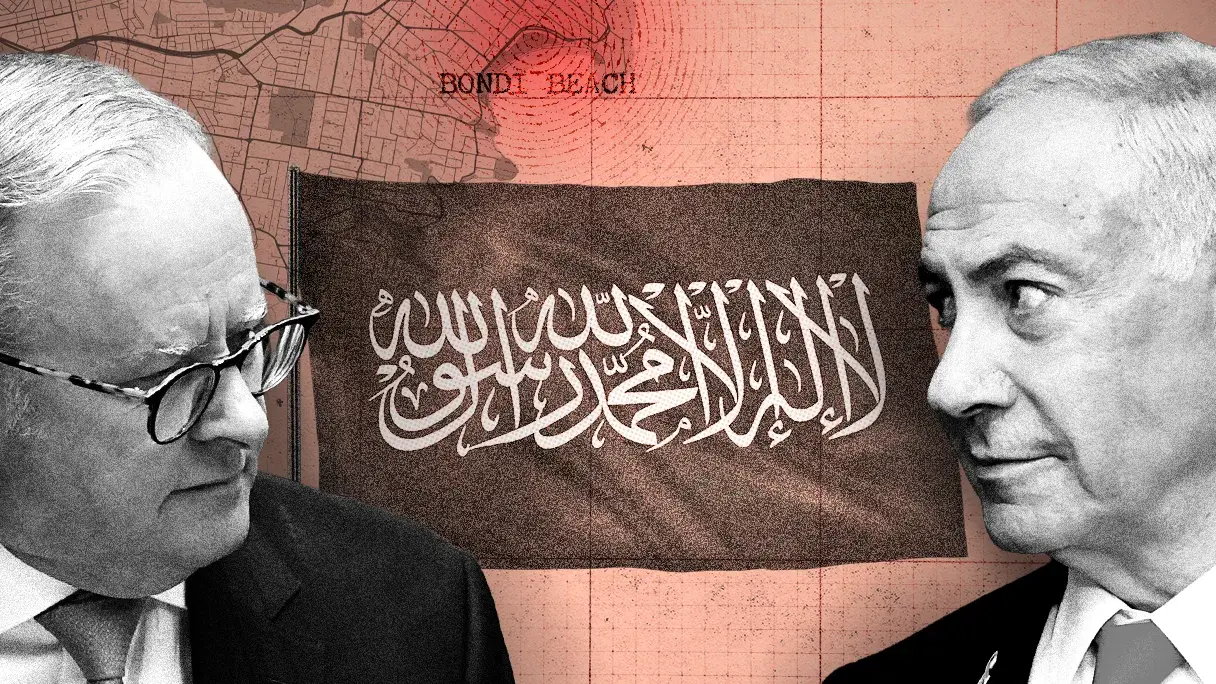
Reactions to the terrorist attack at Bondi Beach have largely focused on the hateful rhetoric believed to have contributed to the violent extremism that claimed 15 lives – the deadliest attack on Jews since October 7. That focus is understandable after two years of global demonstrations under slogans such as “globalize the intifada.”

At the same time, the attack is rooted in more than a toxic debate climate. It also involves a geopolitical and security dimension that has primarily been raised by Israeli officials.

According to Israeli intelligence assessments, links had already existed for several months between Australian pro-Palestinian activists and groups such as the Islamic State, al-Qaeda, and Iran’s Revolutionary Guard. Against this backdrop, Israeli Prime Minister Benjamin Netanyahu accused Australia’s prime minister of betraying the country’s Jews. After the attack, Netanyahu stated that he had already warned in August that recognizing Palestine would, in his words, “pour fuel on the antisemitic fire, reward Hamas terrorists, and encourage threats against Australia’s Jews.”

This raises a number of questions. Does Australia really need Israeli intelligence to identify threats against its Jewish population? And more importantly: is Netanyahu truly the right person to lecture others about being unprepared for Islamist terrorism, when his own government bears responsibility for Israel’s worst catastrophe in decades?

But Netanyahu is not the central issue. What matters is that the warnings proved correct. A massacre of Jews took place in Australia, carried out by men who had ISIS flags in their car. Australian authorities knew that one of the perpetrators had ties to ISIS and that his father, the other perpetrator, legally owned at least six weapons. Despite this, no warning flags were raised, and the Jewish event lacked police protection when the attack occurred.

Islamists operate freely in Sweden

Against this background, Europe should ask itself a clear question. If Australia’s policies over the past two years resemble those pursued in many European countries, could what happened at Bondi Beach happen here?

Both domestic and foreign policy must be scrutinized. Domestically, this concerns insufficient resources to protect Jewish sites, an inability to counter conspiracy theories, and complacency toward Islamist actors. These challenges affect all European countries, including Sweden. Swedish journalists have recently exposed how Islamists operate freely in Sweden, how Iranian actors direct terrorist activity via Swedish organized crime, and what links Swedish activists have to terrorist movements such as the PFLP.

“Jews in countries that do not take Islamist terrorism seriously end up paying the price, regardless of whether government passivity stems from fear, incompetence, or indifference.”

Sweden is not alone. According to a recent Europol report, jihadist terrorism remains a central security challenge for the EU, with groups such as al-Qaeda and the Islamic State exploiting the conflict in Gaza. Added to this is Hamas, which, according to Israel’s Mossad and European intelligence services, has planned attacks against Jews in Europe since 2023. The causal link is clear: Jews in countries that do not take Islamist terrorism seriously pay the price.

Kvartal

Why foreign policy matters

How, then, does foreign policy factor in? Can recognition of Palestine or harsh criticism of Israel encourage terrorism? Countries such as Spain, Norway, and Ireland pursue a clear line against Israel. Like Australia, they have recently recognized Palestine; they voice strong opposition to Israel in international forums and serve as comfortable host countries for movements that not only oppose Israeli policy but view the state itself as an illegitimate colonial project.

Australia’s prime minister firmly rejected Netanyahu’s claim that the country’s foreign policy had any connection to the attack. He may be right – such accusations require evidence. But that does not mean foreign policy is irrelevant to the climate surrounding antisemitic hate crimes.

First, governments – unlike individuals – must understand the unique situation Jews face. Demonstrations are marked by hatred, aggression, Nazi comparisons, terrorist symbols, and boycotts. Of course, protests are legitimate in a democracy, and no one seriously claims that all participants are violent antisemites. But at the political level, it is unclear whether countries such as Norway fully grasp what their Jewish populations are forced to endure. The situation is worsened by the fact that no other conflict in the world is covered as intensely – and, according to many, as one-sidedly – in Norwegian media. This has an enormous impact on Norway’s small Jewish community.

Second, does the tax-funded public sphere remain neutral, or does it contribute to an unsafe environment for Jews? What do teachers say? What do libraries display? How do healthcare professionals behave? This is a matter of public safety, not freedom of speech. In February, a video went viral showing two nurses at Bankstown Hospital in Sydney boasting about refusing care to – or even killing – Israeli patients. In Ireland, an official report found that school textbooks contain serious distortions of the Holocaust and Jewish history, which Jews in the country say fuel antisemitism. In Spain, Jewish organizations similarly warn that some teachers use classrooms for anti-Israel activism.

“Zero tolerance” is no longer enough

We can continue debating the limits of protest, but we must also scrutinize institutions. The state must protect freedom of expression, but it must also guarantee safety. That requires schools, hospitals, and libraries free from political propaganda and symbolic acts intended to influence public opinion.

Finally, it is a fact that jihadist terrorists in Europe are often exposed with the help of Israeli intelligence. Can Jews in Spain and Ireland truly trust that their governments will cooperate with the Mossad to save lives, when those same governments cannot even tolerate Israel’s participation in Eurovision?

After Bondi Beach, Europe’s governments must decide where they place their resources and political capital. If they are serious about protecting their Jewish populations, “zero tolerance” and symbolic gestures of solidarity are no longer sufficient. Political action is required – and it's required urgently.

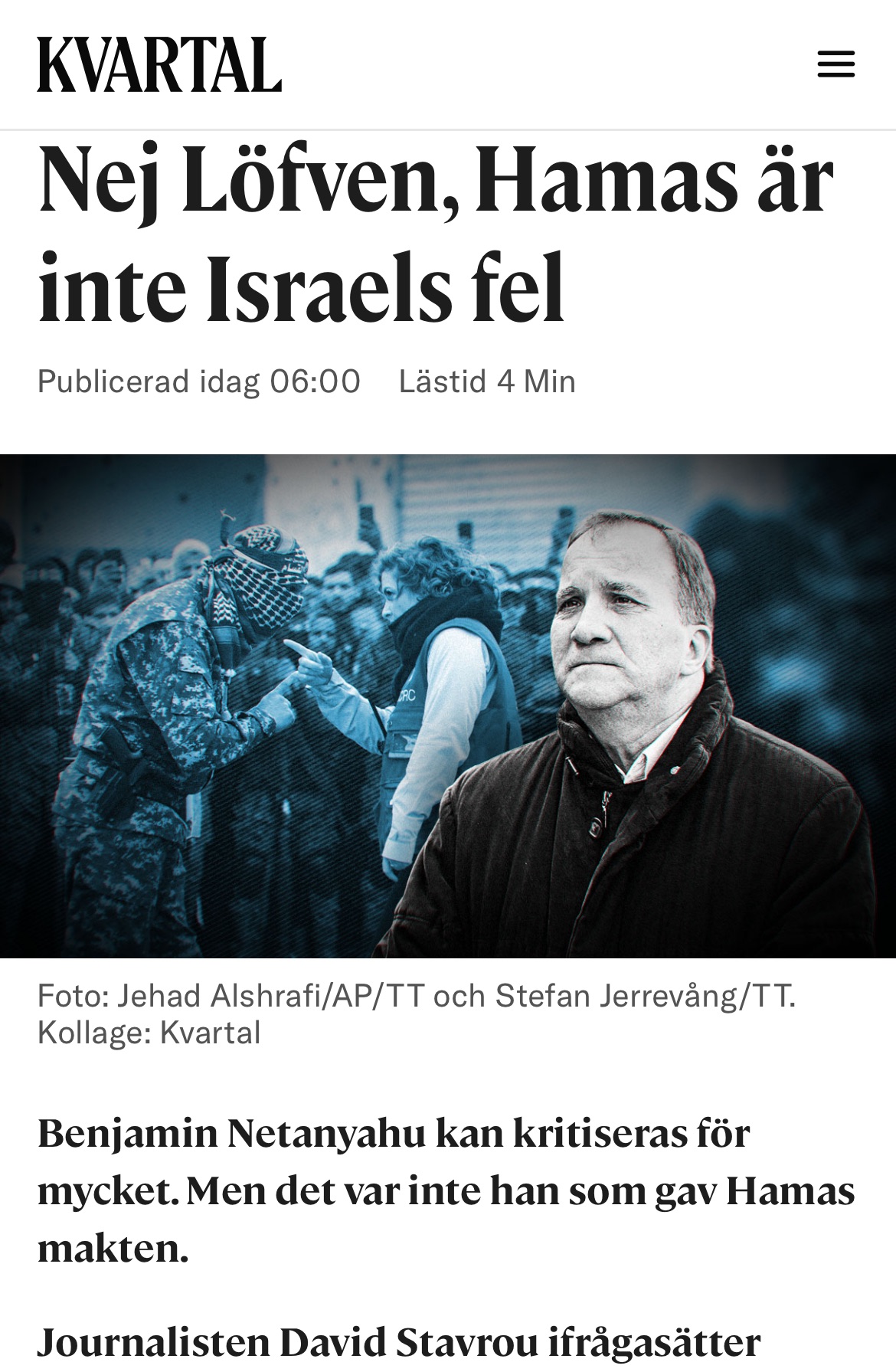
No Löfven, Hamas isn't Israel's Fault

Published in Swedish in Kvartal: https://kvartal.se/erikhogstrom/artiklar/nej-lofven-hamas-ar-inte-israels-fel/cG9zdDoyMjc1NA

A popular proverb says that a half-truth is a whole lie. The latest episode of SVT’s Utrikesbyrån about Hamas was a good example of that. That does not mean it wasn’t interesting. It was. Nor is there any doubt that the three participants — former Prime Minister Stefan Löfven, political scientist Marco Nilsson and Middle East analyst Bitte Hammargren — knew what they were talking about. But when it came to the analysis of Hamas, we were given only a half-truth.

The questions the presenter Rebecca Randhawa asked were: what is left of Hamas, will they lay down their arms, and who will govern Gaza. The first and the third questions are almost impossible to answer. Even Israeli intelligence does not know what remains of Hamas’s military capability, and Gaza’s future governance depends on a complicated geopolitical process. The second question, however, can be answered based on a deep understanding of what Hamas is, the choices it has made in the past, and what its ideological and political DNA is.

According to Löfven, Hamas’s power is the result of a paradox. Despite being one of Israel’s greatest enemies, its power originated with Israel’s political leadership. “Such an organization receives support (from Qatar, for example) simply because Israel wants to avoid the Palestinian Authority (PA) gaining any power.” Hammargren agreed and said that Hamas was a political asset for Israel. “Netanyahu’s line was that by letting Hamas grow in Gaza we don’t have to hear about a Palestinian statehood,” she said. This is a common analysis and it is partly true. Netanyahu and other Israeli leaders do indeed oppose a two-state solution. Because of this, his strategy was to weaken the PA, and many argue that one of the ways he did this was by allowing Hamas to grow. But this is only half the truth.

The other half, and the real reason Hamas rose to power and was able to retain it, is much simpler. The source of Hamas’s power is support from large parts of the Palestinian people. Even now, after two years of destruction and death that are a direct consequence of Hamas’s decision to massacre Israeli civilians on October 7, 2023, Hamas is still supported by many Palestinians. The international support from Qatar and Iran that Löfven and Hammargren mentioned is also not hard to understand. Iran’s regime has a long-term goal of eliminating “the Zionist entity,” and Qatar built its international position on supporting its ideological Muslim Brotherhood allies. Sure, Netanyahu miscalculated Hamas’s capacity and misread its intentions, but it was not he who made Hamas’s ideology popular, and it was not he who turned Qatar and Iran into dangerous regional destabilizing powers.

But where is Hamas heading? Utrikesbyrån’s two-and-a-half-minute clip tried to provide background. According to the clip, “Hamas removed the demand that Israel be destroyed, but still does not recognize the state of Israel.” This is not even a half-truth. Hamas is absolutely committed to the destruction of Israel. Yes, it created a new charter for foreign audiences, because the old document contained antisemitic propaganda that was not particularly popular on university campuses and in some Western circles. But even the new charter demands “all of Palestine” from the river to the sea, it does not accept the Oslo Accords or the two-state solution, and it still endorses “armed resistance,” which has been a decisive part of Hamas’s nature long before October 7. That includes blowing up buses and restaurants full of civilians as well as kidnapping, torturing and murdering Jews of all ages, genders and backgrounds. One interesting thing Utrikesbyrån did not mention is that Hamas activists have on several occasions been arrested in Europe for planning attacks on “Jewish targets.” Worth mentioning if anyone took the “new charter” seriously.

Despite (or perhaps because of) the violence, Hamas won the Palestinian elections in 2006 in both the West Bank and Gaza. Palestinians are not blind or politically incapable — they knew exactly what they were voting for. According to Utrikesbyrån’s experts, Netanyahu could have fought Hamas by strengthening the PA. It’s an interesting theory. Only problem is that it’s not true. Not during the years when Hamas was building its reign of terror, anyway. The reasons are that Netanyahu was not Israel’s prime minister at that time. Between 1999 and 2009 the prime ministers of Israel were Ehud Barak, Ariel Sharon and Ehud Olmert. The first was an outspoken advocate for a two-state solution, the second ended the occupation of Gaza, and the third was probably the one who offered the PA the most generous territorial compromise. Hamas was not impressed. It continued to build the fundamentalist, jihadist, genocidal faction within the Palestinian nationalist movement. Hamas did not need Netanyahu for this. It was fully capable of doing it on its own, while many Israelis were still considering peace and reconciliation.

Utrikesbyrån downplayed all of this. In the program there were no blown-up buses, no tunnels, rockets, high-tech international propaganda campaigns or brutal executions of Palestinian “collaborators.” October 7 was only mentioned in passing, as another point on the timeline. No hostages, no burned neighborhoods, no executed families. This is not a complaint that they “forgot October 7,” but a critique of incomplete analysis. How can one answer the question about Hamas’s intentions without taking into account that the organization recruited thousands of people who were willing not only to kill but also to commit gang rapes and sexualized torture in the name of Allah?

Netanyahu can and should be criticized for many things, but not for this. Sure, he did not destroy Hamas before October 7, and through his incompetence and corruption he may have contributed to the opposite. Israelis should hold him accountable for that. But this is far from the cause of the catastrophe. Hamas began building its advanced military capability long before Netanyahu, it remains standing, and many Palestinians still support it. Let us imagine that Netanyahu had decided to wipe out Hamas back in 2014. Now that we know that not even the destruction of Gaza did the job, would Stefan Löfven have supported an Israeli offensive on that scale? Would the Obama administration have allowed it? Would the UN have accepted it? Of course not. Everyone can complain about Netanyahu and everyone can criticize Hamas, but in the end — whose responsibility is it to eliminate Hamas, and who will support such an effort?

It is obvious that Stefan Löfven in no way supports Hamas. In Utrikesbyrån he spoke very clearly about the necessity of a political process with a reformed Palestinian Authority moving toward a two-state solution. But putting the blame for the situation on the Israeli government while ignoring Hamas’s inherently genocidal nature is a classic half-truth. It leads people to believe in conspiracy theories about secret Israeli involvement in the massacre of its own citizens, and more importantly — it shifts the focus to the wrong side. To reach a lasting ceasefire it would be wiser to focus on the “de‑Hamasification” of Gaza and support moderate forces on both sides that can help their communities recover from this two-year trauma and build a future together.

Amid Rising Antisemitism in Norway, One of the World's Northernmost Synagogues Turns 100

As politicians and dignitaries take part in Trondheim Synagogue's centennial celebrations later this month, for the city's small but growing Jewish population it has become a safe haven from post-October 7 antisemitism.

Published in Haaretz: https://www.haaretz.com/jewish/2025-10-16/ty-article-magazine/.premium/amid-rising-antisemitism-in-norway-one-of-the-worlds-northernmost-synagogues-turns-100/00000199-e7fe-dde4-a7bd-fffedb130000

TRONDHEIM, Norway – When it comes to the attendance list, it's hard to imagine a more distinguished and high-ranking one in Norway. Prime Minister Jonas Gahr Støre will deliver a speech. Mayor of Trondheim Kent Ranum will be there along with other municipal leaders and senior representatives of the Norwegian government. The Royal Family will also be represented alongside leaders of Norwegian Jewish communities, several bishops and leaders of various Christian denominations, an imam and representatives from the Israeli and American embassies in Norway.

The occasion? The 100th anniversary of one of the northernmost synagogues in the world, the Trondheim Synagogue, which will take place on October 26. The synagogue serves the small Jewish community (numbering approximately 200) in Norway's third most populous city, positioned about 350 kilometers south of the Arctic Circle.

Trondheim Synagogue, 2025, photo: Martin Borg

"The events will include religious services, a concert featuring Edan Tamler, a well-known Israeli cantor, and a festive dinner for congregation members and visiting guests," says John Arne Moen, the chairman of the community. Moen, who's a retired journalist and editor, has been a member of the community's board since 2006 and now serves as chairman. "The event will also include a keynote address by Chief Rabbi of Norway, Michael Melchior, who has served as an Israeli government minister and MK (the community itself doesn't have its own permanent rabbi).

The story of Trondheim's Jews goes 150 years back. "The first Jews to arrive in Trondheim came from today's Lithuania and Poland via Sweden in the 1870s," says Moen. "At the end of World War I, there were about 340 Jews in Trondheim and in other towns in Western and Northern Norway. Unlike Jews who came to Oslo, many of whom came from Denmark and German speaking parts of Europe, these were poor immigrants who escaped pogroms and poverty in the Russian Empire."

Moen goes on to say, these Jews "didn't speak Danish or German, which were languages common for educated Norwegians at the time. Instead, they spoke Yiddish and Russian. They came from small shtetls and it must have been really hard for them to settle here. Most of them didn't even intend to stay. They wanted to go to America, and Trondheim was just a stop during which they hoped to make some money for the ship ticket. However, almost all of them ended up staying here."

"These immigrants mostly settled in an area close to the harbor, known for prostitution and poverty, and they transformed it into the only Jewish quarter in Norway. It became rich in Jewish cultural and religious life led by a rabbi who arrived in 1896 from Belarus. A synagogue was founded in a building borrowed and then bought from a Baptist church, and the small community had a women's organization and a Zionist youth organization," Moen says. "There were also unique challenges."

Moen is referring to Trondheim's geographic location. Because of its proximity to the Arctic Circle, the sun in Trondheim sets after 11 p.m. in the summer and before 3 p.m. in the winter. Naturally, this is a challenge for Orthodox Jews when it comes to determining when Shabbat and holidays start and end. "This has been an issue for many years," Moen says. "Rabbi Samuel Brandhändler – the first rabbi in Trondheim – decided to have set times for Shabbat during some weeks in the summer and some winter weeks. Later, in the 1920s, that became the practice year-round making Trondheim probably the only Orthodox Jewish community with set times for Shabbat."

Moen says that the golden age of the community was between the two world wars. It was then that the community moved into its current location – a building which was decommissioned as a train station, purchased by the Salvation Army and then bought by the Jewish community. After extensive renovation work, it was inaugurated in October 1925. The building became the center of Jewish life in Trondheim and it still is today. It serves not only as the synagogue, but also the Jewish community center and home to Jewish Museum Trondheim, the permanent exhibition of this unique community.

"As a museum, we communicate knowledge, we take care of the exhibits, we research and renew," says Agnete Eilersten, 40, who has been the museum's collection manager and curator for the last five years. "The people who come here are mostly school …children [ages] 13 to 18, but we also have [individual visitors] including students, tourists and Norwegians of all ages."

Walking around the museum, Eilersten points out the old ark and Torah scrolls from Trondheim's first synagogue, pictures of the first Jewish families, exhibits about Jewish traditions and an old mikveh (Jewish ritual purification bath) in the cellar. When asked why she was drawn to work at this particular museum Eilersten, who is not Jewish herself, speaks of her fascination with Norwegian-Jewish culture which has been "hidden in many ways." But it's also about combating antisemitism. "We try to counter antisemitism by disseminating knowledge and teaching people about Jewish history," she says, "we believe that more knowledge means less prejudice." And, of course, there's also the war. "It is very important to preserve the history of World War II," she says. "We need to [pass it on] to new generations."

In Norway, this attitude isn't a given. Norway's World War II legacy is complicated by the fact that many Norwegians supported and cooperated with the Nazis. As such, it has remained in the shadows for decades. The Nazis occupied Trondheim and the rest of Norway in 1940. A year later, they took over the synagogue which became barracks for German soldiers. "We think that the soldiers, who were probably drunk, lay in their beds and shot at the ceiling," says Moen, the synagogue chairman. "The building was heavily damaged and during those years more than half of the community's members were deported and murdered. No other Jewish community in the Nordic countries suffered more than Trondheim's."

On the eve of World War II, Norway had around 2,400 Jews, including a few hundred from other nationalities. When Germany invaded and occupied Norway in 1940, the Norwegian king and government fled the country forming a government-in-exile in London, while Norway was ruled by a Nazi official named Josef Terboven, who governed through a pro-Nazi puppet government headed by Vidkun Quisling, the leader of a Norwegian fascist party, Nasjonal Samling (The National Union), founded in 1933. The party cooperated with the Nazis in taking over the country, and in many cases Norwegian policemen, not German Nazis, were the ones who arrested and deported the Jews.

Persecution of the Jews began in 1941 with arrests, property confiscation and some executions on false charges. In 1942, mass arrests of hundreds of Jews were carried out. Most were transported on the SS Donau to Auschwitz. Another ship, the MS Gotenland, transported over 150 more to the same destination in February 1943. In total, 772 Norwegian Jews were arrested or deported. The oldest among them was 80 and the youngest an eight-week-old baby. Fewer than 40 came back. Those who survived had mostly escaped to neutral Sweden. When the war was over, they returned, and although they survived they were deeply traumatized. And even worse – they stood alone.

Continues here: https://www.haaretz.com/jewish/2025-10-16/ty-article-magazine/.premium/amid-rising-antisemitism-in-norway-one-of-the-worlds-northernmost-synagogues-turns-100/00000199-e7fe-dde4-a7bd-fffedb130000