Swedish Election Left the Blocs Closer on Policy – But Split Over Israel and Antisemitism

The center-left won Sweden's election by a slim margin, but now comes the hard part

Published in Haaretz: Swedish Election Left the Blocs Closer on Policy – But Split Over Israel and Antisemitism

Following a tight, polarized election campaign, Sweden woke up Monday morning to a result that almost couldn't be any closer. According to preliminary results, the four opposition parties – the Social Democrats, the Left Party, the Center Party and the Greens – won a combined 176 of the 349 seats in parliament, against 173 for the right-wing bloc. If the result holds, it will mark the end of the center-right government led by Ulf Kristersson and the possible return of Social Democratic leader Magdalena Andersson as Sweden's prime minister.

The result, however, is not yet final. More votes will be counted on Wednesday, including late-arriving early ballots and votes from abroad, and the Swedish Election Authority is expected to announce the final result only later in the week. The gap between the blocs is small enough that even a shift of a few seats could prove significant. Andersson said on election night that if the current result holds, "Sweden will get a new government." Kristersson, for his part, has not conceded.

The result largely reflects the unusual character of this campaign. Unlike the previous election, in 2022, when immigration and crime were front and center, this time no single issue dominated. The various parties tried to push the issues that suited them – the economy and taxes, healthcare, schools, crime, energy and immigration – but on several of the sharp disputes that once divided right and left, the gaps have narrowed considerably.

The dispute over immigration policy, for example, narrowed after the Social Democrats adopted a policy supporting reduced immigration and stricter requirements for integrating immigrants. Almost all the parties now back NATO membership and a significant increase in the defense budget, and there is also broad agreement on the need to step up the fight against organized crime.

It was against this backdrop that the campaign became especially polarized. Instead of a sharp argument over the direction of a single policy, much of it revolved around the question of who would sit in the next government. The right warned against a "red-green" government in which the Left Party would wield unprecedented influence, while the center-left warned against the populist right-wing Sweden Democrats entering government for the first time. Now, after the election, that question is shifting from a campaign talking point to the practical problem of forming a government.

In recent years, Sweden has been led by a center-right government headed by Kristersson of the conservative-liberal Moderates (Moderaterna). The government had no parliamentary majority and relied on two coalition partners – the Liberals and the Christian Democrats – as well as on the Sweden Democrats, which backed it from the outside and had considerable influence over its policies.

For most of the campaign, the polls gave the opposition a clear lead. At one point the gap reached around 10 percent, and an Andersson victory seemed almost certain. But in the final weeks that gap narrowed rapidly, and in the end the race stayed open almost until the very last vote.

Two senior figures in the outgoing coalition spoke to Haaretz before the election about how they saw the contest. The Social Democrats and the Center Party declined to be interviewed.

Joar Forssell of the Liberal Party (Liberalerna), a classic center-right party, who chairs the parliamentary Committee on Education, said that as far as his party was concerned, the answer to the question of what stood at the center of the election was education. The party, which has held the education portfolio for the past four years, wanted to keep it in order to improve student outcomes, strengthen the standing of teachers and continue removing smartphones and screens from schools.

The difficulty in identifying a single issue at the heart of the election, Forssell argued, was itself a sign of the outgoing government's success. "The current government has been delivering on many of the issues that have concerned Sweden in recent years," he said. "We have brought Sweden into NATO, we managed to reduce crime rates, we managed to accomplish a great deal in the schools, including new legislation banning mobile phones. Inflation is down, and economic growth is better than that of most European countries. The opposition is struggling to find an issue it can use to attack the government."

Alice Teodorescu Mawe, a member of the European Parliament for the Christian Democrats (Kristdemokraterna) and a candidate for the Swedish parliament, made a similar argument. In her view, the Social Democrats have in recent years moved closer to the right on issues that once defined the fault line in Swedish politics.

"When it comes to the general direction Sweden should take, the differences are relatively small, and there is broad agreement on issues such as migration and the reform of crime policy," she said, adding that the main ambition of the Social Democrats is to return to power and that, to achieve this, they have adopted positions similar to those of the governing coalition.

Teodorescu Mawe also pointed to a paradox that became Andersson's central problem: On some of these issues, the gap between the Social Democrats and their potential partners on the left – the Left Party and the Greens – is greater than the gap between the Social Democrats and the parties of the right-wing bloc. "These parties hold completely different positions on important issues such as nuclear power, the European Union and migration, and this is also one of the reasons why, since 2010, Swedish politics has repeatedly focused more on the composition of the coalition and the identity of the prime minister than on policy itself," she said. "That in itself is symptomatic: It is easier for journalists and politicians to talk about who is playing with whom than to deal with policy, and it is a win-win situation for everyone who is too lazy to get into a discussion about how the promises that have been made can actually be fulfilled."

For most of the 20th century, Sweden was a byword for a social-democratic welfare state. The Social Democrats ruled the country almost without interruption for more than 40 years, and during that time much of what became known as the "Swedish model" was built – powerful trade unions and extensive collective bargaining that brought a very large share of the economy under collective agreements. Alongside this, the state maintained a large public sector, universal public healthcare and education systems and a generous social safety net, financed by high taxes and producing relatively low levels of inequality.

In recent decades, right-wing and left-wing governments have alternated in power, and the model has changed following tax cuts, privatizations, the opening of public services to competition and reforms to benefits and pensions. But its basic skeleton has remained in place.

Even Forssell, a man of the center-right, does not propose dismantling the Swedish model. "Schools and the healthcare system will remain, and the core activities of the welfare state will continue to be financed almost entirely by taxes," he said. "The dividing line lies elsewhere: How large can the welfare state become before it turns into a nanny state? How much welfare can we provide before people become less concerned with finding a job or less concerned with contributing to society? Our government has proposed, for example, limiting the total amount of benefits a person can receive from the state. We want lower taxes and a system that does not reduce the incentive to work."

Teodorescu Mawe described a similar consensus. "There is agreement between the right and the left that Sweden should have a stable and generous welfare system, but a country that imposes such high taxes cannot accept poor public services, and in the coming years we will also face enormous defense expenditures, because security is at the heart of the welfare state – the state must first and foremost protect its citizens and its territory," she said.

She also opposes raising taxes, and emphasized the principle on which, she says, the model was originally built: "Everyone who can work should work. Today there are people, many of them immigrants, who do not work but still receive benefits, and this is destabilizing the system. That is why, for years, I have supported tying some welfare entitlements more closely to citizenship and to contributing to the financing of the system. Such measures would make clear that the welfare state is, to some extent, like a government insurance company: Here, too, you have to pay the premium before you can demand a payout."

Forssell and Teodorescu Mawe both believe the Swedish welfare model itself is not in danger. The Social Democrats, by contrast, largely framed the election as a battle over the future of the welfare state. They argued that four years of right-wing government were marked by the underfunding of the healthcare and education systems and by tax cuts for high earners.

In her speeches, Andersson repeatedly returned to the state of the schools, the long waits in the healthcare system and the erosion of welfare services. In a televised debate with Kristersson the week before the election, she said: "We're making the least sexy election promise, but the most important one – secure basic government funding for elderly care, for the healthcare system and for schools. When costs rise, government funding will rise too."

Swedish Opposition Could Force Shift on EU-Israel Association Agreement

Sources say the Swedish Foreign Affairs Committee's new Social Democratic chair is pushing for a tougher policy toward Israel. The Center Party could determine whether a majority backs seeking suspension or termination

Published in Haaretz: Swedish Opposition Could Force Shift on EU-Israel Association Agreement

The Swedish parliament's Foreign Affairs Committee discussed Thursday whether Stockholm should advocate for suspending or terminating the European Union's association agreement with Israel, as the opposition's narrow majority may help advance the initiative.

Sweden's Left Party has in the past called for the EU-Israel Association Agreement to be terminated, while the Social Democrats and Greens have advocated for suspending it. The Center Party could therefore prove decisive: If all four parties agree on a common position, their 176-seat majority could be used to change the line the caretaker government is expected to represent at EU level.

No formal statement was made after the meeting. Representatives of the Center Party and the Social Democrats said they will release a statement in the future, while the Sweden Democrats' foreign policy spokesperson, Aron Emilsson, said he does not want to see the agreement frozen. He believes that would be harmful and would leave Sweden isolated within the EU.

Sweden's September 13 election produced an exceptionally narrow result, with the Social Democrats remaining the largest party and, together with the rest of the opposition, holding 176 of parliament's 349 seats. But the Social Democrats' majority has so far proved insufficient to form a government.

The Center Party refuses to join a government that includes the Left Party, while the parties remain divided over the composition and policies of a future coalition. Outgoing Prime Minister Ulf Kristersson and his center-right government therefore remain in office in a caretaker capacity while Social Democratic leader Magdalena Andersson tries to find a viable parliamentary arrangement.

This leaves Sweden in an unusual situation: It may take weeks or even months before a new government is formed, but the four opposition parties that won a razor-thin parliamentary majority – 176 seats compared to the coalition's 173 – can already use it to influence government policy, particularly on the relatively few issues on which all four can agree.

Sources familiar with the details have told Haaretz that Former Social Democrat Deputy Prime Minister Morgan Johansson, who has taken over as chair of the Foreign Affairs Committee, is pushing for a change in Sweden's policy towards Israel. According to the sources, when the committee meets tomorrow, October 8, it is expected to discuss whether Sweden should advocate suspending or terminating the EU-Israel Association Agreement.

Although the Foreign Affairs Committee itself will not formally vote to suspend the agreement, a more consequential stage comes the next day.

On Friday, the Swedish government will consult Sweden's Committee on European Union Affairs, ahead of a meeting of the EU Foreign Affairs Council on Monday. A parliamentary majority could then establish a new Swedish position, potentially requiring the caretaker government to advocate suspending or terminating the EU-Israel agreement despite it not being the government's own policy.

One issue which may delay the process is the fact that the four parties which hold the current parliamentary majority do not yet appear to have agreed on a common formulation, with some calling to suspend the agreement and another to terminate it.

"Now the Center Party must show its hand: Will it follow the left's lead and collectively punish all Israelis, or will it safeguard Sweden's relations with Israel?" a government source told Haaretz.

Any actual suspension or termination of the agreement would ultimately have to be decided at the EU level, which means that the Swedish move will affect Sweden's bilateral relations with Israel rather than Israel-EU relations.

However, a new Swedish position could also make a difference on a European level, since it will mean that another significant European country joins Spain, Ireland and other governments pushing for measures against Israel under the EU-Israel Association Agreement.

The European Commission has already proposed suspending some of the trade preferences Israel receives under the agreement, a measure that can be approved by a qualified majority of EU member states, but the proposal has so far failed to secure sufficient support in the Foreign Affairs Council. A Swedish shift would alter the balance among EU governments and add political weight to efforts to turn the Commission's proposal into EU policy.

The last time a Social Democratic government came to power in Sweden, in 2014, one of its first major foreign-policy decisions was to recognize the State of Palestine, making Sweden the first Western European EU member to do so while already a member of the Union.

The move was followed by years of some of the worst relations between Israel and Sweden in decades, including repeated diplomatic confrontations and periods in which senior-level contacts were severely strained. Relations gradually improved in the years that followed, particularly after Sweden's then-foreign minister Ann Linde visited Israel in 2021, and improved further under the center-right government that took office in 2022.

A new Swedish push to suspend the EU-Israel Association Agreement would therefore risk reversing a decade-long process in which the two countries slowly rebuilt their political relationship.

'At Least Google Their Names': Sweden's Left Party Scrutinized Over Solidarity Letters to Palestinian Terrorists

Sweden's Left Party has come under intense scrutiny after two of its senior lawmakers sent letters of support to Palestinian prisoners convicted of deadly terror attacks weeks before a general election.

Published in Haaretz: 'At Least Google Their Names': Sweden's Left Party Scrutinized Over Solidarity Letters to Palestinian Terrorists – Europe

With just over a month to go before Sweden's general election, the country's Left Party has come under criticism following new revelations that senior party figures sent letters of solidarity to Palestinian prisoners convicted of terrorism or murder.

The letters were part of a solidarity initiative involving the Left Party and Palestinian prisoner advocates. In the space of a few days earlier in August, three Swedish journalists exposed several such cases.

Journalist Sofie Löwenmark wrote in daily newspaper Expressen that Left Party Member of Parliament Ilona Szatmári Waldau had written last year to Ahmad al-Moghrabi, a senior commander of the al-Aqsa Martyrs' Brigades. He is serving multiple life sentences in Israel for his role in planning deadly terrorist attacks in Jerusalem, including an attack on a bar mitzvah celebration that killed 11 people and an attack on a supermarket that killed two. In the letter she sent him, Szatmári Waldau commended his "courage and perseverance."

Szatmári Waldau later explained in a Facebook post that she had not known about al-Moghrabi's background and that the information about the prisoners had been provided by the Palestine Solidarity Association of Sweden.

"None of the prisoners were supposed to have carried out violence against civilians or have human lives on their conscience. In this case, the fact-checking was flawed, which is not acceptable. I have taken down the post. Terrorism and violence against civilians is not something I support or encourage," she wrote.

Later, the Left Party acknowledged that its fact-checking had failed. Party leader Nooshi Dadgostar described the letters as a mistake and said the campaign had been withdrawn, while defending the MPs involved, saying to the Aftonbladet daily of Szatmári Waldau: "I have complete confidence in her values."

Nathalie Rothschild, a journalist at the Swedish online current-affairs magazine Kvartal, subsequently reported that the party's parliamentary group leader, Samuel Gonzalez Westling, had written a letter of solidarity to Ibrahim Abu Mokh, who was sentenced to life imprisonment for kidnapping and murdering 19-year-old Israeli soldier Moshe Tamam in 1984.

Rothschild also reported that the party had organized a seminar in which former Palestinian prisoner Hussam Shaheen, who was sentenced to 27 years imprisonment for attempted murder and conspiracy to commit murder, participated by video link. His conviction had been challenged in Israel's High Court, where his lawyer argued that he had been wrongly identified and that the investigation had suffered from serious omissions. The state acknowledged some investigative errors, although the conviction was not overturned.

"This is a party that aspires to sit in government after the election, and eight of its MPs have taken part in a solidarity campaign with prisoners without even considering that they should at least Google their names," Rothschild tells Haaretz. "It's incompetent at best, and a security risk at worst."

Following this, Expressen investigative journalist Inas Hamdan published a complete list of 24 Palestinian prisoners who were supposedly included in the campaign. Several had been convicted of murder or terrorism-related offenses. The Left Party denied all had been involved in the campaign and rather only a "handful," according to Hamdan's reporting.

"As a Swedish journalist of Palestinian background, I think it's important that politicians are clear about where they stand," Hamdan told Haaretz. "In Sweden, we have seen enormous demonstrations where there have been slogans in support of terrorism or flags representing terrorist organizations such as Hamas, Hezbollah and the al-Aqsa Martyrs' Brigades. Threats against Sweden's Jewish minority are a threat to Swedish democracy. That's why it's incredibly important that we show what these threats look like."

The controversy comes at a sensitive moment for the Left Party, known in Swedish as Vänsterpartiet. The party, which has profiled itself in recent years as a socialist and feminist party, originates from Sweden's Communist Party, which split from the Social Democratic Party in 1917. Today, it sits to the left of the Social Democrats, advocating for a strong welfare state, greater economic equality, expanded public ownership and workers' rights.

Its leader, 41-year-old Nooshi Dadgostar, the daughter of Iranian immigrants who grew up in Gothenburg, has led the Party since 2020. It currently holds 22 of the 349 seats in the Swedish parliament.

The party has never participated in a Swedish national government, though it has frequently provided parliamentary support for Social Democratic governments. Ahead of this year's election, Dadgostar has made clear that the party expects formal cabinet posts if its support is required to form a center-left government.

The letters to the Palestinian prisoners are only the latest chapter in the party's engagement with the Israeli-Palestinian conflict.

Over the past three years, Israel, Gaza and the wars in the Middle East have become an increasingly prominent part of Swedish politics. While all of the country's major political parties have taken positions on the issue, the Left Party has made it a central part of its political identity.

This was particularly clear during the 2024 European Parliament election campaign, when party leader Dadgostar described the vote as a "Palestine election," arguing that a united European Union could put pressure on Israel. "We are not finished until we have liberated Palestine," she says. The Israeli-Palestinian conflict occupied a prominent place in her campaign, and some analysts cite the party's position on Gaza as one of the factors that contributed to its strong electoral performance.

The issue has also extended beyond the party leadership. Many Left Party members and activists have participated in Sweden's pro-Palestinian protest movement that has become a regular feature of Swedish public life. Some of these demonstrations have featured slogans, symbols and political theater that have been described by Jewish community leaders as supporting terrorism or having antisemitic elements. The Israeli-Palestinian conflict has consequently become not merely a foreign policy question for the party, but an issue increasingly shaping its activist base, electoral strategy and internal politics.

In 2023, Swedish public broadcaster SVT reported that aid money from the party's international organization had gone to a project linked to the Democratic Front for the Liberation of Palestine, whose armed wing took part in the October 7 massacre.

The following year, prominent Left Party figure Kristofer Lundberg was expelled from the party after openly supporting the Popular Front for the Liberation of Palestine, which is an EU-designated terrorist organization. During Lundberg's time as chairman of the party's Angered branch, a Popular Front representative also participated in the branch's annual meeting.

In Malmö, Orwa Kadoura, then vice-chairman of the local Left Party branch in what is Sweden's third-largest city, left the party following criticism over antisemitic messages. In 2025, MP Lorena Delgado Varas shared a classic antisemitic conspiracy image and was made to leave the party too. And as recently as June this year, the party removed more than 20 candidates from its municipal electoral lists after investigations found that they had praised Hamas' October 7 attack, spread Holocaust denial and promoted antisemitic conspiracy theories.

Hamdan says the reaction to her reporting has been mixed. "On the one hand, there are threats against me as a journalist," she says, "but there's also confusion about how things came to this. Knowledge about terrorist organizations such as Hamas is very limited among Swedes, because it's not something they have had to deal with very much".

"From the party, we have been met either with silence or with attacks. This is, of course, an incredibly difficult issue for them," Hamdan says. "They have some voters who are attracted by expressions of support for terrorism, while they have other voters who oppose it. They are trying to play both sides."

Löwenmark, who first reported about Szatmári Waldau's letter, describes the reactions as "strong and widespread." She tells Haaretz, "The fact that he was a Palestinian prisoner was enough for him to be praised for his courage and his struggle. No one had even bothered to find out what he had been convicted of."

Löwenmark added that there are almost always strong reactions when investigations concern pro-Palestinian activism and the Left Party. "The pattern is predictable", she said. "Instead of discussing what has been revealed, they attack the person who revealed it. The focus shifts from the facts themselves to the journalist, the newspaper or the alleged motive behind the investigation."

Rothschild, who has also published revelations about the party, says that she too had been met with silence from party officials. "When I tried to get more information from the party, one MP wrote that she won't grant interviews about this topic, while the party's parliamentary group leader confirmed he sent the letter to Abu Mokh but didn't have time to talk when I asked if he knew about the charges against him." Rothschild says that further attempts to contact the party's lawmakers and the party's press service went unanswered.

It remains to be seen whether the controversy will affect the party's support in the polls. These revelations add to a series of controversies over the positions of individual party members that, as the party seeks a formal role in Sweden's next government, puts renewed focus on its position on Israel as a whole.

The Left Party did not respond to Haaretz's request for an interview or comment.

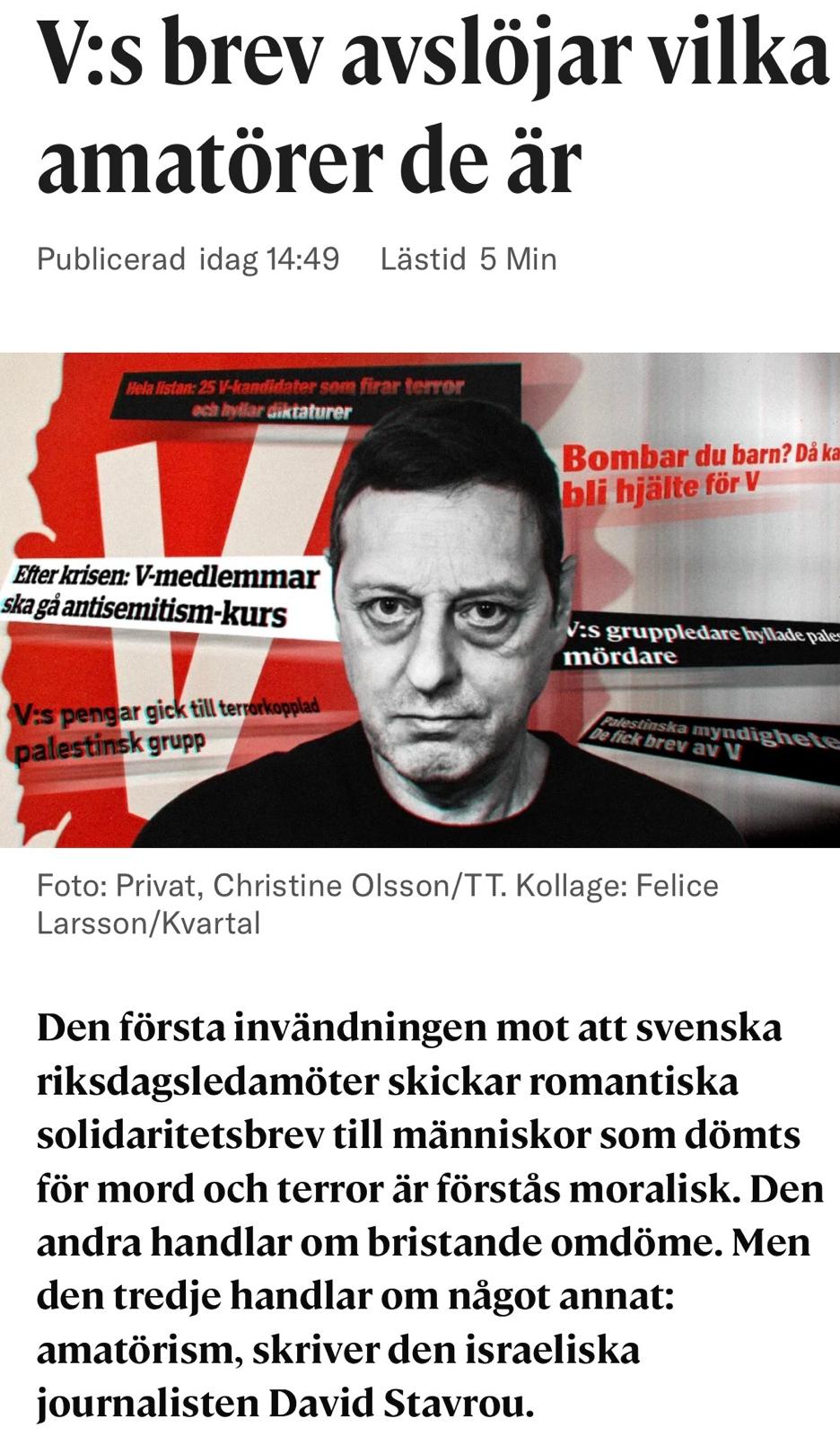
The Swedish Left Party’s letters reveal what amateurs they are

The first objection to Swedish MPs sending romantic letters of solidarity to people convicted of murder and terrorism is, of course, a moral one. The second concerns poor judgment. But the third is about something else: amateurism, writes Israeli journalist David Stavrou.

Published in Swedish in Kvartal: V:s brev avslöjar vilka amatörer de är – Kvartal

In the space of just a few days, journalists Sofie Löwenmark, Nathalie Rothschild and Inas Hamdan published investigations showing how members of the Swedish parliament had sent letters of solidarity to Palestinian prisoners convicted of very serious terrorism offenses and had participated in an organized campaign in which several of the recipients are serving life sentences for attacks against civilians.

In 2023, SVT revealed that aid money from the Left Party’s international organization had gone to a project with links to the DFLP, an organization that participated in the October 7 massacre. The following year, prominent Left Party figure Kristofer Lundberg was expelled after expressing support for the terrorist-designated PFLP. In Malmö, Orwa Kadoura left the party following criticism over antisemitic messages. In 2025, MP Lorena Delgado Varas shared a classic antisemitic conspiracy image, and as recently as June this year, the Left Party removed a large number of candidates who had praised Hamas’s October 7 attack, spread Holocaust denial and promoted antisemitic conspiracy theories.

All of this is, of course, serious. By now, it is clear that the Left Party has a problem with romanticizing terrorism and spreading antisemitism and conspiracy theories. This can no longer be dismissed as anecdotal. Every time you think rock bottom has been reached, another investigation appears with new revelations. But precisely for that reason, it is almost no longer interesting to discuss this as a question of values. Left Party members are free to believe whatever they want. The truly interesting issue is something else.

Politics is not merely an ideological arena. Politics is a profession. There are laws, practices, institutions and rules of the game. And then there is what in British politics is sometimes described as simply not done – things that may not actually be prohibited but that politicians nevertheless know not to do. It is like any other profession. Surgeons do not operate on gut feeling. Judges do not rule according to whom they instinctively like best. Even a passionate politician is expected to be able to control that passion long enough to do the job.

The first objection to Swedish MPs sending romantic letters of solidarity to people convicted of murder and terrorism is, of course, a moral one. The second concerns poor judgment. But the third is about something else: amateurism.

The Left Party’s explanation in the latest affair illustrates the problem. The party secretary has said that the names came from the Palestinian Association of Sweden and that the Left Party carried out no checks of its own. “There had been a mistake in the fact-checking,” MP Ilona Szatmári Waldau wrote. Nooshi Dadgostar has repeatedly resorted to variations of the same defense during the scandals of recent years. In June, she referred to the large number of Left Party representatives – more than 4,000 – and stressed that those exposed represented only a small proportion. She then said that “there are occasions when people turn up whom you haven’t kept track of.” She promised to tighten the party’s procedures, but that is clearly an almost impossible task, since many other Left Party members defend people who have expressed support for terrorist organizations.

If a blue-haired 17-year-old activist sends a love letter to an ideologically motivated murderer he saw on TikTok, perhaps he can get away with shrugging his shoulders or shouting along with Rage Against the Machine: “Fuck you, I won’t do what you tell me!” But members of parliament are not teenagers. They are adults, and adults are expected to evaluate their sources critically and ask questions. What does it look like when we become fixated on prisoners from a single international conflict while ignoring others? What diplomatic, trade-policy and security-policy consequences could our statements have? Which people and organizations are we legitimizing?

Is that boring? Does it involve compromise? Perhaps even moral coruption? Perhaps – if you live in a syndicalist collective, eat out of tin cans beneath posters of “freedom fighters” and say that “when the forest is felled, the chips will fly”. But the Left Party’s MPs are well-paid public officials who participate in – and enjoy all the privileges and perks that come with – professional politics.

That means it is part of the job to investigate the people and organizations you cooperate with, read court judgments, speak to embassies, diplomats, experts and lawyers, ask what is disputed and what has been established, and understand the consequences of your own symbolic politics. For example, when a professional politician becomes involved in another country’s prison system by writing a letter, they must understand how the people they are writing to are perceived by their victims, as well as understand another society’s sensitivities and collective trauma.

To a Swede, Ahmad al-Moghrabi or Ibrahim Abu Mokh may be unfamiliar names on a list of “Palestinian prisoners.” To an Israeli, those same names may signify deadly suicide attacks against civilians, murdered children or a young conscript who was kidnapped on his way home and never returned. You do not have to accept Israel’s policies in the West Bank or agree with the Israeli courts. You only need to be able to imagine the reverse situation. Imagine if foreign parliamentarians wrote to Jackie Arklöv and praised his “courage and perseverance” without checking the judgment against him. The first Swedish response wouldn't be a complex debate about Scandinavian geo-politics, it would be: Have you even bothered to find out who this person is?

This kind of disregard for the rules of politics – in which passionate conviction is allowed to cloud judgment and consequences and basic due diligence are ignored – has a name. It is called populism.

For many years, the Sweden Democrats have struggled with a similar transition – from a protest movement to a party with influence over the state. As part of that process, the party has run internal training programs under the title The Road to Power (Vägen till makten), although there is, of course, no reason to romanticize the results. SD continues to be plagued by recurring scandals. A training course cannot magically erase a political culture.

And this is where the parallel with the Left Party becomes even more uncomfortable. V has already tried the educational route. Following several antisemitism scandals, in the spring of 2025 the party invited its members to a two-hour training session on antisemitism. Every member received an invitation. Yet one year later, the party found itself with 25 candidates removed from its lists following revelations involving, among other things, precisely antisemitism. As the Swedish elections draw closer, the party is finding it increasingly difficult to convince voters that sympathy for terrorists, conspiracy theories and antisemitism among its politicians and activists is a bug. In its case, it seems much more like a feature.


Medelhavsmuseet's Selective History

When it comes to the past, Medelhavsmuseet (The Swedish Museum of Mediterranean and Near Eastern Antiquities) largely ignores Israel, but when it comes to the present the museum presents only different shades of the same narrative, one that excludes a balanced, mainstream Israeli perspective. This in itself is not necessarily a problem. However, since public funds are being used and this is all payed for by tax-payers money, why not invest in presenting all sides of the story? Are Israelis so dehumanized that their pain, loss, and sacrifice are not considered worthy of being told?

Published in Swedish in Svenska Dagbladet: https://www.svd.se/a/K8Bn37/medelhavsmuseets-selektiva-historia

The lecture hall at Medelhavsmuseet was full on September 4th. The evening seminar which took place there was called "Repair, Return and Reconstruction for Palestine’s Decolonized Future", and in case the message wasn’t clear enough from the name, during most of the evening there was a photograph of Gaza and a slogan in Arabic and English projected on the screen behind the panel members. The slogan read: “Glory to Gaza”.

The seminar itself wasn’t exactly intellectually challenging and the message was pretty straight forward. When Israel was mentioned by all speakers it was associated with very specific words. Genocide, occupation, oppression, destruction, starvation, ethnic cleansing, collective punishment and settler-colonialism were some of the favourites. There was also a consensus about the Palestinian reaction to the Israeli aggression. Here the popular words were: education, culture, conservation, de-colonization, renovation and restoration. Listening to the panel members it sounded like Palestinian resistance is all about Mahmoud Darwish poems, architecture podcasts and a struggle for free press.

In an hour and a half of debate there was nothing about Palestinian terror or violence, there were no suicide bombings or rockets, Hamas wasn’t mentioned and October 7th was just the date when the current Israeli offensive started. Since all panel members were engaged in architecture and restoration and apparently very well acquainted with Gaza, it was interesting that the immense military underground tunnel infrastructure, a remarkable architectural achievement in itself, was not mentioned. There was also no mention of another kind of physical destruction – the one of Israeli communities. No destroyed and abandoned kibbutzim, no apartments demolished by Qassam rockets and no homes burned to the ground with entire families still inside. There were no hostages, no executions and no organized rape and sexual violence. The whole event felt like a motivational inspirational gathering for activists, where all the speakers clearly presented a Palestinian narrative, and many in the audience were members of the so-called "pro-Palestinian" movement. Some wore kaffiyehs, a couple of them even had red triangles (a Hamas symbol) on them.

In itself, all this is completely legitimate. In a democracy, people are free to organize whatever seminar they wish. What is, however, somewhat troubling is that Medelhavsmuseet is part of a government agency (Statens museer för världskultur) funded by taxpayers, with tens of millions of Swedish Crowns each year. When Rani Kasapi, Head of Content and Learning at Världskulturmuseerna, opened the seminar, she also mentioned that other institutions were also involved in organizing it: the Swedish Institute of International Affairs (UI), the Swedish Research Institute in Istanbul (SRII), and the Swedish Arts Grants Committee. All of these are also fully or partially funded by Swedish taxpayers, raising the question – why should funds that could be spent on education and culture for the benefit of all be used for a one-sided, highly political event based on foreign policy propaganda?

Perhaps, the idea was to have another event to balance the message and show another side and a different narrative. And indeed, on October 7th, a very symbolic and politically charged date, another event was planned by the museum. This time the title was: What’s Happening in Israel Now? (Vad händer i Israel nu?). In a perfect world, this could have been the the missing piece, the event that shows that the situation is more complex than just propaganda. But the world isn’t perfect. According to publications, the event had only one speaker – Göran Rosenberg. The same Rosenberg who only a few months earlier described Israel as a "morally dead project" and questioned its future existents in its current form. It’s as if the museum invited an anti-vaxer to lecture about the importance of vaccinations. Was it really so hard to find another voice to describe the situation in Israel? One who at least believes in its future?
Medelhavsmuseet has hosted more events about the region in the last couple of years — for example, there was a book talk with Cecilia Uddén, one of Swedish media’s most critical voices when it comes to Israel. There was also a UI event featuring several Israeli left-wing activists. But the bigger picture is that, aside from rare exceptions, Medelhavsmuseet largely presents different shades of the same narrative, one that excludes a balanced, mainstream Israeli perspective. This in itself is not necessarily a problem. However, if public funds are being used, why not invest in presenting all sides of the story? Are Israelis so dehumanized that their pain, loss, and sacrifice are not considered worthy of being told?

Looking a bit deeper, it’s obvious that Medelhavsmusset doesn’t ignore the Israeli perspective only when it comes to the current conflict. For some reason, it ignores Israel’s existence all together (apart from occasionally mentioning it as a colonial bully destructing the fascinating, authentic and noble people of the orient). Israel as a modern state and the ancient Jewish entities in the Eastern Mediterranean like the Kingdoms of Jehuda and The Northern Kingdom of Israel are a treasure of history, archaeology and ancient culture. They’re the origin story of Christianity and Western civilization and a fascinating story of cultural, social and linguistic revival. Still, in the last twenty years of exhibitions, it seems like Medelhavsmuseet hasn’t had a single exhibition presenting Israeli or Jewish culture and history. I spoke with two historians who have studied this in detail. One of them said that “ancient Jewish history is almost completely erased from the museum’s portrayal of the ancient Mediterranean region”. The other said that for historical reasons, the museum focuses on Egypt and Cyprus, which is fine, but even when those cultures had strong connections to Jews in the region, those connections are usually not mentioned, and even on the rare occasions that they are the name Israel never is.

And they're right. Medelhavsmuseet has presented many exhibitions about Egypt, Greece, Rome, Syria, Cyprus, Turkey – and even non-Mediterranean countries such as Iraq. In fact, the only recent exhibition that touched on Israel was “Nakba,” which according to the Jewish Central Council was highly one-sided and sparked debate over whether the museum was pursuing a political agenda. The museum responded that “it is not a historical exhibition, but a small audio exhibition with stories”. When representatives from the Jewish Central Council met with the superintendent of Statens museer för världskultur regarding this, their concerns were not taken seriously.

There’s no doubt that the story of the Nakba should be told. It’s an important part of the region’s history. But if this was only a “small audio exhibition with stories”, where is the next audio exhibition with the other stories from the same war – for example, those about Holocaust survivors who were killed in the battle field after being freed from Auschwitz, or those about massacres of Jews that took place during the same time, or the ones about the Jordanians expelling the Jews from Jerusalem’s old town or the Egyptians illegally occupying Gaza?

During the debate with the Jewish Central Council, the museum mentioned one exhibition – Egypt’s Jews (Egyptens judar), perhaps as one with a more “Jewish narrative”. But the truth is that even when the exhibition explains how Egyptian Jews were attacked, harassed, arrested and expelled in the 1950s and 60s, it’s clear that the message is that this is a direct result of Zionism. The exhibition explains how for 3,000 years Jews were “totally integrated in the surrounding society” (helt integrerade i det omgivande samhället) and only when the UN decided to “divide Palestine” and the 1948 war broke out, Egyptians started “anti-Zionists riots” and resisted “foreign influence”. These texts are a wonderful example of verbal acrobatics. There’s no Egyptian antisemitism, no Muslim Brotherhood (the mother movement of Hamas) promoting genocidal racism against Jews, just an unfortunate mixing up (ihopblandning) of “Jews” and “Zionists”. This makes sense since one of the exhibition’s production partners was Magda Haroun, Head of the Jewish Community Council in Egypt and a vocal opponent of Israel who claims that Zionism is a racist movement. Interestingly, the exhibition which mentions the wars between Israel and Egypt, doesn’t discuss Egyptian President Saadat’s historic recognition of Israel and the resulting Israel-Egypt peace agreement. One can only assume that the reason is that if the museum tells its visitors about Egypt recognizing Israel, this may lead to a demand that Medelhavsmuseet does the same.

Standing Together and the BDS: The Swedish Version

Equal rights in a one state solution may appeal to Swedish sensetivities. But in the context of the Israeli-Palestinian conflict, it is a recipe for bloodshed.

Published in Swedish daily Svenska Dagbladet: https://www.svd.se/a/qP8yvL/bds-rorelsens-fred-skulle-sluta-i-katastrof

Israeli politics can be confusing for those who are used to a system which rewards accountability. One example is that even though Hamas' brutal attack in October 2023 was the biggest tragedy in Israel's history and part of a momentous failure of Israel's leadership, the government is still in place and seems to be stable enough to survive the crises. It's even confident enough to continue its controversial judicial overhaul which many claim is a direct assault against Israel's democracy. When it comes to the conflict with the Palestinians, Netanyahu's government is using the catastrophe as a pretext for going further to the right, perhaps even as an excuse for a future annexation of the West Bank which would be a tragedy for both Palestinians and Israelis who support peace, democracy and freedom.

This is why Standing Together, a grassroot movement of both Jewish and Palestinian Israelis who join hands in working for peace, equality, and social justice is so important. These are exactly the kind of people who can provide hope for Israel's declining peace movement. They can also be excellent partners for actors in the global community who are concerned about developments in the region and want to support positive change. And indeed, two of the movement's leaders are coming to Sweden. When I spoke to one of them, Alon-Lee Green, one of the movement's national coordinators, he told me that the visit's purpose is "to gather support for the fight to end the war, to end the occupation and to achieve Israeli-Palestinian peace".

But it seems not everybody wants to listen. Instead of encouraging Israel's brave opposition, some activists are horrified by the mere thought of Israeli peace fighters. One commentator on social media wrote: " I think it's important that as a movement we keep track of which groups we choose to collaborate with. Standing Together is boycotted". As a self-appointed moral compass, the activist then quotes a text by The Palestinian Campaign for the Academic and Cultural Boycott of Israel claiming that Standing Together is "serving a key role in Israel’s international propaganda strategy". One of the commentators who thanked the writer even added: "we don't recognize Isnotreal!".

Since October 7th the BDS campaign has been gaining support in Sweden. Professors, researchers and students call on their university to cut all ties with Israel, Amnesty cooperates with BDS-Sweden and lists of companies "profiting from the genocide" are all over social media leading to demonstrations and smear campaigns. All this shows what at least part of Sweden's left is all about. The BDS movement claims that Standing Together is serving "Israel’s 75-year-old regime of settler-colonialism and apartheid". Nothing could be clearer – the BDS movement isn't against specific Israeli policies, it isn't against a specific government or a specific war. BDS activists' real problem is the very existence of Israel. When they talk about 75 years of settler colonialism, they're not talking about the 1967 occupation of the West Bank and Gaza, they're talking about the 1948 UN decision to found a Jewish state, and an Arab state, in Palestine. The people who don't want to listen to Israeli peace fighters are doing it simply because they are against peace between Israelis and Arabs. According to them Israelis are the original colonialist sin and they should just disappear.

Do these attitudes belong only to a handful of extremists or are they spreading to Sweden's left as a whole. A good indication is the debate about the so-called two-state solution. Those who still support it, even though it seems almost impossible to achieve, are promoting a solution which includes a compromise between two legitimate national movements. Lately, however, the idea of a one-state solution is becoming popular. Swedish academics are writing texts about one state based on "one citizen-one vote", in the Swedish Left Party congress last May many party members promoted changing the party's position to supporting a one-state solution and further to the left, Fi (the Swedish Feminist Initiative) and the new "Solidarity" party, already took the step. Fi even claims that "Zionism is an imperialist and racist ideology". Anyone who witnessed a pro-Palestinian demonstration during the last few months knows this isn't a minority. The most popular slogan doesn't leave room for doubt – "From the river to the sea Palestine will be free", Not "Palestinians will be free". Palestine means a state – one state, not two, from the river to the sea.

In Sweden's radical left there are those who take it even further. There's a at least one youth movement (RKU) which supports the October 7th "historic offensive in which the Palestinian resistance broke open the prison bars". Another "solidarity movement" (Samidoun) supports the PFLP, an organization which took part in the massacre. In addition, there are plenty left wing-oriented publications which continue to support the narrative which sees Hamas as an anti-imperialist decolonization force. All these movements support a one state solution. Just like Hamas and the most radical Jewish extremists.

One state with an equal vote and equal rights may sound appealing to Swedish sensibilities. Indeed, why not have nothing to kill or die for and no religion too? The only problem is that in the context of the Israeli-Palestinian conflict one state is a receipt for a blood bath. Most Palestinians who support a one state solution mean a Palestinian state. Most Jews who support it mean a Jewish one. The result of such an experiment will either be apartheid or some version of ethnic cleansing or genocide. The only question will be who's killing who.

When I talked to Standing Together's National Coordinator he said that the movement doesn't support a specific model of solution. "We support an Israeli-Palestinian peace", he said, "one that will enable everyone to live in freedom, equality and independence". When it comes to the boycott movement Green says that Standing Together is the largest Israeli movement fighting for peace and against occupation. "We've been protesting all over Israel for 15 months, we arrange aid for Gaza, our activists are fighting settlers who attacked humanitarian aid convoys and we demand an end to the killing", he says, "if anybody wants to argue with us about words that we say or don't say, they can write an essay and perhaps we can discuss it in some lecture in the world of academia. But in the world of politics and actions, the one that we focus on, the BDS statement about us has no influence where we live. It wasn't even translated to Arabic".

The BDS movement leaves no room for Standing Together. It only accepts Israelis who think that their country shouldn't exist. But the men and women of Standing Together are different. They love Israel and they're fighting to make it better. They realize that both Jews and Arabs are there to stay and they promote pragmatic compromises rather than holly wars and abstract ideologies. This is why the Olof Palme Center, the Robert Weil fund and Kulturhuset made the right choice when they invited them to Sweden. Naturally, those who are against Standing Together have the right to protest, but we shouldn’t call them peace activist, we should call them what they really are – dogmatic chaos agents who, if they get what they want, will lead both Israelis and Palestinians to a catastrophic disaster.

!Say it: Yes, I condemn Hamas

The discourse within the Swedish and European left is important even if you're not part of it and the insane embrace of Hamas by so-called left-wing radicals, climate change fighters, human rights activists and western intellectuals and academics must be challenged.

Originally published in Swedish in Parabol: https://www.parabol.press/andreas-malm-har-fel-om-hamas/

Imagine this powerful image: in a country which is slowly being taken over by right-wing nationalists, it's becoming harder to speak truth to power and to speak up for the underdog and the repressed. But then, from the trenches of the opposition, rises a fearless figure. He knows he'll be arrested and tortured if he's caught crying out, and so he does what intellectuals from resistance movements allways do under tyrannical regimes. He uses sarcasm, he sharpens his pencil and cleverly plays with words to produce a text which is radical and subversive, but at the same time meticulously designed not to be flagged down by the authorities. That way the avant-garde academic doesn’t get in trouble with the all-powerful secret service henchmen who are hunting down traitors.

Sweden 2024. While a war is going on in Gaza and in Israel, the whole political elite is powerfully supporting Israel. It's blue and white from left to right and it's not allowed to speak up for the Palestinians. And then, a single voice of a brave dissident rings out. He wrote a text. It's called "I Condemn Hamas" and it's brilliantly designed by a rhetorical trick – the title is mainstream and boring, everyone condemns Hamas. The content seems to be the same, but under the surface lies the explosive message – it's the exact opposite of condemning Hamas, it's actually supporting it (Malm, Anders, Jag Fördömer Hamas, Parabol, 01/11-23). At last the opposition has a voice – Andreas Malm has weighed in. It's a powerful text and a powerful image. The only problem is that none of it is true.

Malm's claim is clear – everyone's condemning Hamas, mainstream media, politicians and public discourse in general. He, on the other hand, thinks this is false. Hamas may have killed civilians, kidnapped children and burned down residential buildings on October 7th, but according to him this isn't unique. It's all been done before by Israel. Malm doesn't claim this directly. He does it by sarcasm. The same kind of sarcasm is pointed at the Swedish discourse. "In Sweden there are strikingly few who have condemned Hamas in the past few days. Those who have done it have only done it once, so that we now wonder if it was really meant honestly", he writes creating an illusion which is the exact opposite of the truth. In fact, Sweden is one of the countries in which the Hamas did surprisingly well. At least for an organization which is internationally recognized as a terror organization.

Hamas supporters have spoken openly in conferences and seminars in Sweden, money has been raised for Hamas freely in Sweden; just in the last few months there have been dozens of pro-Palestinian demonstrations with speeches supporting Hamas or at least not condemning them including demonstrations celebrating the events of October 7th on the day they happened. Unlike other countries, these demonstrations are not only legal, they're supported by some of the political elite and many in the media, in the cultural world and in civil society. Malm's style implies that Swedish publicists have to condemn Hamas or they'll be cancelled. Nothing could be further from the truth. In fact, Malm himself is a writer who has supported Hamas publicly in several newspapers, magazines and publications. As far as I know, he's yet to be arrested, censored or fired. In Sweden it’s allowed to burn the Koran, join parties which support North-Korea and have Neo-Nazi marches on Yom-Kippur. No one's preventing anyone from supporting Hamas. Indeed, I recently met Hamas supporters in Sergels Torg. They were members of two perfectly legal Swedish movements, RKU, the revolutionary communist youth movement and NMR, the friendly neighborhood neo-Nazis. Who knows, perhaps Andreas Malm himself was there supporting them both.

However, the Swedish context is only the beginning of Malm's mistake. The claim that the massacre on October 7th was more of the same, that it was Palestinians retaliating with the same kind of violence Israel uses, is worth studying. "What happened on Black Saturday, October 7th was something new in the history of the Israeli-Palestinian conflict", Malm writes using his smug self-satisfied irony, "it redraws the political and moral map of the Middle East for good. Gunmen stormed into communities and shot children to death with rifles. They did not care at all about the age of the victims. Hundreds of civilians were killed – people with no connection to any military activity, murdered simply because of their identity. Entire families disappeared". If this wasn't so true, it would be real cutting-edge political satire. But Malm's satire, is in fact the sad truth. Nothing like October 7th ever happened before in this conflict. Israelis and Palestinians never killed so many people in one attack or in one day. Not in Kafar Qasim (1956), not in Deir Yassin and Tantura (1948), not in Hebron (1996) and not in the bombings of Gaza in previous years. There were never so many acts of torture and violence against civilians, never so many people kidnaped and never such brutality. And yes, October 7th did redraw the political and moral map of the Middle-East for good. I couldn't have said it better myself.

Israel made many mistakes in the last few decades; like any other army it has committed war crimes during conflict, some of its civilians, especially in the West-Bank are violent extremists and its occupation of the West-Bank continues to be a hindrance to peace in the Middle-East. But October 7th was unique. It's not only about the brutality or the number of victims. The really scary number is the number of the people who committed the crimes. Unlike 9/11 which was executed by a small Jihadist vanguard of 19 Al-Quade operatives, and unlike Utøya which was the work of one (Andreas Malm cracks a little clever joke making the comparison), October 7th was carried out by about 3,000 people. Many of were sipplied with written instructions about how to murder, torture and kidnap civilians, some were also provided with drugs and with body cameras. This wasn’t a spontaneous, heat of the moment action. It was a planned strategy. On October 7th the world saw a society capable of drafting 3,000 people who were 100 percent committed to murder.

Andreas Malm perhaps hasn't heard the story told by David Tahar, father of Adir Tahar, an Israeli soldier who was killed on October 7th. Tahar told Israeli Chanel 14 that before the funeral he insisted on seeing his son's body even though army officials advised against it. The reason was that apparently after he was killed Hamas fighters decapitated Adir and took his head back home to Gaza. A few weeks later, after receiving intelligence from captured terrorists, an Israeli military unit retrieved the head. It was hidden in a bag with some tennis balls and a few documents inside an ice-cream shop freezer in Gaza. Apparently the head was up for sale. The price was 10,000 US Dollars. I know there are many who don't believe Israeli media and think that Zionists fathers are so perverted that they can make up this kind of story for propaganda purposes. So here's another one. This time from the New York Times.

Sapir, a 24-year-old accountant who attended the rave party near Kibbutz Reim on October 7th gave a testimony which was reliable enough for the NYT which told the story of what she saw from her hiding place (Gettleman, Schwartz and Sella, "Screams Without Words": How Hamas Weaponized Sexual Violence on Oct. 7", The New York Times, 28/12-23). Sapir says she saw "a young woman, blood running down her back, pants pushed down to her knees. One man pulled her by the hair and made her bend over. Another penetrated her. Every time she flinched, he plunged a knife into her back. Sapir said she watched another woman "shredded into pieces". While one terrorist raped her another pulled out a box cutter and sliced off her breast. "One continues to rape her", she said, "the other throws her breast to someone else, and they play with it, throw it, and it falls on the road". She said the men sliced her face and then the woman fell out of view. Around the same time, she said, she saw three other women raped and terrorists carrying the severed heads of three more women.

These are just two testimonies from October 7th. There are thousands more. One could always claim, as Malm does in earlier texts, that all this violence should be seen in context. But this kind of violence has no context. If it was really about freedom, or fighting the occupation there would be no need for mass rape, kidnapping babies and removing body parts. The atrocities, the rockets, the tunnels and the complete subordination of Gazans to Hamas militants are all far darker and more sinister than Malm's theories. It's not the price paid for Israel's colonialism. If for no other reason, because this isn't colonialism. Israel isn't Algeria.

According to Malm, the conflict between Israel and the Palestinians isn't a war between two indigenous peoples which have a legitimate claim to the same territory and therefore are engaged in a violent conflict. Instead, there is one legitimate native nation and for over a century it has been fighting an occupation by invaders who came from other countries as colonizers. The invaders are supported by imperialist powers and they are now committing genocide. This kind of aggression according to Malm must be, should be and always has been resisted with violence. In fact, Malm's latest text is one of many in Parabol making the same claim.

These texts rarely even mention the events of October 7th which I would suggest is a sign of total moral bankruptcy. But that's me and I may be biased. The problem here is different, it's about intellectual honesty. The description of the Israeli-Palestinian conflict as a story of a colonial power murdering the natives is incredibly shallow and misleading. It's perfectly ok to oppose Israel's policies (as I do myself most of the time), it's perfectly ok to name-drop Edward Said and Franz Fanon, make comparisons to Apartheid South-Africa and quote Israeli officials making outrageous genocidal statements which can then be quoted at the ICJ in the Hague. But people who have studied the region, as I guess Malm has, know very well that Jews, not only Palestinians are natives to it. And no, I'm not referring to Jesus and Abraham. Biblical stories cannot be a base for international geo-politics. I'm referring to facts completely ignored by the whole post-colonial discourse.

Take Gaza, for example, in the place where Rimal, the political center of Gaza City used to stand, a synagogue was built in the year 508 AD. We know that the figure in the center of the ancient mosaic which was found there is King David. How do we know this? Because his name is written there. In Hebrew. Gaza has a long bloody history – Romans, Christian Crusaders, Arab armies, the Egyptians, Napolean's army, the Ottomans and the British Mandate all controlled Gaza. During this history, Jews lived in Gaza, they didn't arrive in ships in the 1940s. They were there during the time of the Romans, 2,000 years ago, they were there in the Middle-Ages and during the time of Islamic rule, then again in the 14th and 15th century and under the rule of the Ottoman empire. Some were still there even after WW 2.

As in many other areas in the region, for thousands of years, Jews thrived and declined in Gaza, they were expelled and fled, they killed and were killed, built and destroyed, returned, immigrated and emigrated. Arabs in the region have a similar, though somewhat shorter, story (I'm referring to them as Arabs, because the name Palestinians wasn't used in the way that we use it today until after WW2). The story of the region being a land inhabited by indigenous Palestinians who were attacked by American, European and Russian Jews arriving from abroad after the Holocaust and kicking out the natives is a fairytale. Concepts like colonialism and indigenous peoples aren't abstract. Unfashionable as it may seem, these things have actual meanings beyond TikTok clips made by demonstrators wearing fashionable red, white and green scarfs. They can be discussed in terms of archeological findings, origin and descent, historical continuity of settlements, language and culture, collective ancestral ties to a territory and to natural resources, self-identification, experiences of subjugation and discrimination and so on. It may be frustrating, but when it comes to Israel, to the West-Bank and to Gaza, both Jews and Palestinians are natives. They're all a combination of immigrants and people who are decedents of families who haven't left for generations. And they've all suffered from violence, massacres, displacement and trauma.

And there's another similarity between the Jewish national movement (aka Zionism) and the Palestinian one. They both have a genocidal wing. These are the people on both sides who don't accept the idea of territorial compromise in order to achieve peace. The people who are willing to go as far as killing or expelling the other group in its entirety. They're usually religious fanatics, they're extremely violent, they totally oppose democracy and human rights, they're willing to kill and die for the cause and they've always been around. On the Jewish side, they began to become a serious threat after Israel's 1967 victory with the rise of the settler movement in the occupied West-Bank. These days they're becoming stronger, they're getting closer to government circles, but they're still far from being anywhere near a majority in Israeli society.

On the Palestinian side, things seem to be worse. If on the Zionist side there was a right-wing revisionist leader, Zeev Jabotinsky, who had a connection with Mussolini in the 30s, the leader of the Arab nationalists in Palestine at the time, Haj Amin al-Husseini, spent WW2 in Berlin and in Rome, he collaborated with the Nazis and the Fascists, he personally met Hitler, Himmler and Mussolini and was a supporter of the "Final Solution of the Jewish Problem". Al-Husseini was just the beginning. The Palestinian National movement has always had an active and extremely popular genocidal side to it. It's not because of Israel, because it started many years before Israel even existed. And it's not unimportant because what we saw on October 7th was a direct result of the same kind of ideology.

That's what's really amazing about Andreas Malm's text. Hamas is the genocidal wing of the Palestinian national movement and its ideological roots go all the way back to Nazi Germany. Although it was seen as a traditional grassroot, social and religious movement when it was founded in the 80s, it's now a modern, extreme right-wing movement combining Jihadism, high-tech disinformation campaigns, a financial empire of global investments, leaders who live a life of luxury outside the region, modern weapon systems and powerful alliances with the world's most tyrannical regimes. Anyone imagining the Hamas as a young David standing up to the Israeli Goliath is living in a naïve lullaby.

But Andreas Malm isn't naïve. He knows very well that the geo-political realities show that Hamas and indeed the Palestinian national movement is far more complicated than just a victim of western colonialism. He knows about the Israeli disengagement from Gaza in 2005 which means there was no occupation of Gaza for almost two decades. He knows that the blockade on Gaza is just as much an Egyptian policy as it is an Israeli one and that many Arab countries want Israel to destroy Hamas. He knows that the Hamas charter is an antisemitic and fundamentalist text. He knows that Hamas has crushed the secular Palestinian national movement in Gaza and that it sees the Palestinian Fatah movement as an enemy which is almost as bad as Israel. He knows about Hamas' brutal war against the Palestinian Authority and he knows about the unprecedented Hamas military buildup and take-over of civil society in Gaza.

The reason that I know that Malm knows all this is because of other texts that he wrote. Reading them one learns a lot about his way of seeing the world, though I must admit, it's sometimes a confusing task. Although he seems well versed in Middle-Eastern politics, when it comes to moral statements and political conclusions, his considerations are so complicated, it's hard to keep track. Although Israel is always wrong (that's the constant) when it comes to Palestinians, Arab states and Islamic super powers, the target is painted around the dart after it's been thrown.

In a text he wrote a few years ago (Malm, Andreas, "Därför Hamas", Expressen, 15/01-09) he claims one can have two thoughts at the same time, like the Palestinian left which allies itself tactically with Hamas but at the same time supports the opposition in Iran while the opposition in Iran is fighting the Iranian regime at the same time the Iranian regime is funding Hamas. It's ok if you need to read the last sentence again.

Malm's reasoning is not that unique. He supports Hamas and its fight against what he called the "corrupt Fatah politicians" and Mahmoud Abbas, who's an Israeli and American "marionet". If this sounds familiar it's because this is exactly the same logic used by Israeli PM Netanyahu who for years has been undermining the Fatah controlled Palestinian Authority by allowing Hamas to stay in power in Gaza so that he wouldn't have to take real steps towards a two-state solution. Surprisingly enough, Malm and Netanyahu are on the same side. They'll both do anything to avoid compromise and consolidation.

In another text from 2009 Malm referred to Hamas as a liberation movement which is "forced to resort to every possible form of resistance" (Malm, Andreas, "Vi bör följa Iran och stödja Hamas i kampen mot Israels folkmordspolitik", Newsmill, 04/01-09). In the same text he quoted Nir Rosen, who claimed that "Attacking civilians is the last, most desperate and basic method of resistance when confronting overwhelming odds and imminent eradication" (Rosen, Nir, "Gaza: the logic of colonial power", The Guardian, 29/12-08). Malm is entitled to write these kind of statements even if they encourage violence and are fascist in nature. I only hope that most Swedes, including those who support the Palestinians, can see beyond this tragic war mongering, since it's clear to anyone what this means politically. Hamas will continue murdering Israelis; Israel will have to retaliate and will do so forcefully – and more Palestinians will be killed. If there's anything that hasn't changed in the last few decades it's this dynamic.

Hamas is not the only problem. In another text Malm openly supported Hezbollah (Malm, Andreas, "Därför Ska Vi Stödja Hezbollah", 11/08-2006), an Islamic movement funded, trained and inspired by the Iranian Ayatollahs and their Islamic Revolutionary Guard Corps, which was involved in suicide attacks, political assassinations, bombing of civilians and hijackings in Lebanon and other countries. I don't know how Malm manages to pull off being a left wing radical and supporting two of the most conservative, fascist, chauvinist, fundamentalist, hierarchical, anti-democratic, homophobic and xenophobic movements in the history of the known universe, but I know that explanations along the lines of "I can't be expected to condemn actions taken by the weak and oppressed” can't work anymore after the massacre of October 7th which was a tectonic, world-changing event. Not condemning it, or in Malm's case, condemning it sarcastically, means supporting it.

This period isn't easy for the global political left. Just like in the 1950s when left-wing activists, politicians and intellectuals had to decide whether to stay faithful to the Stalinist flagship even after it was exposed as a sadistic killing machine of gulags and mock trials, today's left must decide if its alliance with the dictators, Jihadists and militants from Gaza, Teheran, Beirut and Doha is more important than its ideals. Those who have the courage to choose their ideals and abandon their old murderous  allies will not have Andreas Malm's problem. They will be able to proudly say "yes, I condemn Hamas".