The pioneering French feminist thinker returns to her family’s roots in Germany and Algeria in her Berman Prize-winning book. In an interview with Haaretz, she discusses Netanyahu’s government and why she still wants Israel to survive.
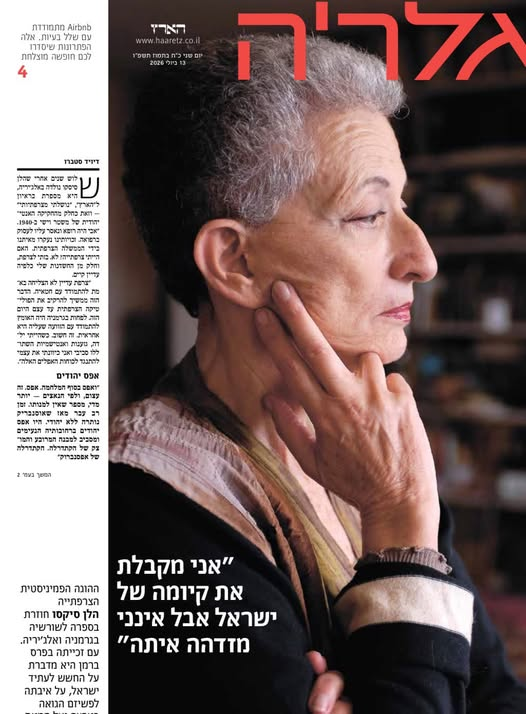
Published in Haaretz: Hélène Cixous: 'I Accept Israel's Existence, but I Don't Identify With It' – Art & Culture
Three years after Hélène Cixous was born in Algeria, she recounts in an interview with Haaretz, “I was dispossessed of my Frenchness” as part of the anti-Jewish legislation of the Vichy regime in 1940. “My father was a doctor and was forbidden to practice medicine. Our rights were stripped from us by the French government. Was I French? No. I despised France, and some of my suspicion toward it still exists.
“France has still not truly managed to confront its sins. This continues to rot French politics to this day. At least Germany had the courage to confront the horror for which it was responsible. That is important. When I was a child, racism and antisemitism raged around me, and I directed myself to oppose these dark forces.”
Zero Jews
“And zero at the end of the war. Zero, that’s enormous, and according to the Nazis, too much, an innumerable number… It had been a long time since Osnabrück was without a Jew, there were zero Jews in the charming streets and around the solid, square body of the cathedral of Zerosnabrück”.
This passage from Hélène Cixous’s book Osnabrück Station to Jerusalem captures the essence of her latest work. Part memoir, part family history, the book combines the great Jewish tragedy with philosophical reflections on Jewish existence.
As is her custom, Cixous employs her creative powers in writing not only in relation to her characters but also toward language itself. Osnabrück, the German city from which her mother’s family originated, becomes “Zerosnabrück” after it is emptied of its Jews. In 1934, 435 Jews lived there, Cixous writes; after the war, the number was zero.
Both historically and magically, the city is linked to Jerusalem: both become landscapes of memory and longing, both are inhabited by the living and the dead and stand at the center of the attempt to understand what it means to be Jewish when one’s world is shaped by displacement, catastrophe and the search for a home.
Osnabrück acquires an almost mythical status throughout the book. For Cixous, it is not just “Zerosnabrück”; it is also “the Paris of Lower Saxony.” Like Jerusalem, it is both real and a surreal dream where living characters meet the dead, and where the book itself becomes a character and speaks with its author. All of this occurs across timelines and locations that jump between the Holocaust in Europe and Algeria and the Middle East, incorporating biblical references, Greek mythology, European classics and Shakespearean tragedy.
All of this greatly resonated with the Swedish Berman Prize for Literature committee, which selected Cixous and her book – published in French in 2016 and in English in 2020, and not yet translated into Hebrew – as the 2026 prize winner. The award ceremony will take place in October. It is one of the most prestigious literary prizes, including a cash award of one million Swedish kronor, approximately 320,000 shekels, and is awarded to writers whose work illuminates Jewish life while also addressing universal human questions.
The prize was founded in 2020 by Swedish philanthropists Thomas and Catharina Berman, through a private donation intended to support Jewish culture and strengthen Jewish literary tradition. Thomas Berman said that the rise in antisemitism was one of the reasons for establishing the prize.
The first recipient was David Grossman, for his body of work, and other recipients include Hungarian author Péter Nádas, Russian-Jewish author, poet and journalist Maria Stepanova, and Jewish-Guatemalan author Eduardo Halfon. This year, the prize committee praised Osnabrück Station to Jerusalem, describing it as a work that “traces the void left by the displaced, maps absence and gives voice to those who can no longer speak.”
A Wonderful, Mysterious Place
“Osnabrück is like Jerusalem: one must go there, one must present oneself before its faces, one must let it speak and advance toward its language as before the monster Behemoth about which God boasts to Job, one must touch it with one’s fingers, one’s feet; one cannot know it from a distance. It’s like the sea: even from two yards away one doesn’t know it, one must throw oneself into its arms yelling.”
Cixous was born in Oran, Algeria, in 1937 to a German-Jewish mother who was a midwife and a Sephardi-Jewish father. For more than six decades, she has addressed questions of identity, language and memory. She is best known as the author of the essay The Laugh of the Medusa (1975), one of the foundational texts in modern feminist literary theory, which established her status as an influential thinker and one of the mothers of post-structuralist feminism.
Cixous worked closely with Jacques Derrida, who referred to her as “the greatest living writer in our language.” In her early 30s, in 1968, she participated in the Paris student revolt and in the founding of Paris 8 University, an institution intended to serve as an alternative to the traditional French academic environment. In 1974, the university became home to a center for women’s studies founded by Cixous, the first of its kind in Europe. She also maintained a lifelong interest in questions concerning her Jewish history. These questions are at the heart of Osnabrück Station to Jerusalem.
Is her book intended to give voice to those who can no longer speak? “When I write, it’s not I who has intentions, it’s the book,” she replies. “The book has its urgency and it doesn’t aim at this or that consideration. It’s true that it gives a voice to the void, like everything else that has been written, because of the huge field of tragic events. But writing is always giving a voice.
“In this case, it’s all somehow in the title, it’s a singular experience, of my relation to history, to politics, to tragedy. The voice of my writing is a mixture of tragedy and comedy and my material is partly autobiographical, partly theater and the obsession that led me to the book was going to Osnabrück.”
The obsession she describes is preservation through family dialogue, fantasy and therapy. Throughout Osnabrück Station to Jerusalem, the dead refuse to disappear, and the book seems full of ghosts – mothers, grandmothers, murdered relatives and those born long after the war, vanished neighbors and destroyed communities. All reappear in dreams, conversations, fragments of language and works of art. The living and the dead merge into one another. The visit to Osnabrück thus becomes not only a journey to a specific place but an encounter with the voices of a lost world.
The city that gives the book its title occupies a remarkable place in Cixous’s imagination. “It’s a place that no one knows. Even the Germans don’t know it,” she says, “but it’s a historic city, one of the two where the Treaty of Westphalia was signed in 1648, ending the Thirty Years’ War. It’s a wonderful, mysterious, fantastic place which fascinated me as a child. I was born to a mother who came from Osnabrück and lived in Oran, an Algerian city which was then part of a French colony. I saw Osnabrück as kind of a light in the distance, just like Jerusalem is seen by so many people.”
She recalls visiting Germany repeatedly with her mother and grandmother while carefully avoiding the city itself. “We went to Berlin, to Cologne, to Bonn, but never Osnabrück. It became something I wondered about – what’s wrong with Osnabrück? Why do we never go there?” She remembers how an official invitation from the city itself arrived for her mother and aunt to come back to the city for a visit. A discussion then began between the two women, which started as a conversation about hotels but became an argument about history and forgiveness.
Eventually, her mother decided to go. “This generation is not our enemy,” Cixous recalls her mother saying. “We don’t have to forgive them. We have to go on and accept the reality of history”. Years later, when Cixous suggested to her mother that they return to Algeria together, her mother refused, explaining: “In Germany, they invited me and asked me for forgiveness. In Algeria, I was kicked out after helping thousands of Algerians come into this world as a midwife.” Only after her mother’s death at the age of 103 did Cixous herself finally travel to Osnabrück.
Since then, she says, she has become “a kind of honorary citizen” there. When she spoke there, she reminded the city’s residents that peace itself can never be taken for granted, and that her own presence is conditional. “If in twenty years you become Nazi, as it sometimes happens,” she said, “it won’t be possible.” This remark captures the central tension in her book: the best and worst possibilities remain simultaneously present.
Does the book represent a return to Jewish roots after decades primarily spent on gender and feminist theory?
“Things are not that simple. The Jewish theme has always been there in a way,” she says and adds, smiling, that “I have a history in resisting the forces of evil. I grew up in colonial Algeria in a family opposed to racism and colonialism, while simultaneously becoming victims of antisemitism. I have, of course, always been on the side of the colonized.
“This wasn’t easy in Algeria where the colonizers were French. I hated the French since I was born. My family was in a situation of being part of a small minority of those who were strictly hostile to racism and colonialism. But this was not perceived in Algeria. From their perspective, we were supposed to be French.
“Later, when I was 18, I arrived in France, and I became ‘re-Frenched,’ although I doubt if one can really become re-Frenched and the truth is that I feel like I never really arrived in France. Then the social and political landscape changed, it was totally foreign, and gradually in two or three years, I started to think that antisemitism isn’t the question any more. On the other hand, I got this horrible feeling that they hate women here".
“It wasn’t an issue of class – it was men against women. Everywhere in society. The urgent fight wasn’t for Jews; it was for women. This is a fight of thousands of years. It’s still that way and it will go on. But every now and then, there’s another cause that becomes the main one for a specific period, and you have to decide, like a general of an army, where your forces are most needed. In the last few years, for example, it happened with Ukraine. And then Israel and Gaza came back again. Sometimes, you need to divide your strength.”
Hesitation Is Food for Fascism
“I can be many things, but being Jewish is always there,” Cixous says. She explains that she can easily make peace with her identity as a woman. “It may be divided into all kinds of tendencies but it’s basic, it’s primitive.” Her Jewish identity and her relation to Zionism and Israel is a different matter.
“It goes back to my mother,” she says. “She grew up in the days of a ‘beautiful Zionism’ – the dreams of young socialist Jews. But she resisted because of her story, which was against anything nationalist. Her father was enrolled in the German army and was killed as a German Jew, and so her way of looking at history was very rational.
“I was a girl when Israel was created, and I saw in Algiers the first emissaries trying to get Jews to go to Israel. I was prudent to that. I immediately thought that I wasn’t going to feel at home with a movement that unfraternally became colonialist. It was unavoidable. So, of course, I understand the creation of Israel, of course I was moved by it. But it couldn’t escape colonialism. “I came from a country where the Arabs were colonized. So, I just watched Israel. I never thought that belonging to what they called ‘the Diaspora,’ which we’re not, is negative. It is a way of being a citizen of the universe. My mother went to Israel to visit the part of her family that moved there. I refrained from doing that. I thought that I shouldn’t go if I don’t identify with Israel. I didn’t want to just be an observer. I like to be involved.”
Couldn’t what you call colonialism also be understood as Jews returning to their homeland?
“I could understand that the emissaries thought that they are returning to their homeland. I could also understand those like the members of my family who escaped the destruction of the Holocaust to Palestine which later became Israel. But for me, this wasn’t the only way. I thought we could be free and choose, and we had many ways to react to these terrible events. I accept Israel, but don’t identify with it. And this is the case for many people”.
Cixous’s attitude to Israel is complex. She doesn’t accept Jewish nationalism, but also doesn’t deny the tragic dimension of Jewish history and the antisemitism that led to Zionism and the establishment of the Jewish state. She is also well aware of how people react to disasters, and in this case, it is a central part of the story of the exodus from Europe and the establishment of Israel.
One of the most powerful themes in your book is the inability to recognize an approaching disaster – as happened in Osnabrück with the rise of the Nazis. How can this be understood?
“The hesitation when a radical change in one’s life is involved is common. In our days this mechanism of the human psyche is obvious when we’re facing the possibility that extreme right fascism will win the presidential elections in France. France is a very political place so everywhere I see people talking to each other about our next elections saying things like ‘next year in hell.’ They discuss what they will do on election day. Some say it’s not going to happen, others say it will happen if we don’t unite. All these discussions are taking place everywhere, and you can see the human soul hesitating”. For her, this hesitation is dangerous. “It’s the food for fascism,” she says.
The contrast within her own family remains instructive. “My grandmother stayed and didn’t leave Osnabrück until after Kristallnacht. My mother, who was a young woman, left the moment she smelled the stink of fascism. She never hesitated.” Other family members perished.
In Israel’s current war, there is a place where gender, sexual violence, and Middle Eastern politics collide in a tragic way: the sexual violence committed during the Hamas attacks of October 7. Many Israelis felt deeply alienated and outraged by the way parts of the international feminist movement appeared unwilling to express sympathy for Jewish victims. What do you think about this?
“This is a monstrous event. It will remain in history and the consequences go deeper and further than can be imagined. To the horror of my kind of people, it divided even the feminists. There was something hideous about the fact that when French Jews reacted passionately to that horrible event, some parts of the French feminist movement were so anti-Israeli and pro-Palestinian that they had no sympathy for the Jewish women who were affected.”
Cixous described this as a moral failure. “These are the perversions of the way people identify with one cause and exclude others. It’s horrible.” Her own position, she says, was unequivocal. “For me, of course, there were no hesitations. This was a terrible crime. Hamas is a cruel, hateful movement like many other movements in the Arab world. The whole world is a victim of Hamas. But now, so many people, countries and movements are also victims to the blindness and craziness of the Netanyahu government.
“The time has come, and it came a long time ago, to stop being colonial and accept the fact that others also have rights. History has decided that this piece of the planet Earth should be shared by Jews and Palestinians.” She worries that Israel is exhausting reservoirs of international goodwill built over generations. “They’re self-destructing and they’re destroying the capital, the inheritance of sympathy and understanding from others.”
This is criticism stemming from concern rather than detachment. “I would like Israel to survive,” she concludes, “but it’s alienating the countries that support it. It’s tragic”.
For Cixous, Israel is not only its politics; it is also the story of exile and migration. “Each migration has its own structure. It requires such courage. It requires giving up and starting again. That’s one of the reasons that I understand the creation of Israel, and literature gives these experiences their deepest human meaning. I really admire Israeli literature which deals with this and the great writers who give these events their deep humanity.” When asked for examples, Cixous says that she loves the works of Aharon Appelfeld and enormously admires David Grossman.
The Gatekeepers
Toward the end of the interview, Cixous reflects on the present moment. “Very often I think that what is happening now, I have already lived through as a young girl, in the 1930s,” she says, but adds that history never repeats itself exactly. “Obviously, technology, the fact that we may be dispossessed by ourselves with AI, is unimaginable. We – who read, who still want to think, the guardians of art – we have to strengthen that part of mankind. Whenever a European country goes the way that Hitler’s Germany went, it contaminates everything, it becomes possible, it seduces other countries. We can be thrown into a period like the one of the plague.
“People keep saying that Europe is weak, divided and ungenerous. That’s why Europe needs to have an army. In the past, it went against its humanistic principles, but this pacifism doesn’t work. It’s not enough to just be on the side of peace and diplomacy. No, when arms are used, you have to resist with arms.”
And beside an army, what’s the role of public intellectuals in such times?
“The concept of public intellectuals is a recent invention. It started with the Dreyfus affair – and it’s extinct. There are no important public intellectuals. There may be media intellectuals. It doesn’t mean that it won’t happen again. I don’t know. Something may come back, but these wonderful moments of light, like the one in 1968, are extinct.”
Cixous’s concern about recurring patterns of extremism and hatred, and the temptation to underestimate danger, runs like a thread throughout Osnabrück Station to Jerusalem, which deals with how people remember and how they forget. The Berman Prize jury praised the book for giving voice to the silenced. In fact, it does more than that. It revives lost worlds – like those of Osnabrück and Jerusalem. In doing so, Cixous poses a long series of questions about memory, reality, exile and belonging. Most remain open. At 89, she offers no definitive answers.


