Hélène Cixous: ‘I Accept Israel’s Existence, but I Don’t Identify With It’

The pioneering French feminist thinker returns to her family’s roots in Germany and Algeria in her Berman Prize-winning book. In an interview with Haaretz, she discusses Netanyahu’s government and why she still wants Israel to survive.

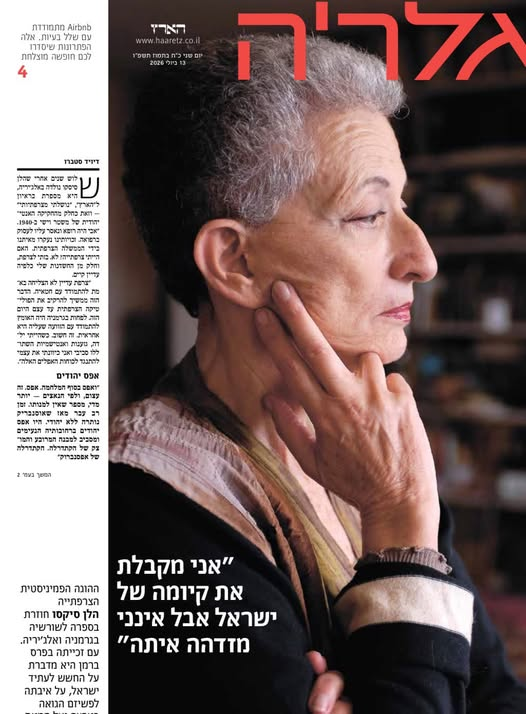
Published in Haaretz: Hélène Cixous: 'I Accept Israel's Existence, but I Don't Identify With It' – Art & Culture

Three years after Hélène Cixous was born in Algeria, she recounts in an interview with Haaretz, “I was dispossessed of my Frenchness” as part of the anti-Jewish legislation of the Vichy regime in 1940. “My father was a doctor and was forbidden to practice medicine. Our rights were stripped from us by the French government. Was I French? No. I despised France, and some of my suspicion toward it still exists.

“France has still not truly managed to confront its sins. This continues to rot French politics to this day. At least Germany had the courage to confront the horror for which it was responsible. That is important. When I was a child, racism and antisemitism raged around me, and I directed myself to oppose these dark forces.”

Zero Jews

“And zero at the end of the war. Zero, that’s enormous, and according to the Nazis, too much, an innumerable number… It had been a long time since Osnabrück was without a Jew, there were zero Jews in the charming streets and around the solid, square body of the cathedral of Zerosnabrück”.

This passage from Hélène Cixous’s book Osnabrück Station to Jerusalem captures the essence of her latest work. Part memoir, part family history, the book combines the great Jewish tragedy with philosophical reflections on Jewish existence.

As is her custom, Cixous employs her creative powers in writing not only in relation to her characters but also toward language itself. Osnabrück, the German city from which her mother’s family originated, becomes “Zerosnabrück” after it is emptied of its Jews. In 1934, 435 Jews lived there, Cixous writes; after the war, the number was zero.

Both historically and magically, the city is linked to Jerusalem: both become landscapes of memory and longing, both are inhabited by the living and the dead and stand at the center of the attempt to understand what it means to be Jewish when one’s world is shaped by displacement, catastrophe and the search for a home.

Osnabrück acquires an almost mythical status throughout the book. For Cixous, it is not just “Zerosnabrück”; it is also “the Paris of Lower Saxony.” Like Jerusalem, it is both real and a surreal dream where living characters meet the dead, and where the book itself becomes a character and speaks with its author. All of this occurs across timelines and locations that jump between the Holocaust in Europe and Algeria and the Middle East, incorporating biblical references, Greek mythology, European classics and Shakespearean tragedy.

All of this greatly resonated with the Swedish Berman Prize for Literature committee, which selected Cixous and her book – published in French in 2016 and in English in 2020, and not yet translated into Hebrew – as the 2026 prize winner. The award ceremony will take place in October. It is one of the most prestigious literary prizes, including a cash award of one million Swedish kronor, approximately 320,000 shekels, and is awarded to writers whose work illuminates Jewish life while also addressing universal human questions.

The prize was founded in 2020 by Swedish philanthropists Thomas and Catharina Berman, through a private donation intended to support Jewish culture and strengthen Jewish literary tradition. Thomas Berman said that the rise in antisemitism was one of the reasons for establishing the prize.

The first recipient was David Grossman, for his body of work, and other recipients include Hungarian author Péter Nádas, Russian-Jewish author, poet and journalist Maria Stepanova, and Jewish-Guatemalan author Eduardo Halfon. This year, the prize committee praised Osnabrück Station to Jerusalem, describing it as a work that “traces the void left by the displaced, maps absence and gives voice to those who can no longer speak.”
A Wonderful, Mysterious Place

“Osnabrück is like Jerusalem: one must go there, one must present oneself before its faces, one must let it speak and advance toward its language as before the monster Behemoth about which God boasts to Job, one must touch it with one’s fingers, one’s feet; one cannot know it from a distance. It’s like the sea: even from two yards away one doesn’t know it, one must throw oneself into its arms yelling.”

Cixous was born in Oran, Algeria, in 1937 to a German-Jewish mother who was a midwife and a Sephardi-Jewish father. For more than six decades, she has addressed questions of identity, language and memory. She is best known as the author of the essay The Laugh of the Medusa (1975), one of the foundational texts in modern feminist literary theory, which established her status as an influential thinker and one of the mothers of post-structuralist feminism.

Cixous worked closely with Jacques Derrida, who referred to her as “the greatest living writer in our language.” In her early 30s, in 1968, she participated in the Paris student revolt and in the founding of Paris 8 University, an institution intended to serve as an alternative to the traditional French academic environment. In 1974, the university became home to a center for women’s studies founded by Cixous, the first of its kind in Europe. She also maintained a lifelong interest in questions concerning her Jewish history. These questions are at the heart of Osnabrück Station to Jerusalem.

Is her book intended to give voice to those who can no longer speak? “When I write, it’s not I who has intentions, it’s the book,” she replies. “The book has its urgency and it doesn’t aim at this or that consideration. It’s true that it gives a voice to the void, like everything else that has been written, because of the huge field of tragic events. But writing is always giving a voice.

“In this case, it’s all somehow in the title, it’s a singular experience, of my relation to history, to politics, to tragedy. The voice of my writing is a mixture of tragedy and comedy and my material is partly autobiographical, partly theater and the obsession that led me to the book was going to Osnabrück.”

The obsession she describes is preservation through family dialogue, fantasy and therapy. Throughout Osnabrück Station to Jerusalem, the dead refuse to disappear, and the book seems full of ghosts – mothers, grandmothers, murdered relatives and those born long after the war, vanished neighbors and destroyed communities. All reappear in dreams, conversations, fragments of language and works of art. The living and the dead merge into one another. The visit to Osnabrück thus becomes not only a journey to a specific place but an encounter with the voices of a lost world.

The city that gives the book its title occupies a remarkable place in Cixous’s imagination. “It’s a place that no one knows. Even the Germans don’t know it,” she says, “but it’s a historic city, one of the two where the Treaty of Westphalia was signed in 1648, ending the Thirty Years’ War. It’s a wonderful, mysterious, fantastic place which fascinated me as a child. I was born to a mother who came from Osnabrück and lived in Oran, an Algerian city which was then part of a French colony. I saw Osnabrück as kind of a light in the distance, just like Jerusalem is seen by so many people.”

She recalls visiting Germany repeatedly with her mother and grandmother while carefully avoiding the city itself. “We went to Berlin, to Cologne, to Bonn, but never Osnabrück. It became something I wondered about – what’s wrong with Osnabrück? Why do we never go there?” She remembers how an official invitation from the city itself arrived for her mother and aunt to come back to the city for a visit. A discussion then began between the two women, which started as a conversation about hotels but became an argument about history and forgiveness.

Eventually, her mother decided to go. “This generation is not our enemy,” Cixous recalls her mother saying. “We don’t have to forgive them. We have to go on and accept the reality of history”. Years later, when Cixous suggested to her mother that they return to Algeria together, her mother refused, explaining: “In Germany, they invited me and asked me for forgiveness. In Algeria, I was kicked out after helping thousands of Algerians come into this world as a midwife.” Only after her mother’s death at the age of 103 did Cixous herself finally travel to Osnabrück.

Since then, she says, she has become “a kind of honorary citizen” there. When she spoke there, she reminded the city’s residents that peace itself can never be taken for granted, and that her own presence is conditional. “If in twenty years you become Nazi, as it sometimes happens,” she said, “it won’t be possible.” This remark captures the central tension in her book: the best and worst possibilities remain simultaneously present.

Does the book represent a return to Jewish roots after decades primarily spent on gender and feminist theory?

“Things are not that simple. The Jewish theme has always been there in a way,” she says and adds, smiling, that “I have a history in resisting the forces of evil. I grew up in colonial Algeria in a family opposed to racism and colonialism, while simultaneously becoming victims of antisemitism. I have, of course, always been on the side of the colonized.

“This wasn’t easy in Algeria where the colonizers were French. I hated the French since I was born. My family was in a situation of being part of a small minority of those who were strictly hostile to racism and colonialism. But this was not perceived in Algeria. From their perspective, we were supposed to be French.

“Later, when I was 18, I arrived in France, and I became ‘re-Frenched,’ although I doubt if one can really become re-Frenched and the truth is that I feel like I never really arrived in France. Then the social and political landscape changed, it was totally foreign, and gradually in two or three years, I started to think that antisemitism isn’t the question any more. On the other hand, I got this horrible feeling that they hate women here".

“It wasn’t an issue of class – it was men against women. Everywhere in society. The urgent fight wasn’t for Jews; it was for women. This is a fight of thousands of years. It’s still that way and it will go on. But every now and then, there’s another cause that becomes the main one for a specific period, and you have to decide, like a general of an army, where your forces are most needed. In the last few years, for example, it happened with Ukraine. And then Israel and Gaza came back again. Sometimes, you need to divide your strength.”

Hesitation Is Food for Fascism

“I can be many things, but being Jewish is always there,” Cixous says. She explains that she can easily make peace with her identity as a woman. “It may be divided into all kinds of tendencies but it’s basic, it’s primitive.” Her Jewish identity and her relation to Zionism and Israel is a different matter.

“It goes back to my mother,” she says. “She grew up in the days of a ‘beautiful Zionism’ – the dreams of young socialist Jews. But she resisted because of her story, which was against anything nationalist. Her father was enrolled in the German army and was killed as a German Jew, and so her way of looking at history was very rational.

“I was a girl when Israel was created, and I saw in Algiers the first emissaries trying to get Jews to go to Israel. I was prudent to that. I immediately thought that I wasn’t going to feel at home with a movement that unfraternally became colonialist. It was unavoidable. So, of course, I understand the creation of Israel, of course I was moved by it. But it couldn’t escape colonialism. “I came from a country where the Arabs were colonized. So, I just watched Israel. I never thought that belonging to what they called ‘the Diaspora,’ which we’re not, is negative. It is a way of being a citizen of the universe. My mother went to Israel to visit the part of her family that moved there. I refrained from doing that. I thought that I shouldn’t go if I don’t identify with Israel. I didn’t want to just be an observer. I like to be involved.”

Couldn’t what you call colonialism also be understood as Jews returning to their homeland?

“I could understand that the emissaries thought that they are returning to their homeland. I could also understand those like the members of my family who escaped the destruction of the Holocaust to Palestine which later became Israel. But for me, this wasn’t the only way. I thought we could be free and choose, and we had many ways to react to these terrible events. I accept Israel, but don’t identify with it. And this is the case for many people”.

Cixous’s attitude to Israel is complex. She doesn’t accept Jewish nationalism, but also doesn’t deny the tragic dimension of Jewish history and the antisemitism that led to Zionism and the establishment of the Jewish state. She is also well aware of how people react to disasters, and in this case, it is a central part of the story of the exodus from Europe and the establishment of Israel.

One of the most powerful themes in your book is the inability to recognize an approaching disaster – as happened in Osnabrück with the rise of the Nazis. How can this be understood?

“The hesitation when a radical change in one’s life is involved is common. In our days this mechanism of the human psyche is obvious when we’re facing the possibility that extreme right fascism will win the presidential elections in France. France is a very political place so everywhere I see people talking to each other about our next elections saying things like ‘next year in hell.’ They discuss what they will do on election day. Some say it’s not going to happen, others say it will happen if we don’t unite. All these discussions are taking place everywhere, and you can see the human soul hesitating”. For her, this hesitation is dangerous. “It’s the food for fascism,” she says.

The contrast within her own family remains instructive. “My grandmother stayed and didn’t leave Osnabrück until after Kristallnacht. My mother, who was a young woman, left the moment she smelled the stink of fascism. She never hesitated.” Other family members perished.

In Israel’s current war, there is a place where gender, sexual violence, and Middle Eastern politics collide in a tragic way: the sexual violence committed during the Hamas attacks of October 7. Many Israelis felt deeply alienated and outraged by the way parts of the international feminist movement appeared unwilling to express sympathy for Jewish victims. What do you think about this?

“This is a monstrous event. It will remain in history and the consequences go deeper and further than can be imagined. To the horror of my kind of people, it divided even the feminists. There was something hideous about the fact that when French Jews reacted passionately to that horrible event, some parts of the French feminist movement were so anti-Israeli and pro-Palestinian that they had no sympathy for the Jewish women who were affected.”

Cixous described this as a moral failure. “These are the perversions of the way people identify with one cause and exclude others. It’s horrible.” Her own position, she says, was unequivocal. “For me, of course, there were no hesitations. This was a terrible crime. Hamas is a cruel, hateful movement like many other movements in the Arab world. The whole world is a victim of Hamas. But now, so many people, countries and movements are also victims to the blindness and craziness of the Netanyahu government.

“The time has come, and it came a long time ago, to stop being colonial and accept the fact that others also have rights. History has decided that this piece of the planet Earth should be shared by Jews and Palestinians.” She worries that Israel is exhausting reservoirs of international goodwill built over generations. “They’re self-destructing and they’re destroying the capital, the inheritance of sympathy and understanding from others.”

This is criticism stemming from concern rather than detachment. “I would like Israel to survive,” she concludes, “but it’s alienating the countries that support it. It’s tragic”.

For Cixous, Israel is not only its politics; it is also the story of exile and migration. “Each migration has its own structure. It requires such courage. It requires giving up and starting again. That’s one of the reasons that I understand the creation of Israel, and literature gives these experiences their deepest human meaning. I really admire Israeli literature which deals with this and the great writers who give these events their deep humanity.” When asked for examples, Cixous says that she loves the works of Aharon Appelfeld and enormously admires David Grossman.

The Gatekeepers

Toward the end of the interview, Cixous reflects on the present moment. “Very often I think that what is happening now, I have already lived through as a young girl, in the 1930s,” she says, but adds that history never repeats itself exactly. “Obviously, technology, the fact that we may be dispossessed by ourselves with AI, is unimaginable. We – who read, who still want to think, the guardians of art – we have to strengthen that part of mankind. Whenever a European country goes the way that Hitler’s Germany went, it contaminates everything, it becomes possible, it seduces other countries. We can be thrown into a period like the one of the plague.

“People keep saying that Europe is weak, divided and ungenerous. That’s why Europe needs to have an army. In the past, it went against its humanistic principles, but this pacifism doesn’t work. It’s not enough to just be on the side of peace and diplomacy. No, when arms are used, you have to resist with arms.”

And beside an army, what’s the role of public intellectuals in such times?

“The concept of public intellectuals is a recent invention. It started with the Dreyfus affair – and it’s extinct. There are no important public intellectuals. There may be media intellectuals. It doesn’t mean that it won’t happen again. I don’t know. Something may come back, but these wonderful moments of light, like the one in 1968, are extinct.”

Cixous’s concern about recurring patterns of extremism and hatred, and the temptation to underestimate danger, runs like a thread throughout Osnabrück Station to Jerusalem, which deals with how people remember and how they forget. The Berman Prize jury praised the book for giving voice to the silenced. In fact, it does more than that. It revives lost worlds – like those of Osnabrück and Jerusalem. In doing so, Cixous poses a long series of questions about memory, reality, exile and belonging. Most remain open. At 89, she offers no definitive answers.
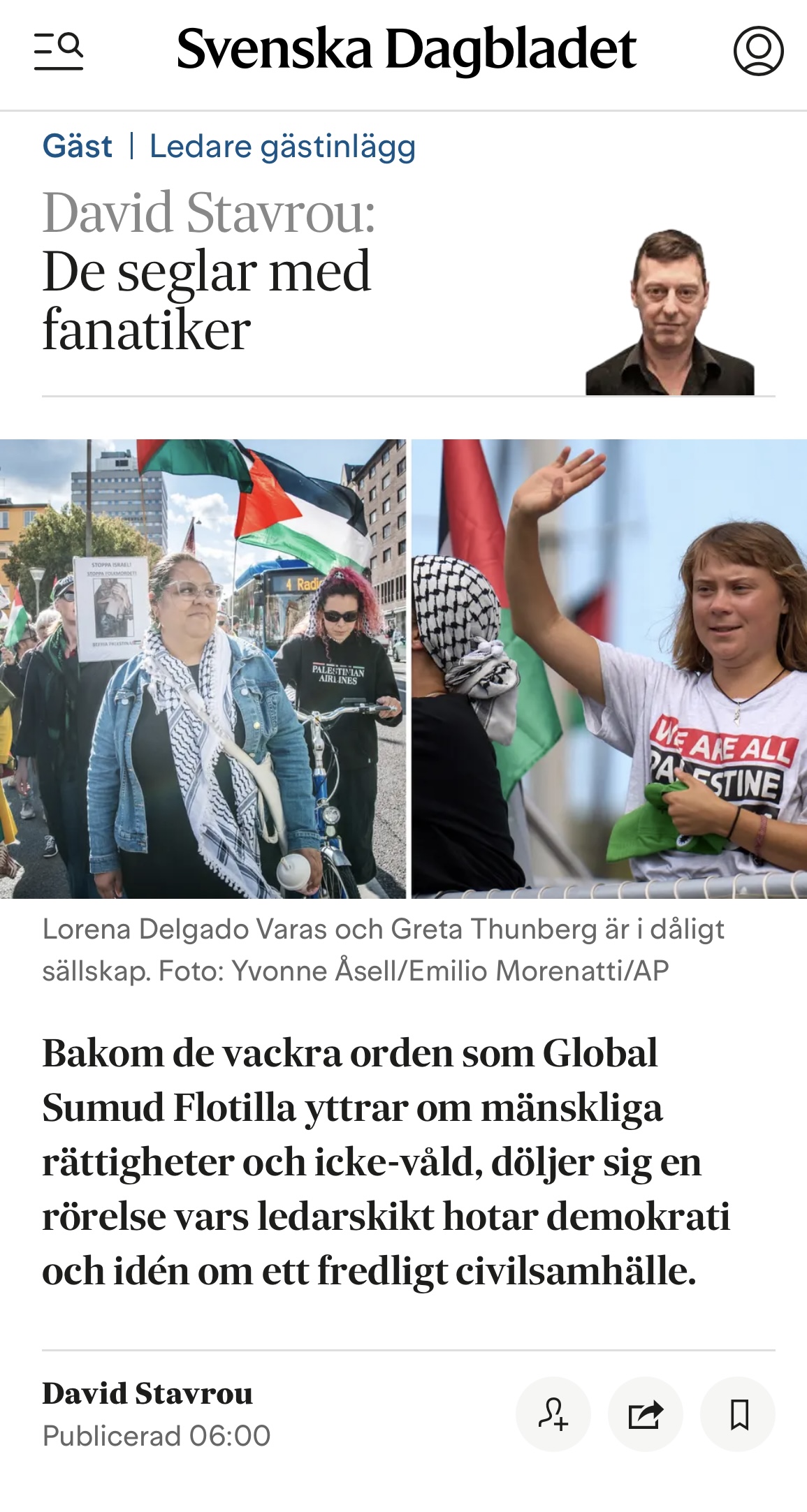
Sailing with Fanatics

As Swedish Member of Parliament Lorena Delgado Varas and activist Greta Thunberg make their way to Gaza as part of the so-called Global Sumud Flotilla (GSF), many Swedes assume that their intentions are good. However, the reality behind the movement they are actively supporting is as far as can be imagined from humanitarian, non-violent, peaceful activism.

Published in Swedish daily Svenska Dagbladet:
https://www.svd.se/a/lw6anA/lorena-delgado-varas-och-greta-thunberg-seglar-i-daligt-sallskap

The images of destruction and suffering from Gaza, combined with statements published by the flotilla's organizers, have created an image of brave and kind-hearted activists, willing to pay a heavy personal price to deliver humanitarian aid and draw the world’s attention to Gaza. On its website, GSF describes itself as “a coalition of everyday people – organizers, humanitarians, doctors, artists, clergy, lawyers, and seafarers – who believe in human dignity and the power of nonviolence.” They also emphasize that their loyalty lies with “justice, freedom, and the sanctity of human life.”

But the reality behind GSF is far removed from the idealistic image presented to the public.

Screenshot

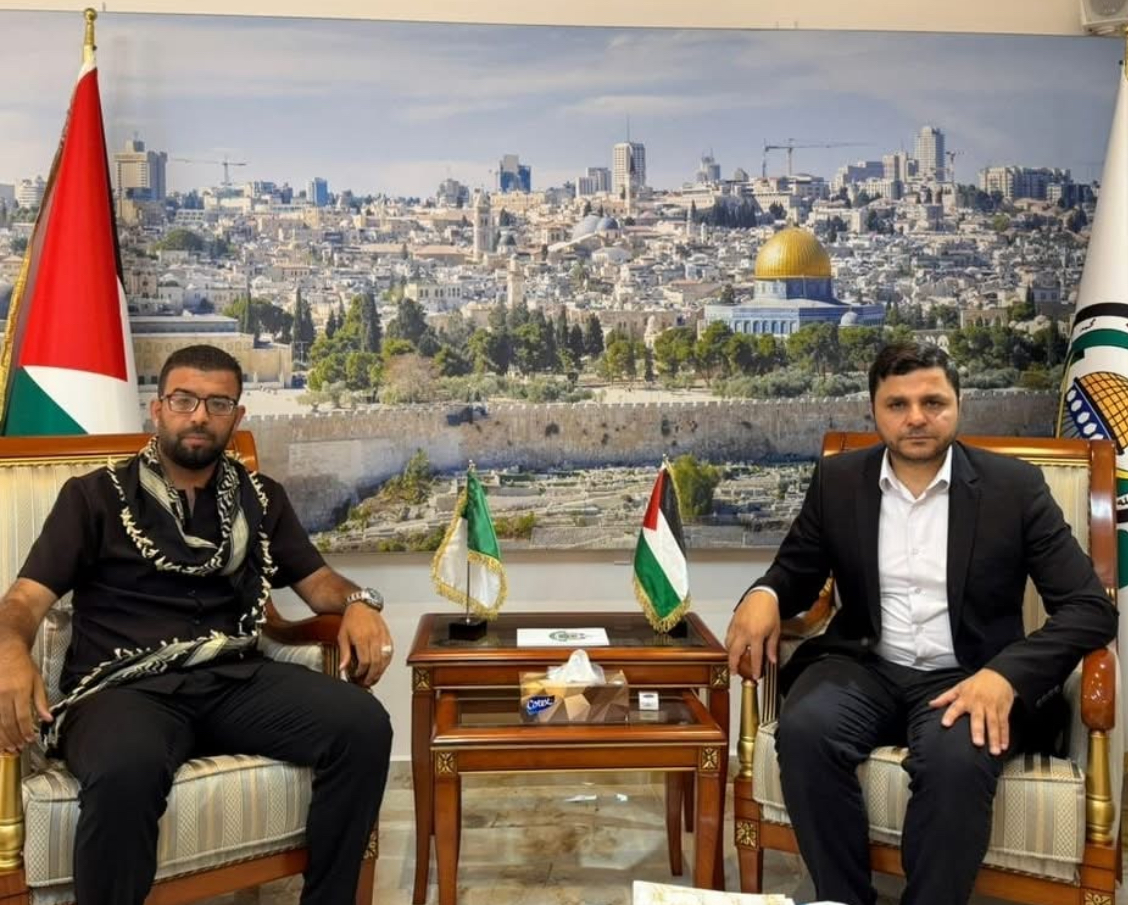
Less than three months ago, a meeting took place at Hamas’ headquarters in Algeria. Participants included representatives of the Global Sumud Flotilla and leaders of the movements that murdered, raped, tortured, and burned hundreds of Israeli civilians on October 7th – and many more before that. Among those present were Youssef Hamdan, Hamas' representative in Algeria, and Nader al-Qaisi, a representative of the Popular Front for the Liberation of Palestine (PFLP). This was no secret meeting. Despite the continued portrayal of the flotilla by Swedish media as a peace initiative with humanitarian aims, publicly available material reveals concrete links between GSF and some of the world’s most notorious terrorist organizations. All it takes to uncover these connections is a basic knowledge of Arabic and a quick search through social media.

In one photo published by Nabil Chennoufi, a spokesperson for GSF who frequently shares extremist violent propaganda on social media, two members of the flotilla’s steering committee – Wael Nawar and Hayfa Mansouri – can be seen smiling and wearing keffiyehs with Hamas symbols, alongside leaders of the terrorist organization in Algeria. The caption says the meeting focused on the flotilla’s progress, its positive impact, and its connection to the "Palestinian resistance." In a second photo, a third steering committee member, Marouan Ben Guettaia, is seen meeting with Hamas leader Hamdan.

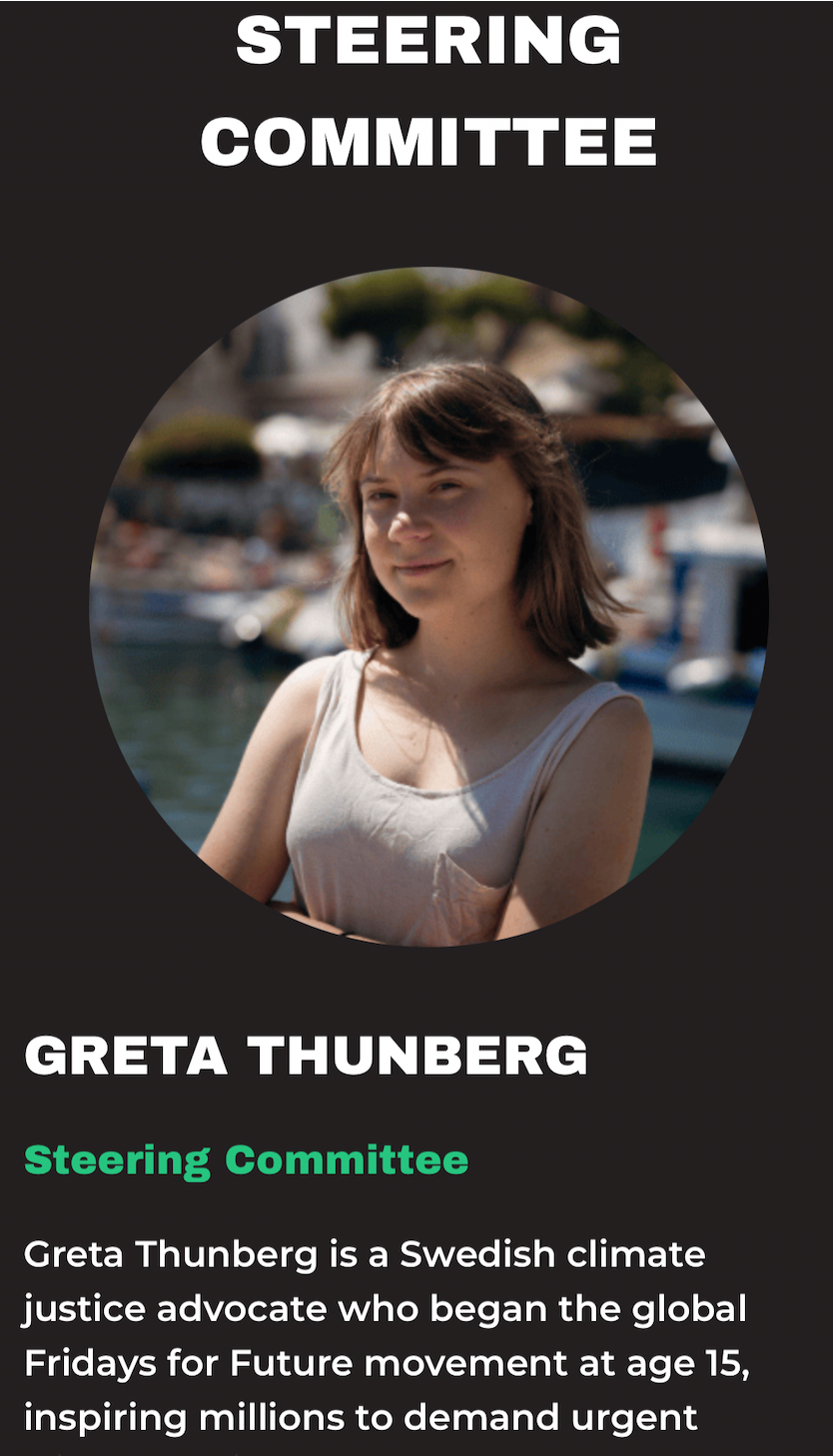
It’s important to stress that Greta Thunberg is not merely a regular passenger on one of the flotilla’s boats. GSF’s own website showed her as a member of the steering committee, alongside the aforementioned individuals. For some reason, her name and picture suddenly disappeared last Thursday.

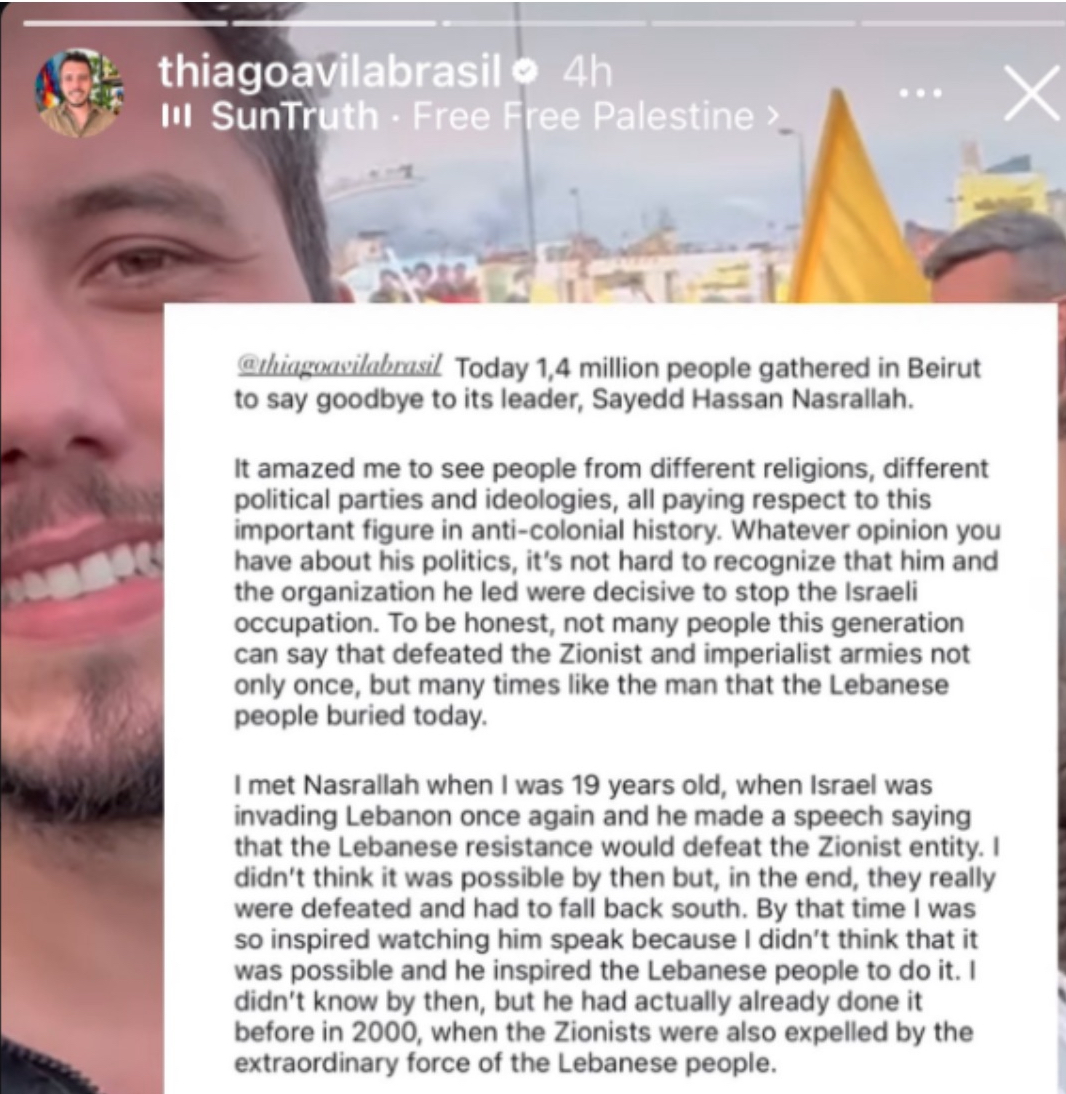
Another committee member is Brazilian activist Thiago Ávila, who has openly expressed his admiration for the late Hezbollah leader Hassan Nasrallah. On social media, Ávila shared how he was inspired as a young man after meeting Nasrallah and described him as “an important anti-colonial figure who defeated Zionist and imperialist armies multiple times.” Earlier this year, Ávila attended Nasrallah’s funeral in Beirut – a massive demonstration attended by tens of thousands of people chanting “Death to Israel” and “Death to America.” Ávila was impressed, writing: “Today I saw thousands of new freedom fighters.”

As a reminder, it’s worth noting that Hezbollah is a militant Shia Muslim organization allied with Iran, Russia, North Korea, and Shia militias in Iraq. It is designated as a terrorist organization by the United States, the United Kingdom, and the European Union, and is responsible for numerous terror attacks and kidnappings around the world – financed by Iran’s Islamist regime and the narcotics trade.

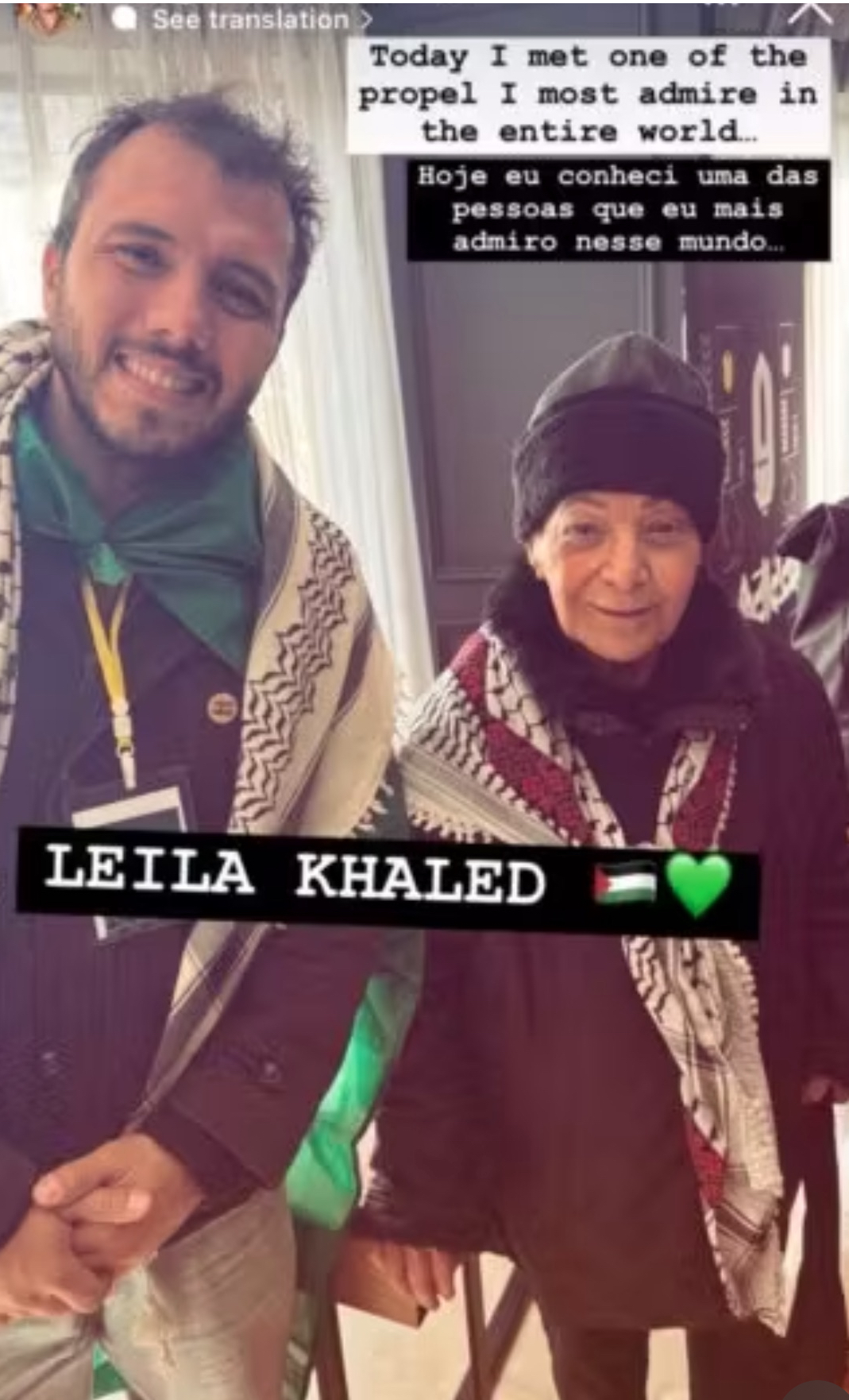
But it seems Ávila is not loyal to only one terrorist organization. In a photo, he is seen posing next to convicted PFLP terrorist Leila Khaled, with a green heart emoji and a Palestinian flag. The caption reads: “Today I met one of the people I admire most in the entire world.” Khaled’s notoriety, it should be remembered, is not based on “human dignity and the power of nonviolent action,” but on her involvement in the hijackings of TWA Flight 840 and El Al Flight 219 in the late 1960s and early 1970s.

Another member of the GSF steering committee is Muhammad Nadir Al-Nuri Kamaruzaman, head of the GSF Southeast Asia coalition. He is also the founder of the Malaysian organization MyAqsa Defenders and CEO of the NGO Cinta Gaza Malaysia. Both organizations have expressed support for Hamas and have been linked to financing Hamas-run infrastructure in Gaza. Among other things, Cinta Gaza has published an e-book glorifying Yahya Ayyash, known as Hamas’s top bombmaker and responsible for numerous mass-casualty attacks in Israel during the 1990s. MyAqsa Defenders has also hosted a livestream event with Muslim Imran, whose name has appeared on Hamas channels as an official Hamas spokesperson.

Despite this information being openly and proudly published by those involved, neither Greta Thunberg nor Lorena Delgado Varas have been publicly questioned in Sweden for their participation in what clearly appears to be a well-organized, international operation with strong ties to terrorist groups. Sure – as citizens of a democratic country, they have every right to take part in whatever Mediterranean adventures they choose. But when those journeys are part of a network led by individuals with proven links to organizations responsible for massacres of civilians, there is a responsibility to investigate, question, and report.

It seems that behind the flowery rhetoric about human rights, humanitarian aid, and nonviolence hides a movement whose leadership praises antisemitic, religiously fanatical, chauvinistic, and ultranationalist violent actors. By participating in this initiative, Thunberg and Delgado Varas help legitimize forces that threaten democracy, gender equality, freedom of expression, and the very idea of a peaceful civil society. Despite their public image as champions of justice and solidarity, the facts suggest something quite different — in reality, Thunberg and Delgado Varas are supporting right-wing extremists.

!Say it: Yes, I condemn Hamas

The discourse within the Swedish and European left is important even if you're not part of it and the insane embrace of Hamas by so-called left-wing radicals, climate change fighters, human rights activists and western intellectuals and academics must be challenged.

Originally published in Swedish in Parabol: https://www.parabol.press/andreas-malm-har-fel-om-hamas/

Imagine this powerful image: in a country which is slowly being taken over by right-wing nationalists, it's becoming harder to speak truth to power and to speak up for the underdog and the repressed. But then, from the trenches of the opposition, rises a fearless figure. He knows he'll be arrested and tortured if he's caught crying out, and so he does what intellectuals from resistance movements allways do under tyrannical regimes. He uses sarcasm, he sharpens his pencil and cleverly plays with words to produce a text which is radical and subversive, but at the same time meticulously designed not to be flagged down by the authorities. That way the avant-garde academic doesn’t get in trouble with the all-powerful secret service henchmen who are hunting down traitors.

Sweden 2024. While a war is going on in Gaza and in Israel, the whole political elite is powerfully supporting Israel. It's blue and white from left to right and it's not allowed to speak up for the Palestinians. And then, a single voice of a brave dissident rings out. He wrote a text. It's called "I Condemn Hamas" and it's brilliantly designed by a rhetorical trick – the title is mainstream and boring, everyone condemns Hamas. The content seems to be the same, but under the surface lies the explosive message – it's the exact opposite of condemning Hamas, it's actually supporting it (Malm, Anders, Jag Fördömer Hamas, Parabol, 01/11-23). At last the opposition has a voice – Andreas Malm has weighed in. It's a powerful text and a powerful image. The only problem is that none of it is true.

Malm's claim is clear – everyone's condemning Hamas, mainstream media, politicians and public discourse in general. He, on the other hand, thinks this is false. Hamas may have killed civilians, kidnapped children and burned down residential buildings on October 7th, but according to him this isn't unique. It's all been done before by Israel. Malm doesn't claim this directly. He does it by sarcasm. The same kind of sarcasm is pointed at the Swedish discourse. "In Sweden there are strikingly few who have condemned Hamas in the past few days. Those who have done it have only done it once, so that we now wonder if it was really meant honestly", he writes creating an illusion which is the exact opposite of the truth. In fact, Sweden is one of the countries in which the Hamas did surprisingly well. At least for an organization which is internationally recognized as a terror organization.

Hamas supporters have spoken openly in conferences and seminars in Sweden, money has been raised for Hamas freely in Sweden; just in the last few months there have been dozens of pro-Palestinian demonstrations with speeches supporting Hamas or at least not condemning them including demonstrations celebrating the events of October 7th on the day they happened. Unlike other countries, these demonstrations are not only legal, they're supported by some of the political elite and many in the media, in the cultural world and in civil society. Malm's style implies that Swedish publicists have to condemn Hamas or they'll be cancelled. Nothing could be further from the truth. In fact, Malm himself is a writer who has supported Hamas publicly in several newspapers, magazines and publications. As far as I know, he's yet to be arrested, censored or fired. In Sweden it’s allowed to burn the Koran, join parties which support North-Korea and have Neo-Nazi marches on Yom-Kippur. No one's preventing anyone from supporting Hamas. Indeed, I recently met Hamas supporters in Sergels Torg. They were members of two perfectly legal Swedish movements, RKU, the revolutionary communist youth movement and NMR, the friendly neighborhood neo-Nazis. Who knows, perhaps Andreas Malm himself was there supporting them both.

However, the Swedish context is only the beginning of Malm's mistake. The claim that the massacre on October 7th was more of the same, that it was Palestinians retaliating with the same kind of violence Israel uses, is worth studying. "What happened on Black Saturday, October 7th was something new in the history of the Israeli-Palestinian conflict", Malm writes using his smug self-satisfied irony, "it redraws the political and moral map of the Middle East for good. Gunmen stormed into communities and shot children to death with rifles. They did not care at all about the age of the victims. Hundreds of civilians were killed – people with no connection to any military activity, murdered simply because of their identity. Entire families disappeared". If this wasn't so true, it would be real cutting-edge political satire. But Malm's satire, is in fact the sad truth. Nothing like October 7th ever happened before in this conflict. Israelis and Palestinians never killed so many people in one attack or in one day. Not in Kafar Qasim (1956), not in Deir Yassin and Tantura (1948), not in Hebron (1996) and not in the bombings of Gaza in previous years. There were never so many acts of torture and violence against civilians, never so many people kidnaped and never such brutality. And yes, October 7th did redraw the political and moral map of the Middle-East for good. I couldn't have said it better myself.

Israel made many mistakes in the last few decades; like any other army it has committed war crimes during conflict, some of its civilians, especially in the West-Bank are violent extremists and its occupation of the West-Bank continues to be a hindrance to peace in the Middle-East. But October 7th was unique. It's not only about the brutality or the number of victims. The really scary number is the number of the people who committed the crimes. Unlike 9/11 which was executed by a small Jihadist vanguard of 19 Al-Quade operatives, and unlike Utøya which was the work of one (Andreas Malm cracks a little clever joke making the comparison), October 7th was carried out by about 3,000 people. Many of were sipplied with written instructions about how to murder, torture and kidnap civilians, some were also provided with drugs and with body cameras. This wasn’t a spontaneous, heat of the moment action. It was a planned strategy. On October 7th the world saw a society capable of drafting 3,000 people who were 100 percent committed to murder.

Andreas Malm perhaps hasn't heard the story told by David Tahar, father of Adir Tahar, an Israeli soldier who was killed on October 7th. Tahar told Israeli Chanel 14 that before the funeral he insisted on seeing his son's body even though army officials advised against it. The reason was that apparently after he was killed Hamas fighters decapitated Adir and took his head back home to Gaza. A few weeks later, after receiving intelligence from captured terrorists, an Israeli military unit retrieved the head. It was hidden in a bag with some tennis balls and a few documents inside an ice-cream shop freezer in Gaza. Apparently the head was up for sale. The price was 10,000 US Dollars. I know there are many who don't believe Israeli media and think that Zionists fathers are so perverted that they can make up this kind of story for propaganda purposes. So here's another one. This time from the New York Times.

Sapir, a 24-year-old accountant who attended the rave party near Kibbutz Reim on October 7th gave a testimony which was reliable enough for the NYT which told the story of what she saw from her hiding place (Gettleman, Schwartz and Sella, "Screams Without Words": How Hamas Weaponized Sexual Violence on Oct. 7", The New York Times, 28/12-23). Sapir says she saw "a young woman, blood running down her back, pants pushed down to her knees. One man pulled her by the hair and made her bend over. Another penetrated her. Every time she flinched, he plunged a knife into her back. Sapir said she watched another woman "shredded into pieces". While one terrorist raped her another pulled out a box cutter and sliced off her breast. "One continues to rape her", she said, "the other throws her breast to someone else, and they play with it, throw it, and it falls on the road". She said the men sliced her face and then the woman fell out of view. Around the same time, she said, she saw three other women raped and terrorists carrying the severed heads of three more women.

These are just two testimonies from October 7th. There are thousands more. One could always claim, as Malm does in earlier texts, that all this violence should be seen in context. But this kind of violence has no context. If it was really about freedom, or fighting the occupation there would be no need for mass rape, kidnapping babies and removing body parts. The atrocities, the rockets, the tunnels and the complete subordination of Gazans to Hamas militants are all far darker and more sinister than Malm's theories. It's not the price paid for Israel's colonialism. If for no other reason, because this isn't colonialism. Israel isn't Algeria.

According to Malm, the conflict between Israel and the Palestinians isn't a war between two indigenous peoples which have a legitimate claim to the same territory and therefore are engaged in a violent conflict. Instead, there is one legitimate native nation and for over a century it has been fighting an occupation by invaders who came from other countries as colonizers. The invaders are supported by imperialist powers and they are now committing genocide. This kind of aggression according to Malm must be, should be and always has been resisted with violence. In fact, Malm's latest text is one of many in Parabol making the same claim.

These texts rarely even mention the events of October 7th which I would suggest is a sign of total moral bankruptcy. But that's me and I may be biased. The problem here is different, it's about intellectual honesty. The description of the Israeli-Palestinian conflict as a story of a colonial power murdering the natives is incredibly shallow and misleading. It's perfectly ok to oppose Israel's policies (as I do myself most of the time), it's perfectly ok to name-drop Edward Said and Franz Fanon, make comparisons to Apartheid South-Africa and quote Israeli officials making outrageous genocidal statements which can then be quoted at the ICJ in the Hague. But people who have studied the region, as I guess Malm has, know very well that Jews, not only Palestinians are natives to it. And no, I'm not referring to Jesus and Abraham. Biblical stories cannot be a base for international geo-politics. I'm referring to facts completely ignored by the whole post-colonial discourse.

Take Gaza, for example, in the place where Rimal, the political center of Gaza City used to stand, a synagogue was built in the year 508 AD. We know that the figure in the center of the ancient mosaic which was found there is King David. How do we know this? Because his name is written there. In Hebrew. Gaza has a long bloody history – Romans, Christian Crusaders, Arab armies, the Egyptians, Napolean's army, the Ottomans and the British Mandate all controlled Gaza. During this history, Jews lived in Gaza, they didn't arrive in ships in the 1940s. They were there during the time of the Romans, 2,000 years ago, they were there in the Middle-Ages and during the time of Islamic rule, then again in the 14th and 15th century and under the rule of the Ottoman empire. Some were still there even after WW 2.

As in many other areas in the region, for thousands of years, Jews thrived and declined in Gaza, they were expelled and fled, they killed and were killed, built and destroyed, returned, immigrated and emigrated. Arabs in the region have a similar, though somewhat shorter, story (I'm referring to them as Arabs, because the name Palestinians wasn't used in the way that we use it today until after WW2). The story of the region being a land inhabited by indigenous Palestinians who were attacked by American, European and Russian Jews arriving from abroad after the Holocaust and kicking out the natives is a fairytale. Concepts like colonialism and indigenous peoples aren't abstract. Unfashionable as it may seem, these things have actual meanings beyond TikTok clips made by demonstrators wearing fashionable red, white and green scarfs. They can be discussed in terms of archeological findings, origin and descent, historical continuity of settlements, language and culture, collective ancestral ties to a territory and to natural resources, self-identification, experiences of subjugation and discrimination and so on. It may be frustrating, but when it comes to Israel, to the West-Bank and to Gaza, both Jews and Palestinians are natives. They're all a combination of immigrants and people who are decedents of families who haven't left for generations. And they've all suffered from violence, massacres, displacement and trauma.

And there's another similarity between the Jewish national movement (aka Zionism) and the Palestinian one. They both have a genocidal wing. These are the people on both sides who don't accept the idea of territorial compromise in order to achieve peace. The people who are willing to go as far as killing or expelling the other group in its entirety. They're usually religious fanatics, they're extremely violent, they totally oppose democracy and human rights, they're willing to kill and die for the cause and they've always been around. On the Jewish side, they began to become a serious threat after Israel's 1967 victory with the rise of the settler movement in the occupied West-Bank. These days they're becoming stronger, they're getting closer to government circles, but they're still far from being anywhere near a majority in Israeli society.

On the Palestinian side, things seem to be worse. If on the Zionist side there was a right-wing revisionist leader, Zeev Jabotinsky, who had a connection with Mussolini in the 30s, the leader of the Arab nationalists in Palestine at the time, Haj Amin al-Husseini, spent WW2 in Berlin and in Rome, he collaborated with the Nazis and the Fascists, he personally met Hitler, Himmler and Mussolini and was a supporter of the "Final Solution of the Jewish Problem". Al-Husseini was just the beginning. The Palestinian National movement has always had an active and extremely popular genocidal side to it. It's not because of Israel, because it started many years before Israel even existed. And it's not unimportant because what we saw on October 7th was a direct result of the same kind of ideology.

That's what's really amazing about Andreas Malm's text. Hamas is the genocidal wing of the Palestinian national movement and its ideological roots go all the way back to Nazi Germany. Although it was seen as a traditional grassroot, social and religious movement when it was founded in the 80s, it's now a modern, extreme right-wing movement combining Jihadism, high-tech disinformation campaigns, a financial empire of global investments, leaders who live a life of luxury outside the region, modern weapon systems and powerful alliances with the world's most tyrannical regimes. Anyone imagining the Hamas as a young David standing up to the Israeli Goliath is living in a naïve lullaby.

But Andreas Malm isn't naïve. He knows very well that the geo-political realities show that Hamas and indeed the Palestinian national movement is far more complicated than just a victim of western colonialism. He knows about the Israeli disengagement from Gaza in 2005 which means there was no occupation of Gaza for almost two decades. He knows that the blockade on Gaza is just as much an Egyptian policy as it is an Israeli one and that many Arab countries want Israel to destroy Hamas. He knows that the Hamas charter is an antisemitic and fundamentalist text. He knows that Hamas has crushed the secular Palestinian national movement in Gaza and that it sees the Palestinian Fatah movement as an enemy which is almost as bad as Israel. He knows about Hamas' brutal war against the Palestinian Authority and he knows about the unprecedented Hamas military buildup and take-over of civil society in Gaza.

The reason that I know that Malm knows all this is because of other texts that he wrote. Reading them one learns a lot about his way of seeing the world, though I must admit, it's sometimes a confusing task. Although he seems well versed in Middle-Eastern politics, when it comes to moral statements and political conclusions, his considerations are so complicated, it's hard to keep track. Although Israel is always wrong (that's the constant) when it comes to Palestinians, Arab states and Islamic super powers, the target is painted around the dart after it's been thrown.

In a text he wrote a few years ago (Malm, Andreas, "Därför Hamas", Expressen, 15/01-09) he claims one can have two thoughts at the same time, like the Palestinian left which allies itself tactically with Hamas but at the same time supports the opposition in Iran while the opposition in Iran is fighting the Iranian regime at the same time the Iranian regime is funding Hamas. It's ok if you need to read the last sentence again.

Malm's reasoning is not that unique. He supports Hamas and its fight against what he called the "corrupt Fatah politicians" and Mahmoud Abbas, who's an Israeli and American "marionet". If this sounds familiar it's because this is exactly the same logic used by Israeli PM Netanyahu who for years has been undermining the Fatah controlled Palestinian Authority by allowing Hamas to stay in power in Gaza so that he wouldn't have to take real steps towards a two-state solution. Surprisingly enough, Malm and Netanyahu are on the same side. They'll both do anything to avoid compromise and consolidation.

In another text from 2009 Malm referred to Hamas as a liberation movement which is "forced to resort to every possible form of resistance" (Malm, Andreas, "Vi bör följa Iran och stödja Hamas i kampen mot Israels folkmordspolitik", Newsmill, 04/01-09). In the same text he quoted Nir Rosen, who claimed that "Attacking civilians is the last, most desperate and basic method of resistance when confronting overwhelming odds and imminent eradication" (Rosen, Nir, "Gaza: the logic of colonial power", The Guardian, 29/12-08). Malm is entitled to write these kind of statements even if they encourage violence and are fascist in nature. I only hope that most Swedes, including those who support the Palestinians, can see beyond this tragic war mongering, since it's clear to anyone what this means politically. Hamas will continue murdering Israelis; Israel will have to retaliate and will do so forcefully – and more Palestinians will be killed. If there's anything that hasn't changed in the last few decades it's this dynamic.

Hamas is not the only problem. In another text Malm openly supported Hezbollah (Malm, Andreas, "Därför Ska Vi Stödja Hezbollah", 11/08-2006), an Islamic movement funded, trained and inspired by the Iranian Ayatollahs and their Islamic Revolutionary Guard Corps, which was involved in suicide attacks, political assassinations, bombing of civilians and hijackings in Lebanon and other countries. I don't know how Malm manages to pull off being a left wing radical and supporting two of the most conservative, fascist, chauvinist, fundamentalist, hierarchical, anti-democratic, homophobic and xenophobic movements in the history of the known universe, but I know that explanations along the lines of "I can't be expected to condemn actions taken by the weak and oppressed” can't work anymore after the massacre of October 7th which was a tectonic, world-changing event. Not condemning it, or in Malm's case, condemning it sarcastically, means supporting it.

This period isn't easy for the global political left. Just like in the 1950s when left-wing activists, politicians and intellectuals had to decide whether to stay faithful to the Stalinist flagship even after it was exposed as a sadistic killing machine of gulags and mock trials, today's left must decide if its alliance with the dictators, Jihadists and militants from Gaza, Teheran, Beirut and Doha is more important than its ideals. Those who have the courage to choose their ideals and abandon their old murderous  allies will not have Andreas Malm's problem. They will be able to proudly say "yes, I condemn Hamas".