In practice, anti-Israel boycotts are often directed at virtually anything with a connection to Israel. They also affect Jews who are not Israeli and people with no connection whatsoever to Israeli policy.
Published in Swedish in Svenska Dagbladet: Sverige bör inte godta diskrimineringen
In recent years, calls to boycott Israel have become increasingly visible. Campaigns to exclude Israel from Eurovision, initiatives declaring various institutions and places “apartheid-free zones,” academic boycotts, and demands to terminate cooperation with Israeli companies have become increasingly common in public debate.
At the same time, the same argument is repeated whenever boycott advocates are accused of antisemitism: the boycott is described as an expression of solidarity with the Palestinians and a struggle against the policies of the Israeli government, rather than as action directed against Jews. As then-Foreign Minister Ann Linde (Social Democrat) put it during a parliamentary debate in 2019, in response to a question from Lars Adaktusson (Christian Democrat): “Advocating a boycott of Israel by peaceful means with the aim of ending the occupation is not antisemitism”.
One can agree with that in theory, but in practice boycotts are often applied without regard for nuance and they're directed at virtually anything connected to Israel – sometimes very indirectly. They also affects Jews who are not Israeli and people with no connection whatsoever to Israeli policy.
One of them is Israel Aloni. Born in Israel and educated at two of the country’s leading dance and art schools, Aloni moved to Sweden more than 25 years ago. Here, they (the artist’s chosen pronoun) built an international career as an artist, dancer, choreographer, educator and artistic director. After spending time with the Göteborg Opera Dance Company, Aloni, together with another Swedish-Israeli dancer, founded ilDance in 2012, which has since developed international performing-arts projects in Sweden and elsewhere in Europe.
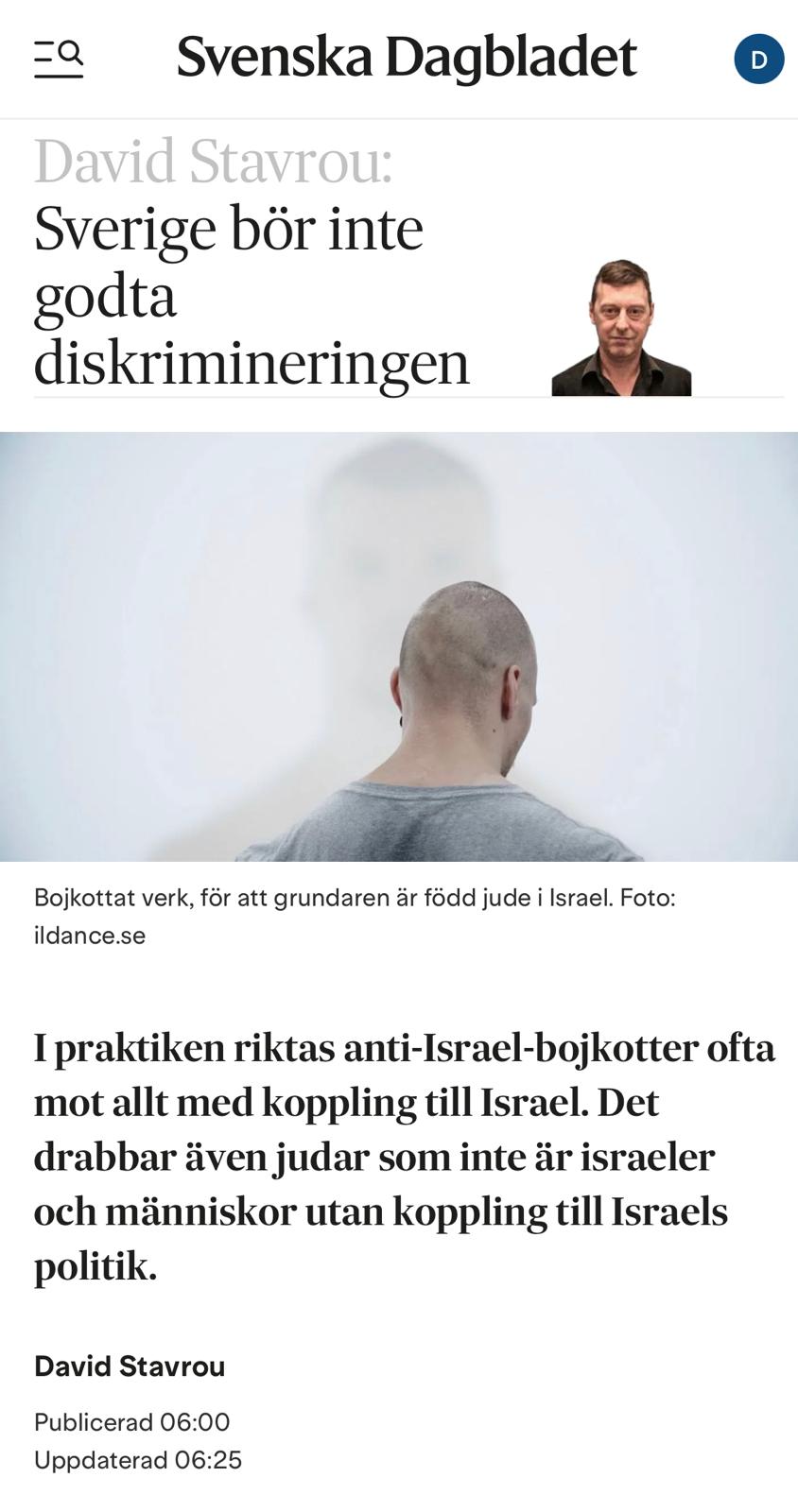
A few years ago, Aloni created Boys Just Want to Have Fun, a multidisciplinary dance and performance work for museum exhibition spaces, described as an exploration of masculinity and an attempt to challenge taboos surrounding male sensuality and sexuality in contemporary Western culture. The work received support from Perform Europe, an EU-funded program for international performing-arts collaborations, and became the only Swedish performing-arts project included in the program’s international touring activities. During 2024 and 2025, it was performed in Serbia, Finland, Norway and the Netherlands.
This year, the Estonian Museum of Contemporary Art (EKKM) decided to present the work. Ahead of the performance, the Swedish Arts Council awarded the company SEK 64,000 in travel funding, thereby judging the work worthy of representing Sweden internationally.
Everything seemed settled. But then came the boycott.
After more than a year of dialogue between Aloni and the Estonian museum, after all the funding had been approved and the museum had committed to hosting the performance, the announcement came during a Zoom meeting: “Unfortunately, we have some bad news. It will not be possible to stage the performance here in August.” No new date was provided.
A postponement without a new date or any guarantee that the project will take place is, in practice, a cancellation. This came despite the initial enthusiasm and close contact with the curator for more than a year, during which no objections had been raised. But the message was clear. The reason was that the work’s creator had been born Jewish in Israel.
No, they never explicitly said that the issue was that Aloni is Jewish. But the museum was simultaneously planning to present an exhibition featuring Palestinian artists and believed that the “political climate in Tallinn” made it impossible to present the two projects at the same time. This was despite the fact that the work has no connection to Israel, Middle Eastern politics or the Israeli state. Nor has the choreographer ever expressed support for the Israeli government. Aloni’s only “fault” was their background.
The Palestinian exhibition, which opens in October and is curated by the same person who invited Aloni, is described on the museum’s website as an attempt to shift the perspective from “news feeds and statistics” to people’s stories and lived experiences. This, it says, would make art and culture “carriers of resilience, memory and imagination.” That the same principle might also apply to an Israeli Jew appears never to have been considered.
When I spoke with Aloni, it became clear that the concern went far beyond the artistic, financial and career consequences: “It is a dehumanizing experience.”
But there are also other dimensions to the issue that concern Sweden. At ilDance, support from the Swedish Arts Council is not taken for granted. Such funding is handled with care. Since the company regards itself as part of the Swedish cultural ecosystem, this was not merely an insult to Aloni. It was also an insult to Sweden.
This is not an isolated case. Israeli artists – and, as in this case, even Jews with only an indirect connection to Israel – are regularly cancelled, excluded or shut out across Europe, even when they have no connection to the Israeli state and are often themselves critical of the Israeli government. There are numerous examples of artists being told that they are welcome only if they publicly distance themselves from Israel and demonstrate that they are on the “right side” politically.
In this case, the Estonian museum argued that presenting a performance by Aloni would make it appear as though the museum had a political agenda. Aloni pointed out that they are a Swedish citizen who left Israel as a teenager and have lived most of their life in Sweden; that they have never made any political statements; and that ilDance is a Swedish company with no connection whatsoever to Israel. None of this made any difference. After all, Aloni had studied in Israel. When Aloni proposed a dialogue with the Palestinian artists, it became clear that the decision had already been made.
If Sweden wants to demonstrate that it does not accept this kind of discrimination, there is an obvious first step. Sweden’s cultural establishment – from the Minister for Culture and the Swedish Arts Council to independent cultural institutions – should clearly protest against an Estonian museum boycotting a Swedish dance company funded by Swedish taxpayers solely because of its founder’s origin. If there has ever been an issue on which Sweden’s self-proclaimed anti-racists ought to be able to agree, this is it.


