We have spoken about hatred and threats for decades. Why is Sweden still unable to recognize them when it comes to Jews?
Published in Sweden in Svenska Dagbladet: Rättegång om hets mot judar missar målet | David Stavrou | SvD Ledare
In recent years, we have seen what hate propaganda, conspiracy theories, and dehumanizing rhetoric can lead to — especially when it concerns Jews.
A long series of arson attacks, stabbings, and shootings has made Jewish communities around the world increasingly vulnerable. In many cases, the perpetrators were influenced precisely by hate propaganda, conspiracy theories, antisemitic incitement, and Islamist ideology portraying Jews as legitimate targets of violence.
At the same time, two recent court cases in Sweden — one in Helsingborg and one in Gothenburg — concluded in a way that shows that Sweden is beginning to understand the importance of combating extremism, while still failing to fully understand it.
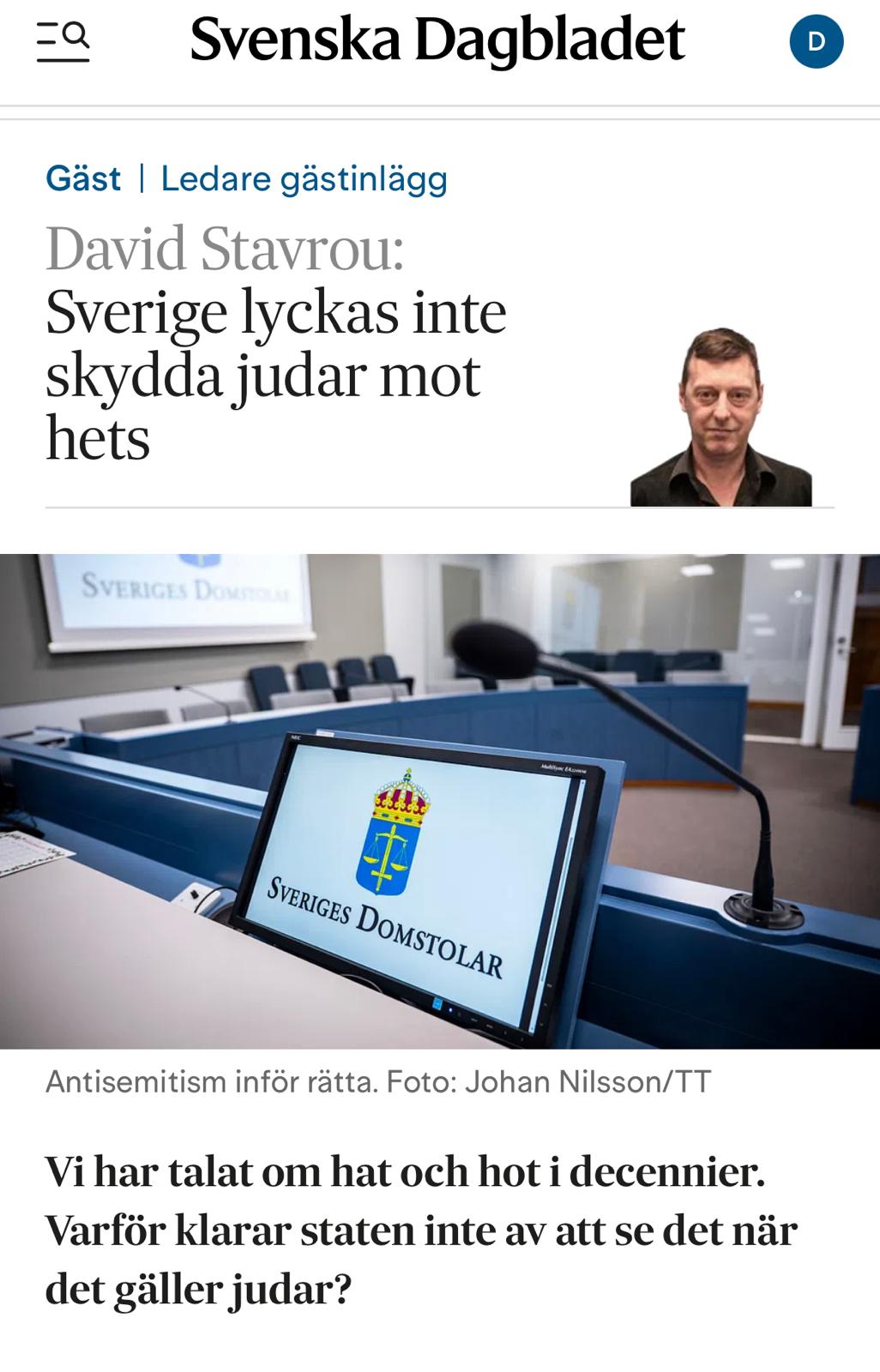
The Helsingborg case concerned charges of incitement against an ethnic group involving antisemitic publications on social media, Holocaust distortion, and conspiratorial content. The defendant was convicted on several counts, including Nazi salutes, publishing antisemitic images, and spreading theories like the one claiming that “4 out of 5 American slave owners were Jewish,” equating Jews with rats, and portraying Jews as a satanic force controlling the world.
At the same time, the man was acquitted on certain counts related to Holocaust distortion — a newer component of Sweden’s incitement legislation. The prosecutor argued that the man’s statements formed part of a broader antisemitic conspiracy narrative involving references to the Illuminati and Freemasons. But the district court was not convinced. During the questioning of Christer Mattsson, an expert on violent extremism and antisemitism and director of the Segerstedt Institute, the defense demanded answers to questions about the number of people cremated in Belzec, Treblinka, and Sobibor, and discussed the extent to which the Israeli government does or does not “weaponize antisemitism”.
Despite Mattsson’s clear answers, and instead of the court telling the defense attorney to stop wasting time on historical revisionism, the result was an acquittal. The defendant’s statements claiming that it would have been impossible to “dispose of 6 million bodies in the ovens,” and the publication of a video describing the figure six million as false, were not considered contrary to generally accepted historical facts and were not considered serious Holocaust distortion.
The problem with the verdict is that the court failed to see the forest for the trees, and the broader antisemitic context disappeared as the court got lost in details. No one has ever claimed that six million bodies were burned or that six million is an exact number. Six million is a widely accepted estimate, supported by millions of confirmed victim names, as well as Nazi documentation, demographic studies, transport records, camp archives, postwar investigations, eyewitness testimony, and forensic evidence.
No serious historian has argued that limited crematorium capacity would suggest exaggerated death tolls or inconsistencies in the history of the Holocaust. The entire debate is absurd. Anyone who has studied this kind of rhetoric knows that Holocaust denial and Holocaust distortion — referred to in academic literature as Holocaust distortion — are very rarely expressed by claiming that the Holocaust never happened. It is usually about relativization, contextualization, and minimization.
This kind of denial is not merely a lie about the past — it is a precondition for genocide: minimizing, justifying, or erasing the crimes and thereby continuing the dehumanization of the victims while obstructing historical accountability and remembrance. In this case, it is not only an insult — it is a call to renew the violence.
In the Gothenburg trial, a woman was acquitted on Wednesday after being charged with incitement against an ethnic group. The images she published online contained classic antisemitic symbols: a snake with a Star of David on its head and large fangs about to attack a naked child; a snake shaped like a Star of David wrapped around a baby bottle with text describing Zionists as child murderers; and an image depicting a hyena eating a child while staring at another child hiding nearby wearing a Palestinian flag on its shirt. The hyena wears a kippah with a Star of David on it.
During police questioning, the woman claimed she had nothing against Jews. “It is Zionists I am speaking against, and what is happening in Gaza is horrific. Seeing children slaughtered every day,” she said.
Christer Mattsson, who also testified in this case, explained that research has long established that snakes and the killing of children are common antisemitic symbols. Anti-Zionism, he explained, becomes antisemitism when it adopts antisemitic stereotypes, conspiracy theories, and so-called antisemitic tropes, such as the notion that evil Jews control global media and governments. Mattsson explained that in this form of “Israelized antisemitism,” “Zionists” assume the role historically assigned to Jews in classic antisemitic ideology and are portrayed as uniquely evil, manipulative, powerful, and conspiratorial.
Despite this, the court missed the point. The fact that a message is critical of Israel does not exclude the possibility that it is simultaneously antisemitic. The Star of David, the snakes, the conspiracies, and the innocent dead children should have been enough. It seems Swedish courts will not act until someone explicitly says, “I really hate Jews and now I’m going to kill a few,” or “Auschwitz is a fictional place.”
But that is not what antisemitism sounds like today. To minimize and distort the Holocaust and spread hatred against the legitimate national movement of the Jewish people is not an exercise in free speech — it is spreading hatred and encouraging violence in disguise.
Things should be called by their proper names, and words have consequences. History gives us many examples of this and they are often associated with specific names – Capital Jewish Museum in Washington DC, the Tree of Life – Or L’Simcha Synagogue in Pittsburgh, Bondi Beach in Sydney, the Krystalgade Synagogue in Copenhagen, the Hypercacher supermarket in Paris, the Jewish Museum in Brussels, Heaton Park Synagogue in Manchester, the Halle Synagogue in Germany, Chabad of Poway Synagogue in California, Golders Green Road in London, the Ozar Hatorah School in Toulouse, and the El Ghriba Synagogue in Tunisia.
All of these acts began with words.
We have spoken about hatred and threats for decades. Why is the state still unable to recognize them when it comes to Jews?


