Once again, hatred and incitement by “pro-Palestinian” demonstrators in Stockholm — this time while they are rightly opposing a new Israeli law

Published in Swedish in Kvartal: Bisarrt judehat – mot en skamlig israelisk lag – Kvartal

The weekly so-called pro-Palestinian demonstrations in Stockholm often include an element of street theatre. These street shows are usually extremely untasteful and they’re often defamatory. Some of the greatest hits include actors dressed as a blood-stained Israeli Prime Minister Netanyahu and KD party leader Ebba Busch holding a Falun sausage in an implied sexual position. There’s President Trump dressed as an SS officer, Prime Minister Kristersson dancing around with a dead baby, Netanyahu in devil horns, and characters wiping their behinds with an Israeli flag.

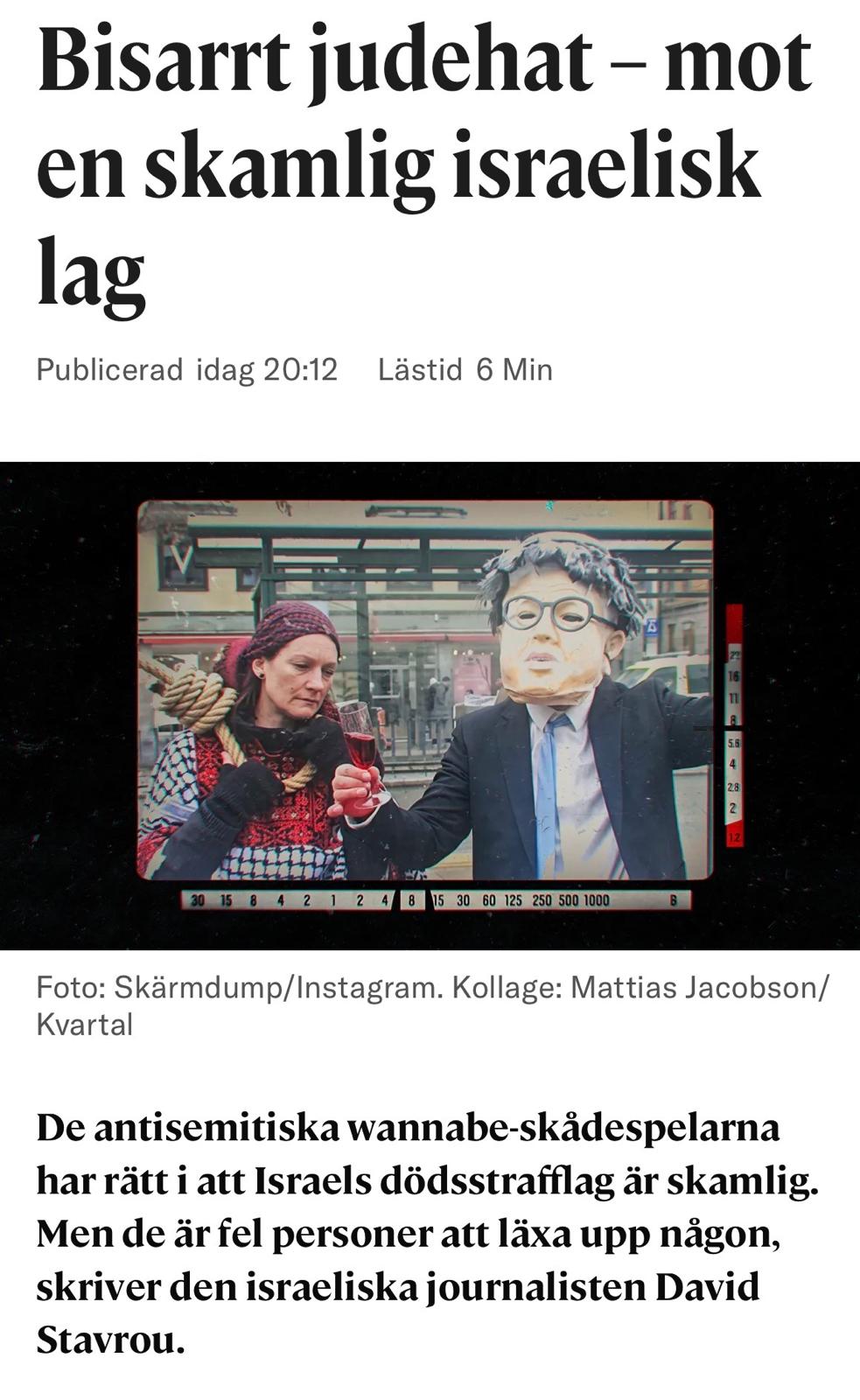
This weekend a new show hit the streets of Stockholm – a character who appears to be a religious Jew because of the kippah on his head holding a glass of blood beside a Palestinian woman being hanged. Those who follow Middle East politics were probably supposed to understand that the Jewish character is Israeli right-wing extremist minister Itamar Ben Gvir celebrating the legislation of the new Israeli death penalty law.

There’s a lot to be said about the Israeli law, but before that’s done the obvious should be pointed out. For those who don’t follow Middle East politics, what happened on Saturday is that Swedish police blocked streets, SL cancelled buses, and taxpayer money was spent in order to allow a group of activists to act out an antisemitic blood libel hundreds of years old, in which a Jew is using the blood of a non-Jewish innocent victim.

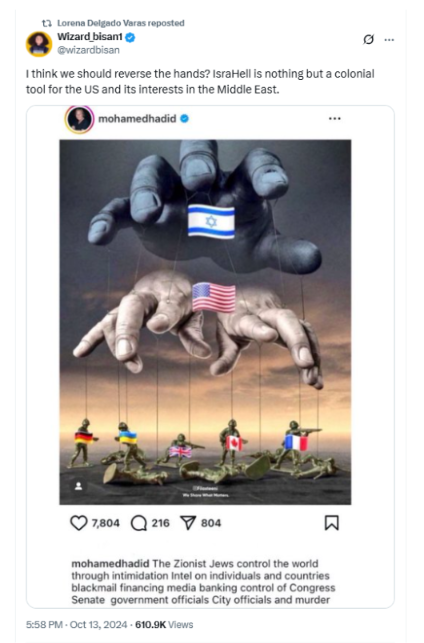
The activists will no doubt claim that their protest is legitimate. The character they acted is not all Jews, they’ll say, it’s only Ben Gvir, or only Israeli Jews, or only Zionists. However, the red-stained glass, the grotesque nature of the Jewish characteristics, and the timing make that claim laughable. The performance took place during Passover, the holiday that European Jews have been blamed since the Middle Ages for using Christian children’s blood for making their special holiday bread. The context of their other shows is that Israel controls the world, the American president and Sweden’s government are maneuvered by the Zionists – Israel’s Prime Minister and Jeffrey Epstein (both Jews of course). They relativize the Holocaust and they mock every Israeli symbol by attaching it to blood and money. Sure, they’re not antisemitic, just anti-Zionists. If anyone is so naive as to think that there’s a difference, perhaps they can explain it to Swedish Jewish children who may have passed by in central Stockholm and wondered why they’re being accused of hanging innocent Palestinians. Again.

Still, the new Israeli legislation deserves a serious discussion, even if those who demonstrated against it in Stockholm are on the wrong side of history. Israel’s new “death penalty for terrorists” law was passed in the Israeli parliament in March. The bill stipulates that the death penalty will be imposed on a terrorist who killed a person “with the intent of denying the existence of the State of Israel.” This wording creates a distinction that effectively designates the law almost exclusively for Palestinian terrorism. However, the court will be authorized to impose a life sentence instead of the death penalty if it finds “special reasons” for doing so or if “exceptional circumstances” are present.

It’s important to point out that the Israeli opposition voted against the law, and many in Israel hope that it will be cancelled if a new government takes over after the next elections. This may be the case because the law, which was pushed through by the most extreme Israeli politicians, was also opposed by other Israeli authorities. An official in the Ministry of Justice said that establishing the death penalty in the West Bank through civilian legislation is “highly problematic”. IDF representatives said that the law contradicts international conventions to which Israel is committed, and officials from both the Ministry of Foreign Affairs and the National Security Council opposed it.

The objections are not only technical. Israeli parliamentarian Gilad Kariv (The Democrats, former Labor Party) said that the law contradicts the values of the State of Israel and that it is disgraceful both in its substance and in the political manner in which it was approved. He also said that the party will bring the constitutional question before the High Court of Justice. This is an important point because the law is indeed expected to be reviewed by the High Court of Justice, and there is a possibility that it will be changed, amended, or cancelled.

However, apart from the extreme right, parts of Israeli society who used to be against such legislation in the past have become more positive towards it because of the 251 Israelis who were kidnapped on October 7th. They argue that many of the people who led and participated in the massacre, including Hamas leader Yahya Sinwar, were prisoners who were released from Israeli jails. If they had been executed for their previous crimes, the most horrific crime in Israeli history could have been avoided. Perhaps the main point supporters of the law point to is the possibility of prisoner exchanges which in Israel’s reality have always been an incentive for Palestinian terrorists to commit more attacks. Capital punishment could, according to the law’s supporters, prevent future Israeli kidnapped civilians from being used as bargaining leverage.

Israeli security officials, including several chiefs of staff of the IDF and heads of the Shin Bet, Israel’s security agency, objected to this reasoning and claimed that terrorism is not meaningfully deterred by the threat of execution because attackers who carry out suicide or high-risk operations are often not motivated by personal survival. Increasing the severity of punishment does not change behavior. Instead, capital punishment could escalate tensions, increase incentives for revenge attacks, and complicate intelligence cooperation and prisoner-management strategies.

Other objections, made by Israeli NGOs, are purely ideological. The Zulat Institute for Human Rights, for example, stated that the legislation “is fundamentally based on racial discrimination, is illegitimate, and has existed in the darkest regimes of modern history.” This is, in short, a very controversial issue in Israel, in many ways it’s another part of the bloody aftermath of October 7th and the regional war that is still going on, and the last word hasn’t been said yet.

Back to Stockholm. Considering the complexities of the Israeli legislation isn’t high on the agenda of the Swedish activists. This is a classic situation of a clock being correct twice a day even if it stopped working. Yes, they’re entirely right in their objection to the Israeli death penalty, but they are the last people in the world to preach on this subject.

First, recently more and more Iranian flags are seen at their demonstrations. The regime in Teheran executes over 1,000 people a year. Still, in the Iranian example, Swedish activists prefer demonstrating in support of the bloodthirsty regime against the “imperialist American-Israeli attack” while conveniently ignoring the institutionalized public hangings of women, homosexuals and regime critics from cranes. Other countries which have had the death penalty for years, from the US, China, and Japan to Iraq and Saudi Arabia, are never mentioned in any demonstration. Only Jewish executions, it seems, are morally wrong as far as they’re concerned.

Second, believe it or not, the Palestinian Authority, the same Palestinians the demonstrations are all about, has a death penalty law. In the West Bank it was used in the past and death sentences are not carried out in practice in recent years, but in Gaza, Palestinians have been executed by Hamas on a large scale, both officially and unofficially. Whoever is really worried about the legal execution of Palestinians should have been demonstrating against Hamas long before demonstrating against Israel.

And the finally, for many Israelis (including the one writing this text), the new law is a source of embarrassment and deep concern. It’s like many Swedes see things like NMR, or Swedish volunteers to the SS, or Swedish imams preaching about Jews engaging in black magic. The fact that in Israel a similar phenomenon is powerful enough to legislate is terrible. Still, the ones who will fix this are democratic and liberal Israelis, not a bunch of extremist wannabe actors from Sweden who believe that Israel never had a right to exist whether it has a death penalty law or not.

Medelhavsmuseet's Selective History

When it comes to the past, Medelhavsmuseet (The Swedish Museum of Mediterranean and Near Eastern Antiquities) largely ignores Israel, but when it comes to the present the museum presents only different shades of the same narrative, one that excludes a balanced, mainstream Israeli perspective. This in itself is not necessarily a problem. However, since public funds are being used and this is all payed for by tax-payers money, why not invest in presenting all sides of the story? Are Israelis so dehumanized that their pain, loss, and sacrifice are not considered worthy of being told?

Published in Swedish in Svenska Dagbladet: https://www.svd.se/a/K8Bn37/medelhavsmuseets-selektiva-historia

The lecture hall at Medelhavsmuseet was full on September 4th. The evening seminar which took place there was called "Repair, Return and Reconstruction for Palestine’s Decolonized Future", and in case the message wasn’t clear enough from the name, during most of the evening there was a photograph of Gaza and a slogan in Arabic and English projected on the screen behind the panel members. The slogan read: “Glory to Gaza”.

The seminar itself wasn’t exactly intellectually challenging and the message was pretty straight forward. When Israel was mentioned by all speakers it was associated with very specific words. Genocide, occupation, oppression, destruction, starvation, ethnic cleansing, collective punishment and settler-colonialism were some of the favourites. There was also a consensus about the Palestinian reaction to the Israeli aggression. Here the popular words were: education, culture, conservation, de-colonization, renovation and restoration. Listening to the panel members it sounded like Palestinian resistance is all about Mahmoud Darwish poems, architecture podcasts and a struggle for free press.

In an hour and a half of debate there was nothing about Palestinian terror or violence, there were no suicide bombings or rockets, Hamas wasn’t mentioned and October 7th was just the date when the current Israeli offensive started. Since all panel members were engaged in architecture and restoration and apparently very well acquainted with Gaza, it was interesting that the immense military underground tunnel infrastructure, a remarkable architectural achievement in itself, was not mentioned. There was also no mention of another kind of physical destruction – the one of Israeli communities. No destroyed and abandoned kibbutzim, no apartments demolished by Qassam rockets and no homes burned to the ground with entire families still inside. There were no hostages, no executions and no organized rape and sexual violence. The whole event felt like a motivational inspirational gathering for activists, where all the speakers clearly presented a Palestinian narrative, and many in the audience were members of the so-called "pro-Palestinian" movement. Some wore kaffiyehs, a couple of them even had red triangles (a Hamas symbol) on them.

In itself, all this is completely legitimate. In a democracy, people are free to organize whatever seminar they wish. What is, however, somewhat troubling is that Medelhavsmuseet is part of a government agency (Statens museer för världskultur) funded by taxpayers, with tens of millions of Swedish Crowns each year. When Rani Kasapi, Head of Content and Learning at Världskulturmuseerna, opened the seminar, she also mentioned that other institutions were also involved in organizing it: the Swedish Institute of International Affairs (UI), the Swedish Research Institute in Istanbul (SRII), and the Swedish Arts Grants Committee. All of these are also fully or partially funded by Swedish taxpayers, raising the question – why should funds that could be spent on education and culture for the benefit of all be used for a one-sided, highly political event based on foreign policy propaganda?

Perhaps, the idea was to have another event to balance the message and show another side and a different narrative. And indeed, on October 7th, a very symbolic and politically charged date, another event was planned by the museum. This time the title was: What’s Happening in Israel Now? (Vad händer i Israel nu?). In a perfect world, this could have been the the missing piece, the event that shows that the situation is more complex than just propaganda. But the world isn’t perfect. According to publications, the event had only one speaker – Göran Rosenberg. The same Rosenberg who only a few months earlier described Israel as a "morally dead project" and questioned its future existents in its current form. It’s as if the museum invited an anti-vaxer to lecture about the importance of vaccinations. Was it really so hard to find another voice to describe the situation in Israel? One who at least believes in its future?
Medelhavsmuseet has hosted more events about the region in the last couple of years — for example, there was a book talk with Cecilia Uddén, one of Swedish media’s most critical voices when it comes to Israel. There was also a UI event featuring several Israeli left-wing activists. But the bigger picture is that, aside from rare exceptions, Medelhavsmuseet largely presents different shades of the same narrative, one that excludes a balanced, mainstream Israeli perspective. This in itself is not necessarily a problem. However, if public funds are being used, why not invest in presenting all sides of the story? Are Israelis so dehumanized that their pain, loss, and sacrifice are not considered worthy of being told?

Looking a bit deeper, it’s obvious that Medelhavsmusset doesn’t ignore the Israeli perspective only when it comes to the current conflict. For some reason, it ignores Israel’s existence all together (apart from occasionally mentioning it as a colonial bully destructing the fascinating, authentic and noble people of the orient). Israel as a modern state and the ancient Jewish entities in the Eastern Mediterranean like the Kingdoms of Jehuda and The Northern Kingdom of Israel are a treasure of history, archaeology and ancient culture. They’re the origin story of Christianity and Western civilization and a fascinating story of cultural, social and linguistic revival. Still, in the last twenty years of exhibitions, it seems like Medelhavsmuseet hasn’t had a single exhibition presenting Israeli or Jewish culture and history. I spoke with two historians who have studied this in detail. One of them said that “ancient Jewish history is almost completely erased from the museum’s portrayal of the ancient Mediterranean region”. The other said that for historical reasons, the museum focuses on Egypt and Cyprus, which is fine, but even when those cultures had strong connections to Jews in the region, those connections are usually not mentioned, and even on the rare occasions that they are the name Israel never is.

And they're right. Medelhavsmuseet has presented many exhibitions about Egypt, Greece, Rome, Syria, Cyprus, Turkey – and even non-Mediterranean countries such as Iraq. In fact, the only recent exhibition that touched on Israel was “Nakba,” which according to the Jewish Central Council was highly one-sided and sparked debate over whether the museum was pursuing a political agenda. The museum responded that “it is not a historical exhibition, but a small audio exhibition with stories”. When representatives from the Jewish Central Council met with the superintendent of Statens museer för världskultur regarding this, their concerns were not taken seriously.

There’s no doubt that the story of the Nakba should be told. It’s an important part of the region’s history. But if this was only a “small audio exhibition with stories”, where is the next audio exhibition with the other stories from the same war – for example, those about Holocaust survivors who were killed in the battle field after being freed from Auschwitz, or those about massacres of Jews that took place during the same time, or the ones about the Jordanians expelling the Jews from Jerusalem’s old town or the Egyptians illegally occupying Gaza?

During the debate with the Jewish Central Council, the museum mentioned one exhibition – Egypt’s Jews (Egyptens judar), perhaps as one with a more “Jewish narrative”. But the truth is that even when the exhibition explains how Egyptian Jews were attacked, harassed, arrested and expelled in the 1950s and 60s, it’s clear that the message is that this is a direct result of Zionism. The exhibition explains how for 3,000 years Jews were “totally integrated in the surrounding society” (helt integrerade i det omgivande samhället) and only when the UN decided to “divide Palestine” and the 1948 war broke out, Egyptians started “anti-Zionists riots” and resisted “foreign influence”. These texts are a wonderful example of verbal acrobatics. There’s no Egyptian antisemitism, no Muslim Brotherhood (the mother movement of Hamas) promoting genocidal racism against Jews, just an unfortunate mixing up (ihopblandning) of “Jews” and “Zionists”. This makes sense since one of the exhibition’s production partners was Magda Haroun, Head of the Jewish Community Council in Egypt and a vocal opponent of Israel who claims that Zionism is a racist movement. Interestingly, the exhibition which mentions the wars between Israel and Egypt, doesn’t discuss Egyptian President Saadat’s historic recognition of Israel and the resulting Israel-Egypt peace agreement. One can only assume that the reason is that if the museum tells its visitors about Egypt recognizing Israel, this may lead to a demand that Medelhavsmuseet does the same.