Once again, hatred and incitement by “pro-Palestinian” demonstrators in Stockholm — this time while they are rightly opposing a new Israeli law

Published in Swedish in Kvartal: Bisarrt judehat – mot en skamlig israelisk lag – Kvartal

The weekly so-called pro-Palestinian demonstrations in Stockholm often include an element of street theatre. These street shows are usually extremely untasteful and they’re often defamatory. Some of the greatest hits include actors dressed as a blood-stained Israeli Prime Minister Netanyahu and KD party leader Ebba Busch holding a Falun sausage in an implied sexual position. There’s President Trump dressed as an SS officer, Prime Minister Kristersson dancing around with a dead baby, Netanyahu in devil horns, and characters wiping their behinds with an Israeli flag.

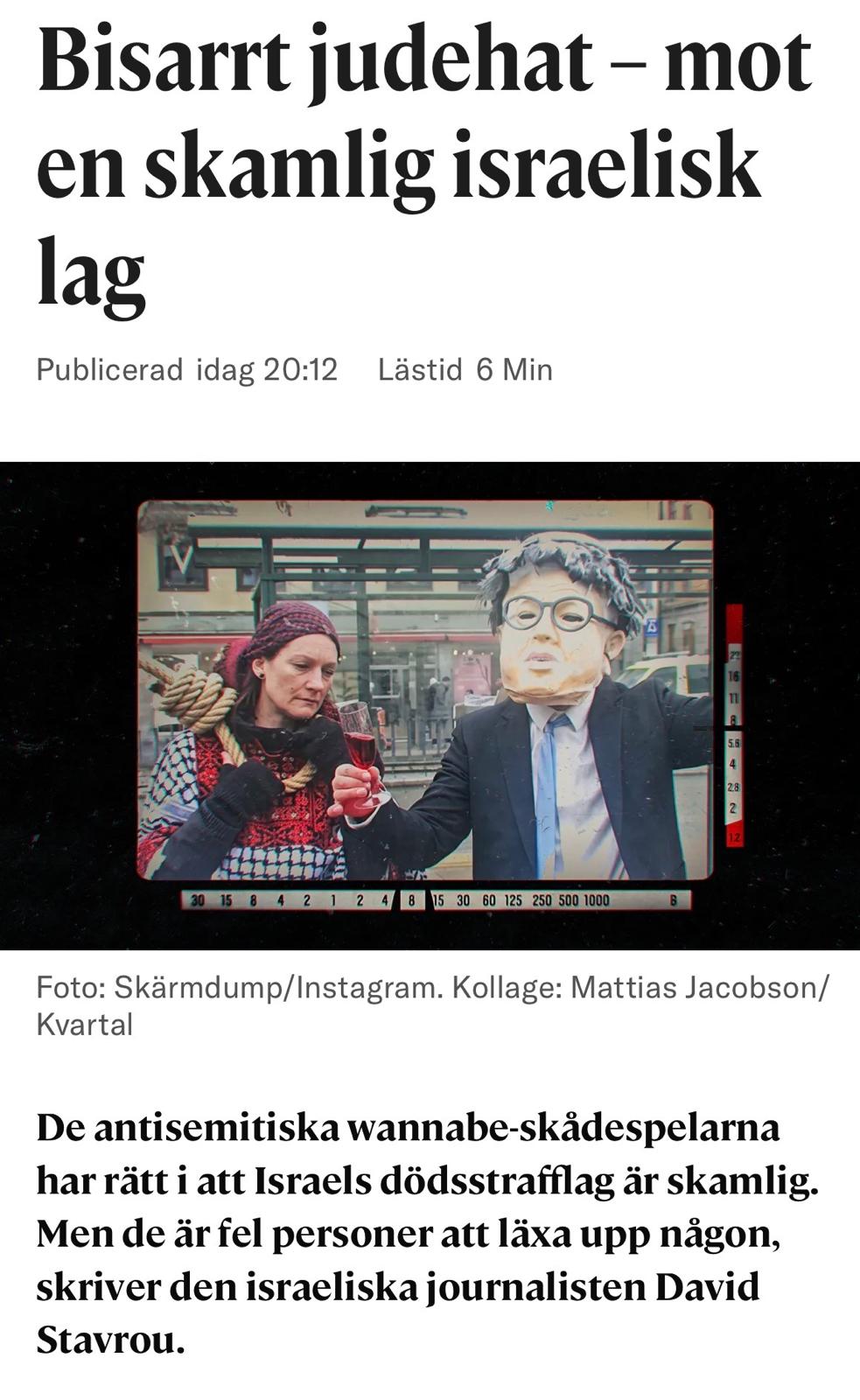
This weekend a new show hit the streets of Stockholm – a character who appears to be a religious Jew because of the kippah on his head holding a glass of blood beside a Palestinian woman being hanged. Those who follow Middle East politics were probably supposed to understand that the Jewish character is Israeli right-wing extremist minister Itamar Ben Gvir celebrating the legislation of the new Israeli death penalty law.

There’s a lot to be said about the Israeli law, but before that’s done the obvious should be pointed out. For those who don’t follow Middle East politics, what happened on Saturday is that Swedish police blocked streets, SL cancelled buses, and taxpayer money was spent in order to allow a group of activists to act out an antisemitic blood libel hundreds of years old, in which a Jew is using the blood of a non-Jewish innocent victim.

The activists will no doubt claim that their protest is legitimate. The character they acted is not all Jews, they’ll say, it’s only Ben Gvir, or only Israeli Jews, or only Zionists. However, the red-stained glass, the grotesque nature of the Jewish characteristics, and the timing make that claim laughable. The performance took place during Passover, the holiday that European Jews have been blamed since the Middle Ages for using Christian children’s blood for making their special holiday bread. The context of their other shows is that Israel controls the world, the American president and Sweden’s government are maneuvered by the Zionists – Israel’s Prime Minister and Jeffrey Epstein (both Jews of course). They relativize the Holocaust and they mock every Israeli symbol by attaching it to blood and money. Sure, they’re not antisemitic, just anti-Zionists. If anyone is so naive as to think that there’s a difference, perhaps they can explain it to Swedish Jewish children who may have passed by in central Stockholm and wondered why they’re being accused of hanging innocent Palestinians. Again.
Still, the new Israeli legislation deserves a serious discussion, even if those who demonstrated against it in Stockholm are on the wrong side of history. Israel’s new “death penalty for terrorists” law was passed in the Israeli parliament in March. The bill stipulates that the death penalty will be imposed on a terrorist who killed a person “with the intent of denying the existence of the State of Israel.” This wording creates a distinction that effectively designates the law almost exclusively for Palestinian terrorism. However, the court will be authorized to impose a life sentence instead of the death penalty if it finds “special reasons” for doing so or if “exceptional circumstances” are present.

It’s important to point out that the Israeli opposition voted against the law, and many in Israel hope that it will be cancelled if a new government takes over after the next elections. This may be the case because the law, which was pushed through by the most extreme Israeli politicians, was also opposed by other Israeli authorities. An official in the Ministry of Justice said that establishing the death penalty in the West Bank through civilian legislation is “highly problematic”. IDF representatives said that the law contradicts international conventions to which Israel is committed, and officials from both the Ministry of Foreign Affairs and the National Security Council opposed it.

The objections are not only technical. Israeli parliamentarian Gilad Kariv (The Democrats, former Labor Party) said that the law contradicts the values of the State of Israel and that it is disgraceful both in its substance and in the political manner in which it was approved. He also said that the party will bring the constitutional question before the High Court of Justice. This is an important point because the law is indeed expected to be reviewed by the High Court of Justice, and there is a possibility that it will be changed, amended, or cancelled.

However, apart from the extreme right, parts of Israeli society who used to be against such legislation in the past have become more positive towards it because of the 251 Israelis who were kidnapped on October 7th. They argue that many of the people who led and participated in the massacre, including Hamas leader Yahya Sinwar, were prisoners who were released from Israeli jails. If they had been executed for their previous crimes, the most horrific crime in Israeli history could have been avoided. Perhaps the main point supporters of the law point to is the possibility of prisoner exchanges which in Israel’s reality have always been an incentive for Palestinian terrorists to commit more attacks. Capital punishment could, according to the law’s supporters, prevent future Israeli kidnapped civilians from being used as bargaining leverage.

Israeli security officials, including several chiefs of staff of the IDF and heads of the Shin Bet, Israel’s security agency, objected to this reasoning and claimed that terrorism is not meaningfully deterred by the threat of execution because attackers who carry out suicide or high-risk operations are often not motivated by personal survival. Increasing the severity of punishment does not change behavior. Instead, capital punishment could escalate tensions, increase incentives for revenge attacks, and complicate intelligence cooperation and prisoner-management strategies.

Other objections, made by Israeli NGOs, are purely ideological. The Zulat Institute for Human Rights, for example, stated that the legislation “is fundamentally based on racial discrimination, is illegitimate, and has existed in the darkest regimes of modern history.” This is, in short, a very controversial issue in Israel, in many ways it’s another part of the bloody aftermath of October 7th and the regional war that is still going on, and the last word hasn’t been said yet.

Back to Stockholm. Considering the complexities of the Israeli legislation isn’t high on the agenda of the Swedish activists. This is a classic situation of a clock being correct twice a day even if it stopped working. Yes, they’re entirely right in their objection to the Israeli death penalty, but they are the last people in the world to preach on this subject.

First, recently more and more Iranian flags are seen at their demonstrations. The regime in Teheran executes over 1,000 people a year. Still, in the Iranian example, Swedish activists prefer demonstrating in support of the bloodthirsty regime against the “imperialist American-Israeli attack” while conveniently ignoring the institutionalized public hangings of women, homosexuals and regime critics from cranes. Other countries which have had the death penalty for years, from the US, China, and Japan to Iraq and Saudi Arabia, are never mentioned in any demonstration. Only Jewish executions, it seems, are morally wrong as far as they’re concerned.

Second, believe it or not, the Palestinian Authority, the same Palestinians the demonstrations are all about, has a death penalty law. In the West Bank it was used in the past and death sentences are not carried out in practice in recent years, but in Gaza, Palestinians have been executed by Hamas on a large scale, both officially and unofficially. Whoever is really worried about the legal execution of Palestinians should have been demonstrating against Hamas long before demonstrating against Israel.

And the finally, for many Israelis (including the one writing this text), the new law is a source of embarrassment and deep concern. It’s like many Swedes see things like NMR, or Swedish volunteers to the SS, or Swedish imams preaching about Jews engaging in black magic. The fact that in Israel a similar phenomenon is powerful enough to legislate is terrible. Still, the ones who will fix this are democratic and liberal Israelis, not a bunch of extremist wannabe actors from Sweden who believe that Israel never had a right to exist whether it has a death penalty law or not.

A Year On, How Coronavirus Changed Sweden

A policy downplaying lockdowns and mask-wearing may have buoyed infection rates and deaths, but Swedes disagree on how the long term will look. How the world we knew has changed – the first in a series.

Published in "Haaretz": https://www.haaretz.com/world-news/.premium.MAGAZINE-coronavirus-year-one-the-way-the-pandemic-has-changed-sweden-1.9511565

Scandiabadet, Malmö, summer 2020. Photo: News Øresund Johan Wessman

David Stavrou

Stockholm, Sweden

 Feb 5, 2021 13:10

STOCKHOLM – Håkan Frändén, 61, lives in Stockholm and normally works as a tour guide, but these aren’t ordinary times and tourists have been a very rare commodity in Sweden since the coronavirus broke out a year ago.

“Of course, the pandemic affected my professional life when the world closed down and the high tourist season ended before it even began,” he says. “In 2020 we had zero tourists and my wife, who’s a tourist guide too, and I lost all our income.”

But Frändén and his wife didn’t give up. She took a course and is now working as a personal trainer and yoga instructor, while Håkan got a part-time job via the national employment agency delivering groceries – plus he receives unemployment benefits for the days he doesn’t work.

.Malmö, 2021. Photo: Maria Eklind

"It’s true this has been a terrible year when it comes to the victims of the pandemic, but personally I had a good year,” he says. “We bought bicycles and made them our main means of transportation, we rediscovered our city – many times with our children and grandchildren – and we had more time for ourselves and our family.”

In the past year, few countries have attracted attention like Sweden. The fact that it didn’t impose lockdowns, didn’t force quarantines, didn’t close schools and didn’t require masks made it the subject of thousands of news reports and commentaries in the world media. Some called Sweden “the world’s control group,” others said it was carrying out “an experiment on people.”

As far as we know, COVID-19 reached Sweden in January 2020, carried by a passenger from Wuhan, China. Still, there’s a suspicion that already the month before people were infected in Sweden, without being traced due to a lack of testing.

Community transmission started in March, after a month earlier many infected people landed on flights from northern Italy, Iran and other countries. Already during the first stage of the pandemic the Swedish authorities were criticized for not assessing the danger and preparing accordingly.

On March 11, the day the World Health Organization declared a global pandemic, the first coronavirus patient died in Stockholm. April saw a significant wave of illness, and by mid-June dozens of infected people were dying every day in Sweden.

Heavy burden on health care

The country’s health care system withstood the heavy burden and didn’t collapse thanks to the great efforts of the medical staff, as well as budgetary and logistics efforts by the government and local authorities. But in nursing homes for the elderly the situation was completely different. A government committee has determined that Sweden failed to protect this population, citing neglect and poor management by the current government and its predecessors.

In the first wave, the Swedish strategy for halting the infection was unique. The authorities simply asked people who developed symptoms and people in risk groups to show responsibility and stay home. Also, everyone was asked to work from home if possible and  forgo unnecessary travel.

Instead of the thorough system of testing, tracing and quarantining established in many countries, the Swedes did coronavirus testing during the first stage only in hospitals and in care for the elderly.

Anders Tegnell, the chief epidemiologist and the person most identified with Sweden’s management of the virus, explained this policy in April in an interview with Haaretz. He said that Sweden had limited testing capacity and that regardless of the test results, the recommendation would be to stay home. The Swedish policy was based on a high level of public trust in the authorities and long-term thinking, he added.

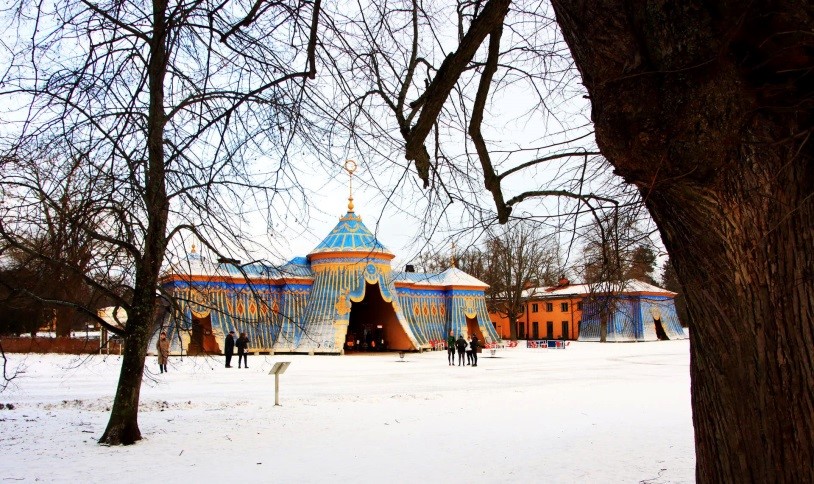
Hagaparkern, north of Stockholm, 2021. Photo: Guillume Baviere

Despite the reliance on public trust, the government and the local authorities, the Swedes took a number of restrictive steps due to the virus. They switched over to online learning at universities and high schools, limited public gatherings to 50 people, prohibited visits to hospitals and nursing homes, and imposed restrictions on serving food in bars and restaurants.

'The long-term social consequences will probably turn out greater in countries that seemed to be succeeding at the beginning'

During the summer the pandemic waned in Sweden and the hospitals’ coronavirus wards emptied out. But this was temporary; in November a more deadly wave began. Once again there were dozens of deaths every day and the hospitals were overburdened. So the authorities tightened the restrictions: They limited gatherings to eight people, banned the sale of alcohol after 8 P.M. and closed movie theaters, museums and libraries.

Still, the overall strategy didn’t change. The country’s leaders continued to rely on public trust and eschewed a general lockdown; they left the schools, restaurants and malls open. Stores and other businesses remained open, but with restrictions on the number of people allowed inside. Also, there was no requirement to wear a mask; Swedes were recommended to wear one only on public transportation at peak hours.

Around the world, people had the impression that while many countries were isolating and suffering a harsh economic blow, in Sweden it was business as usual. But the reality was different. “At first I thought we’d work from home for a month and then return to the office,” says Erik Numan, a 56-year-old art director from Stockholm. “By now, 10 months later, I’ve been in the office for only one day.”

'Even though I work in many fields, everything disappeared and I still can’t plan anything even a year later'

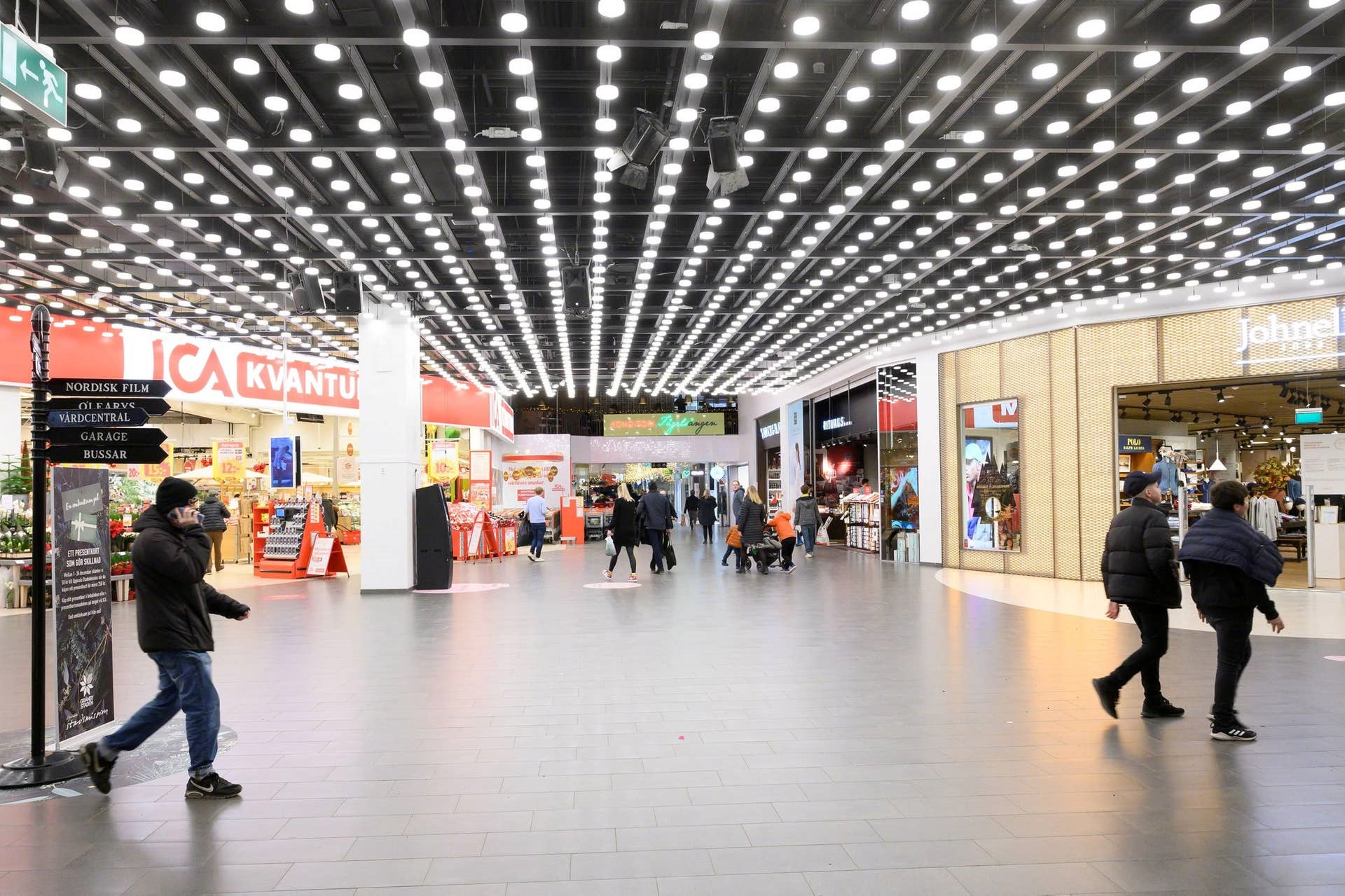
A shopping mall in Stockholm, December 2020. Photo: TT News Agency via Reuters

Numan says he has stopped exercising at a gym, doesn’t visit his parents and rarely meets with friends. Although he says he isn’t very worried about the virus personally, he feels solidarity with others who are likely to become infected and is concerned about the overburdened health care system.

“Nobody checks on me and the police won’t arrest me if I don’t observe the recommendations,” he says. “But I think most Swedes do what’s necessary when there’s a crisis.”

Numan’s 16-year-old daughter contracted the virus, developed mild symptoms and was in quarantine for two weeks. “When she meets girlfriends now they hug as usual, at a time when we adults have completely stopped shaking hands,” Numan says.

Like the Frändéns, Linnéa Sallay, a 60-year-old singer and violinist who lives in Stockholm, saw her professional life racked by the virus. “All the jobs disappeared overnight in mid-March,” she says. “Even though I work in many fields, perform in concerts, guide tours and produce events, everything disappeared and I still can’t plan anything even a year later.”

Sallay notes, however, that the past year has also provided a welcome time-out. She's surviving financially thanks to her savings, she has launched a YouTube channel and is developing her digital skills. She has also spent a lot of time with her family and friends, even if not at restaurants and cafes. And she’s now rehearsing and preparing for digital concerts.

Vaxholm, Sweden, summer of 2020. Photo: Bengt Nyman

Entering the crisis with disadvantages

Sweden has several disadvantages regarding COVID-19. Twenty percent of the population is over 65, it’s cold, its borders are open to other countries, its population is very diverse and it’s not used to emergency situations. But it also had advantages: a universal, quality health care system, stable and well-financed government services, and many single-person households.

Considering its starting conditions a year ago, it’s hard to estimate the real effect of the Swedish policy on illness rates and mortality. Compared to its Nordic neighbors – Finland, Denmark and Norway – Sweden’s mortality has been very high. The country of 10 million people has suffered about 12,000 deaths, with this figure per million people high at 1,444. In Denmark, Finland and Norway the number is 363, 121 and 104, respectively.

It’s not a competition and there’s no point saying who the winner is. It’s far too early and too dangerous to compare week-by-week mortality rates

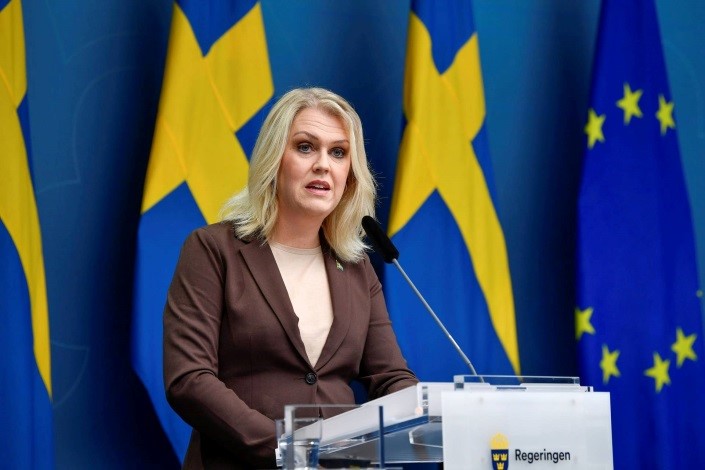
Swedish Health Minister Lena Hallengren

Swedish Health Minister Lena Hallengren at a press conference in Stockholm in November 2020. Photo: Henrik Montgomery / TT News Agency via Reuters

But compared to many other European countries, including those that imposed lockdowns, closed schools and halted the economy, the mortality rate is modest. In Britain, Spain and Italy, for example, the number of deaths from COVID-19 per million inhabitants is 1,591, 1,254 and 1,473, respectively.

Some experts believe that the shunning of lockdowns has brought Sweden better results in metrics that have yet to be measured such as rates for depression, excessive weight gain, addiction, violence and illnesses from diabetes to heart attacks and strokes. In Sweden you could also hear the claim that the country’s high mortality rate in 2020 stemmed from the low mortality rates from the flu in 2019.

Fiasco at the nursing homes

Swedish Health Minister Lena Hallengren told Haaretz in September that it was too early to judge the Swedish policy because this was a marathon, not a sprint.

“It’s not a competition and there’s no point saying who the winner is,” she said. “It’s far too early and too dangerous to compare week-by-week mortality rates. Different countries were hit differently; they have different structures and relations with their authorities, they test in different ways and have different kinds of data and information. In the long run, we all need well-functioning societies. We should learn what there is to learn from others, point fewer fingers and try to keep up with long-term recommendations.”

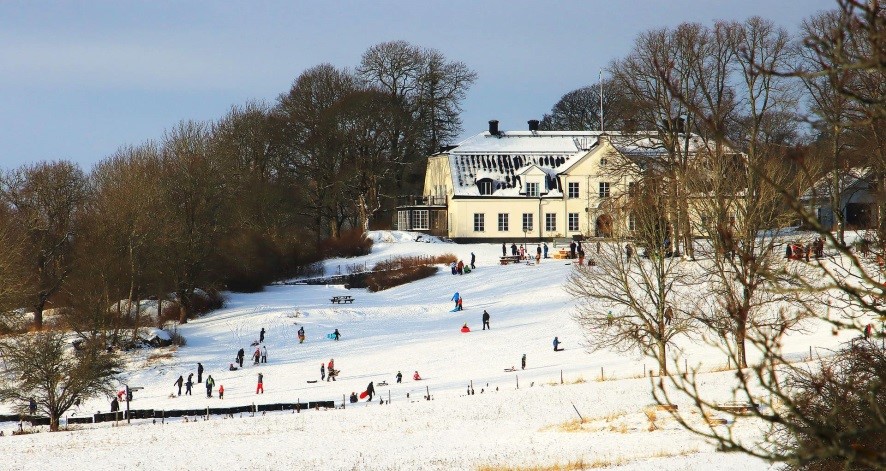
Uppsala, Sweden, last month. Photo: Guillaume Baviere

But there’s considerable evidence of failures in Sweden’s handling of the pandemic. The Swedish media has reported on cases where nursing home residents did not see a doctor and were not evacuated to hospitals despite their serious condition. The nursing home staffs were unequipped and not trained at all to deal with a pandemic.

The Public Health Agency of Sweden has been harshly criticized too. Critics say that during the pandemic’s early days, the agency was complacent and didn’t assess the danger correctly. Later, the prime minister himself, Stefan Löfven, said the agency had downplayed the second wave. At various stages, key people in academia and the medical system demanded that the agency make more stringent recommendations to curb the spread of the virus.

Regarding vaccines in Sweden, signs also attest to delays and complications, though here the shortcoming is mainly on the European level. Like many countries, Sweden has bought vaccines as part of an EU transaction, but the supply has been slow, one reason being a hitch in the manufacture and supply of AstraZeneca’s vaccine.

As of now, Sweden has vaccinated 256,978 people with the first dose and 28,279 with the second. That means 3.13 percent of the population over 18 has received one dose and only 0.34 percent two.

Although Swedish politicians in general have backed the government over the past year, other voices have been heard in recent weeks. “We have to respond differently now,” Ebba Busch, the leader of the opposition Christian Democratic Party, told the daily Aftonbladet. “If the government lacks the courage to lead, it should resign.” Nonetheless, the ruling Social Democratic Party is leading in the polls and received 28.5 percent support in a survey last month, a 2-point rise over November.

'I hope we’ll appreciate each other more when all this is over, and I hope we’ll go back to meeting up again. The hell with Zoom'

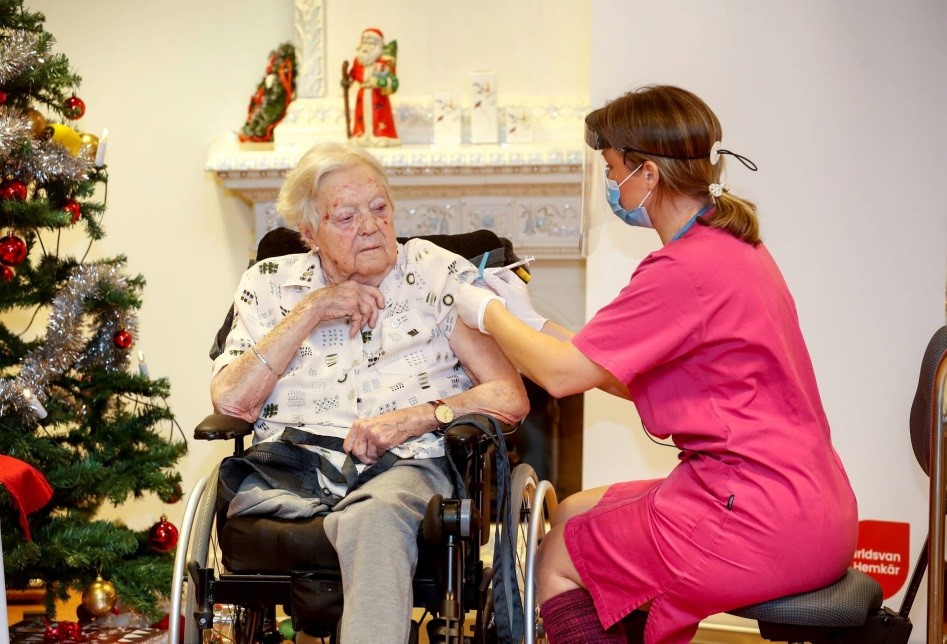
A nurse vaccinating a nursing home resident in Mjölby, Sweden, in December 2020.Photo: Stefan Jerrevang / TT News Agency via Reuters

“I think we’ve dealt pretty well with the pandemic,” says Frändén, the tour guide. “I wouldn’t want to be anywhere else. But there have been failures too, mainly the spreading of the virus in old age homes. In recent decades there has been unrestrained privatization in our care system, and that’s one reason for the negligence in preparing and training staff.”

Frändén says the virus spread within another marginalized group too. “In 2014 and 2015 Sweden was one of the countries in Europe that opened its doors to the most refugees,” he says.

“As a result, many refugees settled in Stockholm’s suburbs and we saw social phenomena that we didn’t have before – crowded living conditions in large families, large family gatherings including elderly people, and less access to the authorities’ information. Our authorities failed here, and that may be an explanation for the differences in the virus’ spread between Sweden and Denmark, Norway and Finland, which hardly took in any refugees.”

‘Every country has its own conditions’

Sallay, the singer and violinist, also criticizes the authorities’ handling of the pandemic, especially the economic aspect, so she and a colleague launched a protest by the self-employed.

“We, the small independent workers who don’t have employees, have been discriminated against,” she says, noting that large companies in Sweden furloughed employees and received government funding for expenses, while small businesses are only now beginning to receive help.

And indeed, in an interview with TheMarker in June, Swedish Finance Minister Magdalena Andersson said the national priority is to help salaried workers and large companies. During the crisis the Swedish government has invested large sums to buoy employment while providing payments to furloughed workers, compensation and guarantees, while strengthening companies’ liquidity and providing professional training and retraining for the unemployed.

“I think it’s too early to know whether we chose the right path,” says Numan, the art director. “Every country has its own conditions, and the long-term social consequences will probably turn out greater in countries that seemed to be succeeding at the beginning.”

As he puts it, “I hope we’ll appreciate each other more when all this is over, and I hope we’ll go back to meeting up again. The hell with Zoom.”