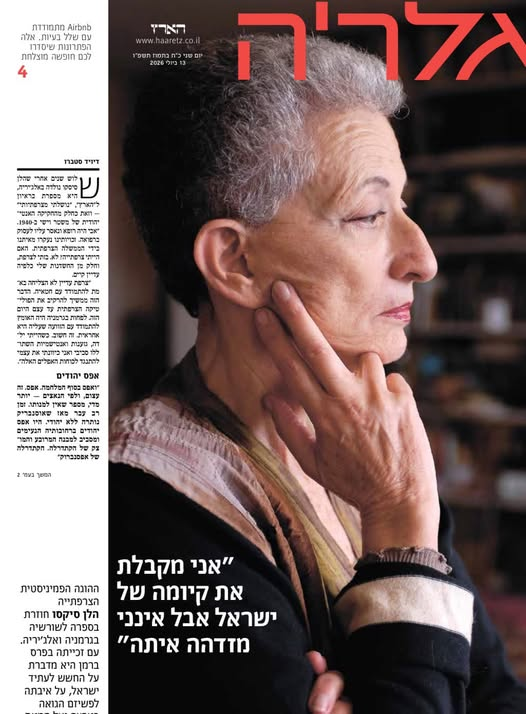
Hélène Cixous: ‘I Accept Israel’s Existence, but I Don’t Identify With It’

The pioneering French feminist thinker returns to her family’s roots in Germany and Algeria in her Berman Prize-winning book. In an interview with Haaretz, she discusses Netanyahu’s government and why she still wants Israel to survive.

Published in Haaretz: Hélène Cixous: 'I Accept Israel's Existence, but I Don't Identify With It' – Art & Culture

Three years after Hélène Cixous was born in Algeria, she recounts in an interview with Haaretz, “I was dispossessed of my Frenchness” as part of the anti-Jewish legislation of the Vichy regime in 1940. “My father was a doctor and was forbidden to practice medicine. Our rights were stripped from us by the French government. Was I French? No. I despised France, and some of my suspicion toward it still exists.

“France has still not truly managed to confront its sins. This continues to rot French politics to this day. At least Germany had the courage to confront the horror for which it was responsible. That is important. When I was a child, racism and antisemitism raged around me, and I directed myself to oppose these dark forces.”

Zero Jews

“And zero at the end of the war. Zero, that’s enormous, and according to the Nazis, too much, an innumerable number… It had been a long time since Osnabrück was without a Jew, there were zero Jews in the charming streets and around the solid, square body of the cathedral of Zerosnabrück”.

This passage from Hélène Cixous’s book Osnabrück Station to Jerusalem captures the essence of her latest work. Part memoir, part family history, the book combines the great Jewish tragedy with philosophical reflections on Jewish existence.

As is her custom, Cixous employs her creative powers in writing not only in relation to her characters but also toward language itself. Osnabrück, the German city from which her mother’s family originated, becomes “Zerosnabrück” after it is emptied of its Jews. In 1934, 435 Jews lived there, Cixous writes; after the war, the number was zero.

Both historically and magically, the city is linked to Jerusalem: both become landscapes of memory and longing, both are inhabited by the living and the dead and stand at the center of the attempt to understand what it means to be Jewish when one’s world is shaped by displacement, catastrophe and the search for a home.

Osnabrück acquires an almost mythical status throughout the book. For Cixous, it is not just “Zerosnabrück”; it is also “the Paris of Lower Saxony.” Like Jerusalem, it is both real and a surreal dream where living characters meet the dead, and where the book itself becomes a character and speaks with its author. All of this occurs across timelines and locations that jump between the Holocaust in Europe and Algeria and the Middle East, incorporating biblical references, Greek mythology, European classics and Shakespearean tragedy.

All of this greatly resonated with the Swedish Berman Prize for Literature committee, which selected Cixous and her book – published in French in 2016 and in English in 2020, and not yet translated into Hebrew – as the 2026 prize winner. The award ceremony will take place in October. It is one of the most prestigious literary prizes, including a cash award of one million Swedish kronor, approximately 320,000 shekels, and is awarded to writers whose work illuminates Jewish life while also addressing universal human questions.

The prize was founded in 2020 by Swedish philanthropists Thomas and Catharina Berman, through a private donation intended to support Jewish culture and strengthen Jewish literary tradition. Thomas Berman said that the rise in antisemitism was one of the reasons for establishing the prize.

The first recipient was David Grossman, for his body of work, and other recipients include Hungarian author Péter Nádas, Russian-Jewish author, poet and journalist Maria Stepanova, and Jewish-Guatemalan author Eduardo Halfon. This year, the prize committee praised Osnabrück Station to Jerusalem, describing it as a work that “traces the void left by the displaced, maps absence and gives voice to those who can no longer speak.”
A Wonderful, Mysterious Place

“Osnabrück is like Jerusalem: one must go there, one must present oneself before its faces, one must let it speak and advance toward its language as before the monster Behemoth about which God boasts to Job, one must touch it with one’s fingers, one’s feet; one cannot know it from a distance. It’s like the sea: even from two yards away one doesn’t know it, one must throw oneself into its arms yelling.”

Cixous was born in Oran, Algeria, in 1937 to a German-Jewish mother who was a midwife and a Sephardi-Jewish father. For more than six decades, she has addressed questions of identity, language and memory. She is best known as the author of the essay The Laugh of the Medusa (1975), one of the foundational texts in modern feminist literary theory, which established her status as an influential thinker and one of the mothers of post-structuralist feminism.

Cixous worked closely with Jacques Derrida, who referred to her as “the greatest living writer in our language.” In her early 30s, in 1968, she participated in the Paris student revolt and in the founding of Paris 8 University, an institution intended to serve as an alternative to the traditional French academic environment. In 1974, the university became home to a center for women’s studies founded by Cixous, the first of its kind in Europe. She also maintained a lifelong interest in questions concerning her Jewish history. These questions are at the heart of Osnabrück Station to Jerusalem.

Is her book intended to give voice to those who can no longer speak? “When I write, it’s not I who has intentions, it’s the book,” she replies. “The book has its urgency and it doesn’t aim at this or that consideration. It’s true that it gives a voice to the void, like everything else that has been written, because of the huge field of tragic events. But writing is always giving a voice.

“In this case, it’s all somehow in the title, it’s a singular experience, of my relation to history, to politics, to tragedy. The voice of my writing is a mixture of tragedy and comedy and my material is partly autobiographical, partly theater and the obsession that led me to the book was going to Osnabrück.”

The obsession she describes is preservation through family dialogue, fantasy and therapy. Throughout Osnabrück Station to Jerusalem, the dead refuse to disappear, and the book seems full of ghosts – mothers, grandmothers, murdered relatives and those born long after the war, vanished neighbors and destroyed communities. All reappear in dreams, conversations, fragments of language and works of art. The living and the dead merge into one another. The visit to Osnabrück thus becomes not only a journey to a specific place but an encounter with the voices of a lost world.

The city that gives the book its title occupies a remarkable place in Cixous’s imagination. “It’s a place that no one knows. Even the Germans don’t know it,” she says, “but it’s a historic city, one of the two where the Treaty of Westphalia was signed in 1648, ending the Thirty Years’ War. It’s a wonderful, mysterious, fantastic place which fascinated me as a child. I was born to a mother who came from Osnabrück and lived in Oran, an Algerian city which was then part of a French colony. I saw Osnabrück as kind of a light in the distance, just like Jerusalem is seen by so many people.”

She recalls visiting Germany repeatedly with her mother and grandmother while carefully avoiding the city itself. “We went to Berlin, to Cologne, to Bonn, but never Osnabrück. It became something I wondered about – what’s wrong with Osnabrück? Why do we never go there?” She remembers how an official invitation from the city itself arrived for her mother and aunt to come back to the city for a visit. A discussion then began between the two women, which started as a conversation about hotels but became an argument about history and forgiveness.

Eventually, her mother decided to go. “This generation is not our enemy,” Cixous recalls her mother saying. “We don’t have to forgive them. We have to go on and accept the reality of history”. Years later, when Cixous suggested to her mother that they return to Algeria together, her mother refused, explaining: “In Germany, they invited me and asked me for forgiveness. In Algeria, I was kicked out after helping thousands of Algerians come into this world as a midwife.” Only after her mother’s death at the age of 103 did Cixous herself finally travel to Osnabrück.

Since then, she says, she has become “a kind of honorary citizen” there. When she spoke there, she reminded the city’s residents that peace itself can never be taken for granted, and that her own presence is conditional. “If in twenty years you become Nazi, as it sometimes happens,” she said, “it won’t be possible.” This remark captures the central tension in her book: the best and worst possibilities remain simultaneously present.

Does the book represent a return to Jewish roots after decades primarily spent on gender and feminist theory?

“Things are not that simple. The Jewish theme has always been there in a way,” she says and adds, smiling, that “I have a history in resisting the forces of evil. I grew up in colonial Algeria in a family opposed to racism and colonialism, while simultaneously becoming victims of antisemitism. I have, of course, always been on the side of the colonized.

“This wasn’t easy in Algeria where the colonizers were French. I hated the French since I was born. My family was in a situation of being part of a small minority of those who were strictly hostile to racism and colonialism. But this was not perceived in Algeria. From their perspective, we were supposed to be French.

“Later, when I was 18, I arrived in France, and I became ‘re-Frenched,’ although I doubt if one can really become re-Frenched and the truth is that I feel like I never really arrived in France. Then the social and political landscape changed, it was totally foreign, and gradually in two or three years, I started to think that antisemitism isn’t the question any more. On the other hand, I got this horrible feeling that they hate women here".

“It wasn’t an issue of class – it was men against women. Everywhere in society. The urgent fight wasn’t for Jews; it was for women. This is a fight of thousands of years. It’s still that way and it will go on. But every now and then, there’s another cause that becomes the main one for a specific period, and you have to decide, like a general of an army, where your forces are most needed. In the last few years, for example, it happened with Ukraine. And then Israel and Gaza came back again. Sometimes, you need to divide your strength.”

Hesitation Is Food for Fascism

“I can be many things, but being Jewish is always there,” Cixous says. She explains that she can easily make peace with her identity as a woman. “It may be divided into all kinds of tendencies but it’s basic, it’s primitive.” Her Jewish identity and her relation to Zionism and Israel is a different matter.

“It goes back to my mother,” she says. “She grew up in the days of a ‘beautiful Zionism’ – the dreams of young socialist Jews. But she resisted because of her story, which was against anything nationalist. Her father was enrolled in the German army and was killed as a German Jew, and so her way of looking at history was very rational.

“I was a girl when Israel was created, and I saw in Algiers the first emissaries trying to get Jews to go to Israel. I was prudent to that. I immediately thought that I wasn’t going to feel at home with a movement that unfraternally became colonialist. It was unavoidable. So, of course, I understand the creation of Israel, of course I was moved by it. But it couldn’t escape colonialism. “I came from a country where the Arabs were colonized. So, I just watched Israel. I never thought that belonging to what they called ‘the Diaspora,’ which we’re not, is negative. It is a way of being a citizen of the universe. My mother went to Israel to visit the part of her family that moved there. I refrained from doing that. I thought that I shouldn’t go if I don’t identify with Israel. I didn’t want to just be an observer. I like to be involved.”

Couldn’t what you call colonialism also be understood as Jews returning to their homeland?

“I could understand that the emissaries thought that they are returning to their homeland. I could also understand those like the members of my family who escaped the destruction of the Holocaust to Palestine which later became Israel. But for me, this wasn’t the only way. I thought we could be free and choose, and we had many ways to react to these terrible events. I accept Israel, but don’t identify with it. And this is the case for many people”.

Cixous’s attitude to Israel is complex. She doesn’t accept Jewish nationalism, but also doesn’t deny the tragic dimension of Jewish history and the antisemitism that led to Zionism and the establishment of the Jewish state. She is also well aware of how people react to disasters, and in this case, it is a central part of the story of the exodus from Europe and the establishment of Israel.

One of the most powerful themes in your book is the inability to recognize an approaching disaster – as happened in Osnabrück with the rise of the Nazis. How can this be understood?

“The hesitation when a radical change in one’s life is involved is common. In our days this mechanism of the human psyche is obvious when we’re facing the possibility that extreme right fascism will win the presidential elections in France. France is a very political place so everywhere I see people talking to each other about our next elections saying things like ‘next year in hell.’ They discuss what they will do on election day. Some say it’s not going to happen, others say it will happen if we don’t unite. All these discussions are taking place everywhere, and you can see the human soul hesitating”. For her, this hesitation is dangerous. “It’s the food for fascism,” she says.

The contrast within her own family remains instructive. “My grandmother stayed and didn’t leave Osnabrück until after Kristallnacht. My mother, who was a young woman, left the moment she smelled the stink of fascism. She never hesitated.” Other family members perished.

In Israel’s current war, there is a place where gender, sexual violence, and Middle Eastern politics collide in a tragic way: the sexual violence committed during the Hamas attacks of October 7. Many Israelis felt deeply alienated and outraged by the way parts of the international feminist movement appeared unwilling to express sympathy for Jewish victims. What do you think about this?

“This is a monstrous event. It will remain in history and the consequences go deeper and further than can be imagined. To the horror of my kind of people, it divided even the feminists. There was something hideous about the fact that when French Jews reacted passionately to that horrible event, some parts of the French feminist movement were so anti-Israeli and pro-Palestinian that they had no sympathy for the Jewish women who were affected.”

Cixous described this as a moral failure. “These are the perversions of the way people identify with one cause and exclude others. It’s horrible.” Her own position, she says, was unequivocal. “For me, of course, there were no hesitations. This was a terrible crime. Hamas is a cruel, hateful movement like many other movements in the Arab world. The whole world is a victim of Hamas. But now, so many people, countries and movements are also victims to the blindness and craziness of the Netanyahu government.

“The time has come, and it came a long time ago, to stop being colonial and accept the fact that others also have rights. History has decided that this piece of the planet Earth should be shared by Jews and Palestinians.” She worries that Israel is exhausting reservoirs of international goodwill built over generations. “They’re self-destructing and they’re destroying the capital, the inheritance of sympathy and understanding from others.”

This is criticism stemming from concern rather than detachment. “I would like Israel to survive,” she concludes, “but it’s alienating the countries that support it. It’s tragic”.

For Cixous, Israel is not only its politics; it is also the story of exile and migration. “Each migration has its own structure. It requires such courage. It requires giving up and starting again. That’s one of the reasons that I understand the creation of Israel, and literature gives these experiences their deepest human meaning. I really admire Israeli literature which deals with this and the great writers who give these events their deep humanity.” When asked for examples, Cixous says that she loves the works of Aharon Appelfeld and enormously admires David Grossman.

The Gatekeepers

Toward the end of the interview, Cixous reflects on the present moment. “Very often I think that what is happening now, I have already lived through as a young girl, in the 1930s,” she says, but adds that history never repeats itself exactly. “Obviously, technology, the fact that we may be dispossessed by ourselves with AI, is unimaginable. We – who read, who still want to think, the guardians of art – we have to strengthen that part of mankind. Whenever a European country goes the way that Hitler’s Germany went, it contaminates everything, it becomes possible, it seduces other countries. We can be thrown into a period like the one of the plague.

“People keep saying that Europe is weak, divided and ungenerous. That’s why Europe needs to have an army. In the past, it went against its humanistic principles, but this pacifism doesn’t work. It’s not enough to just be on the side of peace and diplomacy. No, when arms are used, you have to resist with arms.”

And beside an army, what’s the role of public intellectuals in such times?

“The concept of public intellectuals is a recent invention. It started with the Dreyfus affair – and it’s extinct. There are no important public intellectuals. There may be media intellectuals. It doesn’t mean that it won’t happen again. I don’t know. Something may come back, but these wonderful moments of light, like the one in 1968, are extinct.”

Cixous’s concern about recurring patterns of extremism and hatred, and the temptation to underestimate danger, runs like a thread throughout Osnabrück Station to Jerusalem, which deals with how people remember and how they forget. The Berman Prize jury praised the book for giving voice to the silenced. In fact, it does more than that. It revives lost worlds – like those of Osnabrück and Jerusalem. In doing so, Cixous poses a long series of questions about memory, reality, exile and belonging. Most remain open. At 89, she offers no definitive answers.
Once again, hatred and incitement by “pro-Palestinian” demonstrators in Stockholm — this time while they are rightly opposing a new Israeli law

Published in Swedish in Kvartal: Bisarrt judehat – mot en skamlig israelisk lag – Kvartal

The weekly so-called pro-Palestinian demonstrations in Stockholm often include an element of street theatre. These street shows are usually extremely untasteful and they’re often defamatory. Some of the greatest hits include actors dressed as a blood-stained Israeli Prime Minister Netanyahu and KD party leader Ebba Busch holding a Falun sausage in an implied sexual position. There’s President Trump dressed as an SS officer, Prime Minister Kristersson dancing around with a dead baby, Netanyahu in devil horns, and characters wiping their behinds with an Israeli flag.

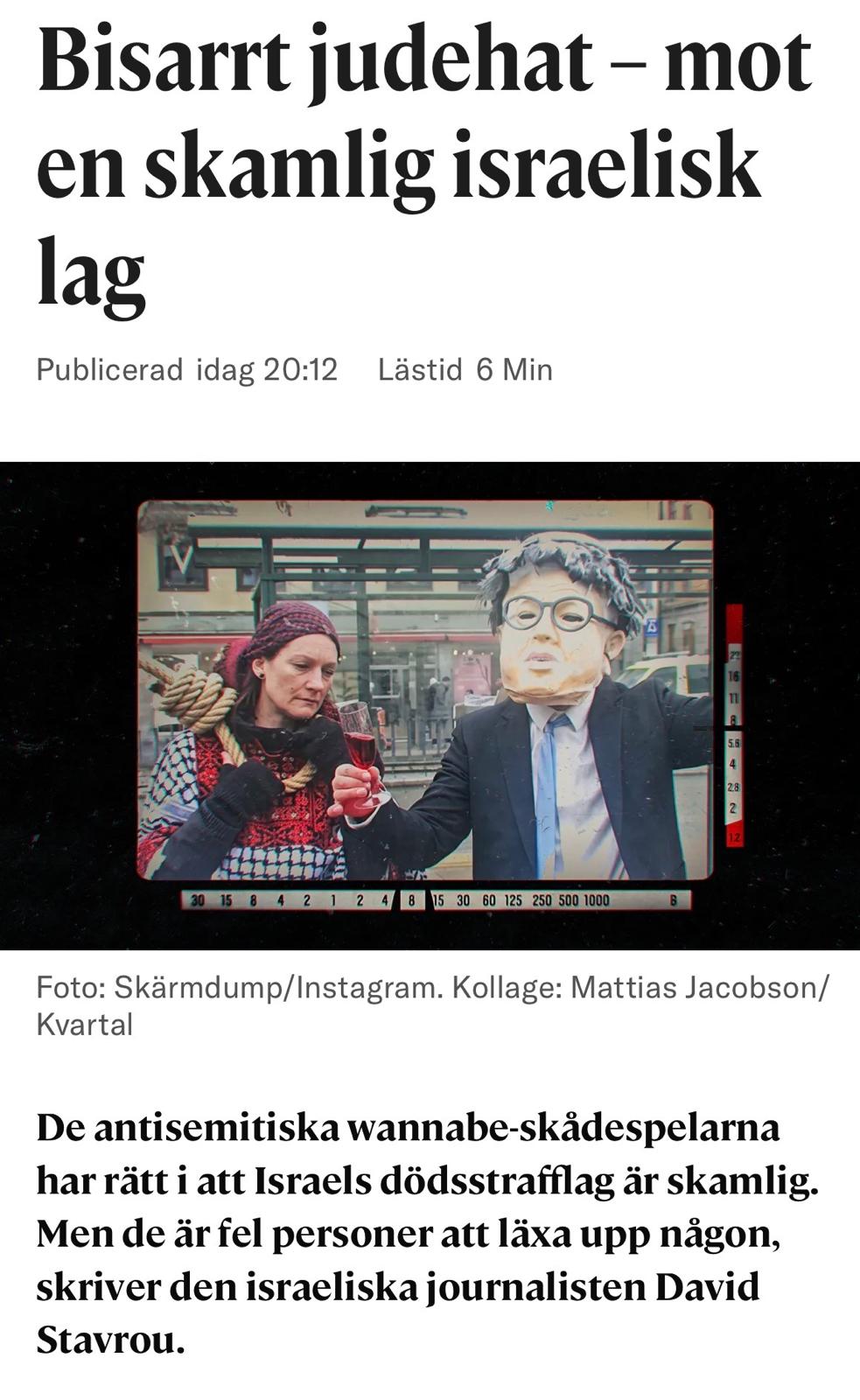
This weekend a new show hit the streets of Stockholm – a character who appears to be a religious Jew because of the kippah on his head holding a glass of blood beside a Palestinian woman being hanged. Those who follow Middle East politics were probably supposed to understand that the Jewish character is Israeli right-wing extremist minister Itamar Ben Gvir celebrating the legislation of the new Israeli death penalty law.

There’s a lot to be said about the Israeli law, but before that’s done the obvious should be pointed out. For those who don’t follow Middle East politics, what happened on Saturday is that Swedish police blocked streets, SL cancelled buses, and taxpayer money was spent in order to allow a group of activists to act out an antisemitic blood libel hundreds of years old, in which a Jew is using the blood of a non-Jewish innocent victim.

The activists will no doubt claim that their protest is legitimate. The character they acted is not all Jews, they’ll say, it’s only Ben Gvir, or only Israeli Jews, or only Zionists. However, the red-stained glass, the grotesque nature of the Jewish characteristics, and the timing make that claim laughable. The performance took place during Passover, the holiday that European Jews have been blamed since the Middle Ages for using Christian children’s blood for making their special holiday bread. The context of their other shows is that Israel controls the world, the American president and Sweden’s government are maneuvered by the Zionists – Israel’s Prime Minister and Jeffrey Epstein (both Jews of course). They relativize the Holocaust and they mock every Israeli symbol by attaching it to blood and money. Sure, they’re not antisemitic, just anti-Zionists. If anyone is so naive as to think that there’s a difference, perhaps they can explain it to Swedish Jewish children who may have passed by in central Stockholm and wondered why they’re being accused of hanging innocent Palestinians. Again.

Still, the new Israeli legislation deserves a serious discussion, even if those who demonstrated against it in Stockholm are on the wrong side of history. Israel’s new “death penalty for terrorists” law was passed in the Israeli parliament in March. The bill stipulates that the death penalty will be imposed on a terrorist who killed a person “with the intent of denying the existence of the State of Israel.” This wording creates a distinction that effectively designates the law almost exclusively for Palestinian terrorism. However, the court will be authorized to impose a life sentence instead of the death penalty if it finds “special reasons” for doing so or if “exceptional circumstances” are present.

It’s important to point out that the Israeli opposition voted against the law, and many in Israel hope that it will be cancelled if a new government takes over after the next elections. This may be the case because the law, which was pushed through by the most extreme Israeli politicians, was also opposed by other Israeli authorities. An official in the Ministry of Justice said that establishing the death penalty in the West Bank through civilian legislation is “highly problematic”. IDF representatives said that the law contradicts international conventions to which Israel is committed, and officials from both the Ministry of Foreign Affairs and the National Security Council opposed it.

The objections are not only technical. Israeli parliamentarian Gilad Kariv (The Democrats, former Labor Party) said that the law contradicts the values of the State of Israel and that it is disgraceful both in its substance and in the political manner in which it was approved. He also said that the party will bring the constitutional question before the High Court of Justice. This is an important point because the law is indeed expected to be reviewed by the High Court of Justice, and there is a possibility that it will be changed, amended, or cancelled.

However, apart from the extreme right, parts of Israeli society who used to be against such legislation in the past have become more positive towards it because of the 251 Israelis who were kidnapped on October 7th. They argue that many of the people who led and participated in the massacre, including Hamas leader Yahya Sinwar, were prisoners who were released from Israeli jails. If they had been executed for their previous crimes, the most horrific crime in Israeli history could have been avoided. Perhaps the main point supporters of the law point to is the possibility of prisoner exchanges which in Israel’s reality have always been an incentive for Palestinian terrorists to commit more attacks. Capital punishment could, according to the law’s supporters, prevent future Israeli kidnapped civilians from being used as bargaining leverage.

Israeli security officials, including several chiefs of staff of the IDF and heads of the Shin Bet, Israel’s security agency, objected to this reasoning and claimed that terrorism is not meaningfully deterred by the threat of execution because attackers who carry out suicide or high-risk operations are often not motivated by personal survival. Increasing the severity of punishment does not change behavior. Instead, capital punishment could escalate tensions, increase incentives for revenge attacks, and complicate intelligence cooperation and prisoner-management strategies.

Other objections, made by Israeli NGOs, are purely ideological. The Zulat Institute for Human Rights, for example, stated that the legislation “is fundamentally based on racial discrimination, is illegitimate, and has existed in the darkest regimes of modern history.” This is, in short, a very controversial issue in Israel, in many ways it’s another part of the bloody aftermath of October 7th and the regional war that is still going on, and the last word hasn’t been said yet.

Back to Stockholm. Considering the complexities of the Israeli legislation isn’t high on the agenda of the Swedish activists. This is a classic situation of a clock being correct twice a day even if it stopped working. Yes, they’re entirely right in their objection to the Israeli death penalty, but they are the last people in the world to preach on this subject.

First, recently more and more Iranian flags are seen at their demonstrations. The regime in Teheran executes over 1,000 people a year. Still, in the Iranian example, Swedish activists prefer demonstrating in support of the bloodthirsty regime against the “imperialist American-Israeli attack” while conveniently ignoring the institutionalized public hangings of women, homosexuals and regime critics from cranes. Other countries which have had the death penalty for years, from the US, China, and Japan to Iraq and Saudi Arabia, are never mentioned in any demonstration. Only Jewish executions, it seems, are morally wrong as far as they’re concerned.

Second, believe it or not, the Palestinian Authority, the same Palestinians the demonstrations are all about, has a death penalty law. In the West Bank it was used in the past and death sentences are not carried out in practice in recent years, but in Gaza, Palestinians have been executed by Hamas on a large scale, both officially and unofficially. Whoever is really worried about the legal execution of Palestinians should have been demonstrating against Hamas long before demonstrating against Israel.

And the finally, for many Israelis (including the one writing this text), the new law is a source of embarrassment and deep concern. It’s like many Swedes see things like NMR, or Swedish volunteers to the SS, or Swedish imams preaching about Jews engaging in black magic. The fact that in Israel a similar phenomenon is powerful enough to legislate is terrible. Still, the ones who will fix this are democratic and liberal Israelis, not a bunch of extremist wannabe actors from Sweden who believe that Israel never had a right to exist whether it has a death penalty law or not.

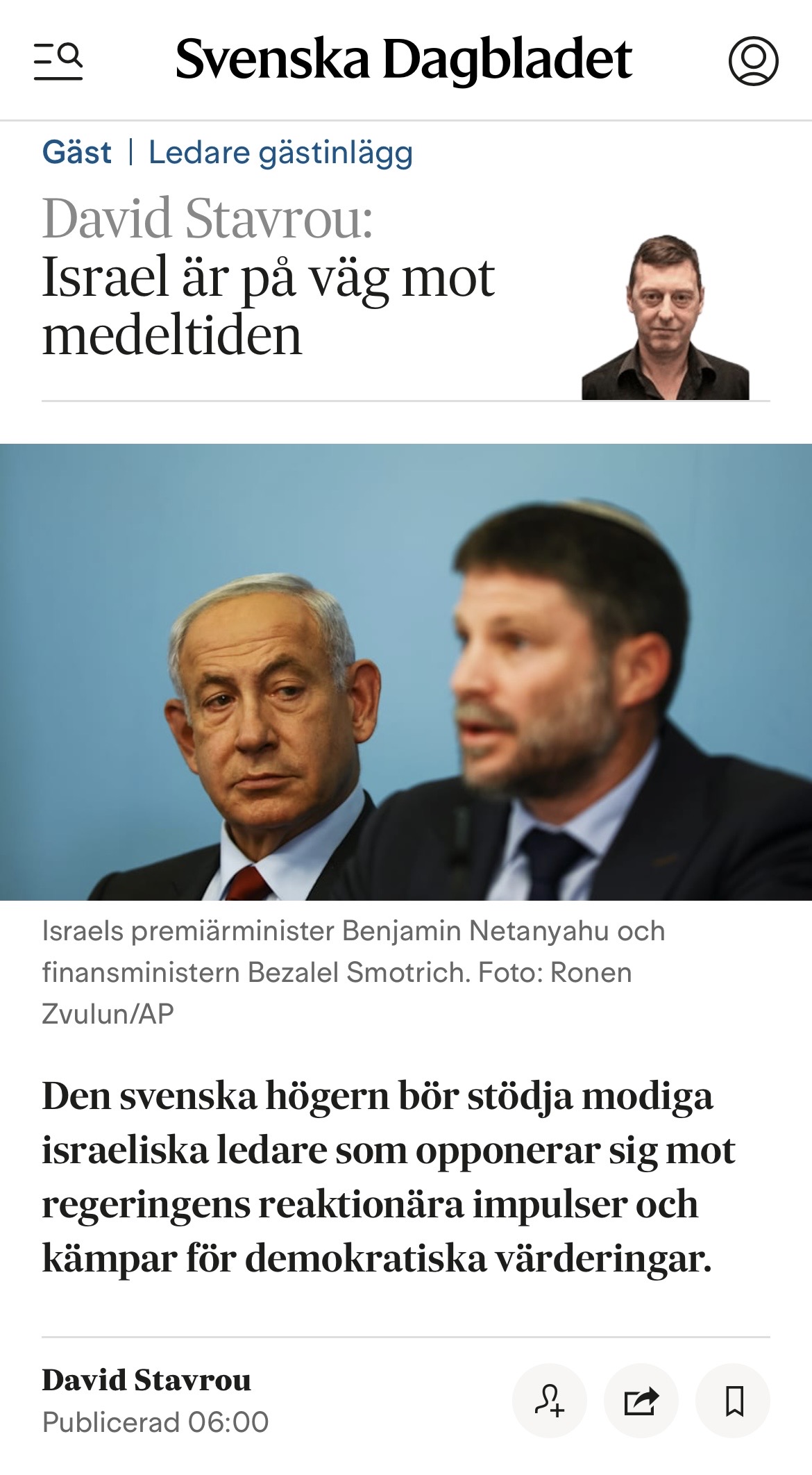
Is Israel on its way to the Middle Ages

The Swedish right should support courageous Israeli leaders who oppose the government’s reactionary impulses and fight for democratic values.

Published in Swedish daily Svenska Dagbladet: https://www.svd.se/a/wr8JEM/netanyahu-tar-israel-mot-medeltiden

The ceasefire which has been in effect in Gaza for several months has given Israelis and Palestinians an opportunity to reflect on their next steps, and to begin rebuilding and recovering after two of the most difficult years in the region’s history. Although Israel is slowly disappearing from the international headlines, it remains important to examine what is actually taking place in its political arena. If there's anything to learn from recent history it's that what happens there will influence global politics for many years to come.

One of the war’s results is that Prime Minister Benjamin Netanyahu, who is currently on trial for corruption, is doing everything he can to control the historical narrative of the war and avoid taking responsibility for Israel’s failure on October 7. Instead, he places the blame on the security services and his political opponents. He refuses to establish an independent official inquiry commission and is doing his utmost to replace Israel’s military and legal elite with loyal officials. These changes may help Netanyahu evade accountability for the charges against him. But for his coalition partners—far-right, fundamentalist, and ultranationalist parties—they are a means to a broader goal: undermining Israel’s liberal democracy.

For example, the Knesset, Israel’s parliament, is discussing a bill that would expand state control over the media. The proposal would replace existing regulatory bodies with a new authority whose members are appointed by the government—effectively enabling political control over broadcast content. The bill has drawn criticism from the government’s legal adviser, who warned that it threatens freedom of the press. It is hardly surprising that the same attorney general is among those the government is attempting to remove.

Screenshot

Because Israel is a democratic country, many Israelis are demonstrating against these proposals and other government measures. In recent months, however, many protesters have claimed that the police are acting in ways they did not previously. They report arbitrary arrests and increased use of force, including stun grenades and mounted riot police.

The minister responsible for this is Itamar Ben-Gvir, a far-right politician previously convicted of incitement and support for terrorism. While he is busy consolidating control over the police within Israel, another minister, Bezalel Smotrich, is consolidating control over the West Bank. Smotrich is laying the groundwork for potential annexation and is taking no action against the growing violence perpetrated by extremist settlers.

Netanyahu himself has recently reaffirmed his intention to continue pursuing the so-called judicial reform which many in Israel describe as a judicial overhaul, as it threatens the fundamental principles of the rule of law and the separation of powers, weakens the independence of the courts, and risks undermining democracy. The issue has now returned to the parliamentary agenda and in addition, efforts to limit the powers of the attorney general and the Supreme Court are being resumed. Another bill currently under discussion would introduce the death penalty for terrorist offenses—formally to prevent Hamas and other groups from taking Israelis hostage in order to exchange them for convicted terrorists, but there are also those motivated simply by revenge.

If the death penalty does not sound like a sufficiently reactionary reform, the Knesset has even discussed the conservative Jewish concept of shmirat negiah—the obligation for a man and a woman who are not married to each other to refrain from physical contact. It is not an official legislative proposal, at least not yet. But the mere fact that it is being discussed alarms liberal and secular Israelis—and rightly so.

Swedes have always had a deep interest in Israel. This can have both positive and negative effects. To understand whether Sweden’s voice can contribute something meaningful in this context, we should examine the country’s current discourse on Israel.

The political left in Sweden has unfortunately totaly lost its bearings. Many of its supporters have embraced Hamas’ narrative of the Israeli–Palestinian conflict. This does not necessarily mean they support terrorism, but the view of Israel as a settler-colonial project that should be boycotted and opposed regardless of its policies or leadership has spread from a radical minority into mainstream politics. Even established political parties have begun discussing the dangerous idea of a one-state solution.

A one-state solution would either mean the end of the Jewish state—which even the Swedish left previously supported—or plunge the entire region into an even worse bloodbath than what we have witnessed over the past two years.

Equally dangerous is the stance of Sweden’s populist right. Supporting Israel because its current leaders appear to use methods similar to those of authoritarian, illiberal regimes, or because they see Israel as a symbol of a struggle against Islam, is both misguided and harmful. It is also a betrayal of the Israelis who are fighting for a democratic, liberal, and peaceful future.

This year, both Swedes and Israelis are heading to the polls. If Sweden still wishes to exert a positive influence on Israel (and on the Palestinians, for that matter), Swedish supporters of the left should cooperate with Israeli artists, entrepreneurs, researchers, and academics who are independent and often in opposition to the government, rather than the easy and intellectually lazy solution of boycotting and margenelizing them.

The Swedish right should support courageous Israeli leaders who oppose the government’s reactionary impulses and fight for democratic values, rather than backing corrupt leaders and extremist parties that are dragging Israel back toward the Middle Ages. Any other approach amounts to rewarding both Hamas and Jewish extremists and for those who live in the region, it is yet another step on the road to hell.

Zero tolerance” is no longer enough after Bondi Beach. Political action is required – and it is urgent

Published in Swedish in Kvartal: https://kvartal.se/erikhogstrom/artiklar/hur-paverkar-politiken-terrordad-mot-judar/cG9zdDozNzA5NA

Reactions to the terrorist attack at Bondi Beach have largely focused on the hateful rhetoric believed to have contributed to the violent extremism that claimed 15 lives – the deadliest attack on Jews since October 7. That focus is understandable after two years of global demonstrations under slogans such as “globalize the intifada.”

At the same time, the attack is rooted in more than a toxic debate climate. It also involves a geopolitical and security dimension that has primarily been raised by Israeli officials.

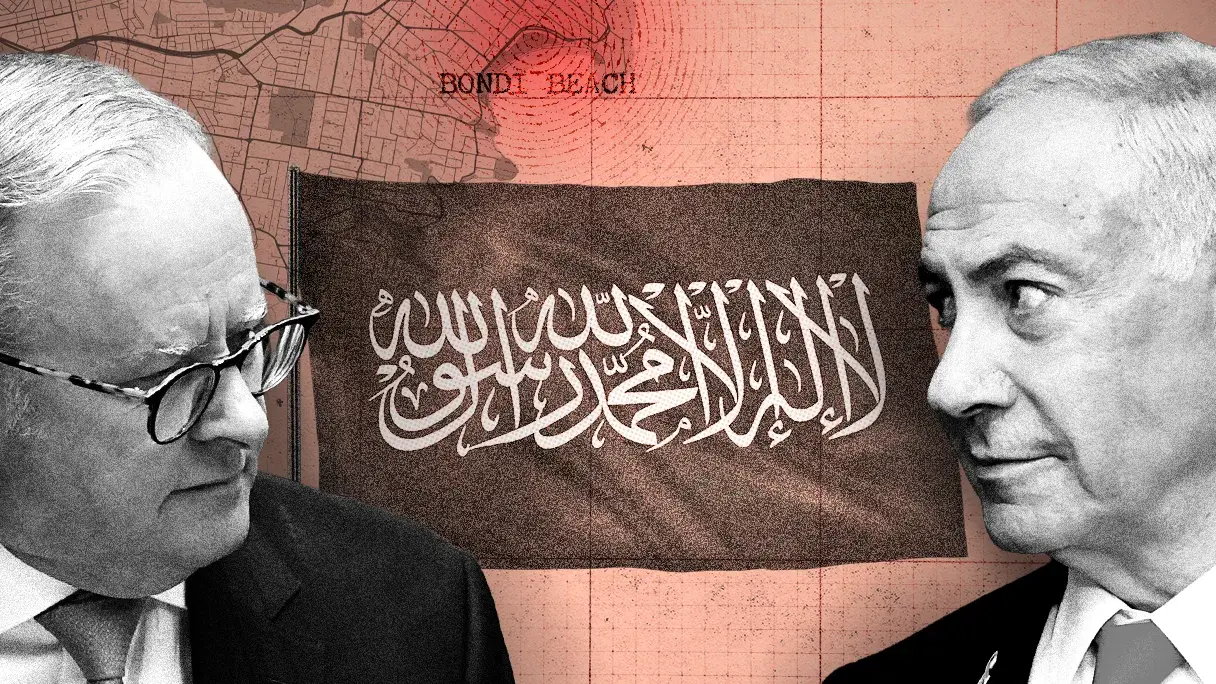
According to Israeli intelligence assessments, links had already existed for several months between Australian pro-Palestinian activists and groups such as the Islamic State, al-Qaeda, and Iran’s Revolutionary Guard. Against this backdrop, Israeli Prime Minister Benjamin Netanyahu accused Australia’s prime minister of betraying the country’s Jews. After the attack, Netanyahu stated that he had already warned in August that recognizing Palestine would, in his words, “pour fuel on the antisemitic fire, reward Hamas terrorists, and encourage threats against Australia’s Jews.”

This raises a number of questions. Does Australia really need Israeli intelligence to identify threats against its Jewish population? And more importantly: is Netanyahu truly the right person to lecture others about being unprepared for Islamist terrorism, when his own government bears responsibility for Israel’s worst catastrophe in decades?

But Netanyahu is not the central issue. What matters is that the warnings proved correct. A massacre of Jews took place in Australia, carried out by men who had ISIS flags in their car. Australian authorities knew that one of the perpetrators had ties to ISIS and that his father, the other perpetrator, legally owned at least six weapons. Despite this, no warning flags were raised, and the Jewish event lacked police protection when the attack occurred.

Islamists operate freely in Sweden

Against this background, Europe should ask itself a clear question. If Australia’s policies over the past two years resemble those pursued in many European countries, could what happened at Bondi Beach happen here?

Both domestic and foreign policy must be scrutinized. Domestically, this concerns insufficient resources to protect Jewish sites, an inability to counter conspiracy theories, and complacency toward Islamist actors. These challenges affect all European countries, including Sweden. Swedish journalists have recently exposed how Islamists operate freely in Sweden, how Iranian actors direct terrorist activity via Swedish organized crime, and what links Swedish activists have to terrorist movements such as the PFLP.

“Jews in countries that do not take Islamist terrorism seriously end up paying the price, regardless of whether government passivity stems from fear, incompetence, or indifference.”

Sweden is not alone. According to a recent Europol report, jihadist terrorism remains a central security challenge for the EU, with groups such as al-Qaeda and the Islamic State exploiting the conflict in Gaza. Added to this is Hamas, which, according to Israel’s Mossad and European intelligence services, has planned attacks against Jews in Europe since 2023. The causal link is clear: Jews in countries that do not take Islamist terrorism seriously pay the price.

Kvartal

Why foreign policy matters

How, then, does foreign policy factor in? Can recognition of Palestine or harsh criticism of Israel encourage terrorism? Countries such as Spain, Norway, and Ireland pursue a clear line against Israel. Like Australia, they have recently recognized Palestine; they voice strong opposition to Israel in international forums and serve as comfortable host countries for movements that not only oppose Israeli policy but view the state itself as an illegitimate colonial project.

Australia’s prime minister firmly rejected Netanyahu’s claim that the country’s foreign policy had any connection to the attack. He may be right – such accusations require evidence. But that does not mean foreign policy is irrelevant to the climate surrounding antisemitic hate crimes.

First, governments – unlike individuals – must understand the unique situation Jews face. Demonstrations are marked by hatred, aggression, Nazi comparisons, terrorist symbols, and boycotts. Of course, protests are legitimate in a democracy, and no one seriously claims that all participants are violent antisemites. But at the political level, it is unclear whether countries such as Norway fully grasp what their Jewish populations are forced to endure. The situation is worsened by the fact that no other conflict in the world is covered as intensely – and, according to many, as one-sidedly – in Norwegian media. This has an enormous impact on Norway’s small Jewish community.

Second, does the tax-funded public sphere remain neutral, or does it contribute to an unsafe environment for Jews? What do teachers say? What do libraries display? How do healthcare professionals behave? This is a matter of public safety, not freedom of speech. In February, a video went viral showing two nurses at Bankstown Hospital in Sydney boasting about refusing care to – or even killing – Israeli patients. In Ireland, an official report found that school textbooks contain serious distortions of the Holocaust and Jewish history, which Jews in the country say fuel antisemitism. In Spain, Jewish organizations similarly warn that some teachers use classrooms for anti-Israel activism.

“Zero tolerance” is no longer enough

We can continue debating the limits of protest, but we must also scrutinize institutions. The state must protect freedom of expression, but it must also guarantee safety. That requires schools, hospitals, and libraries free from political propaganda and symbolic acts intended to influence public opinion.

Finally, it is a fact that jihadist terrorists in Europe are often exposed with the help of Israeli intelligence. Can Jews in Spain and Ireland truly trust that their governments will cooperate with the Mossad to save lives, when those same governments cannot even tolerate Israel’s participation in Eurovision?

After Bondi Beach, Europe’s governments must decide where they place their resources and political capital. If they are serious about protecting their Jewish populations, “zero tolerance” and symbolic gestures of solidarity are no longer sufficient. Political action is required – and it's required urgently.

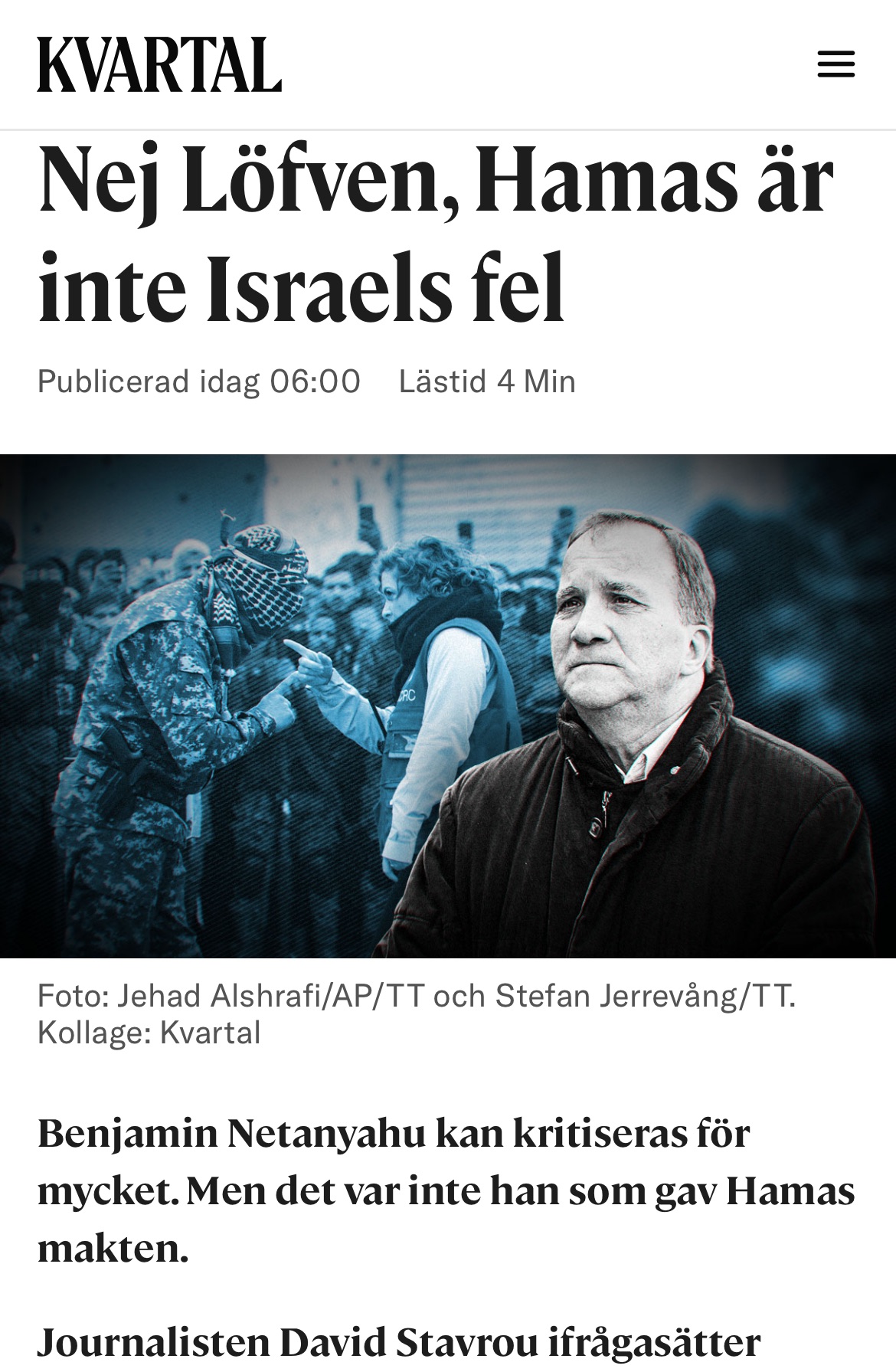
No Löfven, Hamas isn't Israel's Fault

Published in Swedish in Kvartal: https://kvartal.se/erikhogstrom/artiklar/nej-lofven-hamas-ar-inte-israels-fel/cG9zdDoyMjc1NA

A popular proverb says that a half-truth is a whole lie. The latest episode of SVT’s Utrikesbyrån about Hamas was a good example of that. That does not mean it wasn’t interesting. It was. Nor is there any doubt that the three participants — former Prime Minister Stefan Löfven, political scientist Marco Nilsson and Middle East analyst Bitte Hammargren — knew what they were talking about. But when it came to the analysis of Hamas, we were given only a half-truth.

The questions the presenter Rebecca Randhawa asked were: what is left of Hamas, will they lay down their arms, and who will govern Gaza. The first and the third questions are almost impossible to answer. Even Israeli intelligence does not know what remains of Hamas’s military capability, and Gaza’s future governance depends on a complicated geopolitical process. The second question, however, can be answered based on a deep understanding of what Hamas is, the choices it has made in the past, and what its ideological and political DNA is.

According to Löfven, Hamas’s power is the result of a paradox. Despite being one of Israel’s greatest enemies, its power originated with Israel’s political leadership. “Such an organization receives support (from Qatar, for example) simply because Israel wants to avoid the Palestinian Authority (PA) gaining any power.” Hammargren agreed and said that Hamas was a political asset for Israel. “Netanyahu’s line was that by letting Hamas grow in Gaza we don’t have to hear about a Palestinian statehood,” she said. This is a common analysis and it is partly true. Netanyahu and other Israeli leaders do indeed oppose a two-state solution. Because of this, his strategy was to weaken the PA, and many argue that one of the ways he did this was by allowing Hamas to grow. But this is only half the truth.

The other half, and the real reason Hamas rose to power and was able to retain it, is much simpler. The source of Hamas’s power is support from large parts of the Palestinian people. Even now, after two years of destruction and death that are a direct consequence of Hamas’s decision to massacre Israeli civilians on October 7, 2023, Hamas is still supported by many Palestinians. The international support from Qatar and Iran that Löfven and Hammargren mentioned is also not hard to understand. Iran’s regime has a long-term goal of eliminating “the Zionist entity,” and Qatar built its international position on supporting its ideological Muslim Brotherhood allies. Sure, Netanyahu miscalculated Hamas’s capacity and misread its intentions, but it was not he who made Hamas’s ideology popular, and it was not he who turned Qatar and Iran into dangerous regional destabilizing powers.

But where is Hamas heading? Utrikesbyrån’s two-and-a-half-minute clip tried to provide background. According to the clip, “Hamas removed the demand that Israel be destroyed, but still does not recognize the state of Israel.” This is not even a half-truth. Hamas is absolutely committed to the destruction of Israel. Yes, it created a new charter for foreign audiences, because the old document contained antisemitic propaganda that was not particularly popular on university campuses and in some Western circles. But even the new charter demands “all of Palestine” from the river to the sea, it does not accept the Oslo Accords or the two-state solution, and it still endorses “armed resistance,” which has been a decisive part of Hamas’s nature long before October 7. That includes blowing up buses and restaurants full of civilians as well as kidnapping, torturing and murdering Jews of all ages, genders and backgrounds. One interesting thing Utrikesbyrån did not mention is that Hamas activists have on several occasions been arrested in Europe for planning attacks on “Jewish targets.” Worth mentioning if anyone took the “new charter” seriously.

Despite (or perhaps because of) the violence, Hamas won the Palestinian elections in 2006 in both the West Bank and Gaza. Palestinians are not blind or politically incapable — they knew exactly what they were voting for. According to Utrikesbyrån’s experts, Netanyahu could have fought Hamas by strengthening the PA. It’s an interesting theory. Only problem is that it’s not true. Not during the years when Hamas was building its reign of terror, anyway. The reasons are that Netanyahu was not Israel’s prime minister at that time. Between 1999 and 2009 the prime ministers of Israel were Ehud Barak, Ariel Sharon and Ehud Olmert. The first was an outspoken advocate for a two-state solution, the second ended the occupation of Gaza, and the third was probably the one who offered the PA the most generous territorial compromise. Hamas was not impressed. It continued to build the fundamentalist, jihadist, genocidal faction within the Palestinian nationalist movement. Hamas did not need Netanyahu for this. It was fully capable of doing it on its own, while many Israelis were still considering peace and reconciliation.

Utrikesbyrån downplayed all of this. In the program there were no blown-up buses, no tunnels, rockets, high-tech international propaganda campaigns or brutal executions of Palestinian “collaborators.” October 7 was only mentioned in passing, as another point on the timeline. No hostages, no burned neighborhoods, no executed families. This is not a complaint that they “forgot October 7,” but a critique of incomplete analysis. How can one answer the question about Hamas’s intentions without taking into account that the organization recruited thousands of people who were willing not only to kill but also to commit gang rapes and sexualized torture in the name of Allah?

Netanyahu can and should be criticized for many things, but not for this. Sure, he did not destroy Hamas before October 7, and through his incompetence and corruption he may have contributed to the opposite. Israelis should hold him accountable for that. But this is far from the cause of the catastrophe. Hamas began building its advanced military capability long before Netanyahu, it remains standing, and many Palestinians still support it. Let us imagine that Netanyahu had decided to wipe out Hamas back in 2014. Now that we know that not even the destruction of Gaza did the job, would Stefan Löfven have supported an Israeli offensive on that scale? Would the Obama administration have allowed it? Would the UN have accepted it? Of course not. Everyone can complain about Netanyahu and everyone can criticize Hamas, but in the end — whose responsibility is it to eliminate Hamas, and who will support such an effort?

It is obvious that Stefan Löfven in no way supports Hamas. In Utrikesbyrån he spoke very clearly about the necessity of a political process with a reformed Palestinian Authority moving toward a two-state solution. But putting the blame for the situation on the Israeli government while ignoring Hamas’s inherently genocidal nature is a classic half-truth. It leads people to believe in conspiracy theories about secret Israeli involvement in the massacre of its own citizens, and more importantly — it shifts the focus to the wrong side. To reach a lasting ceasefire it would be wiser to focus on the “de‑Hamasification” of Gaza and support moderate forces on both sides that can help their communities recover from this two-year trauma and build a future together.

Sweden is turning Gaza into domestic politics

The situation in Gaza is detreating and the international community has every right to intervene, but anyone who criticizes Israel’s warfare can’t be taken seriously unless they also have a serious suggestion as to how to protect Israeli citizens from another massacre by the genocidal wing of the Palestinian national movement. 

Published in Swedish in Swedish daily Svenska Dagbladet: https://www.svd.se/a/Xj17Vr/gor-inte-gaza-till-svensk-inrikespolitik

Israel’s new ground offensive in Gaza is raising stark Swedish reactions, as always. The left is denouncing Israel as a genocidal power indiscriminately killing Palestinians. The right is slightly more restrained, but it too claims that Israel is going too far. These reactions are understandable considering the horrifying images from Gaza shown on Swedish TV. But it’s more than that. Horrifying scenes are taking place all over the world, but Gaza, unlike other conflicts, has a unique role in Swedish politics. It’s an issue of interest but also a source of easily-won political points. The Swedish Left Party, Vänsterpartiet, uses it to show its electoral base how pro-Palestinian it is, so as not to lose votes to radical breakaway fractions, while The Social Democratic Party leaders use it to show their loyalty to old-school “humanitarian super power” policies. On the other side of the political spectrum, while Right Wing populist party, Sverige Demokraterna, continues marketing itself as “Sweden’s most pro-Israel party” as an alibi against accusations of antisemitism, Moderaterna, the ruling center-right party, is trying to maintain a responsible image, aligning itself with EU allies and international law, by presenting a moderate critical policy towards Israel. Sweden’s Gaza discourse, it seems, is more about domestic politics than the reality in Israel and Gaza.

But there is an Israeli reality which isn’t visible to Swedish news followers, one that adds another dimension and shows that Israel is more than just a blood thirsty monstrous state out for revenge. Those who choose to go beyond Swedish headlines, find that there are many Israelis who oppose their government and its Gaza policy. In fact, thousands of them demonstrate against it week after week. These are not only radical left-wingers from the fringes of the political spectrum. Israel is deeply split and even mainstream Zionist political leaders with hundreds of thousands of voters are speaking up against Netanyahu’s government.

A "sane state does not wage war against civilians, does not kill babies as a hobby, and does not set goals for itself like the expulsion of a population", said the leader of The Democrats, Israel’s Centre-Left Zionist party who’s also a retired IDF major general. When Netanyahu reacted by claiming that Golan’s statement was “wild incitement”, Golan refused to apologize. “The time has come for us to have a backbone of steel”, he said, “we must stand by our values as a Zionist, Jewish, and democratic state”. He added that the government ministers are corrupt and that the “war must be ended, the hostages returned, and Israel rebuilt”.

But it’s not only the Israeli Left. “What’s the strategy?”, said Yair Lapid, leader of the centrist “Yesh Atid” party, “we all support the elimination of Hamas, but Hamas will not disappear unless an alternative to its rule is presented. Getting the IDF stuck in Gaza for years is a strategic mistake, an economic disaster, and a diplomatic tragedy that will prevent us from being part of the historic change in the Middle East”.

Even some Israeli right-wing politicians oppose Netanyahu’s government. “This war is not a war for security but a war for power”, said Avigdor Liberman, a hardliner who in the past held important ministerial posts under Netanyahu, “this government is willing to pay any price for staying in power — even at the cost of the lives of the hostages and soldiers”. This is a point many in Israel agree on. According to a poll published by Israeli Chanel 12, 61% of the Israeli public prefers a deal which would return all Israeli hostages and end the war in Gaza, compared to only 25% who support expanding the fighting and occupying Gaza.

It seems like one must read news in Hebrew to understand that Israelis are more than just aggressors, just like one must read Arabic in order to understand that Palestinians are more than just victims. For example, anyone following Hamas-affiliated Telegram accounts in Arabic knows that besides images of Palestinian suffering, there are posts with images of suicide bombers standing next to bus wreckages accompanied by texts like "the buses carrying you will become coffins" and “our martyrs are on their way”. This isn’t just a reaction to Israel’s Gaza offensive. It’s been going on for decades. Long before October 7th, official Telegram posts by the al-Aqsa Brigades, a Fatah-aligned armed group, called the “heroes of the West Bank” to “stab, run over, slay and blow up”. “Oh heroes of Jerusalem”, one of them said, “the land is your land, what are you waiting for? The time has come to kill the Jews”. Naturally, Hamas takes it even further. Fathi Hamad, a member of the movement’s political bureau and former minister called on Palestinians to "buy knives for five shekels, sharpen them and decapitate the Jews". Naturally, these quotes are not available in Swedish and are not part of the Swedish discourse.

Still, Swedish politicians have every right to react to events in the Middle-East and in the current reality, there’s plenty of reasons to criticize Israel. There are, however, a few simple ideas which can make the criticism more grounded in reality and more balanced. 

First, categorizing Hamas as a terrorist organization is correct, but it has an unwanted side effect. Because it deals with terror, some may assume that it’s a terror organization like others. But it’s not. It’s an army. Some may imagine it as a kind of Baader-Meinhof-like gang of youngsters in red and white keffiyehs squatting in abandoned buildings in down town Rafah and reading texts by Leon Trotsky. Nothing could be further from the truth. The Hamas military machine has brigades, battalions and commando units. It has strict military hierarchies and discipline as well as weapon manufacturing capabilities, a navy, military intelligence, cyber experts, a propaganda machine and thousands of young men to recruit, even during the IDF’s campaign. Hamas is clear about its end game – it’s a barbaric, fascist and fundamentalist movement committed to wipe the Jewish state off the face of the earth. Anyone who criticizes Israel’s war in Gaza can’t be taken seriously unless they also have a serious suggestion as to how to protect Israeli citizens from another massacre by the genocidal wing of the Palestinian national movement. 

Second, sometimes one has to be honest even concerning political and military policies. Israeli society is deeply traumatised by a vicious attack which took the lives of more than 1,100 people. Everyone knows someone who was killed, a child who was kidnapped or a woman who was raped. Everyone saw the atrocities – homes burnet to ashes and dead bodies of all ages. Everyone is worried about a relative or a friend on the front lines. Everyone knows a survivor. Everyone is a survivor. The expectation that Israel will react in a calm, moderate and gentle way is absurd. This doesn’t mean that a wild storm of revenge is justifiable. It does mean that swedes would do well to ask themselves modestly and honestly how they react to crises.

Sweden was unaligned for over 200 years. Then a war started over 2,000 km away. Still, Sweden changed its policy almost over-night and joined NATO. In the same way, a handful of problems with integration caused the country which was known for its leaders asking its citizens to “open their hearts” to refugees because “their Europe has no walls”, made a former neo-Nazi party its second largest. It also reversed all of its immigration policies. These dramatic and, anything but calm and moderate changes, happened without one shot being fired at Sweden and without hundreds of Swedes being killed, raped or injured. Israel, on the other hand, apart from the horrors of October 7th, has had, 35,500 rockets fired directly at it in the last year and a half, targeting, displacing and killing civilians. Is Sweden really qualified to lecture it about reacting unproportionally? And finally, criticizing Israel is fine, but it shouldn’t be done according to the propaganda of Sweden’s so-called pro-Palestinian movement. For some reason, this movement has adopted an extremist narrative echoing Hamas propaganda which claims that the Jewish state has no right to exist. The slogan of a “free Palestine from the river to the sea” is a genocidal one, since it implies the elimination of Israel. The slogans calling for an “Intifada” are incitement for violence and the claim that Israelis are settler colonizer is historically ridiculous and politically dangerous. Those who criticizes Israel because they support a just peace and a political compromise in the Middle-East would do well to find better partners – instead of people who scream “crush Zionism” and are just as bad as those who automatically support everything Israel does; they can join hands with moderate Israelis who still believe in peace and are struggling to save their home from a never-ending cycle of violence.

How the Gaza War Broke Israel's Taboo on Contact With the Far-right Sweden Democrats

Israel's government has boycotted the Sweden Democrats since the party's founding by neo-Nazis in 1988. The political repercussions of the Gaza war have led to a new Israeli directive calling for exploratory talks, but the Swedish Jewish community still refuses all contact with the far-right party

Published in Haaretz: https://www.haaretz.com/israel-news/2025-02-26/ty-article-magazine/.premium/how-the-gaza-war-broke-israels-taboo-on-contact-with-the-far-right-sweden-democrats/00000195-4266-d852-a5df-efefdcb90000

STOCKHOLM – Foreign Minister Gideon Sa'ar's instruction for Israeli diplomats to launch discreet talks with the far-right Sweden Democrats has made waves in the Swedish media. It marks a drastic change for Israel's foreign policy, which was previously characterized by a long-standing boycott against far-right parties associated with antisemitism, Holocaust revisionism and neo-Nazi activists.

Sa'ar has ordered these exploratory talks with far-right parties in France, Spain and Sweden, Axios' Barak Ravid reported Monday. The Sweden Democrats' foreign policy spokesman, Aron Emilsson, who heads the parliamentary Foreign Affairs Committee, told the daily Expressen that Israel's decision was "extremely positive."

"We've been working for a long time to improve relations," he said, adding that "the ties are also important in security matters, particularly regarding Iran."

The Sweden Democrats have been boycotted by the Israeli government since the party's inception in 1988, but two unofficial visits by the party's leaders to Israel in 2023 and early 2024, as well as a series of unpublicized talks with Prime Minister Benjamin Netanyahu's Likud party and the Foreign Ministry triggered a policy change.

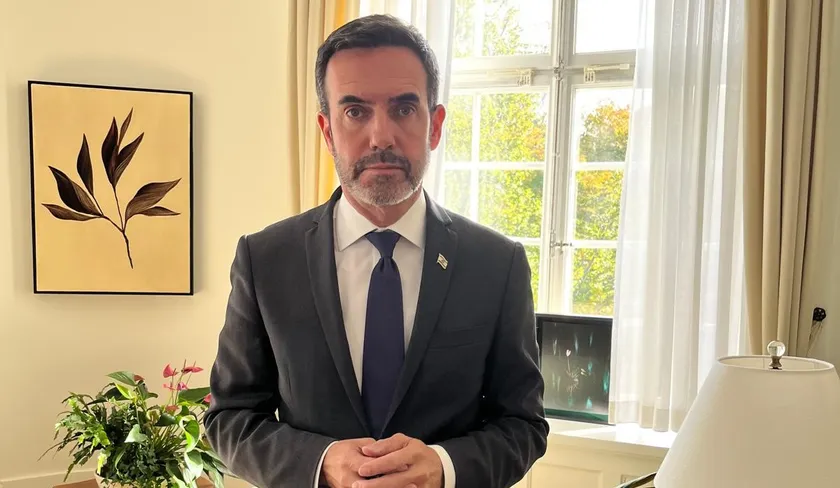
Ziv Nevo Kulman, Israel's ambassador in Stockholm, told the daily Dagens Nyheter in 2021 that his country had no ties with the Sweden Democrats and had no intention of establishing any. "This is a moral position about far-right parties with roots in Nazism," he said, two months into his term.

He told Haaretz last May: "We are aware of the positive statements by the Sweden Democrats about Israel. But at the same time, the party continues to adhere to extremist positions regarding a ban on brit milah [Jewish ritual circumcision] and the importing of kosher meat, and it has yet to seriously grapple with its neo-Nazi past and with the antisemitism among its members." He said the party's alleged support for Israel was "questionable."

Despite this earlier skepticism, the Israeli Embassy said Tuesday: "As part of a broader review of parties in Europe with which we have not previously had contact, the embassy has held talks with the Sweden Democrats. The initial contacts have largely focused on how the party handles its history and its stance on issues affecting Jewish life in Sweden."

Ziv Nevo Kulman, Photo: Israel's Embassy to Sweden

According to sources familiar with Israeli-Swedish relations, this change of tack was not only the work of Israel. Since the beginning of the war in Gaza, Sweden's center-left has been increasingly hostile toward Israel, and these parties' ties with Jerusalem have significantly weakened. Israel has become a wedge issue between Sweden's center-right coalition and the centrist and left-wing opposition.

According to the sources, the opposition's approach is pushing Israel into the arms of the Swedish populist right. As a result, the Sweden Democrats are increasingly seen as a legitimate party in both Israel and the Jewish world, a major win for the party.

For Sweden's Jewish community, the Sweden Democrats are still considered off-limits, at least officially. The party is not in touch with the community and is not welcome at community events.

In a letter to Israel's foreign minister a year ago, the European Jewish Congress and the Council of Swedish Jewish Communities expressed concerns about a meeting between Israeli ministers and Sweden Democrats visiting Jerusalem. The president of the European Jewish Congress, Ariel Muzicant, and the chairman of the Council of Swedish Jewish Communities, Aron Verständig, wrote that they were "gravely concerned" and referred to the party's "neo-Nazi roots."

Muzicant and Verständig added that the Sweden Democrats' "ideology is still inherently xenophobic even though its representatives claim to be our allies, making an exception for the Jews as a national minority, albeit claiming that Jews cannot be Swedes." They said the party regularly submitted bills to ban "non-medical circumcision," as opponents call it, and the importing of kosher meat.

When asked Tuesday about Israel's apparent policy shift, Verständig told Haaretz that he was notified a few days ago that Israel's Foreign Ministry had instructed the Stockholm embassy to forge contacts with the Sweden Democrats.

"However, we don't have contacts with the Sweden Democrats," Verständig said. "The issue of the Sweden Democrats is one that we discuss regularly, but we haven't changed our position and we still don't have ties with the party."roots

The Sweden Democrats party was founded in 1988 by members of Swedish neo-Nazi and far-right movements. A key figure in the organization was Gustav Ekström, a member of Germany's Waffen-SS, the SS' military arm, during World War II and an activist in the NSAP, the Swedish Nazi party that disbanded in 1950. Other founders were members of white supremacist parties, neofascist and neo-Nazi movements, the Swedish skinhead movement and criminal organizations.

But the neo-Nazi past wasn't the only reason for the Israeli boycott. In recent years party members have spread conspiracy theories and racist, antisemitic and Islamophobic propaganda. In 2021 the Swedish daily Aftonbladet revealed that Jörgen Fogelklou, the party's leader in Sweden's second-largest city, Gothenburg, spread antisemitic and racist statements on social media such as "It is clear that Jews are the root of all evil in the world."

A few years ago, another local party leader in southern Sweden, Jonas Lingvärn, took part in performances by rock bands supporting white supremacy and used the slogan "Skinhead 88" – 88 is shorthand for HH, meaning "Heil Hitler."

The party first entered Sweden's parliament in 2010, and in the 2022 elections it won more than 20 percent of the vote, making it the country's second largest party. Until just a few years ago, the Sweden Democrats were boycotted by parties across the political spectrum.

But after a shift in approach by two center-right parties, the Sweden Democrats became an integral part of the right-wing bloc after elections, without which a center-right government could not be formed. In parliament, the party heads the Foreign Affairs Committee, the Justice Committee and the Industry and Commerce Committee.

Standing Together and the BDS: The Swedish Version

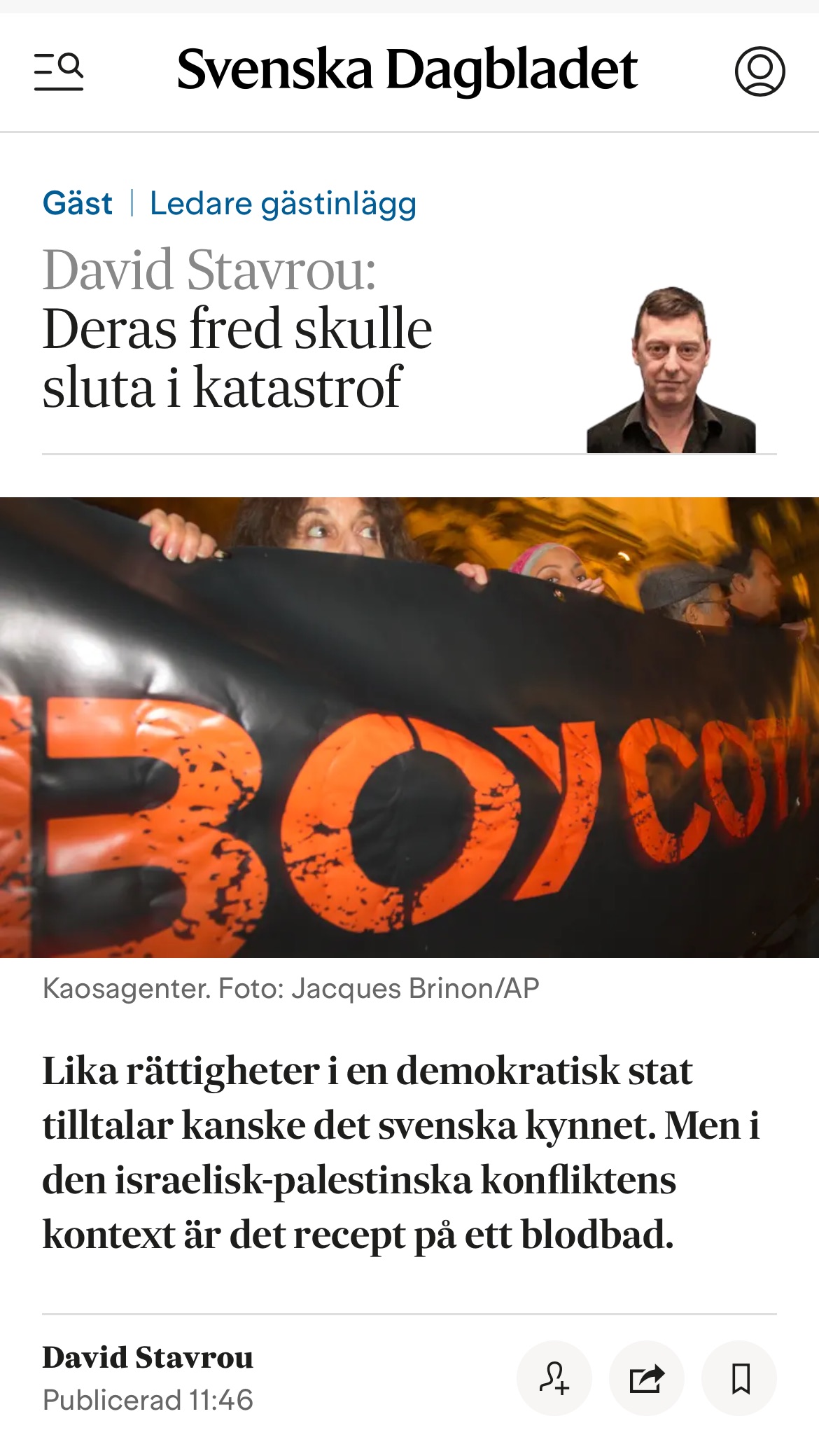
Equal rights in a one state solution may appeal to Swedish sensetivities. But in the context of the Israeli-Palestinian conflict, it is a recipe for bloodshed.

Published in Swedish daily Svenska Dagbladet: https://www.svd.se/a/qP8yvL/bds-rorelsens-fred-skulle-sluta-i-katastrof

Israeli politics can be confusing for those who are used to a system which rewards accountability. One example is that even though Hamas' brutal attack in October 2023 was the biggest tragedy in Israel's history and part of a momentous failure of Israel's leadership, the government is still in place and seems to be stable enough to survive the crises. It's even confident enough to continue its controversial judicial overhaul which many claim is a direct assault against Israel's democracy. When it comes to the conflict with the Palestinians, Netanyahu's government is using the catastrophe as a pretext for going further to the right, perhaps even as an excuse for a future annexation of the West Bank which would be a tragedy for both Palestinians and Israelis who support peace, democracy and freedom.

This is why Standing Together, a grassroot movement of both Jewish and Palestinian Israelis who join hands in working for peace, equality, and social justice is so important. These are exactly the kind of people who can provide hope for Israel's declining peace movement. They can also be excellent partners for actors in the global community who are concerned about developments in the region and want to support positive change. And indeed, two of the movement's leaders are coming to Sweden. When I spoke to one of them, Alon-Lee Green, one of the movement's national coordinators, he told me that the visit's purpose is "to gather support for the fight to end the war, to end the occupation and to achieve Israeli-Palestinian peace".

But it seems not everybody wants to listen. Instead of encouraging Israel's brave opposition, some activists are horrified by the mere thought of Israeli peace fighters. One commentator on social media wrote: " I think it's important that as a movement we keep track of which groups we choose to collaborate with. Standing Together is boycotted". As a self-appointed moral compass, the activist then quotes a text by The Palestinian Campaign for the Academic and Cultural Boycott of Israel claiming that Standing Together is "serving a key role in Israel’s international propaganda strategy". One of the commentators who thanked the writer even added: "we don't recognize Isnotreal!".

Since October 7th the BDS campaign has been gaining support in Sweden. Professors, researchers and students call on their university to cut all ties with Israel, Amnesty cooperates with BDS-Sweden and lists of companies "profiting from the genocide" are all over social media leading to demonstrations and smear campaigns. All this shows what at least part of Sweden's left is all about. The BDS movement claims that Standing Together is serving "Israel’s 75-year-old regime of settler-colonialism and apartheid". Nothing could be clearer – the BDS movement isn't against specific Israeli policies, it isn't against a specific government or a specific war. BDS activists' real problem is the very existence of Israel. When they talk about 75 years of settler colonialism, they're not talking about the 1967 occupation of the West Bank and Gaza, they're talking about the 1948 UN decision to found a Jewish state, and an Arab state, in Palestine. The people who don't want to listen to Israeli peace fighters are doing it simply because they are against peace between Israelis and Arabs. According to them Israelis are the original colonialist sin and they should just disappear.

Do these attitudes belong only to a handful of extremists or are they spreading to Sweden's left as a whole. A good indication is the debate about the so-called two-state solution. Those who still support it, even though it seems almost impossible to achieve, are promoting a solution which includes a compromise between two legitimate national movements. Lately, however, the idea of a one-state solution is becoming popular. Swedish academics are writing texts about one state based on "one citizen-one vote", in the Swedish Left Party congress last May many party members promoted changing the party's position to supporting a one-state solution and further to the left, Fi (the Swedish Feminist Initiative) and the new "Solidarity" party, already took the step. Fi even claims that "Zionism is an imperialist and racist ideology". Anyone who witnessed a pro-Palestinian demonstration during the last few months knows this isn't a minority. The most popular slogan doesn't leave room for doubt – "From the river to the sea Palestine will be free", Not "Palestinians will be free". Palestine means a state – one state, not two, from the river to the sea.

In Sweden's radical left there are those who take it even further. There's a at least one youth movement (RKU) which supports the October 7th "historic offensive in which the Palestinian resistance broke open the prison bars". Another "solidarity movement" (Samidoun) supports the PFLP, an organization which took part in the massacre. In addition, there are plenty left wing-oriented publications which continue to support the narrative which sees Hamas as an anti-imperialist decolonization force. All these movements support a one state solution. Just like Hamas and the most radical Jewish extremists.

One state with an equal vote and equal rights may sound appealing to Swedish sensibilities. Indeed, why not have nothing to kill or die for and no religion too? The only problem is that in the context of the Israeli-Palestinian conflict one state is a receipt for a blood bath. Most Palestinians who support a one state solution mean a Palestinian state. Most Jews who support it mean a Jewish one. The result of such an experiment will either be apartheid or some version of ethnic cleansing or genocide. The only question will be who's killing who.

When I talked to Standing Together's National Coordinator he said that the movement doesn't support a specific model of solution. "We support an Israeli-Palestinian peace", he said, "one that will enable everyone to live in freedom, equality and independence". When it comes to the boycott movement Green says that Standing Together is the largest Israeli movement fighting for peace and against occupation. "We've been protesting all over Israel for 15 months, we arrange aid for Gaza, our activists are fighting settlers who attacked humanitarian aid convoys and we demand an end to the killing", he says, "if anybody wants to argue with us about words that we say or don't say, they can write an essay and perhaps we can discuss it in some lecture in the world of academia. But in the world of politics and actions, the one that we focus on, the BDS statement about us has no influence where we live. It wasn't even translated to Arabic".

The BDS movement leaves no room for Standing Together. It only accepts Israelis who think that their country shouldn't exist. But the men and women of Standing Together are different. They love Israel and they're fighting to make it better. They realize that both Jews and Arabs are there to stay and they promote pragmatic compromises rather than holly wars and abstract ideologies. This is why the Olof Palme Center, the Robert Weil fund and Kulturhuset made the right choice when they invited them to Sweden. Naturally, those who are against Standing Together have the right to protest, but we shouldn’t call them peace activist, we should call them what they really are – dogmatic chaos agents who, if they get what they want, will lead both Israelis and Palestinians to a catastrophic disaster.

'Gravely Concerned': Jewish Leaders Send Letter to Israeli FM Decrying Ministers' Meeting With Far-right Swedish Party

In a letter to Israel's foreign minister, leaders of the European Jewish Congress and the Council of Swedish Jewish Communities warned against allying with the Sweden Democrats who, according to the letter, 'claim to be our allies' while advocating that 'Jews cannot be Swedes.' The party has roots in neo-Nazi and antisemitic ideologies

Published in "Haaretz": https://www.haaretz.com/world-news/europe/2024-02-14/ty-article/.premium/gravely-concerned-jewish-leaders-decry-ministers-meeting-with-far-right-swedish-party/0000018d-a35c-d42f-adcd-ebfcbac60000

STOCKHOLM – In a letter to Israel's foreign minister sent Monday by the presidents of the European Jewish Congress and the Council of Swedish Jewish Communities, the two leaders expressed concern over a recent meeting between Israeli ministers and a delegation from the far-right Sweden Democrats party, which violated Israeli policy.

EJC President Ariel Muzicant and Jewish community leader Aron Verstandig wrote that they were "gravely concerned by the implications and long-term consequences of this meeting" which also ran "counter to the Israeli foreign policy vis-à-vis the Sweden Democrats as being non-welcome, with reference to their Neo-Nazi roots."

On January 29, a delegation of senior members from the Sweden Democrats arrived in Israel and met with Diaspora Affairs Minister Amichai Chikli and Culture and Sports Minister Miki Zohar. The group included the party's leader, Jimmie Akesson, chairman of the Swedish parliament's foreign affairs committee, Aron Emilsson, head of the party's parliamentary group, Linda Lindberg, and the head of the party's group in the European Parliament, Charlie Weimers.

The Sweden Democrats, currently the second-largest party in the Swedish parliament, has roots in neo-Nazi and antisemitic ideologies. It is one of several European parties with which Israel has refrained from establishing official ties. For that reason the recent visit to Israel was not an official one and was not arranged by Israel's Foreign Ministry.

Last year, two members of the Sweden Democrats visited Israel and met with Knesset member Amit Halevi from Netanyahu's Likud party and with former Knesset member Michael Kleiner, who serves as the president of Likud's court. There were no meetings with government ministers.

"With right wing populism and extremism on the rise throughout Europe, Jewish communities easily become exploited in narratives targeting other minorities," Verstandig and Muzicant wrote to Foreign Minister Israel Katz, "these populist parties and movements are often keen to establish alliances with Jewish communities and Israel, acting on the presumption that Jews and Jewish institutions, often being targeted by extremists of Middle Eastern and/or Muslim descent, would (and should) be interested in uniting over the notion of a 'common enemy.'"

In their letter Verstandig and Muzicant also explained that "the [Sweden Democrats] party's ideology is still inherently xenophobic even though its representatives claim to be our allies, making an exception for the Jews as a national minority, albeit claiming that Jews cannot be Swedes." They added that the party regularly submit bills in the Swedish Parliament to ban circumcision and the import of kosher meat.

In this context, the January meeting with Chikli, whose role includes fostering connection between world Jewry and Israel as well as combating antisemitism, is particularly notable. In May, Chikli also caused diplomatic embarrassment for Israel when he delivered a keynote speech at the controversial evangelical Canada Christian College. The school's president, Dr. Charles McVety, is an activist and leader of Canada's Christian far right.

Sweden Democrats leader Akesson took to X after the meeting, writing, "It is clear that our parties and our nations share common values." In response, Chikli tweeted: "We deeply appreciate your support and your passion for our mutual fight for the future of Western civilization."

Asked by Haaretz what he expects as a reply to his letter, Verstandig said he hoped Katz would confirm that the policy of not allying with extremist parties still applies.

A Foreign Ministry source replied to Haaretz's query on the subject, saying there is no change in the ministry's policy toward the Sweden Democrats. The source did not say whether the ministers would face disciplinary action over the meeting.

!Say it: Yes, I condemn Hamas

The discourse within the Swedish and European left is important even if you're not part of it and the insane embrace of Hamas by so-called left-wing radicals, climate change fighters, human rights activists and western intellectuals and academics must be challenged.

Originally published in Swedish in Parabol: https://www.parabol.press/andreas-malm-har-fel-om-hamas/

Imagine this powerful image: in a country which is slowly being taken over by right-wing nationalists, it's becoming harder to speak truth to power and to speak up for the underdog and the repressed. But then, from the trenches of the opposition, rises a fearless figure. He knows he'll be arrested and tortured if he's caught crying out, and so he does what intellectuals from resistance movements allways do under tyrannical regimes. He uses sarcasm, he sharpens his pencil and cleverly plays with words to produce a text which is radical and subversive, but at the same time meticulously designed not to be flagged down by the authorities. That way the avant-garde academic doesn’t get in trouble with the all-powerful secret service henchmen who are hunting down traitors.

Sweden 2024. While a war is going on in Gaza and in Israel, the whole political elite is powerfully supporting Israel. It's blue and white from left to right and it's not allowed to speak up for the Palestinians. And then, a single voice of a brave dissident rings out. He wrote a text. It's called "I Condemn Hamas" and it's brilliantly designed by a rhetorical trick – the title is mainstream and boring, everyone condemns Hamas. The content seems to be the same, but under the surface lies the explosive message – it's the exact opposite of condemning Hamas, it's actually supporting it (Malm, Anders, Jag Fördömer Hamas, Parabol, 01/11-23). At last the opposition has a voice – Andreas Malm has weighed in. It's a powerful text and a powerful image. The only problem is that none of it is true.

Malm's claim is clear – everyone's condemning Hamas, mainstream media, politicians and public discourse in general. He, on the other hand, thinks this is false. Hamas may have killed civilians, kidnapped children and burned down residential buildings on October 7th, but according to him this isn't unique. It's all been done before by Israel. Malm doesn't claim this directly. He does it by sarcasm. The same kind of sarcasm is pointed at the Swedish discourse. "In Sweden there are strikingly few who have condemned Hamas in the past few days. Those who have done it have only done it once, so that we now wonder if it was really meant honestly", he writes creating an illusion which is the exact opposite of the truth. In fact, Sweden is one of the countries in which the Hamas did surprisingly well. At least for an organization which is internationally recognized as a terror organization.

Hamas supporters have spoken openly in conferences and seminars in Sweden, money has been raised for Hamas freely in Sweden; just in the last few months there have been dozens of pro-Palestinian demonstrations with speeches supporting Hamas or at least not condemning them including demonstrations celebrating the events of October 7th on the day they happened. Unlike other countries, these demonstrations are not only legal, they're supported by some of the political elite and many in the media, in the cultural world and in civil society. Malm's style implies that Swedish publicists have to condemn Hamas or they'll be cancelled. Nothing could be further from the truth. In fact, Malm himself is a writer who has supported Hamas publicly in several newspapers, magazines and publications. As far as I know, he's yet to be arrested, censored or fired. In Sweden it’s allowed to burn the Koran, join parties which support North-Korea and have Neo-Nazi marches on Yom-Kippur. No one's preventing anyone from supporting Hamas. Indeed, I recently met Hamas supporters in Sergels Torg. They were members of two perfectly legal Swedish movements, RKU, the revolutionary communist youth movement and NMR, the friendly neighborhood neo-Nazis. Who knows, perhaps Andreas Malm himself was there supporting them both.

However, the Swedish context is only the beginning of Malm's mistake. The claim that the massacre on October 7th was more of the same, that it was Palestinians retaliating with the same kind of violence Israel uses, is worth studying. "What happened on Black Saturday, October 7th was something new in the history of the Israeli-Palestinian conflict", Malm writes using his smug self-satisfied irony, "it redraws the political and moral map of the Middle East for good. Gunmen stormed into communities and shot children to death with rifles. They did not care at all about the age of the victims. Hundreds of civilians were killed – people with no connection to any military activity, murdered simply because of their identity. Entire families disappeared". If this wasn't so true, it would be real cutting-edge political satire. But Malm's satire, is in fact the sad truth. Nothing like October 7th ever happened before in this conflict. Israelis and Palestinians never killed so many people in one attack or in one day. Not in Kafar Qasim (1956), not in Deir Yassin and Tantura (1948), not in Hebron (1996) and not in the bombings of Gaza in previous years. There were never so many acts of torture and violence against civilians, never so many people kidnaped and never such brutality. And yes, October 7th did redraw the political and moral map of the Middle-East for good. I couldn't have said it better myself.

Israel made many mistakes in the last few decades; like any other army it has committed war crimes during conflict, some of its civilians, especially in the West-Bank are violent extremists and its occupation of the West-Bank continues to be a hindrance to peace in the Middle-East. But October 7th was unique. It's not only about the brutality or the number of victims. The really scary number is the number of the people who committed the crimes. Unlike 9/11 which was executed by a small Jihadist vanguard of 19 Al-Quade operatives, and unlike Utøya which was the work of one (Andreas Malm cracks a little clever joke making the comparison), October 7th was carried out by about 3,000 people. Many of were sipplied with written instructions about how to murder, torture and kidnap civilians, some were also provided with drugs and with body cameras. This wasn’t a spontaneous, heat of the moment action. It was a planned strategy. On October 7th the world saw a society capable of drafting 3,000 people who were 100 percent committed to murder.

Andreas Malm perhaps hasn't heard the story told by David Tahar, father of Adir Tahar, an Israeli soldier who was killed on October 7th. Tahar told Israeli Chanel 14 that before the funeral he insisted on seeing his son's body even though army officials advised against it. The reason was that apparently after he was killed Hamas fighters decapitated Adir and took his head back home to Gaza. A few weeks later, after receiving intelligence from captured terrorists, an Israeli military unit retrieved the head. It was hidden in a bag with some tennis balls and a few documents inside an ice-cream shop freezer in Gaza. Apparently the head was up for sale. The price was 10,000 US Dollars. I know there are many who don't believe Israeli media and think that Zionists fathers are so perverted that they can make up this kind of story for propaganda purposes. So here's another one. This time from the New York Times.

Sapir, a 24-year-old accountant who attended the rave party near Kibbutz Reim on October 7th gave a testimony which was reliable enough for the NYT which told the story of what she saw from her hiding place (Gettleman, Schwartz and Sella, "Screams Without Words": How Hamas Weaponized Sexual Violence on Oct. 7", The New York Times, 28/12-23). Sapir says she saw "a young woman, blood running down her back, pants pushed down to her knees. One man pulled her by the hair and made her bend over. Another penetrated her. Every time she flinched, he plunged a knife into her back. Sapir said she watched another woman "shredded into pieces". While one terrorist raped her another pulled out a box cutter and sliced off her breast. "One continues to rape her", she said, "the other throws her breast to someone else, and they play with it, throw it, and it falls on the road". She said the men sliced her face and then the woman fell out of view. Around the same time, she said, she saw three other women raped and terrorists carrying the severed heads of three more women.

These are just two testimonies from October 7th. There are thousands more. One could always claim, as Malm does in earlier texts, that all this violence should be seen in context. But this kind of violence has no context. If it was really about freedom, or fighting the occupation there would be no need for mass rape, kidnapping babies and removing body parts. The atrocities, the rockets, the tunnels and the complete subordination of Gazans to Hamas militants are all far darker and more sinister than Malm's theories. It's not the price paid for Israel's colonialism. If for no other reason, because this isn't colonialism. Israel isn't Algeria.

According to Malm, the conflict between Israel and the Palestinians isn't a war between two indigenous peoples which have a legitimate claim to the same territory and therefore are engaged in a violent conflict. Instead, there is one legitimate native nation and for over a century it has been fighting an occupation by invaders who came from other countries as colonizers. The invaders are supported by imperialist powers and they are now committing genocide. This kind of aggression according to Malm must be, should be and always has been resisted with violence. In fact, Malm's latest text is one of many in Parabol making the same claim.

These texts rarely even mention the events of October 7th which I would suggest is a sign of total moral bankruptcy. But that's me and I may be biased. The problem here is different, it's about intellectual honesty. The description of the Israeli-Palestinian conflict as a story of a colonial power murdering the natives is incredibly shallow and misleading. It's perfectly ok to oppose Israel's policies (as I do myself most of the time), it's perfectly ok to name-drop Edward Said and Franz Fanon, make comparisons to Apartheid South-Africa and quote Israeli officials making outrageous genocidal statements which can then be quoted at the ICJ in the Hague. But people who have studied the region, as I guess Malm has, know very well that Jews, not only Palestinians are natives to it. And no, I'm not referring to Jesus and Abraham. Biblical stories cannot be a base for international geo-politics. I'm referring to facts completely ignored by the whole post-colonial discourse.

Take Gaza, for example, in the place where Rimal, the political center of Gaza City used to stand, a synagogue was built in the year 508 AD. We know that the figure in the center of the ancient mosaic which was found there is King David. How do we know this? Because his name is written there. In Hebrew. Gaza has a long bloody history – Romans, Christian Crusaders, Arab armies, the Egyptians, Napolean's army, the Ottomans and the British Mandate all controlled Gaza. During this history, Jews lived in Gaza, they didn't arrive in ships in the 1940s. They were there during the time of the Romans, 2,000 years ago, they were there in the Middle-Ages and during the time of Islamic rule, then again in the 14th and 15th century and under the rule of the Ottoman empire. Some were still there even after WW 2.

As in many other areas in the region, for thousands of years, Jews thrived and declined in Gaza, they were expelled and fled, they killed and were killed, built and destroyed, returned, immigrated and emigrated. Arabs in the region have a similar, though somewhat shorter, story (I'm referring to them as Arabs, because the name Palestinians wasn't used in the way that we use it today until after WW2). The story of the region being a land inhabited by indigenous Palestinians who were attacked by American, European and Russian Jews arriving from abroad after the Holocaust and kicking out the natives is a fairytale. Concepts like colonialism and indigenous peoples aren't abstract. Unfashionable as it may seem, these things have actual meanings beyond TikTok clips made by demonstrators wearing fashionable red, white and green scarfs. They can be discussed in terms of archeological findings, origin and descent, historical continuity of settlements, language and culture, collective ancestral ties to a territory and to natural resources, self-identification, experiences of subjugation and discrimination and so on. It may be frustrating, but when it comes to Israel, to the West-Bank and to Gaza, both Jews and Palestinians are natives. They're all a combination of immigrants and people who are decedents of families who haven't left for generations. And they've all suffered from violence, massacres, displacement and trauma.

And there's another similarity between the Jewish national movement (aka Zionism) and the Palestinian one. They both have a genocidal wing. These are the people on both sides who don't accept the idea of territorial compromise in order to achieve peace. The people who are willing to go as far as killing or expelling the other group in its entirety. They're usually religious fanatics, they're extremely violent, they totally oppose democracy and human rights, they're willing to kill and die for the cause and they've always been around. On the Jewish side, they began to become a serious threat after Israel's 1967 victory with the rise of the settler movement in the occupied West-Bank. These days they're becoming stronger, they're getting closer to government circles, but they're still far from being anywhere near a majority in Israeli society.

On the Palestinian side, things seem to be worse. If on the Zionist side there was a right-wing revisionist leader, Zeev Jabotinsky, who had a connection with Mussolini in the 30s, the leader of the Arab nationalists in Palestine at the time, Haj Amin al-Husseini, spent WW2 in Berlin and in Rome, he collaborated with the Nazis and the Fascists, he personally met Hitler, Himmler and Mussolini and was a supporter of the "Final Solution of the Jewish Problem". Al-Husseini was just the beginning. The Palestinian National movement has always had an active and extremely popular genocidal side to it. It's not because of Israel, because it started many years before Israel even existed. And it's not unimportant because what we saw on October 7th was a direct result of the same kind of ideology.

That's what's really amazing about Andreas Malm's text. Hamas is the genocidal wing of the Palestinian national movement and its ideological roots go all the way back to Nazi Germany. Although it was seen as a traditional grassroot, social and religious movement when it was founded in the 80s, it's now a modern, extreme right-wing movement combining Jihadism, high-tech disinformation campaigns, a financial empire of global investments, leaders who live a life of luxury outside the region, modern weapon systems and powerful alliances with the world's most tyrannical regimes. Anyone imagining the Hamas as a young David standing up to the Israeli Goliath is living in a naïve lullaby.

But Andreas Malm isn't naïve. He knows very well that the geo-political realities show that Hamas and indeed the Palestinian national movement is far more complicated than just a victim of western colonialism. He knows about the Israeli disengagement from Gaza in 2005 which means there was no occupation of Gaza for almost two decades. He knows that the blockade on Gaza is just as much an Egyptian policy as it is an Israeli one and that many Arab countries want Israel to destroy Hamas. He knows that the Hamas charter is an antisemitic and fundamentalist text. He knows that Hamas has crushed the secular Palestinian national movement in Gaza and that it sees the Palestinian Fatah movement as an enemy which is almost as bad as Israel. He knows about Hamas' brutal war against the Palestinian Authority and he knows about the unprecedented Hamas military buildup and take-over of civil society in Gaza.

The reason that I know that Malm knows all this is because of other texts that he wrote. Reading them one learns a lot about his way of seeing the world, though I must admit, it's sometimes a confusing task. Although he seems well versed in Middle-Eastern politics, when it comes to moral statements and political conclusions, his considerations are so complicated, it's hard to keep track. Although Israel is always wrong (that's the constant) when it comes to Palestinians, Arab states and Islamic super powers, the target is painted around the dart after it's been thrown.

In a text he wrote a few years ago (Malm, Andreas, "Därför Hamas", Expressen, 15/01-09) he claims one can have two thoughts at the same time, like the Palestinian left which allies itself tactically with Hamas but at the same time supports the opposition in Iran while the opposition in Iran is fighting the Iranian regime at the same time the Iranian regime is funding Hamas. It's ok if you need to read the last sentence again.

Malm's reasoning is not that unique. He supports Hamas and its fight against what he called the "corrupt Fatah politicians" and Mahmoud Abbas, who's an Israeli and American "marionet". If this sounds familiar it's because this is exactly the same logic used by Israeli PM Netanyahu who for years has been undermining the Fatah controlled Palestinian Authority by allowing Hamas to stay in power in Gaza so that he wouldn't have to take real steps towards a two-state solution. Surprisingly enough, Malm and Netanyahu are on the same side. They'll both do anything to avoid compromise and consolidation.

In another text from 2009 Malm referred to Hamas as a liberation movement which is "forced to resort to every possible form of resistance" (Malm, Andreas, "Vi bör följa Iran och stödja Hamas i kampen mot Israels folkmordspolitik", Newsmill, 04/01-09). In the same text he quoted Nir Rosen, who claimed that "Attacking civilians is the last, most desperate and basic method of resistance when confronting overwhelming odds and imminent eradication" (Rosen, Nir, "Gaza: the logic of colonial power", The Guardian, 29/12-08). Malm is entitled to write these kind of statements even if they encourage violence and are fascist in nature. I only hope that most Swedes, including those who support the Palestinians, can see beyond this tragic war mongering, since it's clear to anyone what this means politically. Hamas will continue murdering Israelis; Israel will have to retaliate and will do so forcefully – and more Palestinians will be killed. If there's anything that hasn't changed in the last few decades it's this dynamic.

Hamas is not the only problem. In another text Malm openly supported Hezbollah (Malm, Andreas, "Därför Ska Vi Stödja Hezbollah", 11/08-2006), an Islamic movement funded, trained and inspired by the Iranian Ayatollahs and their Islamic Revolutionary Guard Corps, which was involved in suicide attacks, political assassinations, bombing of civilians and hijackings in Lebanon and other countries. I don't know how Malm manages to pull off being a left wing radical and supporting two of the most conservative, fascist, chauvinist, fundamentalist, hierarchical, anti-democratic, homophobic and xenophobic movements in the history of the known universe, but I know that explanations along the lines of "I can't be expected to condemn actions taken by the weak and oppressed” can't work anymore after the massacre of October 7th which was a tectonic, world-changing event. Not condemning it, or in Malm's case, condemning it sarcastically, means supporting it.

This period isn't easy for the global political left. Just like in the 1950s when left-wing activists, politicians and intellectuals had to decide whether to stay faithful to the Stalinist flagship even after it was exposed as a sadistic killing machine of gulags and mock trials, today's left must decide if its alliance with the dictators, Jihadists and militants from Gaza, Teheran, Beirut and Doha is more important than its ideals. Those who have the courage to choose their ideals and abandon their old murderous  allies will not have Andreas Malm's problem. They will be able to proudly say "yes, I condemn Hamas".