Once again, hatred and incitement by “pro-Palestinian” demonstrators in Stockholm — this time while they are rightly opposing a new Israeli law

Published in Swedish in Kvartal: Bisarrt judehat – mot en skamlig israelisk lag – Kvartal

The weekly so-called pro-Palestinian demonstrations in Stockholm often include an element of street theatre. These street shows are usually extremely untasteful and they’re often defamatory. Some of the greatest hits include actors dressed as a blood-stained Israeli Prime Minister Netanyahu and KD party leader Ebba Busch holding a Falun sausage in an implied sexual position. There’s President Trump dressed as an SS officer, Prime Minister Kristersson dancing around with a dead baby, Netanyahu in devil horns, and characters wiping their behinds with an Israeli flag.

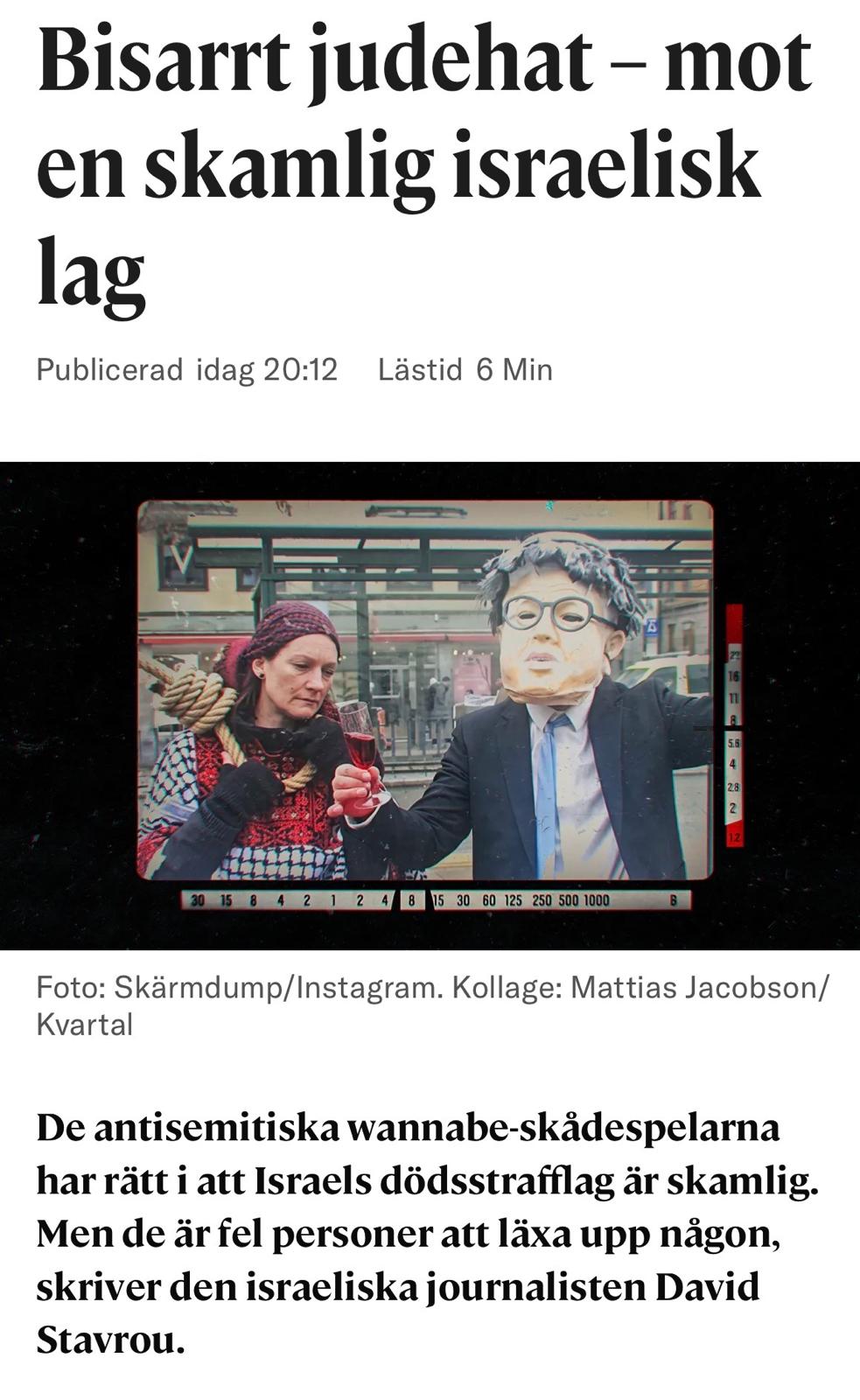
This weekend a new show hit the streets of Stockholm – a character who appears to be a religious Jew because of the kippah on his head holding a glass of blood beside a Palestinian woman being hanged. Those who follow Middle East politics were probably supposed to understand that the Jewish character is Israeli right-wing extremist minister Itamar Ben Gvir celebrating the legislation of the new Israeli death penalty law.

There’s a lot to be said about the Israeli law, but before that’s done the obvious should be pointed out. For those who don’t follow Middle East politics, what happened on Saturday is that Swedish police blocked streets, SL cancelled buses, and taxpayer money was spent in order to allow a group of activists to act out an antisemitic blood libel hundreds of years old, in which a Jew is using the blood of a non-Jewish innocent victim.

The activists will no doubt claim that their protest is legitimate. The character they acted is not all Jews, they’ll say, it’s only Ben Gvir, or only Israeli Jews, or only Zionists. However, the red-stained glass, the grotesque nature of the Jewish characteristics, and the timing make that claim laughable. The performance took place during Passover, the holiday that European Jews have been blamed since the Middle Ages for using Christian children’s blood for making their special holiday bread. The context of their other shows is that Israel controls the world, the American president and Sweden’s government are maneuvered by the Zionists – Israel’s Prime Minister and Jeffrey Epstein (both Jews of course). They relativize the Holocaust and they mock every Israeli symbol by attaching it to blood and money. Sure, they’re not antisemitic, just anti-Zionists. If anyone is so naive as to think that there’s a difference, perhaps they can explain it to Swedish Jewish children who may have passed by in central Stockholm and wondered why they’re being accused of hanging innocent Palestinians. Again.
Still, the new Israeli legislation deserves a serious discussion, even if those who demonstrated against it in Stockholm are on the wrong side of history. Israel’s new “death penalty for terrorists” law was passed in the Israeli parliament in March. The bill stipulates that the death penalty will be imposed on a terrorist who killed a person “with the intent of denying the existence of the State of Israel.” This wording creates a distinction that effectively designates the law almost exclusively for Palestinian terrorism. However, the court will be authorized to impose a life sentence instead of the death penalty if it finds “special reasons” for doing so or if “exceptional circumstances” are present.

It’s important to point out that the Israeli opposition voted against the law, and many in Israel hope that it will be cancelled if a new government takes over after the next elections. This may be the case because the law, which was pushed through by the most extreme Israeli politicians, was also opposed by other Israeli authorities. An official in the Ministry of Justice said that establishing the death penalty in the West Bank through civilian legislation is “highly problematic”. IDF representatives said that the law contradicts international conventions to which Israel is committed, and officials from both the Ministry of Foreign Affairs and the National Security Council opposed it.

The objections are not only technical. Israeli parliamentarian Gilad Kariv (The Democrats, former Labor Party) said that the law contradicts the values of the State of Israel and that it is disgraceful both in its substance and in the political manner in which it was approved. He also said that the party will bring the constitutional question before the High Court of Justice. This is an important point because the law is indeed expected to be reviewed by the High Court of Justice, and there is a possibility that it will be changed, amended, or cancelled.

However, apart from the extreme right, parts of Israeli society who used to be against such legislation in the past have become more positive towards it because of the 251 Israelis who were kidnapped on October 7th. They argue that many of the people who led and participated in the massacre, including Hamas leader Yahya Sinwar, were prisoners who were released from Israeli jails. If they had been executed for their previous crimes, the most horrific crime in Israeli history could have been avoided. Perhaps the main point supporters of the law point to is the possibility of prisoner exchanges which in Israel’s reality have always been an incentive for Palestinian terrorists to commit more attacks. Capital punishment could, according to the law’s supporters, prevent future Israeli kidnapped civilians from being used as bargaining leverage.

Israeli security officials, including several chiefs of staff of the IDF and heads of the Shin Bet, Israel’s security agency, objected to this reasoning and claimed that terrorism is not meaningfully deterred by the threat of execution because attackers who carry out suicide or high-risk operations are often not motivated by personal survival. Increasing the severity of punishment does not change behavior. Instead, capital punishment could escalate tensions, increase incentives for revenge attacks, and complicate intelligence cooperation and prisoner-management strategies.

Other objections, made by Israeli NGOs, are purely ideological. The Zulat Institute for Human Rights, for example, stated that the legislation “is fundamentally based on racial discrimination, is illegitimate, and has existed in the darkest regimes of modern history.” This is, in short, a very controversial issue in Israel, in many ways it’s another part of the bloody aftermath of October 7th and the regional war that is still going on, and the last word hasn’t been said yet.

Back to Stockholm. Considering the complexities of the Israeli legislation isn’t high on the agenda of the Swedish activists. This is a classic situation of a clock being correct twice a day even if it stopped working. Yes, they’re entirely right in their objection to the Israeli death penalty, but they are the last people in the world to preach on this subject.

First, recently more and more Iranian flags are seen at their demonstrations. The regime in Teheran executes over 1,000 people a year. Still, in the Iranian example, Swedish activists prefer demonstrating in support of the bloodthirsty regime against the “imperialist American-Israeli attack” while conveniently ignoring the institutionalized public hangings of women, homosexuals and regime critics from cranes. Other countries which have had the death penalty for years, from the US, China, and Japan to Iraq and Saudi Arabia, are never mentioned in any demonstration. Only Jewish executions, it seems, are morally wrong as far as they’re concerned.

Second, believe it or not, the Palestinian Authority, the same Palestinians the demonstrations are all about, has a death penalty law. In the West Bank it was used in the past and death sentences are not carried out in practice in recent years, but in Gaza, Palestinians have been executed by Hamas on a large scale, both officially and unofficially. Whoever is really worried about the legal execution of Palestinians should have been demonstrating against Hamas long before demonstrating against Israel.

And the finally, for many Israelis (including the one writing this text), the new law is a source of embarrassment and deep concern. It’s like many Swedes see things like NMR, or Swedish volunteers to the SS, or Swedish imams preaching about Jews engaging in black magic. The fact that in Israel a similar phenomenon is powerful enough to legislate is terrible. Still, the ones who will fix this are democratic and liberal Israelis, not a bunch of extremist wannabe actors from Sweden who believe that Israel never had a right to exist whether it has a death penalty law or not.
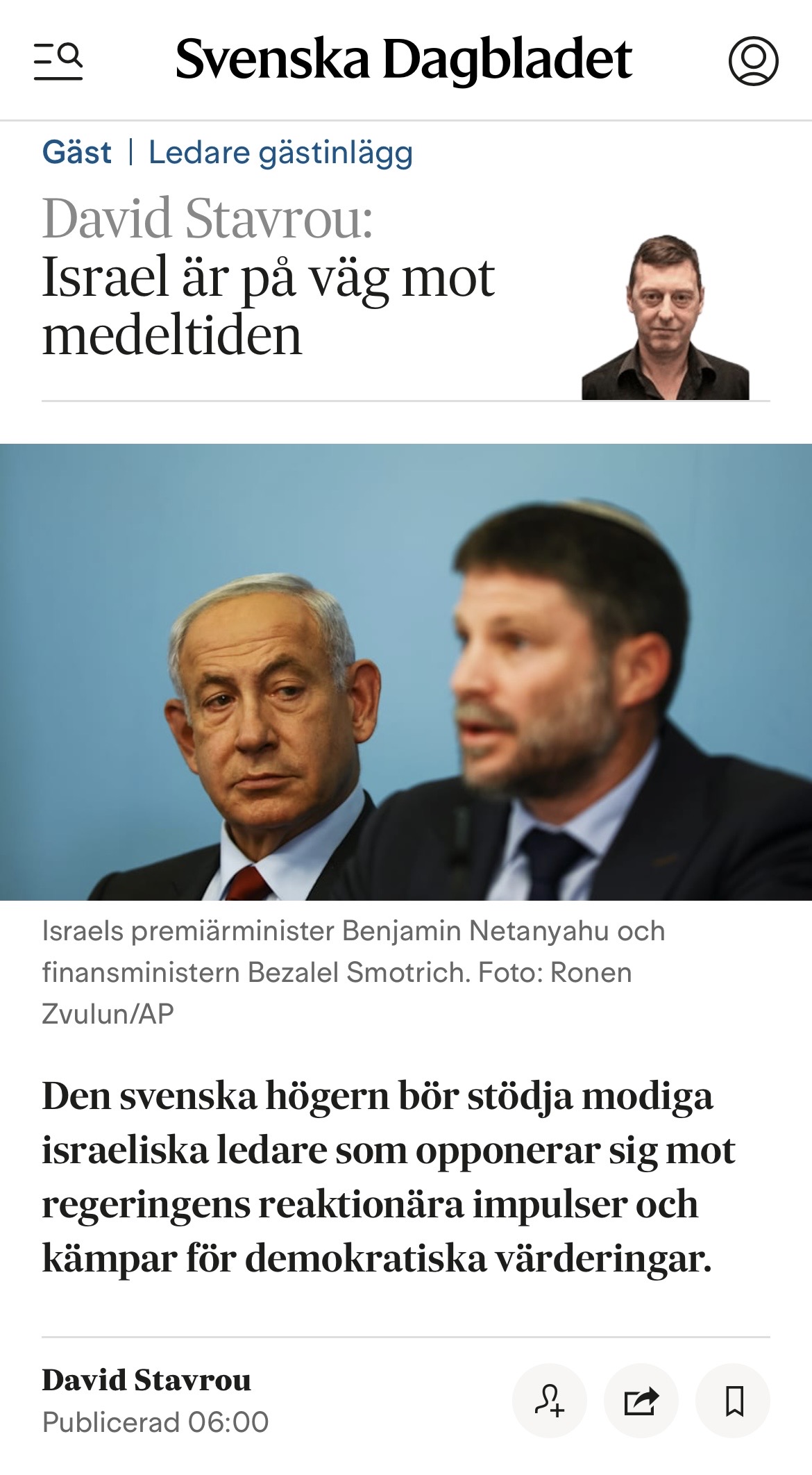
Is Israel on its way to the Middle Ages

The Swedish right should support courageous Israeli leaders who oppose the government’s reactionary impulses and fight for democratic values.

Published in Swedish daily Svenska Dagbladet: https://www.svd.se/a/wr8JEM/netanyahu-tar-israel-mot-medeltiden

The ceasefire which has been in effect in Gaza for several months has given Israelis and Palestinians an opportunity to reflect on their next steps, and to begin rebuilding and recovering after two of the most difficult years in the region’s history. Although Israel is slowly disappearing from the international headlines, it remains important to examine what is actually taking place in its political arena. If there's anything to learn from recent history it's that what happens there will influence global politics for many years to come.

One of the war’s results is that Prime Minister Benjamin Netanyahu, who is currently on trial for corruption, is doing everything he can to control the historical narrative of the war and avoid taking responsibility for Israel’s failure on October 7. Instead, he places the blame on the security services and his political opponents. He refuses to establish an independent official inquiry commission and is doing his utmost to replace Israel’s military and legal elite with loyal officials. These changes may help Netanyahu evade accountability for the charges against him. But for his coalition partners—far-right, fundamentalist, and ultranationalist parties—they are a means to a broader goal: undermining Israel’s liberal democracy.

For example, the Knesset, Israel’s parliament, is discussing a bill that would expand state control over the media. The proposal would replace existing regulatory bodies with a new authority whose members are appointed by the government—effectively enabling political control over broadcast content. The bill has drawn criticism from the government’s legal adviser, who warned that it threatens freedom of the press. It is hardly surprising that the same attorney general is among those the government is attempting to remove.

Screenshot

Because Israel is a democratic country, many Israelis are demonstrating against these proposals and other government measures. In recent months, however, many protesters have claimed that the police are acting in ways they did not previously. They report arbitrary arrests and increased use of force, including stun grenades and mounted riot police.

The minister responsible for this is Itamar Ben-Gvir, a far-right politician previously convicted of incitement and support for terrorism. While he is busy consolidating control over the police within Israel, another minister, Bezalel Smotrich, is consolidating control over the West Bank. Smotrich is laying the groundwork for potential annexation and is taking no action against the growing violence perpetrated by extremist settlers.

Netanyahu himself has recently reaffirmed his intention to continue pursuing the so-called judicial reform which many in Israel describe as a judicial overhaul, as it threatens the fundamental principles of the rule of law and the separation of powers, weakens the independence of the courts, and risks undermining democracy. The issue has now returned to the parliamentary agenda and in addition, efforts to limit the powers of the attorney general and the Supreme Court are being resumed. Another bill currently under discussion would introduce the death penalty for terrorist offenses—formally to prevent Hamas and other groups from taking Israelis hostage in order to exchange them for convicted terrorists, but there are also those motivated simply by revenge.

If the death penalty does not sound like a sufficiently reactionary reform, the Knesset has even discussed the conservative Jewish concept of shmirat negiah—the obligation for a man and a woman who are not married to each other to refrain from physical contact. It is not an official legislative proposal, at least not yet. But the mere fact that it is being discussed alarms liberal and secular Israelis—and rightly so.

Swedes have always had a deep interest in Israel. This can have both positive and negative effects. To understand whether Sweden’s voice can contribute something meaningful in this context, we should examine the country’s current discourse on Israel.

The political left in Sweden has unfortunately totaly lost its bearings. Many of its supporters have embraced Hamas’ narrative of the Israeli–Palestinian conflict. This does not necessarily mean they support terrorism, but the view of Israel as a settler-colonial project that should be boycotted and opposed regardless of its policies or leadership has spread from a radical minority into mainstream politics. Even established political parties have begun discussing the dangerous idea of a one-state solution.

A one-state solution would either mean the end of the Jewish state—which even the Swedish left previously supported—or plunge the entire region into an even worse bloodbath than what we have witnessed over the past two years.

Equally dangerous is the stance of Sweden’s populist right. Supporting Israel because its current leaders appear to use methods similar to those of authoritarian, illiberal regimes, or because they see Israel as a symbol of a struggle against Islam, is both misguided and harmful. It is also a betrayal of the Israelis who are fighting for a democratic, liberal, and peaceful future.

This year, both Swedes and Israelis are heading to the polls. If Sweden still wishes to exert a positive influence on Israel (and on the Palestinians, for that matter), Swedish supporters of the left should cooperate with Israeli artists, entrepreneurs, researchers, and academics who are independent and often in opposition to the government, rather than the easy and intellectually lazy solution of boycotting and margenelizing them.

The Swedish right should support courageous Israeli leaders who oppose the government’s reactionary impulses and fight for democratic values, rather than backing corrupt leaders and extremist parties that are dragging Israel back toward the Middle Ages. Any other approach amounts to rewarding both Hamas and Jewish extremists and for those who live in the region, it is yet another step on the road to hell.

Israeli Elections, October 2022

Published in Swedish daily newspaper Svenska Dagbladet (please note: this is an unoficial and unedited English translation)…

Israel is sometimes called the "only democracy in the Middle East", and in many ways it is. But Israeli democracy is very different from the Swedish one, even though theoretically both have similar parliamentary systems and the same kind of general elections. The differences are more about dynamics than technicalities. One important difference is that governments in Israel very rarely last an entire term, which is why Israelis will be going to the polls again on November 1st in what may seem like a déjà vu.  This is the fifth election campaign in the last four years and the 11th since 2001. In the same period Sweden had only six.

Even though recent years have been unusually unstable in Swedish politics, with weak minority governments and changing political alliances, this is nothing compared to the instability of Israeli politics. This instability combined with unique historical and cultural differences, make the coming up elections very difficult to understand for those who are not locals. Here are a few things to keep in mind if you're following the political drama in the land of milk and honey.

There's probably only one global household name in current Israeli politics – the name of Benjamin Netanyahu. Since Netanyahu first became Prime Minister in 1996, he has held the job for 15 years, even more than David Ben-Gurion who's considered to be Israel's founding father. Netanyahu is head of the "Likud" party and currently leads the opposition even though he's standing trial for bribe and fraud charges. But Netanyahu is more than just a candidate. He's the key issue of these elections. He's not a man leading an agenda. He is the agenda itself. In these elections, many Israelis won't be voting because they want to promote their ideology or influence concrete issues, they'll be voting because they love or hate Netanyahu. 

This leads to a misconception of Israeli politics. Since all recent elections ended in a tie between rival blocks, some assume this is a tie in the European style, meaning between left and right. But nothing could be further from the truth. In a European sense the Israeli left makes up 10 to 15 percent of the electorate on a good day. That is if left means socialist or social-democratic ideology combined with progressive values like secularism, civil rights, feminism, LGBT rights and multiculturalism. In Israel the blocks have nothing to do with all that. It's not socialists against capitalists or conservatives against liberals. It's all about Netanyahu. One block supports him, the other wants to get rid of him.

On Netanyahu's side, things are pretty clear – together with Netanyahu's "Likud" party, there's a coalition of Jewish ultra-orthodox parties, nationalist parties and representatives of West-Bank settlers. The other side, however, has no common values, ideas or interests with the exception of one – the idea of replacing Netanyahu. Led by centrist current Prime Minister Yair Lapid, it's a bizarre coalition based on middle class secular Jews supported by left-wing liberals, a variety of Israeli Palestinians (some Islamist, others secular, some nationalists, others old-school communist) and right-wing conservatives who for some reason or another are in conflict with Netanyahu. This is the main reason why the last Israeli government stayed in power for only a year and even during this short period it had to have two heads of government in rotation. If in Swedish politics, the old left-right spectrum became more complicated in recent years and developed into the so-called GAL-TAN spectrum, in Israel the opposite happened, things became simpler – the whole spectrum is reduced to one man.

But where exactly is Netanyahu on a left-right scale? That should be a simple question to answer since Netanyahu is and always has been a self-proclaimed right-wing leader. He's been called an Israeli Trump, an Israeli Orbán and even an Israeli Erdoğan (although they should be called American, Hungarian and Turkish Netanyahus since he assumed office before them). But context is king, and in an Israeli one, Netanyahu may be hated by the left, but that doesn't mean he's as right as it gets. In a social-economic perspective, Netanyahu used to be a Thatcherist, pushing for privatisations, tax cuts and restraining government spending, but it's been years since he spent his political capital on those kinds of issues. Today he leaves the economy in the hands of others. Though he's certainly a hawk and a sceptic when it comes to relations with the Palestinians, he's always been careful with the use of military power and he never went all the way towards Israel's hard core right which supports the annexation of the West Bank and putting an end to the so-called two state solution. In recent years Netanyahu has been mostly concerned with staying in power and avoiding prison. Unlike his potential successors, he's secular, he was raised in the US and has a western education and world view and he's an intellectual. In Israel this means that in many ways he's actually a centrist.

Just for the sake of perspective, the rising star of these elections is the 46-year-old leader of the "Jewish Strength" party, Itamar Ben Gvir, a man who first came to public attention when he threatened the life of Prime Minister Yitzhak Rabin a few weeks before he was assassinated in 1995. Ben Gvir also supported Baruch Goldstein an American Jew who massacred 29 Muslims in Hebron in 1994. The party Ben Gvir is currently part of has the support of 10 percent of the electorate in the latest polls. When it comes to ideology, Netanyahu is a middle of the road pragmatist compared to Ben Gvir and other Israeli nationalist and religious fanatics. The stark opposition he faces is more about his alleged corruption, opportunism and his relentless populist crusade against Israel's judicial system and law enforcement officials.

One of the reasons that Netanyahu's party is supported by over 25% of the voters according to polls is that in Israel many people don't vote according to their opinions. Rather, they vote according to their identity. It's not about what you think, it's about who you are. Arabs vote for Arab parties, religious people vote for religious parties, traditional Jews with an Eastern background vote for the Likud and secular Jews from a western background vote for one of the liberal centrist parties, usually led by ex-Army generals or former media celebrities. These include the Labour Party led by former TV and radio anchor, Merav Michaeli, and the National Unity Party led by Benny Gantz, former army Chief of Staff. To put it in a Swedish context – no one in Israel needs a "Val Kompas", many parties don't even have a party platform. a strong sectorial identity is much mor useful. The comparison may not be entirely fair, but in this aspect, Israeli parties are not very different from "Nyans".

Finally, Swedes may be surprised to know that the Palestinian issue is no longer an important part of the Israeli discourse. Back in the 80s and 90s, the lines of Israeli politics were drawn according to policies towards the Palestinians. The left promoted the two-state solution, the right argued against a Palestinian state. These days, the two-state solution is probably discussed more in Sweden's Foreign Ministry at Gustav Adolfs Torg, than it is in Jerusalem. It seems like both Israelis and Palestinians have lost faith in concepts like negotiations, compromise and peace agreements and a reality of a never ending low-intensity conflict is accepted on both sides. As a result, Israelis will not be voting to stop or to continue the occupation of the West Bank, they'll also not be voting about the threat from Iran, social issues or the economy. Instead, it's a mix of identity politics combined with anger about an eclectic collection of issues which happened to appear in yesterday's papers or social media feeds. When it comes to art and culture, entrepreneurship and industry, history and science, Israel is a beautiful country full of promise and potential. Its political establishment, on the other hand, has lost its way and is deeply divided. The only democracy in the Middle East is stuck in an endless spiral of election campaigns. The result of this fifth round is still unknown, but it may very well simply be nothing more than round number six.