The Swedish Left Party’s letters reveal what amateurs they are

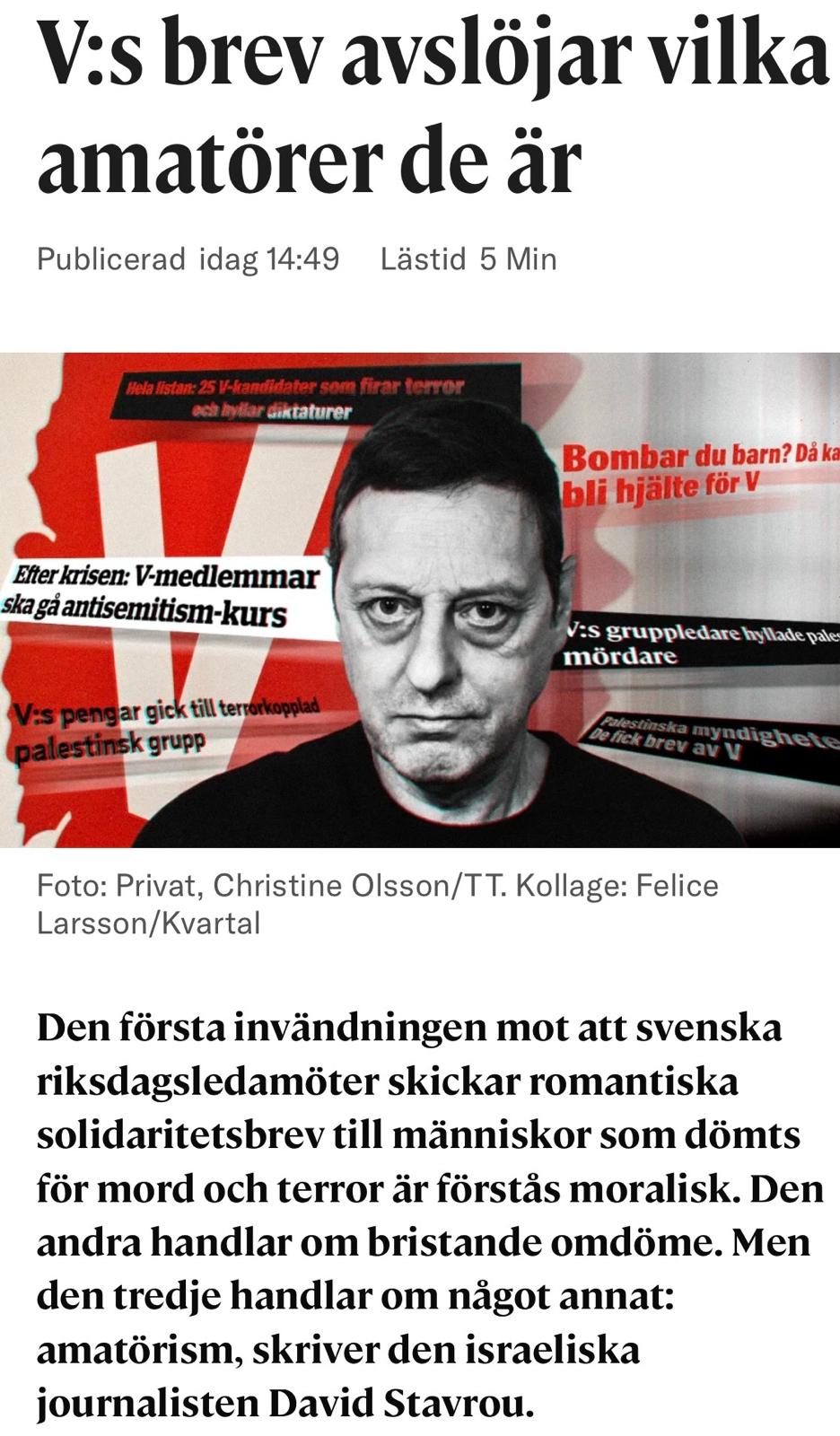
The first objection to Swedish MPs sending romantic letters of solidarity to people convicted of murder and terrorism is, of course, a moral one. The second concerns poor judgment. But the third is about something else: amateurism, writes Israeli journalist David Stavrou.

Published in Swedish in Kvartal: V:s brev avslöjar vilka amatörer de är – Kvartal

In the space of just a few days, journalists Sofie Löwenmark, Nathalie Rothschild and Inas Hamdan published investigations showing how members of the Swedish parliament had sent letters of solidarity to Palestinian prisoners convicted of very serious terrorism offenses and had participated in an organized campaign in which several of the recipients are serving life sentences for attacks against civilians.

In 2023, SVT revealed that aid money from the Left Party’s international organization had gone to a project with links to the DFLP, an organization that participated in the October 7 massacre. The following year, prominent Left Party figure Kristofer Lundberg was expelled after expressing support for the terrorist-designated PFLP. In Malmö, Orwa Kadoura left the party following criticism over antisemitic messages. In 2025, MP Lorena Delgado Varas shared a classic antisemitic conspiracy image, and as recently as June this year, the Left Party removed a large number of candidates who had praised Hamas’s October 7 attack, spread Holocaust denial and promoted antisemitic conspiracy theories.

All of this is, of course, serious. By now, it is clear that the Left Party has a problem with romanticizing terrorism and spreading antisemitism and conspiracy theories. This can no longer be dismissed as anecdotal. Every time you think rock bottom has been reached, another investigation appears with new revelations. But precisely for that reason, it is almost no longer interesting to discuss this as a question of values. Left Party members are free to believe whatever they want. The truly interesting issue is something else.
Politics is not merely an ideological arena. Politics is a profession. There are laws, practices, institutions and rules of the game. And then there is what in British politics is sometimes described as simply not done – things that may not actually be prohibited but that politicians nevertheless know not to do. It is like any other profession. Surgeons do not operate on gut feeling. Judges do not rule according to whom they instinctively like best. Even a passionate politician is expected to be able to control that passion long enough to do the job.

The first objection to Swedish MPs sending romantic letters of solidarity to people convicted of murder and terrorism is, of course, a moral one. The second concerns poor judgment. But the third is about something else: amateurism.

The Left Party’s explanation in the latest affair illustrates the problem. The party secretary has said that the names came from the Palestinian Association of Sweden and that the Left Party carried out no checks of its own. “There had been a mistake in the fact-checking,” MP Ilona Szatmári Waldau wrote. Nooshi Dadgostar has repeatedly resorted to variations of the same defense during the scandals of recent years. In June, she referred to the large number of Left Party representatives – more than 4,000 – and stressed that those exposed represented only a small proportion. She then said that “there are occasions when people turn up whom you haven’t kept track of.” She promised to tighten the party’s procedures, but that is clearly an almost impossible task, since many other Left Party members defend people who have expressed support for terrorist organizations.

If a blue-haired 17-year-old activist sends a love letter to an ideologically motivated murderer he saw on TikTok, perhaps he can get away with shrugging his shoulders or shouting along with Rage Against the Machine: “Fuck you, I won’t do what you tell me!” But members of parliament are not teenagers. They are adults, and adults are expected to evaluate their sources critically and ask questions. What does it look like when we become fixated on prisoners from a single international conflict while ignoring others? What diplomatic, trade-policy and security-policy consequences could our statements have? Which people and organizations are we legitimizing?

Is that boring? Does it involve compromise? Perhaps even moral coruption? Perhaps – if you live in a syndicalist collective, eat out of tin cans beneath posters of “freedom fighters” and say that “when the forest is felled, the chips will fly”. But the Left Party’s MPs are well-paid public officials who participate in – and enjoy all the privileges and perks that come with – professional politics.

That means it is part of the job to investigate the people and organizations you cooperate with, read court judgments, speak to embassies, diplomats, experts and lawyers, ask what is disputed and what has been established, and understand the consequences of your own symbolic politics. For example, when a professional politician becomes involved in another country’s prison system by writing a letter, they must understand how the people they are writing to are perceived by their victims, as well as understand another society’s sensitivities and collective trauma.

To a Swede, Ahmad al-Moghrabi or Ibrahim Abu Mokh may be unfamiliar names on a list of “Palestinian prisoners.” To an Israeli, those same names may signify deadly suicide attacks against civilians, murdered children or a young conscript who was kidnapped on his way home and never returned. You do not have to accept Israel’s policies in the West Bank or agree with the Israeli courts. You only need to be able to imagine the reverse situation. Imagine if foreign parliamentarians wrote to Jackie Arklöv and praised his “courage and perseverance” without checking the judgment against him. The first Swedish response wouldn't be a complex debate about Scandinavian geo-politics, it would be: Have you even bothered to find out who this person is?

This kind of disregard for the rules of politics – in which passionate conviction is allowed to cloud judgment and consequences and basic due diligence are ignored – has a name. It is called populism.

For many years, the Sweden Democrats have struggled with a similar transition – from a protest movement to a party with influence over the state. As part of that process, the party has run internal training programs under the title The Road to Power (Vägen till makten), although there is, of course, no reason to romanticize the results. SD continues to be plagued by recurring scandals. A training course cannot magically erase a political culture.

And this is where the parallel with the Left Party becomes even more uncomfortable. V has already tried the educational route. Following several antisemitism scandals, in the spring of 2025 the party invited its members to a two-hour training session on antisemitism. Every member received an invitation. Yet one year later, the party found itself with 25 candidates removed from its lists following revelations involving, among other things, precisely antisemitism. As the Swedish elections draw closer, the party is finding it increasingly difficult to convince voters that sympathy for terrorists, conspiracy theories and antisemitism among its politicians and activists is a bug. In its case, it seems much more like a feature.


Sweden is turning Gaza into domestic politics

The situation in Gaza is detreating and the international community has every right to intervene, but anyone who criticizes Israel’s warfare can’t be taken seriously unless they also have a serious suggestion as to how to protect Israeli citizens from another massacre by the genocidal wing of the Palestinian national movement. 

Published in Swedish in Swedish daily Svenska Dagbladet: https://www.svd.se/a/Xj17Vr/gor-inte-gaza-till-svensk-inrikespolitik

Israel’s new ground offensive in Gaza is raising stark Swedish reactions, as always. The left is denouncing Israel as a genocidal power indiscriminately killing Palestinians. The right is slightly more restrained, but it too claims that Israel is going too far. These reactions are understandable considering the horrifying images from Gaza shown on Swedish TV. But it’s more than that. Horrifying scenes are taking place all over the world, but Gaza, unlike other conflicts, has a unique role in Swedish politics. It’s an issue of interest but also a source of easily-won political points. The Swedish Left Party, Vänsterpartiet, uses it to show its electoral base how pro-Palestinian it is, so as not to lose votes to radical breakaway fractions, while The Social Democratic Party leaders use it to show their loyalty to old-school “humanitarian super power” policies. On the other side of the political spectrum, while Right Wing populist party, Sverige Demokraterna, continues marketing itself as “Sweden’s most pro-Israel party” as an alibi against accusations of antisemitism, Moderaterna, the ruling center-right party, is trying to maintain a responsible image, aligning itself with EU allies and international law, by presenting a moderate critical policy towards Israel. Sweden’s Gaza discourse, it seems, is more about domestic politics than the reality in Israel and Gaza.

But there is an Israeli reality which isn’t visible to Swedish news followers, one that adds another dimension and shows that Israel is more than just a blood thirsty monstrous state out for revenge. Those who choose to go beyond Swedish headlines, find that there are many Israelis who oppose their government and its Gaza policy. In fact, thousands of them demonstrate against it week after week. These are not only radical left-wingers from the fringes of the political spectrum. Israel is deeply split and even mainstream Zionist political leaders with hundreds of thousands of voters are speaking up against Netanyahu’s government.

A "sane state does not wage war against civilians, does not kill babies as a hobby, and does not set goals for itself like the expulsion of a population", said the leader of The Democrats, Israel’s Centre-Left Zionist party who’s also a retired IDF major general. When Netanyahu reacted by claiming that Golan’s statement was “wild incitement”, Golan refused to apologize. “The time has come for us to have a backbone of steel”, he said, “we must stand by our values as a Zionist, Jewish, and democratic state”. He added that the government ministers are corrupt and that the “war must be ended, the hostages returned, and Israel rebuilt”.

But it’s not only the Israeli Left. “What’s the strategy?”, said Yair Lapid, leader of the centrist “Yesh Atid” party, “we all support the elimination of Hamas, but Hamas will not disappear unless an alternative to its rule is presented. Getting the IDF stuck in Gaza for years is a strategic mistake, an economic disaster, and a diplomatic tragedy that will prevent us from being part of the historic change in the Middle East”.

Even some Israeli right-wing politicians oppose Netanyahu’s government. “This war is not a war for security but a war for power”, said Avigdor Liberman, a hardliner who in the past held important ministerial posts under Netanyahu, “this government is willing to pay any price for staying in power — even at the cost of the lives of the hostages and soldiers”. This is a point many in Israel agree on. According to a poll published by Israeli Chanel 12, 61% of the Israeli public prefers a deal which would return all Israeli hostages and end the war in Gaza, compared to only 25% who support expanding the fighting and occupying Gaza.

It seems like one must read news in Hebrew to understand that Israelis are more than just aggressors, just like one must read Arabic in order to understand that Palestinians are more than just victims. For example, anyone following Hamas-affiliated Telegram accounts in Arabic knows that besides images of Palestinian suffering, there are posts with images of suicide bombers standing next to bus wreckages accompanied by texts like "the buses carrying you will become coffins" and “our martyrs are on their way”. This isn’t just a reaction to Israel’s Gaza offensive. It’s been going on for decades. Long before October 7th, official Telegram posts by the al-Aqsa Brigades, a Fatah-aligned armed group, called the “heroes of the West Bank” to “stab, run over, slay and blow up”. “Oh heroes of Jerusalem”, one of them said, “the land is your land, what are you waiting for? The time has come to kill the Jews”. Naturally, Hamas takes it even further. Fathi Hamad, a member of the movement’s political bureau and former minister called on Palestinians to "buy knives for five shekels, sharpen them and decapitate the Jews". Naturally, these quotes are not available in Swedish and are not part of the Swedish discourse.

Still, Swedish politicians have every right to react to events in the Middle-East and in the current reality, there’s plenty of reasons to criticize Israel. There are, however, a few simple ideas which can make the criticism more grounded in reality and more balanced. 

First, categorizing Hamas as a terrorist organization is correct, but it has an unwanted side effect. Because it deals with terror, some may assume that it’s a terror organization like others. But it’s not. It’s an army. Some may imagine it as a kind of Baader-Meinhof-like gang of youngsters in red and white keffiyehs squatting in abandoned buildings in down town Rafah and reading texts by Leon Trotsky. Nothing could be further from the truth. The Hamas military machine has brigades, battalions and commando units. It has strict military hierarchies and discipline as well as weapon manufacturing capabilities, a navy, military intelligence, cyber experts, a propaganda machine and thousands of young men to recruit, even during the IDF’s campaign. Hamas is clear about its end game – it’s a barbaric, fascist and fundamentalist movement committed to wipe the Jewish state off the face of the earth. Anyone who criticizes Israel’s war in Gaza can’t be taken seriously unless they also have a serious suggestion as to how to protect Israeli citizens from another massacre by the genocidal wing of the Palestinian national movement. 

Second, sometimes one has to be honest even concerning political and military policies. Israeli society is deeply traumatised by a vicious attack which took the lives of more than 1,100 people. Everyone knows someone who was killed, a child who was kidnapped or a woman who was raped. Everyone saw the atrocities – homes burnet to ashes and dead bodies of all ages. Everyone is worried about a relative or a friend on the front lines. Everyone knows a survivor. Everyone is a survivor. The expectation that Israel will react in a calm, moderate and gentle way is absurd. This doesn’t mean that a wild storm of revenge is justifiable. It does mean that swedes would do well to ask themselves modestly and honestly how they react to crises.

Sweden was unaligned for over 200 years. Then a war started over 2,000 km away. Still, Sweden changed its policy almost over-night and joined NATO. In the same way, a handful of problems with integration caused the country which was known for its leaders asking its citizens to “open their hearts” to refugees because “their Europe has no walls”, made a former neo-Nazi party its second largest. It also reversed all of its immigration policies. These dramatic and, anything but calm and moderate changes, happened without one shot being fired at Sweden and without hundreds of Swedes being killed, raped or injured. Israel, on the other hand, apart from the horrors of October 7th, has had, 35,500 rockets fired directly at it in the last year and a half, targeting, displacing and killing civilians. Is Sweden really qualified to lecture it about reacting unproportionally? And finally, criticizing Israel is fine, but it shouldn’t be done according to the propaganda of Sweden’s so-called pro-Palestinian movement. For some reason, this movement has adopted an extremist narrative echoing Hamas propaganda which claims that the Jewish state has no right to exist. The slogan of a “free Palestine from the river to the sea” is a genocidal one, since it implies the elimination of Israel. The slogans calling for an “Intifada” are incitement for violence and the claim that Israelis are settler colonizer is historically ridiculous and politically dangerous. Those who criticizes Israel because they support a just peace and a political compromise in the Middle-East would do well to find better partners – instead of people who scream “crush Zionism” and are just as bad as those who automatically support everything Israel does; they can join hands with moderate Israelis who still believe in peace and are struggling to save their home from a never-ending cycle of violence.