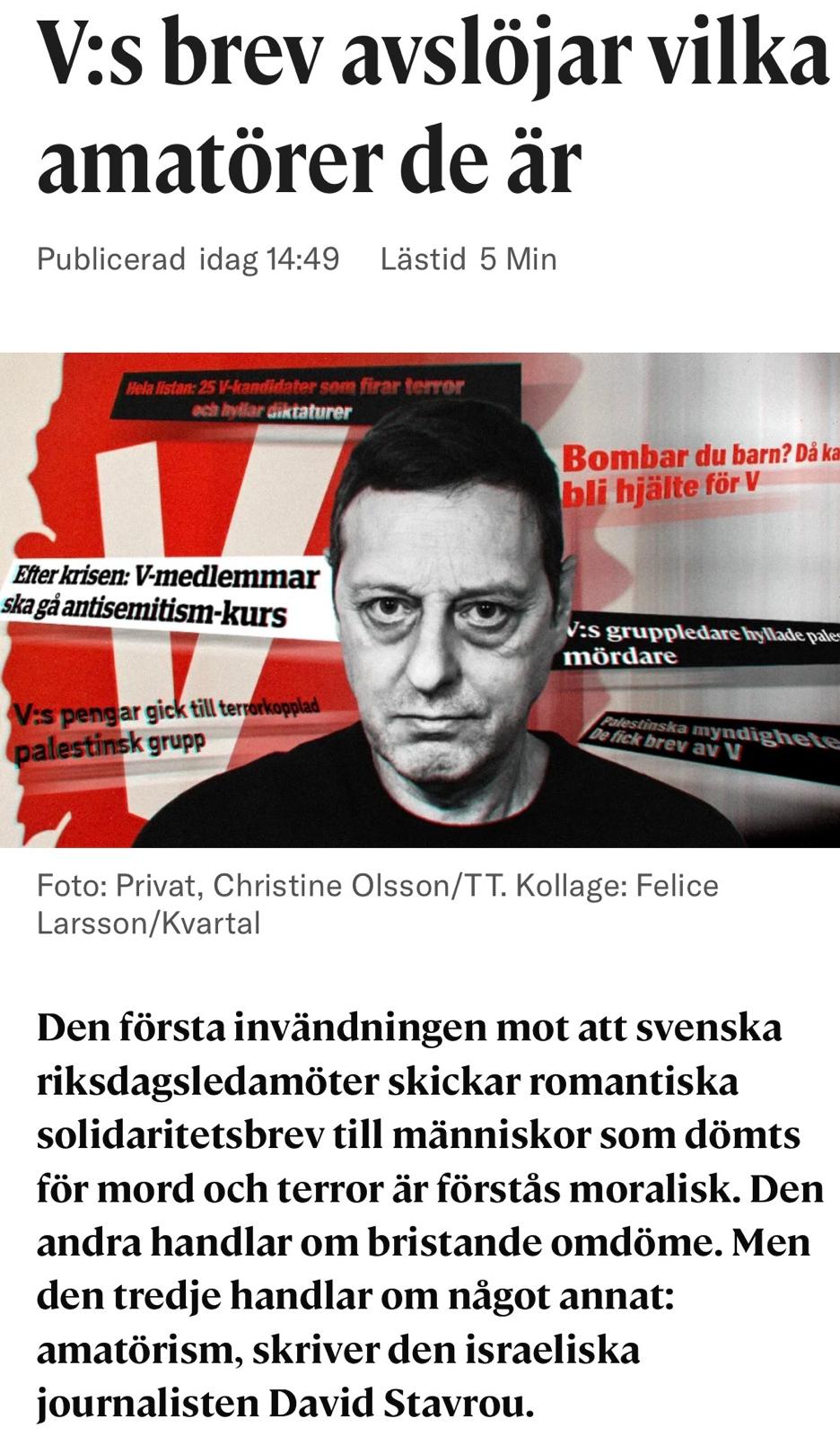
Sweden's Left Party has come under intense scrutiny after two of its senior lawmakers sent letters of support to Palestinian prisoners convicted of deadly terror attacks weeks before a general election.
Published in Haaretz: 'At Least Google Their Names': Sweden's Left Party Scrutinized Over Solidarity Letters to Palestinian Terrorists – Europe
With just over a month to go before Sweden's general election, the country's Left Party has come under criticism following new revelations that senior party figures sent letters of solidarity to Palestinian prisoners convicted of terrorism or murder.
The letters were part of a solidarity initiative involving the Left Party and Palestinian prisoner advocates. In the space of a few days earlier in August, three Swedish journalists exposed several such cases.
Journalist Sofie Löwenmark wrote in daily newspaper Expressen that Left Party Member of Parliament Ilona Szatmári Waldau had written last year to Ahmad al-Moghrabi, a senior commander of the al-Aqsa Martyrs' Brigades. He is serving multiple life sentences in Israel for his role in planning deadly terrorist attacks in Jerusalem, including an attack on a bar mitzvah celebration that killed 11 people and an attack on a supermarket that killed two. In the letter she sent him, Szatmári Waldau commended his "courage and perseverance."
Szatmári Waldau later explained in a Facebook post that she had not known about al-Moghrabi's background and that the information about the prisoners had been provided by the Palestine Solidarity Association of Sweden.
"None of the prisoners were supposed to have carried out violence against civilians or have human lives on their conscience. In this case, the fact-checking was flawed, which is not acceptable. I have taken down the post. Terrorism and violence against civilians is not something I support or encourage," she wrote.
Later, the Left Party acknowledged that its fact-checking had failed. Party leader Nooshi Dadgostar described the letters as a mistake and said the campaign had been withdrawn, while defending the MPs involved, saying to the Aftonbladet daily of Szatmári Waldau: "I have complete confidence in her values."
Nathalie Rothschild, a journalist at the Swedish online current-affairs magazine Kvartal, subsequently reported that the party's parliamentary group leader, Samuel Gonzalez Westling, had written a letter of solidarity to Ibrahim Abu Mokh, who was sentenced to life imprisonment for kidnapping and murdering 19-year-old Israeli soldier Moshe Tamam in 1984.
Rothschild also reported that the party had organized a seminar in which former Palestinian prisoner Hussam Shaheen, who was sentenced to 27 years imprisonment for attempted murder and conspiracy to commit murder, participated by video link. His conviction had been challenged in Israel's High Court, where his lawyer argued that he had been wrongly identified and that the investigation had suffered from serious omissions. The state acknowledged some investigative errors, although the conviction was not overturned.
"This is a party that aspires to sit in government after the election, and eight of its MPs have taken part in a solidarity campaign with prisoners without even considering that they should at least Google their names," Rothschild tells Haaretz. "It's incompetent at best, and a security risk at worst."
Following this, Expressen investigative journalist Inas Hamdan published a complete list of 24 Palestinian prisoners who were supposedly included in the campaign. Several had been convicted of murder or terrorism-related offenses. The Left Party denied all had been involved in the campaign and rather only a "handful," according to Hamdan's reporting.
"As a Swedish journalist of Palestinian background, I think it's important that politicians are clear about where they stand," Hamdan told Haaretz. "In Sweden, we have seen enormous demonstrations where there have been slogans in support of terrorism or flags representing terrorist organizations such as Hamas, Hezbollah and the al-Aqsa Martyrs' Brigades. Threats against Sweden's Jewish minority are a threat to Swedish democracy. That's why it's incredibly important that we show what these threats look like."
The controversy comes at a sensitive moment for the Left Party, known in Swedish as Vänsterpartiet. The party, which has profiled itself in recent years as a socialist and feminist party, originates from Sweden's Communist Party, which split from the Social Democratic Party in 1917. Today, it sits to the left of the Social Democrats, advocating for a strong welfare state, greater economic equality, expanded public ownership and workers' rights.
Its leader, 41-year-old Nooshi Dadgostar, the daughter of Iranian immigrants who grew up in Gothenburg, has led the Party since 2020. It currently holds 22 of the 349 seats in the Swedish parliament.
The party has never participated in a Swedish national government, though it has frequently provided parliamentary support for Social Democratic governments. Ahead of this year's election, Dadgostar has made clear that the party expects formal cabinet posts if its support is required to form a center-left government.
The letters to the Palestinian prisoners are only the latest chapter in the party's engagement with the Israeli-Palestinian conflict.
Over the past three years, Israel, Gaza and the wars in the Middle East have become an increasingly prominent part of Swedish politics. While all of the country's major political parties have taken positions on the issue, the Left Party has made it a central part of its political identity.
This was particularly clear during the 2024 European Parliament election campaign, when party leader Dadgostar described the vote as a "Palestine election," arguing that a united European Union could put pressure on Israel. "We are not finished until we have liberated Palestine," she says. The Israeli-Palestinian conflict occupied a prominent place in her campaign, and some analysts cite the party's position on Gaza as one of the factors that contributed to its strong electoral performance.
The issue has also extended beyond the party leadership. Many Left Party members and activists have participated in Sweden's pro-Palestinian protest movement that has become a regular feature of Swedish public life. Some of these demonstrations have featured slogans, symbols and political theater that have been described by Jewish community leaders as supporting terrorism or having antisemitic elements. The Israeli-Palestinian conflict has consequently become not merely a foreign policy question for the party, but an issue increasingly shaping its activist base, electoral strategy and internal politics.
In 2023, Swedish public broadcaster SVT reported that aid money from the party's international organization had gone to a project linked to the Democratic Front for the Liberation of Palestine, whose armed wing took part in the October 7 massacre.
The following year, prominent Left Party figure Kristofer Lundberg was expelled from the party after openly supporting the Popular Front for the Liberation of Palestine, which is an EU-designated terrorist organization. During Lundberg's time as chairman of the party's Angered branch, a Popular Front representative also participated in the branch's annual meeting.
In Malmö, Orwa Kadoura, then vice-chairman of the local Left Party branch in what is Sweden's third-largest city, left the party following criticism over antisemitic messages. In 2025, MP Lorena Delgado Varas shared a classic antisemitic conspiracy image and was made to leave the party too. And as recently as June this year, the party removed more than 20 candidates from its municipal electoral lists after investigations found that they had praised Hamas' October 7 attack, spread Holocaust denial and promoted antisemitic conspiracy theories.
Hamdan says the reaction to her reporting has been mixed. "On the one hand, there are threats against me as a journalist," she says, "but there's also confusion about how things came to this. Knowledge about terrorist organizations such as Hamas is very limited among Swedes, because it's not something they have had to deal with very much".
"From the party, we have been met either with silence or with attacks. This is, of course, an incredibly difficult issue for them," Hamdan says. "They have some voters who are attracted by expressions of support for terrorism, while they have other voters who oppose it. They are trying to play both sides."
Löwenmark, who first reported about Szatmári Waldau's letter, describes the reactions as "strong and widespread." She tells Haaretz, "The fact that he was a Palestinian prisoner was enough for him to be praised for his courage and his struggle. No one had even bothered to find out what he had been convicted of."
Löwenmark added that there are almost always strong reactions when investigations concern pro-Palestinian activism and the Left Party. "The pattern is predictable", she said. "Instead of discussing what has been revealed, they attack the person who revealed it. The focus shifts from the facts themselves to the journalist, the newspaper or the alleged motive behind the investigation."
Rothschild, who has also published revelations about the party, says that she too had been met with silence from party officials. "When I tried to get more information from the party, one MP wrote that she won't grant interviews about this topic, while the party's parliamentary group leader confirmed he sent the letter to Abu Mokh but didn't have time to talk when I asked if he knew about the charges against him." Rothschild says that further attempts to contact the party's lawmakers and the party's press service went unanswered.
It remains to be seen whether the controversy will affect the party's support in the polls. These revelations add to a series of controversies over the positions of individual party members that, as the party seeks a formal role in Sweden's next government, puts renewed focus on its position on Israel as a whole.
The Left Party did not respond to Haaretz's request for an interview or comment.