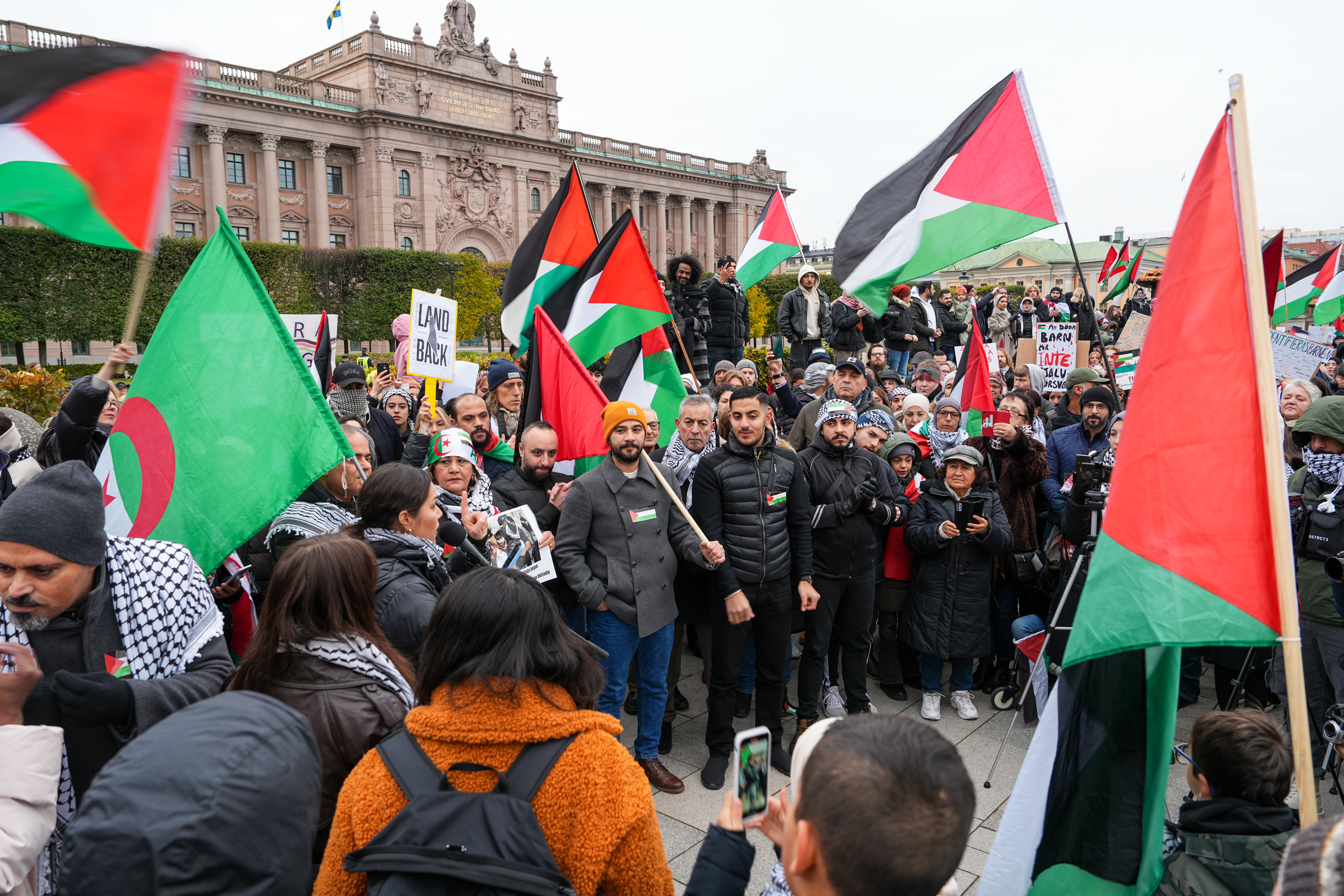
The first objection to Swedish MPs sending romantic letters of solidarity to people convicted of murder and terrorism is, of course, a moral one. The second concerns poor judgment. But the third is about something else: amateurism, writes Israeli journalist David Stavrou.
Published in Swedish in Kvartal: V:s brev avslöjar vilka amatörer de är – Kvartal
In the space of just a few days, journalists Sofie Löwenmark, Nathalie Rothschild and Inas Hamdan published investigations showing how members of the Swedish parliament had sent letters of solidarity to Palestinian prisoners convicted of very serious terrorism offenses and had participated in an organized campaign in which several of the recipients are serving life sentences for attacks against civilians.
In 2023, SVT revealed that aid money from the Left Party’s international organization had gone to a project with links to the DFLP, an organization that participated in the October 7 massacre. The following year, prominent Left Party figure Kristofer Lundberg was expelled after expressing support for the terrorist-designated PFLP. In Malmö, Orwa Kadoura left the party following criticism over antisemitic messages. In 2025, MP Lorena Delgado Varas shared a classic antisemitic conspiracy image, and as recently as June this year, the Left Party removed a large number of candidates who had praised Hamas’s October 7 attack, spread Holocaust denial and promoted antisemitic conspiracy theories.
All of this is, of course, serious. By now, it is clear that the Left Party has a problem with romanticizing terrorism and spreading antisemitism and conspiracy theories. This can no longer be dismissed as anecdotal. Every time you think rock bottom has been reached, another investigation appears with new revelations. But precisely for that reason, it is almost no longer interesting to discuss this as a question of values. Left Party members are free to believe whatever they want. The truly interesting issue is something else.
Politics is not merely an ideological arena. Politics is a profession. There are laws, practices, institutions and rules of the game. And then there is what in British politics is sometimes described as simply not done – things that may not actually be prohibited but that politicians nevertheless know not to do. It is like any other profession. Surgeons do not operate on gut feeling. Judges do not rule according to whom they instinctively like best. Even a passionate politician is expected to be able to control that passion long enough to do the job.
The first objection to Swedish MPs sending romantic letters of solidarity to people convicted of murder and terrorism is, of course, a moral one. The second concerns poor judgment. But the third is about something else: amateurism.
The Left Party’s explanation in the latest affair illustrates the problem. The party secretary has said that the names came from the Palestinian Association of Sweden and that the Left Party carried out no checks of its own. “There had been a mistake in the fact-checking,” MP Ilona Szatmári Waldau wrote. Nooshi Dadgostar has repeatedly resorted to variations of the same defense during the scandals of recent years. In June, she referred to the large number of Left Party representatives – more than 4,000 – and stressed that those exposed represented only a small proportion. She then said that “there are occasions when people turn up whom you haven’t kept track of.” She promised to tighten the party’s procedures, but that is clearly an almost impossible task, since many other Left Party members defend people who have expressed support for terrorist organizations.
If a blue-haired 17-year-old activist sends a love letter to an ideologically motivated murderer he saw on TikTok, perhaps he can get away with shrugging his shoulders or shouting along with Rage Against the Machine: “Fuck you, I won’t do what you tell me!” But members of parliament are not teenagers. They are adults, and adults are expected to evaluate their sources critically and ask questions. What does it look like when we become fixated on prisoners from a single international conflict while ignoring others? What diplomatic, trade-policy and security-policy consequences could our statements have? Which people and organizations are we legitimizing?
Is that boring? Does it involve compromise? Perhaps even moral coruption? Perhaps – if you live in a syndicalist collective, eat out of tin cans beneath posters of “freedom fighters” and say that “when the forest is felled, the chips will fly”. But the Left Party’s MPs are well-paid public officials who participate in – and enjoy all the privileges and perks that come with – professional politics.
That means it is part of the job to investigate the people and organizations you cooperate with, read court judgments, speak to embassies, diplomats, experts and lawyers, ask what is disputed and what has been established, and understand the consequences of your own symbolic politics. For example, when a professional politician becomes involved in another country’s prison system by writing a letter, they must understand how the people they are writing to are perceived by their victims, as well as understand another society’s sensitivities and collective trauma.
To a Swede, Ahmad al-Moghrabi or Ibrahim Abu Mokh may be unfamiliar names on a list of “Palestinian prisoners.” To an Israeli, those same names may signify deadly suicide attacks against civilians, murdered children or a young conscript who was kidnapped on his way home and never returned. You do not have to accept Israel’s policies in the West Bank or agree with the Israeli courts. You only need to be able to imagine the reverse situation. Imagine if foreign parliamentarians wrote to Jackie Arklöv and praised his “courage and perseverance” without checking the judgment against him. The first Swedish response wouldn't be a complex debate about Scandinavian geo-politics, it would be: Have you even bothered to find out who this person is?
This kind of disregard for the rules of politics – in which passionate conviction is allowed to cloud judgment and consequences and basic due diligence are ignored – has a name. It is called populism.
For many years, the Sweden Democrats have struggled with a similar transition – from a protest movement to a party with influence over the state. As part of that process, the party has run internal training programs under the title The Road to Power (Vägen till makten), although there is, of course, no reason to romanticize the results. SD continues to be plagued by recurring scandals. A training course cannot magically erase a political culture.
And this is where the parallel with the Left Party becomes even more uncomfortable. V has already tried the educational route. Following several antisemitism scandals, in the spring of 2025 the party invited its members to a two-hour training session on antisemitism. Every member received an invitation. Yet one year later, the party found itself with 25 candidates removed from its lists following revelations involving, among other things, precisely antisemitism. As the Swedish elections draw closer, the party is finding it increasingly difficult to convince voters that sympathy for terrorists, conspiracy theories and antisemitism among its politicians and activists is a bug. In its case, it seems much more like a feature.