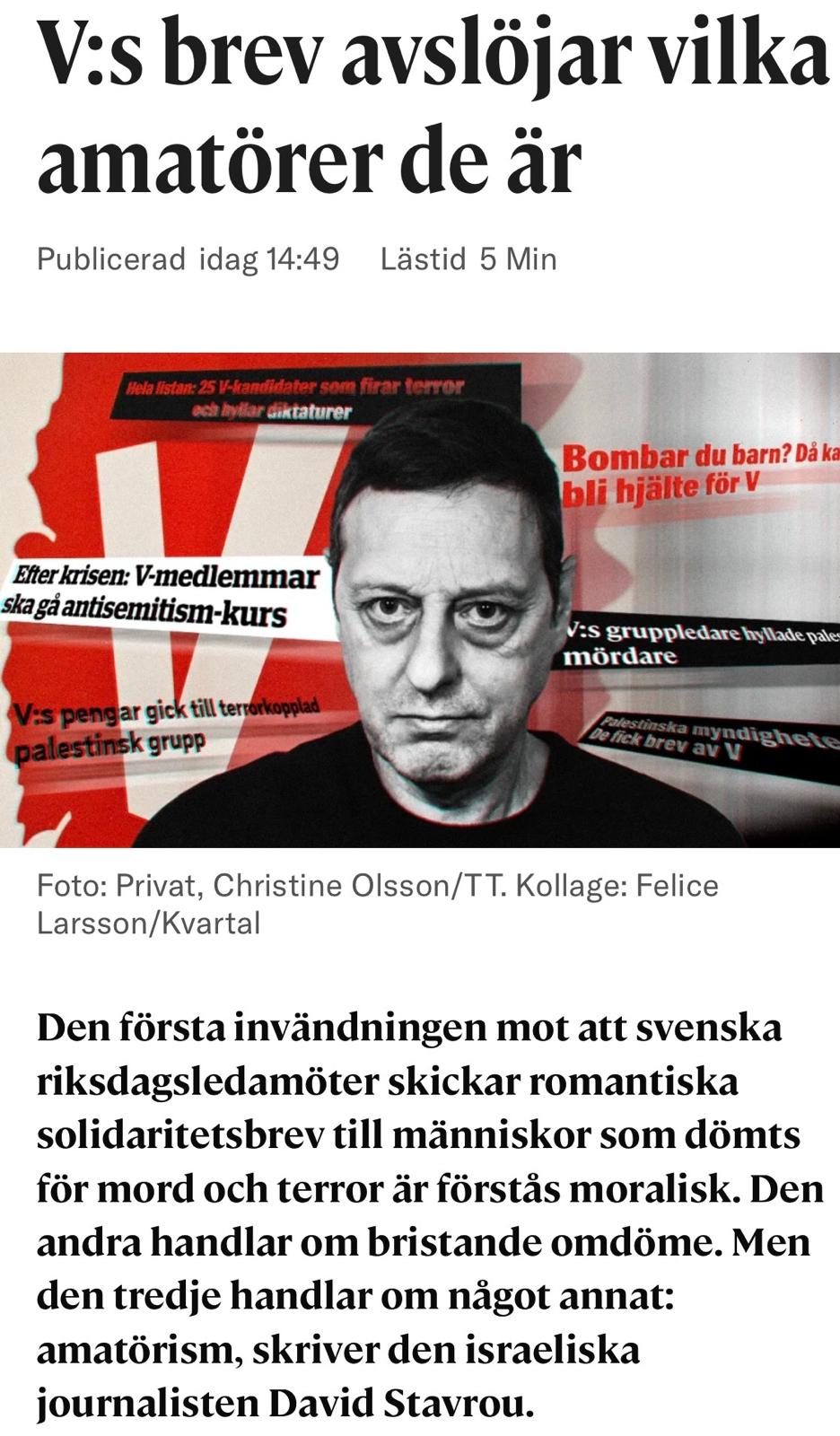
The Swedish Left Party’s letters reveal what amateurs they are

The first objection to Swedish MPs sending romantic letters of solidarity to people convicted of murder and terrorism is, of course, a moral one. The second concerns poor judgment. But the third is about something else: amateurism, writes Israeli journalist David Stavrou.

Published in Swedish in Kvartal: V:s brev avslöjar vilka amatörer de är – Kvartal

In the space of just a few days, journalists Sofie Löwenmark, Nathalie Rothschild and Inas Hamdan published investigations showing how members of the Swedish parliament had sent letters of solidarity to Palestinian prisoners convicted of very serious terrorism offenses and had participated in an organized campaign in which several of the recipients are serving life sentences for attacks against civilians.

In 2023, SVT revealed that aid money from the Left Party’s international organization had gone to a project with links to the DFLP, an organization that participated in the October 7 massacre. The following year, prominent Left Party figure Kristofer Lundberg was expelled after expressing support for the terrorist-designated PFLP. In Malmö, Orwa Kadoura left the party following criticism over antisemitic messages. In 2025, MP Lorena Delgado Varas shared a classic antisemitic conspiracy image, and as recently as June this year, the Left Party removed a large number of candidates who had praised Hamas’s October 7 attack, spread Holocaust denial and promoted antisemitic conspiracy theories.

All of this is, of course, serious. By now, it is clear that the Left Party has a problem with romanticizing terrorism and spreading antisemitism and conspiracy theories. This can no longer be dismissed as anecdotal. Every time you think rock bottom has been reached, another investigation appears with new revelations. But precisely for that reason, it is almost no longer interesting to discuss this as a question of values. Left Party members are free to believe whatever they want. The truly interesting issue is something else.
Politics is not merely an ideological arena. Politics is a profession. There are laws, practices, institutions and rules of the game. And then there is what in British politics is sometimes described as simply not done – things that may not actually be prohibited but that politicians nevertheless know not to do. It is like any other profession. Surgeons do not operate on gut feeling. Judges do not rule according to whom they instinctively like best. Even a passionate politician is expected to be able to control that passion long enough to do the job.

The first objection to Swedish MPs sending romantic letters of solidarity to people convicted of murder and terrorism is, of course, a moral one. The second concerns poor judgment. But the third is about something else: amateurism.

The Left Party’s explanation in the latest affair illustrates the problem. The party secretary has said that the names came from the Palestinian Association of Sweden and that the Left Party carried out no checks of its own. “There had been a mistake in the fact-checking,” MP Ilona Szatmári Waldau wrote. Nooshi Dadgostar has repeatedly resorted to variations of the same defense during the scandals of recent years. In June, she referred to the large number of Left Party representatives – more than 4,000 – and stressed that those exposed represented only a small proportion. She then said that “there are occasions when people turn up whom you haven’t kept track of.” She promised to tighten the party’s procedures, but that is clearly an almost impossible task, since many other Left Party members defend people who have expressed support for terrorist organizations.

If a blue-haired 17-year-old activist sends a love letter to an ideologically motivated murderer he saw on TikTok, perhaps he can get away with shrugging his shoulders or shouting along with Rage Against the Machine: “Fuck you, I won’t do what you tell me!” But members of parliament are not teenagers. They are adults, and adults are expected to evaluate their sources critically and ask questions. What does it look like when we become fixated on prisoners from a single international conflict while ignoring others? What diplomatic, trade-policy and security-policy consequences could our statements have? Which people and organizations are we legitimizing?

Is that boring? Does it involve compromise? Perhaps even moral coruption? Perhaps – if you live in a syndicalist collective, eat out of tin cans beneath posters of “freedom fighters” and say that “when the forest is felled, the chips will fly”. But the Left Party’s MPs are well-paid public officials who participate in – and enjoy all the privileges and perks that come with – professional politics.

That means it is part of the job to investigate the people and organizations you cooperate with, read court judgments, speak to embassies, diplomats, experts and lawyers, ask what is disputed and what has been established, and understand the consequences of your own symbolic politics. For example, when a professional politician becomes involved in another country’s prison system by writing a letter, they must understand how the people they are writing to are perceived by their victims, as well as understand another society’s sensitivities and collective trauma.

To a Swede, Ahmad al-Moghrabi or Ibrahim Abu Mokh may be unfamiliar names on a list of “Palestinian prisoners.” To an Israeli, those same names may signify deadly suicide attacks against civilians, murdered children or a young conscript who was kidnapped on his way home and never returned. You do not have to accept Israel’s policies in the West Bank or agree with the Israeli courts. You only need to be able to imagine the reverse situation. Imagine if foreign parliamentarians wrote to Jackie Arklöv and praised his “courage and perseverance” without checking the judgment against him. The first Swedish response wouldn't be a complex debate about Scandinavian geo-politics, it would be: Have you even bothered to find out who this person is?

This kind of disregard for the rules of politics – in which passionate conviction is allowed to cloud judgment and consequences and basic due diligence are ignored – has a name. It is called populism.

For many years, the Sweden Democrats have struggled with a similar transition – from a protest movement to a party with influence over the state. As part of that process, the party has run internal training programs under the title The Road to Power (Vägen till makten), although there is, of course, no reason to romanticize the results. SD continues to be plagued by recurring scandals. A training course cannot magically erase a political culture.

And this is where the parallel with the Left Party becomes even more uncomfortable. V has already tried the educational route. Following several antisemitism scandals, in the spring of 2025 the party invited its members to a two-hour training session on antisemitism. Every member received an invitation. Yet one year later, the party found itself with 25 candidates removed from its lists following revelations involving, among other things, precisely antisemitism. As the Swedish elections draw closer, the party is finding it increasingly difficult to convince voters that sympathy for terrorists, conspiracy theories and antisemitism among its politicians and activists is a bug. In its case, it seems much more like a feature.
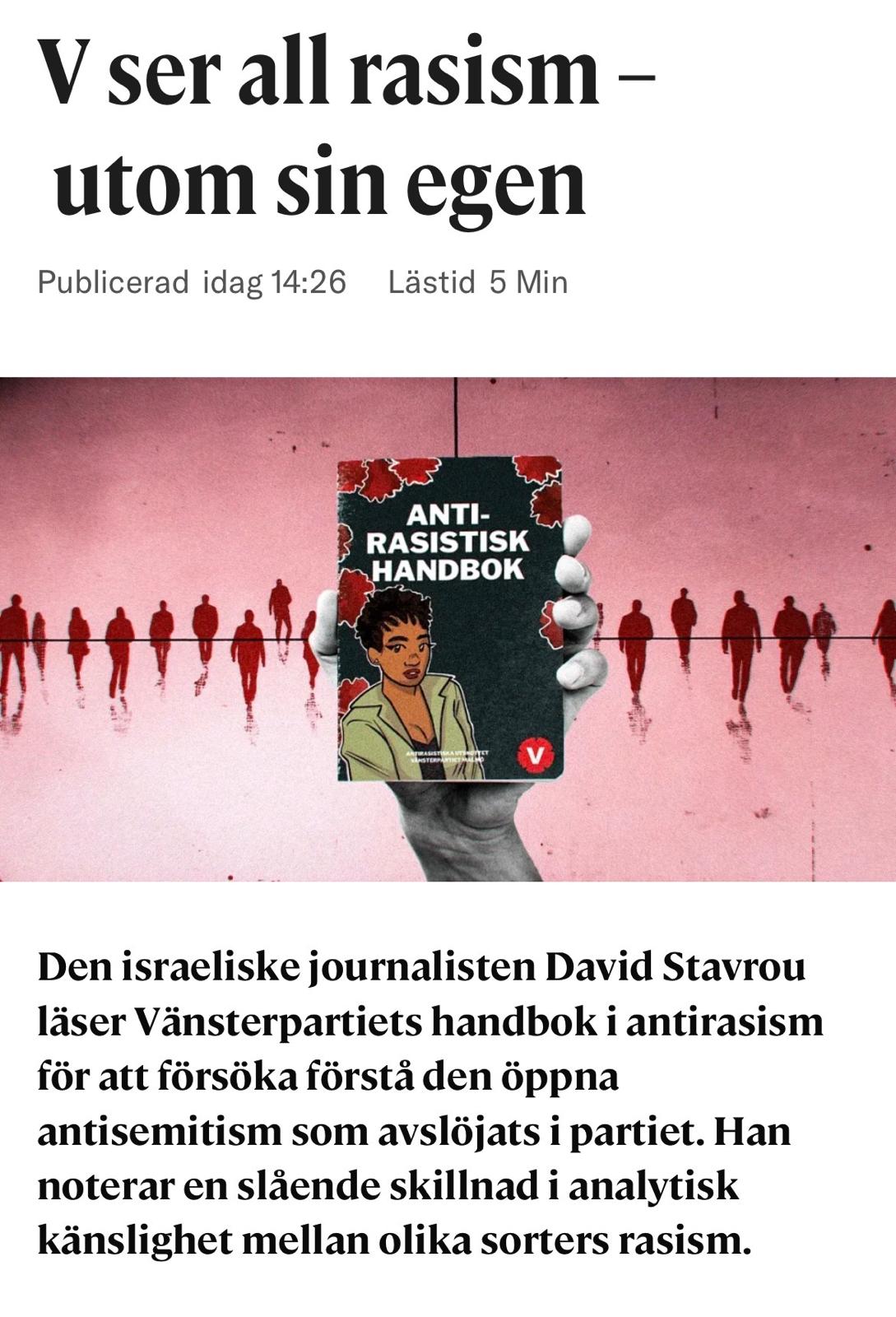
The Left Party Sees All Racism — Except Its Own

In light of Ina Hamdan's widely discussed revelations about members of Sweden's Left Party (Vänsterpartiet) who have expressed support for violent organizations or spread antisemitic propaganda, there is reason to revisit an interesting publication that the Malmö branch of the Party released in 2023 under the title Anti-Racist Handbook.

Published in Kvartal: V ser all rasism – utom sin egen – Kvartal

Vänsterpartiet's Anti-Racist Handbook is a strange document to read in light of current Swedish discourse. On the one hand, it's an ambitious text about how racism and discrimination should be fought. The reader learns about structural racism and intersectionality, Islamophobia and Afrophobia, colonialism and gender power structures and there's an almost academic overview of the various manifestations of racism in Swedish society. In light of this, the book argues that the party should actively recruit "non-white comrades," and proposes a range of symbolic, political and educational measures to combat racism.

On the other hand, there is very little about Islamism and contemporary antisemitism. This is interesting because it may be the key to understanding why people who devote their lives to "anti-racist politics" sometimes end up supporting violent, genocidal and fundamentalist movements such as Hamas and Hezbollah, while spreading propaganda against Jews and their national movement.

The point is the striking difference in how much nuance, complexity and analytical sensitivity the leaders of the Swedish Left Party in Malmö are willing to apply to different social phenomena.

When it comes to racism against Black people, the handbook explains how racism has changed form and modernized. Although African Americans are no longer sold from from one cotton plantation to another and are no longer viewed as people with smaller brains, racism still exists. In Sweden, the handbook explains, there is Afrophobia, manifested through hostility and hate crimes, insults and discrimination, exclusion and structural inequalities resulting from "norms of whiteness" and ideas of white supremacy.

But when it comes to antisemitism, the analysis seems to stop in history.

In the past, Jews were portrayed as the killers of Jesus, as people who kidnapped Christian children and used their blood, or those who started revolutions. The result was pogroms, state violence and discrimination. Twentieth-century antisemitism instead revolved around ideas of Jewish control over governments, the media and financial systems. The result was the Holocaust.

Antisemitism after the Second World War is different, and it is certainly about more than merely "racism against Jews." Christer Mattsson, one of Sweden's leading scholars of antisemitism and violent extremism, describes contemporary antisemitism as an "Israelized antisemitism," in which traditional anti-Jewish stereotypes are no longer expressed directly about "Jews" but are instead projected onto "Israel" or "Zionists."

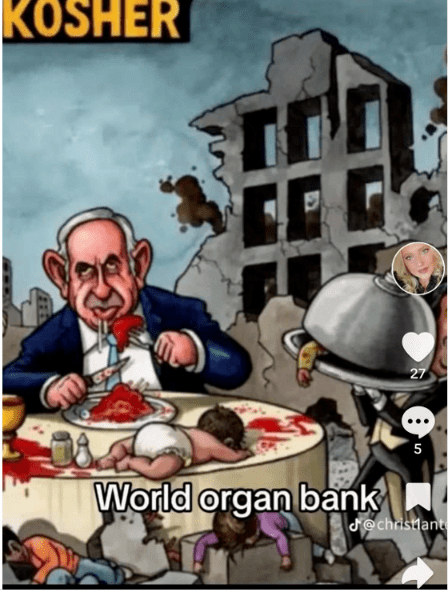
Thousands of people in the streets of Stockholm shout "No Zionists on our streets" on a weekly basis. This is just a new version of "Jews Out!". Their demonstration "street theatre" also portrays Israelis as bloodthirsty creatures who drink the blood of dead infants, or as people who secretly control governments.

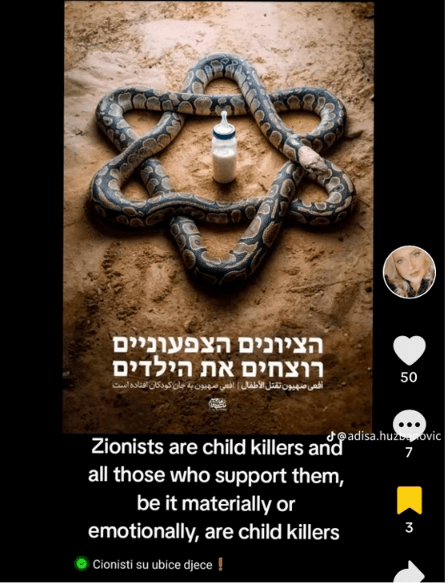
Recently we've also witnessed court cases of Swedish so-called pro-Palestinians who have spread messages on social media destorting the Holocaust and presented images of snakes and hyenas adorned with Stars of David killing Palestinian children. Their defence strategy, which actually convinced the court, was that the Star of David represent the Zionist flag rather than rabbis and synagogues.

This is where the handbook's blind spot becomes visible, and the results are obvious.

At the end of the Left Party's handbook there are quotations from representatives of the Party that reveal the same pattern: extreme sensitivity toward every conceivable form of discrimination on the one hand, and total blindness to extremism and racism when it comes to Jews and Israel on the other.

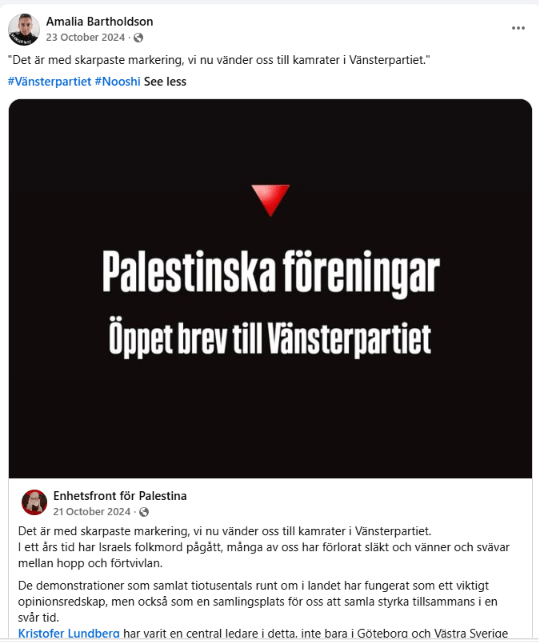
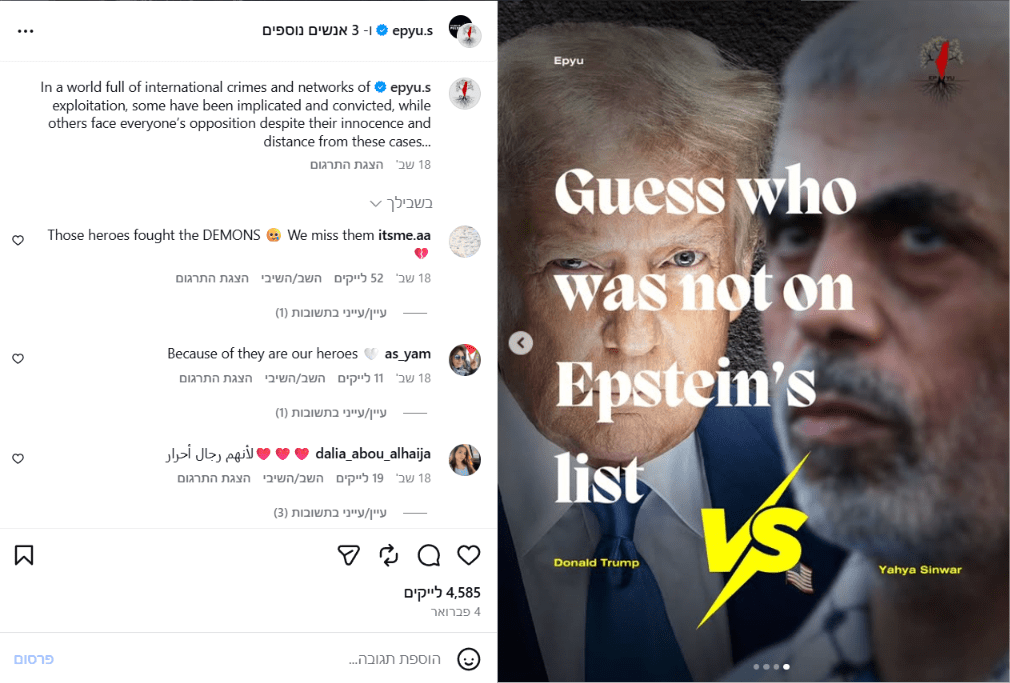
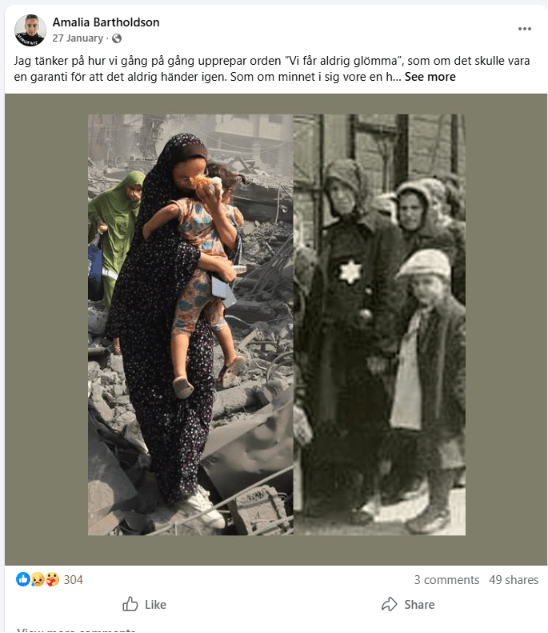
For example, Amelia Bartholdson wrote in the handbook that combating racism requires "awareness, humility and self-awareness." Yet after October 7 she shared a video accusing her own party secretary of being a Zionist because he did not regard October 7 as a legitimate act of resistance (the post came from EPYU, an organization that spreads conspiracy theories and blood libels). She also shared an open letter decorated with a red triangle (known as a Hamas propaganda symbol) supporting Kristofer Lundberg, a well-known supporter of the PFLP, one of the organizations organizations behind the October 7 massacre. Truly a fine display of awareness, humility and self-awareness.

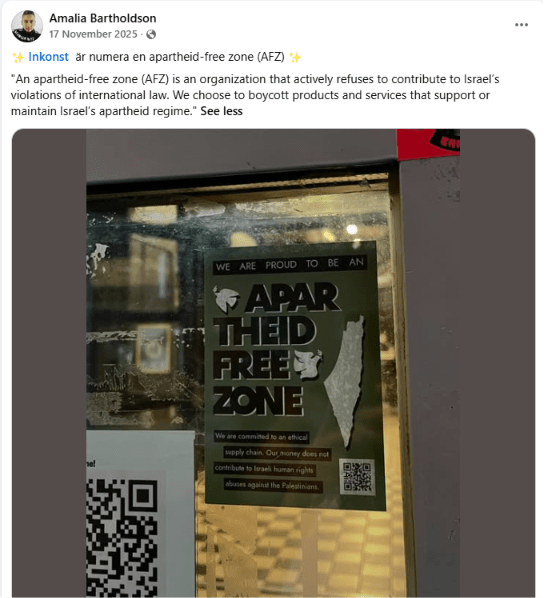
In other posts, Bartholdson compared the situation in Gaza to the Holocaust and supported boycotts and so-called "apartheid-free zones." This is an interesting point, because many of those quoted in the handbook support boycotts that are not directed at products from the West Bank or at far-right Netanyahu supporters, but essentially at anything connected to Israel. It is a bit like boycotting Bruce Springsteen or Beyoncé because of U.S. immigration policy. In an American context that would seem absurd, but when it comes to Israel everyone is lumped together. How does that fit with Sabrin Omar Högelius's statement in the handbook that people should be able to "simply exist, without having to defend their origins"?

"Anti-racism should permeate the party's politics and practice and build broad alliances with civil society," Anders Neergaard wrote in the handbook. Last week he was scheduled to lead a seminar celebrating an intifada (a term that in political contexts clearly implies violence against Israeli and Jewish targets). The other seminar leader was Orwa Kadoura, who was also quoted in the 2023 handbook condemning "racist behaviors, structures and organizations," yet in recent years he has repeatedly shared antisemitic and pro-Hamas material.

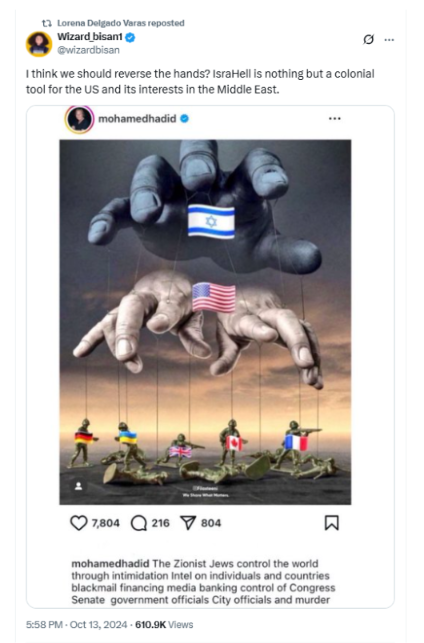
Another prominent former Left Party member quoted in the handbook is Lorena Delgado Varas. "Western anti-racism goes hand in hand with feminism and socialism," she wrote. A few years later, as is well known, there the "hand in hand" had an entirely different meaning as Delgado Varas shared an image on X showing a hand with the Israeli flag controlling a hand with the American flag, which in turn controlled soldiers carrying the flags of various other countries, accompanied by a text claiming that "Zionist Jews control the world" through threats, blackmail, the media, banks and control over the U.S. Congress, Senate and government.

These examples do not even include the individuals Inas Hamdan wrote about in Expressen, because the party's antisemitism problem extends far beyond 25, 50 or even 100 people. The most important lesson of the Anti-Racist Handbook is not what it says about racism, but what it does not say.

It's not about hating Jews. It is about a worldview that blames one people, one movement and one country for all the world's evils and fails to understand what contemporary antisemitism is. Or perhaps understands it perfectly well, but chooses to exploit it in order to win votes.

Sailing with Fanatics

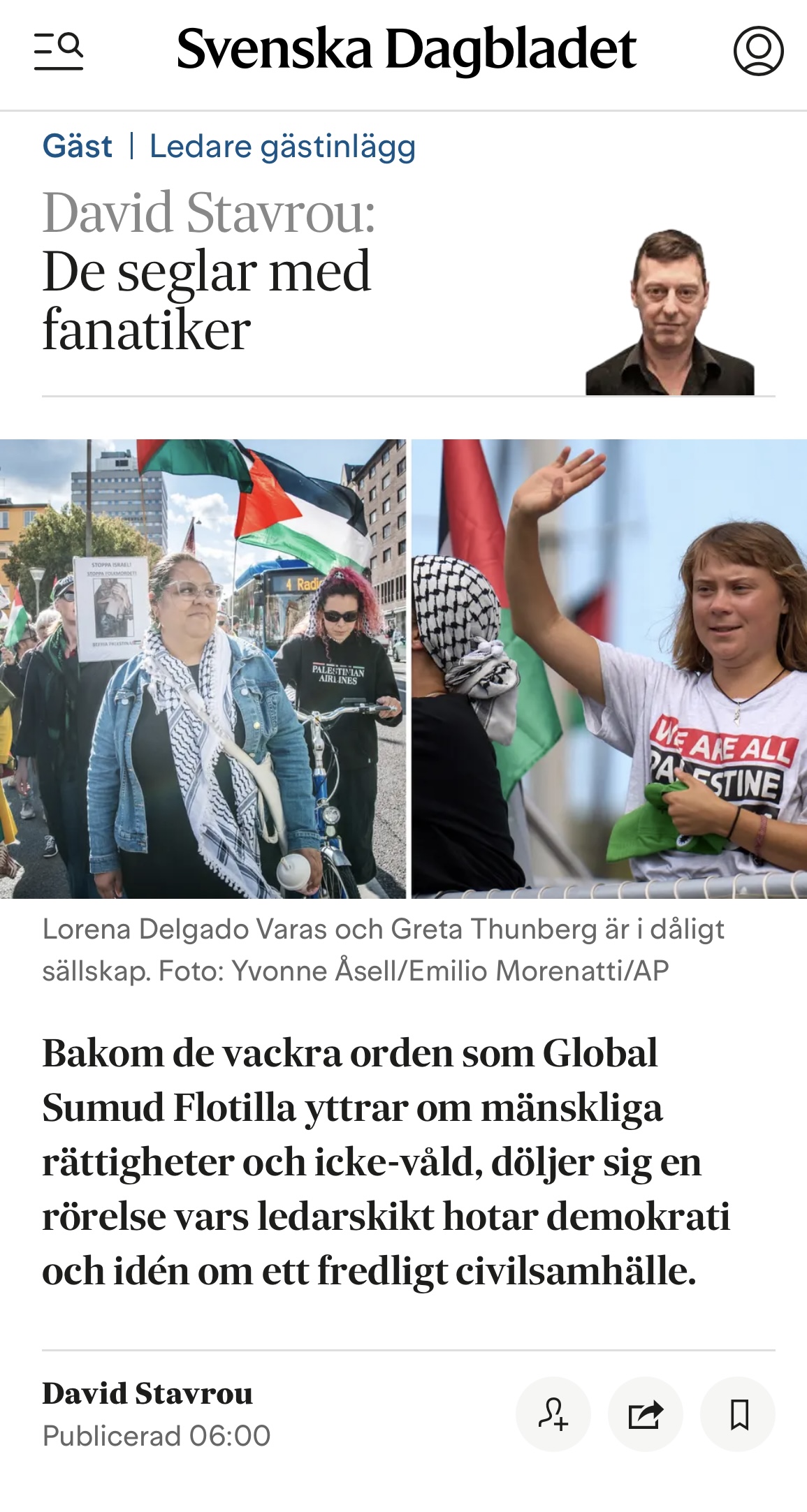
As Swedish Member of Parliament Lorena Delgado Varas and activist Greta Thunberg make their way to Gaza as part of the so-called Global Sumud Flotilla (GSF), many Swedes assume that their intentions are good. However, the reality behind the movement they are actively supporting is as far as can be imagined from humanitarian, non-violent, peaceful activism.

Published in Swedish daily Svenska Dagbladet:
https://www.svd.se/a/lw6anA/lorena-delgado-varas-och-greta-thunberg-seglar-i-daligt-sallskap

The images of destruction and suffering from Gaza, combined with statements published by the flotilla's organizers, have created an image of brave and kind-hearted activists, willing to pay a heavy personal price to deliver humanitarian aid and draw the world’s attention to Gaza. On its website, GSF describes itself as “a coalition of everyday people – organizers, humanitarians, doctors, artists, clergy, lawyers, and seafarers – who believe in human dignity and the power of nonviolence.” They also emphasize that their loyalty lies with “justice, freedom, and the sanctity of human life.”

But the reality behind GSF is far removed from the idealistic image presented to the public.

Screenshot

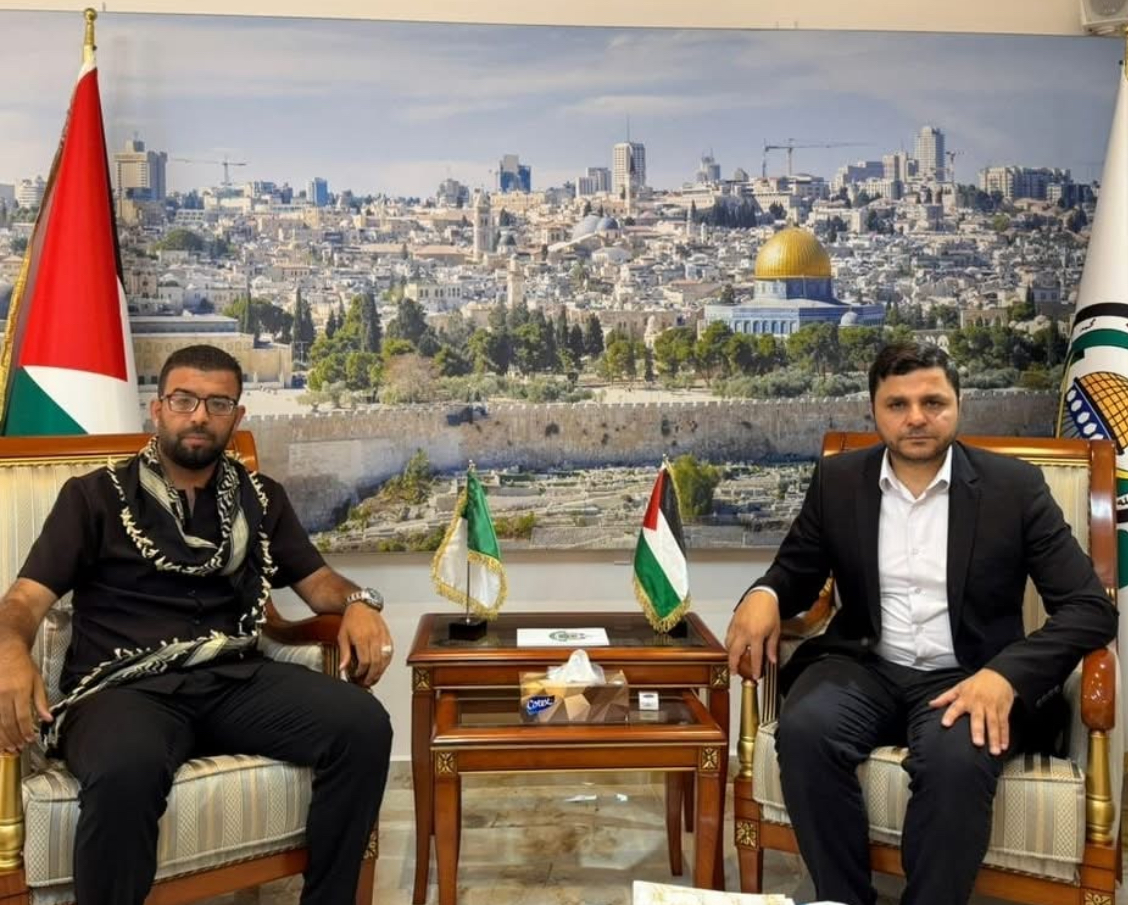
Less than three months ago, a meeting took place at Hamas’ headquarters in Algeria. Participants included representatives of the Global Sumud Flotilla and leaders of the movements that murdered, raped, tortured, and burned hundreds of Israeli civilians on October 7th – and many more before that. Among those present were Youssef Hamdan, Hamas' representative in Algeria, and Nader al-Qaisi, a representative of the Popular Front for the Liberation of Palestine (PFLP). This was no secret meeting. Despite the continued portrayal of the flotilla by Swedish media as a peace initiative with humanitarian aims, publicly available material reveals concrete links between GSF and some of the world’s most notorious terrorist organizations. All it takes to uncover these connections is a basic knowledge of Arabic and a quick search through social media.

In one photo published by Nabil Chennoufi, a spokesperson for GSF who frequently shares extremist violent propaganda on social media, two members of the flotilla’s steering committee – Wael Nawar and Hayfa Mansouri – can be seen smiling and wearing keffiyehs with Hamas symbols, alongside leaders of the terrorist organization in Algeria. The caption says the meeting focused on the flotilla’s progress, its positive impact, and its connection to the "Palestinian resistance." In a second photo, a third steering committee member, Marouan Ben Guettaia, is seen meeting with Hamas leader Hamdan.

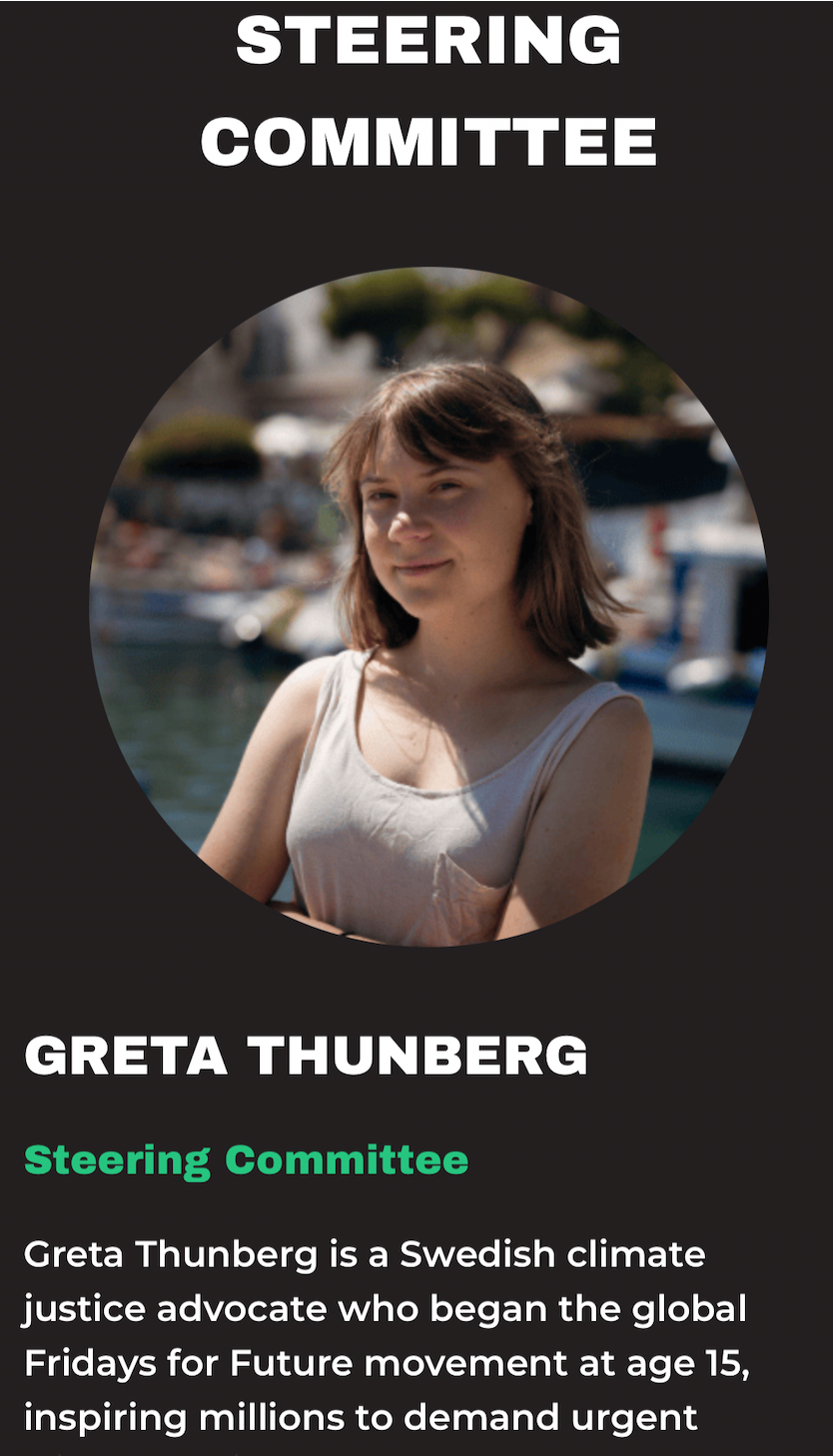
It’s important to stress that Greta Thunberg is not merely a regular passenger on one of the flotilla’s boats. GSF’s own website showed her as a member of the steering committee, alongside the aforementioned individuals. For some reason, her name and picture suddenly disappeared last Thursday.

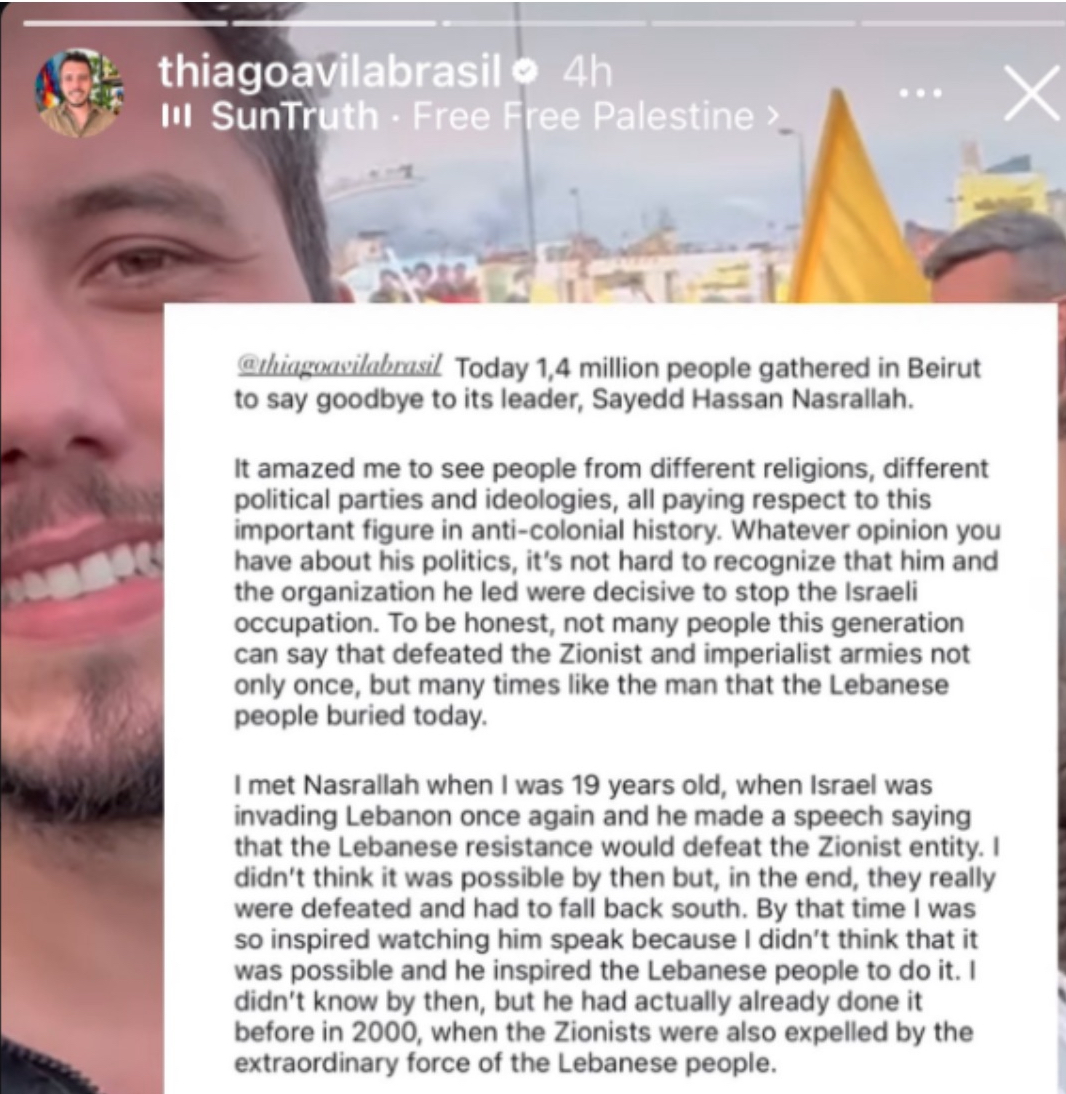
Another committee member is Brazilian activist Thiago Ávila, who has openly expressed his admiration for the late Hezbollah leader Hassan Nasrallah. On social media, Ávila shared how he was inspired as a young man after meeting Nasrallah and described him as “an important anti-colonial figure who defeated Zionist and imperialist armies multiple times.” Earlier this year, Ávila attended Nasrallah’s funeral in Beirut – a massive demonstration attended by tens of thousands of people chanting “Death to Israel” and “Death to America.” Ávila was impressed, writing: “Today I saw thousands of new freedom fighters.”

As a reminder, it’s worth noting that Hezbollah is a militant Shia Muslim organization allied with Iran, Russia, North Korea, and Shia militias in Iraq. It is designated as a terrorist organization by the United States, the United Kingdom, and the European Union, and is responsible for numerous terror attacks and kidnappings around the world – financed by Iran’s Islamist regime and the narcotics trade.

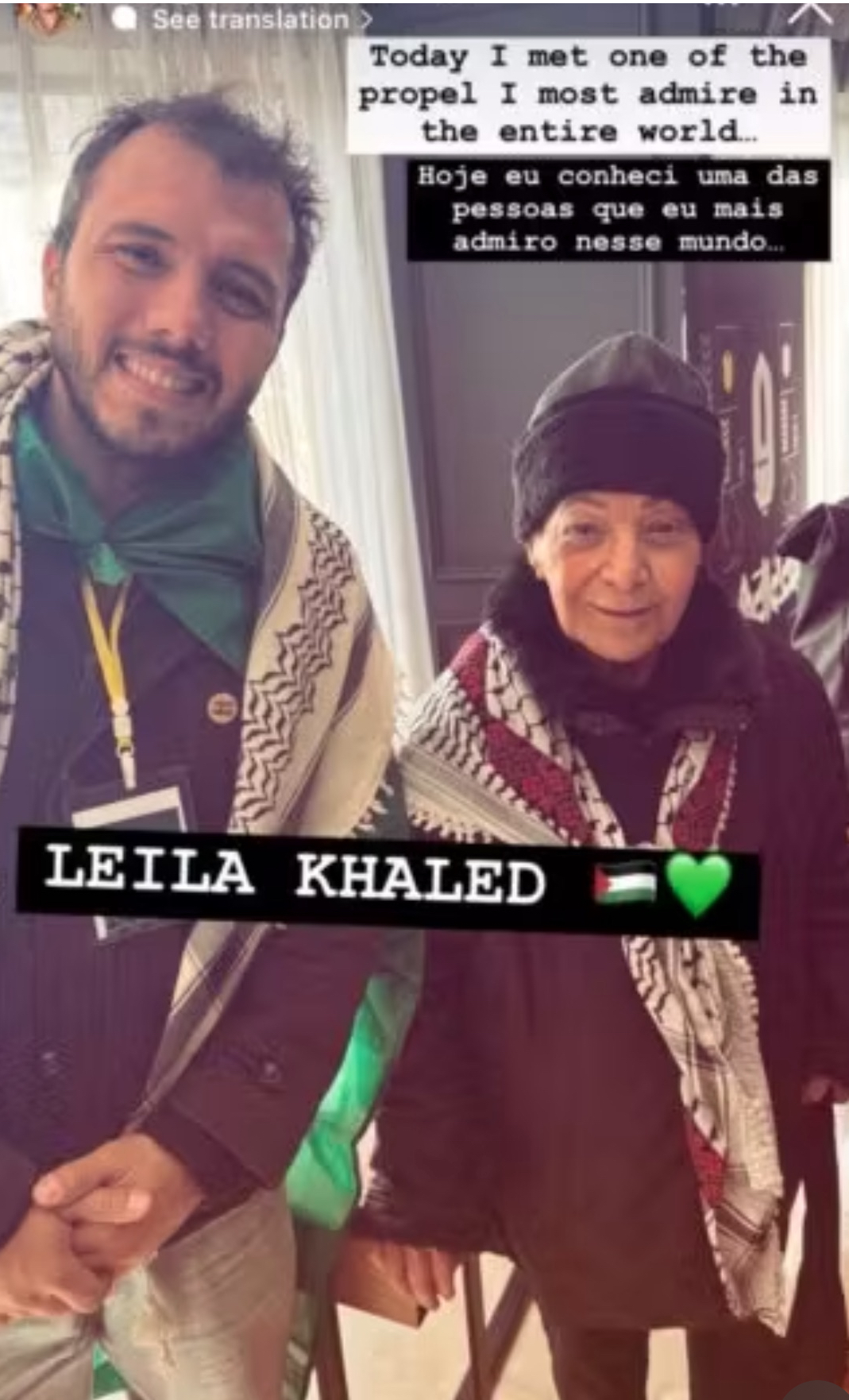
But it seems Ávila is not loyal to only one terrorist organization. In a photo, he is seen posing next to convicted PFLP terrorist Leila Khaled, with a green heart emoji and a Palestinian flag. The caption reads: “Today I met one of the people I admire most in the entire world.” Khaled’s notoriety, it should be remembered, is not based on “human dignity and the power of nonviolent action,” but on her involvement in the hijackings of TWA Flight 840 and El Al Flight 219 in the late 1960s and early 1970s.

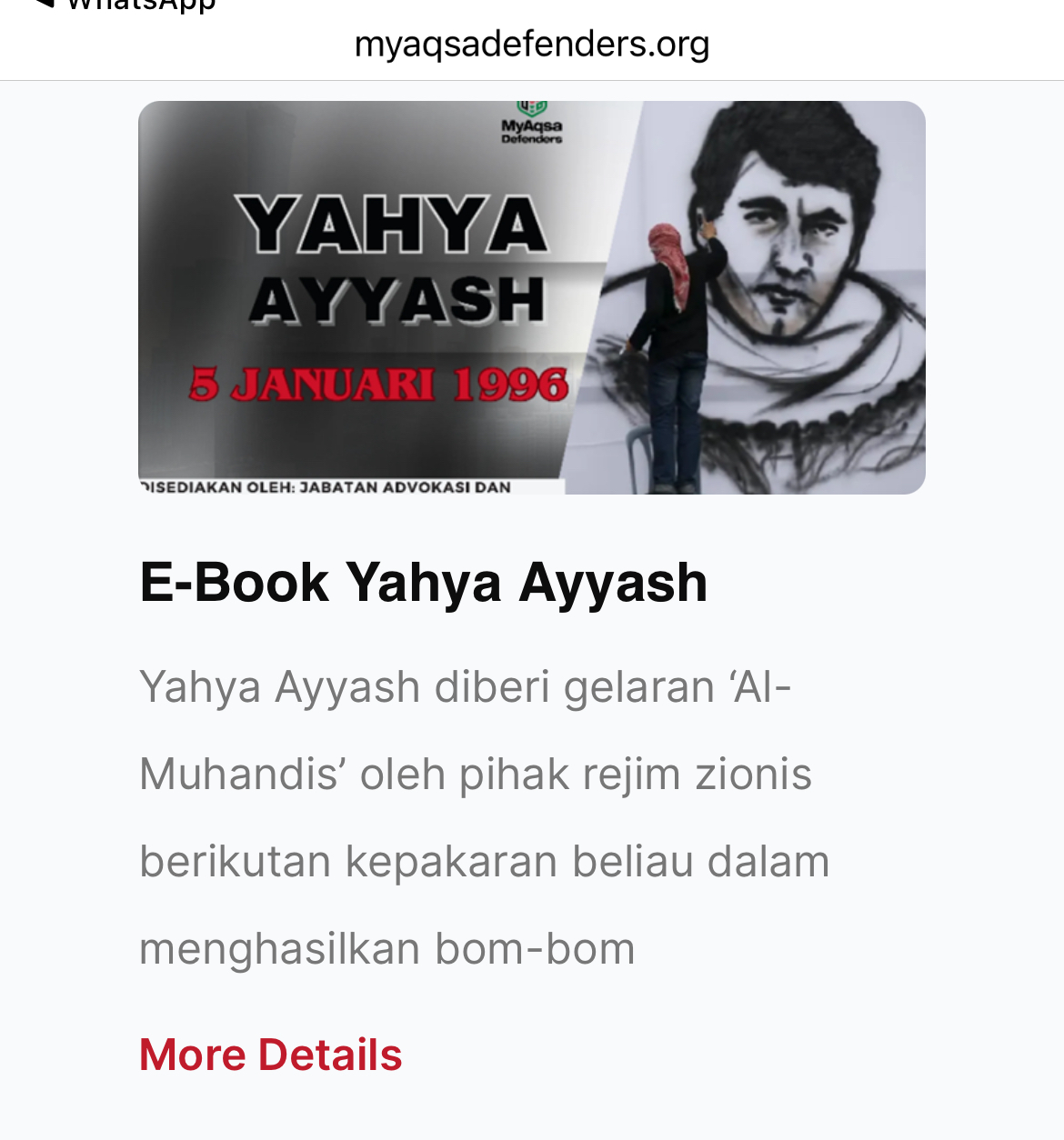
Another member of the GSF steering committee is Muhammad Nadir Al-Nuri Kamaruzaman, head of the GSF Southeast Asia coalition. He is also the founder of the Malaysian organization MyAqsa Defenders and CEO of the NGO Cinta Gaza Malaysia. Both organizations have expressed support for Hamas and have been linked to financing Hamas-run infrastructure in Gaza. Among other things, Cinta Gaza has published an e-book glorifying Yahya Ayyash, known as Hamas’s top bombmaker and responsible for numerous mass-casualty attacks in Israel during the 1990s. MyAqsa Defenders has also hosted a livestream event with Muslim Imran, whose name has appeared on Hamas channels as an official Hamas spokesperson.

Despite this information being openly and proudly published by those involved, neither Greta Thunberg nor Lorena Delgado Varas have been publicly questioned in Sweden for their participation in what clearly appears to be a well-organized, international operation with strong ties to terrorist groups. Sure – as citizens of a democratic country, they have every right to take part in whatever Mediterranean adventures they choose. But when those journeys are part of a network led by individuals with proven links to organizations responsible for massacres of civilians, there is a responsibility to investigate, question, and report.

It seems that behind the flowery rhetoric about human rights, humanitarian aid, and nonviolence hides a movement whose leadership praises antisemitic, religiously fanatical, chauvinistic, and ultranationalist violent actors. By participating in this initiative, Thunberg and Delgado Varas help legitimize forces that threaten democracy, gender equality, freedom of expression, and the very idea of a peaceful civil society. Despite their public image as champions of justice and solidarity, the facts suggest something quite different — in reality, Thunberg and Delgado Varas are supporting right-wing extremists.