She Grew Up in an Exiled Iranian Opposition Group, That Turned Into a Brutal Cult

Atefeh Sebdani was born in Iran to parents active in the MEK but was torn from them and sent for molding to a family in Sweden. In an interview, she describes life in the exiled cult and its rejection of Persian culture.

Published in Haaretz: She Grew Up in an Exiled Iranian Opposition Group, That Turned Into a Brutal Cult – Middle East News

At a protest in Stockholm in April, alongside the Lion and Sun flags representing pre-revolution Iran, Israeli and American flags were also waved. As in similar events around the world, the demonstrators praised the Israeli-American attack on Iran and expressed support for Reza Pahlavi, son of the shah who was deposed in 1979, as Iran's future leader.

The rule of the ayatollahs unites many Iranian exiles against the regime, and threatens political activists operating against it in Europe. However, one of the women who helps the organizers of the Stockholm demonstrations, Atefeh Sebdani, has suffered for most of her life from another Iranian group – an organization that was once part of the Islamic Revolution but later became its enemy.

Mujahedin-e Khalq was founded in 1965 by a group of Iranian students who opposed the shah's rule. The organization combined elements of Shiite Islam with Marxist and anti-imperialist ideas and operated underground during the 1970s. During this period, it attacked regime targets and gained support as an opposition organization.

When the Islamic Revolution emerged in the late 1970s, MEK even joined Khomeini on his path to power. Yet after the establishment of the Islamic Republic, conflict arose between it and the new regime and by the early 1980s, the MEK was attacking government targets. That was countered with brutal repression that included the execution of thousands. The MEK leadership fled into exile in Iraq, where it formed a controversial alliance with Saddam Hussein during the Iran-Iraq War.
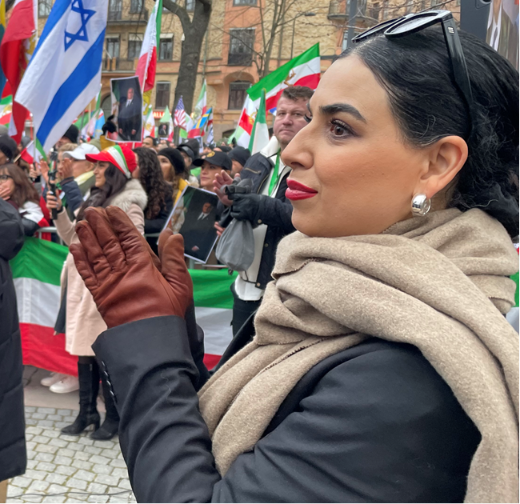
Atefeh Sebdani in Stockholm, 2026. Photo: David Stavrou

Atefeh Sebdani's story begins in the clash between the ayatollahs' regime and the MEK. "My parents were imprisoned after the revolution because of their rivalry with the new regime. They were considered enemies of the state and like other MEK members, after they were released, they were forced to leave," she says.

She was two years old at the time. Sebdani recounts that she, her younger brother, her father and her pregnant mother fled to Pakistan and lived there destitute on the streets. Her father continued from Pakistan onto Iraq, where he joined other MEK members in a camp called Ashraf, which later became the movement's center.

"After some time, we also moved to the camp. By that stage it had become a kind of small town with kindergartens, parks, and schools – mainly for propaganda purposes. They wanted to show how good things were there so others would join," she says. "For me, it was like paradise. I had everything; it was idyllic. I was with my mother and I was happy."

Then, without warning, everything ended at once. She hadn't even turned five yet but her mother told her she would have to take care of her two brothers by herself. She didn't explain why or how, but when the day came, Sebdani found herself standing by a bus with a group of crying women. When the bus departed, five-year-old Sebdani became a mother in practice.

"On the way, I had to take care of one brother who was still a baby and wanted to breastfeed, and another who was very ill," she recalls. She adds that the expulsion of the children from Camp Ashraf was a process. She doesn't know exactly how long it took, but she remembers children disappearing from kindergarten without knowing why or where they were going.

Eventually, all the roughly 900 children in the camp were separated from their parents and transported to other countries.

"The place was emptied of children's voices," she says. "And children's voices are the most human thing there is – the core of life – and that was taken away."

Why were the children expelled?

"The children were an element that disturbed the organization's leader, Massoud Rajavi. The ideological struggle to liberate Iran turned into the struggle of a narcissistic leader who wanted all the power in his hands. He wanted the men and women in the movement to be under his absolute control, and the children stood in his way. The movement began as an ideological movement, but it became a cult."

What Sebdani describes aligns with what is known from other sources about the MEK. During the 1980s and 1990s, the organization became highly centralized, developing political and military branches that operated from bases in Iraq. At the same time, the National Council of Resistance of Iran was established as a political umbrella organization.

'The family I came to was politically obligated to take children. It's not that they loved children or wanted us. We underwent heavy indoctrination and were forced to constantly work for the organization.'

During this period, allegations indeed emerged about cult-like characteristics such as strict internal discipline, ideological control, and exclusion of dissenters.

However, the organization's leader, Rajavi, has not been seen in public since the early 2000s, and his fate remains unclear, as the organization has not disclosed information about his whereabouts nor announced his death. Meanwhile, his wife, Maryam Rajavi, serves as the public face of the organization – contributing to an atmosphere of secrecy and uncertainty regarding its structure and decision-making.

After several months and a long journey that included stops in Jordan and Germany, Sebdani and her two younger brothers arrived in Gothenburg in western Sweden.

"For all that time, I was sure we would soon be reunited with my mother," she recalls. "We sat on planes and trains, I saw things I didn't know, I saw climates and people change, there were new languages and places – but alongside the excitement, I constantly feared we were moving further away from my mother and worried she wouldn't be able to find us."

In Gothenburg, they were told they would soon meet their mother. "I was very excited. But what actually happened was different – we stood on a train platform, and instead of my mother, two other people I didn't know arrived, a woman and a man, and we were told: these are your mother and father. That's when the nightmare began."
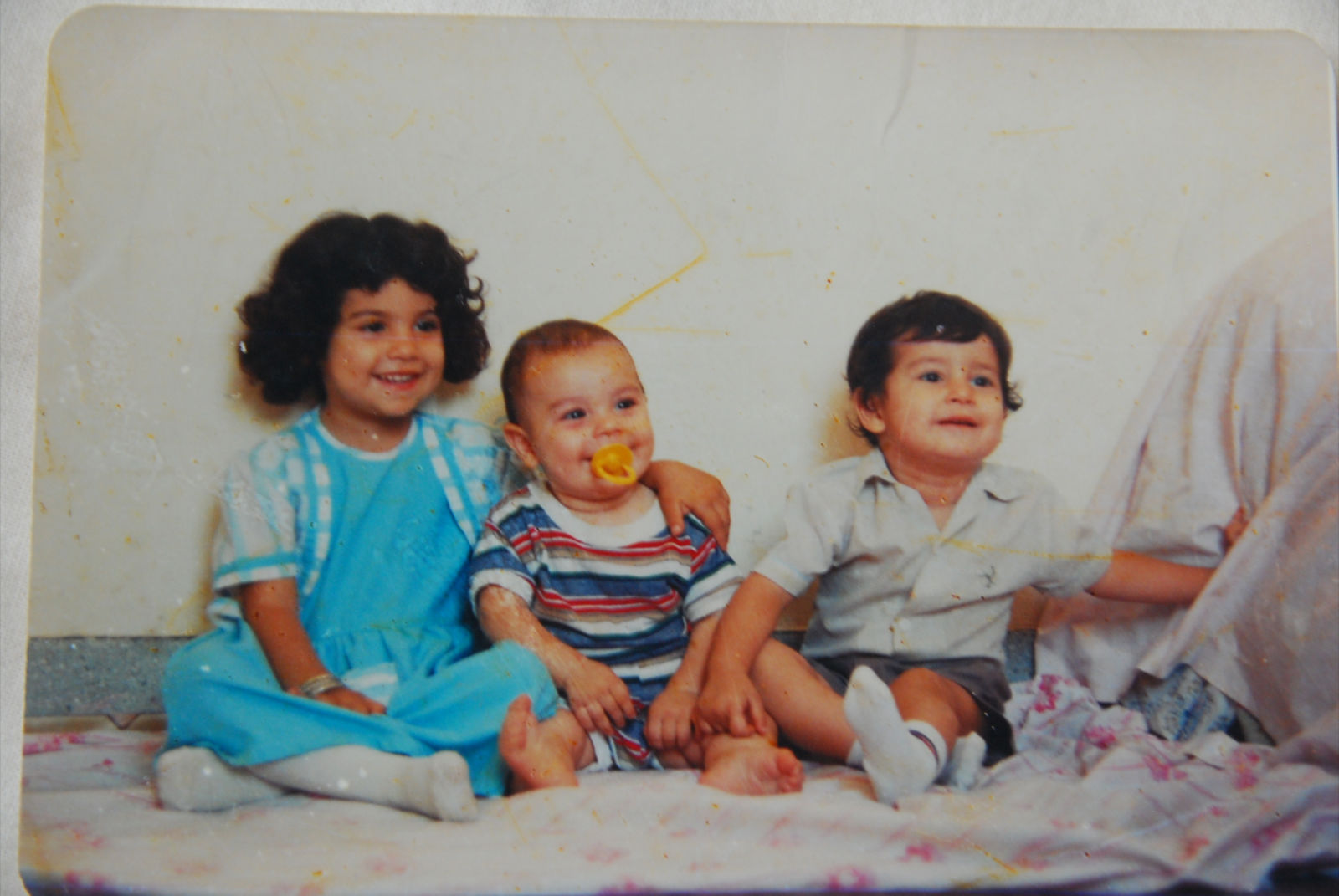
Atefeh and her two brothers

The people who took Sebdani and her brothers were MEK members living in Sweden and working for the movement. They also had a child of their own, and took in two other children out of roughly 200 MEK children who arrived in Sweden. Sebdani says she later traced the fate of hundreds of other children who were "exported" from Camp Ashraf and that she obtained a document listing their destinations – including Germany, the Netherlands, Norway, Canada, and the United States.

"The family I came to was politically obligated to take children," she says. "It's not that they loved children or wanted us. We underwent heavy indoctrination and were forced to constantly work for the organization." She does not reveal the identities of her foster parents, but her childhood memories expose the nature of the organization as it became a cult.

According to her, MEK families abroad were completely mobilized. They engaged in recruiting members and funds, organizing demonstrations, fighting opponents, and harassing defectors. She describes this society as oikophobic (one that is hostile, dislikes and rejects its own "home" culture, country and traditions). "They hated anything Iranian that wasn't related to the MEK. We weren't allowed, for example, to listen to Persian music unless it was the music of MEK members. I didn't read books in Persian. There was no Persian culture—everything was subordinated to the organization."

As far as you know, is this still the case?

"Yes. They still have offices in different countries and a strong presence on social media. The headquarters is in Auvers-sur-Oise, a suburb northwest of Paris, where political leadership members and full-time 'soldiers' are based. At the same time, there are activists like my foster family, and MEK members in Camp Ashraf 3 in Albania. That camp is essentially a 'troll factory' that produces large numbers of accounts and spreads propaganda in Persian and English. They write articles about themselves, smear their opponents, and create the impression of support – even though they have no real support."

Camp Ashraf 3 is the fortified camp to which most MEK members – estimated at 2,500 to 3,000 – were transferred from Iraq between 2013 and 2016. The move was carried out with the support of the United States, the United Nations, and the Albanian government. It took place because after the fall of Saddam Hussein, the MEK was no longer protected in Iraq, and international actors worked to evacuate them. Although the organization had been designated a terrorist organization in the U.S. for many years, it was removed from the list in 2012 as a result of pressure applied by the movement, and some American and other actors even saw it as a partner in opposing the Iranian regime. According to reports, the MEK no longer engages in military activity, but the camp in Albania has become a center of political and media activity with a highly centralized and controlled structure.

"It's a place where entry and exit are not free, and in the past there were physical punishments and torture of those who wanted to leave," says Sebdani. "I know stories of people who disappeared and of mandatory daily confessions about 'dirty thoughts' – for example, sexual thoughts and masturbation. You weren't even allowed to think about your children or speak with members of the opposite sex without permission. Today, with defectors speaking out and social media, the movement can no longer allow itself to use such methods."

Sebdani is not alone in her claims about the MEK. The French newspaper Le Monde conducted interviews in 2024 with former members of the organization living in Europe, including two named Amir Vafa and Amin Golmaryami. Vafa described how he and others were forced to participate in public confession sessions in which, once a week, everyone had to describe their sexual fantasies. He added that friendships were closely monitored: "It was forbidden to have lunch with the same friend twice in a row."

Golmaryami added that during clashes with Iraqi security forces in 2011, MEK leaders sent him and his comrades to go "in front of Iraqi bullets to increase the number of casualties." He claims they did this in order to "put pressure on Europe and the United States to remove the organization from the list of terrorist organizations and facilitate the relocation of its members to another country."

Another MEK member, Reza Torabi, said that at the age of 17 he was a zealous member and was assigned the role of "welcoming" young newcomers. "Our objective was to brainwash them, make them forget their previous lives, and instill in them the ideology of the Mujahedeen," he said. "My dedication was unwavering." In hindsight, he believes that he too fell victim to manipulation and regrets "the harm [he] caused in the course of his duties."

A 2005 report by Human Rights Watch, based on in-depth interviews with former members, also described a reality of beatings, verbal and psychological abuse, coerced confessions, threats of execution, and torture.

How do you believe control of MEK member is maintained today?

"If you look at people like the father, you see someone who joined in his twenties and spent his entire life inside this system. He never paid a bill or looked for a job – everything was handled by the organization. He doesn't know how to buy a plane ticket or even drive to the end of a street. The MEK infantilized these people, and there is no one to take care of them if they leave."

Does that mean there are no new members?

"That's right. There are no new members. It's a movement of older people – but they pay young people to attend demonstrations. If you go to MEK protests, you'll find Poles and Ukrainians who don't speak Persian and don't know what they're protesting about, alongside Swedes with no connection to the organization who were paid to join."

Who pays for all this?

"From what I saw and was part of, many people pay the MEK monthly so they won't harass them – Iranians in exile subjected to pressure, propaganda, flattery, and social coercion. There are also welfare funds, for example for foster families, as well as political donations and funding from human rights organizations influenced by the group's propaganda."

Beyond the political activity, the period that Sebdani stayed with her foster family, had another aspect. She talks about indoctrination and the constant threat that was used to make her stay.

"From the age of five, I experienced sexual abuse, physical abuse and psychological abuse in the foster family," she says, "but I couldn't say anything because they threatened to separate me from my brothers. I was not allowed to be a child. The first thing that happened to me in the foster family was that my father began to show interest in my naked body. He wanted me to do things. I felt it was wrong and frightening, but I knew nothing about sex or sexuality and I didn't understand.

"Over time, it only got worse, and my foster brother abused me too, encouraged by my foster mother. I had no childhood; it was just survival. I was the one who cleaned and tidied, I had to be a good student, and also the one who went out to demonstrations and went to Mujahideen conferences around the world". Talking to Sebdani she describes a reality full of exploitation, punishment, crying at night, and deception of Swedish welfare services.

As an adult, she eventually left, moved to Stockholm, became an engineer, and worked for Microsoft. After a personal crisis, she began telling her story and wrote a book (Min hand i min, "My Hand in Mine", published by Albert Bonniers förlag, 2024). Today she is married and has three children.

Politically, Sebdani is active among supporters of Reza Pahlavi. "I saw the difference between the two leaders," she says. "I met Maryam Rajavi as a child, and recently I met Pahlavi in Paris with a group of other former MEK children. I support the Iranian people, and the people support Pahlavi. He is exactly what Iran needs – a secular, humane person, with a family, who knows what living a normal life is, who listens and can unite people."

After Sebdani's meeting with Reza Pahlavi and other "MEK children" she became the target of an online campaign against her. Sebdani says that this isn't the first time and she has been targeted by a smear campaign led by the MEK on several previous occasions before.
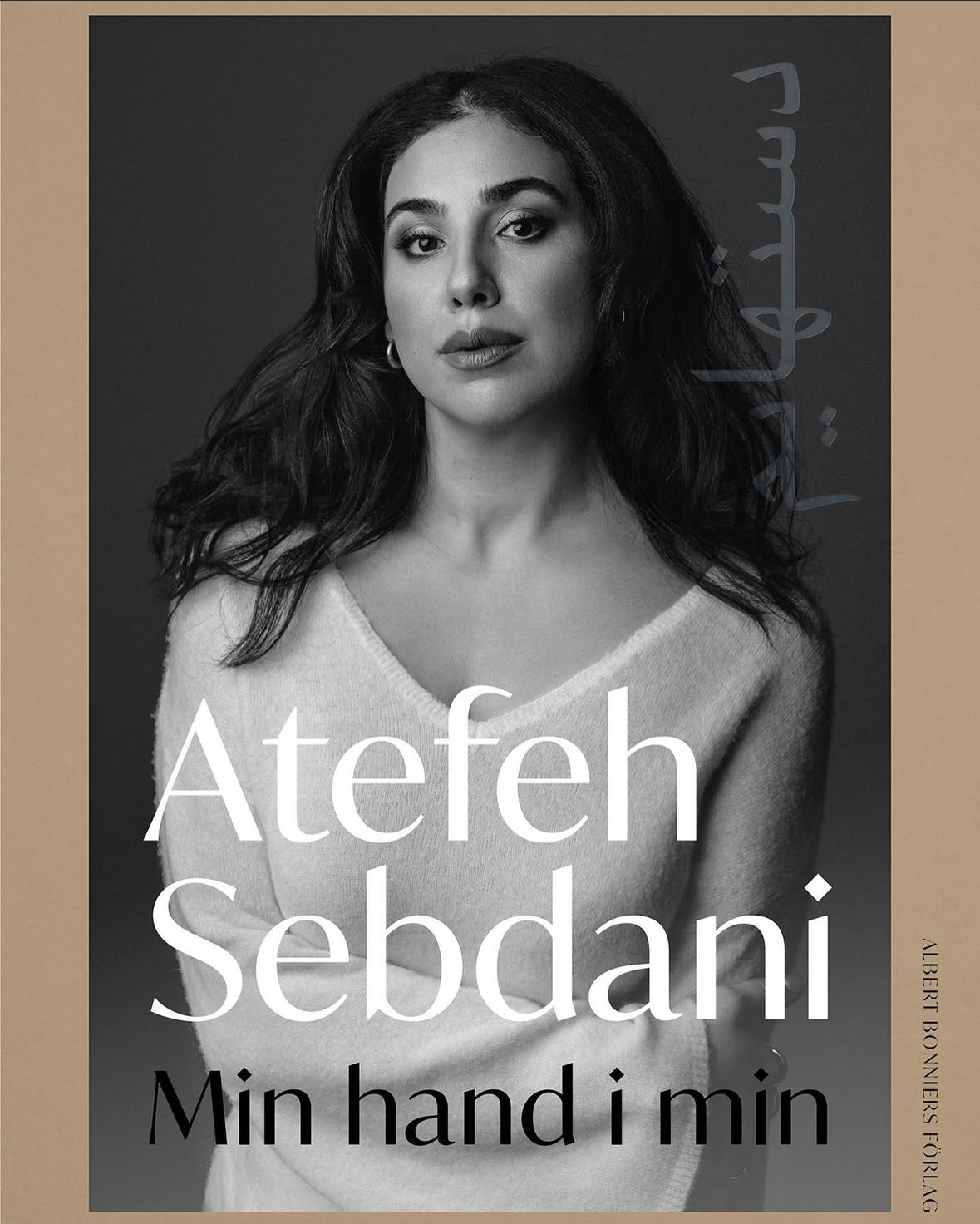
Sebdani's book

"This kind of harassment happens to everyone who has left the organization and spoken out," she says. This time, the MEK website denied Sebdani's account through a letter it claimed was written by her biological father. "For me, as a father, seeing 'Atefeh Sebdani' at a gathering of the Shah's son was painful… Atefeh is the same person who, by spreading defamation against the organization under the false pretext of being part of a group of 'child soldiers,' has for many years become a full servant of Iranian intelligence."

The text claims that Sebdani was never part of the MEK and accuses her and her associates of collaborating with the regime in Tehran. Sebdani does not know whether her father actually wrote the text, but she says that everything in it is false and that she is familiar with other examples of letters that MEK members were forced to write under coercion.

Following the letter, a senior figure in the organization, Freydoun Salimi, also spoke out, accusing Sebdani of never having been a member of the group and of acting as an agent of the regime. In responses to his claims on X, supporters of the organization repeat the accusations and insult Sebdani. On other social media platforms, she is also accused of assisting Israel, betraying Iran, and supporting Americans attacking her country.

Sebdani's personal MEK story has a positive ending – she escaped, her siblings left, and even her mother eventually left the organization. The organization itself, however, is still very much alive. It even claims to still have networks inside Iran, though most analysts believe its influence there is limited. "The MEK is more of a European problem than an Iranian one," Sebdani concludes. "In Iran, they have no real support, not even with regime critics. But after the 'Woman, Life, Freedom' protests, it's clear that a unifying leader is needed, otherwise, there will be no change – and I have no doubt that Pahlavi is the right person."
Sweden Fails to Protect its Jews From Incitement

We have spoken about hatred and threats for decades. Why is Sweden still unable to recognize them when it comes to Jews?
Published in Sweden in Svenska Dagbladet: Rättegång om hets mot judar missar målet | David Stavrou | SvD Ledare

In recent years, we have seen what hate propaganda, conspiracy theories, and dehumanizing rhetoric can lead to — especially when it concerns Jews.

A long series of arson attacks, stabbings, and shootings has made Jewish communities around the world increasingly vulnerable. In many cases, the perpetrators were influenced precisely by hate propaganda, conspiracy theories, antisemitic incitement, and Islamist ideology portraying Jews as legitimate targets of violence.

At the same time, two recent court cases in Sweden — one in Helsingborg and one in Gothenburg — concluded in a way that shows that Sweden is beginning to understand the importance of combating extremism, while still failing to fully understand it.

The Helsingborg case concerned charges of incitement against an ethnic group involving antisemitic publications on social media, Holocaust distortion, and conspiratorial content. The defendant was convicted on several counts, including Nazi salutes, publishing antisemitic images, and spreading theories like the one claiming that “4 out of 5 American slave owners were Jewish,” equating Jews with rats, and portraying Jews as a satanic force controlling the world.

At the same time, the man was acquitted on certain counts related to Holocaust distortion — a newer component of Sweden’s incitement legislation. The prosecutor argued that the man’s statements formed part of a broader antisemitic conspiracy narrative involving references to the Illuminati and Freemasons. But the district court was not convinced. During the questioning of Christer Mattsson, an expert on violent extremism and antisemitism and director of the Segerstedt Institute, the defense demanded answers to questions about the number of people cremated in Belzec, Treblinka, and Sobibor, and discussed the extent to which the Israeli government does or does not “weaponize antisemitism”.
Despite Mattsson’s clear answers, and instead of the court telling the defense attorney to stop wasting time on historical revisionism, the result was an acquittal. The defendant’s statements claiming that it would have been impossible to “dispose of 6 million bodies in the ovens,” and the publication of a video describing the figure six million as false, were not considered contrary to generally accepted historical facts and were not considered serious Holocaust distortion.

The problem with the verdict is that the court failed to see the forest for the trees, and the broader antisemitic context disappeared as the court got lost in details. No one has ever claimed that six million bodies were burned or that six million is an exact number. Six million is a widely accepted estimate, supported by millions of confirmed victim names, as well as Nazi documentation, demographic studies, transport records, camp archives, postwar investigations, eyewitness testimony, and forensic evidence.

No serious historian has argued that limited crematorium capacity would suggest exaggerated death tolls or inconsistencies in the history of the Holocaust. The entire debate is absurd. Anyone who has studied this kind of rhetoric knows that Holocaust denial and Holocaust distortion — referred to in academic literature as Holocaust distortion — are very rarely expressed by claiming that the Holocaust never happened. It is usually about relativization, contextualization, and minimization.

This kind of denial is not merely a lie about the past — it is a precondition for genocide: minimizing, justifying, or erasing the crimes and thereby continuing the dehumanization of the victims while obstructing historical accountability and remembrance. In this case, it is not only an insult — it is a call to renew the violence.

In the Gothenburg trial, a woman was acquitted on Wednesday after being charged with incitement against an ethnic group. The images she published online contained classic antisemitic symbols: a snake with a Star of David on its head and large fangs about to attack a naked child; a snake shaped like a Star of David wrapped around a baby bottle with text describing Zionists as child murderers; and an image depicting a hyena eating a child while staring at another child hiding nearby wearing a Palestinian flag on its shirt. The hyena wears a kippah with a Star of David on it.

During police questioning, the woman claimed she had nothing against Jews. “It is Zionists I am speaking against, and what is happening in Gaza is horrific. Seeing children slaughtered every day,” she said.

Christer Mattsson, who also testified in this case, explained that research has long established that snakes and the killing of children are common antisemitic symbols. Anti-Zionism, he explained, becomes antisemitism when it adopts antisemitic stereotypes, conspiracy theories, and so-called antisemitic tropes, such as the notion that evil Jews control global media and governments. Mattsson explained that in this form of “Israelized antisemitism,” “Zionists” assume the role historically assigned to Jews in classic antisemitic ideology and are portrayed as uniquely evil, manipulative, powerful, and conspiratorial.

Despite this, the court missed the point. The fact that a message is critical of Israel does not exclude the possibility that it is simultaneously antisemitic. The Star of David, the snakes, the conspiracies, and the innocent dead children should have been enough. It seems Swedish courts will not act until someone explicitly says, “I really hate Jews and now I’m going to kill a few,” or “Auschwitz is a fictional place.”

But that is not what antisemitism sounds like today. To minimize and distort the Holocaust and spread hatred against the legitimate national movement of the Jewish people is not an exercise in free speech — it is spreading hatred and encouraging violence in disguise.

Things should be called by their proper names, and words have consequences. History gives us many examples of this and they are often associated with specific names – Capital Jewish Museum in Washington DC, the Tree of Life – Or L’Simcha Synagogue in Pittsburgh, Bondi Beach in Sydney, the Krystalgade Synagogue in Copenhagen, the Hypercacher supermarket in Paris, the Jewish Museum in Brussels, Heaton Park Synagogue in Manchester, the Halle Synagogue in Germany, Chabad of Poway Synagogue in California, Golders Green Road in London, the Ozar Hatorah School in Toulouse, and the El Ghriba Synagogue in Tunisia.

All of these acts began with words.

We have spoken about hatred and threats for decades. Why is the state still unable to recognize them when it comes to Jews?

Spreading Light in the Darkness: Swedish Leaders Wear Kippot in Solidarity March With Jewish Community

Prime Minister Ulf Kristersson and opposition leader Magdalena Andersson were among those marching in Stockholm against antisemitism on Wednesday. 'All leaders bear a responsibility to draw a line against hate,' says premier

Published in Haaretz: https://www.haaretz.com/jewish/2023-12-07/ty-article/.premium/spreading-light-swedish-leaders-wear-kippot-in-solidarity-march-with-jewish-community/0000018c-4488-db23-ad9f-6cd8b6720000

STOCKHOLM – It was minus 12 degrees Celsius (10 degrees Fahrenheit) in the Swedish capital on Wednesday afternoon. Raoul Wallenberg Square, named for the Swedish diplomat who saved tens of thousands of Hungarian Jews during the Holocaust, was covered with both snow and security personnel. The tightened security was not just because of the country's high terror alert, but also due to an unusual gathering taking place there at 1 P.M.

Swedish Prime Minister Ulf Kristersson was at the heart of it all, accompanied by senior members of his government, opposition leader Magdalena Andersson, and the heads of most other opposition parties. In fact, apart from the far-right Sweden Democrats, every single party in the Swedish Parliament showed up for this unique event, coalescing together around the same agenda.

That in itself is unusual, but there was an especially rare element to this gathering: the male politicians were all wearing kippot.

The event, an initiative of the Swedish Parliament's Network Against Antisemitism and the Council of Swedish-Jewish Communities, was dubbed a "kippa march." Politicians, Jewish leaders and several hundred marchers placed the kippot atop their heads and walked through central Stockholm, in order to show solidarity with Sweden's small Jewish community and take a stand against antisemitism.

"The Jewish holiday of Hanukkah begins [on Thursday], and it's about spreading light in the darkness," said Magnus Manhammar, who represents the Social Democratic Party and the Network Against Antisemitism. "Sweden and the world need less polarization and fewer harsh words," he added.

As politicians and participants walked past the Royal Opera House and Royal Palace, they attracted both media and public attention. They then arrived at their destination: Parliament House, where they listened to speeches by PM Kristersson, opposition leader Andersson and others.

Israel's Sweden ambassador, Ziv Nevo Kulman, was there as well, alongside the leadership of many Swedish-Jewish institutions and organizations.

"We are here today to show our support for Sweden's Jews. The right to express one's faith, identity, culture and relations is fundamental in a democracy like ours," Kristersson said. "The government and I will never accept the development we have seen both in Europe and in Sweden since the terrorist attack on October 7 [in southern Israel]. No Jew in Sweden should have to ask himself or herself whether he or she dares to stay in their own country."

Since the Israel-Hamas war began, Kristersson has made numerous statements in support of both Israel and Sweden's Jewish community. He told the parliament that in the context of the harsh, sometimes hostile, political debate about the war in Gaza, "it's legitimate to think differently about conflicts there, but not to spread antisemitism here."

Andersson, meanwhile, said that "in recent months, we have seen antisemitic slogans being chanted in the streets and squares. Spread online. More and more people with a Jewish background are affected. Anxiety spreads, insecurity grows. All leaders – political, religious, in civil society – bear a responsibility to draw a line against hate; to stand up for our way of life, in contrast to those who seek to divide."

She added that "because Jewish life in Sweden is as obvious as an inalienable part of our society, the fight against antisemitism in all its forms must be principled and vigorous. Support for Jewish life must be strong. And in this situation, continued measures against antisemitism, resources for security-enhancing measures and education about the Holocaust and antisemitism, are more important than ever."

From left to right: Center Party leader, Muharrem Demirok; Liberal Party leader, Johan Pehrson; Prime Minister, Ulf Kristersson; Oposition leader Magdalena Andersson; Left Party leader, Nooshi Dadgostar
Photo credit: Hugh Gordon

It's estimated that about 15,000 Jews live in Sweden, which has a population of just over 10 million (although there are probably many more Swedes who are Jewish by descent). The capital has the country's largest Jewish community, with other communities found in Malmö, Gothenburg and a couple of smaller towns.

Antisemitism is by no means a new phenomenon in Swedish society, and in recent years various governments have made concerted efforts to address it. Against the backdrop of the latest war in Gaza, though, media reports have indicated a sharp rise in the number of antisemitic incidents. These include bullying, threats and hate crimes in Swedish schools, antisemitic propaganda spread in universities, "pro-Palestinian" demonstrations featuring antisemitic slogans, and the spreading of antisemitic hate and conspiracy theories online.

"The truth is that antisemitism exists in several places in our society – among Islamists, right-wing extremists and left-wing extremists," said Aron Verständig, chairman of the Council of Swedish-Jewish Communities. "It's not possible to approach the problem by simply pointing out one group as solely responsible for Jew-hatred in society. It's gratifying, therefore, that leading politicians from so many different parties chose to cooperate on Wednesday. The fight against Jew-hatred is everyone's fight."

Far Right Rising, Russia, Electricity Prices and Climate Change: What to Know About Today's Swedish Election

With 1.3 million voters under the age of 30, these are the new leaders of the younger generation in Swedish politics

Published in "Haaretz": https://www.haaretz.com/world-news/europe/2022-09-11/ty-article-magazine/.highlight/far-right-rising-russia-and-greta-what-to-know-about-todays-swedish-election/00000183-2b80-d7b2-abdf-abf7add50000

As the Swedish general election approaches, two issues are coming into focus. One is how difficult it will be to form a stable government after the election. Since the early summer, polls have been indicating that the two blocs representing the two possible government alternatives are having difficulty mobilizing a clear majority. They are alternating in the polls once every few weeks, unable to consolidate a clear advantage over one another and they are finding it hard to formulate a coherent message within the blocs themselves.

This is nothing new – after the previous election in 2018, the Social Democratic Party took 129 days to form a government and even after it was formed, it had trouble obtaining a parliamentary majority on the critical votes.

The second issue is the expected increase in the influence of the Sweden Democrats, the right-wing party that is considered by many to be populist and extremist (although it considers itself nationalist and conservative). In the past, the party was boycotted by the entire political spectrum and was not a candidate to join any coalition. This time, due to a change in approach by two of the traditional right-wing parties, it has become an integral part of the right-wing bloc.Open gallery view

The latest polls show that the Sweden Democrats is the country’s second-largest party, with over 20 percent of voters supporting it, at the expense of the Moderate Party, which has traditionally been considered the right-wing alternative for governing Sweden. According to the surveys, the largest party – with about 30 percent supporting it – remains the Social Democratic Party, headed by Magdalena Andersson, the current prime minster.

The composition of the two political blocs has changed in recent years, and has consolidated largely surrounding the attitude toward the Sweden Democrats. On the right a coalition is forming led by the Moderate Party and the Christian Democrats, with the support of the small Liberal Party and the Sweden Democrats, which despite its size is not seen as a ruling party but rather as an outside supporter.

On the left the Social Democratic Party is leading a very unstable coalition that is supported by the Green Party, the right wing-liberal Center Party and the Left Party, formerly the Communist Party. The election will be held on Sunday, September 11, and the expectation is that over 80 percent of the 7,772,120 Swedes with the right to vote will participate. About 1.3 million of them are under the age of 30, and almost 440,000 of them will be voting for the first time – more than in any other election campaign in Swedish history.

Romina Pourmokhtari, 26, Photo: Hamid Ershad Sarabi

Where did you grow up? Where do you live now?
“I grew up in Sundbyberg outside of Stockholm and still live there but in another part of the town."
What’s your family background?
“My parents immigrated to Sweden from Iran before I was born. My father got a degree in engineering and my mother in dentistry.”
How old were you when you entered politics?
“I joined Liberal Youth of Sweden in 2013 when I was 17 years old.”
What are your main political fields of interest?
“Education, combating climate change and feminism are my main fields of interest in politics. I strive to create a freer world where personal freedom is defended and expanded, and I believe that these subjects are important for achieving this.”
How far do you aim in your political career? what’s your political dream job?
“Right now I am a candidate for Parliament in Sweden. If I get elected on September 11th, I will have reached a big goal of mine. I want to continue my work there and a dream job would be a minister of education or culture.”
Who are your political idols and influences?
“I am very inspired by former LUF president as well as former minister of EU and democracy Birgitta Ohlsson. Her work for feminism and world-wide equality is inspiring to follow.”
What are your hobbies?
“Politics is a 24/7 business, especially during an election. But the few hours I am free I frequently visit soccer games for my favorite team (AIK), read books and walk my dog.”
What’s your living situation?

“I live with my dog Laban and my boyfriend Fredrik".

Like the young voters, some of the candidates for parliament are in their 20s. The younger generation in Swedish politics has recently been attracting attention outside of the country because Sweden traditionally plays a larger role in European politics than its relative size (a population of about 10 million). It is one of the most important countries in European Union institutions, it is expected to join NATO after 200 years of avoiding military alliances, it is one of the only European countries that still maintains the character of a social-democratic welfare state and it is accustomed to starring in international headlines in connection to many issues, from its policy of absorbing asylum seekers to its unique handling of the COVID-19 crisis.

Romina Pourmokhtari is the chairwoman of the Liberal Party’s youth league and a candidate for Parliament. One of the country’s most popular daily newspapers recently chose her as the most influential Swede under the age of 30. “Crime in Sweden is at the center of the public debate in this election campaign, as well as integration issues and the energy crisis that is causing a large increase in electricity prices,” she tells Haaretz at the offices of the youth league in Stockholm. “If we were to set the agenda, we would want to talk more about education and schools.” Pourmokhtari claims that there is a difference between the agenda of younger and older voters. “Young people are interested in questions concerning their lives – the climate crisis, rights of the LGBT community, issues related to the body such as the right to abortion, and of course also economic questions such as taxes, work and unemployment.”

The distinction between issues that interest older voters and those that interest younger ones is very clear in the election campaign. In recent years there has been a rise in violent crime by organized crime gangs, particularly in areas suffering from unemployment, poverty and segregation. The number of serious shooting incidents where innocent bystanders were also hurt have made the issue central to the campaign. Because of the war in Ukraine, electricity costs has become a main issue as well.

Meanwhile, the issue of climate change seems to have taken a back seat. Last Friday, the world's best-known climate activist, Greta Thunberg, took part in a "Fridays for Future" protest in Stockholm. She was quoted as saying: "The climate crisis has been more or less ignored in this election campaign. At best it’s been reduced to an issue about energy. So we have a lot to do."

“The problem of organized crime and the terrible shooting incidents we’re seeing now are causing a kind of doomsday feeling in the public debate and in the media,' says Pourmokhtari. 'The other issues on the agenda are wallet issues – the increase in electricity and fuel prices as a result of the energy crisis. These are questions that look like domestic issues, but they are international issues too,” says Christopher Lindvall, 26, one of the leaders of the Social Democratic Party’s youth league, the head of its international committee and a candidate for Parliament.

“Many questions that the younger generation is interested in are now filtered through the main issues that the parties are dealing with. For example, many young people are now in favor of nuclear power because they think that’s the way to get energy and move away from fossil fuels.

Christopher Lindvall. Photo: Emil Nordfjell, SSU


Where did you grow up? Where do you live now?
“Järfälla, northwest of Stockholm.”
What’s your family background?
“I’m from a working-class background; my father works in a storage factory and my mother retired early.”
How old were you when you entered politics?
“I joined the Swedish Social Democratic Youth League in 2013, and have been a member of the Järfälla municipality parliament since 2018.”
What are your main political fields of interest?
“My main political fields of interest are international issues, defence issues and welfare.”
How far do you aim in your political career? what’s your political dream job?
“I am running for Parliament now, so that is my aim.”
Who are your political idols and influences?
“Former foreign ministers Anna Lindh and Margot Wallström.”
What are your hobbies?
“Being out and about in the nature! I also like to read whenever I do have the time.”
What’s your living situation?
“I live with my girlfriend".

“As far as the general sense of security is concerned, this is of interest to both the older and the younger voters. I myself felt it last week when I came back home from a meeting in the city center late at night – there were shootings right outside my window two nights in a row. These are problems that can happen everywhere to almost everyone, and they’re related to segregation and a class society that has become much more present in recent years. This happened because the government in Sweden has recently withdrawn from many areas and left them to the private sector,” he says. As a result of various reforms in Sweden, the authorities still fund universal healthcare and education, but in some cases, private companies are the ones providing the services.

“Both in the case of health care and education, we waste a lot of our tax money by funding private schools and clinics,” Lindvall continues. “Now the schools in many areas lack funding and professional teachers. Education is the best way to achieve social mobility. I myself come from a working-class family, and with a good education I got the opportunity to go to university. There is also a clear link between crime and poor school results. Segregation in housing is also important. The wealthier local authorities do not build cheap housing for rent, so immigrants are forced to live in segregated areas.”

Lindvall is well aware of the fact that his party has been in power for the past eight years and that it will be hard to convince voters that it is not largely responsible for the situation he describes. When we meet in the cafe of one of the Swedish labor movement’s educational centers, he explains that the Social Democratic Party was forced to be pragmatists and to compromise on many issues. According to Lindvall, the situation would be worse if the right were in power. He hopes that his party will be able to govern in Sweden even after the election, with the support of various parties, on the right and the left, each of which will support legislation on various issues.

There is, however, one party he’s not willing to cooperate with. “My red line is the Swedish Democrats. This is an immature party that has proven time and time again that they have neo-Nazi members and people who praise [Russian President] Vladimir Putin. For me, they are off limits.”

‘Unjustified prejudice’

Tobias Andersson, also 26, is a member of the Swedish Democrats and the Chairman of the Young Swedes SDU since 2015. He is used to hearing things of this nature about his party and is familiar with the argument that many of those who started it in the late 1980s were right-wing extremists, racists with fascistic tendencies, and he is used to hearing that his party has Nazi roots. “Some of my opponents tried to put the weight of the past on me,” he says in a conversation the Parliament building. “But I was born in 1996 and joined the party in 2012. I have no opinion about what the founders of the party did before they founded it in 1988. From what I’ve read, many of those people were terrible people, but when it comes to our policy, almost from the start there were almost no such issues. There are things that I’m glad we changed, but in general, our policy is far less extreme than the way it is portrayed. Occasionally we still find extremists in our party, we have a responsibility to keep them out and I’m proud that we’re doing so.”Open gallery view

Andersson has been a member of Parliament since the previous elections. He is a member of the party leadership and heads its youth league. He claims that the prejudice against the Swedish Democrats is unjustified. “If a racist sits in the basement of his parents’ home and hears from the media, from his friends and from his teacher that we’re a racist party, it seems to me a rational decision to join us. I’m not saying we’re not at all to blame, but maybe the need of our opponents to portray us as racists doesn’t help us to keep the racists out of the party.”

Regardless of the question of racism among Swedish Democrats members, there are certain aspects of the party’s activities that are more characteristic of a centrist party and could explain its increased strength in the polls. Andersson claims that when it comes to welfare issues, they are in the center of the political map, somewhat more to the left when it comes to the job market and somewhat more to the right regarding financial issues such as lowering taxes. He believes that he problem is that the system is falling apart. “We pay some of the highest taxes in the world, but many people feel that their children have to register for a private school in order to provide them with a good education. With all those taxes, we still spend little on the police and the crime level is high. How did we get to this situation?”

Tobias Andersson

Where did you grow up? Where do you live now?
“Outside of Skövde in the countryside. I now own an apartment in Skövde and in Stockholm I stay at an apartment provided by the Parliament.”
What’s your family background?
“Working class from rural areas.”
How old were you when you entered politics?
“16 years old.”
What are your main political fields of interest?
“Judicial policies and civil society issues.”
How far do you aim in your political career? what’s your political dream job?
“I aim to help strengthen my party and do my best to make Sweden a better country, where that leads the future will tell.”
Who are your political idols and influences?
“Never truly had any, I’m not driven in that way.”
What are your hobbies?
“Training, hunting, cooking, eating and drinking.”
What’s your living situation?
“I am officially single at the moment, so I can focus on the election campaign 100 percent".

For Andersson, crime in Sweden is related to the economy, but also to the immigration policy. He thinks that immigration has created cultural clashes: “We warned that that’s what would happen. If people from a certain part of the world were unable to live in peace for 1,400 years, they won’t start to do so when they arrive in Sweden either. These are conflicts that were imported into Sweden. There’s also the socioeconomic component that has worsened due to mass immigration. There are about 700,000 people who come from immigrant families, who are incapable of supporting themselves and live at society’s expense. That has contributed to a poor socioeconomic situation in certain areas, which leads to crime.”

‘A different Sweden’

As opposed to Andersson, for whom issues of law and order are at the top of the agenda, Aida Badeli, 26, head of the Green Party’s youth league and a candidate for Parliament, claims that nothing is currently more important than the climate issue. “We’re emphasizing the reduction of carbon emissions, but also issues of social justice, economic justice and a war against racism. The conservatives in Sweden have taken control of the agenda, but we have to show the young Swedes and the rest of the country that we believe in a different Sweden, one in which there are equal rights for all and a responsibility to reduce the emissions here in Sweden as well, not only in other countries.”

Aida Bedeli

Where did you grow up? Where do you live now?
“Gothenburg, now I live in Stockholm.”
What’s your family background?
“I was raised by a single mother.”
How old were you when you entered politics?
“15 years old.”
What are your main political fields of interest?
“Human rights.”
How far do you aim in your political career? what’s your political dream job?
“I live in the moment. I have no aim in my political career, I just want to make the world a better place.”
Who are your political idols and influences?
“My uncle and Olaf Palme.”
What are your hobbies?
“Netflix and hanging out with friends.”
What’s your living situation?
“I live with my boyfriend".

Like most of those running in the Swedish election, Badeli believes in the Swedish welfare model even though her party focuses on the climate crisis. “I’m trying to push my party leftward so we’ll talk more about social justice,” she says. “We see that in Sweden, the social disparities are growing. Many young people don’t finish school, the health care system is not longer good enough, and young Swedes, mainly young men, are murdering one another due to poverty and lack of justice.

“There are children who don’t have enough food at home. Although it’s not poverty like in Africa, it’s poverty that we haven’t seen here for a long time. The welfare state must be stronger, I don’t believe that the free market will take care of the needy. The government must do that and increase the budgets that haven’t increased since the 1990s.”

Badeli proposes higher taxes for the top 1% of the wealthy in order to pay for the increase in budgets and finance the cost of joining NATO. Although she and her party were initially opposed to joining NATO, almost nobody in the election campaign is discussing the topic, which only a few weeks ago was the most talked-about issue in the country. Foreign policy, as important as it may be, is simply not on the agenda.

However, the young candidates certainly have something to say on the subject. Pourmokhtari, of the Liberal Party, is opposed to Swedish neutrality, which came to an end with the decision to join NATO, and is proud of the fact that her party has been advocating this change for over 20 years. “There’s good and bad in the world,” she say. “Joining NATO is part of international solidarity and Swedish values – it’s our responsibility as a free democracy.”

Lindvall, of the Social Democratic Party, says that the war in Ukraine was a decisive factor in his party’s position on NATO. “There is now a general trend of return of authoritarian governments that are more aggressive, expansionist and nationalist, such as Russia and China. And when democracy is threatened, it is important that democracies work together. I wasn’t happy with the decision to join NATO [which was the result of a radical policy change by the leadership of the Social Democratic Party in the face of internal opposition], but now that it’s done, it’s important that we work within it and be a clear voice for disarmament together with other Nordic countries,” he says.

The Sweden Democrats were also opposed to joining NATO at the start, but changed their position after Russia’s invasion of Ukraine. Andersson says that their position was always nationalist, in favor of sovereignty and rejecting intervention by groups such as the European Union. With the situation that has been created with the war in Ukraine, he says, it was natural for them to examine public opinion. After listening to it, they tended to favor joining.

Badeli, leader of the Green Party’s youth league, is aware that for most of the voters, this election will be decided based on issues such as the prices of energy, fuel and food. In spite of that, she sees a bigger picture. “The most important thing is planet Earth,” she says. “We must have a place to live, it’s a question of survival. But it’s also important for us to have social justice. We care about the planet but no less than that, we care about the human beings living on it.”

Another anti-Semitic attack in Sweden

Jewish Cemetery Attacked, in Sweden's Second anti-Semitic Incident This Week.

Another anti-Semitic attack was discovered in Sweden amid protests against president Trump's Jerusalem decision.

published in Haaretz: https://www.haaretz.com/world-news/europe/1.828380

David Stavrou Dec 11, 2017 8:15 PM

A Jewish cemetery in Malmö was attacked early on Monday, in Sweden's second suspected anti-Semitic incident this week.
Two bottles containing flammable substances were thrown at a Jewish cemetery close to the Jewish community building in the southern Swedish town of Malmö. No damage or injuries took place, as no one was present in the cemetery at the time of the attack. The Swedish police opened an investigation into what is being called a hate crime, after the bottles were discovered later on Monday. No arrests have been made.
Over the weekend, a couple of pro-Palestinian demonstrations took place in Malmö in response to U.S. President Donald Trump's announcement, in which he recognized Jerusalem as the capital of Israel. During one of the demonstrations, anti-Semitic and violent slogans were shouted.
A synagogue in Gothenburg was firebombed on Saturday, and an Israeli flag burned in Stockholm, also in response to Trump's decision. Three people were arrested Sunday in connection with the attack on the Gothenburg synagogue as part of the investigation in which the Swedish secret police are involved.

According to local media the three men arrived in Sweden this year from the Middle East. The men are 18, 20 and 21 year old men, two of them arrived from Syria and another was born in Gaza. Police used material from surveillance cameras to make the arrests. The men's lawyers say their clients deny the charges.
Malmö police spokesman, Nils Norling, said on Monday that there is no clear connection between the three incidents, "but we feel the atmosphere and feelings around the world, which are apparent in Malmö too."
Local politicians and religious leaders in Sweden have condemned these actions.