Israel's Ambassador to Sweden Remains Optimistic Under Constant Threats

Ziv Nevo Kulman took office in 2021, at the tail end of one of the most difficult crises in the history of Israeli-Swedish relations. October 7 brought other voices to the fore. 'Suddenly, we see that on the core issues there is agreement,' he says in an interview with Haaretz

Published in "Haaretz": https://www.haaretz.com/israel-news/2024-05-21/ty-article/.premium/israels-ambassador-to-sweden-remains-optimistic-while-working-under-constant-threats/0000018f-9a6c-dce9-a1cf-feecb91f0000

While singer Eden Golan was on the Eurovision stage in Malmö, one person in the audience was accompanied by at least the same amount of security guards as the Israeli delegation. Ziv Nevo Kulman, the Israeli Ambassador to Sweden and longtime Eurovision fan, insisted on coming to the event to support Golan and her team, despite likely being one of the most heavily guarded people in the Scandinavian country at the time.

"There was an illustrative moment in the Israeli performance in the semi-final," he says. "The performance began with boos before Eden even opened her mouth. In response, there were also cheers from the audience, and a kind of duel started up between them. And then, because the performance was so good and Eden wasn't affected at all by the boos, most of the audience cheered for her. They were impressed by a 20-year-old singer who was put in a difficult situation and rose to the occasion with great honor."

Nevo Kulman says the hostility and calls for a boycott of Israel were met with a clear and supportive reaction from the public. "That was also the moment when she leapt up in the odds," the ambassador says. "As someone who has really been following the boycott calls in Sweden recently, I can say that the Swedes are in favor of dialogue, in favor of listening and in favor of freedom of expression. My impression is that the Swedes are not advocates for BDS."
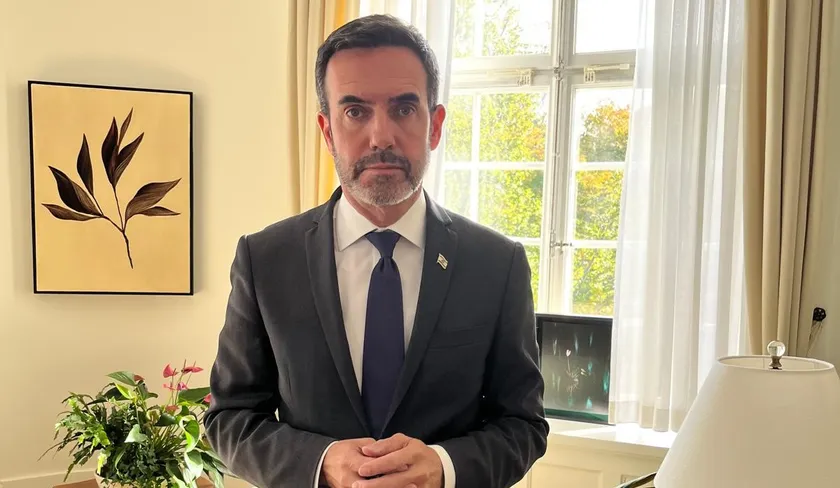
Ambassador Ziv Nevo Kulman, photo credit: Embassy of Israel in Sweden

The conversation with Nevo Kulman took place in a discreet location in Stockholm, with four security guards, both Swedes and Israelis, sitting in the next room. He says that after Eurovision ended, just before the delegation returned to Israel, he met with Golan. "It was one of the most thrilling and moving moments in my career," he says. "What we had here was a concerted effort by an incredible delegation with an incredible singer and an incredible song, and we [at the embassy] also helped to provide the right umbrella."

This umbrella, Nevo Kulman says, included his local media appearances in which he sought to provide a counterweight to the large anti-Israel protests in Malmö over Eurovision weekend. In an interview with the Swedish daily Dagens Nyheter, the ambassador was pictured wearing an ABBA T-shirt adorned with a yellow ribbon, as well as a necklace with the Chai symbol.

Nevo Kulman says that, normally, Eurovision to him is a time for celebration. If things were normal, he would probably have been going around Malmö with other ABBA fans, simply enjoying the fun and colorful event. But because of the current situation, this year none of that is possible.

"The shirt is like a wink," he explains. "I speak with a wide audience through the media interviews and I see more Swedes who are sympathetic to Israel. I hear from people who tell me – Don't get the wrong idea, don't be confused. Just because there are loud people in the streets, in protests, doesn't mean that's what the Swedes think. Our messages are getting through to a lot of readers and listeners and viewers."

Nevo Kulman wanted to stress that, while the protesters are entitled to freedom of expression, as a member of the European Broadcasting Union, Israel also has the right to participate in Eurovision without being harassed. "We also deserve the right to speak, and the competition showed that the conception that everyone in Europe hates us is incorrect," he says.

Unlike the professional juries, the voters from the general public are anonymous, and a large portion of them awarded Israel the coveted 12 points. "Including people from countries you wouldn't expect," the ambassador says.

Nevo Kulman cites the LGBT community as an example of a group that is partly hostile to Israel, despite the country's historic role in the contest. "We were supposed to be the country that carries this banner in the Eurovision, but this is a generation that doesn't know who Dana International was." Nevo Kulman, who is gay himself, says, "Now they're into being Queers for Palestine. It's not enough for them anymore to just be gay or trans, and this is concerning. We need to find a way to talk with these publics."

Things have been particularly tense at the Israeli Embassy in Sweden lately. This past Friday, the police detained several people suspected of firing guns near the embassy. In January, a grenade was thrown at the building, but did not explode. The incident took place a few days after reports came out that Hamas planned to attack the Israeli Embassy and other sites in the country.

Police outside the Israeli embassy in Stockholm, in January.Credit: David Stavrou

"Of course, it affects the work," Nevo Kulman says. "In Sweden, unfortunately, consular services are only provided online. But the embassy is working, we're here and we're operating." He says the threats definitely have an impact on his regular agenda as ambassador: "There are things I did in the past that I can't do now. I can't stand in a public square and give a speech, and therefore I have to miss certain events, and it breaks my heart."

Nevo Kulman has been in the Israeli foreign service for 28 years. He served as cultural attache at the embassy in Tokyo, as Deputy Ambassador to the Czech Republic, as cultural affairs advisor at the embassy in Paris, as general consul in Montreal, and as head of the cultural diplomacy division at the Foreign Ministry in Jerusalem. The position in Sweden is his first as an ambassador. Despite the nation's tranquil image, his tenure in Stockholm has been quite tumultuous.

He is well-liked by Swedish politicians and the Swedish media, maintains extensive ties with the country's Jewish community, and does not hesitate to express an opinion in different areas. For example, he firmly denounced the practice of far-right political provocateurs burning copies of the Koran. He fought for Israeli culture to be included in the Book Fair in Gothenburg. One of his more controversial moves was to declare that Israel would not maintain ties with the populist far-right Swedish Democrats party.

"We are aware of the positive statements by the Swedish Democrats about Israel," he says. "But at the same time, the party continues to adhere to extremist positions regarding a ban on brit milah [Jewish religious circumcision] and the importing of kosher meat, and it has yet to seriously grapple with its neo-Nazi past and with the antisemitism among its members." He adds that the party has not expressed any remorse for its many years of mistreatment of Holocaust survivors, which makes its supposed support for Israel questionable.

Nevo Kulman took over the position in Sweden in the summer of 2021, when Israeli Swedish relations had been languishing after a long and difficult state of crisis. The two countries were attempting to mend the rift that began in 2014, when Sweden officially recognized a Palestinian state and was followed by years of harsh statements, recalls of ambassadors and a halt to state visits.

"It was a lengthy process," Nevo Kulman says. "The Swedes understood that they had gone too far with the recognition of a Palestinian state. The move didn't change anything on the ground and didn't contribute to the Swedish interest of being perceived as a fair partner acceptable to both sides."

But the process of rehabilitating relations was jolted again in the aftermath of October 7. "Now it's impossible to promote an agenda beyond the conflict," says the ambassador, although he also sees an optimistic angle here. "Suddenly, we see that on the core issues there is agreement: the attitude toward Hamas, Israel's right to defend itself, returning the hostages, the fight against the accusations of genocide, and other issues."

Nevo Kulman explains that Israel and Sweden have similar positions on many matters. "Swedish official statements consistently cite Israel's right to defend itself and call for the immediate release of all the hostages." He adds that the Swedish foreign minister has said that he will soon visit the region. "Naturally, this will enable a direct and fruitful dialogue about all the issues on the agenda," the ambassador says.

As It Prepares for 250th Anniversary, Sweden's Jewish Community Suddenly Faces Uncertain Future

Sweden's 20,000-strong Jewish community was looking forward to marking a landmark event next year – but October 7 changed everything. Now, with antisemitic incidents skyrocketing, there are fears that a community that was only founded in 1775 could be at risk.

Published in "Haaretz": https://www.haaretz.com/jewish/2024-02-03/ty-article-magazine/.premium/as-it-prepares-for-250th-anniversary-swedens-jewish-community-faces-uncertain-future/0000018d-69d4-dd6e-a98d-fdf6c1170000

STOCKHOLM – Sweden's Jewish community is preparing to celebrate its 250th anniversary next year, but what was being heralded as an unprecedentedly good moment for the community changed in the blink of an eye on Oct. 7.

This is a story about both ancient and modern history, and how a country went from having no Jews to having a vibrant Jewish community – yet could still end up having very few local Jewish communities if the recent tensions continue.

Prior to 1774, there was no Jewish community in Sweden. Although some Jews had settled there earlier, there was no Jewish community as Jews who immigrated there had to be baptized into the Lutheran religion.

Aaron Isaac. In 1774, the seal engraver became the first person allowed to live as a Jew in Sweden.
Aaron Isaac, Credit: Wikipedia

That all changed 250 years ago, though, when a Jewish seal engraver named Aaron Isaac arrived in Stockholm from German Mecklenburg. "Isaac became the first person who was allowed to live as a Jew in Sweden," says Daniel Leviathan, a Swedish-Jewish historian who's also active in some of the country's Jewish organizations. "He was able to secure the right to form a minyan [prayer group] and to found a Jewish cemetery and mikveh."

Within the space of a year, Stockholm had a proper Jewish community, which included new arrivals from Germany, Denmark and Holland. Around the same period, under King Gustav III, a second Jewish community was established in Sweden's second largest city, Gothenburg. "In 1782, a Jewish ordinance was issued as a demand of the Swedish aristocracy," Leviathan recounts. Apart from regulating the right for Jews to live in Sweden, the ordinance set some restrictions. Jews were only allowed to move to the country if they had a minimum capital worth today's equivalent of about $100,000; they had to live in one of three towns; and local guilds stopped them from working in certain fields. "At the beginning of the 19th century," he says, "there were only about 1,000 Jews living in Sweden. Many of them were young and industrious people who thought they could make a better life for themselves in Sweden. At this point, they couldn't yet assimilate into Swedish society, and since it was a small community they all knew each other. They competed with each other but were also dependent on each other."

"At the beginning of the 19th century," he says, "there were only about 1,000 Jews living in Sweden. Many of them were young and industrious people who thought they could make a better life for themselves in Sweden. At this point, they couldn't yet assimilate into Swedish society, and since it was a small community they all knew each other. They competed with each other but were also dependent on each other."

Swedish-Jewish historian Daniel Leviathan in Stockholm last month.
Daniel Leviathan, photo: Hugh Gordon

According to Leviathan, the second part of the 19th century brought great change: Sweden opened its borders more widely, with pogroms and hardships in the Russian Empire bringing poor Orthodox Jews to the country. At the same time, the Jews who had been in Sweden for several generations enjoyed full emancipation in 1870.

They were considered Swedish citizens of the Jewish faith, no longer a "foreign" element. Many were assimilated and belonged to the elite of Swedish society. They could live anywhere, had a brand-new synagogue in the capital, and many considered themselves Reform Jews. By the time immigration came to a halt because of World War I, Sweden had about 7,000 Jews.

Sweden's World War II story is well-known: It managed to maintain so-called neutrality and wasn't officially part of the war. As for immigration, it was extremely restrictive both before and at the start of the war, but this changed dramatically in 1942 when it allowed about half of Norway's Jews, all of Denmark's Jews and many more refugees from across the continent find refuge within its borders. "After the war, Sweden accepted around 15,000 Jews," says Leviathan. "Many of the Holocaust survivors immigrated later to the United States or Israel, but 5,000 or 6,000 stayed. They were joined by other waves of immigration in later decades: Poles in 1969, Russians in the 1990s, and also Israelis. Today, the community is in many ways similar to Swedish society – modern, liberal and relatively secular. Because of its unique wartime history, it's different to most European communities because it became much bigger after the war than it was before it."

Today, it's estimated that about 20,000 Jews live in Sweden – though there are thousands more who can claim Jewish heritage. The largest community is in Stockholm, which has three synagogues and a relatively new cultural center called Bajit that is home to a Jewish elementary school and kindergarten, Jewish activities, a kosher shop and a café. The city also houses plenty of Jewish cultural and educational institutions, and organizations. Other Jewish communities and associations exist in Malmö, Gothenburg and a few smaller towns.

Sweden's Jewish groups are united under an umbrella organization called the Official Council of Swedish Jewish Communities, and its chairman, Aron Verständig, says the local community is a vibrant and diverse one. "It's more diverse now than it was 150 or even 50 years ago," he says. "There are families like my own that have been here for three or four generations and are established in Sweden. And there are also many Jews who live here but weren't born here." Verständig adds that this diversity is of a religious nature too. "These days, Stockholm has – for the first time – a progressive community with a progressive rabbi, but there's also renewed interest in the Great Synagogue [which is Conservative] and Orthodox Judaism. Chabad, which has been here for over 20 years, has also become a respected part of the community."

But there are many challenges too. One is the fact that the smaller Jewish communities aren't as vibrant as the one in the capital. "The optimism that you can see in Stockholm, where the community is growing, isn't what you see in the smaller communities – and this has been the case for many decades," says Verständig. "Initially, many members of the smaller communities moved to Stockholm, Gothenburg and Malmö. Now Gothenburg and Malmö's communities are getting smaller too, and many are moving to Stockholm. It's increasingly hard to live a Jewish life outside of Stockholm, and organized Jewish life in the smaller towns is quite slim."

Other challenges, according to Verständig, include staying relevant who those who are not observant and finding ways to attract new members in a country where assimilation rates are very high. He adds, though, that things have changed in that regard in his lifetime. "When I was growing up, they said that if you married a non-Jew, your kids wouldn't be Jewish – but nowadays it's not like that," he says. "We see that children of interfaith marriages are sent to Jewish schools and summer camps. There's a great need for Jewish education when you have a non-Jewish spouse, and it's a challenge to be inclusive enough for different groups from very different backgrounds."

However, while issues such as the legal status of circumcision, importing kosher meat and the legal framework of Jewish schools are undoubtedly issues for the community, all pale in comparison to the main problem these days: antisemitism. The issue of antisemitism has been discussed extensively over several decades in Sweden. In fact, all Swedish governments since the turn of the century have made concerted attempts to address it. The current (center-right) government appointed a special interministerial task force in order to combat antisemitism and strengthen Jewish life. This was a follow-up to 2021's Malmö International Forum on Holocaust Remembrance and Combating Antisemitism, which had been arranged by the previous (center-left) government.

These measures acknowledged that antisemitism comes in many different forms, including right-wing nationalism, left-wing radicalism and Islamism, which arrived through large waves of immigration from the Middle East starting in the last few decades. It was also clear that antisemitism can be found in many different arenas: online, in the workplace, public spaces and, perhaps worst of all, in schools. "A report that was written as a result of our request, and as one of the pledges of the Malmö conference, was released a few weeks ago," says Verständig. "In general, there are many suggestions that I think improve the possibility of living a Jewish life in Sweden – including safeguarding the right for Brit Milah [circumcision], financing security [at Jewish institutions], funding maintenance of synagogues and setting up a Jewish information center."

Yet the situation has deteriorated dramatically since the start of the Israel-Hamas war on Oct. 7. "Antisemitism has skyrocketed," says Verständig. "Many are feeling afraid, insecure and anxious," he says – and this was said on Tuesday, a day before a grenade was found outside the Israeli Embassy in central Stockholm. "A survey we did in November shows that many Jews have considered leaving Sweden. The government has reacted in an excellent way – but in civil society, reactions are sometimes very different."

Leviathan also expresses concerns over recent developments. "What's new in the current situation is that antisemitism is much harder to avoid," he says. "We always had antisemitism, but you could avoid it by moving to a different neighborhood or changing your job. Now it's everywhere – in the streets and squares, even in the 'nice' neighborhoods. It's in schools and universities. Youngsters are being bullied and exposed to antisemitism on TikTok, and adults are losing friends and colleagues who post anti-Israeli propaganda online. You're not even safe in your private space: you never know if the postman will react to the Jewish name on your mailbox. This is what I hear from young people in Sweden, and it's what I've experienced myself: there's no safe space anymore."

Leviathan's views are echoed by others in the community. Sweden has a vibrant Jewish cultural scene, but the difference between the period prior to Oct. 7 and afterward are dramatic.

The week before Oct. 7, the most important cultural event in the region, the Gothenburg Book Fair, hosted an institution called Jewish Culture in Sweden – founded and managed by Swedish-Israeli Lizzie Oved Scheja – as a guest of honor. This was a historic moment for Swedish-Jewish culture: Jewish literature, philosophy, music and humor were celebrated by a very wide audience, in what many described as an almost euphoric atmosphere.

What followed changed everything.

"My life has changed drastically since Oct. 7, both personally and professionally," says Natalie Lantz, a PhD scholar in Hebrew Bible studies who's also a columnist and translator of Hebrew literature (her translations include works by David Grossman, Amos Oz and Sara Shilo). "In 2013, I started writing and lecturing about Jewish and Hebrew culture and literature. My field of expertise has always spurred curiosity and positive reactions. Before Oct. 7, I had only been treated with suspicion by colleagues a few times. I remember a social gathering at a cultural institution when I was presented as the translator of Amos Oz's 'Dear Zealots,' and a person immediately took two steps back and said with disgust: 'I just want to be very clear that I don't support the Israeli occupation.' The conversation was abruptly shot down. Painfully, I realized that some people in the cultural world consider the Hebrew language and Israeli cultural expressions as being evil to the core. But such incidents were rare before Oct. 7. Now, there seems to be no end to the aggressive calls for a boycott of Israeli academia and culture."

She recounts how a petition signed by cultural workers, including some from public institutions, was peppered with terms like "apartheid system" and "Zionist-motivated genocide." "There are BDS rallies at the universities and I hear of faculties that are asked by students and staff to report if they have academic cooperation with Israeli universities," Lantz says.

Hebrew Bible studies scholar Natalie Lantz in a Stockholm synagogue last month.
Natalie Lantz, photo: Hugh Gordon

For her, it's not only about her feelings but also her livelihood. "I'm dependent on being in dialogue with the intellectual arenas of Israel in order to conduct my work in an insightful manner," she says. "Now I fear that the calls for boycott may result in a difficulty to get funding for academic and cultural exchanges between Sweden and Israel. I myself have become very anxious in interactions with colleagues and institutions.

"Will my upcoming university lecture on the history of Jewish Bible translations provoke someone?" she asks. "Is [Austrian-Israeli philosopher] Martin Buber going to be canceled? Can I film the planned family program about Purim for Swedish television without being aggressively attacked? And, most scarily, can I continue to be an openly Jewish public figure in Sweden? I feel vulnerable and exposed. My world is shrinking."

Lantz is accustomed to the sight of a heavy security presence outside synagogues and Stockholm's Jewish school, "even though it feels absurd that community members have to be protected just for being Jewish. I've never really felt frightened of taking part in Jewish activities, but this has changed. I was out walking in the city center last Saturday when I accidentally got caught in a pro-Palestinian demonstration. This was on International Holocaust Remembrance Day. That evening, some people from the demonstration stood outside the synagogue where we hosted a memorial ceremony with Holocaust survivors present. They filmed people entering the synagogue and screamed 'child murderers,' 'death to Israel' and 'intifada.' That horrified me."

She believes the Swedish government has an "enormous responsibility" to combat this wave of antisemitism. "It seems to me that the politicians are taking the matter seriously, as they're not only allocating funds for security to Jewish institutions but also have a strategy to strengthen Jewish life – which focuses on the transmission of Jewish culture and Yiddish to future generations."

Yiddish is one of five official minority languages in Sweden, which is why Lantz believes focusing on it makes sense. That said, she still has concerns. "I fear that the strong focus on Yiddish in Sweden comes at the expense of possibilities to strengthen the knowledge of Hebrew, which is important as a common language for Jews globally," she says. "I was puzzled to note that 'Yiddish' appears 327 times in the strategy document while 'Hebrew' appears only 15 times. To me, strengthening Jewish life in Sweden is also about providing tools to partake in the international Hebrew cultural scene. After all, we'll need Hebrew translators also in future generations. At least, I hope so."

יום כיפור בשוודיה – הפגנה ניאו-נאצית בעיר גוטנברג

מתוך הארץ באנגלית: https://www.haaretz.com/world-news/europe/1.814179

Swedish Police Routed neo-Nazi March Past a Synagogue on Yom Kippur

Nordic Resistance Movement march in Gothenburg on Saturday could draw up to 1,000 people; court ruled Monday that it can’t go near the local synagogue but NRM says it doesn’t accept decision

David Stavrou (Stockholm) Sep 26, 2017 9:21 PM

While Jews worldwide will be praying and fasting this Yom Kippur, members of Gothenburg’s Jewish community will have to face a grim political reality when a neo-Nazi movement marches through the city on the holiest day of the Jewish calendar.
That is horrible in itself, but it could have been even worse after the local police originally rerouted the march past the city’s synagogue. It was only after the local Jewish community appealed the decision that a Swedish court nixed the police plan on Monday.

Saturday’s demonstration is organized by the Nordic Resistance Movement, a national socialist movement with branches in Sweden, Norway and Finland. Although the movement itself is legal and the Swedish branch even has a political wing, many of its members, including its leaders, have been indicted and arrested for various violent crimes in the past. The movement promotes a white supremacist, anti-Semitic ideology and openly praises Hitler.

The Swedish branch has become stronger in recent months, organizing demonstrations attended by hundreds – including an unannounced demonstration in Gothenburg last week. The movement refers to Saturday’s demonstration as its most important yet and expects over 1,000 participants to attend.

Up until Monday, the NRM demonstration was going to pass near Gothenburg Synagogue. The movement had initially planned to march down Gothenburg’s main avenue, but the police, concerned by violent clashes with counterprotesters, made the NRM change the route, which would have brought it closer to the synagogue.

But as a result of appeals by Sweden’s Jewish communities organization and Gothenburg’s Book Fair (which also takes place this weekend), Gothenburg Administrative Court decided to shorten the demonstration route, citing risks to public order and security.

According to the court decision, demonstrators will not be allowed to gather outside the book fair’s location or be allowed to pass near the synagogue.
According to the Swedish daily Svenska Dagbladet, Aron Verständig, chairman of the Council of Swedish Jewish Communities, said he was pleased with the decision. An NRM spokesperson, however, was quoted in TT news agency as saying, “We do not accept the decision and we may defy it.”

When the march was initially rerouted near the synagogue, Greater Gothenburg police chief Erik Nord told Swedish public service television that when the authorities “sat in the room together, I don’t think any of us were aware it was a Jewish holy day. It’s not nice that Jews who went through the Holocaust will meet Nazi demonstrators in the streets during their holy day – I fully understand that – but we can’t take that into consideration. We examined this from the perspective of order and security,” he added, prior to the court ruling.

Nord said the NRM is indeed a national socialist movement that promotes race ideology and may commit hate crimes during its demonstrations, but that Swedish law permits demonstrations even if they’re organized by Nazis.

Leaders of Sweden’s Jewish community had protested the police decision in the local press. “It’s about what kind of society we want to have,” wrote Verständig and Allan Stutzinky, chairman of the Jewish Community in Gothenburg, in an op-ed in Svenska Dagbladet. “Do we want a society that does its best to meet the Nazis’ needs or a society that cares about protecting minorities?”

Verständig and Stutzinky had also cited a smaller Swedish-Jewish community in the northern town of Umeå, which earlier this year had to shut down its activities because of threats made by neo-Nazis.

“Aside from fear for our own security, the demonstration evokes uncomfortable associations for us Jews,” they added. “During the Holocaust, it wasn’t unusual for the German Nazis to choose the most important days of the Jewish calendar to conduct their horrendous atrocities.”

In Sweden, freedom of speech is vigorously protected and the Jewish community leaders are not claiming that neo-Nazis don’t have the right to express their opinions.

Although the Gothenburg police said they must allow demonstrators to protest in a safe and orderly manner, even if they are Nazis, Swedish law does not allow hate crimes. Consequently, the police published a leaflet of “dos and don’ts” aimed at Saturday’s demonstrators.

According to the flyer, individuals can be arrested if they march in a military manner, wear uniforms and wave flags with symbols that resemble National Socialist Party demonstrations from the 1930s and ’40s. These guidelines are subject to interpretation, though, and have been widely debated in the Swedish press and on social media in recent days.

The police said the leaflets were an attempt to clarify the rules before the actual demonstration and “reduce crime before it’s committed.” However, according to local press reports, a lot of work has been done on the basement of Gothenburg’s main police station in recent days, in order for it to be able to hold hundreds of detainees. Just in case.