When two Israeli soldiers visited Stockholm, their story was misunderstood, writes Israeli journalist David Stavrou.
Published in Kvartal: https://kvartal.se/erikhogstrom/artiklar/svenska-journalister-forstar-inte-de-israeliska-soldaterna/cG9zdDo2MTgxMg
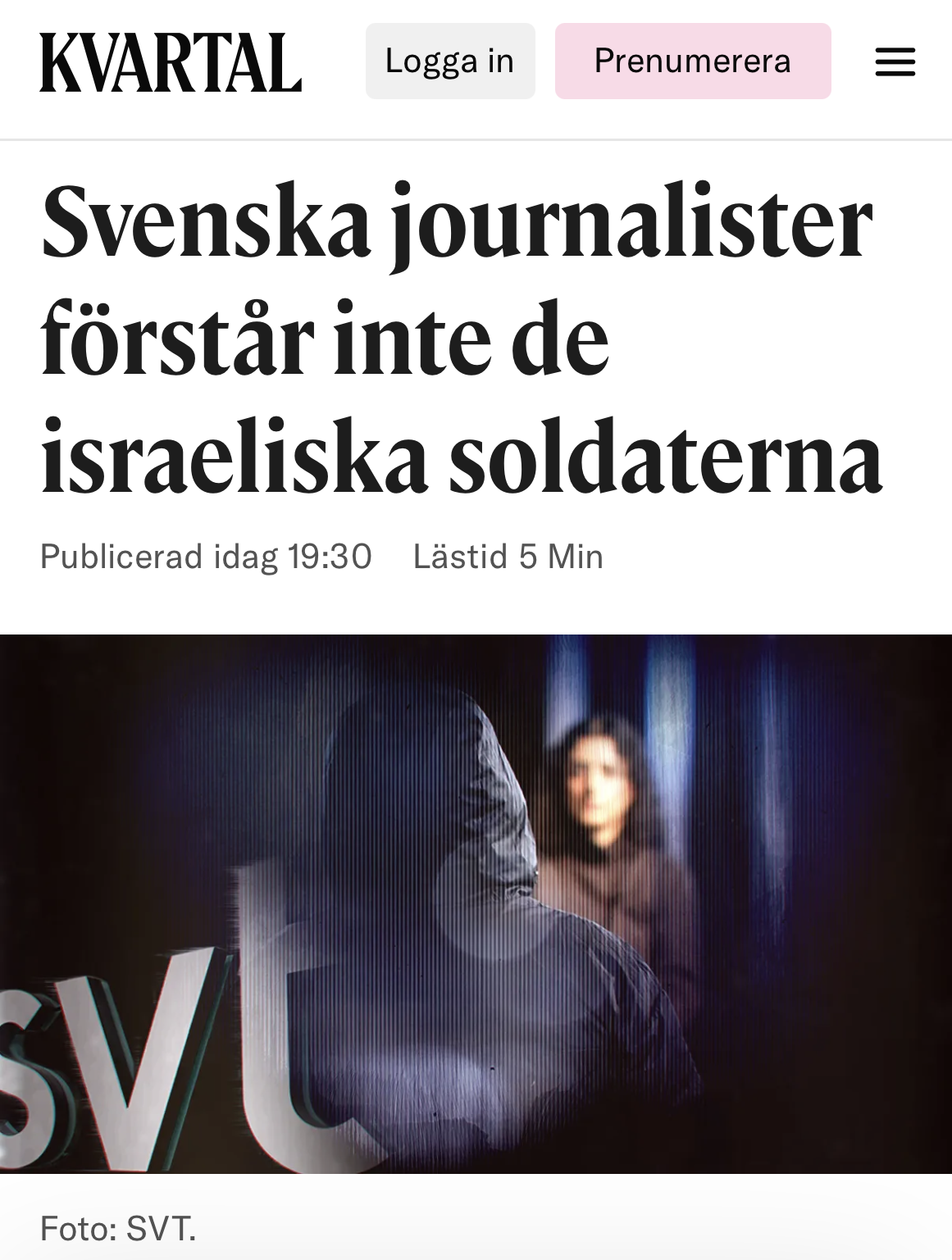
Two young Israeli soldiers recently visited Stockholm together with an activist from Breaking the Silence, an Israeli organization that collects and publishes testimonies from Israeli veterans and, in many cases, acts as a whistleblower by exposing alleged human rights violations and war crimes. The Swedish visit was organized in collaboration with the Christian aid organization Diakonia, which arranged interviews with the Swedish press (SVT, Dagens ETC, Dagens Arena, and Jewish Chronicle). In the interviews, the soldiers used pseudonyms, and their faces were not shown.
In some of the publications, the interviews were presented as evidence supporting the gravest accusations against Israel. For example, Dagens ETC wrote: “The serious allegations have been dismissed as Hamas propaganda by commentators like Alice Teodorescu Måwe. But everything is now confirmed by Israeli soldiers.”
In the interviews, the soldiers reportedly said things like, “we were ordered to shoot all Palestinians we considered ‘military-age men’” and “we used Palestinian men as human shields.” Other claims included that many buildings were destroyed in Gaza and that, during the first weeks of the war, there was a lack of rules of engagement. Later, the soldiers said, rules were introduced, but they were weak and not always applied. As a result, unarmed men were shot.
They also reported that journalists and healthcare workers were considered legitimate targets, even if they themselves did not participate in such incidents. The two soldiers also described a discourse that dehumanized Palestinians.
Many Israelis have strong objections to Breaking the Silence. They argue that this type of testimony contributes to hatred of Israel, causes the country to be treated unfairly, and that even if the reports are true, they should be discussed domestically rather than in a hostile international stage.
Of course, Swedish journalists do not need to concern themselves with this—but it can help to understand the context. Many Swedes would likely raise an eyebrow if Swedish organizations on the political fringe were setting the agenda for Sweden’s image abroad. In this case, the soldiers are telling an important story—the problem is that the Swedish press misunderstood it.
A key issue concerns how to distinguish between different types of armed forces. Traditionally, there is a difference between terrorists or non-state actors who use violence against civilians and state-controlled armies with formal military forces, command structures, and legal frameworks. That definition is largely irrelevant for Israelis because Hamas is a hybrid actor. Although the organization uses terrorist methods, its military branch—the al-Qassam Brigades—is structured like an army, with battalions and brigades, elite units, command chains, and modern weapons systems. During the war, this was also supported by high-tech disinformation campaigns, a financial empire of global investments, leaders living luxuriously outside the region, and alliances with some of the world’s most tyrannical regimes.
This paints the Israeli soldiers’ testimony in a very specific colour since Hamas, despite its military structure, is not bound by international law. Its militants can behead, rape, and execute civilians, burn people alive, and take children as hostages—with or without uniforms—while exploiting its other source of power – the power of sovereignty, and the civilian control the organisation holds in Gaza. Expecting Israel not to act against individuals simply because they are not in uniform in this asymmetric conflict may be understandable, but it is hardly surprising that the reality forces terrible dilemmas and tragic decisions.
The Israeli soldiers confirm that Israel, despite the genocidal nature of the Hamas attack against it, at least tried to maintain some form of legal framework. They say civilians were evacuated, leaflets were dropped as warnings, orders were given not to shoot women and children, and no-go zones were established in order to limit Israel's massive firepower. Using human shields is obviously illegal and should be punished. But the claim that journalists and healthcare workers are always protected in a reality where Hamas has been shown to use both journalistic and medical infrastructure for attacks on Israeli civilians is detached from reality.
Israel claims that intercepted communications show Hamas used ambulances to transport fighters, weapons, and equipment. Hamas also hid weapons and command centers in hospitals, schools, mosques, and private homes. The IDF has released images that allegedly confirm this. Furthermore, at least three civilian hostages—Almog Meir Jan, Andrey Kozlov, and Shlomi Ziv—were reportedly held in a family home in Gaza where the son was a journalist and the father a doctor. There are also allegations that so-called freelance journalists were embedded in Hamas units on October 7 and documented the massacre for propaganda purposes.
The fact that Hamas controlled the Gaza Strip with an iron grip for years means that almost everything in Gaza effectively became part of the effort to destroy Israel. When the soldiers say they were told “everything is a military target,” this is viewed as condemning evidence against Israel—but in reality, it is not far from the truth.
International law recognizes these complex circumstances. While it may seem unfair to those unaccustomed to war, under the Geneva Conventions civilian structures—including hospitals—can lose their protection if they are used for military purposes. Even unarmed combatants and civilians participating in hostilities can, under certain circumstances, be considered legitimate targets. This is not what Israel claims—it is how international law works.
The reality described by the Israeli soldiers is horrific. Some of it, such as the use of human shields, also appears illegal. It can and should be discussed. It can and should be used for journalistic purposes and, hopefully, ultimately, for reconciliation when the heartbreaking testimonies from both sides become part of a healing process. That said, nothing in what the soldiers said in Sweden confirms allegations of genocide or deliberate starvation of civilians. Using these stories to imply that these horrific accusations are true is an abuse of the witnesses and their experiences.
Finally, there is one more aspect to consider. Being scared, wanting revenge, and not adhering to strict moral ideals under fire is natural in armed conflict. So too are remorse and shame. The Israeli soldiers who came to Stockholm were brave enough to share this with the world. But a reasonable question to pose to Diakonia, which organized the visit, is: Where is the Palestinian Breaking the Silence? Where are the remorseful Hamas fighters? Where are the Islamic Jihad militants ashamed of massacring Israeli civilians and now revealing their actions as “deeply immoral and devastating to our neighbors,” as one of the Israeli activists put it? Are these ignored by Diakonia—or do they simply not exist?
 דיויד סטברו