Jewish communities worldwide are reeling from a year of hostility from neighbors. But probably nothing matches what the tiny community in Norway has endured.
Published in Haaretz: https://www.haaretz.com/israel-news/2024-11-01/ty-article-magazine/.highlight/amid-wave-of-antisemitism-norways-jews-feel-vulnerable-and-betrayed/00000192-e939-dd31-a9be-fb3bb73b0000
OSLO – Yael Nilsen has lived in Norway for years, but a year ago, on October 7, she was glued to television broadcasts from her native Israel. So, it was only recently that she discovered how the events of that day were presented to viewers of Norwegian media.
That was when she came across a recording of the main evening news show of NRK, the Norwegian public broadcaster, from October 7. "I watched it," Nilsen relates. "The top headline [on the NRK website] that evening was: 'Strong reactions to Hamas' attacks on Israel; main goal is liberation of Palestinian prisoners, says Hamas spokesman.'" The Israelis who were abducted and killed by Palestinians were mentioned in passing, she notes.
That was the line followed by many of the country's media outlets, both public and commercial. A week after the massacres of Simhat Torah, the official representative of the Palestinian Authority in Oslo (who became an ambassador when Norway officially recognized a Palestinian state in May), said that she wasn't familiar with videos showing people being murdered in their homes. "That is Israeli propaganda, intended to get [the country] a free pass from the international community to attack as it wants," she told a Christian newspaper in an interview that then widely shared on social media.
The Norwegian government, for its part, saw to it that King Harald V, the country's official head of state, did not express condolences to Israel after October 7, because, according to the foreign ministry, it's a "political conflict." Contrary to the other countries of Europe, Norway does not categorize Hamas as a terrorist organization; many in the country view it as a legitimate political player. In an interview with TheMarker, Haaretz's business newspaper, Norway's foreign minister noted that his country maintains relations with both that group and Hezbollah.
Pro-Palestinian demonstrations and rising anti-Israeli sentiment have been widespread during the past year worldwide. But in Norway things appear to have gone somewhat further. Hamas' narrative took hold in broad circles in the country, extending far beyond the radical left and pro-Palestinian activists. What sprang from an anti-Israeli point of departure quickly snowballed in a way that was out of proportion with what other Jewish communities in Europe experienced. Criticism of Israel swiftly took the form of hatred on the street and on social media, and was also directed at Jews in general. Members of the Jewish community say they feel this trend effectively enjoys an institutional tailwind.
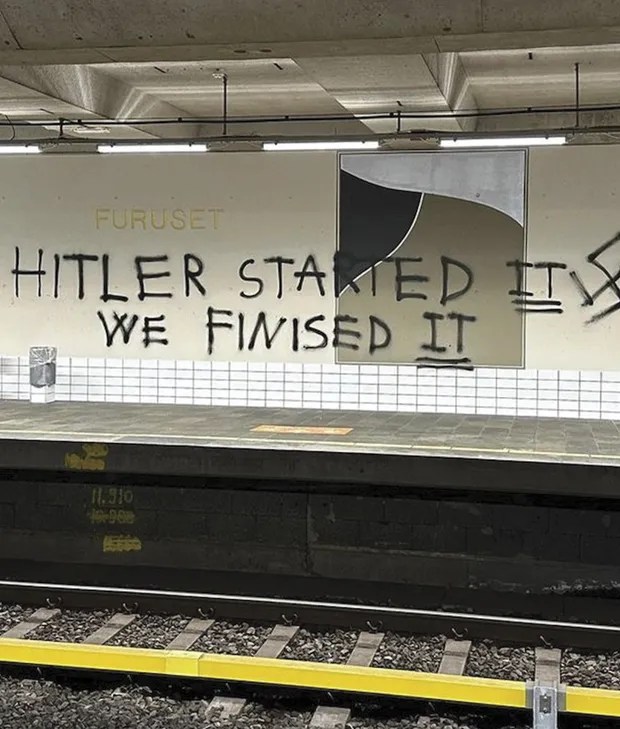
Norway's Jews started to report instances of harassment and threats. Graffiti and artworks likening Israel to Nazi Germany cropped up in the public space across the country. A wall drawing in the city of Bergen depicted Anne Frank in a keffiyeh, and openly antisemitic messages soon followed: From the inscription "All Jews out' spray-painted on walls, to an ominous message (in English) in an Oslo Metro station – "Hitler started it. We finis[h]ed it" – accompanied by a swastika.

Norway's tiny Jewish community is badly rattled by what it's experiencing as a lethal blow to its feelings of belonging and security. A visit to Oslo, and conversations with Jews living elsewhere in Norway as well, reveal that the tiny community, which numbers only 1,500, truly feels threatened. Some of those interviewed asked not to have their names published. "The community is isolated because the government is not looking after it and is not condemning the violence it's experiencing," a source who's involved in the Jewish community tells Haaretz, adding, "The government is effectively affirming the discourse of hatred."
The case of A., a Jewish Norwegian woman, illustrates how far things have gone. One of A.'s daughters lives in Israel and serves as an officer in the Israel Defense Forces. At the end of last year, someone found an online video of her daughter, in uniform and speaking Norwegian, and re-posted it on Instagram. Overnight, the life of both daughter and mother became hell.
"Immediately, all [our] social media accounts were flooded with messages, curses, hatred and threats," A. relates. "An influencer and model of Muslim origin posted the video and added the name of my workplace along with pictures of me and my daughter." The threats did not come solely from Palestinians. The account information associated with those who sent the messages, and the messages themselves, suggested that many were not of Muslim or Arab origin.
"Waiting for you to land in Norway, then I'll show you what I and my friends from Hamas will do to you," someone wrote. And there was also: "She's a dirty genocide supporter. I hope she sinks into the sand stained with the blood of Gaza and returns to Norway without arms or legs." As well as a third reading, "Zionist whore, I hope you get a bullet from Hamas."
There was even an initiative to have the authorities place her daughter on trial, like Europeans who fought for ISIS. Separate from that, the Norwegian branch of Save the Children issued a demand that every returning Norwegian who has been in wartime Gaza Strip be questioned by the authorities, in keeping with Norway's "international commitment to prevent genocide."
What did you do?
A.: "I went to the police. In the end, they decided it wasn't criminal and closed the case. I was given an emergency-call button for a certain period, and suggested that I move to different accommodations. To this day I live 'underground.' Still, now everyone knows where I work, and everyone knows my daughter is in the Israeli army. Besides, my daughter lost all her friends in Norway and can't come to visit for fear of her life. I am Norwegian, I love my country, but I am very disappointed. No one can protect me."
Did you encounter that attitude before October 7, or is it completely new?
"Even if it's worse now, it's not new. My children have had to account for everything Israel has done since they were in first grade." She adds that one of her children was forbidden by a teacher in her school to talk about a family vacation in Israel, so as to avoid "offending other children," and in other instances, teachers told her children that it's alright to be Jewish, but not to talk about Israel.
Others in the Jewish community put forward similar accounts. Rami, for example, has lived in Norway since 2007. Russian-born, he immigrated to Israel in the 1990s and then moved to Norway in the wake of his wife. The couple's daughter and two sons were born in Norway; the family lives not far from Oslo. "Until not long ago, we didn't hide the fact that we are Jews," he says, "but lately we feel the antisemitism, via our children."
The children don't speak Hebrew, he notes, and have never lived in Israel. Nevertheless, his 5-year-old daughter said that children from her kindergarten asked her why she was murdering Palestinian children. "My 13-year-old son is suffering even more," Rami adds. "Children say he's a Jew and harass him. Some of them called out 'Heil Hitler' at him."

History plays an important role here. The Jews, who are today have the status of an official minority in Norway, began to arrive only in the mid-19th century. Until then, Jews were forbidden by law from stepping foot in the country. Immigration, mostly from Eastern Europe, led to the establishment of Jewish communities in Oslo and Trondheim. They suffered a great deal in World War II, when the country was ruled by the fascist Quisling regime, which collaborated with the Nazis. A third of Norway's 2,100 Jews were murdered. They included more than 500 members of the community who were seized by police officers, soldiers and Norwegian volunteers and expelled via ship, then transported by train to Auschwitz. Others perished in camps in Norway and Germany. The survivors were those who fled to Sweden and Britain.
One of the most painful aspects of the situation for the Jewish community is the feeling they have that even the persecution they endured eight decades ago is now being turned against them. Prof. Torkel Brekke, a historian from MF University of Theology, Religion and Society, in Oslo, recalls last year's memorial ceremony for Kristallnacht, held in the capital.
"Norway's Jews felt that the event had been hijacked from them," he relates. "A Norwegian anti-racism organization turned the event into a pro-Palestinian one." Instead of dealing with Nazism, the Holocaust and antisemitism, the event focused on a discussion of the Middle East and political radicalization. The organization of the event was coopted by left-wing groups who were part of the anti-Israeli wave of protests – Israeli flags and Jewish symbols were banned from the ceremony. The Jewish community therefore decided not to participate in the event and held one event of its own, in a synagogue
There's also anger among community members with the Norwegian Center for Holocaust and Minority Studies. Established at the state's initiative with funds belonging to Jews who were murdered in the Holocaust, the center's mission is to map and battle antisemitism in the country. However, in a letter sent recently to the institution, Norwegian Holocaust survivors and their descendants accused it of failing in its duty, maintaining that instead of fighting antisemitism it was positioning itself as a "critic of Israel's policies and military tactics." Moreover, the center is manifesting "bias in its choice of experts, supporting a narrative that is negative toward Israel as a Jewish state."
To which the center's director, Prof. Jan Heiret, stated in response to a query from Haaretz, "Since October 7, we have observed a disturbing increase in antisemitic attitudes and incidents in Norway. This deeply concerns us. The center works daily to fulfill our mandate, which is to conduct research and disseminate knowledge about the Holocaust, antisemitism, genocide and related human-rights violations, as well as the conditions of minorities in Norway."
"We were promised certain things as Jews and as citizens of Norway who have a specific history," says Leif Knutsen, a Jewish-Norwegian activist and professional media monitor. "All of this collapsed within hours on October 7." Knutsen talks about the disparity between the expectations from Norwegian society – with its democratic and liberal values – and the situation as it is being experienced by the country's Jews in practice.
There were in fact portents, he notes, including threats, disturbances and antisemitic remarks in periods of earlier Israeli military operations in the Gaza Strip and Lebanon. "Despite these events, there was still a sense of safety," Knutsen points out. "But on October 7 we realized that the social contract we had as a minority in Norway would not be honored. This is a harsh reality because we are barely holding on as it is. The community's institutions are run by volunteers, it's hard to fill all the roles, the pressure is immense, and the task of maintaining all the institutions is really hard," even in normal times.
There are indications of a community in trauma, Knutsen believes, as Jews cope with extremely hostile media, intolerable remarks, provocations and harassment. "After October 7," he continues, "I conducted a survey among Norwegian Jews and received responses from about 150 people. Half the respondents said they were considering leaving the country, and more than 90 percent said the Norwegian authorities don't understand what antisemitism is. "If the Jewish community disappears from Norway, it would be a tragedy," says Knutsen. "It would be just one sad episode among many in Jewish history, but it would be a catastrophe for Norway. This is why I am mostly concerned – not necessarily as a Jew, but as a Norwegian patriot," he concludes.
Prof. Brekke concurs. "Something broke on October 7. Norwegian Jews today feel vulnerable and betrayed by society. They are constantly told what they should think about the [Palestinian] conflict. If they do not condemn Israel, they are told they are 'Jews in the wrong way.' There are public figures and politicians who support Hamas, and far-right extremists and neo-Nazis who supported the October 7 massacre. It's not surprising, then, that the country's Jews are questioning their place in Norwegian society."
The sources of Norwegian hostility toward Israel go back to the late 1960s and early 1970s, Brekke explains. "After World War II and Israel's establishment, Norway's clear stance was opposition to antisemitism and support for the young Jewish state," he says. "However, pro-Palestinian attitudes began to gain momentum after the Six-Day War, and pro-Palestinian leftist movements, including Marxist and Maoist groups, tried to push the more moderate social-democratic left in that direction. Although similar trends occurred in other countries, there are unique elements in Norway that led to the entire Norwegian left adopting this stance.
"From the late 1970s, for 20 years, Norway sent over 20,000 soldiers to serve in UNIFIL (United Nations peacekeeping forces), in Lebanon. As a result, that generation had a feeling that Norway possessed special knowledge of the region. I see this as Norwegian arrogance. You can also add Norway's involvement in the Oslo Accords. When the accords collapsed, the anti-Zionist movement simply spiraled out of control."

The most distinctive factor in Norway, says Brekke, is the impact of trade unions on the shaping of the country's foreign policy. "More than one million Norwegians, about a fifth of the population, are members of unions. In recent decades, these unions have cultivated a grassroots culture that is strongly anti-Israel and anti-Zionist. This movement is deeply tied to the [ruling] Norwegian Labor Party, both organizationally and ideologically, which gives the unions considerable influence over Norway's foreign policy." This anti-Zionism, Brekke argues, has turned into a type of antisemitism.
According to Dr. Cathrine Thorleifsson, from the social anthropology department of the University of Oslo, a genuine problem exists in Norway when it comes to understanding the new antisemitism, which is Israel-related. Norway's Jews, explains Thorleifsson – who has lived in Israel and speaks Hebrew – are in a vulnerable position and encounter antisemitism in various milieus: conventional media, social media and the public space. In the course of her research into the life of Norway's Jews in the 21st century, Thorleifsson has uncovered much prejudicial thinking about the community and about Israel. In one survey she conducted, half the respondents expressed the belief that Israel's attitude toward treatment of the Palestinians is no better than the way the Jews were treated in the Holocaust.
In Thorleifsson's view, the country's political discourse plays a crucial role in this regard. "Norway is a small country," she observes, "and its political discourse is still evolving. There is conformity, a lack of diverse voices expressing different experiences, and insufficient democratic tools to protect minorities." Norwegian politics espouses "a very pro-Palestinian attitude," she adds. "In certain activist circles, Hamas' attack is considered legitimate resistance, and the word 'terrorism' is not used where it should be. Norwegian conformity hides the antisemitism linked to Israel, as well as the misinformation and political violence that fuel it."
Israeli-born Ilan Sharoni, who lives in Stavanger, a city in the country's southwest, has been in the country since 1988. "I live here, my children and grandchildren live here, and I am very worried," he says. The chief culprit is the media, he avers. "Day after day on television, for decades now. Whoever doesn't condemn Israel is condemned as a supporter of genocide. Everything just blew up after October 7. The anti-Israeli approach, which was always part of domestic politics, has now become fatal."
To which Yaniv, a resident of Oslo who works and teaches in the field of art, adds, "When I speak to people who discover that I am from Israel, they stop talking or even choke. Afterward, they sometimes return to apologize." Yet, he says he has heard on more than one occasion the view that Israel is a criminal country that should not exist.
Ahead of the events marking the first anniversary of October 7, security around Jewish institutions in the country was beefed up by authorities. Pro-Palestinian demonstrations were held opposite the community memorial assemblies in Oslo and Bergen. In Oslo, models of Hamas' Qassam rockets, painted green, white and red, were raised. In a demonstration held in Bergen under the slogan "A Year since the Al-Aqsa Flood" (as Hamas called the attack on Israel), demonstrators burned Israeli flags. The police asked participants in rallies of support for Israel not to go home in groups because it would be "difficult to protect them."
Many in the Jewish community understand where the criticism of Israel is coming from. But even so, on March 8 this year, International Women's Day, a group of Jews, women and men, hoped they would be able to demonstrate in solidarity with women around the world in a large event that was set to take place in Oslo.
Yael Nilsen, the longtime Norway resident who has taken part in the international effort for the return of the Gaza hostages, contacted the organizers and asked to join the event. Together with her friends, she requested that the acts of rape that were perpetrated on October 7 and the condition of the abducted Israelis be brought to public awareness.

"Those issues are barely discussed in the Norwegian media," says Nilsen. "We thought that by joining the large-scale event of International Women's Day, we would be able to introduce the subject of the sexual violence and the awful condition of the abducted Israelis into the Norwegian discourse."
Initially, it didn't look like there would be a problem. One of the slogans that had been decided on for the demonstration dealt with the weaponizing of rape, so there was compatibility between the content of the demonstration and the goals of Nilsen's group. "And the fact is that when I contacted the organizers, they said that the program was already set, but that we would be able to join the group that would march under the slogan 'Fighting rape as a weapon.' To be certain, I made sure that the organizers knew that we would be carrying photographs of the abducted women, and I also asked them to confirm that the security arrangements would ensure that we would be safe with our Jewish symbols. Everything looked to be in order."
The group consisted of 40 to 50 people, most of them local Jews, Israelis and a few supporters. Nilsen made sure that no one would be carrying an Israeli flag and that everyone was clear about the message. "It was important for us to focus on the sexual violence, so we dispensed with Israeli flags. But to identify the women as Israelis, we had a blue-and-white banner with the inscription '#MeToo Unless you're a Jew,' together with graphics of a Star of David made out of women's undergarments and a triangle of blood, which was also used internationally in similar demonstrations."
The group knew they might encounter hostility. "Our symbols often generate hatred and aggression in Norway," Nilsen notes. "There is a large Muslim community here, and during that period there were demonstrations against Israel every day. Some of them crossed the thin line between anti-Israel views and antisemitism. So we were worried, but we got confirmation from the organizers, and because we didn't represent Israel, and the demonstration was supposed to deal with something that all of Norway could agree on – opposition to the use of violence against women as a weapon – we hoped for the best."
The hostile reaction manifested almost immediately. Initially, the group was refused entry to the event and had to prove that they had the organizers' authorization to participate. "One of the organizers went on shouting and cursing, and then took one of our signs and threw it on the ground," Nilsen recalls. "After the police made sure he couldn't get close to us, more and more organizers told us that our message conflicted with the messages of the event.
"They looked at us with hatred and disgust, and started to shout that we were Zionists and fascists. Then the crowd joined in with slogans and rhythmic chanting that we were already used to, like 'Murderers,' 'No to Zionists in our streets' and 'From the river to the sea, Palestine shall be free.'"
They avoided getting into a direct confrontation, Nilsen relates, "and we instructed our group not to scatter and not to respond. But when the atmosphere heated up, some of the other demonstrators – Norwegian men and women of my age – approached the members of the group very closely, and whispered into their ear things like 'child murderer' and skadedyr' ['parasites' in Norwegian]. "I've had anti-Israeli calls shouted at me in the past," Nilsen continues. "But this time it was very different. The hatred came from people I thought we shared basic values with. The feeling was that we were being canceled as human beings. We weren't women and men – we were the embodiment of evil."


 דיויד סטברו