In Kulturhuset's Defence

Some places, the ones where we send our young children, the places where we treat our pain, and those where we invest our shared resources, should be free from polarizing content. Schools, hospitals, and clinics, and yes, if it’s public and taxpayer-funded – even Kulturhuset – have no place for Quran burnings, no place for NMR marches, and absolutely no place for polarizing political propaganda. Not even if 15-year-olds created it.

An article from Kvartal (January 22) tells of an incident in the Stockholm suburb of Husby last spring. High school students from a local school exhibited paintings they created in the foyer of Kulturhuset, which is owned by the City of Stockholm and shares premises with Husby’s public culture school. The paintings were the result of lessons on post-colonial theories and art at the students' school. A few hours after they were displayed, the paintings were taken down. Kulturhuset stated that the paintings were “strongly anti-Israeli” and “bloody, political, and violent.”

Reactions were swift. The school's principal defended the students' right to express their opinions, and the art teachers felt that the decision was a form of censorship. Lars Nittve, former director of Stockholm’s Modern Art Museum and London’s Tate Modern, wondered how “scary” drawings and paintings could be, and Makode Linde criticized concerns over art that distanced itself from the “ongoing genocide in Gaza and the occupation of Palestine.”

Some of the paintings that provoked reactions were published in the media: a Palestinian flag over a map of Israel, and images depicting slavery and colonialism in Africa. One painting was not mentioned. This painting depicts one image of three men standing over a fourth man who is lying down, and another of two faceless soldiers leaning on a Palestinian flag. It’s unclear whether the flag is covering anything, but it is obvious who the soldiers are – they have armbands, similar to the ones Nazi soldiers wore with swastikas. On the armbands, there is an Israeli flag.
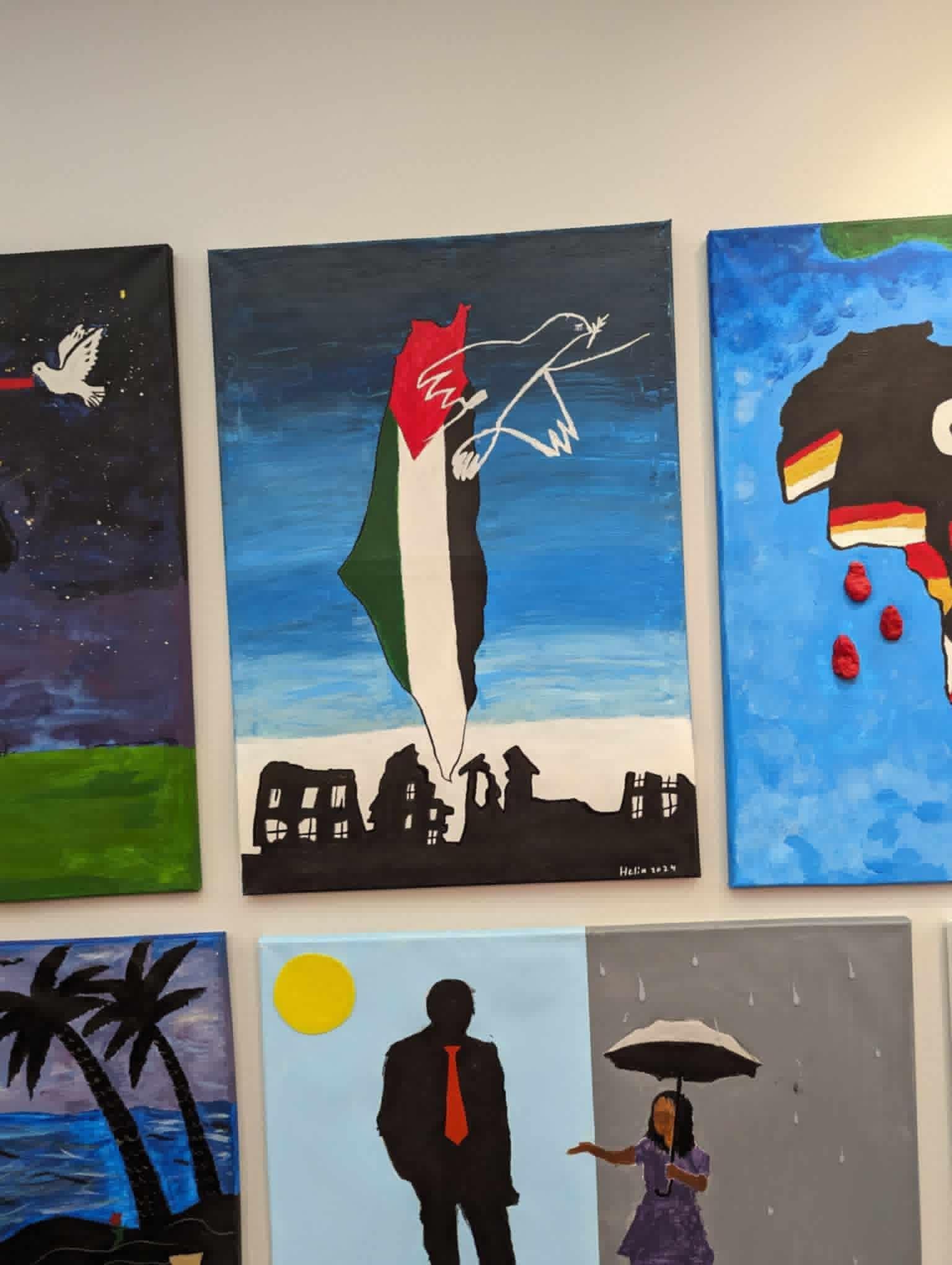
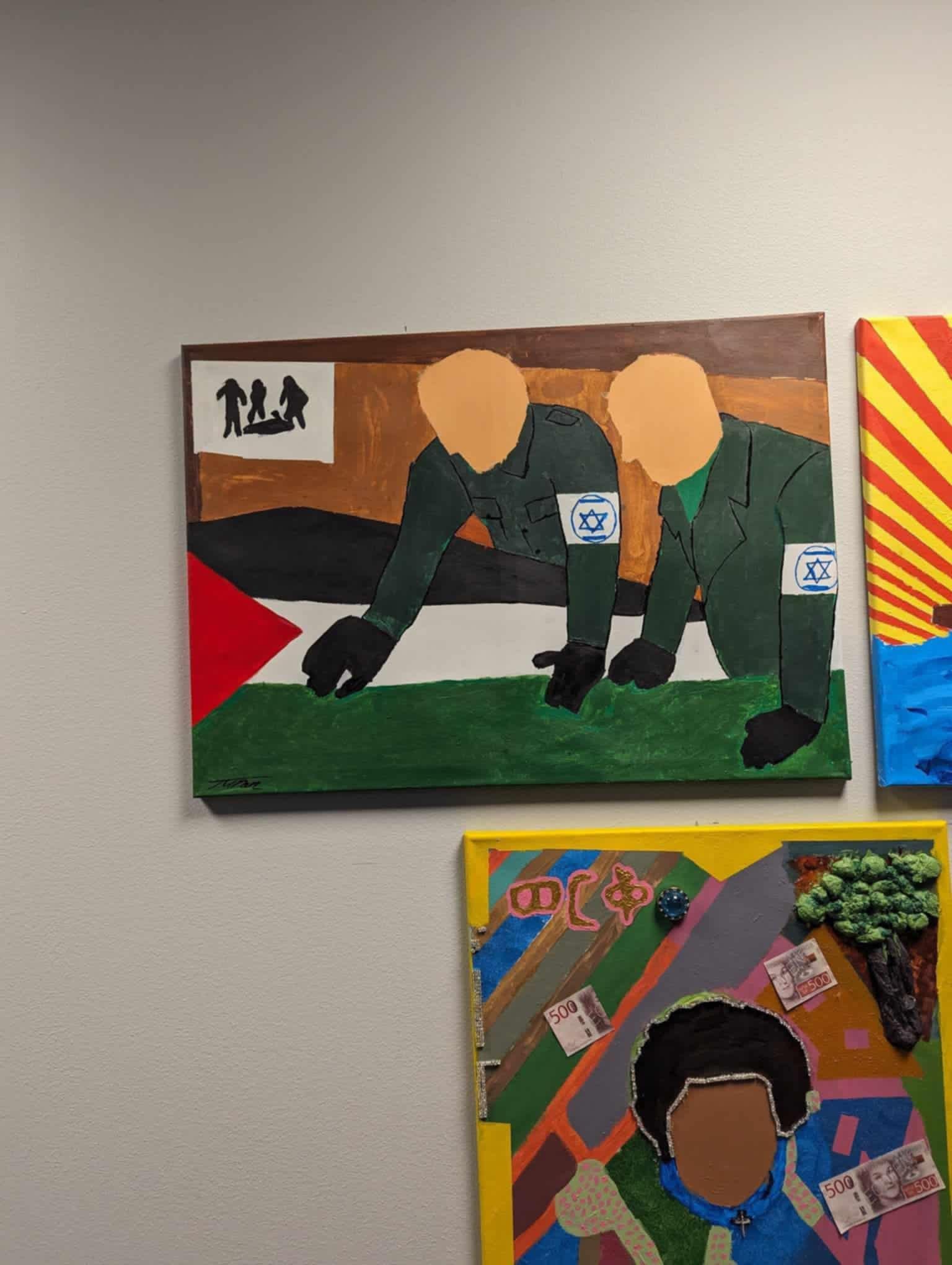
According to the Kvartal article, there is no documented evidence from Kulturhuset that anyone was upset by the exhibition.

However, it wasn’t hard to find such a person. “I came to Kulturhuset and saw that paintings were being hung on the wall. When I looked at them, my heart ached, I felt cold, and I started trembling with shock over seeing the hatred,” said a person with Jewish background who was at Kulturhuset when the paintings were hung up and chose to remain anonymous because he is worried about his safety.

For those who are not familiar with Middle Eastern politics, it might seem strange, but a map of Israel covered by a Palestinian map is as loaded and shocking as a map of Poland covered by a Nazi flag or a map of Ukraine covered by with a Russian flag. It symbolizes ethnic cleansing for Israelis. Paintings depicting Israeli soldiers as murderers support the narrative that Israel is the aggressor and the Palestinians are the victims, while ignoring the October 7 massacre, Israeli hostages, and rocket attacks on Israel. The context of post-colonialism challenges Israel's legitimacy as a state and its right to exist.

It doesn’t matter if these claims are true or whether such opinions should be allowed to be expressed. This is not about censorship or freedom of speech. Yes, students should be encouraged to think critically and creatively. Yes, we must encourage an open public debate. But the issue here is a different one – the relationship between publicly funded institutions and controversial political content.

Kulturhuset manager, Malin Dahlberg, pointed out that there is a responsibility to create a safe and comfortable environment in public spaces. According to her, removing only the most problematic paintings would be insulting to those who created them, which is why all the paintings were taken down. Leaving them up could also expose the students to a media storm that no 15-year-old could handle.

Dahlberg is right.

Sweden is a polarized country where people have strong opinions and personal connections to the conflict in Gaza. People are bombarded with extreme views on social media. Some believe it is an Israeli genocide, while others see it as an Islamist holy war of extermination against Israel. Many have relatives affected by the violence. Many are angry and scared.

These people have something in common. They all need healthcare, education, and welfare. We must be able to offer safe spaces for this. There are many places for political activism – squares for demonstrations, galleries for political art, youth movements for youth activism, organizations for humanitarian work, and media for political debates.

Some places, the ones where we send our young children, the places where we treat our pain, and those where we invest our shared resources, should be free from polarizing content. Schools, hospitals, and clinics, and yes, if it’s public and taxpayer-funded – even Kulturhuset – have no place for Quran burnings, no place for NMR marches, and absolutely no place for polarizing political propaganda. Not even if 15-year-olds created it.
?Why Stop Israeli Art

Swedish freedom of speech applies in all situations. That's the message when Korans burn and Nazi marchers take to the streets. But Israeli video art during Culture Night is canceled due to the "security risk"?

Published in Svenska Dagbladet: https://www.svd.se/a/JbWra7/varfor-far-inte-israelisk-konst-delta-under-kulturnatten?fbclid=IwZXh0bgNhZW0CMTAAAR0F9EJjuYazcpPDIOh8CRQ_dm_4cklJZWMbQBjWhfzltVRKB5XJ74oOpD8_aem_AeOcy3lg7mlRs_87dcgOhUN9TjUgr9Q6YNvci7d-YQJYoYg4B3yWx-xKVEKtWkS4uFaXscmbBNdn1LQQkoAad3gd

Last Friday about twenty pro-Palestinian activists marched past Stockholm's Jewish school protesting against the war in Gaza. There was no rioting or threatening behavior and there were plenty of policemen to keep the peace. Still, there were reasons for concern. It's no secret that some pro-Palestinian protesters use antisemitic slogans and exhibits antisemitic behavior. The term "Intifada", for example, is often used in demonstrations and in this context, it means violent resistance against Jews. "Inga zionister I våra gator" is a clear comparison of Zionism and Nazism which is antisemitic according to most experts. And it's not only slogans. Recently, Holocaust survivors were screamed at when they entered Stockholm's Great Synagogue and in Malmö hundreds of people celebrated the October massacre in southern Israel. In this context it's easy to understand why the idea of Pro-Palestinian protesters marching by a Jewish school may seem less than appealing. But freedom of speech is a sacred value in Sweden – it applies at all places, under all conditions and at any risk. If you choose to shout that Israel is a "butcher of small children" (små barn slaktare), you're entitled to so even near Jewish children. That's what Swedish democracy is all about.
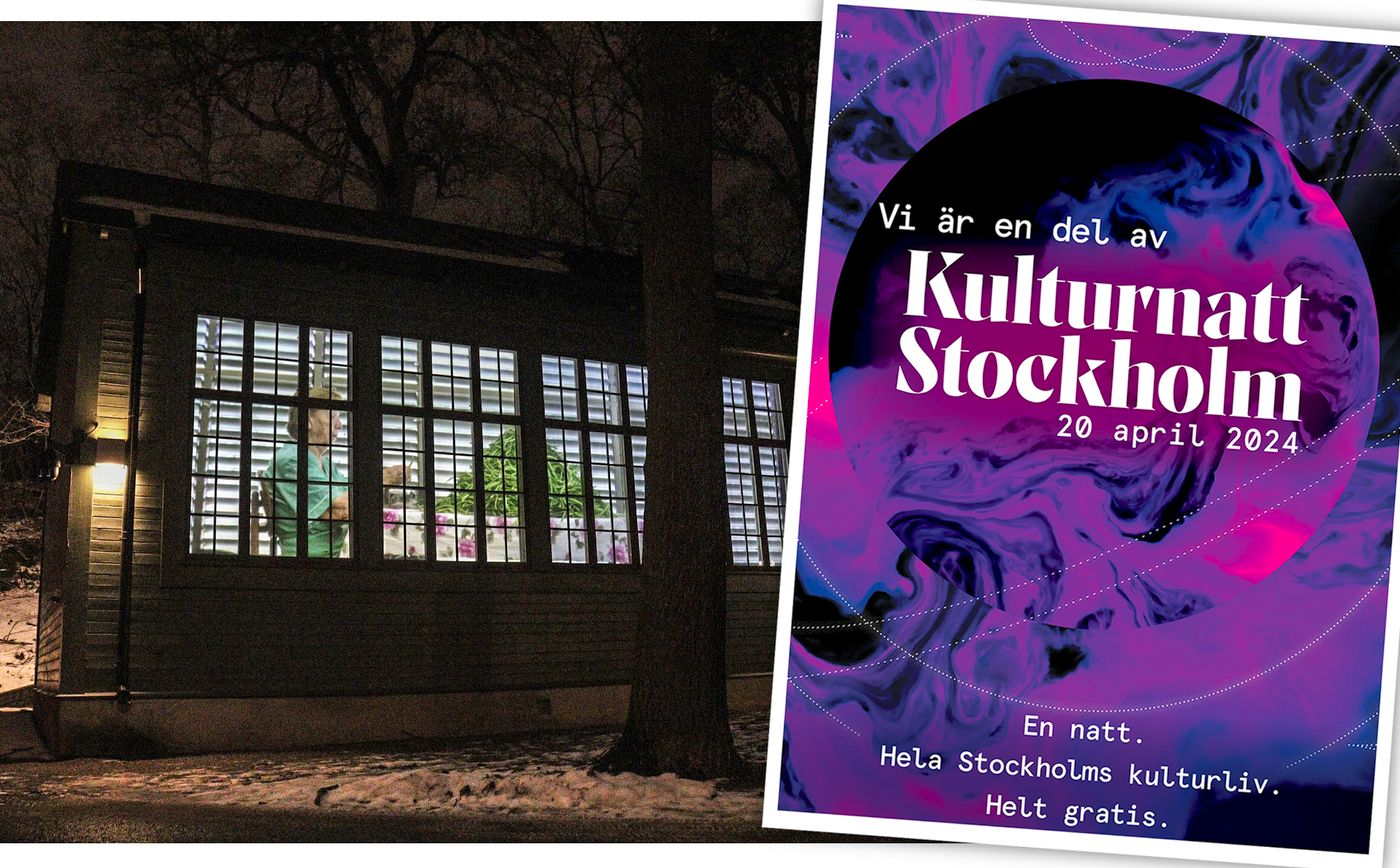
Unless, of course, you're Israeli. At least that's how it seems in Stockholm's culture world. As part of Stockholm's Kulturnatten, the Israeli embassy, like other embassies, planned a cultural event – a video art gallery presenting works by three female Israeli artists focusing on female figures presenting various interactions with nature. Just to be clear – the works are not political; they were created before the current war and the plan was to have them projected on the wall of a building adjacent to the embassy. That way, viewers don't have to enter the embassy or even get particularly close to it. They just pass by on the street, viewing from a public space. Being entirely in the spirit of Kulturnatten, Stockholm Stad approved the project and published it in the event catalogue. Then, a week ago, the Stockholm officials changed their minds and the Israeli project was suddenly taken off the program.
Why this sudden change of hearts? Could it have something to do with social media campaigns, anti-Israeli sentiments and the fact that Israel isn’t the most popular country in certain circles these days? "Varför låter ni Israel utnyttja Kulturnatten för att flytta fokus från det pågående folkmordet och försöka rentvätta sitt anseende med kulturens hjälp?" (Why do you allow Israel to use Culture Night to shift the focus from the ongoing genocide and try to clean its reputation with the help of culture), this was part of a social media campaign launched on April 3rd by Palastinagrupperna. It's hard to say what effect the campaign had on Stockholm decision makers, but one thing is clear – less than a week after it was launched City Hall cancelled the event it previously approved.

Video art by Israeli artist Tal Kronkop on the Israeli Embassy in Stockholm

When I asked Stockholm Stad, why the event was taken of the program, the answer was clear: "The decision to not market/promote the program was made entirely on the basis of the security situation and public safety". A City Hall spokesman also explained that "the heightened threat towards Israel and the decision by the State of Israel to close the embassy on April the 5th, changed the risk assessment. Answering my question, he admitted that there have been comments on social media and that emails asking for the Israeli event not to be included were received, but the "security situation" was the only reason for cancelation.
"We expect the city of Stockholm to reverse its discriminatory decision", an Israeli embassy official told me, "they can exclude us from their program but it won’t stop Israeli culture. We've been through worse and will continue to thrive". The official added that even though the program was canceled by Kulturnatt, it will still be presented as planned. It's important to point out that the cancelation decision was made by Stockholm Stad, not by SÄPO or the Police which Stockholm Stad says has no jurisdiction in this case. Instead, city officials based their decision on a press report saying that Israel recently decided to close its Stockholm embassy. It's unclear how this partial and unofficial information is relevant, since the art exhibition was planned to take place outside the building in an entirely public space. The result however is clear – while embassies and cultural institutions of countries from Hungary to Mongolia will officially be part of the city festivities, Israel will show its art without being included in the party. If Stockholm decided to be part of the international BDS bullying movement, it can at least say that's what it's doing. instead it's hiding behind claims of "security situation".
Time and again has Sweden preached to the world that freedom of speech doesn't work only when it's convenient. Rasmus Paludan was allowed to burn Quran books upsetting thousands of believers and endangering Sweden's NATO application and national security. Neo-Nazis are regularly allowed to march through Swedish streets and radical Islamist can arrange rallies and publish propaganda. Does Stockholm Stad really want to tell us that all these are worth taking the risk for in the name of democracy and free speech, but the art of three Israeli women isn't?