'In Norway, We Have Yet to Confront the Full Meaning of the Holocaust'

Irene Levin turned the hundreds of notes her mother left behind after her death into a book chronicling the story of Norwegian Jews during the Holocaust.

Published in "Haaretz": https://www.haaretz.com/world-news/europe/2025-04-30/ty-article-magazine/.premium/in-norway-we-have-yet-to-confront-the-full-meaning-of-the-holocaust/00000196-804b-dc27-a3df-f2fbf3d80000

When Irene Levin's mother was 96, she left her apartment in Oslo and moved into a Jewish old age home. Levin and her two children wanted her mother's – and their grandmother's – new home to feel like a miniature version of the elegant, meticulously arranged apartment she had lived in for decades. To do so, they moved in the gilded-upholstered furniture, the paintings, the silverware, and the mirrors her mother never passed without briefly checking her reflection. As part of the process, they also cleaned and organized the apartment.

It took Levin more than five years to understand the significance of what she found during that process. "There were notes everywhere," she told Haaretz in an interview. "Some were hidden in piles of newspapers, other were tucked away in drawers, on shelves, and in cupboards. Some had only one or two sentences, others were full pages written in my mother's handwriting. Although they weren't dated, her handwriting showed they spanned different time periods – the 1960s, 70s and 80s.

Levin's mother, Fanny Raskow, died in 2013 at the age of 101. "After she passed away, and after I retired, I started reading the notes," Levin recalls. "Mostly the notes were about World War II, but also about her upbringing before the war in a family that had escaped to what is now Lithuania. There were many unfinished sentences, especially those dealing with the arrest and deportation of her father, my grandfather. It's unclear who the notes were meant for. Maybe she wrote for herself, as a way of venting, or perhaps she hoped I would eventually find them. But she never mentioned them".

Levin says the notes revealed the dilemmas and choices her mother faced. "My mother blamed herself all her life for not being able to save her father," she says. "It haunted her constantly, until the end of her life. In all my upbringing there was a silence, and the war was never discussed openly. If it came up, it was always indirectly or through broken, incomplete sentences."

At a certain point, Levin realized that her mother's story was also the story of other Norwegian Jews. The result was her book, ("Vi snakket ikke om Holocaust. Mor, jeg og tausheten," Gyldendal, 2020, literally translated as "We Didn't Talk About the Holocaust: Mother, I, and the Silence"). The English version, titled "Everyday Silence and the Holocaust", was published by Routledge last year.

"My mother was trapped in a history that had been imposed on her, and one that for decades remained almost unspoken in Norwegian society," Levin says. "When I began researching in the National Archives of Norway in Oslo, I tried to see whether other Jewish families' stories were similar to that of my mother. I started asking new questions about my personal history and discovered experiences and events that had always been there, just not talked about.

"As a child, I simply acted on behaviors that seemed normal. As an adult – and as a professional – I began questioning my own story. Are the gaps in the stories significant? The fact that the life of our tiny nuclear family was defined by specific, historical events was something I simply knew. Just as one learns one's mother tongue intuitively, I learned about 'the war'. I lived my whole life in a community of World War II survivors, yet I still didn't really know much, despite believing I knew the whole story."

The story of Irene Levin is, to a great extent, the story of an entire generation of Norwegian Jews. Her grandparents' families emigrated to Norway around 1905 from Lithuania, fleeing poverty, hard conditions, and persecution. Levin explains that this migration differed from that of other Scandinavian countries. While Denmark and Sweden received "Ost-Juden" – Jews from Central Europe – there were already established Jewish communities in those countries. Some were prominent figures in society and openly identified as Jews. In Norway, by contrast, Jews were only permitted to enter starting in the mid-19th century. They were few in number, poor, and mostly uneducated.

Irene Levin's book, with Irene and her mother on the cover.

Less than 40 years after her grandparents arrived in Norway, they and their children had to flee. This time, it was due to the German occupation during World War II, and their destination was Sweden, the neutral and thus safe neighboring country to the east. Levin's parents were among hundreds of Jews who left Norway as the Nazi persecution escalated, peaking in the fall of 1942 when hundreds of Norwegian Jews were deported to Auschwitz.

Levin's parents received help from a neighboring family, and their escape was aided by friends and members of the resistance movement, who hid them from the Gestapo and the Norwegian police in various locations. Their journey took 23 days. Levin's mother was pregnant during the escape, and she gave birth to Irene, her first and only child, in the Swedish town of Norrköping, where the family stayed until the war ended.

After the war, Levin, her mother, and father returned to Norway and began rebuilding their lives. She was less than two and a half years old and doesn't remember Liberation Day, but it's clear to her that even then, silence began to play a significant role.

"We didn't talk about the war," she recalls. "The fact that the family went through a disaster was always present, but it wasn't spoken about. In the 1950s, when I was ten, we could be sitting with guests around the dinner table, and someone might suddenly say something like, 'It was Norwegian police who made the arrests, not the Germans.' And someone would reply, 'It doesn't matter, we're not getting them back either way.' Then the conversation would switch to the previous topic, and no one would ask, 'What do you mean?' Everyone knew what it meant, they just didn't talk about it for decades."

Did the silence begin right at the end of the war?

"You can tell from the Norwegian press how knowledge about what had happened slowly evolved. The free press resumed operations as early as May 14, 1945. On the second day, the country's largest newspaper, Aftenposten, asked, 'What happened to our Jews?' The article reported, 'There is reason to fear that many Norwegian Jews have died,' and quickly added that no confirmation had been received. In the weeks that followed, reports ended with phrases like, 'There is no reason to lose hope.' On May 17, the same newspaper reported, 'We have 750 Jews in Germany. So far, we've heard from only nine or ten.' Slowly, the news worsened, and by May 23, it was reported that the Jews had been taken to 'the notorious concentration camp Auschwitz.'

"After a while, the topic was no longer written about. It resurfaced in the trials of Norwegians who had collaborated with the Nazis, and in the court case of the Norwegian traitor Vidkun Quisling [a Nazi collaborator who headed the government of Norway during the country's occupation by Nazi Germany] where two survivors testified. One of them, the later well-known psychiatrist Leo Eitinger, told of Jews being gassed. When asked by the judge if Norwegian Jews were treated in the same way, he answered 'Yes, I swear to God.'"

The outcome of the war was catastrophic for Levin's family. Thirty-two members of her extended family, including her maternal grandfather, were murdered in Auschwitz. Her grandfather was deported along with hundreds of other Norwegians –men, women, and children – on November 26, 1942. Levin's mother tried to spare him by putting him in a hospital but he was taken from there, arrested and, the next day, loaded onto the ship SS Donau. After four days in its cargo hold, he and the others arrived in Stettin, where they were crammed into cattle cars. On December 1, they reached Auschwitz-Birkenau. Levin's grandfather's exact fate remains unknown. He was one of an endless number of victims who didn't survive and never returned to Norway.

The facts about World War II in Norway and the fate of its Jews are well-known. On the eve of the war, Norway had around 2,800,000 inhabitants, of whom about 2,400 were Jews, including around 500 from other nationalities. During World War I, Norway had remained neutral, and hoped to maintain neutrality again during World War II. But events took a different turn. A Norwegian fascist party, Nasjonal Samling (The National Union), founded in 1933 by officer and politician Vidkun Quisling, offered the Nazis cooperation in taking over the country. Germany invaded Norway and Denmark on April 9, 1940, in Operation Weserübung. Denmark surrendered within hours, while battles in Norway lasted around two months before the German victory, achieved after the Allied forces retreated and Narvik – a strategic port used for shipping iron ore from Sweden – was captured.

As the Germans occupied the country, the Norwegian king and government fled and formed a government-in-exile in London. Civilian rule in Norway was overtaken by Nazi official Josef Terboven, appointed Reichskommissar by Hitler. Terboven governed through a pro-German puppet government headed by Quisling. The Norwegian parliament was dissolved, all parties banned except Quisling's, and the judiciary was subordinated to German control.

Persecution of the Jews began with sporadic decrees early in the occupation. In 1941, arrests were made, property confiscated, and some Jews were executed on false charges. In 1942, mass arrests of hundreds of Jews were carried out, most of whom, including Levin's grandfather, were transported on the SS Donau to Auschwitz. Another ship, the MS Gotenland, transported 158 more Jews to the same destination in February 1943. In total, 772 Norwegian Jews were arrested or deported. The oldest among them 80, the youngest an 8-week-old baby. Fewer than 40 came back. Those who survived the war had mostly escaped to neutral Sweden or Britain.

The facts were known for decades, but their meaning has been the subject of public debate – one that Irene Levin, after publishing her book, is now central to. Levin is a professor emeritus of social sciences at Oslo Metropolitan University. Her work started in the area of family studies with emphasis on new family forms and gender studies. In recent years, she has moved her area of research into history and Holocaust studies and has been closely connected to the Norwegian Center for Holocaust and Minority Studies, including working with surveys on antisemitism. She has worked with Soviet Jewry and been active in applying for Norwegian non-Jews receiving the Righteous Among the Nations award, granted by Yad Vashem.

Her recent book adds to numerous other publications she's written or edited, covering topics from social sciences to remembrance, and the Holocaust in Norway. Her new book generated considerable attention in Norway. Positive reviews appeared in major newspapers; she was interviewed by media and gave lectures across the country for over a year. Headlines focused on themes like "The Holocaust That Always Sat Within the Walls" or "The Mother Who Dealt with Trauma Through Silence." Critics noted that Levin "presents her family's history as a gateway to understanding the Jewish tragedy in Norway," "gives us a micro-history that opens wounds – with painful, terrifying details," and "breaks the silence, telling dramatic stories of fate."

Is the silence of the survivors and Norwegian society similar to that of survivors in other countries, or does it have unique characteristics?

"The phenomenon of silence is not unique, but circumstances vary. What's special about Norway is that it had a small number of Jews and geographically, with the long border with Sweden and the long coastline to England, one would think that it would be possible to hide more".

"Moreover, Norwegian Jews loved Norway. They learned the language and embraced the culture; they embraced the Norwegian love of nature and even changed their surnames to make them easier for their neighbors to pronounce. That's why what happened shocked them. They told themselves that they were arrested by the Gestapo – when, in fact, it was the Norwegian police.

"My mother always said: 'It took such a long time until we really understood, Irene.' Those who survived and returned weren't like the other Norwegians coming back after the war – the resistance fighters or political exiles. They weren't heroes. They won the war. The Jews had not won the war. They were deported or fled because of who they were, not what they did – and that came with a sense of shame. They asked themselves, 'What kind of Norwegians are we now?'"

Levin explains that other elements were involved. Some blamed themselves for failing to save relatives. They were grief-stricken, and many had to face the painful, often unsuccessful process of reclaiming seized property. Homes and businesses had been confiscated or auctioned off. Only in the 1990s, following a media campaign and the creation of a restitution committee, did Norwegian society begin to seriously reckon with the Holocaust. Survivors received compensation, and the Norwegian Center for Holocaust and Minority Studies was established.

"Until the 1990s, the story of the Jews was not integrated into the national historical narrative," Levin says. "It's not that people didn't know what happened – there were books and survivor testimonies – but Jews were not part of the main story. The Holocaust in Norway was like an appendix to Norwegian history, not part of the official narrative."

So, if the Holocaust wasn't part of Norway's war story, would it be accurate to say that Norway didn't take responsibility for what happened to its Jews?

"In three major historical books that shaped the narrative and were published in 1950, the extermination of the Jews was described merely as a 'detail'. Later, in the 1980s, six volumes titled 'Norway at War' asked: What happened to the Jews? The answer is mostly covered in the third volume, spanning 18 pages with photos. In the final section, the question is raised – could more have been done to help the Jews? could they have been warned about what deportation meant? the answer the book gives is that Jews in all occupied countries and even in the free world underestimated the cruelty of the SS. That is, responsibility was ultimately shifted to the Jews themselves – because they didn't resist arrest.

"When I first read these, I thought that they did the same as my mother, blaming herself for her father's arrest, as did society at large. Both the minority and the majority put the responsibility on the Jews. But I realized that when my mother blamed herself, she was taking the burden on herself, bearing the responsibility – as a Jewish woman and a daughter. When the author, as a representative of society, blamed the Jews, it was the opposite: it was the removal of responsibility."

Irene in her mother's arms, 1943.
Irene Levin and her mother on 1943. Photo: Irene Levin

Do you think this perspective still echoes in Norway in 2025, amid rising antisemitism and claims that Norwegian society is abandoning its Jews?

"For the Jews in Norway [the community numbers approximately 1,500 people], October 7 is an echo from the war, while knowing that it was not the same and that the Holocaust is unique. But Norwegian society at large did not hear the same echo. They only heard the voice from Hamas and very quickly defined the attack as a continuity of occupation.

"It was a shock that the empathy that the Jews in Norway had earned due their history during the war, suddenly disappeared. I never thought that during my lifetime, I would experience a rise of antisemitism. When researching the Holocaust and antisemitism, I was doing it as something belonging to the past to ensure it would not happen again. Suddenly, the Jewish state was attacked and its legitimacy was at stake. The Jewish voice has lost its legitimacy.

"My grandmother would always tell me: 'Die Juden sind schuldig' – the Jews are to blame, always. I thought that was relevant to the shtetl, not my everyday life. There is a shift in the perception of responsibility and legitimacy – the focus has changed, and it is no longer in our favor. I demonstrated on Women's Day and my fellow feminists didn't allow us to participate! They questioned whether there were even sexual assaults on October 7; and if they did accept that they happened, they minimized their significance, treating it as something that 'naturally' happens in every war.

"In my research on silence, an important factor is the interaction between the individual and society. After World War II, it was not only the Jews who were silent. The society at large was silent, too, but for different reasons. The space the minority has is shaped by the majority. It took Norwegian society 50 years before it recognized its responsibility in the atrocities. In the current situation, the Jewish voice has little legitimacy and the connection with society at large is of distrust. But can we Jews wait for the society to show us such a space? We have to take it. In that sense, it's like a revolution."

At the end of the interview, Levin returns to the topic of silence, which she sees as the common thread between the biographical and the historical. It's a silence shared by many survivors of the war, but Levin suggests that it is an even broader phenomenon.

"If you had asked me about the Holocaust while I was growing up – if you had asked me whether I knew about the war and what happened to the Jews – I would have said yes," she says. "But today I know that I didn't know. I didn't have the details; I didn't know what really happened. What I had was a sense that a catastrophe had occurred, and that it had happened to the Jews. Nothing more.

"And maybe that's similar to other disasters, like what happened on October 7. Even though information spreads much faster today, the feeling is similar. We know a disaster occurred, we think we understand it, but as time passes, we realize in hindsight that we didn't know everything, that we didn't grasp the scope, and that we still haven't dealt with all the implications."

Top Members of Far-right Swedish Party With neo-Nazi Roots Meet Israeli Minister in Knesset

Israel has so far refrained from engaging with the Swedish Democrats amid antisemitic and Islamophobic sentiments expressed by members. Party members told Haaretz that they met with several ministers during their visit but refused to disclose their names.

Published in Haaretz (with Jonathan Lis and Noa Shpigel): https://www.haaretz.com/israel-news/2024-01-29/ty-article/.premium/top-members-of-far-right-swedish-party-with-neo-nazi-roots-meet-israeli-minister/0000018d-564e-d0fc-a9bd-5e5f9ff00000

A delegation of senior members from the far-right party in Sweden, the Swedish Democrats, arrived in Israel on an unofficial visit and met on Monday with Israeli Diaspora Affairs Minister Amichai Chikli in the Knesset.

The party, currently the second-largest in the Swedish parliament, has roots in neo-Nazi and antisemitic ideologies. It is one of several European parties with which Israel has refrained from establishing official ties.

The delegation has visited Yad Vashem, one of the crossings connecting Israel to the West Bank, and the Old City in Jerusalem. Yad Vashem Museum has emphasized that the delegation members registered for a regular guided tour at the site, like any other tourists, and did not have an official visit within the compound.

Officials in Sweden following the party suggest that the visit is part of its attempt to whitewash its antisemitic and racist positions by presenting itself as a friend of Israel. In a post on the social media platform X (formerly Twitter), the party leader, Jimmie Akesson, wrote: "It is clear that our parties and our nations share common values," accompanied by a photo of himself with Minister Chikli.

Party members told Haaretz that they met with several ministers during their visit but refused to disclose their names.

Israel has so far refrained from engaging with the Swedish Democrats not only due to their neo-Nazi roots but also because members of the party have disseminated conspiracy theories and expressed racist, antisemitic, and Islamophobic sentiments in recent years.

Israel's Ambassador to Stockholm, Ziv Nevo Kulman, even declared that Israel does not maintain and will not establish future relations with the party. The Israeli foreign ministry, which was not involved in coordinating the visit, clarified on Monday that "there is no change in policy towards the party."

Among the delegation members who visited the Knesset were party leader Akesson, the chairman of the Swedish parliament's foreign affairs committee, Aron Emilsson, the head of the party's parliamentary group, Linda Lindberg, and the head of the party's group in the European Parliament, Charlie Weimers.

Weimers is one of the party's top members who already visited Israel in May of last year. During the previous visit, it was reported that party leaders met with Knesset member Amit Halevi from Likud and former Knesset member Michael Kleiner, who now serves as the president of the Likud's court.

Though part of the Swedish political establishment today, the Sweden Democrats do indeed have roots in Nazism. Some of the party's founders were known Nazis, such as its first auditor, Gustaf Ekström, who was a Waffen-SS veteran.

The party's first spokesperson Leif Ericsson and its first chairman Anders Klarström were both active in various neo-Nazi and extremist right-wing parties, and the chairman of the party's youth organization, Robert Vesterlund, was also a known neo-Nazi. During the 80's and 90's, the party was a marginal force in Swedish politics, and it began distancing itself from extremism and aligning itself closer to mainstream politics in the mid 90's.

The party entered the Swedish parliament for the first time in 2010, and in the elections held a year and a half ago, it received over 20% of the votes. Until a few years ago, the party was ostracized by parties across the political spectrum in Sweden and was not considered for inclusion in any coalition.

However, due to a change in approach by two traditional right-wing parties, the Swedish Democrats became an integral part of the right-wing bloc after the elections, with the government in Stockholm entirely dependent on their support. Party members wield significant influence over the government's policies and hold key positions in parliamentary committees, including foreign affairs, justice, and industry and trade.

In recent months, the party has been attempting to position itself as "the most pro-Israel party in Sweden" and distance itself from its antiemetic and neo-Nazi past. However, in 2021, the Swedish newspaper Aftonbladet revealed that the party leader in the second-largest city council in Sweden, Gothenburg, Jörgen Fogelklou, had posted antisemitic and racist statements on social media, such as "It is clear that the Jews are the root of all evil in the world."

Two years ago, it was exposed that some party members had connections with neo-Nazi movements even in recent years. For instance, one party member in southern Sweden, Jonas Lingren, publicly supported rock bands advocating for "white supremacy" and used the slogan "Skinhead 88" (88 is a known code for Heil Hitler, i.e., HH).

The Myth Behind the Rescue of Denmark's Jews From the Holocaust

Recent research reexamines the historical myths surrounding the rescue of Danish Jewry during the Holocaust, exposing surprising underlying interests

Published in Haaretz: https://www.haaretz.com/world-news/2023-02-03/ty-article-magazine/.highlight/the-myth-behind-the-rescue-of-denmarks-jews-from-the-holocaust/00000186-140b-d5d5-adef-349bb2730000

STOCKHOLM – Out of the horrors of the Holocaust came no few tales that stir inspiration, but many of them ended with a firing squad or a hangman’s noose. The rescue of Denmark’s Jews, whose 80th anniversary will be marked this year, was different. It was the story of a country that decided to rescue all the members of its Jewish community – and succeeded.

Danish Jewry had an advantage not shared by other Jews in Europe: In the wake of a leak in information from Germany, they knew what was in store for them. Indeed, in October 1943, during Rosh Hashanah, many had already heard the report of their looming expulsion. Denmark’s Jewish population stood at approximately 7,700 at the time, among whom were 1,200 Jews who had arrived there recently from other countries. Those who received the report were requested to pass the information on to other members of the community and to go into hiding. Concurrently, a kind of popular uprising erupted. Ordinary Danes – police officers and postmen, waiters and drivers, teachers and clergy – spread the news, and some also helped Jews find escape routes and places to hide. Thanks to the popular support, nearly all the Jews were able to find places where they could hide from the Gestapo during raids, and then places where they could wait until they could make the trip to Sweden, which had already offered them a safe harbor. Not everyone managed to escape. Some ill and elderly members of the community were captured by the Germans. In the town of Gilleleje, for example, the Gestapo caught and arrested several dozen Jews who were hiding in a church loft. However, the vast majority managed to reach the villages and towns along the coast of the Strait of Oresund, which separates Denmark and Sweden. Residents there continued to hide them until fishermen and sailors could take them to neutral Sweden on boats. Here, too, not everything went smoothly – some of the vessels sank – but eventually the majority of the country’s Jews, more than 7,200 individuals, reached Sweden.

Most of the facts about the rescue of Danish Jewry are not in dispute. The story became a formative myth that is taught in the Israeli school system, is marked at ceremonies and commemorated at public sites, such as Denmark Square and Denmark High School in Jerusalem and in a square in Haifa. In contrast to what many people assume, however, the Danish people was not designated as Righteous Among the Nations by the Yad Vashem Holocaust Memorial in Jerusalem (that honorific is granted only to individuals), though three trees were planted there in honor of the people of Denmark, the country’s underground organization and King Christian X (who reigned from 1912 to 1947).

This assumption is another example of the fact that not everything related to Danish Jewry during the Holocaust is faithful to the facts. One of the well-known stories, for example, is that the king wore the telltale yellow Star of David patch Jews were forced to wear in many occupied countries while riding his horse in the streets of Copenhagen, as a mark of identification with the community. That account turns out to be false, probably a result of public relations efforts during the war by Danes who lived in the United States and sought to better the image of their homeland, which had capitulated to the Nazis almost without a battle.

To understand whether the other accounts are also vitiated by elements that do not square with the truth, we need to return to 1940. “Denmark survived the Nazi occupation better than any other European country,” says historian Orna Keren-Carmel of the Hebrew University of Jerusalem, an expert in Israel-Scandinavia relations and author of the 2021 book “Israel and Scandinavia: The Beginning of Relations” (in Hebrew), on the ties between the young state of Israel and the Scandinavian countries.

“When Hitler invaded Denmark, Norway, Holland, Belgium and France,” Dr. Keren-Carmel explains in an interview, “he made them all the same offer: surrender in advance, and in return you will be given the possibility of going on managing your domestic affairs in a sovereign manner, while Germany will be in charge of foreign policy.”

Denmark was the only country that acceded to this offer, signing terms of surrender within hours, on April 9, 1940. According to Keren-Carmel, the Danes knew they had no chance against the “giant from the south.” They preferred to capitulate, preserve their ability to function and to minimize the blow to the civilian population, its property and the country’s economy. “The Germans, from their point of view, chose to rule Denmark with a ‘velvet hand’ in order to maintain political stability and avail themselves of Danish exports,” she says.

In addition, she notes, this approach also dovetailed with the Nazi theory of the racial affinities of the Aryan race and the Nordic race, and with the “new European order”: The Nazis’ plan was for the Nordic peoples to help them rule the so-called inferior peoples of Eastern Europe after the war.

The Danes thus remained in control of their three branches of government – legislature, executive and judiciary. Moreover, daily life proceeded as before, and in March 1943 a free election was held in which the parties that were in favor of cooperation with Germany won 94 percent of the vote. Even the lives of the Jews had not changed substantially up until that point: They had retained their property, jobs and income, and were not required to wear a yellow patch or move into ghettos. Even synagogue worship continued unabated.

In the summer of 1943 a political crisis developed in Denmark. Why did it happen and was it the cause of the change in policy regarding the Jews?

Keren-Carmel: “After a surge in resistance activity by the Danish underground in [mid-] 1943, Germany demanded that the death penalty be imposed on its members. The Danish government objected and resigned on August 29, and from that day ministerial directors general, not ministers themselves, were actually the ones making decisions in the country. For many years, August 29 was seen to be the watershed date on which the Danes ceased to cooperate with Nazi Germany and declaratively joined the Allies. The rescue of the Jews, which took place about a month later, bolstered this conception. However, in recent years quite a few researchers, especially Danish scholars, have come up with a different view. They maintain that a few weeks after the members of government stepped down, relations between the Danes and the Germans returned to the former routine and the proportion of Denmark’s industrial production earmarked for Nazi Germany remained intact.”

After August 29, a state of emergency was declared and the Reich’s plenipotentiary in Denmark, Werner Best, decided to expel the Jews to the Theresienstadt camp/ghetto in Czechoslovakia. According to Keren-Carmel, shortly before the start of the planned deportation, which was due to take place on the night between October 1 and 2, Best himself decided to leak its exact date to his naval attaché, who passed on the information to senior Danish and Swedish officials.

“This was apparently an attempt to continue the political-economic cooperation between Germany and Denmark, and also an effort to avoid a conflict with the Danes over the Jews,” Keren-Carmel explains. “In the end, Best was able to report to Hitler that Denmark was ‘free of Jews.’ The fact that the Jews had escaped from the country and had not been deported to Theresienstadt made little difference, from Best’s point of view.”

How did the Nazis respond to the fact that the deportation plan had been leaked and to the events that followed?

“The German police were ordered not to break into Jewish homes by force. Some survivors also testified that the Germans turned a blind eye to the Jews’ attempts to hide and escape. Around this time, the commander of the German fleet, who was in charge of the passage in the Oresund Strait, instructed all German patrol boats there to return to port for maintenance. It’s also known that the Germans received intelligence information in real time that thousands of Jews were reaching Sweden, but they had a greater interest in preserving fruitful relations with the Danes than in annihilating the country’s small Jewish community.”

If so, even if it was the Danes who initiated the rescue operation, its success was apparently due primarily to the Germans’ conduct. But the number of Jews who didn’t succeed in escaping was not negligible – and they included not only the sick and the elderly in Copenhagen. For example, the leaked information about the expulsion did not reach members of the Hechalutz movement and other Zionist pioneering groups preparing for life in Palestine, who were then living in far-flung, isolated farms. All told, 482 Jews were captured and transported to Theresienstadt (none were sent to death camps); 53 died in the camp and the rest returned in April 1945 to Denmark within the framework of Operation White Buses, which was initiated by the Swedish aristocrat and diplomat Count Folke Bernadotte.

What prompted Danish society and members of the Danish underground to make an effort to rescue the Jews?

“The overwhelming majority of the citizens who helped hide the Jews of Denmark and get them to Sweden did not come from the underground and did not join it afterward. The Danes who helped the Jews did so in order to preserve the country’s democratic character – not as part of a resistance operation. In the Israeli culture of memory, however, the rescue has become a myth and the emphasis has been placed on the Danes’ singular humanitarian nature. That myth strengthened the assumption that those countries that wanted to save their Jews, like the Danes, could have done so, and that perhaps other countries did not want to do that enough.

אורנה קרן
Orna Keren-Carmel. Photo: Yoni Carmel

“But beyond the fact that a concrete possibility of rescue existed in Denmark because the Germans looked the other way, the explanation for the unprecedented success can be attributed to the character of the Danish government. In the 1930s, Denmark, like the other Nordic countries, had begun to take shape as a welfare state. One of the principles that guided its government in building this comprehensive welfare state – up until today – is that of equality. The moment you are part of a country, it has full responsibility toward you. In accordance with this concept, the Danish authorities saw it as their mission to protect the Jews and therefore were vehemently opposed to any infringement of their rights. For example, already in the surrender agreement in 1940 [in April, shortly after the Nazis invaded the country], the Danes declared that they would not allow any harm to befall the Jewish minority.”

According to Keren-Carmel, this commitment continued even after almost 500 of its Jews were deported to Theresienstadt. “The relatively high survival rate of the Danish Jewish inmates in that camp can be explained by the agreement the Danes signed with Adolf Eichmann, according to which Denmark’s Jews would not be deported to camps in the East, and by the fact that those who were at Theresienstadt were permitted to receive packages of food, vitamins and warm clothing from the government in Copenhagen.”

Moreover, the historian notes that the Danes were the only ones who insisted, and succeeded, in making official visits to the citizens imprisoned in Theresienstadt, in June 1944. “The Danish authorities were also able to preserve most of the Jews’ homes and property while they were in Sweden. They locked their abandoned homes and stored their property, then returned it all after the war. Denmark was the only country which, upon the return of the Jews at the end of the war, paid them compensation at its own initiative for the economic reversals they had suffered.

“The explanation for the rescue lies in the state’s approach toward its minorities. It was a rescue that effectively came from above, and not as it’s usually depicted – as a rescue by the people, from below. Many Danish citizens, especially fishermen, exacted payment from the Jews, in some cases exaggerated amounts, for helping them escape. That is not surprising, but it shows that the true hero of this story was not the ordinary Danish citizen but the Danish welfare state.”

How did the leadership of the Jewish community comport itself during the war years? Did the Jews actually resist the deportation or were they passive, placing their fate in the hands of their neighbors?

“For years the Jews of Denmark were depicted as passive victims. The Danes were said to have warned them, hidden them, supplied them with food and clothing, and finally also shipped them to Sweden. But the transformation that occurred in Israel in recent decades in the perception of the status of the survivors led to far-reaching changes in the way they’ve been represented, and the image of the survivor as an individual, as opposed to being merely part of a collective, began to gain prominence.

“When we delve into the details, we discover that the vast majority of Denmark’s Jews took pains to find themselves a place to hide. They left their homes within hours, found a way to reach the coast, and the majority financed their own boat trips to Sweden. Another unknown fact is that there was an active Jewish underground that was made up of members of the pioneering groups, which tried, albeit unsuccessfully, to smuggle its people to Palestine.”

The story of the rescue of Denmark’s Jews later created a tremendous impression in Israel. “On October 8, 1943, while thousands of Danish Jews looked for ways to cross Oresund Strait, Nathan Alterman published in his weekly ‘Seventh Column’ [in the daily Davar] a poem titled ‘The Swedish Language,’” Keren-Carmel says. “The poem lauds the opening of the gates of Sweden to the Jewish refugees unconditionally and without a quota, but the Danes’ contribution to the rescue isn’t mentioned in the poem at all. Over the years, however, the depiction of Sweden’s role as it has been represented internationally has diminished, and today its contribution is noted, if at all, as marginal.”

During the postwar years, the narrative that became accepted in Israel was that Denmark and Sweden were responsible for the rescue of thousands of Jews, whether in the wake of the rescue of the members of Denmark’s community or because of the actions of the Swedish diplomat Raoul Wallenberg. But the reality was more complicated: Denmark surrendered to Germany without a fight, and Sweden cooperated with the Nazis in multiple ways. So how and why was that narrative accepted?

“The Israeli culture of memory didn’t succeed in portraying the rescue event other than as a counter-example to the narratives involving other countries: The Danish people were presented as a ‘ray of light in the darkness of the Holocaust.’ The unique conditions and circumstances that [actually] made the rescue possible in Denmark, both from the German side and the Danish side, did not find a place or a memory in the rescue story.

“And there is also a political aspect here. The sweepingly positive representation of the behavior of the Danes and of the rescue efforts by Sweden and by the Norwegian underground, is a result of the good relations that developed between Israel and the Scandinavian countries after the state’s establishment. Scandinavian support for nascent Israel was frequently interpreted as a natural continuation of their support for their Jewish communities during the war. In this sense, the memory that took shape around the rescue efforts of Scandinavian countries served as a lever to enhance the diplomatic relations between the countries.”

The rescue operation itself and those who aided it were indeed a ray of light in the darkness of the Holocaust. However, at the same time, a more complex historical picture reveals that, just as Raoul Wallenberg did not, in his efforts, represent all of Swedish society, which did in some ways collaborate with the Nazis, it was also not solely morality that drove the Danes to act.

A slightly more nuanced view shows clearly that the more closely a country collaborated with the Germans, the easier it was for it to rescue its Jewish population. After the war, when the capitulation and collaboration became a historical legacy that was not something to be proud of, the rescue of Danish Jews assumed a new role. In addition to being a model of humanism, it also began to serve as proof of the country’s place on the right side of history. As such, the Jews and their rescue were transformed from a source of inspiration to an alibi.

Sweden Conference Promises 'A New Chapter' in Fight Against Antisemitism

Heads of state from several European countries and a world-famous Israeli historian were the stars of the show at last week’s International Forum on Holocaust Remembrance and Combating Antisemitism in Malmö.

Published in "Haaretz": https://www.haaretz.com/world-news/europe/.premium-sweden-conference-promises-a-new-chapter-in-fight-against-antisemitism-1.10302197

MALMÖ – A governmental pledege to establish a new Holocaust museum, a plan to criminalize organized racism, and vows by social media giants to increase funding to combat antisemitism on their platforms – these were among the main highlights that emerged out of last week's International Forum on Holocaust Remembrance and Combating Antisemitism, which was held in Malmö, the third largest city in Sweden. 

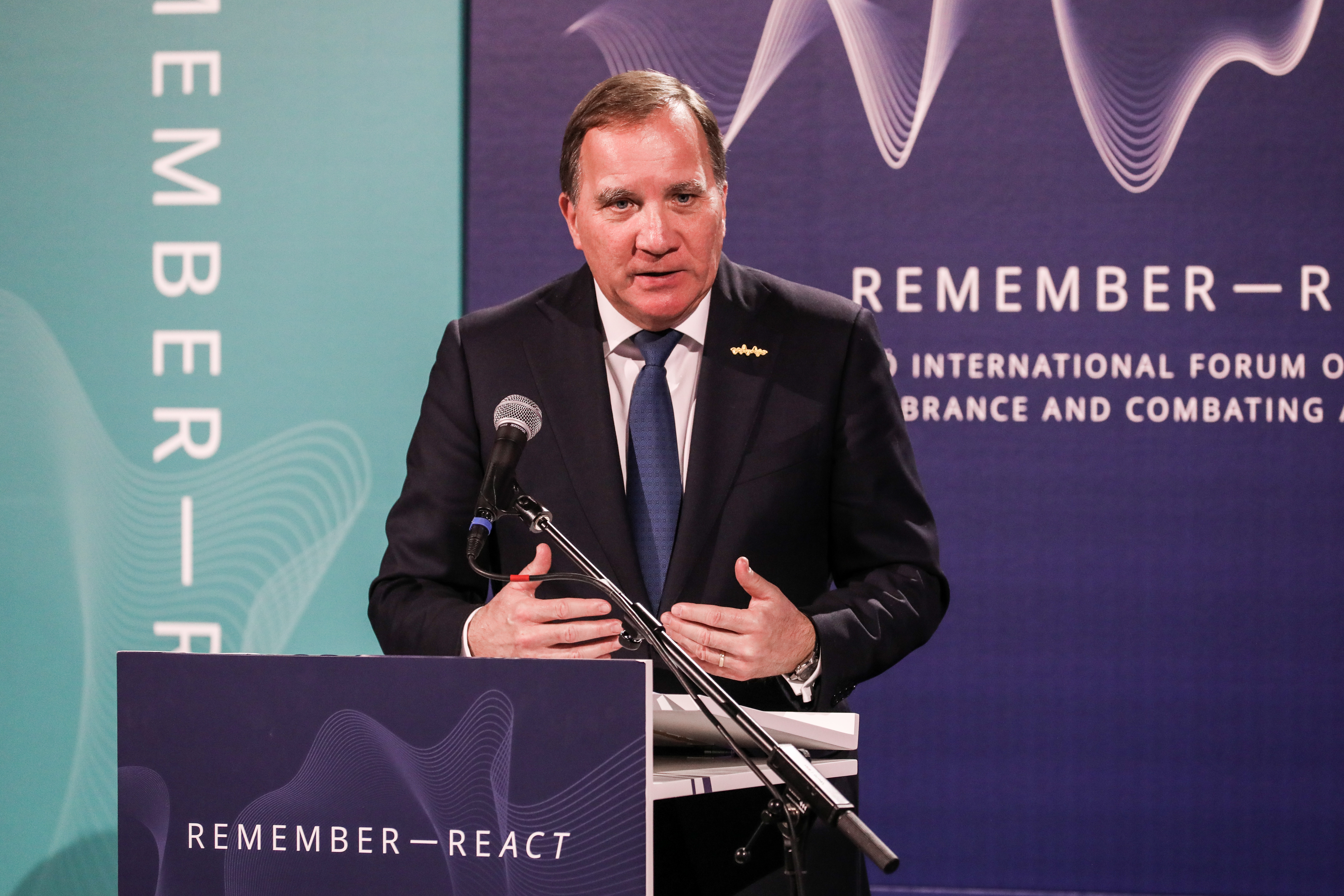
The Swedish government invited some 50 heads of state to the International Forum, but few sent their highest-ranking officials. Notable exceptions included the prime ministers of Albania, Estonia, Slovakia and Ukraine, and the presidents of Finland, Latvia, Romania and North Macedonia. Naturally, the host nation was represented at the highest levels, by Prime Minister Stefan Löfven, other senior ministers, and the country’s king and queen. Israel, meanwhile, was represented by Diaspora Affairs Minister Nachman Shai, while President Isaac Herzog made a virtual appearance. As he was entering the conference, Shai told the local media that “a new chapter of combating antisemitism is starting in Malmö today.”

Prime Minister Stefan Löfven at the Malmö International Forum on Holocaust Remembrance and Combating Antisemitism, Remember – ReAct, in Malmö on October 13, 2021
Photo: Ninni Andersson/Government offices of Sweden
Prime Minister Stefan Löfven at the Malmö International Forum on Holocaust Remembrance and Combating Antisemitism, in Malmö on October 13, 2021. Photo: Ninni Andersson/Government offices of Sweden

Even though Sweden itself has witnessed numerous antisemitic incidents in recent years, the Swedish government has been recognized as a world leader in efforts to tackle the scourge globally. “Threats and hatred against Jews remain widespread in many societies and have unfortunately increased, not least through social media,” Swedish Education Minister Anna Ekström said in an interview with Haaretz. “We can and we must do more to combat antisemitism, counter Holocaust denial and distortion, and promote democratic values and respect for human rights,” she added.

Originally planned to coincide with the 20-year anniversary of the Stockholm International Forum, the coronavirus pandemic put the conference on hold for a year. The original forum in 2000 was initiated by then-Prime Minister Göran Persson, as part of his efforts to deal with young people’s lack of knowledge about the Holocaust and a rise in antisemitism. Internationally, Persson’s campaign led to the foundation of what is now known as the International Holocaust Remembrance Alliance (IHRA), which is best known for its working definition of what antisemitism is.

Persson himself wasn’t present at last week’s conference, but the honorary chairman and senior academic adviser at the original forum, Israeli Prof. Yehuda Bauer, was. In a powerful speech, Bauer, now 95, told delegates: “We remember because this is an extreme case of a general human disease. This is not a Jewish illness, though the Jews are the obvious first victims. Antisemitism is a cancer in the body politic of the world’s societies.” The forum’s program was defined as “action-orientated,” as world leaders and representatives of private and civil society organizations were asked to present pledges and concrete programs to promote Holocaust remembrance and combat antisemitism.

Professor Yehuda Bauer at the Malmö Forum. Photo: Mikael Sjöberg/Government offices of Sweden

Sweden’s incumbent premier, Löfven, told the conference: “We’re not looking for another declaration, we’re looking for a way to translate the principles of these [Stockholm Forum and IHRA] documents into reality. It’s our duty to continue to tell the stories of Holocaust survivors when they are no longer among us; it’s our duty to do whatever necessary to counter the forces that threaten human dignity. It’s our duty to remember and react,” he said.

“I’ll never forget that when I was there, I learned from Prof. Bauer – one of the most forceful minds I’ve ever met – that the easiest thing to do when you’re a teacher dealing with an expression of antisemitism in the classroom is to pretend you didn’t hear it,” she relayed. “The next easiest thing is to simply tell the student to leave. None of this works. The strongest tool against antisemitism is for the teacher to have the time, the resources, the courage and the support of school leadership to interact with the young person. This takes time, it’s difficult and challenging.”

The guts to fight’

Several leading Jewish organizations were present at the conference, including the American Jewish Committee, the Anti-Defamation League and B’nai B’rith. However, it was the World Jewish Congress, represented by President Ronald Lauder, which was particularly active. The night before the conference, it hosted an event in Malmö’s synagogue attended by Lauder, Löfven, Israeli minister Shai, and the leadership of Sweden’s and local Jewish communities. During the event Lauder said: “There is still so much to be done. I’m not naïve; I realize the hatred of Jews has been with us for 2,000 years and will never completely go away. But we can do everything in our power to keep this virus from spreading.”

Speaking to Haaretz, Lauder praised the Swedish initiative. “Prime Minister Löfven is superb,” he said. “This man is committed to fighting antisemitism. He knows how important it is for his country.” When asked if he believes there is a future for Jews in countries like Sweden and, specifically, cities like Malmö that have become breeding grounds for antisemitism, Lauder said: “There’s a great future [for Jews] in Sweden. It may take time in Malmö, but Stockholm is growing and I believe that we as Jews don’t give up, we fight back. We in the World Jewish Congress have the guts to fight. Other international Jewish organizations don’t have the same guts we do, but we’re out there fighting.”

Perhaps the best perspective to understand the Malmö forum was offered by Bauer. “For the Nazis, the Jews were the paramount enemy,” he told delegates in his speech. “This makes the Holocaust an unprecedented event. A genocide for ideological, anti-pragmatic reasons such as the Holocaust can be repeated, not only with Jews as victims but with anyone by anyone. The Holocaust becomes a universal issue precisely because it is specific. Because it happened to a specific people, for a specific reason, it could happen to others – and so it becomes a universal threat.”