‘People just disappear in the middle of the night and their organs are harvested ‘

China experts and activists claim that the repression of minorities in Xinjiang has escalated in recent years, with thousands of Uighur Muslims in ‘reeducation camps’ being murdered and their organs harvested for wealthy Chinese and foreign patients. The Chinese deny all such allegations.

David Stavrou

Published in "Haaretz": https://www.haaretz.com/israel-news/.premium.MAGAZINE-china-s-xxx-files-people-just-disappear-and-their-organs-are-harvested-1.9340106

“The interrogation started at 9 P.M. and ended around noon the next day. The five officers didn’t hit me, but there was a sixth man and he beat me and threatened me. ‘I’ll remove your organs,’ he said, ‘and burn what’s left of your body.’” 

This is what Huiqiong Liu told Haaretz recently in a video call from her home in Europe. Liu was arrested at her Beijing home in 2001 when she was 29 years old, and taken for “reeducation through labor” as part of the Chinese government’s battle with Falun Gong – the spiritual movement that has been persecuted by the authorities since the late 1990s. 

Liu was in the camp for about 18 months, and was imprisoned again between 2005 and 2007. She says that during her first imprisonment, she was taken to a hospital for tests. “I told [a doctor] I have a heart problem, but she said my heart is fine. I asked if they’re planning to take it away from me, and the doctor said: ‘That will be decided by someone at a higher level.’” Liu decided to go on hunger strike. Eight days later, she weighed just 88 pounds (40 kilograms) and the doctors decided that her organs were no longer viable.

Liu says she also underwent blood tests, blood pressure tests, X-rays and ECGs during her incarceration. “Sometimes they would take us to a hospital; other times, a large vehicle full of medical equipment would come to the camp and the checkups would be done in it,” Liu recalls. “They gave us all numbers and the doctors would follow-up on our situation. The doctors only knew the numbers, not our names. Sometimes they would ask for a specific number to be taken to the hospital. Those people never came back.”

Liu says she has another vital piece of evidence: “Before I was taken to the hospital during my first arrest, they gave me a form to sign with my fingerprints,” she recounts. “The form was already filled out but the name and address on it wasn’t mine, it was a name I didn’t recognize. I didn’t want to sign, but they made me do so anyway. They didn’t let me see what it was I was signing, but when I asked other women who were arrested with me, one of them – a woman who was sentenced to death – told me it was a consent form, saying I’m willing to donate my organs after I die.”

‘Harvesting never left’

In recent decades, alongside China’s rising political and economic power, reports have also surfaced of human rights violations and methodical oppression of minorities and opponents of the regime. 

During this time, the Chinese authorities have been accused of torture, executions and organ harvesting from tens of thousands of Falun Gong practitioners and selling the organs to patients in need of transplants. Repression, ethnic cleansing and even genocide of minorities living in the Xinjiang province, northwestern China, has also been alleged. 

According to numerous testimonies, minority groups – the largest of whom are the Uighur (aka Uyghur) Muslims, who number some 12 million – are suffering restrictions on their rights and liberties, surveillance and privacy invasions, separation of children from parents and forced abortions. It is believed that more than 1 million members of minority groups in Xinjiang are now in “reeducation camps,” which combine violent indoctrination with forced labor, rape and torture.

A number of international researchers and human rights activists say the oppression of minorities in Xinjiang has only grown worse, and that some prisoners are being murdered and their organs harvested. 

Ethan Gutmann, an independent researcher who’s considered a world expert on this issue, unequivocally believes the practice is occurring. “Harvesting never left Xinjiang, it just took a vacation,” he tells Haaretz. “The Chinese Communist Party [CCP] first experimented with the live organ harvesting of death row criminals on the execution grounds of Xinjiang as early as 1994. By 1997, surgeons were extracting livers and kidneys from Uighur political and religious prisoners for high-ranking CCP cadres – small-scale, but it set a precedent. 

“The explosion in transplant activity that followed and the use of surgeons as executioners?” he asks rhetorically. “This was fueled by Falun Gong organs. Now China appears to be running out of young and healthy Falun Gong, and, like ‘a dog returning to its vomit,’ the party’s killing machine has returned to Xinjiang.”

Gutmann, 62, authored the 2014 book “The Slaughter: Mass Killings, Organ Harvesting, and China’s Secret Solution to Its Dissident Problem,” is co-founder of the International Coalition to End Transplant Abuse in China (ETAC), a China Studies research fellow at the Victims of Communism Memorial Foundation (VOC) and was nominated for the Nobel Peace Prize in 2017.

Ethan Gutmann Photo: Simon Gross

The executions and organ harvesting are not sporadic or local, he says. “China’s transplant volume is 60,000 to 100,000 transplants per year. Beijing has no intention of dismantling its vast transplant infrastructure. Over 15 million Uighurs, Kazakhs, Kyrgyz and Hui have been blood tested, compatible with tissue matching. Over 1 million are in camps. So yes, the CCP has created a policy of ethnic cleansing – a potentially very profitable one,” the American scholar asserts.

Matthew Robertson is anothe research fellow at the VOC and a doctoral student at Australian National University, Canberra. He told Haaretz that while China claims to be performing over 20,000 transplants annually, sourced exclusively from voluntary donors, the figures appear to have been falsified, since they conform “extraordinarily closely to a simple mathematical function, and because of numerous artefacts throughout the data sets that are indicative or otherwise inexplicable except for human manipulation.”

According to Robertson, there’s a direct connection between the mass incarceration of Uighurs in Xinjiang and the rise in organ transplants. “Over the last couple of years – during the same period organ transplants from ‘volunteers’ are claimed to have grown rapidly – over a million Uighurs have been incarcerated in detention camps and prisons,” he says. 

At the same time, he adds, “reports have emerged of Uighurs being subjected to blood tests and other medical examinations consistent with those required to assess organ health, which is a prerequisite for organ matching and transplantation. There’s a history of the use of prisoners, including non-death row prisoners, for their organs. So in the end, it’s very much about where the burden of proof should reside,” Robertson says.

Robertson and Gutmann aren’t the only ones to suspect the Chinese regime. An international tribunal based in London and headed by leading British human rights prosecutor Sir Geoffrey Nice published a report last year declaring that China’s campaign of forced organ harvesting against innocent victims was a “crime against humanity,” constituting one of the world’s “worst atrocities committed” in modern times. 

Like the tribunal, law-makers and politicians in countries such as Canada, The US and the UK have begun to shed a light on China's Xinjiang policies, as well as Uighur leaders abroad who are trying to raise awareness. Dolkun Isa, President of the World Uyghur Congress, said: "We have real fears that the Chinese government may be cremating the bodies of detainees to hide evidence of torture, execution, and organ harvesting. We are also deeply disturbed by reports of the Chinese authorities collecting blood samples from the entire Uighur population in East Turkestan (Xinjiang), and establishing a DNA database from these samples. We do not know its purpose. But it could be used to match prisoners’ organs with patients who need transplants".

According to Rushan Abbas, the founder and executive director of "Campaign for Uyghurs", China has established “organ farms,” where millions of people are forced to undergo DNA testing and are “prepped for slaughter”, she said in a 2019 speech, “In the beginning of the Holocaust, countries around the world continued to do business with Germany, enabling their economies while millions of innocent people were being attained and held in concentration camps,” she added, “I don’t know what it takes to get the attention of world leaders for action. Don’t let it come to mass executions and gas chambers.”

Xinjiang Camp, photo: Ng Han Guan/AP

‘Something wild’

In the 1990s, Envar Tohti was a young surgeon in a hospital north of the city of Ürümqi, the capital of Xinjiang. He tells Haaretz that in 1995, two senior surgeons asked him if he “wanted to do something wild.” In a phone interview from his home in London, Tohti recounts: “They asked me to pick up the largest mobile operation kit and bring assistants, nurses and anesthesiologists to the hospital gate at 9:30 the next morning and join an ambulance, which was in fact just a van with a bed in it. 

“The next morning, we assembled at the gate and the chief surgeons told us to follow them in a convey. We drove toward our branch hospital in the western mountain district, but halfway through our journey, we turned left and our driver said we were going to the western mountain execution ground.” 

At that moment, he says, “I felt chilly even in the hot summer.” There was a hill at the site, Tohti recalls, and the surgeons told him “to wait there, ‘and come around when you hear gun shots.’ I was scared, wondering why we were here.”

Tohti says he then heard gunshots. “We jumped into the van and drove toward the entrance to the field. There were between 10 to 20 corpses. They had shaved heads and were dressed in prison uniform. Their foreheads were blown up. They were shot in the back of the head. A police officer – I think he was one of the executioners – shouted at us: ‘The one on the far right is yours.’ I was confused. I moved to the location and our surgeons held me and told me: ‘Hurry up, extract the liver and two kidneys.’”

Tohti says he did as he was told. “I turned into a robot trained to carry out its duty,” he says. “The officers and my assistants put the body on the bed already inside the van. The victim was a man in his 30s.” 

The senior surgeons apparently kept an eye on Tohti and when he asked to administer anesthesia, he was told there was no need because the man was already dead. “So I started my insertion, a cut designed as an upside-down ‘T’ shape to expose internal organs as wide as possible. My scalpel found its way cutting his skin. Blood could be seen, which implies that his heart was still pumping blood. He was alive! My chief surgeon whispered to me: ‘Hurry up!’”

The operation took some 30 to 40 minutes. When it ended, Tohti says, “The chief surgeons happily put the organs into a weird-looking box and said ‘OK, now take your team back to hospital. And remember – nothing happened here today.’ This was a command. No one talked about it ever since.” The events Tohti recounted happened 25 years ago. But researchers say the situation in Xinjiang has grown much worse since then. 

‘Like a monkey’

Abduweli Ayup, 46, is a linguist who now dedicates his life to the education and preservation of the Uighur language and culture, and lives in Europe. He was arrested in August 2013 and incarcerated for 15 months at three different prisons in Ürümqi. Though it’s widely claimed that the “reeducation camps” were only established in 2017, Ayup says the prisons in Xinjiang were operating the same way for years beforehand. “They were at the same places, the same conditions, the same uniform and the same rules,” he tells Haaretz, adding that when he was arrested in his hometown of Kashgar he was gang-raped by other prisoners who were ordered to do so by Chinese officers. 

Ayup says that in the first prison, he was the “victim of a cruel prison hierarchy orchestrated by the regime.” There were 17 prisoners in his cell, he says, explaining that he was one of the 12 “low-status” political prisoners forced to wear a yellow uniform. “There was no room for us on the beds, so we slept on the floor close to the toilet, which was a bucket covering a hole in the floor exposed to all. When we slept, the other prisoners’ pee drops fell on us,” he says.

The higher-status prisoners were drug dealers and murderers, Ayup reports. “One was in charge and he could decide to violently punish the others; another would execute the punishments, while a third and a fourth would guard and document them.” He says he witnessed and suffered countless acts of violence, humiliation, torture and sexual abuse. 

Abdewali Ayup photo: Issa Shaker

With lights on 24/7, cameras on the ceiling, a never-ending stench from the toilets and a strict schedule of indoctrination, this was just the first of the three camps where Ayup was imprisoned. 

In the second prison, he had an encounter he will never forget. “A man called Abdul Rahman was brought into the cell,” he says. “He was a political prisoner too, accused of separatism. I was shocked because he had a red uniform – the uniform of the people who are sentenced to death. His legs were chained and one of his hands was chained to his legs. Someone told me he has been held like that for two years. He slept in our cell, and I couldn’t sleep that night. The next morning, he requested that after his death his body be cleansed according to Uighur tradition, but the guards refused. When his arms and legs were finally freed, he couldn’t stand up so he had to walk with his hands. Like a monkey.” 

Ayup says that later, when he was finally released and fled to Turkey, he met Abdul Rahman’s wife and a couple of his friends. “His wife said that after the execution, the family was notified but she was only allowed to see his face, not his body,” he recounts. “The family was not allowed to wash the body and they were allowed to visit the grave only a month after the execution. 

“Even then, they were told that they were not allowed to plant a flower in the soil beside the grave, as is customary in Uighur tradition, for at least a year,” Ayup continues. “The family were told by workers at the ‘burial administration’ that organs are usually removed from executed prisoners, and that’s why families are not allowed to see the bodies.”

This part of Ayup's account matches the account of Jiang Li whose father was arrested as a Falun Gong practitioner in 2008 and sent to a labor camp in Chongquing in central China. In January 2009, a day after Li visited him and found him healthy, the family was notified that he had died.

"After my father died in prison", says Li, "we were allowed to go and see him. We were only allowed to see the head, not the body. We were not allowed to enter the room with cell phones or cameras. After a physical search, my sister entered first. They opened the refrigerator where they kept the body and opened it just enough to see the head. My sister touched the head and felt it was still warm. She shouted 'he's alive!' and we immediately ran inside, we were able to take out the body and touch the chest. It was still warm. Then about 10 policemen ran in and pulled us out. My sister tried to revive my father but she was pushed away. The whole thing only took five minutes and we never saw our father again".

Top secret files

Dr. Alim (not his real name) worked as a physician at the university hospital in Ürümqi for a decade, before leaving China. “In 2016,” he tells Haaretz, “a new department was opened at the hospital. It was a liver transplantation coordinating department and the department head’s office was close to mine.” 

When the department head was out, Alim says, “some of the patients who came to see him stepped over to my office and we sometimes chatted. These were wealthy people, they weren’t local – I remember some of them being from Shanghai, Beijing and even South Korea. When I asked them what they were doing here, they said they were patients in need of a liver transplant and that it took 24 hours between the time they had their checkup and DNA test until a matching organ was found for them.” (The waiting period in most countries is at least a few months.)

Alim says he recalled at least two instances in which he came across files of transplant patients. “In one case, all the information about the person who received the liver was in place – name, age, medical status, and so on,” he recalls. “But in the file of the so-called donor, there was no identifying information and instead of a name there was just ‘XXX.’” 

According to Alim, all of the transplant files at the hospital were kept secret and most of the doctors were not given access to them. “In another case, I noticed there was a name on a consent form – but the name didn’t match the name of the person who signed the form. Medical forms don’t include prices, but it was common knowledge that a liver costs a minimum of 100,000 RMB [about $15,000].”  

The Uighur doctor also believes there’s a connection between what’s happening in Xinjiang and the hospital transplants. “Many Uighurs disappeared after the massacre of July 5,” he says, referring to violent clashes between rival Uighur and Han Chinese protesters in Ürümqi in 2009, which resulted in hundreds of deaths and injuries. 

“Since then, the number of transplants at my hospital grew dramatically,” Alim says. “In 2007-08, there were about 60 to 70 transplants a year. I first saw patients from outside of Ürümqi in 2009, and since then it was around 200 transplants a year. The new coordinating department finally opened in 2016. That was also when I remember all Uighurs in Ürümqi being summoned to local clinics, in order to provide blood and DNA samples and medical data.”

In response to questions for this story, the Chinese Embassy in Israel told Haaretz: “Vocational education and training centers operate legally, and citizen donations are the only legal source for organ transplants,” in China.

A 2014 Chinese hospital add which has since disappeared from the internet.

Constructing crematoria 

Gutmann wanted to look more deeply into claims of organ harvesting in Xinjiang, so he went to Kazakhstan earlier this year and looked for people who had been released from the “reeducation camps.” Once there, he says he drove around in an old car and refrained from using the internet or electronic devices that could reveal his identity. 

“I disappeared, and this gave me the freedom to do confidential interviews with witnesses who still had family in the camps,” he says. Gutmann spoke with approximately two dozen people, who all indicated a clear pattern. “Every year, about 2.5 to 5 percent of healthy individuals in the camps simply disappear in the middle of the night. On average, they’re 28 – Beijing’s preferred age for harvesting.” This, he says, explains the “health checks” that Uighurs undergo in Xinjiang.

Gutmann believes at least 25,000 people are murdered every year in Xinjiang and their organs harvested. To streamline the process, he says, the Chinese created “fast lanes” for the movement of human organs in local airports, while crematoria have recently been constructed throughout the province. 

One of these was discovered by chance thanks to a job ad in a local Ürümqi newspaper, seeking 50 security guards for work at a crematorium, on a salary of about $1,200 a month – “a small fortune in that part of the world,” Gutmann says. “I don’t know about you, but the presence of 50 security guards in a single crematorium sends a chill up my spine,” he adds. 

The majority of the clients for these organs are wealthy Chinese people, according to Gutmann. But the big profit margins come from medical tourists: Japanese, South Koreans, Germans – and Muslims from the Gulf states. “The theory is that they have a preference for organs taken from people who don’t eat pork,” he explains.

Gutmann says the Chinese themselves have admitted that until 2015, they harvested organs from death row prisoners after execution, though they never released precise numbers or admitted that these were political prisoners. He adds that the Chinese have taken advantage of their power on the world stage to silence criticism, and that international institutions such as the World Health Organization chose in 2016 to present the Chinese transplant industry as a case of successful reform. 

The problem, Gutmann concludes, is that “they never saw the human rights catastrophe in Xinjiang coming. Now they’re left in an indefensible position.” Anyhow, the researcher says, the phenomenon of organ harvesting is known, but the Chinese have extensive influence in the international medical establishment. Only a handful of doctors and physicians came out as opposers to these Chinese practices, one of them being the Israeli Dr. Jacob Lavee, Director of Sheba's Heart Transplantation Unit, who was the force behind the Israeli transplant law which blocks "organ transplant tourism" from Israel to China.

“Every major media that I can think of in the West has reported on this crime during the last four years,” he says. “Not on the front page perhaps, but as I’m sure your readers are aware, The New York Times didn’t put the Holocaust on the front page until after 1945 either.”

China's Embassy in Israel's responce:

Firstly, regarding the Vocational Education and Training Centers. From 1990 to 2016, separatists, religious extremists and terrorists have plotted and carried out several thousand violent terrorist attacks in Xinjiang. Many innocent people were killed and several hundred police officers died while performing their duty. Terrorism and extremism are the common scourge confronting the humanity. It is for the purpose of counter-terrorism, deradicalization and saving those who were deceived by extremist ideas that Vocational Education and Training Centers were built in China, and their operation has always been in strict accordance with the law. In essence, the Education and Training Centers are no different from the deradicalization centers in many countries around the world, and they do not target any specific region, ethnicity and religion.

 The Vocational Education and Training Centers fully protect the personal dignity and freedom of trainees in accordance with the basic principles of the Chinese Constitution and the laws on respecting and protecting human rights. These Centers are education and training institutions that deliver the curriculum including standard spoken and written Chinese, laws and regulations, vocational skills, and deradicalization. Trainees can have home visits, ask for leave to attend to private affairs and have freedom of communication. The relatives of the trainees are fully aware of their training through telephone or video chat as well as visiting the trainees.

 The number of people participating in Vocational Education and Training programs is not fixed, some in and some out from time to time. It is purely fabricated and baseless to say that there are “around one million or even two million trainees” by some media. Vocational Education and Training centers are special efforts in special times. By the end of 2019, all the trainees of the Vocational Education and Training Centers have reached the training requirements and graduated. Most of them have obtained vocational qualification certificates or vocational skill level certificates and found decent jobs.

 In the future, Xinjiang will provide regular and open educational training programs to meet the needs of local people to improve their skills, based on principles of respect for their will, independent decision, categorized training programs and freedom to join or leave.

Secondly, regarding the question about organ transplantation. The Chinese government has consistently followed the WHO guidelines on human organ transplantation. In recent years China has further strengthened the management of organ transplantation. In 2007, the State Council of China promulgated and implemented the Regulations on Human Organ Transplantation, which stipulates that organ donation should follow the principle of being voluntary and for free. The sale of human organs is strictly prohibited in China. Since January 1st 2015, the use of death row prisoners’ organs as a source for transplantation has been completely banned and citizen donation is the only legal source for organ transplantation.

 Last but not least, I would like to emphasize that some international forces with ulterior motives have fabricated some lies distorting facts, smeared and attacked China’s policy of governing Xinjiang, in an attempt to contain China’s development. We hope our Israeli friends keep your eyes open and not be deceived by those lies.

'Guards Beat a Detainee. He Cried and Cried, Then Stopped. Doctors Came and Covered His Head'

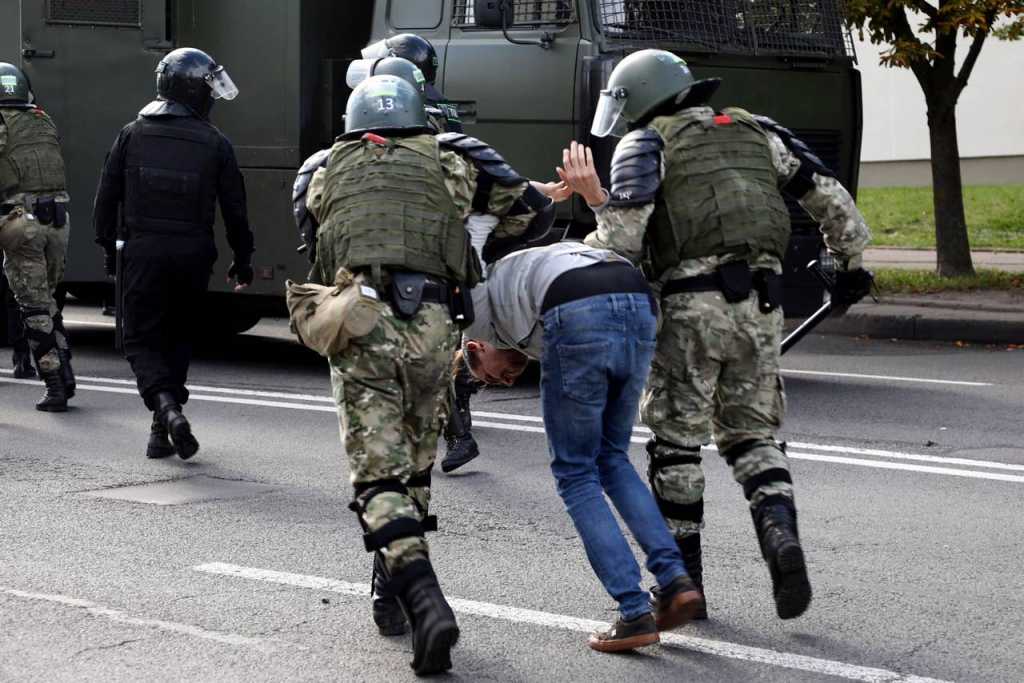
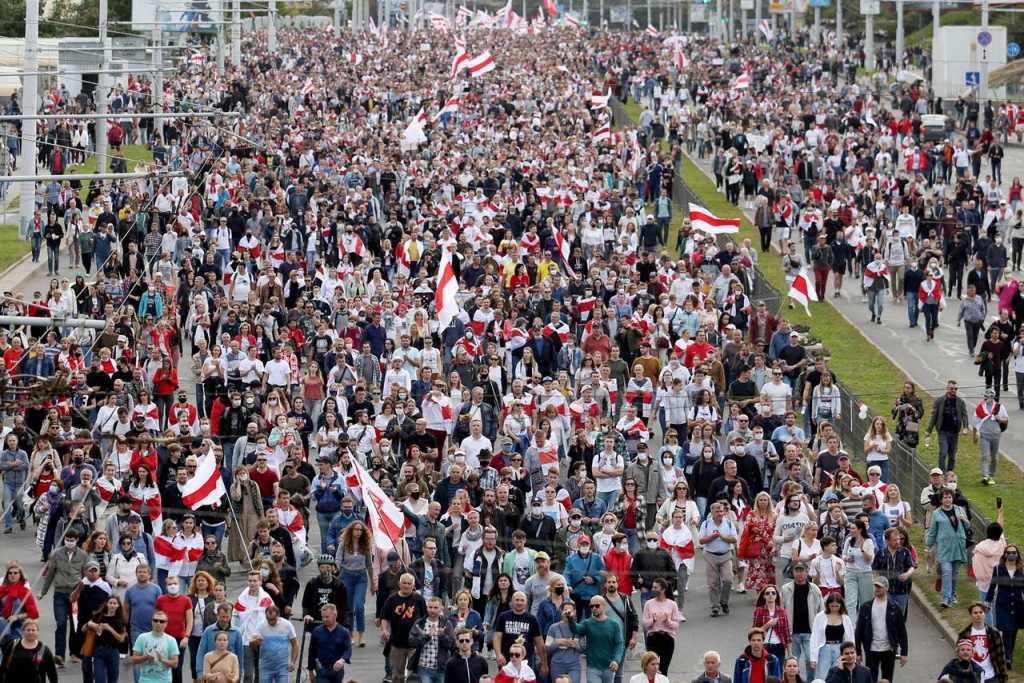
Large numbers of people went into the streets of Belarus in August after the authorities in Minsk declared that President Alexander Lukashenko had been reelected with 80 percent of the votes. The opposition candidate, Sviatlana Tsikhanouskaya, was said to have received 10 percent. Since then, statements testifying to fraud in the voting booths have been published, and the European Union condemned the Minsk government for “elections that were not free or fair.” Undeterred, however, Lukashenko had himself inaugurated for a sixth term on September 23, even as protests continued around the country. The demonstrations in Belarus against Lukashensko, who has been in power for 26 years, have been met with a heavy hand by the security forces. Thousands of demonstrators who have been arrested since the protests began have testified about brutal violence, torture and the crass violation of their rights. Three of them told Haaretz about what they endured in incarceration.

Published in Haaretz: https://www.haaretz.com/world-news/.premium.MAGAZINE-guards-beat-a-detainee-he-cried-then-stopped-doctors-came-and-covered-his-head-1.9203112

‘I wanted to protest the theft of my vote’

Valery Samalazou, 32, a software engineer from Minsk, is married and the father of three daughters. In June, he received a visa to work in the U.K. He returned in August to visit his daughters and wife and his friends, and to vote. He says he never expressed his political opinions publicly in the past, never broke the law and was never arrested. “I never even received a driving ticket,” he relates.

On August 8, the day before the election, he was on a camping trip with his family, cut off from the unfolding events in the country. On his return to Minsk, he discovered that the city was full of soldiers and that internet access was blocked. “We decided to take the girls out of town, to my wife’s mother,” he says, speaking to Haaretz by phone using secure channels, “in order to save them from the uncertainty and possible dangers.” He and his wife then returned to the capital, shortly before the polling stations closed, in order to vote. To find out the results, he bypassed the government's internet shutdown by connecting via a computer of the company he works for – an Israeli company based in the U.K.

An arrest in Minsk, Photo: AFP

Initial exit polls, Samalazou discovered, showed an apparent Lukashenko victory. “That was impossible, we thought. When I checked again in the morning, I also found messages from people abroad who sent video clips via social media of arrests and violence. I didn’t know anything and I decided to look into it. By the evening, there was no internet at all. After I met colleagues who confirmed that there had been war-like scenes in Minsk, I decided to go to the city center in order to speak my mind and protest the theft of my vote.”

He continues, “As I passed the central railway station, I saw people in black masks hiding around the corner. They blocked my path, questioned me and asked to see some identification. Then they grabbed me, hit me in the head and dragged me to a police vehicle which already had around five detainees inside.” Afterward, he was pulled out of the vehicle and dragged to a nearby building, where his shoes were removed and he was beaten again and questioned. His phone was examined, and the security forces wanted to know why he had money, pictures and bank cards from Britain.

“They treated me like I was a spy,” Samalazou continues. “When the person in charge arrived – in civilian clothes and not wearing a mask – he ordered me to be taken to the police station. He told me that I would be jailed for such a long time that my daughters would be married by the time I got out, and he also threatened to rape me with a club. A police vehicle took me to the station and collected more detainees along the way.” At the police station, the prisoners were forced out of the vehicle and made to lie on the ground. Police officers occasionally came by and hit them randomly, focusing on the younger detainees. “Some of them were hit so hard that they passed out,” he recalls. “We weren’t allowed to look, but we heard the truncheons strike their bodies. I discovered that a truncheon that strikes someone who’s unconscious makes a different sound. There was a girl there who pleaded with them to stop hitting those who had fainted, and they then beat her on the legs. When someone asked to see a doctor, the guard shouted ‘Doctor!’ and two policemen in masks arrived and beat the person viciously.”

Valery Samalazou and his doughters

Samalazou was interrogated in the station: “They tried to prove I was a spy. I was asked about my work and my political views. By searching my phone, they discovered that I had voted for Tsikhanouskaya [by reveiling a picture of the ballot which was taken for a system whereby activists submitted such pictures in order to compare them to the official count]. They beat me for that. Finally I was taken back to the parking area. In the middle of the night they brought detainees from the demonstrations, who had undergone worse beatings. Their faces were seveirly wounded and covered with blood.” He was left lying, bound, on the ground in the parking area for some 18 hours. “I understood that we were not under arrest but had been kidnapped and that they could do with us as they pleased.”

In the morning, after the group spent the night in the cold, a military vehicle transported Samalazou and the others to a detention facility. “We were made to lie on the floor of the vehicle in three layers. Whoever got on after us had to step on us,” he relates. He was handcuffed, and started to feel that the blood wasn’t reaching the palms of his hands. When he asked for his hands to be freed, they were bound behind his back instead. Leaving the vehicle, his arms were twisted violently and he lost consciousness.

At the detention facility, Samalazou was left for seven hours in an inner courtyard. The handcuffs were removed, but by then his hands had turned blue and purple and he had no feeling in them. Finally he and 30 more detainees were incarcerated in a cell intended for 10. There he was finally given food, after two days in which he hadn’t eaten. “There were no beatings in that prison, but the conditions were awful,” he says. After three and a half days, Samalazou was released with no explanation. He signed a declaration stating that he would not take part in demonstrations and was hospitalized for two weeks with head injuries. Since then he’s returned to his job in London and hopes that his wife and daughters, who don’t yet have visas for Britain, will be able to join him soon. He still has no feeling in his fingers.

Four days in a cell with 40 people

Viachaslau Krasulin, 32 and single, was forced to leave Belarus after the demonstrations in August. A lecturer on culture and art at a university in Minsk, and a musician, he fled to Vilnius, the Lithuanian capital, on September 3, after a criminal case was opened against him in Belarus, which could land him in prison for some years. He had participated with friends in a demonstration at a shopping center in Minsk on August 10.

“There were maybe a hundred people there, and things were calm,” he recalls. “There were no weapons. Some of the demonstrators erected roadblocks, a few young ones collected stones. After a time, police vehicles arrived, and the forces began throwing stun grenades. People ran and the police started to dismantle the roadblocks. My friends fled, but I thought that if I didn’t run, they wouldn’t take me in. That was a mistake.”

As he was trying to leave the scene, Krasulin continues, “I saw that one of the police officers had shot an elderly man in the stomach. The man wasn’t moving. I was in shock. I saw a young man running toward the man who had been shot to try and help him, and I wanted to join him, but then four men in green uniforms jumped me. They started to hit me and took me to a police vehicle. Two more of them attacked me there – one of them cut off my long hair with a knife. They made me lie on the floor, shouted at me that I was gay and handcuffed me. Then the man who had helped the person who was shot was forced into the vehicle. He was a doctor.”

More detainees were brought to the already crowded vehicle – two people had to lie on top of him, Krasulin relates. After a drive of about half an hour, they arrived at the Okrestina detention center. “We were beaten as we got out of the vehicle. They made us run to the wall of the courtyard and get on our knees, and left us like that for two hours.” They were then forced to lie on the ground for a few hours. “We were left there until 8 in the morning and then interrogated separately and taken to a cell. It was a cell for six people but they packed 30 detainees in and ordered us to strip down to our underwear. We weren’t beaten, but we were forbidden to approach the windows, so that people standing outside would not be able to see or hear us.”

Viachaslau Krasulin, Photo: Alfred Mikus

Eventually, he says, about 40 people were crammed into the cell, making it impossible to sit, let alone lie down. “I spent four days there, and for the first three days I received only a little bread and cereal for breakfast,” Krasulin continues. “We drank water, but there was no more food. On the third day, there were trials. There were no lawyers and we weren’t allowed to make calls. Each trial lasted six minutes. The judge asked what I had done, who had beaten me and why. I replied that I had no idea why I was beaten. I was sentenced to 11 days in prison. I was glad not to have received more; others were given far worse punishments.”

On the following day, Krasulin and his fellow detainees also were fed supper. After being interrogated again, he was transferred to a different, less crowded cell. Subsequently a police officer arrived to let him out. “I was given back my clothes, which were filthy, but not my bag, which held my passport, papers and credit cards,” he relates. “My telephone also remained with the police, because it was used as evidence in someone else’s trial. Before being released, I was made to sign a document stating that I would not take part in more demonstrations. I was taken in a police vehicle with six other people to a cemetery in the city, where we were released.”

Krasulin received medical treatment and decided to file a complaint against the police officers who had beaten him. In the wake of the complaint, he was informed that a file had been opened against him, after which he left the country at the advice of his lawyer.

‘He was beaten, then doctors covered his head’

Aliaksei Novik, 37, from Minsk, is the owner of a technology company. On Election Day, he was an independent poll observer for an opposition party. “Because of the coronavirus, we were not allowed to be inside the polling station during the day,” he relates. “But at the end of the day we waited outside for the protocol [i.e., the results of the voting at the station] to be published. It was made available two hours after the polling stations closed, and it turned out that Lukashenko had won big. That was a joke. It was clear that the results were falsified.”

Aliaksei Novik

Novik wanted to make his way home, but discovered that public transportation had been halted and also that internet access was being blocked: “I tried to walk to the center and find a taxi, but when I got close to one of the metro stations, I saw large forces who looked to be from the army. I lay on the grass in a courtyard, I heard very loud screaming and also shots, and I waited for it all to end.” Afterward, he relates, “I got up and ran in the opposite direction. I ran into a police patrol. I felt safe and asked them how I could get home. They pointed to a yellow bus nearby and one of them said, ‘That’s your ride home.’ Maybe he was joking. Then a few of them grabbed me. The five days that followed will stay with me for the rest of my life.”

He, too, like Krasulin, was taken to Okrestina. Sentenced to a 15-day prison term, apparently for participating in the protests, he was moved to a different detention facility in Zhodino, northeast of Minsk. His story is also rife with brutal violence against detainees, the hacking of his phone, coerced false confessions that were videoed, threats of rape on the part of the guards and appalling hunger and overcrowding in the detention cell. The age of the detainees ranged from 16 to 74, he says, based on their conversations. “There were people with broken ribs. One night in Okrestina, through the window, we saw guards beating a man in the yard. He cried and cried, then stopped. When things were quiet, I saw a few doctors arrive and cover his head. I don’t know for certain that he was dead, but I think a few people died there.”

Snipers were posted on the watchtowers of the facility, Novik relates, and there were dogs in the yard. From the adjacent cell he heard women’s voices. He refers to the police as “Gestapo,” and he says that one police officer called him “Jew” (he isn't Jewish). After he was released, apparently following the intervention of the European Union and human rights organizations, he filed a complaint against the police and has been conducting a legal battle against them since. He has remained in Minsk. He says he is wounded mentally and physically and can’t sleep at night.

“The Belarusian people is starting anew,” Novik says. “We live in the center of Europe. I see how people live in Ukraine, Poland and Lithuania, and I ask: Why do I not have human rights such as freedom of expression and freedom of assembly? I do not want a union with Russia, we are not its ‘little brother.’ We are a free people in Europe, and this is our war of independence.”

. Mass demonstration in Minsk, photo: AFP

Israel is back in lockdown while Swedish COVID-19 mortality rates are plummeting. Here’s the difference

Swedish Health Minister Lena Hallengren tells Haaretz why her country never imposed a full lockdown, and why public trust in the government is a vital component of fighting the coronavirus
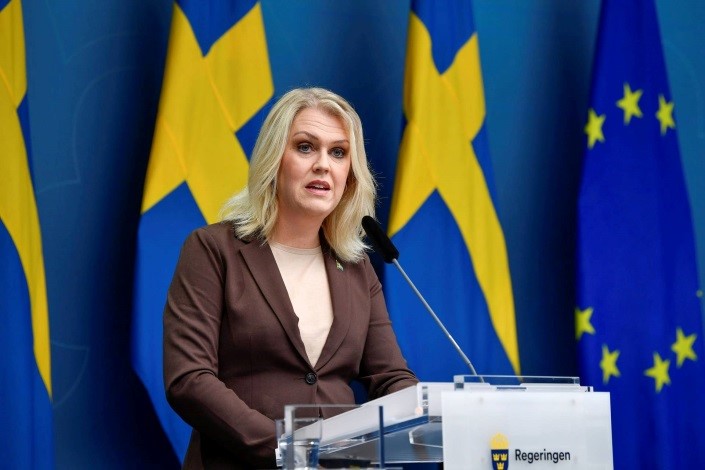
Published in "Haaretz": https://www.haaretz.com/israel-news/.premium-israel-s-back-in-lockdown-while-swedish-covid-deaths-are-plummeting-here-s-why-1.9173277

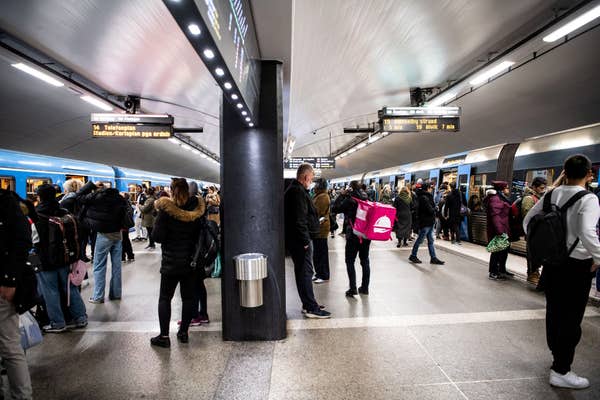
STOCKHOLM – Back in April, many worldwide thought the Swedes had lost their minds. As country after country shuttered its schools, shopping malls and restaurants due to the coronavirus pandemic, Sweden decided to take another approach. 

Despite the Scandinavian country’s death toll reaching a peak of about 100 a day by mid-April, many Swedes were still going about their daily lives, face masks were not recommended and rarely used, young children were still going to school, and no national isolation system was set up for infected but asymptomatic individuals. And though many businesses took a hit – because Sweden relies heavily on its export trade – most remained open and gradually started to rebound. It’s not as if Sweden did nothing at all to combat the virus. High schools and universities switched to online learning, most cultural, entertainment and sports venues closed, and the general population was asked to maintain hygiene and social distancing, avoid traveling wherever possible, and to stay home when symptoms appeared. 

But there was clearly a major difference between the Swedish way and that of the rest of the world. Besides legal restrictions prohibiting gatherings of over 50 people or visitors at hospitals and retirement homes, most were recommendations rather than legal decrees. Fines, police enforcement, mobile phone tracking and curfews were deemed unnecessary. 

Despite this, most Swedes observed social distancing and the infection rate finally began to drop. Last week, Sweden carried out over 140,000 tests, with 1.2 percent coming back positive. The country currently has one of the lowest infection rates in Europe. 

While the curves are clearly flattening, the government isn’t wasting time. After a traumatic spring, it’s doing its best to learn from its initial mistakes by improving testing capabilities and boosting the economy. 

It’s a stark contrast to Israel, which has just become the first country to enter lockdown for a second time. Yet Sweden’s health minister, Lena Hallengren, told Haaretz that it’s not just about having or not having a lockdown.

“It’s true we didn’t have lockdowns [in Sweden], but we did have lots of changes in society – and the most crucial thing is having long-term measures,” she said. “Without a lockdown, restaurants, bars, trains and buses have to be adapted with regulations – legally binding or recommendations. You have to always maintain distance, have signs, information, sanitizing, washing hands: all that has to be in place. We can see that you can’t lock down the virus forever, and you always have to consider the price that society pays.”

Lena Hallengren, Photo: Kristian Pohl/Regeringskansliet

Falling mortality rates

Different countries’ success rates in handling the coronavirus has become something of a “sport” in the past six months, a table reflecting the global “winners” and “losers.” Given its outlier approach, Sweden has come under particularly close scrutiny: initially, it drew harsh criticism and was used as a cautionary tale; now, it’s offered as a slightly more sustainable model than repeatedly going into lockdown. But Hallengren is careful about making any comparisons. 

“We’ve said since the beginning of the pandemic that this is not a sprint, it’s a marathon,” she said. “It’s not a competition and there’s no point saying who the winner is. It’s far too early and too dangerous to compare week-by-week mortality rates. Different countries were hit differently; they have different structures and relations with their authorities, they test in different ways and have different kinds of data and information. In the long run, we all need well-functioning societies. We should learn what there is to learn from others, point less fingers and try to keep up with long-term recommendations,” she added. 

So far, some 5,800 people in Sweden have died due to COVID-19, mainly as a result of the virus spreading in Sweden’s nursing and care homes in the spring. 

“In the worst week of April, we had 845 new cases of infection in elderly care facilities. Last week we had 17,” Hallengren reported. “Our mortality rates have also fallen radically. We don’t have excess mortality and in August, the rates were below normal [yearly] figures.”

Hallengren also tried to look beyond the headline figure concerning COVID-19 deaths. “One [southern] region in Sweden, Östergötland, recently conducted a study investigating all cases of elderly patients who died infected from the coronavirus,” she said. “In only 15 percent of the cases was it concluded that COVID-19 was the direct cause of death. In 15 percent [of cases], the real reason was another illness or medical condition, and in 70 percent of cases COVID-19 contributed to death due to underlying conditions or the health status of the patient.”

The health minister said her government is analyzing why the coronavirus hit Sweden so badly, especially in comparison to its Nordic neighbors, and is taking long-term measures to tackle possible new local outbreaks. 

Scenarios are being prepared by government authorities and financial resources allocated to address unemployment and support the health care system, as well as those in elderly and mental health care. “The outbreak of COVID-19 is not, and has never been, a narrow health issue for the infected people,” Hallengren said. “It’s a broad issue affecting all parts of society.”

‘Functioning society’

When quizzed on Sweden’s “no lockdown” policy, Hallengren said that although a total lockdown was never imposed, remote work, online studying in high schools and universities, and restrictions on entertainment venues affected the country’s citizens. 

“It was certainly not ‘business as usual’ in Sweden,” she said, rebutting a common claim, “but we needed to have a functioning society. That’s why we made an active decision not to close preschools and elementary schools. If you close schools, how do you enable people to work at the care homes, hospitals, and police and emergency forces? How do you keep the pharmacies, commuter trains and food stores running and open?  

“We decided to lean on experts and the available knowledge at the time,” she explained. “We knew children were not severely affected and not the ones spreading the virus. This was proven by looking at the number of people on sick leave. Teachers working at preschools and schools were not sicker than other groups in society. 

“We need to fight the virus, we need to protect vulnerable groups,” she continued. “But we need to make sure that the measures can be kept for a long time in a functioning society.  

“Swedish people have high confidence in government authorities,” she added, “so with transparency and a lot of quantifying information, we created a strategy based on taking the right measures at the right time and in the right part of Sweden.”

How do you respond to allegations that Sweden sacrificed its older population for the sake of the economy?

“That criticism is unfair and untrue. Of course we never sacrificed anyone. We tried our very best, as I suppose other countries did, to protect lives, to stop the virus spreading in society and to protect the vulnerable groups. 

“The care homes have been an extremely difficult and sad part, but they are very specific – people living there are extremely old, fragile and sick. We created a government commission to find out what happened, who did what and what we can learn from this. 

“In Sweden, care homes are not just facilities for older people; they provide health care. We have 1,700 such homes and about 85,000 people live in them. Fifty percent of them live in these homes for only six months – that’s how old, fragile and multi-diseased their situation is. If you get COVID-19 or even the flu into these homes, it’s a matter of life and death.”

Retirement homes were generally perceived to be the weakest link in Sweden’s coronavirus strategy. But there’s another part of it that others could benefit from: decision-making based on expertise rather than politics. 

“We [political decision-makers] are thinking people and we're responsible for the decisions we make,” Hallengren said, “but our authorities wouldn’t be independent if we’d sometimes decide to follow the experts on disease prevention and disease control, and sometimes not to do so. You don’t have experts and expert agencies just to have them. You have them to listen to, and take what they know into consideration,” she concluded.

Exiled Belarusian regime opponents' leader: The president is weak, women can defend our country

In an interview with Haaretz from a hiding place in Lithuania, Sviatlana Tsikhanouskaya calls on Russia and other countries not to intervene in the political crisis in Belarus, and stresses that she does not intend to run for the presidency in any future election

Published in Haaretz: https://www.haaretz.com/israel-news/.premium-exiled-belarus-opposition-leader-to-haaretz-our-female-revolution-is-significant-1.9137156

Sviatlana Tsikhanouskaya has been in hiding in Lithuania since August 10, under guard. While she has been living in forced exile, Belarus President Alexander Lukashenko – who is considered by many to be “the last dictator in Europe,” having served as his country’s leader since 1994 – has been facing huge nationwide demonstrations daily.

“I feel great pride [at] my people who at last woke up,” Tsikhanouskaya told Haaretz in an interview – the first time Lukashenko’s greatest rival, who ran in the recent presidential election against him, has been interviewed in the Israeli media.

Tsikhanouskaya during the interview: "I’m not the leader of the opposition, I’m the leader of the majority"

“They have aims, they know what they’re fighting for. They’re fighting for new elections where they’ll be able to choose a new president for our country,” she said.

Until last summer, Tsikhanouskaya, 37, was an English teacher and translator. She had no intention of being active in politics and only decided to run in this year’s presidential election after her husband, Sergei Tikhanovsky – an entrepreneur who launched a YouTube channel last year in which he criticized the government – was not allowed to stand. He has been labeled an opponent of the regime and was arrested at a demonstration in May. He was later charged with disorderly conduct and attacking a police officer, and has been imprisoned ever since.

In response, Tsikhanouskaya became the opposition candidate in the August 9 election. Her husband supported her until he was jailed, and she continued to campaign despite threats, harassment and the arrest of some of her supporters and staff. 

She reportedly received widespread support from the public on Election Day, as well as from major opposition figures. Standing alongside her were Veronika Tsepkalo, the wife of Valery Tsepkalo – another opposition candidate who was barred from running – and Maria Kalesnikava, the campaign manager of a third candidate, Viktor Babaryka, who was also barred from running and jailed. 

Tsikhanouskaya said she was worried about the “awful violence” being used by the authorities in Minsk against Belarusians. She views the public protest that broke out in her country as the tip of a process that has existed for years.

“Of course it didn’t happen in just a moment,” she said. “There were preconditions. COVID played a huge role: Our society understood that we can help each other, that we’re a nation and our authorities don’t care for us in difficult times. So, when Sergei Tikhanovsky was going around the country showing the truth and saying the truth, they started to prosecute him. But he encouraged other people to understand they have the right to say the truth and talk about it".

“Step by step, people started to wake up,” she continued. “There was a great fear, but every day – the same as I did – people had to overcome the fear and do something and say what they want. During this election campaign they saw how united they are. Many people came to our rallies,” she said, “and they looked into each other’s eyes and understood that they want to live in a different country. They want to be respected by the authorities, unlike the last 26 years. We want a different life for our children.”

According to the official result, Lukashenko won 80 percent of the votes while Tsikhanouskaya received only 10 percent. However, opposition activists claimed there had been voter fraud, while the European Union condemned the government in Minsk for holding an election that was “neither free nor fair.” It also criticized the violent repression of the protests that erupted immediately after the election, and is advancing sanctions against senior Belarusian leaders. 

Tsikhanouskaya filed a complaint with the Central Election Committee the day after the vote, and as a result was detained by the authorities for several hours. Later that same day, security forces accompanied her to the Lithuanian border (to the west of Belarus). In Lithuania, she joined her 10-year-old son and 5-year-old daughter, who were evacuated from Belarus before the election due to threats against the family.

After arriving in Lithuania, the official media in Belarus released a video in which Tsikhanoskaya can be seen reading an announcement calling on protesters not to go out into the streets and to respect the election result – in a style reminiscent of those films where hostages read the words of their captors. Later that day, she released her own video on social media in which she stated that she was forced to leave Belarus out of fears for her children’s safety.

A few days later, Tsikhanouskaya declared in another video that she had won the election and was forming a public council to arrange the transfer of power from Lukashenko to her – and to hold new and free elections. In interviews, Tsikhanouskaya emphasized that she would serve as an interim president and didn’t intend to run in any new election.

Will the fact that the president holds all the power in Belarus, including the military and police force, not cause the protest to dissipate without replacing the government – especially in light of the fact that the opposition leader is not even in the country? Do you have the power to even start a dialogue with Lukashenko?

“First of all, I’m not the leader of the opposition, I’m the leader of the majority. Second, you say that Lukashenko has all the power, and you mentioned police, but he doesn’t have the power on his people. This matters. He has power on 1 percent of the people. He has no power at all in the eyes of the Belarusians. They will never trust him anymore, they will not be able to live in their country under his leadership. So, how can you say that he has power? Absolutely not!"

In that case, what practical steps are you taking in order to bring a regime change?

“First of all, all the political prisoners must be released. That will be the sign that our authorities are ready for a dialogue. This dialogue has to happen as soon as possible, because of the political crises and the economic crises. When the political prisoners will be released we’ll start this dialogue – which will lead to new, fair and transparent elections, and people will have the right to elect a new president for themselves,” she said. 

“Thanks to different initiatives, we have results from poll stations where the results were falsified. At the moment, we have over 150 real results which are radically different than those which were published.” Says Tsikhanoskaya and adds that

 international observers were not allowed to come and supervise the election. Furthermore, the results she obtained were the result of acts of bravery from people who worked in the polling places and were charged by the authorities because they published the truth. She added that she won over 50 percent of the vote – a level that does not require a second round of voting according to Belarusian law.

Are you, like many others, concerned about possible Russian intervention in the situation in Belarus? Have you been in touch with the Kremlin or have they tried to contact you?

“What’s going on in Belarus is absolutely our internal affair. It’s not about geopolitics, it’s a political crisis where our people are standing up against one person. There’s no need and there’s no reason for the Russians to interfere in this political crisis. There is awareness to this [Russian intervention], but I can’t say that I’m afraid of this. I always ask all the countries, including Russia, to respect our sovereignty. We have to deal with this conflict ourselves.”

The principle of Belarusian sovereignty is equally valid with regards to other nations too, Tsikhanouskaya says. Nonetheless, she’s happy to note that many countries recognize her claims that election results in Belarus were falsified and that they don’t recognize Lukashenko’s victory.

“They show their support for the Belarusian people who are standing up for their rights and for defending our elections. They are absolutely for our people, they are supporting us in this fight,” she said. “We appreciate what they say and we appreciate that they are vocal, and we are very grateful for whatever they do to support our people. 

“But we also call to respect the sovereignty of our country. We underline that what’s going on is our internal affair and other countries shouldn’t interfere in the situation. When other leaders ask what they can do for us, I say that if one day we will need international mediation in starting negotiations with our authorities, then all the countries which care about our situation are invited.”

Women’s revolution

International criticism, nonrecognition of the election result and calls for Lukashenko to avoid violence have also come from the United Nations, Belarus’ neighbors and even from the Vatican. A source close to Tsikhanoskaya said she has already spoken with U.S. Deputy Secretary of State Stephen Biegun, European Commission President Ursula von der Leyen, and the Leaders of Sweden, Finland and Estonia. But her exile in Lithuania has forced her to devote time not only to foreign officials but also to her partners in the protest.

What’s the nature of your relationship with the protest leadership and the other leaders, Veronika Tsepkalo and Maria Kalesnikava? Do you speak? Are there any disagreements or conflicts between you?

“Of course we’re in touch. We’re working together. But we understand that Maria Kalesnikava is in Minsk, and of course she has much more pressure on herself than I have or Veronika Tsepkalo, who is in Poland I suppose. But each one of us does her best to reach the aim we have. So I’m here, meeting with leaders of different countries who show support to our people and our situation. Veronika also, I’m sure, is doing her best for the same purpose, and Maria, who’s in front at this moment in Minsk. I’m really proud that she’s there and I’m proud that we’re still together, that we have one aim and we’re moving toward it together.”

The fact that the leadership of the opposition is made up of women is no coincidence, and Tsikhanoskaya attributed great importance to it. “The phenomena of a [female] revolution is very significant in our demonstrations. We understood that we can, we are important and we can defend our country not in the kitchen but in front of men and beside men. So we felt ourselves as a united nation where people help other people, take care of other people – and this is our unity.” 

But in spite of what she may say, it’s clear that living in exile is not easy for Tsikhanouskaya.

In a video released after she arrived in Lithuania, she said that the decision to leave was very difficult and one she made on her own, without consulting with political figures – or even her husband in prison. In subsequent interviews, as well as now, she has refused to say exactly what happened during the hours when she was held by the authorities in Minsk before crossing the border into Lithuania. 

“It’s not time [to tell]. Sorry,” she said.

What about your future plans? Do you intend to be president of Belarus?

“No, my opinion on this hasn’t changed. I’m not planning to be involved in the future elections.”

Are you in touch with your husband? When did you last talk to him?

“I think I spoke to him about three and a half months ago, because in our country you can’t phone prisoners. But we communicate via a lawyer who visits him about twice a week. The lawyer tells him about what’s going on in Belarus, and he’s very proud of the Belarusian people. He supports me and he’s really grateful to the Belarusian people that everything he did wasn’t in vain. Of course I’m worried about him, because he’s held like a hostage.”

Can you tell us a little about your situation in Lithuania, the conditions in which you live, the situation of the children and your plans to return to Belarus?

“What matters is that I feel safe here. I’m surrounded with different, wonderful people – Lithuanians and Belarusians – who are now members of my team, and we’re doing our best to achieve our aims in Belarus. We’re all working for the same purpose, which hasn’t changed: new elections in Belarus.

“My children are fine, thank God. They want to go back, they miss their Daddy. I also want to go back to Belarus, and I will as soon as I feel safe there.”

She continues: “We have a wonderful country with peaceful, friendly and hardworking people who have lived under this regime for 26 years. According to the Constitution we have a lot of rights, but in reality we have no rights at all. People are imprisoned just for having an intention to tell the truth; they’re imprisoned for going out and showing their disagreement with the regime. 

“It’s not safe to live there, because people are disappearing. It’s not safe to go out and raise your voice, because you’ll be beaten and imprisoned. There’s no justice – our people have had enough. They woke up and want to live in a democratic country where people are safe and free. Now it’s high time for our people to struggle for their rights, and they’re ready to build a country for life.”

Is Sweden Censoring a Book About Its Ties to the Nazis, Written by a Jewish Comedian?

It was clear that a new, provocative book about Sweden’s attitude toward the Nazis in World War II was going to stir up controversy. But the author didn’t imagine that the state would seize its last print run and demand to pulp it.

Published in "Haaretz": https://www.haaretz.com/world-news/europe/.premium.MAGAZINE-is-sweden-censoring-a-book-about-its-ties-to-nazis-written-by-a-jewish-comedian-1.9050447

STOCKHOLM – The four police officers showed up at the building, located in a commercial area of south Stockholm, shortly after 9 A.M. this past June 11. Several of the officers, dispatched by the international and organized crime division, were armed and wearing protective vests. They took the elevator up and found the storeroom, which contained about 150 cartons. Wasting no time, they loaded the cartons onto a waiting truck and drove off. Now all that is required is a court decision to pave the way for the destruction of the contents of the cartons. This could be the opening scene of a Nordic-noir crime story if, say, the cartons were packed with drugs or if a crime syndicate was involved. But this is a story of a different kind: The items in question belong not to a mobster, but to a comedian. And instead of dangerous substances they are packed with history books.

Aron Flam is a 42-year-old Swedish Jewish comedian who does stand-up, appears in film and on TV, radio and podcasts, and writes books. The subjects he tackles are often complex (such as the Israeli-Palestinian conflict). He is drawn to slaughtering sacred cows and enjoys spouting controversial political and cultural criticism (especially when it  omes to ideas and ideologies that are popular in Sweden, such as feminism and socialism). He has frequently been accused of having ties to the Swedish alt-right and to populist groups, although he presents himself as a liberal and a democrat. He’s a free-speech advocate who likes to discuss what he calls “culture-specific taboos,” and though his subject matter is often very serious, he’s better known on social media than in academic circles.

But the book he published this year took his controversial persona a step further. Its title, “Det här är en svensk tiger,” translates as “This Is a Swedish Tiger” and it deals with,  among other subjects, Swedish policy during World War II. In the book, Flam puts forward a radical argument to the effect that Sweden collaborated with Nazi Germany from start to finish. Most historians, in contrast, depict Sweden as a neutral country that leaned toward Germany until 1943, then tilted toward the Allies as the war wound down.
The first two printings, of a total of 5,000 copies, sold out completely, and now, in a highly unusual move, the third print run, of 2,000 books, has been confiscated by the police. Formally, the reason is not the book’s content, but rather a lawsuit over an alleged copyright infringement, centered around the illustration on the cover. But the fact that
the author’s claims are controversial and embarrassing to Sweden, as well as perceived as an effort to undermine the country’s national heritage, immediately ignited a trenchant public debate and fierce criticism: Why did the state prosecution take such an extreme step?

Is censorship alive and well, even in a free, liberal country like Sweden? It all started almost 80 years ago, during the war. In 1941, the Swedish authorities commissioned the illustrator and author Bertil Almqvist to design a poster showing a tiger painted in yellow and blue, the colors of the Swedish flag, with the slogan “A Swedish tiger.” This is a play on words, as “tiger” in Swedish can also be a verb meaning “to keep silent.” In other words, the “Swedish tiger” is not only a predator in the colors of the national flag, it is also a sort of sly directive meaning, “A good Swede keeps his mouth shut.” The wording recalls wartime field-security slogans from many countries, such as America’s “Loose lips sink ships” or Britain’s “Careless talk costs lives.” “During the war that symbol was everywhere – on pencil cases, on Tshirts and on lunchboxes,” Flam says. The tiger appears on the cover of Flam’s new book, but unlike its original wartime iteration, his tiger is winking and stretching its right front leg upward, as in a Nazi salute, while the left leg is adorned with a swastika. The animal casts a long shadow behind it. In Flam’s telling, the tiger is the symbol of a Swedish culture of silence and functions as a kind of joke about that silence. The Swedes, he explains, are strong, silent types.

“Sweden is the only country that takes pride in its silence,” Flam tells Haaretz in a phone conversation, referring to the first lines of the national anthem, lauding the land of the northern hills, which is “joyful, fair and quiet.” “We like silence so much that we sing about it.” “In contrast to the Americans, we had no ships in danger of sinking in World War II – we were ostensibly neutral,” he says. “That makes one wonder about the purpose of the Swedish silence, and that is exactly what my book is about. The cover is a parody of the tiger, which is to say, a parody of a joke. I deal in the book with psychology, law, politics and philosophy, and it all starts with that joke. Today’s Swedes aren’t familiar with the historical context. They don’t get the joke, precisely because their grandparents got it so well, and maintained absolute silence about what happened in Sweden during the war. To understand a joke, you need to understand the references. The book explains them.”

‘Emotional response’
There’s at least one body that doesn’t appreciate the joke: the Military Readiness Museum, a private institution in the country’s south that owns the rights to the original illustration by Almqvist. According to the museum, the Almqvist tiger is “part of the Swedish cultural heritage,” and no one was authorized to make use of it. “Their response was very emotional,” Flam explains. “I got a call from a lawyer who is one of the museum’s owners. She screamed at me over the phone and said that I should be ashamed of myself for undermining our cultural heritage.” He adds that “she told the police that she wants every copy of the book, including those that were already sold, to be destroyed.”
After the museum filed a complaint of copyright infringement (in February 2019, after the book’s release), the police entered the picture. They contacted the printer, summoned Flam for an interrogation and seized the entire third print run. “One morning,” Flam relates, “I suddenly received a text message from the office building where I rent a storeroom. The message stated, ‘The police are here.’” The police continue to hold onto the cartons, and now the Stockholm District Court will have to decide on the conflict between the principles of freedom of expression and copyright considerations. A trial is set to open September 24. If the prosecution triumphs, all remaining copies of the book will be destroyed and Flam will have to pay the museum 1.5 million Swedish crowns (about $171,000).
The state prosecution insists that no censorship of content is involved in the case, only the issue of rights. “The books were impounded because the cover is inseparable from the book itself,” a press communique stated. Flam: “The chief prosecutor in the case claimed I was ‘desecrating’ the original work by placing a swastika onit. If they think my work desecrates Swedish heritage, that is their right, but satire is not supposed to be polite and respectable.” Both the Swedish prosecutors and the museum turned repeated requests from Haaretz to speak with their representatives.
The Swedish public has not been indifferent to the state’s dramatic action against Flam. “It’s scandalous,” Thorsten Cars, a senior jurist, wrote in the newspaper Svenska Dagbladet. “It is difficult to understand what interest the copyright holders – they are not even connected to the artist himself – have in the prosecution and the confiscation of the books. It is even more difficult to understand how the harm done to the state, the people and its ‘national symbol’ is so severe as to justify prosecution and confiscation.” Like other legal and media observers, Cars characterizes the actions of the police and the prosecution as “gross intervention in freedom of expression.” The journalist Nils Funcke, who deals frequently with the issue of freedom of expression, found it “strange that the prosecution is taking such a drastic step.” Seizure of the entire inventory of a book is a rare event, he added. Colleagues of Flam’s – well-known Swedish comedians – also rallied to his defense. “Comedy and humor are a very important part of freedom of expression and public discourse, even in Sweden, a country that lacks humor,” the comedian Sandra Ilar said with a smile, adding that one must not be silent in the face of such a threat.
“It is wrong to prosecute a comic and a writer because he casts doubt and creates satire,” comedian Özz Nûjen said. “That is exactly his job.” Others go farther in their criticism, accusing the Social Democratic Party establishment of taking action against Flam in  order to conceal its own dark history. Even if there is no proof to back up this allegation,
it is gaining traction because of the silence of the political establishment on the subject. The Social Democrats were in power during most of the 20th century, and led a national-unity government during the war. It is still in power today and though it has recently renewed its commitment to combat anti-Semitism, some still accuse it of hiding its dark past. Writer and musician Jens Ganman had harsh words for the government and the state-owned media in a Facebook post he called, “How can we sleep while our books are burning?” Why wasn’t the justice minister invited to the country’s major news studio to comment on the subject, he asked, and went on to wonder rhetorically, how it was possible that the Swedish police were sent to impound a book, whose author is a Jew, about the Social Democratic Party and its ties with Hitler.

So much for rescues
Flam’s thesis deals with the depth of cooperation and collaboration between the Swedish authorities and the Nazis. “I maintain that the Swedish Social Democrats started to work with Hitler even before he rose to power,” he says. “The Swedish account of history leaves out the fact that Sweden was dependent on Germany and collaborated with Berlin before and during the war. Most Swedes today don’t know this, but Sweden was Germany’s ally from 1933 until 1944, by which time the war was already very much over. Only then did Sweden announce that it would cease to do business with Germany.”
Flam, who has a master’s degree in economics, also addresses that aspect of the story. “The Germans needed weapons, Sweden had the materials to manufacture weapons (iron and ball bearings), and the Swiss banks were able to launder the money that  changed hands in these transactions. Sweden supplied Germany with the components without which no modern army can operate.” When it comes to the results of Sweden’s policies during World War II, Flam goes so far as to maintain that the Swedish welfare state “is built on gold that was stolen from Jews and other European peoples.” He also greatly minimizes Sweden’s vaunted rescue operations on behalf of Jews in the war: the saving of the lives of tens of thousands of Hungarian Jews by Swedish diplomat Raoul
Wallenberg, the asylum granted to the Jews of Denmark and the so-called White Buses operation involving the Swedish Red Cross, which extricated refugees from concentration camps in areas under German control during the final weeks of the war.
“I would say that none of it is significant,” he says provocatively. “The goal of Folke Bernadotte [the Swedish diplomat, who negotiated the release of thousands of Jews from the camps, became the United Nations mediator in the Arab-Israeli conflict and was
assassinated by the Lehi pre-state underground, in Palestine in September 1948] was not to save Jews. He collected Jews along the way and then wrote a book explaining what a hero he was. The case of Denmark’s Jews [who were smuggled into Sweden by the Danish underground] is similarly complex. They placed the Swedish government in an embarrassing position and were taken in for reasons of public image. Regarding Raoul Wallenberg, as far as I understand he was a hero – there’s always an exception.”

Though Flam’s claims in the book are debatable, it’s a fascinating project, which jumps between disciplines and historical periods. He draws a line and demonstrates connections and similarities between Sweden’s policy in World War II to the Swedish establishment’s attitude toward Israel and toward antisemitism in Sweden itself,
before, during and after the war. Not everyone will agree with Flam’s conclusions, but even many of those who don’t are convinced that the mobilization of the police and the state prosecution against him is both extreme and unwarranted. His book, they say,
should be debated, not destroyed. “You don’t have to agree with Aron in order to support him,” says Nûjen, the comedian. We ask Flam, who says he will appeal the case if the court rules against him, if he thinks there’s an effort afoot to silence him. “If that’s what they’re trying to do,” he says, “they’re doing a very bad job of it. I insist on my right as a satirist to make fun of things that people think are sacred. Does freedom of speech exist without the right to parody? I think not, but I’m not objective. I’m only a comedian.

What Can Be Learned from the Swedish Coronavirus Case

STOCKHOLM – In the final analysis the Swedes will disappoint everyone. Those who claim that their own government's reaction to the coronavirus pandemic was hysterical, because "in Sweden it's business as usual," have yet to discover how little they knew about business in Sweden. Even those who claim that countries that opted for a lockdown saved numerous lives, as opposed to the Swedes who are dying in the thousands, will discover that the numbers are misleading and confusing.

Published in Haaretz: https://www.haaretz.com/opinion/.premium-what-can-be-learned-from-the-swedish-coronavirus-case-1.8903160

Both groups will be forced to find another source to prove their arguments. Last week, for example, headlines worldwide declared that the Swedes admit their mistake and that their model for dealing with COVID-19 has collapsed. The headlines were incorrect. The Swedish authorities are still adhering to their initial strategy, and the presumed admission of a mistake was a general statement that was taken totally out of context. But Sweden has long since become a punching bag for those justifying the lockdown policy as well as an exemplar for those who oppose it. Meanwhile, in the real world, the situation is more complex.

First it should be noted that it is not business as usual in Sweden – high schools and universities have switched to distance learning, most of the cultural, entertainment and sports venues are closed, and residents were asked to work from home, maintain social distancing and avoid traveling. Although most of the restrictions are only recommendations, it can be proven that most Swedes observe them meticulously,

Despite that, the elementary schools and preschools did not close, no lockdown was imposed and there is no obligation to wear a mask. These are examples of controversial policies, which may turn out to be more damaging than beneficial. It is definitely possible that the Swedish government is wrong, but the claim that it is practicing “human experimentation” could be directed to all the other governments too. In times of coronavirus uncertainty, steps such as isolating asymptomatic patients, prohibiting swimming in the sea and closing places of business are also a gamble. It’s clear to everyone that they all cause social, economic and health-related damage, but it is still unknown if and to what extent these steps limit the spread of the virus.

As is true of every country, Sweden has advantages and disadvantages in dealing with the pandemic. The advantages include: an efficient public sector, a good health care system, a sparse population and a large number of single-person households (about 40 percent of households). And on the other hand, the Swedish population is elderly (about 20 percent are aged 65 and above), the country has open borders and a cold climate, and about one fifth of the population was born outside the country – and therefore has less trust in the authorities and limited access to their directives.

There is therefore a limit to our ability to learn from the terrible figure – about 4,500 dead. Even if we ignore the differences in the way countries count their dead, and complex data such as overall and excess mortality – it is hard to compare young countries with elderly ones, hot countries with cold ones, and open and closed countries. Although Worldometer charts have become a morbid sport of body counts and patriotic wrestling matches, it is doubtful whether we can learn from counting the dead about the degree of effectiveness in a country’s handling of the pandemic, and especially the effectiveness of lockdowns.

Heading the charts are Belgium, Spain, Italy, England and France – countries which imposed a lockdown, and occasionally adopted tough measures to enforce it. They are followed by Sweden, without a lockdown and with a “soft policy.” And then come the rest of the countries, which have various ways of dealing with the problem. There are countries that imposed a lockdown and have a high mortality rate (Belgium), there are countries with a lockdown and a low mortality rate (Israel), countries without a lockdown and a high mortality rate (Sweden) and some without a lockdown and a low mortality rate (Iceland). And of course there are also differences between one city and the next in the same country.

Why then have so many died in Sweden? At this point it seems that the failure is not related to the failure to impose a lockdown. There is no evidence of a significant contribution by schools or shopping centers to the spread of the pandemic. But there is evidence of a different failure – the treatment of the elderly. Although the handling of senior citizens’ homes was problematic all over the world, in Sweden the situation was especially grave. Recently it was revealed that due to power struggles among the authorities, the personnel were not prepared, there was a lack of equipment and the ban on visits was belated.

And yes, although Sweden is a developed welfare state, in the years when the seeds of the failure were sown it suffered from another plague: privatization, cutbacks and reforms in the public sector. Today, as opposed to the situation in the past, senior citizens’ homes in Stockholm lack work slots, equipment and skilled manpower. This is another example of the helplessness of the “invisible hand” when it comes to managing crises and protecting the weak.

Is it true, as has been claimed, that Sweden gave up on its elderly for the sake of the economy? Definitely not. First of all, public health is managed by an independent authority, which is not subject to economic considerations. Second, the Swedish economy is export-oriented. Initial investigations have shown that the blow to Sweden did not differ greatly from that of its neighbors. In Sweden too there was a decline in consumption, growth was harmed and unemployment increased. Even if local businesses remained open, Volvo cannot manufacture vehicles when there is interference in the supply chains and demand plummets, and H&M cannot sell clothing when factories and malls the world over are closed. Not to mention the tourism industry. Policymakers knew that and did not waste time on attempts to prevent the blow, but instead channeled money to reduce the damage it caused.

Even more serious is the claim that the Swedes tried to save the economy by achieving herd immunity, because initial examinations demonstrated that Sweden is very far from that objective. But Sweden has never claimed that it was aiming at herd immunity – on the contrary, it vehemently denied that. The objectives were to flatten the curve of the number of patients and to protect the populations at risk. The first objective was achieved: intensive care beds and ventilators were ready for use at all times – an impressive achievement, because there was no need for a ruinous lockdown. In the case of the second objective, the Swedes themselves admit failure. Those using the example of Sweden would do well to stop looking at the country for proof for their arguments, and to try to think what can be learned from the Swedish case. In the final analysis, this is not a theoretical exercise, it is an essential preparation for the second wave.

Why Sweden isn't forcing its citizens to stay home due to the coronavirus

Sweden’s top epidemiologist explains his country’s radical pandemic policies

Published in Haaretz: https://www.haaretz.com/world-news/.premium.MAGAZINE-why-sweden-isn-t-forcing-its-citizens-to-stay-home-due-to-the-coronavirus-1.8754251?utm_source=dlvr.it&utm_medium=twitter 

STOCKHOLM – The primary schools are operating normally; gatherings of up to 50 people are still permitted; restaurants, shops, cafés and gyms remain open, although there are fewer customers. Most limitations announced by the authorities are no more than recommendations. Anyone displaying the symptoms characteristic of the coronavirus is asked to stay home, but other members of their family are not restricted from going to school or showing up for work.

Public transportation is operating, though people are encouraged to use it only when absolutely necessary, and the borders to most European countries are still open.

Welcome to Sweden, early April 2020 – a country that has adopted a radically different approach to the pandemic from both its neighbors in Scandinavia and on the European continent, and most of the rest of the world, even though the virus has already claimed quite a few victims here (477 deaths as of April 6).

It’s still too early to say whether Stockholm’s policy will turn out to be a success story or a blueprint for disaster. But, when the microbes settle, following the global crisis, Sweden may be able to constitute a kind of control group: Did other countries go too far in the restrictions they have been imposing on their populations? Was the economic catastrophe spawned globally by the crisis really unavoidable? Or will the Swedish case turn out to be an example of governmental complacency that cost human lives unnecessarily?

The body in charge of managing the crisis in Sweden is the National Institute of Public Health. The agency’s 500 experts have the task of monitoring the epidemic’s development, working with the medical services and advising the government and parliament. One of its senior figures, Anders Tegnell, Sweden’s state epidemiologist, has become the country’s best-known face of the crisis, and Sweden’s singular policy has transformed him from an anonymous official into a well-known figure worldwide.

“The truth is that we have a policy similar to that of other countries,” he tells Haaretz. “Like everyone, we are trying to slow down the rate of infection in order to avoid a situation in which too many patients will have recourse to the medical system at the same point of time. The differences derive from a different tradition and from a different culture that prevail in Sweden. We prefer voluntary measures, and there is a high level of trust here between the population and the authorities, so we are able to avoid coercive restrictions.”

Tegnell, 63, has been the country’s chief epidemiologist since 2013. A native of Uppsala, he became a physician in 1985, specialized in infectious diseases, and has held positions in the World Health Organization and in the European Commission. A profile of Tegnell in the newspaper Svenska Dagbladet described him as an “answer machine,” whose phone never stops ringing. Some Swedes consider him a national hero, others see him as a traitor.

The criticism comes from all directions – from some Swedish health-care professionals, local and foreign journalists and of course from the social media. “How many lives are they ready to sacrifice in order to avert the risk of a greater impact on the economy?” Joacim Rocklöv, a professor of epidemiology from the city of Umeå in northern Sweden, was quoted as saying in a recent article in The Guardian.

Britain’s Daily Mail termed Sweden “Europe’s odd man out,” and the German newspaper Die Zeit called the country “an island in Europe” and wondered whether Stockholm was ignoring reality while a carelessly dressed epidemiologist, rather than the government, was the country’s first line of defense against the epidemic.

Indeed, initially Tegnell’s exterior appearance was the subject of many skeptical remarks. By the end of March, things had changed somewhat. Tegnell got a haircut and, like his appearance, the Swedish attitude toward the crisis also became more serious. The National Institute of Public Health developed a strategy, albeit a slightly exceptional and unusual one, the government adopted it, and Tegnell is now at the epicenter of the response to the crisis.

In a phone interview last week, Tegnell answered Haaretz’s questions about the Swedish response to the crisis.

Even given the high level of social trust and personal responsibility in Sweden, there is still the matter of the measures themselves. Don’t you think that, for example, closing schools and refraining from every form of social interaction would be a more effective way to curb the virus?

Tegnell: “Possibly, if it had been possible to do that with a high level of fidelity to the laws, and for a great many months. That is not possible in Sweden.”

As he says, Sweden’s goal, like that of other countries, is to “flatten the curve.” The tactics, however, are a little different. At this stage, they include two central components which are intended to slow down the infection rate. The first is to request of everyone who develops such symptoms as coughing, a sore throat and fever to stay home. The second element is safeguarding the elderly population and high-risk groups. People of 70 and up have been asked to stay home, though they’re allowed to go out for a walk if it doesn’t involve a social encounter.

Beyond that, although kindergartens and primary schools are still open, the universities and high schools have moved to online teaching, and since March 27, gatherings have been restricted to 50 people – 10 percent of the number permitted to congregate at the start of the crisis.

In another new restriction, bars and restaurants are only allowed to serve customers seated at tables (without service at the bar or at stands). In general, entertainment venues, theaters, cinemas and museums are closed. Moreover, no visits are allowed at hospitals or old-age homes (a step that was evidently taken too late, after many of these institutions have already been infected).

Most directives in the country take the form of requests and recommendations. For example, anyone who can, is asked to work from home, and the entire population has been urged to refrain from nonessential trips during the upcoming Easter holiday – but no police officers or mobilephone surveillance are being used to enforce the recommendations.

According to Tegnell, this policy is more likely to be effective than stricter bans imposed by coercive means. Asked whether he is bothered by the fact that Sweden’s elderly population will pay the price if the public does not behave responsibly, Tegnell replies that the principal question is whether rules that are forced on the population create a higher level of obedience than voluntary behavior. “We believe that what we are doing is more sustainable and effective in the long term,” he says.

What is the testing policy in Sweden? How many tests are you doing?

“We are testing medical personnel and everyone who is admitted to a hospital in order to avoid infections there. We are also testing those who are looking after the elderly. At this stage, we are doing about 10,000 tests a week, and that number is growing. In addition, we are carrying out surveys among the general population in order to understand how far the virus is spreading in the community. Those are statistical tests and are not part of the 10,000 or so weekly tests.”

Many people in Sweden are experiencing symptoms of the coronavirus, but they are not being tested, only being asked to stay home. Why aren’t you testing them?

“Partly that is due to a limited ability [to conduct tests], but it’s also because the recommendation would be the same in any case,” by which he means, to stay home.

Are you trying to reach a point of ‘herd immunity’?

“We are not trying to achieve herd immunity, but to slow the virus’ spread. At the same time, the majority of the experts agree that the virus will stop only when widespread immunity is achieved or an effective vaccine is developed. Those are the only means by which to stop the virus. Every other solution is temporary.”

So herd immunity is not the goal of the strategy, but a kind of byproduct that you are hoping to attain?

“Yes.”

The issue of herd immunity became a focal point of world interest when the media reported that Britain was basing its policy on the concept at the start of the crisis. According to the reports, the assumption of the British scientists was that it would be impossible to eradicate the virus anytime soon, so the possibility was entertained of allowing most of the population to become infected and thereby to develop immunity in the general population. One of the reasons for adopting that policy, according to various commentators, was concern for the economic consequences of a total lockdown.

Since then, British policy has undergone a complete about-face. Anders Tegnell maintains that it was never Swedish policy to begin with, and that the same holds for the economic aspect.

Are the recommendations of the Swedish National Institute of Public Health being fully adopted by the government, or are economic considerations, including the prevention of mass unemployment or the desire to avert a financial crisis, also influencing the strategy?

“We in the public health agency don’t make economic calculations – our only considerations are for public health. It is true that there are also broader aspects in regard to public health; for example, a decision to close the schools will affect the labor force in the health system [referring to the fact that medical personnel are also parents of children]. But other economic issues are the government’s responsibility. We are working closely with the government, it is basing its decisions on our recommendations, and the dialogue and cooperation are good.”

What about Sweden’s readiness for a scenario of the flooding of the health system with patients? Are there enough ventilators, intensive care beds and is there protective gear for the medical teams?

“There are of course problems of equipment in Sweden, like everywhere else in the world. It’s a constant struggle. In the meantime, nothing is lacking and we are continuing to build up our ability in any event. In terms of intensive care capability, Sweden has already doubled its capacities, and in the Stockholm region, we are on the way to triple and quadruple the ability we had, including a field hospital that is now being set up.”

Tegnell is referring to a field hospital that the Swedish army and the municipal authority just finished building within a convention center in the south of Stockholm. The new hospital will have a total of 600 beds, 30 of them intended for intensive care patients. Another field hospital is being set up next to one of the hospitals in Gothenburg, the country’s second-largest city, in western Sweden. So far, intensive care facilities in the country’s hospitals are strained but not working at full capacity yet.

When do you estimate that the crisis will peak in Sweden?

“We don’t know exactly when the peak will come. The Stockholm region is a week or two ahead of the rest of the country, which is a positive situation, because that way the load is distributed better. The pressure has already begun in Stockholm, and I estimate that it will peak in two-three weeks.”

Some maintain that the Swedish policy can succeed only in Sweden, because of its distinctive characteristics – a country where population density is low, where a high percentage of the citizenry live in one-person households and very few households include people over 70 cohabiting with young people and children. Those are mitigating circumstances which the Swedes hope will work to their advantage.

“The only way to manage this crisis is to face it as a society,” Swedish Prime Minister Stefan Löfven said in a short speech to the nation on March 22, elaborating, “with everyone taking responsibility for themselves, for each other and for our country.”

A Ray of Northern Light

Against the backdrop of a surge of anti-Semitism in Sweden, a former neo-Nazi and a former Israeli teamed up to try and turn the tide.

Published in Haaretz: https://www.haaretz.com/world-news/.premium.MAGAZINE-what-drove-this-swede-to-quit-his-neo-nazi-cult-and-fight-anti-semitism-instead-1.8693123

STOCKHOLM – “I don’t know if you know who I am, so I will start by pointing out that until about a year ago, I was an active member of the Nazi organization the Nordic Resistance Movement,” the message that Carinne Sjoberg found in her email in-box last month stated, by way of introduction. Sjoberg, a former Israeli who lives in the northeastern Swedish city of Umeå, was surprised by the message from a local teenager named Hugo Edlund, but it was clear to her why she had been chosen to receive it. A resident of Sweden since the 1980s, she is a member of the city council of Umeå, a city of 90,000 people, only a few dozen of whom are Jews. About a decade ago, Sjoberg, who is a teacher by training, and several associates established a small Jewish cultural center in the city. The center conducted educational and other community activities with the aim of reviving Jewish life in the area and acquainting the local public with Jewish customs. Jews and non-Jews alike attended the events, which included activities to mark the Jewish holidays, dialogue encounters, lectures and exhibitions.

The center was a success, but at a certain stage, during 2017, it came under a shadow. It was here that Hugo Edlund entered the picture, albeit indirectly. “One day I found stickers pasted on the center’s windows, with messages like ‘Beware of mixing with foreigners,’” Sjoberg relates. “A photograph of Hitler covered the Star of David on the sign above the door. Afterward, people were observed taking pictures of the area in front of the center and of the cars in the parking lot. We took that as a threat. We didn’t have a fence, there were no security guards. People began to feel stressed.”

Behind the ominous activity was the Nordic Resistance Movement – and worse was to come, Sjoberg says. “They even got to my house. Flyers with quotes from ‘Mein Kampf’ appeared in my mailbox.” In some cases, members of the neo-Nazi organization approached Sjoberg physically. In November 2017, she recalls, “when I concluded my remarks as the representative of the Jewish community in the memorial ceremony for Kristallnacht, I found myself surrounded by a human wall. Local politicians and others had formed a [protective] circle around me. At first, I didn’t understand why, but then it turned out that neo-Nazis had been there all along. Afterward, a police vehicle began to follow me around.”

Sjoberg, a member of the Liberals (a center-right party), says the developments did not frighten her, but attendance at the center dwindled: “Sons and daughters of Holocaust survivors said there was no one to protect them and simply stopped coming. Parents were afraid to send children, and some said that maybe we should lower our profile in order not to draw fire. My view was that there was no point to the activities if they had to be done in secret.” In the end, in May 2018, Sjoberg says, it was decided to terminate the activity of the Jewish center. It was against this background that Hugo Edlund’s email arrived. Even more surprising was how its text continued: “A while ago I decided to leave the organization, because I reached the conclusion that it is destructive and has elements of a cult. That is my past, and today I am ashamed of it.” He added that even though he had not been involved in the activity against Sjoberg, he was distressed by the organization’s actions and was now trying to change and to act more positively and productively. “My personal apology is the first thing I want to send,” he wrote. “Besides that, I would like to know if you would agree to meet and talk.” Sjoberg used her contacts in the local police and the municipal government to ascertain that Edlund’s message was genuine and that she was not in danger. When she was satisfied with its authenticity, she accepted his invitation to meet.

“It was a good meeting,” she says. “I had nothing personal against him. My heart ached for him and for the fact that there are so many others like him.” Sjoberg says she learned from Edlund that the Nordic Resistance Movement, which is active not only in Sweden, but also in Norway and Finland, attempts to recruit teens from schools in Umeå. “They simply take advantage of their naivete,” she says. “Hugo is a good boy, nice and not aggressive. The neo-Nazis find kids like that and recruit them into their ranks. The society turns a blind eye. In the end, if the adults don’t address manifestations of anti-Semitism and [they continue to] ignore racism – it should be no surprise that youth are easily recruited into organizations like this.”

הוגו אדלונד וקארין שוברג. "זה לא מאבק למען היהודים בלבד", אומרת שוברג

Edlund and Sjuberg. Photo: Kristoffer Pettersson

‘Grotesque  “Holocaust” lie’

The Jewish community in Umeå is not an isolated case: The Jews of Sweden have been coping with overt anti-Semitism for the past decade. Some of the most widely reported assaults occurred in 2017: Molotov cocktails thrown at a synagogue in Gothenburg while a youth activity was underway inside, extreme anti-Semitic slogans shouted out during a pro-Palestinian rally in Malmö, and a march of neo-Nazis through the center of Gothenburg on Yom Kippur that year. Around the same time, firebombs were thrown at Malmö’s Jewish cemetery, which had also been targeted in previous years, as part of a string of attacks on Jews and Jewish institutions in the city. The Swedish National Council for Crime Prevention last year published a report on hate crimes in the country. In 2018, the report stated, there were 7,090 reported hate crimes (up 11 percent compared to 2016 and 29 percent more than in 2013). The biggest rise was recorded in anti-Semitic hate crimes: 280, a surge of 53 percent from 2016. In addition to actual cases of physical violence, many reports have recently appeared in Sweden about a threatening atmosphere, harassment and verbal abuse of Jews.

One case that was widely reported in the Swedish and international media involves a Jewish physician in Karolinska Hospital in Stockholm. In an interview with Haaretz last week, the physician said that he and his Jewish colleagues suffered for years “systematic discrimination and injustice” from their department head: “The head of the department created a hostile working atmosphere, published anti-Semitic cartoons in the social networks and made anti-Semitic remarks in the workplace.” The doctor also related that his superiors and other senior figures in Karolinska had tried to cover up the matter, a claim that was confirmed in January in a report issued by the Swedish Ombudsman’s Office.

Additionally, on the “Big Brother” reality show here, two contestants were thrown off the program for expressing anti-Semitic sentiments during small talk about jobs. When one of them mentioned his Jewish boss; the other responded that she hated Jews. A third contestant, who wasn’t removed, had tattoos of Nazi symbols. Concurrently, a neo-Nazi was sentenced to a six-month prison term for harassing two journalists and a senior lawyer and for sending threatening anti-Semitic messages to all three women. It’s against this background that the neo-Nazi "Nordic Resistance Movement" ("Nordiska Motstandsrorelsen", or NMR, in Swedish) operates. Officially founded in 2016 on the basis of a previous organization, "The Swedish Resistance Movement", it is the latest in a chain of neo-Nazi movements and parties that have been active in Sweden since the 1930s. It is also active in neighboring Norway and Finland. The NRM proclaims admiration of Hitler, disseminates anti-Semitic conspiracy theories, uses Nazi terminology and cultivates hatred of a host of enemies: gays, migrants, Jews, Muslims and anyone who’s suspected of advocating feminism, globalization, multiculturalism and democracy. Many in the movement have a history of violence, crime and prison time, but there’s a political arm as well. The party received only 0.03 percent of the vote in the 2018 general election in Sweden, but two of its representatives won seats on two of country’s municipal councils. In recent years, under the aegis of the laws of freedom of expression and freedom of assembly, the movement has held marches and demonstrations throughout Sweden. In many cases these develop into violent confrontations with the police and with counter-demonstrators.

Hugo Edlund, who’s now 18, joined the movement when he was 15. His texts still appear in his name on the movement’s website. At one stage he referred to those fighting against the organization: “This has included psychologists who try to ‘cure’ us of our worldview, police who play us films of the grotesque ‘Holocaust’ lie, interviews with social services, parents who arrange meetings with ‘defectors,’ Reds who leave us threatening messages, pressure from the Swedish Security Service, expulsion from the armed forces, and so on. The list is long” (from the organization’s English language website). “At first, I didn’t take an interest in ideology,” he says now. “I was drawn to the visual side – the flags, the uniform, the shields. The struggle against the police also attracted us, and so did the fact that the organization had a lot of opponents. NRM members see it as a rebellious organization, interesting and cool, which is what made me and a childhood friend start to follow them.”

What did you actually do in the movement? What is the character of the activity?

“The truth is that most of the time it’s just sitting and talking. There’s more internal than external activity. Every week there was a social encounter; we would meet in someone’s house and talk. Once a month there was a meeting in the basement of the district chief, and many times afterward there was an activity such as a demonstration or handing out flyers. Sometimes we would read something or study the movement’s platform.”

The movement’s platform explicitly invokes the term National Socialism and an array of symbols that are evocative of the 1930s. It is replete with racist doctrine (a call to limit immigration to “ethnic northern Europeans”), anti-Semitic conspiracy theories (the need for an all-out struggle against the “global Zionist elite”), Nordic nationalism (a call for unification of the Nordic countries and an immediate withdrawal from the European Union, which is considered an enemy of the people), evocations of fascism (a strong state for the people) and patriotic romanticism (preserving the Nordic essence, being in harmony with the laws of nature, doing compulsory military service and arming the general public).

How many of you were there, and what was your common denominator? Who were your partners in the activities?

“In our city, there were seven-eight active members, maybe 25 in the district. Most of them were older, there were only two women. There was a feeling of belonging and of deep partnership. There was an atmosphere that said we needed to defend ourselves, and of course not talk to the police. The district chief would laugh and say, ‘If you talk to the police, we’ll shoot you.’”

Hugo Edlund. Photo: Kristoffer Pettersson.

Did things become violent?

“I wasn’t involved in violent incidents, but there were cases like that. Two of the older members, for example, were tried for assaulting someone – I think he was black. We talked about those things. For example, when someone from the movement beat up a 16-year-old boy in the election campaign, we talked about that in the meeting and praised him. “The first time I personally encountered a violent situation, I froze. It was in the Umeå Pride Parade, when we were attacked by activists from the other side. We told the police we didn’t want to file a complaint – the word in the movement is that the police work in the service of the Jews.”

What else did they say about the Jews?

 “They talked a lot about the Jews. There are lots of conspiracy theories about how the Jews are promoting an agenda that is turning Europe multicultural and into a kind of ‘bland bloc.’ The idea was that the Jews want to mix the races, and in that way destroy the white race. They said that the Jews influenced society through their property – the banks and the media. There was also criticism of specific Jews. The moment a Jew was involved in something, there was prejudice [against him] and they looked for a hidden agenda. For example, they said that when the ‘Jewess Carinne Sjoberg’ whined and closed the Jewish center, the only reason she did it was to appear in the media.”

Easily offended

“It is difficult to say with certainty how the level of anti-Semitism develops in Sweden,” says Mathan Shastin Ravid, of the Swedish Committee Against Antisemitism. “Research on the subject is limited and we don’t have extensive studies on the development of anti-Semitic notions and attitudes over time. What can be said is that anti-Semitism is more evident and more visible throughout society in recent years.” He adds that studies show that many Jews in Sweden are loath to show signs of their Jewishness in public. No few Jews have encountered anti-Semitic incidents, he notes. “At the same time,” he says, “awareness has risen. Anti-Semitism is more present in the public debate than it was 10 years ago. More decision makers and commentators refer to the subject and publicly condemn anti-Semitism, and that is important.”

Still, many cases go unreported. Several months ago, a young Jewish woman from the south of Sweden opened an Instagram account in which young Jews in Malmö have shared their experiences. They tell about being cursed, spat at and threatened, receiving hate letters, finding swastikas painted on doors and walls, and in some cases being beaten. The assailants were often migrants or second-generation migrants from Muslim countries in the Middle East and Africa. Periods during which the Israeli-Palestinian conflict intensified were particularly prone to anti-Semitic hate crimes. But Malmö is not alone. “Get your stinking Jewish hands off my products,” a saleswoman in a Stockholm store told a young Jewish man, according to his testimony. A young Swedish woman of Jewish origin noted that in a high-school history class, “when we talked about the Holocaust and the teacher said that the Nazis didn’t succeed in annihilating all the Jews, I heard two of my classmates behind me whisper, ‘Too bad.’ One of them said another time that the Jews are disgusting and have to disappear from Sweden.” A Jewish teacher in a school in southern Sweden recalls an email she received from her school principal. “The message contained an anti-Semitic caricature in which two Jews are shown killing a Christian child. I complained to my union, but nothing was done. The reaction of other staff members was a thunderous silence, and in the end the principal also canceled the funding for one of my projects.” When the teacher called her union’s headquarters in Stockholm, the response was disappointing: “You Jews are quick to take offense,” the official on the phone said. “What do you want, money?”

According to Mathan Shastin Ravid, physical danger for Jews in Sweden definitely exists, primarily from the far-right movements and from radical Islamists. At the same time, anti-Semitic viewpoints, anti-Semitic rhetoric and conspiracy theories are infiltrating broader circles of society. “It is important to understand that anti-Semitism is not only present on the extreme political margins,” he says. “It is also present in society’s mainstream. It’s more common than people think it is and it should be taken very seriously.” The Swedish government maintains that it is committed to combatting anti-Semitism. Recently, the government has indeed supported educational and cultural activities, as well as public diplomacy, on the subject, and upgrading the ability of the law enforcement system and the police to combat racist organizations and ensure the security of institutions that are liable to be victimized by hate crimes. Symbolic measures are also being taken. For example, members of the Swedish parliament visited Auschwitz, and the country’s education ministry is cooperating with Yad Vashem, the Holocaust memorial in Jerusalem, on developing curricula.

Nevertheless, the problem remains far from being resolved. On the last International Holocaust Day, this past January, Carinne Sjoberg organized an event for ninth-graders in Umeå. The event itself has been held for a number of years, with the participation of about a thousand students and teachers. There are talks and speeches, along with other content related to the Holocaust and its lessons. This year, Sjoberg encountered students who laughed, made retching noises and cursed during the event. “When I began my remarks, they interrupted so much that I couldn’t finish speaking,” she relates. “No one did anything, and the event was simply halted. Even worse, some local politicians said that maybe the event shouldn’t be held in the future, since it makes the young people behave like that. Some of the teachers also don’t want it anymore, because it’s a lot of work and is quite costly. I find that hard to accept.

“First they caused the Jewish center to shut down, and now they’ll terminate this educational project, too? That will be another victory for the neo-Nazis, while the city’s leadership behaves like the three monkeys: See nothing, hear nothing, say nothing.”

Getting out

Hugo Edlund’s period of membership in the Nordic Resistance Movement drew to an end in 2019. “In the past two years, two indictments were filed against me,” he relates. “One was for a hate crime because of things I circulated against Jews on Twitter. I was sentenced to community service work for youth and a fine. The second time I was convicted of a hate crime and also for graffiti – I spray-painted swastikas and symbols of the movement in different places in the city. I was sentenced to community service work and a fine again, plus payment of compensation.”

אדלונד מחזיק דגלים של NMR במרכז אומיאו קרדיט_מתוך האוסף הפרטי של הוגו אדלונד (1)

Edlund during his NRM days.

You were still a minor then, living with your family. How did your parents react?

“I didn’t tell them that I was a member of the Nordic Resistance Movement. They found out by surprise when I took part in activity against the Gay Pride Parade in Luleå [a small city in northern Sweden]. They knew about my opinions and my ideology, but not about my connection with the organization. One of my older brothers broke off relations with me, and the family was confused and didn’t know what to make of me. My parents tried everything. They tried to cut off the internet, to prevent political conversations in the house and to stop me from going to activities. But it came to a point where they simply despaired, because they felt there was nothing they could do.”

What finally made you decide to leave?

“It was a lengthy process, with all kinds of stages. For example, when the police came to my house at 5 A.M. to do a search. I realized that I didn’t have a regular life, I didn’t feel good, there was a social stigma on me and I wasn’t doing the things a regular person does. It was like living in a bubble. I didn’t go to school; I tried to work, but I left that, too, and I stopped even caring about the money. My whole focus was on the movement. “There are stages in membership in an organization like that. The first stage takes you from online activity alone to active membership, and in the second stage you become more extreme. It’s a destructive environment, and there’s a good chance you’ll start committing crimes and closing off doors to yourself. Gradually you lose friends, job possibilities and studies. In the end I understood that and I decided to leave.”

Edlund’s friends, in particular two who were close to him and whom he had recruited to the movement, reacted aggressively to his departure. One evening last October they came to his house and hit him during an argument about returning the movement’s uniform. Two months later, the two were tried for assault and convicted, sentenced to do community service work and ordered to pay compensation to Edlund – who is aware that his former comrades might go on persecuting him. Still, he is determined to embark on a new path. “Now I am completely free of that past,” he says. “I am finishing my schooling. I am also working on a project, in cooperation with Carinne. The project is about the far right, and that is also what I want to do in the future. I want to make a contribution to society and I don’t want other young people to follow the same path that I once did.” Edlund has passed on information about the Nordic Resistance Movement to an NGO that monitors and analyzes the activity of extreme-right movements in Sweden. His aspiration is to work with youth and contribute to the efforts to prevent radicalization. His meeting with Carinne Sjoberg, following the message he sent, was only the first. They are now in regular contact and are both participating in the struggle against racist political extremism and against anti-Semitism in Sweden. “It’s not a struggle for the sake of the Jews alone,” Sjoberg says. “It’s a battle for democracy that’s important for everyone. It’s a struggle for the right to be what we want to be and to live the life we choose to live.”

Sweden Hopes Its First Top-level Visit to Israel in 21 Years Will Thaw Ties

Stockholm is stepping up its efforts against anti-Semitism and hate crimes, as the foreign minister tries to mend relations with Israel. Published in Haaretz: https://www.haaretz.com/israel-news/.premium-sweden-hopes-its-first-top-level-visit-to-israel-in-21-years-will-thaw-ties-1.8468492

STOCKHOLM – Among the dozens of world leaders who landed in Israel last week for the International Holocaust Forum, the presence of Swedish Prime Minister Stefan Löfven was particularly notable. It had been 21 years since a Swedish Prime Minister had visited, and a series of diplomatic incidents in recent years only worsened the atmosphere.

The incidents included the recognition of a Palestinian state by Löfven’s government and then-Foreign Minister Margot Wallström’s linking of the Israeli-Palestinian conflict to terror attacks in Paris. For nearly three years after Wallström’s comments in 2015, there were no official meetings between the two countries, with Israel repeatedly rebuffing requests by Wallström and Löfven to improve ties.

But at the end of 2017, two senior Swedish officials came to Israel: then-Parliament Speaker Urban Ahlin and then-Commerce Minister Ann Linde, who is now foreign minister. Also, Israel named a new ambassador to Stockholm, Ilan Ben-Dov, who a Swedish Foreign Ministry source says brought “a new atmosphere and approach” to bilateral relations.

Like Göran Persson, who served as Swedish prime minister from 1996 to 2006 and was considered a friend of Israel, Löfven is striving to turn Sweden into a world leader in Holocaust commemoration and the battle against anti-Semitism. At the same time, Stockholm continues to address the Palestinian issue, support the Palestinian Authority and promote the two-state solution when most of the world seems to have lost interest.

“The government stands behind the recognition of Palestine,” Linde told Haaretz last week. “The recognition was done in support of a negotiated two-state solution; one State of Israel and one State of Palestine,” she said, adding that support for the two-state solution is solid in the EU, which, like Sweden, supports the Palestinians and donates to them.

“I am very clear about my sincere ambition to further deepen and broaden the relationship with Israel,” she added. “I will continue to strive for this. We must be able to maintain an international law-based foreign policy and at the same time have a very good and constructive relationship with Israel.”
Arson and other attacks

Linde is also unequivocal about the fight against anti-Semitism. “Sweden remains deeply committed to the international fight against anti-Semitism,” she said. Asked about anti-Semitic remarks, including in her Social Democratic Party, she said: “Criticism against the Israeli government’s actions can be motivated, as against any other state, but it is never acceptable to use anti-Semitic stereotypes or to question Israel’s right to exist.”

“It could be bullying on social media and in some cases, physical attacks, even if it’s not very common,” said Aron Verständig, president of the Official Council of Swedish Jewish Communities. Firebombs have been thrown at the Gothenburg synagogue and the Malmo cemetery. There have also been arson attacks, swastika graffiti, violent demonstrations by neo-Nazis and other harassment of Jews.

These include, amongst other incidents, the Jewish cultural center in the city of Umeå closing down after receiving neo-Nazi threats, media attention which was turned towards a Jewish doctor who suffered discrimination and abuse at Stockholm’s Karolinska University Hospital and many reports of threats, harassment and cursing at Jewish teenagers, younger children and teachers in Sweden’s schools.

But there has also been greater interest in the Holocaust and the recognition that its memory must be preserved. Over the past year numerous events in the country have focused on Holocaust commemoration and the fight against anti-Semitism. Notably, the Living History Forum, a Swedish government authority, teaches against racism and anti-Semitism and an organization named “Jewish Culture in Sweden” preserves the legacy of the Holocaust by arranging various cultural events.

The Swedish government is determined to show that it takes the issue seriously. Linde spoke about a number of steps like efforts by the Swedish police to increase funding and staffing against hate crimes, and investments in protecting Jewish institutions and other sites likely to be targets. The government has also initiated legislation against racist groups and is improving enforcement and the prosecution of hate crimes.

Efforts also include visits by legislators and school students to Auschwitz, while the Swedish education minister is cooperating with the Yad Vashem memorial and museum in Jerusalem. The Swedes are also considering building their own Holocaust museum.

For now the highlight is the Malmö International Forum on Holocaust Remembrance and Combating Anti-Semitism, which is scheduled for October. Löfven has invited researchers, world leaders and other representatives from some 50 countries to plan steps to help preserve the memory of the Holocaust and fight anti-Semitism. Also, last week Löfven announced that Sweden is adopting the International Holocaust Remembrance Alliance’s definition of anti-Semitism.

Aron Verständig, president of Sweden’s Official Council of Swedish Jewish Communities, would like to see an even larger investment in Jewish life in Sweden but he says cooperation with the government is good. “lately it’s doing good things like arranging the international conference in Malmö and creating a new Holocaust museum”, he said.

Still, the Israeli government doesn’t seem very impressed, and ties between the countries remain cool. During his visit to Jerusalem last week Löfven didn’t meet a single Israeli official, though, granted, he wasn’t the only leader who didn’t hold meetings outside the Holocaust forum.

Foreign Minister Linde, for one, isn’t discouraged. “There is no reason why we could not have a fully normal relationship given the long-standing friendly relations between our two countries and plenty of common interests such as innovation, gender equality and the important struggle against anti-Semitism,” she said. “The prime minister’s visit to Jerusalem this week proves how important the work on combating anti-Semitism is for the Swedish government. The fact that we have different views on certain other issues should not prevent dialogue, but rather makes dialogue even more important.

Don't look away from Rojava

“If we have to choose between compromise and genocide, we will choose our people,” Mazloum Abdi, the commander of the Syrian Democratic Forces, wrote a little over a month ago. Abdi, who commands tens of thousands of male and female soldiers who fought and beat the Islamic State organization, knows what he’s talking about. The Autonomous Administration of North and East Syria, also known as Rojava, is on the brink of an abyss. The American abandonment, the offensive by Turkey and its jihadist allies, and the involvement of Syria’s Assad regime and its Russian patrons have forced the area’s inhabitants, especially the Kurds, to maneuver and compromise in order to preserve human life and stop the fighting.

Published in Haaretz: https://www.haaretz.com/us-news/.premium-the-slaughter-in-syria-still-goes-on-1.8187413

But the agreements that have been reached primarily serve Turkey, whose achievements include damaging the armed Kurdish forces, causing civilian flight from the new “security zone” and diverting international attention to other places. After a few days in which the world showed signs of concern over the hundreds of people who were killed or wounded and the thousands more who were expelled, the imaginary cease-fire has calmed international public opinion and allowed Turkey to continue with its plans for regional domination. But the fire has not ceased and quiet has not been restored. All the world needs to do in order to realize is to stop plugging up its ears.

Over the past two weeks, I’ve spoken with several Kurds who were in Rojava during the Turkish operation. These conversations took place in Sweden after the interviewees — Swedes of Kurdish origin — returned from visits to northern Syria. When you hear their stories and combine them with reports from other sources, it’s no longer possible to believe Turkey’s claim that it’s only fighting terrorists and restoring order. Bejan Rashid, for instance, is a Syrian who found refuge in Europe nine years ago. After receiving a European passport, he went to visit his hometown of Qamishli. “I was in Serê Kaniyê (Ras al-Ain) when the fighting started,” he said. “On the afternoon of October 9, F-16 planes started to bomb various targets, some of them entirely civilian. They bombed schools, residential buildings and hospitals.” Bejan said that  he volunteered to help the Kurdish Red Cross to transfer the wounded to a hospital. “I saw many who were killed and many who were injured,” he said. “Most of the injured were missing arms or legs or were hit by shrapnel. I tried to help the children and the elderly people first. The thing that’s hardest to forget was a girl, about 8 years old, who was sitting by her dead brother, trying to wake him up.”

A few days after the Turkish offensive began, Amnesty International published a report that showed the big picture. According to this report, civilians were bombed indiscriminately. One of the testimonies in the report described the bombing of an area near a school that was far from any military target. “In total, there were six injured and four killed, including two children,” a Kurdish Red Crescent worker said. “I couldn’t tell if they were boys or girls because their corpses were black. They looked like charcoal.” Other witnesses described an attack on a convoy of hundreds of civilians. Six people were killed and 59 wounded in this incident, which a journalist who was present described as “an absolute massacre.” The report also accused Turkey’s jihadist partners of executing people in cold blood, including a female Kurdish politician, Hevrin Khalaf, on the road between Raqqa and Qamishli. These claims have been reinforced by a Wall Street Journal report that quoted American sources as saying that serious war crimes of this sort were filmed by American military drones.

Those who survived the attacks and escaped to safer areas have to endure impossible conditions and uncertainty about the future. Helin Kerim Sonmez is a young Swede of Kurdish descent who traveled to Rojava after the Turkish invasion and spent a week volunteering in the Hesîçe (Hasakah) region. She told me about thousands of refugees staying at schools who suffer from bad sanitary conditions and a lack of medical care. There is no running water and sometimes no mattresses or blankets either; they just sleep on the bare ground.  “Traveling between the different schools between Hasakah and Tell Tamer,” she said, “we saw buildings in the villages that were totally destroyed. Roads were destroyed. We saw a water silo which was bombed and destroyed and schools that were hit too.”

Another Swede of Kurdish descent, Lorîn Ibrahim Berzincî, was in Qamishli on a family visit when the fighting started and was witness to the artillery bombings and the panic they created. “At night they bombed the old town area (Kudurbek) and the next day they hit right in the center of town. They hit a bakery, a soccer ground and a street in the center of town, but luckily that bomb didn’t detonate.” Lorin, who was staying at Qamishli with her family — which included young children and old people — managed to leave town before the situation deteriorated. But before coming back to Sweden, she witnessed another aspect of the Turkish assault. In a local hospital, she briefly met Mohammed Hamid, a 13-year-old boy from Serê Kaniyê (Ras al-Ain), who suffered from horrible burns that may have been caused by white phosphorus. “More than half of his body was burned,” she said, “and the doctor who took care of him told me he’s never seen anything like it.”

Many Rojava residents say these crimes are part of a deliberate policy. Elisabeth Gouriye, one of the leaders of Rojava’s Christian community, said in a videotaped speech that the Turks intend to “cleanse” northern Syria of its Christians by means of massacres and expulsions. This jibes with the claim that the Turks’ goal is to settle the region with Syrian refugees expelled from Turkey in place of Christians, Kurds and others. The Amnesty report, which was published in October, reinforces these claims and brings evidence that Syrian refugees have indeed been deported from Turkey into battle zones in Syria. Meanwhile, Turkish President Recep Tayyip Erdogan is threatening to “flood” Europe with 3.6 million migrants if its leaders oppose his actions.

Even though Rojava is disappearing from the headlines, a catastrophe is still in the offing. Fighting continues in key areas, suicide bombings are targeting civilian populations, clerics are being murdered and refugees aren’t being allowed to return to their homes. This is a manmade catastrophe, and it’s happening before our very eyes. But unlike previous such catastrophes, it’s accompanied by pictures, videos and calls for help on social media. In his address to the Bundestag in 1998, the Israeli historian Yehuda Bauer suggested adding three more commandants to the existing 10: “You, your children and your children’s children shall never become perpetrators”; “You, your children and your children’s children shall never, never allow yourselves to become victims”; and “You, your children and your children’s children shall never, but never, be passive onlookers to mass murder, genocide, or (let us hope it may never be repeated) to a Holocaust-like tragedy.”