Lund University will host a conference on the 'instrumentalization of antisemitism,' and last month, a lecturer at Stockholm University denounced the leader of the local Jewish community as a 'murderer.' Jewish scholars see these incidents as signs that they are no longer welcome in Sweden.
STOCKHOLM – On Monday, Lund University in southern Sweden will host a conference titled "Beyond Polarization and Instrumentalization: Antisemitism and Other Racisms."
According to an advertisement on the university website, it will explore the "broader context" of "whiteness, the nation-state, Europeanness, politics of belonging, racial capitalism, gender, sexuality, religion/secularism, and (anti-)Zionism," and also the "instrumentalization [of antisemitism] in relation to support and opposition to Israel, before and after October 7th 2023."
This attempt to redefine antisemitism "and reduce it to a definition most Jews cannot support," says a Jewish historian in Sweden who asked not to be identified, effectively bars many Jewish scholars from participating in the discussion. The organizers of the conference, being hosted by the department of gender studies, rejected a request from Haaretz to attend and declined to answer questions.
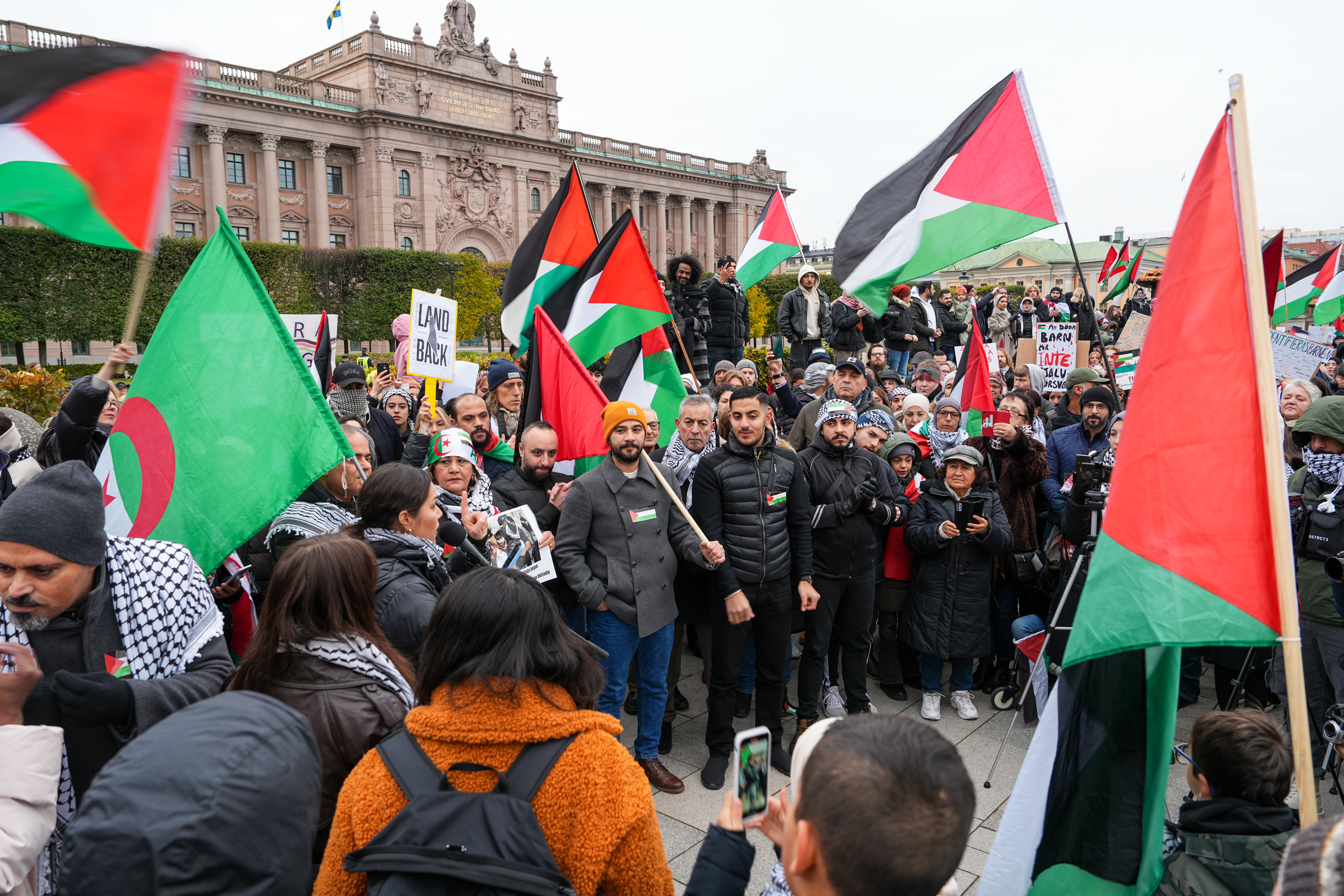
A demonstration outside the Swedish parliament in Stockholm. Photo: David Stavrou
A few weeks ago, another Swedish university – defying growing calls from students and faculty to boycott Israel – notified its doctoral candidates about a fellowship opportunity in Israel. But less than a week later, Uppsala University issued an unusual apology. "We understand that the information we forwarded has caused strong reactions, and we apologize for this," it said, adding that it intended to review procedures for passing on such information.
Asked for comment, a university representative dismissed the retraction as a technicality. "We realized that several recipients perceived the information passed on from the career office as a statement from Uppsala University," said Cecilia Edin, head of the career office. "This was never our intention, and we wanted to say sorry for the feelings this misunderstanding caused. PhDs at Uppsala University aren't the main target group for the career office, and we don't usually communicate with them. Therefore, the routines for passing on information to this group will be reviewed.
But an email complaint circulated among Uppsala staff and shared with Haaretz suggests there were other reasons for the apology. "It's inappropriate to advertise Ph.D./postdoc opportunities at any institution or foundation complicit in apartheid," it said.
These two incidents indicate just how fraught the discourse surrounding antisemitism and Israel has become at Swedish universities. Indeed, just a few months ago, Uppsala – Sweden's oldest institute of higher education and one of its most prestigious – was accused of "canceling" its Jewish connections when it removed the name of Hugo Valentin – a prominent Jewish historian and ardent Zionist – from its Center for Holocaust and Genocide Studies. The move has been described by international scholars and historians as "removing the Jewish perspective from the Holocaust," which may explain why this academic center has repeatedly rejected requests to honor Jewish Holocaust historian Paul Levine, who was one of its leading historians. Although Levine, who died in 2019, was a groundbreaking Holocaust historian and a laureate of the Raoul Wallenberg Centennial Medal, the center refused to create a memorial page on its website or place a plaque at the center to recognize his contribution.
In March, tensions between the Jewish community and the Swedish academy escalated even further when a lecturer at Stockholm University denounced the leader of the local Jewish community as a "murderer." Aron Verständig, chairman of the Official Council of Swedish Jewish Communities, responded by filing a complaint to the Swedish police against sociologist Pär Engholm for slandering him.
Swedish journalists Sofie Löwenmark and Lars Jonson have since revealed, in a piece for the online magazine Doku, other vociferously anti-Israel statements by this Stockholm-based academic, including his depiction of Israelis as "Zionist monsters who must be forced back to Eastern Europe and the United States. "Engholm has referred to Jewish leaders and terrorism researchers as "obnoxious" and "disgusting Zionists." He propagated theories suggesting that Israel murdered its own citizens on October 7 and defended Hamas, accusing Israelis and Americans of being the true terrorists.
Verständig later reported to the Swedish Committee Against Antisemitism that Engholm attacked him because he had called out another Swedish institution of higher education, Gothenburg University, for allowing pro-Palestinians student activists to take over the premises of its school of art and design and distribute Hamas propaganda. Commenting on the increasingly hostile climate on campuses, Daniel Janouch, chairman of the Swedish Jewish Youth Union, told Haaretz: "Jewish and Israeli students are worried and feel uncertain about how the situation will develop and what it will mean for them. There is concern about whether students' grades could be affected if they are simply open about being Jewish or having a connection to Israel." He added: "Jewish students should not have to take a detour on their own campus to feel safe."
From Annie Leibovitz to Amy Winehouse and Ofra Haza: New book on Jewish heroines, created by three feminist Swedish Jewish women, offers an answer to antisemitism
What do Amy Winehouse, Anne Frank, Estée Lauder, Rosa Luxemburg, Ofra Haza and Marilyn Monroe have in common? They were all Jewish (Marilyn converted), they were all heroines, and now, all six are among the 120 Jewish women in the new Swedish-language book "Jewish Heroines." The book, which targets both young readers and adults, not only tells the heroines' stories but also uses them to pose questions that have become more urgent in the post-October 7 world.
"Jewish Heroines" is the work of three Jewish Swedish women. The text was written by Anneli Rådestad, the editor of the Jewish-Swedish culture magazine Judisk Krönika, and Karin Brygger, a poet and author who also writes for the Swedish media. The heroines were illustrated by Joanna Rubin Dranger, a graphic artist and also an illustration professor at the University of Arts, Crafts and Design in Stockholm. She's also a winner of the Nordic Council's Literature Prize for her latest graphic novel.
Anneli Rådestad.Credit: Hugh Gordon
"The three of us come from very strong feminist backgrounds," says Rådestad, who's also a former journalist for Swedish public radio. She notes that Rubin Dranger has been working with feminist issues since the '90s, while Brygger has being studying women's history and literature for around 25 years. Rådestad is the editor of Judisk Krönika, which launched a series of articles about Jewish women, "partly because the magazine has been male dominated since its founding in 1932. Through these articles, we tried to contribute to a correction of Jewish-Swedish history by bringing women out of the shadows."
The idea to turn the project into a book came during the pandemic, while Rådestad was reading to her daughter, who was 5 at the time. "The book I was reading was the Swedish version of 'Good Night Stories for Rebel Girls' [by Elena Favilli and Francesca Cavallo], and I thought it would be great if there was a book dedicated to Jewish heroines. Jews are a small minority in Sweden, and the stories of Jewish women … have left very little mark." Rådestad says that when she told Rubin Dranger about the idea, "she was enthusiastic and very surprised that a book like this didn't already exist."
The book cover.Credit: Joanna Rubin Dranger / Natur & Kultur
I spoke with the three authors in Stockholm's Old Town after the book's launch party at a local bookstore. They say that when they checked if there was already a book on Jewish heroines, they found a few in English, but on a smaller scale. And they discovered the Jewish Women's Archive in the United States – a great source, but it's not a book. Rubin Dranger notes that they aimed to rise above the local context. "I wanted to make a book that would not only be for the Jewish community in Sweden but would suit everyone, including people in other countries," she says.
Brygger adds that "Jewish Heroines" could also play a role in academic debates. "It can be part of women's history and women's literary history studies. I've been involved in women's studies for a long time and I've been writing life stories and texts that give women a voice," she says. "These stories are missing in the academic world. In fact, a large part of the ability to do this now exists thanks to women like those we wrote about in the book, such as Gloria Steinem, Betty Friedan and Susan Faludi."
These last three are among a long line of American women in "Jewish Heroines," including Supreme Court Justice Ruth Bader Ginsburg, thinkers such as Susan Sontag, Judith Butler and Masha Gessen, and artists of various stripes such as Barbra Streisand, Bette Midler and Annie Leibovitz. The book also portrays women from totally different backgrounds – Nobel-winning scientists such as Israeli Ada Yonath and Italian Rita Levi-Montalcini – as well as actresses, dancers, heroines from Middle Eastern history and even biblical figures such as Esther, Ruth and the Four Matriarchs: Sarah, Rebecca, Leah and Rachel. "Jewish Heroines" weaves them into a tapestry of inspiring women from different eras all over the world.
Your book features a wide variety of countries of origin, eras and ethnic groups, but some are more widely represented than others. For example, there are many women from Sweden and the United States and only a few from Israel including Golda Meir, Ofra Haza, Ada Yonath, Ester Rada and Robi Damelin of the Parents Circle – Families Forum. How did you make your choices?
Joanna Rubin Dranger.Credit: Hugh Gordon
Brygger: "When we found women we wanted to have in the book, we made presentations for the others … and the others took some time to think and learn, and we made a decision. The three of us had an equal part in 'finding' the women." Then came the greater work of research, writing and illustrating. "This ongoing conversation was the most fabulous part of working on the book," Brygger says. "We were in constant contact, sending messages, photos and articles to each other in a flow of creative desire to write and portray as many great women as we could."
Rubin Dranger adds about the women they chose: "For Israelis, it's quite clear that Jews can be anything – religious or secular, Asian, white or Black – but for Swedes it's not so clear. Many people have never met a Jew but they have an image of Jews. Often, they think of a Jew as a religious man with a hat and payes [sidelocks]. They don't always realize that this is a flexible identity."
According to Rubin Dranger, this is why the book also features a Black American rabbi, writers, journalists and spiritual women from Algeria, New Zealand, Egypt and Cuba, not to mention a Mexican poet and actresses from India. Rådestad adds: "In a way, this book is a response to things like the report published in 2021 about antisemitism in schools in Malmö, a city that has become notorious in this context. The report showed the way students and teachers understand the word 'Jew': an Orthodox religious white man or a figure in the Israeli-Palestinian conflict."
Karin Brygger.Credit: Hugh Gordon
Brygger notes that the world of the past – and unfortunately still the present – is filled with prejudices. So the book "not only offers a wonderful possibility of finding a character who is similar to you, who can give you strength or inspire you. It's also a tool for breaking down stereotypes and fighting antisemitism."
Brygger, who lives in Gothenburg, adds that she received warm responses when she presented the book at cultural institutions in the city. "They said, 'We don't need more reports, we already know that there is antisemitism here. We need tools to deal with the problem.' They were enthusiastic about the book and wanted to use it as an educational tool."
And the issue of Jewish diversity isn't taken for granted in the Jewish community.
"Today, when you look, for example, at the school photo of the Jewish school in Stockholm, you can find the whole world in them," Rådestad says. "People get married in all kinds of ways, and it's important to represent everyone."
In Brygger's opinion, the book's diversity of Jewish identities includes "a way to deal with prejudices and racism that exist even in the Jewish community." Rubin Dranger adds: "But it's not just the representation. It's not just pointing out the fact that there is someone in the book who is adopted or someone who is Ethiopian. It's a presence that's truly broad, not an example or two who are chosen just to serve as an alibi."
Beyond the choice of specific characters, the creators stress the significance of the content being available in a physical book, sold nationwide, rather than just being information in an internet archive or a Jewish publication. "In a country where the Jewish minority is tiny, we shouldn't underestimate the fact that a large non-Jewish publisher released the book in Swedish," Rådestad says. "This makes a statement that this book is for everyone – Jews and non-Jews, young and old, library visitors and school students."
She and her two co-authors are aware that the book is being published in stormy times globally for both women and Jews. The book links these two identities. Many of the profiles are of women who stood – or are still standing – at the forefront of such troubles, from Russian-American anarchist Emma Goldman, through Hannah Szenes and women fighters in WWII ghettos, to young Ethiopian-American activist Naomi Wadler. The impression is that, beyond its heroines' scientific and artistic achievements, the book celebrates the struggle against tyranny, racism and the patriarchy.
Illustrations of Ruth Bader Ginsburg and Ofra Haza, from the book.Credit: Joanna Rubin Dranger
"We have seen and continue to see a retreat in women's rights in the world," Brygger says. "It keeps returning. In the book, we connect Jewish history with women's history." Rådestad continues: "We are connecting in many ways with other struggles, like that of the LGBTQ community. The Jewish feminist movement and the Jewish LGBTQ movement walked hand in hand. "Take Steven Greenberg, for example, the first openly homosexual Orthodox rabbi. His interpretation of the Biblical verse forbidding male intercourse is that it is a prohibition against degrading another man. Doing so lowers him to the status of a woman, which in biblical times was seen as inferior. Greenberg's interpretation connects the two struggles – striving for equality in both male-male relationships and male-female relationships. It's a common struggle."
The authors acknowledge that the book's significance has changed somewhat since October 7. Work on the book was finished before the Hamas attack. However, says Rådestad, quite a few more Jewish female heroines have emerged since then. "Take, for example, Rachel Edri from Ofakim, who saved her own life and that of her husband," she says. "She became famous for giving cookies and coffee to the terrorists, thus preventing them from murdering more people. Another example came after the terrible Eurovision week in Malmö. I think that Eden Golan not only carried Israel on her shoulders but also Sweden's Jewish minority. A young woman stood high when so many older people around her went so low. She really showed great strength, while many Jews around the world felt pressure and fear. Her character gave me strength, too."
"We couldn't have imagined these circumstances when we wrote the book. We presented it, on the eve of its publication, at the Gothenburg International Book Fair the week before October 7," Rådestad recalls, referring to the largest cultural event in Scandinavia and one of Europe's largest book fairs. "The transition from being on an important international cultural stage to October 7 was very stark. It was a terrible fall. It shook the ground beneath the feet of Israelis and Palestinians – and Jews worldwide.
"I realized a few months later that the meaning of some of the book's heroines had changed for me. For example, Dona Gracia. When I wrote about her, I saw her as a powerful historical figure who faced the Inquisition 500 years ago. Today, I understand that there are still many who live as crypto-Jews – I have friends worried because they gave their children Jewish names. Now, they don't know what effect this will have.
Illustrations of Golda Meir and Esther Rada from the book.Illustration: Joanna Rubin Dranger/Natur & Kultur
In the reality of cultural and educational boycotts, a Jewish name can lead to serious consequences. At the same time, I feel that the resistance, the strength and the resilience of Jews are an important part of this book. As a people, we've been through this many times for hundreds of years. Some of the heroines here withstood the test. They gave what they created to themselves, to their families, to their people and to the world."
Rådestad mentions a common sentiment among Jews around the world today: "Israelis have become more Jewish and Jews have become more Israeli since Since October 7. The pogromist terror of October 7 evoked something that previously only happened in the Diaspora and that Israel was supposed to prevent. The security of independence and having agency was shaken. Israelis got a taste of what it was like to be a minority in Russia a couple of hundred years ago in the most terrible and terrifying way."
She observes that many Jews worldwide are suffering for the same reason Israelis are suffering. She says they see erstwhile friends and partners, such as the international cultural communities and feminist movement, being silent and turning their backs. "It's become very important for some Jews to stand up for Israel and Israelis in a world where haters are targeting Jews and Israelis alike," she says. "So when Israel is framed as a pariah state and a controversial country, the women we profiled provide strength that children and teenagers need."
"It's not just children," Brygger adds. "When I look through the book, I'm inspired and feel strength and joy. Already when we were writing it, when we discovered women we didn't know about, it made us happy. But now the joy is different. In the past, it was the euphoria of discovering something new – like the Jewish actresses who starred in Bollywood. But today, under the shadow of October 7, the book also gives us the strength we need."
Another layer to the book is the flexible definition of Jewish identity. Some figures were not born Jewish and converted (like Marilyn Monroe, who underwent a Reform conversion to Judaism ahead of her marriage to playwright Arthur Miller, and called herself "a Jewish atheist"). Some had a Jewish father and a non-Jewish mother. Some weren't born Jewish but were adopted by Jews. Some of the heroines didn't identify as Jewish growing up, but as adults were foced by others to grapple with their Jewish identity.
By way of example, Brygger points out Marianne Cohn, a member of the French Resistance during World War II. She saved many Jewish children by smuggling them over the Swiss border. She had no active Jewish identity whatsoever during her childhood in Germany. It only developed upon emigrating to France with her parents. Rubin Dranger talks about Lotte Laserstein, a German painter whose family had converted to Christianity. But the Nazis considered her Jewish and forbade her to work as an artist. She found refuge in Sweden. "In a way, her story connects to my own experience," she says. "I grew up assimilated and only embraced my Jewish identity after a priest in my Christian confirmation process made me feel singled out and attacked me because of my Jewish heritage. I know that many today share this experience. After October 7, many people are rediscovering their Jewish identity and they start searching for a community they may have already forgotten."
"In the current global climate, words like "minyan" and "shtetel" may take on a new meaning," Rådestad observes. "In progressive Judaism, at least, you can find a women's minyan. The term shtetel may represent a safe place." This is needed because there are already American publishing houses who say "No to sexism, no to racism and no to Zionism." Says Rådestad, "Jews may once again be forced to publish their books alone, until the world rediscovers them."
What sets a Jewish heroine apart from general heroism, and what is the uniqueness of women's heroism?
Brygger: "It's about persecution. The heroism in our book is related to the strength of coping with and resisting persecution, antisemitism and exclusion. In general society, there is a struggle against patriarchy and glass ceilings of all kinds. Here we need to add another struggle – the struggle that Jewish women have had to wage throughout history."
Rubin Dranger: "Part of it is that many Jewish women fought for the rights of other minorities, like African Americans or indigenous peoples in the United States. They weren't content with fighting for their own interests."
Rådestad: "It's part of Jewish values and Jewish tradition. Telling truth to power is part of what Jews do. So is the attempt to make the world a better place, tikkun olam. Although this characterizes American Judaism, it's not only in the United States. We wrote, for example, about the Iraqi-born philanthropist Flora Sassoon. She funded and promoted the use of vaccines against terrible diseases in India and fought against deprivation and discrimination."
Given the chance, who'd you like to meet from among the heroines you profiled?
Rubin Dranger: "The American cryptanalyst Elizebeth Smith Friedman, who cracked the Nazi codes. Code cracking and intelligence defense fascinates me, and the fact that Friedman's work wasn't known until quite recently. For many decades, her files were kept confidential and were lost to history. Elizebeth wasn't Jewish by birth but married a Jewish man, a U.S. Army cryptographer." It is important to talk about this type of Jewishness, exactly because not everybody considers them Jewish, she says.
Rådestad has a hard time choosing. She starts with Shifra and Puah, the biblical midwives who disobeyed Pharaoh's order to kill Hebrew children. Then she moves on to the young Jewish women who were part of the anti-Nazi resistance movements and the Warsaw Ghetto Uprising fighters. She finally chooses Asenath Barzani, a rabbinical scholar who was active in 17th century Kurdistan. Barzani's father was a yeshiva head in Mosul. She became a yeshiva head herself. "Barzani's story changed my view about how progress happens," she explains. "It gives perspective on what the West used to be and what Iraq used to be."
Brygger also mentions several women. She says her encounter with Susan Sontag "not only shaped my academic life, but also my personal life since I was a teenager." She also recalls the story of Charlotte Salomon, the Jewish-German artist who was murdered in Auschwitz. "It's a story with a lot of pain," she says. "Salomon sent her works to a friend with instructions to 'keep this safe, it's my whole life.' Salomon reminds us how important it is to write and document our lives even today, how important it is to leave traces and testimonies."
"I hope that if a young person feels alone or lost, they'll be able to find what I found in these women that changed my life so radically," she adds. "I hope our book will give them role models in these turbulent and terrible times. Perhaps they'll even find a soulmate, even if it's someone who's no longer alive or someone who's far away. It's so hard to find and mold your identity. I'd never have made it through my teenage years without these women who made me a reading and writing person, with a life goal. As usual, I went all in and really tried to learn everything about many of them. Some of them are much closer to me than 'real people.' The world opens up to you when you relate to texts and books. These writers and artists also give you a hand to hold throughout life."
STOCKHOLM – A Jewish doctor who works at the Swedish hospital accused of covering up repeated alleged incidents of anti-Semitism by a department chairman tells Haaretz the abuse consisted of both verbal attacks and professional decisions that adversely affected his and his colleagues careers.
A former department chairman at the Karolinska University Hospital, who is also a researcher at the affiliated Karolinska institute that awards the Nobel Prize in medicine, is accused of anti-Semitic behavior toward Jewish doctors. Haaretz speaks to one of his alleged victims and to other sources close to the events.
The accused, a former department chairman at the Karolinska University Hospital in Stockholm, allegedly bullied and harassed Jewish doctors working in his department. The physician has been forced to take time away from his duties while the accusations are being investigated, after the story broke in Swedish newspaper Aftonbladet at the end of October.
Haaretz is aware of the identity of the accused, but we are not naming him due to Swedish legal restrictions.
A senior Jewish doctor who has worked at Karolinska for almost 20 years (and who agreed to speak to Haaretz on condition of anonymity) says that, together with Jewish colleagues, he was systematically discriminated against by the department chairman.
The doctor says two of his Jewish colleagues had to quit the department because of the abuse and he is the only Jewish doctor still working there. He says all three had to pay both a personal and professional price for the conduct of a person whom Jewish organizations say posted anti-Semitic materials online.
“Our work environment was extremely hostile,” the Jewish senior doctor tells Haaretz. “The situation started over three years ago, he says, and escalated over the ensuing years”. He first told his superiors about the abuse in mid-2017, he says.
In one case, the doctor says the department head saw him talking with another Jewish colleague and remarked: "There goes the Jewish ghetto." The doctor adds that "the harassment included a series of damaging steps to our careers," such as being denied access to research funds and not being allowed to participate in medical conferences or courses.
The alleged discrimination also had a negative effect on their patients, the doctor says. "In some instances, we were not even allowed to meet patients and perform surgical procedures, which were an important part of our jobs," he says, citing cases in which the department head referred his patients to other doctors.
Another example centered on an international congress in which the Jewish doctor was invited to give the keynote lecture. The department chairman allegedly denied his request to attend, without supplying a reason, but then provided funding for five non-Jewish doctors to travel there instead – even though they had not received formal invitations. Karolinska University Hospital’s acting CEO, Annika Tibell, told Haaretz that the initial decision was overruled by senior management and a university representative, and the Jewish doctor was eventually able to deliver his keynote speech at the event.
In another case, the senior Jewish doctor was supposed to lead a multi-center study funded by the European Union, and involving an Israeli hospital, at the Karolinska Institute. But the suggestion that he would serve as the project’s local principal investigator was rejected by the chairman, with no official reason given.
Though some of these accusations could be attributed to professional differences or even office politics, the Jewish doctor and other sources with knowledge of the situation believe that they are the result of the chairman’s anti-Semitism.
As proof, the doctor and others cite material that the department chairman allegedly posted on his Facebook account. This material included cartoons that were deemed anti-Semitic by three anti-Semitism watchdog organizations: The Simon Wiesenthal Center; the Swedish Committee Against Anti-Semitism; and the Living History Forum, a Swedish public body that promotes human rights and educates on the Holocaust.
One cartoon depicts a bloodthirsty Israeli soldier with a large, grotesque nose, while another compares Israel to Nazi Germany.
Karolinska University Hospital’s acting CEO, Annika Tibell, tells Haaretz the institution has “a zero-tolerance policy regarding all forms of harassment and discrimination. In addition to a well-functioning working environment and respect for each other, this is fundamental for our hospital and for the care of our patients.”
Cover up?
The senior doctor who spoke with Haaretz, as well as sources with knowledge of the department’s inner workings, also detail how attempts to complain about the ex-chairman’s conduct were initially ignored, while subsequent investigations fell short.
According to the doctor, his initial complaint was ignored. It was only when he complained with the help of a lawyer that the hospital agreed to launch a probe into the department head's behavior, he says.
The Jewish doctor charges that, far from revealing the truth, these were essentially "cover-ups" designed to protect the accused department chairman. (In a response to Haaretz, Tibell rejected all accusations of a cover-up.)
"The first investigation was conducted (after the chairman was temporarily suspended) by the new head of the department – a professor at the Karolinska Institute who was also a close friend of the former chairman," says the senior doctor. "This professor was biased and asked non-Jewish doctors if they had experienced anti-Semitism in the department. These questions were asked face-to-face, and naturally their answer was negative.”
When one Jewish doctor confirmed "that he had indeed experienced anti-Semitic comments" and couldn’t rule out that "there was a problem, this information was ‘forgotten,’" the doctor alleges. "During the investigation, no protocols were written and eventually the conclusion was that there was no anti-Semitism problem,” he adds.
Tibell says an external investigation was deemed necessary following the first probe. The Jewish doctor reveals that this was to be conducted by two psychologists, but they removed themselves from the process, he says, "because they were not qualified to assess such issues and were not experts in anti-Semitism."
Tibell confirms that, saying that the initial external investigation "did not start as planned, due to lack of required competence in the specific area of harassment.”
She says the current (third) investigation is ongoing and will likely end in December. However, she notes that “with hindsight, I believe we could have acted more quickly and assertively in securing the prompt start of the present external investigation.”
The senior Jewish doctor remains skeptical about the latest investigation. “It is supposed to be an external [probe], but the legal firm conducting it has economic ties to the hospital and isn't really objective," the doctor claims. He also alleges that Karolinska rejected an offer that the Simon Wiesenthal Center and the Swedish Committee Against Anti-Semitism serve as observers, which he claims is necessary to ensure the integrity of the investigation.
The former department chairman is still being paid while the investigation continues, and is still conducting research at the affiliated university. In addition, the Professor, who allegedly tried to cover up the events, is on a similar "time-out" although sources told Haaretz that he is still involved in the department's work both as consultant and as a professor.
Last week, another senior official who was responsible for the department in which the anti-Semitic incidents allegedly occurred, decided to quit. This was for both personal reasons and after admitting he didn’t react strongly enough to resolve the problem, according to an internal hospital email seen by Haaretz. He too will continue working as a doctor and researcher at Karolinska.
A dark history
Karolinska is the name of both a major hospital and an affiliated medical university that is regarded as one of the most prestigious in the world. The university's Nobel Assembly, which consists of 50 professors from various disciplines, selects the recipients of the Nobel Prize in Physiology or Medicine.
Although the university and adjacent hospital are two separate legal entities, they are closely connected. The original Karolinska Hospital in Solna, just north of Stockholm, was founded over 80 years ago.
Sweden has a dark and complex historical relationship with anti-Semitism – one that has not skipped over the medical profession. Swedish doctors were prominent in the development of eugenics and race biology in the first half of the 20th century, and institutions, including Karolinska, actively rejected Jewish refugees fleeing Nazi Germany in the 1930s and seeking work in Sweden. The country's dark past can still be found in the hospital grounds today, with one street named after Astrid Cleve – a Swedish researcher who remained a Nazi sympathizer even after World War II ended.
Asked about the street named after Cleve, Tibell told Haaretz: “This was just recently brought to the attention of the hospital, prompting a strong reaction from Karolinska University Hospital asking the local municipality to rapidly change the name of the street.”
The anti-Semitism scandal at the hospital comes at a time when Sweden has been facing a new wave of anti-Semitism. In the most recent election in September, for example, a party with Nazi roots made substantial political gains. And the last few years have also seen a string of anti-Semitic attacks in the country. Last December, for instance, a synagogue in Gothenburg was firebombed while an event was taking place; Malmö has been the site of numerous attacks against Jewish people and institutions in recent years; and recently a Jewish local politician in Lund, a town in southern Sweden, was a victim of an arson attack. Other cases of threats, harassment and vandalism have occurred in various places, including one town, Umeå, in northern Sweden, where a local Jewish center had to close down because of attacks and threats by neo-Nazis.
"The situation has become worse in the last few years," Aron Verständig, chairman of the Official Council of Swedish Jewish Communities, tells Haaretz. "This is not new and it's very worrying." Verständig says that though anti-Semitism isn't common in Sweden when it comes to the general population, for quite a few years now there have been many attacks, mainly in Malmö, committed by people with a Middle-Eastern or North African background. “In recent years the extreme right has become a problem too and there is also anti-Semitism within the pro-Palestinian movement and Swedish extreme left, although this is usually not violent", adds Verständig.
However, five Jewish doctors and researchers who currently work at Karolinska all said they have no recent personal experiences of being harassed, discriminated against or mistreated due to their Jewishness. According to these conversations, apart from a couple of minor incidents dating from a number of years ago, Karolinska’s anti-Semitism problem is seemingly confined to one department.
However, all five voiced strong feelings of discontent about the way Karolinska had chosen to handle the scandal.
One source talked about a "management culture of silencing critics and covering up scandals." Another said Karolinska has an organizational problem that allows employees to be subjected to toxic work relations for years, with no mechanism for respite. A third said they thought Karolinska’s management was hoping for "the storm to pass, while failing to understand how serious the allegations are and how much damage they caused staff and patients."
Rabbi Abraham Cooper, one of the founders and the associate dean of the Simon Wiesenthal Center, concurs. After being approached by one of the Jewish doctors who claimed harassment at Karolinska, Cooper sent a letter to the hospital's management last month, alleging that the hospital knew about the "obvious and open anti-Semitism," and ignored it.
Two weeks ago, Cooper traveled to Stockholm and met the hospital's acting CEO, Tibell. In a press conference held after their meeting, Cooper told journalists he had urged the hospital's leadership to fast-track the investigation.
"This needs to be fully addressed. If it isn't, there will be damage to the name of Karolinska – which is something the Wiesenthal Center doesn’t want to see," he said. "That's one of the reasons I got on the plane and came here."
Cooper added that the doctor who approached the center for help is "a brilliant physician, who wants to continue doing good work at this hospital."
The Swedish Medical Association has been criticized by some of its members on social media for its response to the situation. According to an article in Swedish daily Dagens Nyheter, the union has been reluctant to help the Jewish doctors, with the chairwoman of the union saying that mutual respect is needed by both sides in the dispute.
When asked how a Jewish person can show respect to a person who has been anti-Semitic and harassed them, her response was: “They can listen to each other. I don’t have a better answer. Harsh words are exchanged in every demanding workplace. In these cases, one should try to talk to each other and explain what happened.” One doctor reacted online by asking, “What exactly does the discriminated-against doctor need to understand about the bully’s racism?”
Karolinska Institute President Ole Petter Ottersen said in response: “Questions regarding anti-Semitism and discrimination are of great concern both to Karolinksa Institute and to me personally, and if we find out that there are issues of this sort within the institute, we will react immediately. We do not tolerate discrimination of any sort. Discrimination has absolutely no place in a university and goes against all what a university should stand for.”
Regarding the future of the doctor suspected of abuse and the professor involved in the first internal probe, he said the institute "will closely study the outcome of this investigation and make necessary follow-ups."
When writing about Auschwitz, it's important to start with the obvious. The theft of the camp's notorious entrance sign was an appalling act and those who are responsible for it must be punished. In a broader context, on the occasion of the International Holocaust Remembrance Day and the 65 anniversary of the liberation of Auschwitz, it is important to point out that the original camp site, along with the museum and archive which were built on it, are in need of serious renovation. If the site's educational projects, research activities and ceremonial events, are to continue, there is need of a large investment, of international support and of course, a better security system.
So much for stating the obvious.
There is however another way of looking at the theft of the sign which naturally raised many angry reactions. Interestingly enough, statements made after the event were of the kind usually made when religious sites are desecrated. It's easy to forget that Auschwitz is not a holy site. It is not a vandalized grave or a burnt down synagogue, in fact it's as far from a holy site as one can imagine. Birkenau (Auschwitz 2) may well be the largest Jewish graveyard in the world and the site where thousands of Poles, Roma, Russians and many others were murdered, but the entrance sign of the main camp, Auschwitz 1, which simply states "Arbeit Macht Frei" (work liberates) is perhaps one of most profound symbols of evil and one of the most symbolic representations of Nazism. So much so that it is almost tempting to cry out to the thieves and to all the Anti-Semites and Neo-Nazis who support them: "If you want it so badly, just go ahead and take it!"
There is a reason why that sign is so symbolic. Auschwitz wasn't on another planet, as Jewish writer and Auschwitz survivor, Yehiel Dinur, once put it. It was made from the stuff of our very own planet. It took all the evils of this world and brought them to a new level. Though it developed new and monstrous techniques, it didn't invent anything new. It was the most accurate representation of the world view of the Nazi movement which, while being politically revolutionary, was based on old and conservative values. Like Nazism itself, Auschwitz was hierarchical, racist, and murderous all of which are typical aspects of the twentieth century. It was a world where human beings had no value, where every part of their body and belongings was used to make profit before they were annihilated. It was a world of cruelty and ruthlessness, but not less interesting, it was a world of lies. And this is where the "Work Liberates" slogan has its deeper meaning.
The lies in Auschwitz weren’t limited to the lies told to the victims who were told, for example, that they are entering the showers when they were standing at the doors of gas chambers. They were deeper, almost philosophical. Auschwitz had every aspect of human life. There was music, medicine and even a judicial system. There were work places, sex life, trade and industry. But these were all distorted. Any trace of humanity was sucked out of them. Music, for example, was transformed from an expression of beauty and human emotions to a soundtrack of slave marches and executions. In the so called "Joy Division", sex was transformed from a source of pleasure and expression of intimacy to violent and repeated rape. In the torture chambers of Block no. 11, the judicial system served might instead of right and in Dr. Mengale's Block medicine did not save lives, but practiced diabolical experiments to glorify a mythical ‘master race.’
And then there's work. Work can define us; it can give us pleasure, release our creative abilities or at least provide for us. Work can liberate. But in Auschwitz work was the exploitation of people struck by disease and hunger by corporations, some of which, sadly enough, still exist today. All this makes the stolen slogan not only cynical but also a pure symbol of everything wrong in this world. As such, perhaps we can do without it.
Many, myself included, were shocked by the theft of the sign. But was the response proportional? Is the symbol really so important? I have visited Auschwitz many times and have seen how the sign has turned into a tourist attraction and how groups of laughing teenagers from all over the world gather beneath it to have their picture taken. Visiting Auschwitz is important and Symbols are important too but they are not everything. It's important to remember that although the war ended in 1945 genocide, racism and oppression didn't. Perhaps it would be more effective if some of the attention given to the stolen sign were diverted to the atrocities in Darfur for example, or to the many cases of minority oppression and discrimination worldwide.
The Israeli historian Prof. Yehuda Bauer, who is one of the world's greatest authorities on the Holocaust, says: "There are many places in the world today where mass murder and even genocide are possible. Everyone knows about Sudan but there are other places like Burma (Myanmar) and East Congo. The situation in other regions like Iran, with its complex ethnical problems, The Balkans, Zimbabwe, Kenya and Iraq and some places in South America like Guatemala could also deteriorate into mass murder". Bauer, who is visiting Stockholm this week, serves as an senior adviser to many institutes including the Swedish Government, the Task Force for International Cooperation on Holocaust Education, Remembrance, and Research and the International Forum on Genocide Prevention. "The Holocaust was an unprecedented event because of its totality, universality and the pure ideological motives behind it", says Bauer, "But it was not unique, since it was an act of human beings on other human beings, it can happen again".
Though Bauer's work with the UN and other international organizations to prevent future crimes, may be more important to future generations than the preservation of old Nazi concentration camps, it can be claimed that the stolen sign, like the camp itself, is important as a witness of what happened and can be used in the battle against those who deny the Holocaust. There is truth in this. But there will come a day when not much will remain of the original camp. What then?
Even today parts of it are falling apart despite all preservation efforts. Like it or not, physical artifacts, just like the testimonies of living survivors, important as they are, will have a smaller role in remembering and understanding the Holocaust in the future. It is, after all, an event from the past century, and sadly its' survivors are becoming fewer and fewer. Camps like Treblinka and Sobibor were totally destroyed and many documents and artifacts are already lost. Future discussion about the Holocaust will have to be based on books, museums and films, and if we want it to have a future at all, public debate, educational dialogue and historical research will have to take the place of visiting the sites themselves.
From a Swedish perspective, these observations are particularly important. The apparent involvement of a Swedish Neo-Nazi in the sign theft last month reminds us that there is a need to continue the efforts to fight racism, Anti-Semitism and undemocratic trends in Swedish society. Sweden's ambivalent role in WW2 makes this even more crucial. As a vital exporter of iron ore to the German war machine, and as an industrial and sometimes political and ideological Nazi allay, Sweden has a moral and political obligation to deal with its past even if it is also responsible for saving many lives through its diplomatical efforts and generosity to refugees.
"Anti-Semitism in Europe is getting worse", says Prof. Bauer and explains that it exists in the extreme Right-Wing as well as in the left and in parts of the second generation of Muslim immigrants who rebel against their communities by targeting Israel and the Jews. He points out Sweden's efforts in fighting these trends, "Sweden dedicated time and money and has created The Living History Forum, a government agency commissioned to promote democracy and human rights, with the Holocaust as its point of reference". There is of course still work to be done and Bauer claims that studying the core issues of the Holocaust and especially the dilemmas of its victims are crucial to this process.
As for the stolen sign, I don't really know what the thieves who climbed on Auschwitz's gate and removed the sign on that cold December night had in mind. Truth be told, I don't really care. I was shocked when it was taken and I'm glad it is now back. But that is stating the obvious again.
Beyond the obvious is another thought. In one of his books, Yehiel Dinur describes a vision of an Auschwitz prisoner. He is sitting in a truck full of prisoners on the way to the crematorium and he's looking at an SS officer. He realizes, to his horror, that under other circumstances the roles could have been reversed and he could have been the killer. The worst thing about Auschwitz, he realizes, is that it is man-maid, not the work of the devil and it lies within the potential of human behavior. He describes the truck passing under the German words "Arbeit Mach Frei" and in his mind the German words are transformed into Hebrew ones: "In the image of God created he him". The symbol of Nazism becomes the cradle of Humanism. Now that would be a sign no one could steal.
וגרסה עברית:
כשעוסקים באושוויץ חשוב לפתוח במובן מאליו. גניבת השלט משער המחנה לפני יותר מחודש היא מעשה נפשע והאחראים לו חייבים להיענש. זאת ועוד, יום השנה ה 65 לשחרור המחנה ויום השואה הבינלאומי, שיצוין השבוע ברחבי העולם, הוא הזדמנות נוספת להזכיר את מצבו הקשה של האתר בו נרצחו מעל למיליון וחצי בני-אדם ולקוות כי השמירה עליו תשופר, שהכסף הנדרש לשיפוצו יגויס בקרוב ושמאמץ ניכר יושקע בשימור המחנה ובהמשך הפעילות החינוכית, התיעודית והטקסית המתקיימת בו.
עד כאן המובן מאליו.
גניבת השלט "העבודה משחררת" עורר מטבע הדברים גל תגובות בישראל ובעולם. רוב התגובות הזכירו דברים שנשמעים כאשר מטרות יהודיות מותקפות בחו"ל. אך גניבת שלט הכניסה של אושוויץ איננה דומה לריסוס גרפיטי על בית-כנסת, להשחתת ספר תורה או לחילול קבר יהודי. מחנה אושוויץ איננו מקום קדוש, הוא מקום מקולל. שדות בירקנאו הם אמנם בית-הקברות הגדול ביותר של העם היהודי, אך דווקא השלט בעל הכתובת "ארבט מאכט פריי", הוא הדבר הרחוק ביותר מהיהדות או מהאנושיות שניתן לעלות על הדעת. הוא אולי הייצוג הנאמן ביותר של הנאציזם ושל הרוע עצמו. הוא ארור ומאוס עד כדי כך שמפתה לומר לגנביו כמו גם לכל האנטישמים, הניאו-נאצים והפשיסטים למיניהם שחוגגים את האירוע: "אם אתם כל כך רוצים את השלט הזה, בבקשה – קחו אותו!".
אושוויץ לא הייתה, כפי שאמר ק.צטניק, פלנטה אחרת. להיפך, אושוויץ הייתה בנויה מהחומרים של הפלנטה הזאת. היא לקחה את כל הרעות החולות של העולם המודרני והביאה אותן לקצה. היא פיתחה אמנם טכניקות חדשות, מפלצתיות, אך היא לא המציאה שום רעיון חדש. היא הייתה התגלמותו הנאמנה של האידיאולוגיה הנאצית, שהייתה מהפכנית אולי מבחינה פוליטית, אך התבססה על עקרונות שמרניים ומוכרים, החל מהפרקטיקה הניהולית ועד השימוש בפסיכולוגיה של התליינים והקורבנות. במחנה אושוויץ, כמו בנאציזם עצמו, היה כל מה שהיה רע במודרנה. הייתה בו ההיררכיה, הגזענות והרצחנות שאפיינו את המאה העשרים (ושלא חלפו עדיין מן העולם). נבנה בו עולם בו בני-אדם היו פחות מסך כל חלקיהם, חפצים חסרי ערך שכל חלק מגופם ורכושם נוצל למטרות כלכליות. היו באושוויץ אכזריות, חוסר חמלה ודיכוי אך מעניין לא פחות, אושוויץ הייתה מבוססת על שקר. וכאן בדיוק תפקידה של הסיסמא הידועה לשמצה: "העבודה משחררת".
ההונאה באושוויץ לא התבטאה רק בשקרים שסופרו לקורבנות שנכנסו לתאי-הגזים מתוך אמונה שהם מקלחות. השקר של אושוויץ היה עמוק יותר. כמעט פילוסופי. באושוויץ היו הרי כל ביטויי העולם האנושי, היו בה מוסיקה, רפואה ומערכת משפט, היו בה מקומות עבודה, חיי מין, מסחר ותעשייה. אך מחולליה של אושוויץ לקחו כל מה שהיה לו פוטנציאל אנושי והפכו אותו על פיו. המוסיקה באושוויץ, למשל, הפכה מביטוי של יופי ורגשות אנושיים לפס-קול של מצעדי עבדים והוצאות להורג. בבית-הבובות המין הפך ממקור של עונג ואינטימיות לאונס סדרתי ואלים. במרתפי העינויים של בלוק 11, המשפט לא עשה צדק אלא הנציח את שרירות לבו ואכזריותו של השליט. בבלוק 10 של הדר' מנגלה הרפואה הפכה ממצילת חיים לגיהינום של המתת ילדים וקטיעת איברים.
ויש כמובן את העבודה. העבודה מעצבת את מי שאנחנו, היא יכולה להיות מקום של יצירה ומקור של פרנסה, היא יכולה להיות משחררת. אבל לא באושוויץ. באושוויץ העבודה הפכה לעבדות, לניצול של בני-אדם מוכי קור, מחלות ורעב ע"י תאגידים כלכליים שחלקם, למרבה הציניות, קיימים עדיין היום. כל אלו מבוטאים היטב בשלט "העבודה משחררת". זוהי יותר מציניות, זהו הביטוי הטהור ביותר של השקר והרוע של הנאציזם.
רבים הזדעזעו, ובצדק, מגניבת הסמל החשוב הזה. אך האם הפרופורציות הופרו? האם הסמל הזה באמת כל כך חשוב? אני ביקרתי באושוויץ פעמים רבות. ראיתי כיצד השלט הזה הופך לאתר תיירות וכיצד קבוצות מצחקקות של בני נוער מכל העולם מתקבצים תחתיו כדי להצטלם. אין ספק, הביקורים באושוויץ הם חשובים וגם סמלים הם חשובים אך הם לא מראית הכל. המלחמה אמנם הסתיימה ב 1945 אך מעשים של רצח-עם, גזענות ואפליה הם לא נחלת ההיסטוריה. ייתכן שלא היה מזיק אם מעט מתשומת הלב שלו זכה השלט הנאצי באושוויץ היה מופנה לנעשה בדרפור, לדיכוי מיעוטים או לצמיחתן של תנועות פשיסטיות ברחבי העולם.
פרופ' יהודה באואר, אחת האוטוריטות החשובות בעולם בנושא השואה, אומר: "יש מקומות רבים בעולם כיום שהרג המוני ורצח-עם אפשריים בהם. כולם יודעים על סודאן, אך יש מקומות נוספים כמו בורמה (מיאנמר) וקונגו המזרחית. המצב במקומות כמו איראן, על המורכבות האתנית שלה, הבלקנים, זימבבווה, קניה ועיראק ומקומות מסוימים בדרום-אמריקה כמו גווטאמאלה, יכול גם הוא להידרדר לרצח המוני". באואר, המבקר בימים אלו בסטוקהולם, משמש כיועץ בכיר לפורומים בינלאומיים שונים הנלחמים בתופעות של הרג המוני ורצח-עם. "השואה הייתה אירוע אי-תקדימי במובן הזה שהיא הייתה טוטאלית, אוניברסאלית, שיטתית ומונעת ע"י מניעים אידיאולוגיים טהורים", הוא אומר, "אבל היא איננה ייחודית. מכיוון שהיא בוצעה ע"י בני-אדם היא יכולה לקרות שוב".
למרות שעבודתו של באואר ושל אחרים חשובה אולי לאנושות יותר משימור מחנות-הריכוז הישנים, יש הטוענים שהשלט הגנוב, כמו שאר שרידי המחנה, חשוב כדי להילחם בהכחשת השואה. יש אמת בטענה זאת אך יבוא היום שבו לא יוותר הרבה מהמחנה המקורי ומשרידיו. כבר היום חלקים ממנו מתפוררים ויש שרידים שיתכלו למרות כל מאמצי השימור. השרידים הפיזיים כמו גם העדים החיים, חשובים ככל שיהיו, לא נותנים היום מענה להכחשת השואה וגם לא להבנתה. אחרי הכל, מדובר באירועים מאמצע המאה הקודמת ובקרוב לא יוותרו להם עדים חיים. מחנות חשובים כמו טרבלינקה וסוביבור נהרסו לחלוטין ע"י הגרמניים וחומר תיעודי רב נהרס ונעלם. אם חשוב לנו שהשואה ולקחיה לא יישכחו ניאלץ להתרגל ללמוד אותם דרך ספרים, סרטים ומוזיאונים ובעיקר דרך מחקר היסטורי, דיון ציבורי ושיח חינוכי.
מנקודת ראות שוודית אבחנות אלו חשובות במיוחד. מעורבותו לכאורה של ניאו-נאצי שוודי בגניבת השלט בחודש שעבר היא תזכורת לחשיבותו של המאבק בגזענות, באנטישמיות ובמגמות אנטי-דמוקרטיות בחברה השוודית. זכר התפקיד האמביוולנטי של שוודיה במלה"ע השנייה רק מחזקת צורך זה. כיצאנית ברזל חיוני למכונת המלחמה הגרמנית וכשותפה עסקית, ולעיתים גם פוליטית ואידיאולוגית של גרמניה הנאצית, לשוודיה יש אחריות פוליטית ומוסרית להתמודד עם עברה, אפילו אם היא הצילה אלפי בני-אדם בתקופת המלחמה כתוצאה ממאמציה הדיפלומטיים ונדיבותה כלפי פליטים. זוהי מחויבות היסטורית שנוגעת גם למגמות מדאיגות בהווה.
"מצבם של היהודים באירופה גרוע יותר היום משהוא היה בעבר", אומר פרופסור יהודה באואר ומסביר כי יש היום באירופה אנטישמיות מסורתית, דומה לזו הטרום-נאצית וגם אנטישמיות חדשה יותר. האנטישמיות לדבריו מגיעה משלושה מקומות מרכזיים: הימין הקיצוני, השמאל והדור השני והשלישי של מהגרים מוסלמים שמפנים את המרד שלהם בחברות המערביות הקולטות נגד ישראל והיהודים. שוודיה, מציין באואר, מקדישה מאמצים, זמן וכסף רב להילחם במגמות אלו אך יש עוד עבודה רבה. השימוש בגרעין הקשה של השואה, ובעיקר בדילמות של קורבנותיה, היא הדרך הטובה ביותר להמשיך את הדיון החשוב הזה.
אינני יודע מה בדיוק עבר בראשם של החוליגנים העלובים שטיפסו על השער של אושוויץ, הבריגו החוצה את שלט הכניסה וברחו איתו. למען האמת, זה גם לא אכפת לי במיוחד. המובן מאליו אומר שהשלט חשוב להנצחת הקורבנות ולפעילות החינוכית של המוזיאון וטוב שהוא הוחזר. אבל מעבר למובן מאליו יש מחשבה נוספת.
הסופר ק.צטניק בספרו "הצופן" מתאר חיזיון של אסיר, שלד בין שלדים עירומים, היושב במשאית בדרך לקרמטוריום ומביט אל קצין SS. האסיר מבין שהזוועה האמיתית של אושוויץ היא בכך שהיוצרות יכולות היו להתהפך ושהוא עצמו, בנסיבות אחרות, יכול היה להיות קצין SS. אושוויץ הרי איננה יצירת השטן, הוא מבין, אלא יצירת בני-אדם, שכולם שווים וכולם נבראו בצלם. "המשאית עוברת את שער אושוויץ שמעליו האותיות הגרמניות: ARBEIT MACHT FREI", כותב ק.צטניק את חזיון האסיר, "והן מתחלפות באותיות העבריות: "בצלם אלוהים ברא אותו". כך הופך סמל הנאציזם לערש ההומניזם. את השלט הזה אין איש יכול לגנוב.


 דיויד סטברו