Israel Between Peace and the Sword

The choices the region will face after the Iran-US-Israel War, and does international law have anything to do with them.

Published in Swedish Svenska Dagbladet: Israel måste alltid ha svärdet redo | David Stavrou | SvD Ledare

The Swedish discourse on the war in Iran has been dominated by the question of its legality. In recent weeks, international law scholars, academics, politicians, and columnists have explained why the American and Israeli attack is “illegal under international law.” There is much to say about this reasoning, but a reasonable question is what the point really is. In the real world, the legality of war matters very little, because international law, in general, has hardly had any real significance over the past decades.

The main reason is simply that it doesn't work. International law has been used by some of the world’s worst despots, from Gaddafi to Assad, to delay international action against their crimes, and when it was finally used for intervention—in many cases, it made the situation even worse and led to more violence and failed states.

International law has also given legitimacy to regimes such as Qatar and Somalia, which have gained seats on the UN Human Rights Council despite their total lack of such rights. Terrorist organizations have used it in their propaganda to avoid the consequences of their actions, and China’s and Russia’s veto rights in the UN Security Council ensure that aggressive dictators go unpunished.

“If the U.S. illegally invades other countries, Russia will do the same” is a common argument against the American offensive. But the truth is rather the opposite: Russia did not wait for the Americans to attack Georgia or Ukraine, and—like Turkey in Syria, Azerbaijan in Armenia, and Eritrea in Ethiopia—has ignored international law for decades. No country is waiting for Israel or the U.S. to legitimize their actions according to the “law of the jungle”.
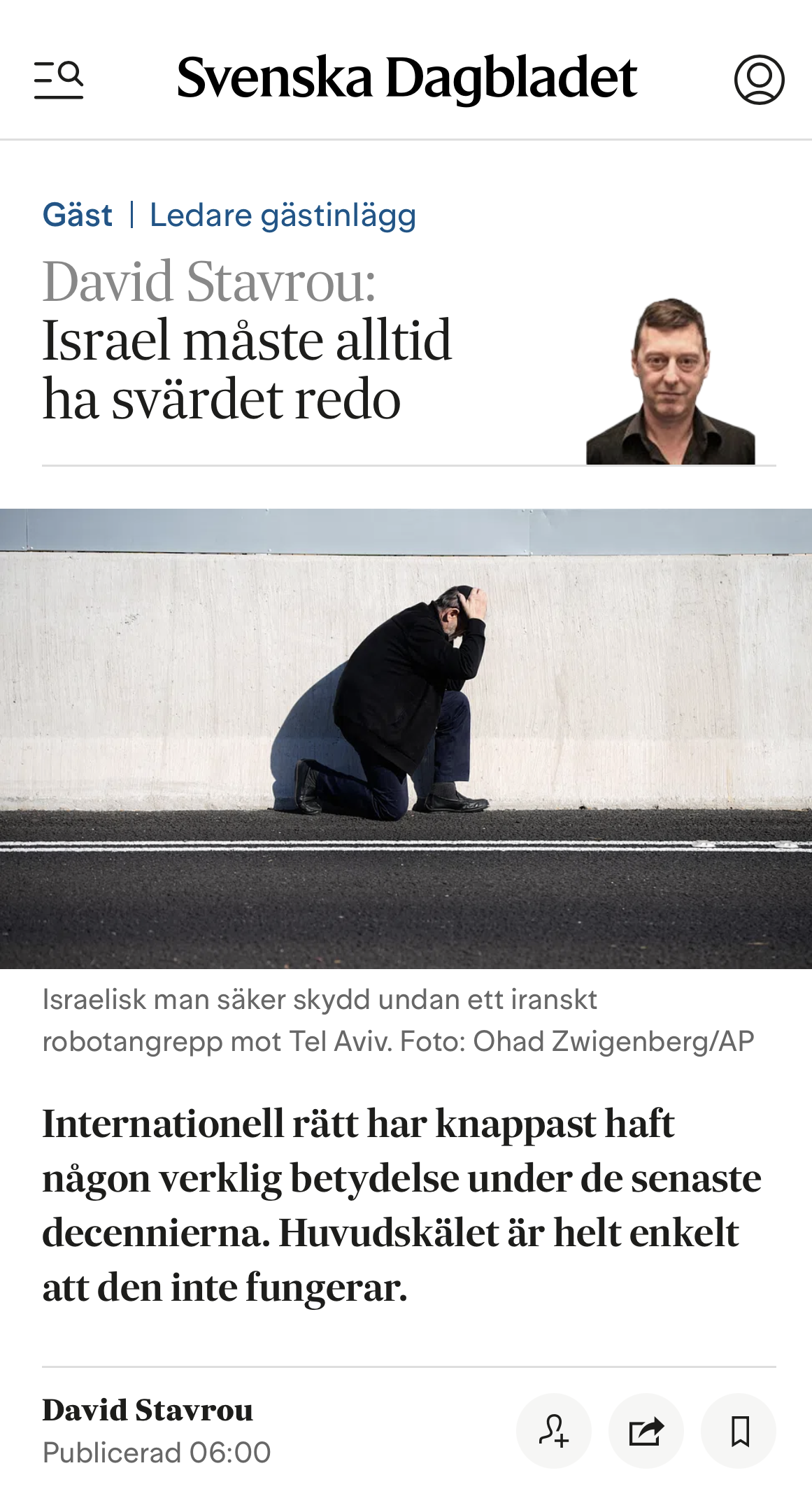
For a country that has not been at war since 1814, the question of the legality of military interventions may seem like the most important one. Theoretically, even a superpower like the U.S. should be concerned with issues of limiting its global power. But for a country like Israel, which is constantly threatened by real enemies who want to annihilate it and kill its population, this question appears fairly academic.

There is, however, another question that from an Israeli perspective is extremely important. It is simple but crucial, and it should concern other countries as well—it is not whether the war is legal, but whether it is effective. Or more broadly: can military power by itself solve Israel’s problems with Iran and other enemies?

“When all you have is a hammer,” as the well-known saying goes, “every problem looks like a nail.” Israel undoubtedly has a powerful hammer. Could it be that the country has become accustomed to solving all its problems with it? Previously, Israel used many forms of power to strengthen its security and international standing. Diplomats engaged in creating complex alliances, its soft power included outstanding achievements in culture, art, agriculture, science, and technology, and governments were willing to participate in peace negotiations and consider compromises.

The Hamas massacre on October 7 and Iran’s persistence in combining nuclear ambitions with threats to wipe Israel off the map changed all of this. The Israeli foreign service has been marginalized; the country’s artists and scientists are boycotted around the world, and its enemies are blown to pieces rather than invited to ceremonies on the White House lawn. Considering that many of Israel’s enemies are ruthless killers, this is hardly surprising. Anyone who sees value in human life should not shed tears for people like Hassan Nasrallah, Yahya Sinwar, and Ali Khamenei. But do military operations improve reality if they are not accompanied by other measures such as diplomacy, economic development, and new creative political alliances? This is not only an Israeli question. A new world order is taking shape before our eyes, and if we are not heading toward total anarchy, the question of limiting military power and understanding what it can and cannot achieve is crucial.

One indication is the situation in Gaza. After more than two years of extensive military force and enormous destruction, the reality is that Hamas not only still exists, it is armed and controls many state functions. In Lebanon, Israel may have achieved significant military successes against Hezbollah, but the Israeli are still spending far too much time in bomb shelters, and despite everything, Hezbollah is still alive and kicking. Both militarily and politically.

Israelis are once again deprived of basic necessities—schools are closed, workplaces shut down, flights canceled, thousands have lost relatives, been forced from their homes, and suffered injuries and trauma. Not to mention that Israel is deeply divided on issues concerning its democracy, which can only be resolved when the shooting stops. Meanwhile, Israel has also, without justification, become the punching bag of the international community. All the world’s power seems to be of little use in solving this.

And then there is Iran. Now that the war has begun, it should, for the sake of both Iranians and Israelis, end with a regime change—and no regime change is possible without the use of force. The Iranian people themselves, who ultimately must liberate themselves, have asked for foreign intervention, and giving it to them is the right thing to do. But what then?

“From the moment we decided that only here, in the land of Israel, could the Jewish state arise, we accepted that more than a hundred million people from the Arab world, from the Arab nations, and from the Palestinians would be our neighbors,” said Israel’s former prime minister Yitzhak Rabin a few years before he was assassinated in 1995. “There are now only two possibilities: either a serious and determined effort is made to achieve peace—peace and security—or the sword will always rule.” In the 1990s, Rabin chose the first option, but since then, leaders across the region, including Israeli leaders, have developed a dependence on using force. Perhaps even an adiction.

When the war in Iran is over, Israel will face a choice. Previously, the country combined pragmatic diplomacy, careful alliance-building, and visionary openings toward the Arab world. In a region like the Middle East, this is risky. Israel will always need to keep a sword ready, but with security guarantees and economic support instead of anachronistic laws and self-righteous moralism from other countries, peace may once again become an option.
Can Swedish journalists understand the chaos, suffering, and fear of war

When two Israeli soldiers visited Stockholm, their story was misunderstood, writes Israeli journalist David Stavrou.

Published in Kvartal: https://kvartal.se/erikhogstrom/artiklar/svenska-journalister-forstar-inte-de-israeliska-soldaterna/cG9zdDo2MTgxMg

Two young Israeli soldiers recently visited Stockholm together with an activist from Breaking the Silence, an Israeli organization that collects and publishes testimonies from Israeli veterans and, in many cases, acts as a whistleblower by exposing alleged human rights violations and war crimes. The Swedish visit was organized in collaboration with the Christian aid organization Diakonia, which arranged interviews with the Swedish press (SVT, Dagens ETC, Dagens Arena, and Jewish Chronicle). In the interviews, the soldiers used pseudonyms, and their faces were not shown.

In some of the publications, the interviews were presented as evidence supporting the gravest accusations against Israel. For example, Dagens ETC wrote: “The serious allegations have been dismissed as Hamas propaganda by commentators like Alice Teodorescu Måwe. But everything is now confirmed by Israeli soldiers.”

In the interviews, the soldiers reportedly said things like, “we were ordered to shoot all Palestinians we considered ‘military-age men’” and “we used Palestinian men as human shields.” Other claims included that many buildings were destroyed in Gaza and that, during the first weeks of the war, there was a lack of rules of engagement. Later, the soldiers said, rules were introduced, but they were weak and not always applied. As a result, unarmed men were shot.

They also reported that journalists and healthcare workers were considered legitimate targets, even if they themselves did not participate in such incidents. The two soldiers also described a discourse that dehumanized Palestinians.


Many Israelis have strong objections to Breaking the Silence. They argue that this type of testimony contributes to hatred of Israel, causes the country to be treated unfairly, and that even if the reports are true, they should be discussed domestically rather than in a hostile international stage.

Of course, Swedish journalists do not need to concern themselves with this—but it can help to understand the context. Many Swedes would likely raise an eyebrow if Swedish organizations on the political fringe were setting the agenda for Sweden’s image abroad. In this case, the soldiers are telling an important story—the problem is that the Swedish press misunderstood it.

A key issue concerns how to distinguish between different types of armed forces. Traditionally, there is a difference between terrorists or non-state actors who use violence against civilians and state-controlled armies with formal military forces, command structures, and legal frameworks. That definition is largely irrelevant for Israelis because Hamas is a hybrid actor. Although the organization uses terrorist methods, its military branch—the al-Qassam Brigades—is structured like an army, with battalions and brigades, elite units, command chains, and modern weapons systems. During the war, this was also supported by high-tech disinformation campaigns, a financial empire of global investments, leaders living luxuriously outside the region, and alliances with some of the world’s most tyrannical regimes.

This paints the Israeli soldiers’ testimony in a very specific colour since Hamas, despite its military structure, is not bound by international law. Its militants can behead, rape, and execute civilians, burn people alive, and take children as hostages—with or without uniforms—while exploiting its other source of power – the power of sovereignty, and the civilian control the organisation holds in Gaza. Expecting Israel not to act against individuals simply because they are not in uniform in this asymmetric conflict may be understandable, but it is hardly surprising that the reality forces terrible dilemmas and tragic decisions.


The Israeli soldiers confirm that Israel, despite the genocidal nature of the Hamas attack against it, at least tried to maintain some form of legal framework. They say civilians were evacuated, leaflets were dropped as warnings, orders were given not to shoot women and children, and no-go zones were established in order to limit Israel's massive firepower. Using human shields is obviously illegal and should be punished. But the claim that journalists and healthcare workers are always protected in a reality where Hamas has been shown to use both journalistic and medical infrastructure for attacks on Israeli civilians is detached from reality.

Israel claims that intercepted communications show Hamas used ambulances to transport fighters, weapons, and equipment. Hamas also hid weapons and command centers in hospitals, schools, mosques, and private homes. The IDF has released images that allegedly confirm this. Furthermore, at least three civilian hostages—Almog Meir Jan, Andrey Kozlov, and Shlomi Ziv—were reportedly held in a family home in Gaza where the son was a journalist and the father a doctor. There are also allegations that so-called freelance journalists were embedded in Hamas units on October 7 and documented the massacre for propaganda purposes.

The fact that Hamas controlled the Gaza Strip with an iron grip for years means that almost everything in Gaza effectively became part of the effort to destroy Israel. When the soldiers say they were told “everything is a military target,” this is viewed as condemning evidence against Israel—but in reality, it is not far from the truth.


International law recognizes these complex circumstances. While it may seem unfair to those unaccustomed to war, under the Geneva Conventions civilian structures—including hospitals—can lose their protection if they are used for military purposes. Even unarmed combatants and civilians participating in hostilities can, under certain circumstances, be considered legitimate targets. This is not what Israel claims—it is how international law works.

The reality described by the Israeli soldiers is horrific. Some of it, such as the use of human shields, also appears illegal. It can and should be discussed. It can and should be used for journalistic purposes and, hopefully, ultimately, for reconciliation when the heartbreaking testimonies from both sides become part of a healing process. That said, nothing in what the soldiers said in Sweden confirms allegations of genocide or deliberate starvation of civilians. Using these stories to imply that these horrific accusations are true is an abuse of the witnesses and their experiences.

Finally, there is one more aspect to consider. Being scared, wanting revenge, and not adhering to strict moral ideals under fire is natural in armed conflict. So too are remorse and shame. The Israeli soldiers who came to Stockholm were brave enough to share this with the world. But a reasonable question to pose to Diakonia, which organized the visit, is: Where is the Palestinian Breaking the Silence? Where are the remorseful Hamas fighters? Where are the Islamic Jihad militants ashamed of massacring Israeli civilians and now revealing their actions as “deeply immoral and devastating to our neighbors,” as one of the Israeli activists put it? Are these ignored by Diakonia—or do they simply not exist?