Published in Swedish in Kvartal: https://kvartal.se/erikhogstrom/artiklar/nej-lofven-hamas-ar-inte-israels-fel/cG9zdDoyMjc1NA
A popular proverb says that a half-truth is a whole lie. The latest episode of SVT’s Utrikesbyrån about Hamas was a good example of that. That does not mean it wasn’t interesting. It was. Nor is there any doubt that the three participants — former Prime Minister Stefan Löfven, political scientist Marco Nilsson and Middle East analyst Bitte Hammargren — knew what they were talking about. But when it came to the analysis of Hamas, we were given only a half-truth.
The questions the presenter Rebecca Randhawa asked were: what is left of Hamas, will they lay down their arms, and who will govern Gaza. The first and the third questions are almost impossible to answer. Even Israeli intelligence does not know what remains of Hamas’s military capability, and Gaza’s future governance depends on a complicated geopolitical process. The second question, however, can be answered based on a deep understanding of what Hamas is, the choices it has made in the past, and what its ideological and political DNA is.
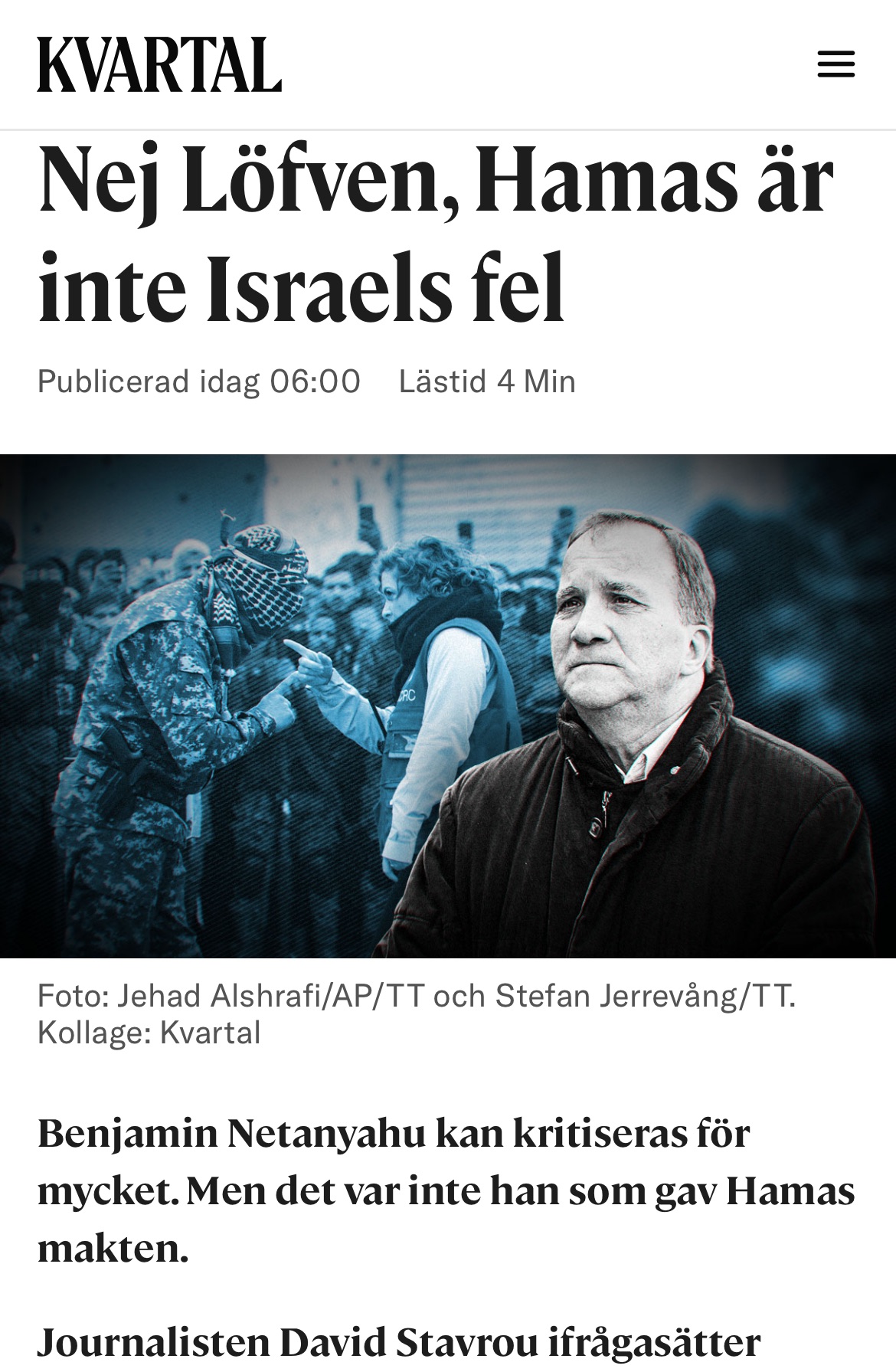
According to Löfven, Hamas’s power is the result of a paradox. Despite being one of Israel’s greatest enemies, its power originated with Israel’s political leadership. “Such an organization receives support (from Qatar, for example) simply because Israel wants to avoid the Palestinian Authority (PA) gaining any power.” Hammargren agreed and said that Hamas was a political asset for Israel. “Netanyahu’s line was that by letting Hamas grow in Gaza we don’t have to hear about a Palestinian statehood,” she said. This is a common analysis and it is partly true. Netanyahu and other Israeli leaders do indeed oppose a two-state solution. Because of this, his strategy was to weaken the PA, and many argue that one of the ways he did this was by allowing Hamas to grow. But this is only half the truth.
The other half, and the real reason Hamas rose to power and was able to retain it, is much simpler. The source of Hamas’s power is support from large parts of the Palestinian people. Even now, after two years of destruction and death that are a direct consequence of Hamas’s decision to massacre Israeli civilians on October 7, 2023, Hamas is still supported by many Palestinians. The international support from Qatar and Iran that Löfven and Hammargren mentioned is also not hard to understand. Iran’s regime has a long-term goal of eliminating “the Zionist entity,” and Qatar built its international position on supporting its ideological Muslim Brotherhood allies. Sure, Netanyahu miscalculated Hamas’s capacity and misread its intentions, but it was not he who made Hamas’s ideology popular, and it was not he who turned Qatar and Iran into dangerous regional destabilizing powers.
But where is Hamas heading? Utrikesbyrån’s two-and-a-half-minute clip tried to provide background. According to the clip, “Hamas removed the demand that Israel be destroyed, but still does not recognize the state of Israel.” This is not even a half-truth. Hamas is absolutely committed to the destruction of Israel. Yes, it created a new charter for foreign audiences, because the old document contained antisemitic propaganda that was not particularly popular on university campuses and in some Western circles. But even the new charter demands “all of Palestine” from the river to the sea, it does not accept the Oslo Accords or the two-state solution, and it still endorses “armed resistance,” which has been a decisive part of Hamas’s nature long before October 7. That includes blowing up buses and restaurants full of civilians as well as kidnapping, torturing and murdering Jews of all ages, genders and backgrounds. One interesting thing Utrikesbyrån did not mention is that Hamas activists have on several occasions been arrested in Europe for planning attacks on “Jewish targets.” Worth mentioning if anyone took the “new charter” seriously.
Despite (or perhaps because of) the violence, Hamas won the Palestinian elections in 2006 in both the West Bank and Gaza. Palestinians are not blind or politically incapable — they knew exactly what they were voting for. According to Utrikesbyrån’s experts, Netanyahu could have fought Hamas by strengthening the PA. It’s an interesting theory. Only problem is that it’s not true. Not during the years when Hamas was building its reign of terror, anyway. The reasons are that Netanyahu was not Israel’s prime minister at that time. Between 1999 and 2009 the prime ministers of Israel were Ehud Barak, Ariel Sharon and Ehud Olmert. The first was an outspoken advocate for a two-state solution, the second ended the occupation of Gaza, and the third was probably the one who offered the PA the most generous territorial compromise. Hamas was not impressed. It continued to build the fundamentalist, jihadist, genocidal faction within the Palestinian nationalist movement. Hamas did not need Netanyahu for this. It was fully capable of doing it on its own, while many Israelis were still considering peace and reconciliation.
Utrikesbyrån downplayed all of this. In the program there were no blown-up buses, no tunnels, rockets, high-tech international propaganda campaigns or brutal executions of Palestinian “collaborators.” October 7 was only mentioned in passing, as another point on the timeline. No hostages, no burned neighborhoods, no executed families. This is not a complaint that they “forgot October 7,” but a critique of incomplete analysis. How can one answer the question about Hamas’s intentions without taking into account that the organization recruited thousands of people who were willing not only to kill but also to commit gang rapes and sexualized torture in the name of Allah?
Netanyahu can and should be criticized for many things, but not for this. Sure, he did not destroy Hamas before October 7, and through his incompetence and corruption he may have contributed to the opposite. Israelis should hold him accountable for that. But this is far from the cause of the catastrophe. Hamas began building its advanced military capability long before Netanyahu, it remains standing, and many Palestinians still support it. Let us imagine that Netanyahu had decided to wipe out Hamas back in 2014. Now that we know that not even the destruction of Gaza did the job, would Stefan Löfven have supported an Israeli offensive on that scale? Would the Obama administration have allowed it? Would the UN have accepted it? Of course not. Everyone can complain about Netanyahu and everyone can criticize Hamas, but in the end — whose responsibility is it to eliminate Hamas, and who will support such an effort?
It is obvious that Stefan Löfven in no way supports Hamas. In Utrikesbyrån he spoke very clearly about the necessity of a political process with a reformed Palestinian Authority moving toward a two-state solution. But putting the blame for the situation on the Israeli government while ignoring Hamas’s inherently genocidal nature is a classic half-truth. It leads people to believe in conspiracy theories about secret Israeli involvement in the massacre of its own citizens, and more importantly — it shifts the focus to the wrong side. To reach a lasting ceasefire it would be wiser to focus on the “de‑Hamasification” of Gaza and support moderate forces on both sides that can help their communities recover from this two-year trauma and build a future together.
 דיויד סטברו