Israel Between Peace and the Sword

The choices the region will face after the Iran-US-Israel War, and does international law have anything to do with them.

Published in Swedish Svenska Dagbladet: Israel måste alltid ha svärdet redo | David Stavrou | SvD Ledare

The Swedish discourse on the war in Iran has been dominated by the question of its legality. In recent weeks, international law scholars, academics, politicians, and columnists have explained why the American and Israeli attack is “illegal under international law.” There is much to say about this reasoning, but a reasonable question is what the point really is. In the real world, the legality of war matters very little, because international law, in general, has hardly had any real significance over the past decades.

The main reason is simply that it doesn't work. International law has been used by some of the world’s worst despots, from Gaddafi to Assad, to delay international action against their crimes, and when it was finally used for intervention—in many cases, it made the situation even worse and led to more violence and failed states.

International law has also given legitimacy to regimes such as Qatar and Somalia, which have gained seats on the UN Human Rights Council despite their total lack of such rights. Terrorist organizations have used it in their propaganda to avoid the consequences of their actions, and China’s and Russia’s veto rights in the UN Security Council ensure that aggressive dictators go unpunished.

“If the U.S. illegally invades other countries, Russia will do the same” is a common argument against the American offensive. But the truth is rather the opposite: Russia did not wait for the Americans to attack Georgia or Ukraine, and—like Turkey in Syria, Azerbaijan in Armenia, and Eritrea in Ethiopia—has ignored international law for decades. No country is waiting for Israel or the U.S. to legitimize their actions according to the “law of the jungle”.
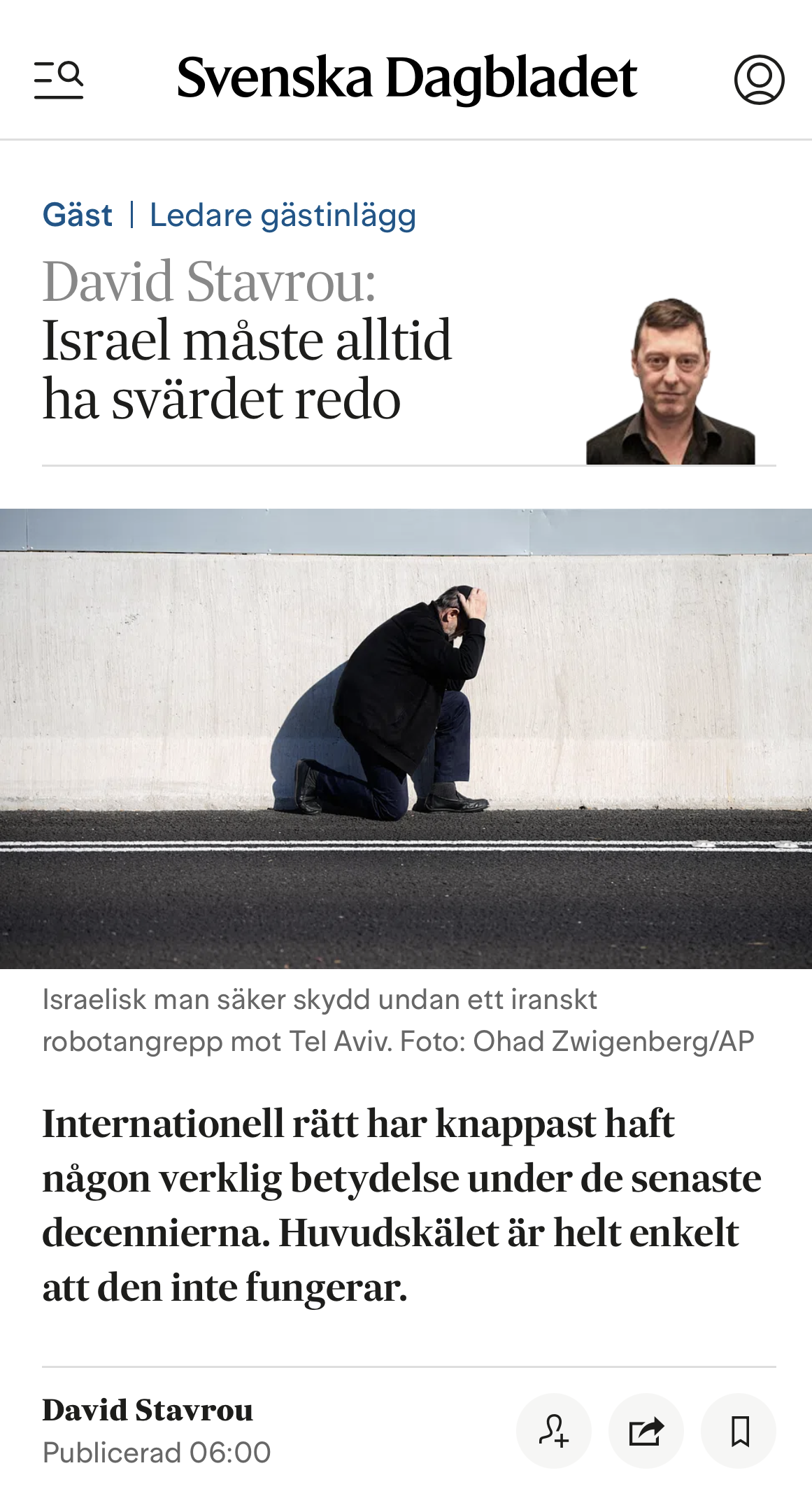
For a country that has not been at war since 1814, the question of the legality of military interventions may seem like the most important one. Theoretically, even a superpower like the U.S. should be concerned with issues of limiting its global power. But for a country like Israel, which is constantly threatened by real enemies who want to annihilate it and kill its population, this question appears fairly academic.

There is, however, another question that from an Israeli perspective is extremely important. It is simple but crucial, and it should concern other countries as well—it is not whether the war is legal, but whether it is effective. Or more broadly: can military power by itself solve Israel’s problems with Iran and other enemies?

“When all you have is a hammer,” as the well-known saying goes, “every problem looks like a nail.” Israel undoubtedly has a powerful hammer. Could it be that the country has become accustomed to solving all its problems with it? Previously, Israel used many forms of power to strengthen its security and international standing. Diplomats engaged in creating complex alliances, its soft power included outstanding achievements in culture, art, agriculture, science, and technology, and governments were willing to participate in peace negotiations and consider compromises.

The Hamas massacre on October 7 and Iran’s persistence in combining nuclear ambitions with threats to wipe Israel off the map changed all of this. The Israeli foreign service has been marginalized; the country’s artists and scientists are boycotted around the world, and its enemies are blown to pieces rather than invited to ceremonies on the White House lawn. Considering that many of Israel’s enemies are ruthless killers, this is hardly surprising. Anyone who sees value in human life should not shed tears for people like Hassan Nasrallah, Yahya Sinwar, and Ali Khamenei. But do military operations improve reality if they are not accompanied by other measures such as diplomacy, economic development, and new creative political alliances? This is not only an Israeli question. A new world order is taking shape before our eyes, and if we are not heading toward total anarchy, the question of limiting military power and understanding what it can and cannot achieve is crucial.

One indication is the situation in Gaza. After more than two years of extensive military force and enormous destruction, the reality is that Hamas not only still exists, it is armed and controls many state functions. In Lebanon, Israel may have achieved significant military successes against Hezbollah, but the Israeli are still spending far too much time in bomb shelters, and despite everything, Hezbollah is still alive and kicking. Both militarily and politically.

Israelis are once again deprived of basic necessities—schools are closed, workplaces shut down, flights canceled, thousands have lost relatives, been forced from their homes, and suffered injuries and trauma. Not to mention that Israel is deeply divided on issues concerning its democracy, which can only be resolved when the shooting stops. Meanwhile, Israel has also, without justification, become the punching bag of the international community. All the world’s power seems to be of little use in solving this.

And then there is Iran. Now that the war has begun, it should, for the sake of both Iranians and Israelis, end with a regime change—and no regime change is possible without the use of force. The Iranian people themselves, who ultimately must liberate themselves, have asked for foreign intervention, and giving it to them is the right thing to do. But what then?

“From the moment we decided that only here, in the land of Israel, could the Jewish state arise, we accepted that more than a hundred million people from the Arab world, from the Arab nations, and from the Palestinians would be our neighbors,” said Israel’s former prime minister Yitzhak Rabin a few years before he was assassinated in 1995. “There are now only two possibilities: either a serious and determined effort is made to achieve peace—peace and security—or the sword will always rule.” In the 1990s, Rabin chose the first option, but since then, leaders across the region, including Israeli leaders, have developed a dependence on using force. Perhaps even an adiction.

When the war in Iran is over, Israel will face a choice. Previously, the country combined pragmatic diplomacy, careful alliance-building, and visionary openings toward the Arab world. In a region like the Middle East, this is risky. Israel will always need to keep a sword ready, but with security guarantees and economic support instead of anachronistic laws and self-righteous moralism from other countries, peace may once again become an option.

Anti-Semitism on the rise in Sweden

התגובות בשוודיה לאירועים בעזה

Published in The Local – Sweden's news in Enlgish, Febuary 2009 http://www.thelocal.se/17466/20090209/

Sweden, like most countries in the western world, is obsessed with the Middle-East. The Arab-Israeli conflict receives constant media coverage and public interest, and the recent events in Gaza were no exception. As usual, they sparked a lively and sometimes violent debate. Sadly and this too is usual, the debate is full of misinformation and misunderstandings.

Most Swedish political figures positioned themselves between strongly condemning Israel whilst mildly criticizing Hamas' actions and totally supporting the Hamas and its administration in Gaza. On the left many condemned Israel's military operation and the Jewish state in general. "I don’t think Israel is a democracy worthy of the name. It’s a racist apartheid state,” said Left Party's Hans Linde, calling for a boycott of Israel. On the right, Carl Bildt, Sweden's foreign minister who visited Gaza last week, blamed Israel of intentionally targeting economic infrastructure and called Israeli policies "neither morally nor politically defensible". These remarks were part of a wider debate which included demonstrations, calls for boycotts and anti-Israel diplomacy.

A leading Social-Democrat, Urban Ahlin, Deputy Chair of the Committee of Foreign Affairs, implored the government to encourage the EU to suspend its cooperation agreement with Israel and perhaps the most amazing remark was made by another Social-Democrat. “Israel is an apartheid state. I think Gaza is comparable to the Warsaw ghetto,” said Ingalill Bjartén, the vice-chair of one of the Social-Democratic women's organizations.

This is all very well and is part of living in a democracy but when one mentions the Holocaust and the latest round of violence in the Middle-East in the same breath – a ridiculous and manipulative comparison – one should try to remain true to the facts. These are important since the victims of the conflict in Gaza and southern Israel, Jews and Arabs alike, deserve the truth. Deceitful and over simplified versions, like those listed above, are an insult to those who live through the reality of the region, and are part of the reason the tragedy goes on.

Here are a few inconvenient truths that Swedish politicians, on the left and right, choose to forget:

There is no Israeli occupation in Gaza. Israel withdrew all its troops and settlements years ago and did not blockade Gaza when its forces withdrew. In fact (and this may come as surprise to those who don't bother with facts before they make their moral judgments), Israel signed an agreement with the Palestinian Authority concerning security arrangements and safe passage of people and goods between Israel and Gaza. The agreement was breached by the Hamas, purposely ignoring the best interest of the Palestinians themselves, when they took control of Gaza in 2007 and declared that all agreements and cease-fires with Israel were cancelled and that Israel must be destroyed.

The Hamas then launched numerous rocket attacks against Israeli citizens (whom, for some reason, don't attract much attention by Swedish moral experts) and massacred hundreds of members of rival Palestinian fraction, Fattah, amongst them those who were responsible for the safety of the borders with Israel (yes, that’s right, their own people). Two additional facts are interesting to point out here: first, even when Israel finally had to close its border with Gaza because of the violent nature of the new Palestinian regime it still allowed the passage of humanitarian help, fuel, electricity and money.

Second, Egypt too had to close its border with Gaza, which shows that this is not really an Israeli-Arab conflict, but rather a struggle against gangsters and thugs. Egypt, of course, drew absolutely no Swedish criticism though it is blockading Gaza just as much as Israel is. In Swedish terms you could imagine the following scenario: Norway is taken over by a gang of crazed fascists who regularly launch rocket attacks on Karlstad, kidnaps Swedish nationals and threaten to annihilate all Swedes in a holy war. Obviously, in a case like this most Swedes would support a strong reaction and certain adjustments in Swedish border and foreign policies. Well, this is exactly what happened in Israel and Israel waited eight years before finally attacking the Hamas power basis in Gaza!

But this is only the tip of the iceberg. During the latest conflict Hamas intentionally fired rockets from schools and mosques in order to provoke a counter-attack. You would expect the Hamas' rather unlikely Swedish supporters (oddly enough, usually left-wingers supporting ultra nationalist religious fanatics), to be a little more critical of a leadership cynically sacrificing its own people, including women and children for political purposes.

Even the Arab press has had enough of this. "There are a million and a half desperate people", wrote a columnist in the leading Arab daily "Al-Hayat", "they were wounded, their houses destroyed, their children were kidnapped to be human shields for those craving a confrontation with Israel. And there are those who sit in their comfortable chairs in Damascus and Beirut, boasting their divine victory which never existed and preventing a cease-fire". It is one thing that extremist Arab regimes silence voices like this. It's incomprehensible that Swedes should do the same.

In the broader context, The Hamas began to implement Sharia-Law over the population of Gaza. These laws include punishments such as executions, beatings and limb amputations, not to speak of the degradation of women, a total lack of respect for Human Rights and a complete disregard of human life. Not exactly the material of Socialist utopias.

Now Israel is often accused of aggression towards its Arab and Muslim neighbors but history, both recent and far, shows that it is the Arab regimes which oppress their own people and sometimes slaughter them in an orgy of death-worshipping fundamentalism. Yet, somehow Israel is always to blame. Israel, though far from perfect, didn't butcher almost two hundred thousands Muslims with knives and axes during the nineties, that was Algeria. Tens of thousands of Palestinians were murdered during "Black September" by forces of the king of Jordan, not by the Israelis.

The Israeli regime, whilst having its flaws, didn't slaughter, rape and burn thousands of Shia Muslims in Afghanistan. That was the Taliban. Israel is not responsible for the daily suicide bombs in Iraq that claim the lives of thousands of Muslims. Israel is not innocent, it is has also committed acts of violence and aggression, but it is nothing compared to the barbaric and murderous regimes in Sudan, Syria and Saudi-Arabia, which, like Hamas are all responsible for countless Muslim deaths and for millions of Muslims living in poverty and despair.

Swedes with a conscience may want to stop turning their head the other way when it concerns the homemade tragedies of the Muslim world. Was there a large demonstration in Sergels Torg when the Syrians, the Pakistanis or the Somalis initiated yet another of their bloodbaths? Are there any boycotts of products from the Gulf States which continue to persecute minorities, oppress women and mock basic concepts of freedom and Democracy? Of course not. It's all Israel's fault. If only the Jews could stop provoking the Arab world, say Israel's critics, if only Israel would accept a peaceful solution. But they're wrong. The assumption that the Palestinian struggle is a reaction to Israeli policies, though it may sounds reasonable, is simply wrong.

Any careful study will show that Radical Islamism is not a reaction to Israel's so-called imperialism – it existed long before the state of Israel; Islamic racism and Anti-Semitism are not a reaction to Israel's so-called aggression, they existed long before the Zionist movement even began and, for God's sake, movements like Hamas and the Hizbullah aren't really interested in a Palestinian state. Their agenda is to kill Jews and focusing on this agenda enables them to continue oppressing their own people. The Palestinians themselves rejected numerous chances to establish an independent state and reach a solution to their tragic situation (some examples are the 1936 Peel Commission, the 1947 UN Partition plan and the 2000 Clinton proposal). Their leadership simply thrives on the conflict and they'll continue it at any cost.

But why are these facts ignored in Sweden? How can a leading Social-Democrat compare Israel to the Nazis and still keep her seat. Is this ignorance or deceitfulness? Are they ill-informed or are they knowingly playing an active role in the propaganda machine of extremist elements from the Middle-East? One can only speculate which of these is the case regarding Ms. Bjartén and Mr. Linde.

And it's not just a question of words. Mr. Linde and Ms. Bjartén cannot claim their words have nothing to do with the eggs and bottles thrown at pro-Israel demonstrators in Malmö at the end of January. They are partly responsible for the attacks on Israel's embassy in Stockholm, the Jewish centre in Helsingborg and the Jewish cemetery in Malmö. An ugly wave of Anti-Semitism is on the rise in Sweden and they cannot claim to be free of responsibility.

A participant in a demonstration in Stockholm, a Swede converted to Islam who writes regularly in the Swedish press, wrote in his blog: "it felt good to burn Israel's flag and trample on the remains. It was uplifting to shout "Allah hu akbar" (God is great, D.S) together with blond and blue eyed non-Muslims Swedes". Do Mona Sahlin and Jan Eliasson of Sweden's biggest political party, really think that marching under Hezbollah and Hamas flags, as they did a couple of weeks ago, doesn't contribute to the legitimacy of these actions? Can they really consider themselves worthy heirs to the noble Social-Democratic values of Humanism and Solidarity?

Back in Israel, many Israelis are not at all sure that the Israeli operation in Gaza was wise or justified. Many opposed it and demonstrated against it. They may be right. Israel is a democracy and unlike the Palestinians in Gaza they are entitled to express their opinion without being tortured or executed. The aftermath of almost every round of violence in the Middle-East is that the conflict isn't between Jews and Arabs, it's between progressive peace-seekers and warmongers within the various countries.

At the end of the day, the Palestinians have suffered the most from the recent conflict. Sadly, their own leadership is responsible. Most Palestinians, and specially the children and the families who have lost everything, are innocent victims. For their sake the historical lesson must be clear. Freedom and Democracy must be defended at any cost. Racists, fascists and promoters of oppression and genocide must be opposed. Hamas is all of these things just like the Lebanese Hezbollah, despite the support they attract from the bizarre Swedish so-called left. Swedes, as lovers of peace and freedom, would be wise to encourage those who fight these forces of evil thousands of miles away or they might find them in their back yard. If they're not there all ready.