Israel's Ambassador to Sweden Remains Optimistic Under Constant Threats

Ziv Nevo Kulman took office in 2021, at the tail end of one of the most difficult crises in the history of Israeli-Swedish relations. October 7 brought other voices to the fore. 'Suddenly, we see that on the core issues there is agreement,' he says in an interview with Haaretz

Published in "Haaretz": https://www.haaretz.com/israel-news/2024-05-21/ty-article/.premium/israels-ambassador-to-sweden-remains-optimistic-while-working-under-constant-threats/0000018f-9a6c-dce9-a1cf-feecb91f0000

While singer Eden Golan was on the Eurovision stage in Malmö, one person in the audience was accompanied by at least the same amount of security guards as the Israeli delegation. Ziv Nevo Kulman, the Israeli Ambassador to Sweden and longtime Eurovision fan, insisted on coming to the event to support Golan and her team, despite likely being one of the most heavily guarded people in the Scandinavian country at the time.

"There was an illustrative moment in the Israeli performance in the semi-final," he says. "The performance began with boos before Eden even opened her mouth. In response, there were also cheers from the audience, and a kind of duel started up between them. And then, because the performance was so good and Eden wasn't affected at all by the boos, most of the audience cheered for her. They were impressed by a 20-year-old singer who was put in a difficult situation and rose to the occasion with great honor."

Nevo Kulman says the hostility and calls for a boycott of Israel were met with a clear and supportive reaction from the public. "That was also the moment when she leapt up in the odds," the ambassador says. "As someone who has really been following the boycott calls in Sweden recently, I can say that the Swedes are in favor of dialogue, in favor of listening and in favor of freedom of expression. My impression is that the Swedes are not advocates for BDS."
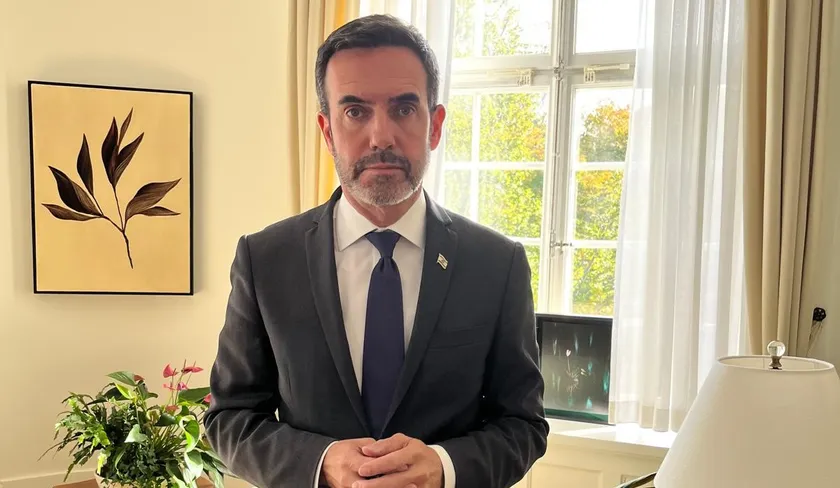
Ambassador Ziv Nevo Kulman, photo credit: Embassy of Israel in Sweden

The conversation with Nevo Kulman took place in a discreet location in Stockholm, with four security guards, both Swedes and Israelis, sitting in the next room. He says that after Eurovision ended, just before the delegation returned to Israel, he met with Golan. "It was one of the most thrilling and moving moments in my career," he says. "What we had here was a concerted effort by an incredible delegation with an incredible singer and an incredible song, and we [at the embassy] also helped to provide the right umbrella."

This umbrella, Nevo Kulman says, included his local media appearances in which he sought to provide a counterweight to the large anti-Israel protests in Malmö over Eurovision weekend. In an interview with the Swedish daily Dagens Nyheter, the ambassador was pictured wearing an ABBA T-shirt adorned with a yellow ribbon, as well as a necklace with the Chai symbol.

Nevo Kulman says that, normally, Eurovision to him is a time for celebration. If things were normal, he would probably have been going around Malmö with other ABBA fans, simply enjoying the fun and colorful event. But because of the current situation, this year none of that is possible.

"The shirt is like a wink," he explains. "I speak with a wide audience through the media interviews and I see more Swedes who are sympathetic to Israel. I hear from people who tell me – Don't get the wrong idea, don't be confused. Just because there are loud people in the streets, in protests, doesn't mean that's what the Swedes think. Our messages are getting through to a lot of readers and listeners and viewers."

Nevo Kulman wanted to stress that, while the protesters are entitled to freedom of expression, as a member of the European Broadcasting Union, Israel also has the right to participate in Eurovision without being harassed. "We also deserve the right to speak, and the competition showed that the conception that everyone in Europe hates us is incorrect," he says.

Unlike the professional juries, the voters from the general public are anonymous, and a large portion of them awarded Israel the coveted 12 points. "Including people from countries you wouldn't expect," the ambassador says.

Nevo Kulman cites the LGBT community as an example of a group that is partly hostile to Israel, despite the country's historic role in the contest. "We were supposed to be the country that carries this banner in the Eurovision, but this is a generation that doesn't know who Dana International was." Nevo Kulman, who is gay himself, says, "Now they're into being Queers for Palestine. It's not enough for them anymore to just be gay or trans, and this is concerning. We need to find a way to talk with these publics."

Things have been particularly tense at the Israeli Embassy in Sweden lately. This past Friday, the police detained several people suspected of firing guns near the embassy. In January, a grenade was thrown at the building, but did not explode. The incident took place a few days after reports came out that Hamas planned to attack the Israeli Embassy and other sites in the country.

Police outside the Israeli embassy in Stockholm, in January.Credit: David Stavrou

"Of course, it affects the work," Nevo Kulman says. "In Sweden, unfortunately, consular services are only provided online. But the embassy is working, we're here and we're operating." He says the threats definitely have an impact on his regular agenda as ambassador: "There are things I did in the past that I can't do now. I can't stand in a public square and give a speech, and therefore I have to miss certain events, and it breaks my heart."

Nevo Kulman has been in the Israeli foreign service for 28 years. He served as cultural attache at the embassy in Tokyo, as Deputy Ambassador to the Czech Republic, as cultural affairs advisor at the embassy in Paris, as general consul in Montreal, and as head of the cultural diplomacy division at the Foreign Ministry in Jerusalem. The position in Sweden is his first as an ambassador. Despite the nation's tranquil image, his tenure in Stockholm has been quite tumultuous.

He is well-liked by Swedish politicians and the Swedish media, maintains extensive ties with the country's Jewish community, and does not hesitate to express an opinion in different areas. For example, he firmly denounced the practice of far-right political provocateurs burning copies of the Koran. He fought for Israeli culture to be included in the Book Fair in Gothenburg. One of his more controversial moves was to declare that Israel would not maintain ties with the populist far-right Swedish Democrats party.

"We are aware of the positive statements by the Swedish Democrats about Israel," he says. "But at the same time, the party continues to adhere to extremist positions regarding a ban on brit milah [Jewish religious circumcision] and the importing of kosher meat, and it has yet to seriously grapple with its neo-Nazi past and with the antisemitism among its members." He adds that the party has not expressed any remorse for its many years of mistreatment of Holocaust survivors, which makes its supposed support for Israel questionable.

Nevo Kulman took over the position in Sweden in the summer of 2021, when Israeli Swedish relations had been languishing after a long and difficult state of crisis. The two countries were attempting to mend the rift that began in 2014, when Sweden officially recognized a Palestinian state and was followed by years of harsh statements, recalls of ambassadors and a halt to state visits.

"It was a lengthy process," Nevo Kulman says. "The Swedes understood that they had gone too far with the recognition of a Palestinian state. The move didn't change anything on the ground and didn't contribute to the Swedish interest of being perceived as a fair partner acceptable to both sides."

But the process of rehabilitating relations was jolted again in the aftermath of October 7. "Now it's impossible to promote an agenda beyond the conflict," says the ambassador, although he also sees an optimistic angle here. "Suddenly, we see that on the core issues there is agreement: the attitude toward Hamas, Israel's right to defend itself, returning the hostages, the fight against the accusations of genocide, and other issues."

Nevo Kulman explains that Israel and Sweden have similar positions on many matters. "Swedish official statements consistently cite Israel's right to defend itself and call for the immediate release of all the hostages." He adds that the Swedish foreign minister has said that he will soon visit the region. "Naturally, this will enable a direct and fruitful dialogue about all the issues on the agenda," the ambassador says.

Sweden's New FM Says 2014 Palestine Recognition Was 'Premature and Unfortunate’

Sweden’s new foreign minister, Tobias Billström, talks to Haaretz about recalibrating foreign policy, the importance of ties with Israel and the new government's far-right partners

published in "Haaretz": https://www.haaretz.com/world-news/europe/2022-11-22/ty-article/.premium/swedens-new-fm-calls-2014-palestine-recognition-premature-and-unfortunate/00000184-9f0a-d40d-a9ce-bf7f31f60000

STOCKHOLM – Swedish foreign policy has been unique for many years in Europe. The Scandinavian nation hasn’t joined military alliances since it was a military power in the 17th and 18th centuries, and hasn’t been involved in a war for over 200 years (with the exception of occasional peacekeeping missions far away from its borders). In the second half of the 20th century, its policy of avoiding alliances and maintaining wartime neutrality created a foreign policy that in many ways wasn’t about serving Swedish national interests. Instead, it was about becoming a “humanitarian superpower” and endeavoring to make the world a better place.

Naturally, there were those both at home and abroad who criticized this policy. Some saw Sweden’s attempts to position itself on the right side of history as self-serving, opportunistic and hypocritical. Others claimed its private sector’s thriving arms industry was incompatible with a government preaching peace, love and understanding. Another problematic aspect was Sweden’s close ties with a host of dictators and oppressive regimes.

Still, for decades, Swedish diplomats were crucial in bringing wars to a close. Swedish policymakers were generous when it came to humanitarian aid, and vocal when it came to issues like the struggles against apartheid and the Cold War arms race.

This tradition was maintained in recent years as well. As well as being the only Western European country to recognize a Palestinian state, Sweden did its best to export progressive ideas like “feminist foreign policy,” taking radical steps against climate change and building stronger international institutions.

But change is on the horizon. Sweden has taken its first steps to join the NATO military alliance and is building up its military capabilities in a way it hasn’t done for decades due to recent Russian aggression. After voting out the left-wing Social Democrats and electing a center-right government led by the Moderate Party and supported by the far-right Sweden Democrats, what is the future of neutral Sweden?

“Since I took office, I’ve been very clear that we need a recalibration of Swedish foreign policy,” says Sweden’s new foreign minister, Tobias Billström. “We need to make some very clear statements about our priorities. One priority, above anything else, is the NATO accession. With that we also have to think about our neighborhood – the Nordic states, the Baltic states and the countries surrounding the Baltic Sea. This is where we’re putting our emphasis. It’s not a choice between being active in the international arena and being focused on our neighborhood. You can do both. What you can’t do is be everywhere all the time and be active in all aspects. We’ll have to prioritize.”

This may be a seismic change on the national level but it’s not for Billström, who notes that his party “has supported joining NATO for years. And I believe that the question of neutrality ended in 1995 when Sweden became a member of the European Union.”

No Jerusalem embassy yet

Billström, 48, is an experienced politician despite his relatively young age. He has been a parliamentarian for 20 years, serving as migration and asylum policy minister from 2006 to 2014, and was a local politician before that. The role he now holds is one of his country’s most important considering current regional instabilities. He meets Haaretz at his Stockholm office, which is located in a beautiful 18th-century palace facing the Royal Opera House on one side and the Royal Palace and Parliament House on the other. He has just accompanied the king and queen of Sweden on a state visit to Jordan, one of his first on the job. He says he’d like to visit Israel one day and thinks that Sweden’s relationship with Israel is “excellent following the establishment of dialogue in 2021.” Still, no official visit has as yet been planned.

Eight years ago, one of the first steps of the previous government was to recognize a Palestinian state. What is your government’s position on the issue?

“The decision to recognize Palestine in 2014 was premature and unfortunate. However, the decision has been taken and this government doesn’t plan to revoke it.”

But it wasn’t just about recognition. The previous government was very active in this field: it appointed a special envoy to the Israeli-Palestinian conflict; it actively opposed Israeli settlements in the West Bank; and it supported the Palestinian Authority and the two-state solution. Is Sweden’s new government still committed to these policies?

“On the Israeli-Palestinian conflict, the government stands firmly behind the EU policy. We want to see a negotiated two-state solution based on international law. That decision will remain. As for being active, we will continue to criticize the parties when called for, when violations of international law are committed and when human rights are abused. We’ll do that in the same way we criticize other states when it’s justified. This is in no way contrary to having excellent relations with Israel or Palestine. The government will at all times stand up for Israel’s legitimate security needs.”

Would Sweden consider moving its embassy from Tel Aviv to the capital, Jerusalem?

“Like the EU, the government will continue to respect the broad consensus of the international community and relevant UN Security Council resolutions and regard Jerusalem as a final-status issue. Pending a peace agreement, Sweden’s embassy will not be moved.”

Your government plans to cut foreign aid drastically in the next couple of years – will this affect Swedish aid to the Palestinians, and could this lead to a problem with Sweden’s Palestinian partners?

“Sweden’s development cooperation with Palestine, just like the EU’s, ultimately aims to build the conditions and promote a two-state solution in line with international law. This goal will remain. As we review our overall development cooperation, we will also recess our Palestine strategy, which applies to the period of 2020 to 2024.”

What about aid to the Palestinian organizations that the Israeli government claims are terror groups? Or aid to the UN Relief and Works Agency for Palestine Refugees, which allegedly publishes schoolbooks containing antisemitic incitement?

“The government takes terrorist accusations very seriously and several of these civil society organizations – which were listed by Israel as terror groups in October 2021 – receive support from the EU, the United Nations, Sweden and other donors. Together, the donors within the EU followed up thoroughly on the allegations and concluded that no substantial evidence was provided. The donors will therefore continue to support Palestinian civil society. We believe that a free and strong civil society is indispensable for promoting democratic values and the two-state solution. Needless to say, if Israel makes convincing evidence available that would justify a review in the policy toward these organizations, we would act accordingly.

“When it comes to antisemitism, it is of course unacceptable and it’s very important that the PA ensures that its textbooks fully meet UNESCO standards, and that the EU continues to be clear in its dialogue with the Palestinians to ensure that this is the case.”

Israel’s new government will be led by former Prime Minister Benjamin Netanyahu. Are you confident that Israeli-Swedish relations, which have recently improved under another government, won’t deteriorate again under the new one?

“As Sweden’s foreign minister, I would like to see a good dialogue with countries we think we can maintain good relations with. The question of relations between Sweden and Israel is exactly about that: to have a dialogue on issues that we might disagree on – but we think it’s still a good thing to sit and talk about them.

“It’s not up to me as foreign minister of Sweden to say anything about Israel’s domestic policy. The people of Israel have a right to elect their government, just as the Swedish people have a right to elect our government. The important thing is to understand that in Sweden we cherish dialogue and would like to see it maintained.”

Just over a year ago, Israel’s ambassador to Sweden said Israel will not have any contacts with the populist Sweden Democrats party. Since then, it has become the closest and most important political supporter of your government. Will it influence Sweden’s foreign policy? And do you think Israel should have ties with it?

“It’s up to the Israeli government through its ambassador here in Sweden to choose with whom it wants to talk. As foreign minister, the case is very clear: the Swedish constitution says that foreign policy is shaped by the government, which keeps parliament informed. This means that since the Sweden Democrats are not part of the government, their influence is limited to exactly that – namely, parliamentary control, just like all the other parties represented in the Swedish parliament.”

A personal Holocaust story

As well as relations with Israel and the Israeli-Palestinian conflict, another Swedish policy to draw attention during the previous government’s term was the one concerning antisemitism and Holocaust remembrance.

For over 20 years, since a Swedish initiative started the International Holocaust Remembrance Alliance in 1998, Sweden has been considered a world leader in this field. Last year, the government organized a major international conference in Malmö dedicated to Holocaust remembrance and combating antisemitism. It also decided to open a new Holocaust Museum and accept the IHRA definition of antisemitism and its examples (which some have slammed for equating criticism of Israel with antisemitism).

When asked if his government is just as committed to combating antisemitism and preserving the memory of the Holocaust, Billström says: “Certainly! Combating antisemitism is very important and the new government is fully committed to doing so.”

Since Sweden is still struggling with many instances of antisemitism in schools, in some Muslim environments and in far-right circles, Billström knows the problem is still unresolved. “I will always be a very strong advocate against antisemitism,” he says. “We are working very closely with Israel on this. I appreciate the very fruitful cooperation with Israel during the IHRA presidency, and we’re looking forward to continuing the cooperation during Israel’s presidency in 2025.

“I would also like to make a personal remark on this,” he adds. “My grandparents in Malmö took in a Jewish family that escaped from Denmark across the Öresund strait, during the period in 1943 when the Gestapo tried to round up the Jews. I grew up with this story. I have this very nice diploma that says two trees were planted in their memory in Tzippori [in northern Israel] as thanks from this family. My grandmother and my mother, who remembers playing with the kids of this family, told me this story, and it has left a deep mark on me leading to my understanding of what the Jews and what Denmark went through.

“I’ve always believed that antisemitism is a horrible thing. When the Jewish burial chapel in Malmö was attacked during my time as migration minister [in 2009], I went there for the inauguration of the restored chapel and talked about my family’s story in my speech. For me, it’s obvious that there are examples of antisemitism in Swedish society that should be condemned, and it’s obvious there are people in our society who have not laid off the horrible idea that there are grounds for antisemitic persecution of people of Jewish origin in our society. That should always be combated – in schools, at workplaces, wherever we find it. As foreign minister of Sweden, this is something I have a very firm conviction about.”

What about the Sweden Democrats? Besides their past as a neo-Nazi party and many extremely problematic antisemitic opinions voiced by some of their leaders, the biggest party supporting your government supports various laws that could be problematic for Sweden’s Jewish community – such as forbidding circumcision and banning the importation of kosher meat. Are you sure your partnership with them won’t be part of the problem rather than part of the solution?

“I have to say that although there is certainly room for political debate concerning those aspects, as foreign minister it’s clear that the constitution limits their parliamentary influence. As to other issues you mentioned, they belong to areas under the influence of other ministers and I think that, again, under the limits of the constitution I shouldn’t be addressing them.”

One issue Billström is willing to address is Swedish-Iranian relations, which have been tense lately. A Swedish court recently sentenced an Iranian official, Hamid Nouri, to life in prison for war crimes committed in Iran in 1988. There are also two Iranian-born Swedes standing trial in Stockholm after allegedly spying for Russia, while Swedish nationals are also being held in Iran. The recent domestic demonstrations against the Iranian regime make it even harder for Sweden to maintain business as usual with the Islamic republic.

When asked if these events will bring about a change of Swedish policy toward Iran, Billström makes the Swedish position clear. He says that since Sweden has an independent judiciary, there is no government influence on verdicts in Swedish courts. This may be seen as a signal to Tehran about the government’s policy concerning the complicated court cases in both countries.

However, when it comes to the political arena, things are easier to act upon. “As we see it, there is no movement on the Iran nuclear deal,” Billström says. “But the developments in Iran are a source of great worry for Sweden, which also has a considerable Iranian diaspora. The violence directed against peaceful demonstrators is horrible. I had direct communication with the foreign minister of Iran a few days ago, and I was very frank about the way the Swedish government feels about this – we believe people shouldn’t be persecuted and that the use of the death penalty is absolutely unacceptable in every regard. However, we still feel there’s room for dialogue with the Iranian government on this – and the only way to influence them is by dialogue.

“We are also very clear that individuals who have participated in the persecution of demonstrators, and also those who have been involved in the sale of drones to Russia to be used in the war in Ukraine, should face sanctions. It’s very worrying that Iran is turning in this direction.”

Another Middle Eastern leader Billström’s government is dealing with is Turkish President Recep Tayyip Erdogan. Swedish Prime Minister Ulf Kristersson met him in Ankara earlier this month, in a bid to get Turkey to ease its objections to Sweden’s NATO accession.

“There is a trilateral memorandum signed by Sweden, Finland and Turkey,” says Billström, explaining the current state of affairs. “The memorandum has conditions that have to be fulfilled and will pave the way for the Turkish parliament to ratify Sweden and Finland’s accession to NATO. The visit to Ankara was good; I think it was a fruitful dialogue.”

It seems there are items on the Turkish president’s agenda – some domestic, others foreign – that are still causing him to block Sweden’s NATO ambitions. Billström thinks it is now time for the “relevant authorities in all three countries” to get to work, but doesn’t specify what the problematic issues are or when he thinks the process will be completed. “Because there are certain issues that have to be dealt with,” he concludes, “I don’t want to set a time frame. Because it’s not helpful to do that.”

Israel’s Ambassador to Sweden Rejects Far-right – and Stirs Political Storm

Israel's new ambassador to Sweden, Ziv Nevo Kulman, is eliciting strong reactions in the country following an interview he gave to Swedish newspaper, in which he said that Israel has no ties to the right-wing populist Sweden Democrats party.

Published in "Haaretz": https://www.haaretz.com/world-news/europe/.premium-israel-s-ambassador-to-sweden-rejects-far-right-and-stirs-political-storm-1.10334124

The ambassador's interview followed the official visit of Swedish Foreign Minister Ann Linde to Israel, which was the first such visit in ten years. It was seen by many as a new start for bilateral relations between Israel and Sweden after the frigid period that came with Sweden’s recognition of Palestinian statehood in 2014. Speaking to the Dagens Nyheter daily, Nevo Kulman, who took his post in August, said that Israel has no relations with the Sweden Democrats and has no intention of establishing such ties in the future. He does not mean to get involved in Sweden's democratic process, he said, "but this is a moral position that is about far-right parties with roots in Nazism."

He continued, "We don't have, and don't intend to establish, any contact with the Sweden Democrats. They can say that they support Israel, but you also have to look at what they don't support. We will also not have contact with openly Islamophobic parties. This also applies to other countries in Europe. ”The Sweden Democrats party was founded in the late 80's as a result of a series of mergers of political movements on Sweden's far-right, nationalist and neo-Nazi scene. Since then, it has become closer to the mainstream, referring to itself as a "nationalist and social-conservative" party. It entered the Swedish parliament in 2010, and is currently the third-largest political party in Sweden.

Anders Lindberg, left-leaning political editor-in-chief of the Aftonbladet daily wrote that Israel's clear spoken language about "far-right parties with roots in Nazism" should be seen as a "wake-up call" to his home country. He also claimed that the Israeli statement emphasized that the Sweden Democrats’ Nazi past and ideology should make it impossible for democratic parties to have any contact with them.

On the other hand, on the right, many claimed on social media that Nevo Kulman was meddling in Swedish politics. "I hardly think that an ‘apartheid state’ built on stolen land where the original inhabitants are treated as less-than-second-class citizens are in a position to lecture others on ‘xenophobia,’" one critic wrote on Twitter, "nor is what happens in Sweden any of your business." Another wrote, "Please avoid burning bridges at this point, you might change your mind after a year in an almost-dystopia of rampant crime, Arabic clan infiltration and imported antisemitism."

Continues here: https://www.haaretz.com/world-news/europe/.premium-israel-s-ambassador-to-sweden-rejects-far-right-and-stirs-political-storm-1.10334124