Amanah was one of the most important Jewish-Muslim cooperation projects to exist in Europe before October 7. Founded eight years ago in the Swedish city of Malmö by Moshe David HaCohen, then the city's rabbi, and Salahuddin Barakat, a local imam, it aimed to build trust between the city's Jews and Muslims and to counter discrimination. This specific name for the organization was chosen because in Hebrew and Arabic, Amanah refers to the principles of faith and trust.
When it was still active, Amanah ran school programs and developed digital tools to combat racism and monitor social media, addressing many of the challenges for which Malmö had gained notoriety: Holocaust denial in schools, rising incidents of antisemitism every time violence broke out in the Middle East; and escalating Islamophobia culminating in the burning of Qurans by right-wing extremists on multiple occasions.
Amanah's activities were put on hold immediately after October 7, initially because of a statement posted on Facebook by Barakat's Islamic Academy that was deemed highly offensive to the Jewish community. "As Muslims, we stand with our oppressed brothers and sisters in their right to fight against these injustices for freedom, justice, and peace," read the post, which was written when the October massacre was still ongoing. While the post was later updated to offer condolences "to all the innocent victims of violence," the damage had been done. Although dialogue between HaCohen and several Muslim leaders continued and even helped prevent violence during the Eurovision Song Contest in Malmö last May, Amanah officially disbanded in December 2024.
Moshe David HaCohen, Photo: Herald Nilsson
HaCohen is now launching a new organization named B.R.I.T – an acronym for Building Resilience Identity and Trust, and a reference to the Hebrew word for "covenant." He says the organization will work to foster relations between Jews and Muslims in several European countries, based on the premise that security and safety "can't only be based on fear, guards and security cameras – it needs a deeper understanding and working together to overcome the problems."
Jewish-Muslim bridge-building initiatives have been tested in other Scandinavian countries as well over the past year and a half. Before October 7, Jews and Muslims in Oslo regularly held dialogue meetings under the auspices of the Council for Religious and Life Stance Communities (the umbrella organization for Norwegian religious organizations).
"After October 7, cooperation became a serious challenge to both sides," says Rabbi Joav Melchior, the leader of Oslo's Jewish community. "For members of the Jewish community, it was a challenge to deal with Muslim leaders who claimed Israel was committing genocide and spread anti-Israeli conspiracy theories," he adds. "Muslim leaders, on the other hand, saw the support of Zionism as a challenge and expected their Jewish counterparts to denounce it."
Although no major interfaith events have been held in the city over the past year-and-a-half, Melchior says Jewish and Muslim clergy continue to meet and share their thoughts in more intimate gatherings organized through the umbrella organization. "There is a will to improve relations, even though it won't be like it was before October 7," says Melchior, stressing the importance of continuing to talk.
Salaam Shalom was a Danish initiative launched a decade ago that aimed to facilitate dialogue between Middle Eastern communities based in Copenhagen. Inspired by a similar program in Berlin and partially funded by the European Union, the program, which ran for four years, was started by Tali Padan, an Israeli who grew up in the United States and now lives in the Danish capital.
After October 7, Padan wanted to arrange a get-together of some of the former activists and proposed holding a Hanukkah candle-lighting event. The response was not especially encouraging.
"In that first meeting we had only one Muslim, about 20-to-30 Israeli and Danish Jews, and some non-Jewish Danes," she recalls. "The atmosphere was heavy, but there were group activities. We talked, and we lit candles despite it all."
Padan was pleasantly surprised not long thereafter when one of her former Muslim partners, of Lebanese origin, suggested reviving the program. "I was shocked by his initiative because some of his family members were killed in an Israeli air-strike," she says. "Still, we went ahead and the first event took place this January. This time, the room was full. About 50 people, Danish Jews and Muslims, talked about activism and building bridges with a new energy."
Tali Padan, Photo: Thomas Busk
In contrast to the past, she says, in this latest iteration of her Jewish-Muslim partnership organization, the feel-good experience is not the main point. "This time it feels like people are making a powerful choice to commit to unity and peace," says Padan. "They know it's the only way forward."
Swedish Police Approve Hebrew Bible-burning Event Near Israeli Embassy in Stockholm
According to reports in Swedish media, local police will allow the event to take place on Saturday, during which the attendees are expected to burn a Hebrew and Christian bible in an attempt to expose Swedish hyprocisy
July 14th
Police in Sweden have approved a request to burn both a Hebrew and a Christian Bible during a protest expected to take place Saturday in front of the Israeli embassy in Stockholm, police in the Swedish capital have confirmed. The request was made by a 32-year-old Swede who claims that his action is a protest against recent events of burning the Quran, which were approved by Swedish authorities and took place in the last few months.
In a statement released on Friday, Israeli Prime Minister Benjamin Netanyahu said that he condemns “in the strongest terms the authorities’ decision in Sweden to permit the burning of a Jewish Bible in front of the Israeli Embassy.” Netanyahu added that “this deeply shameful act undermines the sacredness of the Jewish people’s holiest scriptures.” Israel’s ambassador to Sweden, Ziv Nevo Kulman, condemned the burning of holy books from any religion, saying it’s “an act of hate and disrespect, that has nothing to do with freedom of expression.”
Israeli President Isaac Herzog said he “unequivocally condemn[s] the permission granted in Sweden to burn holy books,” and that he is “heartbroken that the same fate awaits a Jewish Bible.” Herzog added that “permitting the defacement of sacred texts is not an exercise in freedom of expression, it is blatant incitement and an act of pure hate.”
Israeli Foreign Minister Eli Cohen also stated on Friday that “burning a Torah scroll is a hate crime, provocation, and a severe attack on the Jewish people and Jewish tradition,” urging Swedish authorities to “prevent this disgraceful event and not allow the burning of a Torah scroll.” On Friday, the European Jewish Congress (EJC) also issued a condemnation, saying the Swedish authorities shouldn’t allow the event to take place. “Provocative, racist, antisemitic and sickening acts such as these have no place in any civilized society,” EJC president Dr. Ariel Muzicant said.
The Official Council of Swedish Jewish Communities published a statement claiming that “our tragic European history links the burning of Jewish books with pogroms, expulsions, inquisitions and the Holocaust.” The council added that it condemns the abuse of freedom of expression that takes place with the aim of sowing hatred in society. “Burning holy books, be it the Quran, the Torah or the New Testament,” it concluded, “are hateful acts that we perceive as direct threats to the societies that value them. Following the Quran burnings, we support the Muslim community in Sweden, express our gratitude for their strong stance and condemnation, and sincerely hope that this and all other burnings of holy books will stop.”
In a meeting with representatives of religious communities in Sweden, Swedish Prime Minister Ulf Kristersson said: “Sweden is and must be a country where people of different faiths – or no faith – can live together side by side in mutual respect. Let us together fight the hatred in society, which drives people to burn the Quran, the Bible or the Torah, and in places and times that are most offensive. Instead, let’s show each other respect.”
The practice of burning holy books in Sweden started a few years ago as a result of a Danish far right provocateur and politician named Rasmus Paludan. A few of Paludan’s supporters burned the Quran in the southern city of Malmö in 2020, and he himself repeated the act a number of times since then.
Rasmus Paludan in Stockholm, August 2022, photo: David Stavrou
In April 2022, Paludan managed to provoke a violent reaction when criminal elements took advantage of the local communities’ outrage and used the opportunity to set off riots which included setting cars on fire and attacking police in several Swedish towns. In January, Paludan returned to Sweden after he received a permit to burn a Quran in front of the Turkish Embassy in Stockholm. This time the reaction had geopolitical implications. Turkey used the Quran burning in Stockholm as a pretext to continue blocking Sweden’s decision to join NATO.
Things got even worse in June when an Iraqi Christian immigrant burned a Quran just outside a Stockholm Mosque during Eid al-Adha. This led to anti-Sweden protests all over the Arab world. In recent weeks there have been more applications sent to the police requesting approval to hold demonstrations which include burning of holy books. The current case of burning of Jewish and Christian holy scripture is intended as a way of exposing Swedish hypocrisy, claiming the authorities allow burning the Quran in the name of freedom of expression too easily, but many claim the result is that a handful of extremists have managed to drag Sweden down a path which is becoming both dangerous and internationally embracing.
Some Swedes have had enough of this, including some government officials. Jonas Trolle, the head of the Swedish Center for Preventing Violent Extremism, for example, said that it’s time for Sweden to consider certain legal changes. “Sweden needs to be equipped in a turbulent time in Europe,” he wrote in “Expressen” one of Sweden’s daily newspapers, “Today it’s Quran burnings, tomorrow it will be something else. Without a legal change, Sweden risks becoming vulnerable. It’s unreasonable that our laws concerning public order are out of step with our basic laws [concerning freedom of speech]. We must protect both our freedom of expression and our national security.” Trolle also claimed in recent interviews to the Swedish press that Sweden needs a “reality check” in these matters and it can learn from countries like Germany, France and the UK which have managed to legally forbid these kinds of events and still remain democratic.
Earlier this month, a man who identified himself in Swedish media as a refugee from Iraq burned a Quran outside a mosque in central Stockholm – resulting in strong condemnation from several countries. Shortly after, reports surfaced about another individual who had applied for a police permit to burn the Torah outside the Israeli embassy. “I am shocked and horrified by the prospect of the burning of more books in Sweden, be it the Koran [sic], the Torah or any other holy book,” Ambassador Nevo Kulman tweeted in early July.
Man Who Planned Hebrew Bible-burning Event in Stockholm Delivers Speech Against Act Instead
The 32-year-old Swedish citizen, who is Muslim, says his intention was to 'show how wrong it is that people don't respect other religions'
July 15th
STOCKHOLM — A 32-year-old Swede named Ahmad Alush who announced that he intended to burn a Hebrew and Christian Bible on Saturday in front of the Israeli embassy in Stockholm surprised those present and instead gave a speech against the burning of religious books. When he arrived in front of the Israeli embassy in Stockholm at noon holding a large lighter in his hand, he made it clear that he did not intend to use it. "I'm Muslim, we don't burn [books]," he said, adding "I wanted to show how wrong it is that people don't respect other religions."
The man, who lives in the south of Sweden, explained on Friday that he intends to burn a Bible as a protest against an event about three weeks ago in which a Quran was burned before a mosque in Stockholm with police permission. "It deeply saddens me and many others in Sweden and the world who allow the Quran to be burned," he explained. "I know that the Swedes are very good people and that they want to prevent the burning of the Quran and that there is a legal obstacle to doing that."
Ahmad Alush, the man who said he'd burn a Torah book outside the Israeli embassy in Stockholm, photo: David Stavrou
After the Swedish police approved the man's request to burn the Bibles, Israeli Foreign Minister Eli Cohen instructed Israel’s ambassador to Sweden, Ziv Nevo Kulman, "to act in every way in order to prevent this shameful incident." It was also reported that the ministry's political director Aliza Bin Noun spoke with Kulman in Israel "and made clear to him the seriousness with which Israel views the police's approval of damage to the sacred sites of Judaism."
The decision to permit burning of the Bible was met with harsh criticism in Israel, with Prime Minister Benjamin Netanyahu saying he condemns “in the strongest terms the authorities’ decision in Sweden to permit the burning of a Jewish Bible in front of the Israeli Embassy.” Netanyahu added that “this deeply shameful act undermines the sacredness of the Jewish people’s holiest scriptures.” Kulman earlier condemned the burning of holy books from any religion, saying it’s “an act of hate and disrespect, that has nothing to do with freedom of expression.”
Israeli President Isaac Herzog said he “unequivocally condemn[s] the permission granted in Sweden to burn holy books,” and that he is “heartbroken that the same fate awaits a Jewish Bible.” Herzog added that “permitting the defacement of sacred texts is not an exercise in freedom of expression, it is blatant incitement and an act of pure hate.” On Friday, the European Jewish Congress (EJC) also issued a condemnation, saying the Swedish authorities shouldn’t allow the event to take place. “Provocative, racist, antisemitic and sickening acts such as these have no place in any civilized society,” EJC president Dr. Ariel Muzicant said.
In a meeting with representatives of religious communities in Sweden, Swedish Prime Minister Ulf Kristersson said: “Sweden is and must be a country where people of different faiths – or no faith – can live together side by side in mutual respect. Let us together fight the hatred in society, which drives people to burn the Quran, the Bible or the Torah, and in places and times that are most offensive. Instead, let’s show each other respect.”
The practice of burning holy books in Sweden started a few years ago as a result of a Danish far right provocateur and politician named Rasmus Paludan. A few of Paludan’s supporters burned the Quran in the southern city of Malmö in 2020, and he himself repeated the act a number of times since then. In January, Paludan returned to Sweden after he received a permit to burn a Quran in front of the Turkish Embassy in Stockholm. This time the reaction had geopolitical implications. Turkey used the Quran burning in Stockholm as a pretext to continue blocking Sweden’s decision to join NATO.
When an Iraqi Christian immigrant burned a Quran just outside a Stockholm Mosque during Eid al-Adha in June, anti-Sweden protests broke out all over the Arab world. In recent weeks there have been more applications sent to the police requesting approval to hold demonstrations which include burning of holy books. Earlier this month, a man who identified himself in Swedish media as a refugee from Iraq burned a Quran outside a mosque in central Stockholm – resulting in strong condemnation from several countries. Shortly after, reports surfaced about another individual who had applied for a police permit to burn the Torah outside the Israeli embassy. “I am shocked and horrified by the prospect of the burning of more books in Sweden, be it the Koran [sic], the Torah or any other holy book,” Ambassador Nevo Kulman tweeted in early July.
The Torah Wasn’t Burned This Time. But What’s Next?
Are public burnings of the Quran and other holy books inevitable in a country that values free speech? No, according to the co-head of a Jewish-Muslim organization in Sweden, Rabbi Moshe David Hacohen. 'These events are an opportunity for cooperation, because the threat to Muslims and Jews is real,' he says
July 16th
STOCKHOLM – The Swedish capital found itself in the world news this weekend when a Muslim man who had pledged to burn copies of the Torah and Bible in front of the Israeli Embassy instead discarded his lighter and sought to send a message about respecting other religions. The Swede, who was named in the media as Ahmad Alush, went on to explain that he and many other Muslims were saddened by the burning of the Quran in Sweden and that the right to freedom of expression can’t excuse such hate crimes.
The practice of the Quran being publicly burned in Sweden started a few years ago because of a far-right Danish politician called Rasmus Paludan. A few of his supporters burned the sacred book of Islam in the southern city of Malmö in 2020, and he himself has subsequently repeated the act a number of times. In April 2022, he managed to provoke a violent reaction when criminal elements took advantage of the local outrage and started riots, including setting cars alight and attacking police forces in several Swedish towns.
Last January, Paludan returned to Sweden after receiving a permit to burn a Quran in front of the Turkish Embassy in Stockholm. This time, the reaction had geopolitical implications: Turkey used the incident as a pretext to continue blocking Sweden’s efforts to join NATO. Things got even worse last month when an Iraqi Christian immigrant burned a Quran just outside a Stockholm mosque during the Eid al-Adha festival. This prompted not only more Turkish reaction, but also anti-Sweden protests all over the Arab world. And more applications requesting approval to hold public demonstrations to burn the holy books of three major religions (Judaism, Islam and Christianity) were sent to the police in recent weeks.
On Saturday, Alush said he wanted to expose Swedish hypocrisy that permits the Quran to be burned in the name of freedom of expression, but ended up making a wider statement by saying the practice of burning holy books must end.
Dismantling the fear
This point has been made by others, including some Swedish officials. Jonas Trolle, who heads the Swedish Center for Preventing Violent Extremism, has said it’s time for Sweden to consider certain legal changes. He said in recent media interviews that Sweden needs a “reality check” in such matters and that it can learn from countries such as Germany, France and Britain, which have managed to legally ban these kinds of events yet still remain democratic.
Civil society has also joined the discourse over the burning of holy books. The Amanah organization, founded by Imam Salahuddin Barakat and Rabbi Moshe David Hacohen, for instance, has prevented Torah burnings in the past. The group focuses on creating a trusting society while working to combat discrimination, antisemitism and Islamophobia.
“Jewish history is useful in this debate,” Hacohen said in an interview. “It’s clear that the purpose of burning holy books is not to demonstrate an objection to the content of the books; it’s about creating the Other in society – like Nazi propaganda in the 1930s. Burning books is a way of showing certain people that they are not welcome in society, and this leads to legitimizing murder.”
Asked what Amanah does when it learns that someone intends to burn a holy book, Hacohen explained that “the first thing we do is join forces. These events are a good opportunity for real cooperation, because the threat to both Muslims and Jews is real. We try to bring in forces from the Jewish world, the Muslim world, the leaderships of all communities in Sweden, the Nordic countries and Europe, and we try to send a unified message.
“On a more local and practical level, we exert our influence wherever we can behind the scenes – not only in order to prevent the burning of books, but also to prevent antisemitic incidents and Islamophobic behavior such as hate speech online. We work on dismantling the fear and building bridges in various ways. We created a digital project for Swedish schools, funded by the Swedish government, which helps young people understand what it’s like to be a Muslim or a Jew in Sweden. We also created a Jewish-Muslim madrassa [school] for adults, in order to deepen the knowledge about the two religions, understand the similarities, and see beyond the black and white way of seeing reality.” Hacohen noted that the imam of Stockholm's main mosque spoke on Friday against the burning of all holy books, and added that Muslims should not act against Jews who are their partners in the struggle against Quran burnings.
Sweden's unique interface
As for why Sweden has seemingly become an epicenter of book-burning controversies, Hacohen believes it is because the country has a unique interface where religion and social freedom meet. “The limits of democracy are stretched as they meet different cultural and religious values such as those brought by immigrants who arrive to a very different culture than they came from,” he said. “This friction triggers a debate about limits on freedom of speech and limits on behavior in the public arena when it comes to hate and racism. In Sweden, freedom of expression is a value above almost all others, and limiting it because of the danger of hate crimes is seen by many Swedes as a threat to their basic values.”
Hacohen referred to Jewish tradition when asked if Swedish exaltation of freedom of expression makes such incidents inevitable. “Amanah was invited to a panel discussion at the law faculty in Lund University. The participants were a law professor, the archbishop of the Church of Sweden and us, Imam Barakat and myself. When asked about the freedom of expression in Judaism, I replied that the notion of freedom is very personal, it’s about how one relates to choices. But when it comes to social laws and the relationship to others, the word ‘responsibility’ is used. We have rules regarding responsibility to others and the society we live in. It’s about responsibility rather than freedom. Perhaps this distinction can help direct us toward a true cohesive society where we care for one another and have a trusted shared space.”
The rabbi also highlighted recent comments by the Vatican and the World Jewish Congress. Pope Francis told United Arab Emirates daily Al-Ittihad that any book considered sacred by its people must be respected out of respect for its believers. “Freedom of expression must never be used as an excuse to despise others, and allowing this must be rejected and condemned,” the pope was quoted as saying.
WJC President Ronald Lauder, meanwhile, reacted to the recent incidents in Sweden by calling the burning of the Quran a “heinous act,” expressing solidarity with “our Muslim brothers and sisters.” On Friday, he said that “the burning of our sacred texts ostracizes and hurts the Swedish Jewish community as well as all those who value pluralism and multiculturalism. Books should be read and cherished, not set ablaze.”
Quran Burnings and Terror Threats: Israel Warns Citizens to Avoid Crowds – in Sweden
As Sweden raises its terrorism alert to its second-highest level, Prime Minister Ulf Kristersson warns of potential revenge attacks for recent public burnings of the Quran – from Lebanon's Hezbollah, Al-Shabab in Somalia and Al-Qaida
August 21st
STOCKHOLM – The Swedish Security Service on Thursday raised the country's terrorist-threat level to its second-highest rung, a step last taken in 2016 when Europe was wracked by terror attacks. The move follows a spate of Quran burnings by protesters in Sweden, angering the Muslim world and triggering assaults on Swedish consulates and embassies in Baghdad, Beirut and Izmir, Turkey. The threat level will now be a 4 in a five-rung scale.
“There are also several examples of terrorist groups that have urged their sympathizers around the world to take revenge for the Quran burnings that have taken place in Sweden. Among them are Hezbollah in Lebanon, al-Shabab in Somalia and Al-Qaida,” Prime Minister Ulf Kristersson told a press conference Wednesday.
At the news conference, officials said the authorities had thwarted terrorist attempts and made arrests. Sweden's security agencies were cooperating with each other and their foreign counterparts, Kristersson added. Meanwhile, Britain and the United States have warned their citizens to stay vigilant in public places and tourist sites in Sweden. Even the National Security Council in Jerusalem has asked Israelis to “try their best to avoid crowded places and public institutions at the present time.” British officials have said there is a chance that terrorists will attempt to strike in Sweden, adding that the Swedish security agencies had already prevented attacks on Swedish citizens.
Burning holy books as a political provocation is nothing new to this Scandinavian country. For years now, far-right Danish politician Rasmus Paludan has been burning Qurans to express opposition to immigration to Sweden and neighboring Denmark, and in a bid to goad immigrant communities. In April 2022, provoked by Paludan, criminal elements took advantage of Muslim citizens' wrath and sparked riots in Swedish cities that included the torching of cars and attacks on the police. In January this year, Paludan returned to Sweden after receiving permission to burn a Quran in front of the Turkish Embassy in Stockholm. This time there were geopolitical repercussions: Turkey used the event as one of its reasons to block Sweden's entry into NATO.
The situation worsened in June when Salwan Momika, an Iraqi Christian, burned a Quran outside a mosque in Stockholm during the Eid al-Adha holiday. This time, the Turkish protests were joined by anti-Swedish demonstrations around the world. This wasn't the only Quran-burning by Momika, an anti-Muslim activist and asylum seeker who has been in Sweden since 2018. He has burned a Quran outside parliament, and on Friday, a day after the raising of the threat level, he burned the book outside the Iranian Embassy. Similar incidents have occurred in Denmark. In recent weeks, further requests for approval to burn holy books have been submitted to the Swedish police, with torchings of the New Testament and the Hebrew Bible also being prepared.
Sweden has absolute freedom of speech; it has no law preventing the burning of holy books. Meanwhile, the country’s legislation on hate crimes and public disturbances doesn’t allow the police to prevent book burnings, except in extraordinary circumstances. But many in Sweden argue that the country is paying too high a price for this policy. The freedom to burn holy books is letting a handful of extremists – whose views or actions are very unpopular around the country – drag Sweden into severe international crises while worsening the security situation.
At the press conference, Justice Minister Gunnar Strömmer said that new legislation to fight terror groups is now in place while new policies have been crafted to prevent terrorists from entering the country in the first place. Sweden's police chiefs added that the security services were following suspects' online activities, gathering intelligence on radicals and preparing the rescue and security services for a rapid response to all scenarios. The head of the Swedish Security Service, Charlotte von Essen, added that the threat to Sweden may carry on for a long time.
She said the threat stems largely from Islamic extremists, while the spread of fake news, disinformation and rumors about Sweden – mainly portraying it as an anti-Muslim country – worsens the situation. The authorities are also monitoring intimidation from the far right and security threats in the entire region, against the backdrop of Russia's war on Ukraine and the Swedes' subsequent request to join NATO.
The threats in Sweden cast a shadow over Stockholm’s annual end-of-summer culture festival, which ended Sunday. For many Swedes, the mid-August event marks the last week of the summer vacation, after which it's back to work and school.
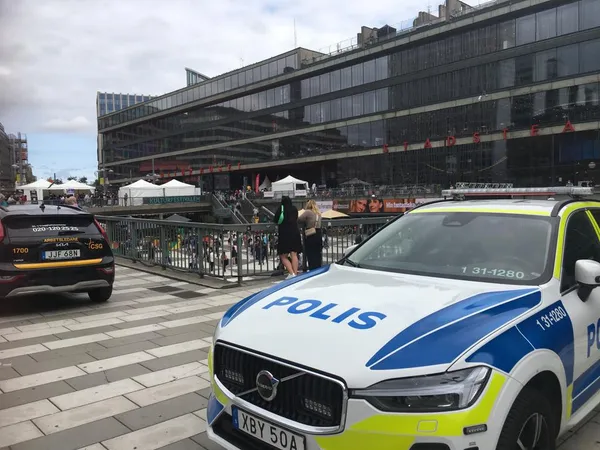
A police Car at Stockholm's Culture Festival. Photo: David Stavrou
Since its inception nearly two decades ago, the festival has been a huge attraction both for Stockholmers and tourists. For five days, stages throughout the city center host dance, music, circus and theater performances, all for free. Long lines stretch around dozens of food and drink stands, and more than a million visitors and hundreds of workers fill central Stockholm's streets, squares and bridges.
This year's installment went by without incident. Despite the warnings, there were no metal detectors, no one checking bags at the entrance, and no tense atmosphere at all. Maybe the reason is that instead of the rainy weather of the first half of August, the sun shined on Stockholm. Maybe it's just that the Swedish approach to terror threats, at least for now, is the same as the Swedish approach in general: faith in the authorities and security forces – and a cautious pragmatism. “We must live our lives as normal,” Kristersson said. “We stand behind our democratic values. We are defending ourselves, but we still stand behind our way of life.”
Malmö, the large city in southern Sweden, has been in the headlines in recent years because of expressions of antisemitism. This is the story of the slow awareness of local and national authorities and the measures taken to deal with the problem. Could Malmö's experience be of any value for the whole of Europe, where many large cities are facing similar problems.
Those who believe in the old saying “there’s no such thing as bad publicity” would do well to study the case of Sweden’s third largest city – Malmö. Home to some 350,000 people, it‘s not particularly big, it’s not Sweden’s oldest or most beautiful city and it’s not exceptionally cheap or expensive to live in. Still, in the last few years it made an international name for itself, though perhaps not the name its leaders were hoping for. Instead of being praised for Västra Hamnen which claims to be Europe’s first carbon neutral neighbourhood, for its multiculturism or for the Turning Torso building, Scandinavia’s highest skyscraper, Malmö is known around the world for a much less appealing feature – antisemitism.
The new antisemitism of Malmö
It’s hard to say when or where it started. Antisemitism isn’t a new phenomenon in Sweden. In fact, it was there even before the first Jewish communities were founded in Stockholm and Marstrand near Gothenburg in the late 18th century. Towards the end of the 19th century and the beginning of the 20th, official state restrictions and discrimination slowly disappeared, but antisemitic ideology and propaganda could be found throughout both the old political establishment and newly founded neo-Nazi and fascist movements. Surprisingly, the end of WW2, which left neutral Sweden relatively unharmed, wasn’t the end of Swedish Nazism. Quite the opposite. After the war Sweden became host for many racist, nationalist and fascist movements. While the political elite was gradually embracing universal values and continuing to develop a social-democratic welfare state, the extreme right on the margins of Swedish society was, and some say still is, flourishing. Neo-Nazi skinheads, antisemitic publishing houses and movements based on pre-Christian imagery that promote nationalist, racist and anti-establishment ideas became an integrate part of Swedish society.
Malmö played an interesting role in this story during the final stages of WW2 and the following years. On one hand, this was the city that became a safe haven for Danish Jews who arrived at its shores after crossing the Öresund strait fleeing the Nazis in 1943. This is also where the Swedish Red Cross’ “White Buses” arrived in 1945, carrying survivors of the Nazi concentration camps. On the other hand, this was the home of the so-called Malmö Movement, which played a central role in the rehabilitation of Europe’s extreme right, back in the 1950’s. The movement’s leader Per Engdahl took a leading role in the project of connecting the remnants of fascist and Nazi movements from all over Europe and forming a political network which published literature, organized conferences and created an escape route for Nazis from Europe to South America. The center of all this was Malmö were Engdahl lived and worked. But all this is ancient history.
For over ten years now, Malmö has become, in the eyes of many, a symbol of a new kind of Swedish antisemitism. While right wing extremism is still dangerous and threatens Jews in Malmö just like anywhere else, in the last few years an imported antisemitism originating in the Middle East and Islamist environments has taken over. In Sweden, the combination of the two proved itself particularly worrying and Malmö is sometimes seen as the center of it all. In 2012 an explosion shook the Jewish community center. In 2009, Molotov cocktails were thrown at the local Jewish funeral home. In the same year Malmö was the scene of what is now known as the Davis Cup riots. As Israel and Sweden were playing an official tennis match, thousands of anti-Israel demonstrators took to the streets and the protest developed into physical and verbal attacks against the city’s Jews and law enforcement forces. At the time, former mayor IImar Reepalu, was accused of being part of the problem, rather than part of the solution when he said to a local daily that “We accept neither Zionism nor antisemitism which are extremes that put themselves above other groups”. But problems didn’t stop when Reepalu was replaced in 2013. Pro-Palestinian demonstrations, especially during periods of conflict in Gaza, continued to feature heavily antisemitic slogans, signs and rhetoric.
When I visited the city in 2015 in order to write a report for “Haaretz” I spoke to a few members of its Jewish Community. Those were the days when hundreds of asylum seekers were arriving every day, mainly from Syria and Afghanistan, crossing the bridge from Copenhagen and arriving at Malmö which became their Swedish port of arrival. As authorities in Sweden were struggling with challenges of housing, employment, education and integration, many in Malmö were worried. “There is fear and harassment on a daily bases”, one woman who immigrated from Israel to Malmö decades ago told me. She claimed that authorities were doing nothing against the daily harassment and the incitement from local mosques. “I’m not against accepting asylum seekers”, another community member told me, “one should not close the door to people in need of help, but this is what happens when we want to solve one problem by creating a bigger one. We need to use our heads, not only our hearts”. After this, I returned to the city on several occasions and reports continued to be troubling. Some claimed that Jewish families were leaving the city because they no longer felt safe. In 2021, a report commissioned by the municipality described Malmö schools as an unsafe environment for Jewish students who suffer from verbal and physical attacks while teachers prefer to avoid conflict with the aggressors. Other reports claimed that Holocaust survivors are no longer invited to tell their stories in certain schools in Malmö because Muslim students treat them disrespectfully.
Malmö at the center of the world
As a response to all this, Malmö’s Jewish community which has existed since the 1870s and now has two synagogues, a community center, a variety of educational activities and just under 500 members, decided to speak out. Now it became harder for the Swedish press to ignore the problem and the picture it painted wasn’t a pretty one – the reports included children who had to put up with their schoolmates burning Israeli flags, making threats and praising Hitler, youngsters who were suffering from bullying and threats of rape and murder on social media and Jewish teachers who were told to put up with the harassment and keep a low profile. These are all well documented facts. They are based on resident’s testimonies, information collected by journalist, NGOs and authorities and studies conducted by serious researchers. But when it comes to Malmö there seems to be a layer of mythology covering the facts. This is the Mythology that gave Malmö unflattering titles like “Sweden’s antisemitism capital” or even “Europe’s most antisemitic city”. During the last few years, reports on Malmö, mainly in the international press, became full of stories about so-called honor killings, forced marriages, polygamy, female genital mutilation, parallel societies, riots, organized crime of ethnic clans and no-go zones in which local criminals have taken over and police and authorities cannot operate.
All this seemed to go hand in hand with the reports on antisemitism and although many of the reports in the media were true or at least based on some aspect of reality, others were extremely exaggerated, taken out of context and, more importantly, highly politicized. This is where Malmö became part of the global list of “greatest hits” for everyone who was spreading stories and conspiracy theories about Sharia law taking over Sweden, Sweden becoming the “rape capital of the world” and Sweden as proof of the “Great Replacement Theory”. With these reports, the attention of the Jewish world was turned towards Sweden and in 2010 the Los-Angeles based Simon Wiesenthal Center started advising Jews to not visit Malmö. With the populist right in Sweden growing stronger, integration of immigrants from the Middle-East becoming harder and the Israel-Palestinian conflict growing closer, Malmö‘s small Jewish community suddenly became a symbol for all the problems in the world, even if a reluctant one.
Public authorities react
It’s hard to say if the situation in Malmö is really as bad as it’s sometimes portrayed in foreign media, or if it’s really that different from the situation in other Swedish cities or any other multicultural European city for that sake. Still, at some point local authorities and the government in Stockholm realized they have a serious problem. The situation in Malmö, whether exaggerated by the press or not, was making Sweden look bad. But it was more than that. In the last couple of years, I have spoken about antisemitism with the Mayor of Malmö, Sweden‘s Education Minister, Foreign Minister and former Prime Minister (all Social Democrats) and there is no doubt in my mind that they were all troubled by antisemitism and dedicated to the fight against it. For them, this is not only a PR problem. This doesn’t necessarily mean that their efforts were 100 percent effective, but at least their concern was sincere. Last October, When I interviewed Katrin Stjernfeldt Jammeh who has been Mayor of Malmö since 2013 she said that she realizes that Malmö isn’t vaccinated against antisemitism. “It’s a problem we’re addressing” she said, “we talk about it more today and, when you talk about it, it seems like it’s a bigger problem than it does if you don’t talk about it. But for me, (the image) is not important. The only thing that’s important is that we attack the problem and create change”.
Asked to detail what the city has done to confront the problem in the eight years she has been in charge, she said she has been working to combat antisemitism and racism since the day she was elected by “working with our citizens in various different set-ups, working with the Jewish community in several ways to map the problem, to create an understanding of the problem and, today, we have a long-term commitment”. She added that the city is investing more than 2 million Euros over four years. “This is not just a small project this year or next year”, she explained, “it’s a commitment to work in the long-term to create better conditions for the (Jewish) congregation, to enhance security and create knowledge. We’re also working within our school system, mapping the problem there too, and creating different ways to prevent prejudice”.
On the national level, former Prime Minister, Stefan Löfven, made the struggle against antisemitism and Holocaust remembrance a major part of his political legacy. Here too Malmö played a critical role. Last October Löfven and the city of Malmö hosted a special conference – The Malmö International Forum on Holocaust Remembrance and Combating Antisemitism. Although the conference dealt with a much wider issue than the concrete problems of Malmö’s Jewish community, it caught the attention of many around the world as heads of state and governments, researchers and representatives of private and civil society organizations engaged in what the Swedish government called an “action-oriented” program. The idea was that delegations from around the globe would present pledges of “concrete steps forward in the work on Holocaust remembrance and the fight against antisemitism”. The Swedish government, for example, promised to build a new Holocaust Museum, to criminalize organized racism, to contribute to the Auschwitz-Birkenau Foundation, to appoint a government inquiry on a strategy to promote Jewish life in Sweden and to “significantly increase” the funding for “security enhancing measures for civil society, including the Jewish community from 2022”.
The Malmö Forum took place just over twenty years after the original Stockholm International Forum which was initiated by one of Löfven’s predecessors, former Swedish Prime Minister Göran Persson. This was the beginning of the international partnership to fight antisemitism and promote Holocaust remembrance and it led to the “Stockholm Declaration” which is the founding document of the International Holocaust Remembrance Alliance (IHRA). When I spoke to Löfven a few weeks after the conference he told me that the Malmö forum was “all about commitments, not about speeches”. He then explained that there were two kinds of commitments: “first, never to forget, which is why different countries undertook to have various memorial events and memorial sites, and second, the fight against antisemitism, which is also about commitments. In our case, this means doing more in schools, investing more in research so that we have a better understanding of the forces behind antisemitism and so on. We want to spread this to other countries, organizations and companies, such as social media companies for example. Everyone can make commitments. Individual schools can commit, more companies can make commitments, sport organizations can make commitments. That’s the way to address these issues”.
The limits of political mobilization
The Malmö Forum made some headlines and brought Malmö some positive attention for a change. But are these national and international initiatives, which are discussed by high-ranking politicians, business leaders, journalists and international organizations making any difference on the local level – in the streets, the squares and the schools of Malmö? That depends, naturally, on who you ask. Some local opposition politicians, for example, were skeptical even before the conference started. “It’s obvious we have a huge issue with antisemitism and it’s affecting people’s everyday lives in Malmö”, Helena Nanne the deputy chairman of the center-right Moderate Party in City Hall told me a few days before the Malmö Forum convened, “For families with children at school, the situation with antisemitism is a major issue, and we hear stories of families who choose to move because they don’t feel safe and can’t be sure the school will be safe for their children”. Nanne wasn’t opposed to the international forum as an idea but she claimed that the Social-Democrats who were organizing it had a home-made antisemitism problem. “This city is run by a party that has had a problem with antisemitism in its own organization”, she said, “It’s hard to take commitments they make seriously”. Another opposition politician based in Malmö, Ilan Sadé, who leads the right-wing Citizens’ Coalition party, was even more critical. “I’m not against the forum taking place in Malmö”, he said, “but this might just be an attempt to improve Malmö’s image. There’s a problematic connection between the Social Democrats and the immigrant population in neighborhoods like Rosengård (a Malmö neighborhood known for its immigrant population and gang-related crime, D.S). The Social Democrats have very wide support there, and they don’t want to lose it; they need to keep the balance. And of course, there are also many people from Arab countries who are party members. There were incidents like the one when members of the party’s youth league were heard shouting slogans like ‘Crush Zionism’ at demonstrations. That’s at least borderline antisemitism – they don’t shout that against other countries”. Sadé alleges that there is a lack of determination to prevent, stop and prosecute hate crimes in Malmö. “The police file on the attacks against the Chabad rabbi of Malmö is as thick as a Dostoevsky book”, he told me, “there are about 160 to 180 cases registered: anything from spitting on him to cursing and harassing him. This is absurd. In Sweden, a religious leader should be able to walk down the street. Priests can do it, imams can do it, so why not a rabbi? This should be prioritized, and it isn’t”.
Another way of approaching the problem does indeed involve both an imam and a rabbi. Imam Salahuddin Barakat and Rabbi Moshe David HaCohen, both based in Malmö, founded an organization which aims to create a trusting society while working to counter discrimination. The organization, Amanah, believes that deepening of identity and roots are key elements towards reaching their goal and it focuses on countering antisemitism and islamophobia within all levels of society – schools, universities, communities and official representatives. I spoke to rabbi HaCohen on the morning the Malmö Forum started and he told me that he appreciated the Swedish government‘s efforts even though not much attention was paid to Malmö itself since the forum was happening from the top down. His organization, on the other hand, is more of a grassroots one. HaCohen spoke about school programs combating racism that Amanah was promoting as well as a digital project that simulates dealing with antisemitic situations and the efforts the organization makes to address Holocaust denial in schools and monitor social media that can potentially “poison the minds of 9- and 10-year-olds”. Hacohen already sees some results to the interfaith dialogue. “During the last Gaza conflict (in May 2021), there was increased tension in the city, as we’ve seen in the past”, he remembered, “since there’s a large Palestinian community here, there were demonstrations against Israel, and as usual some of the protesters started to shout antisemitic slogans. But this time, these people were removed by imams who left their comfort zone and protected their Jewish neighbors. In the same way, we stood alongside our Muslim neighbors when supporters of a far-right Danish politician who was denied access to Sweden filmed themselves burning and kicking the Koran in the streets of Malmö”.
The people of Amanah aren’t standing alone. Other organizations and municipal leaders are doing their best to deal with the problem of antisemitism in the city. The Jewish community recently opened a new learning center that has been working with local schools. City Hall is working with the Swedish Committee Against Antisemitism to arrange trips to the concentration camps in Poland and its partnering with local football clubs to help them deal with racism and antisemitism. The city has also appointed a special coordinator to work on the problem of antisemitism in Malmö’s schools. The coordinator, Miriam Katzin, a Jew herself, a lawyer and a left-wing politician, gave an important perspective when she spoke to the Swedish Expo magazine just over a year ago. “There’s an antisemitism problem in in the whole of society which expresses itself in different ways”, she said, “I think it’s convenient for the majority of Swedes to turn to Malmö and place antisemitism there as the fault of groups that don’t belong to the majority. But that’s making it easy for themselves. The antisemitism I grew up with was expressed by regular majority swedes. That antisemitism is still alive, but it’s often overlooked. One wants to make antisemitism to be a problem of the others”. According to Katzin immigrant groups are blamed for antisemitism as part of this tendency, the right blames the left for being antisemitic and the left blames the right, while in reality antisemitism is a general social problem and it’s “deeply problematic to engage in a competition about who are the worst antisemites”.
This is indeed one of the most serious problems regarding antisemitism in Malmö and in many other European cities. The understanding that it still exists in this day and age is a depressing thought as it is. The thought that it’s not limited to one side of the political debate or to one particular social group, region or culture makes it even worse. Once one realizes that hatred of Jews is a problem that unites left-wing progressives, old-school conservatives, white supremist and hard-core Islamists, it’s hard to imagine a solution. In the same way, Malmö which became a symbol of antisemitism but in reality, was never the only or the worse expression of it, is just a tiny part of the bigger problem. After all that has happened in Malmö – the international attention, the media circus, the scores of high-profile politicians, the pledges, the promises and the time, effort and money spent on education, interfaith dialogue and security measures, there is still a serious problem. It’s not that nothing helped. Things are probably a bit better these days in this one medium sized city in southern Sweden. But that’s just the tip of the iceberg. Now, all that’s left to do is fix the rest of the world.
David Stavrou is a regular contributor for “Haaretz” based is Stockholm. This article is based on a series of articles about Malmö originally published in “Haaretz”.
A week after the International Forum on Holocaust Remembrance and Combating Antisemitism left Malmö, local Jewish leaders have differing views about the battle and challenges ahead.
MALMÖ – The international focus may have moved on following last week’s International Forum on Holocaust Remembrance and Combating Antisemitism here, but community leaders here are under no illusions about the battle ahead. In the eyes of some, this southern Swedish city has become part of the problem rather than part of the solution in recent years, with numerous instances of harassment and antisemitic attacks. These problems were not ignored at the forum, though local Jewish activists know that a one-day conference featuring world leaders and Swedish dignitaries won’t bring change on the ground when it comes to hate crimes against the community.
Swedish Prime Minister Stefan Löfven, the man behind the forum, visited Malmö a day before the main event and met with local Jewish community leaders. One of them was Rabbi Moshe David Hacohen, who recounts how he told the premier that he really appreciated his efforts to bring the forum to the city. “It wasn’t an easy choice,” says Hacohen, who is originally from Tekoa, Israel. But he noted that, for him, the forum was “happening from the top down: delegates came from all over the world, but not much attention was paid to Malmö itself.”
Hacohen’s work, on the other hand, takes the opposite approach. Apart from being the city’s rabbi, he is also one of the founders of Amanah, a grassroots organization featuring members of Malmö’s Jewish community and the Malmö Muslim Network, which is represented by local imam Salahuddin Barakat. “Of course there’s a problem of antisemitism in Malmö – everybody acknowledges that,” Hacohen says. “Every time there’s an escalation in the Israeli-Palestinian conflict, Jewish children suffer from it at schools and we see the effect of it in the streets.” But Hacohen tries to approach the problem in a unique way. He talks about long-term change and doesn’t see the situation as a result of tensions between the Jewish and Muslim communities. “Morally, we should avoid generalizations and racism toward other groups,” he says. “We must also remember that antisemitism doesn’t come only from the Muslim community; there’s also an old, traditional, European antisemitism to be addressed.”
Imam Salahuddin Barakat and Rabbi Moshe David Hacohen
Hacohen and his Muslim counterparts believe in tackling this challenge in several ways. These include school programs combating racism; a digital project that simulates dealing with antisemitic situations; addressing Holocaust denial in schools; and monitoring social media that can potentially “poison the minds of 9- and 10-year-olds.” Hacohen doesn’t claim Amanah has solved the problem of antisemitism in Malmö – but says it’s a start at least. “During the last Gaza conflict [in May], there was increased tension in the city, as we’ve seen in the past, since there’s a large Palestinian community here,” he says. “There were demonstrations against Israel, and as usual some of the protesters started to shout antisemitic slogans. But this time, these people were removed by imams who left their comfort zone and protected their Jewish neighbors. “In the same way, we stood alongside our Muslim neighbors when supporters of a far-right Danish politician who was denied access to Sweden filmed themselves burning and kicking the Koran in the streets of Malmö,” he adds.
Skeptical voice
Not all Jewish activists voice such optimism. Ilan Sadé, for instance, is an Israeli-born lawyer, news site owner and Malmö-based politician who leads the right-wing Citizens’ Coalition party, which is yet to make into Sweden’s parliament but holds four seats at various city halls in southern Sweden. “I’m not against the forum taking place in Malmö,” he says, “but this might just be an attempt to improve Malmö’s image.” Sadé is skeptical when it comes to the ruling Social Democratic party’s efforts to combat antisemitism. “There’s a problematic connection between the Social Democrats and the immigrant population in neighborhoods like Rosengård,” he says, referring to a hardscrabble Malmö neighborhood known for its gang-related crime.
“The Social Democrats have very wide support there, and they don’t want to lose it; they need to keep the balance,” he charges. “And of course, there are also many people from Arab countries who are party members. There were incidents like the one when members of the party’s youth league were heard shouting slogans like ‘Crush Zionism’ at demonstrations. That’s at least borderline antisemitism – they don’t shout that against other countries.”
Ilan Sade. Photo: Tomas Fransson
According to Sadé, there was a new wave of hate when the latest conflict broke out in Gaza last May. “There’s a gray zone between hatred of Israel and antisemitism,” he says, adding that though the Social Democratic party and Malmö City Hall are at least trying to combat antisemitism, it still “felt uncomfortable to see cars driving around town shouting and waving Palestinian flags. These days, hate spreads very quickly on social media and we saw these scenes all over Europe.” Sadé believes the root of the problem is found in many places. He cites the so-called cellar mosques that, unlike established mainstream mosques, have imams who spread Islamist propaganda. He also highlights what he sees as a “chaotic situation” in local schools, and immigrant families who are inspired by Arab networks news. He alleges that there is a lack of determination to prevent, stop and prosecute hate crimes. “The police file on the attacks against the Chabad rabbi of Malmö is as thick as a Dostoevsky book,” Sadé says. “There are about 160 to 180 cases registered: anything from spitting on him to cursing and harassing him. This is absurd. In Sweden, a religious leader should be able to walk down the street. Priests can do it, imams can do it, so why not a rabbi? This should be prioritized, and it isn’t.”
When Sadé is asked what he would do differently, his solutions focus on more restrictive immigration policies, teaching Western values in Swedish schools, combating foreign Wahhabist and Salafist ideologies, which he says have spread among the immigrant populations, and preventing foreign funds from countries like Turkey or Qatar reaching local organizations. “If you bring so many uneducated people from the Middle East,what you get in the end is a new Middle East,” he says, echoing the thoughts of many far-right groups.
Those on the other side of the debate, like Hacohen, would admit that more work needs to be done. However, they would argue that leaders on the municipal level like Malmö Mayor Katrin Stjernfeldt Jammeh and, on the national level, Löfven are committed to the issue, as are opposition leaders in both the municipal and national arenas. Some of the steps currently being discussed and promoted are stepping up police work, changing prosecution policies for hate crimes, legislating against organized racism and more work in local schools. Compared to the past, the Swedish discourse on antisemitism, on all sides of the political spectrum, is clearer and unequivocal.
Prime Minister Löfven said last week that “even though antisemitism should belong to the past, we see it spreading in society even today. Hatred of Jews exists in our history, in extreme right-wing groups, in parts of the left and in Islamist environments.” He concluded by saying that “we all have a duty to stand up to antisemitism. An important part of this is remembering the Holocaust, which is becoming harder now that less and less survivors can tell their stories.” Löfven has stated on many occasions his commitment to the survivors, and to Jewish communities in Malmö and elsewhere. Whether this commitment turns into concrete steps and a real change in the lives of the city’s Jews remains the challenge now the circus has left town.



 דיויד סטברו