The state of antisemitism in Sweden

As Sweden is marking 250 years of Jewish life, the reactions to the October 7th massacre, the war in Gaza and the tone of the rhetoric in the public debate are reasons to be concerned about Swedish antisemitism. But what is the true extent of this scourge, what is its impact on Sweden’s Jewish community, and how is it being addressed by the authorities? By placing these issues in a broader historical context, David Stavrou’s investigation, which we are publishing as part of our partnership with the DILCRAH, seeks to answer these questions.

Published in K. in English: https://k-larevue.com/en/sweden/ and in French: https://k-larevue.com/antisemitisme-suede/

In 1973 a young Moroccan army officer named Ahmed Rami arrived in Sweden asking for political asylum. He said he needed protection because he was part of an unsuccessful coup d’état in his homeland the previous summer. More than a decade later, after obtaining asylum in Sweden, Rami started broadcasting Radio Islam, a radio program which subsequently turned into a newspaper and later, a web-site. The focus of these enterprises became clear right at the beginning – it was not about Islam; it was about Jews. The radio program and the website featured some of antisemitism’s greatest hits; conspiracy theories about how Jews and Zionists control the world, Holocaust denial, Nazi propaganda, lists of influential Swedish Jews and Israel bashing. During the last three decades, Rami has been investigated, charged, convicted and fined for hate speech and hate crimes and his radio station was shut down by the authorities more than once. Still, now aged 78, Rami’s legacy lives on. He has published books, voiced support for Hezbollah and neo-Nazi groups, his website is still very much alive and the internet allows his work to continue.

Radio Islam is an important landmark in the history of Swedish antisemitism for several reasons. One of them is that the precedential trial which sent Rami to prison for six months also gave a small and relatively unknown Swedish organization called The Swedish Committee Against Antisemitism (SCAA, or SKMA in Swedish) an important role in the Swedish public arena. “SCAA is a religiously and politically unaffiliated NGO which was founded in 1983”, says Mathan Shastin Ravid, the organization’s office manager, “it was founded by a group of activists who wanted to raise awareness about antisemitism. It was a period with a clear wave of antisemitism in Sweden and other European countries during and after the Lebanon War in 1982. Antisemitism was not a new phenomenon in Sweden back then, but this was on a new scale, there were all these accusations with motives and images that targeted not only Israel, but Jews as a group. When the Radio Islam broadcasts started in the end of the eighties, it was clear to us that the radio station was a megaphone for anti-Jewish hatred and propaganda. On the basis of SCAA´s report to Sweden’s Chancellor of Justice, Rami was convicted of hate speech. But it was clear that in those days we stood pretty much alone. Not many people understood the problem, people did not want to talk about it and there were many known figures who came to Rami’s defence saying it was only criticism of Israel, not antisemitism”.

A lot has changed in Sweden since then and SCAA probably has an important part in the change. Shastin Ravid says that since the nineties, the organization has become more than just an activist watchdog. It now also focuses on education. “These days we stand on two legs”, he explains, “one of them is monitoring, information and advocacy, as we try to follow what is happening in Sweden and the world and follow the Swedish and international debate regarding antisemitism. We then react when we see antisemitism in different forms. The other leg is education. We have educational programs for different target groups such as teachers and pupils in Swedish schools, journalists and politicians. We also work with some governmental authorities like the police, which often lack a deeper knowledge of contemporary antisemitism and how it spreads. It is my understanding that there is more awareness in this area today than there was ten years ago and that positive things are happening as part of a higher level of knowledge and consciousness in general in Swedish society today when it comes to antisemitism. But there is still much work to do..”

When Shastin Ravid is asked for an up-to-date description of antisemitism in Sweden, he starts by saying that more research is needed to get a better understanding of the problem. That said, it is clear that in many ways Sweden is not different from other countries. “The development in Sweden is connected to global developments”, he says, “antisemitic conspiracy theories have been spread and legitimized by important political actors in recent years. In Europe we have for example seen it in countries like Hungary and Poland amongst right-wing nationalist parties and governments, but we have also seen it in other countries including the US where amongst others Donald Trump, Elon Musk and the MAGA movement have legitimized and spread antisemitic propaganda. This global phenomenon has affected Sweden too and has sparked hate speech and hate crimes. And then there is, of course, the strong global wave of antisemitism after Hamas’ attack in Israel on the 7th of October 2023 and the war in Gaza. It is not the first time an escalation of the Israel-Palestinian conflict triggers antisemitism in Sweden and other countries, but the level of propaganda, hate, threats and attacks against Jews has been unusually high.”

“Studies show that antisemitism in the form of negative beliefs and attitudes towards Jews exists, in varying degrees, in all Swedish society, in many different groups and milieus. Within Swedish mainstream politics, the problem has long been visible in the right-wing nationalist Sweden Democrats party. For years, the party has tried to portray itself as a party which opposes antisemitism and is pro-Israel, but antisemitism continues to be a problem in the party. We often find high- and low-level representatives of the party spreading antisemitic propaganda and we see many connections between the party and right-wing and even Nazi extremists. In addition, the Sweden-Democrats do not deal with antisemitism within their ranks unless they are exposed by the media, and even then, there are many cases of people within the party who have kept their jobs after they were exposed”. The party’s proclaimed “Zero Tolerance” policy towards racism and extremism, including antisemitism, Shastin Ravid says, is “a joke”.

“But the nationalist and populist right is just part of the problem. Antisemitism does, for example, also regularly appear within the pro-Palestine movement and parts of the Swedish left, where it is often related to Israel and the Israel-Palestinian conflict. In these circles there is sometimes a denial or an unwillingness to see the problem of antisemitism, sometimes rooted in the misperception that Jews are “white” and therefore cannot be victims of racism. In the last year, there has been a big debate in Sweden about the fact that several representatives of the Swedish Left Party have spread antisemitic propaganda, many times on social media. And when criticized, those party representatives have been backed by many others within and around the party who have denied that the propaganda is antisemitic. The SCAA and many others have strongly criticized all of this, and the fact that the party leadership many times has been slow to act and condemn the spread of such anti-Jewish racism and those party members who defend and excuse it.”

“And of course, movements linked to radical Islamism must also be taken into account”, Shastin Ravid adds. According to him, antisemitism is most virulent within those movements and Nazi and other right-wing extremist movements. “For all of them, antisemitism is an ideological foundation, a “worldview,” a way of understanding and describing events both locally and globally. Jews are constantly portrayed as conspirators and blamed for all the world’s ills”. Furthermore, Shastin Ravid adds, “antisemitism has long been a weapon of regimes in the Middle East, where it is deeply rooted, openly expressed, and legitimized. The spread of this type of propaganda via the internet by regimes such as Iran has contributed to the globalization of this hatred. Recently, it was revealed that the Iranian regime is suspected of having planned to murder Swedish Jews, among them Aron Verständig, the chair of the Official Council of Swedish Jewish Communities (Judiska Centralrådet). According to the Swedish Security Services (Säpo), Iran has also recruited Swedish criminal networks to carry out attacks against Israeli and Jewish targets. The Swedish National Centre for Terrorist Threat Assessment (NCT) has reported that the biggest terror threats in Sweden come from violent Islamists and right-wing extremists, which both have Jews and Jewish institutions as some of their primary targets”.

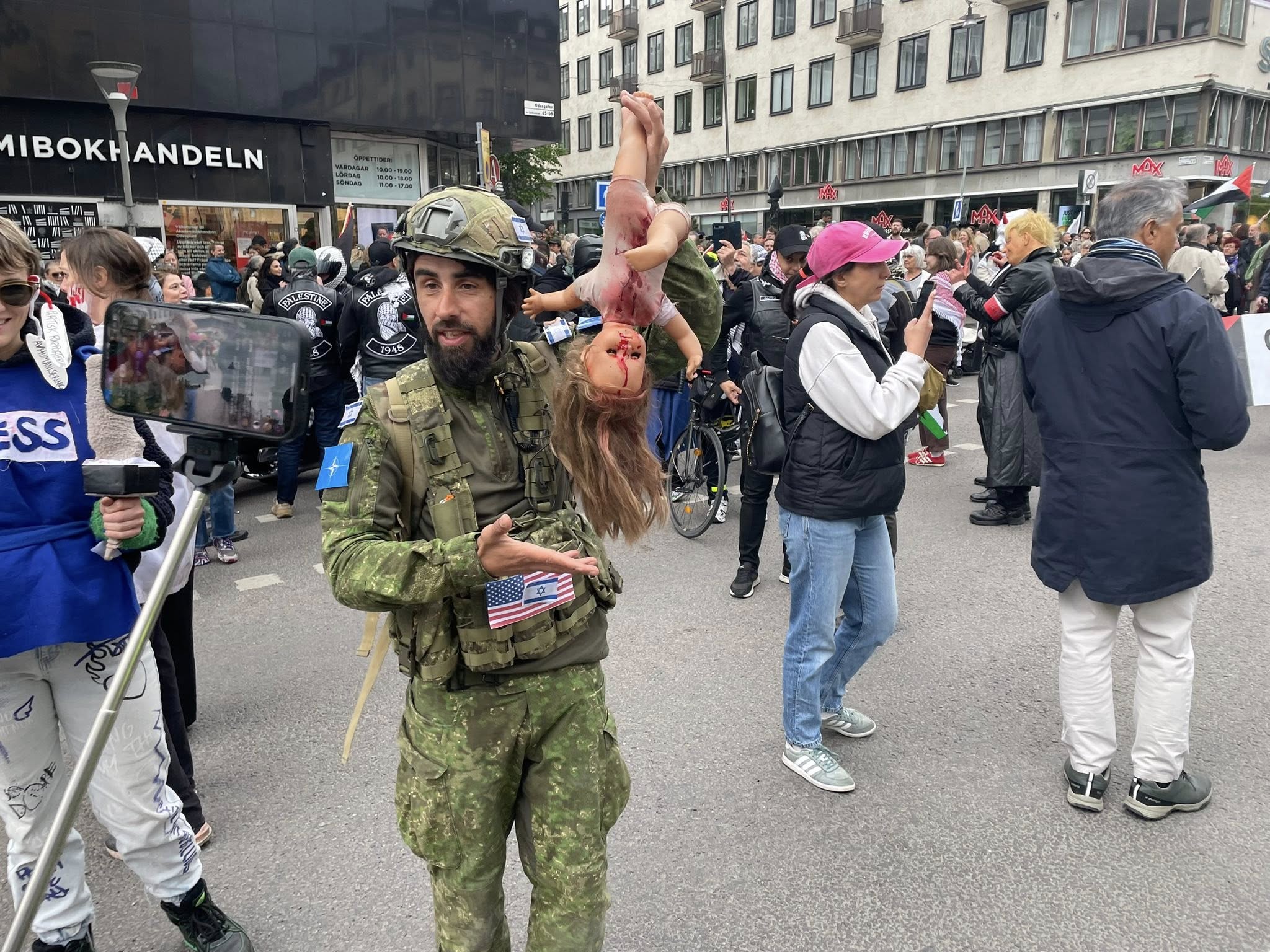
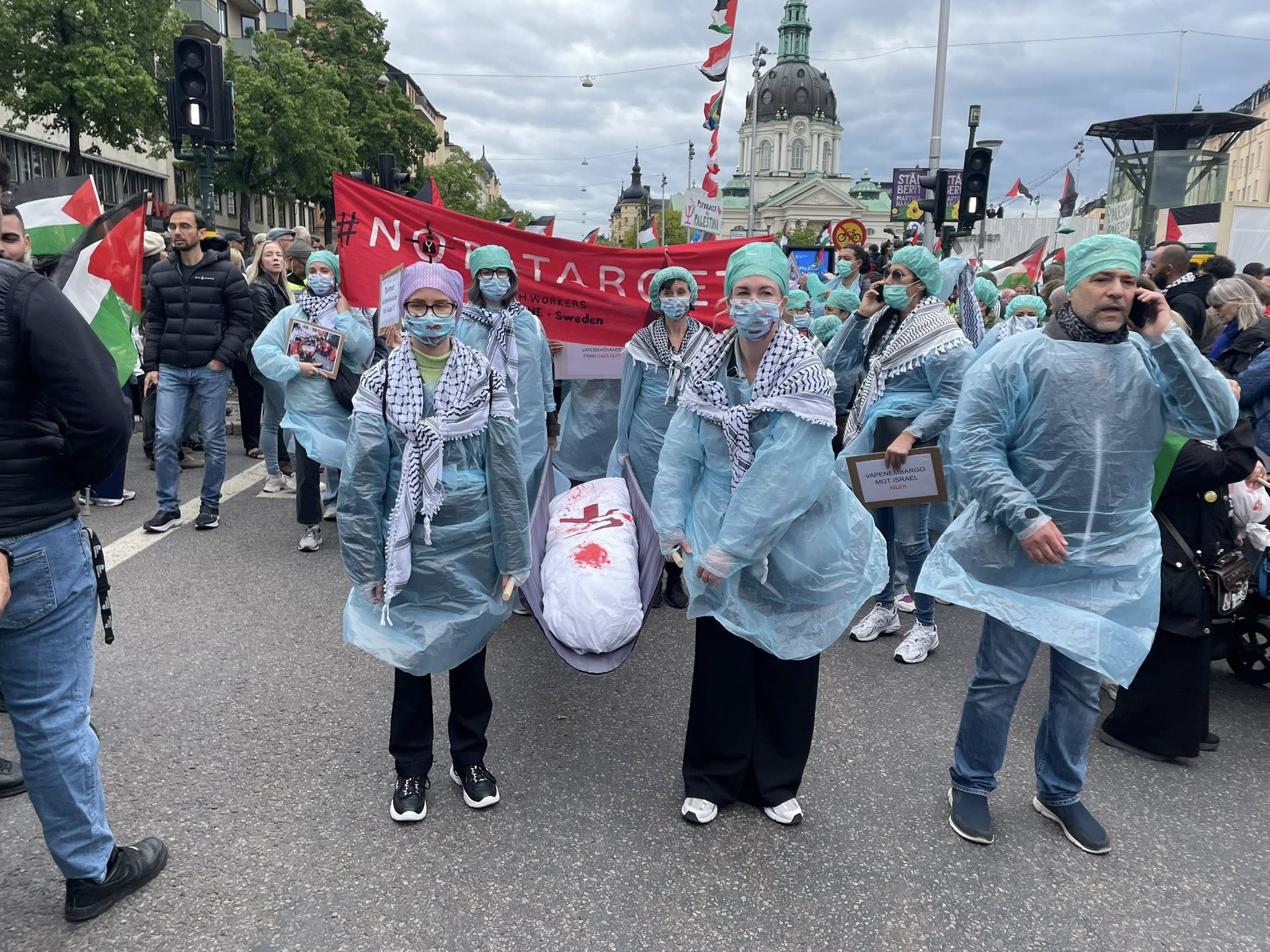
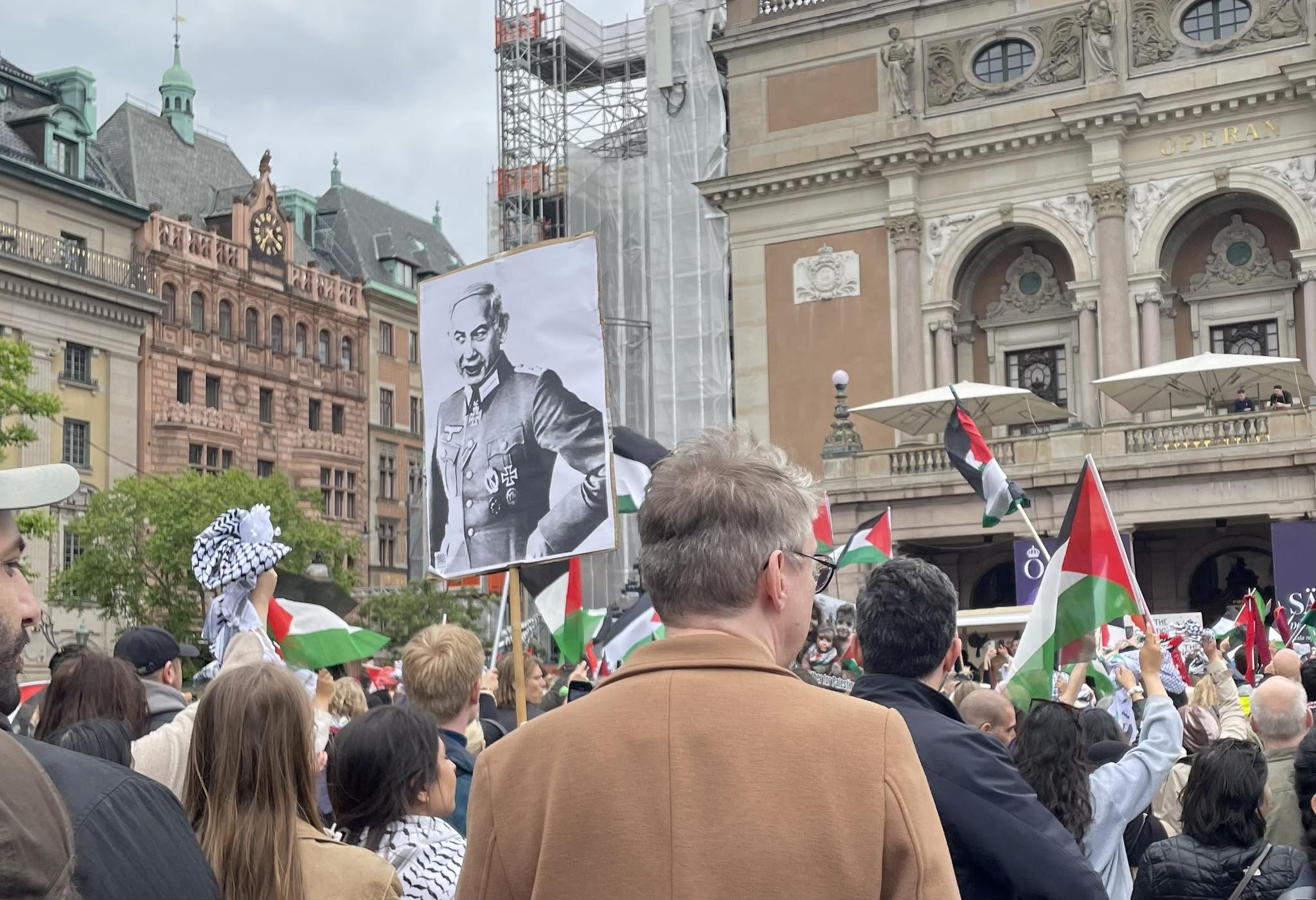
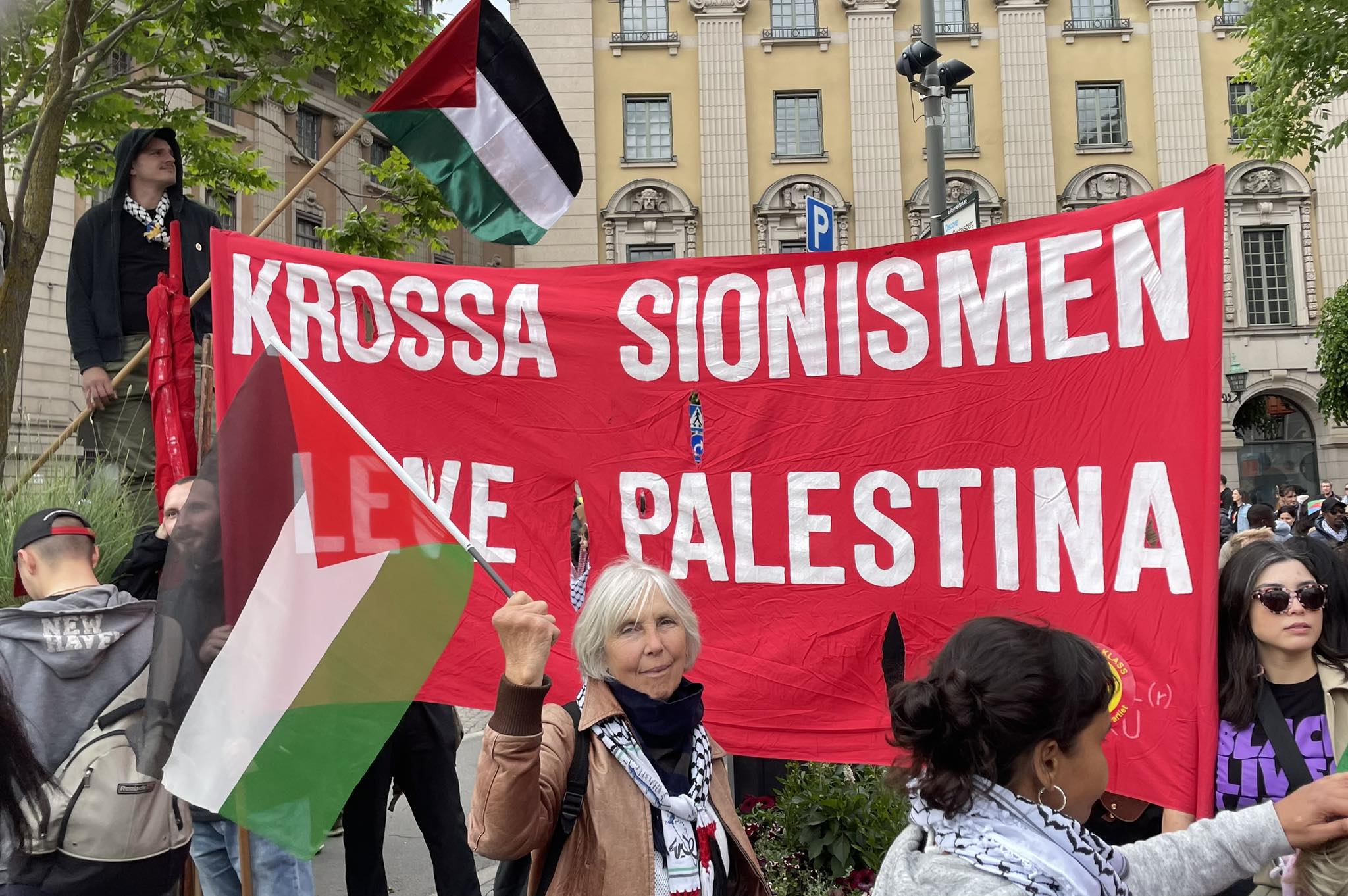
Even without physical violence, Swedish antisemitism is present in the public sphere and one of its main outlets are the numerous demonstrations in support of the Palestinians and denouncing the “genocide” in Gaza. The days right after October 7th, and before the Israeli ground attack on Gaza began, were a good example. While the massacre in southern Israel was still ongoing, there were a couple of spontaneous demonstrations in southern Sweden which included music, dancing and convoys of cars honking their horns in support of the Hamas attack. Right after that, in the course of one weekend in Stockholm, three different organizations demonstrated separately but with similar slogans. A part from the mainstream Pro-Palestinian movements, there were more radical organizations on the streets. One was Hizb ut-Tahrir, a radical Islamic group advocating the creation of a caliphate governed by Sharia law from Uzbekistan to Morocco, with a small branch in Sweden. It was granted permission to demonstrate despite being banned in several countries. Next came the Nordic Resistance Movement, a neo-Nazi group with a few hundred members who demonstrated in support of the Hamas attack. They were followed by the Revolutionary Communist Youth, which claims that Palestinians have the right to “fight by all means against the occupying power to liberate their land.” The latter described the October 7 attacks as an act of liberation that “caught the Zionists in their beds.” Both organizations, one neo-Nazi and the other Marxist-Leninist, support the Palestinian slogan calling for “crushing Zionism.”

Since then, there have been numerous demonstrations in Sweden, many of them on a weekly basis. These demonstrations are legal, the organizers deny that they feature antisemitic content and they are seen by many Swedes as legitimate opposition to Israel and solidarity with Palestinians. However, they often include slogans which are considered antisemitic by many such as supporting a “global intifada” and “crushing Zionism”, promoting antisemitic conspiracy theories and calling for a “Free Palestine from the River to the Sea”.  

Still, demonstrations are not the main concern when it comes to current Swedish antisemitism. There have been numerous reports of activists who have used school classes, universities and even pre-schools to spread radical anti-Israeli political propaganda which is seen by many as antisemitic, the culture world has been full of calls for boycotting Israel and ending cooperation with Israeli artists, the BDS movement which was hardly present in Sweden before the war has been publicly active in promoting boycotts against companies which they claim are complicit with Israel’s “illegal occupation and apartheid politics” and parts of Swedish academia have become hostile to Jewish and Israeli students. In Gothenburg University, for example, activists were allowed to take over the premises of the university’s art and design school and they distributed Hamas propaganda. In Stockholm, Lund and Uppsala there have been reports in Swedish media of pro-Palestinian encampments and so-called “liberated zones” which together with harsh rhetoric from members of senior university staff who are also political activists made students hide their Jewish identity and caused concerns about their safety and well-being.
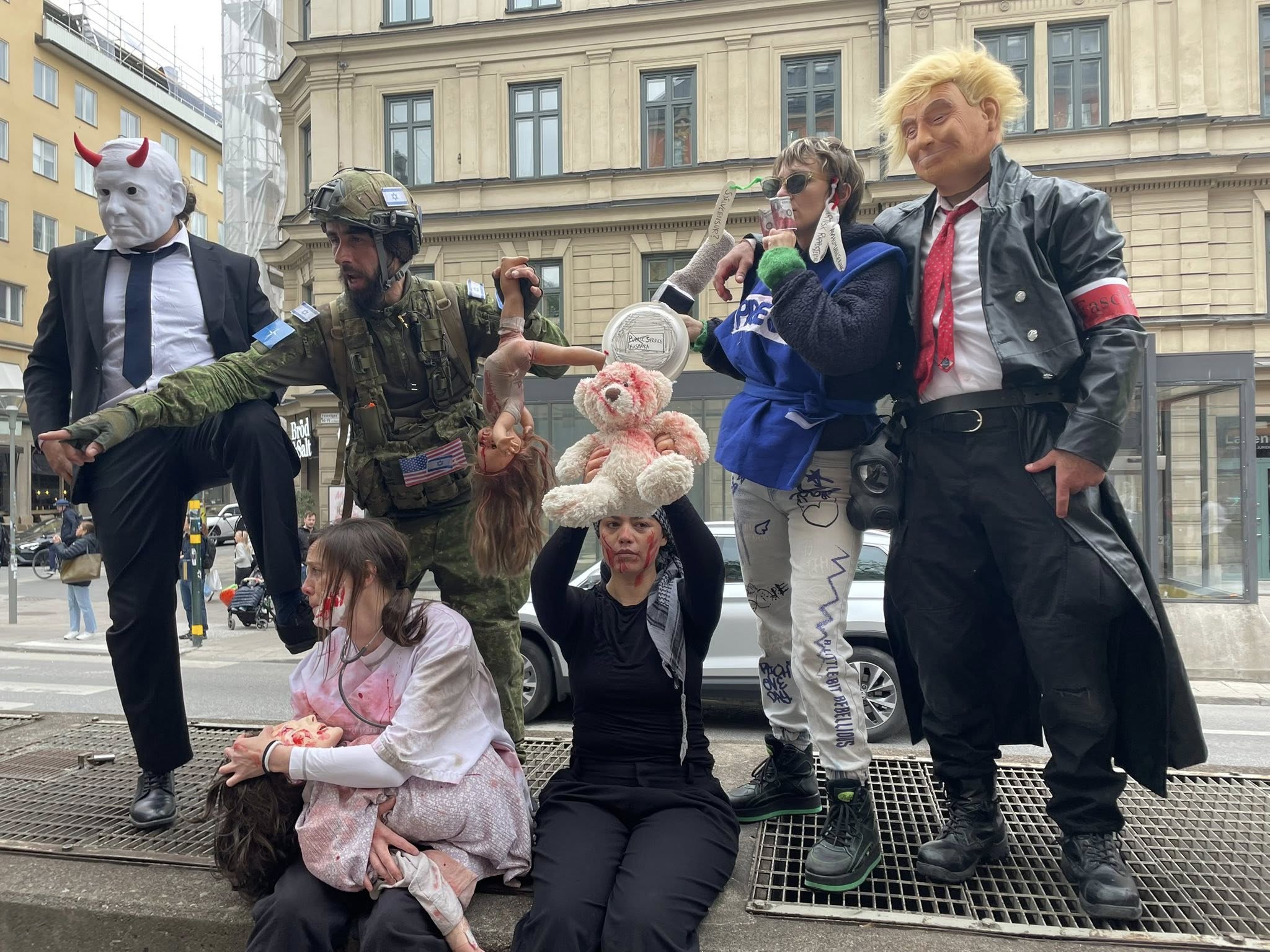
Demonstration in Stockholm, June 2025

How prevalent are antisemitic crimes?

“Many Jews in Sweden have experienced antisemitism in one way or another”, Shastin Ravid says, “we need more research, but studies have indicated that many Swedish Jews have been targeted by antisemitism and many of them have not reported these incidents. This is also true for other hate crimes, most of them are probably never reported to the police”. Some of the studies Shastin Ravid is referring to were made by the Swedish National Council for Crime Prevention (Brottsförebyggande rådet, Brå). They show that there is a small and inconsistent increase in the number of reported antisemitic hate crimes over the years, but some years there is a sharp rise. “These are often the years when the conflict between Israel and the Palestinians has escalated, like the last war in Gaza. According to a study from Brå, there was a sharp rise in reported antisemitic hate crimes during the last part of 2023, almost 5 times as many as during the same period the year before”.

But other global events may also have been important in this respect. “The pandemic, for example, brought at least two kinds of antisemitic effects”, Shastin Ravid says, “First, there were accusations against the Jews, who were blamed for starting the pandemic and for profiting from it. Then, there were parts of the anti-vaccination movement which instrumentalized and diminished the Holocaust, claiming that they are treated the same way as the Jews in Nazi Germany. The war in Ukraine also triggers antisemitism on a global scale as do the discussion about Quran burnings and the debate about migration and refugees which fuels the antisemitic so-called replacement theory. These days antisemitic propaganda is often spread online with code words replacing the word Jews. Instead, it is Zionists or Globalist or specific names like Soros or Rothschild. These words are used globally as symbols of a big Jewish conspiracy, and they are widely spread in Sweden too”. 

Another study Shastin Ravid speaks of was made by a government agency called The Living History Forum (Forum för Levande historia), which was founded in the beginning of the 2000s to “work for democracy and equality between all people, using lessons learned from the Holocaust”. According to Shastin Ravid, the study from 2020, showed that there had been a decline in antisemitic attitudes and notions over a period of 15 years, but that antisemitism still exists within different parts of the population. “I think that this is an important point to make”, he says, “the study showed that around 5 % of the respondents displayed antisemitic attitudes with a stronger intensity, which is a rather low figure compared to many other countries. However, if you broaden it and look at the group of people who agreed with one or more of the study’s antisemitic statements, the number is 34 %. This does not mean that 34 % can be said to be antisemitic, but it indicates that antisemitic ideas exist among a bigger part of the population than many think. We should not only focus on the most extreme groups. According to the study, higher levels of antisemitic beliefs correlated among other things with, and were more common amongst people who are: older, have lower levels of education and have a low trust in public institutions. Antisemitic beliefs were also more common among people who have sexist and anti-immigrant attitudes, people who sympathize with the Sweden Democrats party, people who were born outside Sweden or Europe, and people with a Muslim religious affiliation. Another interesting factor is that traditional and Holocaust related antisemitic beliefs tended to be slightly more common among men, and Israel-related antisemitic attitudes and notions tended to be slightly more common among women”. However, Shastin Ravid points out, the study is now a few years old, and many things have happened since that could affect the results of the next study, which is supposed to be published in 2026.

One group which is particularly exposed to antisemitic hatred is the group of school pupils and teachers who in many cases are scared to be open with their Jewish identity. “We have studies from among other places Malmö and Stockholm which show that there are serious problems with antisemitism in some Swedish schools. Sometimes it is related to the Israeli-Palestinian conflict, sometimes the word Jew is used as a curse and sometimes we see antisemitic conspiracy theories which fascinate youngsters. We also see jokes about the Holocaust, swastikas on benches or lockers, and Nazi salutes. Jewish pupils often feel that their teachers and schools do not take the matter of antisemitism seriously, and they say that there is a lack of knowledge and support. This is something that many Swedish youngsters have told us at the SCAA through the years”.

Sweden is home to the largest Jewish community in Scandinavia. It’s estimated that about 15,000 Jews live in the country which has a population of just over ten million. That said, there are probably many more Swedes who have a Jewish background, as Jewish immigration to Sweden dates back to the 18th and 19th centuries and many have married into Swedish families. The largest community in the country is the one in the capital Stockholm which has three synagogues, including the conservative Great Synagogue adjacent to the Raoul Wallenberg and Holocaust monuments and an office building which houses various Jewish organizations. A few minutes’ walk away, there’s a relatively new cultural centre called “Bajit” which houses a Jewish primary school, a Jewish kindergarten and a variety of Jewish activities for all ages, as well as a Kosher shop and a café. Smaller Jewish communities and associations exist in Malmö, Gothenburg and a couple of other smaller towns. Sweden’s Jewish communities are united under an umbrella organization, the Official Council of Swedish Jewish Communities (Judiska Centralrådet) which usually takes part in national discussions concerning Jewish life in the Swedish Parliament, Government and other authorities.

Since the problem of antisemitism isn’t new to Swedish society, it’s no surprise that in recent years the Swedish government has made many attempts to address it. After decades of ignoring the problem, dismissing and repressing it, recent Swedish governments have put it on their agenda and have tried many different approaches. Petra Kahn Nord who served as the World Jewish Congress’ representative in the Nordic countries, says that the current Swedish government appointed a special inter-ministerial task force in order to combat antisemitism and improve the conditions for Jewish life in Sweden. “This government task force was set up to be a ‘one point of contact’ authority, which is something we’ve suggested before”, she says, “it was founded in January 2023 and the first issue that it focused on was government funding for security for Jewish institutions like synagogues and schools. The second issue was, and still is, addressing antisemitism”. Kahn Nord explains that the previous government had the political will to secure security funding, but the budget mechanism didn’t really work. The current government, however, addressed the issue, increased funding and gave additional funding after October 7th. But protection against violent antisemitic incidents isn’t all that’s needed.

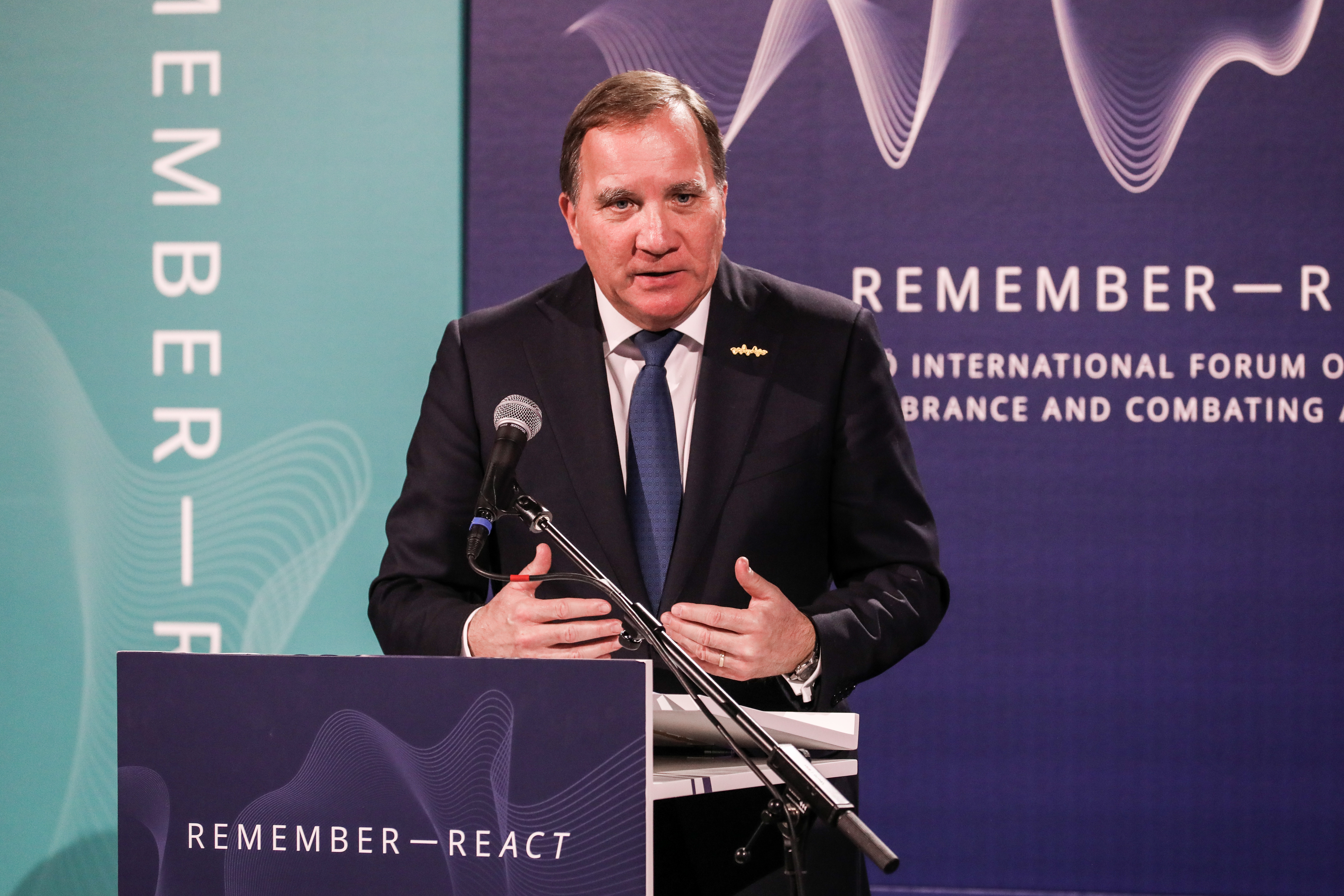
In 2021 Sweden hosted The Malmö International Forum on Holocaust Remembrance and Combating Antisemitism. The conference, hosted by then-Prime-Minister, Social-Democrat Stefan Löfven, asked the participating countries and organization to make concrete pledges that would strengthen Holocaust remembrance and tackle Holocaust distortion, Holocaust denial and contemporary antisemitism. The Malmö forum was seen by many as a natural continuation to the steps another Social-Democratic Prime-Minister, Göran Persson, made twenty years earlier. Persson founded what is now called the International Holocaust Remembrance Alliance (IHRA) and initiated the Stockholm International Forum on the Holocaust which brought together political leaders, state officials, religious leaders, survivors, educators, and historians from around the globe. When Löfven initiated the 2021 events, one of Sweden’s pledges was to form an inquiry on strengthening Jewish life in the country. The idea was that fighting antisemites is one thing, but making Jewish life flourish was another subject. One that has been neglected for many years.

This indeed happened and various issues which Jews in Sweden were concerned about were discussed seriously. These included the threats of illegalizing Jewish circumcision and banning the import of Kosher meat which were supported by some political parties. Another important issue was the status of Jewish schools in Sweden which doesn’t have almost any real private schools. There are so-called independent schools, including a couple of Jewish ones, within a charter system, but because of reports of radicalization in some of Sweden’s independent Muslim schools, new legislation was put in place which affected Jewish schools too. The new legislation imposed the definition of “denominational schools”, and with-it necessary restrictions, on existing Jewish schools. Another concern was an initiative to limit the establishment of new denominational schools. These were all concerns in the Swedish-Jewish pre-October 7th reality. Community leaders were saying then that “Swedish Jews may be able to survive a terror attack, but not legislation forbidding Brit Mila or Jewish schools”.

Today, after October 7th, it’s clear that the majority of political parties, and certainly the ones which are part of the Swedish Government, are committed to addressing these Jewish concerns. Antisemitism, however, is not necessarily a problem which the government can easily address since its origins are well-rooted and widespread in many parts of Swedish society. All recent Swedish governments have therefore realized that combating antisemitism is as complicated as it’s important. And it’s a work in progress. Petra Kahn Nord mentions two major shifts in the last few years. “First, before 2015 it was not acceptable to talk about antisemitism which came from immigrant groups from the Middle-East. This made members of the Jewish community feel abandoned. Sweden has now changed and it’s now possible to talk about it and deal with the problem”, Kahn Nord says, “the second shift has to do with the fact that the populist right-wing Sweden-Democrats party is supporting the government. So far, however, the party hasn’t caused any policy shifts aimed at the Jewish minority. But October 7th created a new reality. We’ve seen an increase in the number of antisemitic incidents in schools and universities, we’ve seen politicians, especially in the Swedish Left, who spread antisemitic propaganda and we’ve seen support for Hamas in demonstrations and online”. Kahn Nord says that schools and social media are a particular concern. “The problem in these arenas is serious”, she claims, “and it can’t be dealt with by using old “action plans” that previous governments suggested. Many of these plans, including pledges made in Malmö four years ago, focused on Holocaust education and educational strategies against racism in general, as opposed to antisemitism as a specific phenomenon. The Malmö Pledges, for example, included the pledge to establish a new Holocaust Museum in Stockholm (which has indeed been opened since then) and another to contribute 5.5 million SEK to the Auschwitz-Birkenau Foundation. “There’s a Swedish tendency to focus on dead Jews”, Petra Kahn Nord says, “perhaps now, especially after October 7th, it’s time to focus on the living ones”.

And indeed, when it comes to living Jews and real concrete Jewish communities, combating antisemitism and taking measures to improve Jewish depends on strong support and clear stands by governments. 

In Sweden, the subject of antisemitism has been on the agenda for decades and different governments have handled it in different ways. Today, the government minister who holds the relevant portfolio is Parisa Liljestrand, a forty-two-year-old minister from the center-right Moderate party. Liljestrand, immigrated to Sweden as a young child from Iran and worked as a teacher and school head-master before getting involved in local politics. In 2022 she received her first post on the national political scene and became Sweden’s Minister of Culture. In an interview conducted in her Stockholm office she explains that one of her responsibilities is addressing issues connected with Sweden’s five national minorities. The minorities and their languages, which are considered official minority languages in Sweden, were recognized in the year 2000 and they include Jews and Yiddish; Roma and Romani Chib; the Sami and the Sami language; the Swedish Finns and Finnish and the Tornedalers and their Meänkieli language.

 “Our government was appointed in October 2022 and the Prime Minister made it clear, as early as his first government statement, that strengthening Jewish life and working against antisemitism would be one of our priorities”, she says, “When we started our work, we decided that we need to understand what’s been done in Sweden today and to listen to the Jewish organizations which are active in Sweden. We wanted to understand what they think is needed. What we found out was that a lot of important work is being done, but there are things which still don’t work and there are things which are lacking. Sweden ranks well in global measurements of antisemitism, but there’s still widespread antisemitism in Sweden which we need to actively fight. This became even more evident after Hamas’s horrific attack on October 7, 2023. As in many other countries, we have seen the threat perception towards Swedish Jews increase, as has open antisemitism. The government takes this very seriously.

But it is not enough to work against antisemitism. We need to strengthen the possibility to live a free Jewish life, both in terms of Jewish culture and in terms of Jewish religious life. This is why we need to gather the work that’s done by different government ministries and by Jewish organizations. When we talked to the organizations, we found that it was sometimes hard to understand who’s responsible for what issue and it was important to make sure that things don’t end up in the wrong place. That’s why we founded the Government Task Force for Jewish Life as an inter-governmental work group which, beside the Prime Minister’s office, has eight more government offices represented in it”.

When asked if the fact that her government is supported by a party with roots in neo-Nazism doesn’t affect her attempts to fight antisemitism, Liljestrand tells a story of one of her meetings. “I met a Jewish father who told me about his son who went shopping while he was wearing a necklace with a Star of David. The father said that when the boy came to the cashier, the person who was working there told him that he was not welcome in the shop. This story really hurts. This can’t be our reality. This isn’t Sweden. We have a clear mission – making Sweden a free country to live in and supporting those groups who cannot live a de-facto free life here. So, I don’t feel the Sweden-Democrats are stopping me from doing this. I understand that there’s a concern, but I’m clear, and the government is clear in its message. One must remember that antisemitism is about gathering and capitalizing violence from various directions. That’s what makes it different from regular racism”. 
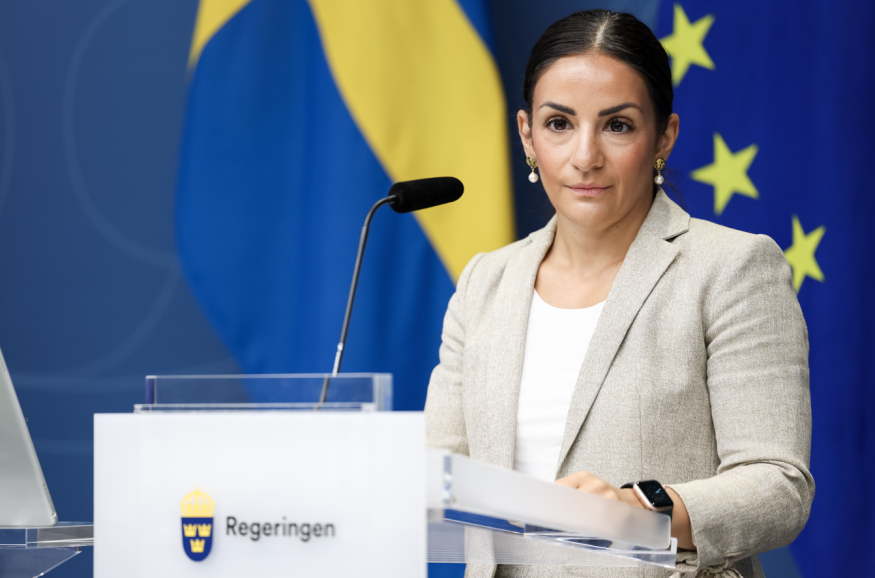
Parisa Liljestrand, Photo by Ninni Andersson Regeringskansliet

Part of the violence Liljestrand is talking about is online and much of it is aimed at young people who have to grow up with it. “It’s extremely serious when antisemitism becomes a natural part of day-to-day life and it isn’t limited to the physical space and instead it’s spread digitally”, Liljestrand says, “it’s worrying and we need to fight it and work towards the goal of not having another generation which is exposed to the same kind of difficulties living a Jewish life or the same kind of antisemitic hate which previous generations were exposed to”.

Liljestrand seems to be serious about this particular aspect of her job. “I myself, with my background, know exactly what it’s like to live in a society which treats you differently if you have a different skin color or if you have a different culture”, she says, “I know what it’s like to fight your way into society and have the will to be part of it while still keeping a part of your culture and heritage”.

When it comes to antisemitism and the struggle against it, Sweden is indeed an interesting case. For much of its post war history, antisemitism wasn’t taken very seriously. Neo-Nazi movements operated freely while the close ties to Nazi Germany were ignored. This came together with a widespread ignorance about the Holocaust, antisemitic attitudes within the Swedish elite and free import of antisemitism with large waves of immigration from other countries. Then, in the last couple of decades, all that changed. Sweden became a world leader of Holocaust education and combating antisemitism. At least that’s what it presents itself as being. But are the museums, task forces, international conferences, research projects and educational initiatives really working? 

On the one hand, it is clear that Sweden is much more aware of the problem and much better equipped to combat it than it has ever been. But any honest assessment of the situation must admit that, in many cases, Swedish schools and universities remain hostile dangerous places for Jewish students and teachers, who continue to suffer from harassment, social pressure and occasionally also violence, while teachers and principals avoid confronting the aggressors. It has been reported that in some schools, Shoah survivors haven’t been invited to share their stories because of the disrespect shown by some students. 

Outside the education system, other problems remain unresolved. Although physical violence against Jewish targets is not common in Sweden, it has occurred and, according to police and the press, it remains possible. Molotov cocktails have been thrown at Jewish cemeteries, funeral homes, and synagogues, the Israeki embassy has been attacked and other cases of physical and verbal assaults against Jews have been documented. 

The resurgence of pro-Palestinian demonstrations since October 7—where strongly antisemitic slogans, signs, and rhetoric have been documented—is also a cause for concern. The scale of the protests against singer Eden Golan’s participation in the Eurovision 2024 final in Malmö made international headlines, but the truth is that although those demonstrations may have been the biggest, they weren’t the most aggressive. 

For many Jews who live in Sweden it’s not about the size of the demonstration and not about the legitimate right to demonstrate. Anyone who’s uncomfortable with these demonstrations can just avoid them. The problem is that when Sweden’s Jews see thousands of people who are collectively calling Israel, which is an important part of their identity, the worse things in the world and promoting a very high level of hate, they know that in that crowd there may be familiar faces – perhaps their children’s pre-school teacher or their local clinic’s nurse or doctor. And it’s not only that. The separation that some of the demonstrators try to make between criticizing Israel and attacking Jews doesn’t always work. When demonstrators wanted to burn an Israeli flag in Malmö in November 2023, they didn’t get on a train and go to Israel’s embassy in Stockholm. They did it outside the local synagogue. A couple of months later protesters from a group called ”Together for Palestine” chanted anti-Israeli slogans at people who were entering Stockholm’s Great synagogue for a Holocaust Remembrance Day ceremony. Some of the people who encountered this were Holocaust survivors. The demonstrators demanded that Sweden’s Jews will denounce Israel and its war in Gaza. These events send a message that 250 years after Jews were officially allowed to live and create a community in Sweden, their legitimacy is now conditional. If they speak out against their historic homeland and its government, they are tolerated. If not, all hell may to break loose. 

A look at the Radio Islam website is a thought-provoking experience. It features lengthy texts about subjects like how Jews have controlled Sweden for centuries, how they “instrumentalize the Holocaust” and how racism, hatred and cruelty are the driving forces of the Torah and the Talmud. In a way this brings us full circle. Sweden has gone a long way fighting antisemitism since Radio Islam was persecuted back in the eighties. Since then, Swedish governments, Jewish organizations and civil society organizations have turned Sweden into a country known for its rigorous combat against antisemitism. However, with populist and racist political movements on the rise, with Islamist propaganda on and off-line, with an increasingly aggressive discourse against Israel and Zionism, demonstrations, boycotts, and burnings of flags and books on a weekly basis, it’s now clearer than ever that the fight against antisemitism still has a long way to go.

How Gaza Became a Swedish Domestic Political Issue

Sweden is no longer trying to create peace in the Middle East. Instead, the "humanitarian superpower" has become a country where the parties make short-term use of the war to win votes.

Published in Svenska Dagbladet: https://www.svd.se/a/Jbx098/david-stavrou-gaza-har-blivit-svensk-inrikespolitik

Sweden's Middle-East policy is a dynamic creature. In the 70's it went from the early pro-Israeli policies of the Erlander era to the radical pro-Palestinian activism of the Palme era. Later ties with Israel strengthened as Göran Persson positioned himself as an international fighter against antisemitism and part of attempts to bring peace to the region. confusingly enough, Sweden's turn to the right and Carl Bildt's term as Foreign Minister aligned Sweden with the Palestinians again. A few years later, Stefan Löfven's government continued the trend when it recognised Palestine, while Foreign Minister Wallström promoted a "feminist foreign policy", but focused on supporting the Palestinian cause more than woman's rights in any other region.

These policies had one thing in common – whether they were formed by Sten Andersson's "Stockholmsgruppen" or by over enthusiastic professional diplomats, they were all based on the assumption that Sweden can somehow contribute to solving this decades-long conflict and that it's an actor in this far away complicated drama. That all supposedly changed two years ago. Sweden's application to join NATO, the end of 200 years of non-alignment and the focus on Ukraine meant a paradigm shift. When I talked to Foreign-Minister Billström in 2022, he told me about a "recalibration of Swedish foreign policy" and "new priorities". He said that the NATO accession is above anything else and after that it's all about "our neighborhood" meaning the Nordic states and the Baltic region. He added that "this is where we're putting our emphasis", making it clear that fixing the world, including the Middle-East, is no longer a priority.

Fast forward a couple of years and we suddenly have a new reality. Sweden's new foreign policy priorities may be right or wrong, but at least they're clear and transparent. What happened during the last European Parliament election campaign, however, is the exact opposite. Since the war in Gaza became a major part of the news cycle and a fashionable subject in activist circles, Swedish policy makers, in a new and cynical twist, decided to use it as a tool to mobilize voters. And so, Sweden is no longer trying to bring peace to the Middle-East, instead the "humanitarian super-power" has become a petty war profiteering vote-collector.

Vänsterpartiet is a good example. You'd have to be extremely naïve in order to think that the European Parliament has a substantial effect on the current war. Still, Dadgostar and Sjöstedt went all in with the genocide accusations and demands for sanctions against Israel. They even supported boycotting Israel's Eurovision participation. When it comes to the EU, this is all symbol politics. The real issues are climate change, immigration and economic growth. But V's electorate are wearing Palestinasjals and shouting "Intifada-revolution!". That's where the votes are. Sjöstedt may also be looking at a competing party which can only be described as war-mongering. Nyans posters say "Legitimera Hamas" and the party claimed it  will use a seat in the European Parliament to remove Hamas from the terror organizations list. For Vänsterpartiet there was nothing to lose by making Gaza a campaign issue and there was a world to win. Socialdemokraterna, in perfect harmony, jumped on the Palestinian wagon slightly more moderately, insuring it wouldn't stay behind. How this will affect even one Palestinian in Rafah remains to be seen.

The conflict in Gaza was also used by Sverigedemokraterna which for months is trying to position itself as "Sweden's most pro-Israel party". But this isn't really about Israel. It's an attempt to wash away the party's neo-Nazi past. The idea that "we are friends of Israel, so we're no longer antisemites" is just as insulting as the old claim that "I'm not an antisemite because some of my best friends are Jews". Bust SD's timing is perfect. Some Israeli politicians are willing to align themselves with Europe's most populist and minority-hating parties, even if the side effect is legitimizing parties which are, or used to be antisemitic or neo-Nazi.

All this wouldn't have mattered so much if it was only about politics. Parties use what they can to get elected, that's just how it is. But this is causing damage too. The last thing real Israelis need is the support of ultra-right-wing parties encouraging Israeli politicians to continue marching into a hopeless future of endless war and backsliding democracy. They do, however, need real friends – Europeans who will support Israel's right to be a Jewish state and defend itself, but also insist that it coexists with its neighbors and stays a prosperous democracy. On the other side, the last thing Palestinians need are friends who adopt the Hamas narrative of colonialism, genocide and armed struggle. What they really need, besides humanitarian help, is uncorrupt leaders who are not the local chapter of the Muslim brotherhood or Iran.

But it's even more serious in a Swedish context. Politically dancing on the blood in Gaza and Israel is blowing wind in the sails of Swedish antisemitism which has never been worse.

Sweden's political class has to start taking responsibility. It's fine that it decided that Sweden can't bring world peace. It's actually probably very wise. But that doesn't mean Swedish politicians have to go to the other extreme. Even if they can't be part of the solution, at least they can stop being part of the problem.

After Gaza Flotillas and a Suicide Bomber in His Art, All Dror Feiler Wants Is Peace

At 70, avant-garde musician Dror Feiler is best-known as one of the organizers of the Gaza aid flotillas and an art installation featuring a Palestinian suicide bomber. But the Israeli artist who lives in Sweden stresses that despite all the controversy, all he hopes for is a peaceful Middle East.

Published in Haaretz: https://www.haaretz.com/israel-news/2022-05-18/ty-article-magazine/.premium/after-gaza-flotillas-and-suicide-bomber-in-his-art-dror-feiler-only-wants-is-peace/00000180-e9f3-dc12-a5b1-fdfb56760000

STOCKHOLM – When Haaretz met experimental musician, artist and political activist Dror Feiler at his home in the Swedish capital in January, he was composing a new work for an 80-piece orchestra. This task involved no small amount of optimism, since no one had commissioned the piece and European concert halls were shutting down at a rate of knots in those COVID days.

If the piece is eventually performed, then, like most of the 70-year-old’s works, audiences will likely describe it as “avant-garde,” “experimental,” “noncommunicative” or just “noise.” And while there may be some truth to these descriptions, over the decades Feiler’s work has included biographical elements from his kibbutz childhood, his military service as a paratrooper, his emigration to Sweden and his experience as a European expat. His works are ideological and artistic statements combined with personal elements.

In Israel, Feiler is famous – some would say notorious – for his political activism, mainly because of his role helping organize the flotillas attempting to bring aid to a blockaded Gaza Strip. Then there was the controversial art installation “Snow White and the Madness of Truth,” which he made with his Swedish artist wife Gunilla Sköld-Feiler and which the Israeli ambassador to Sweden attempted to deface.

Feiler’s arrest in Israel, his support for the boycott, divestment and sanctions movement and his well-publicized views, which sit well outside the legitimate boundaries of Israeli discourse: all these have attracted attention, sometimes at the expense of the music. Nonetheless, Feiler’s work is still performed around the world with some success – as much as noncommercial art music is able to enjoy success, at least.

Feiler was born in Tel Aviv in 1951. In eighth grade he left home to study at the Mikveh Israel boarding school, where he clashed with teachers due to his being so opinionated and was expelled two years later. He returned to his parents, who were now living at the Yad Hana kibbutz that had split from the United Kibbutz Movement to become the only kibbutz to support the Israeli Communist Party.

Feiler’s parents were party activists. His father, Eliezer, who died in 1993, was the personal assistant to the party’s general secretary. His mother, Pnina, who recently died at age 98, was an activist into her 90s. Feiler’s childhood memories are political in nature: he recalls demonstrations and handing out flyers; spraying anti-occupation graffiti with his father as early as June 1967; the heated arguments his mother had with the party leadership; and joining a demonstration against Arab land grabs with Uri Avnery and Dan Ben-Amotz.

Feiler was a member of the Alliance of Israeli Communist Youth, where he once again fell out of favor due to his opinionated independence and refusal to automatically toe the party line. This was in the late 1960s and Feiler was at the heart of Israel’s radical left. Years later, in 1986, his father met Palestine Liberation Organization representatives in Bucharest when it was still illegal to do so.

“This was significant,” Feiler says. “They went there despite the ban and spoke about coexistence. I was happy and proud that my father took part in this. It was not the first time he had met with Palestinian leaders, but on this occasion it was out in the open – in an attempt to challenge the stupid law that banned speaking to an enemy about peace.”

He joined the military at the end of the ’60s. “Every communist knows that political power grows from the barrel of a rifle, as Mao Zedong said, and as was written on my tent in the 50th Battalion,” Feiler says, more than 50 years after he joined the Paratroopers Brigade. “The Communist Party was not against the military; on the contrary, it fought against its co-optation by the right. Joining the military was important to me. I was a pale child who sunburned easily, was small, weak and had a big mouth. I wanted to express a little more machismo and masculinity. This was also the first time I encountered a broad section of Israeli society up close – religious people and Mizrahim, for example.”

These encounters and his time in the military did not influence Feiler’s worldview. In 1970, while serving in Gaza, he refused a direct order to fire into a crowd from which someone had thrown a grenade, arguing that the order was illegal. He was sent to military prison and eventually discharged from the battalion, finishing his service in his kibbutz.“When I spent time in solitary confinement in jail, the cell was tiny, the light was on the whole time and there was no one to be seen,” he recounts. “I could only hear my own heartbeat, the grumbling of my stomach, and a high-pitched sound that maybe came from my own brain or maybe was just in my imagination. My music contains these elements: rhythm, chaotic movement and high-pitched sounds.”

Dror Feiler. Photo: Pelle Seth

Feiler’s music is not easy on the ear. It is frequently chaotic, loud and turbulent. It is not concerned with sounding beautiful, and is the enemy of banality and cliché. Feiler once complained that Swedish pop stars ABBA were destroying the soul of music. “I make music that appeals to me, that I feel in my body, not just my ears. It is a total physical experience,” he explains.

Not everyone finds Feiler’s noise easy to play, let alone listen to: the Bavarian Radio Symphony Orchestra dropped his piece “Halat Hisar” (“State of Siege” in Arabic) ahead of its 2009 premiere, despite having commissioned and paid for the piece. Some musicians complained about the work’s volume, which they said caused headaches and ear problems. (The piece was eventually performed six months later.)

“I find anything that has become too mechanical hard to deal with,” Feiler says. “I don’t like things that are formulaic and compositions where you can predict exactly which chord is coming next, and which all follow the same beat.”

You told me you love melodies. Why don’t you write more of them?

“I also like salt, but I don’t add it to every dish,” smiles Feiler, who has written a considerable amount about his musical approach in the Swedish press. In one story he asks: “Is dissonance still possible today? At a time where the music of artists like Jimi Hendrix or the Sex Pistols, who once symbolized alternative lifestyles, are used in soft drink or car commercials, will noise music find its way into the mainstream?” Feiler’s answer? No; this music will always cause discomfort.

Do you make political music?

“My music is not political by nature. It isn’t written to cause a revolution. I make free music, but the job of the listener, the way they must approach this unknown thing, the very act of listening – this is the political act.”

Art and political struggles

Feiler is full of stories about previous concert tours that combined art and political struggles: from performances in front of FARC guerrillas in the jungles of Colombia to saxophone performances at demonstrations against the far right in Sweden.

He has toured in Russia, Japan, Europe and the United States, where he met with and collaborated with musicians such as Frank Zappa (this was in 1983 and Feiler does not remember much, except that the meeting took place in Zappa’s basement late at night), the saxophonist Anthony Braxton, the German free jazz musician Peter Brötzmann, Japanese noise project Merzbow, and many others.

Alongside his wife Sköld-Feiler, he makes sculptures and runs the Tegen2 gallery near his home in central Stockholm. One of the artists whose work he has displayed is David Reeb, whom Feiler considers a friend. Reeb was at the center of a controversy recently after his artwork “Jerusalem” was removed from an exhibition at the Ramat Gan Museum at the mayor’s behest. Reeb even drew a portrait of Feiler.

Another renowned artist who has focused on Feiler in his work is Blixa Bargeld, a founding member of the German experimental group Einstürzende Neubauten and former member of Nick Cave and the Bad Seeds. In 2019, Bargeld made a film about Feiler for Arte’s Square Artiste series, dealing with Feiler’s life, his views and his music. It goes without saying that Feiler was against Bargeld’s performance in Israel with Einstürzende Neubauten in 2016.

Marxist literature and memorabilia can be spotted among the artwork, books and musical instruments that litter Feiler’s home. Books on Che Guevara and Leon Trotsky rub shoulders with beautiful Hebrew literature and ancient Jewish texts – including a Talmud from 19th-century Moscow and Feiler’s father’s Passover Haggadah from ’30s Dusseldorf. The main living space features a large collection of unique bells and music boxes, some of which Feiler restored himself. Pride of place goes to the music boxes that play variations on “The Internationale.”

His own musical career was set in motion when he left Israel about 50 years ago. Six months after being discharged from the army, after spending a few months on the Continent he moved to Linköping, southern Sweden, following a Swedish kibbutz volunteer who lived in a women’s collective there. “Thirteen days after arriving here, I saw [Israel’s then-Defense Minister] Moshe Dayan on TV declaring that ‘total war’ had broken out. It was October 6, 1973, and I, Dror Feiler the communist, immediately called the Israeli embassy and asked how I could help.”

The embassy inquired if he was a medic or belonged to a tank unit. When he replied that he was a paratrooper, they asked him to leave his contact details so they could get back to him if they needed him. “I’m still waiting,” he laughs.

Feiler remained in Sweden. He was forced to give up his Israeli citizenship because it was still illegal to hold dual citizenship at the time, learned Swedish, bought a saxophone and met Gunilla, whom he would later marry.

In 1975, he moved to the capital, where he was accepted for musicology studies at Stockholm University and went on to study composition at the Royal Swedish Academy of Music. His experience as a migrant who lives in the Diaspora is an integral part of his music.

“For me, life as a migrant is like noise in a musical context,” he says. “It’s music that generates panic and fear, something that sounds like the screech of a dentist’s drill, a helicopter crash or the thermonuclear scream of the sun’s core. It sounds like musical machines are swallowing the Earth, and we’re listening to the waste being cleared as nature is devoured by technology. This fear resembles the experience of the Other, the migrant.”

Especially when it comes to a migrant who is an intellectual, Feiler says. Or at least this was the situation when he arrived in Sweden. “Foreigners, exiles and migrants make noise and disturbance for their new society,” he explains, “and the migrant intellectual is especially bothersome. He doesn’t become a street cleaner or delivery man, but participates in a social sphere the locals don’t think he should belong to. They’re happy for him to make hip-hop music or play basketball, but concert halls are a bit too much for them.”

Feiler demonstrated this performatively at a festival in 2008 when he placed a garbage truck at the front of the stage to make noise along with an orchestra and singer Meira Asher. American composer John Cage “talked about opening a window to the street noises. But compared to my truck, John Cage made lite noise.”

One gets the sense that anyone is lite compared to Feiler. “I am radical in my politics and my personality,” he admits. “I say what I think without thinking twice, and I’m an intense person. I used to argue with my mother even when she was in her 90s, and when we had a disagreement, I acted up. I can listen to and entertain other opinions intellectually, but I struggle when people talk in slogans or talk about things they don’t understand.”

The ‘Snow White’ affair

Public awareness of Feiler peaked in 2004, but not only because of his music. Instead, It was an art installation he and his wife created, which generated headlines worldwide and was a turning point in the Swedish artistic discourse and even diplomatic relations between Sweden and Israel.

“Snow White and the Madness of Truth” – shown in the snow-covered courtyard of Stockholm’s Swedish History Museum – was an installation consisting of a pool filled with blood red liquid, illuminated by three lighting rigs, with a recording of Bach’s “Mein Herze schwimmt im Blut” (“My Heart is Bathed in Blood”) church cantata playing in the background. On the liquid drifted a boat named “Snow White” carrying a portrait of Hanadi Jaradat, the Palestinian suicide bomber who had killed 21 people at the Maxim restaurant in Haifa a year earlier.

The installation didn’t receive much attention until Zvi Mazel, Israel’s then-ambassador to Sweden, visited the museum. He cut the power and knocked one of the lighting rigs into the water, causing a power surge. He refused to leave until he was ejected by museum security personnel. The incident caused an outrage and Feiler appeared on news programs around the world.

“The museum commissioned the installation from us as part of an exhibition called ‘Making Differences,’ which was scheduled to coincide with an international conference about Holocaust commemoration, and initiatives to combat genocide and antisemitism, convened by Swedish Prime minister Göran Persson,” Feiler explains.

“The inspiration for the work came from the cover of Haaretz newspaper’s weekend supplement featuring an image of Jaradat with black hair, a white face and red lips. We asked for the installation to be placed outdoors, in the cold and snow, to make it difficult to stand next to while enjoying a cocktail. Following the incident, a Swedish journalist who came to our support received death threats and was assigned a bodyguard. Gunilla and I received thousands of threats, 24 hours a day. The Swedish prime minister received 40,000 emails. It was an orchestrated campaign. I received a phone call from a man claiming to be from [the Israeli] police, saying my mother’s house was on fire and she was in hospital being treated for burns. He called back a few minutes later and said it was not actually true, but that it may well happen. This went on for weeks.”

“It was awful,” says Gunilla, who has entered the room and briefly joins the conversation. “It was much harder for me to shake off the accusations of antisemitism than it was for Dror. Beyond the threats,” she adds, “I really struggled when I realized that the work’s meaning had been already decided upon, had been disseminated widely and would be very hard to challenge.”

Gunilla strongly rejects the interpretation that “Snow White and the Madness of Truth” glorifies the murderer and supports Palestinian terrorism. “We tried to construct something to shed light on how someone can commit such an atrocity,” she explains. “We have to try to understand – not to forgive, but we must understand. How can we prevent such things if we don’t understand them?

“The installation explicitly objects to violence and conveys sorrow for the blood that was shed,” she says. “And there was something there, in the Stockholm cold, in the music and text alongside the installation, that made people reflect.”

When the strong reactions and threats started, Gunillla left town for a while. Feiler stayed and visited the museum daily, where he instructed visitors about the installation and became the subject of international attention. “When CNN called, after Prime Minister [Ariel] Sharon applauded Mazel, I thanked the ambassador for all the attention my work received due to him,” Feiler recounts.

Is it possible that you were also eager to provoke, just like the ambassador? I mean, you didn’t have to focus on the Israeli-Palestinian conflict as part of an exhibition on genocide and the Holocaust. There are plenty of other violent conflicts around the world.

“First of all, I’m Israeli and I care about what happens there. And in any case, the ambassador claimed he hadn’t heard about the installation before he visited the museum – but obviously that isn’t true. He came with the intent to do what he did. He was calculated: he headed straight to the installation, pulled the plug, knocked the lighting rig into the water, caused a short power surge and the pump stopped working so the water froze.

“In my opinion, this was part of a deliberate effort by the Israeli government. Israel wanted the exhibition to only deal with the Holocaust. They demanded that Sweden refrain from raising the Palestinian issue in this context, and Israel applied diplomatic pressure and threatened to pull out of the exhibition if our installation wasn’t removed. Once the Swedes made it clear that they couldn’t prevent art from being exhibited in a museum, Israel used the incident to try to show that Sweden and the Europeans are anti-Israeli and antisemitic.”

Death threats

Feiler has always engaged in numerous political issues – from the struggle against the far right in Sweden, the anti-apartheid and anti-Vietnam War campaigns, to support for leftist movements in South America and the Belarusian opposition movement. But the Israeli-Palestinian conflict has been closest to his heart. He joined the Swedish organization Jews for Israeli-Palestinian Peace after the first Lebanon war in 1982, and now serves as one of its spokespersons. In the early 2000s he was involved in forming the European umbrella organization Europeans Jews for a Just Peace, for which he also serves as president.

One of Feiler’s best-known actions occurred following Israel’s Operation Cast Lead in the Gaza Strip from December 2008 to January 2009. According to him, it started out “with a few people from the fringe of the Stockholm left” who were inspired by the Ship to Bosnia campaign – a humanitarian aid campaign in Bosnia during the ’90s – and culminated with the Israeli military raid on the [Turkish ship] Mavi Marmara and the other vessels that took part in the Gaza flotilla in 2010.

“We didn’t have any boats, money or experience,” Feiler recalls, presenting his version of events. “But we thought that if the politicians won’t do anything about the blockade of Gaza, we will. We heard about a Greek organization called Ship to Gaza that knew more about boats than we did. We raised donations from thousands of people – just normal people, no major donors – and traveled to Greece to buy a boat. After we already closed the deal, the seller called it off because he received another offer for twice the amount.

“We realized we needed to keep the whole thing secret and wait until another offer presented itself. Once it did, we left for Greece and on a dark night arrived at an unfamiliar place. We didn’t bring our mobile phones. They showed us the boat and even thought we knew nothing about boats, we bought it. Later on, once the Mavi Marmara – a boat belonging to the IHH [the Turkish-Islamist group recognized as a terrorist organization by several countries, including Israel] – joined, this led to additional participants joining from England, France, Norway and other countries. And so the Freedom Flotilla was born.

“This wasn’t the first time overseas boats had sailed to Gaza in support of the Palestinians – we were preceded by some smaller boats in 2008-2009 that carried tens of activists. But the 2010 flotilla was on a different scale and included over 600 people, including journalists, lawmakers, members of international organizations, human rights activists and trade union representatives.”

Tell us about the events of May 31, the night Israel Defense Forces commandoes raided the boats.

“It was the middle of the night, we were 85 kilometers [52 miles] from shore, within international waters, and I saw the attack on the Mavi Marmara from about 300 meters away. There was helicopter fire, apparently to destroy the searchlights; we saw the soldiers descending onto the ship and later some soldiers boarded our ship as well. They led us one after the other to the captain’s deck, and I was first. There was an Israeli officer there. He took my passport and cameras, and I asked him to guarantee that my gear was safe, and he refused to answer so I took everything back. Then he instructed two soldiers to lead me outside. They knocked me to the floor, kicked me and broke three of my ribs, and bruised my head. Later they tied my hands and threw me under a bench in the galley, still bleeding from my ear.”

Feiler said that when he and his associates were taken to the Israeli port of Ashdod, a bearded soldier with sidelocks and a skullcap, carrying a submachine gun, separated him from the group. Then, he added, the soldier ripped the earring from his ear and the necklaces from his neck, and ordered him to undress in front of hundreds of people. “While the rest of the detainees boarded buses, I was put in a caged vehicle. I, a 60-year-old Swedish composer, with broken ribs and a bruised head – an enemy of the Israeli state,” he recounts. “They said that because I was an Israeli citizen, even though I am not, that I will be tried for treason and aiding the enemy during wartime.

“In the end, they let me join the other detainees and we were sent to the new prison they built in Be’er Sheva. I was put in solitary confinement, separated from the others who were all together. They even refused me a book. I told them I didn’t care which book they gave me, even if it’s the Bible, but they refused that as well.”

“Eventually, [Turkish President Recep Tayyip] Erdogan sent three planes to transfer all the detainees to Istanbul, and said the planes would not take off unless every single one of us was released. Everyone gathered at the airport, waiting just for me. I finally got there and they tried to get me to sign a document and keep me back on the basis of a claim that I had used force. They also tried to keep Bülent back [Fehmi Bülent Yildirim, president of the IHH]. A violent clash between Bülent’s guards and the soldiers developed at the airport. I was sitting there, on a plastic chair inside Terminal 1, surrounded by soldiers with batons and one of them says to me ‘Go ahead, just try, make my day – just make one move.’ They released me eventually with the last detainees and I boarded the plane.”

In hindsight, Feiler believes he should have pressed charges against Israel. However, he says he was in such a state of shock from the solitary confinement, the violence and the fact that his family had not been notified about his circumstances that it never occurred to him at the time. For him, the entire episode remains traumatic.

The Mavi Marmara affair has been investigated by the IDF and the Turkel Commission, which ruled that the IDF soldiers acted appropriately and that Israel had complied with international law. The heated debate that took place in Israel following the affair was between sides talking over each other, possessing two incompatible versions of reality. Regarding the violence used against Feiler, the IDF Spokesperson’s Unit chose not to comment.

After the 2010 flotilla, Feiler took part in three additional ones and was arrested each time – finally being banned from entering Israel for several years. He was not even permitted to visit his mother, only being granted a temporary, restricted entry permit in 2019-2020. The Mavi Marmara affair served as inspiration for his composition “32°, 43’ North, 33°, 31’ East,” after the exact coordinates in the Mediterranean Sea where the ship was raided. A relatively recent composition, “Epexegesis,” for two soloists and orchestra, includes a text by the Palestinian-Syrian-Swedish poet Ghayath Almadhoun, and was performed by Norway’s Stavanger Symphony Orchestra in 2019, with Feiler and Bargeld as soloists.

“We, who are strewn about in fragments, whose flesh flies through the air like raindrops, offer our profound apologies to everyone in this civilized world, men, women and children, because we have unintentionally appeared in their peaceful homes without asking permission,” Almadhoun is quoted in Feiler’s piece. “We also apologize to the Israeli soldiers who took the trouble to press the buttons in their aircrafts and tanks to blow us to pieces, and we are sorry for how hideous we looked after they aimed their shells and bombs straight at our soft heads, and for the hours they are now going to spend in psychiatrists’ clinics, trying to become human again.”

A very dangerous individual

As a committed leftist and Marxist, Feiler still sees himself as having a Jewish identity. Together with his band Lokomotiv Konkret, he released the album “A Voice Still Heard” in 2011, which is full of Jewish influences stemming from his long-held admiration for Jewish liturgical music. He celebrates Jewish holidays, his family members speak Hebrew, and his home is stacked with Jewish texts and Jewish-themed artworks. He says he became a real Jew once he emigrated to Sweden.

His political activism and views may strongly antagonize many Israelis, but he sees it as part of the tradition of Jewish cosmopolitanism, in solidarity with the sufferings of all people everywhere. To him, the connection between the Gaza flotillas and his installation “Snow White and the Madness of Truth” is clear, even if many in the Jewish state would claim he is misguided and working for the enemy.

“At the end of the day, the siege of Gaza generates hatred of Israel and strengthens extremists on both sides,” he claims, “and this is the reason we wanted to bring humanitarian aid to Gaza. To show the Gazans that someone cares, that they don’t have to be so desperate to have to commit atrocious things, like Hanadi Jaradat.”

With all your criticism of Israel, aren’t you also disappointed with the Palestinian national movement?

“Of course I am. I consider Hamas to be a fanatical religious movement and it saddens me that so many Palestinians support them. But one of the reasons they do support them is the impotence of the PLO, which collaborates with the Israeli occupation. [President] Mahmoud Abbas visited Stockholm a few years ago. I was invited to meet him and [chief negotiator] Saeb Erekat at their hotel. I entered the room, they greeted me and I told them: ‘Excuse me, Mr. President, I am not a politician, I am an artist and a composer, and I speak truthfully. So I have to say to you, I am more of a president than you. I am president of European Jews for a Just Peace; I can travel to wherever I want for whatever I need. You cannot. You need to ask Israel for permission to travel. I suggest you head over to the United Nations and declare that you do not have a state, don’t have a government and don’t have a parliament. Tell them: We are under occupation and our sole demand is one person, one vote [voting rights for all Palestinians]. No one in the world would oppose this.’ Erekat looked at me and said, ‘You’re a very dangerous individual.’”

Do you still support a two-state solution? Do the changes in the Middle East, the Arab Spring, the regional wars and the Abraham Accords not require a change of perspective about the optimal diplomatic solution?

“I don’t care how many states there are. I care about the kind of states. If we have two democratic, egalitarian states, with equal rights and responsibilities for Jews and Palestinians, that’s fine. Even if we have seven states, or one state, or a federation or confederation, that’s fine. As a citizen of the world, I want to see equal rights over there as well – civil and equal rights for everyone.”

Is the existence of a Jewish state important in and of itself?

“No. It depends what kind of state. If it will be a Jewish state led by an extreme right-wing dictator who supports genocide, is that an important state? That’s an awful thing. What does a Jewish state even mean? Who is a Jew? These ideas about racial purity make me feel a certain discomfort – and that’s an understatement.”

Feiler writes tough music and when it comes to his worldview, there is also little room for sentimentality. Yet, at 70, he can reflect on life with a degree of optimism. “Even after 49 years in Sweden,” he says, “all I wish for is that people living between the [Jordan] river and the [Mediterranean] sea can have a good life without killing each other, and that they have equal rights and can establish paradise in the region.”

Ultimately, despite being banned from entering the country for years and the fact that many Israelis regard him as a traitor, Feiler – through a mixture of stubbornness, toughness, burning faith and uncompromising struggle – remains far more Israeli than Swedish. “Gunilla keeps telling me that you can take yourself out of Israel, but you can’t take the country out of you,” he concludes.

Antisemitism in Malmö: from a Swedish Symptom to an European Symbol?

Malmö, the large city in southern Sweden, has been in the headlines in recent years because of expressions of antisemitism. This is the story of the slow awareness of local and national authorities and the measures taken to deal with the problem. Could Malmö's experience be of any value for the whole of Europe, where many large cities are facing similar problems.

Punlished in K. Magazine: https://k-larevue.com/en/antisemitism-in-malmo-from-swedish-symptom-to-european-symbol/

Those who believe in the old saying “there’s no such thing as bad publicity” would do well to study the case of Sweden’s third largest city – Malmö. Home to some 350,000 people, it‘s not particularly big, it’s not Sweden’s oldest or most beautiful city and it’s not exceptionally cheap or expensive to live in. Still, in the last few years it made an international name for itself, though perhaps not the name its leaders were hoping for. Instead of being praised for Västra Hamnen which claims to be Europe’s first carbon neutral neighbourhood, for its multiculturism or for the Turning Torso building, Scandinavia’s highest skyscraper, Malmö is known around the world for a much less appealing feature – antisemitism.

The new antisemitism of Malmö

It’s hard to say when or where it started. Antisemitism isn’t a new phenomenon in Sweden. In fact, it was there even before the first Jewish communities were founded in Stockholm and Marstrand near Gothenburg in the late 18th century. Towards the end of the 19th century and the beginning of the 20th, official state restrictions and discrimination slowly disappeared, but antisemitic ideology and propaganda could be found throughout both the old political establishment and newly founded neo-Nazi and fascist movements. Surprisingly, the end of WW2, which left neutral Sweden relatively unharmed, wasn’t the end of Swedish Nazism. Quite the opposite. After the war Sweden became host for many racist, nationalist and fascist movements. While the political elite was gradually embracing universal values and continuing to develop a social-democratic welfare state, the extreme right on the margins of Swedish society was, and some say still is, flourishing. Neo-Nazi skinheads, antisemitic publishing houses and movements based on pre-Christian imagery that promote nationalist, racist and anti-establishment ideas became an integrate part of Swedish society.

Malmö played an interesting role in this story during the final stages of WW2 and the following years. On one hand, this was the city that became a safe haven for Danish Jews who arrived at its shores after crossing the Öresund strait fleeing the Nazis in 1943. This is also where the Swedish Red Cross’ “White Buses” arrived in 1945, carrying survivors of the Nazi concentration camps. On the other hand, this was the home of the so-called Malmö Movement, which played a central role in the rehabilitation of Europe’s extreme right, back in the 1950’s. The movement’s leader Per Engdahl took a leading role in the project of connecting the remnants of fascist and Nazi movements from all over Europe and forming a political network which published literature, organized conferences and created an escape route for Nazis from Europe to South America. The center of all this was Malmö were Engdahl lived and worked. But all this is ancient history.

For over ten years now, Malmö has become, in the eyes of many, a symbol of a new kind of Swedish antisemitism. While right wing extremism is still dangerous and threatens Jews in Malmö just like anywhere else, in the last few years an imported antisemitism originating in the Middle East and Islamist environments has taken over. In Sweden, the combination of the two proved itself particularly worrying and Malmö is sometimes seen as the center of it all. In 2012 an explosion shook the Jewish community center. In 2009, Molotov cocktails were thrown at the local Jewish funeral home. In the same year Malmö was the scene of what is now known as the Davis Cup riots. As Israel and Sweden were playing an official tennis match, thousands of anti-Israel demonstrators took to the streets and the protest developed into physical and verbal attacks against the city’s Jews and law enforcement forces. At the time, former mayor IImar Reepalu, was accused of being part of the problem, rather than part of the solution when he said to a local daily that “We accept neither Zionism nor antisemitism which are extremes that put themselves above other groups”. But problems didn’t stop when Reepalu was replaced in 2013. Pro-Palestinian demonstrations, especially during periods of conflict in Gaza, continued to feature heavily antisemitic slogans, signs and rhetoric.

When I visited the city in 2015 in order to write a report for “Haaretz” I spoke to a few members of its Jewish Community. Those were the days when hundreds of asylum seekers were arriving every day, mainly from Syria and Afghanistan, crossing the bridge from Copenhagen and arriving at Malmö which became their Swedish port of arrival. As authorities in Sweden were struggling with challenges of housing, employment, education and integration, many in Malmö were worried. “There is fear and harassment on a daily bases”, one woman who immigrated from Israel to Malmö decades ago told me. She claimed that authorities were doing nothing against the daily harassment and the incitement from local mosques. “I’m not against accepting asylum seekers”, another community member told me, “one should not close the door to people in need of help, but this is what happens when we want to solve one problem by creating a bigger one. We need to use our heads, not only our hearts”. After this, I returned to the city on several occasions and reports continued to be troubling. Some claimed that Jewish families were leaving the city because they no longer felt safe. In 2021, a report commissioned by the municipality described Malmö schools as an unsafe environment for Jewish students who suffer from verbal and physical attacks while teachers prefer to avoid conflict with the aggressors. Other reports claimed that Holocaust survivors are no longer invited to tell their stories in certain schools in Malmö because Muslim students treat them disrespectfully.

Malmö at the center of the world

As a response to all this, Malmö’s Jewish community which has existed since the 1870s and now has two synagogues, a community center, a variety of educational activities and just under 500 members, decided to speak out. Now it became harder for the Swedish press to ignore the problem and the picture it painted wasn’t a pretty one – the reports included children who had to put up with their schoolmates burning Israeli flags, making threats and praising Hitler, youngsters who were suffering from bullying and threats of rape and murder on social media and Jewish teachers who were told to put up with the harassment and keep a low profile. These are all well documented facts. They are based on resident’s testimonies, information collected by journalist, NGOs and authorities and studies conducted by serious researchers. But when it comes to Malmö there seems to be a layer of mythology covering the facts. This is the Mythology that gave Malmö unflattering titles like “Sweden’s antisemitism capital” or even “Europe’s most antisemitic city”. During the last few years, reports on Malmö, mainly in the international press, became full of stories about so-called honor killings, forced marriages, polygamy, female genital mutilation, parallel societies, riots, organized crime of ethnic clans and no-go zones in which local criminals have taken over and police and authorities cannot operate.

All this seemed to go hand in hand with the reports on antisemitism and although many of the reports in the media were true or at least based on some aspect of reality, others were extremely exaggerated, taken out of context and, more importantly, highly politicized. This is where Malmö became part of the global list of “greatest hits” for everyone who was spreading stories and conspiracy theories about Sharia law taking over Sweden, Sweden becoming the “rape capital of the world” and Sweden as proof of the “Great Replacement Theory”. With these reports, the attention of the Jewish world was turned towards Sweden and in 2010 the Los-Angeles based Simon Wiesenthal Center started advising Jews to not visit Malmö. With the populist right in Sweden growing stronger, integration of immigrants from the Middle-East becoming harder and the Israel-Palestinian conflict growing closer, Malmö‘s small Jewish community suddenly became a symbol for all the problems in the world, even if a reluctant one.   

Public authorities react

It’s hard to say if the situation in Malmö is really as bad as it’s sometimes portrayed in foreign media, or if it’s really that different from the situation in other Swedish cities or any other multicultural European city for that sake. Still, at some point local authorities and the government in Stockholm realized they have a serious problem. The situation in Malmö, whether exaggerated by the press or not, was making Sweden look bad. But it was more than that. In the last couple of years, I have spoken about antisemitism with the Mayor of Malmö, Sweden‘s Education Minister, Foreign Minister and former Prime Minister (all Social Democrats) and there is no doubt in my mind that they were all troubled by antisemitism and dedicated to the fight against it. For them, this is not only a PR problem. This doesn’t necessarily mean that their efforts were 100 percent effective, but at least their concern was sincere. Last October, When I interviewed Katrin Stjernfeldt Jammeh who has been Mayor of Malmö since 2013 she said that she realizes that Malmö isn’t vaccinated against antisemitism. “It’s a problem we’re addressing” she said, “we talk about it more today and, when you talk about it, it seems like it’s a bigger problem than it does if you don’t talk about it. But for me, (the image) is not important. The only thing that’s important is that we attack the problem and create change”.

Asked to detail what the city has done to confront the problem in the eight years she has been in charge, she said she has been working to combat antisemitism and racism since the day she was elected by “working with our citizens in various different set-ups, working with the Jewish community in several ways to map the problem, to create an understanding of the problem and, today, we have a long-term commitment”. She added that the city is investing more than 2 million Euros over four years. “This is not just a small project this year or next year”, she explained, “it’s a commitment to work in the long-term to create better conditions for the (Jewish) congregation, to enhance security and create knowledge. We’re also working within our school system, mapping the problem there too, and creating different ways to prevent prejudice”.

On the national level, former Prime Minister, Stefan Löfven, made the struggle against antisemitism and Holocaust remembrance a major part of his political legacy. Here too Malmö played a critical role. Last October Löfven and the city of Malmö hosted a special conference – The Malmö International Forum on Holocaust Remembrance and Combating Antisemitism. Although the conference dealt with a much wider issue than the concrete problems of Malmö’s Jewish community, it caught the attention of many around the world as heads of state and governments, researchers and representatives of private and civil society organizations engaged in what the Swedish government called an “action-oriented” program. The idea was that delegations from around the globe would present pledges of “concrete steps forward in the work on Holocaust remembrance and the fight against antisemitism”. The Swedish government, for example, promised to build a new Holocaust Museum, to criminalize organized racism, to contribute to the Auschwitz-Birkenau Foundation, to appoint a government inquiry on a strategy to promote Jewish life in Sweden and to “significantly increase” the funding for “security enhancing measures for civil society, including the Jewish community from 2022”.

The Malmö Forum took place just over twenty years after the original Stockholm International Forum which was initiated by one of Löfven’s predecessors, former Swedish Prime Minister Göran Persson. This was the beginning of the international partnership to fight antisemitism and promote Holocaust remembrance and it led to the “Stockholm Declaration” which is the founding document of the International Holocaust Remembrance Alliance (IHRA). When I spoke to Löfven a few weeks after the conference he told me that the Malmö forum was “all about commitments, not about speeches”. He then explained that there were two kinds of commitments: “first, never to forget, which is why different countries undertook to have various memorial events and memorial sites, and second, the fight against antisemitism, which is also about commitments. In our case, this means doing more in schools, investing more in research so that we have a better understanding of the forces behind antisemitism and so on. We want to spread this to other countries, organizations and companies, such as social media companies for example. Everyone can make commitments. Individual schools can commit, more companies can make commitments, sport organizations can make commitments. That’s the way to address these issues”.

The limits of political mobilization

The Malmö Forum made some headlines and brought Malmö some positive attention for a change. But are these national and international initiatives, which are discussed by high-ranking politicians, business leaders, journalists and international organizations making any difference on the local level – in the streets, the squares and the schools of Malmö? That depends, naturally, on who you ask. Some local opposition politicians, for example, were skeptical even before the conference started.  “It’s obvious we have a huge issue with antisemitism and it’s affecting people’s everyday lives in Malmö”, Helena Nanne the deputy chairman of the center-right Moderate Party in City Hall told me a few days before the Malmö Forum convened, “For families with children at school, the situation with antisemitism is a major issue, and we hear stories of families who choose to move because they don’t feel safe and can’t be sure the school will be safe for their children”. Nanne wasn’t opposed to the international forum as an idea but she claimed that the Social-Democrats who were organizing it had a home-made antisemitism problem. “This city is run by a party that has had a problem with antisemitism in its own organization”, she said, “It’s hard to take commitments they make seriously”. Another opposition politician based in Malmö, Ilan Sadé, who leads the right-wing Citizens’ Coalition party, was even more critical. “I’m not against the forum taking place in Malmö”, he said, “but this might just be an attempt to improve Malmö’s image. There’s a problematic connection between the Social Democrats and the immigrant population in neighborhoods like Rosengård (a Malmö neighborhood known for its immigrant population and gang-related crime, D.S). The Social Democrats have very wide support there, and they don’t want to lose it; they need to keep the balance. And of course, there are also many people from Arab countries who are party members. There were incidents like the one when members of the party’s youth league were heard shouting slogans like ‘Crush Zionism’ at demonstrations. That’s at least borderline antisemitism – they don’t shout that against other countries”. Sadé alleges that there is a lack of determination to prevent, stop and prosecute hate crimes in Malmö. “The police file on the attacks against the Chabad rabbi of Malmö is as thick as a Dostoevsky book”, he told me, “there are about 160 to 180 cases registered: anything from spitting on him to cursing and harassing him. This is absurd. In Sweden, a religious leader should be able to walk down the street. Priests can do it, imams can do it, so why not a rabbi? This should be prioritized, and it isn’t”.

Another way of approaching the problem does indeed involve both an imam and a rabbi. Imam Salahuddin Barakat and Rabbi Moshe David HaCohen, both based in Malmö, founded an organization which aims to create a trusting society while working to counter discrimination. The organization, Amanah, believes that deepening of identity and roots are key elements towards reaching their goal and it focuses on countering antisemitism and islamophobia within all levels of society – schools, universities, communities and official representatives. I spoke to rabbi HaCohen on the morning the Malmö Forum started and he told me that he appreciated the Swedish government‘s efforts even though not much attention was paid to Malmö itself since the forum was happening from the top down. His organization, on the other hand, is more of a grassroots one. HaCohen spoke about school programs combating racism that Amanah was promoting as well as a digital project that simulates dealing with antisemitic situations and the efforts the organization makes to address Holocaust denial in schools and monitor social media that can potentially “poison the minds of 9- and 10-year-olds”. Hacohen already sees some results to the interfaith dialogue. “During the last Gaza conflict (in May 2021), there was increased tension in the city, as we’ve seen in the past”, he remembered, “since there’s a large Palestinian community here, there were demonstrations against Israel, and as usual some of the protesters started to shout antisemitic slogans. But this time, these people were removed by imams who left their comfort zone and protected their Jewish neighbors. In the same way, we stood alongside our Muslim neighbors when supporters of a far-right Danish politician who was denied access to Sweden filmed themselves burning and kicking the Koran in the streets of Malmö”.

The people of Amanah aren’t standing alone. Other organizations and municipal leaders are doing their best to deal with the problem of antisemitism in the city. The Jewish community recently opened a new learning center that has been working with local schools. City Hall is working with the Swedish Committee Against Antisemitism to arrange trips to the concentration camps in Poland and its partnering with local football clubs to help them deal with racism and antisemitism. The city has also appointed a special coordinator to work on the problem of antisemitism in Malmö’s schools. The coordinator, Miriam Katzin, a Jew herself, a lawyer and a left-wing politician, gave an important perspective when she spoke to the Swedish Expo magazine just over a year ago. “There’s an antisemitism problem in in the whole of society which expresses itself in different ways”, she said, “I think it’s convenient for the majority of Swedes to turn to Malmö and place antisemitism there as the fault of groups that don’t belong to the majority. But that’s making it easy for themselves. The antisemitism I grew up with was expressed by regular majority swedes. That antisemitism is still alive, but it’s often overlooked. One wants to make antisemitism to be a problem of the others”. According to Katzin immigrant groups are blamed for antisemitism as part of this tendency, the right blames the left for being antisemitic and the left blames the right, while in reality antisemitism is a general social problem and it’s “deeply problematic to engage in a competition about who are the worst antisemites”.

This is indeed one of the most serious problems regarding antisemitism in Malmö and in many other European cities. The understanding that it still exists in this day and age is a depressing thought as it is. The thought that it’s not limited to one side of the political debate or to one particular social group, region or culture makes it even worse. Once one realizes that hatred of Jews is a problem that unites left-wing progressives, old-school conservatives, white supremist and hard-core Islamists, it’s hard to imagine a solution. In the same way, Malmö which became a symbol of antisemitism but in reality, was never the only or the worse expression of it, is just a tiny part of the bigger problem. After all that has happened in Malmö – the international attention, the media circus, the scores of high-profile politicians, the pledges, the promises and the time, effort and money spent on education, interfaith dialogue and security measures, there is still a serious problem. It’s not that nothing helped. Things are probably a bit better these days in this one medium sized city in southern Sweden. But that’s just the tip of the iceberg. Now, all that’s left to do is fix the rest of the world.

David Stavrou is a regular contributor for “Haaretz” based is Stockholm. This article is based on a series of articles about Malmö originally published in “Haaretz”.

Sweden Conference Promises 'A New Chapter' in Fight Against Antisemitism

Heads of state from several European countries and a world-famous Israeli historian were the stars of the show at last week’s International Forum on Holocaust Remembrance and Combating Antisemitism in Malmö.

Published in "Haaretz": https://www.haaretz.com/world-news/europe/.premium-sweden-conference-promises-a-new-chapter-in-fight-against-antisemitism-1.10302197

MALMÖ – A governmental pledege to establish a new Holocaust museum, a plan to criminalize organized racism, and vows by social media giants to increase funding to combat antisemitism on their platforms – these were among the main highlights that emerged out of last week's International Forum on Holocaust Remembrance and Combating Antisemitism, which was held in Malmö, the third largest city in Sweden. 

The Swedish government invited some 50 heads of state to the International Forum, but few sent their highest-ranking officials. Notable exceptions included the prime ministers of Albania, Estonia, Slovakia and Ukraine, and the presidents of Finland, Latvia, Romania and North Macedonia. Naturally, the host nation was represented at the highest levels, by Prime Minister Stefan Löfven, other senior ministers, and the country’s king and queen. Israel, meanwhile, was represented by Diaspora Affairs Minister Nachman Shai, while President Isaac Herzog made a virtual appearance. As he was entering the conference, Shai told the local media that “a new chapter of combating antisemitism is starting in Malmö today.”

Prime Minister Stefan Löfven at the Malmö International Forum on Holocaust Remembrance and Combating Antisemitism, Remember – ReAct, in Malmö on October 13, 2021
Photo: Ninni Andersson/Government offices of Sweden
Prime Minister Stefan Löfven at the Malmö International Forum on Holocaust Remembrance and Combating Antisemitism, in Malmö on October 13, 2021. Photo: Ninni Andersson/Government offices of Sweden

Even though Sweden itself has witnessed numerous antisemitic incidents in recent years, the Swedish government has been recognized as a world leader in efforts to tackle the scourge globally. “Threats and hatred against Jews remain widespread in many societies and have unfortunately increased, not least through social media,” Swedish Education Minister Anna Ekström said in an interview with Haaretz. “We can and we must do more to combat antisemitism, counter Holocaust denial and distortion, and promote democratic values and respect for human rights,” she added.

Originally planned to coincide with the 20-year anniversary of the Stockholm International Forum, the coronavirus pandemic put the conference on hold for a year. The original forum in 2000 was initiated by then-Prime Minister Göran Persson, as part of his efforts to deal with young people’s lack of knowledge about the Holocaust and a rise in antisemitism. Internationally, Persson’s campaign led to the foundation of what is now known as the International Holocaust Remembrance Alliance (IHRA), which is best known for its working definition of what antisemitism is.

Persson himself wasn’t present at last week’s conference, but the honorary chairman and senior academic adviser at the original forum, Israeli Prof. Yehuda Bauer, was. In a powerful speech, Bauer, now 95, told delegates: “We remember because this is an extreme case of a general human disease. This is not a Jewish illness, though the Jews are the obvious first victims. Antisemitism is a cancer in the body politic of the world’s societies.” The forum’s program was defined as “action-orientated,” as world leaders and representatives of private and civil society organizations were asked to present pledges and concrete programs to promote Holocaust remembrance and combat antisemitism.

Professor Yehuda Bauer at the Malmö Forum. Photo: Mikael Sjöberg/Government offices of Sweden

Sweden’s incumbent premier, Löfven, told the conference: “We’re not looking for another declaration, we’re looking for a way to translate the principles of these [Stockholm Forum and IHRA] documents into reality. It’s our duty to continue to tell the stories of Holocaust survivors when they are no longer among us; it’s our duty to do whatever necessary to counter the forces that threaten human dignity. It’s our duty to remember and react,” he said.

“I’ll never forget that when I was there, I learned from Prof. Bauer – one of the most forceful minds I’ve ever met – that the easiest thing to do when you’re a teacher dealing with an expression of antisemitism in the classroom is to pretend you didn’t hear it,” she relayed. “The next easiest thing is to simply tell the student to leave. None of this works. The strongest tool against antisemitism is for the teacher to have the time, the resources, the courage and the support of school leadership to interact with the young person. This takes time, it’s difficult and challenging.”

The guts to fight’

Several leading Jewish organizations were present at the conference, including the American Jewish Committee, the Anti-Defamation League and B’nai B’rith. However, it was the World Jewish Congress, represented by President Ronald Lauder, which was particularly active. The night before the conference, it hosted an event in Malmö’s synagogue attended by Lauder, Löfven, Israeli minister Shai, and the leadership of Sweden’s and local Jewish communities. During the event Lauder said: “There is still so much to be done. I’m not naïve; I realize the hatred of Jews has been with us for 2,000 years and will never completely go away. But we can do everything in our power to keep this virus from spreading.”

Speaking to Haaretz, Lauder praised the Swedish initiative. “Prime Minister Löfven is superb,” he said. “This man is committed to fighting antisemitism. He knows how important it is for his country.” When asked if he believes there is a future for Jews in countries like Sweden and, specifically, cities like Malmö that have become breeding grounds for antisemitism, Lauder said: “There’s a great future [for Jews] in Sweden. It may take time in Malmö, but Stockholm is growing and I believe that we as Jews don’t give up, we fight back. We in the World Jewish Congress have the guts to fight. Other international Jewish organizations don’t have the same guts we do, but we’re out there fighting.”

Perhaps the best perspective to understand the Malmö forum was offered by Bauer. “For the Nazis, the Jews were the paramount enemy,” he told delegates in his speech. “This makes the Holocaust an unprecedented event. A genocide for ideological, anti-pragmatic reasons such as the Holocaust can be repeated, not only with Jews as victims but with anyone by anyone. The Holocaust becomes a universal issue precisely because it is specific. Because it happened to a specific people, for a specific reason, it could happen to others – and so it becomes a universal threat.”

Sweden Hopes Its First Top-level Visit to Israel in 21 Years Will Thaw Ties

Stockholm is stepping up its efforts against anti-Semitism and hate crimes, as the foreign minister tries to mend relations with Israel. Published in Haaretz: https://www.haaretz.com/israel-news/.premium-sweden-hopes-its-first-top-level-visit-to-israel-in-21-years-will-thaw-ties-1.8468492

STOCKHOLM – Among the dozens of world leaders who landed in Israel last week for the International Holocaust Forum, the presence of Swedish Prime Minister Stefan Löfven was particularly notable. It had been 21 years since a Swedish Prime Minister had visited, and a series of diplomatic incidents in recent years only worsened the atmosphere.

The incidents included the recognition of a Palestinian state by Löfven’s government and then-Foreign Minister Margot Wallström’s linking of the Israeli-Palestinian conflict to terror attacks in Paris. For nearly three years after Wallström’s comments in 2015, there were no official meetings between the two countries, with Israel repeatedly rebuffing requests by Wallström and Löfven to improve ties.

But at the end of 2017, two senior Swedish officials came to Israel: then-Parliament Speaker Urban Ahlin and then-Commerce Minister Ann Linde, who is now foreign minister. Also, Israel named a new ambassador to Stockholm, Ilan Ben-Dov, who a Swedish Foreign Ministry source says brought “a new atmosphere and approach” to bilateral relations.

Like Göran Persson, who served as Swedish prime minister from 1996 to 2006 and was considered a friend of Israel, Löfven is striving to turn Sweden into a world leader in Holocaust commemoration and the battle against anti-Semitism. At the same time, Stockholm continues to address the Palestinian issue, support the Palestinian Authority and promote the two-state solution when most of the world seems to have lost interest.

“The government stands behind the recognition of Palestine,” Linde told Haaretz last week. “The recognition was done in support of a negotiated two-state solution; one State of Israel and one State of Palestine,” she said, adding that support for the two-state solution is solid in the EU, which, like Sweden, supports the Palestinians and donates to them.

“I am very clear about my sincere ambition to further deepen and broaden the relationship with Israel,” she added. “I will continue to strive for this. We must be able to maintain an international law-based foreign policy and at the same time have a very good and constructive relationship with Israel.”
Arson and other attacks

Linde is also unequivocal about the fight against anti-Semitism. “Sweden remains deeply committed to the international fight against anti-Semitism,” she said. Asked about anti-Semitic remarks, including in her Social Democratic Party, she said: “Criticism against the Israeli government’s actions can be motivated, as against any other state, but it is never acceptable to use anti-Semitic stereotypes or to question Israel’s right to exist.”

“It could be bullying on social media and in some cases, physical attacks, even if it’s not very common,” said Aron Verständig, president of the Official Council of Swedish Jewish Communities. Firebombs have been thrown at the Gothenburg synagogue and the Malmo cemetery. There have also been arson attacks, swastika graffiti, violent demonstrations by neo-Nazis and other harassment of Jews.

These include, amongst other incidents, the Jewish cultural center in the city of Umeå closing down after receiving neo-Nazi threats, media attention which was turned towards a Jewish doctor who suffered discrimination and abuse at Stockholm’s Karolinska University Hospital and many reports of threats, harassment and cursing at Jewish teenagers, younger children and teachers in Sweden’s schools.

But there has also been greater interest in the Holocaust and the recognition that its memory must be preserved. Over the past year numerous events in the country have focused on Holocaust commemoration and the fight against anti-Semitism. Notably, the Living History Forum, a Swedish government authority, teaches against racism and anti-Semitism and an organization named “Jewish Culture in Sweden” preserves the legacy of the Holocaust by arranging various cultural events.

The Swedish government is determined to show that it takes the issue seriously. Linde spoke about a number of steps like efforts by the Swedish police to increase funding and staffing against hate crimes, and investments in protecting Jewish institutions and other sites likely to be targets. The government has also initiated legislation against racist groups and is improving enforcement and the prosecution of hate crimes.

Efforts also include visits by legislators and school students to Auschwitz, while the Swedish education minister is cooperating with the Yad Vashem memorial and museum in Jerusalem. The Swedes are also considering building their own Holocaust museum.

For now the highlight is the Malmö International Forum on Holocaust Remembrance and Combating Anti-Semitism, which is scheduled for October. Löfven has invited researchers, world leaders and other representatives from some 50 countries to plan steps to help preserve the memory of the Holocaust and fight anti-Semitism. Also, last week Löfven announced that Sweden is adopting the International Holocaust Remembrance Alliance’s definition of anti-Semitism.

Aron Verständig, president of Sweden’s Official Council of Swedish Jewish Communities, would like to see an even larger investment in Jewish life in Sweden but he says cooperation with the government is good. “lately it’s doing good things like arranging the international conference in Malmö and creating a new Holocaust museum”, he said.

Still, the Israeli government doesn’t seem very impressed, and ties between the countries remain cool. During his visit to Jerusalem last week Löfven didn’t meet a single Israeli official, though, granted, he wasn’t the only leader who didn’t hold meetings outside the Holocaust forum.

Foreign Minister Linde, for one, isn’t discouraged. “There is no reason why we could not have a fully normal relationship given the long-standing friendly relations between our two countries and plenty of common interests such as innovation, gender equality and the important struggle against anti-Semitism,” she said. “The prime minister’s visit to Jerusalem this week proves how important the work on combating anti-Semitism is for the Swedish government. The fact that we have different views on certain other issues should not prevent dialogue, but rather makes dialogue even more important.