Amid Wave of Antisemitism, Norway's Jews Feel Vulnerable and Betrayed

Jewish communities worldwide are reeling from a year of hostility from neighbors. But probably nothing matches what the tiny community in Norway has endured.

Published in Haaretz: https://www.haaretz.com/israel-news/2024-11-01/ty-article-magazine/.highlight/amid-wave-of-antisemitism-norways-jews-feel-vulnerable-and-betrayed/00000192-e939-dd31-a9be-fb3bb73b0000

OSLO – Yael Nilsen has lived in Norway for years, but a year ago, on October 7, she was glued to television broadcasts from her native Israel. So, it was only recently that she discovered how the events of that day were presented to viewers of Norwegian media.

That was when she came across a recording of the main evening news show of NRK, the Norwegian public broadcaster, from October 7. "I watched it," Nilsen relates. "The top headline [on the NRK website] that evening was: 'Strong reactions to Hamas' attacks on Israel; main goal is liberation of Palestinian prisoners, says Hamas spokesman.'" The Israelis who were abducted and killed by Palestinians were mentioned in passing, she notes.

That was the line followed by many of the country's media outlets, both public and commercial. A week after the massacres of Simhat Torah, the official representative of the Palestinian Authority in Oslo (who became an ambassador when Norway officially recognized a Palestinian state in May), said that she wasn't familiar with videos showing people being murdered in their homes. "That is Israeli propaganda, intended to get [the country] a free pass from the international community to attack as it wants," she told a Christian newspaper in an interview that then widely shared on social media.

The Norwegian government, for its part, saw to it that King Harald V, the country's official head of state, did not express condolences to Israel after October 7, because, according to the foreign ministry, it's a "political conflict." Contrary to the other countries of Europe, Norway does not categorize Hamas as a terrorist organization; many in the country view it as a legitimate political player. In an interview with TheMarker, Haaretz's business newspaper, Norway's foreign minister noted that his country maintains relations with both that group and Hezbollah.

Pro-Palestinian demonstrations and rising anti-Israeli sentiment have been widespread during the past year worldwide. But in Norway things appear to have gone somewhat further. Hamas' narrative took hold in broad circles in the country, extending far beyond the radical left and pro-Palestinian activists. What sprang from an anti-Israeli point of departure quickly snowballed in a way that was out of proportion with what other Jewish communities in Europe experienced. Criticism of Israel swiftly took the form of hatred on the street and on social media, and was also directed at Jews in general. Members of the Jewish community say they feel this trend effectively enjoys an institutional tailwind.

Norway's Jews started to report instances of harassment and threats. Graffiti and artworks likening Israel to Nazi Germany cropped up in the public space across the country. A wall drawing in the city of Bergen depicted Anne Frank in a keffiyeh, and openly antisemitic messages soon followed: From the inscription "All Jews out' spray-painted on walls, to an ominous message (in English) in an Oslo Metro station – "Hitler started it. We finis[h]ed it" – accompanied by a swastika.

ברגן נורבגיה גרפיטי אנה פרנק
Graffiti depicting Anne Frank in a Keffiyeh, in Bergen. Töddel / JTA

Norway's tiny Jewish community is badly rattled by what it's experiencing as a lethal blow to its feelings of belonging and security. A visit to Oslo, and conversations with Jews living elsewhere in Norway as well, reveal that the tiny community, which numbers only 1,500, truly feels threatened. Some of those interviewed asked not to have their names published. "The community is isolated because the government is not looking after it and is not condemning the violence it's experiencing," a source who's involved in the Jewish community tells Haaretz, adding, "The government is effectively affirming the discourse of hatred."

The case of A., a Jewish Norwegian woman, illustrates how far things have gone. One of A.'s daughters lives in Israel and serves as an officer in the Israel Defense Forces. At the end of last year, someone found an online video of her daughter, in uniform and speaking Norwegian, and re-posted it on Instagram. Overnight, the life of both daughter and mother became hell.

"Immediately, all [our] social media accounts were flooded with messages, curses, hatred and threats," A. relates. "An influencer and model of Muslim origin posted the video and added the name of my workplace along with pictures of me and my daughter." The threats did not come solely from Palestinians. The account information associated with those who sent the messages, and the messages themselves, suggested that many were not of Muslim or Arab origin.

"Waiting for you to land in Norway, then I'll show you what I and my friends from Hamas will do to you," someone wrote. And there was also: "She's a dirty genocide supporter. I hope she sinks into the sand stained with the blood of Gaza and returns to Norway without arms or legs." As well as a third reading, "Zionist whore, I hope you get a bullet from Hamas."

There was even an initiative to have the authorities place her daughter on trial, like Europeans who fought for ISIS. Separate from that, the Norwegian branch of Save the Children issued a demand that every returning Norwegian who has been in wartime Gaza Strip be questioned by the authorities, in keeping with Norway's "international commitment to prevent genocide."

What did you do?

A.: "I went to the police. In the end, they decided it wasn't criminal and closed the case. I was given an emergency-call button for a certain period, and suggested that I move to different accommodations. To this day I live 'underground.' Still, now everyone knows where I work, and everyone knows my daughter is in the Israeli army. Besides, my daughter lost all her friends in Norway and can't come to visit for fear of her life. I am Norwegian, I love my country, but I am very disappointed. No one can protect me."
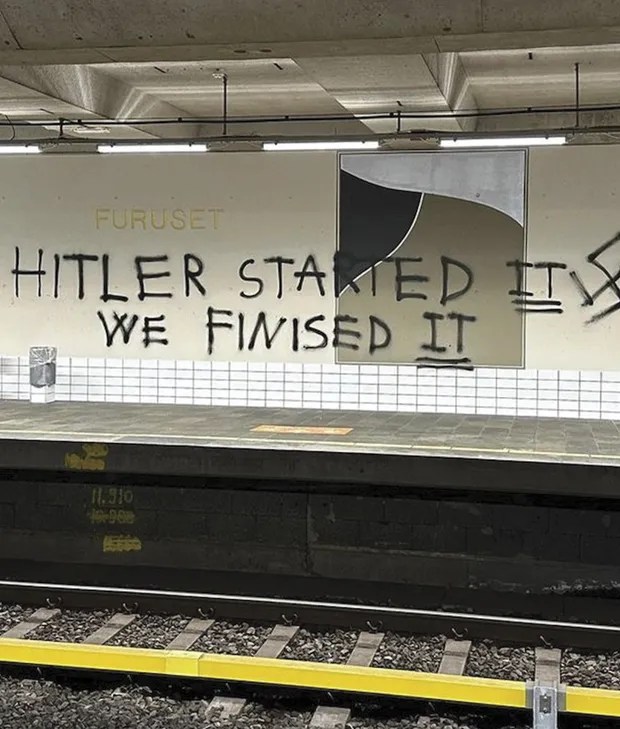
A tube station in Oslo

Did you encounter that attitude before October 7, or is it completely new?

"Even if it's worse now, it's not new. My children have had to account for everything Israel has done since they were in first grade." She adds that one of her children was forbidden by a teacher in her school to talk about a family vacation in Israel, so as to avoid "offending other children," and in other instances, teachers told her children that it's alright to be Jewish, but not to talk about Israel.

Others in the Jewish community put forward similar accounts. Rami, for example, has lived in Norway since 2007. Russian-born, he immigrated to Israel in the 1990s and then moved to Norway in the wake of his wife. The couple's daughter and two sons were born in Norway; the family lives not far from Oslo. "Until not long ago, we didn't hide the fact that we are Jews," he says, "but lately we feel the antisemitism, via our children."

The children don't speak Hebrew, he notes, and have never lived in Israel. Nevertheless, his 5-year-old daughter said that children from her kindergarten asked her why she was murdering Palestinian children. "My 13-year-old son is suffering even more," Rami adds. "Children say he's a Jew and harass him. Some of them called out 'Heil Hitler' at him."

אוסלו אוקטובר 2023 צלב קרס
A swastika replaces the Star of David on a corrupted Israeli flag flying in Oslo. Credit: Ronen Bahar

History plays an important role here. The Jews, who are today have the status of an official minority in Norway, began to arrive only in the mid-19th century. Until then, Jews were forbidden by law from stepping foot in the country. Immigration, mostly from Eastern Europe, led to the establishment of Jewish communities in Oslo and Trondheim. They suffered a great deal in World War II, when the country was ruled by the fascist Quisling regime, which collaborated with the Nazis. A third of Norway's 2,100 Jews were murdered. They included more than 500 members of the community who were seized by police officers, soldiers and Norwegian volunteers and expelled via ship, then transported by train to Auschwitz. Others perished in camps in Norway and Germany. The survivors were those who fled to Sweden and Britain.

One of the most painful aspects of the situation for the Jewish community is the feeling they have that even the persecution they endured eight decades ago is now being turned against them. Prof. Torkel Brekke, a historian from MF University of Theology, Religion and Society, in Oslo, recalls last year's memorial ceremony for Kristallnacht, held in the capital.

"Norway's Jews felt that the event had been hijacked from them," he relates. "A Norwegian anti-racism organization turned the event into a pro-Palestinian one." Instead of dealing with Nazism, the Holocaust and antisemitism, the event focused on a discussion of the Middle East and political radicalization. The organization of the event was coopted by left-wing groups who were part of the anti-Israeli wave of protests – Israeli flags and Jewish symbols were banned from the ceremony. The Jewish community therefore decided not to participate in the event and held one event of its own, in a synagogue

There's also anger among community members with the Norwegian Center for Holocaust and Minority Studies. Established at the state's initiative with funds belonging to Jews who were murdered in the Holocaust, the center's mission is to map and battle antisemitism in the country. However, in a letter sent recently to the institution, Norwegian Holocaust survivors and their descendants accused it of failing in its duty, maintaining that instead of fighting antisemitism it was positioning itself as a "critic of Israel's policies and military tactics." Moreover, the center is manifesting "bias in its choice of experts, supporting a narrative that is negative toward Israel as a Jewish state."

To which the center's director, Prof. Jan Heiret, stated in response to a query from Haaretz, "Since October 7, we have observed a disturbing increase in antisemitic attitudes and incidents in Norway. This deeply concerns us. The center works daily to fulfill our mandate, which is to conduct research and disseminate knowledge about the Holocaust, antisemitism, genocide and related human-rights violations, as well as the conditions of minorities in Norway."

"We were promised certain things as Jews and as citizens of Norway who have a specific history," says Leif Knutsen, a Jewish-Norwegian activist and professional media monitor. "All of this collapsed within hours on October 7." Knutsen talks about the disparity between the expectations from Norwegian society – with its democratic and liberal values – and the situation as it is being experienced by the country's Jews in practice.

There were in fact portents, he notes, including threats, disturbances and antisemitic remarks in periods of earlier Israeli military operations in the Gaza Strip and Lebanon. "Despite these events, there was still a sense of safety," Knutsen points out. "But on October 7 we realized that the social contract we had as a minority in Norway would not be honored. This is a harsh reality because we are barely holding on as it is. The community's institutions are run by volunteers, it's hard to fill all the roles, the pressure is immense, and the task of maintaining all the institutions is really hard," even in normal times.

There are indications of a community in trauma, Knutsen believes, as Jews cope with extremely hostile media, intolerable remarks, provocations and harassment. "After October 7," he continues, "I conducted a survey among Norwegian Jews and received responses from about 150 people. Half the respondents said they were considering leaving the country, and more than 90 percent said the Norwegian authorities don't understand what antisemitism is. "If the Jewish community disappears from Norway, it would be a tragedy," says Knutsen. "It would be just one sad episode among many in Jewish history, but it would be a catastrophe for Norway. This is why I am mostly concerned – not necessarily as a Jew, but as a Norwegian patriot," he concludes.

Prof. Brekke concurs. "Something broke on October 7. Norwegian Jews today feel vulnerable and betrayed by society. They are constantly told what they should think about the [Palestinian] conflict. If they do not condemn Israel, they are told they are 'Jews in the wrong way.' There are public figures and politicians who support Hamas, and far-right extremists and neo-Nazis who supported the October 7 massacre. It's not surprising, then, that the country's Jews are questioning their place in Norwegian society."

The sources of Norwegian hostility toward Israel go back to the late 1960s and early 1970s, Brekke explains. "After World War II and Israel's establishment, Norway's clear stance was opposition to antisemitism and support for the young Jewish state," he says. "However, pro-Palestinian attitudes began to gain momentum after the Six-Day War, and pro-Palestinian leftist movements, including Marxist and Maoist groups, tried to push the more moderate social-democratic left in that direction. Although similar trends occurred in other countries, there are unique elements in Norway that led to the entire Norwegian left adopting this stance.

"From the late 1970s, for 20 years, Norway sent over 20,000 soldiers to serve in UNIFIL (United Nations peacekeeping forces), in Lebanon. As a result, that generation had a feeling that Norway possessed special knowledge of the region. I see this as Norwegian arrogance. You can also add Norway's involvement in the Oslo Accords. When the accords collapsed, the anti-Zionist movement simply spiraled out of control."

Torkel Brekke, Photo: CF – Wesenberg/Kolonihaven.no

The most distinctive factor in Norway, says Brekke, is the impact of trade unions on the shaping of the country's foreign policy. "More than one million Norwegians, about a fifth of the population, are members of unions. In recent decades, these unions have cultivated a grassroots culture that is strongly anti-Israel and anti-Zionist. This movement is deeply tied to the [ruling] Norwegian Labor Party, both organizationally and ideologically, which gives the unions considerable influence over Norway's foreign policy." This anti-Zionism, Brekke argues, has turned into a type of antisemitism.

According to Dr. Cathrine Thorleifsson, from the social anthropology department of the University of Oslo, a genuine problem exists in Norway when it comes to understanding the new antisemitism, which is Israel-related. Norway's Jews, explains Thorleifsson – who has lived in Israel and speaks Hebrew – are in a vulnerable position and encounter antisemitism in various milieus: conventional media, social media and the public space. In the course of her research into the life of Norway's Jews in the 21st century, Thorleifsson has uncovered much prejudicial thinking about the community and about Israel. In one survey she conducted, half the respondents expressed the belief that Israel's attitude toward treatment of the Palestinians is no better than the way the Jews were treated in the Holocaust.

In Thorleifsson's view, the country's political discourse plays a crucial role in this regard. "Norway is a small country," she observes, "and its political discourse is still evolving. There is conformity, a lack of diverse voices expressing different experiences, and insufficient democratic tools to protect minorities." Norwegian politics espouses "a very pro-Palestinian attitude," she adds. "In certain activist circles, Hamas' attack is considered legitimate resistance, and the word 'terrorism' is not used where it should be. Norwegian conformity hides the antisemitism linked to Israel, as well as the misinformation and political violence that fuel it."
Cathrine Thorleifsson, Photo: University of Oslo

Israeli-born Ilan Sharoni, who lives in Stavanger, a city in the country's southwest, has been in the country since 1988. "I live here, my children and grandchildren live here, and I am very worried," he says. The chief culprit is the media, he avers. "Day after day on television, for decades now. Whoever doesn't condemn Israel is condemned as a supporter of genocide. Everything just blew up after October 7. The anti-Israeli approach, which was always part of domestic politics, has now become fatal."

To which Yaniv, a resident of Oslo who works and teaches in the field of art, adds, "When I speak to people who discover that I am from Israel, they stop talking or even choke. Afterward, they sometimes return to apologize." Yet, he says he has heard on more than one occasion the view that Israel is a criminal country that should not exist.

Ahead of the events marking the first anniversary of October 7, security around Jewish institutions in the country was beefed up by authorities. Pro-Palestinian demonstrations were held opposite the community memorial assemblies in Oslo and Bergen. In Oslo, models of Hamas' Qassam rockets, painted green, white and red, were raised. In a demonstration held in Bergen under the slogan "A Year since the Al-Aqsa Flood" (as Hamas called the attack on Israel), demonstrators burned Israeli flags. The police asked participants in rallies of support for Israel not to go home in groups because it would be "difficult to protect them."

Many in the Jewish community understand where the criticism of Israel is coming from. But even so, on March 8 this year, International Women's Day, a group of Jews, women and men, hoped they would be able to demonstrate in solidarity with women around the world in a large event that was set to take place in Oslo.

Yael Nilsen, the longtime Norway resident who has taken part in the international effort for the return of the Gaza hostages, contacted the organizers and asked to join the event. Together with her friends, she requested that the acts of rape that were perpetrated on October 7 and the condition of the abducted Israelis be brought to public awareness.

הפגנות בעד ונגד ישראל נורבגיה
International Women's Day event in Oslo during which Jewish activists were met with hostility.Credit: Pål Holden

"Those issues are barely discussed in the Norwegian media," says Nilsen. "We thought that by joining the large-scale event of International Women's Day, we would be able to introduce the subject of the sexual violence and the awful condition of the abducted Israelis into the Norwegian discourse."

Initially, it didn't look like there would be a problem. One of the slogans that had been decided on for the demonstration dealt with the weaponizing of rape, so there was compatibility between the content of the demonstration and the goals of Nilsen's group. "And the fact is that when I contacted the organizers, they said that the program was already set, but that we would be able to join the group that would march under the slogan 'Fighting rape as a weapon.' To be certain, I made sure that the organizers knew that we would be carrying photographs of the abducted women, and I also asked them to confirm that the security arrangements would ensure that we would be safe with our Jewish symbols. Everything looked to be in order."

The group consisted of 40 to 50 people, most of them local Jews, Israelis and a few supporters. Nilsen made sure that no one would be carrying an Israeli flag and that everyone was clear about the message. "It was important for us to focus on the sexual violence, so we dispensed with Israeli flags. But to identify the women as Israelis, we had a blue-and-white banner with the inscription '#MeToo Unless you're a Jew,' together with graphics of a Star of David made out of women's undergarments and a triangle of blood, which was also used internationally in similar demonstrations."

The group knew they might encounter hostility. "Our symbols often generate hatred and aggression in Norway," Nilsen notes. "There is a large Muslim community here, and during that period there were demonstrations against Israel every day. Some of them crossed the thin line between anti-Israel views and antisemitism. So we were worried, but we got confirmation from the organizers, and because we didn't represent Israel, and the demonstration was supposed to deal with something that all of Norway could agree on – opposition to the use of violence against women as a weapon – we hoped for the best."

The hostile reaction manifested almost immediately. Initially, the group was refused entry to the event and had to prove that they had the organizers' authorization to participate. "One of the organizers went on shouting and cursing, and then took one of our signs and threw it on the ground," Nilsen recalls. "After the police made sure he couldn't get close to us, more and more organizers told us that our message conflicted with the messages of the event.

"They looked at us with hatred and disgust, and started to shout that we were Zionists and fascists. Then the crowd joined in with slogans and rhythmic chanting that we were already used to, like 'Murderers,' 'No to Zionists in our streets' and 'From the river to the sea, Palestine shall be free.'"

They avoided getting into a direct confrontation, Nilsen relates, "and we instructed our group not to scatter and not to respond. But when the atmosphere heated up, some of the other demonstrators – Norwegian men and women of my age – approached the members of the group very closely, and whispered into their ear things like 'child murderer' and skadedyr' ['parasites' in Norwegian]. "I've had anti-Israeli calls shouted at me in the past," Nilsen continues. "But this time it was very different. The hatred came from people I thought we shared basic values with. The feeling was that we were being canceled as human beings. We weren't women and men – we were the embodiment of evil."

Israel and Norway: An Icy Relationship

Norway is seen by many as one of the most hostile European countries toward Israel. But the government in Oslo is veering between demands that it toughen its line against Israel and its actions in Gaza – and the fact that Norway is a major arms exporter

Published in Haaretz: https://www.haaretz.com/world-news/europe/2024-04-11/ty-article-magazine/.premium/israel-and-norway-a-schizophrenic-relationship/0000018e-c7a3-dc93-adce-eff3a37e0000

In recent months, some Israelis have declared Norway the European country most hostile to Israel. This theory is largely based on the policy of Norwegian Foreign Minister Espen Barth Eide, whose term began only a few days after the October 7 Hamas attacks. Barth Eide, a member of the Labour Party, is doing his second stint as foreign minister for the second time, having served in the role in 2012 and 2013. He has also briefly served as defense minister and climate and environment minister.

The list of Israeli grievances against him and his government is long. First came a report that Barth Eide's ministry had prevented King Harald V from sending a condolence letter to Israel after October 7 – because in Norway, the king isn't authorized to make declarations concerning "victims of a political conflict."

This was followed by a condemnation of Israel two weeks later at an international conference in Cairo. Norway's decision not to recognize Hamas as a terror organization also drew anger. In addition, Norway insisted on continuing to transfer money to the United Nations Relief and Works Agency, the UN agency assisting Palestinian refugees, while several other countries halted their support in response to reports that some of its employees had been involved in the October 7 attacks.

Norway not only continued to transfer money but initiated a campaign to defend UNRWA in other countries. Meanwhile, Norway has been active in the lawsuit against Israel in the International Court of Justice over the occupation of the West Bank and East Jerusalem, which is separate from the South African suit accusing Israel of genocide.

Espen Barth Eide on a Stockholm visit, June 2024, photo: David Stavrou

"We are friends of Israel," says the foreign minister, clarifying his position in an interview. "We always have been and we will continue to be. Sometimes good friends need to give good advice, but we are in no way hostile to Israel. We have always tried to help Israel live in peace and security." When asked to explain why Norway is nevertheless seen by many in Israel as hostile, he says that despite the friendship, his country can disagree with the Israeli government.

"We condemned the attack by Hamas on October 7 and we recognize Israel's right to defend itself against terrorism," he says, "but we also said that, like any other country, Israel must obey the laws of war within the international humanitarian laws of the Geneva Convention. Our criticism was that some of the military tactics that Israel used, and the de facto partial blockade on the Gaza Strip that prevented food, electricity, and necessary means of life from the Gaza population, were very problematic. This is not hostility towards Israel; it's criticism towards certain elements of the government's policy."

Among the issues Barth Eide mentions are statements by Israeli cabinet ministers who "gave the impression, which is probably wrong, that Israel wants to expel the Palestinians from Gaza. There have been such statements in Israel and they are very problematic when they come from government ministers."

Although several countries stopped transferring funds to UNRWA, Norway continued to transfer funds and demanded that other countries do so too. Do you not believe the Israeli authorities who reported that UNRWA employees were involved in the October 7 attack, or do you think this is not a sufficient reason to stop funding the organization?

"Our decision is not based on a lack of trust in the Israeli claim. Although we haven't seen evidence, that's not the point, because it may indeed be true. It may be that amongst 13,000 employed in Gaza, there were some who were involved with Hamas and even in the terrorist attack. This is terrible, unacceptable and it requires an investigation, we said this to the UN Secretary-General Guterres and to [UNRWA Commissioner-General Philippe] Lazzarini.

"But we did not agree that if this is true, all funding should be cut," he says. "This is not how to react to transgressions or crimes inside organizations. You don't close the organization, you look for the criminals. If someone in the Oslo police force is arrested on suspicion of murder, I will not shut down the police but arrest the suspect. We are happy to see that there are now countries that have changed their position on this – Australia, Denmark, Sweden, and Canada, for example, as well as the European Commission. It's not that we don't believe Israel, but we don't think that all Palestinians should be punished because of it."

Regarding UNRWA as a whole, Barth Eide does not accept claims that the organization is problematic and that aid for Palestinians should flow through other organizations instead. "A vast majority of the other international organizations operating in the region say that it's not possible to replace UNRWA in the short term," he says, "because they are the backbone for all humanitarian activities in Gaza, so all organizations are coordinating with them."

In November you declared, "We were clear in stating that Hamas should be seen as a terror organization." Is this, as opposed to the past, now Norway's official policy, including when it comes to enforcing the law, economic sanctions, etc.?

"The terrorist attack on October 7 was clearly a terrorist attack and it was carried out by Hamas, so in this context they carried out a very grave terrorist act. However, we have a standing position that maintains some kind of contact with all the relevant groups. This does not mean that we accept their goals or their policies, but we think that if we are trying to contribute to a cease-fire between the Israeli army and Hamas, someone has to talk to Hamas. This is not an endorsement of Hamas, but only an acknowledgment that they exist.

"The way to weaken Hamas is to develop an alternative path to a Palestinian statehood. People who contributed to the division of Palestinian society served Hamas and those who did not want progress. We do not want a Palestine under the control of Hamas, but a Palestine who recognizes Israel under the control of other Palestinians who recognize Israel and its right to life and security."

So are you in contact with Hamas?

"Yes, we are in contact with Hamas, as we are in contact with Hezbollah, with the Houthis, and everybody else in the neighborhood. And that is why we didn't impose the same sanctions that other countries imposed –but this should not be understood as endorsement of their goals and policies." Barth Eide adds, without specifying exactly to whom he is referring, that "There are people in the world who criticize us for this in public, but are actually happy that this is the case, because someone has to maintain these contacts".

What is your current position regarding the South African lawsuit in The Hague and its results?

"I commended the fact that Israel decided to respond to the lawsuit. We did not respond to the initiative itself, but given that the lawsuit exists, it's good that Israel responded, it's good that it recognizes the authority of the court and it's clearly its right to defend itself against the accusations. The court did not conclude that there is a genocide here, but that there are sufficient elements that may constitute a violation of the Convention on the Prevention of Genocide, and Israel should respond and inform the court what steps it is taking to comply with the limitations applicable to a country at war. It isn't illegal to go to war in self-defense, but there are laws on how to do it.

"There is of course another ICJ case dealing with the Israeli occupation. Unlike the genocide case, in the occupation case, we have actually intervened." Indeed, Norway was one of 50 countries that testified before the court on the matter in late February. "Norway clearly distances itself from Israeli settlers' displacement of and violence against Palestinians on occupied land," Barth Eide says. "The settlements are illegal according to international law… the injustice the Palestinians are being subjected to must stop."

Retail policy

Norway's policy toward Israel also has an economic aspect. Its Foreign Ministry recently issued a warning to Norwegian companies "not to engage in business cooperation or trade that serves to perpetuate the illegal Israeli settlements." Regarding this topic, Barth Eide was quoted in the statement as saying "Norway has long maintained that Israel's settlement policy in the West Bank, including East Jerusalem, is in violation of international law, including international humanitarian law and human rights, and undermines the prospects of achieving a future Palestinian state and a peaceful resolution of the conflict."

The statement said the recommendation to Norwegian companies was issued against the backdrop of swelling settlement expansion, as well as "increased settlement violence against the Palestinians."

The minister said in the statement that the "Norwegian business community has sought advisory guidelines from the Norwegian authorities. This recommendation makes it clear that Norwegian companies should be alert to the fact that engaging in any economic or financial activity in the illegal Israeli settlements could put them at risk of contributing to violations of international humanitarian law and human rights."

This policy has already had practical consequences. "A week ago, Norway's foreign minister sent an 'information letter' to the Norwegian Confederation of Business and made it clear that doing anything that would benefit organizations that contribute to the illegal occupation in Israel is not in keeping with Norwegian policy," says Leif Knutsen, the media coordinator for Norway's Jewish community. "He also sent this letter to Vinmonopolet, Norway's government-owned alcoholic beverage retailer monopoly. Vinmonopolet then immediately called for an emergency board meeting, which decided to take all wines from the West Bank and the Golan Heights off the shelves."

Knutsen says that this step may be illegal in the context of European Union or World Trade Organization rules, especially in the case of the Golan Heights. "It's a policy change that Barth Eide dictated from his own desk, not via the cabinet or the parliament, as foreign policy conducted via retail," says Knutsen. "One of the results of this is that in practice, Jews in Norway who want wine [that] is kosher for Pesach will find it hard to get hold of it."

Barth Eide clarifies that "Vinmonopolet can import other Israeli wines if it chooses to," and adds: "We have economic relations with Israel and we want to continue to maintain them. But we have been arguing for years that our economic relations with Israel should be with the Israel within the 1967 borders. This is not new. Now, we are strengthening our advice to Norwegian businesses – feel free to buy and sell in Israel, but not in what fuels the occupation, which I think everyone, except the Israeli government, recognizes is illegal.

"This is not a very radical policy," he says. "But [it exists] to be consistent with our own policy of not financially contributing to human rights violations and violations of international law. We do not go into the specifics, we give general advice. So it was the board of Vinmonopolet who made this decision."

In spite of all that, it seems that the Norwegian economy isn't paying a particularly high price for the government's moral stance. Trade relations with Israel haven't slowed dramatically, and the calls for a boycott of Israel are more symbolic than concrete.

According to Mette Johanne Follestad, president of the Norwegian-Israeli Chamber of Commerce, "For decades, Norway's main export to Israel [has been] fish. More than 80 percent of all imported salmon to Israel is from Norway. To a much smaller extent, Norway also exports metals and paper. Israel's main export to Norway is agricultural products – i.e., fruits and vegetables. Israel also exports to Norway technological products such as computer items. Those two sectors cover most of the Israeli imports to Norway."

She adds that despite political tensions, Norwegian fish exports to Israel have continued to grow in recent years. Exports from other industries have not increased for some time, however. "The political climate in Norway regarding Israel is not helpful for the promotion of business and especially for initiating new lines of trade. It seems that the anti-Israel sentiment has created a reluctance to develop new business relations with Israel.

"Even so, some trade continues to grow. In 2022-2023, Israeli imports to Norway increased from 1.649 billion kroner (570 million shekels) to 1.801 billion, reaching record figures in both years. Norwegian exports to Israel were also at a record level in 2022 at 2.644 billion krone. Unfortunately, Norwegian exports to Israel decreased to 2.313 billion kroner in 2023."

In addition to the recommendation of the Norwegian government to boycott Israeli products from the West Bank, Follestad also notes that universities in Norway are calling for an academic boycott against Israel, although the Norwegian government is against it. Knutsen adds that Norway has seen many calls for various types of boycotts against Israel. In Norwegian academia, for example, some universities have severed ties with academic institutions from Israel. One example is Oslo Metropolitan University, commonly known as OsloMet, which decided not to continue a student exchange program with the University of Haifa. "This is a case where the institution's board of directors made the decision," says Knutsen. "They claim that it's not a boycott but a decision not to continue a program, but this is a game of semantics."

Knutsen sees the decision as a clear violation of fundamental academic freedom that was meant to appease activists wishing to silence anyone disagreeing with them. According to reports, OsloMet is not alone, with the University of South-East Norway deciding to end its academic and research collaborations with the Hadassah College of Technology in Jerusalem over the war in Gaza.

The boycotting isn't limited to academia. Knutsen says there has been a flood of calls for boycotts of Israeli products in recent months. Some trade unions and local municipalities, including Oslo, have called for boycotts or announced them. "They're very careful to say that they're not boycotting Israel, they're only boycotting organizations and cooperation that contribute to the settlements, particularly in the West Bank," she says. "However, it's not always clear what exactly that means and what it is that they're not buying. It seems like virtue signaling for a domestic audience."

When it comes to big money, however, Norway is in no rush to cut off every investment that could somehow be connected to the occupation and the settlements. On this subject, it's interesting to consider Norway's Oil Fund, which invests the surplus revenue from the country's oil sector in what has become the largest sovereign wealth fund in the world. The fund, which holds about $1.5 trillion, has previously withdrawn investments in Israeli companies. However, according to various reports, it still has investments in some 70 Israeli companies totaling billions of dollars. Now it's examining whether to withdraw investments from companies connected to the occupation and settlements, mainly entities like Israeli banks and financial institutions.

"This is discussed widely here," says Barth Eide. "Our recommendations are also relevant to investments in the Oil Fund. The ethical committee of the fund is looking into the matter. It's complicated, because, for example, when there is ownership in a bank, the bank may have activities both in Israel and in the occupied territories, so it's complicated, it's a question of to what grade, and the government doesn't go into the details of every portfolio. The fund has a board of directors and it also has a wider management and an ethics committee. They are the ones who decide."

Sell and forget

In spite of the many steps aimed at pressuring Israel, there are voices in Norway arguing that the government isn't doing enough to oppose Israel and support the Palestinians. Pro-Palestinian organizations say the Norwegian arms industry, a large part of which is government-owned, has found ways of bypassing the prohibition against selling weapons to countries at war. Could Norway be trying to enjoy the best of both worlds, portraying itself as the enthusiastic defender of the Palestinians while avoiding missing out on the profits made from its relationship with Israel?

"There is a clear definition of what a Norwegian weapon is," says Barth Eide. "It's a weapon that is manufactured in Norway or at least the main component is manufactured in Norway. This is an international definition. In this sense, it's forbidden to export Norwegian weapons to countries that are at war like Israel and we have no reason to believe that there has been violation of this." However, the foreign minister clarifies that since Norway has a large arms industry, Norwegian companies also own companies abroad –and here, the government's control is more limited. The same is true of other countries.

"Besides, there are also joint projects in which we produce parts for weapons made by other countries," says Barth Eide. "For example, we manufacture some minor parts for F-35 aircraft. Norwegian laws do not apply here because it would simply create a situation where international defense cooperation would be impossible." Barth Eide says Norway doesn't sell weapons to Israel and that he has called on other countries to follow its example to ensure there is no indirect complicity in what potentially may constitute genocide.

However, some say that Norwegian companies, including at least one that is half-owned by the government, are bypassing this government policy. The online daily magazine Verdens Gang reported in November that Norwegian-produced components may be used in missiles that Israel is firing in Gaza. The publication reported that since Norway allows the exportation of weapons components to NATO countries like the U.S., the parts could be used to assemble weapons exported to Israel according to American regulations.

That's how, according to the newspaper, Chemring Nobel is one of the manufacturers of rocket fuel for Hellfire missiles, which the U.S. supplies to Israel for use in the war in Gaza. Reports that this company produces rocket fuel and explosives for missiles used by the Israel Defense Forces aren't new and have appeared in various Norwegian media outlets in the past.

In response to the Verdens Gang report, Chemring Nobel's CEO said he couldn't rule out the possibility that Norwegian components are included in the weapons systems used in Gaza, Ukraine, or other places. This is because several of Norway's allies permit the export of defense products to Israel, in contradiction with Norwegian export policy.

The Nordic Ammunition Company (aka Nammo), another Norwegian company, has also been accused of selling weapons to Israel. Ownership of Nammo is divided between the Norwegian government and a Finnish company named Patria, itself half-owned by a Norwegian company whose largest stockholder is the government. In December, the Norwegian public broadcaster reported that pro-Palestinian activists had blocked the entrance to the company's factory in Raufoss, saying that "Nammo's weapons are helping to kill Palestinians in Gaza." According to the demonstrators, M141 shoulder-fired missiles exported by Nammos' factory in Arizona to Israel are being used in Gaza. The company denied the claims, saying the weapons were sold to the U.S. military up until 10 years ago, which was the extent of its involvement.

In response to a request for comment, a Nammo spokesperson wrote: "We have also seen media reports about U.S.-made Nammo products in Israel. Given that sales of these products took place several years ago and were made to U.S. authorities, we're not in a position to confirm reports of later transfer from the US to Israel, nor are we privy to knowledge about which weapons or materiel the Israeli military uses."

Asked whether there is oversight over the use of the weapons parts the company exports to other countries (such as by means of an End-User Certificate), the spokesperson wrote: "Nammo is subject to export control laws in the countries where we have operations, including Norway, which does not permit exports of Norwegian-produced products to Israel. For export license requests to countries where exports from Norway are permitted, end-user documentation or certificates are normally part of the list of required documents."

Chemring Nobel declined to respond to a request for comment.

Mediation and boycott

"Trends in International Arms Transfers, 2023," the latest edition of the annual report by the respected independent watchdog Stockholm International Peace Research Institute provides context regarding Norway's arms industry. The think tank is dedicated to research into conflicts, armaments, arms control, and disarmament. Its publications are considered highly reliable sources on the global arms trade, although the institute acknowledges that complete information on deals in the field is hard to obtain. In the 2023 report, Norway is 19th on its list of the 25 largest exporters of major arms – all the more notable because of the country's small population of 5.5 million. According to the report, imports of major arms by European countries increased by 94 percent – nearly double – in 2014-18 and 2019-23.

More than half of European arms imports in 2019-23, 55 percent, were from the U.S., up from 35 percent in 2014-18. Arms imports to countries in Asia, Oceania, and the Middle East also increased significantly in 2019-23. The top arms importers in this period were India, Saudi Arabia, Qatar, Ukraine, Pakistan, Japan, Egypt, Australia, South Korea, and China. Israel was 15th on the list. Almost 70 percent of its arms imports were from the United States – the world's top arms exporter, whose total arms exports rose 17 percent. Russia's exports, in contrast, fell 53 percent, losing its spot as the second-largest arms exporter to France and dropping to third place. The U.S., France, and Russia were followed by China, Germany, Italy, Britain, Spain, and Israel (in ninth place).

Countries in the Middle East accounted for 30 percent of arms imports in 2019-23. Saudi Arabia, the world's second-largest arms importer, received 8.4 percent of global arms imports during this period. With a global share of 7.6 percent, arms imports by Qatar increased 396 percent during that timeframe. The United States is the region's arms supplier, accounting for 52 percent of Middle East arms imports; following it are France (12 percent), Italy (10 percent,) and Germany (7.1 percent).

Norway shouldn't be on the list at all, since its regulations prohibit arms exports to countries in a state of war. Therefore, the countries leading the list of imports from Norwegian companies in this field are the United States, Ukraine, and Lithuania. After Russia's invasion of Ukraine and given Norway's special interest in helping to repel it, the Norwegian government passed a resolution allowing direct arms sales to Ukraine. Also, Norwegian law allows the provision of military aid to countries at war, as opposed to the sale of weapons for commercial purposes.

"The defense and weapons market in Norway is highly regulated," Nicholas Marsh, a senior researcher at the Oslo Peace Research Institute, says. "The Ministry of Foreign Affairs issues export permits and customs checks the products that cross the border. The trading partners in this area are mainly NATO countries and [other] developed and democratic countries, such as Australia. The main principle according to which export licenses are granted was already formulated in the late 1950s, in the declaration of the Norwegian Parliament according to which it is forbidden to sell weapons or ammunition to areas that are at war, under threat of war, or in civil war. Beyond that, Norway is also subject to the International Arms Trade Control Treaty and EU guidelines." Although Norway is not an EU member, it has accepted the EU's guidelines in this field.

"Norway's defense and weapons industry doesn't have a huge effect on the national economy. Obviously, it's much less important than oil and gas in terms of Norway's gross domestic product. However," Marsh adds, "Norway doesn't produce much. For example, unlike Sweden, we don't have a large high-tech industry, so in terms of production and employment, [the defense] sector is important. There are two major companies, Nammo and Kongsberg, both partly owned by the Norwegian government."

What about Norwegian companies with subsidiaries in other countries? Are they subject to Norwegian law, or to the laws of the countries in which they manufacture the arms?

"When it comes to subsidiaries, things get complicated. Hypothetically, if a Norwegian company buys a company abroad, Norwegian regulations don't apply to it. It only applies to products that leave Norway. However, Norwegian export regulations can be applied if a product that is manufactured in, say, the United States, uses parts that were made in Norway or even uses software or technical plans [that] are Norwegian intellectual property."

When Norway exports arms, is it considered standard to demand an end-user certificate?

"Like other countries, Norway also uses end-user certificates, but more important are the conditions of sale documents. This is how companies define, among other things, who they allow their products to be sold to. It is not only a matter of maintaining human rights, it is also a commercial matter. But in the case of NATO countries, Norway has repeatedly made it clear that it does not request end-user certificates. This is a political statement and it has been repeated over the years.

"Thus, since Norway can sell to France, the United States, and the United Kingdom, for example, and since it does not require an end-user certificate from these countries that export to countries like Saudi Arabia, the situation is that the government can claim that there are no weapons in countries at war that have 'Made in Norway' on them, but It's certainly possible that there are weapons that have Norwegian parts or are produced by subsidiaries of Norwegian companies. It should be remembered that the arms industry is partially owned by the government, which has both an economic and a political interest here, so there is a balance between principled considerations and practical consideration," Marsh says.

"This has characterized Norway for a long time," Marsh adds, summing up what he calls Norway's dualistic nature. "The Nobel Peace Prize is awarded here and there is political emphasis on peace talks, diplomatic efforts, solidarity, and humanitarian activity. But on the other hand, Norway has been a NATO member from the very beginning, and since World War II it has a strong military which is part of a military alliance that opposes Russia. As a small country, its interest is to promote peace, but it has never been a pacifist country."

When Barth Eide is asked about the future of Israel-Norway relations, he says that although there are ups and downs, his country still formally has a central role in the region because it's the chair of the Ad Hoc Liaison Committee, the body that coordinates international economic aid to the Palestinian Authority. Established in 1993, it has 16 members, led by Norway and sponsored by the United States and the European Union.

"After a cease-fire, this will again be the key body for discussing the coordination of donations to build the Palestinian Authority," Barth Eide says. "That is why we worked with the Israeli government to find a solution to the problem of the clearance revenues collected by Israel on behalf of the Palestinian Authority. This shows that we can still work with Israel and with Ramallah to solve problems." This is a reference to the temporary arrangement facilitated by Norway between Israel and the Palestinian Authority, in which Norway serves as an intermediary for the portion of tax and customs revenues that Israel has withheld since October 7.

In a broader context, Barth Eide still holds to the policy he held in the past. "I believe and have believed for many years that the best path to peace is an agreement with the Palestinians," he says, "not with Hamas, of course, but with the Palestinian Authority, with Fatah and the PLO. Israel will be more successful in its attempt to be both a state for Jews and a democratic state if it has a Palestinian state by its side. Everything we do on this issue is intended to end suffering but also to establish a Palestinian state that is run by a legitimate authority after an agreement. This is a goal that is good for both the Israelis and the Palestinians."

Follestad, the president of the Norwegian Israeli Chamber of Commerce, stresses that any boycott, including one only on Israeli products from the West Bank, would be primarily damaging to Norway's position as an honest broker. "Ever since the Oslo Accords were negotiated in our country, Norway has tried to be a mediator and bring the sides closer to peace," she says. "By boycotting Israeli products from the West Bank, which according to the Oslo Accords is still legally under Israeli jurisdiction, the Norwegian government, by not respecting the signed agreements, is itself violating the spirit of the Oslo Accords. Accordingly, Norway's opinion may no longer be respected by Israel, and Norway may become irrelevant as a mediator in the conflict."