She Grew Up in an Exiled Iranian Opposition Group, That Turned Into a Brutal Cult

Atefeh Sebdani was born in Iran to parents active in the MEK but was torn from them and sent for molding to a family in Sweden. In an interview, she describes life in the exiled cult and its rejection of Persian culture.

Published in Haaretz: She Grew Up in an Exiled Iranian Opposition Group, That Turned Into a Brutal Cult – Middle East News

At a protest in Stockholm in April, alongside the Lion and Sun flags representing pre-revolution Iran, Israeli and American flags were also waved. As in similar events around the world, the demonstrators praised the Israeli-American attack on Iran and expressed support for Reza Pahlavi, son of the shah who was deposed in 1979, as Iran's future leader.

The rule of the ayatollahs unites many Iranian exiles against the regime, and threatens political activists operating against it in Europe. However, one of the women who helps the organizers of the Stockholm demonstrations, Atefeh Sebdani, has suffered for most of her life from another Iranian group – an organization that was once part of the Islamic Revolution but later became its enemy.

Mujahedin-e Khalq was founded in 1965 by a group of Iranian students who opposed the shah's rule. The organization combined elements of Shiite Islam with Marxist and anti-imperialist ideas and operated underground during the 1970s. During this period, it attacked regime targets and gained support as an opposition organization.

When the Islamic Revolution emerged in the late 1970s, MEK even joined Khomeini on his path to power. Yet after the establishment of the Islamic Republic, conflict arose between it and the new regime and by the early 1980s, the MEK was attacking government targets. That was countered with brutal repression that included the execution of thousands. The MEK leadership fled into exile in Iraq, where it formed a controversial alliance with Saddam Hussein during the Iran-Iraq War.
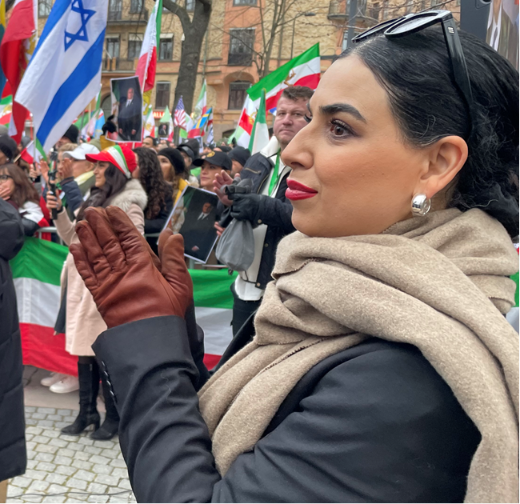
Atefeh Sebdani in Stockholm, 2026. Photo: David Stavrou

Atefeh Sebdani's story begins in the clash between the ayatollahs' regime and the MEK. "My parents were imprisoned after the revolution because of their rivalry with the new regime. They were considered enemies of the state and like other MEK members, after they were released, they were forced to leave," she says.

She was two years old at the time. Sebdani recounts that she, her younger brother, her father and her pregnant mother fled to Pakistan and lived there destitute on the streets. Her father continued from Pakistan onto Iraq, where he joined other MEK members in a camp called Ashraf, which later became the movement's center.

"After some time, we also moved to the camp. By that stage it had become a kind of small town with kindergartens, parks, and schools – mainly for propaganda purposes. They wanted to show how good things were there so others would join," she says. "For me, it was like paradise. I had everything; it was idyllic. I was with my mother and I was happy."

Then, without warning, everything ended at once. She hadn't even turned five yet but her mother told her she would have to take care of her two brothers by herself. She didn't explain why or how, but when the day came, Sebdani found herself standing by a bus with a group of crying women. When the bus departed, five-year-old Sebdani became a mother in practice.

"On the way, I had to take care of one brother who was still a baby and wanted to breastfeed, and another who was very ill," she recalls. She adds that the expulsion of the children from Camp Ashraf was a process. She doesn't know exactly how long it took, but she remembers children disappearing from kindergarten without knowing why or where they were going.

Eventually, all the roughly 900 children in the camp were separated from their parents and transported to other countries.

"The place was emptied of children's voices," she says. "And children's voices are the most human thing there is – the core of life – and that was taken away."

Why were the children expelled?

"The children were an element that disturbed the organization's leader, Massoud Rajavi. The ideological struggle to liberate Iran turned into the struggle of a narcissistic leader who wanted all the power in his hands. He wanted the men and women in the movement to be under his absolute control, and the children stood in his way. The movement began as an ideological movement, but it became a cult."

What Sebdani describes aligns with what is known from other sources about the MEK. During the 1980s and 1990s, the organization became highly centralized, developing political and military branches that operated from bases in Iraq. At the same time, the National Council of Resistance of Iran was established as a political umbrella organization.

'The family I came to was politically obligated to take children. It's not that they loved children or wanted us. We underwent heavy indoctrination and were forced to constantly work for the organization.'

During this period, allegations indeed emerged about cult-like characteristics such as strict internal discipline, ideological control, and exclusion of dissenters.

However, the organization's leader, Rajavi, has not been seen in public since the early 2000s, and his fate remains unclear, as the organization has not disclosed information about his whereabouts nor announced his death. Meanwhile, his wife, Maryam Rajavi, serves as the public face of the organization – contributing to an atmosphere of secrecy and uncertainty regarding its structure and decision-making.

After several months and a long journey that included stops in Jordan and Germany, Sebdani and her two younger brothers arrived in Gothenburg in western Sweden.

"For all that time, I was sure we would soon be reunited with my mother," she recalls. "We sat on planes and trains, I saw things I didn't know, I saw climates and people change, there were new languages and places – but alongside the excitement, I constantly feared we were moving further away from my mother and worried she wouldn't be able to find us."

In Gothenburg, they were told they would soon meet their mother. "I was very excited. But what actually happened was different – we stood on a train platform, and instead of my mother, two other people I didn't know arrived, a woman and a man, and we were told: these are your mother and father. That's when the nightmare began."
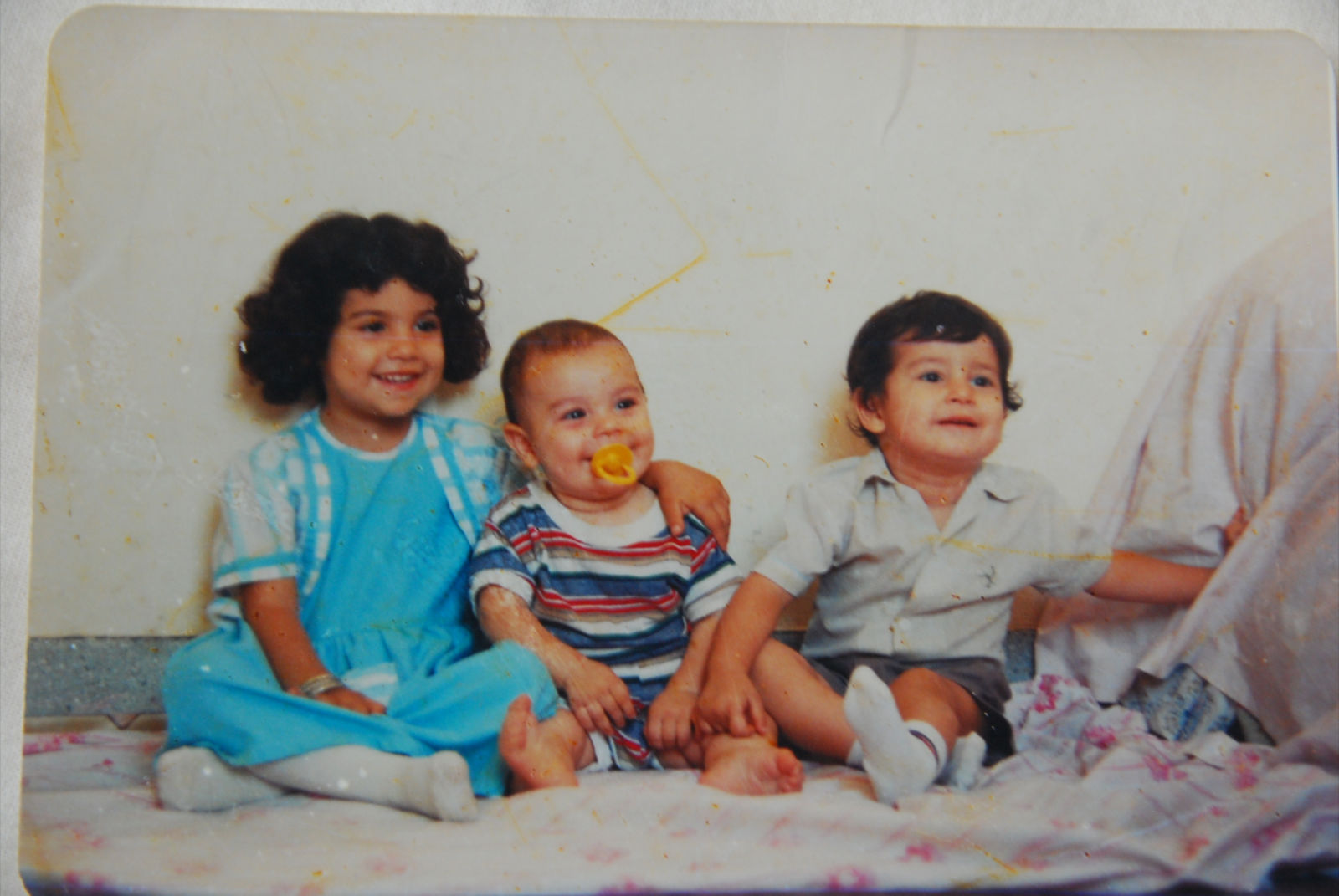
Atefeh and her two brothers

The people who took Sebdani and her brothers were MEK members living in Sweden and working for the movement. They also had a child of their own, and took in two other children out of roughly 200 MEK children who arrived in Sweden. Sebdani says she later traced the fate of hundreds of other children who were "exported" from Camp Ashraf and that she obtained a document listing their destinations – including Germany, the Netherlands, Norway, Canada, and the United States.

"The family I came to was politically obligated to take children," she says. "It's not that they loved children or wanted us. We underwent heavy indoctrination and were forced to constantly work for the organization." She does not reveal the identities of her foster parents, but her childhood memories expose the nature of the organization as it became a cult.

According to her, MEK families abroad were completely mobilized. They engaged in recruiting members and funds, organizing demonstrations, fighting opponents, and harassing defectors. She describes this society as oikophobic (one that is hostile, dislikes and rejects its own "home" culture, country and traditions). "They hated anything Iranian that wasn't related to the MEK. We weren't allowed, for example, to listen to Persian music unless it was the music of MEK members. I didn't read books in Persian. There was no Persian culture—everything was subordinated to the organization."

As far as you know, is this still the case?

"Yes. They still have offices in different countries and a strong presence on social media. The headquarters is in Auvers-sur-Oise, a suburb northwest of Paris, where political leadership members and full-time 'soldiers' are based. At the same time, there are activists like my foster family, and MEK members in Camp Ashraf 3 in Albania. That camp is essentially a 'troll factory' that produces large numbers of accounts and spreads propaganda in Persian and English. They write articles about themselves, smear their opponents, and create the impression of support – even though they have no real support."

Camp Ashraf 3 is the fortified camp to which most MEK members – estimated at 2,500 to 3,000 – were transferred from Iraq between 2013 and 2016. The move was carried out with the support of the United States, the United Nations, and the Albanian government. It took place because after the fall of Saddam Hussein, the MEK was no longer protected in Iraq, and international actors worked to evacuate them. Although the organization had been designated a terrorist organization in the U.S. for many years, it was removed from the list in 2012 as a result of pressure applied by the movement, and some American and other actors even saw it as a partner in opposing the Iranian regime. According to reports, the MEK no longer engages in military activity, but the camp in Albania has become a center of political and media activity with a highly centralized and controlled structure.

"It's a place where entry and exit are not free, and in the past there were physical punishments and torture of those who wanted to leave," says Sebdani. "I know stories of people who disappeared and of mandatory daily confessions about 'dirty thoughts' – for example, sexual thoughts and masturbation. You weren't even allowed to think about your children or speak with members of the opposite sex without permission. Today, with defectors speaking out and social media, the movement can no longer allow itself to use such methods."

Sebdani is not alone in her claims about the MEK. The French newspaper Le Monde conducted interviews in 2024 with former members of the organization living in Europe, including two named Amir Vafa and Amin Golmaryami. Vafa described how he and others were forced to participate in public confession sessions in which, once a week, everyone had to describe their sexual fantasies. He added that friendships were closely monitored: "It was forbidden to have lunch with the same friend twice in a row."

Golmaryami added that during clashes with Iraqi security forces in 2011, MEK leaders sent him and his comrades to go "in front of Iraqi bullets to increase the number of casualties." He claims they did this in order to "put pressure on Europe and the United States to remove the organization from the list of terrorist organizations and facilitate the relocation of its members to another country."

Another MEK member, Reza Torabi, said that at the age of 17 he was a zealous member and was assigned the role of "welcoming" young newcomers. "Our objective was to brainwash them, make them forget their previous lives, and instill in them the ideology of the Mujahedeen," he said. "My dedication was unwavering." In hindsight, he believes that he too fell victim to manipulation and regrets "the harm [he] caused in the course of his duties."

A 2005 report by Human Rights Watch, based on in-depth interviews with former members, also described a reality of beatings, verbal and psychological abuse, coerced confessions, threats of execution, and torture.

How do you believe control of MEK member is maintained today?

"If you look at people like the father, you see someone who joined in his twenties and spent his entire life inside this system. He never paid a bill or looked for a job – everything was handled by the organization. He doesn't know how to buy a plane ticket or even drive to the end of a street. The MEK infantilized these people, and there is no one to take care of them if they leave."

Does that mean there are no new members?

"That's right. There are no new members. It's a movement of older people – but they pay young people to attend demonstrations. If you go to MEK protests, you'll find Poles and Ukrainians who don't speak Persian and don't know what they're protesting about, alongside Swedes with no connection to the organization who were paid to join."

Who pays for all this?

"From what I saw and was part of, many people pay the MEK monthly so they won't harass them – Iranians in exile subjected to pressure, propaganda, flattery, and social coercion. There are also welfare funds, for example for foster families, as well as political donations and funding from human rights organizations influenced by the group's propaganda."

Beyond the political activity, the period that Sebdani stayed with her foster family, had another aspect. She talks about indoctrination and the constant threat that was used to make her stay.

"From the age of five, I experienced sexual abuse, physical abuse and psychological abuse in the foster family," she says, "but I couldn't say anything because they threatened to separate me from my brothers. I was not allowed to be a child. The first thing that happened to me in the foster family was that my father began to show interest in my naked body. He wanted me to do things. I felt it was wrong and frightening, but I knew nothing about sex or sexuality and I didn't understand.

"Over time, it only got worse, and my foster brother abused me too, encouraged by my foster mother. I had no childhood; it was just survival. I was the one who cleaned and tidied, I had to be a good student, and also the one who went out to demonstrations and went to Mujahideen conferences around the world". Talking to Sebdani she describes a reality full of exploitation, punishment, crying at night, and deception of Swedish welfare services.

As an adult, she eventually left, moved to Stockholm, became an engineer, and worked for Microsoft. After a personal crisis, she began telling her story and wrote a book (Min hand i min, "My Hand in Mine", published by Albert Bonniers förlag, 2024). Today she is married and has three children.

Politically, Sebdani is active among supporters of Reza Pahlavi. "I saw the difference between the two leaders," she says. "I met Maryam Rajavi as a child, and recently I met Pahlavi in Paris with a group of other former MEK children. I support the Iranian people, and the people support Pahlavi. He is exactly what Iran needs – a secular, humane person, with a family, who knows what living a normal life is, who listens and can unite people."

After Sebdani's meeting with Reza Pahlavi and other "MEK children" she became the target of an online campaign against her. Sebdani says that this isn't the first time and she has been targeted by a smear campaign led by the MEK on several previous occasions before.
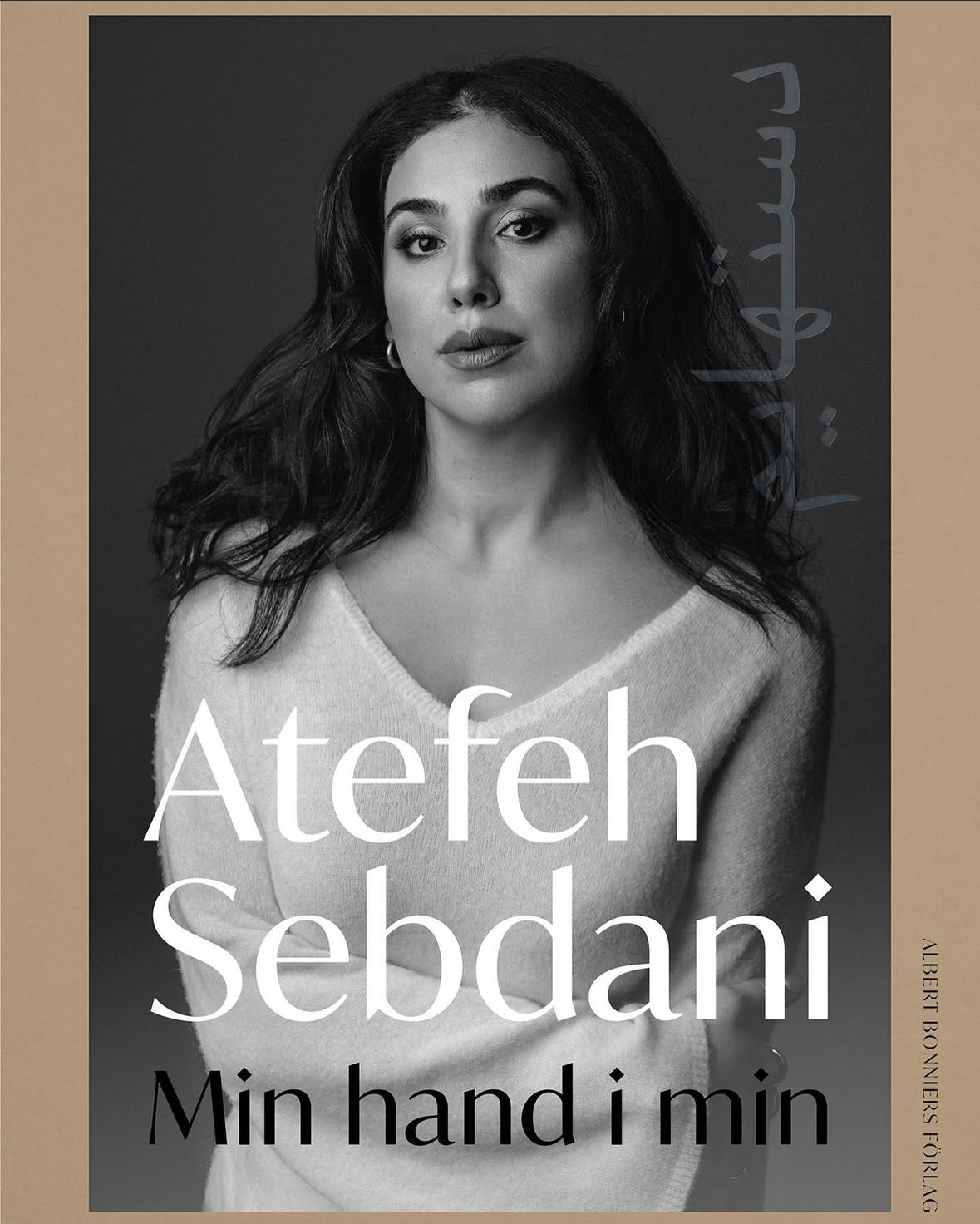
Sebdani's book

"This kind of harassment happens to everyone who has left the organization and spoken out," she says. This time, the MEK website denied Sebdani's account through a letter it claimed was written by her biological father. "For me, as a father, seeing 'Atefeh Sebdani' at a gathering of the Shah's son was painful… Atefeh is the same person who, by spreading defamation against the organization under the false pretext of being part of a group of 'child soldiers,' has for many years become a full servant of Iranian intelligence."

The text claims that Sebdani was never part of the MEK and accuses her and her associates of collaborating with the regime in Tehran. Sebdani does not know whether her father actually wrote the text, but she says that everything in it is false and that she is familiar with other examples of letters that MEK members were forced to write under coercion.

Following the letter, a senior figure in the organization, Freydoun Salimi, also spoke out, accusing Sebdani of never having been a member of the group and of acting as an agent of the regime. In responses to his claims on X, supporters of the organization repeat the accusations and insult Sebdani. On other social media platforms, she is also accused of assisting Israel, betraying Iran, and supporting Americans attacking her country.

Sebdani's personal MEK story has a positive ending – she escaped, her siblings left, and even her mother eventually left the organization. The organization itself, however, is still very much alive. It even claims to still have networks inside Iran, though most analysts believe its influence there is limited. "The MEK is more of a European problem than an Iranian one," Sebdani concludes. "In Iran, they have no real support, not even with regime critics. But after the 'Woman, Life, Freedom' protests, it's clear that a unifying leader is needed, otherwise, there will be no change – and I have no doubt that Pahlavi is the right person."

Why President Trump Could Betray Israel Just Like He Betrayed Greenland

In recent months, Greenland has found itself under a treacherous bullying attack by The United States which decided to break the rules and resort to threats, pressure, and blackmail. President Trump adopted the geopolitical logic of his Russian counterpart and threatened to annex the island regardless of the will of its inhabitants. Will this actually happen and what does it mean for Israel?

Published in "Haaretz": https://www.haaretz.com/opinion/2025-04-01/ty-article-opinion/.premium/what-happened-to-greenland-can-happen-to-israel/00000195-f2b8-d1f1-a7d5-f2fc93630000

STOCKHOLM – It's hard to think of two countries more different from each other than Greenland and Israel. Greenland actually isn't even a country; it's an autonomous area on its way to independence from Denmark. It's also a giant island almost empty of inhabitants, with no intercity roads and no traffic jams. Israel, as we all know, is crowded, hot, small and tense.

These differences could create the illusion that what is happening now to Greenland couldn't happen to Israel. But that isn't so. In recent months, Greenland has come under a thuggish, traitorous attack. The United States, which for decades was its partner and friend, decided to break the rules and threaten, pressure and extort the island.

U.S. President Donald Trump adopted the geopolitical logic of his Russian counterpart and threatened to annex Greenland regardless of its inhabitants' wishes. To prove that it was serious, the administration sent Vice President JD Vance to visit the island in defiance of its government's wishes and at a sensitive political time.

Two weeks ago, Greenland held a general election that ended with the incumbent's ouster. Vance's visit was thus slated to take place while the coalition negotiations to form a new government were being held, and also just days before the local elections. Political sources described this as foreign intervention in the elections. The outgoing prime minister termed the visit "highly aggressive."

The visit took place last Friday. Washington tried to market it as a defense-oriented visit to the U.S. space force base there. Before that, it had been marketed as a cultural tour by Vance's wife, without her husband (she joined her husband on the visit in its new incarnation).

Having the Vances visit the base was a sophisticated move. Ostensibly, it was a de-escalation, because the Americans wouldn't interact with angry residents and would focus on the base. Yet in another sense, it was an escalation, because the visitor was the vice president of the United States – the highest-level American official to ever visit Greenland. But either way, Greenlanders rightly view the visit as an act of extortion.

Contrary to the Trump administration's claims, there is no demand in Greenland for American intervention. "We – all party leaders – cannot accept the repeated statements about annexation and control of Greenland," the leaders of all five of the island's parties said in a joint statement. "We as party leaders find this behavior unacceptable towards friends and allies in a defense alliance."

Denmark's prime minister termed the American move "unacceptable pressure." And throughout the island, demonstrations were held against Trump's threats, with slogans like "Make America Go Away." Two months ago, a poll found that 85 percent of the island's residents oppose becoming part of the United States (and only 6 percent support it). But the Americans haven't been deterred.

The example of Greenland, like the United States' abandonment of Ukraine, shows a worrying side of the Trump administration. The U.S. could always have continued protecting its national security by stationing systems there to defend and control sea lanes. It could also have cooperated with Greenland's government and its residents in finding, mining, and producing valuable minerals.

Instead, Washington chose to signal to the world that there's a new sheriff in town who's willing to ride roughshod over anyone who stands in his way.

Should other countries also be worried by this new America, which abandons its partners, changes its loyalties and fires in every direction? Israelis don't appear to be particularly worried. Their enthusiasm for Trump has only grown, and his intervention to get the hostages released and his lifting of restraints on Israeli military action are obviously reasons for that. But people are also making deeper arguments for this blind faith in the Trump administration.

One argument is that in contrast to Greenland, President Trump feels an emotional connection to Israel. His confidants and his Jewish relatives nurtured a deep connection to the Jewish people in him, so he won't betray Israel like he has betrayed America's partners in Europe, Mexico and Canada.

Another argument is realpolitik. In the new global order, the American global cop is giving way to a multipolar world in which Russia and China also have spheres of influence. Israel can, therefore, count on the Americans even if they are opportunistic thugs because it's part of an American-Saudi-Egyptian-Emirati axis against the Iranian enemy. Consequently, Washington will protect it in any case – if not because of Trump's warm feelings for the Jews, then out of political and economic interests.

But vast blindness and indifference are needed to depend on these arguments. The first one relies on the existence of a stable, normative emotional base of empathy, responsibility and altruistic feelings of belonging in someone who has none of those traits. The second one relies on America having permanent, unchanging interests in a world characterized by changing alliances, dissolving coalitions, and unforeseen dramatic developments.

Even if America gives up on Greenland and moves on to its next adventure, we have to remember that political processes always have more than one side. Even people who have lost their moral spine and become enthusiastic over the idea of population transfer for the Palestinians must remember that if transfer is part of the diplomatic toolbox, it could be applied in any direction. If the U.S. administration can "clear out Gaza," why shouldn't it decide to clear out the Negev?

Similarly, even people who celebrated Washington's green light to flatten the Gaza Strip should remember that a lack of international rules and laws can be used against them in the future as well. And even if American nihilism and opportunism are working to the benefit of a local, temporary Israeli interest, we must keep in mind that we won't be immune forever.

Israel and Norway: An Icy Relationship

Norway is seen by many as one of the most hostile European countries toward Israel. But the government in Oslo is veering between demands that it toughen its line against Israel and its actions in Gaza – and the fact that Norway is a major arms exporter

Published in Haaretz: https://www.haaretz.com/world-news/europe/2024-04-11/ty-article-magazine/.premium/israel-and-norway-a-schizophrenic-relationship/0000018e-c7a3-dc93-adce-eff3a37e0000

In recent months, some Israelis have declared Norway the European country most hostile to Israel. This theory is largely based on the policy of Norwegian Foreign Minister Espen Barth Eide, whose term began only a few days after the October 7 Hamas attacks. Barth Eide, a member of the Labour Party, is doing his second stint as foreign minister for the second time, having served in the role in 2012 and 2013. He has also briefly served as defense minister and climate and environment minister.

The list of Israeli grievances against him and his government is long. First came a report that Barth Eide's ministry had prevented King Harald V from sending a condolence letter to Israel after October 7 – because in Norway, the king isn't authorized to make declarations concerning "victims of a political conflict."

This was followed by a condemnation of Israel two weeks later at an international conference in Cairo. Norway's decision not to recognize Hamas as a terror organization also drew anger. In addition, Norway insisted on continuing to transfer money to the United Nations Relief and Works Agency, the UN agency assisting Palestinian refugees, while several other countries halted their support in response to reports that some of its employees had been involved in the October 7 attacks.

Norway not only continued to transfer money but initiated a campaign to defend UNRWA in other countries. Meanwhile, Norway has been active in the lawsuit against Israel in the International Court of Justice over the occupation of the West Bank and East Jerusalem, which is separate from the South African suit accusing Israel of genocide.

Espen Barth Eide on a Stockholm visit, June 2024, photo: David Stavrou

"We are friends of Israel," says the foreign minister, clarifying his position in an interview. "We always have been and we will continue to be. Sometimes good friends need to give good advice, but we are in no way hostile to Israel. We have always tried to help Israel live in peace and security." When asked to explain why Norway is nevertheless seen by many in Israel as hostile, he says that despite the friendship, his country can disagree with the Israeli government.

"We condemned the attack by Hamas on October 7 and we recognize Israel's right to defend itself against terrorism," he says, "but we also said that, like any other country, Israel must obey the laws of war within the international humanitarian laws of the Geneva Convention. Our criticism was that some of the military tactics that Israel used, and the de facto partial blockade on the Gaza Strip that prevented food, electricity, and necessary means of life from the Gaza population, were very problematic. This is not hostility towards Israel; it's criticism towards certain elements of the government's policy."

Among the issues Barth Eide mentions are statements by Israeli cabinet ministers who "gave the impression, which is probably wrong, that Israel wants to expel the Palestinians from Gaza. There have been such statements in Israel and they are very problematic when they come from government ministers."

Although several countries stopped transferring funds to UNRWA, Norway continued to transfer funds and demanded that other countries do so too. Do you not believe the Israeli authorities who reported that UNRWA employees were involved in the October 7 attack, or do you think this is not a sufficient reason to stop funding the organization?

"Our decision is not based on a lack of trust in the Israeli claim. Although we haven't seen evidence, that's not the point, because it may indeed be true. It may be that amongst 13,000 employed in Gaza, there were some who were involved with Hamas and even in the terrorist attack. This is terrible, unacceptable and it requires an investigation, we said this to the UN Secretary-General Guterres and to [UNRWA Commissioner-General Philippe] Lazzarini.

"But we did not agree that if this is true, all funding should be cut," he says. "This is not how to react to transgressions or crimes inside organizations. You don't close the organization, you look for the criminals. If someone in the Oslo police force is arrested on suspicion of murder, I will not shut down the police but arrest the suspect. We are happy to see that there are now countries that have changed their position on this – Australia, Denmark, Sweden, and Canada, for example, as well as the European Commission. It's not that we don't believe Israel, but we don't think that all Palestinians should be punished because of it."

Regarding UNRWA as a whole, Barth Eide does not accept claims that the organization is problematic and that aid for Palestinians should flow through other organizations instead. "A vast majority of the other international organizations operating in the region say that it's not possible to replace UNRWA in the short term," he says, "because they are the backbone for all humanitarian activities in Gaza, so all organizations are coordinating with them."

In November you declared, "We were clear in stating that Hamas should be seen as a terror organization." Is this, as opposed to the past, now Norway's official policy, including when it comes to enforcing the law, economic sanctions, etc.?

"The terrorist attack on October 7 was clearly a terrorist attack and it was carried out by Hamas, so in this context they carried out a very grave terrorist act. However, we have a standing position that maintains some kind of contact with all the relevant groups. This does not mean that we accept their goals or their policies, but we think that if we are trying to contribute to a cease-fire between the Israeli army and Hamas, someone has to talk to Hamas. This is not an endorsement of Hamas, but only an acknowledgment that they exist.

"The way to weaken Hamas is to develop an alternative path to a Palestinian statehood. People who contributed to the division of Palestinian society served Hamas and those who did not want progress. We do not want a Palestine under the control of Hamas, but a Palestine who recognizes Israel under the control of other Palestinians who recognize Israel and its right to life and security."

So are you in contact with Hamas?

"Yes, we are in contact with Hamas, as we are in contact with Hezbollah, with the Houthis, and everybody else in the neighborhood. And that is why we didn't impose the same sanctions that other countries imposed –but this should not be understood as endorsement of their goals and policies." Barth Eide adds, without specifying exactly to whom he is referring, that "There are people in the world who criticize us for this in public, but are actually happy that this is the case, because someone has to maintain these contacts".

What is your current position regarding the South African lawsuit in The Hague and its results?

"I commended the fact that Israel decided to respond to the lawsuit. We did not respond to the initiative itself, but given that the lawsuit exists, it's good that Israel responded, it's good that it recognizes the authority of the court and it's clearly its right to defend itself against the accusations. The court did not conclude that there is a genocide here, but that there are sufficient elements that may constitute a violation of the Convention on the Prevention of Genocide, and Israel should respond and inform the court what steps it is taking to comply with the limitations applicable to a country at war. It isn't illegal to go to war in self-defense, but there are laws on how to do it.

"There is of course another ICJ case dealing with the Israeli occupation. Unlike the genocide case, in the occupation case, we have actually intervened." Indeed, Norway was one of 50 countries that testified before the court on the matter in late February. "Norway clearly distances itself from Israeli settlers' displacement of and violence against Palestinians on occupied land," Barth Eide says. "The settlements are illegal according to international law… the injustice the Palestinians are being subjected to must stop."

Retail policy

Norway's policy toward Israel also has an economic aspect. Its Foreign Ministry recently issued a warning to Norwegian companies "not to engage in business cooperation or trade that serves to perpetuate the illegal Israeli settlements." Regarding this topic, Barth Eide was quoted in the statement as saying "Norway has long maintained that Israel's settlement policy in the West Bank, including East Jerusalem, is in violation of international law, including international humanitarian law and human rights, and undermines the prospects of achieving a future Palestinian state and a peaceful resolution of the conflict."

The statement said the recommendation to Norwegian companies was issued against the backdrop of swelling settlement expansion, as well as "increased settlement violence against the Palestinians."

The minister said in the statement that the "Norwegian business community has sought advisory guidelines from the Norwegian authorities. This recommendation makes it clear that Norwegian companies should be alert to the fact that engaging in any economic or financial activity in the illegal Israeli settlements could put them at risk of contributing to violations of international humanitarian law and human rights."

This policy has already had practical consequences. "A week ago, Norway's foreign minister sent an 'information letter' to the Norwegian Confederation of Business and made it clear that doing anything that would benefit organizations that contribute to the illegal occupation in Israel is not in keeping with Norwegian policy," says Leif Knutsen, the media coordinator for Norway's Jewish community. "He also sent this letter to Vinmonopolet, Norway's government-owned alcoholic beverage retailer monopoly. Vinmonopolet then immediately called for an emergency board meeting, which decided to take all wines from the West Bank and the Golan Heights off the shelves."

Knutsen says that this step may be illegal in the context of European Union or World Trade Organization rules, especially in the case of the Golan Heights. "It's a policy change that Barth Eide dictated from his own desk, not via the cabinet or the parliament, as foreign policy conducted via retail," says Knutsen. "One of the results of this is that in practice, Jews in Norway who want wine [that] is kosher for Pesach will find it hard to get hold of it."

Barth Eide clarifies that "Vinmonopolet can import other Israeli wines if it chooses to," and adds: "We have economic relations with Israel and we want to continue to maintain them. But we have been arguing for years that our economic relations with Israel should be with the Israel within the 1967 borders. This is not new. Now, we are strengthening our advice to Norwegian businesses – feel free to buy and sell in Israel, but not in what fuels the occupation, which I think everyone, except the Israeli government, recognizes is illegal.

"This is not a very radical policy," he says. "But [it exists] to be consistent with our own policy of not financially contributing to human rights violations and violations of international law. We do not go into the specifics, we give general advice. So it was the board of Vinmonopolet who made this decision."

In spite of all that, it seems that the Norwegian economy isn't paying a particularly high price for the government's moral stance. Trade relations with Israel haven't slowed dramatically, and the calls for a boycott of Israel are more symbolic than concrete.

According to Mette Johanne Follestad, president of the Norwegian-Israeli Chamber of Commerce, "For decades, Norway's main export to Israel [has been] fish. More than 80 percent of all imported salmon to Israel is from Norway. To a much smaller extent, Norway also exports metals and paper. Israel's main export to Norway is agricultural products – i.e., fruits and vegetables. Israel also exports to Norway technological products such as computer items. Those two sectors cover most of the Israeli imports to Norway."

She adds that despite political tensions, Norwegian fish exports to Israel have continued to grow in recent years. Exports from other industries have not increased for some time, however. "The political climate in Norway regarding Israel is not helpful for the promotion of business and especially for initiating new lines of trade. It seems that the anti-Israel sentiment has created a reluctance to develop new business relations with Israel.

"Even so, some trade continues to grow. In 2022-2023, Israeli imports to Norway increased from 1.649 billion kroner (570 million shekels) to 1.801 billion, reaching record figures in both years. Norwegian exports to Israel were also at a record level in 2022 at 2.644 billion krone. Unfortunately, Norwegian exports to Israel decreased to 2.313 billion kroner in 2023."

In addition to the recommendation of the Norwegian government to boycott Israeli products from the West Bank, Follestad also notes that universities in Norway are calling for an academic boycott against Israel, although the Norwegian government is against it. Knutsen adds that Norway has seen many calls for various types of boycotts against Israel. In Norwegian academia, for example, some universities have severed ties with academic institutions from Israel. One example is Oslo Metropolitan University, commonly known as OsloMet, which decided not to continue a student exchange program with the University of Haifa. "This is a case where the institution's board of directors made the decision," says Knutsen. "They claim that it's not a boycott but a decision not to continue a program, but this is a game of semantics."

Knutsen sees the decision as a clear violation of fundamental academic freedom that was meant to appease activists wishing to silence anyone disagreeing with them. According to reports, OsloMet is not alone, with the University of South-East Norway deciding to end its academic and research collaborations with the Hadassah College of Technology in Jerusalem over the war in Gaza.

The boycotting isn't limited to academia. Knutsen says there has been a flood of calls for boycotts of Israeli products in recent months. Some trade unions and local municipalities, including Oslo, have called for boycotts or announced them. "They're very careful to say that they're not boycotting Israel, they're only boycotting organizations and cooperation that contribute to the settlements, particularly in the West Bank," she says. "However, it's not always clear what exactly that means and what it is that they're not buying. It seems like virtue signaling for a domestic audience."

When it comes to big money, however, Norway is in no rush to cut off every investment that could somehow be connected to the occupation and the settlements. On this subject, it's interesting to consider Norway's Oil Fund, which invests the surplus revenue from the country's oil sector in what has become the largest sovereign wealth fund in the world. The fund, which holds about $1.5 trillion, has previously withdrawn investments in Israeli companies. However, according to various reports, it still has investments in some 70 Israeli companies totaling billions of dollars. Now it's examining whether to withdraw investments from companies connected to the occupation and settlements, mainly entities like Israeli banks and financial institutions.

"This is discussed widely here," says Barth Eide. "Our recommendations are also relevant to investments in the Oil Fund. The ethical committee of the fund is looking into the matter. It's complicated, because, for example, when there is ownership in a bank, the bank may have activities both in Israel and in the occupied territories, so it's complicated, it's a question of to what grade, and the government doesn't go into the details of every portfolio. The fund has a board of directors and it also has a wider management and an ethics committee. They are the ones who decide."

Sell and forget

In spite of the many steps aimed at pressuring Israel, there are voices in Norway arguing that the government isn't doing enough to oppose Israel and support the Palestinians. Pro-Palestinian organizations say the Norwegian arms industry, a large part of which is government-owned, has found ways of bypassing the prohibition against selling weapons to countries at war. Could Norway be trying to enjoy the best of both worlds, portraying itself as the enthusiastic defender of the Palestinians while avoiding missing out on the profits made from its relationship with Israel?

"There is a clear definition of what a Norwegian weapon is," says Barth Eide. "It's a weapon that is manufactured in Norway or at least the main component is manufactured in Norway. This is an international definition. In this sense, it's forbidden to export Norwegian weapons to countries that are at war like Israel and we have no reason to believe that there has been violation of this." However, the foreign minister clarifies that since Norway has a large arms industry, Norwegian companies also own companies abroad –and here, the government's control is more limited. The same is true of other countries.

"Besides, there are also joint projects in which we produce parts for weapons made by other countries," says Barth Eide. "For example, we manufacture some minor parts for F-35 aircraft. Norwegian laws do not apply here because it would simply create a situation where international defense cooperation would be impossible." Barth Eide says Norway doesn't sell weapons to Israel and that he has called on other countries to follow its example to ensure there is no indirect complicity in what potentially may constitute genocide.

However, some say that Norwegian companies, including at least one that is half-owned by the government, are bypassing this government policy. The online daily magazine Verdens Gang reported in November that Norwegian-produced components may be used in missiles that Israel is firing in Gaza. The publication reported that since Norway allows the exportation of weapons components to NATO countries like the U.S., the parts could be used to assemble weapons exported to Israel according to American regulations.

That's how, according to the newspaper, Chemring Nobel is one of the manufacturers of rocket fuel for Hellfire missiles, which the U.S. supplies to Israel for use in the war in Gaza. Reports that this company produces rocket fuel and explosives for missiles used by the Israel Defense Forces aren't new and have appeared in various Norwegian media outlets in the past.

In response to the Verdens Gang report, Chemring Nobel's CEO said he couldn't rule out the possibility that Norwegian components are included in the weapons systems used in Gaza, Ukraine, or other places. This is because several of Norway's allies permit the export of defense products to Israel, in contradiction with Norwegian export policy.

The Nordic Ammunition Company (aka Nammo), another Norwegian company, has also been accused of selling weapons to Israel. Ownership of Nammo is divided between the Norwegian government and a Finnish company named Patria, itself half-owned by a Norwegian company whose largest stockholder is the government. In December, the Norwegian public broadcaster reported that pro-Palestinian activists had blocked the entrance to the company's factory in Raufoss, saying that "Nammo's weapons are helping to kill Palestinians in Gaza." According to the demonstrators, M141 shoulder-fired missiles exported by Nammos' factory in Arizona to Israel are being used in Gaza. The company denied the claims, saying the weapons were sold to the U.S. military up until 10 years ago, which was the extent of its involvement.

In response to a request for comment, a Nammo spokesperson wrote: "We have also seen media reports about U.S.-made Nammo products in Israel. Given that sales of these products took place several years ago and were made to U.S. authorities, we're not in a position to confirm reports of later transfer from the US to Israel, nor are we privy to knowledge about which weapons or materiel the Israeli military uses."

Asked whether there is oversight over the use of the weapons parts the company exports to other countries (such as by means of an End-User Certificate), the spokesperson wrote: "Nammo is subject to export control laws in the countries where we have operations, including Norway, which does not permit exports of Norwegian-produced products to Israel. For export license requests to countries where exports from Norway are permitted, end-user documentation or certificates are normally part of the list of required documents."

Chemring Nobel declined to respond to a request for comment.

Mediation and boycott

"Trends in International Arms Transfers, 2023," the latest edition of the annual report by the respected independent watchdog Stockholm International Peace Research Institute provides context regarding Norway's arms industry. The think tank is dedicated to research into conflicts, armaments, arms control, and disarmament. Its publications are considered highly reliable sources on the global arms trade, although the institute acknowledges that complete information on deals in the field is hard to obtain. In the 2023 report, Norway is 19th on its list of the 25 largest exporters of major arms – all the more notable because of the country's small population of 5.5 million. According to the report, imports of major arms by European countries increased by 94 percent – nearly double – in 2014-18 and 2019-23.

More than half of European arms imports in 2019-23, 55 percent, were from the U.S., up from 35 percent in 2014-18. Arms imports to countries in Asia, Oceania, and the Middle East also increased significantly in 2019-23. The top arms importers in this period were India, Saudi Arabia, Qatar, Ukraine, Pakistan, Japan, Egypt, Australia, South Korea, and China. Israel was 15th on the list. Almost 70 percent of its arms imports were from the United States – the world's top arms exporter, whose total arms exports rose 17 percent. Russia's exports, in contrast, fell 53 percent, losing its spot as the second-largest arms exporter to France and dropping to third place. The U.S., France, and Russia were followed by China, Germany, Italy, Britain, Spain, and Israel (in ninth place).

Countries in the Middle East accounted for 30 percent of arms imports in 2019-23. Saudi Arabia, the world's second-largest arms importer, received 8.4 percent of global arms imports during this period. With a global share of 7.6 percent, arms imports by Qatar increased 396 percent during that timeframe. The United States is the region's arms supplier, accounting for 52 percent of Middle East arms imports; following it are France (12 percent), Italy (10 percent,) and Germany (7.1 percent).

Norway shouldn't be on the list at all, since its regulations prohibit arms exports to countries in a state of war. Therefore, the countries leading the list of imports from Norwegian companies in this field are the United States, Ukraine, and Lithuania. After Russia's invasion of Ukraine and given Norway's special interest in helping to repel it, the Norwegian government passed a resolution allowing direct arms sales to Ukraine. Also, Norwegian law allows the provision of military aid to countries at war, as opposed to the sale of weapons for commercial purposes.

"The defense and weapons market in Norway is highly regulated," Nicholas Marsh, a senior researcher at the Oslo Peace Research Institute, says. "The Ministry of Foreign Affairs issues export permits and customs checks the products that cross the border. The trading partners in this area are mainly NATO countries and [other] developed and democratic countries, such as Australia. The main principle according to which export licenses are granted was already formulated in the late 1950s, in the declaration of the Norwegian Parliament according to which it is forbidden to sell weapons or ammunition to areas that are at war, under threat of war, or in civil war. Beyond that, Norway is also subject to the International Arms Trade Control Treaty and EU guidelines." Although Norway is not an EU member, it has accepted the EU's guidelines in this field.

"Norway's defense and weapons industry doesn't have a huge effect on the national economy. Obviously, it's much less important than oil and gas in terms of Norway's gross domestic product. However," Marsh adds, "Norway doesn't produce much. For example, unlike Sweden, we don't have a large high-tech industry, so in terms of production and employment, [the defense] sector is important. There are two major companies, Nammo and Kongsberg, both partly owned by the Norwegian government."

What about Norwegian companies with subsidiaries in other countries? Are they subject to Norwegian law, or to the laws of the countries in which they manufacture the arms?

"When it comes to subsidiaries, things get complicated. Hypothetically, if a Norwegian company buys a company abroad, Norwegian regulations don't apply to it. It only applies to products that leave Norway. However, Norwegian export regulations can be applied if a product that is manufactured in, say, the United States, uses parts that were made in Norway or even uses software or technical plans [that] are Norwegian intellectual property."

When Norway exports arms, is it considered standard to demand an end-user certificate?

"Like other countries, Norway also uses end-user certificates, but more important are the conditions of sale documents. This is how companies define, among other things, who they allow their products to be sold to. It is not only a matter of maintaining human rights, it is also a commercial matter. But in the case of NATO countries, Norway has repeatedly made it clear that it does not request end-user certificates. This is a political statement and it has been repeated over the years.

"Thus, since Norway can sell to France, the United States, and the United Kingdom, for example, and since it does not require an end-user certificate from these countries that export to countries like Saudi Arabia, the situation is that the government can claim that there are no weapons in countries at war that have 'Made in Norway' on them, but It's certainly possible that there are weapons that have Norwegian parts or are produced by subsidiaries of Norwegian companies. It should be remembered that the arms industry is partially owned by the government, which has both an economic and a political interest here, so there is a balance between principled considerations and practical consideration," Marsh says.

"This has characterized Norway for a long time," Marsh adds, summing up what he calls Norway's dualistic nature. "The Nobel Peace Prize is awarded here and there is political emphasis on peace talks, diplomatic efforts, solidarity, and humanitarian activity. But on the other hand, Norway has been a NATO member from the very beginning, and since World War II it has a strong military which is part of a military alliance that opposes Russia. As a small country, its interest is to promote peace, but it has never been a pacifist country."

When Barth Eide is asked about the future of Israel-Norway relations, he says that although there are ups and downs, his country still formally has a central role in the region because it's the chair of the Ad Hoc Liaison Committee, the body that coordinates international economic aid to the Palestinian Authority. Established in 1993, it has 16 members, led by Norway and sponsored by the United States and the European Union.

"After a cease-fire, this will again be the key body for discussing the coordination of donations to build the Palestinian Authority," Barth Eide says. "That is why we worked with the Israeli government to find a solution to the problem of the clearance revenues collected by Israel on behalf of the Palestinian Authority. This shows that we can still work with Israel and with Ramallah to solve problems." This is a reference to the temporary arrangement facilitated by Norway between Israel and the Palestinian Authority, in which Norway serves as an intermediary for the portion of tax and customs revenues that Israel has withheld since October 7.

In a broader context, Barth Eide still holds to the policy he held in the past. "I believe and have believed for many years that the best path to peace is an agreement with the Palestinians," he says, "not with Hamas, of course, but with the Palestinian Authority, with Fatah and the PLO. Israel will be more successful in its attempt to be both a state for Jews and a democratic state if it has a Palestinian state by its side. Everything we do on this issue is intended to end suffering but also to establish a Palestinian state that is run by a legitimate authority after an agreement. This is a goal that is good for both the Israelis and the Palestinians."

Follestad, the president of the Norwegian Israeli Chamber of Commerce, stresses that any boycott, including one only on Israeli products from the West Bank, would be primarily damaging to Norway's position as an honest broker. "Ever since the Oslo Accords were negotiated in our country, Norway has tried to be a mediator and bring the sides closer to peace," she says. "By boycotting Israeli products from the West Bank, which according to the Oslo Accords is still legally under Israeli jurisdiction, the Norwegian government, by not respecting the signed agreements, is itself violating the spirit of the Oslo Accords. Accordingly, Norway's opinion may no longer be respected by Israel, and Norway may become irrelevant as a mediator in the conflict."