She Grew Up in an Exiled Iranian Opposition Group, That Turned Into a Brutal Cult

Atefeh Sebdani was born in Iran to parents active in the MEK but was torn from them and sent for molding to a family in Sweden. In an interview, she describes life in the exiled cult and its rejection of Persian culture.

Published in Haaretz: She Grew Up in an Exiled Iranian Opposition Group, That Turned Into a Brutal Cult – Middle East News

At a protest in Stockholm in April, alongside the Lion and Sun flags representing pre-revolution Iran, Israeli and American flags were also waved. As in similar events around the world, the demonstrators praised the Israeli-American attack on Iran and expressed support for Reza Pahlavi, son of the shah who was deposed in 1979, as Iran's future leader.

The rule of the ayatollahs unites many Iranian exiles against the regime, and threatens political activists operating against it in Europe. However, one of the women who helps the organizers of the Stockholm demonstrations, Atefeh Sebdani, has suffered for most of her life from another Iranian group – an organization that was once part of the Islamic Revolution but later became its enemy.

Mujahedin-e Khalq was founded in 1965 by a group of Iranian students who opposed the shah's rule. The organization combined elements of Shiite Islam with Marxist and anti-imperialist ideas and operated underground during the 1970s. During this period, it attacked regime targets and gained support as an opposition organization.

When the Islamic Revolution emerged in the late 1970s, MEK even joined Khomeini on his path to power. Yet after the establishment of the Islamic Republic, conflict arose between it and the new regime and by the early 1980s, the MEK was attacking government targets. That was countered with brutal repression that included the execution of thousands. The MEK leadership fled into exile in Iraq, where it formed a controversial alliance with Saddam Hussein during the Iran-Iraq War.
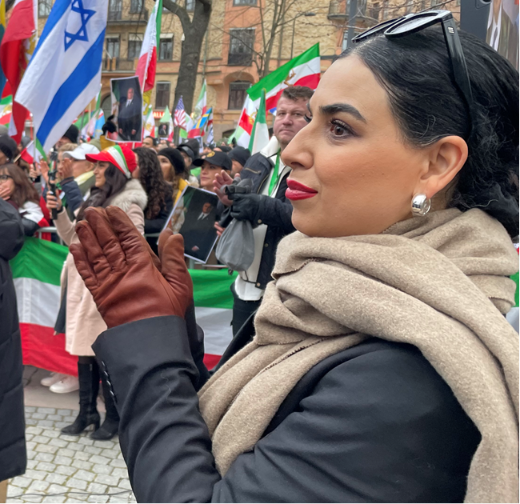
Atefeh Sebdani in Stockholm, 2026. Photo: David Stavrou

Atefeh Sebdani's story begins in the clash between the ayatollahs' regime and the MEK. "My parents were imprisoned after the revolution because of their rivalry with the new regime. They were considered enemies of the state and like other MEK members, after they were released, they were forced to leave," she says.

She was two years old at the time. Sebdani recounts that she, her younger brother, her father and her pregnant mother fled to Pakistan and lived there destitute on the streets. Her father continued from Pakistan onto Iraq, where he joined other MEK members in a camp called Ashraf, which later became the movement's center.

"After some time, we also moved to the camp. By that stage it had become a kind of small town with kindergartens, parks, and schools – mainly for propaganda purposes. They wanted to show how good things were there so others would join," she says. "For me, it was like paradise. I had everything; it was idyllic. I was with my mother and I was happy."

Then, without warning, everything ended at once. She hadn't even turned five yet but her mother told her she would have to take care of her two brothers by herself. She didn't explain why or how, but when the day came, Sebdani found herself standing by a bus with a group of crying women. When the bus departed, five-year-old Sebdani became a mother in practice.

"On the way, I had to take care of one brother who was still a baby and wanted to breastfeed, and another who was very ill," she recalls. She adds that the expulsion of the children from Camp Ashraf was a process. She doesn't know exactly how long it took, but she remembers children disappearing from kindergarten without knowing why or where they were going.

Eventually, all the roughly 900 children in the camp were separated from their parents and transported to other countries.

"The place was emptied of children's voices," she says. "And children's voices are the most human thing there is – the core of life – and that was taken away."

Why were the children expelled?

"The children were an element that disturbed the organization's leader, Massoud Rajavi. The ideological struggle to liberate Iran turned into the struggle of a narcissistic leader who wanted all the power in his hands. He wanted the men and women in the movement to be under his absolute control, and the children stood in his way. The movement began as an ideological movement, but it became a cult."

What Sebdani describes aligns with what is known from other sources about the MEK. During the 1980s and 1990s, the organization became highly centralized, developing political and military branches that operated from bases in Iraq. At the same time, the National Council of Resistance of Iran was established as a political umbrella organization.

'The family I came to was politically obligated to take children. It's not that they loved children or wanted us. We underwent heavy indoctrination and were forced to constantly work for the organization.'

During this period, allegations indeed emerged about cult-like characteristics such as strict internal discipline, ideological control, and exclusion of dissenters.

However, the organization's leader, Rajavi, has not been seen in public since the early 2000s, and his fate remains unclear, as the organization has not disclosed information about his whereabouts nor announced his death. Meanwhile, his wife, Maryam Rajavi, serves as the public face of the organization – contributing to an atmosphere of secrecy and uncertainty regarding its structure and decision-making.

After several months and a long journey that included stops in Jordan and Germany, Sebdani and her two younger brothers arrived in Gothenburg in western Sweden.

"For all that time, I was sure we would soon be reunited with my mother," she recalls. "We sat on planes and trains, I saw things I didn't know, I saw climates and people change, there were new languages and places – but alongside the excitement, I constantly feared we were moving further away from my mother and worried she wouldn't be able to find us."

In Gothenburg, they were told they would soon meet their mother. "I was very excited. But what actually happened was different – we stood on a train platform, and instead of my mother, two other people I didn't know arrived, a woman and a man, and we were told: these are your mother and father. That's when the nightmare began."
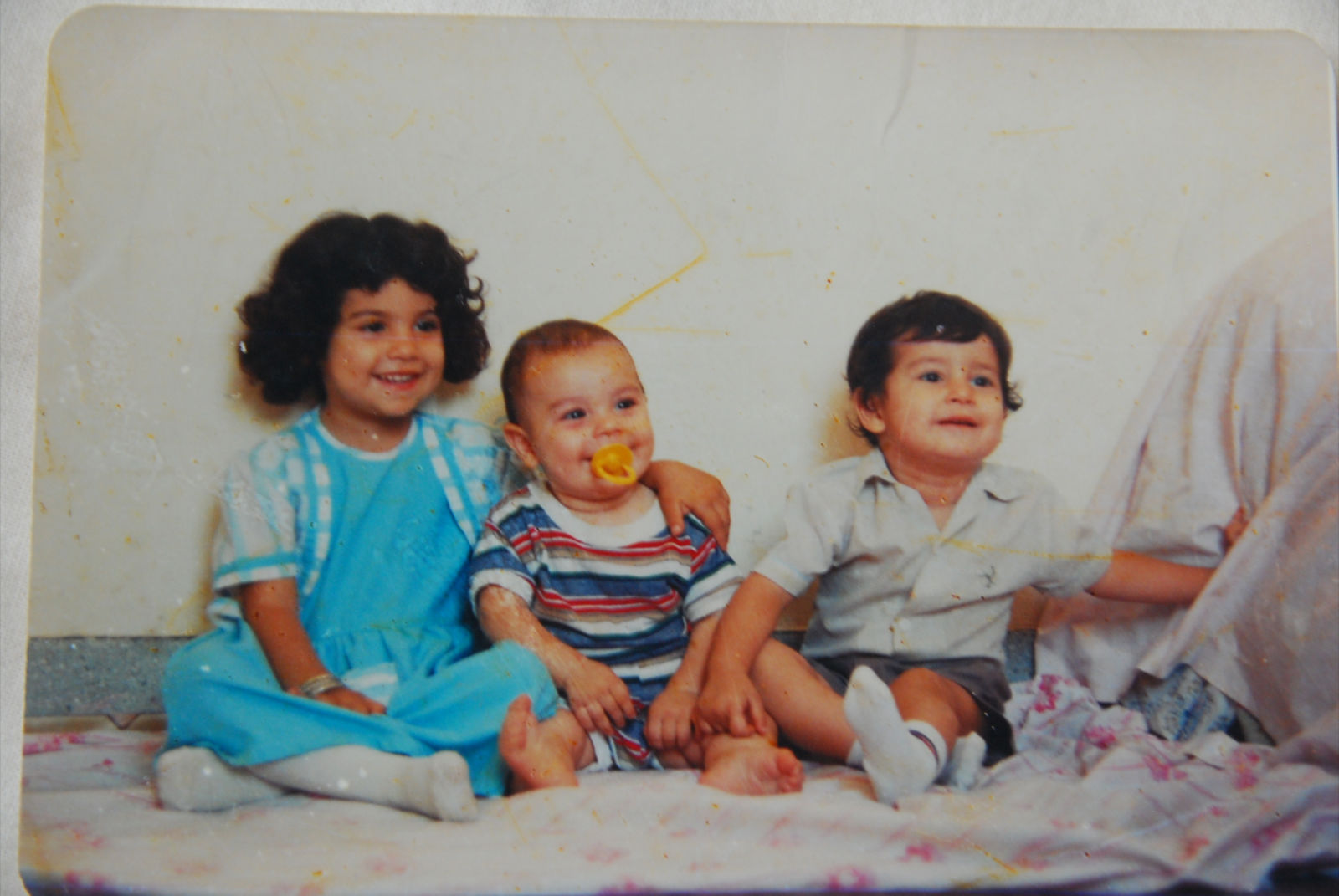
Atefeh and her two brothers

The people who took Sebdani and her brothers were MEK members living in Sweden and working for the movement. They also had a child of their own, and took in two other children out of roughly 200 MEK children who arrived in Sweden. Sebdani says she later traced the fate of hundreds of other children who were "exported" from Camp Ashraf and that she obtained a document listing their destinations – including Germany, the Netherlands, Norway, Canada, and the United States.

"The family I came to was politically obligated to take children," she says. "It's not that they loved children or wanted us. We underwent heavy indoctrination and were forced to constantly work for the organization." She does not reveal the identities of her foster parents, but her childhood memories expose the nature of the organization as it became a cult.

According to her, MEK families abroad were completely mobilized. They engaged in recruiting members and funds, organizing demonstrations, fighting opponents, and harassing defectors. She describes this society as oikophobic (one that is hostile, dislikes and rejects its own "home" culture, country and traditions). "They hated anything Iranian that wasn't related to the MEK. We weren't allowed, for example, to listen to Persian music unless it was the music of MEK members. I didn't read books in Persian. There was no Persian culture—everything was subordinated to the organization."

As far as you know, is this still the case?

"Yes. They still have offices in different countries and a strong presence on social media. The headquarters is in Auvers-sur-Oise, a suburb northwest of Paris, where political leadership members and full-time 'soldiers' are based. At the same time, there are activists like my foster family, and MEK members in Camp Ashraf 3 in Albania. That camp is essentially a 'troll factory' that produces large numbers of accounts and spreads propaganda in Persian and English. They write articles about themselves, smear their opponents, and create the impression of support – even though they have no real support."

Camp Ashraf 3 is the fortified camp to which most MEK members – estimated at 2,500 to 3,000 – were transferred from Iraq between 2013 and 2016. The move was carried out with the support of the United States, the United Nations, and the Albanian government. It took place because after the fall of Saddam Hussein, the MEK was no longer protected in Iraq, and international actors worked to evacuate them. Although the organization had been designated a terrorist organization in the U.S. for many years, it was removed from the list in 2012 as a result of pressure applied by the movement, and some American and other actors even saw it as a partner in opposing the Iranian regime. According to reports, the MEK no longer engages in military activity, but the camp in Albania has become a center of political and media activity with a highly centralized and controlled structure.

"It's a place where entry and exit are not free, and in the past there were physical punishments and torture of those who wanted to leave," says Sebdani. "I know stories of people who disappeared and of mandatory daily confessions about 'dirty thoughts' – for example, sexual thoughts and masturbation. You weren't even allowed to think about your children or speak with members of the opposite sex without permission. Today, with defectors speaking out and social media, the movement can no longer allow itself to use such methods."

Sebdani is not alone in her claims about the MEK. The French newspaper Le Monde conducted interviews in 2024 with former members of the organization living in Europe, including two named Amir Vafa and Amin Golmaryami. Vafa described how he and others were forced to participate in public confession sessions in which, once a week, everyone had to describe their sexual fantasies. He added that friendships were closely monitored: "It was forbidden to have lunch with the same friend twice in a row."

Golmaryami added that during clashes with Iraqi security forces in 2011, MEK leaders sent him and his comrades to go "in front of Iraqi bullets to increase the number of casualties." He claims they did this in order to "put pressure on Europe and the United States to remove the organization from the list of terrorist organizations and facilitate the relocation of its members to another country."

Another MEK member, Reza Torabi, said that at the age of 17 he was a zealous member and was assigned the role of "welcoming" young newcomers. "Our objective was to brainwash them, make them forget their previous lives, and instill in them the ideology of the Mujahedeen," he said. "My dedication was unwavering." In hindsight, he believes that he too fell victim to manipulation and regrets "the harm [he] caused in the course of his duties."

A 2005 report by Human Rights Watch, based on in-depth interviews with former members, also described a reality of beatings, verbal and psychological abuse, coerced confessions, threats of execution, and torture.

How do you believe control of MEK member is maintained today?

"If you look at people like the father, you see someone who joined in his twenties and spent his entire life inside this system. He never paid a bill or looked for a job – everything was handled by the organization. He doesn't know how to buy a plane ticket or even drive to the end of a street. The MEK infantilized these people, and there is no one to take care of them if they leave."

Does that mean there are no new members?

"That's right. There are no new members. It's a movement of older people – but they pay young people to attend demonstrations. If you go to MEK protests, you'll find Poles and Ukrainians who don't speak Persian and don't know what they're protesting about, alongside Swedes with no connection to the organization who were paid to join."

Who pays for all this?

"From what I saw and was part of, many people pay the MEK monthly so they won't harass them – Iranians in exile subjected to pressure, propaganda, flattery, and social coercion. There are also welfare funds, for example for foster families, as well as political donations and funding from human rights organizations influenced by the group's propaganda."

Beyond the political activity, the period that Sebdani stayed with her foster family, had another aspect. She talks about indoctrination and the constant threat that was used to make her stay.

"From the age of five, I experienced sexual abuse, physical abuse and psychological abuse in the foster family," she says, "but I couldn't say anything because they threatened to separate me from my brothers. I was not allowed to be a child. The first thing that happened to me in the foster family was that my father began to show interest in my naked body. He wanted me to do things. I felt it was wrong and frightening, but I knew nothing about sex or sexuality and I didn't understand.

"Over time, it only got worse, and my foster brother abused me too, encouraged by my foster mother. I had no childhood; it was just survival. I was the one who cleaned and tidied, I had to be a good student, and also the one who went out to demonstrations and went to Mujahideen conferences around the world". Talking to Sebdani she describes a reality full of exploitation, punishment, crying at night, and deception of Swedish welfare services.

As an adult, she eventually left, moved to Stockholm, became an engineer, and worked for Microsoft. After a personal crisis, she began telling her story and wrote a book (Min hand i min, "My Hand in Mine", published by Albert Bonniers förlag, 2024). Today she is married and has three children.

Politically, Sebdani is active among supporters of Reza Pahlavi. "I saw the difference between the two leaders," she says. "I met Maryam Rajavi as a child, and recently I met Pahlavi in Paris with a group of other former MEK children. I support the Iranian people, and the people support Pahlavi. He is exactly what Iran needs – a secular, humane person, with a family, who knows what living a normal life is, who listens and can unite people."

After Sebdani's meeting with Reza Pahlavi and other "MEK children" she became the target of an online campaign against her. Sebdani says that this isn't the first time and she has been targeted by a smear campaign led by the MEK on several previous occasions before.
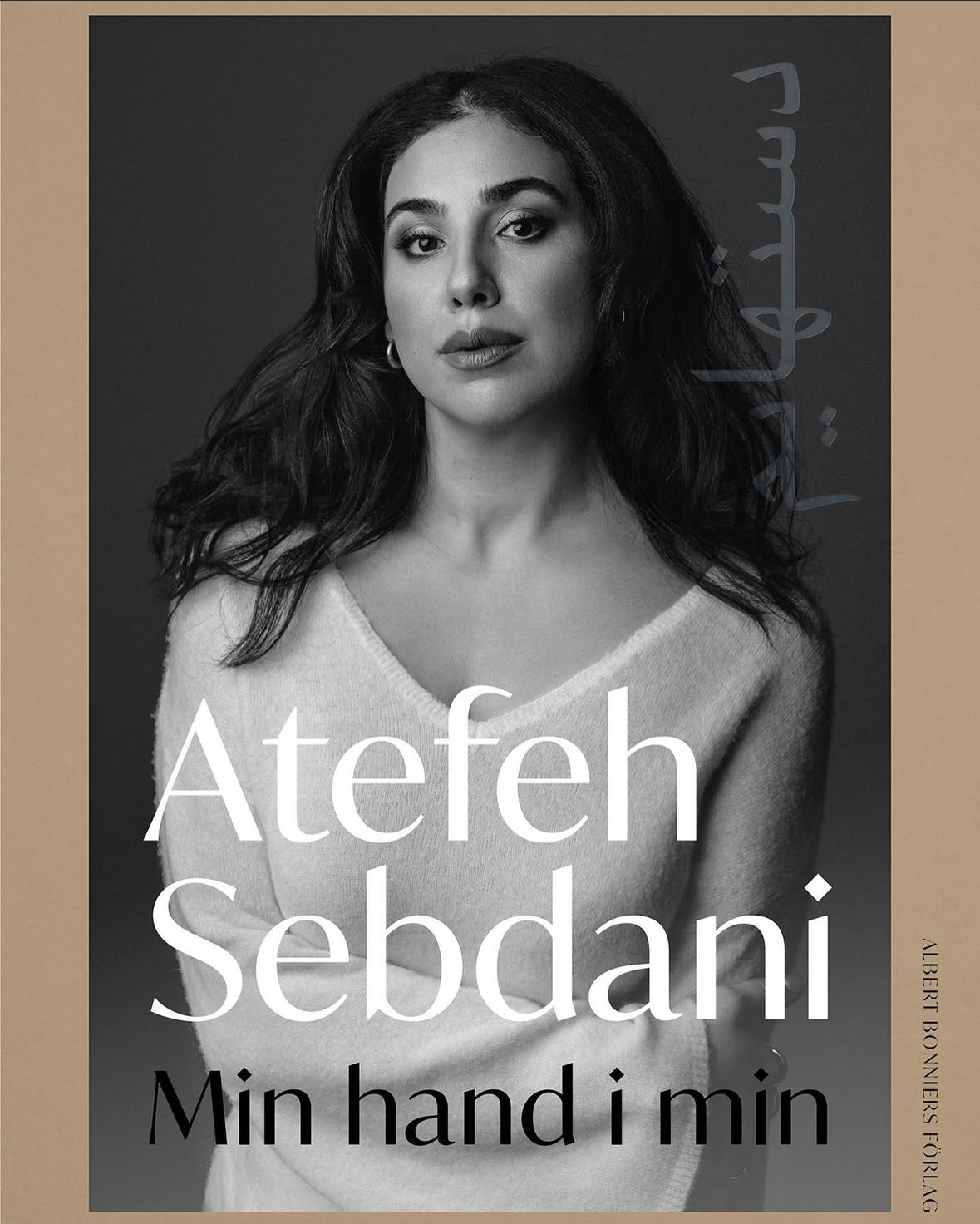
Sebdani's book

"This kind of harassment happens to everyone who has left the organization and spoken out," she says. This time, the MEK website denied Sebdani's account through a letter it claimed was written by her biological father. "For me, as a father, seeing 'Atefeh Sebdani' at a gathering of the Shah's son was painful… Atefeh is the same person who, by spreading defamation against the organization under the false pretext of being part of a group of 'child soldiers,' has for many years become a full servant of Iranian intelligence."

The text claims that Sebdani was never part of the MEK and accuses her and her associates of collaborating with the regime in Tehran. Sebdani does not know whether her father actually wrote the text, but she says that everything in it is false and that she is familiar with other examples of letters that MEK members were forced to write under coercion.

Following the letter, a senior figure in the organization, Freydoun Salimi, also spoke out, accusing Sebdani of never having been a member of the group and of acting as an agent of the regime. In responses to his claims on X, supporters of the organization repeat the accusations and insult Sebdani. On other social media platforms, she is also accused of assisting Israel, betraying Iran, and supporting Americans attacking her country.

Sebdani's personal MEK story has a positive ending – she escaped, her siblings left, and even her mother eventually left the organization. The organization itself, however, is still very much alive. It even claims to still have networks inside Iran, though most analysts believe its influence there is limited. "The MEK is more of a European problem than an Iranian one," Sebdani concludes. "In Iran, they have no real support, not even with regime critics. But after the 'Woman, Life, Freedom' protests, it's clear that a unifying leader is needed, otherwise, there will be no change – and I have no doubt that Pahlavi is the right person."

Over 100 Murders: The Iranian Standing Trial for War Crimes in Sweden

Hamid Nouri is charged with being involved in over 100 murders and war crimes during the bloody Iranian massacre of July 1988. In a unique legal case, Stockholm District Court may sentence him to life in prison

Published in "Haaretz": https://www.haaretz.com/world-news/europe/2022-06-21/ty-article-magazine/.premium/over-100-murders-the-iranian-standing-trial-for-war-crimes-in-sweden/00000181-853d-ddb4-a3ab-d5fd84520000

STOCKHOLM – At the time, Manoochehr Eshaghi didn’t really understand why he was taken out of the line. Leaving Tehran’s Evin Prison courtroom, after a collective legal proceeding lasting only a few minutes, he and the others in his group were blindfolded and ordered to walk toward a bus, each holding the shoulder of the man in front. When the bus dropped them off, Eshaghi was told to wait by a wall. From under the blindfold, he could see the others. Joined by prisoners from other buses arriving on the scene, they were divided into groups of four. These were their last moments, and Eshaghi, the lone survivor, can’t forget them.

They stood with their backs to their executioners. A few words were said to announce the verdict and some of them shouted out last words. Then came the shots. “Nobody begged or showed any weakness,” Eshaghi says some 40 years on, in an interview in a Stockholm café not far from his home. “Some shouted ‘Long live freedom!’ Others shouted ‘Death to Khomeini!’ After a first round of shots, the commander checked the bodies and shot them again in the head. I just sat there and cried.”

The apparent reason Eshaghi was spared was because he had yet to reach puberty. Today, aged 55, he remembers the demonstration that caused his arrest in 1981. He says he was there to support his uncle, who was a supporter of the People’s Mujahedin of Iran (aka Mujahedin-e-Khalq, or MEK), a student movement that in those days combined a modernist version of Islam, Marxist influences and opposition to Ayatollah Ruhollah Khomeini’s Islamic clergy.

Eshaghi was sentenced to 10 years in prison, during which time he saw many of his prison mates executed. Sometimes he and others were made to carry the bodies and load them onto trucks. He says prisoners were raped by guards; many, including himself, were tortured and placed in solitary confinement. When he was transferred to another prison – Gohardasht in Karaj, west of Tehran – things only got worse. Violence there was part of the daily routine. One form of torture Eshaghi remembers is being beaten by the guards and then stuffed into a small unventilated room together with other prisoners until they almost suffocated to death. They called it the “gas chamber.”

Eshaghi was at Gohardasht during the summer of 1988, when thousands of political prisoners were executed by hanging. He remembers many of his cellmates being taken to a committee and asked about their political beliefs. Some agreed to show remorse, condemn the Mujahedin movement and ask for mercy. Others refused, not knowing in those early days that rejecting the terms meant being sent to the gallows.

Thirty-four years have passed but Eshaghi hasn’t forgotten his cellmates who were murdered, or the men in charge of the killings. One of them, a deputy to the assistant prosecutor, was a man he knew as Hamid Abbasi. In an unexpected turn of events, Abbasi, whose real name is Hamid Nouri, is now standing trial for the 1988 Gohardasht and Evin killings not far from the Stockholm café where Eshaghi told me his story.

A protester outside Stockholm District Court during the trial of Hamid Nouri last month. David Stavrou

According to the prosecutors, in the space of just a few weeks, Nouri and his colleagues rounded up thousands of prisoners, gave them staged trials and handed down death sentences. Most of them were People’s Mujahedin of Iran supporters, others were members of left-wing movements. It was all done secretly, hastily and deceitfully. At last, Manoochehr Eshaghi, who was asked to testify at the trial, got to face one of his torturers. “I’m 100 percent sure it’s him,” he says, “and he knows exactly who I am too. Me and my two brothers, who were also imprisoned in Gohardasht, were targets for him. When I first saw him in court, I was frightened. But then I calmed down. When I testified, it felt good. Finally, he had to answer questions and take responsibility.”

Nouri, who is 61, is charged with more than 100 murders and war crimes. The verdict will be announced on July 14 and, if convicted on both charges, he may spend the rest of his life in a Swedish prison.

***

The trial in Stockholm District Court began last August, almost two years after Nouri was dramatically detained at Stockholm’s international airport. According to the prosecution, back in 1988 Nouri was one of those who took the prisoners to the so-called death committee and then to the execution chambers. He was also involved in the torture, the hangings and the secret burial of the victims, they say.

Nouri projected an air of confidence during the trial. He was always well-dressed and looked elegant when his handcuffs were removed and he took his place at the defendant’s table. His behavior during the proceedings was eye-catching: he exchanged intense looks with witnesses and members of the public attending the court sessions. He occasionally mumbled a few words or expressed his opinion using body language. He followed every word (translated into Persian for him from Swedish, and vice versa), read the material presented to the court and exchanged remarks with the judge, lawyers and law enforcement officers.

On the days when he presented his side of the story, it sometimes felt like he was lecturing the court with a mix of self-praise, political theories and theatrics. He claimed he wasn’t a violent man, never hurt anyone and that everybody loves him. He also praised Iran and its regime, which has to face the “terrible lies” it’s accused of and made harsh allegations against the Mujahedin movement, which he refused to call by name – referring to it instead as “the little group” that “murdered thousands of Iranians in a way that makes ISIS look like innocent children.”

It was as if Nouri was certain he’d soon be back home and wanted to avoid being seen as a man who turned his back on his previous ideals and comrades. At times, it seemed as if Nouri’s testimony had very little to do with a coherent legal defense or the advice of his Swedish lawyers. He claimed that although he used the alias Hamid Abbasi and worked at Evin Prison, he was not the only Hamid Abbasi there and he wasn’t employed at Gohardasht at all.

He also claimed that because his wife had just given birth, he was on leave on the dates when the supposed executions took place – but according to him there were no mass executions at all. Even so, the Swedish court, the plaintiff’s lawyers and prosecutors put an enormous amount of work and resources into this unique trial, which is based on the international legal principle of universal jurisdiction. This allows for crimes that are deemed a threat to the whole of humanity to be prosecuted by national courts regardless of where they were committed.

The trial even relocated to Albania for a few weeks in November, in order to hear from witnesses who are still Mujahedin supporters and are based there. But it wasn’t the tireless work of Swedish authorities that first brought Nouri to Sweden on November 9, 2019. Rather, it was the determination of one man: a former Iranian Mujahedin supporter called Iraj Mesdaghi.

***

Mesdaghi is another survivor of the 1988 massacre who lives in Sweden. He was born in Tehran and educated in the United States. Although he is today a harsh critic of the Mujahedin movement, he was a supporter back in 1981 when he started a 10-year prison sentence, during which he was subjected to violence and torture.

In 2019, decades after arriving in Sweden, Mesdaghi received information that one of his torturers – the man he knew as Hamid Abbasi – was traveling to Stockholm for a private visit. It turned out that one of his stepdaughters used to be married to a Swede and was involved in a custody dispute over their 2-year-old child. When Mesdaghi heard of this, he put a complex international legal plot into action.

“With the help of one of Nouri’s Swedish acquaintances, who secretly assisted me, I got Nouri tickets for a cruise and booked hotels for him in order to tempt him to start his trip in Stockholm, meet the family here and then go on vacation,” he recounts in an interview outside the courtroom.

Iraj Mesdaghi

“After making these arrangements, I traveled to London and met with British lawyers and legal advisers to start preparing the case. Later, they contacted a Swedish lawyer, who got in touch with the Swedish prosecutor.” Mesdaghi was initially concerned about the Swedish government being reluctant to get involved. “I know the European system,” he says. “There’s a difference between foreign affairs, intelligence services and the justice system. Everyone does their job. Intelligence services are concerned about keeping the country safe, they don’t care about justice. But I created the scenario and I knew we could get him here.”

The plan worked. Nouri was arrested upon arrival in Stockholm and charges were filed against him. When the trial finally began some 21 months later, it was only natural that Mesdaghi would be the first witness. He told the court about how he was taken from his cell in Gohardasht and stood in line, blindfolded, with other prisoners awaiting trial. When the procedure began, he was not officially warned that the next few minutes could seal his fate. However, he understood that his answers could send him straight to the executioners who were waiting on the other side of what would be known as the “death corridor.”

Mesdaghi was therefore willing to promise that he would not carry out political activities upon his release. In the following days, he met the committee again, signed various written statements, was tortured by prison guards and witnessed many of his fellow inmates being taken to their deaths as his own fate was hanging in the balance. After his eventual release and escape from Iran in 1994, Mesdaghi wrote extensively about the events leading up to the summer of 1988. He claims there was a power struggle within the Iranian political elite as the Iran-Iraq War was coming to an end, Khomeini’s health was deteriorating and the question of political prisoners was dividing his assumed successors.

Hussein-Ali Montazeri, the designated successor, was opposed to the massacre, while other senior officials such as Akbar Hashemi Rafsanjani and Ali Khamenei were supporters. Mesdaghi experienced the results of this geopolitical drama in solitary confinement, when he heard the guards speaking of a fatwa soon to be issued by the supreme leader. Toward the end of July 1988, it was obvious something was going on: prison visits were canceled, prisoners were being moved between wings, and access to newspapers and television was denied.

The fatwa, which was issued on July 28, sanctioned the execution of political prisoners who were still loyal to the Mujahedin. Later, Khomeini allegedly issued a second fatwa targeting left-wing prisoners. Mesdaghi explains that when Montazeri objected to the massacre, he was removed from his senior positions by Khomeini, who also set up the so-called death commissions. In the Tehran area, the commission that arrived at Gohardasht on July 30 included Sharia Judge Hossein Ali Nayyeri and Tehran prosecutor Gen. Morteza Eshraghi. When Mesdaghi faced the committee on August 6, he recognized the two as well as the man who he knew as Naserian – now known as Mohammad Moghiseh, a judge in Tehran’s Revolutionary Court. Naserian’s deputy was Hamid Abbasi, who Mesdaghi recognizes as Hamid Nouri. The committee included several others who would become extremely important figures. One was Mostafa Pourmohammadi, an intelligence official who later served as a minister under presidents Mahmoud Ahmadinejad and Hassan Rohani. The other would become even more significant. His name was Ebrahim Raisi.

***

In Iran, the president is second only to the supreme religious leader in the chain of command. The fact that Raisi was a key player in the 1988 massacre, and then became Iran’s president in June 2021, makes the Nouri trial even more momentous. One of the prisoners who clearly remembers Raisi is Fereydoun Najafi (62) who now lives in Australia and was one of the witnesses in Nouri’s trial. “When taken to the committee I told Raisi that I didn’t do anything. I said 'I’m not against you, I don’t care about the Mujahedin’. Raisi then told me to go and wait outside, and I was returned to my cell. After that I was transferred back to Evin where I spent three more years”. Unlike other prisoners, Najafi answered the committee members this way, because he already had information about the proceedings and their possible results thanks to two other prisoners who managed to contact him before their executions and explained the situation by morse code. "Other prisoners didn’t know and they just asked to be left alone", says Najafi, "which meant that they are still Mujahidin supporters”.

Najafi, who was arrested because his brother and sister were Mujahedin supporters, was beaten and tortured, sent to Evin and given a harsh sentence of 15 years with no real grounds. He was later transferred to Gohardasht where he spent three years in solitary confinement. When he was called in to face the Death Committee, he was asked a couple of questions. He recognized Eshraghi, Nayyeri, Naserian and Raisi who he said received his file from Hamid Abbasi who he’s now completely sure is Hamid Nouri. “Even if you forget everything”, he says, “you never forget your enemy. This guy is a torturer. I’ll never forget him”.

“The trial of Hamid Nouri is one of the most significant events during the rule of the Islamic regime,” says Mehdi Aslani, another trial witness. He is a writer and activist who is now based in Germany and was a member of the left-wing Fadaiyan-e-Khalq (FKO) in the 1980s. “Up until recently, arrests of Islamic regime operatives were predominantly linked to their activities outside of Iran. Whereas now, for the first time, someone is facing justice outside Iran for involvement in crimes against political prisoners in Iran.”

Mesdaghi (left) and Aslani leaving the Stockholm courtroom. David Stavrou

For Aslani, it’s not just about politics. He says that when he stared Nouri in the eye during the trial, he remembered friends who perished in their youth and shed a tear for the victims of the 1988 “thought inquisition and slaughter of intellect.” “Khomeini’s second fatwa is even more sinister and outrageous than the first one against the Mujahedin,” says Ervand Abrahamian, a U.S.-based historian of modern Iran. “The first fatwa tried to get the prisoners to deny the Mujahedin and rat against their colleagues. The second fatwa is medieval. It’s against apostates, the members of the left-wing groups. They were asked other questions such as did they pray? Or did they believe the Koran is the word of God? According to strict Islamic law, apostates can be executed. This is a case of medieval law in 20th-century Iran.

“There are two different stories here,” he continues. “The first one, the war on political opponents, is brutal but it’s normal in 20th-century politics. The second, the execution of prisoners because they were nonbelievers, is like the [Spanish] Inquisition.” Abrahamian estimates the number of executed members of the Mujahedin at between 2,500 and 7,000, while the number of left-wing activists who were killed was smaller (probably several hundred). The Mujahedin victims may include prisoners of war who were executed after Operation Mersad – an invasion of Iran in July 1988 in which Iraqi forces and Mujahedin fighters cooperated. Whatever the real number, the American-Iranian historian says the regime “wanted to keep a lid on the information and never admitted anything.”

But the massacre didn’t remain a secret. Members of the Iranian diaspora have been talking about it for decades; there are books and reports on it; and international organizations have been demanding justice for years, including Amnesty International. Many of these organizations have been present at the Stockholm trial, which is currently in recess ahead of the verdict next month, and it is clear that although they are united against the Iranian regime and Nouri as its representative, they are sometimes strongly opposed to each other as well. Under the surface, there are many accusations and deep animosity between Mujahedin supporters, former Marxists, human right activists and different Iranian diaspora groups.

Inside Iran, however, the regime seems to be united in a new strategy toward the West. Former presidents “Khatami, Rohani and Rafsanjani were interested in foreign relations and the image of Iran in Western Europe,” Abrahamian says. “Raisi couldn’t care less. I think they’re not worried about the West anymore; they’re isolationists, and they’re counting on Russia and China.

Ervand Abrahamian Photo: Emma Nolan-Abrahamian

A prime example of the way Iran is behaving toward Europe nowadays was offered in May. In what was widely seen as an attempt to affect the Stockholm court, Tehran is threatening to execute Iranian-Swedish doctor Ahmadreza Reza Djalali, who was convicted of espionage in 2017 in what human rights groups regard as a highly dubious trial. The Islamic republic, it seems, is trying to get Nouri back and is certainly not accepting any blame for the 1988 massacre.

Nouri himself continues to deny a massacre ever happened, praises Iran’s leaders and threatens his opponents. In this sense, he can be seen as a warning. If he is the face of the current Iranian regime, negotiations over the new nuclear deal, oil sales and sanctions may be different than in the past. “Concerning the nuclear discussions in Vienna,” historian Abrahamian says, “the premise in the West is that Iran wants an agreement with the world powers, including the United States. But that may not be true now that the right-wing, die-hard extremists are in charge.”

If he is right, Hamid Nouri’s trial may be just the beginning of a whole new chapter in Iran’s relations with the West.