As politicians and dignitaries take part in Trondheim Synagogue's centennial celebrations later this month, for the city's small but growing Jewish population it has become a safe haven from post-October 7 antisemitism.
TRONDHEIM, Norway – When it comes to the attendance list, it's hard to imagine a more distinguished and high-ranking one in Norway. Prime Minister Jonas Gahr Støre will deliver a speech. Mayor of Trondheim Kent Ranum will be there along with other municipal leaders and senior representatives of the Norwegian government. The Royal Family will also be represented alongside leaders of Norwegian Jewish communities, several bishops and leaders of various Christian denominations, an imam and representatives from the Israeli and American embassies in Norway.
The occasion? The 100th anniversary of one of the northernmost synagogues in the world, the Trondheim Synagogue, which will take place on October 26. The synagogue serves the small Jewish community (numbering approximately 200) in Norway's third most populous city, positioned about 350 kilometers south of the Arctic Circle.
Trondheim Synagogue, 2025, photo: Martin Borg
"The events will include religious services, a concert featuring Edan Tamler, a well-known Israeli cantor, and a festive dinner for congregation members and visiting guests," says John Arne Moen, the chairman of the community. Moen, who's a retired journalist and editor, has been a member of the community's board since 2006 and now serves as chairman. "The event will also include a keynote address by Chief Rabbi of Norway, Michael Melchior, who has served as an Israeli government minister and MK (the community itself doesn't have its own permanent rabbi).
The story of Trondheim's Jews goes 150 years back. "The first Jews to arrive in Trondheim came from today's Lithuania and Poland via Sweden in the 1870s," says Moen. "At the end of World War I, there were about 340 Jews in Trondheim and in other towns in Western and Northern Norway. Unlike Jews who came to Oslo, many of whom came from Denmark and German speaking parts of Europe, these were poor immigrants who escaped pogroms and poverty in the Russian Empire."
Moen goes on to say, these Jews "didn't speak Danish or German, which were languages common for educated Norwegians at the time. Instead, they spoke Yiddish and Russian. They came from small shtetls and it must have been really hard for them to settle here. Most of them didn't even intend to stay. They wanted to go to America, and Trondheim was just a stop during which they hoped to make some money for the ship ticket. However, almost all of them ended up staying here."
"These immigrants mostly settled in an area close to the harbor, known for prostitution and poverty, and they transformed it into the only Jewish quarter in Norway. It became rich in Jewish cultural and religious life led by a rabbi who arrived in 1896 from Belarus. A synagogue was founded in a building borrowed and then bought from a Baptist church, and the small community had a women's organization and a Zionist youth organization," Moen says. "There were also unique challenges."
Moen is referring to Trondheim's geographic location. Because of its proximity to the Arctic Circle, the sun in Trondheim sets after 11 p.m. in the summer and before 3 p.m. in the winter. Naturally, this is a challenge for Orthodox Jews when it comes to determining when Shabbat and holidays start and end. "This has been an issue for many years," Moen says. "Rabbi Samuel Brandhändler – the first rabbi in Trondheim – decided to have set times for Shabbat during some weeks in the summer and some winter weeks. Later, in the 1920s, that became the practice year-round making Trondheim probably the only Orthodox Jewish community with set times for Shabbat."
Moen says that the golden age of the community was between the two world wars. It was then that the community moved into its current location – a building which was decommissioned as a train station, purchased by the Salvation Army and then bought by the Jewish community. After extensive renovation work, it was inaugurated in October 1925. The building became the center of Jewish life in Trondheim and it still is today. It serves not only as the synagogue, but also the Jewish community center and home to Jewish Museum Trondheim, the permanent exhibition of this unique community.
"As a museum, we communicate knowledge, we take care of the exhibits, we research and renew," says Agnete Eilersten, 40, who has been the museum's collection manager and curator for the last five years. "The people who come here are mostly school …children [ages] 13 to 18, but we also have [individual visitors] including students, tourists and Norwegians of all ages."
Walking around the museum, Eilersten points out the old ark and Torah scrolls from Trondheim's first synagogue, pictures of the first Jewish families, exhibits about Jewish traditions and an old mikveh (Jewish ritual purification bath) in the cellar. When asked why she was drawn to work at this particular museum Eilersten, who is not Jewish herself, speaks of her fascination with Norwegian-Jewish culture which has been "hidden in many ways." But it's also about combating antisemitism. "We try to counter antisemitism by disseminating knowledge and teaching people about Jewish history," she says, "we believe that more knowledge means less prejudice." And, of course, there's also the war. "It is very important to preserve the history of World War II," she says. "We need to [pass it on] to new generations."
In Norway, this attitude isn't a given. Norway's World War II legacy is complicated by the fact that many Norwegians supported and cooperated with the Nazis. As such, it has remained in the shadows for decades. The Nazis occupied Trondheim and the rest of Norway in 1940. A year later, they took over the synagogue which became barracks for German soldiers. "We think that the soldiers, who were probably drunk, lay in their beds and shot at the ceiling," says Moen, the synagogue chairman. "The building was heavily damaged and during those years more than half of the community's members were deported and murdered. No other Jewish community in the Nordic countries suffered more than Trondheim's."
On the eve of World War II, Norway had around 2,400 Jews, including a few hundred from other nationalities. When Germany invaded and occupied Norway in 1940, the Norwegian king and government fled the country forming a government-in-exile in London, while Norway was ruled by a Nazi official named Josef Terboven, who governed through a pro-Nazi puppet government headed by Vidkun Quisling, the leader of a Norwegian fascist party, Nasjonal Samling (The National Union), founded in 1933. The party cooperated with the Nazis in taking over the country, and in many cases Norwegian policemen, not German Nazis, were the ones who arrested and deported the Jews.
Persecution of the Jews began in 1941 with arrests, property confiscation and some executions on false charges. In 1942, mass arrests of hundreds of Jews were carried out. Most were transported on the SS Donau to Auschwitz. Another ship, the MS Gotenland, transported over 150 more to the same destination in February 1943. In total, 772 Norwegian Jews were arrested or deported. The oldest among them was 80 and the youngest an eight-week-old baby. Fewer than 40 came back. Those who survived had mostly escaped to neutral Sweden. When the war was over, they returned, and although they survived they were deeply traumatized. And even worse – they stood alone.
As Sweden is marking 250 years of Jewish life, the reactions to the October 7th massacre, the war in Gaza and the tone of the rhetoric in the public debate are reasons to be concerned about Swedish antisemitism. But what is the true extent of this scourge, what is its impact on Sweden’s Jewish community, and how is it being addressed by the authorities? By placing these issues in a broader historical context, David Stavrou’s investigation, which we are publishing as part of our partnership with the DILCRAH, seeks to answer these questions.
In 1973 a young Moroccan army officer named Ahmed Rami arrived in Sweden asking for political asylum. He said he needed protection because he was part of an unsuccessful coup d’état in his homeland the previous summer. More than a decade later, after obtaining asylum in Sweden, Rami started broadcasting Radio Islam, a radio program which subsequently turned into a newspaper and later, a web-site. The focus of these enterprises became clear right at the beginning – it was not about Islam; it was about Jews. The radio program and the website featured some of antisemitism’s greatest hits; conspiracy theories about how Jews and Zionists control the world, Holocaust denial, Nazi propaganda, lists of influential Swedish Jews and Israel bashing. During the last three decades, Rami has been investigated, charged, convicted and fined for hate speech and hate crimes and his radio station was shut down by the authorities more than once. Still, now aged 78, Rami’s legacy lives on. He has published books, voiced support for Hezbollah and neo-Nazi groups, his website is still very much alive and the internet allows his work to continue.
Radio Islam is an important landmark in the history of Swedish antisemitism for several reasons. One of them is that the precedential trial which sent Rami to prison for six months also gave a small and relatively unknown Swedish organization called The Swedish Committee Against Antisemitism (SCAA, or SKMA in Swedish) an important role in the Swedish public arena. “SCAA is a religiously and politically unaffiliated NGO which was founded in 1983”, says Mathan Shastin Ravid, the organization’s office manager, “it was founded by a group of activists who wanted to raise awareness about antisemitism. It was a period with a clear wave of antisemitism in Sweden and other European countries during and after the Lebanon War in 1982. Antisemitism was not a new phenomenon in Sweden back then, but this was on a new scale, there were all these accusations with motives and images that targeted not only Israel, but Jews as a group. When the Radio Islam broadcasts started in the end of the eighties, it was clear to us that the radio station was a megaphone for anti-Jewish hatred and propaganda. On the basis of SCAA´s report to Sweden’s Chancellor of Justice, Rami was convicted of hate speech. But it was clear that in those days we stood pretty much alone. Not many people understood the problem, people did not want to talk about it and there were many known figures who came to Rami’s defence saying it was only criticism of Israel, not antisemitism”.
A lot has changed in Sweden since then and SCAA probably has an important part in the change. Shastin Ravid says that since the nineties, the organization has become more than just an activist watchdog. It now also focuses on education. “These days we stand on two legs”, he explains, “one of them is monitoring, information and advocacy, as we try to follow what is happening in Sweden and the world and follow the Swedish and international debate regarding antisemitism. We then react when we see antisemitism in different forms. The other leg is education. We have educational programs for different target groups such as teachers and pupils in Swedish schools, journalists and politicians. We also work with some governmental authorities like the police, which often lack a deeper knowledge of contemporary antisemitism and how it spreads. It is my understanding that there is more awareness in this area today than there was ten years ago and that positive things are happening as part of a higher level of knowledge and consciousness in general in Swedish society today when it comes to antisemitism. But there is still much work to do..”
When Shastin Ravid is asked for an up-to-date description of antisemitism in Sweden, he starts by saying that more research is needed to get a better understanding of the problem. That said, it is clear that in many ways Sweden is not different from other countries. “The development in Sweden is connected to global developments”, he says, “antisemitic conspiracy theories have been spread and legitimized by important political actors in recent years. In Europe we have for example seen it in countries like Hungary and Poland amongst right-wing nationalist parties and governments, but we have also seen it in other countries including the US where amongst others Donald Trump, Elon Musk and the MAGA movement have legitimized and spread antisemitic propaganda. This global phenomenon has affected Sweden too and has sparked hate speech and hate crimes. And then there is, of course, the strong global wave of antisemitism after Hamas’ attack in Israel on the 7th of October 2023 and the war in Gaza. It is not the first time an escalation of the Israel-Palestinian conflict triggers antisemitism in Sweden and other countries, but the level of propaganda, hate, threats and attacks against Jews has been unusually high.”
“Studies show that antisemitism in the form of negative beliefs and attitudes towards Jews exists, in varying degrees, in all Swedish society, in many different groups and milieus. Within Swedish mainstream politics, the problem has long been visible in the right-wing nationalist Sweden Democrats party. For years, the party has tried to portray itself as a party which opposes antisemitism and is pro-Israel, but antisemitism continues to be a problem in the party. We often find high- and low-level representatives of the party spreading antisemitic propaganda and we see many connections between the party and right-wing and even Nazi extremists. In addition, the Sweden-Democrats do not deal with antisemitism within their ranks unless they are exposed by the media, and even then, there are many cases of people within the party who have kept their jobs after they were exposed”. The party’s proclaimed “Zero Tolerance” policy towards racism and extremism, including antisemitism, Shastin Ravid says, is “a joke”.
“But the nationalist and populist right is just part of the problem. Antisemitism does, for example, also regularly appear within the pro-Palestine movement and parts of the Swedish left, where it is often related to Israel and the Israel-Palestinian conflict. In these circles there is sometimes a denial or an unwillingness to see the problem of antisemitism, sometimes rooted in the misperception that Jews are “white” and therefore cannot be victims of racism. In the last year, there has been a big debate in Sweden about the fact that several representatives of the Swedish Left Party have spread antisemitic propaganda, many times on social media. And when criticized, those party representatives have been backed by many others within and around the party who have denied that the propaganda is antisemitic. The SCAA and many others have strongly criticized all of this, and the fact that the party leadership many times has been slow to act and condemn the spread of such anti-Jewish racism and those party members who defend and excuse it.”
“And of course, movements linked to radical Islamism must also be taken into account”, Shastin Ravid adds. According to him, antisemitism is most virulent within those movements and Nazi and other right-wing extremist movements. “For all of them, antisemitism is an ideological foundation, a “worldview,” a way of understanding and describing events both locally and globally. Jews are constantly portrayed as conspirators and blamed for all the world’s ills”. Furthermore, Shastin Ravid adds, “antisemitism has long been a weapon of regimes in the Middle East, where it is deeply rooted, openly expressed, and legitimized. The spread of this type of propaganda via the internet by regimes such as Iran has contributed to the globalization of this hatred. Recently, it was revealed that the Iranian regime is suspected of having planned to murder Swedish Jews, among them Aron Verständig, the chair of the Official Council of Swedish Jewish Communities (Judiska Centralrådet). According to the Swedish Security Services (Säpo), Iran has also recruited Swedish criminal networks to carry out attacks against Israeli and Jewish targets. The Swedish National Centre for Terrorist Threat Assessment (NCT) has reported that the biggest terror threats in Sweden come from violent Islamists and right-wing extremists, which both have Jews and Jewish institutions as some of their primary targets”.
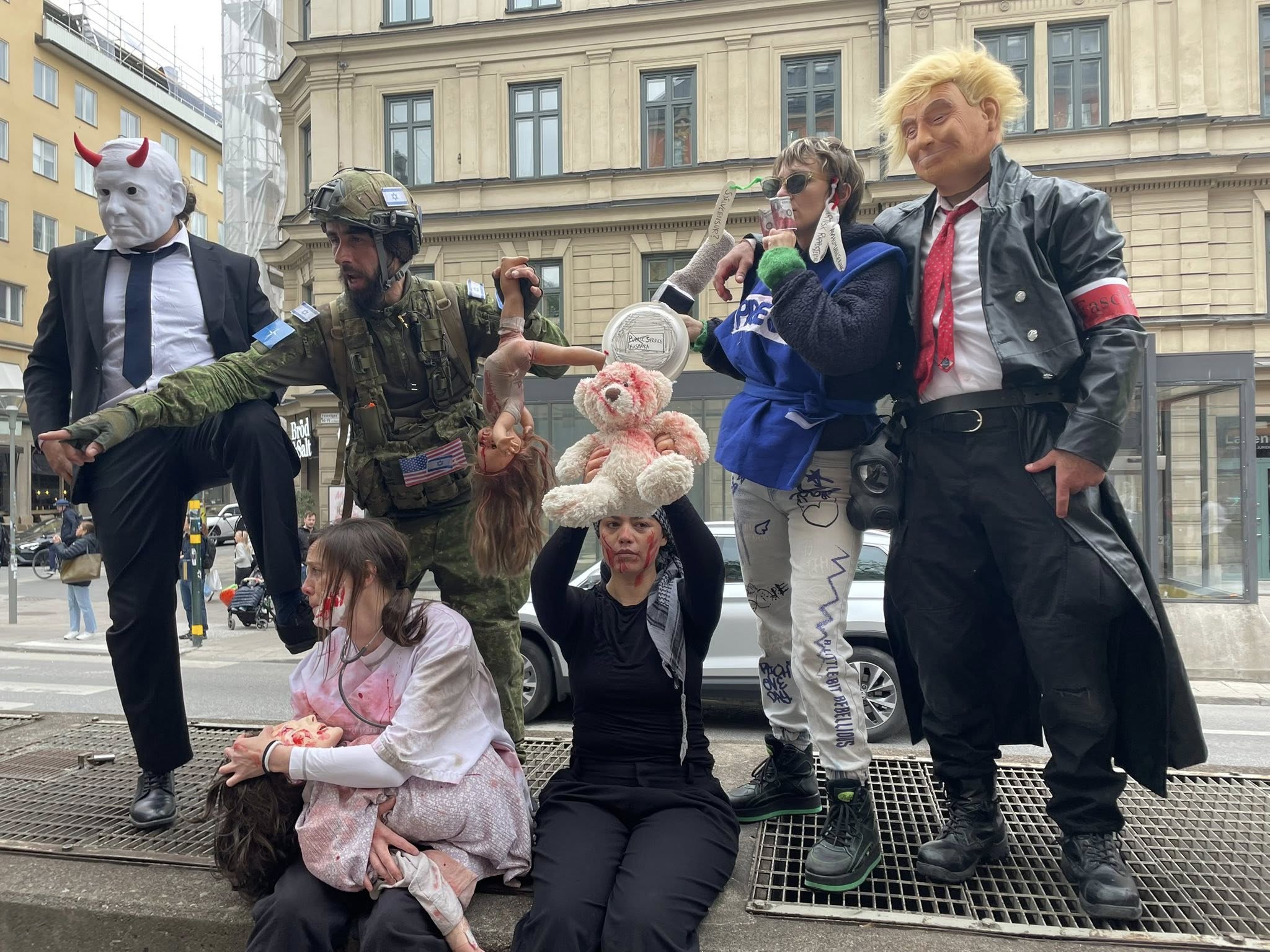
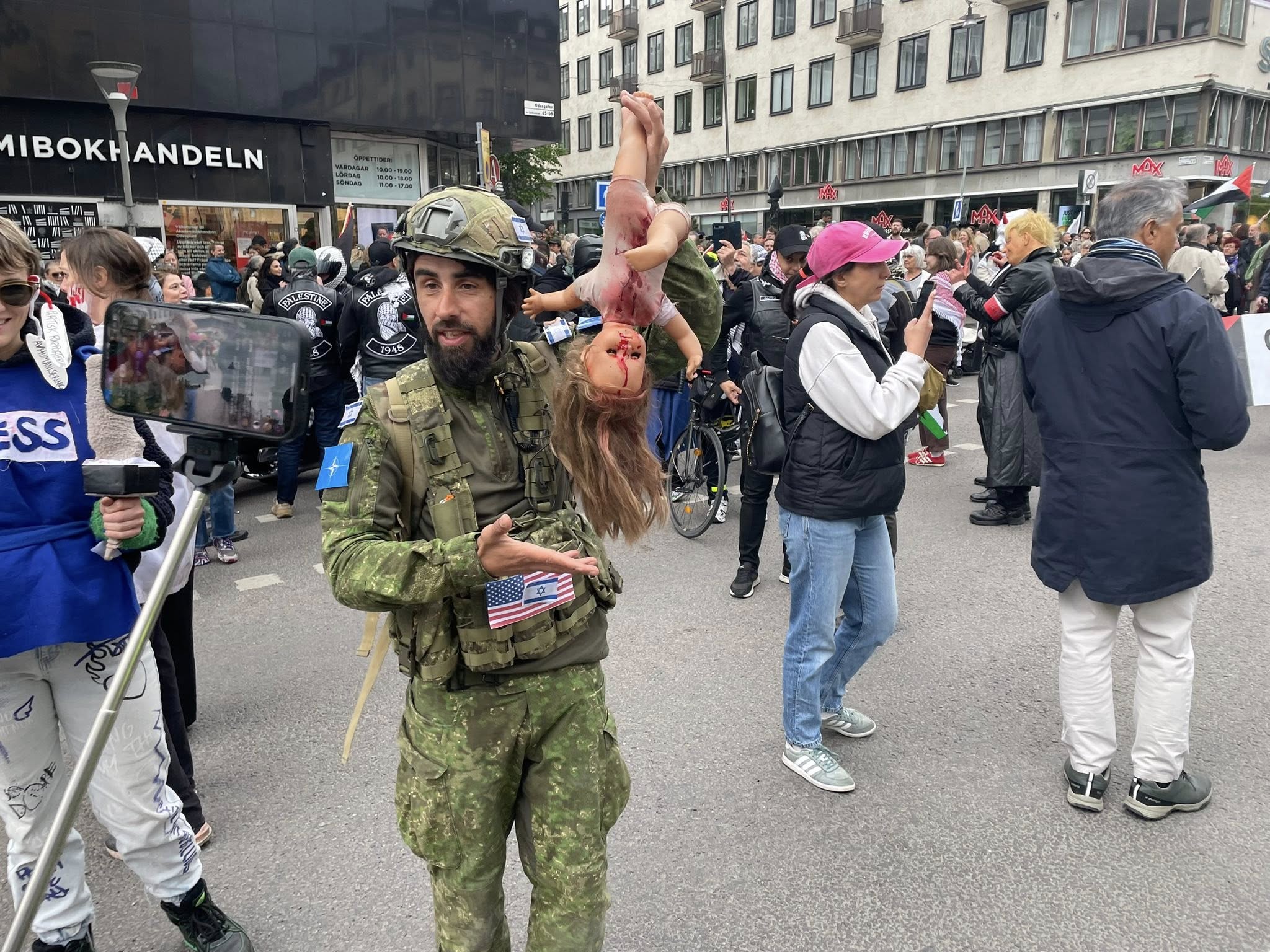
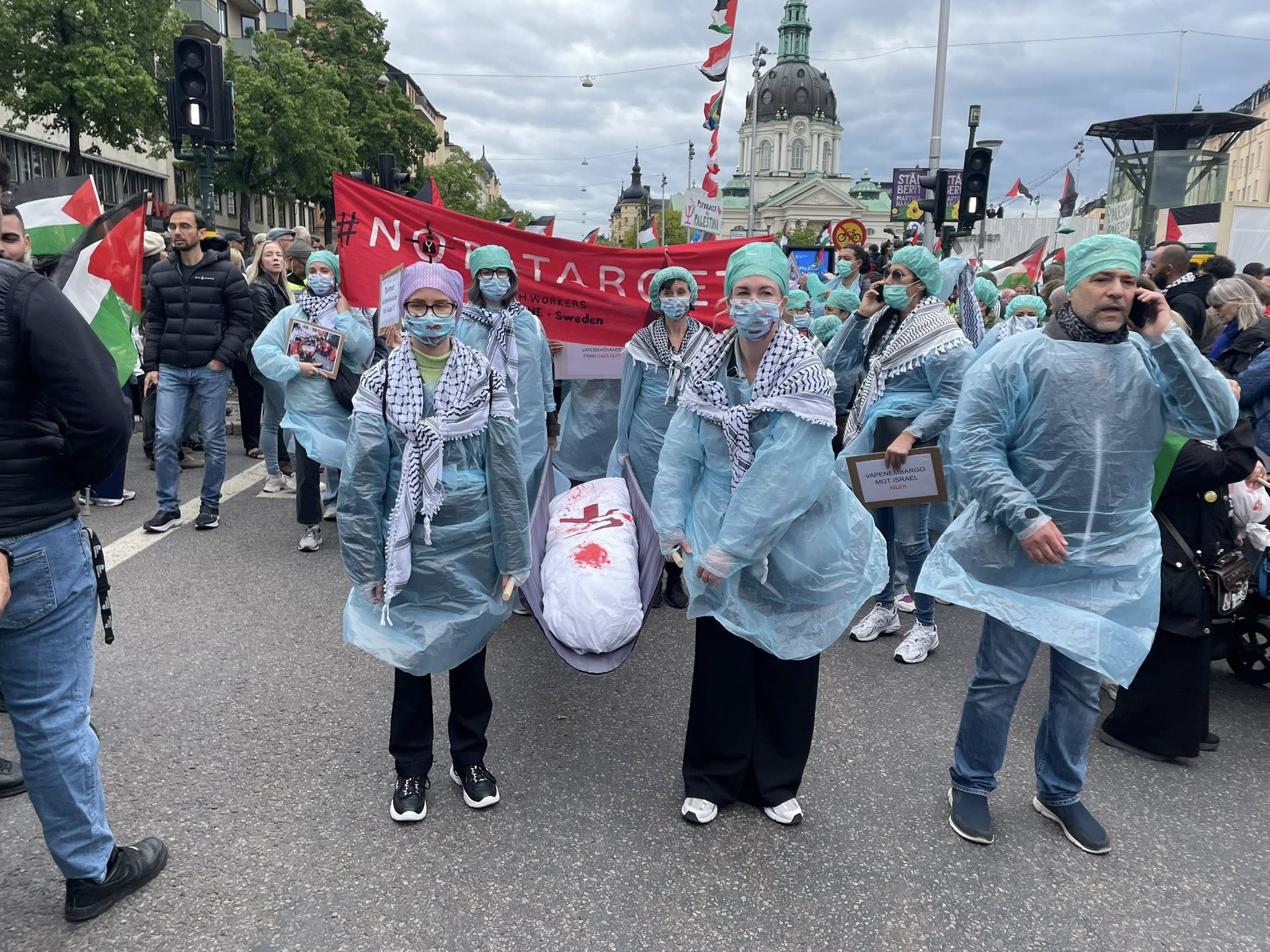
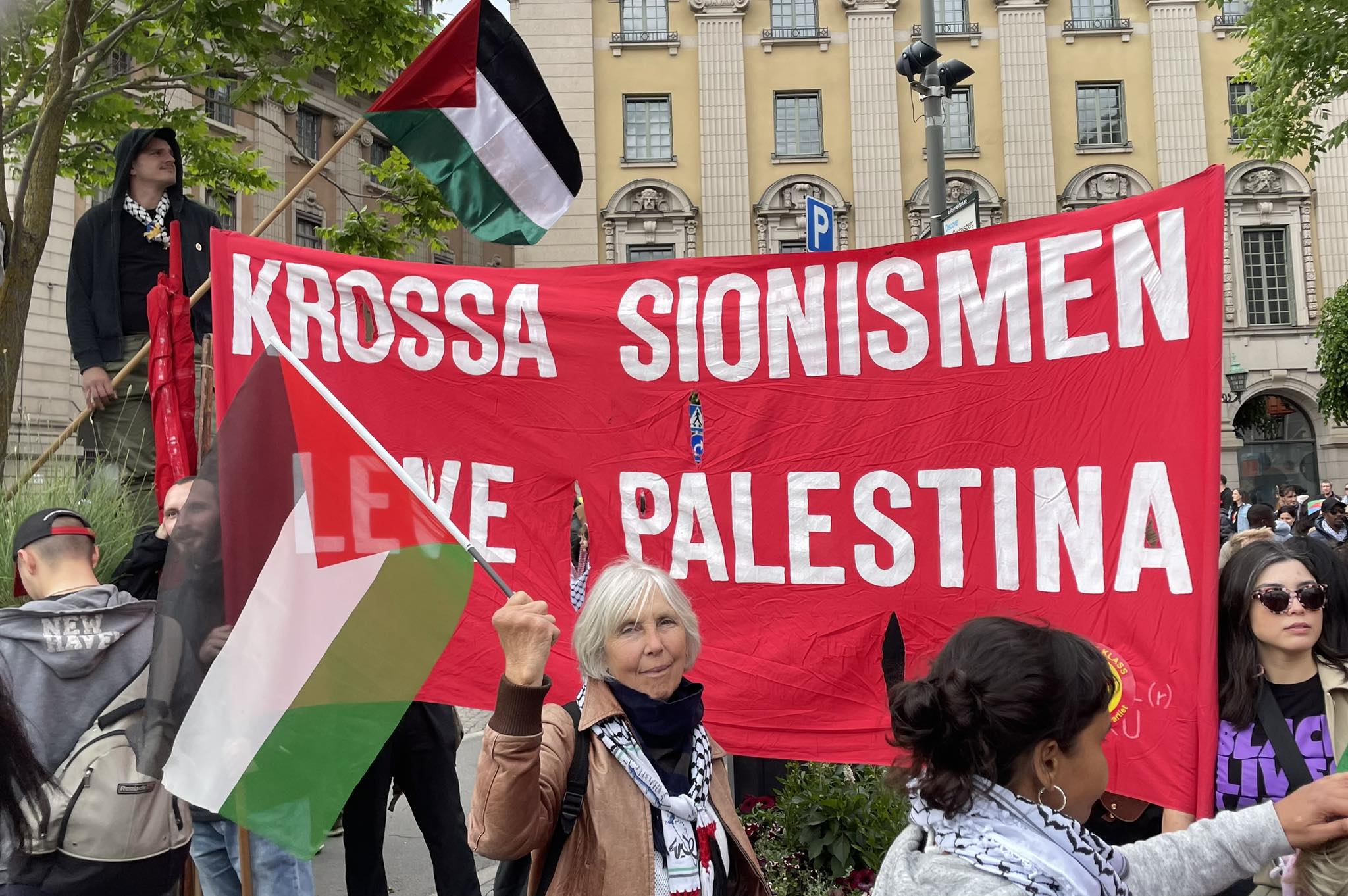
Even without physical violence, Swedish antisemitism is present in the public sphere and one of its main outlets are the numerous demonstrations in support of the Palestinians and denouncing the “genocide” in Gaza. The days right after October 7th, and before the Israeli ground attack on Gaza began, were a good example. While the massacre in southern Israel was still ongoing, there were a couple of spontaneous demonstrations in southern Sweden which included music, dancing and convoys of cars honking their horns in support of the Hamas attack. Right after that, in the course of one weekend in Stockholm, three different organizations demonstrated separately but with similar slogans. A part from the mainstream Pro-Palestinian movements, there were more radical organizations on the streets. One was Hizb ut-Tahrir, a radical Islamic group advocating the creation of a caliphate governed by Sharia law from Uzbekistan to Morocco, with a small branch in Sweden. It was granted permission to demonstrate despite being banned in several countries. Next came the Nordic Resistance Movement, a neo-Nazi group with a few hundred members who demonstrated in support of the Hamas attack. They were followed by the Revolutionary Communist Youth, which claims that Palestinians have the right to “fight by all means against the occupying power to liberate their land.” The latter described the October 7 attacks as an act of liberation that “caught the Zionists in their beds.” Both organizations, one neo-Nazi and the other Marxist-Leninist, support the Palestinian slogan calling for “crushing Zionism.”
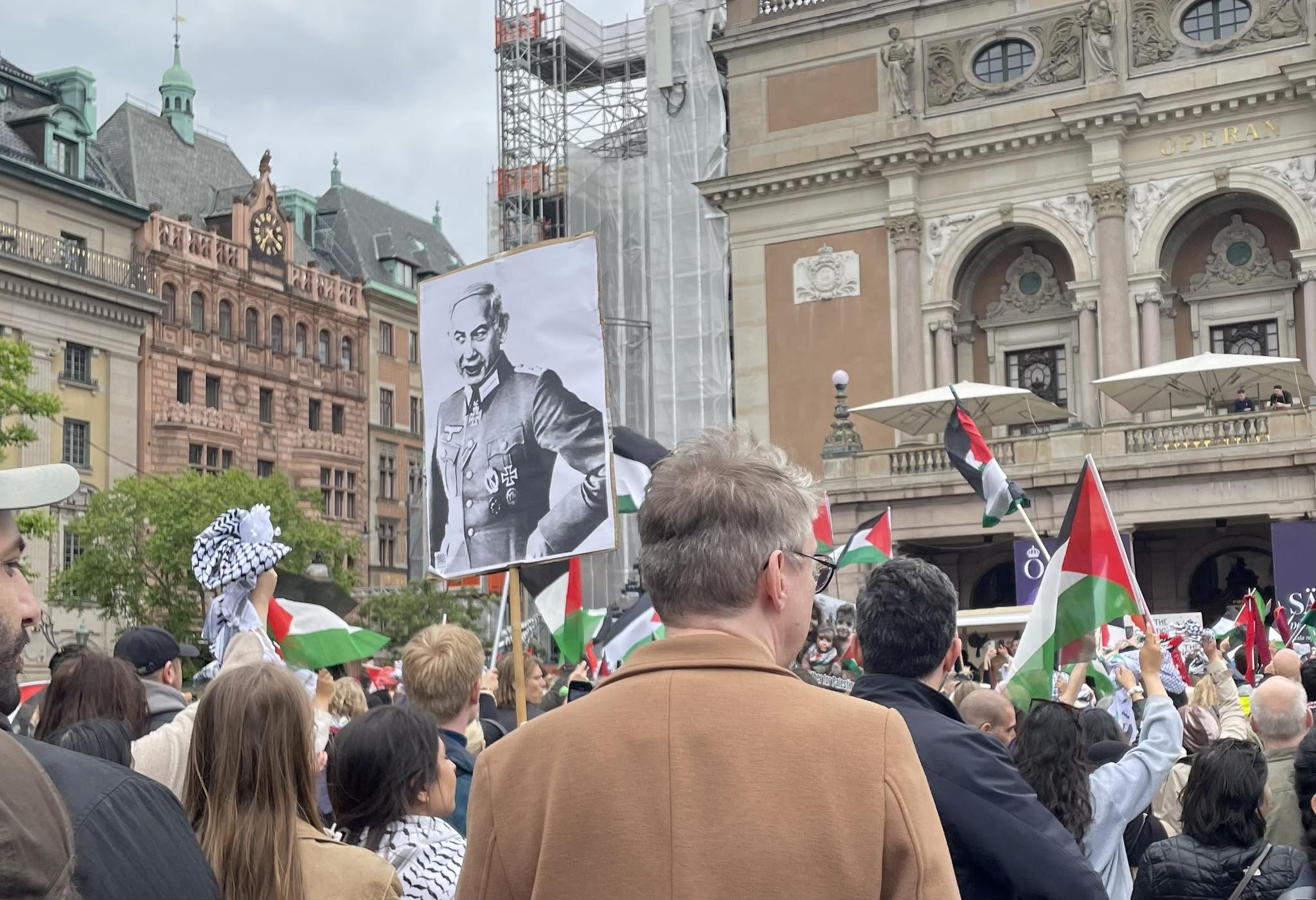
Since then, there have been numerous demonstrations in Sweden, many of them on a weekly basis. These demonstrations are legal, the organizers deny that they feature antisemitic content and they are seen by many Swedes as legitimate opposition to Israel and solidarity with Palestinians. However, they often include slogans which are considered antisemitic by many such as supporting a “global intifada” and “crushing Zionism”, promoting antisemitic conspiracy theories and calling for a “Free Palestine from the River to the Sea”.
Still, demonstrations are not the main concern when it comes to current Swedish antisemitism. There have been numerous reports of activists who have used school classes, universities and even pre-schools to spread radical anti-Israeli political propaganda which is seen by many as antisemitic, the culture world has been full of calls for boycotting Israel and ending cooperation with Israeli artists, the BDS movement which was hardly present in Sweden before the war has been publicly active in promoting boycotts against companies which they claim are complicit with Israel’s “illegal occupation and apartheid politics” and parts of Swedish academia have become hostile to Jewish and Israeli students. In Gothenburg University, for example, activists were allowed to take over the premises of the university’s art and design school and they distributed Hamas propaganda. In Stockholm, Lund and Uppsala there have been reports in Swedish media of pro-Palestinian encampments and so-called “liberated zones” which together with harsh rhetoric from members of senior university staff who are also political activists made students hide their Jewish identity and caused concerns about their safety and well-being.
Demonstration in Stockholm, June 2025
How prevalent are antisemitic crimes?
“Many Jews in Sweden have experienced antisemitism in one way or another”, Shastin Ravid says, “we need more research, but studies have indicated that many Swedish Jews have been targeted by antisemitism and many of them have not reported these incidents. This is also true for other hate crimes, most of them are probably never reported to the police”. Some of the studies Shastin Ravid is referring to were made by the Swedish National Council for Crime Prevention (Brottsförebyggande rådet, Brå). They show that there is a small and inconsistent increase in the number of reported antisemitic hate crimes over the years, but some years there is a sharp rise. “These are often the years when the conflict between Israel and the Palestinians has escalated, like the last war in Gaza. According to a study from Brå, there was a sharp rise in reported antisemitic hate crimes during the last part of 2023, almost 5 times as many as during the same period the year before”.
But other global events may also have been important in this respect. “The pandemic, for example, brought at least two kinds of antisemitic effects”, Shastin Ravid says, “First, there were accusations against the Jews, who were blamed for starting the pandemic and for profiting from it. Then, there were parts of the anti-vaccination movement which instrumentalized and diminished the Holocaust, claiming that they are treated the same way as the Jews in Nazi Germany. The war in Ukraine also triggers antisemitism on a global scale as do the discussion about Quran burnings and the debate about migration and refugees which fuels the antisemitic so-called replacement theory. These days antisemitic propaganda is often spread online with code words replacing the word Jews. Instead, it is Zionists or Globalist or specific names like Soros or Rothschild. These words are used globally as symbols of a big Jewish conspiracy, and they are widely spread in Sweden too”.
Another study Shastin Ravid speaks of was made by a government agency called The Living History Forum (Forum för Levande historia), which was founded in the beginning of the 2000s to “work for democracy and equality between all people, using lessons learned from the Holocaust”. According to Shastin Ravid, the study from 2020, showed that there had been a decline in antisemitic attitudes and notions over a period of 15 years, but that antisemitism still exists within different parts of the population. “I think that this is an important point to make”, he says, “the study showed that around 5 % of the respondents displayed antisemitic attitudes with a stronger intensity, which is a rather low figure compared to many other countries. However, if you broaden it and look at the group of people who agreed with one or more of the study’s antisemitic statements, the number is 34 %. This does not mean that 34 % can be said to be antisemitic, but it indicates that antisemitic ideas exist among a bigger part of the population than many think. We should not only focus on the most extreme groups. According to the study, higher levels of antisemitic beliefs correlated among other things with, and were more common amongst people who are: older, have lower levels of education and have a low trust in public institutions. Antisemitic beliefs were also more common among people who have sexist and anti-immigrant attitudes, people who sympathize with the Sweden Democrats party, people who were born outside Sweden or Europe, and people with a Muslim religious affiliation. Another interesting factor is that traditional and Holocaust related antisemitic beliefs tended to be slightly more common among men, and Israel-related antisemitic attitudes and notions tended to be slightly more common among women”. However, Shastin Ravid points out, the study is now a few years old, and many things have happened since that could affect the results of the next study, which is supposed to be published in 2026.
One group which is particularly exposed to antisemitic hatred is the group of school pupils and teachers who in many cases are scared to be open with their Jewish identity. “We have studies from among other places Malmö and Stockholm which show that there are serious problems with antisemitism in some Swedish schools. Sometimes it is related to the Israeli-Palestinian conflict, sometimes the word Jew is used as a curse and sometimes we see antisemitic conspiracy theories which fascinate youngsters. We also see jokes about the Holocaust, swastikas on benches or lockers, and Nazi salutes. Jewish pupils often feel that their teachers and schools do not take the matter of antisemitism seriously, and they say that there is a lack of knowledge and support. This is something that many Swedish youngsters have told us at the SCAA through the years”.
Sweden is home to the largest Jewish community in Scandinavia. It’s estimated that about 15,000 Jews live in the country which has a population of just over ten million. That said, there are probably many more Swedes who have a Jewish background, as Jewish immigration to Sweden dates back to the 18th and 19th centuries and many have married into Swedish families. The largest community in the country is the one in the capital Stockholm which has three synagogues, including the conservative Great Synagogue adjacent to the Raoul Wallenberg and Holocaust monuments and an office building which houses various Jewish organizations. A few minutes’ walk away, there’s a relatively new cultural centre called “Bajit” which houses a Jewish primary school, a Jewish kindergarten and a variety of Jewish activities for all ages, as well as a Kosher shop and a café. Smaller Jewish communities and associations exist in Malmö, Gothenburg and a couple of other smaller towns. Sweden’s Jewish communities are united under an umbrella organization, the Official Council of Swedish Jewish Communities (Judiska Centralrådet) which usually takes part in national discussions concerning Jewish life in the Swedish Parliament, Government and other authorities.
Since the problem of antisemitism isn’t new to Swedish society, it’s no surprise that in recent years the Swedish government has made many attempts to address it. After decades of ignoring the problem, dismissing and repressing it, recent Swedish governments have put it on their agenda and have tried many different approaches. Petra Kahn Nord who served as the World Jewish Congress’ representative in the Nordic countries, says that the current Swedish government appointed a special inter-ministerial task force in order to combat antisemitism and improve the conditions for Jewish life in Sweden. “This government task force was set up to be a ‘one point of contact’ authority, which is something we’ve suggested before”, she says, “it was founded in January 2023 and the first issue that it focused on was government funding for security for Jewish institutions like synagogues and schools. The second issue was, and still is, addressing antisemitism”. Kahn Nord explains that the previous government had the political will to secure security funding, but the budget mechanism didn’t really work. The current government, however, addressed the issue, increased funding and gave additional funding after October 7th. But protection against violent antisemitic incidents isn’t all that’s needed.
In 2021 Sweden hosted The Malmö International Forum on Holocaust Remembrance and Combating Antisemitism. The conference, hosted by then-Prime-Minister, Social-Democrat Stefan Löfven, asked the participating countries and organization to make concrete pledges that would strengthen Holocaust remembrance and tackle Holocaust distortion, Holocaust denial and contemporary antisemitism. The Malmö forum was seen by many as a natural continuation to the steps another Social-Democratic Prime-Minister, Göran Persson, made twenty years earlier. Persson founded what is now called the International Holocaust Remembrance Alliance (IHRA) and initiated the Stockholm International Forum on the Holocaust which brought together political leaders, state officials, religious leaders, survivors, educators, and historians from around the globe. When Löfven initiated the 2021 events, one of Sweden’s pledges was to form an inquiry on strengthening Jewish life in the country. The idea was that fighting antisemites is one thing, but making Jewish life flourish was another subject. One that has been neglected for many years.
This indeed happened and various issues which Jews in Sweden were concerned about were discussed seriously. These included the threats of illegalizing Jewish circumcision and banning the import of Kosher meat which were supported by some political parties. Another important issue was the status of Jewish schools in Sweden which doesn’t have almost any real private schools. There are so-called independent schools, including a couple of Jewish ones, within a charter system, but because of reports of radicalization in some of Sweden’s independent Muslim schools, new legislation was put in place which affected Jewish schools too. The new legislation imposed the definition of “denominational schools”, and with-it necessary restrictions, on existing Jewish schools. Another concern was an initiative to limit the establishment of new denominational schools. These were all concerns in the Swedish-Jewish pre-October 7th reality. Community leaders were saying then that “Swedish Jews may be able to survive a terror attack, but not legislation forbidding Brit Mila or Jewish schools”.
Today, after October 7th, it’s clear that the majority of political parties, and certainly the ones which are part of the Swedish Government, are committed to addressing these Jewish concerns. Antisemitism, however, is not necessarily a problem which the government can easily address since its origins are well-rooted and widespread in many parts of Swedish society. All recent Swedish governments have therefore realized that combating antisemitism is as complicated as it’s important. And it’s a work in progress. Petra Kahn Nord mentions two major shifts in the last few years. “First, before 2015 it was not acceptable to talk about antisemitism which came from immigrant groups from the Middle-East. This made members of the Jewish community feel abandoned. Sweden has now changed and it’s now possible to talk about it and deal with the problem”, Kahn Nord says, “the second shift has to do with the fact that the populist right-wing Sweden-Democrats party is supporting the government. So far, however, the party hasn’t caused any policy shifts aimed at the Jewish minority. But October 7th created a new reality. We’ve seen an increase in the number of antisemitic incidents in schools and universities, we’ve seen politicians, especially in the Swedish Left, who spread antisemitic propaganda and we’ve seen support for Hamas in demonstrations and online”. Kahn Nord says that schools and social media are a particular concern. “The problem in these arenas is serious”, she claims, “and it can’t be dealt with by using old “action plans” that previous governments suggested. Many of these plans, including pledges made in Malmö four years ago, focused on Holocaust education and educational strategies against racism in general, as opposed to antisemitism as a specific phenomenon. The Malmö Pledges, for example, included the pledge to establish a new Holocaust Museum in Stockholm (which has indeed been opened since then) and another to contribute 5.5 million SEK to the Auschwitz-Birkenau Foundation. “There’s a Swedish tendency to focus on dead Jews”, Petra Kahn Nord says, “perhaps now, especially after October 7th, it’s time to focus on the living ones”.
And indeed, when it comes to living Jews and real concrete Jewish communities, combating antisemitism and taking measures to improve Jewish depends on strong support and clear stands by governments.
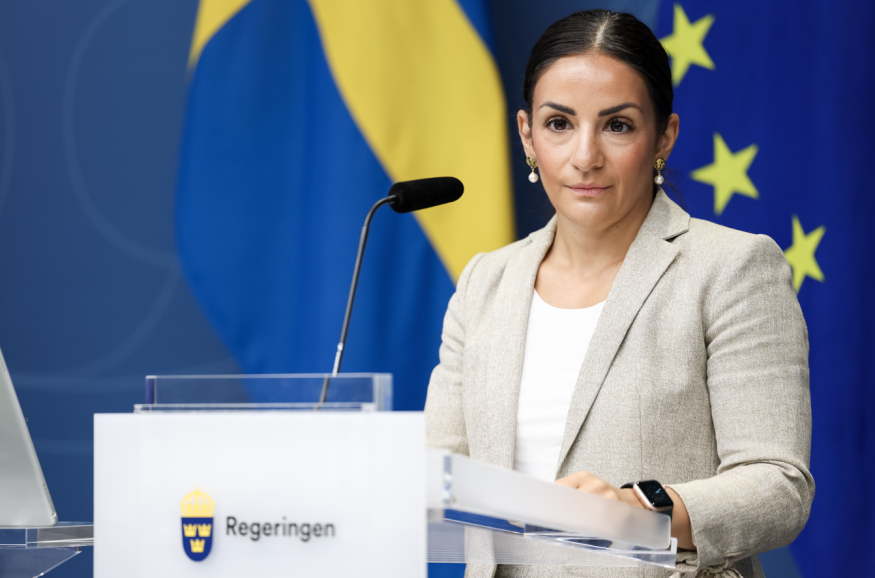
In Sweden, the subject of antisemitism has been on the agenda for decades and different governments have handled it in different ways. Today, the government minister who holds the relevant portfolio is Parisa Liljestrand, a forty-two-year-old minister from the center-right Moderate party. Liljestrand, immigrated to Sweden as a young child from Iran and worked as a teacher and school head-master before getting involved in local politics. In 2022 she received her first post on the national political scene and became Sweden’s Minister of Culture. In an interview conducted in her Stockholm office she explains that one of her responsibilities is addressing issues connected with Sweden’s five national minorities. The minorities and their languages, which are considered official minority languages in Sweden, were recognized in the year 2000 and they include Jews and Yiddish; Roma and Romani Chib; the Sami and the Sami language; the Swedish Finns and Finnish and the Tornedalers and their Meänkieli language.
“Our government was appointed in October 2022 and the Prime Minister made it clear, as early as his first government statement, that strengthening Jewish life and working against antisemitism would be one of our priorities”, she says, “When we started our work, we decided that we need to understand what’s been done in Sweden today and to listen to the Jewish organizations which are active in Sweden. We wanted to understand what they think is needed. What we found out was that a lot of important work is being done, but there are things which still don’t work and there are things which are lacking. Sweden ranks well in global measurements of antisemitism, but there’s still widespread antisemitism in Sweden which we need to actively fight. This became even more evident after Hamas’s horrific attack on October 7, 2023. As in many other countries, we have seen the threat perception towards Swedish Jews increase, as has open antisemitism. The government takes this very seriously.
But it is not enough to work against antisemitism. We need to strengthen the possibility to live a free Jewish life, both in terms of Jewish culture and in terms of Jewish religious life. This is why we need to gather the work that’s done by different government ministries and by Jewish organizations. When we talked to the organizations, we found that it was sometimes hard to understand who’s responsible for what issue and it was important to make sure that things don’t end up in the wrong place. That’s why we founded the Government Task Force for Jewish Life as an inter-governmental work group which, beside the Prime Minister’s office, has eight more government offices represented in it”.
When asked if the fact that her government is supported by a party with roots in neo-Nazism doesn’t affect her attempts to fight antisemitism, Liljestrand tells a story of one of her meetings. “I met a Jewish father who told me about his son who went shopping while he was wearing a necklace with a Star of David. The father said that when the boy came to the cashier, the person who was working there told him that he was not welcome in the shop. This story really hurts. This can’t be our reality. This isn’t Sweden. We have a clear mission – making Sweden a free country to live in and supporting those groups who cannot live a de-facto free life here. So, I don’t feel the Sweden-Democrats are stopping me from doing this. I understand that there’s a concern, but I’m clear, and the government is clear in its message. One must remember that antisemitism is about gathering and capitalizing violence from various directions. That’s what makes it different from regular racism”.
Parisa Liljestrand, Photo by Ninni Andersson Regeringskansliet
Part of the violence Liljestrand is talking about is online and much of it is aimed at young people who have to grow up with it. “It’s extremely serious when antisemitism becomes a natural part of day-to-day life and it isn’t limited to the physical space and instead it’s spread digitally”, Liljestrand says, “it’s worrying and we need to fight it and work towards the goal of not having another generation which is exposed to the same kind of difficulties living a Jewish life or the same kind of antisemitic hate which previous generations were exposed to”.
Liljestrand seems to be serious about this particular aspect of her job. “I myself, with my background, know exactly what it’s like to live in a society which treats you differently if you have a different skin color or if you have a different culture”, she says, “I know what it’s like to fight your way into society and have the will to be part of it while still keeping a part of your culture and heritage”.
When it comes to antisemitism and the struggle against it, Sweden is indeed an interesting case. For much of its post war history, antisemitism wasn’t taken very seriously. Neo-Nazi movements operated freely while the close ties to Nazi Germany were ignored. This came together with a widespread ignorance about the Holocaust, antisemitic attitudes within the Swedish elite and free import of antisemitism with large waves of immigration from other countries. Then, in the last couple of decades, all that changed. Sweden became a world leader of Holocaust education and combating antisemitism. At least that’s what it presents itself as being. But are the museums, task forces, international conferences, research projects and educational initiatives really working?
On the one hand, it is clear that Sweden is much more aware of the problem and much better equipped to combat it than it has ever been. But any honest assessment of the situation must admit that, in many cases, Swedish schools and universities remain hostile dangerous places for Jewish students and teachers, who continue to suffer from harassment, social pressure and occasionally also violence, while teachers and principals avoid confronting the aggressors. It has been reported that in some schools, Shoah survivors haven’t been invited to share their stories because of the disrespect shown by some students.
Outside the education system, other problems remain unresolved. Although physical violence against Jewish targets is not common in Sweden, it has occurred and, according to police and the press, it remains possible. Molotov cocktails have been thrown at Jewish cemeteries, funeral homes, and synagogues, the Israeki embassy has been attacked and other cases of physical and verbal assaults against Jews have been documented.
The resurgence of pro-Palestinian demonstrations since October 7—where strongly antisemitic slogans, signs, and rhetoric have been documented—is also a cause for concern. The scale of the protests against singer Eden Golan’s participation in the Eurovision 2024 final in Malmö made international headlines, but the truth is that although those demonstrations may have been the biggest, they weren’t the most aggressive.
For many Jews who live in Sweden it’s not about the size of the demonstration and not about the legitimate right to demonstrate. Anyone who’s uncomfortable with these demonstrations can just avoid them. The problem is that when Sweden’s Jews see thousands of people who are collectively calling Israel, which is an important part of their identity, the worse things in the world and promoting a very high level of hate, they know that in that crowd there may be familiar faces – perhaps their children’s pre-school teacher or their local clinic’s nurse or doctor. And it’s not only that. The separation that some of the demonstrators try to make between criticizing Israel and attacking Jews doesn’t always work. When demonstrators wanted to burn an Israeli flag in Malmö in November 2023, they didn’t get on a train and go to Israel’s embassy in Stockholm. They did it outside the local synagogue. A couple of months later protesters from a group called ”Together for Palestine” chanted anti-Israeli slogans at people who were entering Stockholm’s Great synagogue for a Holocaust Remembrance Day ceremony. Some of the people who encountered this were Holocaust survivors. The demonstrators demanded that Sweden’s Jews will denounce Israel and its war in Gaza. These events send a message that 250 years after Jews were officially allowed to live and create a community in Sweden, their legitimacy is now conditional. If they speak out against their historic homeland and its government, they are tolerated. If not, all hell may to break loose.
A look at the Radio Islam website is a thought-provoking experience. It features lengthy texts about subjects like how Jews have controlled Sweden for centuries, how they “instrumentalize the Holocaust” and how racism, hatred and cruelty are the driving forces of the Torah and the Talmud. In a way this brings us full circle. Sweden has gone a long way fighting antisemitism since Radio Islam was persecuted back in the eighties. Since then, Swedish governments, Jewish organizations and civil society organizations have turned Sweden into a country known for its rigorous combat against antisemitism. However, with populist and racist political movements on the rise, with Islamist propaganda on and off-line, with an increasingly aggressive discourse against Israel and Zionism, demonstrations, boycotts, and burnings of flags and books on a weekly basis, it’s now clearer than ever that the fight against antisemitism still has a long way to go.
The Kaleidoscope project revives an initiative that was interrupted by the Holocaust: an autobiographical writing competition for Jewish youth from all over Europe
"My father spoke with me as a friend. He touched offhandedly on the question of whether I was in love with a boy. The question has opened a new page for me … I've always tried to banish the subject from my heart," wrote a 17-year-old Jewish girl calling herself Hansi in Vilna in 1934. Later, she wrote that the boys in her class ignored her, that she saw herself as "unattractive to the eye" and that the indifference of the boys made her sit on the sidelines and sink into thought while the other girls sat together and shared anecdotes.
"That specific situation made it so I didn't love a single boy," she wrote. "At a time when I couldn't stop my feelings, I felt love for boys in general, as the opposite sex, as a group and not as individuals."
Hansi's text is only one testament out of hundreds that unfurl over thousands of pages written by young Jews who lived in Poland and several of its neighbors in the 1930s. They were collected by the Yiddish Scientific Institute, which worked in Eastern Europe in the lead-up to World War II with the mission of researching and preserving the region's Jewish life and Yiddish culture.
The organization was established in 1925 in Vilna (then in Poland, now the capital of Lithuania and known as Vilnius) and had branches in Warsaw, Berlin and New York. World War II forced the organization to move its operations to New York, which is the home to its modern incarnation's headquarters to this day.
The collection of these autobiographical accounts is fascinating in the personal glimpse it gives into prewar Jewish life. Many of the teenagers who wrote them died in the Holocaust, their words now serving as a memorial to the complex, diverse lives that were lost. They wrote about music, literature, ice skating and a myriad of other subjects. Some were politically aware and were Zionists, socialists or members of the Bund movement. There were the religious and the secular, the poor and the rich, the city folk and the rural folk. There were young people in love, the newly married and the divorced. Some dreamed of emigrating to the New World; some were excited about the future, and others were afraid of it.
The beginning of the Hebrew-language entry for the competition written by Hansi, a girl from Vilna, in 1934.Credit: YIVO Institute for Jewish Research
"In the 1930s, the YIVO institute in Vilna wanted to know what was going on in the minds of young people in Yiddish-speaking countries," says Daniela Greiber, the Jewish Communal Life grants program manager at Rothschild Foundation Hanadiv Europe. "They organized a competition for autobiographical writing, and over the course of several rounds, between 1934 and 1939, they received 627 manuscripts. Most were handwritten and dozens of pages long. Most of the writers were boys, but there were girls too, and although the prevalent language was Yiddish, there were also some – including Hansi – who wrote in both Hebrew and Polish.
"The idea wasn't to publish the manuscripts, but to preserve them so they would serve as raw material for social research," continues Greiber. "The background for the project was the "Yiddishist" worldview, which believed in the need to develop a sense of belonging and meaning in Jewish life in countries where Yiddish was spoken.
There was also a belief among many that there was a future for Jews in Europe that would involve a socialist revolution. This was a time when people studied ethnography and were involved in the discipline of autobiographical writing. Someone had the ingenious idea of asking young people to write their biographies, and to make the manuscripts truthful, it was proposed to do it with anonymity."
The request was publicized in the press; to increase motivation, a competition with prizes was announced. Each year, several writers won 150 zlotys each. However, the winners in the final round never found out about their accomplishment. The date set for announcing the winner was September 1, 1939, the very day World War II broke out. It's likely that many of the participants didn't survive the following years.
The Jewish autobiographical competition was abruptly forced to end because of the war, but 85 years later, the Rothschild Foundation has begun to revive the project. It named the new project Kaleidoscope, and it seems almost like the twin of the original one. Once more, young Jews from all over Europe are writing about their lives. This time, the works aren't only being preserved and collected, but are also being published (in their original language and the English translation) on the project's website.
Dennis Grossman, one of the first participants in the project, is a young Jewish man from Budapest who grew up participating in Hungarian Jewish schools and summer camps. "I'm 21 years old and I still go to summer camps – now as a counselor," he wrote. "It is very hard to stay involved in the Jewish community after somebody reaches adulthood. Before that, you can go to camps, Jewish school and youth movements. But you grow out of these when you become 18 years old.
"That is why – if you want to stay involved – people usually go work at [camps] as a counselor or get jobs in Jewish organizations," he continued. "My girlfriend and I started hosting Shabbat dinners for our Jewish friends every other Friday as a way to keep our little community together. We usually say blessings for the wine and challah, sometimes we say kiddush. After that we eat, drink, have conversations and play board games.
"Most of the people who come are our friends from […] camp, but we also try to invite anybody who has somewhat of a connection to Judaism and is looking for a way into the community," he added. "There are lots of young Jews in Hungary who either find out about their being Jewish too late or have some other reason for not getting involved in the community early on. These people get locked out because most of the programs and communities for young adults are just like our Shabbat dinners. Small, because my home can only fit so many, and somewhat closed because we only know the people in our social bubble.
Denis Grossman
"I am truly frustrated by this dynamic and I'm always looking for ways to get more people involved," he wrote. "My philosophy is that people should relate to their Jewish identities through experiences they have. These experiences can be anywhere from going to the synagogue to attending a Shabbat dinner or a bar mitzvah. These can overwrite the fact that a lot of people relate to Judaism through the Holocaust or through our history."
Dennis is the son of an American father and a Hungarian mother who divorced when he was a baby. Most of his mother's family died in Auschwitz, and those who survived avoided their Jewish identity after the war. His mother started to show renewed interest in her 20s. "My mother always put more emphasis on making these experiences fun and digestible for us rather than following the strict rules," he wrote. "Because of this, for example, my concept of Shabbat is about having everyone around the table and my mom kissing my head, blessing me, and having peace around us. It is very far from the concept that we aren't allowed to do certain things…"
Dennis understands the significance of the manuscripts that were written so many decades ago and of the renewal of the project. "It's trying to understand the period we live in and the significance of being a Hungarian Jew in this time period," he says. "In my text, I tried to explain the situation so that people understand it. But besides the historical aspect, I also like to express myself in writing, and it feels good to be a part of something like this and to share my Jewish identity with the world. "
In addition to the positive aspects of Jewish identity, are there also more challenging aspects?
"For me, it's not a big challenge to be Jewish. If I wasn't an active Jew, that would be a greater concession. There's a fear of antisemitism, of estrangement, of discrimination, of the fact that people don't understand us or think we're strange, but if we don't expose ourselves and aren't active, people will understand us even less. I believe in being a full part of society in general, and I feel that through me, people will understand what Judaism is.
Yiddish as an official minority language? A government agency that promotes Yiddish? Translations into that language of 'Harry Potter' and 'The Lord of the Rings' – and all this in Sweden?? Vos? Yo, yo!
STOCKHOLM – It was less than two weeks after October 7. The Stockholm Jazz Festival was taking place as scheduled, but for some of the visitors nothing was "as scheduled." The performance by renowned Israeli bassist Avishai Cohen, touted as one of the festival's highlights, was canceled because of the war, and for many Jews in Sweden and for the Israelis who live there as well, that was a portent of a very fraught period.
But the evening of October 18 was different. In Faschig, one of the most important jazz venues in Sweden, 13 musicians performed before a full house. Musically, the Georg Riedels Yiddishland performance, it was spectacular. The pieces sounded like a mash-up of Frank Zappa and Swedish folk tunes, combined with American jazz and zemirot – traditional Jewish songs sung on Shabbat – from some East European shtetl. The traditional songs in particular constituted a very unusual occurrence for a Nordic jazz festival. All the lyrics in the songs performed that evening were in Yiddish.
The music was composed by Georg Riedel, one of the biggest names in Swedish jazz. But it turns out that when it comes to a fondness for Yiddish, Riedel is actually not alone. In recent years, the language has been flourishing in Sweden. One reasons for this is that Yiddish has a special status here: It is officially recognized as a non-territorial, minority language. As such, it joins the languages of other minorities in Sweden: Finnish, Sami, Romany (the language of the Roma) and Meänkieli (a Finnish language spoken in the Torne Valley of far-north Sweden). In practice, the government in Stockholm is obligated to promote and preserve Yiddish.
"Because Yiddish is an official language here, there's a government agency to promote Yiddish," says Sarah Schulman, a local writer and publisher of books in Yiddish. "Swedes have a right to study Yiddish at school as a mother tongue, even if it's not their mother tongue. Public radio has several Yiddish programs and there are television shows in Yiddish – all part of a quota that the public broadcasting service has to meet."
Schulman is a member of the Yiddish Society of Stockholm, which she describes as a "very active" community. Some 20,000 Jews live in her country, the vast majority of whom do not speak Yiddish. "For example, through Judisk Kultur I Sverige – the Jewish Culture in Sweden organization – we brought a Yiddish-language production of Beckett's 'Waiting for Godot' to the Royal Dramatic Theatre, Sweden's most important theater. We just held a huge, two-day symposium about the Singer family [Isaac Bashevis, his brother Israel Joshua Singer and their sister Esther Kreitman, all accomplished Yiddish writers] with experts from all over the world. We have a Yiddish faculty at Lund University [in southern Sweden], and there are several Yiddish-related courses at [a college called] Paideia – The European Institute for Jewish Studies in Sweden. There is an annual seminar of worldwide scope about Yiddish. There has been a Yiddish theater in Stockholm for 120 years, we have a Yiddish choir, and there are several publishing houses that put out Yiddish books. My publishing house is one of them, but there are also poetry publishers and more."
Schulman was also the driving force behind Riedel's recent jazz concert. Riedel, who celebrated his 90th birthday in January, was born to a Jewish mother and a Sudeten-German father, who had fled to Sweden from the former Czech Republic four years before that. During his long career – he is also an accomplished double bass player – he has composed music rife with multiple influences, but it was only in recent years that he was inspired by his Jewish roots and began composing music with Yiddish lyrics, and approached Schulman.
"I love Yiddish songs and I have always sung traditional songs, but for my children I wanted newer songs," says Schulman, 40. "When Riedel contacted me and said he wanted to put Yiddish texts to music, I put him in touch with the Swedish Yiddish writer Salomon Schulman [no relation to Sarah] and together with me and with the poet Hanna Riedel, Georg's daughter, we wrote the new songs that were finally compiled into a beautiful book, two music albums and a theater show for children in Yiddish.
Sarah Schulman, photo: Hugh Gordon
"This is a fascinating project," she continues, "because it offers a bridge between Yiddish culture, Jewish culture and Swedish culture. Since every Swedish child knows Georg's music [not least because Riedel composed the songs for a series of films about the iconic children's book heroine Pippi Longstocking], we have also translated some of Georg's better-known Swedish songs into Yiddish. This is one of the most important projects we have ever done to revive the language and attract a new audience to the Yiddish world. For me it was like 'go big, or go home,' so I made sure the project reached the biggest stages. I wanted to show people – including also Jews in Sweden – that the Yiddish world has something unique and different to offer. This year a Georg Riedels Yiddishland album was also been nominated for one of the most prestigious music awards in Sweden."
Schulman grew up in a Yiddish-speaking family. "My Yiddish-speaking grandparents, who survived the Holocaust, came to Sweden from Poland with the White Boats [a humanitarian operation that transported thousands of survivors to Sweden from German concentration camps after World War II]. My father is the head of the Yiddish Society in Stockholm, so Yiddish is a large part of my Jewish identity. I grew up with Yiddish literature, with Isaac Bashevis Singer, I. L. Peretz and Itzik Manger. Yiddish stories were my favorites when I was young. I was surrounded by Yiddish music, idiomatic expressions and jokes."
She went on to study Yiddish at Columbia University in New York. "As a young woman in New York, I realized how important Yiddish was for me, so when I returned to Sweden I became very active in the local Yiddish community. In 2015 I wrote my first children's book in Yiddish. I was looking for books in Yiddish for my sister's children, and because I couldn't find any that were secular and modern, I wrote one myself. A few years later, in 2019, I founded my own publishing house, Dos Nisele (the Little Nut), because the comments I got from readers were so positive. They wanted more."
Does the Swedish audience accept Yiddish naturally? Is there no resistance to a relatively unknown language identified with the Jewish past in Europe?
"It's been a slow process, but Swedish society is gradually getting interested in what we're doing. Yiddishists tend to have pretty radical dreams, and in the last 20 years, and especially since the Georg Riedel project, we've been getting a lot of attention. We've been on radio and television and in the newspapers. The project is doing very well, probably because Riedel's music is part of the core of Swedish culture and we are taking this core and adding something to it, using Yiddish."
Nikolaj Olniansky also heads a Yiddish publishing house in the city of Lund, in southern Sweden, which is known worldwide. Its recent publications include Yiddish translations of some of the "Harry Potter" books and "The Lord of the Rings," typically purchased by secular Yiddish lovers and also as collectibles by non-speakers.
"We started Olniansky Tekst back in 2010," the publisher says. "My wife, Ida, and I had just taken Yiddish at Lund University and wanted an outlet to use the language afterward. Together with a friend from Yiddish studies, Linda Gordon, we decided to put out a magazine. While in university, we noticed that a lot of material published in Yiddish was also about Yiddish [itself]. We wanted to do something different: to write in Yiddish about things that interested us, like movies, video games, books, music, etc. Much of the content had absolutely nothing to do with Yiddish and/or Jewish culture. The result was a small periodical called Dos Bletele [the Small Page].' We did everything ourselves: articles, editing, graphics, distribution – the works. Although we had some subscribers, it was really a project designed for ourselves as a way to practice our language skills, and when we felt ready we decided to take the publishing house to the next level."
In time, Ida and Nikolaj continued on their own,and began to focus on children's literature in Yiddish. With a grant from the Swedish Arts Council, they published four books. "This was – and is – pure activism," he says. "The feeling that Yiddish was about to fade away was hard to bear, and we knew that a lot of families outside the Hasidic world felt the same way. So our mission became to help keep Yiddish alive in the secular world by creating modern, high-quality literature. So when Yiddishists became parents, there would be point-and-learn books for their children, when a Jewish teenager searched for their roots they would have juvenile fiction to enjoy, and when Yiddish writers created prose and poetry there would be a publishing house available for them. So far we have published about 30 books and 21 issues of an ambitious literary quarterly."
What books have you published lately, and how many copies have you sold?
"We've published classic Yiddish writers like Bashevis Singer and [the poet] Kadya Molodowsky, big international writers like J.K. Rowling, Erich Kästner and J.R.R. Tolkien; award-winning graphic novels, poetry and prose from the best contemporary writers, new children's books and more. A standard print run for us is 500 to 1,000 copies, but there are exceptions. 'Harry Potter' reaches a lot of target groups, because many see it as a collector's item, a cool book to have on the bookshelf, or a fun gift to give – we've printed 5,000 copies so far."
How do you explain the fact that a country with a population of 10 million and a small Jewish community has become a Yiddish superpower?
Yiddish has been a part of the Swedish-Jewish cultural scene for a long time. However, as in the rest of the world, Yiddish basically skipped a generation and became a language of the past and a reminder of terrible pain and suffering.Nikolaj Olniansky
"First of all, one has to remember that although the Jewish community in Sweden is small in numbers, there have been several immigration waves that have kept Yiddish alive within the community – from the Jews who came from czarist Russia to those who came from Poland in the 1960s. Yiddish has been a part of the Swedish-Jewish cultural scene for a long time. However, as in the rest of the world, Yiddish basically skipped a generation and became a language of the past and a reminder of terrible pain and suffering, whereas Hebrew became the language of a new dawn, of victory and prosperity.
"The fact that Yiddish became an official minority language in Sweden in 2000 is what brought about the current situation," he observes, "but that would not have happened if Yiddish hadn't been a central part of many Swedish Jews' lives. It was also partly a matter of timing. Sweden's governments were then investing in minority languages just as some people who thought it was important were putting their heart and soul into creating a new wave of Yiddish literature.
"And it's not just in Sweden. Take [American-born translators including] Arun Viswanath, for example, who wanted his kids to be able to read Harry Potter in Yiddish and set out to translate the book without knowing whether it would ever see the light of day; or [former computer programmer-turned-translator] Barry Goldstein, who wanted something to do after retiring and decided that translating Tolkien's works into Yiddish was a good project; or Israeli writers Michael (Mikhel) Felsenbaum, Velvl Chernin and Emil Kalin, who also write in Yiddish. I'm very happy to be a small part of this group of people who live and breathe Yiddish and carry the language into the 21st century."
The Yiddish translation of "Harry Potter and the Philosopher's Stone."Credit: Art: Jonny Duddle/OLNIANSKY TE
Schulman, too, sees Swedish history as a central factor behind the present revival of Yiddish in the country. "Because Sweden was not involved in World War II, it became the only country in Europe [besides Albania] that had more Jews after the Holocaust than before. After the war, Sweden was also one of the wealthiest countries in Europe because it had stayed out of the war. The Jews who came here brought [with them] the stars of the Yiddish theater, the Yiddish music scene and Yiddish films. All the great names performed here; we had more Yiddish culture here than existed almost anywhere else."
How important is Yiddish to the local Jewish community?
"Most Swedish Jews come from Yiddish-speaking families. The events organized by the Yiddish Society of Stockholm always attract a full house and there's obviously much interest in the language. So, we bring value to the Jewish community and add to Jewish life in Sweden. Aaron Isaac, the first Jew to come to Sweden, 250 years ago, spoke Yiddish, and I think that even today it's the right of every Jewish child in Sweden to have access to the Yiddish culture and language. More and more Jewish families today ask for Yiddish teachers, and we don't have enough."
But for Schulman, the language's importance is not just historical. "There's something in the Yiddish world that doesn't only give me meaning and purpose," she says. "It's also something I want to create for my children. Yiddish is driven by tolerance, curiosity and courage. It's a platter of ideas, and these values are embedded in the Yiddish world – it's an alternative to a world that's gotten increasingly polarized."
Isn't there tension between Yiddish and Hebrew? Is it convenient for the Swedes to support Yiddish because it helps distinguish the Jews of Sweden from the State of Israel, where Hebrew is spoken?
"It doesn't come from the need to protect the Jewish minority – that's something else – but from the need to protect Yiddish as an endangered language. Hebrew is a different story altogether … it doesn't qualify as an official minority language.
"Jews have always been multilingual, and there's no reason to choose one Jewish language over another. We don't think about what some perceive as tension between Yiddish and Hebrew. If we can create quality Yiddish culture for Jews and non-Jews in Sweden as well as for Yiddishists around the world, we're happy to do it. We've received recognition in Sweden, and we are really going to use the opportunities we get. I want my children and the generations to come to have access to the beautiful Yiddish culture that I knew as a child, and which has brought me so much joy and happiness."





 דיויד סטברו