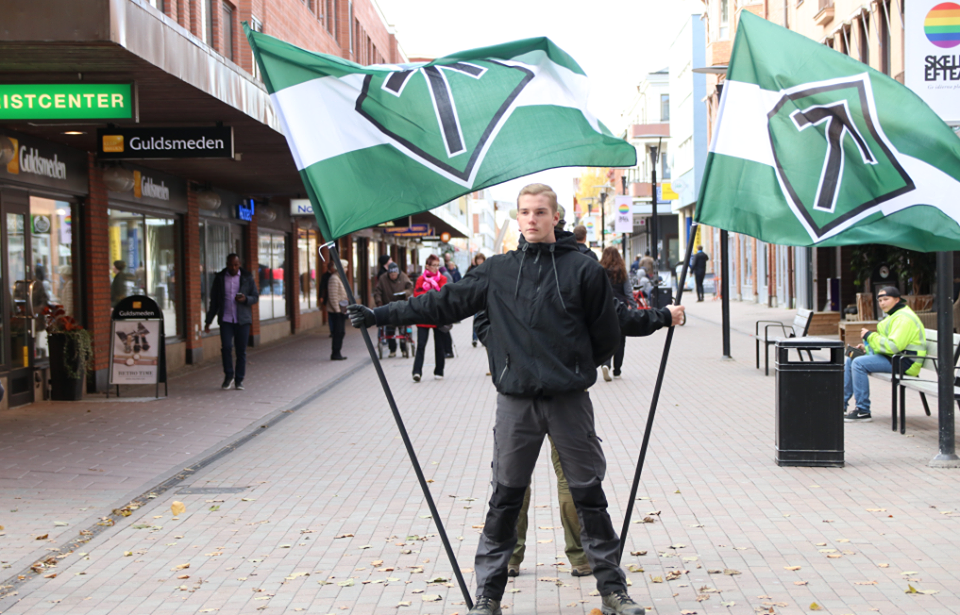
Malmö Has Eurovision Fever. Its Jewish Community Is Feeling the Heat

A visit to Sweden's third-largest city a few weeks before it hosts the huge song competition reveals that preparations for putting the Palestinian cause on Europe's biggest stage are at a fever pitch. 'People I know are taking off kippot and necklaces with Stars of David in public'

published in Haaretz: https://www.haaretz.com/world-news/europe/2024-03-24/ty-article-magazine/.premium/only-teardrops-malmo-has-the-eurovision-fever-its-jewish-community-is-feeling-the-heat/0000018e-708a-d8e8-a9de-7cbb53170000

MALMÖ, Sweden – On a wintry March day, Malmö gives the impression of a multifaceted port city. Fans of the crime series "The Bridge" are familiar with its architectural symbol, the long Oresund Bridge linking the city with Copenhagen in Denmark. But a visitor to Sweden's third-largest city can discover all kinds of architectural connections to historical and demographic processes.

Take the contrast between the medieval historic city center and the impressive modern port to its west, where shipyards and industrial zones have been replaced by luxury homes, with the Turning Torso skyscraper as the area's landmark – and the contrast with concrete apartment buildings constructed decades ago as part of the government's large public housing program, which have become home to immigrants.

In May, these areas will all be flooded with swarms of visitors to celebrate the 68th Eurovision Song Contest and shake off the remnants of the freezing winter. Patriotic groups will fill the 130-year-old Folkets Park, which will become the Eurovision Village. Members of the indefatigable Eurovision fan clubs will party at the EuroClub every night, and the residents will, of course, enjoy an economic and cultural boom.

Meanwhile, when asked what they think about the event, their answers sound like they're reading from a marketing pamphlet. They're pleased and are happy to welcome everyone. This answer echoes the city council's message and description of the event: "A lively celebration of openness and inclusion."

But in the two months before the Eurovision contest – which has become important to Israel after attempts to get it kicked out, as though an entire nation's honor rests on it– the city has been thronged with crowds of a completely different nature.

It began with celebrations in the city on the night of October 7, after the Hamas attack that saw civilians brutally massacred. Hundreds celebrated with music, dancing, and fireworks as convoys of honking cars passed by and people handed out candy. Since then, protests against Israel and its participation in Eurovision have not stopped in the city.

Midweek, Malmö's central Möllevången neighborhood, the focal point of the protests, is quiet. Around the neighborhood, which gentrification has changed from a working-class area to one characterized by hipsters, students, and multiculturalism, hang posters with slogans like "stop the genocide" and flyers calling for demonstrations. A supermarket shelf with avocados from Israel has a label with a Palestinian flag and the word "boycott."

A secondhand clothing store's display window has a big screen breaking down the number of dead in Gaza: how many children have died, how many people are wounded or buried underneath rubble, how many become orphans every day, how many mosques have been destroyed, how many medical workers have been arrested or killed. An Israeli flag appears next to each number, and postcards are available to send to the foreign ministers.

But weekends provide a much more dynamic picture. Protests with thousands of participants are regularly held here, with Palestinian flags and signs reading "free Palestine" and "end the Israeli occupation," speeches in which Israel is called a child murderer and don't mention the events of October 7, and catchy songs with choruses such as "Free Palestine – crush Zionism."

They do not appear to have lost their strength – unsurprisingly, given that Malmö, like nearby cities such as Helsingborgs and Landskrona, is the residence of tens of thousands of Palestinian immigrants. Some claim it's one of the most antisemitic cities in Europe. But anyone expecting to find only immigrants in the throngs of demonstrators will be disappointed. There are also Swedish retirees, activists from youth organizations, and young couples with strollers.

Mira Kelber

The Jewish community is unsettled by the protests. "Being a Jew in Malmö after October 7 is living in fear," says Mira Kelber, 24, who is chairwoman of the Malmö Jewish Youth organization. "I walk around with the thought that something might happen, and the only question is what will happen, to whom, and when."

There is no question that October 7 exacerbated the situation, and Eurovision provides a unique platform for protesting the war that followed the Hamas attack. But the Jewish community was already concerned about its safety beforehand, and you don't have to look at Eurovision for the start of Malmö's ties with the Palestinian cause.

If we were to search for a starting point, it might be found in the waves of immigration to the city in the late 20th century. By 2015, Malmö had become a major focal point of the refugee crisis in Europe. Since then, thousands of people have crossed the Oresund Bridge every day to seek asylum in Sweden. Today, people from over 180 countries live in the city. More than a third of its population of 362,000 was born outside the country. And in contrast to the rest of Sweden, half of the immigrants are below the age of 35.

Among the consequences of these demographic changes was an increase in antisemitism, most notably in demonstrations that have sometimes seen violent incidents. The list of such protests is long. In 2009, when Malmö hosted the Davis Cup tennis matches between Israel and Sweden, thousands of demonstrators gathered in the city. Several hundred extremists who were among them – Islamists, far-left activists, and neo-Nazis – rioted and clashed with police.

Over the years, other demonstrations have seen antisemitic chants that have been documented and discussed in the Swedish media. In 2017, the cry was "we're going to shoot the Jews," made at a demonstration against the relocation of the U.S. embassy in Israel from Tel Aviv to Jerusalem. In 2019, it was young activists from the Social Democratic Party shouting "crush Zionism" at the May Day Parade. In 2020, it was "Khaybar, Khaybar, oh Jews, Mohammed's army will return," a reference to the victory of Mohammed's followers over the Jewish tribes in the seventh-century battle of Khaybar, an inspiration to modern Islamist fighters.

Meanwhile, Jews in the city have experienced violence. In 2009, Molotov cocktails were thrown at the city's Jewish funeral home. In 2010 and 2012, firecrackers were thrown outside the synagogue and Jewish community center, breaking windows. In the following years, several complaints have been filed of verbal and physical attacks and harassment, and the community's sense of security has been undermined.

A 2021 report by the municipality determined that the city's schools were an unsafe environment for Jewish students, who were encountering verbal and physical assault as teachers chose to avoid confronting the assailants. Media outlets have also reported that Holocaust survivors are no longer invited to tell their stories in some of the city's schools because Muslim students disrespect them.

"Those who are born Jewish in Malmö grow up with the feeling that they have to protect themselves," says Kelber. "I'm publicly known as a Jew, but people I know are taking off kippot and necklaces with Stars of David in public."

The uneasiness doesn't just stem from harassment and hate crimes. Some of the city's residents of Palestinian descent have been involved in terrorism. These include Osama Karim, a son of Palestinian immigrants who was caught in Belgium after participating in attacks in Brussels and France in 2015 and 2016 and traveling to Syria to join ISIS. There have also been Palestinian Swedish groups that have been found to have ties to terrorist organizations. One of them, Group 194, had longstanding ties with the Democratic Front for the Liberation of Palestine, which reportedly took part in the October 7 attack.

In May 2023, less than half a year before the slaughter in Israel's southern border communities, a large pan-European Palestinian conference was held in Malmö with the participation of Palestinian Dutch leader Amin Abu-Rashid, who has links to Hamas. The Social Democratic Party, which was scheduled to attend, canceled when it learned about his attendance. One member, Jamal al-Hajj, attended despite being forbidden from doing so.

Concerns for Malmö's Jewish community haven't been eased by the fact that he is still a member of parliament and that quite a few people in the Swedish political system, academy, and cultural world are affiliated with Hamas, directly or indirectly. The result is that the city's Jewish community is shrinking.

These events look like another chapter in a long story. The community was founded in 1871, mostly by immigrants from Germany and Poland. From the late 1800s to the 1920s, it expanded through large-scale immigration, driven by poverty, antisemitism, and pogroms, from Poland, Russia, Ukraine, and the Baltic states. With Hitler's rise to power, the community absorbed more refugees, mostly from Nazi Germany, greatly expanding its social activity.

In the autumn of 1943, during World War II, Denmark's Jews were successfully smuggled to Sweden over the Oresund Straits by the Danish resistance. The Nazi occupation government in Denmark turned a blind eye. Along with other Holocaust survivors, several hundred of these Jews settled in Malmö after the war and became pillars of the community. In the late 1960s, almost 3,000 Polish Jews fleeing antisemitic persecution arrived in Sweden, with some of them settling in the Malmö area. The community's size peaked at 3,000 people in the early 1970s. The city now has 1,500 Jews, of whom only 534 are active members of the community.

Roko Kursar, photo: Liberalerna

"The issue of antisemitism is a global problem and in Malmö we have been aware of the problem locally for a long time. That's why we've been working on combating antisemitism in a structural way for a long time," says Roko Kursar, one of Malmö's deputy mayors and a member of the city council from the Liberal Party. "Antisemitism in Malmö didn't start after October 7. … We have a collaboration and cooperation with the Jewish community: we have put in resources, formed a steering committee which forms an action plan for every year. We also want to strengthen Jewish life, Jewish identity and Jewish culture in our city, and this is a wide cooperation which has been going on for over four years, and last year we extended this for another four years."

Can you explain?

"For example, we have coordinators in our schools with the job to combat antisemitism… We have also allocated a couple of extra million euros for work on conflict and crisis management in our schools… The work that was put in before October is a basis to gear up and face the challenges, like members of the Jewish community feeling insecure. The solidarity with the Jewish community in Malmö is widespread. We've had 'kippah marches'" – joint marches by Jewish community leaders and national or local political leaders in which they wear kippahs, held in Stockholm and Malmö since October 7 – "and we've had manifestations of solidarity from all sides of the political spectrum joined by citizens showing solidarity with our Jewish brothers and sisters. … Malmö is a very international and multicultural city. … That means we have backgrounds and ethnicities from all over the world, including places which are conflict-torn and war-torn, and many citizens of Malmö are affected by this. We have to always continue the work and be prepared to gear it up."

It may be time to speed things up. "There is fear within the Jewish community these days, especially when it comes to schoolchildren," says Fredrik Sieradzki, spokesman for the local Jewish community and director of the synagogue's Jewish learning center, which teaches locals and visitors about the community. "People are reluctant to say that they are Jewish, and some hide Jewish signs in public. All this isn't new, but it's much worse now. There is a strong sense of being alone. We have wide social circles, but a lot of people have the feeling that many in their social circles are turning against them. There's a lot of unfriending on social media, friends share antisemitic propaganda and so on. This has been a shock for many."

Fredrik Sieradzki, spokesman for the local Jewish community and director of the synagogue's Jewish learning center.
Fredrik Sieradzki, Malmö Jewish community spokesman and director of synagogue's learning center

Kelber describes similar feelings. "When we recently had a Shabbat dinner at the synagogue, people told me that they were afraid to even be near the synagogue." She says that every time she looks at her phone, she encounters antisemitism. "An Instagram account we opened under the name Proud Jew, for example, is filled with pig emojis and videos from Gaza with the question, 'Are you proud of this?' People do not distinguish between Israel and Jews and there are many influencers and celebrities who publish terrible things."

One of the examples Kelber is referring to is Stina Wollter, a highly prominent Swedish artist, radio host, and activist. Wollter wrote on her Instagram account, which has over 300,000 followers, that the Swedish media was not telling the truth about the conflict in Gaza and was ignoring the "fact" that Israel steals organs from dead Palestinians, that Israel lied about rapes and babies being beheaded on October 7, that Israel killed its own citizens by shooting at them from helicopters at the Nova music festival, and more. "We read in the newspaper about swastikas graffiti and attacks on Jews, a few days after October 7, Hamas published a call to attack Jews in the world, and many students simply did not go to university that day. There is always the fear – when will this happen to me," Kelber says.

The controversy surrounding Israel's participation in Eurovision, and then around the first version of its entry for this year's contest, "October Rain" – which, very symbolically, turned into "Hurricane" – certainly did little to allay the fears. "We are aware … that there are risks and security needs and restrictions here. Still, Malmö is a city that should be able to host everyone, including Israelis, so I hope the city will step up," Sieradzki says. "It's reassuring that the city is investing many resources in the event which is important to us all."

Kelber is less official sounding. "When Sweden won last time and when we heard that the Eurovision would be held in Malmö, we were very happy. I love the Eurovision and I would really like to be part of the party. But after October, I'm not ready to risk it. I won't participate" in the celebrations surrounding the event, she says, adding that her friends are also afraid. "We always doubt, and I don't feel like I want to risk myself for the Eurovision. In the past I was optimistic about a Jewish future in Malmö, I thought there were much worse places. But now, unfortunately, I'm not sure I can be optimistic. … [Eurovision is] supposed to be an event of joy and love, but for us it's about fear."

Do you have a message for [Israel's Eurovision entry] Eden Golan and the Israeli delegation?

"Yes, stay safe."

This is far from Malmös first encounter with Eurovision. It was the host city in both 1992 and 2013. "When we had all the options on the table, we conducted a thorough assessment considering many factors. And this time, once again, all the pieces fell into place in Malmö," Ebba Adielsson, the executive producer of Eurovision 2024, says. The city, she says, has the necessary "infrastructure, new meeting places and one of Sweden's best arenas. … In Malmö there is also a great commitment and a great deal of experience in hosting Eurovision."

Has the Swedish production team discussed the fact that there are large Palestinian protests on a regular basis in Malmö and that these may affect the event?

"We understand and are aware that people are making their voices heard on this issue and we are prepared for protests that may occur in connection with the event," Adielsson says.

Despite these assurances, Kelber says she was relieved when news emerged that Israel might not participate this year. Not everyone is happy that Israel is still set to do so. A group of residents has filed a motion asking the city to disqualify the Israeli delegation, which will most likely be debated in April. The Left Party is the only one in the city council that is expected to support the proposal, whose value is mainly symbolic in any case. The city has no authority to act on the matter beyond contacting the European Broadcasting Union.

Nina Jakku is a Left Party member of the Malmö City Council and the party's political secretary in the city. She says that the motion is a citizens' initiative, not a political one. We speak in her office, which is decorated with a large picture of Karl Marx and posters of Palestinian flags and slogans. "The Left Party supports the initiative by saying that it would be a good statement from the city of Malmö to say we don't wish for Israel to participate in the Eurovision."

Why shouldn't Israel participate, actually?

"It's about the situation in Gaza. The International Court of Justice is asking Israel to take immediate and effective measures to prevent a genocide and Israel has not even taken the bare minimum. Perhaps it has even done the opposite. The question should be how can we go on with business as usual."

Assuming that Eurovision does go on as usual, what are the Left Party and related movements planning to do as a protest during the song contest in May?

"The city of Malmö can't make a decision not to allow Israel's participation, but … there is a broad movement which is planning demonstration, a boycott campaign, and other protest events which in a sense have already started. We are part of that in the broader context," Jakku says.

That broad movement seems to be gaining momentum. Over 1,000 Swedish musical acts, including Robyn, Fever Ray, the folk duo First Aid Kit, and some of the singers who participated in Melodifestivalen (the competition that determines Sweden's Eurovision entry) signed an open letter demanding that Israel be barred from this year's competition over its "brutal" war in Gaza.

The letter, which was published in the Aftonbladet daily in January, states: "We believe that by allowing Israel's participation, the European Broadcasting Union is exhibiting a remarkable double standard that undermines the organization's credibility. … The fact that countries that place themselves above humanitarian law are welcomed to participate in international cultural events trivializes violations of international law and makes the suffering of the victims invisible."

From the Malmö.for.Palestine Instegram account

The musicians are hardly alone. Many social media groups are calling for a boycott of Israel and protests against its participation. One of them, Malmö for Palestine, is calling for weekly demonstrations outside city hall. In a message posted on Instagram, an illustration of an Israeli soldier with a microphone and a cable made of razor wire appears next to the slogans "remove Israel from Eurovision" and "stop the genocide in Gaza." The soldier is standing at the entrance to the Eurovision stage door, and his gun drips blood onto a large puddle that has already accumulated beneath him.

Nina Jakku's colleague at the city council, Anfal Mahdi, has also called for Israel's disqualification. "Belarus got a 'No' in 2021, Russia got a 'No' in 2022, Israel can also get a 'No' in 2024," she wrote on her Instagram account. "We've all seen how Israel starves and bombs Gaza. Children undergo amputations without anesthesia, the health services are bombed and smashed to pieces. There is no water, no food and no electricity for the residents of Gaza. Malmö should not celebrate with terrorist states." In a different post, Mahdi added: "Being political for Ukraine but not for Palestine is pure racism."

"I think there is no reason to compare wars or occupations, they are all horrific, wherever they are," Jakku says when asked about the comparison of Israel to Russia regarding Eurovision. "Still, the decision not to allow Russia to participate was correct and it would be correct not to allow Israel to participate too. In that sense it is comparable."

Do you take into account the effect of the demonstrations on members of the Jewish community in Malmö? Are you aware of the claim that the pro-Palestinian demonstrations in the city include antisemitic content?"

"I hope everyone will be safe to visit anywhere they want to in Malmö . I do agree that there is a big concern when it comes to antisemitism in Malmö . Every antiracist should be concerned about that situation. But I have been participating in massive protests in Malmö almost every week since October and in these demonstrations, there are no signs or slogans that can be classified as antisemitic. The protests are against war crimes, about genocide and what's happening in Gaza. They're asking for a cease-fire and raising concerns about the violence and killing of civilians. Antisemitism in Malmö and the protests against Israel, of which [the latter] are totally legitimate, are two entirely different things," Jakku says.
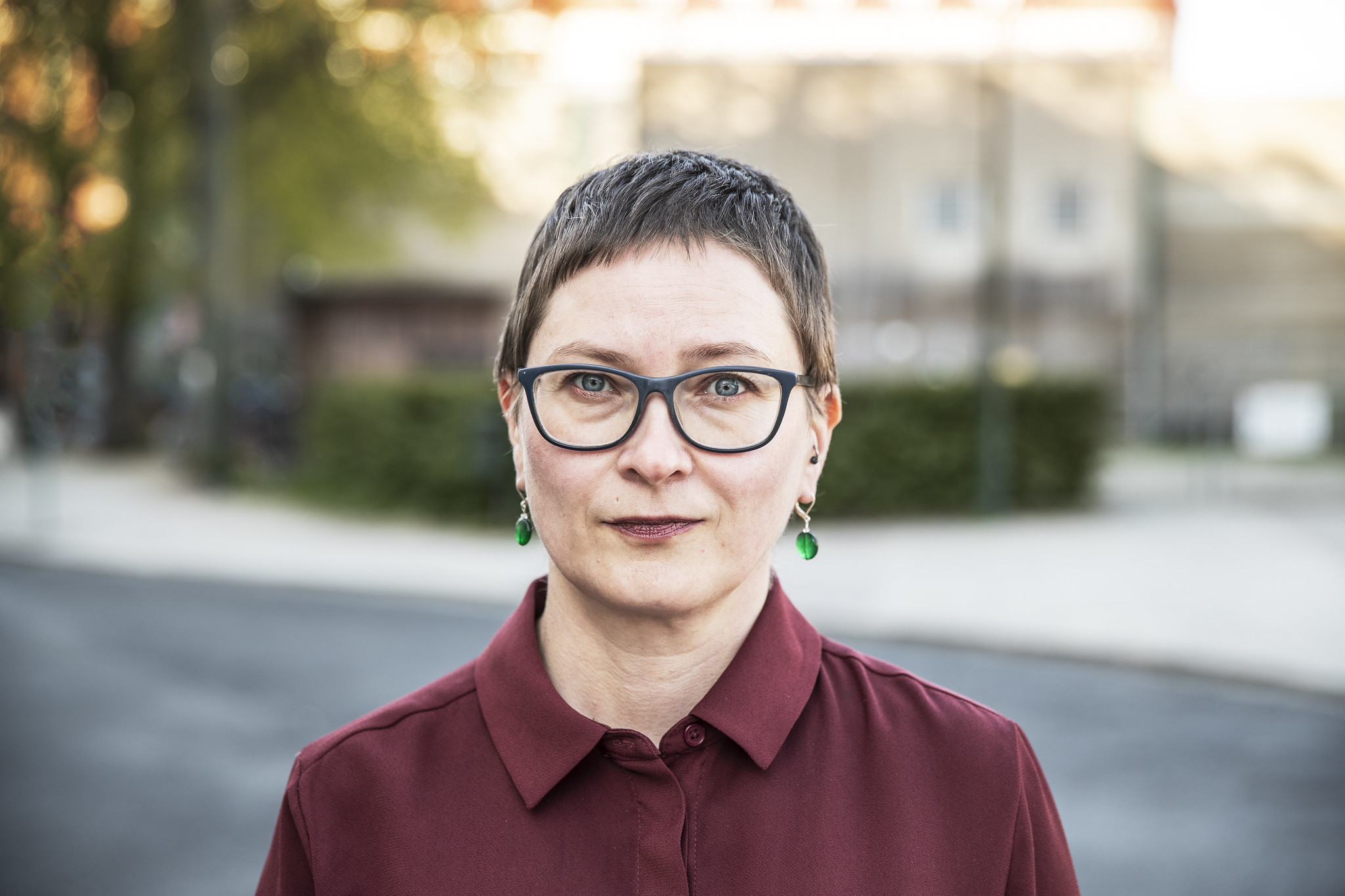
Nina Jakku, photo: Emmalisa Pauli

What about the burning of the Israeli flag outside the synagogue and the spontaneous demonstrations on the evening of October 7 that praised the massacre and Hamas?

"There have been some protests that have been totally unacceptable. But if you look at the total amount of people and demonstrations, the flag-burning was just one occasion, with only a couple of people involved. There have been some other occasions that can be seen as inappropriate, but we have taken part in protests against burning the flag and we have to be able to hold two thoughts in our head at the same time," she says – that is, to support the protests against Israel while also ensuring nothing inappropriate happens.

Doesn't excluding singers, dancers, and those who love Israeli music hurt precisely Israelis who are open to criticism and destroy the chances for dialogue?

"The question implies that there are two equal parts that can engage in a dialogue; that there's a possibility of a dialogue. But as far as I can see, that's not the case in the past 75 years. What we have is a military occupation that is using massive violence, and the people of Gaza don't have the possibility of dialogue with those who oppress them. The boycott is a possibility for the rest of the world to put pressure on Israel and we need to use it. As I understand, there are also some Israeli organizations calling for a boycott. The boycott isn't against an individual. It's the State of Israel that's the target."

The situation, certainly since October 7, is not a situation where one side is strong, conquering, and oppressive. There are victims on both sides. Israel has more than 1,000 civilian victims, including more than 200 hostages, some of whom are still in Gaza. Isn't your protest one-sided?

"The massacres in Gaza are going on now, and that is what we're trying to stop. I'm not questioning feelings or other victims, it's not my place to do so, but the people in Gaza are starving, tens of thousands have been murdered in five months, the International Court of Justice has called to prevent a genocide and other organizations are talking about war crimes which are going on. Unfortunately, we can't change what happened on October 7, but nothing justifies business as usual, as the Israeli bombs are killing civilians in Gaza month after month."

It has been reported that the Left Party's foreign aid organization, Left International Forum, has for years, via its Danish partners, cooperated with the Democratic Front for the Liberation of Palestine. It is also known that the party had tight connections with Group 194 and similar organizations that, according to many reports in Swedish media outlets, also supported the DFLP, spread antisemitic propaganda, and supported armed resistance against Israel. In light of the current war, does the party still support these partners and their messages, or has the party changed its policy on this?

"Regarding [Left International Forum], their statement has been that they take responsibility and their task now is to make sure that something like this never happens again in our organization. When it comes to the other groups, I don't have any further information."

What is almost certain to happen, as Jakku says, is protests against Israel being part of Eurovision. Other Palestinian solidarity organizations in Malmö didn't respond to inquiries from Haaretz, but they are presumably planning major protest activity in the city during the song contest in May. Are measures being taken to prevent attempts to use the live broadcast as a platform for political protest, perhaps by planting large numbers of political activists in the audience with propaganda items like signs and flags to wave before the cameras?

"One of Eurovision's fundamental values is to be a nonpolitical event where everyone is united through music," says Adielsson, the song contest's executive producer this year. "[W]e always go through potential/prospective and conceivable scenarios and … take measures to avoid political expressions during the live broadcasts."

Were the musicians and members of the delegations told that they are not allowed to express political opinions before, during, and after the show, as the competition rules state?

"The European Broadcasting Union is responsible for the rules regarding the Eurovision Song Contest, [which] state that it is a nonpolitical event. For further information or questions on the topic, please contact the [union]."

City officials were similarly cautious and terse in their responses. "I heard that the Eurovision is the second largest TV show in the world after the Super Bowl, so obviously having it here in Malmö is important to us," says Kursar, a deputy member and council member. "But it's not the first time this is happening; we had the Eurovision in Malmö in the early 1990s and again in 2013. From the city's perspective, it's a very important event. … We're looking forward to having an inclusive, welcoming, and sustainable song contest," Kursar says.

I understand that despite the inclusive competition, less inclusive demonstrations are expected surrounding it. Let's say anti-Israeli protests with extreme expressions of antisemitism.

"[W]e have freedom of speech and freedom of protest in Sweden, and this is a question for the police to answer and decide on. The police are responsible for questions regarding public order, and we have a very good dialogue with the police."

Overall, the city government puts forward a united front of full trust in the police. It's a matter for the police, the city's director of safety and security, Per-Erik Ebbestahl, concurs. In any case, he adds, officials aren't aware of any concrete threats.

The police have ways to avoid eroding Jewish audiences' sense of security, such as refusing to approve a protest location or changing it, Ebbestahl says. He says the city is responsible for security at the events in which it is the main organizer and that there is no upper limit to the budget put into it.

Nevertheless, on the Israeli side, no one is taking chances. Although things are still under review, says a person familiar with the country's preparations for Eurovision, there will clearly be very stringent restrictions on the delegation, and it will be absent from events that other delegations attend, such as media appearances, public relations events, and parties.

It is Israel's ambassador to Sweden, Ziv Nevo Kulman, who sees less reason for anxiety. He says that despite Malmö's image as a place that is hostile and dangerous for Israelis, he knows another side of the city. "I was in Malmö during the 2021 Malmö International Forum on Holocaust Remembrance and Combating Antisemitism," Nevo Kulman says, "and I saw how this city knows how to deal with major international events. Not all of Malmö is against us, and not all of Sweden is against us.

"It is true that [Eurovision] is a complex event in which there can be provocations, protests and demonstrations, but I trust the Swedish authorities to take the challenges seriously and those responsible for the competition itself and the members of the delegations to ensure that the rules of the competition are respected and that no politics are brought into it. So, on the one hand, it may well be that Israelis, Jews, or members of the LGBT community, who usually support Israeli music, will not feel comfortable walking around Malmö with Israeli flags. But from what I hear, the Swedes are opposed to ostracism and only on the extreme left are there calls against Israel, for populist reasons. Most of the Swedes I've spoken to said they are against mixing politics and music and that they are happy that Israel is participating."

In general, says Nevo Kulman, a die-hard Eurovision fan and Israel's official representative, if it weren't for the political issue, he has no doubt that Israel would reach a respectable place in the final contest. "The song is excellent, Eden is amazing, and the performance is great," he says.

Are you willing to bet on Israel's final position?

"Let's wait and see."

Top Members of Far-right Swedish Party With neo-Nazi Roots Meet Israeli Minister in Knesset

Israel has so far refrained from engaging with the Swedish Democrats amid antisemitic and Islamophobic sentiments expressed by members. Party members told Haaretz that they met with several ministers during their visit but refused to disclose their names.

Published in Haaretz (with Jonathan Lis and Noa Shpigel): https://www.haaretz.com/israel-news/2024-01-29/ty-article/.premium/top-members-of-far-right-swedish-party-with-neo-nazi-roots-meet-israeli-minister/0000018d-564e-d0fc-a9bd-5e5f9ff00000

A delegation of senior members from the far-right party in Sweden, the Swedish Democrats, arrived in Israel on an unofficial visit and met on Monday with Israeli Diaspora Affairs Minister Amichai Chikli in the Knesset.

The party, currently the second-largest in the Swedish parliament, has roots in neo-Nazi and antisemitic ideologies. It is one of several European parties with which Israel has refrained from establishing official ties.

The delegation has visited Yad Vashem, one of the crossings connecting Israel to the West Bank, and the Old City in Jerusalem. Yad Vashem Museum has emphasized that the delegation members registered for a regular guided tour at the site, like any other tourists, and did not have an official visit within the compound.

Officials in Sweden following the party suggest that the visit is part of its attempt to whitewash its antisemitic and racist positions by presenting itself as a friend of Israel. In a post on the social media platform X (formerly Twitter), the party leader, Jimmie Akesson, wrote: "It is clear that our parties and our nations share common values," accompanied by a photo of himself with Minister Chikli.

Party members told Haaretz that they met with several ministers during their visit but refused to disclose their names.

Israel has so far refrained from engaging with the Swedish Democrats not only due to their neo-Nazi roots but also because members of the party have disseminated conspiracy theories and expressed racist, antisemitic, and Islamophobic sentiments in recent years.

Israel's Ambassador to Stockholm, Ziv Nevo Kulman, even declared that Israel does not maintain and will not establish future relations with the party. The Israeli foreign ministry, which was not involved in coordinating the visit, clarified on Monday that "there is no change in policy towards the party."

Among the delegation members who visited the Knesset were party leader Akesson, the chairman of the Swedish parliament's foreign affairs committee, Aron Emilsson, the head of the party's parliamentary group, Linda Lindberg, and the head of the party's group in the European Parliament, Charlie Weimers.

Weimers is one of the party's top members who already visited Israel in May of last year. During the previous visit, it was reported that party leaders met with Knesset member Amit Halevi from Likud and former Knesset member Michael Kleiner, who now serves as the president of the Likud's court.

Though part of the Swedish political establishment today, the Sweden Democrats do indeed have roots in Nazism. Some of the party's founders were known Nazis, such as its first auditor, Gustaf Ekström, who was a Waffen-SS veteran.

The party's first spokesperson Leif Ericsson and its first chairman Anders Klarström were both active in various neo-Nazi and extremist right-wing parties, and the chairman of the party's youth organization, Robert Vesterlund, was also a known neo-Nazi. During the 80's and 90's, the party was a marginal force in Swedish politics, and it began distancing itself from extremism and aligning itself closer to mainstream politics in the mid 90's.

The party entered the Swedish parliament for the first time in 2010, and in the elections held a year and a half ago, it received over 20% of the votes. Until a few years ago, the party was ostracized by parties across the political spectrum in Sweden and was not considered for inclusion in any coalition.

However, due to a change in approach by two traditional right-wing parties, the Swedish Democrats became an integral part of the right-wing bloc after the elections, with the government in Stockholm entirely dependent on their support. Party members wield significant influence over the government's policies and hold key positions in parliamentary committees, including foreign affairs, justice, and industry and trade.

In recent months, the party has been attempting to position itself as "the most pro-Israel party in Sweden" and distance itself from its antiemetic and neo-Nazi past. However, in 2021, the Swedish newspaper Aftonbladet revealed that the party leader in the second-largest city council in Sweden, Gothenburg, Jörgen Fogelklou, had posted antisemitic and racist statements on social media, such as "It is clear that the Jews are the root of all evil in the world."

Two years ago, it was exposed that some party members had connections with neo-Nazi movements even in recent years. For instance, one party member in southern Sweden, Jonas Lingren, publicly supported rock bands advocating for "white supremacy" and used the slogan "Skinhead 88" (88 is a known code for Heil Hitler, i.e., HH).

Antisemitism in Malmö: from a Swedish Symptom to an European Symbol?

Malmö, the large city in southern Sweden, has been in the headlines in recent years because of expressions of antisemitism. This is the story of the slow awareness of local and national authorities and the measures taken to deal with the problem. Could Malmö's experience be of any value for the whole of Europe, where many large cities are facing similar problems.

Punlished in K. Magazine: https://k-larevue.com/en/antisemitism-in-malmo-from-swedish-symptom-to-european-symbol/

Those who believe in the old saying “there’s no such thing as bad publicity” would do well to study the case of Sweden’s third largest city – Malmö. Home to some 350,000 people, it‘s not particularly big, it’s not Sweden’s oldest or most beautiful city and it’s not exceptionally cheap or expensive to live in. Still, in the last few years it made an international name for itself, though perhaps not the name its leaders were hoping for. Instead of being praised for Västra Hamnen which claims to be Europe’s first carbon neutral neighbourhood, for its multiculturism or for the Turning Torso building, Scandinavia’s highest skyscraper, Malmö is known around the world for a much less appealing feature – antisemitism.

The new antisemitism of Malmö

It’s hard to say when or where it started. Antisemitism isn’t a new phenomenon in Sweden. In fact, it was there even before the first Jewish communities were founded in Stockholm and Marstrand near Gothenburg in the late 18th century. Towards the end of the 19th century and the beginning of the 20th, official state restrictions and discrimination slowly disappeared, but antisemitic ideology and propaganda could be found throughout both the old political establishment and newly founded neo-Nazi and fascist movements. Surprisingly, the end of WW2, which left neutral Sweden relatively unharmed, wasn’t the end of Swedish Nazism. Quite the opposite. After the war Sweden became host for many racist, nationalist and fascist movements. While the political elite was gradually embracing universal values and continuing to develop a social-democratic welfare state, the extreme right on the margins of Swedish society was, and some say still is, flourishing. Neo-Nazi skinheads, antisemitic publishing houses and movements based on pre-Christian imagery that promote nationalist, racist and anti-establishment ideas became an integrate part of Swedish society.

Malmö played an interesting role in this story during the final stages of WW2 and the following years. On one hand, this was the city that became a safe haven for Danish Jews who arrived at its shores after crossing the Öresund strait fleeing the Nazis in 1943. This is also where the Swedish Red Cross’ “White Buses” arrived in 1945, carrying survivors of the Nazi concentration camps. On the other hand, this was the home of the so-called Malmö Movement, which played a central role in the rehabilitation of Europe’s extreme right, back in the 1950’s. The movement’s leader Per Engdahl took a leading role in the project of connecting the remnants of fascist and Nazi movements from all over Europe and forming a political network which published literature, organized conferences and created an escape route for Nazis from Europe to South America. The center of all this was Malmö were Engdahl lived and worked. But all this is ancient history.

For over ten years now, Malmö has become, in the eyes of many, a symbol of a new kind of Swedish antisemitism. While right wing extremism is still dangerous and threatens Jews in Malmö just like anywhere else, in the last few years an imported antisemitism originating in the Middle East and Islamist environments has taken over. In Sweden, the combination of the two proved itself particularly worrying and Malmö is sometimes seen as the center of it all. In 2012 an explosion shook the Jewish community center. In 2009, Molotov cocktails were thrown at the local Jewish funeral home. In the same year Malmö was the scene of what is now known as the Davis Cup riots. As Israel and Sweden were playing an official tennis match, thousands of anti-Israel demonstrators took to the streets and the protest developed into physical and verbal attacks against the city’s Jews and law enforcement forces. At the time, former mayor IImar Reepalu, was accused of being part of the problem, rather than part of the solution when he said to a local daily that “We accept neither Zionism nor antisemitism which are extremes that put themselves above other groups”. But problems didn’t stop when Reepalu was replaced in 2013. Pro-Palestinian demonstrations, especially during periods of conflict in Gaza, continued to feature heavily antisemitic slogans, signs and rhetoric.

When I visited the city in 2015 in order to write a report for “Haaretz” I spoke to a few members of its Jewish Community. Those were the days when hundreds of asylum seekers were arriving every day, mainly from Syria and Afghanistan, crossing the bridge from Copenhagen and arriving at Malmö which became their Swedish port of arrival. As authorities in Sweden were struggling with challenges of housing, employment, education and integration, many in Malmö were worried. “There is fear and harassment on a daily bases”, one woman who immigrated from Israel to Malmö decades ago told me. She claimed that authorities were doing nothing against the daily harassment and the incitement from local mosques. “I’m not against accepting asylum seekers”, another community member told me, “one should not close the door to people in need of help, but this is what happens when we want to solve one problem by creating a bigger one. We need to use our heads, not only our hearts”. After this, I returned to the city on several occasions and reports continued to be troubling. Some claimed that Jewish families were leaving the city because they no longer felt safe. In 2021, a report commissioned by the municipality described Malmö schools as an unsafe environment for Jewish students who suffer from verbal and physical attacks while teachers prefer to avoid conflict with the aggressors. Other reports claimed that Holocaust survivors are no longer invited to tell their stories in certain schools in Malmö because Muslim students treat them disrespectfully.

Malmö at the center of the world

As a response to all this, Malmö’s Jewish community which has existed since the 1870s and now has two synagogues, a community center, a variety of educational activities and just under 500 members, decided to speak out. Now it became harder for the Swedish press to ignore the problem and the picture it painted wasn’t a pretty one – the reports included children who had to put up with their schoolmates burning Israeli flags, making threats and praising Hitler, youngsters who were suffering from bullying and threats of rape and murder on social media and Jewish teachers who were told to put up with the harassment and keep a low profile. These are all well documented facts. They are based on resident’s testimonies, information collected by journalist, NGOs and authorities and studies conducted by serious researchers. But when it comes to Malmö there seems to be a layer of mythology covering the facts. This is the Mythology that gave Malmö unflattering titles like “Sweden’s antisemitism capital” or even “Europe’s most antisemitic city”. During the last few years, reports on Malmö, mainly in the international press, became full of stories about so-called honor killings, forced marriages, polygamy, female genital mutilation, parallel societies, riots, organized crime of ethnic clans and no-go zones in which local criminals have taken over and police and authorities cannot operate.

All this seemed to go hand in hand with the reports on antisemitism and although many of the reports in the media were true or at least based on some aspect of reality, others were extremely exaggerated, taken out of context and, more importantly, highly politicized. This is where Malmö became part of the global list of “greatest hits” for everyone who was spreading stories and conspiracy theories about Sharia law taking over Sweden, Sweden becoming the “rape capital of the world” and Sweden as proof of the “Great Replacement Theory”. With these reports, the attention of the Jewish world was turned towards Sweden and in 2010 the Los-Angeles based Simon Wiesenthal Center started advising Jews to not visit Malmö. With the populist right in Sweden growing stronger, integration of immigrants from the Middle-East becoming harder and the Israel-Palestinian conflict growing closer, Malmö‘s small Jewish community suddenly became a symbol for all the problems in the world, even if a reluctant one.   

Public authorities react

It’s hard to say if the situation in Malmö is really as bad as it’s sometimes portrayed in foreign media, or if it’s really that different from the situation in other Swedish cities or any other multicultural European city for that sake. Still, at some point local authorities and the government in Stockholm realized they have a serious problem. The situation in Malmö, whether exaggerated by the press or not, was making Sweden look bad. But it was more than that. In the last couple of years, I have spoken about antisemitism with the Mayor of Malmö, Sweden‘s Education Minister, Foreign Minister and former Prime Minister (all Social Democrats) and there is no doubt in my mind that they were all troubled by antisemitism and dedicated to the fight against it. For them, this is not only a PR problem. This doesn’t necessarily mean that their efforts were 100 percent effective, but at least their concern was sincere. Last October, When I interviewed Katrin Stjernfeldt Jammeh who has been Mayor of Malmö since 2013 she said that she realizes that Malmö isn’t vaccinated against antisemitism. “It’s a problem we’re addressing” she said, “we talk about it more today and, when you talk about it, it seems like it’s a bigger problem than it does if you don’t talk about it. But for me, (the image) is not important. The only thing that’s important is that we attack the problem and create change”.

Asked to detail what the city has done to confront the problem in the eight years she has been in charge, she said she has been working to combat antisemitism and racism since the day she was elected by “working with our citizens in various different set-ups, working with the Jewish community in several ways to map the problem, to create an understanding of the problem and, today, we have a long-term commitment”. She added that the city is investing more than 2 million Euros over four years. “This is not just a small project this year or next year”, she explained, “it’s a commitment to work in the long-term to create better conditions for the (Jewish) congregation, to enhance security and create knowledge. We’re also working within our school system, mapping the problem there too, and creating different ways to prevent prejudice”.

On the national level, former Prime Minister, Stefan Löfven, made the struggle against antisemitism and Holocaust remembrance a major part of his political legacy. Here too Malmö played a critical role. Last October Löfven and the city of Malmö hosted a special conference – The Malmö International Forum on Holocaust Remembrance and Combating Antisemitism. Although the conference dealt with a much wider issue than the concrete problems of Malmö’s Jewish community, it caught the attention of many around the world as heads of state and governments, researchers and representatives of private and civil society organizations engaged in what the Swedish government called an “action-oriented” program. The idea was that delegations from around the globe would present pledges of “concrete steps forward in the work on Holocaust remembrance and the fight against antisemitism”. The Swedish government, for example, promised to build a new Holocaust Museum, to criminalize organized racism, to contribute to the Auschwitz-Birkenau Foundation, to appoint a government inquiry on a strategy to promote Jewish life in Sweden and to “significantly increase” the funding for “security enhancing measures for civil society, including the Jewish community from 2022”.

The Malmö Forum took place just over twenty years after the original Stockholm International Forum which was initiated by one of Löfven’s predecessors, former Swedish Prime Minister Göran Persson. This was the beginning of the international partnership to fight antisemitism and promote Holocaust remembrance and it led to the “Stockholm Declaration” which is the founding document of the International Holocaust Remembrance Alliance (IHRA). When I spoke to Löfven a few weeks after the conference he told me that the Malmö forum was “all about commitments, not about speeches”. He then explained that there were two kinds of commitments: “first, never to forget, which is why different countries undertook to have various memorial events and memorial sites, and second, the fight against antisemitism, which is also about commitments. In our case, this means doing more in schools, investing more in research so that we have a better understanding of the forces behind antisemitism and so on. We want to spread this to other countries, organizations and companies, such as social media companies for example. Everyone can make commitments. Individual schools can commit, more companies can make commitments, sport organizations can make commitments. That’s the way to address these issues”.

The limits of political mobilization

The Malmö Forum made some headlines and brought Malmö some positive attention for a change. But are these national and international initiatives, which are discussed by high-ranking politicians, business leaders, journalists and international organizations making any difference on the local level – in the streets, the squares and the schools of Malmö? That depends, naturally, on who you ask. Some local opposition politicians, for example, were skeptical even before the conference started.  “It’s obvious we have a huge issue with antisemitism and it’s affecting people’s everyday lives in Malmö”, Helena Nanne the deputy chairman of the center-right Moderate Party in City Hall told me a few days before the Malmö Forum convened, “For families with children at school, the situation with antisemitism is a major issue, and we hear stories of families who choose to move because they don’t feel safe and can’t be sure the school will be safe for their children”. Nanne wasn’t opposed to the international forum as an idea but she claimed that the Social-Democrats who were organizing it had a home-made antisemitism problem. “This city is run by a party that has had a problem with antisemitism in its own organization”, she said, “It’s hard to take commitments they make seriously”. Another opposition politician based in Malmö, Ilan Sadé, who leads the right-wing Citizens’ Coalition party, was even more critical. “I’m not against the forum taking place in Malmö”, he said, “but this might just be an attempt to improve Malmö’s image. There’s a problematic connection between the Social Democrats and the immigrant population in neighborhoods like Rosengård (a Malmö neighborhood known for its immigrant population and gang-related crime, D.S). The Social Democrats have very wide support there, and they don’t want to lose it; they need to keep the balance. And of course, there are also many people from Arab countries who are party members. There were incidents like the one when members of the party’s youth league were heard shouting slogans like ‘Crush Zionism’ at demonstrations. That’s at least borderline antisemitism – they don’t shout that against other countries”. Sadé alleges that there is a lack of determination to prevent, stop and prosecute hate crimes in Malmö. “The police file on the attacks against the Chabad rabbi of Malmö is as thick as a Dostoevsky book”, he told me, “there are about 160 to 180 cases registered: anything from spitting on him to cursing and harassing him. This is absurd. In Sweden, a religious leader should be able to walk down the street. Priests can do it, imams can do it, so why not a rabbi? This should be prioritized, and it isn’t”.

Another way of approaching the problem does indeed involve both an imam and a rabbi. Imam Salahuddin Barakat and Rabbi Moshe David HaCohen, both based in Malmö, founded an organization which aims to create a trusting society while working to counter discrimination. The organization, Amanah, believes that deepening of identity and roots are key elements towards reaching their goal and it focuses on countering antisemitism and islamophobia within all levels of society – schools, universities, communities and official representatives. I spoke to rabbi HaCohen on the morning the Malmö Forum started and he told me that he appreciated the Swedish government‘s efforts even though not much attention was paid to Malmö itself since the forum was happening from the top down. His organization, on the other hand, is more of a grassroots one. HaCohen spoke about school programs combating racism that Amanah was promoting as well as a digital project that simulates dealing with antisemitic situations and the efforts the organization makes to address Holocaust denial in schools and monitor social media that can potentially “poison the minds of 9- and 10-year-olds”. Hacohen already sees some results to the interfaith dialogue. “During the last Gaza conflict (in May 2021), there was increased tension in the city, as we’ve seen in the past”, he remembered, “since there’s a large Palestinian community here, there were demonstrations against Israel, and as usual some of the protesters started to shout antisemitic slogans. But this time, these people were removed by imams who left their comfort zone and protected their Jewish neighbors. In the same way, we stood alongside our Muslim neighbors when supporters of a far-right Danish politician who was denied access to Sweden filmed themselves burning and kicking the Koran in the streets of Malmö”.

The people of Amanah aren’t standing alone. Other organizations and municipal leaders are doing their best to deal with the problem of antisemitism in the city. The Jewish community recently opened a new learning center that has been working with local schools. City Hall is working with the Swedish Committee Against Antisemitism to arrange trips to the concentration camps in Poland and its partnering with local football clubs to help them deal with racism and antisemitism. The city has also appointed a special coordinator to work on the problem of antisemitism in Malmö’s schools. The coordinator, Miriam Katzin, a Jew herself, a lawyer and a left-wing politician, gave an important perspective when she spoke to the Swedish Expo magazine just over a year ago. “There’s an antisemitism problem in in the whole of society which expresses itself in different ways”, she said, “I think it’s convenient for the majority of Swedes to turn to Malmö and place antisemitism there as the fault of groups that don’t belong to the majority. But that’s making it easy for themselves. The antisemitism I grew up with was expressed by regular majority swedes. That antisemitism is still alive, but it’s often overlooked. One wants to make antisemitism to be a problem of the others”. According to Katzin immigrant groups are blamed for antisemitism as part of this tendency, the right blames the left for being antisemitic and the left blames the right, while in reality antisemitism is a general social problem and it’s “deeply problematic to engage in a competition about who are the worst antisemites”.

This is indeed one of the most serious problems regarding antisemitism in Malmö and in many other European cities. The understanding that it still exists in this day and age is a depressing thought as it is. The thought that it’s not limited to one side of the political debate or to one particular social group, region or culture makes it even worse. Once one realizes that hatred of Jews is a problem that unites left-wing progressives, old-school conservatives, white supremist and hard-core Islamists, it’s hard to imagine a solution. In the same way, Malmö which became a symbol of antisemitism but in reality, was never the only or the worse expression of it, is just a tiny part of the bigger problem. After all that has happened in Malmö – the international attention, the media circus, the scores of high-profile politicians, the pledges, the promises and the time, effort and money spent on education, interfaith dialogue and security measures, there is still a serious problem. It’s not that nothing helped. Things are probably a bit better these days in this one medium sized city in southern Sweden. But that’s just the tip of the iceberg. Now, all that’s left to do is fix the rest of the world.

David Stavrou is a regular contributor for “Haaretz” based is Stockholm. This article is based on a series of articles about Malmö originally published in “Haaretz”.

A Ray of Northern Light

Against the backdrop of a surge of anti-Semitism in Sweden, a former neo-Nazi and a former Israeli teamed up to try and turn the tide.

Published in Haaretz: https://www.haaretz.com/world-news/.premium.MAGAZINE-what-drove-this-swede-to-quit-his-neo-nazi-cult-and-fight-anti-semitism-instead-1.8693123

STOCKHOLM – “I don’t know if you know who I am, so I will start by pointing out that until about a year ago, I was an active member of the Nazi organization the Nordic Resistance Movement,” the message that Carinne Sjoberg found in her email in-box last month stated, by way of introduction. Sjoberg, a former Israeli who lives in the northeastern Swedish city of Umeå, was surprised by the message from a local teenager named Hugo Edlund, but it was clear to her why she had been chosen to receive it. A resident of Sweden since the 1980s, she is a member of the city council of Umeå, a city of 90,000 people, only a few dozen of whom are Jews. About a decade ago, Sjoberg, who is a teacher by training, and several associates established a small Jewish cultural center in the city. The center conducted educational and other community activities with the aim of reviving Jewish life in the area and acquainting the local public with Jewish customs. Jews and non-Jews alike attended the events, which included activities to mark the Jewish holidays, dialogue encounters, lectures and exhibitions.

The center was a success, but at a certain stage, during 2017, it came under a shadow. It was here that Hugo Edlund entered the picture, albeit indirectly. “One day I found stickers pasted on the center’s windows, with messages like ‘Beware of mixing with foreigners,’” Sjoberg relates. “A photograph of Hitler covered the Star of David on the sign above the door. Afterward, people were observed taking pictures of the area in front of the center and of the cars in the parking lot. We took that as a threat. We didn’t have a fence, there were no security guards. People began to feel stressed.”

Behind the ominous activity was the Nordic Resistance Movement – and worse was to come, Sjoberg says. “They even got to my house. Flyers with quotes from ‘Mein Kampf’ appeared in my mailbox.” In some cases, members of the neo-Nazi organization approached Sjoberg physically. In November 2017, she recalls, “when I concluded my remarks as the representative of the Jewish community in the memorial ceremony for Kristallnacht, I found myself surrounded by a human wall. Local politicians and others had formed a [protective] circle around me. At first, I didn’t understand why, but then it turned out that neo-Nazis had been there all along. Afterward, a police vehicle began to follow me around.”

Sjoberg, a member of the Liberals (a center-right party), says the developments did not frighten her, but attendance at the center dwindled: “Sons and daughters of Holocaust survivors said there was no one to protect them and simply stopped coming. Parents were afraid to send children, and some said that maybe we should lower our profile in order not to draw fire. My view was that there was no point to the activities if they had to be done in secret.” In the end, in May 2018, Sjoberg says, it was decided to terminate the activity of the Jewish center. It was against this background that Hugo Edlund’s email arrived. Even more surprising was how its text continued: “A while ago I decided to leave the organization, because I reached the conclusion that it is destructive and has elements of a cult. That is my past, and today I am ashamed of it.” He added that even though he had not been involved in the activity against Sjoberg, he was distressed by the organization’s actions and was now trying to change and to act more positively and productively. “My personal apology is the first thing I want to send,” he wrote. “Besides that, I would like to know if you would agree to meet and talk.” Sjoberg used her contacts in the local police and the municipal government to ascertain that Edlund’s message was genuine and that she was not in danger. When she was satisfied with its authenticity, she accepted his invitation to meet.

“It was a good meeting,” she says. “I had nothing personal against him. My heart ached for him and for the fact that there are so many others like him.” Sjoberg says she learned from Edlund that the Nordic Resistance Movement, which is active not only in Sweden, but also in Norway and Finland, attempts to recruit teens from schools in Umeå. “They simply take advantage of their naivete,” she says. “Hugo is a good boy, nice and not aggressive. The neo-Nazis find kids like that and recruit them into their ranks. The society turns a blind eye. In the end, if the adults don’t address manifestations of anti-Semitism and [they continue to] ignore racism – it should be no surprise that youth are easily recruited into organizations like this.”

הוגו אדלונד וקארין שוברג. "זה לא מאבק למען היהודים בלבד", אומרת שוברג

Edlund and Sjuberg. Photo: Kristoffer Pettersson

‘Grotesque  “Holocaust” lie’

The Jewish community in Umeå is not an isolated case: The Jews of Sweden have been coping with overt anti-Semitism for the past decade. Some of the most widely reported assaults occurred in 2017: Molotov cocktails thrown at a synagogue in Gothenburg while a youth activity was underway inside, extreme anti-Semitic slogans shouted out during a pro-Palestinian rally in Malmö, and a march of neo-Nazis through the center of Gothenburg on Yom Kippur that year. Around the same time, firebombs were thrown at Malmö’s Jewish cemetery, which had also been targeted in previous years, as part of a string of attacks on Jews and Jewish institutions in the city. The Swedish National Council for Crime Prevention last year published a report on hate crimes in the country. In 2018, the report stated, there were 7,090 reported hate crimes (up 11 percent compared to 2016 and 29 percent more than in 2013). The biggest rise was recorded in anti-Semitic hate crimes: 280, a surge of 53 percent from 2016. In addition to actual cases of physical violence, many reports have recently appeared in Sweden about a threatening atmosphere, harassment and verbal abuse of Jews.

One case that was widely reported in the Swedish and international media involves a Jewish physician in Karolinska Hospital in Stockholm. In an interview with Haaretz last week, the physician said that he and his Jewish colleagues suffered for years “systematic discrimination and injustice” from their department head: “The head of the department created a hostile working atmosphere, published anti-Semitic cartoons in the social networks and made anti-Semitic remarks in the workplace.” The doctor also related that his superiors and other senior figures in Karolinska had tried to cover up the matter, a claim that was confirmed in January in a report issued by the Swedish Ombudsman’s Office.

Additionally, on the “Big Brother” reality show here, two contestants were thrown off the program for expressing anti-Semitic sentiments during small talk about jobs. When one of them mentioned his Jewish boss; the other responded that she hated Jews. A third contestant, who wasn’t removed, had tattoos of Nazi symbols. Concurrently, a neo-Nazi was sentenced to a six-month prison term for harassing two journalists and a senior lawyer and for sending threatening anti-Semitic messages to all three women. It’s against this background that the neo-Nazi "Nordic Resistance Movement" ("Nordiska Motstandsrorelsen", or NMR, in Swedish) operates. Officially founded in 2016 on the basis of a previous organization, "The Swedish Resistance Movement", it is the latest in a chain of neo-Nazi movements and parties that have been active in Sweden since the 1930s. It is also active in neighboring Norway and Finland. The NRM proclaims admiration of Hitler, disseminates anti-Semitic conspiracy theories, uses Nazi terminology and cultivates hatred of a host of enemies: gays, migrants, Jews, Muslims and anyone who’s suspected of advocating feminism, globalization, multiculturalism and democracy. Many in the movement have a history of violence, crime and prison time, but there’s a political arm as well. The party received only 0.03 percent of the vote in the 2018 general election in Sweden, but two of its representatives won seats on two of country’s municipal councils. In recent years, under the aegis of the laws of freedom of expression and freedom of assembly, the movement has held marches and demonstrations throughout Sweden. In many cases these develop into violent confrontations with the police and with counter-demonstrators.

Hugo Edlund, who’s now 18, joined the movement when he was 15. His texts still appear in his name on the movement’s website. At one stage he referred to those fighting against the organization: “This has included psychologists who try to ‘cure’ us of our worldview, police who play us films of the grotesque ‘Holocaust’ lie, interviews with social services, parents who arrange meetings with ‘defectors,’ Reds who leave us threatening messages, pressure from the Swedish Security Service, expulsion from the armed forces, and so on. The list is long” (from the organization’s English language website). “At first, I didn’t take an interest in ideology,” he says now. “I was drawn to the visual side – the flags, the uniform, the shields. The struggle against the police also attracted us, and so did the fact that the organization had a lot of opponents. NRM members see it as a rebellious organization, interesting and cool, which is what made me and a childhood friend start to follow them.”

What did you actually do in the movement? What is the character of the activity?

“The truth is that most of the time it’s just sitting and talking. There’s more internal than external activity. Every week there was a social encounter; we would meet in someone’s house and talk. Once a month there was a meeting in the basement of the district chief, and many times afterward there was an activity such as a demonstration or handing out flyers. Sometimes we would read something or study the movement’s platform.”

The movement’s platform explicitly invokes the term National Socialism and an array of symbols that are evocative of the 1930s. It is replete with racist doctrine (a call to limit immigration to “ethnic northern Europeans”), anti-Semitic conspiracy theories (the need for an all-out struggle against the “global Zionist elite”), Nordic nationalism (a call for unification of the Nordic countries and an immediate withdrawal from the European Union, which is considered an enemy of the people), evocations of fascism (a strong state for the people) and patriotic romanticism (preserving the Nordic essence, being in harmony with the laws of nature, doing compulsory military service and arming the general public).

How many of you were there, and what was your common denominator? Who were your partners in the activities?

“In our city, there were seven-eight active members, maybe 25 in the district. Most of them were older, there were only two women. There was a feeling of belonging and of deep partnership. There was an atmosphere that said we needed to defend ourselves, and of course not talk to the police. The district chief would laugh and say, ‘If you talk to the police, we’ll shoot you.’”

Hugo Edlund. Photo: Kristoffer Pettersson.

Did things become violent?

“I wasn’t involved in violent incidents, but there were cases like that. Two of the older members, for example, were tried for assaulting someone – I think he was black. We talked about those things. For example, when someone from the movement beat up a 16-year-old boy in the election campaign, we talked about that in the meeting and praised him. “The first time I personally encountered a violent situation, I froze. It was in the Umeå Pride Parade, when we were attacked by activists from the other side. We told the police we didn’t want to file a complaint – the word in the movement is that the police work in the service of the Jews.”

What else did they say about the Jews?

 “They talked a lot about the Jews. There are lots of conspiracy theories about how the Jews are promoting an agenda that is turning Europe multicultural and into a kind of ‘bland bloc.’ The idea was that the Jews want to mix the races, and in that way destroy the white race. They said that the Jews influenced society through their property – the banks and the media. There was also criticism of specific Jews. The moment a Jew was involved in something, there was prejudice [against him] and they looked for a hidden agenda. For example, they said that when the ‘Jewess Carinne Sjoberg’ whined and closed the Jewish center, the only reason she did it was to appear in the media.”

Easily offended

“It is difficult to say with certainty how the level of anti-Semitism develops in Sweden,” says Mathan Shastin Ravid, of the Swedish Committee Against Antisemitism. “Research on the subject is limited and we don’t have extensive studies on the development of anti-Semitic notions and attitudes over time. What can be said is that anti-Semitism is more evident and more visible throughout society in recent years.” He adds that studies show that many Jews in Sweden are loath to show signs of their Jewishness in public. No few Jews have encountered anti-Semitic incidents, he notes. “At the same time,” he says, “awareness has risen. Anti-Semitism is more present in the public debate than it was 10 years ago. More decision makers and commentators refer to the subject and publicly condemn anti-Semitism, and that is important.”

Still, many cases go unreported. Several months ago, a young Jewish woman from the south of Sweden opened an Instagram account in which young Jews in Malmö have shared their experiences. They tell about being cursed, spat at and threatened, receiving hate letters, finding swastikas painted on doors and walls, and in some cases being beaten. The assailants were often migrants or second-generation migrants from Muslim countries in the Middle East and Africa. Periods during which the Israeli-Palestinian conflict intensified were particularly prone to anti-Semitic hate crimes. But Malmö is not alone. “Get your stinking Jewish hands off my products,” a saleswoman in a Stockholm store told a young Jewish man, according to his testimony. A young Swedish woman of Jewish origin noted that in a high-school history class, “when we talked about the Holocaust and the teacher said that the Nazis didn’t succeed in annihilating all the Jews, I heard two of my classmates behind me whisper, ‘Too bad.’ One of them said another time that the Jews are disgusting and have to disappear from Sweden.” A Jewish teacher in a school in southern Sweden recalls an email she received from her school principal. “The message contained an anti-Semitic caricature in which two Jews are shown killing a Christian child. I complained to my union, but nothing was done. The reaction of other staff members was a thunderous silence, and in the end the principal also canceled the funding for one of my projects.” When the teacher called her union’s headquarters in Stockholm, the response was disappointing: “You Jews are quick to take offense,” the official on the phone said. “What do you want, money?”

According to Mathan Shastin Ravid, physical danger for Jews in Sweden definitely exists, primarily from the far-right movements and from radical Islamists. At the same time, anti-Semitic viewpoints, anti-Semitic rhetoric and conspiracy theories are infiltrating broader circles of society. “It is important to understand that anti-Semitism is not only present on the extreme political margins,” he says. “It is also present in society’s mainstream. It’s more common than people think it is and it should be taken very seriously.” The Swedish government maintains that it is committed to combatting anti-Semitism. Recently, the government has indeed supported educational and cultural activities, as well as public diplomacy, on the subject, and upgrading the ability of the law enforcement system and the police to combat racist organizations and ensure the security of institutions that are liable to be victimized by hate crimes. Symbolic measures are also being taken. For example, members of the Swedish parliament visited Auschwitz, and the country’s education ministry is cooperating with Yad Vashem, the Holocaust memorial in Jerusalem, on developing curricula.

Nevertheless, the problem remains far from being resolved. On the last International Holocaust Day, this past January, Carinne Sjoberg organized an event for ninth-graders in Umeå. The event itself has been held for a number of years, with the participation of about a thousand students and teachers. There are talks and speeches, along with other content related to the Holocaust and its lessons. This year, Sjoberg encountered students who laughed, made retching noises and cursed during the event. “When I began my remarks, they interrupted so much that I couldn’t finish speaking,” she relates. “No one did anything, and the event was simply halted. Even worse, some local politicians said that maybe the event shouldn’t be held in the future, since it makes the young people behave like that. Some of the teachers also don’t want it anymore, because it’s a lot of work and is quite costly. I find that hard to accept.

“First they caused the Jewish center to shut down, and now they’ll terminate this educational project, too? That will be another victory for the neo-Nazis, while the city’s leadership behaves like the three monkeys: See nothing, hear nothing, say nothing.”

Getting out

Hugo Edlund’s period of membership in the Nordic Resistance Movement drew to an end in 2019. “In the past two years, two indictments were filed against me,” he relates. “One was for a hate crime because of things I circulated against Jews on Twitter. I was sentenced to community service work for youth and a fine. The second time I was convicted of a hate crime and also for graffiti – I spray-painted swastikas and symbols of the movement in different places in the city. I was sentenced to community service work and a fine again, plus payment of compensation.”

אדלונד מחזיק דגלים של NMR במרכז אומיאו קרדיט_מתוך האוסף הפרטי של הוגו אדלונד (1)

Edlund during his NRM days.

You were still a minor then, living with your family. How did your parents react?

“I didn’t tell them that I was a member of the Nordic Resistance Movement. They found out by surprise when I took part in activity against the Gay Pride Parade in Luleå [a small city in northern Sweden]. They knew about my opinions and my ideology, but not about my connection with the organization. One of my older brothers broke off relations with me, and the family was confused and didn’t know what to make of me. My parents tried everything. They tried to cut off the internet, to prevent political conversations in the house and to stop me from going to activities. But it came to a point where they simply despaired, because they felt there was nothing they could do.”

What finally made you decide to leave?

“It was a lengthy process, with all kinds of stages. For example, when the police came to my house at 5 A.M. to do a search. I realized that I didn’t have a regular life, I didn’t feel good, there was a social stigma on me and I wasn’t doing the things a regular person does. It was like living in a bubble. I didn’t go to school; I tried to work, but I left that, too, and I stopped even caring about the money. My whole focus was on the movement. “There are stages in membership in an organization like that. The first stage takes you from online activity alone to active membership, and in the second stage you become more extreme. It’s a destructive environment, and there’s a good chance you’ll start committing crimes and closing off doors to yourself. Gradually you lose friends, job possibilities and studies. In the end I understood that and I decided to leave.”

Edlund’s friends, in particular two who were close to him and whom he had recruited to the movement, reacted aggressively to his departure. One evening last October they came to his house and hit him during an argument about returning the movement’s uniform. Two months later, the two were tried for assault and convicted, sentenced to do community service work and ordered to pay compensation to Edlund – who is aware that his former comrades might go on persecuting him. Still, he is determined to embark on a new path. “Now I am completely free of that past,” he says. “I am finishing my schooling. I am also working on a project, in cooperation with Carinne. The project is about the far right, and that is also what I want to do in the future. I want to make a contribution to society and I don’t want other young people to follow the same path that I once did.” Edlund has passed on information about the Nordic Resistance Movement to an NGO that monitors and analyzes the activity of extreme-right movements in Sweden. His aspiration is to work with youth and contribute to the efforts to prevent radicalization. His meeting with Carinne Sjoberg, following the message he sent, was only the first. They are now in regular contact and are both participating in the struggle against racist political extremism and against anti-Semitism in Sweden. “It’s not a struggle for the sake of the Jews alone,” Sjoberg says. “It’s a battle for democracy that’s important for everyone. It’s a struggle for the right to be what we want to be and to live the life we choose to live.”

Top Swedish Hospital to Make List of 10 Worst anti-Semitic Incidents of 2018

Karolinska University Hospital, affiliated with the institute that awards the Nobel Prize in Medicine, named on Simon Wiesenthan Center's list for failing to respond adequately to alleged anti-Semitism towards three Jewish doctors.

published in Haaretz: https://www.haaretz.com/world-news/europe/.premium-top-swedish-hospital-to-make-list-of-10-worst-anti-semitic-incidents-of-2018-1.6769067

STOCKHOLM – One of Sweden's most prestigious hospitals will be included in a high-profile list of the year's worst cases of anti-Semitism, in a grouping that has in the past included white supremacists and Muslim fundamentalists.

Rabbi Abraham Cooper, the associate dean of the Simon Wiesenthal Center, recently informed Stockholm's Karolinska University Hospital that it will appear on its list of the 10 worst anti-Semitic incidents worldwide in 2018. The full list will be published on Thursday.

Cooper's letter to Iréne Svenonius, finance commissioner of Stockholm County, which owns the hospital, claims that the medical center's reaction to a series of anti-Semitic events that allegedly took place in one of its departments has "further inflicted suffering on innocent people, and only deepened and spread the stain of anti-Semitism."  

Last October, Swedish daily newspaper Aftonbladet reported that Jewish doctors working at the hospital were victims of anti-Semitic bullying by one of their superiors – who is both a department head and senior surgeon. The alleged abuse included verbal attacks, anti-Semitic posts on social media and professional decisions that affected their careers.

In November, one of the abused doctors told Haaretz he had been systematically discriminated against by the department head for years. He added that two of his Jewish colleagues had quit the department because of the abuse, leaving him as the only Jewish physician still working there.

He also said all three had to pay both a personal and professional price for the abuse, and suffered from an extremely hostile working environment.

The Los Angeles-based Simon Wiesenthal Center, which confronts anti-Semitism and promotes human rights worldwide, became involved in November when Cooper was approached by one of the Jewish doctors.

After an initial correspondence with the hospital's acting CEO, Annika Tibell, Cooper traveled to Stockholm last month and met the hospital’s leadership. He then told the local press that the matter "needs to be fully addressed. If it isn’t, there will be damage to the name of Karolinska."

Over a month after his visit to Stockholm, Cooper told Haaretz he is "extremely disappointed that Dr. Tibell has failed to take quick, decisive action.

Rabbi Abraham Cooper from the Simon Wiesenthal Center in Los Angeles.
Rabbi Abraham Cooper from the Simon Wiesenthal Center in Los Angeles.MARK RALSTON / AFP

"The lack of action against anti-Semitic bias is a slap in the face to the Jewish doctors, to the Swedish Jewish community and to our center," he wrote to Svenonius.

His letter added that the hospital "ignored the cancer of anti-Semitism, and only reacted when the scandal went public." When the hospital finally decided to investigate, he said, the professor in charge of the investigation ignored "inconvenient truths" and found no anti-Semitism-related problem at the department.

"In America," Cooper concluded, "we call this a cover-up."

Karolinska is the name of both a major hospital and an affiliated medical institute that is one of the most respected in the world. The latter's Nobel Assembly awards the Nobel Prize in Physiology or Medicine. Although the institute and adjacent hospital are two different legal entities, they are closely connected and all those who were involved in the alleged anti-Semitic behavior and subsequent investigation still work at both the hospital and institute.

Karolinska acting CEO Tibell told Haaretz that the hospital "continues to engage in ongoing efforts surrounding the report of anti-Semitism at one of our departments." She said an external investigation is ongoing and will be completed in January, which is when the hospital "will take all necessary actions based on the findings of an independent investigation and in accordance with Swedish legislation, including labor laws and regulations."

She continued: "In early 2019, the hospital is planning a number of lectures for employees on the theme of Everyone’s Equal Value, as well as a seminar based on the discussion of discrimination and victimization in health care."

Tibell also addressed the hospital's inclusion on the Wiesenthal Center list. "Clearly we see this as a very serious matter," she said. "Karolinska University Hospital has a zero-tolerance policy for all forms of discrimination, victimization and other offensive behavior – it goes without saying that this also includes all forms of anti-Semitism."

Svenonius responded to Cooper's letter, telling him: "I personally, and the whole political leadership in the County of Stockholm, have zero tolerance" to anti-Semitism. She sought Cooper's advice on the matter, welcomed a meeting with him, and suggested holding a conference promoting "work against discrimination and anti-Semitism" in the workplace.

Svenonius told Haaretz that "since Ms. Tibell was given the responsibility as acting CEO, the matter has been given top priority. I intend to immerse myself in the conclusions of the investigation and return with additional measures to the hospital unless adequate actions are taken by it.

"I take the list, as well as Rabbi Cooper's letter, extremely seriously," she continued. "I also find the growing anti-Semitism we have seen in Sweden recently totally unacceptable. Persons of Jewish descent should both feel welcome and secure in the Stockholm region and in Sweden. We need strong actions nationally and regionally to stop it," she said.

Cooper told Haaretz that while "lectures about cancer are important, action against the existing cancer of anti-Semitism is what's demanded first."

He added that the Swedish hospital "must ensure that those who have exhibited their bias never have any supervisory control over the Jewish doctors. That is a baseline for all other actions."

Inside the anti-semitism storm rocking Sweden’s most prestigious medical institute

STOCKHOLM – A Jewish doctor who works at the Swedish hospital accused of covering up repeated alleged incidents of anti-Semitism by a department chairman tells Haaretz the abuse consisted of both verbal attacks and professional decisions that adversely affected his and his colleagues careers.

Published in Haaretz:https://www.haaretz.com/world-news/europe/.premium-anti-semitism-and-a-cover-up-rock-sweden-s-most-prestigious-medical-institute-1.6695780 

A former department chairman at the Karolinska University Hospital, who is also a researcher at the affiliated Karolinska institute that awards the Nobel Prize in medicine, is accused of anti-Semitic behavior toward Jewish doctors. Haaretz speaks to one of his alleged victims and to other sources close to the events.

The accused, a former department chairman at the Karolinska University Hospital in Stockholm, allegedly bullied and harassed Jewish doctors working in his department. The physician has been forced to take time away from his duties while the accusations are being investigated, after the story broke in Swedish newspaper Aftonbladet at the end of October.

Haaretz is aware of the identity of the accused, but we are not naming him due to Swedish legal restrictions.

A senior Jewish doctor who has worked at Karolinska for almost 20 years (and who agreed to speak to Haaretz on condition of anonymity) says that, together with Jewish colleagues, he was systematically discriminated against by the department chairman.

The doctor says two of his Jewish colleagues had to quit the department because of the abuse and he is the only Jewish doctor still working there. He says all three had to pay both a personal and professional price for the conduct of a person whom Jewish organizations say posted anti-Semitic materials online.

“Our work environment was extremely hostile,” the Jewish senior doctor tells Haaretz. “The situation started over three years ago, he says, and escalated over the ensuing years”. He first told his superiors about the abuse in mid-2017, he says.

In one case, the doctor says the department head saw him talking with another Jewish colleague and remarked: "There goes the Jewish ghetto." The doctor adds that "the harassment included a series of damaging steps to our careers," such as being denied access to research funds and not being allowed to participate in medical conferences or courses.

The alleged discrimination also had a negative effect on their patients, the doctor says. "In some instances, we were not even allowed to meet patients and perform surgical procedures, which were an important part of our jobs," he says, citing cases in which the department head referred his patients to other doctors.

Another example centered on an international congress in which the Jewish doctor was invited to give the keynote lecture. The department chairman allegedly denied his request to attend, without supplying a reason, but then provided funding for five non-Jewish doctors to travel there instead – even though they had not received formal invitations. Karolinska University Hospital’s acting CEO, Annika Tibell, told Haaretz that the initial decision was overruled by senior management and a university representative, and the Jewish doctor was eventually able to deliver his keynote speech at the event.

In another case, the senior Jewish doctor was supposed to lead a multi-center study funded by the European Union, and involving an Israeli hospital, at the Karolinska Institute. But the suggestion that he would serve as the project’s local principal investigator was rejected by the chairman, with no official reason given.

Though some of these accusations could be attributed to professional differences or even office politics, the Jewish doctor and other sources with knowledge of the situation believe that they are the result of the chairman’s anti-Semitism.

As proof, the doctor and others cite material that the department chairman allegedly posted on his Facebook account. This material included cartoons that were deemed anti-Semitic by three anti-Semitism watchdog organizations: The Simon Wiesenthal Center; the Swedish Committee Against Anti-Semitism; and the Living History Forum, a Swedish public body that promotes human rights and educates on the Holocaust.

One cartoon depicts a bloodthirsty Israeli soldier with a large, grotesque nose, while another compares Israel to Nazi Germany.

Karolinska University Hospital’s acting CEO, Annika Tibell, tells Haaretz the institution has “a zero-tolerance policy regarding all forms of harassment and discrimination. In addition to a well-functioning working environment and respect for each other, this is fundamental for our hospital and for the care of our patients.”

Cover up?

The senior doctor who spoke with Haaretz, as well as sources with knowledge of the department’s inner workings, also detail how attempts to complain about the ex-chairman’s conduct were initially ignored, while subsequent investigations fell short.

According to the doctor, his initial complaint was ignored. It was only when he complained with the help of a lawyer that the hospital agreed to launch a probe into the department head's behavior, he says.

The Jewish doctor charges that, far from revealing the truth, these were essentially "cover-ups" designed to protect the accused department chairman. (In a response to Haaretz, Tibell rejected all accusations of a cover-up.)

"The first investigation was conducted (after the chairman was temporarily suspended) by the new head of the department – a professor at the Karolinska Institute who was also a close friend of the former chairman," says the senior doctor. "This professor was biased and asked non-Jewish doctors if they had experienced anti-Semitism in the department. These questions were asked face-to-face, and naturally their answer was negative.”

When one Jewish doctor confirmed "that he had indeed experienced anti-Semitic comments" and couldn’t rule out that "there was a problem, this information was ‘forgotten,’" the doctor alleges. "During the investigation, no protocols were written and eventually the conclusion was that there was no anti-Semitism problem,” he adds.

Tibell says an external investigation was deemed necessary following the first probe. The Jewish doctor reveals that this was to be conducted by two psychologists, but they removed themselves from the process, he says, "because they were not qualified to assess such issues and were not experts in anti-Semitism."

Tibell confirms that, saying that the initial external investigation "did not start as planned, due to lack of required competence in the specific area of harassment.”

She says the current (third) investigation is ongoing and will likely end in December. However, she notes that “with hindsight, I believe we could have acted more quickly and assertively in securing the prompt start of the present external investigation.”

The senior Jewish doctor remains skeptical about the latest investigation. “It is supposed to be an external [probe], but the legal firm conducting it has economic ties to the hospital and isn't really objective," the doctor claims. He also alleges that Karolinska rejected an offer that the Simon Wiesenthal Center and the Swedish Committee Against Anti-Semitism serve as observers, which he claims is necessary to ensure the integrity of the investigation.

The former department chairman is still being paid while the investigation continues, and is still conducting research at the affiliated university. In addition, the Professor, who allegedly tried to cover up the events, is on a similar "time-out" although sources told Haaretz that he is still involved in the department's work both as consultant and as a professor.

Last week, another senior official who was responsible for the department in which the anti-Semitic incidents allegedly occurred, decided to quit. This was for both personal reasons and after admitting he didn’t react strongly enough to resolve the problem, according to an internal hospital email seen by Haaretz. He too will continue working as a doctor and researcher at Karolinska.

A dark history

Karolinska is the name of both a major hospital and an affiliated medical university that is regarded as one of the most prestigious in the world. The university's Nobel Assembly, which consists of 50 professors from various disciplines, selects the recipients of the Nobel Prize in Physiology or Medicine.

Although the university and adjacent hospital are two separate legal entities, they are closely connected. The original Karolinska Hospital in Solna, just north of Stockholm, was founded over 80 years ago.

Sweden has a dark and complex historical relationship with anti-Semitism – one that has not skipped over the medical profession. Swedish doctors were prominent in the development of eugenics and race biology in the first half of the 20th century, and institutions, including Karolinska, actively rejected Jewish refugees fleeing Nazi Germany in the 1930s and seeking work in Sweden. The country's dark past can still be found in the hospital grounds today, with one street named after Astrid Cleve – a Swedish researcher who remained a Nazi sympathizer even after World War II ended.

Asked about the street named after Cleve, Tibell told Haaretz: “This was just recently brought to the attention of the hospital, prompting a strong reaction from Karolinska University Hospital asking the local municipality to rapidly change the name of the street.”

The anti-Semitism scandal at the hospital comes at a time when Sweden has been facing a new wave of anti-Semitism. In the most recent election in September, for example, a party with Nazi roots made substantial political gains. And the last few years have also seen a string of anti-Semitic attacks in the country. Last December, for instance, a synagogue in Gothenburg was firebombed while an event was taking place; Malmö has been the site of numerous attacks against Jewish people and institutions in recent years; and recently a Jewish local politician in Lund, a town in southern Sweden, was a victim of an arson attack. Other cases of threats, harassment and vandalism have occurred in various places, including one town, Umeå, in northern Sweden, where a local Jewish center had to close down because of attacks and threats by neo-Nazis.

"The situation has become worse in the last few years," Aron Verständig, chairman of the Official Council of Swedish Jewish Communities, tells Haaretz. "This is not new and it's very worrying." Verständig says that though anti-Semitism isn't common in Sweden when it comes to the general population, for quite a few years now there have been many attacks, mainly in Malmö, committed by people with a Middle-Eastern or North African background. “In recent years the extreme right has become a problem too and there is also anti-Semitism within the pro-Palestinian movement and Swedish extreme left, although this is usually not violent", adds Verständig.

However, five Jewish doctors and researchers who currently work at Karolinska all said they have no recent personal experiences of being harassed, discriminated against or mistreated due to their Jewishness. According to these conversations, apart from a couple of minor incidents dating from a number of years ago, Karolinska’s anti-Semitism problem is seemingly confined to one department.

However, all five voiced strong feelings of discontent about the way Karolinska had chosen to handle the scandal.

One source talked about a "management culture of silencing critics and covering up scandals." Another said Karolinska has an organizational problem that allows employees to be subjected to toxic work relations for years, with no mechanism for respite. A third said they thought Karolinska’s management was hoping for "the storm to pass, while failing to understand how serious the allegations are and how much damage they caused staff and patients."

Rabbi Abraham Cooper, one of the founders and the associate dean of the Simon Wiesenthal Center, concurs. After being approached by one of the Jewish doctors who claimed harassment at Karolinska, Cooper sent a letter to the hospital's management last month, alleging that the hospital knew about the "obvious and open anti-Semitism," and ignored it.

Two weeks ago, Cooper traveled to Stockholm and met the hospital's acting CEO, Tibell. In a press conference held after their meeting, Cooper told journalists he had urged the hospital's leadership to fast-track the investigation.

"This needs to be fully addressed. If it isn't, there will be damage to the name of Karolinska – which is something the Wiesenthal Center doesn’t want to see," he said. "That's one of the reasons I got on the plane and came here."

Cooper added that the doctor who approached the center for help is "a brilliant physician, who wants to continue doing good work at this hospital."

The Swedish Medical Association has been criticized by some of its members on social media for its response to the situation. According to an article in Swedish daily Dagens Nyheter, the union has been reluctant to help the Jewish doctors, with the chairwoman of the union saying that mutual respect is needed by both sides in the dispute.

When asked how a Jewish person can show respect to a person who has been anti-Semitic and harassed them, her response was: “They can listen to each other. I don’t have a better answer. Harsh words are exchanged in every demanding workplace. In these cases, one should try to talk to each other and explain what happened.” One doctor reacted online by asking, “What exactly does the discriminated-against doctor need to understand about the bully’s racism?”

Karolinska Institute President Ole Petter Ottersen said in response: “Questions regarding anti-Semitism and discrimination are of great concern both to Karolinksa Institute and to me personally, and if we find out that there are issues of this sort within the institute, we will react immediately. We do not tolerate discrimination of any sort. Discrimination has absolutely no place in a university and goes against all what a university should stand for.”

Regarding the future of the doctor suspected of abuse and the professor involved in the first internal probe, he said the institute "will closely study the outcome of this investigation and make necessary follow-ups."

Another anti-Semitic attack in Sweden

Jewish Cemetery Attacked, in Sweden's Second anti-Semitic Incident This Week.

Another anti-Semitic attack was discovered in Sweden amid protests against president Trump's Jerusalem decision.

published in Haaretz: https://www.haaretz.com/world-news/europe/1.828380

David Stavrou Dec 11, 2017 8:15 PM

A Jewish cemetery in Malmö was attacked early on Monday, in Sweden's second suspected anti-Semitic incident this week.
Two bottles containing flammable substances were thrown at a Jewish cemetery close to the Jewish community building in the southern Swedish town of Malmö. No damage or injuries took place, as no one was present in the cemetery at the time of the attack. The Swedish police opened an investigation into what is being called a hate crime, after the bottles were discovered later on Monday. No arrests have been made.
Over the weekend, a couple of pro-Palestinian demonstrations took place in Malmö in response to U.S. President Donald Trump's announcement, in which he recognized Jerusalem as the capital of Israel. During one of the demonstrations, anti-Semitic and violent slogans were shouted.
A synagogue in Gothenburg was firebombed on Saturday, and an Israeli flag burned in Stockholm, also in response to Trump's decision. Three people were arrested Sunday in connection with the attack on the Gothenburg synagogue as part of the investigation in which the Swedish secret police are involved.

According to local media the three men arrived in Sweden this year from the Middle East. The men are 18, 20 and 21 year old men, two of them arrived from Syria and another was born in Gaza. Police used material from surveillance cameras to make the arrests. The men's lawyers say their clients deny the charges.
Malmö police spokesman, Nils Norling, said on Monday that there is no clear connection between the three incidents, "but we feel the atmosphere and feelings around the world, which are apparent in Malmö too."
Local politicians and religious leaders in Sweden have condemned these actions.