Is Israel on its way to the Middle Ages

The Swedish right should support courageous Israeli leaders who oppose the government’s reactionary impulses and fight for democratic values.

Published in Swedish daily Svenska Dagbladet: https://www.svd.se/a/wr8JEM/netanyahu-tar-israel-mot-medeltiden

The ceasefire which has been in effect in Gaza for several months has given Israelis and Palestinians an opportunity to reflect on their next steps, and to begin rebuilding and recovering after two of the most difficult years in the region’s history. Although Israel is slowly disappearing from the international headlines, it remains important to examine what is actually taking place in its political arena. If there's anything to learn from recent history it's that what happens there will influence global politics for many years to come.

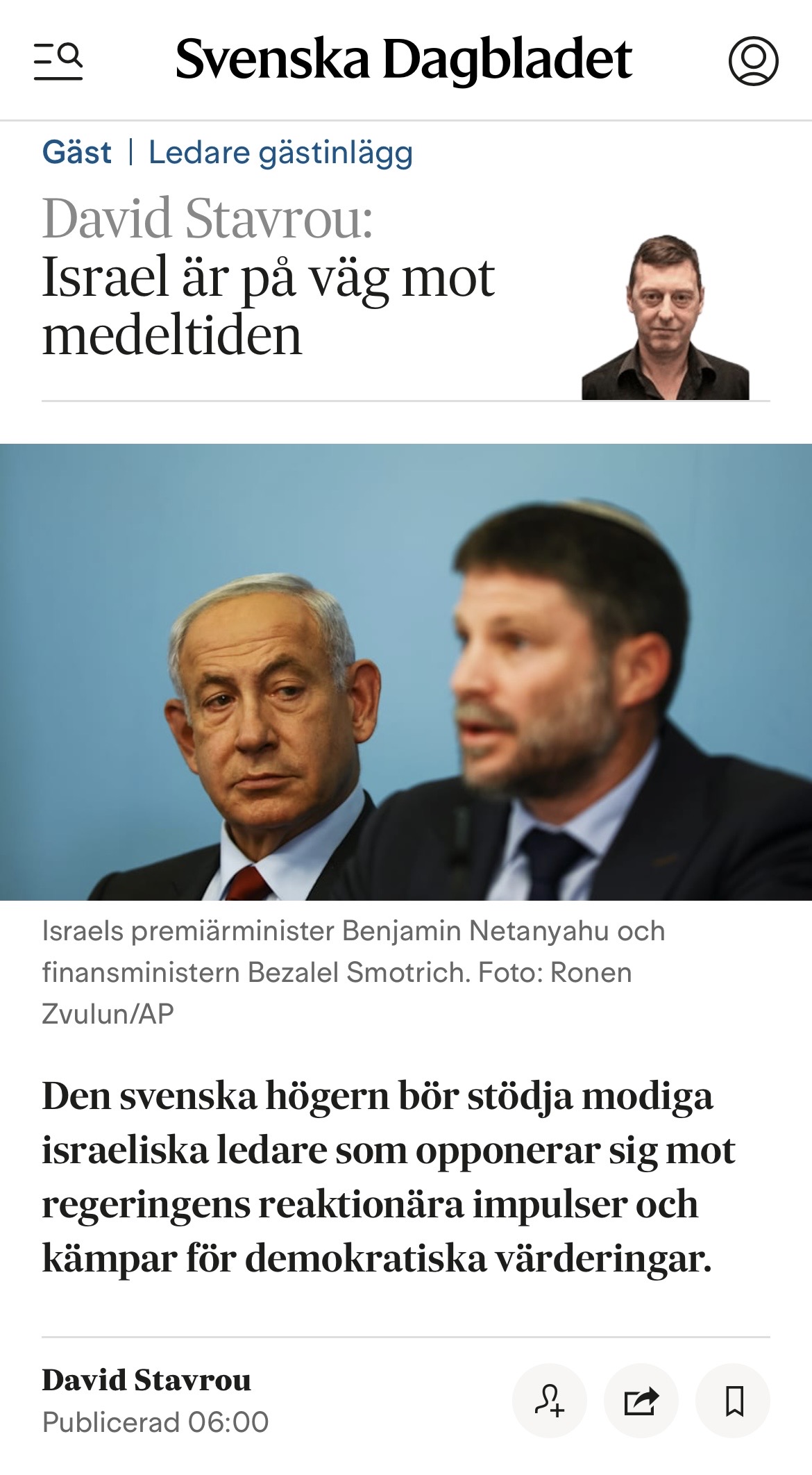
One of the war’s results is that Prime Minister Benjamin Netanyahu, who is currently on trial for corruption, is doing everything he can to control the historical narrative of the war and avoid taking responsibility for Israel’s failure on October 7. Instead, he places the blame on the security services and his political opponents. He refuses to establish an independent official inquiry commission and is doing his utmost to replace Israel’s military and legal elite with loyal officials. These changes may help Netanyahu evade accountability for the charges against him. But for his coalition partners—far-right, fundamentalist, and ultranationalist parties—they are a means to a broader goal: undermining Israel’s liberal democracy.

For example, the Knesset, Israel’s parliament, is discussing a bill that would expand state control over the media. The proposal would replace existing regulatory bodies with a new authority whose members are appointed by the government—effectively enabling political control over broadcast content. The bill has drawn criticism from the government’s legal adviser, who warned that it threatens freedom of the press. It is hardly surprising that the same attorney general is among those the government is attempting to remove.
Screenshot

Because Israel is a democratic country, many Israelis are demonstrating against these proposals and other government measures. In recent months, however, many protesters have claimed that the police are acting in ways they did not previously. They report arbitrary arrests and increased use of force, including stun grenades and mounted riot police.

The minister responsible for this is Itamar Ben-Gvir, a far-right politician previously convicted of incitement and support for terrorism. While he is busy consolidating control over the police within Israel, another minister, Bezalel Smotrich, is consolidating control over the West Bank. Smotrich is laying the groundwork for potential annexation and is taking no action against the growing violence perpetrated by extremist settlers.

Netanyahu himself has recently reaffirmed his intention to continue pursuing the so-called judicial reform which many in Israel describe as a judicial overhaul, as it threatens the fundamental principles of the rule of law and the separation of powers, weakens the independence of the courts, and risks undermining democracy. The issue has now returned to the parliamentary agenda and in addition, efforts to limit the powers of the attorney general and the Supreme Court are being resumed. Another bill currently under discussion would introduce the death penalty for terrorist offenses—formally to prevent Hamas and other groups from taking Israelis hostage in order to exchange them for convicted terrorists, but there are also those motivated simply by revenge.

If the death penalty does not sound like a sufficiently reactionary reform, the Knesset has even discussed the conservative Jewish concept of shmirat negiah—the obligation for a man and a woman who are not married to each other to refrain from physical contact. It is not an official legislative proposal, at least not yet. But the mere fact that it is being discussed alarms liberal and secular Israelis—and rightly so.

Swedes have always had a deep interest in Israel. This can have both positive and negative effects. To understand whether Sweden’s voice can contribute something meaningful in this context, we should examine the country’s current discourse on Israel.

The political left in Sweden has unfortunately totaly lost its bearings. Many of its supporters have embraced Hamas’ narrative of the Israeli–Palestinian conflict. This does not necessarily mean they support terrorism, but the view of Israel as a settler-colonial project that should be boycotted and opposed regardless of its policies or leadership has spread from a radical minority into mainstream politics. Even established political parties have begun discussing the dangerous idea of a one-state solution.

A one-state solution would either mean the end of the Jewish state—which even the Swedish left previously supported—or plunge the entire region into an even worse bloodbath than what we have witnessed over the past two years.

Equally dangerous is the stance of Sweden’s populist right. Supporting Israel because its current leaders appear to use methods similar to those of authoritarian, illiberal regimes, or because they see Israel as a symbol of a struggle against Islam, is both misguided and harmful. It is also a betrayal of the Israelis who are fighting for a democratic, liberal, and peaceful future.

This year, both Swedes and Israelis are heading to the polls. If Sweden still wishes to exert a positive influence on Israel (and on the Palestinians, for that matter), Swedish supporters of the left should cooperate with Israeli artists, entrepreneurs, researchers, and academics who are independent and often in opposition to the government, rather than the easy and intellectually lazy solution of boycotting and margenelizing them.

The Swedish right should support courageous Israeli leaders who oppose the government’s reactionary impulses and fight for democratic values, rather than backing corrupt leaders and extremist parties that are dragging Israel back toward the Middle Ages. Any other approach amounts to rewarding both Hamas and Jewish extremists and for those who live in the region, it is yet another step on the road to hell.
Standing Together and the BDS: The Swedish Version

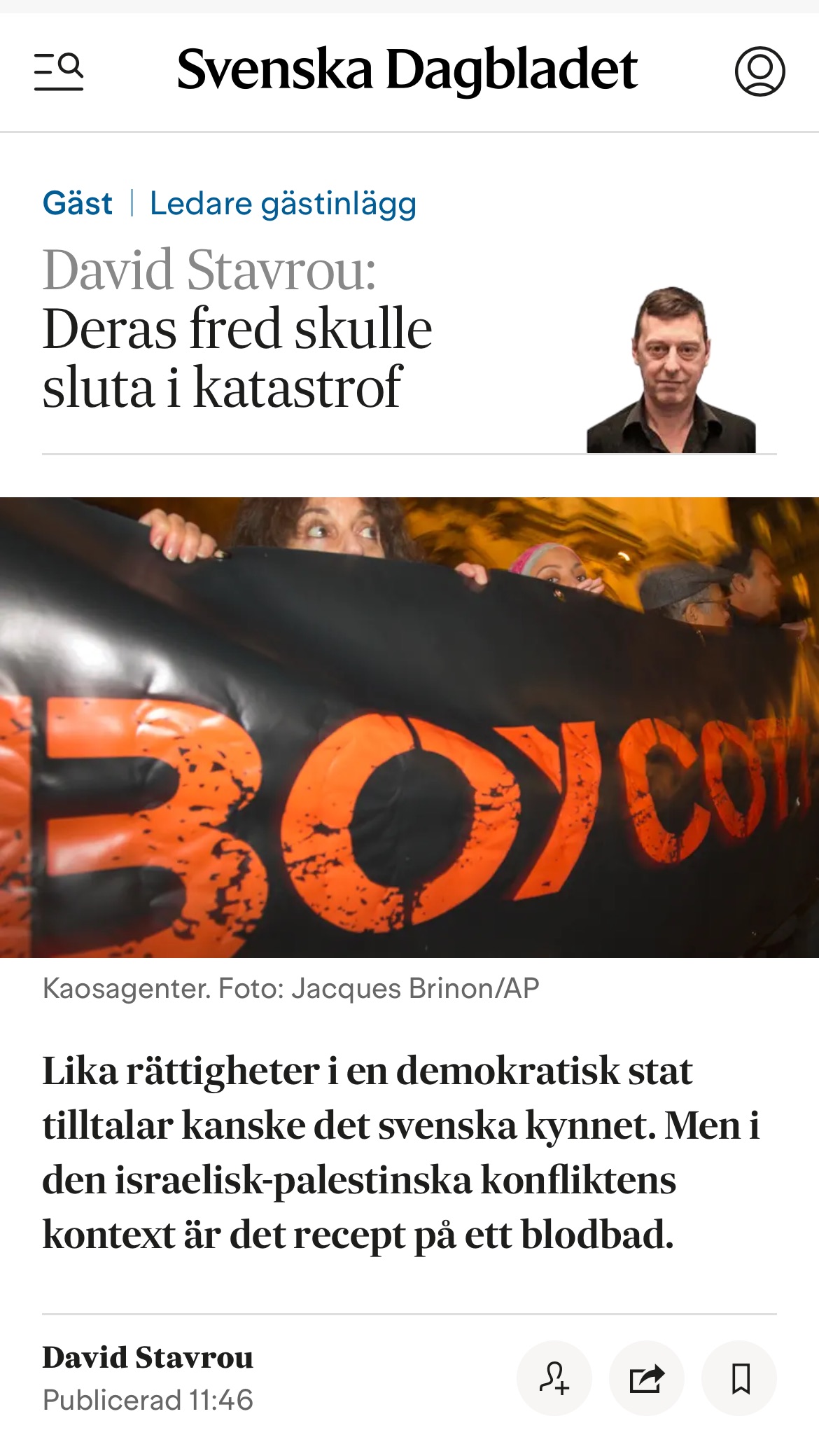
Equal rights in a one state solution may appeal to Swedish sensetivities. But in the context of the Israeli-Palestinian conflict, it is a recipe for bloodshed.

Published in Swedish daily Svenska Dagbladet: https://www.svd.se/a/qP8yvL/bds-rorelsens-fred-skulle-sluta-i-katastrof

Israeli politics can be confusing for those who are used to a system which rewards accountability. One example is that even though Hamas' brutal attack in October 2023 was the biggest tragedy in Israel's history and part of a momentous failure of Israel's leadership, the government is still in place and seems to be stable enough to survive the crises. It's even confident enough to continue its controversial judicial overhaul which many claim is a direct assault against Israel's democracy. When it comes to the conflict with the Palestinians, Netanyahu's government is using the catastrophe as a pretext for going further to the right, perhaps even as an excuse for a future annexation of the West Bank which would be a tragedy for both Palestinians and Israelis who support peace, democracy and freedom.

This is why Standing Together, a grassroot movement of both Jewish and Palestinian Israelis who join hands in working for peace, equality, and social justice is so important. These are exactly the kind of people who can provide hope for Israel's declining peace movement. They can also be excellent partners for actors in the global community who are concerned about developments in the region and want to support positive change. And indeed, two of the movement's leaders are coming to Sweden. When I spoke to one of them, Alon-Lee Green, one of the movement's national coordinators, he told me that the visit's purpose is "to gather support for the fight to end the war, to end the occupation and to achieve Israeli-Palestinian peace".

But it seems not everybody wants to listen. Instead of encouraging Israel's brave opposition, some activists are horrified by the mere thought of Israeli peace fighters. One commentator on social media wrote: " I think it's important that as a movement we keep track of which groups we choose to collaborate with. Standing Together is boycotted". As a self-appointed moral compass, the activist then quotes a text by The Palestinian Campaign for the Academic and Cultural Boycott of Israel claiming that Standing Together is "serving a key role in Israel’s international propaganda strategy". One of the commentators who thanked the writer even added: "we don't recognize Isnotreal!".

Since October 7th the BDS campaign has been gaining support in Sweden. Professors, researchers and students call on their university to cut all ties with Israel, Amnesty cooperates with BDS-Sweden and lists of companies "profiting from the genocide" are all over social media leading to demonstrations and smear campaigns. All this shows what at least part of Sweden's left is all about. The BDS movement claims that Standing Together is serving "Israel’s 75-year-old regime of settler-colonialism and apartheid". Nothing could be clearer – the BDS movement isn't against specific Israeli policies, it isn't against a specific government or a specific war. BDS activists' real problem is the very existence of Israel. When they talk about 75 years of settler colonialism, they're not talking about the 1967 occupation of the West Bank and Gaza, they're talking about the 1948 UN decision to found a Jewish state, and an Arab state, in Palestine. The people who don't want to listen to Israeli peace fighters are doing it simply because they are against peace between Israelis and Arabs. According to them Israelis are the original colonialist sin and they should just disappear.

Do these attitudes belong only to a handful of extremists or are they spreading to Sweden's left as a whole. A good indication is the debate about the so-called two-state solution. Those who still support it, even though it seems almost impossible to achieve, are promoting a solution which includes a compromise between two legitimate national movements. Lately, however, the idea of a one-state solution is becoming popular. Swedish academics are writing texts about one state based on "one citizen-one vote", in the Swedish Left Party congress last May many party members promoted changing the party's position to supporting a one-state solution and further to the left, Fi (the Swedish Feminist Initiative) and the new "Solidarity" party, already took the step. Fi even claims that "Zionism is an imperialist and racist ideology". Anyone who witnessed a pro-Palestinian demonstration during the last few months knows this isn't a minority. The most popular slogan doesn't leave room for doubt – "From the river to the sea Palestine will be free", Not "Palestinians will be free". Palestine means a state – one state, not two, from the river to the sea.

In Sweden's radical left there are those who take it even further. There's a at least one youth movement (RKU) which supports the October 7th "historic offensive in which the Palestinian resistance broke open the prison bars". Another "solidarity movement" (Samidoun) supports the PFLP, an organization which took part in the massacre. In addition, there are plenty left wing-oriented publications which continue to support the narrative which sees Hamas as an anti-imperialist decolonization force. All these movements support a one state solution. Just like Hamas and the most radical Jewish extremists.

One state with an equal vote and equal rights may sound appealing to Swedish sensibilities. Indeed, why not have nothing to kill or die for and no religion too? The only problem is that in the context of the Israeli-Palestinian conflict one state is a receipt for a blood bath. Most Palestinians who support a one state solution mean a Palestinian state. Most Jews who support it mean a Jewish one. The result of such an experiment will either be apartheid or some version of ethnic cleansing or genocide. The only question will be who's killing who.

When I talked to Standing Together's National Coordinator he said that the movement doesn't support a specific model of solution. "We support an Israeli-Palestinian peace", he said, "one that will enable everyone to live in freedom, equality and independence". When it comes to the boycott movement Green says that Standing Together is the largest Israeli movement fighting for peace and against occupation. "We've been protesting all over Israel for 15 months, we arrange aid for Gaza, our activists are fighting settlers who attacked humanitarian aid convoys and we demand an end to the killing", he says, "if anybody wants to argue with us about words that we say or don't say, they can write an essay and perhaps we can discuss it in some lecture in the world of academia. But in the world of politics and actions, the one that we focus on, the BDS statement about us has no influence where we live. It wasn't even translated to Arabic".

The BDS movement leaves no room for Standing Together. It only accepts Israelis who think that their country shouldn't exist. But the men and women of Standing Together are different. They love Israel and they're fighting to make it better. They realize that both Jews and Arabs are there to stay and they promote pragmatic compromises rather than holly wars and abstract ideologies. This is why the Olof Palme Center, the Robert Weil fund and Kulturhuset made the right choice when they invited them to Sweden. Naturally, those who are against Standing Together have the right to protest, but we shouldn’t call them peace activist, we should call them what they really are – dogmatic chaos agents who, if they get what they want, will lead both Israelis and Palestinians to a catastrophic disaster.