This Swedish Academic Center Was Named After a Jew. Now, His Name Is Gone

'Part of a dangerous trend of taking antisemitism out of the Holocaust': A surprise decision to remove the name of Jewish historian Hugo Valentin from the Holocaust research center at Uppsala University has sparked backlash in Sweden's Jewish community
Published in Haaretz: https://www.haaretz.com/jewish/2025-02-03/ty-article-magazine/.premium/this-was-the-only-academic-center-in-sweden-named-after-a-jew-now-his-name-is-gone/00000194-c6af-d533-a3b6-cfafbd030000

STOCKHOLM – Years before the Nazis rose to power, Hugo Valentin, a prominent member of Stockholm's Jewish community, recognized the dangers of Nazi ideology. A historian and scholar, he warned against the "wild psychosis of hatred" as far back as 1930, and even before the outbreak of World War II, he cautioned against the "total eradication of German Jewry." When the Third Reich began implementing the Final Solution, he was among the first to inform the Swedish public that the Jews of Europe were being annihilated. Already in 1942, he wrote in a Swedish daily newspaper that 700,000 Polish Jews had been murdered, and he continued to report about the mass killings of Jews around Europe over the next few years for the Swedish Jewish Chronicle.

Until his death in 1963, Valentin was considered a leading authority on antisemitism. He connected ancient, medieval, and modern antisemitism and argued that "it is not the Jews who are hated, but an imaginary image of them." A pioneer of Swedish-Jewish studies, Valetin was also a vocal supporter of Zionism and of the young state of Israel. In 2009, nearly half a century after his death, Uppsala University – Sweden's oldest institute of higher education and one of its most prestigious – merged its Center for Multiethnic Studies with the Program for Holocaust and Genocide studies. Since Valentin had been a distinguished scholar of the history of the local Jewish community and antisemitism, as well as Nazism and genocide, it seemed only natural to name the center after him.

And so, the Hugo Valentin Center was established – the only academic center in Sweden named after a Jew. Late last year, the university announced that a decision had been taken to change its name: As of January 1 this year, it would be called the Uppsala Center for Holocaust and Genocide Studies.

Hugo Valentin apparently got cancelled.

"The removal of Valentin's name is part of a dangerous trend of taking antisemitism out of the Holocaust," said Aron Verständig, chairman of the Council of Jewish Communities in Sweden. Speaking with Haaretz, he described the deceased historian as "the foremost writer of Jewish history in Sweden and one of the first to write about the Holocaust."

Pontus Rudberg, an associate professor of history at Uppsala University who was previously affiliated with the center, was also concerned. "It's disgraceful," he said. "It supports the trend that removes Jewish perspectives and Jewish history from Holocaust and genocide studies. It's also disgraceful because you don't remove the name of the person your institution is named after unless he's done something wrong."

Rudberg said he was surprised by the decision-making process. "I was asked by the director of the center for my opinion in a vague way during an informal meeting a week or two before the decision was made," he told Haaretz. "I said I was against it, but I didn't realize it was an actual process, and I found out about the decision, which was made with no informed and open debate, only when it was published just before the Christmas holidays."

In a protest letter addressed to Anders Hagfeldt, vice chancellor of the university, Professor Emeritus Harald Runblom, another Uppsala historian, wrote that "erasing a name in this context is like tearing down a statue, and it raises legitimate questions. Has he become persona non grata? Is there political opportunism behind this?"

Another letter addressed to the vice chancellor, signed by 93 international scholars, warned that erasing Valentin's name could set in motion "a broader trend of distancing Holocaust and genocide studies from Jewish history" and described the move as "an affront to Hugo Valentin's legacy and a diminution of his remarkable contributions." Among those signed on this letter were the distinguished Holocaust historians Christopher Browning and Jan Grabowski.

Weighing in on the controversy, journalist Nathan Shachar recently penned an op-ed in Dagens Nyheter, a leading Swedish daily, titled "Uppsala University embarrasses itself – does not dare to be linked to Sweden's most famous Zionist." "In the difficult reality since October 7, the center wants to tone down its Jewish affiliation for populist reasons of convenience and avoid being associated with the most famous of Swedish Zionists," he wrote.

Rudberg offered a somewhat different explanation for Valentin's erasure. "It's ignorance, rather than bad intentions," he said, "The people who made the decision don't know much about Valentin. They think he was mostly involved in Jewish history and antisemitism studies. They don't understand he was also a pioneer in Holocaust and Genocide studies."

Still, the decision seems to be in line with the current zeitgeist on campus. In November, a group of 131 university members published a letter in the Swedish daily Aftonbladet demanding that the university cuts all ties with Israeli universities "complicit in the genocide."

The letter was the latest in a series of calls at Uppsala to boycott Israel, and although the university's leaders have refused to bow to such demands from student groups, the fact that many professors and researchers support such sanctions against Israel has many Jews on campus feeling uneasy. Since October 7, the Uppsala campus has emerged as a hotbed of the Swedish pro-Palestinian protest movement. On a number of occasions during the past year, students disrupted university activities and the administration made the decision to summon police over what it perceived as threatening disruptions to campus life.

Several Jewish students, who agreed to speak with Haaretz on condition of anonymity, said they felt protests against Israel have crossed the line into antisemitism. They said that posters sighted at demonstrations and encampments on campus over the past year have supported violent resistance and denied Israel's right to exist.

Asked for comment, Elsa Bådagård from Uppsala University's office for Humanities and Social Sciences, issued the following statement: "Uppsala Center for Holocaust and Genocide Studies is a center within the Faculty of Arts, and the decision regarding its name has been made by the faculty board upon request from the board of the Hugo Valentin Center in December 2024.

The different reactions to the name change have been received and noted by the Faculty of Arts. However, since the request originated with the center, the faculty will not overturn its collegial decision on the basis of these opinions. Furthermore, the proposition to change the name has the support of the current employees at the center."

Bådagård insisted that the reason for the name change was that the board wanted it to reflect the primary field of research of the center, which is Holocaust and Genocide Studies. "It was not part of any political agenda, and the name change will not lead to any change regarding the focus of the various activities at the Center," she said, adding that "this is a purely organizational decision, and should not be read as a wish for the Faculty of Arts to distance itself from Hugo Valentin and his work."

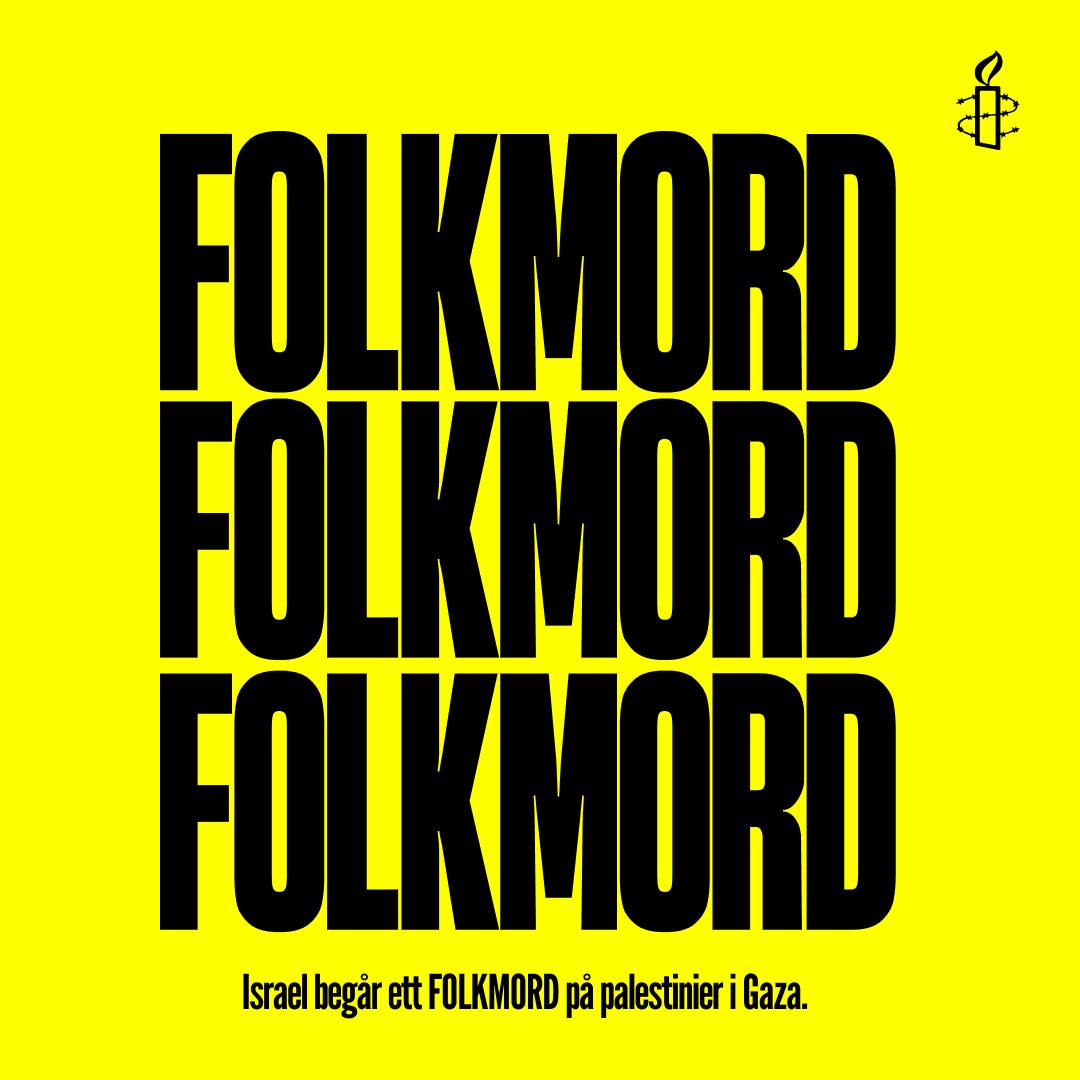
The Amnesty Article

Since my article about Amnesty and Swedish schools was written and published in Swedish and since the debate with Amnesty Sweden's Secretery Genral in Svenska Dagbladet was also in Swedish, I finally got round to translating the original texts into English so that non-Swedish speakers can see what the all the fuss was about…

When a Jewish woman from Umeå was featured on DN's first page after she decided to leave town, at least one writer, Göran Rosenberg, was critical. The article explained that the woman was leaving because of decades of antisemitic harassment. Still, Rosenberg wasn't impressed. "Today, DN publishes on its entire front page that a woman in Umeå (of Israeli origin) intends to leave the city because of her experiences of antisemitism ", he wrote and added that DN failed to explain the background: "consequently, we are not told that the same woman was very active in supporting Israel in the Gaza war". A couple of days later he explained in Expressen that antisemitism is being used as a political weapon. The woman from Umeå, it seems, had it coming. After all, she's not a "Swedish Jew", rather she's "a woman in Umeå (of Israeli origin)". Rosenberg's message is clear: while Antisemitism against regular Jews like himself, is despicable, Zionists and Israelis just "experience" antisemitism which is actually just good old criticism of Israel, or as Swedes elegantly call it – Israelkritik.

I thought of this when I talked to an organization called "Zikaron" last week. This small but extremely important organization offers lectures on the fates of Holocaust survivors to Swedish schools. The lectures are carried out by young people, grandchildren or great grandchildren of survivors who are taking over the historic burden of remembrance. Naturally, this has nothing to do with Israel. The Holocaust took place before there was an Israel and the victims were not "settler colonialist" or responsible for the "blockade of Gaza". And yet, it turns out that sometimes even the Holocaust is too problematic for some schools. When I talked to one of Zikaron's organizers, she told me that after the massacre of October 7th last year there were about ten schools that cancelled their lectures due to reasons like "wrong timing" or "sensitive timing" and since then, there has been less demand for their lectures. Could this also be "Israelkritik" or is it just that Swedish schools are too scared of upsetting the sensitive souls who find Holocaust education provocative. Or perhaps they don’t want to get in trouble with activist bullies who didn't get the memo saying that it's ok to talk about dead Jews from the 40s and the problem is only with the other kind of Jews, the ones with guns from the Middle-East. Whatever it is, anyone who's worried about Swedish schools being cowards can rest assured. They found their courage elsewhere.

While Holocaust education may be too sensitive, foreign policy political activism seems to be no problem at all. Otherwise, how could 39 Swedish schools be "partner schools (samarbetsskolor)" of Amnesty, a political organization which is as far from mainstream as it gets. These schools use Amnesty's "Schools for Human Rights" model (skola för mänskliga rättigheter) for teacher's education, planning "theme days" (temadagar) and providing material and lectures. They even take part in global campaigns. This model may be great for highlighting human rights and democracy, but there's a serious problem when it comes to the conflict in the Middle-East, since Amnesty is anything but impartial.

In recent years Amnesty International positioned itself clearly as opposed to everything Israeli. It has disproportionately targeted Israel for years, it has supported boycott campaigns and some of its campaigners and partners have supported or even been linked to terror organization and Islamist movements (to name some: Yasmin Hussein, Saleh Hijazi and Moazzam Begg). It almost entirely ignores attacks against Israel and atrocities committed against its civilians, it bases its information about Gaza casualties on Hamas' propaganda and it makes claims which are obviously false like "Israel's military operations in Gaza continue to kill people on a scale that has never been seen before".

But it's not only talk. Amnesty Sweden actively campaigned against policies of the Swedish government, like the decision to pause funding for UNRWA (based on information that some of its employees took part in the October 7th massacre) and the decision to stop funding Swedish Ibn Rushd study circle (after accusations that the organization has ties to the Muslim Brotherhood and spreads antisemitism). In fact, whoever wants an idea of what Amnesty really supports can take a look at the kind of people it awards its prizes to. Elin Forghani, a Vänsterpartiet activist from Östersund just won Amnesty's new "Noismaker" prize after publicly claiming that: "Israel is a colonial project and an outpost of the West in the Middle East and always has been". And just to make clear what should be done with the colonizers she wrote: "we can make Israel and their sponsors sweat, tremble and fall. Liberation is in sight".

Naturally, in a democracy political activism is more than legitimate. However, it's also clear that Amnesty is in no way neutral or objective. It's a political player in global geo-politics, but it's still marching into Swedish schools, presenting itself as a non-biased public informer and bearer of a universal truth. Although political parties and organizations are allowed in Swedish schools and naturally Democracy and human rights should be part of their education, this isn't a case of mainstream education. Amnesty is getting a special "partner" status as a long-term official partner while other political actors are just guests, implying that Amnesty represents facts while the others represent opinions.

It's unclear why Swedish schools should be discussing the war in Gaza in the first place, but if they must, the material should be written and supervised carefully by serious state actors. This isn’t the place to start outsourcing. I spoke to a few parents and students in a Stockholm high school. They told me about their complaints to the school management regarding Amnesty's Gaza war education material and about lessons using material from Globalis, an organization run by "Svenska FN-förbundet" an organization which claims to "work for a better and stronger UN ". The UN in the title shouldn't be confused with impartiality. When I spoke to one student, he told me that since the lessons about the Israeli-Palestinian conflict started "it feels like I have to go to school to defend Israel twice a week. It's not that the teacher lies but it's so one-sided. For example, there were two lessons about the Palestinian Nakba and only half a slide about the expulsion of Jews from Arab countries and Iran and even that, according to the teacher, could be understood as a result of "Mossad activity". When the students were given texts on the subject, they were given guiding questions like: "what support is there for the claim that Israel is an apartheid state?". Student I spoke to talked about feeling very uncomfortable and worried about their classmates. "I feel I have to give the other side", one of them said, "because the other students in the class don't know the whole picture".

In an incident in another school, UN day was celebrated in the schoolyard by waving flags of different countries. According to one of the teachers, when some angry spectators who were passing by threatened to enter the school and remove the Israeli flag, the reaction wasn’t standing up to the threatening bullies and informing the police. Instead, the flag was removed and the person waving it was asked not to wave it again.

It seems that our schools are becoming a ridiculous case of Dr. Jackyle and Mr. Hyde. On one hand, they're wannabe rebels, dealing with the world's most complicated conflicts by employing radical political activists, while on the other hand, they're so afraid of controversy and conflict that they can't even wave a flag of a UN member country or talk about the Holocaust.

It's true, only a few schools cancelled Holocaust lectures and only some are Amnesty partners. But it's also true that only some pro-Palestinian demonstrators support violence (which is what shouting "Intifada!" means), only part of vänsterpartiet supports the PFLP and only a handful burned an Israeli flag outside a synagogue. Not to mention that just several thousand attended a Hamas conference in Malmö, and only a few hundred contribute to Islamist, antisemitic movements, and only one Imam praised Hezbollah's leader and only one or two artist spread antisemitic conspiracy theories, and only a small minority screamed at Holocaust survivors entering a memorial ceremony. How many minorities will it take to get the message? and when will our schools become part of the solution instead of part of the problem.

Amnesty Sweden's comment (originally in Swedish):

Our schoolwork is based on international conventions and Swedish school's governing documents.

On December 10th, 1948, the newly formed UN adopted the Universal Declaration of Human Rights. For the first time, the world had an agreement that viewed all people as free and equal, regardless of gender, skin color, religion or other beliefs or characteristics.

In 2011, knowledge of human rights was incorporated into the Swedish curriculum. Since 2012, Amnesty has been supporting upper secondary schools with teaching materials, lectures, and a model for working with human rights, based on both international conventions and Sweden's school governing documents.

David Stavrou, guest columnist for Svenska Dagbladet, criticizes Amnesty for supporting upper secondary schools in their work on human rights education, by making directly false accusations about Amnesty as an organization and our work. But these claims are easy to refute: No, Amnesty does not support the call for a boycott of Israel. Yes, Amnesty has condemned attacks on civilian Israelis and called for those responsible for these war crimes to be held accountable. No, our teaching materials and lectures are not about Israel and Palestine.

David Stavrou claims that we are a biased organization and that our criticism of Israel is disproportionate. This is a direct false statement that is often made by representatives of the Israeli government. Amnesty is an impartial, politically independent organization. We do not accept government funds because we want to be free to investigate human rights violations without being dependent on anyone. Our demands and criticisms are based on international law and respect for human rights. And we assess all states by the same standards.

Even though our lectures in high schools this fall did not address the war in Gaza, high school students have asked many questions about the situation in Gaza. Human rights, contrary to what David Stavrou suggests, apply both in times of peace and in conflicts. Amnesty's focus in all conflicts is the protection of civilians and their human rights.

Amnesty is not alone in criticizing Israel's indiscriminate attacks on civilians, the forced displacement of Palestinian civilians, and the denial of humanitarian aid into Gaza, three clear examples of violations of the laws of war. Knowledge of human rights is necessary. We are happy to contribute to helping upper secondary schools fulfill the curriculum, providing students with more knowledge and the conditions to protect their own rights and work to ensure that others' rights are respected, both now and in the future.

Anna Johansson, Secretary General, Amnesty International Sweden.

David Stavrou's reply:

It’s great that Amnesty Sweden takes texts which are published in Svenska Dagbladet seriously. However, it’s a bit surprising because, during the process of writing the article, I contacted their press service to ask questions that had arisen after conversations with students at their partner schools. No one responded. To avoid mistakes, I wrote again, but I was ignored once more. On the other hand, Amnesty’s response suggests it might not matter – it’s filled with answers to questions no one asked and avoids addressing the questions that were actually raised.

No one suggested that schools shouldn’t teach human rights and democracy. No one asked whether human rights are important during wartime. Even if one appreciates the Secretary General of Amnesty’s inspiring words, that wasn’t at all what the article was about. Everyone knows human rights are important. The question is whether her organization is qualified to be the one teaching our children about them.

One question that goes unanswered, however, in the one addressing Amnesty’s partners abroad that have had connections to terrorist organizations and Islamist movements. Perhaps it’s because she is aware of the collaboration with Moazzam Begg, for example. Begg, a former Guantanamo detainee, was invited to Sweden by Amnesty despite having supported the Taliban. This isn’t something I’m claiming – it’s what a senior official within Amnesty in London, Gita Sahgal, said. She argued that collaboration with "Britain’s most famous Taliban supporter" and links to groups promoting Islamic right-wing ideas damage Amnesty’s integrity and pose a threat to human rights. Amnesty’s reaction – she was dismissed.

Then there’s the claim that Amnesty doesn’t support a boycott of Israel. If that’s the case, why did Amnesty’s Regional Director for the Middle East and North Africa write the following: "We urge the international community to cease all forms of support – whether direct or indirect, through actions or omissions – for Israel’s apartheid system"? (Direct quote from Amnesty’s website).

As for Amnesty having condemned attacks on Israeli civilians, it is true that they’ve done so on certain occasions. After October 7th, it would have been absurd if they hadn’t. But anyone familiar with Amnesty’s publications knows that the Secretary General’s statement is misleading. During September and October, Amnesty International published 14 texts on their website criticizing Israel. That’s as many as the texts about Syria, Afghanistan, and Iraq – combined. Iran received seven texts during the same period, Sudan and South Sudan six in total, and Belarus only four. During these two months, 7,517 rockets were fired at Israel. Amnesty published nothing about these attacks, which kill and injure and have forced over 140,000 Israeli citizens to live as internally displaced persons for more than a year.

"We assess all states by the same standards," writes Amnesty’s Secretary General. That’s hard to believe when reading about their "regional activist seminars" in Stockholm and Malmö in November. The program begins with "Palestine then and now" and continues with "a deeper understanding of the Palestine issue through a Palestinian perspective." Then there’s a lecture on the Palestine groups in Malmö, followed by "panel discussion: Academics for Palestine." Later in the day, there’s "panel discussion: on Palestine, struggle, and conflict." It seems like the Rohingyas, Uighurs, the Belarusian opposition, and Tigrayans from Ethiopia will have to wait for the next seminar because the next workshop is "What can I do? A guide to action for Palestinian liberation." This is organized by, drumroll, BDS Sweden. Yes, BDS – Boycott, Divestment, and Sanction (remember the Secretary General’s statement: "But these claims are easy to refute: No, Amnesty does not support the call for a boycott of Israel." Does she think we can’t read?).

None of the speakers at the seminar are pro-Israel; instead, it’s full of well-known pro-Palestinian activists. And that’s entirely okay. The Svenska Dagbladet article wasn’t about whether Amnesty is right or wrong or about their right to be pro-Palestinian. It was about impartiality. I wonder if any of the young people who participated in the activist seminar are students from one of Amnesty’s 39 partner schools. I suggest that Sweden’s school principals take what the Secretary General wrote seriously. When she writes that she’s glad to "give students more knowledge," it becomes clear that their schools are her recruitment ground.

Antisemitism in Malmö: from a Swedish Symptom to an European Symbol?

Malmö, the large city in southern Sweden, has been in the headlines in recent years because of expressions of antisemitism. This is the story of the slow awareness of local and national authorities and the measures taken to deal with the problem. Could Malmö's experience be of any value for the whole of Europe, where many large cities are facing similar problems.

Punlished in K. Magazine: https://k-larevue.com/en/antisemitism-in-malmo-from-swedish-symptom-to-european-symbol/

Those who believe in the old saying “there’s no such thing as bad publicity” would do well to study the case of Sweden’s third largest city – Malmö. Home to some 350,000 people, it‘s not particularly big, it’s not Sweden’s oldest or most beautiful city and it’s not exceptionally cheap or expensive to live in. Still, in the last few years it made an international name for itself, though perhaps not the name its leaders were hoping for. Instead of being praised for Västra Hamnen which claims to be Europe’s first carbon neutral neighbourhood, for its multiculturism or for the Turning Torso building, Scandinavia’s highest skyscraper, Malmö is known around the world for a much less appealing feature – antisemitism.

The new antisemitism of Malmö

It’s hard to say when or where it started. Antisemitism isn’t a new phenomenon in Sweden. In fact, it was there even before the first Jewish communities were founded in Stockholm and Marstrand near Gothenburg in the late 18th century. Towards the end of the 19th century and the beginning of the 20th, official state restrictions and discrimination slowly disappeared, but antisemitic ideology and propaganda could be found throughout both the old political establishment and newly founded neo-Nazi and fascist movements. Surprisingly, the end of WW2, which left neutral Sweden relatively unharmed, wasn’t the end of Swedish Nazism. Quite the opposite. After the war Sweden became host for many racist, nationalist and fascist movements. While the political elite was gradually embracing universal values and continuing to develop a social-democratic welfare state, the extreme right on the margins of Swedish society was, and some say still is, flourishing. Neo-Nazi skinheads, antisemitic publishing houses and movements based on pre-Christian imagery that promote nationalist, racist and anti-establishment ideas became an integrate part of Swedish society.

Malmö played an interesting role in this story during the final stages of WW2 and the following years. On one hand, this was the city that became a safe haven for Danish Jews who arrived at its shores after crossing the Öresund strait fleeing the Nazis in 1943. This is also where the Swedish Red Cross’ “White Buses” arrived in 1945, carrying survivors of the Nazi concentration camps. On the other hand, this was the home of the so-called Malmö Movement, which played a central role in the rehabilitation of Europe’s extreme right, back in the 1950’s. The movement’s leader Per Engdahl took a leading role in the project of connecting the remnants of fascist and Nazi movements from all over Europe and forming a political network which published literature, organized conferences and created an escape route for Nazis from Europe to South America. The center of all this was Malmö were Engdahl lived and worked. But all this is ancient history.

For over ten years now, Malmö has become, in the eyes of many, a symbol of a new kind of Swedish antisemitism. While right wing extremism is still dangerous and threatens Jews in Malmö just like anywhere else, in the last few years an imported antisemitism originating in the Middle East and Islamist environments has taken over. In Sweden, the combination of the two proved itself particularly worrying and Malmö is sometimes seen as the center of it all. In 2012 an explosion shook the Jewish community center. In 2009, Molotov cocktails were thrown at the local Jewish funeral home. In the same year Malmö was the scene of what is now known as the Davis Cup riots. As Israel and Sweden were playing an official tennis match, thousands of anti-Israel demonstrators took to the streets and the protest developed into physical and verbal attacks against the city’s Jews and law enforcement forces. At the time, former mayor IImar Reepalu, was accused of being part of the problem, rather than part of the solution when he said to a local daily that “We accept neither Zionism nor antisemitism which are extremes that put themselves above other groups”. But problems didn’t stop when Reepalu was replaced in 2013. Pro-Palestinian demonstrations, especially during periods of conflict in Gaza, continued to feature heavily antisemitic slogans, signs and rhetoric.

When I visited the city in 2015 in order to write a report for “Haaretz” I spoke to a few members of its Jewish Community. Those were the days when hundreds of asylum seekers were arriving every day, mainly from Syria and Afghanistan, crossing the bridge from Copenhagen and arriving at Malmö which became their Swedish port of arrival. As authorities in Sweden were struggling with challenges of housing, employment, education and integration, many in Malmö were worried. “There is fear and harassment on a daily bases”, one woman who immigrated from Israel to Malmö decades ago told me. She claimed that authorities were doing nothing against the daily harassment and the incitement from local mosques. “I’m not against accepting asylum seekers”, another community member told me, “one should not close the door to people in need of help, but this is what happens when we want to solve one problem by creating a bigger one. We need to use our heads, not only our hearts”. After this, I returned to the city on several occasions and reports continued to be troubling. Some claimed that Jewish families were leaving the city because they no longer felt safe. In 2021, a report commissioned by the municipality described Malmö schools as an unsafe environment for Jewish students who suffer from verbal and physical attacks while teachers prefer to avoid conflict with the aggressors. Other reports claimed that Holocaust survivors are no longer invited to tell their stories in certain schools in Malmö because Muslim students treat them disrespectfully.

Malmö at the center of the world

As a response to all this, Malmö’s Jewish community which has existed since the 1870s and now has two synagogues, a community center, a variety of educational activities and just under 500 members, decided to speak out. Now it became harder for the Swedish press to ignore the problem and the picture it painted wasn’t a pretty one – the reports included children who had to put up with their schoolmates burning Israeli flags, making threats and praising Hitler, youngsters who were suffering from bullying and threats of rape and murder on social media and Jewish teachers who were told to put up with the harassment and keep a low profile. These are all well documented facts. They are based on resident’s testimonies, information collected by journalist, NGOs and authorities and studies conducted by serious researchers. But when it comes to Malmö there seems to be a layer of mythology covering the facts. This is the Mythology that gave Malmö unflattering titles like “Sweden’s antisemitism capital” or even “Europe’s most antisemitic city”. During the last few years, reports on Malmö, mainly in the international press, became full of stories about so-called honor killings, forced marriages, polygamy, female genital mutilation, parallel societies, riots, organized crime of ethnic clans and no-go zones in which local criminals have taken over and police and authorities cannot operate.

All this seemed to go hand in hand with the reports on antisemitism and although many of the reports in the media were true or at least based on some aspect of reality, others were extremely exaggerated, taken out of context and, more importantly, highly politicized. This is where Malmö became part of the global list of “greatest hits” for everyone who was spreading stories and conspiracy theories about Sharia law taking over Sweden, Sweden becoming the “rape capital of the world” and Sweden as proof of the “Great Replacement Theory”. With these reports, the attention of the Jewish world was turned towards Sweden and in 2010 the Los-Angeles based Simon Wiesenthal Center started advising Jews to not visit Malmö. With the populist right in Sweden growing stronger, integration of immigrants from the Middle-East becoming harder and the Israel-Palestinian conflict growing closer, Malmö‘s small Jewish community suddenly became a symbol for all the problems in the world, even if a reluctant one.   

Public authorities react

It’s hard to say if the situation in Malmö is really as bad as it’s sometimes portrayed in foreign media, or if it’s really that different from the situation in other Swedish cities or any other multicultural European city for that sake. Still, at some point local authorities and the government in Stockholm realized they have a serious problem. The situation in Malmö, whether exaggerated by the press or not, was making Sweden look bad. But it was more than that. In the last couple of years, I have spoken about antisemitism with the Mayor of Malmö, Sweden‘s Education Minister, Foreign Minister and former Prime Minister (all Social Democrats) and there is no doubt in my mind that they were all troubled by antisemitism and dedicated to the fight against it. For them, this is not only a PR problem. This doesn’t necessarily mean that their efforts were 100 percent effective, but at least their concern was sincere. Last October, When I interviewed Katrin Stjernfeldt Jammeh who has been Mayor of Malmö since 2013 she said that she realizes that Malmö isn’t vaccinated against antisemitism. “It’s a problem we’re addressing” she said, “we talk about it more today and, when you talk about it, it seems like it’s a bigger problem than it does if you don’t talk about it. But for me, (the image) is not important. The only thing that’s important is that we attack the problem and create change”.

Asked to detail what the city has done to confront the problem in the eight years she has been in charge, she said she has been working to combat antisemitism and racism since the day she was elected by “working with our citizens in various different set-ups, working with the Jewish community in several ways to map the problem, to create an understanding of the problem and, today, we have a long-term commitment”. She added that the city is investing more than 2 million Euros over four years. “This is not just a small project this year or next year”, she explained, “it’s a commitment to work in the long-term to create better conditions for the (Jewish) congregation, to enhance security and create knowledge. We’re also working within our school system, mapping the problem there too, and creating different ways to prevent prejudice”.

On the national level, former Prime Minister, Stefan Löfven, made the struggle against antisemitism and Holocaust remembrance a major part of his political legacy. Here too Malmö played a critical role. Last October Löfven and the city of Malmö hosted a special conference – The Malmö International Forum on Holocaust Remembrance and Combating Antisemitism. Although the conference dealt with a much wider issue than the concrete problems of Malmö’s Jewish community, it caught the attention of many around the world as heads of state and governments, researchers and representatives of private and civil society organizations engaged in what the Swedish government called an “action-oriented” program. The idea was that delegations from around the globe would present pledges of “concrete steps forward in the work on Holocaust remembrance and the fight against antisemitism”. The Swedish government, for example, promised to build a new Holocaust Museum, to criminalize organized racism, to contribute to the Auschwitz-Birkenau Foundation, to appoint a government inquiry on a strategy to promote Jewish life in Sweden and to “significantly increase” the funding for “security enhancing measures for civil society, including the Jewish community from 2022”.

The Malmö Forum took place just over twenty years after the original Stockholm International Forum which was initiated by one of Löfven’s predecessors, former Swedish Prime Minister Göran Persson. This was the beginning of the international partnership to fight antisemitism and promote Holocaust remembrance and it led to the “Stockholm Declaration” which is the founding document of the International Holocaust Remembrance Alliance (IHRA). When I spoke to Löfven a few weeks after the conference he told me that the Malmö forum was “all about commitments, not about speeches”. He then explained that there were two kinds of commitments: “first, never to forget, which is why different countries undertook to have various memorial events and memorial sites, and second, the fight against antisemitism, which is also about commitments. In our case, this means doing more in schools, investing more in research so that we have a better understanding of the forces behind antisemitism and so on. We want to spread this to other countries, organizations and companies, such as social media companies for example. Everyone can make commitments. Individual schools can commit, more companies can make commitments, sport organizations can make commitments. That’s the way to address these issues”.

The limits of political mobilization

The Malmö Forum made some headlines and brought Malmö some positive attention for a change. But are these national and international initiatives, which are discussed by high-ranking politicians, business leaders, journalists and international organizations making any difference on the local level – in the streets, the squares and the schools of Malmö? That depends, naturally, on who you ask. Some local opposition politicians, for example, were skeptical even before the conference started.  “It’s obvious we have a huge issue with antisemitism and it’s affecting people’s everyday lives in Malmö”, Helena Nanne the deputy chairman of the center-right Moderate Party in City Hall told me a few days before the Malmö Forum convened, “For families with children at school, the situation with antisemitism is a major issue, and we hear stories of families who choose to move because they don’t feel safe and can’t be sure the school will be safe for their children”. Nanne wasn’t opposed to the international forum as an idea but she claimed that the Social-Democrats who were organizing it had a home-made antisemitism problem. “This city is run by a party that has had a problem with antisemitism in its own organization”, she said, “It’s hard to take commitments they make seriously”. Another opposition politician based in Malmö, Ilan Sadé, who leads the right-wing Citizens’ Coalition party, was even more critical. “I’m not against the forum taking place in Malmö”, he said, “but this might just be an attempt to improve Malmö’s image. There’s a problematic connection between the Social Democrats and the immigrant population in neighborhoods like Rosengård (a Malmö neighborhood known for its immigrant population and gang-related crime, D.S). The Social Democrats have very wide support there, and they don’t want to lose it; they need to keep the balance. And of course, there are also many people from Arab countries who are party members. There were incidents like the one when members of the party’s youth league were heard shouting slogans like ‘Crush Zionism’ at demonstrations. That’s at least borderline antisemitism – they don’t shout that against other countries”. Sadé alleges that there is a lack of determination to prevent, stop and prosecute hate crimes in Malmö. “The police file on the attacks against the Chabad rabbi of Malmö is as thick as a Dostoevsky book”, he told me, “there are about 160 to 180 cases registered: anything from spitting on him to cursing and harassing him. This is absurd. In Sweden, a religious leader should be able to walk down the street. Priests can do it, imams can do it, so why not a rabbi? This should be prioritized, and it isn’t”.

Another way of approaching the problem does indeed involve both an imam and a rabbi. Imam Salahuddin Barakat and Rabbi Moshe David HaCohen, both based in Malmö, founded an organization which aims to create a trusting society while working to counter discrimination. The organization, Amanah, believes that deepening of identity and roots are key elements towards reaching their goal and it focuses on countering antisemitism and islamophobia within all levels of society – schools, universities, communities and official representatives. I spoke to rabbi HaCohen on the morning the Malmö Forum started and he told me that he appreciated the Swedish government‘s efforts even though not much attention was paid to Malmö itself since the forum was happening from the top down. His organization, on the other hand, is more of a grassroots one. HaCohen spoke about school programs combating racism that Amanah was promoting as well as a digital project that simulates dealing with antisemitic situations and the efforts the organization makes to address Holocaust denial in schools and monitor social media that can potentially “poison the minds of 9- and 10-year-olds”. Hacohen already sees some results to the interfaith dialogue. “During the last Gaza conflict (in May 2021), there was increased tension in the city, as we’ve seen in the past”, he remembered, “since there’s a large Palestinian community here, there were demonstrations against Israel, and as usual some of the protesters started to shout antisemitic slogans. But this time, these people were removed by imams who left their comfort zone and protected their Jewish neighbors. In the same way, we stood alongside our Muslim neighbors when supporters of a far-right Danish politician who was denied access to Sweden filmed themselves burning and kicking the Koran in the streets of Malmö”.

The people of Amanah aren’t standing alone. Other organizations and municipal leaders are doing their best to deal with the problem of antisemitism in the city. The Jewish community recently opened a new learning center that has been working with local schools. City Hall is working with the Swedish Committee Against Antisemitism to arrange trips to the concentration camps in Poland and its partnering with local football clubs to help them deal with racism and antisemitism. The city has also appointed a special coordinator to work on the problem of antisemitism in Malmö’s schools. The coordinator, Miriam Katzin, a Jew herself, a lawyer and a left-wing politician, gave an important perspective when she spoke to the Swedish Expo magazine just over a year ago. “There’s an antisemitism problem in in the whole of society which expresses itself in different ways”, she said, “I think it’s convenient for the majority of Swedes to turn to Malmö and place antisemitism there as the fault of groups that don’t belong to the majority. But that’s making it easy for themselves. The antisemitism I grew up with was expressed by regular majority swedes. That antisemitism is still alive, but it’s often overlooked. One wants to make antisemitism to be a problem of the others”. According to Katzin immigrant groups are blamed for antisemitism as part of this tendency, the right blames the left for being antisemitic and the left blames the right, while in reality antisemitism is a general social problem and it’s “deeply problematic to engage in a competition about who are the worst antisemites”.

This is indeed one of the most serious problems regarding antisemitism in Malmö and in many other European cities. The understanding that it still exists in this day and age is a depressing thought as it is. The thought that it’s not limited to one side of the political debate or to one particular social group, region or culture makes it even worse. Once one realizes that hatred of Jews is a problem that unites left-wing progressives, old-school conservatives, white supremist and hard-core Islamists, it’s hard to imagine a solution. In the same way, Malmö which became a symbol of antisemitism but in reality, was never the only or the worse expression of it, is just a tiny part of the bigger problem. After all that has happened in Malmö – the international attention, the media circus, the scores of high-profile politicians, the pledges, the promises and the time, effort and money spent on education, interfaith dialogue and security measures, there is still a serious problem. It’s not that nothing helped. Things are probably a bit better these days in this one medium sized city in southern Sweden. But that’s just the tip of the iceberg. Now, all that’s left to do is fix the rest of the world.

David Stavrou is a regular contributor for “Haaretz” based is Stockholm. This article is based on a series of articles about Malmö originally published in “Haaretz”.

From Recognizing Palestine to Warming Ties With Israel: An Interview With Sweden's Outgoing Prime Minister

In an exclusive interview with Haaretz, Swedish prime minister Stefan Löfven explains his policies on Israel, and reaffirms his support for Holocaust commemoration, better U.S.-Europe relations and a revived Iran nuclear deal

GOTHENBURG, Sweden – Just weeks after Sweden hosted the Malmö International Forum on Holocaust Remembrance and Combating Antisemitism, Stefan Löfven, the country’s prime minister and the driving force behind the forum, is stepping down as head of the Social Democratic party – and the government. While the 64-year-old premier, whose tenure is coming to an end this week after more than seven years, has recently been praised internationally for his role in confronting antisemitism, his policies concerning a host of other issues, both foreign and domestic, have also attracted attention. Among these are his country's unique handling of the coronavirus pandemic, the way it is dealing with challenges posed by a looming refugee crisis in Europe, relations with Iran, and Sweden's recently improved ties with Israel. Talking to Haaretz during a party congress in Gothenburg, Löfven addresses these subjects and offers some initial insight into his political legacy.

It’s recently been announced that you are the recipient of the Aron Isaac Prize that's awarded by the Jewish community in Stockholm for your “efforts to ensure that the victims of the Holocaust are not forgotten and to counter antisemitism and racism in today’s society.” When and why did you decide to make these issues part of your job as prime minister?

“This is a deep conviction that I’ve held all my life, ever since I can remember. When I became prime minister, it was obvious to me that I would take part in Holocaust commemoration, and naturally I met more and more people, I heard more stories and I promised the survivors that I’d do all I could both as prime minister and as a fellow human being. For example, when (Holocaust survivor) Max Safir called me a few years ago and asked me to help found a Holocaust museum in Sweden – that felt like something I could do, so we started a dialogue with survivors and organization and we’re well on our way now (the museum will open next year). Then, when the 20-year anniversary of the Stockholm International Forum on the Holocaust took place, we thought that since these problems still exist, we have to do more.”

Löfven is referring to the 2020 conference of an organization initiated by then-Prime Minister Göran Persson as an international partnership to fight antisemitism and promote Holocaust remembrance, education and research. 21 years later, Löfven created the Malmö forum to continue to address the same problems. “I started with a deep personal conviction,” he stresses, “and the prime ministerial role gave me the possibility to do a lot more”.

Stefan Löfven Photo: Kristian Pohl/Regeringskansliet

Despite the awards and ceremonies, Sweden’s Jewish community still has many unresolved problems. With possible changes in the country’s school system, will it still be possible to have a Jewish school in the country? Will circumcision for religious purposes stay legal? And for how long will hate crimes and bullying of Jewish children and teachers continue in Swedish schools? Has enough been done in these areas? Is there more than just rhetoric?

“It’s true, we do still have problems. That’s why, in the short run, we’re investing more in security. Yes, it will be possible to have Jewish schools in Sweden even if independent religious schools which receive public funding will be prohibited in the future. The Jewish minority is one of our national minorities, which means that its language, culture and schools are protected. [Five minorities are protected by law in Sweden: Jews, the Roma, the Sami people – Sweden’s indigenous inhabitants – Swedish Finns and the residents of the Torne Valley.]. I don’t see any danger for the right to conduct circumcisions since there’s no majority against it. Sure, there are still problems and that’s why the Malmö forum was all about commitments, not about speeches. It was about two kinds of commitments: first, never to forget, which is why different countries undertook to have various memorial events and memorial sites, and second, the fight against antisemitism, which is also about commitments. In our case, this means doing more in schools, investing more in research so that we have a better understanding of the forces behind antisemitism and so on. We want to spread this to other countries, organizations and companies (such as social media companies for example). Everyone can make commitments. Individual schools can commit, more companies can make commitments, sport organizations can make commitments. That’s the way to address these issues".  More than 40 countries and more than 20 international organizations, civil society organizations and private sector giants such as Facebook and Googel participated in the Malmö Forum and made pledges to combat antisemitism and promote Holocaust remembrance.

Löfven has served as prime minister since October 2014. Though born in Stockholm, he grew up in northern Sweden with a foster family, since his biological father died before he was born and his biological mother was unable to raise him. His foster parents were working-class Swedes – the father a lumberjack and factory worker; the mother, a homemaker. After completing his high school and a couple of years of military service in the Swedish Air Force, he became a welder. As a metal worker, he became a trade unionist and worked his way up the ranks until 2005 when he became the head of IF Metall, one of Sweden’s largest and most powerful blue-collar unions. In January 2012, Löfven, who had been active as a young man in the Social Democratic youth league, was elected head of the party at a point when the Social Democrats were in the opposition and suffered a leadership crisis. Löfven became Sweden's Prime-Minister after the 2014 general elections and won a second term four years later, despite the fact that the Social Democrats had their worse showing in over 100 years in those elections. The fact that country's four center-right parties would not cooperate with the populist right-wing Sweden Democrats at the time created a situation in which Löfven was able to form a coalition with the Green Party, bolstered by a left-wing party and a couple of center-right parties. This coalition, still in power, has suffered and still suffers from week support in the parliament and the Social Democrats have had to make painful compromises in order to stay in power. Löfven has often been described as a political survivor and an extremely skillful negotiator who has managed to keep his party afloat despite the tough political landscape.

Last week, during the party gathering in Gothenburg, Löfven’s successor, Finance Minister Magdalena Andersson, was elected. If all goes according to Löfven’s plan, Andersson will be chosen by the Swedish parliament to become prime minister until the 2022 elections. She'll be the first woman ever to hold the job. Her task now is to lead the Social Democratic party to victory. In her first speech as party leader, she chose to stress the core values of her electorate, away from the compromises made by her predecessor. “In the age of global crises, it is obvious to more and more people that the wind is blowing for us Social Democrats, for strong society, for equality,” she said, adding that after decades of privatization, market experiments, weakened worker’s rights and growing social gaps in the interest of private profits, it’s time for common solutions rather than market solutions. In another speech Andersson mentioned Löfven’s efforts to combat antisemitism and promote Holocaust remembrance, and vowed: “Stefan, we will all continue that work.” Löfven himself is confident that she will continue stepping in the path he laid. “This is part of our party’s ideology,” he says. “I’m convinced that my successor as party leader has no different understanding than I do (on these issues).”

Bilateral ties

When it comes to Sweden’s relations with Israel, the start of Löfven’s first term couldn’t have been worse. One of his government’s first steps was the recognition of a Palestinian state. The following year, 2015, in an interview on Swedish TV, then-Foreign Minister Margot Wallström linked that year's jihadist terror attacks in Paris to the Palestinians' plight under Israel's occupation. That comment, and others like it, were viewed in Jerusalem as pro-Palestinian and anti-Israeli in Jerusalem, and led to the recall of ambassadors and freezing of bilateral relations. Indeed, for nearly three years, there were no meetings between the countries' official and Israel repeatedly rebuffed requests by Wallström and Löfven to make more efforts to improve ties. The situation improved slightly toward the end of 2017, but there were no one-on-one meetings between Löfven and Israel’s then-Prime Minister, Benjamin Netanyahu, and no high-level contacts between the countries’ foreign ministries. But all that changed last month when Swedish Foreign Minister Ann Linde visited Israel and met with her Israeli counterpart, Yair Lapid. A few days earlier, Israel’s President Isaac Herzog made an online appearance at the Malmö forum.

Was recognizing a Palestinian state a mistake?

Continues here: https://www.haaretz.com/world-news/europe/.premium-sweden-s-pm-likes-warming-ties-with-israel-but-doesn-t-regret-recognizing-palestine-1.10364546