!Say it: Yes, I condemn Hamas

The discourse within the Swedish and European left is important even if you're not part of it and the insane embrace of Hamas by so-called left-wing radicals, climate change fighters, human rights activists and western intellectuals and academics must be challenged.

Originally published in Swedish in Parabol: https://www.parabol.press/andreas-malm-har-fel-om-hamas/

Imagine this powerful image: in a country which is slowly being taken over by right-wing nationalists, it's becoming harder to speak truth to power and to speak up for the underdog and the repressed. But then, from the trenches of the opposition, rises a fearless figure. He knows he'll be arrested and tortured if he's caught crying out, and so he does what intellectuals from resistance movements allways do under tyrannical regimes. He uses sarcasm, he sharpens his pencil and cleverly plays with words to produce a text which is radical and subversive, but at the same time meticulously designed not to be flagged down by the authorities. That way the avant-garde academic doesn’t get in trouble with the all-powerful secret service henchmen who are hunting down traitors.

Sweden 2024. While a war is going on in Gaza and in Israel, the whole political elite is powerfully supporting Israel. It's blue and white from left to right and it's not allowed to speak up for the Palestinians. And then, a single voice of a brave dissident rings out. He wrote a text. It's called "I Condemn Hamas" and it's brilliantly designed by a rhetorical trick – the title is mainstream and boring, everyone condemns Hamas. The content seems to be the same, but under the surface lies the explosive message – it's the exact opposite of condemning Hamas, it's actually supporting it (Malm, Anders, Jag Fördömer Hamas, Parabol, 01/11-23). At last the opposition has a voice – Andreas Malm has weighed in. It's a powerful text and a powerful image. The only problem is that none of it is true.

Malm's claim is clear – everyone's condemning Hamas, mainstream media, politicians and public discourse in general. He, on the other hand, thinks this is false. Hamas may have killed civilians, kidnapped children and burned down residential buildings on October 7th, but according to him this isn't unique. It's all been done before by Israel. Malm doesn't claim this directly. He does it by sarcasm. The same kind of sarcasm is pointed at the Swedish discourse. "In Sweden there are strikingly few who have condemned Hamas in the past few days. Those who have done it have only done it once, so that we now wonder if it was really meant honestly", he writes creating an illusion which is the exact opposite of the truth. In fact, Sweden is one of the countries in which the Hamas did surprisingly well. At least for an organization which is internationally recognized as a terror organization.

Hamas supporters have spoken openly in conferences and seminars in Sweden, money has been raised for Hamas freely in Sweden; just in the last few months there have been dozens of pro-Palestinian demonstrations with speeches supporting Hamas or at least not condemning them including demonstrations celebrating the events of October 7th on the day they happened. Unlike other countries, these demonstrations are not only legal, they're supported by some of the political elite and many in the media, in the cultural world and in civil society. Malm's style implies that Swedish publicists have to condemn Hamas or they'll be cancelled. Nothing could be further from the truth. In fact, Malm himself is a writer who has supported Hamas publicly in several newspapers, magazines and publications. As far as I know, he's yet to be arrested, censored or fired. In Sweden it’s allowed to burn the Koran, join parties which support North-Korea and have Neo-Nazi marches on Yom-Kippur. No one's preventing anyone from supporting Hamas. Indeed, I recently met Hamas supporters in Sergels Torg. They were members of two perfectly legal Swedish movements, RKU, the revolutionary communist youth movement and NMR, the friendly neighborhood neo-Nazis. Who knows, perhaps Andreas Malm himself was there supporting them both.

However, the Swedish context is only the beginning of Malm's mistake. The claim that the massacre on October 7th was more of the same, that it was Palestinians retaliating with the same kind of violence Israel uses, is worth studying. "What happened on Black Saturday, October 7th was something new in the history of the Israeli-Palestinian conflict", Malm writes using his smug self-satisfied irony, "it redraws the political and moral map of the Middle East for good. Gunmen stormed into communities and shot children to death with rifles. They did not care at all about the age of the victims. Hundreds of civilians were killed – people with no connection to any military activity, murdered simply because of their identity. Entire families disappeared". If this wasn't so true, it would be real cutting-edge political satire. But Malm's satire, is in fact the sad truth. Nothing like October 7th ever happened before in this conflict. Israelis and Palestinians never killed so many people in one attack or in one day. Not in Kafar Qasim (1956), not in Deir Yassin and Tantura (1948), not in Hebron (1996) and not in the bombings of Gaza in previous years. There were never so many acts of torture and violence against civilians, never so many people kidnaped and never such brutality. And yes, October 7th did redraw the political and moral map of the Middle-East for good. I couldn't have said it better myself.

Israel made many mistakes in the last few decades; like any other army it has committed war crimes during conflict, some of its civilians, especially in the West-Bank are violent extremists and its occupation of the West-Bank continues to be a hindrance to peace in the Middle-East. But October 7th was unique. It's not only about the brutality or the number of victims. The really scary number is the number of the people who committed the crimes. Unlike 9/11 which was executed by a small Jihadist vanguard of 19 Al-Quade operatives, and unlike Utøya which was the work of one (Andreas Malm cracks a little clever joke making the comparison), October 7th was carried out by about 3,000 people. Many of were sipplied with written instructions about how to murder, torture and kidnap civilians, some were also provided with drugs and with body cameras. This wasn’t a spontaneous, heat of the moment action. It was a planned strategy. On October 7th the world saw a society capable of drafting 3,000 people who were 100 percent committed to murder.

Andreas Malm perhaps hasn't heard the story told by David Tahar, father of Adir Tahar, an Israeli soldier who was killed on October 7th. Tahar told Israeli Chanel 14 that before the funeral he insisted on seeing his son's body even though army officials advised against it. The reason was that apparently after he was killed Hamas fighters decapitated Adir and took his head back home to Gaza. A few weeks later, after receiving intelligence from captured terrorists, an Israeli military unit retrieved the head. It was hidden in a bag with some tennis balls and a few documents inside an ice-cream shop freezer in Gaza. Apparently the head was up for sale. The price was 10,000 US Dollars. I know there are many who don't believe Israeli media and think that Zionists fathers are so perverted that they can make up this kind of story for propaganda purposes. So here's another one. This time from the New York Times.

Sapir, a 24-year-old accountant who attended the rave party near Kibbutz Reim on October 7th gave a testimony which was reliable enough for the NYT which told the story of what she saw from her hiding place (Gettleman, Schwartz and Sella, "Screams Without Words": How Hamas Weaponized Sexual Violence on Oct. 7", The New York Times, 28/12-23). Sapir says she saw "a young woman, blood running down her back, pants pushed down to her knees. One man pulled her by the hair and made her bend over. Another penetrated her. Every time she flinched, he plunged a knife into her back. Sapir said she watched another woman "shredded into pieces". While one terrorist raped her another pulled out a box cutter and sliced off her breast. "One continues to rape her", she said, "the other throws her breast to someone else, and they play with it, throw it, and it falls on the road". She said the men sliced her face and then the woman fell out of view. Around the same time, she said, she saw three other women raped and terrorists carrying the severed heads of three more women.

These are just two testimonies from October 7th. There are thousands more. One could always claim, as Malm does in earlier texts, that all this violence should be seen in context. But this kind of violence has no context. If it was really about freedom, or fighting the occupation there would be no need for mass rape, kidnapping babies and removing body parts. The atrocities, the rockets, the tunnels and the complete subordination of Gazans to Hamas militants are all far darker and more sinister than Malm's theories. It's not the price paid for Israel's colonialism. If for no other reason, because this isn't colonialism. Israel isn't Algeria.

According to Malm, the conflict between Israel and the Palestinians isn't a war between two indigenous peoples which have a legitimate claim to the same territory and therefore are engaged in a violent conflict. Instead, there is one legitimate native nation and for over a century it has been fighting an occupation by invaders who came from other countries as colonizers. The invaders are supported by imperialist powers and they are now committing genocide. This kind of aggression according to Malm must be, should be and always has been resisted with violence. In fact, Malm's latest text is one of many in Parabol making the same claim.

These texts rarely even mention the events of October 7th which I would suggest is a sign of total moral bankruptcy. But that's me and I may be biased. The problem here is different, it's about intellectual honesty. The description of the Israeli-Palestinian conflict as a story of a colonial power murdering the natives is incredibly shallow and misleading. It's perfectly ok to oppose Israel's policies (as I do myself most of the time), it's perfectly ok to name-drop Edward Said and Franz Fanon, make comparisons to Apartheid South-Africa and quote Israeli officials making outrageous genocidal statements which can then be quoted at the ICJ in the Hague. But people who have studied the region, as I guess Malm has, know very well that Jews, not only Palestinians are natives to it. And no, I'm not referring to Jesus and Abraham. Biblical stories cannot be a base for international geo-politics. I'm referring to facts completely ignored by the whole post-colonial discourse.

Take Gaza, for example, in the place where Rimal, the political center of Gaza City used to stand, a synagogue was built in the year 508 AD. We know that the figure in the center of the ancient mosaic which was found there is King David. How do we know this? Because his name is written there. In Hebrew. Gaza has a long bloody history – Romans, Christian Crusaders, Arab armies, the Egyptians, Napolean's army, the Ottomans and the British Mandate all controlled Gaza. During this history, Jews lived in Gaza, they didn't arrive in ships in the 1940s. They were there during the time of the Romans, 2,000 years ago, they were there in the Middle-Ages and during the time of Islamic rule, then again in the 14th and 15th century and under the rule of the Ottoman empire. Some were still there even after WW 2.

As in many other areas in the region, for thousands of years, Jews thrived and declined in Gaza, they were expelled and fled, they killed and were killed, built and destroyed, returned, immigrated and emigrated. Arabs in the region have a similar, though somewhat shorter, story (I'm referring to them as Arabs, because the name Palestinians wasn't used in the way that we use it today until after WW2). The story of the region being a land inhabited by indigenous Palestinians who were attacked by American, European and Russian Jews arriving from abroad after the Holocaust and kicking out the natives is a fairytale. Concepts like colonialism and indigenous peoples aren't abstract. Unfashionable as it may seem, these things have actual meanings beyond TikTok clips made by demonstrators wearing fashionable red, white and green scarfs. They can be discussed in terms of archeological findings, origin and descent, historical continuity of settlements, language and culture, collective ancestral ties to a territory and to natural resources, self-identification, experiences of subjugation and discrimination and so on. It may be frustrating, but when it comes to Israel, to the West-Bank and to Gaza, both Jews and Palestinians are natives. They're all a combination of immigrants and people who are decedents of families who haven't left for generations. And they've all suffered from violence, massacres, displacement and trauma.

And there's another similarity between the Jewish national movement (aka Zionism) and the Palestinian one. They both have a genocidal wing. These are the people on both sides who don't accept the idea of territorial compromise in order to achieve peace. The people who are willing to go as far as killing or expelling the other group in its entirety. They're usually religious fanatics, they're extremely violent, they totally oppose democracy and human rights, they're willing to kill and die for the cause and they've always been around. On the Jewish side, they began to become a serious threat after Israel's 1967 victory with the rise of the settler movement in the occupied West-Bank. These days they're becoming stronger, they're getting closer to government circles, but they're still far from being anywhere near a majority in Israeli society.

On the Palestinian side, things seem to be worse. If on the Zionist side there was a right-wing revisionist leader, Zeev Jabotinsky, who had a connection with Mussolini in the 30s, the leader of the Arab nationalists in Palestine at the time, Haj Amin al-Husseini, spent WW2 in Berlin and in Rome, he collaborated with the Nazis and the Fascists, he personally met Hitler, Himmler and Mussolini and was a supporter of the "Final Solution of the Jewish Problem". Al-Husseini was just the beginning. The Palestinian National movement has always had an active and extremely popular genocidal side to it. It's not because of Israel, because it started many years before Israel even existed. And it's not unimportant because what we saw on October 7th was a direct result of the same kind of ideology.

That's what's really amazing about Andreas Malm's text. Hamas is the genocidal wing of the Palestinian national movement and its ideological roots go all the way back to Nazi Germany. Although it was seen as a traditional grassroot, social and religious movement when it was founded in the 80s, it's now a modern, extreme right-wing movement combining Jihadism, high-tech disinformation campaigns, a financial empire of global investments, leaders who live a life of luxury outside the region, modern weapon systems and powerful alliances with the world's most tyrannical regimes. Anyone imagining the Hamas as a young David standing up to the Israeli Goliath is living in a naïve lullaby.

But Andreas Malm isn't naïve. He knows very well that the geo-political realities show that Hamas and indeed the Palestinian national movement is far more complicated than just a victim of western colonialism. He knows about the Israeli disengagement from Gaza in 2005 which means there was no occupation of Gaza for almost two decades. He knows that the blockade on Gaza is just as much an Egyptian policy as it is an Israeli one and that many Arab countries want Israel to destroy Hamas. He knows that the Hamas charter is an antisemitic and fundamentalist text. He knows that Hamas has crushed the secular Palestinian national movement in Gaza and that it sees the Palestinian Fatah movement as an enemy which is almost as bad as Israel. He knows about Hamas' brutal war against the Palestinian Authority and he knows about the unprecedented Hamas military buildup and take-over of civil society in Gaza.

The reason that I know that Malm knows all this is because of other texts that he wrote. Reading them one learns a lot about his way of seeing the world, though I must admit, it's sometimes a confusing task. Although he seems well versed in Middle-Eastern politics, when it comes to moral statements and political conclusions, his considerations are so complicated, it's hard to keep track. Although Israel is always wrong (that's the constant) when it comes to Palestinians, Arab states and Islamic super powers, the target is painted around the dart after it's been thrown.

In a text he wrote a few years ago (Malm, Andreas, "Därför Hamas", Expressen, 15/01-09) he claims one can have two thoughts at the same time, like the Palestinian left which allies itself tactically with Hamas but at the same time supports the opposition in Iran while the opposition in Iran is fighting the Iranian regime at the same time the Iranian regime is funding Hamas. It's ok if you need to read the last sentence again.

Malm's reasoning is not that unique. He supports Hamas and its fight against what he called the "corrupt Fatah politicians" and Mahmoud Abbas, who's an Israeli and American "marionet". If this sounds familiar it's because this is exactly the same logic used by Israeli PM Netanyahu who for years has been undermining the Fatah controlled Palestinian Authority by allowing Hamas to stay in power in Gaza so that he wouldn't have to take real steps towards a two-state solution. Surprisingly enough, Malm and Netanyahu are on the same side. They'll both do anything to avoid compromise and consolidation.

In another text from 2009 Malm referred to Hamas as a liberation movement which is "forced to resort to every possible form of resistance" (Malm, Andreas, "Vi bör följa Iran och stödja Hamas i kampen mot Israels folkmordspolitik", Newsmill, 04/01-09). In the same text he quoted Nir Rosen, who claimed that "Attacking civilians is the last, most desperate and basic method of resistance when confronting overwhelming odds and imminent eradication" (Rosen, Nir, "Gaza: the logic of colonial power", The Guardian, 29/12-08). Malm is entitled to write these kind of statements even if they encourage violence and are fascist in nature. I only hope that most Swedes, including those who support the Palestinians, can see beyond this tragic war mongering, since it's clear to anyone what this means politically. Hamas will continue murdering Israelis; Israel will have to retaliate and will do so forcefully – and more Palestinians will be killed. If there's anything that hasn't changed in the last few decades it's this dynamic.

Hamas is not the only problem. In another text Malm openly supported Hezbollah (Malm, Andreas, "Därför Ska Vi Stödja Hezbollah", 11/08-2006), an Islamic movement funded, trained and inspired by the Iranian Ayatollahs and their Islamic Revolutionary Guard Corps, which was involved in suicide attacks, political assassinations, bombing of civilians and hijackings in Lebanon and other countries. I don't know how Malm manages to pull off being a left wing radical and supporting two of the most conservative, fascist, chauvinist, fundamentalist, hierarchical, anti-democratic, homophobic and xenophobic movements in the history of the known universe, but I know that explanations along the lines of "I can't be expected to condemn actions taken by the weak and oppressed” can't work anymore after the massacre of October 7th which was a tectonic, world-changing event. Not condemning it, or in Malm's case, condemning it sarcastically, means supporting it.

This period isn't easy for the global political left. Just like in the 1950s when left-wing activists, politicians and intellectuals had to decide whether to stay faithful to the Stalinist flagship even after it was exposed as a sadistic killing machine of gulags and mock trials, today's left must decide if its alliance with the dictators, Jihadists and militants from Gaza, Teheran, Beirut and Doha is more important than its ideals. Those who have the courage to choose their ideals and abandon their old murderous  allies will not have Andreas Malm's problem. They will be able to proudly say "yes, I condemn Hamas".

A Ray of Northern Light

Against the backdrop of a surge of anti-Semitism in Sweden, a former neo-Nazi and a former Israeli teamed up to try and turn the tide.

Published in Haaretz: https://www.haaretz.com/world-news/.premium.MAGAZINE-what-drove-this-swede-to-quit-his-neo-nazi-cult-and-fight-anti-semitism-instead-1.8693123

STOCKHOLM – “I don’t know if you know who I am, so I will start by pointing out that until about a year ago, I was an active member of the Nazi organization the Nordic Resistance Movement,” the message that Carinne Sjoberg found in her email in-box last month stated, by way of introduction. Sjoberg, a former Israeli who lives in the northeastern Swedish city of Umeå, was surprised by the message from a local teenager named Hugo Edlund, but it was clear to her why she had been chosen to receive it. A resident of Sweden since the 1980s, she is a member of the city council of Umeå, a city of 90,000 people, only a few dozen of whom are Jews. About a decade ago, Sjoberg, who is a teacher by training, and several associates established a small Jewish cultural center in the city. The center conducted educational and other community activities with the aim of reviving Jewish life in the area and acquainting the local public with Jewish customs. Jews and non-Jews alike attended the events, which included activities to mark the Jewish holidays, dialogue encounters, lectures and exhibitions.

The center was a success, but at a certain stage, during 2017, it came under a shadow. It was here that Hugo Edlund entered the picture, albeit indirectly. “One day I found stickers pasted on the center’s windows, with messages like ‘Beware of mixing with foreigners,’” Sjoberg relates. “A photograph of Hitler covered the Star of David on the sign above the door. Afterward, people were observed taking pictures of the area in front of the center and of the cars in the parking lot. We took that as a threat. We didn’t have a fence, there were no security guards. People began to feel stressed.”

Behind the ominous activity was the Nordic Resistance Movement – and worse was to come, Sjoberg says. “They even got to my house. Flyers with quotes from ‘Mein Kampf’ appeared in my mailbox.” In some cases, members of the neo-Nazi organization approached Sjoberg physically. In November 2017, she recalls, “when I concluded my remarks as the representative of the Jewish community in the memorial ceremony for Kristallnacht, I found myself surrounded by a human wall. Local politicians and others had formed a [protective] circle around me. At first, I didn’t understand why, but then it turned out that neo-Nazis had been there all along. Afterward, a police vehicle began to follow me around.”

Sjoberg, a member of the Liberals (a center-right party), says the developments did not frighten her, but attendance at the center dwindled: “Sons and daughters of Holocaust survivors said there was no one to protect them and simply stopped coming. Parents were afraid to send children, and some said that maybe we should lower our profile in order not to draw fire. My view was that there was no point to the activities if they had to be done in secret.” In the end, in May 2018, Sjoberg says, it was decided to terminate the activity of the Jewish center. It was against this background that Hugo Edlund’s email arrived. Even more surprising was how its text continued: “A while ago I decided to leave the organization, because I reached the conclusion that it is destructive and has elements of a cult. That is my past, and today I am ashamed of it.” He added that even though he had not been involved in the activity against Sjoberg, he was distressed by the organization’s actions and was now trying to change and to act more positively and productively. “My personal apology is the first thing I want to send,” he wrote. “Besides that, I would like to know if you would agree to meet and talk.” Sjoberg used her contacts in the local police and the municipal government to ascertain that Edlund’s message was genuine and that she was not in danger. When she was satisfied with its authenticity, she accepted his invitation to meet.

“It was a good meeting,” she says. “I had nothing personal against him. My heart ached for him and for the fact that there are so many others like him.” Sjoberg says she learned from Edlund that the Nordic Resistance Movement, which is active not only in Sweden, but also in Norway and Finland, attempts to recruit teens from schools in Umeå. “They simply take advantage of their naivete,” she says. “Hugo is a good boy, nice and not aggressive. The neo-Nazis find kids like that and recruit them into their ranks. The society turns a blind eye. In the end, if the adults don’t address manifestations of anti-Semitism and [they continue to] ignore racism – it should be no surprise that youth are easily recruited into organizations like this.”

הוגו אדלונד וקארין שוברג. "זה לא מאבק למען היהודים בלבד", אומרת שוברג

Edlund and Sjuberg. Photo: Kristoffer Pettersson

‘Grotesque  “Holocaust” lie’

The Jewish community in Umeå is not an isolated case: The Jews of Sweden have been coping with overt anti-Semitism for the past decade. Some of the most widely reported assaults occurred in 2017: Molotov cocktails thrown at a synagogue in Gothenburg while a youth activity was underway inside, extreme anti-Semitic slogans shouted out during a pro-Palestinian rally in Malmö, and a march of neo-Nazis through the center of Gothenburg on Yom Kippur that year. Around the same time, firebombs were thrown at Malmö’s Jewish cemetery, which had also been targeted in previous years, as part of a string of attacks on Jews and Jewish institutions in the city. The Swedish National Council for Crime Prevention last year published a report on hate crimes in the country. In 2018, the report stated, there were 7,090 reported hate crimes (up 11 percent compared to 2016 and 29 percent more than in 2013). The biggest rise was recorded in anti-Semitic hate crimes: 280, a surge of 53 percent from 2016. In addition to actual cases of physical violence, many reports have recently appeared in Sweden about a threatening atmosphere, harassment and verbal abuse of Jews.

One case that was widely reported in the Swedish and international media involves a Jewish physician in Karolinska Hospital in Stockholm. In an interview with Haaretz last week, the physician said that he and his Jewish colleagues suffered for years “systematic discrimination and injustice” from their department head: “The head of the department created a hostile working atmosphere, published anti-Semitic cartoons in the social networks and made anti-Semitic remarks in the workplace.” The doctor also related that his superiors and other senior figures in Karolinska had tried to cover up the matter, a claim that was confirmed in January in a report issued by the Swedish Ombudsman’s Office.

Additionally, on the “Big Brother” reality show here, two contestants were thrown off the program for expressing anti-Semitic sentiments during small talk about jobs. When one of them mentioned his Jewish boss; the other responded that she hated Jews. A third contestant, who wasn’t removed, had tattoos of Nazi symbols. Concurrently, a neo-Nazi was sentenced to a six-month prison term for harassing two journalists and a senior lawyer and for sending threatening anti-Semitic messages to all three women. It’s against this background that the neo-Nazi "Nordic Resistance Movement" ("Nordiska Motstandsrorelsen", or NMR, in Swedish) operates. Officially founded in 2016 on the basis of a previous organization, "The Swedish Resistance Movement", it is the latest in a chain of neo-Nazi movements and parties that have been active in Sweden since the 1930s. It is also active in neighboring Norway and Finland. The NRM proclaims admiration of Hitler, disseminates anti-Semitic conspiracy theories, uses Nazi terminology and cultivates hatred of a host of enemies: gays, migrants, Jews, Muslims and anyone who’s suspected of advocating feminism, globalization, multiculturalism and democracy. Many in the movement have a history of violence, crime and prison time, but there’s a political arm as well. The party received only 0.03 percent of the vote in the 2018 general election in Sweden, but two of its representatives won seats on two of country’s municipal councils. In recent years, under the aegis of the laws of freedom of expression and freedom of assembly, the movement has held marches and demonstrations throughout Sweden. In many cases these develop into violent confrontations with the police and with counter-demonstrators.

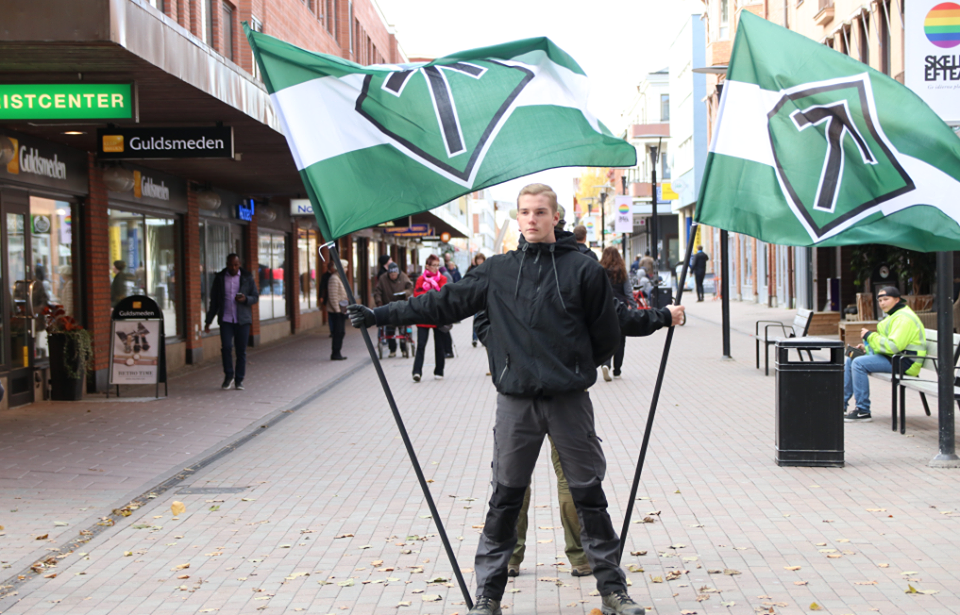
Hugo Edlund, who’s now 18, joined the movement when he was 15. His texts still appear in his name on the movement’s website. At one stage he referred to those fighting against the organization: “This has included psychologists who try to ‘cure’ us of our worldview, police who play us films of the grotesque ‘Holocaust’ lie, interviews with social services, parents who arrange meetings with ‘defectors,’ Reds who leave us threatening messages, pressure from the Swedish Security Service, expulsion from the armed forces, and so on. The list is long” (from the organization’s English language website). “At first, I didn’t take an interest in ideology,” he says now. “I was drawn to the visual side – the flags, the uniform, the shields. The struggle against the police also attracted us, and so did the fact that the organization had a lot of opponents. NRM members see it as a rebellious organization, interesting and cool, which is what made me and a childhood friend start to follow them.”

What did you actually do in the movement? What is the character of the activity?

“The truth is that most of the time it’s just sitting and talking. There’s more internal than external activity. Every week there was a social encounter; we would meet in someone’s house and talk. Once a month there was a meeting in the basement of the district chief, and many times afterward there was an activity such as a demonstration or handing out flyers. Sometimes we would read something or study the movement’s platform.”

The movement’s platform explicitly invokes the term National Socialism and an array of symbols that are evocative of the 1930s. It is replete with racist doctrine (a call to limit immigration to “ethnic northern Europeans”), anti-Semitic conspiracy theories (the need for an all-out struggle against the “global Zionist elite”), Nordic nationalism (a call for unification of the Nordic countries and an immediate withdrawal from the European Union, which is considered an enemy of the people), evocations of fascism (a strong state for the people) and patriotic romanticism (preserving the Nordic essence, being in harmony with the laws of nature, doing compulsory military service and arming the general public).

How many of you were there, and what was your common denominator? Who were your partners in the activities?

“In our city, there were seven-eight active members, maybe 25 in the district. Most of them were older, there were only two women. There was a feeling of belonging and of deep partnership. There was an atmosphere that said we needed to defend ourselves, and of course not talk to the police. The district chief would laugh and say, ‘If you talk to the police, we’ll shoot you.’”

Hugo Edlund. Photo: Kristoffer Pettersson.

Did things become violent?

“I wasn’t involved in violent incidents, but there were cases like that. Two of the older members, for example, were tried for assaulting someone – I think he was black. We talked about those things. For example, when someone from the movement beat up a 16-year-old boy in the election campaign, we talked about that in the meeting and praised him. “The first time I personally encountered a violent situation, I froze. It was in the Umeå Pride Parade, when we were attacked by activists from the other side. We told the police we didn’t want to file a complaint – the word in the movement is that the police work in the service of the Jews.”

What else did they say about the Jews?

 “They talked a lot about the Jews. There are lots of conspiracy theories about how the Jews are promoting an agenda that is turning Europe multicultural and into a kind of ‘bland bloc.’ The idea was that the Jews want to mix the races, and in that way destroy the white race. They said that the Jews influenced society through their property – the banks and the media. There was also criticism of specific Jews. The moment a Jew was involved in something, there was prejudice [against him] and they looked for a hidden agenda. For example, they said that when the ‘Jewess Carinne Sjoberg’ whined and closed the Jewish center, the only reason she did it was to appear in the media.”

Easily offended

“It is difficult to say with certainty how the level of anti-Semitism develops in Sweden,” says Mathan Shastin Ravid, of the Swedish Committee Against Antisemitism. “Research on the subject is limited and we don’t have extensive studies on the development of anti-Semitic notions and attitudes over time. What can be said is that anti-Semitism is more evident and more visible throughout society in recent years.” He adds that studies show that many Jews in Sweden are loath to show signs of their Jewishness in public. No few Jews have encountered anti-Semitic incidents, he notes. “At the same time,” he says, “awareness has risen. Anti-Semitism is more present in the public debate than it was 10 years ago. More decision makers and commentators refer to the subject and publicly condemn anti-Semitism, and that is important.”

Still, many cases go unreported. Several months ago, a young Jewish woman from the south of Sweden opened an Instagram account in which young Jews in Malmö have shared their experiences. They tell about being cursed, spat at and threatened, receiving hate letters, finding swastikas painted on doors and walls, and in some cases being beaten. The assailants were often migrants or second-generation migrants from Muslim countries in the Middle East and Africa. Periods during which the Israeli-Palestinian conflict intensified were particularly prone to anti-Semitic hate crimes. But Malmö is not alone. “Get your stinking Jewish hands off my products,” a saleswoman in a Stockholm store told a young Jewish man, according to his testimony. A young Swedish woman of Jewish origin noted that in a high-school history class, “when we talked about the Holocaust and the teacher said that the Nazis didn’t succeed in annihilating all the Jews, I heard two of my classmates behind me whisper, ‘Too bad.’ One of them said another time that the Jews are disgusting and have to disappear from Sweden.” A Jewish teacher in a school in southern Sweden recalls an email she received from her school principal. “The message contained an anti-Semitic caricature in which two Jews are shown killing a Christian child. I complained to my union, but nothing was done. The reaction of other staff members was a thunderous silence, and in the end the principal also canceled the funding for one of my projects.” When the teacher called her union’s headquarters in Stockholm, the response was disappointing: “You Jews are quick to take offense,” the official on the phone said. “What do you want, money?”

According to Mathan Shastin Ravid, physical danger for Jews in Sweden definitely exists, primarily from the far-right movements and from radical Islamists. At the same time, anti-Semitic viewpoints, anti-Semitic rhetoric and conspiracy theories are infiltrating broader circles of society. “It is important to understand that anti-Semitism is not only present on the extreme political margins,” he says. “It is also present in society’s mainstream. It’s more common than people think it is and it should be taken very seriously.” The Swedish government maintains that it is committed to combatting anti-Semitism. Recently, the government has indeed supported educational and cultural activities, as well as public diplomacy, on the subject, and upgrading the ability of the law enforcement system and the police to combat racist organizations and ensure the security of institutions that are liable to be victimized by hate crimes. Symbolic measures are also being taken. For example, members of the Swedish parliament visited Auschwitz, and the country’s education ministry is cooperating with Yad Vashem, the Holocaust memorial in Jerusalem, on developing curricula.

Nevertheless, the problem remains far from being resolved. On the last International Holocaust Day, this past January, Carinne Sjoberg organized an event for ninth-graders in Umeå. The event itself has been held for a number of years, with the participation of about a thousand students and teachers. There are talks and speeches, along with other content related to the Holocaust and its lessons. This year, Sjoberg encountered students who laughed, made retching noises and cursed during the event. “When I began my remarks, they interrupted so much that I couldn’t finish speaking,” she relates. “No one did anything, and the event was simply halted. Even worse, some local politicians said that maybe the event shouldn’t be held in the future, since it makes the young people behave like that. Some of the teachers also don’t want it anymore, because it’s a lot of work and is quite costly. I find that hard to accept.

“First they caused the Jewish center to shut down, and now they’ll terminate this educational project, too? That will be another victory for the neo-Nazis, while the city’s leadership behaves like the three monkeys: See nothing, hear nothing, say nothing.”

Getting out

Hugo Edlund’s period of membership in the Nordic Resistance Movement drew to an end in 2019. “In the past two years, two indictments were filed against me,” he relates. “One was for a hate crime because of things I circulated against Jews on Twitter. I was sentenced to community service work for youth and a fine. The second time I was convicted of a hate crime and also for graffiti – I spray-painted swastikas and symbols of the movement in different places in the city. I was sentenced to community service work and a fine again, plus payment of compensation.”

אדלונד מחזיק דגלים של NMR במרכז אומיאו קרדיט_מתוך האוסף הפרטי של הוגו אדלונד (1)

Edlund during his NRM days.

You were still a minor then, living with your family. How did your parents react?

“I didn’t tell them that I was a member of the Nordic Resistance Movement. They found out by surprise when I took part in activity against the Gay Pride Parade in Luleå [a small city in northern Sweden]. They knew about my opinions and my ideology, but not about my connection with the organization. One of my older brothers broke off relations with me, and the family was confused and didn’t know what to make of me. My parents tried everything. They tried to cut off the internet, to prevent political conversations in the house and to stop me from going to activities. But it came to a point where they simply despaired, because they felt there was nothing they could do.”

What finally made you decide to leave?

“It was a lengthy process, with all kinds of stages. For example, when the police came to my house at 5 A.M. to do a search. I realized that I didn’t have a regular life, I didn’t feel good, there was a social stigma on me and I wasn’t doing the things a regular person does. It was like living in a bubble. I didn’t go to school; I tried to work, but I left that, too, and I stopped even caring about the money. My whole focus was on the movement. “There are stages in membership in an organization like that. The first stage takes you from online activity alone to active membership, and in the second stage you become more extreme. It’s a destructive environment, and there’s a good chance you’ll start committing crimes and closing off doors to yourself. Gradually you lose friends, job possibilities and studies. In the end I understood that and I decided to leave.”

Edlund’s friends, in particular two who were close to him and whom he had recruited to the movement, reacted aggressively to his departure. One evening last October they came to his house and hit him during an argument about returning the movement’s uniform. Two months later, the two were tried for assault and convicted, sentenced to do community service work and ordered to pay compensation to Edlund – who is aware that his former comrades might go on persecuting him. Still, he is determined to embark on a new path. “Now I am completely free of that past,” he says. “I am finishing my schooling. I am also working on a project, in cooperation with Carinne. The project is about the far right, and that is also what I want to do in the future. I want to make a contribution to society and I don’t want other young people to follow the same path that I once did.” Edlund has passed on information about the Nordic Resistance Movement to an NGO that monitors and analyzes the activity of extreme-right movements in Sweden. His aspiration is to work with youth and contribute to the efforts to prevent radicalization. His meeting with Carinne Sjoberg, following the message he sent, was only the first. They are now in regular contact and are both participating in the struggle against racist political extremism and against anti-Semitism in Sweden. “It’s not a struggle for the sake of the Jews alone,” Sjoberg says. “It’s a battle for democracy that’s important for everyone. It’s a struggle for the right to be what we want to be and to live the life we choose to live.”