Did a Secret Resistance Network Assassinate Sweden's Prime Minister?

For 40 years, the assassination of Sweden's prime minister, Olof Palme, has remained unsolved. Now, some are revisiting a dark possibility: not a lone gunman, but a covert network embedded deep within Swedish society – part of a secret Europe-wide effort to resist a Soviet invasion

Published in Haaretz: 40-year Mystery: Did a Secret Resistance Network Assassinate Sweden's Prime Minister? – Europe

The most shocking event in the history of modern Sweden occurred almost exactly 40 years ago. On the evening of Friday, February 28, 1986, Prime Minister Olof Palme and his wife, Lisbet, went to see a movie in central Stockholm. It was a cold winter evening in the capital. As he often did, Palme dismissed his bodyguards and the couple travelled three subway stations to the theater without a security escort. When they emerged onto the street, they met up with their 25-year-old son, Mårten, and his partner. The four bought tickets and went in.

Shortly after 11:20 P.M., while the prime minister and his wife were walking back home along a main street in the city, a man approached them from behind and fired a gun at close range. Palme was hit and collapsed on the frozen pavement. A second shot was fired immediately afterward, lightly wounding Lisbet. Bystanders attempted to help but it was in vain. Palme died on the spot. An ambulance was called and evacuated his body and his wife to a hospital, arriving less than 20 minutes after the shots were fired.

The hours that followed were dramatic. News of the murder spread in the Swedish media and overseas. The country went on high alert, and Deputy Prime Minister Ingvar Carlsson convened the cabinet. At 5 A.M. Saturday morning a press conference was held. Flags were subsequently lowered to half-mast, flowers and candles were placed at the murder site, and an atmosphere of national mourning and crisis permeated the country. At the same time, it emerged that almost every possible mistake was made in the investigation of the murder: The shooter immediately fled; police arriving at the scene failed to apprehend him. They also did not set up roadblocks or cordon off the area. Coordination between law enforcement forces at the site was poor; no situation room was established, and testimonies from eyewitnesses were neither systematically collected nor fully documented. These errors were never corrected in the intervening four decades.
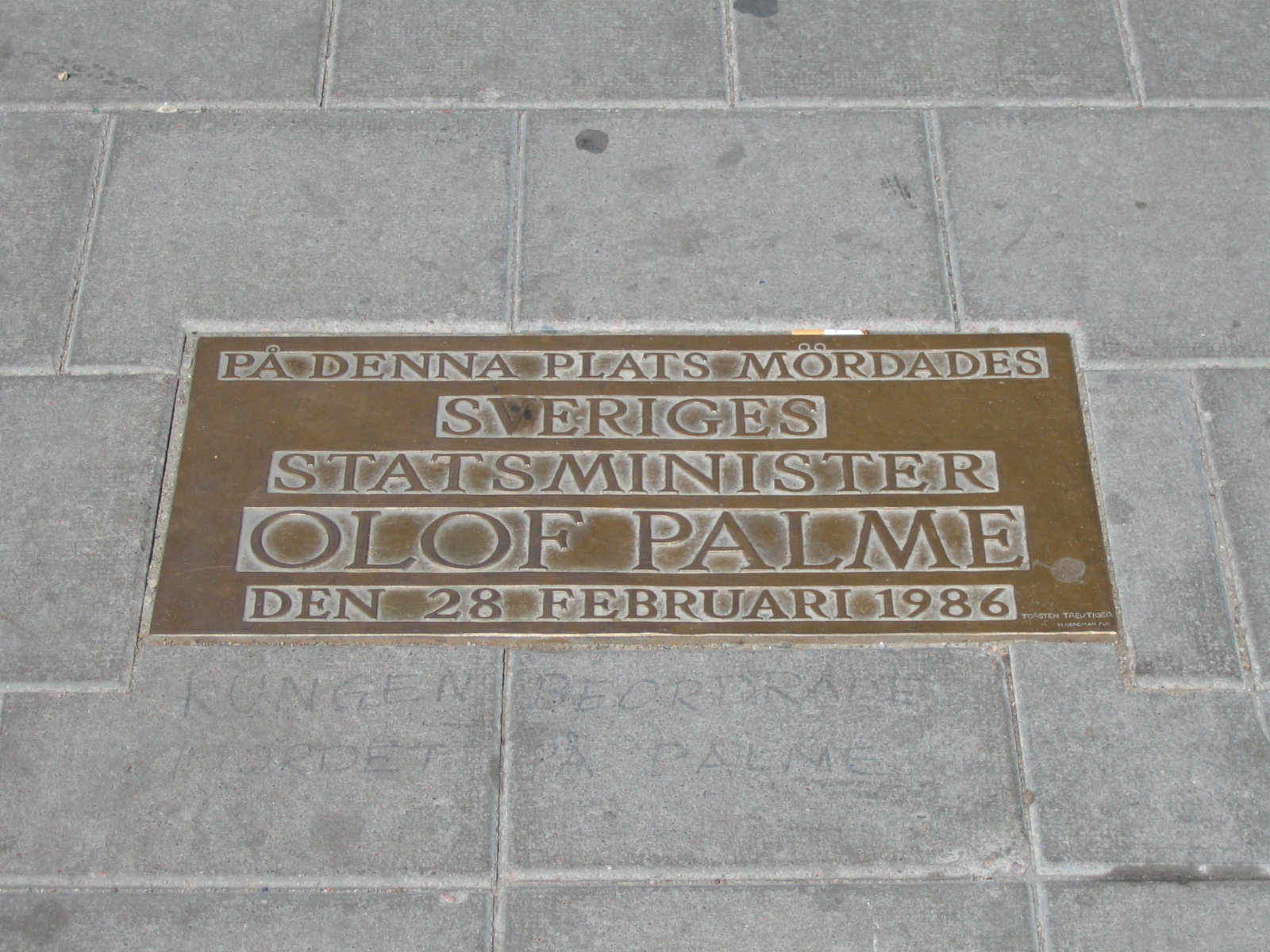
Olof Pale's Murder Site on Sveavägen in Cenral Stockholm

In the years following the murder, what is referred to by Swedish authorities as "the largest and longest-running murder investigation in the world" was launched, but despite significant resources, it was marred by disputes and conflicts and did not lead to any definitive outcome. Many investigative directions were pursued but no one was charged. In the first year, the Kurdish PKK organization was a central focus. Later, theories involving possible actors from various countries, such as South Africa – which allegedly had both a motive and the capability for executing a political assassination abroad – were explored but did not result in indictments. Such was also the case following investigations of theories involving terrorist organizations from the Middle East and Eastern Europe.

In 1988, a local criminal named Christer Pettersson was convicted of the murder, mainly based on a controversial identification by Lisbet Palme; a year later he was acquitted on appeal due to lack of evidence. In June 2020, the Swedish prosecution announced that the investigation was closed, declaring that a man named Stig Engström was the probable suspect. Engström had allegedly been present at the scene on the night of the shooting and had been interviewed as a witness in later years, but he died in 2000 and therefore could not be prosecuted. His motive was unclear, and the evidence against him was circumstantial and unconvincing. Nevertheless, this was enough for the prosecution to close the case.

But this was not the end of the story: In December 2025, the prosecution reversed its position. In a surprising development, it announced that a renewed examination of the investigative material had concluded that there was insufficient evidence against Engström, and thus he was no longer officially considered to be the suspect. At the same time, no other names were suggested, nor was the investigation formally reopened. Thus, 40 years later, the Swedish public still does not know who killed its prime minister or why. Meanwhile, on the margins of these developments, a discussion has surfaced about another historical phenomenon, which – like the identity of the man who pulled the trigger – was heretofore unknown to the Swedish public and kept in the shadows for decades.

"Today, we know no more about the murder than we did the day after it happened," says Gunnar Wall, a journalist and author who has dedicated years to researching and writing books about the Palme assassination. "We do not know if it was a lone assassin or an organized group, we do not know the motive, how the killer escaped, whether he was Swedish or foreign, or whether he is still alive today and, if so, is he in Sweden or abroad. Given this situation, there are countless speculations and theories."

Wall, recipient of the 1998 and 2024 Guldspaden (Golden Spade) award, Sweden's most prestigious prize for investigative journalism, for books he wrote about the incident, notes that while there are those who claim to know who the murderer was, despite years of research, he himself does not.
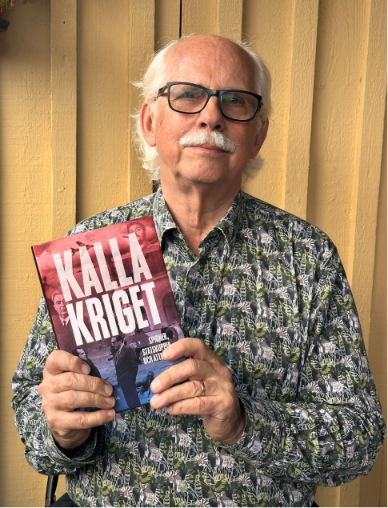
Gunnar Wall

However, Wall points to an interesting issue. The decision not to reopen the investigation late last year is strange, in his view, because about 15 years ago Sweden changed its legislation regarding statutes of limitations. Serious inquests into crimes such as murder, under the new law, are no longer closed after 25 years as was previously the case, and can remain open indefinitely. The prosecutor who last December chose not to resume the whole process justified that by saying there were no conditions for doing so – even though he admitted that he had examined only the Engström lead and not other possibilities.

When the previous prosecutor closed the case in 2020, it was possible to say that happened because he had reached a dead end – but the same cannot be said about his successor's decision, since he said he had not even attempted to evaluate materials that did not concern Engström. And yet, he seemed determined to leave the case closed nonetheless.
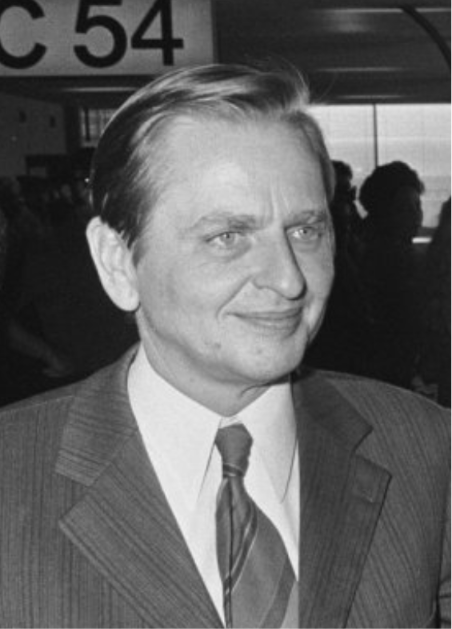
Olof Palme, Photo:Bert Verhoeff / Anefo / Nationaal Archief (CC BY-SA3.0 NL)

"The investigators of the Palme murder examined, almost until the very last moment, indications of [involvement by] a larger group that went beyond Engström alone," says Wall, who bases his claims on interviews he conducted with the investigators themselves and with additional witnesses, as well as on reviews of countless documents, reports and other materials. "Their main hypothesis was that forces within a secret Swedish network were behind the murder, and they tried to link Engström to these actors. When they failed, they abandoned the hypothesis and Engström remained the sole suspect. Five years later, because the evidence against him was weak, it all ended with no conviction and no suspect."

Suggestions about some secret entity having been behind the Palme assassination may sound like far-fetched conspiracy theories – but they are not. For decades, underground organizations called stay-behind networks existed in Sweden and many other European countries. While a direct link between the Swedish stay-behind network and Palme's assassination has not been proven, the existence of the group is an established fact. These clandestine bodies were created after World War II as a way for countries to prepare for a possible invasion and hostile occupation. Their work included drafting blueprints for underground resistance groups, maintaining contact with a government-in-exile and actively opposing an occupier.

In the early days of the Cold War, following World War II, the threat of Soviet aggression was tangible. Across Europe, secret networks were created in various countries, in order to forge connections between the military, police, intelligence services and civil society. Initially, these organizations were intended to prepare for a Soviet invasion, but over time some engaged in other activities, sometimes even conducting covert operations within their own borders, including false flag operations – designed to appear as if carried out by others to justify certain political or military reactions.

The most famous example is the Italian network and operation code named Gladio, whose existence was revealed to parliament in 1990 by Prime Minister Giulio Andreotti. Some claimed that this stay-behind network participated in domestic acts of political terrorism in the 1970s and '80s. Parliamentary inquiries looked into its operations and ties with foreign actors and intelligence bodies such as the CIA and NATO, and exposed its involvement in guerrilla training, communications networks, weapons storage and sabotage. There were also suspicions that Italy's network operatives engaged in domestic political activity, including terrorism designed to strengthen the Italian right and diminish the left. Similar underground groups have been documented in Belgium and Switzerland, and evidence of same exists in France and Germany, although without confirmation of domestic violence. There are also hypotheses about the involvement of such networks in coups and politically motivated violence in Greece and Turkey.

The investigators' hypothesis was that forces within a secret Swedish network were behind the murder, and they tried to link Engström to these actors. When they failed, they abandoned the hypothesis.

The whole phenomenon remains highly controversial and difficult to research due to the secrecy and compartmentalization surrounding it, yet there is general agreement that stay-behind networks have existed across Europe, operating without parliamentary oversight and known to only a small circle of decision-makers.

After years of rumors and official denials of such bodies existing underground in Sweden, in 2013, one of the country's major newspapers, Dagens Nyheter, published an article by Inga-Britt Ahlenius, a civil servant who worked at the Ministry of Finance, the National Audit Office and the United Nations. Based on evidence and research that had emerged since the 1990s, Ahlenius wrote: "While the initial disclosure of Sweden's institutional but unofficial Cold War connections with Western powers was met with denials and outrage, it was eventually accepted as the new truth. Thus, the revelation of stay-behind networks is often treated more like a romantic spy adventure than a historical fact." She noted that the secret resistance movement established in Sweden, and closely linked with Western powers, was likely initiated by Prime Minister Tage Erlander (Palme's predecessor) along with several ministers.

"[It was] initially led by Alvar Lindencrona, CEO of Thule insurance, three department heads and regional/local 'cells' operated under him," she wrote and added, "meetings occurred in secret rooms in Lindencrona's house or Thule's offices, and funding came from secret sources. Between 1951 and 1953, the CIA under William Colby, stationed in Stockholm and later CIA director, helped establish the network in Sweden, although the Swedes retained top-level control."

Journalist Wall adds some background information: Experience from World War II, he says, showed that countries that were occupied had been unprepared for such an eventuality – there were no resistance movements and they in essence had to be improvised. Thereafter, it was in the interest of those countries and others to prepare properly for the threat of military occupation; in Sweden, various actors dealt with this scenario at an early stage. Immediately after the war, a secret, state-level initiative was launched by the prime minister; the CIA entered the picture in the 1950s. Before that certain extremist elements had worked toward similar aims – among them war veterans who supported the Nazis during the war and volunteered to fight alongside them in the Continuation War in Finland. In the end, these three trajectories evolved into the Sweden's stay-behind network, although it is unclear exactly what remained of them in its final iteration.

"Unlike in other places, despite the cooperation with American and other actors, the Swedish network was established and organized by Swedes," says historian Mats Deland, a senior lecturer at Mid Sweden University (Mittuniversitetet) in Sundsvall. "Sweden did not participate in World War II, but it could learn from the Nazi invasion of Norway in 1940. The Norwegians sank the Blücher, one of the German ships on its way to capture the Norwegian capital in the Oslo fjord, which delayed the Germans and caused them heavy losses, while at the same time giving the Norwegians time to evacuate the royal family and their government northward.

"This experience was important for both the Norwegians and the Swedes who learned from it and came up with the idea to establish an organization that could evacuate the Swedish royal family and the government, but also 'stay behind' and protect the country. This goal of staying behind was the result of another experience from World War II: the NKVD, the Soviet security service under Stalin, who remained behind and became partisans in the German-occupied areas."

So, in the Swedish case, the stay-behind network was not controlled by the Americans or by NATO?

Deland: "Correct, in Sweden this was a local initiative. The Americans arrived a little after the network was established, and even then, they did not take control; they only integrated needs arising from NATO doctrine, which was based on the fact that only the United States had nuclear weapons. In the case of a Soviet invasion and the need for American aircraft to fly over Sweden, the idea was, like the French resistance – and to some extent the Belgian and Dutch resistance – to create escape lines that could smuggle out downed crews. But the United States did not establish the network and did not manage it. This may have changed in 1965, when Swedish security services were reorganized [when the Cold War-era external intelligence agency, T-kontoret, and internal intelligence agency, B-kontoret, merged into a single, secret organization], partly with the involvement of Olof Palme. It is possible that American involvement increased then."

How much was the Swedish stay behind network controlled by the state, and how much of its activity was conducted by civilian or military actors without the knowledge or control of the political leadership?

"Between 1947 and 1951, there were many volunteers in the network, including people who had served alongside the Germans during World War II, some of whom were highly problematic. Because of these types, the secret police discovered the network even though they were not supposed to know about it. Only the people directly involved – Prime Minister Erlander and a small part of the security apparatus – were meant to be 'in the loop.' Following this discovery, which angered Erlander and the security apparatus greatly, the network was reorganized, removing the problematic elements and incorporating trade union members and the business sector."
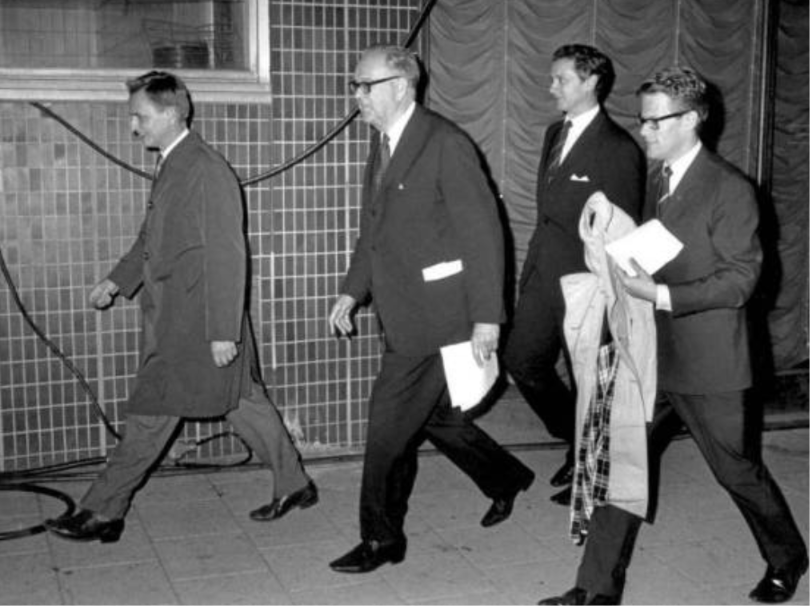
,Olof Palme, Tage Erlander, Sten Andersson and Ingvar Carlsson (1968) Photo: Lennart Nygren / SvD / Scanpix

According to Deland – and in keeping with Ahlenius' observations, as mentioned – the network was indeed led by executives such as Alvar Lindencrona, the head of the Thule company, a businessman with relatively progressive social views for his time, and it recruited forces from the trade unions that had a traditional affinity to the ruling Social Democratic Party. "These were ordinary people," he says, "not former soldiers. Although they needed training, they could be trusted, and the network remained secret until the 1990s." In other words, even though neither the Swedish parliament nor the rest of the government knew about the network, it was indeed an official entity. Indeed Deland notes that a recent book revealed an interesting document: an official government decision from the 1950s forming Sweden's stay-behind network, showing that it was legal and above board. The diaries of Prime Minister Erlander show that he may have given it a green light as early as 1947.

The book Deland refers to is Johan Wennström's "Sweden's Cause Was Our Cause: The Secret Swedish Resistance Movement" (2023). Wennström calls his country's stay-behind underground a "resistance movement," and reveals that the organization's code name, used by its members at the time, was Metro. Wennström says Metro was not established or controlled by NATO and it did not act on the latter's behalf, although he confirms there was cooperation with MI6 in Britain and, to some extent, with the CIA, mainly concerning programs such as evacuating Swedish decision-makers to England if necessary.

Furthermore, Wennström writes, Metro likely included several hundred people, as well as a sort of "invisible combat unit" that could expand to as many as 3,000. The underlying principle was that the network's members would recruit additional people from their immediate circle if necessary. The author also describes the group's structure was fairly cooperative, with representation from various sectors of Swedish society; information about its activities, he says, was distributed on a strict "need-to-know" basis. The organization was formally legalized in 1955, having been mandated by an earlier government decision. Typically, it was involved in organizing potential resistance and civil defense activities, such as mapping escape routes, planning acts of sabotage of critical infrastructure that could fall into Soviet hands, rescuing government officials and storing weapons. Wennström does not know when the organization ceased to exist, or if it exists today.

The phenomenon remains highly controversial and difficult to research, yet there's general agreement that stay-behind networks existed in Europe, operating without parliamentary oversight and known to few decision-makers.

Regarding other countries that had stay-behind networks, it is clear, both from Wennström's book and other sources, that heterogeneity was the keyword. Each country built its organization differently depending on perceived threat and the nature of the country's political, military and industrial power structures. Even in NATO member states, the networks were not necessarily under that organization's control. Parliamentary or public oversight was generally minimal, and there is still controversy over what their involvement was in domestic activity beyond preparing for a possible Soviet invasion during the Cold War era.

One of those who has focused on the phenomenon at the European level is Swiss author and researcher Daniele Ganser, whose controversial 2005 book – "NATO's Secret Armies: Operation Gladio and Terrorism in Western Europe" – is one of the best-known on the subject. It received praise but also criticism by some who claim that it is based on an unsubstantiated conspiracy. In it Ganser claims that Western intelligence networks operated secretly in Allied countries during the postwar era, sometimes beyond the bounds of proper legal and political oversight. He cites Italy, Belgium, France, Germany, Switzerland, the Netherlands, and Turkey, emphasizing that in some of these countries the stay-behind networks were indeed involved in terrorism, false-flag operations and political manipulation.

Mats Deland collaborated with Ganser on the Swedish edition of the book, which includes a chapter on the possible connection to the Palme assassination.

Did Prime Minister Olof Palme know about the network?

Deland: "We know he was aware of it during the tenure of his predecessor, Erlander, because he worked on it as one of Erlander's people in the 1950s. What he knew later, we do not know for certain. But it is reasonable to assume that all prime ministers knew about the network, although there are no official documents on the matter."

What can be said, to the best of your knowledge, about the Swedish stay-behind network in the 1980s, during Palme's second government?

"We don't know. We have some information about the network in the 1950s, but very little about the 1980s."

When did suspicions arise about a connection between the network and Palme's assassination?

"These were suspicions that arose from the very beginning. There was an investigative attempt as part of the official inquiry, and there were also discussions about people from the Stockholm police who could have been involved in the murder, but these are speculations and I do not deal with them."

Sometimes it's difficult to know whether a fact uncovered in an investigation is the key to solving a (murder) mystery or just a coincidence. The last person suspected of killing Prime Minister Palme, Stig Engström, who died 26 years ago, was nicknamed the "Scandia Man" because his workplace was in a building called the Scandia building. The building had previously housed the headquarters of the above-mentioned Thule insurance company Thule merged with Scandia in the 1960s and was run by Alvar Lindercrona who, as said, apparently headed country's the stay-behind network; indeed some of its meetings took place in that same building. In other words, if Engström murdered Palme, he did so while leaving a place where in the past – and possibly as late as the 1980s – meetings of senior members of the country's stay-behind network were held. Is this a coincidence? And even though there is no evidence that Engström was actually connected to the underground organization, is there any logic to the claim that it was involved in Palme's murder?

Wall, the journalist, is not unequivocal on this matter, but he does suggest some key historical points that should be taken into account. "One of the things that happened during Palme's second term as prime minister in the 1980s was a series of alleged Soviet submarine incursions into Swedish territorial waters," he explains. "These incidents caused a severe security crisis, and some argued that they were preparations for an invasion and the establishment of espionage infrastructure. Within the Swedish security establishment, there were claims that Palme did not take the threat seriously and that, because of this, he posed a security risk to Sweden.

"Furthermore, Palme was supposed to travel to Moscow to meet Soviet leader Mikhail Gorbachev in April 1986. Palme, who returned to serve as prime minister in 1982, was active on the international stage on issues of arms reduction and nuclear disarmament. His opponents argued that he had close and controversial ties to the Soviet Union, although a more balanced description would be that he was open to discussions with Soviet leaders about disarmament – something that went against both NATO's view and the opinions of senior Swedish military officials. The assassination on February 28, 1986, meant that it was Palme's successor, Ingvar Carlsson, who met Gorbachev."

As far as is known, the issue of disarmament was not on the agenda at that Swedish-Soviet summit.

Wall adds that there were a number of people who claimed to have received offers to kill Olof Palme; in several cases, it was suggested that Swedish intelligence services were behind those offers. But no one known to have actually belonged to any of these secret services has ever come forward to confirm that they were approached. Wall also provided Haaretz with documents he's collected showing that evidence indicating that people with radio devices were present in the area on the night of the assassination was not taken seriously by the investigators. He does not claim that there is proof that the murder was organized by political actors, but argues that it is certainly a line of inquiry worthy of serious examination.

And he is not alone: Ahead of the 40th anniversary of the assassination, a public appeal was launched to encourage the Swedish government and parliament to establish a "truth commission" to finally resolve any outstanding questions.

"On February 28, 1986, Olof Palme fell victim to a brutal attack on an open street in central Stockholm," the appeal begins. "The assassination of the prime minister of Sweden was a unique attack on our democracy. In a country governed by the rule of law like Sweden, everything possible should have been done to solve this murder. The fact that it remains unsolved 40 years later is unacceptable, especially when not all possibilities for an indisputable and absolute solution have been investigated."

The text cites problems that may have prevented discovery of the truth – still-classified archives, false answers given to the investigators by secret service personnel and investigative files that have disappeared. Possible involvement of the Swedish stay-behind network is also mentioned, and the conclusion is: "This is the only assassination of a political leader in modern Europe that may remain unsolved. Clarifying all the circumstances surrounding Olof Palme's murder will strengthen Sweden."

Still, at this rate, it is doubtful whether the mystery will ever be solved. Even if it is, the relatively recent revelations regarding stay-behind networks in Europe are just another example of how, even if and when the public discovers the truth, it sometimes comes decades too late, in the form of very old news.

This is Not a Drill – The Roger Waters Interview

Published in the Hebrew edition of Haaretz: https://www.haaretz.co.il/gallery/galleryfriday/2023-05-03/ty-article-magazine/.highlight/00000187-dcd1-dea8-af97-dff1b5ca0000

The pre-show announcement in Roger Water's latest tour is rather unconventional. After the regular, please "turn off your cell phones", comes a slightly more provocative announcement "if you’re one of those ‘I love Pink Floyd, but I can’t stand Roger’s politics’ people, you might do well to fuck off to the bar right now". This sets the tone since the show's main theme is a mix of current affairs, political science and global politics and Waters is anything but mainstream in these aspects. In fact, many would say he's a hard core radical.
This, combined with the fact that Waters is one his generation's biggest rock stars and he attracts tens of thousands of people to his concerts, makes his tour an important cultural phenomenon which provokes many reactions and heated debates. Waters granted "Haaretz" an interview during this controversial tour and I spoke to him at his hotel, a couple of days prior to his Stockholm show, after he completed the American part of the tour and 14 of its 40 European dates.

So as not to start the conversation with the confrontational opener, we talk first about the music, rather than the politics. This is after all a rock concert, not an election campaign. Waters, who will be 80 in September has an enormous body of work to choose from when he goes on the road. He realizes, of course, that it wouldn't be right to go on stage without playing any of the classics he created together with Pink Floyd, the band he co-founded in 1965 with by Syd Barrett, Nick Mason and Rick Wright and left in the mid-eighties. And indeed, the show includes the whole second part of The Dark Side of the Moon, Pink Floyd's 1973 album as well as material from Wish You Were Here (1975), Animals (1977), The Wall (1979) and The Final Cut (1983). "If I followed only my heart and not my head, I'd probably do what I used to do with Pink Floyd", Waters says, "I led Pink Floyd for many years, and when I did, at least during the last few years, when we toured, we only played the current record and the last record. If I would do that now I would have played only my latest solo albums and I might have also added Us and Them (from The Dark Side of the Moon), which is a genuine co-write with Rick Wright (Pink Floyd's keyboard player)".

Waters points out that he has just finished re-recording the whole of The Dark Side of the Moon which was released exactly fifty years ago. The new version will be released this July. Waters believes it's still extremely relevant and that's why so much of it is on his current show. "Nothing I've done recently is more political than Us and Them", he says and quotes the lyrics, "with, without, and who'll deny that's what the fighting's all about". "It's a truism and part of the reason I re-made the album", he explains, "people haven't noticed in the last fifty years what it's actually about". Waters adds that he enjoys playing this part of the show as much as the newer songs, because it's very visual. "There's an enormous LED crucifix hanging over the stage", he explains, "and the images that we show, particularly during Us and Them move people very deeply because it's so anti-war".

So, as it is, are you pleased with the set list you're playing on the tour even though it includes more than just your current and previous albums?

"Yes, I'm content with the way the set lives, it's full of new things and old things, and in consequence sometimes people are a bit puzzled". Waters mentions, as an example, a new song called The Bar which he says is "extremely important philosophically and emotionally, because it's my plea for conversation and communication between us human beings, in support of, and in defense of humanity, and how we need to learn to cooperate with one another, rather than killing one another".

When it comes to the visual side, don't you feel that the sophisticated video work, the images on the enormous screens and the setup of flying pigs and flying sheep is all a bit grandiose and makes your connection with the audience less intimate?

Waters doesn't approve of the word grandiose. "It either is, or it is not good theatre", he says, "I've spent the last sixty years trying to create theatre which is appropriate for rock'n'roll in arenas and outdoor venues and to play for anything from 15 to 100 thousand people. You can't do intimate theatre, much as I adore intimate theater and sometimes regret that I haven't been able to work in small theaters". Waters adds that there are plans "in the pipeline" to do one or two smaller shows of the new version of The Dark Side of the Moon as well as a theatrical version of The Wall in an intimate space. With these projects and others, it doesn't seem at all as if he's ready to retire.

The Show is called This is Not a Drill – The First Farwell Tour, it also includes biographical texts explaining various parts of you career. Is this your attempt to start wrapping things up, is this you shaping the narrative one last time?

"No, whenever I do a tour, I have to decide what it's going to look like, what the story's going to be, what the narrative is, what it is I hope to achieve and how much of the old Pink Floyd stuff I need to do in order to satisfy the hunger. One thing that's really good is the age demographic of the people who are coming to the shows. Many of them are 20-year-olds. That's fantastic and that doesn’t happen with many of the old bands. Obviously when I put out adds saying "his first final farewell tour" it's a joke. Because so many of the others do farewell tour after farewell tour for years and years".

Speaking of other bands, you said in an interview a few years ago that you don't listen much to music and you're not very interested in what's going on in the so-called music industry. Since your show is part of this industry, aren't you interested in what else is going around?

"What else is going around? You tell me, if you are interested. I'm really not interested. Life is too short". Waters explains that no artist has time for that. "You get on with your work", he says, "Michelangelo didn’t say 'well, I think I'll get on a donkey, go round Italy and see what the others are doing. He said – 'I want that bit of Carrara marble, now let's see how I can get it down the hill without killing a hundred people'". At this point Waters quotes his 1972 song, Free Four, "Life is a short warm moment, and death is a long cold rest, You get your chance to try, In the twinkling of an eye, Eighty years with luck or even less, So all aboard for the American tour, And maybe you'll make it to the top, But mind how you go, And I can tell you 'cos I know
You may find it hard to get off. But you are the angel of death, And I am the dead man's son, He was buried like a mole in a fox-hole, And everyone's still on the run
".

These are important sentences in the Waters universe. He was born in South East England in 1943 and has lived in the United States for twenty years ("because of the weather more than anything else. It never stops raining in England"). His father, Eric Fletcher Waters, who was a schoolteacher and a member of the communist party, was killed in the WW2 in the battle of Anzio in Italy when Waters was just five months old. His grandfather, George Henry Waters, was also a war casualty. He died while fighting in France during WW1. Considering this, it's not much of a surprise that the cruelty and meaninglessness of war have always been an important part of Waters' work and in the current show these themes are more apparent than ever. It is in this context one should see the opener asking those who don't approve with Waters' politics to "fuck off to the bar", it's just his way of saying he's not forgetting and he has no interested in toning it down.

Roger Waters on the cover of Haaretz' weekend culture magazine, photo: Kate Izor

Apart from being a unique opener, there's also a serious issue here. If someone comes to your show because he or she loves your music, but that someone happens to also be a supporter of Trump, Bolsonaro, Boris Johnson or Netanyahu, do you really not want them there?

"I don't give a fuck if they're there or not. I'm not proselytizing. You know, you're writing this for Haaretz and people are always trying to persuade me to go to Israel, do gigs in Tel-Aviv and talk to people, proselytize and try to get them to change their policies and work from within. And I say, fuck off, there's a picket line here and I'm not crossing it because I believe in human rights. Those people, people who voted for Trump, they would get up and leave when I played tracks from Animals (Pink Floyd's 1977 album based on George Orwell's Animal Farm). I couldn't care less. Leave! I don't want you to come. This isn't an attempt to affect you because you're lost. The people who I'm trying to encourage are the young people who want to resist the dreadful destruction of our home planet by the ruling class. I'm interested in communicating with them. I don't care about people who vote for Netanyahu or Trump or Bolsonaro".

Here's another way of putting it. It seems like from decade to decade your work becomes more specific and less abstract and universal. If, in the 70s you dealt with the way we see the humanity in others, and existential and abstract concepts like time, death alienation and loneliness and later with general political ideas like dystopian societies and fascism, since the 80s, you're writing about specific events like the wars in Afghanistan or Iraq and you clearly mark your villains like Thatcher and Trump and your heroes like Juliane Assange. This isn’t something everyone can sympathize with.

"I couldn’t agree more. I think it's a function of age. We all live within the context of our personal histories. Those of us who can actually read, and there are fewer and fewer of us, we read history and take notice of what happened in the past, but as our lives unfold, we recognize the folly of repeating the same mistakes over and over again, and the engine which drives those mistakes, is by an large greed. Greed for money or power. And so, yes, I'm less concerned about becoming irrelevant because I'm writing about specific things or specific periods of time. The context of the passage of time is very important, maybe because I'm 79 years old, the idea of rejoining the great oneness of everything as ashes and dust, possibly as a memory but maybe not even that, becomes closer and also behooves us more and more to grapple with the big questions, which is required of all art which means anything".

Speaking of great works of art which you quote in your show – George Orwell's 1984 and Animal Farm and Aldus Huxley's Brave New World, you refer to the dystopian future they talk about and to the real-life leaders who are making their visions into a reality, mostly American presidents – the pictures of all presidents from Reagan to Biden are on the screens in you show presented as war criminals. I wonder if Chines president Xi, Russia's Putin and Belarus's Lukashenko are not on the screen because you think that they are not war criminals, or is there some other reason?

"My history is full of those American presidents; they have been denominating geo-political events since the Second World War when I was born. The 'evil empire' since WW2 is the USA and it continues to be. And right now, the US with Joe Biden at the helm is driving us towards World War 3 as fast as it can. And there seems to be two potential drivers – one is profit, the value of the war industries has gone up vastly since the Ukraine war started. The other is what's considered to be their manifested destiny – to rule the world. So, they decide who is and who isn’t democratic. What makes anybody think the US is a democracy is absolutely beggar's belief, because it is not, and anybody with an IQ above room temperature knows it's not. It's driven by money and power and the people have no say in the matter".

Waters also mentions he knows he's making an extreme statement, but since he lives in America, and does not live in Russia or speak Russian, some issues he can't really comment on. He doesn't trust the American media, he quotes presidents Eisenhower's warnings against the so-called "military-industrial complex" and, in his show, the screens are full of examples and images which make clear where he thinks the real problem lies – victims of state violence against civilians, victims of the so-called "war on terror", victims of drone attacks, American foreign policies in South America and domestic policies against native Americans.

In a CNN interview you reacted to a question about Chinese violence towards their own people by saying it was "bollocks, absolute nonsense". Do you not believe, for example, the news about the atrocities being committed in Xinjiang against ethnic minorities or do you just think it's not your place to comment about that? To me, what's happening there is the closest thing to 1984 in the real world.

"Depends what story you read. I do not believe the western narrative about the Uyghurs. I don't believe it. I don't believe there are millions and millions of people locked up in concentration camps being slowly murdered and tortured to death and that the women are being raped by the Chinese government. I don't believe it. Is there a problem in that part of China? Possibly. Probably. Are the Muslim's all being re-educated in camps? Almost certainly not. Are some of them? Quite possibly, if they're members of ISIS for instance. If I was in China and spoke Chinese I could answer these questions, I cannot relay on the western mainstream media to tell me what's going on there and I don't believe them any more than I believe this Russiagate nonsense and any of this phobia against other countries going on all day every day, drumming up a third world war. In my show I say "you can't rule the world. Nobody can. The world is there to be respected, nurtured, loved protected and shared. That's the text I wrote, you can call it corny, I don't give a fuck, but this is the problem with the whole geo-political situation, the US wants to rule China, they want to rule Russia, they want to rule the world, they declared it, it's in all their political manifestos and it's destroying the world".

According to Waters the war in Ukraine is a result of the same American policies. Even though he denounced the Russian invasion, he doesn't see the war as the fault of the Russians alone. He also strongly condemns continued military support to Ukraine. "It's them (the US) advancing NATO further and further east since the end of the cold war", he says, "are they going to beat Russia? Not without a nuclear war they won't. So, why are they doing it? Well, it's because they've got morons like (American National Security Advisor) Jake Sullivan and (Secretary of State) Antony Blinken chattering in the ear of a really really old bloke with Alzheimers who doesn’t understand any of it and never will" (incidentally, President Biden is less than a year older than Waters).

Last September Waters wrote a couple of letters to Olena Zelenska, Ukrainian president Zelenskyy's wife, in order to try to get her to convince her husband that it's time for a compromise with the Russians. When she replied on Twitter and wrote that he was writing to the wrong president, Waters wrote to President Putin too. Putin is yet to answer. Although Waters made clear that he's horrified by the invasion's results, he claims that a different Ukrainian policy in the Donbas and less American intervention would have led to a peaceful solution. This attitude led to strong reactions in the west and it seems Waters is once again paying a price for his politics.

Just after the Zelenska letter was published, the Polish city of Krakow cancelled Waters' shows in the city. The reason was that the city, which owns the arena, would not tolerate it being used by an artist spreading ideas objectionable to most people in Poland, referring to Waters' stance on the war in Ukraine. "I wrote a letter to the councilor who orchestrated all that", Waters says, "but they didn’t take any notice of it". The gig was indeed cancelled and that was not the only Ukraine related controversy Waters was involved in. A few months earlier, Waters' ex bandmates from Pink Floyd, guitarist David Gilmour and drummer Nick Mason, recorded a song called "Hey, Hey, Rise up!", supporting Ukraine and featuring vocals in Ukrainian by the Ukrainian musician Andriy Khlyvnyuk. Waters talked about the song in an interview to Berliner Zeitung a couple of months ago. "I have seen the video and I am not surprised", he said, "but I find it really, really sad. It’s so alien to me, this action is so lacking in humanity. It encourages the continuation of the war. Pink Floyd is a name I used to be associated with. That was a huge time in my life, a very big deal. To associate that name now with something like this. Proxy war makes me sad. I mean, they haven’t made the point of demanding, “Stop the war, stop the slaughter, bring our leaders together to talk!” It’s just this content-less waving of the blue and yellow flag. I wrote in one of my letters to the Ukrainian teenager Alina: I will not raise a flag in this conflict, not a Ukrainian flag, not a Russian flag, not a US flag".

This was probably the background for one of the most extreme public comments against Waters made by Polly Samson, a novelist, lyricist and journalist who is married to Gilmour and has written the lyrics to many of his songs. "Sadly, you are antisemitic to your rotten core", Samson wrote, "also a Putin apologist and a lying, thieving, hypocritical, tax-avoiding, lip-synching, misogynistic, sick-with-envy, megalomaniac. Enough of your nonsense".

Would you care to comment on what Samson wrote?

"No", Waters smiles, "I think I'll rise above that. Thank you for the offer".

But Samson isn't the only one opposing Waters. His latest tour is being threatened from another direction. One that Waters has encountered before. In Germany, he's being accused of antisemitism and therefore some cities have tried to cancel his shows. Waters claims the people behind this are "the Israeli lobby and people who believe that I'm an antisemite because they've read all the lies and believe this ridiculous story".  As always, he denies the allegations. "I'm not an antisemite, never have been and never will be", he says, "I have nothing against Jews, I criticize the Israeli government and I'm part of the BDS movement. So, they're trying to cancel me in Frankfurt and in Munich and in Cologne. Munich has now backed off, Cologne seems to be backing off". This means the shows there are supposed to take place and so is the performance in Frankfurt at the end of the month, due to a court ruling forbidding the authorities to cancel it. "In Frankfurt I've taken out an injunction reminding them it's illegal even though the council and state own the venue", Waters explains, "in their attack on me they were trotting out stories about Kristallnacht, sort of accusing me of somehow being responsible for the deaths of 3,000 Jews who were rounded up by their Frankfurt police and sent off to be killed" (the venue Waters was supposed to play was the place where 3,000 Jewish men were arrested after Kristallnacht and from where they were sent to concentration camps).

According to Waters this is far from the first time he is being attacked on this background. "When I finished The Wall movie (2014), we had a world premiere in Canada at Toronto International Film Festival", he recalls, "that night a representative from Netflix came to see my management and said 'I adore the movie, we want it, let's make a deal tomorrow', he could not have been more effusive. The next morning there's a phone call saying 'we're not sure it's quite right for Netflix'. That's just a board meeting with the Israeli lobby raising its voice saying 'you cannot have anything to do with this man, Waters, he's an antisemite, anti-Israeli and anti-Zionist, we are going to crush him. And they've tried. Trust me. I have the bruises. But they have failed".

There are many stories regarding the accusations claiming Waters is an antisemite and they've all been told in length. The flying pig which appeared in his concerts with a star of David symbol on it (along many other symbols including a cross and a crescent), the events surrounding the replacement of Waters' show in Tel-Aviv with a show in Neve Shalom in 2006 and comparisons Waters made between Israel and Nazi Germany and Apartheid South Africa. Essentially, however, it seems like the main long-lasting reason he attracts this particular criticism is his support of the BDS movement.

You are a supporter of the BDS movement and many wonder about the way the BDS campaign is focused only on Israel. Considering everything you say about the US, for example, why are you still playing concerts in America? Isn't it time to start boycotting the US?

"Should one turn one's back on any problem anywhere simply because you can't solve all the problems everywhere? My view is – no. And my view is that it was correct to join the anti-apartheid movement in South Africa, even though we may never know what effect that had on the downfall of that supremacist white racist regime. In my view, what really did it was when we stopped playing rugby and cricket with south Africa, that's what tipped it over the edge. They couldn't bare it".

And you think the BDS will have the same effect on the occupation?

"I'm certain it will. We're coming close to it now. You can see what happened with Indonesia which refused to host the U20 world cup because they wouldn't entertain an Israeli team. The point was made. The power is shifting. It's about the Human Rights Declaration of Paris, 1948 – you cannot cherry pick. You're either in or you're out. You either believe in human rights or you don't. and most governments don't. so, you say, why don't I boycott America. Because I can't! I can't boycott America and the UK and France and Germany. Well, I could, I could go and live on a fucking island and do nothing for the rest of my life. But I think because Israel is so extreme and it gets more and more extreme as the minutes go by, we may win this and get human rights for the people of Palestine".

When you say human rights for Palestinians, It's not clear if you're talking about 1948 or 1967. If the problem is the occupation of the West Bank, it could theoretically be solved by a two-state solution. But if the problem is not only the occupation of 1967, does your success mean the disappearance of the Jewish state? What exactly is your solution?

The solution is a state that is democratic and that every citizen and every person who lives within the territory has equal civil, political and religious rights. If that means the end of the Jewish state, so be it. It would be like having a Christian state. If America would become a Christian only state, I would say, you can't do that. I would say – get rid of America because you cannot have a Christian supremacist state where only Christians have rights. That's anti-human, anti-democratic and against everything I believe in. so is the Jewish state of Israel, because people who are not Jewish do not have rights. There's no getting round it. Maybe it's the nomenclature that is the problem, because (the Jewish state) is expressed in the behavior of these disgusting thugs, the settlers, like the ones from Hawara. Doesn't that make your blood boil? We've all met these kinds of people. They don't have to be Jewish. Their religion is irrelevant. It's the attachment to the religion that they think gives them the permission to be a fascist.

So, no two-state solution then?

Please! Go back to the 67 borders, get the settlers out, allow the Palestinians a separate and sovereign state, and you can do it tomorrow. It's not rocket science. But we've all known, right from the beginning that there was never ever going to be any possibility for any of that. A lot of people believed in all the shenanigans of pretending that. They never had any intention of there being a Palestinian state because they've read their bible, they want Jorden and the whole fucking lot and they want it to be a Jewish supremacist apartheid state. Well, you can't have it because the rest of global civil society will not stand for it. And the people who've looked after you for all these years, the US, are discovering that they can't support it either, and the Jewish community in North America are changing their stance faster than you can imagine, because many of them are really wonderful humane people who follow their religion, who've read the Talmud and who actually aspire to a lot of the great things that are in it.

What about the hundreds of thousands of people within Israel who are against the government and demonstrating these last months?

What are they demonstrating about?

Democracy and freedom.

Well, no they're not. You mean democracy and freedom for them, in their little supremacist Jewish bubble. That's not democracy and freedom.

Well, even if the Israeli peace movement is small, aren't you worried about the BDS making its attempts for dialogue even harder, there have been claims that the BDS shuts down initiatives for dialogue by informing on them to Hamas.

"So, it's Hamas' fault again. What a surprise! But that's bullshit". Waters denies the theory of the BDS being an obstacle for peace and he's very clear about his support for the BDS movement. He speaks of the "picket line" that his Palestinian brothers and sisters asked him not to break, he speaks of the Balfour declaration that says that the National Jewish home does not "infringe in any way on the religious or civil rights of any of the indigenous people" and he insists that the only democratic solution is one of equal rights to all between the river and the sea. In his show there are images of the Israeli West Bank barrier, of Palestinian victims and a slogan that couldn't be clearer "you can't have occupation and human rights".

What if a one state solution doesn't mean a democratic country in reality, but instead it's the beginning of ethnic cleansing? Whether it will be Jews killing Arabs or Arabs killing Jews, decades of hatred on both sides, including the Palestinian leadership, may lead to a bloodbath, rather than peace and harmony.

"I'm trying to work out if this is a question or not", Waters says, "this is the story they're being fed all their lives, but you can't say 'we do not want equal human rights because it might turn into a blood bath', that is the new Hitler. 'If I control everything, then we'll live in an ordered society'. If you really believe in freedom and democracy, you have to tear up all the papers that Ben Gurion wrote all those years ago and you have to say 'we got this completely wrong. This is not what we want. We do not want a supremacist apartheid state. We want to live in a lovely country where we can live safely, but where everybody else can live safely too. It's no good for the burden of being the oppressor just to be switched from the Germans to us. We don't want to be the oppressors. We want everybody to be free. That's what we want if we're going to have a homeland'".

In a way, the first sentence of Waters' new show, the one sending those who are not fans of his politics to the bar, is a reasonable warning. Waters' opinions are far from mainstream politics and some of them may seem offensive to many. The last part of the show, however, is somewhat different. Waters has a drink with the musicians he shares the stage with, talks about his wife (his fifth) as a rock he leans on and about his older brother, John, who died last year. He then goes back to the new song, "The Bar", which is about his family, about memory and empathy. The song's accompanied by an old black and white family picture which appears on the screen. There are four people on it – his mother, his father, his brother and himself, just a couple of months old. He's now the only one on that picture who is still alive. After a song describing a nuclear holocaust and the end of life on earth, this is a surprising private, non-political moment which is both touching and honest. Waters would probably disagree and claim that everything is political, but perhaps the words he uses to describe the loss of his old friend and bandmate, Syd Barret, explain the uniqueness and importance of the human experience, the fragility of life and the importance of human connection at this moment at the end of the show. "When you lose someone you love", he says, "it does serve to remind you. This is not a drill".