Lund University will host a conference on the 'instrumentalization of antisemitism,' and last month, a lecturer at Stockholm University denounced the leader of the local Jewish community as a 'murderer.' Jewish scholars see these incidents as signs that they are no longer welcome in Sweden.
STOCKHOLM – On Monday, Lund University in southern Sweden will host a conference titled "Beyond Polarization and Instrumentalization: Antisemitism and Other Racisms."
According to an advertisement on the university website, it will explore the "broader context" of "whiteness, the nation-state, Europeanness, politics of belonging, racial capitalism, gender, sexuality, religion/secularism, and (anti-)Zionism," and also the "instrumentalization [of antisemitism] in relation to support and opposition to Israel, before and after October 7th 2023."
This attempt to redefine antisemitism "and reduce it to a definition most Jews cannot support," says a Jewish historian in Sweden who asked not to be identified, effectively bars many Jewish scholars from participating in the discussion. The organizers of the conference, being hosted by the department of gender studies, rejected a request from Haaretz to attend and declined to answer questions.
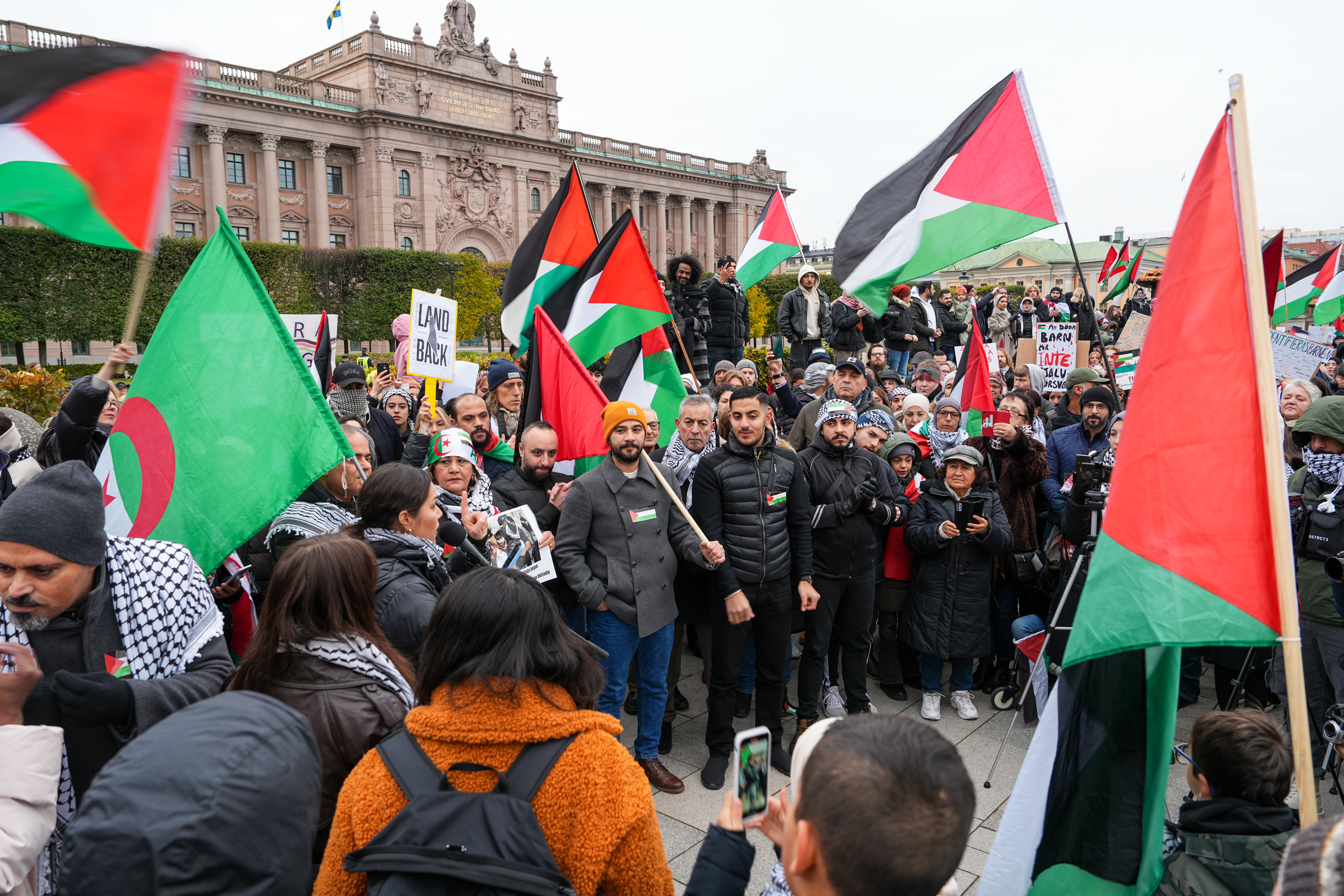
A demonstration outside the Swedish parliament in Stockholm. Photo: David Stavrou
A few weeks ago, another Swedish university – defying growing calls from students and faculty to boycott Israel – notified its doctoral candidates about a fellowship opportunity in Israel. But less than a week later, Uppsala University issued an unusual apology. "We understand that the information we forwarded has caused strong reactions, and we apologize for this," it said, adding that it intended to review procedures for passing on such information.
Asked for comment, a university representative dismissed the retraction as a technicality. "We realized that several recipients perceived the information passed on from the career office as a statement from Uppsala University," said Cecilia Edin, head of the career office. "This was never our intention, and we wanted to say sorry for the feelings this misunderstanding caused. PhDs at Uppsala University aren't the main target group for the career office, and we don't usually communicate with them. Therefore, the routines for passing on information to this group will be reviewed.
But an email complaint circulated among Uppsala staff and shared with Haaretz suggests there were other reasons for the apology. "It's inappropriate to advertise Ph.D./postdoc opportunities at any institution or foundation complicit in apartheid," it said.
These two incidents indicate just how fraught the discourse surrounding antisemitism and Israel has become at Swedish universities. Indeed, just a few months ago, Uppsala – Sweden's oldest institute of higher education and one of its most prestigious – was accused of "canceling" its Jewish connections when it removed the name of Hugo Valentin – a prominent Jewish historian and ardent Zionist – from its Center for Holocaust and Genocide Studies. The move has been described by international scholars and historians as "removing the Jewish perspective from the Holocaust," which may explain why this academic center has repeatedly rejected requests to honor Jewish Holocaust historian Paul Levine, who was one of its leading historians. Although Levine, who died in 2019, was a groundbreaking Holocaust historian and a laureate of the Raoul Wallenberg Centennial Medal, the center refused to create a memorial page on its website or place a plaque at the center to recognize his contribution.
In March, tensions between the Jewish community and the Swedish academy escalated even further when a lecturer at Stockholm University denounced the leader of the local Jewish community as a "murderer." Aron Verständig, chairman of the Official Council of Swedish Jewish Communities, responded by filing a complaint to the Swedish police against sociologist Pär Engholm for slandering him.
Swedish journalists Sofie Löwenmark and Lars Jonson have since revealed, in a piece for the online magazine Doku, other vociferously anti-Israel statements by this Stockholm-based academic, including his depiction of Israelis as "Zionist monsters who must be forced back to Eastern Europe and the United States. "Engholm has referred to Jewish leaders and terrorism researchers as "obnoxious" and "disgusting Zionists." He propagated theories suggesting that Israel murdered its own citizens on October 7 and defended Hamas, accusing Israelis and Americans of being the true terrorists.
Verständig later reported to the Swedish Committee Against Antisemitism that Engholm attacked him because he had called out another Swedish institution of higher education, Gothenburg University, for allowing pro-Palestinians student activists to take over the premises of its school of art and design and distribute Hamas propaganda. Commenting on the increasingly hostile climate on campuses, Daniel Janouch, chairman of the Swedish Jewish Youth Union, told Haaretz: "Jewish and Israeli students are worried and feel uncertain about how the situation will develop and what it will mean for them. There is concern about whether students' grades could be affected if they are simply open about being Jewish or having a connection to Israel." He added: "Jewish students should not have to take a detour on their own campus to feel safe."
Israel's government has boycotted the Sweden Democrats since the party's founding by neo-Nazis in 1988. The political repercussions of the Gaza war have led to a new Israeli directive calling for exploratory talks, but the Swedish Jewish community still refuses all contact with the far-right party
STOCKHOLM – Foreign Minister Gideon Sa'ar's instruction for Israeli diplomats to launch discreet talks with the far-right Sweden Democrats has made waves in the Swedish media. It marks a drastic change for Israel's foreign policy, which was previously characterized by a long-standing boycott against far-right parties associated with antisemitism, Holocaust revisionism and neo-Nazi activists.
Sa'ar has ordered these exploratory talks with far-right parties in France, Spain and Sweden, Axios' Barak Ravid reported Monday. The Sweden Democrats' foreign policy spokesman, Aron Emilsson, who heads the parliamentary Foreign Affairs Committee, told the daily Expressen that Israel's decision was "extremely positive."
"We've been working for a long time to improve relations," he said, adding that "the ties are also important in security matters, particularly regarding Iran."
The Sweden Democrats have been boycotted by the Israeli government since the party's inception in 1988, but two unofficial visits by the party's leaders to Israel in 2023 and early 2024, as well as a series of unpublicized talks with Prime Minister Benjamin Netanyahu's Likud party and the Foreign Ministry triggered a policy change.
Ziv Nevo Kulman, Israel's ambassador in Stockholm, told the daily Dagens Nyheter in 2021 that his country had no ties with the Sweden Democrats and had no intention of establishing any. "This is a moral position about far-right parties with roots in Nazism," he said, two months into his term.
He told Haaretz last May: "We are aware of the positive statements by the Sweden Democrats about Israel. But at the same time, the party continues to adhere to extremist positions regarding a ban on brit milah [Jewish ritual circumcision] and the importing of kosher meat, and it has yet to seriously grapple with its neo-Nazi past and with the antisemitism among its members." He said the party's alleged support for Israel was "questionable."
Despite this earlier skepticism, the Israeli Embassy said Tuesday: "As part of a broader review of parties in Europe with which we have not previously had contact, the embassy has held talks with the Sweden Democrats. The initial contacts have largely focused on how the party handles its history and its stance on issues affecting Jewish life in Sweden."
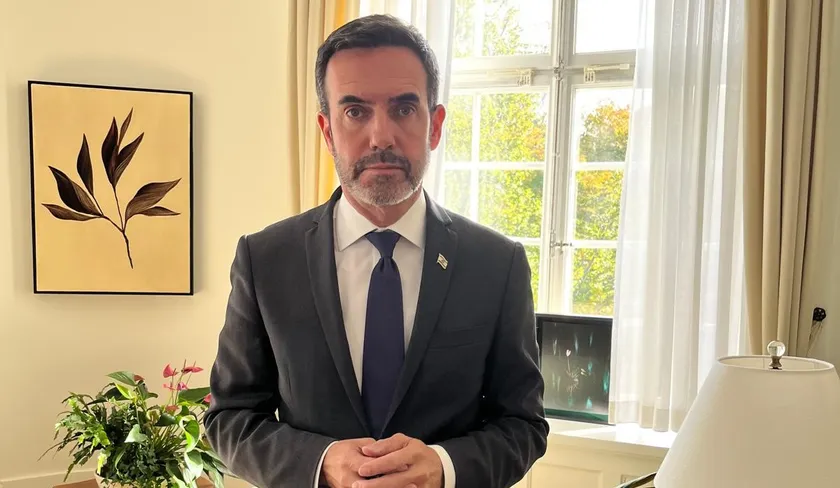
Ziv Nevo Kulman, Photo: Israel's Embassy to Sweden
According to sources familiar with Israeli-Swedish relations, this change of tack was not only the work of Israel. Since the beginning of the war in Gaza, Sweden's center-left has been increasingly hostile toward Israel, and these parties' ties with Jerusalem have significantly weakened. Israel has become a wedge issue between Sweden's center-right coalition and the centrist and left-wing opposition.
According to the sources, the opposition's approach is pushing Israel into the arms of the Swedish populist right. As a result, the Sweden Democrats are increasingly seen as a legitimate party in both Israel and the Jewish world, a major win for the party.
For Sweden's Jewish community, the Sweden Democrats are still considered off-limits, at least officially. The party is not in touch with the community and is not welcome at community events.
In a letter to Israel's foreign minister a year ago, the European Jewish Congress and the Council of Swedish Jewish Communities expressed concerns about a meeting between Israeli ministers and Sweden Democrats visiting Jerusalem. The president of the European Jewish Congress, Ariel Muzicant, and the chairman of the Council of Swedish Jewish Communities, Aron Verständig, wrote that they were "gravely concerned" and referred to the party's "neo-Nazi roots."
Muzicant and Verständig added that the Sweden Democrats' "ideology is still inherently xenophobic even though its representatives claim to be our allies, making an exception for the Jews as a national minority, albeit claiming that Jews cannot be Swedes." They said the party regularly submitted bills to ban "non-medical circumcision," as opponents call it, and the importing of kosher meat.
When asked Tuesday about Israel's apparent policy shift, Verständig told Haaretz that he was notified a few days ago that Israel's Foreign Ministry had instructed the Stockholm embassy to forge contacts with the Sweden Democrats.
"However, we don't have contacts with the Sweden Democrats," Verständig said. "The issue of the Sweden Democrats is one that we discuss regularly, but we haven't changed our position and we still don't have ties with the party."roots
The Sweden Democrats party was founded in 1988 by members of Swedish neo-Nazi and far-right movements. A key figure in the organization was Gustav Ekström, a member of Germany's Waffen-SS, the SS' military arm, during World War II and an activist in the NSAP, the Swedish Nazi party that disbanded in 1950. Other founders were members of white supremacist parties, neofascist and neo-Nazi movements, the Swedish skinhead movement and criminal organizations.
But the neo-Nazi past wasn't the only reason for the Israeli boycott. In recent years party members have spread conspiracy theories and racist, antisemitic and Islamophobic propaganda. In 2021 the Swedish daily Aftonbladet revealed that Jörgen Fogelklou, the party's leader in Sweden's second-largest city, Gothenburg, spread antisemitic and racist statements on social media such as "It is clear that Jews are the root of all evil in the world."
A few years ago, another local party leader in southern Sweden, Jonas Lingvärn, took part in performances by rock bands supporting white supremacy and used the slogan "Skinhead 88" – 88 is shorthand for HH, meaning "Heil Hitler."
The party first entered Sweden's parliament in 2010, and in the 2022 elections it won more than 20 percent of the vote, making it the country's second largest party. Until just a few years ago, the Sweden Democrats were boycotted by parties across the political spectrum.
But after a shift in approach by two center-right parties, the Sweden Democrats became an integral part of the right-wing bloc after elections, without which a center-right government could not be formed. In parliament, the party heads the Foreign Affairs Committee, the Justice Committee and the Industry and Commerce Committee.
Swedish public radio has reported that the two agents, a man and a woman who were expelled from Sweden in 2022, were linked to Iran's Revolutionary Guards and that among their intended victims was the chairman of the Jewish community
Swedish public radio reported on Tuesday that Iran had planned to kill Swedish Jews using agents who had infiltrated into the country in 2015 by pretending to be refugees. In its investigative report, Radio Sweden said that the agents, a man, and a woman, were linked to the Iranian Revolutionary Guards and that among the targets of their plot was Aron Verständig, the chairman of the Swedish Jewish community's umbrella organization, the Official Council of Swedish Jewish Communities.
"This involves a plan by another country to murder a Swedish citizen, and that has me boiling," Verständig told the public radio station. "It felt very unpleasant. I was worried and as a father of young children, I felt a major responsibility for my children's safety." In a Facebook post, Verständig added: "From my standpoint, there was never any doubt that I would continue living life as usual. I hope that what was disclosed today doesn't cause anyone to be less open regarding their Jewish identity."
Another person who was in the Iranian agents' crosshairs was a U.S. citizen, and according to the Swedish prosecutor's office, the FBI was involved in the investigation.
The two alleged Iranian agents – Mahdi Ramezani and Fereshteh Sanaeifarid– were arrested in the Stockholm area in April 2021, the radio station reported. The Swedish prosecutor told reporters that the authorities hadn't managed to gather sufficient evidence against them at the time to indict them, so it was decided to expel them to Iran in 2022. Their expulsion was reported in the past, but the circumstances of the matter weren't disclosed at the time. The Iranian embassy in Stockholm refused to comment.
The Iranian plot revealed a major failure on the part of Sweden's immigration authority, which had granted the pair status as Afghan asylum-seekers, and later resident status. This was despite the fact that in 2016, the immigration authority received two anonymous tips that the pair were Iranian and not Afghani, and that the Iranian man was working for the Iranian Revolutionary Guards.
The immigration authority declined to comment on this specific case, but a spokesman said, "What's important is that ultimately, the correct decision was made."
In addition, in recent months, there has been an increase in reports of antisemitic incidents in Sweden, including demonstrations with antisemitic content, calls for boycotts, antisemitic comments in the media and on social media and abuse and harassment at schools and universities.
"Antisemitism has gone sky-high since October 7," Verständig told Haaretz last week, in reference to the Hamas attacks in a string of Israeli border communities that day, "and many people have been experiencing fear, insecurity, and anxiety. A survey that we carried out in November shows that many Jews have considered leaving Sweden. The government has reacted in an excellent way – but in civil society, reactions are sometimes very different."
Sweden's 20,000-strong Jewish community was looking forward to marking a landmark event next year – but October 7 changed everything. Now, with antisemitic incidents skyrocketing, there are fears that a community that was only founded in 1775 could be at risk.
STOCKHOLM – Sweden's Jewish community is preparing to celebrate its 250th anniversary next year, but what was being heralded as an unprecedentedly good moment for the community changed in the blink of an eye on Oct. 7.
This is a story about both ancient and modern history, and how a country went from having no Jews to having a vibrant Jewish community – yet could still end up having very few local Jewish communities if the recent tensions continue.
Prior to 1774, there was no Jewish community in Sweden. Although some Jews had settled there earlier, there was no Jewish community as Jews who immigrated there had to be baptized into the Lutheran religion.
Aaron Isaac, Credit: Wikipedia
That all changed 250 years ago, though, when a Jewish seal engraver named Aaron Isaac arrived in Stockholm from German Mecklenburg. "Isaac became the first person who was allowed to live as a Jew in Sweden," says Daniel Leviathan, a Swedish-Jewish historian who's also active in some of the country's Jewish organizations. "He was able to secure the right to form a minyan [prayer group] and to found a Jewish cemetery and mikveh."
Within the space of a year, Stockholm had a proper Jewish community, which included new arrivals from Germany, Denmark and Holland. Around the same period, under King Gustav III, a second Jewish community was established in Sweden's second largest city, Gothenburg. "In 1782, a Jewish ordinance was issued as a demand of the Swedish aristocracy," Leviathan recounts. Apart from regulating the right for Jews to live in Sweden, the ordinance set some restrictions. Jews were only allowed to move to the country if they had a minimum capital worth today's equivalent of about $100,000; they had to live in one of three towns; and local guilds stopped them from working in certain fields. "At the beginning of the 19th century," he says, "there were only about 1,000 Jews living in Sweden. Many of them were young and industrious people who thought they could make a better life for themselves in Sweden. At this point, they couldn't yet assimilate into Swedish society, and since it was a small community they all knew each other. They competed with each other but were also dependent on each other."
"At the beginning of the 19th century," he says, "there were only about 1,000 Jews living in Sweden. Many of them were young and industrious people who thought they could make a better life for themselves in Sweden. At this point, they couldn't yet assimilate into Swedish society, and since it was a small community they all knew each other. They competed with each other but were also dependent on each other."
Daniel Leviathan, photo: Hugh Gordon
According to Leviathan, the second part of the 19th century brought great change: Sweden opened its borders more widely, with pogroms and hardships in the Russian Empire bringing poor Orthodox Jews to the country. At the same time, the Jews who had been in Sweden for several generations enjoyed full emancipation in 1870.
They were considered Swedish citizens of the Jewish faith, no longer a "foreign" element. Many were assimilated and belonged to the elite of Swedish society. They could live anywhere, had a brand-new synagogue in the capital, and many considered themselves Reform Jews. By the time immigration came to a halt because of World War I, Sweden had about 7,000 Jews.
Sweden's World War II story is well-known: It managed to maintain so-called neutrality and wasn't officially part of the war. As for immigration, it was extremely restrictive both before and at the start of the war, but this changed dramatically in 1942 when it allowed about half of Norway's Jews, all of Denmark's Jews and many more refugees from across the continent find refuge within its borders. "After the war, Sweden accepted around 15,000 Jews," says Leviathan. "Many of the Holocaust survivors immigrated later to the United States or Israel, but 5,000 or 6,000 stayed. They were joined by other waves of immigration in later decades: Poles in 1969, Russians in the 1990s, and also Israelis. Today, the community is in many ways similar to Swedish society – modern, liberal and relatively secular. Because of its unique wartime history, it's different to most European communities because it became much bigger after the war than it was before it."
Today, it's estimated that about 20,000 Jews live in Sweden – though there are thousands more who can claim Jewish heritage. The largest community is in Stockholm, which has three synagogues and a relatively new cultural center called Bajit that is home to a Jewish elementary school and kindergarten, Jewish activities, a kosher shop and a café. The city also houses plenty of Jewish cultural and educational institutions, and organizations. Other Jewish communities and associations exist in Malmö, Gothenburg and a few smaller towns.
Sweden's Jewish groups are united under an umbrella organization called the Official Council of Swedish Jewish Communities, and its chairman, Aron Verständig, says the local community is a vibrant and diverse one. "It's more diverse now than it was 150 or even 50 years ago," he says. "There are families like my own that have been here for three or four generations and are established in Sweden. And there are also many Jews who live here but weren't born here." Verständig adds that this diversity is of a religious nature too. "These days, Stockholm has – for the first time – a progressive community with a progressive rabbi, but there's also renewed interest in the Great Synagogue [which is Conservative] and Orthodox Judaism. Chabad, which has been here for over 20 years, has also become a respected part of the community."
But there are many challenges too. One is the fact that the smaller Jewish communities aren't as vibrant as the one in the capital. "The optimism that you can see in Stockholm, where the community is growing, isn't what you see in the smaller communities – and this has been the case for many decades," says Verständig. "Initially, many members of the smaller communities moved to Stockholm, Gothenburg and Malmö. Now Gothenburg and Malmö's communities are getting smaller too, and many are moving to Stockholm. It's increasingly hard to live a Jewish life outside of Stockholm, and organized Jewish life in the smaller towns is quite slim."
Other challenges, according to Verständig, include staying relevant who those who are not observant and finding ways to attract new members in a country where assimilation rates are very high. He adds, though, that things have changed in that regard in his lifetime. "When I was growing up, they said that if you married a non-Jew, your kids wouldn't be Jewish – but nowadays it's not like that," he says. "We see that children of interfaith marriages are sent to Jewish schools and summer camps. There's a great need for Jewish education when you have a non-Jewish spouse, and it's a challenge to be inclusive enough for different groups from very different backgrounds."
However, while issues such as the legal status of circumcision, importing kosher meat and the legal framework of Jewish schools are undoubtedly issues for the community, all pale in comparison to the main problem these days: antisemitism. The issue of antisemitism has been discussed extensively over several decades in Sweden. In fact, all Swedish governments since the turn of the century have made concerted attempts to address it. The current (center-right) government appointed a special interministerial task force in order to combat antisemitism and strengthen Jewish life. This was a follow-up to 2021's Malmö International Forum on Holocaust Remembrance and Combating Antisemitism, which had been arranged by the previous (center-left) government.
These measures acknowledged that antisemitism comes in many different forms, including right-wing nationalism, left-wing radicalism and Islamism, which arrived through large waves of immigration from the Middle East starting in the last few decades. It was also clear that antisemitism can be found in many different arenas: online, in the workplace, public spaces and, perhaps worst of all, in schools. "A report that was written as a result of our request, and as one of the pledges of the Malmö conference, was released a few weeks ago," says Verständig. "In general, there are many suggestions that I think improve the possibility of living a Jewish life in Sweden – including safeguarding the right for Brit Milah [circumcision], financing security [at Jewish institutions], funding maintenance of synagogues and setting up a Jewish information center."
Yet the situation has deteriorated dramatically since the start of the Israel-Hamas war on Oct. 7. "Antisemitism has skyrocketed," says Verständig. "Many are feeling afraid, insecure and anxious," he says – and this was said on Tuesday, a day before a grenade was found outside the Israeli Embassy in central Stockholm. "A survey we did in November shows that many Jews have considered leaving Sweden. The government has reacted in an excellent way – but in civil society, reactions are sometimes very different."
Leviathan also expresses concerns over recent developments. "What's new in the current situation is that antisemitism is much harder to avoid," he says. "We always had antisemitism, but you could avoid it by moving to a different neighborhood or changing your job. Now it's everywhere – in the streets and squares, even in the 'nice' neighborhoods. It's in schools and universities. Youngsters are being bullied and exposed to antisemitism on TikTok, and adults are losing friends and colleagues who post anti-Israeli propaganda online. You're not even safe in your private space: you never know if the postman will react to the Jewish name on your mailbox. This is what I hear from young people in Sweden, and it's what I've experienced myself: there's no safe space anymore."
Leviathan's views are echoed by others in the community. Sweden has a vibrant Jewish cultural scene, but the difference between the period prior to Oct. 7 and afterward are dramatic.
The week before Oct. 7, the most important cultural event in the region, the Gothenburg Book Fair, hosted an institution called Jewish Culture in Sweden – founded and managed by Swedish-Israeli Lizzie Oved Scheja – as a guest of honor. This was a historic moment for Swedish-Jewish culture: Jewish literature, philosophy, music and humor were celebrated by a very wide audience, in what many described as an almost euphoric atmosphere.
What followed changed everything.
"My life has changed drastically since Oct. 7, both personally and professionally," says Natalie Lantz, a PhD scholar in Hebrew Bible studies who's also a columnist and translator of Hebrew literature (her translations include works by David Grossman, Amos Oz and Sara Shilo). "In 2013, I started writing and lecturing about Jewish and Hebrew culture and literature. My field of expertise has always spurred curiosity and positive reactions. Before Oct. 7, I had only been treated with suspicion by colleagues a few times. I remember a social gathering at a cultural institution when I was presented as the translator of Amos Oz's 'Dear Zealots,' and a person immediately took two steps back and said with disgust: 'I just want to be very clear that I don't support the Israeli occupation.' The conversation was abruptly shot down. Painfully, I realized that some people in the cultural world consider the Hebrew language and Israeli cultural expressions as being evil to the core. But such incidents were rare before Oct. 7. Now, there seems to be no end to the aggressive calls for a boycott of Israeli academia and culture."
She recounts how a petition signed by cultural workers, including some from public institutions, was peppered with terms like "apartheid system" and "Zionist-motivated genocide." "There are BDS rallies at the universities and I hear of faculties that are asked by students and staff to report if they have academic cooperation with Israeli universities," Lantz says.
Natalie Lantz, photo: Hugh Gordon
For her, it's not only about her feelings but also her livelihood. "I'm dependent on being in dialogue with the intellectual arenas of Israel in order to conduct my work in an insightful manner," she says. "Now I fear that the calls for boycott may result in a difficulty to get funding for academic and cultural exchanges between Sweden and Israel. I myself have become very anxious in interactions with colleagues and institutions.
"Will my upcoming university lecture on the history of Jewish Bible translations provoke someone?" she asks. "Is [Austrian-Israeli philosopher] Martin Buber going to be canceled? Can I film the planned family program about Purim for Swedish television without being aggressively attacked? And, most scarily, can I continue to be an openly Jewish public figure in Sweden? I feel vulnerable and exposed. My world is shrinking."
Lantz is accustomed to the sight of a heavy security presence outside synagogues and Stockholm's Jewish school, "even though it feels absurd that community members have to be protected just for being Jewish. I've never really felt frightened of taking part in Jewish activities, but this has changed. I was out walking in the city center last Saturday when I accidentally got caught in a pro-Palestinian demonstration. This was on International Holocaust Remembrance Day. That evening, some people from the demonstration stood outside the synagogue where we hosted a memorial ceremony with Holocaust survivors present. They filmed people entering the synagogue and screamed 'child murderers,' 'death to Israel' and 'intifada.' That horrified me."
She believes the Swedish government has an "enormous responsibility" to combat this wave of antisemitism. "It seems to me that the politicians are taking the matter seriously, as they're not only allocating funds for security to Jewish institutions but also have a strategy to strengthen Jewish life – which focuses on the transmission of Jewish culture and Yiddish to future generations."
Yiddish is one of five official minority languages in Sweden, which is why Lantz believes focusing on it makes sense. That said, she still has concerns. "I fear that the strong focus on Yiddish in Sweden comes at the expense of possibilities to strengthen the knowledge of Hebrew, which is important as a common language for Jews globally," she says. "I was puzzled to note that 'Yiddish' appears 327 times in the strategy document while 'Hebrew' appears only 15 times. To me, strengthening Jewish life in Sweden is also about providing tools to partake in the international Hebrew cultural scene. After all, we'll need Hebrew translators also in future generations. At least, I hope so."
The actions of far-right politician Rasmus Paludan anger many in the Muslim world, and raise the question: is it time for Sweden to restrict the freedom to say and do anything you want in the public arena?
Officially, Rasmus Paludan is the leader of a far-right party active in Sweden and Denmark, but to call him a “leader” is misleading. Paludan, a 41-year-old lawyer with dual Swedish and Danish citizenship, has hardly any supporters – at least not in Sweden. Still, he's very famous there because of an unusual political tactic he developed: Burning the Koran.
A handful of supporters burned the Koran in Malmö in southern Sweden in 2020, and since then Paludan has repeated the act a number of times. In April 2022, he achieved exactly what he wanted. In response to his one-man show in a number of Swedish cities, criminal elements took advantage of the opportunity and set off riots, burned cars and attacked police. They gave Paludan and his pyromaniacal hobby impressive impact.
In January, Paludan returned to Sweden after he received a permit to burn a Koran in front of the Turkish Embassy in Stockholm. Not that he needed it, but this time he found a geopolitical excuse for his demonstration. For many months, Turkey has been using its power to prevent Sweden from joining NATO, supposedly because Sweden supports “Kurdish terrorists.”
Paludan exploited Sweden's justified anger and planned to score some points – or at the very least attract attention as another point of tension between the two countries. And that's what happened: Turkey and Muslims around the world aimed their arrows to the north. Boycotts were imposed on Swedish companies, protests were held in Muslim countries and Sweden’s entry into NATO looks more distant than ever. All this happened even though the vast majority of Swedes have reservations about Paludan, if they're not totally disgusted by him and his provocations.
So why have the Swedish authorities let Paludan harm their political interests and damage the social fabric? Because freedom of speech is absolute in Sweden. Some say that it's almost sacred and that civil rights such as freedom of speech and the right to protest and form unions have become in many ways the replacement for religion in one of the most secular societies in the world.
In Sweden, events like neo-Nazi marches and Koran burnings can cause riots and split society by stirring up emotions. This is how neo-Nazi movements can hold marches next to synagogues on Yom Kippur, supporters of dictators from around the world can demonstrate, and a person like Rasmus Paludan – who has almost no means in addition to his minuscule support – can undermine Sweden's national interests, cause riots and split society by stirring up emotions.
But the Swedes have another option. In recent years, some have argued that now is the time to restrict, if just a little, the freedom to say and do anything you want in the public arena. Despite the country's tranquil image, a prime minister and a foreign minister have been murdered in Sweden, which also has neo-Nazi movements, volunteers for the Islamic State, and harsh problems of integration and political violence – both above and below the surface.
The situation may still be better than in most countries, but Sweden is definitely not immune to the religious wars, social instability and political extremism spreading throughout the world in the third decade of the 21st century. Unsurprisingly, among those who understand the severity of the situation are Sweden's Jewish organizations. The Jewish community council there and the group Amanah, which promotes Jewish-Muslim dialogue, released a statement immediately after the Koran burning, saying: “Racists and extremists are once again allowed to burn the Koran, abusing democracy and freedom of speech to normalize hatred against one of Sweden’s religious minorities.”
Amanah mentions the “tragic history of Europe” and quotes Heinrich Heine’s famous words: “Those who burn books will in the end burn people.” In a democratic society, every person has the right to feel safe and respected, Amanah said, expressing its support for Sweden's Muslim minority and making clear that every act of discrimination and hate is unacceptable.
Proof of the need for this statement arrived quickly. In two separate cases late last month, Swedes of Egyptian origin tried to prove the “Swedish hypocrisy” by burning a Torah – in one case in front of the Israeli Embassy in Stockholm. It seems they thought that if they didn't receive a permit it would be proof of discrimination against Muslims. If they did receive one, it would add more fuel to the fire of hateful anger.
Even though the Israeli Foreign Ministry tried to take credit for intervening with the Swedes and preventing the burning of the Torah, it was others who prevented – or at least postponed – the incident. It was the Muslim community in Sweden, including people who cooperate with the Jewish community, who made the right calls and applied the right pressure to prevent the burning – at least for now.
True, dialogue alone won't solve the political, cultural and social problems today in Sweden – and outside it. Legislation, education, investment and sometimes even a little force are needed too. But dialogue is necessary; only it can set both limits and the rules of the game, because in the real world it's impossible to have rights without restrictions – and no one is better suited than Muslims and Jews to take responsibility together to set these limits.


 דיויד סטברו