Israel Between Peace and the Sword

The choices the region will face after the Iran-US-Israel War, and does international law have anything to do with them.

Published in Swedish Svenska Dagbladet: Israel måste alltid ha svärdet redo | David Stavrou | SvD Ledare

The Swedish discourse on the war in Iran has been dominated by the question of its legality. In recent weeks, international law scholars, academics, politicians, and columnists have explained why the American and Israeli attack is “illegal under international law.” There is much to say about this reasoning, but a reasonable question is what the point really is. In the real world, the legality of war matters very little, because international law, in general, has hardly had any real significance over the past decades.

The main reason is simply that it doesn't work. International law has been used by some of the world’s worst despots, from Gaddafi to Assad, to delay international action against their crimes, and when it was finally used for intervention—in many cases, it made the situation even worse and led to more violence and failed states.

International law has also given legitimacy to regimes such as Qatar and Somalia, which have gained seats on the UN Human Rights Council despite their total lack of such rights. Terrorist organizations have used it in their propaganda to avoid the consequences of their actions, and China’s and Russia’s veto rights in the UN Security Council ensure that aggressive dictators go unpunished.

“If the U.S. illegally invades other countries, Russia will do the same” is a common argument against the American offensive. But the truth is rather the opposite: Russia did not wait for the Americans to attack Georgia or Ukraine, and—like Turkey in Syria, Azerbaijan in Armenia, and Eritrea in Ethiopia—has ignored international law for decades. No country is waiting for Israel or the U.S. to legitimize their actions according to the “law of the jungle”.
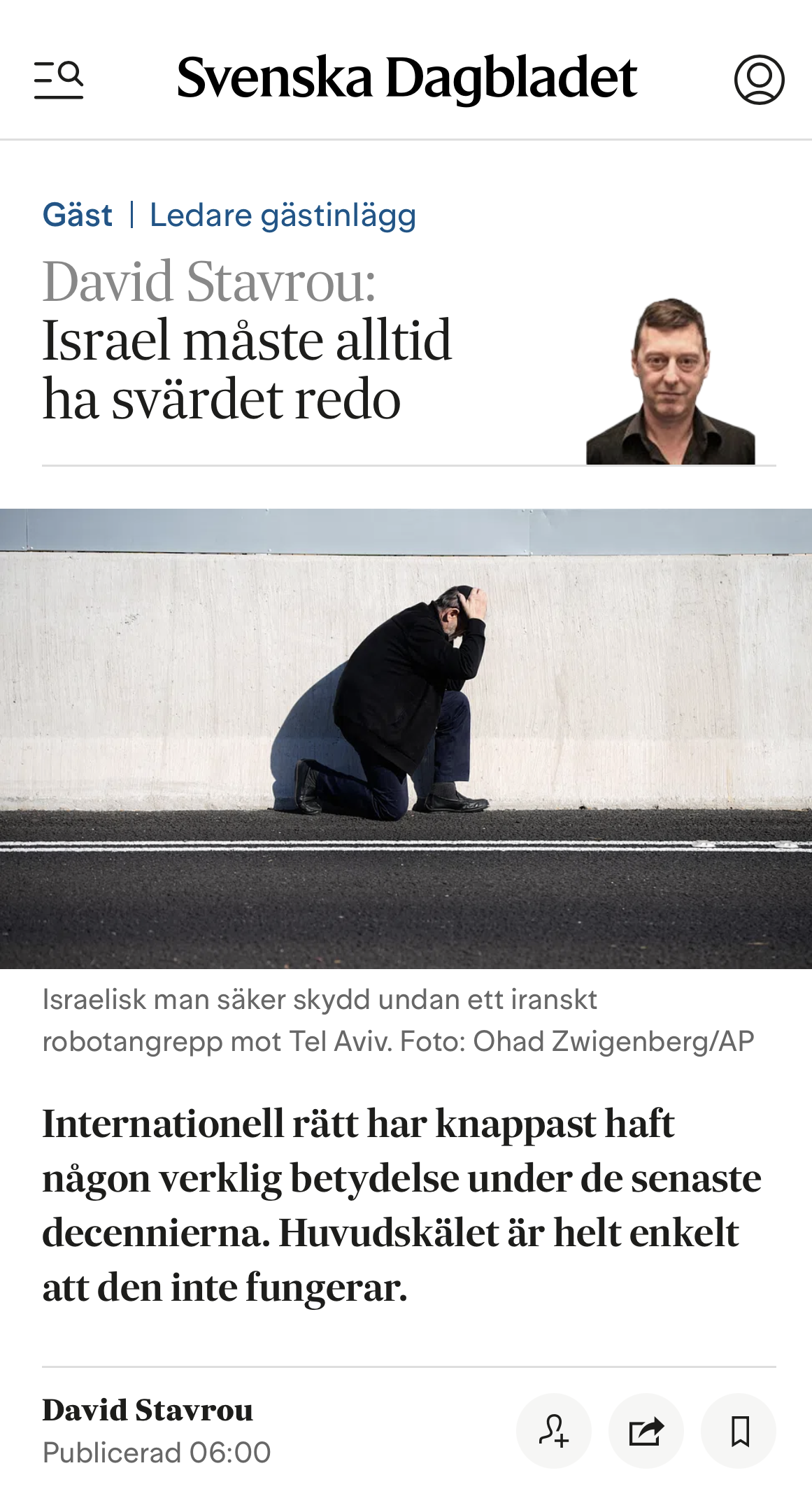
For a country that has not been at war since 1814, the question of the legality of military interventions may seem like the most important one. Theoretically, even a superpower like the U.S. should be concerned with issues of limiting its global power. But for a country like Israel, which is constantly threatened by real enemies who want to annihilate it and kill its population, this question appears fairly academic.

There is, however, another question that from an Israeli perspective is extremely important. It is simple but crucial, and it should concern other countries as well—it is not whether the war is legal, but whether it is effective. Or more broadly: can military power by itself solve Israel’s problems with Iran and other enemies?

“When all you have is a hammer,” as the well-known saying goes, “every problem looks like a nail.” Israel undoubtedly has a powerful hammer. Could it be that the country has become accustomed to solving all its problems with it? Previously, Israel used many forms of power to strengthen its security and international standing. Diplomats engaged in creating complex alliances, its soft power included outstanding achievements in culture, art, agriculture, science, and technology, and governments were willing to participate in peace negotiations and consider compromises.

The Hamas massacre on October 7 and Iran’s persistence in combining nuclear ambitions with threats to wipe Israel off the map changed all of this. The Israeli foreign service has been marginalized; the country’s artists and scientists are boycotted around the world, and its enemies are blown to pieces rather than invited to ceremonies on the White House lawn. Considering that many of Israel’s enemies are ruthless killers, this is hardly surprising. Anyone who sees value in human life should not shed tears for people like Hassan Nasrallah, Yahya Sinwar, and Ali Khamenei. But do military operations improve reality if they are not accompanied by other measures such as diplomacy, economic development, and new creative political alliances? This is not only an Israeli question. A new world order is taking shape before our eyes, and if we are not heading toward total anarchy, the question of limiting military power and understanding what it can and cannot achieve is crucial.

One indication is the situation in Gaza. After more than two years of extensive military force and enormous destruction, the reality is that Hamas not only still exists, it is armed and controls many state functions. In Lebanon, Israel may have achieved significant military successes against Hezbollah, but the Israeli are still spending far too much time in bomb shelters, and despite everything, Hezbollah is still alive and kicking. Both militarily and politically.

Israelis are once again deprived of basic necessities—schools are closed, workplaces shut down, flights canceled, thousands have lost relatives, been forced from their homes, and suffered injuries and trauma. Not to mention that Israel is deeply divided on issues concerning its democracy, which can only be resolved when the shooting stops. Meanwhile, Israel has also, without justification, become the punching bag of the international community. All the world’s power seems to be of little use in solving this.

And then there is Iran. Now that the war has begun, it should, for the sake of both Iranians and Israelis, end with a regime change—and no regime change is possible without the use of force. The Iranian people themselves, who ultimately must liberate themselves, have asked for foreign intervention, and giving it to them is the right thing to do. But what then?

“From the moment we decided that only here, in the land of Israel, could the Jewish state arise, we accepted that more than a hundred million people from the Arab world, from the Arab nations, and from the Palestinians would be our neighbors,” said Israel’s former prime minister Yitzhak Rabin a few years before he was assassinated in 1995. “There are now only two possibilities: either a serious and determined effort is made to achieve peace—peace and security—or the sword will always rule.” In the 1990s, Rabin chose the first option, but since then, leaders across the region, including Israeli leaders, have developed a dependence on using force. Perhaps even an adiction.

When the war in Iran is over, Israel will face a choice. Previously, the country combined pragmatic diplomacy, careful alliance-building, and visionary openings toward the Arab world. In a region like the Middle East, this is risky. Israel will always need to keep a sword ready, but with security guarantees and economic support instead of anachronistic laws and self-righteous moralism from other countries, peace may once again become an option.

Oslo Accords Mediators Probed Over Epstein Ties Threaten Norway's Diplomatic Legacy

Norway's reputation as a peace-broker could be tarnished by the allegations against the country's elite.

Published in Haaretz: Oslo Accords Mediators Probed Over Epstein Ties Threaten Norway's Diplomatic Legacy – Europe

The release of court documents in the U.S on Jeffrey Epstein in February has sent political shockwaves far beyond Washington. From American power brokers to British royalty and European decision-makers, the files reference powerful figures across the globe. In Norway, the fallout has struck a blow to the country's self-image, as well as its image abroad.

Traditionally, Norway, which has one of the world's most comprehensive welfare state systems, has had a high level of trust in its public officials, and until recently the country was best-known internationally for the Nobel Peace Prize and for humanitarian and peacemaking efforts.

Now high-profile Norwegian public figures are facing criminal investigations as a result of their links to late convicted sex offender Epstein, and the country is reckoning with the fallout. The most high-profile Norwegian figures to be implicated in the files are Crown Princess Mette-Marit, who exchanged hundreds of emails with Epstein between 2011 and 2014 and stayed at his Palm Beach residence in 2013, and former Prime Minister and former Chair of the Nobel Committee Thorbjørn Jagland who has been charged with gross corruption as a result of his ties with Epstein.

But the files have also revealed that two members of Norway's diplomatic elite – married couple Terje Rød-Larsen and Mona Juul – had connections with Epstein. The couple were among a small group of diplomats who facilitated the back-channel negotiations between Israeli and the Palestine Liberation Organization representatives in the early 1990s which led to the Oslo Accords in 1993.

Norwegian authorities have now opened an investigations into Juul – who resigned as Norway's ambassador to Iraq and Jordan earlier this year – on suspicion of gross corruption and Rød-Larsen on suspicion of complicity in gross corruption in relation to gifts and favors the two received from Epstein. According to the released files, they maintained extensive personal and financial ties with Epstein over several years. They visited his private island, their two children were bequeathed $10 million by Epstein in his will, and Rød Larsen was appointed executer of the will (which was later revoked).

According to lawyers for Juul, who has also served as Norway's ambassador to Israel, the U.K. and the UN, she "does not recognize" the allegations against her. For his part, Rød-Larsen has acknowledged the relationship with Epstein but denies wrongdoing. He has not held a public role for over two decades and resigned from his position as president of New York-based think tank the International Peace Institute in 2020 following revelations about his ties to Epstein.

Norway's efforts to facilitate secret Israeli-Palestinian negotiations in the early 1990s leading to the Oslo Accords helped forge its identity as a peace-brokering power, and the current association of key figures from that legacy with Epstein has prompted a discourse in the country about political oversight and elite networks.

"Norwegian diplomats are loyal people, but if they were honest, they would say that the behavior of these two individuals has been an open secret for many years," Professor Torkel Brekke, an Oslo historian who works for the Norwegian think tank Civita and also studies Norway's relations with its Jewish minority and with Israel, tells Haaretz.

Brekke added that "People probably didn't know about the most serious part of the allegations, the ones concerning trafficking [the files show that in his capacity as president of IPI Rod-Larsen wrote recommendations letters for U.S. visas for young Eastern European women at Epstein's request], but the rest of it was known to many. They just didn't want to talk about it".

According to Brekke, Rød-Larsen, in particular, is well-known for his tendency to promote himself and there were many rumors within diplomatic circles of inappropriate conduct and inappropriate associations.

Beyond the personal allegations, what has this done to the political discourse in Norway?

"In Norway the concept of trust has been elevated and is almost sacred," Brekke said. "You always hear Norwegians speaking about trust being more important than oil and that it's what makes us special as a society. So, the question many people are asking now is if this is going to destroy trust in our society. I often personally think that the concept of trust is sometimes sprinkled as a kind of gold dust and that too much trust in government is probably not a good thing. We may need trust that's a bit more critical."

According to Brekke, political implications span the spectrum. While Jagland was a Labour party prime minister and Juul and Rød-Larsen served under Labor governments, former Conservative foreign minister Børge Brende also stepped down as president and CEO of the World Economic Forum following scrutiny of past interactions with Epstein.

"The Royal Family too is a great concern," Brekke adds. "Crown Princess Mette-Marit has been in close contact with Epstein. The communication between her and Epstein is hard to explain and combined with the court case against her son. [Marius Borg Høiby, the crown princess's son from a former relationship, is currently facing multiple criminal charges, including rape, which he denies.] It's concerning to many Norwegians. Even more concerning than party politics."

When it comes to the Israeli angle, does the fact that officials involved in the Oslo Accords are now implicated affect Norway's peacemaking legacy and relations with Israel?

"First, I think that although there were several hard-working, very decent diplomats who created the Israeli-Palestinian back channel, there were, at the same time, others who tried to make it into something a lot more important than it really was. Rød-Larsen tried to make himself seem much more important than he really was. When it comes to relations with Israel, I don't think there will be much of an impact, apart from maybe giving Israelis another reason to be critical of Norway [Many Israelis' resent Norway's criticism of Israeli conduct in the Gaza war which has also led to tension between the two countries' governments].

I'd expect some Israelis will feel some kind of schadenfreude after the recent souring of relations," he said. Two weeks after October 7, 2023, Norway condemned Israel's war in Gaza, and drew anger from Israel after deciding not to recognize Hamas as a terror organization. Oslo also continued funding UNRWA – and campaigned to defend it abroad – despite allegations some staff took part in the October 7 attacks.

"However, relations with Israel will probably only improve if there is a new government that will be able to set things back on track after the way things were handled from the Norwegian side after October 7."

The argument that Norway's role in the Oslo process was more facilitative than decisive is not a new one. Many analysts contend that the end of the Cold War and political shifts within Israel and the PLO were the primary drivers, and Norway's role was mainly to provide a discreet venue.

But while the Norwegians' influence over the content of the Oslo accords was limited, Rød-Larsen was influential in his role as the facilitator of the secret channel, and in that sense he and his wife had an important role in the Oslo story.

Continues: Oslo Accords Mediators Probed Over Epstein Ties Threaten Norway's Diplomatic Legacy – Europe

Israeli Elections, October 2022

Published in Swedish daily newspaper Svenska Dagbladet (please note: this is an unoficial and unedited English translation)…

Israel is sometimes called the "only democracy in the Middle East", and in many ways it is. But Israeli democracy is very different from the Swedish one, even though theoretically both have similar parliamentary systems and the same kind of general elections. The differences are more about dynamics than technicalities. One important difference is that governments in Israel very rarely last an entire term, which is why Israelis will be going to the polls again on November 1st in what may seem like a déjà vu.  This is the fifth election campaign in the last four years and the 11th since 2001. In the same period Sweden had only six.

Even though recent years have been unusually unstable in Swedish politics, with weak minority governments and changing political alliances, this is nothing compared to the instability of Israeli politics. This instability combined with unique historical and cultural differences, make the coming up elections very difficult to understand for those who are not locals. Here are a few things to keep in mind if you're following the political drama in the land of milk and honey.

There's probably only one global household name in current Israeli politics – the name of Benjamin Netanyahu. Since Netanyahu first became Prime Minister in 1996, he has held the job for 15 years, even more than David Ben-Gurion who's considered to be Israel's founding father. Netanyahu is head of the "Likud" party and currently leads the opposition even though he's standing trial for bribe and fraud charges. But Netanyahu is more than just a candidate. He's the key issue of these elections. He's not a man leading an agenda. He is the agenda itself. In these elections, many Israelis won't be voting because they want to promote their ideology or influence concrete issues, they'll be voting because they love or hate Netanyahu. 

This leads to a misconception of Israeli politics. Since all recent elections ended in a tie between rival blocks, some assume this is a tie in the European style, meaning between left and right. But nothing could be further from the truth. In a European sense the Israeli left makes up 10 to 15 percent of the electorate on a good day. That is if left means socialist or social-democratic ideology combined with progressive values like secularism, civil rights, feminism, LGBT rights and multiculturalism. In Israel the blocks have nothing to do with all that. It's not socialists against capitalists or conservatives against liberals. It's all about Netanyahu. One block supports him, the other wants to get rid of him.

On Netanyahu's side, things are pretty clear – together with Netanyahu's "Likud" party, there's a coalition of Jewish ultra-orthodox parties, nationalist parties and representatives of West-Bank settlers. The other side, however, has no common values, ideas or interests with the exception of one – the idea of replacing Netanyahu. Led by centrist current Prime Minister Yair Lapid, it's a bizarre coalition based on middle class secular Jews supported by left-wing liberals, a variety of Israeli Palestinians (some Islamist, others secular, some nationalists, others old-school communist) and right-wing conservatives who for some reason or another are in conflict with Netanyahu. This is the main reason why the last Israeli government stayed in power for only a year and even during this short period it had to have two heads of government in rotation. If in Swedish politics, the old left-right spectrum became more complicated in recent years and developed into the so-called GAL-TAN spectrum, in Israel the opposite happened, things became simpler – the whole spectrum is reduced to one man.

But where exactly is Netanyahu on a left-right scale? That should be a simple question to answer since Netanyahu is and always has been a self-proclaimed right-wing leader. He's been called an Israeli Trump, an Israeli Orbán and even an Israeli Erdoğan (although they should be called American, Hungarian and Turkish Netanyahus since he assumed office before them). But context is king, and in an Israeli one, Netanyahu may be hated by the left, but that doesn't mean he's as right as it gets. In a social-economic perspective, Netanyahu used to be a Thatcherist, pushing for privatisations, tax cuts and restraining government spending, but it's been years since he spent his political capital on those kinds of issues. Today he leaves the economy in the hands of others. Though he's certainly a hawk and a sceptic when it comes to relations with the Palestinians, he's always been careful with the use of military power and he never went all the way towards Israel's hard core right which supports the annexation of the West Bank and putting an end to the so-called two state solution. In recent years Netanyahu has been mostly concerned with staying in power and avoiding prison. Unlike his potential successors, he's secular, he was raised in the US and has a western education and world view and he's an intellectual. In Israel this means that in many ways he's actually a centrist.

Just for the sake of perspective, the rising star of these elections is the 46-year-old leader of the "Jewish Strength" party, Itamar Ben Gvir, a man who first came to public attention when he threatened the life of Prime Minister Yitzhak Rabin a few weeks before he was assassinated in 1995. Ben Gvir also supported Baruch Goldstein an American Jew who massacred 29 Muslims in Hebron in 1994. The party Ben Gvir is currently part of has the support of 10 percent of the electorate in the latest polls. When it comes to ideology, Netanyahu is a middle of the road pragmatist compared to Ben Gvir and other Israeli nationalist and religious fanatics. The stark opposition he faces is more about his alleged corruption, opportunism and his relentless populist crusade against Israel's judicial system and law enforcement officials.

One of the reasons that Netanyahu's party is supported by over 25% of the voters according to polls is that in Israel many people don't vote according to their opinions. Rather, they vote according to their identity. It's not about what you think, it's about who you are. Arabs vote for Arab parties, religious people vote for religious parties, traditional Jews with an Eastern background vote for the Likud and secular Jews from a western background vote for one of the liberal centrist parties, usually led by ex-Army generals or former media celebrities. These include the Labour Party led by former TV and radio anchor, Merav Michaeli, and the National Unity Party led by Benny Gantz, former army Chief of Staff. To put it in a Swedish context – no one in Israel needs a "Val Kompas", many parties don't even have a party platform. a strong sectorial identity is much mor useful. The comparison may not be entirely fair, but in this aspect, Israeli parties are not very different from "Nyans".

Finally, Swedes may be surprised to know that the Palestinian issue is no longer an important part of the Israeli discourse. Back in the 80s and 90s, the lines of Israeli politics were drawn according to policies towards the Palestinians. The left promoted the two-state solution, the right argued against a Palestinian state. These days, the two-state solution is probably discussed more in Sweden's Foreign Ministry at Gustav Adolfs Torg, than it is in Jerusalem. It seems like both Israelis and Palestinians have lost faith in concepts like negotiations, compromise and peace agreements and a reality of a never ending low-intensity conflict is accepted on both sides. As a result, Israelis will not be voting to stop or to continue the occupation of the West Bank, they'll also not be voting about the threat from Iran, social issues or the economy. Instead, it's a mix of identity politics combined with anger about an eclectic collection of issues which happened to appear in yesterday's papers or social media feeds. When it comes to art and culture, entrepreneurship and industry, history and science, Israel is a beautiful country full of promise and potential. Its political establishment, on the other hand, has lost its way and is deeply divided. The only democracy in the Middle East is stuck in an endless spiral of election campaigns. The result of this fifth round is still unknown, but it may very well simply be nothing more than round number six.

A Swedish Lesson for Israel on Political Violence and Remembering Rabin

The link between Swedish Prime Minister Olof Palme’s murder and that of Yitzhak Rabin, teaches Israelis that they should dedicate prime minister's memorial to addressing the existential dangers of political violence.

Published in Haaretz: https://www.haaretz.com/opinion/.premium-a-swedish-lesson-for-israel-on-political-violence-and-remembering-rabin-1.6639757

STOCKHOLM – The Palmes had just finished an evening at the cinema. It was at the end of February 1986, and Stockholm was snowy, freezing and dark. As strange as it sounds, Olof Palme, the prime minister of Sweden, had no security that evening. He and his wife left the official residence in the Old City, took public transportation to the center of town, and spent time in crowded places without bodyguards, metal detectors or patrols.

At 11:20 P.M., as they were making their way home, they were accosted by an armed man in a black coat and hooded sweatshirt who shot Palme at point-blank range. The prime minister fell, his blood staining the snow. After a split second the gunman fired another bullet at Palme’s wife, Lisbeth, which grazed her back. The assassin turned and fled. A passing cabdriver called police, who came three minutes after the shooting. The ambulance came right afterward. Palme was pronounced dead at the hospital at six minutes after midnight. 

Sweden awoke to a morning unlike any they’d ever experienced. Their prime minister had been murdered and no one knew why or by whom. Thirty-two years later, the murder remains a mystery. At the end of 1988, a young alcoholic criminal named Christer Pettersson was caught, tried and convicted, but released when his conviction was overturned by the Supreme Court on appeal. From time to time there emerge new testimonies, revelations or conspiracy theories, but the truth remains unknown.

There are two reasons to recall this murder now. One is that Lisbeth Palme died of an illness three weeks ago. The second is more essential and more Israeli – the link between Palme’s murder and that of Prime Minister Yitzhak Rabin.

Political assassinations are always traumatic and history is filled with them. In the case of Rabin’s murder, the incitement campaign that preceded it, its diplomatic and social significance and the political revolution that occurred afterward made its consequences critical.

That was not the case in Sweden, at least not on the surface. As after Rabin’s murder, masses gathered at the site of the Palme’s killing with candles and flowers, the funeral was attended by thousands of people and grief flooded the country. Unlike with Rabin’s assassination, though, Palme’s murder didn’t expose any clear dispute, primarily because the identity of the murderer and his motives weren’t known. Still, at least one lesson should have been clear, the prosaic and self-understood lesson that careful guarding of elected officials is at least as important as guarding democracy itself.

Palme was totally exposed during his murder and Swedish society paid a high price for this blunder. But was the lesson learned? The answer is no. Proof of this is what happened in September 2003, when Anna Lindh, then Swedish foreign minister, visited a department store in downtown Stockholm. Although she was one of the government’s senior figures, she had no security, just like Palme. While she was shopping she was approached by a 25-year-old man who stabbed her all over her body. She died in the hospital the following day.

Since then the security around senior Swedish officials has improved, but it still isn’t rare to see ministers and members of parliament walking alone in the street or riding the bus. This isn’t the result of a security failure. It’s the result of a political tradition that sanctifies accessibility, openness and transparency. These are unquestionably good traits, but interpreting them this way leaves democracy exposed to obvious dangers.

To the same degree, Sweden sanctifies freedom of expression and freedom of assembly almost without limit. These are also admirable traits, but they are exploited in the real world by the followers of the 21st century’s cancerous diseases. Neo-Nazis march through the streets in uniform; desperate, frustrated men perpetuate hate crimes against Jews and migrants; and youths in the suburbs of large cities are recruited to join ISIS. These are all symptoms of a society that doesn’t find the strength and courage to recognize that democracy has enemies, and there is no choice but to discuss ways of protecting it.

Here lies the Israeli connection to Palme’s murder. Since Rabin’s assassination in Tel Aviv in 1995, there has been a bitter debate over his commemoration. Some see it important to emphasize his political legacy, while others claim that commemoration should be dignified, neutral and lacking a political message. Yet there is another possibility. Between political remembrance, which belongs to just one camp, and official remembrance, which treats the murder as if the prime minister had died of a heart attack, there is the obvious truth.

The Rabin assassination is first and foremost a horrible case of political violence, whose message must be above all a message of setting boundaries to the political discourse and (physical) protection of democratic institutions and elected officials.

Those who assert that aspiring for unity and concealing Rabin’s path from the collective memory is superficial and often fascistic, too, are right. On the other hand, the aspiration to remember Rabin in the context of the Oslo Accords alone forgoes the attention and identification of most of Israeli society. In contrast, the debate on protecting democracy itself and on what it permits or forbids is important and relevant to all sides. It is neither an unimportant message that papers over the murder, nor a message that speaks to only one political camp. It is not partisan, but it is very political.

Democracy needs protection by all camps. It needs checks, balances and a free press. It won’t tolerate incitement and racism. And it should have freedom of expression with clear, unequivocal borders, which Rabin himself defined minutes before his death. “Violence is undermining the very foundations of Israeli democracy,” he said. “It must be condemned, denounced, and isolated. This is not the way of the State of Israel.”

The Swedes missed this basic idea in 1986 and ended up with more political violence. Israel, given as it is to internal and external conflicts, is in even greater danger. Its public leaders would do well to dedicate the memorial day for Rabin to addressing this existential danger, and not wasting it time and again on the usual spats over who will speak in the square and who will organize the ceremony.