את האירוע האלים באמסטרדם אפשר גם לראות בהקשר רחב יותר מזה שהוצג בתקשורת הישראלית. לא כל המהגרים אנטישמים, לא כל האנטישמים הם מהגרים, והתקריות האנטישמיות באירופה הן לא בהכרח התפרצות ספונטנית של שנאה או מחאה. ממש כמו שרוב האנסים לא נראים כמו מפלצות ואינם מגיחים משיחים בפארקים חשוכים, גם המפלצת האנטישמית שוכנת לעתים בדמויות רגילות ולכאורה לא מאיימות. כשאוהדי כדורגל מגיעים לאירופה ורואים מפגינים המפיצים שנאה לישראל תחת דגלי פלסטין, הם רואים איום פיזי. כשיהודים אירופים רואים את אותה הפגנה, יותר משהם חוששים שמשתתפיה יכו אותם, הם מפחדים שבתוך ההמון העוין נמצאים הגננת של ילדיהם, פקיד הבנק שלהם או האחות מקופת חולים.
ההתפרעות לאחר משחק הכדורגל באמסטרדם בתחילת החודש, עוררה תגובות מעורבות בישראל. החל בזעזוע על האופי האנטישמי הבוטה שלה וקינה על ה"איסלאמיזציה של אירופה", ועד לטענות שהיא נגרמה בגלל ההתנהגות של אוהדי מכבי ושההשוואה לליל הבדולח היא זילות השואה. טיעונים אלו שווים דיון, אבל כדי להעמיק אותו כדאי להוסיף לנקודת המבט הישראלית גם נקודת מבט אירופית.
ראשית, כשאוהדי מכבי נתקלו באלימות פיזית, הם נתקלו בצורת ביטוי קיצונית מאוד של אנטי־ישראליות ואנטישמיות, אך בעבור יהודים שחיים באירופה זהו רק מופע אחד, אולי המפחיד ביותר, אבל ודאי לא הנפוץ ביותר, של האנטישמיות. המופעים האחרים מצטלמים פחות טוב, אבל מכבידים מאוד על חייהם: הצקות בבתי ספר, קמפיינים אגרסיביים ברשתות חברתיות, חרמות בעולם התרבות ובאקדמיה, והערות פוגעניות, מתחים ונידויים במקומות עבודה. אלימות פיזית נדירה למדי, אם כי היא עלולה להפוך לנפוצה יותר שכן היא התפתחות כמעט הכרחית של שיח שנאה, קיצוניות פוליטית והפצת נרטיבים שקריים.
שנית, אנטישמיות היא הרבה יותר ממקרה פרטי של גזענות. אכן, במובנה המצומצם שנאת יהודים יכולה להיות דומה לשנאת ערבים או שחורים, אך במובנה הרחב היא תופעה מורכבת הרבה יותר. בשיח האירופי מתחילים להכיר בכך שמדובר בסוג של תיאוריית קונספירציה. הנופלים ברשתה והמפיצים אותה יכולים להיות אנשים שלא פגשו יהודי מעולם, והם יכולים לתפוש את עצמם כליברלים דמוקרטים ש"אין להם דבר נגד יהודים". הם לא חייבים אפילו להשתמש במילה "יהודי". הקונפליקט במזרח התיכון, ומה שמכונה "התחום האפור" בין אנטישמיות לאנטי־ישראליות מאפשר שימוש במילות קוד כמו "גלובליסטים", "ג'ורג' סורוס", וכמובן — "ציונים".
זו אינה תופעה חדשה במהותה, אבל יש לה עולם מושגים חדש. במקום האנטישמיות הקדומה, שבה הואשמו היהודים ברצח ישו, והאנטישמיות המודרנית שהאשימה את היהודים בשליטה בעולם באמצעות בנקאים, תנועות מהפכניות ואגודות סתר, יש כתבי אישום מודרניים שמבלבלים גם כאלו שאינם בעלי דעות גזעניות במובהק: היהודים הפיצו את הקורונה מכיוון שהם הרוויחו ממנה. הם גרמו למלחמה באוקראינה. הם מפרקים את מדינות הלאום. הם שולטים בתקשורת ובשווקים הפיננסיים.
גם השמאל הישראלי נופל לפעמים במלכודת הזו. מכיוון שהוא מתנגד, ובצדק, להמשך השליטה בגדה ולפשעי המלחמה בעזה, הוא מוצא שותפים אירופים להשקפת עולמו. לעתים אלו שותפים רציניים וכנים, אך לעתים מדובר בגורמים שמפיצים האשמות ברצח עם תוך כדי תמיכה בארגוני טרור איסלאמיסטים והפצת תעמולה לחיסול ישראל. כמו שהימין הישראלי מוצא שותפים בתנועות ניאו־נאציות בגלל מלחמתן במוסלמים, חלק מהשמאל מוצא שותפים אנטישמיים משום שהם מתנגדים לכיבוש (גם אם מדובר בזה של 48' ולא של 67').
שלישית, האנטישמים של החיים האמיתיים, בניגוד לאלו המוצגים בתקשורת, הם לא דמויות שטוחות. הסיקור מאמסטרדם התמקד בתמונות של גברים רעולי פנים ממוצא מזרח תיכוני שיצאו לחפש דם. בינתיים, בעולם האמיתי, אנטישמיות מתחבאת גם מאחורי פרצופים מוכרים יותר, בעלי תכונות אחרות, רקע אחר ומניעים אחרים: צעירים אירופים שקראו ספרות טרוצקיסטית, תיכוניסטים שמשתמשים באנטישמיות ככלי להתעמרות בבן כיתה ומרצים באוניברסיטה שמנסים להתבלט.
לא כל המהגרים אנטישמים, לא כל האנטישמים הם מהגרים, והתקריות האנטישמיות באירופה הן לא בהכרח התפרצות ספונטנית של שנאה או מחאה. הן גם תוצאה של קמפיינים שממומנים על ידי גורמים כמו קטאר, טורקיה ורוסיה. ממש כמו שרוב האנסים לא נראים כמו מפלצות ואינם מגיחים משיחים בפארקים חשוכים, גם המפלצת האנטישמית שוכנת לעתים בדמויות רגילות ולכאורה לא מאיימות. כשאוהדי כדורגל מגיעים לאירופה ורואים מפגינים המפיצים שנאה לישראל תחת דגלי פלסטין, הם רואים איום פיזי. כשיהודים אירופים רואים את אותה הפגנה, יותר משהם חוששים שמשתתפיה יכו אותם, הם מפחדים שבתוך ההמון העוין נמצאים הגננת של ילדיהם, פקיד הבנק שלהם או האחות מקופת חולים.
ונקודה אחרונה. אנחנו רגילים לזהות את קורבנות האנטישמיות באירופה עם חברי הקהילות היהודיות, באמסטרדם הקורבנות היו תיירים ישראלים שחוו אותה לרגע וחזרו הביתה. אבל יש בין שתי הקבוצות המובחנות האלו קבוצה נוספת. בשנים האחרונות קבוצות של מהגרים ישראלים באירופה מקימים קהילות העוסקות בחינוך, תרבות ויזמות חברתית, כשהשפה העברית והזהות הישראלית החילונית פורחות בהן. קהילות אלו חוות ומתמודדות עם אנטישמיות בצורה אחרת, ומהוות גם סיכוי וגם סיכון בהקשר זה. מצד אחד, הן עלולות להוות יעד אטרקטיבי למפגעים ולמפיצי השנאה. מצד אחר, חבריהן עשויים להוות גשר של דיאלוג בין ישראל לחברה האירופית, שיכולה להיעזר בהן להתמודדות עם מחלת האנטישמיות שממנה היא סובלת כבר מאות שנים.
Since my article about Amnesty and Swedish schools was written and published in Swedish and since the debate with Amnesty Sweden's Secretery Genral in Svenska Dagbladet was also in Swedish, I finally got round to translating the original texts into English so that non-Swedish speakers can see what the all the fuss was about…
When a Jewish woman from Umeå was featured on DN's first page after she decided to leave town, at least one writer, Göran Rosenberg, was critical. The article explained that the woman was leaving because of decades of antisemitic harassment. Still, Rosenberg wasn't impressed. "Today, DN publishes on its entire front page that a woman in Umeå (of Israeli origin) intends to leave the city because of her experiences of antisemitism ", he wrote and added that DN failed to explain the background: "consequently, we are not told that the same woman was very active in supporting Israel in the Gaza war". A couple of days later he explained in Expressen that antisemitism is being used as a political weapon. The woman from Umeå, it seems, had it coming. After all, she's not a "Swedish Jew", rather she's "a woman in Umeå (of Israeli origin)". Rosenberg's message is clear: while Antisemitism against regular Jews like himself, is despicable, Zionists and Israelis just "experience" antisemitism which is actually just good old criticism of Israel, or as Swedes elegantly call it – Israelkritik.
I thought of this when I talked to an organization called "Zikaron" last week. This small but extremely important organization offers lectures on the fates of Holocaust survivors to Swedish schools. The lectures are carried out by young people, grandchildren or great grandchildren of survivors who are taking over the historic burden of remembrance. Naturally, this has nothing to do with Israel. The Holocaust took place before there was an Israel and the victims were not "settler colonialist" or responsible for the "blockade of Gaza". And yet, it turns out that sometimes even the Holocaust is too problematic for some schools. When I talked to one of Zikaron's organizers, she told me that after the massacre of October 7th last year there were about ten schools that cancelled their lectures due to reasons like "wrong timing" or "sensitive timing" and since then, there has been less demand for their lectures. Could this also be "Israelkritik" or is it just that Swedish schools are too scared of upsetting the sensitive souls who find Holocaust education provocative. Or perhaps they don’t want to get in trouble with activist bullies who didn't get the memo saying that it's ok to talk about dead Jews from the 40s and the problem is only with the other kind of Jews, the ones with guns from the Middle-East. Whatever it is, anyone who's worried about Swedish schools being cowards can rest assured. They found their courage elsewhere.
While Holocaust education may be too sensitive, foreign policy political activism seems to be no problem at all. Otherwise, how could 39 Swedish schools be "partner schools (samarbetsskolor)" of Amnesty, a political organization which is as far from mainstream as it gets. These schools use Amnesty's "Schools for Human Rights" model (skola för mänskliga rättigheter) for teacher's education, planning "theme days" (temadagar) and providing material and lectures. They even take part in global campaigns. This model may be great for highlighting human rights and democracy, but there's a serious problem when it comes to the conflict in the Middle-East, since Amnesty is anything but impartial.
In recent years Amnesty International positioned itself clearly as opposed to everything Israeli. It has disproportionately targeted Israel for years, it has supported boycott campaigns and some of its campaigners and partners have supported or even been linked to terror organization and Islamist movements (to name some: Yasmin Hussein, Saleh Hijazi and Moazzam Begg). It almost entirely ignores attacks against Israel and atrocities committed against its civilians, it bases its information about Gaza casualties on Hamas' propaganda and it makes claims which are obviously false like "Israel's military operations in Gaza continue to kill people on a scale that has never been seen before".
But it's not only talk. Amnesty Sweden actively campaigned against policies of the Swedish government, like the decision to pause funding for UNRWA (based on information that some of its employees took part in the October 7th massacre) and the decision to stop funding Swedish Ibn Rushd study circle (after accusations that the organization has ties to the Muslim Brotherhood and spreads antisemitism). In fact, whoever wants an idea of what Amnesty really supports can take a look at the kind of people it awards its prizes to. Elin Forghani, a Vänsterpartiet activist from Östersund just won Amnesty's new "Noismaker" prize after publicly claiming that: "Israel is a colonial project and an outpost of the West in the Middle East and always has been". And just to make clear what should be done with the colonizers she wrote: "we can make Israel and their sponsors sweat, tremble and fall. Liberation is in sight".
Naturally, in a democracy political activism is more than legitimate. However, it's also clear that Amnesty is in no way neutral or objective. It's a political player in global geo-politics, but it's still marching into Swedish schools, presenting itself as a non-biased public informer and bearer of a universal truth. Although political parties and organizations are allowed in Swedish schools and naturally Democracy and human rights should be part of their education, this isn't a case of mainstream education. Amnesty is getting a special "partner" status as a long-term official partner while other political actors are just guests, implying that Amnesty represents facts while the others represent opinions.
It's unclear why Swedish schools should be discussing the war in Gaza in the first place, but if they must, the material should be written and supervised carefully by serious state actors. This isn’t the place to start outsourcing. I spoke to a few parents and students in a Stockholm high school. They told me about their complaints to the school management regarding Amnesty's Gaza war education material and about lessons using material from Globalis, an organization run by "Svenska FN-förbundet" an organization which claims to "work for a better and stronger UN ". The UN in the title shouldn't be confused with impartiality. When I spoke to one student, he told me that since the lessons about the Israeli-Palestinian conflict started "it feels like I have to go to school to defend Israel twice a week. It's not that the teacher lies but it's so one-sided. For example, there were two lessons about the Palestinian Nakba and only half a slide about the expulsion of Jews from Arab countries and Iran and even that, according to the teacher, could be understood as a result of "Mossad activity". When the students were given texts on the subject, they were given guiding questions like: "what support is there for the claim that Israel is an apartheid state?". Student I spoke to talked about feeling very uncomfortable and worried about their classmates. "I feel I have to give the other side", one of them said, "because the other students in the class don't know the whole picture".
In an incident in another school, UN day was celebrated in the schoolyard by waving flags of different countries. According to one of the teachers, when some angry spectators who were passing by threatened to enter the school and remove the Israeli flag, the reaction wasn’t standing up to the threatening bullies and informing the police. Instead, the flag was removed and the person waving it was asked not to wave it again.
It seems that our schools are becoming a ridiculous case of Dr. Jackyle and Mr. Hyde. On one hand, they're wannabe rebels, dealing with the world's most complicated conflicts by employing radical political activists, while on the other hand, they're so afraid of controversy and conflict that they can't even wave a flag of a UN member country or talk about the Holocaust.
It's true, only a few schools cancelled Holocaust lectures and only some are Amnesty partners. But it's also true that only some pro-Palestinian demonstrators support violence (which is what shouting "Intifada!" means), only part of vänsterpartiet supports the PFLP and only a handful burned an Israeli flag outside a synagogue. Not to mention that just several thousand attended a Hamas conference in Malmö, and only a few hundred contribute to Islamist, antisemitic movements, and only one Imam praised Hezbollah's leader and only one or two artist spread antisemitic conspiracy theories, and only a small minority screamed at Holocaust survivors entering a memorial ceremony. How many minorities will it take to get the message? and when will our schools become part of the solution instead of part of the problem.
Amnesty Sweden's comment (originally in Swedish):
Our schoolwork is based on international conventions and Swedish school's governing documents.
On December 10th, 1948, the newly formed UN adopted the Universal Declaration of Human Rights. For the first time, the world had an agreement that viewed all people as free and equal, regardless of gender, skin color, religion or other beliefs or characteristics.
In 2011, knowledge of human rights was incorporated into the Swedish curriculum. Since 2012, Amnesty has been supporting upper secondary schools with teaching materials, lectures, and a model for working with human rights, based on both international conventions and Sweden's school governing documents.
David Stavrou, guest columnist for Svenska Dagbladet, criticizes Amnesty for supporting upper secondary schools in their work on human rights education, by making directly false accusations about Amnesty as an organization and our work. But these claims are easy to refute: No, Amnesty does not support the call for a boycott of Israel. Yes, Amnesty has condemned attacks on civilian Israelis and called for those responsible for these war crimes to be held accountable. No, our teaching materials and lectures are not about Israel and Palestine.
David Stavrou claims that we are a biased organization and that our criticism of Israel is disproportionate. This is a direct false statement that is often made by representatives of the Israeli government. Amnesty is an impartial, politically independent organization. We do not accept government funds because we want to be free to investigate human rights violations without being dependent on anyone. Our demands and criticisms are based on international law and respect for human rights. And we assess all states by the same standards.
Even though our lectures in high schools this fall did not address the war in Gaza, high school students have asked many questions about the situation in Gaza. Human rights, contrary to what David Stavrou suggests, apply both in times of peace and in conflicts. Amnesty's focus in all conflicts is the protection of civilians and their human rights.
Amnesty is not alone in criticizing Israel's indiscriminate attacks on civilians, the forced displacement of Palestinian civilians, and the denial of humanitarian aid into Gaza, three clear examples of violations of the laws of war. Knowledge of human rights is necessary. We are happy to contribute to helping upper secondary schools fulfill the curriculum, providing students with more knowledge and the conditions to protect their own rights and work to ensure that others' rights are respected, both now and in the future.
Anna Johansson, Secretary General, Amnesty International Sweden.
David Stavrou's reply:
It’s great that Amnesty Sweden takes texts which are published in Svenska Dagbladet seriously. However, it’s a bit surprising because, during the process of writing the article, I contacted their press service to ask questions that had arisen after conversations with students at their partner schools. No one responded. To avoid mistakes, I wrote again, but I was ignored once more. On the other hand, Amnesty’s response suggests it might not matter – it’s filled with answers to questions no one asked and avoids addressing the questions that were actually raised.
No one suggested that schools shouldn’t teach human rights and democracy. No one asked whether human rights are important during wartime. Even if one appreciates the Secretary General of Amnesty’s inspiring words, that wasn’t at all what the article was about. Everyone knows human rights are important. The question is whether her organization is qualified to be the one teaching our children about them.
One question that goes unanswered, however, in the one addressing Amnesty’s partners abroad that have had connections to terrorist organizations and Islamist movements. Perhaps it’s because she is aware of the collaboration with Moazzam Begg, for example. Begg, a former Guantanamo detainee, was invited to Sweden by Amnesty despite having supported the Taliban. This isn’t something I’m claiming – it’s what a senior official within Amnesty in London, Gita Sahgal, said. She argued that collaboration with "Britain’s most famous Taliban supporter" and links to groups promoting Islamic right-wing ideas damage Amnesty’s integrity and pose a threat to human rights. Amnesty’s reaction – she was dismissed.
Then there’s the claim that Amnesty doesn’t support a boycott of Israel. If that’s the case, why did Amnesty’s Regional Director for the Middle East and North Africa write the following: "We urge the international community to cease all forms of support – whether direct or indirect, through actions or omissions – for Israel’s apartheid system"? (Direct quote from Amnesty’s website).
As for Amnesty having condemned attacks on Israeli civilians, it is true that they’ve done so on certain occasions. After October 7th, it would have been absurd if they hadn’t. But anyone familiar with Amnesty’s publications knows that the Secretary General’s statement is misleading. During September and October, Amnesty International published 14 texts on their website criticizing Israel. That’s as many as the texts about Syria, Afghanistan, and Iraq – combined. Iran received seven texts during the same period, Sudan and South Sudan six in total, and Belarus only four. During these two months, 7,517 rockets were fired at Israel. Amnesty published nothing about these attacks, which kill and injure and have forced over 140,000 Israeli citizens to live as internally displaced persons for more than a year.
"We assess all states by the same standards," writes Amnesty’s Secretary General. That’s hard to believe when reading about their "regional activist seminars" in Stockholm and Malmö in November. The program begins with "Palestine then and now" and continues with "a deeper understanding of the Palestine issue through a Palestinian perspective." Then there’s a lecture on the Palestine groups in Malmö, followed by "panel discussion: Academics for Palestine." Later in the day, there’s "panel discussion: on Palestine, struggle, and conflict." It seems like the Rohingyas, Uighurs, the Belarusian opposition, and Tigrayans from Ethiopia will have to wait for the next seminar because the next workshop is "What can I do? A guide to action for Palestinian liberation." This is organized by, drumroll, BDS Sweden. Yes, BDS – Boycott, Divestment, and Sanction (remember the Secretary General’s statement: "But these claims are easy to refute: No, Amnesty does not support the call for a boycott of Israel." Does she think we can’t read?).
None of the speakers at the seminar are pro-Israel; instead, it’s full of well-known pro-Palestinian activists. And that’s entirely okay. The Svenska Dagbladet article wasn’t about whether Amnesty is right or wrong or about their right to be pro-Palestinian. It was about impartiality. I wonder if any of the young people who participated in the activist seminar are students from one of Amnesty’s 39 partner schools. I suggest that Sweden’s school principals take what the Secretary General wrote seriously. When she writes that she’s glad to "give students more knowledge," it becomes clear that their schools are her recruitment ground.
The son of Itzhak El Al, one of 28 Jewish Tunisian children who were on the plane that crashed in Norway in 1949, reflects back on his father's good fortune. 'The Norwegians even built my family's home on the moshav,' he says.
STOCKHOLM – Seventy-five years ago, on November 20, 1949, a Dutch Douglas DC-3 aircraft was approaching Oslo on its way to Fornebu, Norway's main international airport at the time.
Confronting bad weather conditions, the pilot lowered the plane, apparently not aware of the exact height of the mountainous terrain. Its wing hit a tree not far from Hurum, a small community southwest of Oslo, and disaster followed: The plane crashed into a mountain, igniting the fuel tank. Except for one 12-year-old child, Itzhak Allal, all other 30 passengers on board – 27 of them children – and four crew members were killed.
Although the tragedy happened in Norway, it was very Jewish. The plane had been chartered by the Youth Aliyah organization (Aliyat Hano'ar) to transport Jewish children from Tunisia to a recovery center in Norway, before their planned immigration to Israel.
They were heading to a sanitarium for tuberculosis patients made available by the Norwegian government for Jewish children from North Africa. In April 1949, 200 Jewish children from Morocco were hosted there for the first time, and the Jewish children from Tunisia were the next group in line.
Haim El Al and his son Itzhak, named after his grandfather, visit the 1949 Hurum air disaster site in Norway. Credit: Rami Kafarov.
It took two days until the wreckage was discovered by two hunters, who also found the dead bodies of the passengers and crew as well as the only survivor. Allal was handed over to the Norwegian authorities and aroused so much sympathy in the country that King Haakon VII offered to adopt him.
The bodies of the other children were flown back to Tunisia where they were buried.
Allal was taken to Israel where he was eventually united with his family who immigrated to Israel and settled in Yanuv, a moshav near Netanya. This agricultural community had been partly built with Norwegian funds, following the air disaster. Allal changed his last name to El Al, and he and his wife Lilian would eventually have six children. He died of cancer when he was 48.
One of the couple's children, Haim, now 51, visited Norway for the first time last week. He came with his 15-year-old son Itzhak, named after his grandfather and born, coincidentally, on the 60th anniversary of the tragedy.
The two family members of the sole survivor of the accident were invited to attend a series of events to mark the 75th anniversary of the crash, organized by the Israeli embassy in Norway and the Friends of Israel in the Norwegian Labor Movement association (Venner av Israel i Norsk Arbeiderbevegelse).
"I've felt a strong connection to Norway my whole life," Haim El Al said in an interview after visiting the site of the disaster, "so it's really emotional for me to be here for the first time."
When you were a child, did your father tell you about the accident and the tragedy he was part of as a 12-year-old boy?
"My dad died young, when I was only 13. But we heard plenty of stories at home. My father talked about the two planes which took him and the other Jewish children from Tunisia to Norway. He remembered the story well – one aircraft arrived safely and the other, the one he was on, made a stop in Belgium because of a faulty radio. As we know, that was the plane that crashed in the Norwegian forest outside Hurum.
"He talked about being discovered two days later by the two Norwegian hunters and about how he survived in the cold and the darkness – drinking water from a nearby stream, eating apples from the bags and boxes that the children had on the plane and warming himself by the warm parts of the engine and the motor oil that kept on burning. He said that one of the people who found him gave him his coat. I was at the site just now with my son and we were freezing after just 30 minutes. He was there for two whole days."
Do you think your father was traumatized? As a boy, did you feel he was still under the influence of this tragic event?
"No, the Norwegians took care of his rehabilitation very well. They treated him in a wonderful way. They gave him presents and even the king of Norway, who was very touched by his story, gave him a bicycle. When dad came to Israel, he became famous, everybody knew him and his story. When his parents, my grandparents, immigrated to Israel, the Norwegians even built them a home, which is where I grew up."
From Annie Leibovitz to Amy Winehouse and Ofra Haza: New book on Jewish heroines, created by three feminist Swedish Jewish women, offers an answer to antisemitism
What do Amy Winehouse, Anne Frank, Estée Lauder, Rosa Luxemburg, Ofra Haza and Marilyn Monroe have in common? They were all Jewish (Marilyn converted), they were all heroines, and now, all six are among the 120 Jewish women in the new Swedish-language book "Jewish Heroines." The book, which targets both young readers and adults, not only tells the heroines' stories but also uses them to pose questions that have become more urgent in the post-October 7 world.
"Jewish Heroines" is the work of three Jewish Swedish women. The text was written by Anneli Rådestad, the editor of the Jewish-Swedish culture magazine Judisk Krönika, and Karin Brygger, a poet and author who also writes for the Swedish media. The heroines were illustrated by Joanna Rubin Dranger, a graphic artist and also an illustration professor at the University of Arts, Crafts and Design in Stockholm. She's also a winner of the Nordic Council's Literature Prize for her latest graphic novel.
Anneli Rådestad.Credit: Hugh Gordon
"The three of us come from very strong feminist backgrounds," says Rådestad, who's also a former journalist for Swedish public radio. She notes that Rubin Dranger has been working with feminist issues since the '90s, while Brygger has being studying women's history and literature for around 25 years. Rådestad is the editor of Judisk Krönika, which launched a series of articles about Jewish women, "partly because the magazine has been male dominated since its founding in 1932. Through these articles, we tried to contribute to a correction of Jewish-Swedish history by bringing women out of the shadows."
The idea to turn the project into a book came during the pandemic, while Rådestad was reading to her daughter, who was 5 at the time. "The book I was reading was the Swedish version of 'Good Night Stories for Rebel Girls' [by Elena Favilli and Francesca Cavallo], and I thought it would be great if there was a book dedicated to Jewish heroines. Jews are a small minority in Sweden, and the stories of Jewish women … have left very little mark." Rådestad says that when she told Rubin Dranger about the idea, "she was enthusiastic and very surprised that a book like this didn't already exist."
The book cover.Credit: Joanna Rubin Dranger / Natur & Kultur
I spoke with the three authors in Stockholm's Old Town after the book's launch party at a local bookstore. They say that when they checked if there was already a book on Jewish heroines, they found a few in English, but on a smaller scale. And they discovered the Jewish Women's Archive in the United States – a great source, but it's not a book. Rubin Dranger notes that they aimed to rise above the local context. "I wanted to make a book that would not only be for the Jewish community in Sweden but would suit everyone, including people in other countries," she says.
Brygger adds that "Jewish Heroines" could also play a role in academic debates. "It can be part of women's history and women's literary history studies. I've been involved in women's studies for a long time and I've been writing life stories and texts that give women a voice," she says. "These stories are missing in the academic world. In fact, a large part of the ability to do this now exists thanks to women like those we wrote about in the book, such as Gloria Steinem, Betty Friedan and Susan Faludi."
These last three are among a long line of American women in "Jewish Heroines," including Supreme Court Justice Ruth Bader Ginsburg, thinkers such as Susan Sontag, Judith Butler and Masha Gessen, and artists of various stripes such as Barbra Streisand, Bette Midler and Annie Leibovitz. The book also portrays women from totally different backgrounds – Nobel-winning scientists such as Israeli Ada Yonath and Italian Rita Levi-Montalcini – as well as actresses, dancers, heroines from Middle Eastern history and even biblical figures such as Esther, Ruth and the Four Matriarchs: Sarah, Rebecca, Leah and Rachel. "Jewish Heroines" weaves them into a tapestry of inspiring women from different eras all over the world.
Your book features a wide variety of countries of origin, eras and ethnic groups, but some are more widely represented than others. For example, there are many women from Sweden and the United States and only a few from Israel including Golda Meir, Ofra Haza, Ada Yonath, Ester Rada and Robi Damelin of the Parents Circle – Families Forum. How did you make your choices?
Joanna Rubin Dranger.Credit: Hugh Gordon
Brygger: "When we found women we wanted to have in the book, we made presentations for the others … and the others took some time to think and learn, and we made a decision. The three of us had an equal part in 'finding' the women." Then came the greater work of research, writing and illustrating. "This ongoing conversation was the most fabulous part of working on the book," Brygger says. "We were in constant contact, sending messages, photos and articles to each other in a flow of creative desire to write and portray as many great women as we could."
Rubin Dranger adds about the women they chose: "For Israelis, it's quite clear that Jews can be anything – religious or secular, Asian, white or Black – but for Swedes it's not so clear. Many people have never met a Jew but they have an image of Jews. Often, they think of a Jew as a religious man with a hat and payes [sidelocks]. They don't always realize that this is a flexible identity."
According to Rubin Dranger, this is why the book also features a Black American rabbi, writers, journalists and spiritual women from Algeria, New Zealand, Egypt and Cuba, not to mention a Mexican poet and actresses from India. Rådestad adds: "In a way, this book is a response to things like the report published in 2021 about antisemitism in schools in Malmö, a city that has become notorious in this context. The report showed the way students and teachers understand the word 'Jew': an Orthodox religious white man or a figure in the Israeli-Palestinian conflict."
Karin Brygger.Credit: Hugh Gordon
Brygger notes that the world of the past – and unfortunately still the present – is filled with prejudices. So the book "not only offers a wonderful possibility of finding a character who is similar to you, who can give you strength or inspire you. It's also a tool for breaking down stereotypes and fighting antisemitism."
Brygger, who lives in Gothenburg, adds that she received warm responses when she presented the book at cultural institutions in the city. "They said, 'We don't need more reports, we already know that there is antisemitism here. We need tools to deal with the problem.' They were enthusiastic about the book and wanted to use it as an educational tool."
And the issue of Jewish diversity isn't taken for granted in the Jewish community.
"Today, when you look, for example, at the school photo of the Jewish school in Stockholm, you can find the whole world in them," Rådestad says. "People get married in all kinds of ways, and it's important to represent everyone."
In Brygger's opinion, the book's diversity of Jewish identities includes "a way to deal with prejudices and racism that exist even in the Jewish community." Rubin Dranger adds: "But it's not just the representation. It's not just pointing out the fact that there is someone in the book who is adopted or someone who is Ethiopian. It's a presence that's truly broad, not an example or two who are chosen just to serve as an alibi."
Beyond the choice of specific characters, the creators stress the significance of the content being available in a physical book, sold nationwide, rather than just being information in an internet archive or a Jewish publication. "In a country where the Jewish minority is tiny, we shouldn't underestimate the fact that a large non-Jewish publisher released the book in Swedish," Rådestad says. "This makes a statement that this book is for everyone – Jews and non-Jews, young and old, library visitors and school students."
She and her two co-authors are aware that the book is being published in stormy times globally for both women and Jews. The book links these two identities. Many of the profiles are of women who stood – or are still standing – at the forefront of such troubles, from Russian-American anarchist Emma Goldman, through Hannah Szenes and women fighters in WWII ghettos, to young Ethiopian-American activist Naomi Wadler. The impression is that, beyond its heroines' scientific and artistic achievements, the book celebrates the struggle against tyranny, racism and the patriarchy.
Illustrations of Ruth Bader Ginsburg and Ofra Haza, from the book.Credit: Joanna Rubin Dranger
"We have seen and continue to see a retreat in women's rights in the world," Brygger says. "It keeps returning. In the book, we connect Jewish history with women's history." Rådestad continues: "We are connecting in many ways with other struggles, like that of the LGBTQ community. The Jewish feminist movement and the Jewish LGBTQ movement walked hand in hand. "Take Steven Greenberg, for example, the first openly homosexual Orthodox rabbi. His interpretation of the Biblical verse forbidding male intercourse is that it is a prohibition against degrading another man. Doing so lowers him to the status of a woman, which in biblical times was seen as inferior. Greenberg's interpretation connects the two struggles – striving for equality in both male-male relationships and male-female relationships. It's a common struggle."
The authors acknowledge that the book's significance has changed somewhat since October 7. Work on the book was finished before the Hamas attack. However, says Rådestad, quite a few more Jewish female heroines have emerged since then. "Take, for example, Rachel Edri from Ofakim, who saved her own life and that of her husband," she says. "She became famous for giving cookies and coffee to the terrorists, thus preventing them from murdering more people. Another example came after the terrible Eurovision week in Malmö. I think that Eden Golan not only carried Israel on her shoulders but also Sweden's Jewish minority. A young woman stood high when so many older people around her went so low. She really showed great strength, while many Jews around the world felt pressure and fear. Her character gave me strength, too."
"We couldn't have imagined these circumstances when we wrote the book. We presented it, on the eve of its publication, at the Gothenburg International Book Fair the week before October 7," Rådestad recalls, referring to the largest cultural event in Scandinavia and one of Europe's largest book fairs. "The transition from being on an important international cultural stage to October 7 was very stark. It was a terrible fall. It shook the ground beneath the feet of Israelis and Palestinians – and Jews worldwide.
"I realized a few months later that the meaning of some of the book's heroines had changed for me. For example, Dona Gracia. When I wrote about her, I saw her as a powerful historical figure who faced the Inquisition 500 years ago. Today, I understand that there are still many who live as crypto-Jews – I have friends worried because they gave their children Jewish names. Now, they don't know what effect this will have.
Illustrations of Golda Meir and Esther Rada from the book.Illustration: Joanna Rubin Dranger/Natur & Kultur
In the reality of cultural and educational boycotts, a Jewish name can lead to serious consequences. At the same time, I feel that the resistance, the strength and the resilience of Jews are an important part of this book. As a people, we've been through this many times for hundreds of years. Some of the heroines here withstood the test. They gave what they created to themselves, to their families, to their people and to the world."
Rådestad mentions a common sentiment among Jews around the world today: "Israelis have become more Jewish and Jews have become more Israeli since Since October 7. The pogromist terror of October 7 evoked something that previously only happened in the Diaspora and that Israel was supposed to prevent. The security of independence and having agency was shaken. Israelis got a taste of what it was like to be a minority in Russia a couple of hundred years ago in the most terrible and terrifying way."
She observes that many Jews worldwide are suffering for the same reason Israelis are suffering. She says they see erstwhile friends and partners, such as the international cultural communities and feminist movement, being silent and turning their backs. "It's become very important for some Jews to stand up for Israel and Israelis in a world where haters are targeting Jews and Israelis alike," she says. "So when Israel is framed as a pariah state and a controversial country, the women we profiled provide strength that children and teenagers need."
"It's not just children," Brygger adds. "When I look through the book, I'm inspired and feel strength and joy. Already when we were writing it, when we discovered women we didn't know about, it made us happy. But now the joy is different. In the past, it was the euphoria of discovering something new – like the Jewish actresses who starred in Bollywood. But today, under the shadow of October 7, the book also gives us the strength we need."
Another layer to the book is the flexible definition of Jewish identity. Some figures were not born Jewish and converted (like Marilyn Monroe, who underwent a Reform conversion to Judaism ahead of her marriage to playwright Arthur Miller, and called herself "a Jewish atheist"). Some had a Jewish father and a non-Jewish mother. Some weren't born Jewish but were adopted by Jews. Some of the heroines didn't identify as Jewish growing up, but as adults were foced by others to grapple with their Jewish identity.
By way of example, Brygger points out Marianne Cohn, a member of the French Resistance during World War II. She saved many Jewish children by smuggling them over the Swiss border. She had no active Jewish identity whatsoever during her childhood in Germany. It only developed upon emigrating to France with her parents. Rubin Dranger talks about Lotte Laserstein, a German painter whose family had converted to Christianity. But the Nazis considered her Jewish and forbade her to work as an artist. She found refuge in Sweden. "In a way, her story connects to my own experience," she says. "I grew up assimilated and only embraced my Jewish identity after a priest in my Christian confirmation process made me feel singled out and attacked me because of my Jewish heritage. I know that many today share this experience. After October 7, many people are rediscovering their Jewish identity and they start searching for a community they may have already forgotten."
"In the current global climate, words like "minyan" and "shtetel" may take on a new meaning," Rådestad observes. "In progressive Judaism, at least, you can find a women's minyan. The term shtetel may represent a safe place." This is needed because there are already American publishing houses who say "No to sexism, no to racism and no to Zionism." Says Rådestad, "Jews may once again be forced to publish their books alone, until the world rediscovers them."
What sets a Jewish heroine apart from general heroism, and what is the uniqueness of women's heroism?
Brygger: "It's about persecution. The heroism in our book is related to the strength of coping with and resisting persecution, antisemitism and exclusion. In general society, there is a struggle against patriarchy and glass ceilings of all kinds. Here we need to add another struggle – the struggle that Jewish women have had to wage throughout history."
Rubin Dranger: "Part of it is that many Jewish women fought for the rights of other minorities, like African Americans or indigenous peoples in the United States. They weren't content with fighting for their own interests."
Rådestad: "It's part of Jewish values and Jewish tradition. Telling truth to power is part of what Jews do. So is the attempt to make the world a better place, tikkun olam. Although this characterizes American Judaism, it's not only in the United States. We wrote, for example, about the Iraqi-born philanthropist Flora Sassoon. She funded and promoted the use of vaccines against terrible diseases in India and fought against deprivation and discrimination."
Given the chance, who'd you like to meet from among the heroines you profiled?
Rubin Dranger: "The American cryptanalyst Elizebeth Smith Friedman, who cracked the Nazi codes. Code cracking and intelligence defense fascinates me, and the fact that Friedman's work wasn't known until quite recently. For many decades, her files were kept confidential and were lost to history. Elizebeth wasn't Jewish by birth but married a Jewish man, a U.S. Army cryptographer." It is important to talk about this type of Jewishness, exactly because not everybody considers them Jewish, she says.
Rådestad has a hard time choosing. She starts with Shifra and Puah, the biblical midwives who disobeyed Pharaoh's order to kill Hebrew children. Then she moves on to the young Jewish women who were part of the anti-Nazi resistance movements and the Warsaw Ghetto Uprising fighters. She finally chooses Asenath Barzani, a rabbinical scholar who was active in 17th century Kurdistan. Barzani's father was a yeshiva head in Mosul. She became a yeshiva head herself. "Barzani's story changed my view about how progress happens," she explains. "It gives perspective on what the West used to be and what Iraq used to be."
Brygger also mentions several women. She says her encounter with Susan Sontag "not only shaped my academic life, but also my personal life since I was a teenager." She also recalls the story of Charlotte Salomon, the Jewish-German artist who was murdered in Auschwitz. "It's a story with a lot of pain," she says. "Salomon sent her works to a friend with instructions to 'keep this safe, it's my whole life.' Salomon reminds us how important it is to write and document our lives even today, how important it is to leave traces and testimonies."
"I hope that if a young person feels alone or lost, they'll be able to find what I found in these women that changed my life so radically," she adds. "I hope our book will give them role models in these turbulent and terrible times. Perhaps they'll even find a soulmate, even if it's someone who's no longer alive or someone who's far away. It's so hard to find and mold your identity. I'd never have made it through my teenage years without these women who made me a reading and writing person, with a life goal. As usual, I went all in and really tried to learn everything about many of them. Some of them are much closer to me than 'real people.' The world opens up to you when you relate to texts and books. These writers and artists also give you a hand to hold throughout life."
ראש ממשלת שוודיה אולף קריסטרסון אמר בכנס על אנטישמיות בסטוקהולם שמאז 7 באוקטובר חלה עלייה משמעותית בתקריות אנטישמיות: "אסור להתעלם מכל הדוגמאות שראינו לאחרונה: חלונות שבורים, ציורים של צלבי קרס ואיומי מוות". בריאיון ל"הארץ" התייחס למלחמה בצפון ואמר ש"כל העולם חושש מהסלמה ומהשלכותיה שלא ניתן לצפות אותן".
ראש ממשלת שוודיה, אולף קריסטרסון, אמר אתמול (שני) שחלה עלייה משמעותית באנטישמיות במדינה מאז מתקפת חמאס בישראל ב-7 באוקטובר, במהלך כנס שנערך בנושא בסטוקהולם.
קריסטרסון שיתף את באי הכנס בפגישות שקיים באחרונה בבית הספר היהודי בבירה וכן בקהילה היהודית במאלמו ואמר: "בשנה הבאה תציין הקהילה היהודית 250 שנה בשוודיה, ויהודי שוודיה חייבים להרגיש בטוחים כשהם מבקרים בבית הכנסת, כשהם עונדים תליון עם מגן דוד וכשהם מגיעים עם הילדים לבית הספר".כתבות קשורות
"אסור להתעלם מכל הדוגמאות שראינו לאחרונה: חלונות שבורים, ציורים של צלבי קרס ואיומי מוות. תלמידים נתקלים באנטישמיות חסרת בושה בבית הספר. פוליטיקאים שהפיצו תמונות אנטישמיות ברורות ברשתות החברתיות", אמר קריסטרסון. "אסור להתעלם או להפחית בחשיבות האנטישמיות. השנאה משגשגת בדממה. גם מילים יפות על אפס סובלנות אינן מספיקות. שוודיה היא אחת המדינות הסובלניות ביותר בעולם, אך יש למתוח את קו הסובלנות כשמופיעה חוסר סובלנות".
"ב-7 באוקטובר 2023 בוצע הרצח ההמוני הגדול ביותר של יהודים מאז השואה. המתקפה זכתה לגינוי נרחב גם בחלקים נרחבים של העולם. במקביל, נחגגה האלימות ברחובות ובכיכרות – הן בשוודיה והן במדינות אחרות, עם זיקוקים, שירה וריקודים. זה היה ניגוד ברור להבטחה של 'לעולם לא עוד'. והתברר שיש לנו עוד הרבה מה לעשות", אמר קריסטרסון. הוא ציטט את נשיאת הנציבות האירופית אורסולה פון דר ליין, ואמר שדבריה על כך ש"לא היתה תרבות אירופית ללא תרבות יהודית ולא היתה אירופה ללא העם היהודי" נכונים גם לגבי שוודיה.
בסיום הכנס התראיין קריסטרסון ל"הארץ" והתייחס לסוגיית האנטישמיות במדינה וגם למלחמה. "מאז שבעה באוקטובר, דברים רבים החמירו מבחינת יהודי שוודיה", אמר ראש הממשלה השוודי.
ראש ממשלת שוודיה אולף קריסטרסון בכנס על אנטישמיות בסטוקהולם, אתמול, צילום: דיויד סטברו
על פי המועצה הלאומית למניעת פשיעה בשוודיה (BRÅ), נרשמה עלייה של פי חמישה בפשעי שנאה על רקע אנטישמי בין 7 באוקטובר לסוף 2023 בהשוואה לאותה תקופה בשנה הקודמת. על פי הדו"ח מדובר בכרזות וסיסמאות בהפגנות, אך גם בהצקות, הטרדות ותקיפות בעלות אופי אנטישמי על רקע המלחמה בעזה.
"בשוודיה, כמו ברוב המדינות, יש אנטישמיות זה עשורים. בעבר זה הגיע מכיוון ניאו-נאצים ואנשי ימין קיצוני. בימינו, אנשי הקהילה היהודית פוגשים אנשים רבים עם שורשים במזרח התיכון, ואנשים שמשתמשים ברטוריקה אנטישמית בגלל דעות שונות על מה שמתרחש במזרח התיכון", אמר קריסטרסון. "בדמוקרטיה כמו שוודיה בוודאי שמותר להחזיק בדעות שונות בנוגע לשאלה כיצד לפתור בעיות במזרח התיכון וכיצד לקדם שלום, ואנחנו עושים מה שאנחנו יכולים משוודיה, אבל יש לנו אחריות מלאה להגן על יהודים ועל החיים היהודיים בשוודיה ועדיין לא עשינו מספיק".
קריסטרסון נשאל על עמדת ממשלתו לגבי העברת הלחימה המרכזית מרצועת עזה לצפון והשיב ש"כל העולם חושש מהסלמה ומהשלכות של הסלמה שלא ניתן לצפות אותן. מבחינת שוודיה, אנחנו מוטרדים מכך שיש בין 2,000 ל-4,000 שוודים השוהים עכשיו בלבנון למרות העובדה שביקשנו מאזרחינו שלנו לצאת משם ולחזור לשוודיה כאשר זה עדיין אפשרי. יש לנו משאבים מוגבלים מאוד לעזור לאנשים לצאת אם המצב יהיה גרוע יותר".
ראש הממשלה השוודי לא התייחס ישירות בריאיון לשאלת החטופים בעזה וליוזמות להפסקת אש בין ישראל לבין חמאס. הוא גם נמנע מלומר אם שוודיה תנהג כמו מדינות אחרות שהטילו סנקציות על בכירים ישראלים, בהם איתמר בן גביר ובצלאל סמוטריץ'. בעניין תגובתה של שוודיה לפלישה קרקעית ישראלית אפשרית ללבנון, הפנתה לשכת ראש הממשלה למשרד החוץ השוודי, שמסר ל"הארץ" שאין באפשרותו להתייחס לנושא.
במשך שנים רבות היו יחסי ישראל-שוודיה במשבר חריף, אך בשנים האחרונות חל שיפור ששיאו בביקור שר החוץ הישראלי אלי כהן בסטוקהולם במאי 2023. קריסטרסון לא חושב שהמלחמה השפיעה על היחסים בין המדינות. "שוודיה עומדת כמובן מאחורי זכות הקיום של ישראל ומאחורי זכותה של ישראל להגן על עצמה ואפילו חובתה להגן על עצמה בתוך גבולות של זכויות הומניטריות", הוא אמר. "לאיחוד האירופי יש עמדה עקבית בנוגע לכך. בסופו של דבר, אנחנו מאמינים בפתרון שתי המדינות וכמובן שלשוודיה חשוב מאוד שיהיה אפשר להפריד בין דעות שונות על הסכסוך במזרח התיכון והתמיכה המלאה ביהודים החיים בשוודיה".
הפגנה פרו-פלסטינית בסטוקהולם, צילום: דיויד סטברו
בחודשים האחרונים נרשמו כמה אירועים קשים בשוודיה כמו ירי וזריקת רימון יד על השגרירות הישראלית בסטוקהולם, פרסום ידיעות על ארגונים שוודיים שתומכים אקטיבית בחמאס ואפילו סוכנים של משמרות המהפכה האיראניים שהתכוונו לרצוח מנהיגים יהודיים במדינה.
קריסטרסון אמר ששוודיה ערוכה לאפשרות שחיזבאללה ירצה לנקום בישראל דרך פגיעה ביעדים ישראליים ויהודיים בחו"ל. "אנחנו בכוננות גבוהה ושוודיה נמצאת זה יותר משנה ברמת הכוננות השנייה הכי גבוהה האפשרית. הייתי אומר שהרשויות ערניות מאוד ושולטות במצב. עושה רושם שטרוריסטים מחמשים עבריינים שוודיים שבדרך כלל עוסקים בפעילות פלילית ואנחנו מוטרדים מכך, אבל אני מבטיח שאנחנו מודעים לכך ועוקבים אחרי המצב בזהירות רבה".
קריסטרסון הוא ראש מפלגת "המתונים" השמרנית שמאז אוקטובר 2022 עומדת בראש קואליציית מרכז-ימין הנתמכת בידי מפלגת ה"שוודים הדמוקרטים" הימנית-פופוליסטית. ממשלתו נחשבת ידידותית מאוד לישראל וכמו הממשלה הקודמת, ממשלת מרכז-שמאל בראשות המפלגה הסוציאל-דמוקרטית, היא פועלת בדרכים שונות למאבק באנטישמיות וקידום חיים יהודיים בשוודיה.
בכנס שנערך אתמול בסטוקהולם תחת הכותרת "אנטישמיות בשוודיה – תיאור מצב וצעדי מנע", השתתפו גם שרת התרבות פריסה ליליסטרנד, השר לעניינים חברתיים יקוב פורסמד, שר המשפטים גונאר סטרומר, השרה האחראית על בתי הספר לוטה אדהולם והשרה לשוויון חברתי פאולינה ברנדברג. יחד עם השרים הבכירים, דנו במשך כשלוש שעות אקדמאים שוודים מובילים, נציגי קהילות וארגונים יהודיים, עיתונאים וארגוני חברה אזרחית בגורמי האנטישמיות בשוודיה, באופנים בהם היא מתבטאת ובצעדים הנדרשים להיאבק בה.
מה משותף לאיימי ויינהאוס, אנה פרנק, אסתי לאודר, רוזה לוקסמבורג, עפרה חזה ומרילין מונרו? פרט לכך שכולן נשים וכולן יהודיות, הן גם כולן גיבורות. וכעת כל השש הן חלק מקבוצה של 120 נשים יהודיות המככבות בספר שוודי חדש, "גיבורות יהודיות" (Judiska hjältinnor), שמיועד לצעירים ומבוגרים כאחד. הספר, שמזכיר ספרי ילדים המעמידים במרכזם דמויות נשיות בולטות מההיסטוריה, לא רק משרטט את דיוקנותיהן של הגיבורות אלא גם מציג דרכן שאלות חשובות, שהפכו לדחופות יותר בעולם שלאחר 7 באוקטובר.
שלוש נשים יהודיות-שוודיות חברו ליצירתו: את הטקסטים כתבו עֲנֵלִי רודסטד, העורכת הראשית של מגזין התרבות היהודי השוודי Judisk Krönika ולשעבר גם עיתונאית ברדיו של רשות השידור השוודית, וקארין בריגר, משוררת וסופרת, המפרסמת גם בעיתונות השוודית. את דמויותיהן של הגיבורות איירה יואנה רובין דרנגר, יוצרת גרפית שוודית ששימשה גם כפרופסורית לאיור בקונסטפק (המקבילה השוודית לבצלאל) ואף זכתה לאחרונה בפרס הספרות של המועצה הנורדית בעבור הרומן הגרפי האחרון שלה.
"שלושתנו באות מרקע פמיניסטי חזק מאוד", מספרת רודסטד. "יואנה עוסקת בסוגיות פמיניסטיות מאז שנות ה-90, קארין למדה היסטוריה נשית וספרות ואני עורכת את המגזין היהודי שבמסגרתו יזמנו סדרת כתבות על נשים יהודיות, בין השאר מכיוון שבמגזין היתה דומיננטיות גברית מאז היווסדו ב-1932. באמצעות סדרת הכתבות ניסינו לתרום לתיקון היסטורי ולהוצאת נשים מהצללים של ההיסטוריה היהודית-השוודית.
"הרעיון להפוך את הפרויקט לספר הגיע בזמן מגפת הקורונה. בזמן שקראתי לבתי, שהיתה אז בת 5, גרסה שוודית של 'סיפורים לפני השינה לילדות מורדות', שעסקה בגיבורות שוודיות מעולם הרפואה, חשבתי שזה יהיה נהדר אם יהיה ספר שיוקדש לגיבורות יהודיות. יהודים הם מיעוט קטן בשוודיה והסיפורים של נשים יהודיות, שתמיד היו חלק ממנו, השאירו מעט מאוד חותם. מכיוון שאני עוסקת בניסיון להאיר את הסיפורים האלה כדי שאנשים יכירו אותם, התקשרתי ליואנה וסיפרתי לה על הרעיון. היא התלהבה והופתעה מאוד מכך שאין כבר ספר כזה בנמצא".
איורים של רות ביידר גינסבורג, עופרה חזה ואסתר רדא מתוך הספר. איור: Joanna Rubin Dranger, Natur & Kultur, Stockhoml
השיחה עם שלוש היוצרות מתקיימת בעיר העתיקה של סטוקהולם לאחר אירוע השקה לספר שהתקיים בחנות ספרים מקומית. הן מספרות שבמהלך הבדיקה אם כבר קיים ספר דומה המוקדש לגיבורות יהודיות, מצאו כמה ספרים שנכתבו באנגלית בנושא דומה אבל בהיקף מצומצם יותר. בנוסף, הן גילו את ארכיון הנשים היהודיות (Jewish Women's Archive) האמריקאי שהיה בעבורן מקור חשוב, אך הוא לא ספר מודפס. רובין דרנגר מציינת כי מראש בחרו לפנות לכיוון שיחרוג מההקשר המקומי. "אני רציתי לעשות ספר שלא יהיה רק לקהילה היהודית בשוודיה, אלא יתאים לכולם, גם במדינות אחרות". בריגר מוסיפה שספרן יכול לתרום גם לדיון אקדמי: "הוא צריך להיות חלק מלימודי היסטוריה נשית והיסטוריה של ספרות נשית. אני עובדת זמן רב בלימודי נשים ובכתיבת סיפורי חיים והענקת קול לנשים. הסיפורים האלו חסרים גם באקדמיה. למעשה, חלק גדול מהיכולת לעשות את זה עכשיו קיים בזכות נשים כמו אלה שכתבנו עליהן בספר, כמו גלוריה סטיינם, בטי פרידן וסוזן פלודי".
שלוש האחרונות הן חלק משורה ארוכה של נשים אמריקאיות שיש להן מקום מרכזי בספר, בהן השופטת רות ביידר גינסבורג, נשות רוח כמו סוזן סונטאג, ג'ודית באטלר ומאשה גסן ואמניות ומוזיקאיות כמו ברברה סטרייסנד, בט מידלר ואנני ליבוביץ'. אך יש בו גם נשים מרקע אחר לגמרי – מדעניות זוכות פרס נובל כמו עדה יונת הישראלית וריטה לוי-מונטלצ'יני האיטלקייה (זוכת פרס נובל לרפואה), שחקניות, רקדניות, דמויות היסטוריות מהמזרח התיכון ואפילו דמויות תנ"כיות כמו אסתר, רות וארבע האמהות. כולן יחדיו מצטברות בספר לפסיפס מרשים של נשים מעוררות השראה מתקופות היסטוריות שונות ומכל קצווי תבל.
בספר שלכן יש מגוון גדול של ארצות מוצא, תקופות ועדות, אבל יש כאלה שמקבלות ייצוג נרחב מאחרות. למשל, יש נשים רבות משוודיה ומארצות הברית ומעטות מישראל — בהן גולדה מאיר, עפרה חזה, עדה יונת, אסתר רדא ורובי דמלין מפורום המשפחות השכולות הישראלי-פלסטיני. איך התנהלה העבודה ומה היה שיקול הדעת בבחירת הדמויות?
בריגר: "כשאחת מאיתנו מצאה דמות חדשה שרצינו שתהיה בספר, הצגנו אותה לאחרות, לקחנו קצת זמן לחשוב וללמוד ואז קיבלנו החלטה. לשלושתנו היה חלק שווה במציאת הנשים. זו היתה שיחה מתמשכת שבה כל אחת מאיתנו הציגה נשים אחת לשנייה, שוחחנו, וידאנו שכולן מסכימות ואז החלה העבודה הגדולה יותר של מחקר, כתיבה וציור. השיחה המתמשכת הזאת היתה החלק המופלא ביותר בעבודה. היינו בקשר רציף, שלחנו הודעות, תמונות ומאמרים זו לזו בזרם של פליאה ורצון יצירתי לכתוב ולהציג כמה שיותר נשים נהדרות".
רובין דרנגר מוסיפה בנוגע לזהות הנשים שנבחרו: "בשביל ישראלים זה ברור לגמרי שיהודים יכולים להיות הכל – דתיים וחילונים, אסיאתים, לבנים ושחורים – אבל בשביל שוודים זה לא כך ברור. הרבה אנשים מעולם לא פגשו יהודי אבל יש להם דימוי של יהודים. כשהם חושבים על יהודי הם חושבים על איש דתי עם כובע ופאות. הם לא מבינים שזו זהות גמישה". זה לדבריה הרקע לכך שבספר מופיעות בין היתר רבה אמריקאית שחורה, סופרות, עיתונאיות ונשות רוח מאלג'יריה, ניו זילנד, מצרים וקובה, משוררת מקסיקאית ושחקניות מהודו.
"במובן מסוים, הספר הזה הוא תשובה לדברים כמו הדו"ח שפורסם ב-2021 על אנטישמיות בבתי ספר במאלמו, עיר שהפכה כבר לידועה לשמצה בהקשרים האלה", מוסיפה רודסטד. "הדו"ח הראה שהצורה שתלמידים ומורים מבינים את המילה 'יהודי' היא בצורת גבר לבן דתי אורתודוקסי עם פאות או דמות שקשורה לקונפליקט הישראלי-פלסטיני". ובריגר ממשיכה: "הספר ממלא את החלל הזה שבעבר, ולצערנו גם היום, מתמלא בדעות קדומות. הוא לא רק מציע את האפשרות הנהדרת למצוא דמות שדומה לך, שיכולה לתת לך כוח או שיכולה להעניק לך השראה; הוא גם כלי לפירוק סטריאוטיפים ומאבק באנטישמיות". בריגר, שחיה בגטבורג, מוסיפה שקיבלה תגובות אוהדות כשהציגה את הספר במוסדות תרבות בעירה שעוסקים בחינוך: "הם אמרו, 'אנחנו לא צריכים עוד דו"חות, אנחנו כבר יודעים שיש כאן אנטישמיות, אנחנו צריכים כלים להתמודד עם הבעיה'. הם התלהבו מהספר ורוצים להשתמש בו ככלי חינוכי".
אבל מעבר למאבק בסטריאוטיפים של החברה הכללית, הספר מבקש להתמודד עם סוגיית המגוון היהודי, שאינו מובן מאליו אפילו בקהילות היהודיות עצמן. "היום, כשמסתכלים למשל בתמונות של הילדים מבית הספר היהודי בסטוקהולם, אפשר למצוא בהן את העולם כולו", אומרת רודסטד, "אנשים מתחתנים בכל מיני דרכים ויש חשיבות לייצוג של כולם". לדעתה של בריגר, המניפה המגוונת של הזהות היהודית שהספר פורש היא "דרך להתמודד עם דעות קדומות וגזענות שיש בתוך הקהילה היהודית". ורובין דרנגר מציינת: "אבל זה לא רק הייצוג, לא רק ציון העובדה שיש בספר מישהי שהיא מאומצת או מישהי שהיא אתיופית. זו נוכחות שהיא רחבה באמת, לא דוגמה או שתיים שנבחרו רק כדי לשמש אליבי".
מעבר לבחירה בדמויות ספציפיות, יש משמעות לכך שהספר קיים, כמוצר פיזי, על מדפי חנויות ספרים ברחבי המדינה ולא רק כמידע בארכיון אינטרנטי או כפרסום פנים-יהודי, מדגישות היוצרות. "במדינה כמו שוודיה, שבה המיעוט היהודי קטן מאוד, אי אפשר להמעיט בערך העובדה שהספר יצא לאור בשוודית ועל ידי הוצאה גדולה שאינה יהודית", אומרת רודסטד. "זו הצהרה על כך שזה ספר בשביל כולם – יהודים ושאינם יהודים, צעירים ומבוגרים, מבקרי ספריות ותלמידי בתי ספר".
היא ושתי שותפותיה מודעות לכך שהספר מתפרסם בתקופה סוערת וקשה גם מבחינת מצב הנשים בעולם וגם מבחינת מצב היהודים. הספר מקשר בין שתי הזהויות האלה ורבות מהדמויות המרכזיות שבו הן נשים שעמדו – או ממשיכות לעמוד – בחזית המאבקים האלה בעבר ובהווה; מהאנרכיסטית הרוסית-אמריקאית אמה גולדמן, דרך חנה סנש והלוחמות בגטאות במלחמת העולם השנייה ועד האקטיביסטית האתיופית-אמריקאית הצעירה נעמי וולדר. הרושם הוא שמעבר להישגים המדעיים והאמנותיים של הגיבורות, הספר מעלה על נס את המאבק בעריצות, בגזענות ובפטריארכיה.
"בעבר וגם היום אנחנו ממשיכות לראות נסיגה בזכויות נשים בעולם", אומרת בריגר. "זה כל הזמן חוזר. אנחנו מחברות בספר בין ההיסטוריה היהודית להיסטוריה הנשית". רודסטד ממשיכה: "במובנים רבים אנחנו מחברות כאן גם מאבקים נוספים, למשל את זה של קהילת הלהט"ב. התנועה הפמיניסטית היהודית והתנועה הגאה היהודית צעדו יד ביד. קח למשל את סטיבן גרינברג, שהיה הרב האורתודוקסי הראשון שהיה הומוסקסואל מוצהר, ואת הפרשנות שלו לפסוק מספר ויקרא האוסר על משכב זכר. הוא מסביר את האיסור הזה כאיסור על השפלה של גבר אחר והבאתו לסטטוס של אישה, שבימי המקרא היה נחות. לפי התורה, משכב זכר מוריד למעשה את הגבר למעמד של אישה ופרשנותו של גרינברג מחברת בין שני המאבקים – חתירה לשוויון גם ביחסים בין גברים לגברים וגם ביחסים בין המינים. זה מאבק משותף".
האם משהו במשמעותו של הספר השתנה מאז 7 באוקטובר?
רודסטד: "העבודה על הספר הסתיימה למעשה לפני 7 באוקטובר וישנן עוד לא מעט גיבורות שהאירוע הזה הוסיף לגבורה היהודית הנשית – למשל, רחל אדרי מאופקים, בת הערובה שנתנה עוגיות וקפה למחבלים. מעבר לכך, אחרי שבוע האירוויזיון הנורא במאלמו, אני חושבת שעדן גולן נשאה על כתפיה לא רק את ישראל, אלא גם את המיעוט היהודי בשוודיה. אישה צעירה שעמדה בכבוד מול כל כך הרבה אנשים מבוגרים סביבה שירדו לרמה נמוכה כל כך. היא באמת הפגינה כוח גדול בזמן שיהודים רבים בכל רחבי העולם הרגישו לחץ ופחד. הדמות שלה נתנה לי באופן אישי כוח".
"לא יכולנו לדמיין את הנסיבות האלה כשכתבנו את הספר. הצגנו אותו, קצת לפני שהוא פורסם, ביריד הספרים הבינלאומי בגוטנברג (אירוע התרבות הגדול בסקנדינביה ואחד מירידי הספרים בגדולים באירופה, ד"ס), שנערך שבוע לפני 7 באוקטובר. המעבר בין בימת תרבות בינלאומית חשובה ובין הנפילה של 7 באוקטובר היה חריף מאוד. זה הרעיד את הקרקע תחת הרגליים של ישראלים ופלסטינים – ושל יהודים בכל העולם. זו נפילה נוראה.
"כמה חודשים מאוחר יותר הבנתי שמשמעותן של חלק מהגיבורות בספר השתנתה בעבורי. למשל, דונה גרציה. כשכתבתי עליה היא היתה מין דמות היסטורית רבת עוצמה שהתמודדה עם האינקוויזיציה לפני 500 שנה. היום אני מבינה שיש גם עכשיו המון יהודים שחיים כאנוסים (יהודים נסתרים) – יש לי חברים יהודים שמודאגים כי הם נתנו לילדים שלהם שמות יהודיים ועכשיו הם לא יודעים מה יקרה להם כתוצאה מכך. במציאות של חרמות בעולם התרבות ובבתי ספר, שם יהודי יכול להביא להשלכות קשות. בו בזמן, אני מרגישה שההתנגדות, הכוח והחוסן של יהודים הם חלק מהספר הזה. כעם, עברנו דברים כאלה פעמים רבות ובמשך מאות שנים. חלק מהגיבורות כאן עמדו במבחן ויצרו את מה שיצרו עבורן, עבור משפחותיהן, עבור העם שלהן ועבור העולם".
ענלי רודסטד צילום: Hugh Gordon
רודסטד מציינת סנטימנט בולט בקרב יהודים ברחבי העולם היום: "ישראלים בימינו נהיו יהודים יותר, ויהודים נהיו ישראלים יותר. הטרור הפוגרומיסטי של 7 באוקטובר היה משהו שבעבר קרה רק בגולה ושישראל היתה אמורה למנוע. הביטחון של העצמאות התערער וישראלים קיבלו טעימה באופן הנורא והמפחיד ביותר של מה זה להיות מיעוט כמו המיעוט היהודי ברוסיה לפני 200 שנה. במקביל, יהודים רבים בעולם סובלים היום ממה שישראלים סובלים ממנו – השתיקה והפניית העורף של אנשים שהם החשיבו בעבר לחברים ושותפים, כמו אנשי עולם התרבות או התנועה הפמיניסטית. מעבר לכך, יהודים רבים עומדים עכשיו לצד ישראל כאשר השונאים שמים להם למטרה יהודים וישראלים כאחד. כך, כשישראל מוצגת כמדינה מצורעת וכמדינה שתמיכה בה מעוררת מחלוקת, הנשים שכתבנו עליהן מעניקות כוח שילדים ובני נוער צריכים".
"אלה לא רק ילדים", מוסיפה בריגר. "כשאני מעיינת בספר, אני מקבלת השראה ומרגישה כוח ושמחה. כבר כשכתבנו את הספר, כשגילינו נשים חדשות שלא הכרנו, זה שימח אותנו, אבל עכשיו השמחה היא אחרת. בעבר זו היתה האופוריה של מציאת משהו חדש שלא הכרנו – למשל, כשגילינו את השחקניות היהודיות שכיכבו בבוליווד. אבל היום ישנו כל הזמן הצל של 7 באוקטובר והספר גם נותן כוח שאנו זקוקות לו".
איור של גולדה מאיר, איור: Joanna Rubin Dranger/Natur & Kultur, Stockholm
רובד נוסף שקיים בספר הוא ההגדרה הגמישה של הזהות היהודית. יש דמויות שלא נולדו יהודיות ושהתגיירו (כמו מרילין מונרו, שהתגיירה בגיור רפורמי לקראת נישואיה למחזאי ארתור מילר והגדירה עצמה "יהודייה אתאיסטית"), יש כאלה שאביהן היה יהודי ולא אמן ויש כאלה שלא נולדו יהודיות אך אומצו על ידי יהודים. מעבר לכך, חלק מהגיבורות לא הגדירו את עצמן יהודיות בצעירותן ורק בבגרותן נדחקו על ידי אחרים לגבש את זהותן היהודית.
בריגר מציינת לדוגמה את מריאן כהן, חברת המחתרת היהודית בצרפת בזמן מלחמת העולם השנייה, שהצילה ילדים יהודים על ידי הברחתם לגבול שווייץ: בימי ילדותה בגרמניה כלל לא היתה לה זהות יהודית פעילה וזו התפתחה רק כשהיגרה עם הוריה לצרפת. רובין דרנגר מספרת על לוטה לזרשטיין, ציירת יהודייה-גרמנייה שמצאה מקלט בשוודיה ושיהדותה הוגדרה למעשה רק כאשר הנאצים אסרו עליה להציג את עבודותיה, סגרו את הסטודיו שלה וסילקו אותה מאגודת האמניות של ברלין. "זה גם הסיפור שלי", היא אומרת, "אני התבגרתי כילדה שעברה אסימילציה (היטמעות), ואימצתי את הזהות היהודית שלי רק אחרי שכומר בתהליך הקונפירמציה הנוצרית שלי הצביע עלי כיהודייה. אני יודעת שזו חוויה שרבים שותפים לה והיום, אחרי 7 באוקטובר, אנשים רבים מגלים מחדש את זהותם היהודית ופונים לחיפוש אחר קהילה שאולי הם כבר שכחו".
רודסטד ממשיכה: "באקלים הגלובלי הנוכחי, מילים כמו 'מניין' ו'שטעטל' יקבלו משמעות חדשה. ביהדות הפרוגרסיבית לפחות, אפשר יהיה למצוא מניין של נשים, והמונח שטעטל יקבל משמעות מודרנית של מקום בטוח. יש בזה צורך מכיוון שיש כבר הוצאות לאור באמריקה שאומרות 'לא לסקסיזם, לא לגזענות ולא לציונות'. ייתכן שיהודים שוב ייאלצו להוציא את ספריהם לבד, עד שהעולם יגלה אותם מחדש".
יואנה רובין דרנגר צילום: Hugh Gordon
מה מבדיל גבורה יהודית מגבורה כללית ומה ייחודה של גבורה נשית?
בריגר: "זה קשור לרדיפה. הגבורה בספר שלנו קשורה לכוח ההתמודדות וההתנגדות לרדיפה, לאנטישמיות, לגזרות. בחברה הכללית, ישנו המאבק בפטריארכיה ובתקרות הזכוכית למיניהן. כאן צריך להוסיף את המאבק הנוסף, השונה – המאבק שנשים יהודיות היו צריכות לנהל לאורך ההיסטוריה".
רובין דרנגר: "חלק מהעניין הוא שנשים יהודיות רבות לחמו בעבור זכויות של מיעוטים אחרים – למשל, שחורים או עמים ילידיים בארצות הברית. הן לא הסתפקו במלחמה על האינטרסים שלהן".
רודסטד: "זה חלק מהערכים היהודיים ומהמסורת היהודית. יש מסורת יהודית של אמירת אמת בפני בעלי שררה. זה חלק מהמסורת של יהודים לעשות את העולם למקום טוב יותר, להשתמש בפלטפורמה שלהם בעבור תיקון עולם. אף על פי שזה מאפיין את היהדות האמריקאית, זה לא רק בארצות הברית. כתבנו למשל על הפילנתרופית פרחה (פלורה) ששון, ילידת עיראק, שמימנה וקידמה שימוש בחיסונים נגד מחלות נוראות בהודו ונלחמה בקיפוח ואפליה".
קארין בריגר צילום: Hugh Gordon
אם היתה ניתנה לכן הזדמנות לפגוש אחת מהגיבורות שכתבתן עליהן, במי הייתן בוחרות?
רובין דרנגר: "מפצחת הקודים האמריקאית אליזבת סמית פרידמן. עבודת פיצוח ועבודה של הגנה באמצעות מודיעין מרתקת אותי. ופרידמן בכלל לא היתה ידועה עד לאחרונה כי התיקים היו חסויים. חוץ מזה, היא לא היתה יהודייה במקור, אלא התחתנה עם יהודי וזה חשוב. חשוב לדבר גם על יהודיות מהסוג הזה, דווקא מפני שלא עבור כולם הן נחשבות יהודיות".
רודסטד מתקשה לבחור. היא מתחילה משפרה ופועה, המיילדות התנ"כיות שלא צייתו למצוותו של פרעה להמית את ילדי היהודים. אחר כך היא עוברת לצעירות היהודיות שהיו חלק מתנועות ההתנגדות לנאצים וממרד גטו ורשה ולבסוף היא בוחרת באסנת ברזאני, בת המאה ה-16 מכורדיסטאן, פוסקת הלכה ותלמידה חכמה שהיתה בתו של ראש ישיבה במוסול והפכה לראש ישיבה בעצמה. "הסיפור של ברזאני שינה את דעתי על האופן שבו מתרחשת קִדמה", היא מסבירה, "הוא נותן פרספקטיבה על מה היה פעם המערב ומה היתה פעם עיראק".
גם בריגר מדברת על כמה דמויות. היא הושפעה רבות מסוזן סונטאג, "המפגש איתה עיצב לא רק את חיי האקדמיים, אלא את החיים האישיים שלי מאז שהייתי בת עשרה", וגם מסיפורה של שרלוטה סלומון, האמנית היהודייה-גרמנייה שנרצחה באושוויץ. "זה סיפור עם הרבה כאב", היא אומרת, "סלומון השאירה את עבודותיה למַכרה עם ההוראה 'שמרי על זה. אלה הם כל חיי'. היא מזכירה לנו עד כמה חשוב לכתוב ולתעד גם היום, כמה חשוב להשאיר עקבות ועדויות.
"אני מקווה שאם אדם צעיר מרגיש לבד או אבוד, הוא או היא יוכלו למצוא בספר שלנו את מה שאני מצאתי בנשים האלה ששינו את חיי לחלוטין. אני מקווה שהספר ייתן להם מודל לחיקוי בזמנים הסוערים והנוראים האלה. אולי הם אפילו ימצאו בו חברת נפש, גם אם זו חברה שנמצאת רחוק מאוד או שכבר אינה בין החיים. כל כך קשה למצוא ולעצב זהות. אני לעולם לא הייתי צולחת את שנות העשרה שלי בלי הנשים האלה שהפכו אותי לאשת קריאה וכתיבה, למישהי עם מטרה בחיים. הלכתי עד הסוף בניסיון ללמוד הכל על רבות מהן, וחלק מהן הרבה יותר קרובות אלי מאנשים אמיתיים. העולם נפתח בפנייך כאשר יש לך קשר לטקסטים ולספרים, והסופרות והאמניות יכולות לתת לך יד להחזיק בה וללכת איתה לאורך כל החיים".
The Kaleidoscope project revives an initiative that was interrupted by the Holocaust: an autobiographical writing competition for Jewish youth from all over Europe
"My father spoke with me as a friend. He touched offhandedly on the question of whether I was in love with a boy. The question has opened a new page for me … I've always tried to banish the subject from my heart," wrote a 17-year-old Jewish girl calling herself Hansi in Vilna in 1934. Later, she wrote that the boys in her class ignored her, that she saw herself as "unattractive to the eye" and that the indifference of the boys made her sit on the sidelines and sink into thought while the other girls sat together and shared anecdotes.
"That specific situation made it so I didn't love a single boy," she wrote. "At a time when I couldn't stop my feelings, I felt love for boys in general, as the opposite sex, as a group and not as individuals."
Hansi's text is only one testament out of hundreds that unfurl over thousands of pages written by young Jews who lived in Poland and several of its neighbors in the 1930s. They were collected by the Yiddish Scientific Institute, which worked in Eastern Europe in the lead-up to World War II with the mission of researching and preserving the region's Jewish life and Yiddish culture.
The organization was established in 1925 in Vilna (then in Poland, now the capital of Lithuania and known as Vilnius) and had branches in Warsaw, Berlin and New York. World War II forced the organization to move its operations to New York, which is the home to its modern incarnation's headquarters to this day.
The collection of these autobiographical accounts is fascinating in the personal glimpse it gives into prewar Jewish life. Many of the teenagers who wrote them died in the Holocaust, their words now serving as a memorial to the complex, diverse lives that were lost. They wrote about music, literature, ice skating and a myriad of other subjects. Some were politically aware and were Zionists, socialists or members of the Bund movement. There were the religious and the secular, the poor and the rich, the city folk and the rural folk. There were young people in love, the newly married and the divorced. Some dreamed of emigrating to the New World; some were excited about the future, and others were afraid of it.
The beginning of the Hebrew-language entry for the competition written by Hansi, a girl from Vilna, in 1934.Credit: YIVO Institute for Jewish Research
"In the 1930s, the YIVO institute in Vilna wanted to know what was going on in the minds of young people in Yiddish-speaking countries," says Daniela Greiber, the Jewish Communal Life grants program manager at Rothschild Foundation Hanadiv Europe. "They organized a competition for autobiographical writing, and over the course of several rounds, between 1934 and 1939, they received 627 manuscripts. Most were handwritten and dozens of pages long. Most of the writers were boys, but there were girls too, and although the prevalent language was Yiddish, there were also some – including Hansi – who wrote in both Hebrew and Polish.
"The idea wasn't to publish the manuscripts, but to preserve them so they would serve as raw material for social research," continues Greiber. "The background for the project was the "Yiddishist" worldview, which believed in the need to develop a sense of belonging and meaning in Jewish life in countries where Yiddish was spoken.
There was also a belief among many that there was a future for Jews in Europe that would involve a socialist revolution. This was a time when people studied ethnography and were involved in the discipline of autobiographical writing. Someone had the ingenious idea of asking young people to write their biographies, and to make the manuscripts truthful, it was proposed to do it with anonymity."
The request was publicized in the press; to increase motivation, a competition with prizes was announced. Each year, several writers won 150 zlotys each. However, the winners in the final round never found out about their accomplishment. The date set for announcing the winner was September 1, 1939, the very day World War II broke out. It's likely that many of the participants didn't survive the following years.
The Jewish autobiographical competition was abruptly forced to end because of the war, but 85 years later, the Rothschild Foundation has begun to revive the project. It named the new project Kaleidoscope, and it seems almost like the twin of the original one. Once more, young Jews from all over Europe are writing about their lives. This time, the works aren't only being preserved and collected, but are also being published (in their original language and the English translation) on the project's website.
Dennis Grossman, one of the first participants in the project, is a young Jewish man from Budapest who grew up participating in Hungarian Jewish schools and summer camps. "I'm 21 years old and I still go to summer camps – now as a counselor," he wrote. "It is very hard to stay involved in the Jewish community after somebody reaches adulthood. Before that, you can go to camps, Jewish school and youth movements. But you grow out of these when you become 18 years old.
"That is why – if you want to stay involved – people usually go work at [camps] as a counselor or get jobs in Jewish organizations," he continued. "My girlfriend and I started hosting Shabbat dinners for our Jewish friends every other Friday as a way to keep our little community together. We usually say blessings for the wine and challah, sometimes we say kiddush. After that we eat, drink, have conversations and play board games.
"Most of the people who come are our friends from […] camp, but we also try to invite anybody who has somewhat of a connection to Judaism and is looking for a way into the community," he added. "There are lots of young Jews in Hungary who either find out about their being Jewish too late or have some other reason for not getting involved in the community early on. These people get locked out because most of the programs and communities for young adults are just like our Shabbat dinners. Small, because my home can only fit so many, and somewhat closed because we only know the people in our social bubble.
Denis Grossman
"I am truly frustrated by this dynamic and I'm always looking for ways to get more people involved," he wrote. "My philosophy is that people should relate to their Jewish identities through experiences they have. These experiences can be anywhere from going to the synagogue to attending a Shabbat dinner or a bar mitzvah. These can overwrite the fact that a lot of people relate to Judaism through the Holocaust or through our history."
Dennis is the son of an American father and a Hungarian mother who divorced when he was a baby. Most of his mother's family died in Auschwitz, and those who survived avoided their Jewish identity after the war. His mother started to show renewed interest in her 20s. "My mother always put more emphasis on making these experiences fun and digestible for us rather than following the strict rules," he wrote. "Because of this, for example, my concept of Shabbat is about having everyone around the table and my mom kissing my head, blessing me, and having peace around us. It is very far from the concept that we aren't allowed to do certain things…"
Dennis understands the significance of the manuscripts that were written so many decades ago and of the renewal of the project. "It's trying to understand the period we live in and the significance of being a Hungarian Jew in this time period," he says. "In my text, I tried to explain the situation so that people understand it. But besides the historical aspect, I also like to express myself in writing, and it feels good to be a part of something like this and to share my Jewish identity with the world. "
In addition to the positive aspects of Jewish identity, are there also more challenging aspects?
"For me, it's not a big challenge to be Jewish. If I wasn't an active Jew, that would be a greater concession. There's a fear of antisemitism, of estrangement, of discrimination, of the fact that people don't understand us or think we're strange, but if we don't expose ourselves and aren't active, people will understand us even less. I believe in being a full part of society in general, and I feel that through me, people will understand what Judaism is.
"אבא שוחח איתי כחבר. הוא נגע דרך אגב בשאלה אם אני אוהבת בחור. השאלה הזו הוסיפה לי דף חדש… השתדלתי תמיד למחוק מהלב את העניין הזה", כך כתבה צעירה יהודייה בת 17, שכינתה את עצמה האנזי, בווילנה ב-1934. בהמשך היא מספרת ליומנה כי הנערים בכיתה מתעלמים ממנה, שהיא תופסת את עצמה כ"מכוערת בשביל העין" ושאדישותם של הבנים גורמת לה לשבת בצד ולשקוע במחשבות בזמן שהנערות האחרות יושבות יחד ומספרות אנקדוטות זו לזו. "מצב ספציפי זה גרם שלא אהבתי בחור אחד", היא מסכמת, "ובשעה שלא יכולתי לעצור ברגשי הלב, חשתי אהבה לבחורים בכלל, באשר הם מין שני, בתור קיבוץ ולא בתור פרט".
רשימתה של האנזי היא רק עדות אחת מתוך מאות עדויות הנפרשות על פני אלפי עמודים שכתבו צעירים יהודים שחיו בפולין וכמה משכנותיה בשנות ה-30 של המאה הקודמת. הן נאספו על ידי מכון יהודי בשם ייִוואָ (YIVO, ראשי תיבות ביידיש של המכון המדעי היהודי), שפעל במזרח אירופה בשנים שקדמו למלחמת העולם השנייה וקיבל עליו לחקור ולשמר את אורח החיים היהודי במזרח אירופה ואת תרבות היידיש. הארגון הוקם ב-1925 בווילנה (אז בפולין, היום בליטא) והיו לו סניפים בוורשה, ברלין וניו יורק; לעיר זו עברה פעילות הארגון בעקבות מלחמת העולם השנייה ובה נמצא המטה של גלגולו המודרני עד היום.
הרשימות שלוקטו במסגרת איסוף העדויות האוטוביוגרפיות מרתקות. רבים מבני הנוער שכתבו אותן נספו בשואה והטקסטים שלהם משמשים מעין מצבה המזכירה את החיים המגוונים והעשירים שאבדו. הם כתבו בין השאר על מוזיקה, ספרות וגלישה על קרח; חלקם היו מודעים פוליטית – ציונים, סוציאליסטים או אנשי תנועת הבונד; היו ביניהם דתיים וחילונים, עניים ועשירים, כפריים ועירונים; הם כללו נערים מאוהבים, נשואים טריים וגם גרושים; חלקם חלמו להגר לעולם החדש, חלקם התרגשו לקראת העתיד ואחרים דווקא חששו ממנו.
"בשנות ה-30 המכון בווילנה ביקש לדעת מה קורה במוחם של צעירים בארצות דוברות היידיש", מספרת דניאלה גרייבר, מנהלת תוכניות מענקים בקרן רוטשילד "הנדיב" אירופה. "הם אירגנו תחרות כתיבת אוטוביוגרפיות ובמשך כמה סבבים, בין 1934 ל-1939, הם קיבלו 627 טקסטים. רובם היו כתובים בכתב יד והיו בני עשרות עמודים. מרבית הכותבים היו בנים, אך היו גם בנות, ואף שהשפה השלטת היתה יידיש, היו גם כאלה ובהם האנזי שכתבו בעברית ובפולנית. הרעיון לא היה לפרסם את הטקסטים, אלא לשמור אותם כך שיהיו חומר גלם למחקר חברתי. הרקע לפרויקט היה השקפת העולם הבונדיסטית, שהאמינה בצורך לפתח שייכות ומשמעות לחיים היהודיים במדינות דוברות היידיש. היתה גם אמונה שיש עתיד יהודי באירופה שתעבור מהפכה סוציאליסטית. מכיוון שזו היתה תקופה שבה אנשים למדו אתנוגרפיה ועסקו בדיסציפלינה של כתיבת אוטוביוגרפיות, מישהו חשב על הרעיון המבריק לבקש מאנשים צעירים לכתוב ביוגרפיות, וכדי שהטקסטים יהיו כנים, ההצעה היתה לעשות זאת באופן אנונימי".
הבקשה הופצה בעיתונות וכדי להגביר את המוטיבציה אף הוכרזה תחרות נושאת פרסים. בכל שנה זכו כמה כותבים ב-150 זלוטי כל אחד. עם זאת, הזוכים בסיבוב האחרון מעולם לא קיבלו הודעה על זכייתם: המועד המתוכנן להכרזת הזוכים היה 1 בספטמבר 1939, היום שבו פרצה מלחמת העולם השנייה. ככל הנראה, רבים מהכותבים לא שרדו בשנים הבאות.
תחילת רשימתה של האנזי, נערה מווילנה ב-1934, במסגרת תחרות העדויות של מכון ייווא. טקסטים ספורים בעברית צילום: YIVO Institute for Jewish Research
תחרות האוטוביוגרפיות היהודיות המקורית אמנם נקטעה באחת בסוף שנות ה-30, אבל קרן רוטשילד מצאה דרך לחדש את הפרויקט כעבור 85 שנים. לפרויקט החדש הם החליטו לקרוא "קלידוסקופ" והוא מעין תמונת מראה של הפרויקט המקורי – גם בו צעירים יהודים מרחבי אירופה כותבים על חייהם כיום, והפעם הטקסטים לא רק נשמרים ונאספים אלא גם מתפרסמים בפומבי (בשפות המקור ובתרגום לאנגלית), באתר האינטרנט של הפרויקט.
דניס גרוסמן, אחד המשתתפים הראשונים בפרויקט, הוא צעיר יהודי מבודפשט שהתבגר במסגרות יהודיות-הונגריות. "אני בן 21 ועדיין הולך למחנה הקיץ", הוא כותב בטקסט שלו, "אבל עכשיו בתור מדריך. קשה מאוד להישאר מעורב בקהילה היהודית אחרי שמגיעים לבגרות. לפני כן אפשר ללכת למחנות קיץ, לבית ספר יהודי או לתנועת נוער, אבל כשמגיעים לגיל 18 עוברים הלאה. מי שרוצה להישאר מעורב הולך לעבוד במחנה בתור מדריך או בארגונים יהודיים. אני וחברתי התחלנו לארח ארוחות שבת עבור חברינו היהודים, פעם בשבועיים בערבי שישי, כדרך לשמור על הקהילה הקטנה שלנו. בדרך כלל אנחנו מברכים על היין והחלה, לפעמים אומרים קידוש. אחרי זה אנחנו אוכלים, שותים, מנהלים שיחות ומשחקים משחקי קופסה. רוב מי שמגיעים הם חברים שלנו ממחנה הקיץ. אבל אנחנו גם מנסים להזמין כל מי שיש לו קצת קשר ליהדות ומחפש דרך להיכנס לקהילה.
"הרבה יהודים צעירים בהונגריה מגלים על היותם יהודים מאוחר מדי, או שיש להם סיבה אחרת לא להתערב בקהילה בשלב מוקדם", הוא ממשיך. "האנשים האלה מוצאים את עצמם בחוץ כי רוב התוכניות לצעירים הן קטנות וסגורות ואנחנו מכירים רק את האנשים בבועה החברתית שלנו. אני באמת מתוסכל מהדינמיקה הזאת ואני תמיד מחפש דרכים לגרום לאנשים נוספים להיות מעורבים. הפילוסופיה שלי היא שאנשים צריכים להתייחס לזהותם היהודית באמצעות חוויות שיכולות להיות בכל מקום, מהליכה לבית הכנסת ועד להשתתפות בארוחת שבת או בר מצווה. זה יכול להחליף את ההתייחסות ליהדות רק דרך השואה או ההיסטוריה שלנו".
דניס הוא בן לאב אמריקאי ואם הונגרייה, שהתגרשו כשהיה תינוק. רוב בני משפחתה של האם נספו באושוויץ ואלה ששרדו נמנעו מעיסוק בזהותם היהודית אחרי המלחמה. אמו החלה לגלות בה עניין מחודש בשנות ה-20 שלה. "אמי תמיד שמה יותר דגש על הפיכת החוויות היהודיות למהנות וקלות לעיכול עבורנו, ופחות על כללים נוקשים", הוא כותב. "בגלל זה תפיסת השבת שלי היא שכולם יושבים סביב השולחן ואמא שלי מנשקת לי את הראש ומברכת אותי. זה רחוק מאוד מהרעיון שמשמעות השבת היא שאסור לעשות דברים מסוימים".
דניס מודע לחשיבות הטקסטים שנכתבו לפני עשרות שנים ולמשמעות חידושו של פרויקט התיעוד. "זו התמודדות עם הבנת הזמן שאנו חיים בו ועם המשמעות של להיות יהודי-הונגרי בזמן הזה", הוא אומר. "בטקסט שלי ניסיתי להבהיר את המציאות הזאת כדי שאנשים יבינו אותה. אבל מעבר לעניין ההיסטורי, אני גם אוהב לבטא את עצמי בכתיבה, וזו הרגשה טובה להיות חלק מדבר כזה ולשתף את העולם בזהות היהודית שלי".
האם מעבר לצדדים החיוביים של הזהות היהודית יש לה גם צדדים מאתגרים יותר?
"בשבילי, זה לא אתגר גדול להיות יהודי. אם לא הייתי יהודי פעיל, זה היה ויתור גדול יותר. יש פחד מאנטישמיות, מקיפוח, מאפליה, מכך שלא מבינים אותנו או שחושבים שאנחנו מוזרים, אבל אם לא ניחשף ולא נהיה פעילים, אנשים לא יבינו אותנו עוד יותר. אני מאמין בלהיות חלק מלא מהחברה הכללית ואני מרגיש שאנשים יבינו מה זו יהדות דרכי. אני מסביר להם וכך יוצר מודעות. זה אולי מפחיד להסתובב ברחוב עם כיפה, אבל כשאני בדרך לבית הכנסת אני חובש אותה אף שבדרך כלל אני לא חובש כיפה. אני עושה את זה כי זו ההזדמנות שלי להיות אדם יהודי ברחוב, ולא סתם אדם ברחוב. כשיראו 100 כיפות, יקבלו את זה ויבינו מה זה".
דניס גרוסמן, צילום פרטי.
הוא מציין כי צעירים יהודים רבים בהונגריה חשים מנותקים ממורשתם, ו"זו הסיבה שהקמתי עם עוד כמה שותפים את 'קרן הקשר הונגריה' (The Kesher Hungary Foundationn) שנועדה לעזור לבנות מחדש את העולם היהודי שאיבדנו במאה ה-20. המשימה שלנו היא לספק לצעירים יהודים תחושת שייכות דתית וקהילתית באמצעות תוכניות ואירועים חינוכיים".
בהתחשב במה שקורה כיום במזרח התיכון ובאופי השלטון בהונגריה, האם יש בפעילות כזאת גם פחד?
"אני מרגיש את הפחד עוד לפני 7 באוקטובר, אבל אני בוחר להתגבר עליו. לכן כשאני עושה את זה או כשאני חובש כיפה, אני מרגיש גאווה. זה לא רק כדי להראות לאנשים, יש לזה גם משמעות דתית ולכן יש לי סיבה לגיטימית, כלומר יש כאן מכשול ואפשר וצריך להתגבר עליו. יש פחד בקרב צעירים יהודים לחשוף את עצמם כיהודים, חלקם מתגברים עליו וחלקם לא".
גם ליזה ג'מל, צעירה בת 25 שנולדה בטורקיה וחיה בהיידלברג שבגרמניה, מנסה להבין את משמעות הזהות היהודית כיום. "הבחירה להיות יהודייה באופן אקטיבי השתנתה אצלי במשך השנים", היא מספרת. "פגשתי אנשים והייתי מעורבת בתוכניות חברתיות ואחר כך גם בתוכניות אקדמיות, שסייעו לי להבין את הערכים היהודיים שאני מאמינה בהם. למדתי עברית ולימודים יהודיים וזה חלק חשוב בחיים שלי. אני גם אוהבת זיכרונות ומסורות המסופרות בעל פה וחשוב לי לדעת את ההיסטוריה המשפחתית שלי". ליזה פתחה את הטקסט שלה ב"קלידוסקופ" בציטוט מהמשנה – "אם אין אני לי, מי לי" – והסבירה שהוא מעודד ניסיון להבין מי אנחנו באמת. "אני גאה להיות חלק ממשהו שיישמר לעתיד", היא אומרת על השתתפותה בפרויקט.
ליזה נולדה באנטקיה בדרום טורקיה, כילדה עברה עם משפחתה לאיסטנבול ובגיל 17 נסעה ללמוד באיטליה. אחר כך המשיכה לגרמניה, שם השתתפה בפרויקט לימודים יהודיים שחשף אותה ליהודים ממדינות רבות נוספות. "אפשר למצוא בכל מקום חבר יהודי ולהתחבר על בסיס התמודדויות וחוויות משותפות", כתבה בטקסט שלה. ליזה מדברת על יצירת קשרים וגשרים ועל הימנעות מיצירת נרטיב של "אנחנו" ו"הם": "אנחנו זוכרים שלכל קהילה עשוי להיות סיפור ייחודי, מהיכן הם מגיעים וכיצד הם מצטלבים עם אחרים. באופן דומה, רבים מחברי הקהילה חלוקים בעמדותיהם על נושאים רבים, אך ההיסטוריה והתרבות המשותפת מחברות אותנו מחדש".
ליזה, צילום פרטי
בסיפור השורשים שלה חלה התפתחות קשה: רעידת האדמה שפקדה את טורקיה וסוריה בפברואר 2023 והחריבה את עיר הולדתה תפסה אותה בזמן שערכה ספר ובו תרגומים לאנגלית של טקסטים על זהות יהודית, שכתבה בפרסומים שונים בטורקיה. "בדיוק ברגע שאני מתעניינת יותר ויותר בשורשים שלי, הבנתי שלא נותרה שם קהילה. אנחנו נאחזים בזיכרונות, בסיפורים, בשירים, בשפות, באוכל, במשפחה ובמסורת", היא אומרת ומספרת שהקדישה את הספר לשתי סבותיה ולראש הקהילה היהודית הקטנטנה באנטקיה, שאיבדו את חייהם ברעידת האדמה.
דניאלה גרייבר, צילום: Rothschild Foundation Hanadiv Europe
גרייבר, שיזמה את הפרויקט החדש, מציינת כי רוב הסיפורים בפרויקט המקורי הם עצובים: "הכותבים ניסו לצאת מהמקום שבו הם נמצאו באמצעות הכתיבה. יש סיפורים קשים – 'אבא שלנו עזב אותנו' או 'היינו 13 ילדים ושרדו רק שמונה'". היא מוסיפה שקרן רוטשילד עוסקת תמיד בתיעוד ההיסטוריה היהודית, אבל הפעם חיפשה משהו שיקשר את העבר אל ההווה דרך הכלים שהיא עוסקת בהם – ספריות, מוזיאונים וארכיונים. "כאן יש משהו שיכול להיות כלי להבנת העבר", היא אומרת, "אבל גם השראה לצעירים וסיוע לקהילות האירופיות של היום".
לדבריה, "בהתחלה אמרו לי שאני חייבת לעשות ביוגרפיות בווידיאו, שאף אחד לא יכתוב טקסטים ושאין טעם לבקש. אבל חשבתי שאין טעם בווידיאו – כי רציתי ש'קלידוסקופ' יהיה מראה של הפרויקט המקורי אבל גם כי רציתי לתת לכותבים הזדמנות לעשות משהו מעמיק יותר. זה מיועד לאנשים שהכתיבה באה להם יותר בקלות ומוכנים להיות חשופים וכנים, וזה לא קל למצוא אנשים כאלה". הקושי טמון לא רק בכתיבת הטקסטים. "אנשים צעירים מתקשים למצוא את עצמם היום בקהילה היהודית המאורגנת", אומרת גרייבר. "זה לא דבר חדש. כבר 2,000 שנה שמבוגרים אומרים שהצעירים לא מחויבים מספיק. אבל יש היום מספיק אנשים שמתנדבים ובוחרים להיות פעילים במעגלים יהודיים ושיש להם זהות יהודית חיובית, לא רק כזאת שנובעת מפחד ומלחמה באנטישמיות. הם משקיעים שעות רבות מזמנם החופשי כדי להתנדב בתנועת נוער, בבית ספר ובאירועי תרבות".
איך את רואה את המשך הפרויקט?
"המטרה כרגע היא לקבל תמונת מצב של 2024 כי זו שנה משמעותית מבחינה היסטורית. כל סיפור שנקבל ייתן עוד חלק בפאזל שלה".
גרייבר מתייחסת להשפעת אירועי 7 באוקטובר והמלחמה שהחלה בעקבותיהם. אלה מרעידים עדיין את הקרקע תחת רגליהם של יהודים בתפוצות, הנדרשים להתמודד לא רק עם הפגנות, חרמות ועוינות פוליטית, אלא במקרים רבים גם עם איבוד חברים, בדידות, ניכור חברתי ושינויים דרמטיים בשיח הציבורי כלפיהם. "התחלנו לפתח את 'קלידוסקופ' בחורף 2022", אומרת גרייבר. "הסיפורים הראשונים נכתבו ופורסמו בספטמבר 2023, אך רוב הסיפורים חוברו ופורסמו בסוף 2023 ו-2024. לא יכולנו לחזות שהתזמון שלנו עומד להיות כה משמעותי בתיעוד תגובה אירופית על רגע מרכזי בהיסטוריה היהודית בזמן אמת. תחושת הזהות, החיבור והשייכות היהודית של יהודי התפוצות והישראלים התערערה עמוקות, כפי שמשתקף בסיפורים".
ציפי, צילום פרטי
צעירה נוספת שמשתתפת ב"קלידוסקופ" היא ציפי, תיכוניסטית מהעיר גטבורג בשוודיה (שכמו חלק מהמרואיינים בכתבה זו, העדיפה להזדהות בשמה הפרטי בלבד, כפי שהיא מוצגת בפרויקט). "בדרך כלל אני אומרת שאני איטלקייה, שוודית ואמריקאית", היא מספרת, "אני גם חצי אשכנזייה וחצי ספרדייה". אביה נולד בשטוקהולם להורים אמריקאים שמשפחותיהם היגרו מפולין, רוסיה וגרמניה. מצד אמה, לציפי יש שורשים איראניים ואיטלקיים. היא למדה בבית ספר יהודי, השתתפה במחנות קיץ יהודיים ולקחה חלק בפעילויות קהילתיות, אך הקהילה לדבריה לא תמיד סיפקה לה תחושת שייכות. "הקהילה ובית הספר היהודי בגטבורג הם קטנים מאוד. גדלים שם עם אותם אנשים והיה לי קשה למצוא חברים חדשים. כילדה הייתי ביישנית ורגישה, הרבה פעמים הרגשתי פגועה ומודרת מהילדים האחרים. מעולם לא הרגשתי שאני מסוגלת ליצור חברויות ארוכות טווח בתוך הקהילה היהודית, אבל לא היה קל למצוא חברים מחוץ לקהילה. מאוחר יותר, כשלמדתי בבית ספר רגיל, הייתי קצת אאוטסיידרית, היו לי תחומי עניין וסגנון לבוש שונים, והזהות היהודית החזקה שלי לא הקלה את ההשתלבות. הרגשתי בודדה במשך שנים רבות".
בהמשך, היא מספרת, דברים השתפרו. היום היא בת 17, לומדת בתיכון ומרגישה שמצאה סביבה חברתית בוגרת ופתוחה יותר. היא מתייחסת ברצינות לזהותה היהודית אך עוסקת גם בדברים אחרים – רוק, ציור וכן תת-התרבות הגותית. היא מספרת שהתקופה האחרונה לא הקלה את ההתמודדות: "אחרי המתקפה של 7 באוקטובר חשבתי שאני צריכה להוריד את מגן הדוד מהצוואר שלי, אבל אחרי כשבוע הרגשתי ריקנות בלעדיו ועכשיו אני מרגישה שאני צריכה לענוד אותו שוב. אני מרגישה חזקה וגאה יותר ויש תחושה טובה להיות חלק ממשהו גדול יותר".
גם רחל, צעירה בת 20 מהעיר ליברץ בצ'כיה המשתתפת בפרויקט, מכירה במשקלו ההיסטורי. "כשכתבתי את הסיפור שלי חשבתי על כך שיהיה נהדר אם יהיה אוסף כזה עבור קוראים עתידיים. אולי הם יוכלו למצוא בו כוח ותחושת שייכות כשיהיה גל נוסף של אנטישמיות בעתיד", היא אומרת. רחל גם הפכה את זהותה היהודית לשליחות – היא לומדת להיות רבה בבית המדרש על שם אברהם גייגר בפוטסדאם שבגרמניה, המזוהה עם הזרם הרפורמי. היא מספרת כי אמה, בדומה לאירופים רבים בדורה, לא היתה יכולה לחיות את יהדותה באופן מלא מפני שגדלה בצ'כוסלובקיה הקומוניסטית (אביה של רחל אינו יהודי): "דור ההורים שלי לא קיבל את האפשרות לחיות כיהודים. לדור שלנו יש יתרון – יש אצלנו תופעה של חזרה לשורשים. אנחנו מוקירים את הזהות היהודית שלנו, מזינים אותה ומעמיקים עוד יותר את מה שדור הסבים שלנו עשה".
את ההכשרה שלה לרבנות רחל מתארת בטקסט שלה כהקלה: "הרגשתי שאני יכולה סוף סוף לנשום. כבר לא הייתי צריכה להרגיש מוזרה כשהרגשתי חיבור לאלוהים, דבר נדיר בצ'כיה האתיאיסטית, או כשחיפשתי משמעות גדולה יותר לחיים. אני מסתובבת בין בני העם שלי, לא צריכה להסביר מה הם כיפה או בית כנסת ולמה אני הולכת לשם בכל יום שישי. אלה דברים שחברי הלא יהודים לא יכולים להבין עד הסוף כי הם לא חיים את אורח החיים הזה, אף שאני מעריכה את הסובלנות שלהם לתרבות שלי".
כשאני שואל אותה על האתגרים החדשים בימינו, היא משיבה: "זה נכון שיהודים לא פופולריים במיוחד היום. אבל זה היה כך גם בעבר והיום יש יותר אנשים שמתקרבים ליהדות ומתעניינים בה. יש תחושה של קהילה שמתחברת, וזה נותן לאנשים כוח ותחושה שמבינים אותם".
רחל, צילום פרטי
הפרויקט החדש גם מקים לתחייה את רעיונותיה של תנועת הבונד, שדגלה בטיפוח חיי התרבות היהודיים באירופה ותפיסתה עמדה מאחורי הפרויקט המקורי. אף שהיא קרסה אחרי השואה, במובנים מסוימים יש להשקפותיה רלוונטיות חדשה עבור צעירים שחיים באירופה כיום, אומרת גרייבר. "העולם היהודי אינו רק בישראל ובארה"ב – יש באירופה חיים יהודיים, יש מספיק יהודים שרואים בה בית ויש בה גם קהילות עתיקות". לדעתה, הפרויקט החדש אינו "בונדיסטי" במובן של מאבק בהגירה מאירופה או דבקות באידיאולוגיה סוציאליסטית, אך הוא מבטא התמודדות עם זהות יהודית-אירופית חיובית החורגת מעבר למלחמה באנטישמיות ולמאבק על עצם האפשרות לקיים זהות יהודית.
ארבעת הצעירים שהתראיינו לכתבה זו אינם דתיים במובן הישראלי של המילה אך הם קשורים לערכים, למסורת ולתרבות היהודיים. הם נבדלים זה מזה ביחסם לישראל אך ברור שהיא חלק חשוב בזהותם, גם אם לא המרכיב היחיד או החשוב ביותר בה. דניס, לדוגמה, אומר שהוא מושקע בשגשוגה העתידי של ישראל כי עצם קיומה, כמדינה יהודית שתתקיים גם אם הקהילה שלו תיעלם, תורם לביטחונו. עם זאת, את התפקיד שלו הוא רואה בתפוצות. "ככל שיותר אנשים יעזבו לישראל, כך תהיה כאן פחות קהילה", הוא אומר. "הקהילה היהודית ההונגרית חשובה. אני צריך להישאר כאן, לתמוך בה ולחזק אותה".
גם ליזה אוהבת את ישראל ותומכת בה. היא יכולה לדמיין את עצמה חיה בישראל אבל כרגע היא "אוהבת מאוד את חייה כיהודייה באירופה". לדבריה, "ישראל צריכה להתקיים, על ערכיה המבוססים על הגינות, מגוון אנושי והבטחת שלום ואחדות בין קהילות שונות וביטחון ליהודים בסכנה". ציפי אומרת שמעבר לתחושת הביטחון שישראל מקנה לה, היא גם מעניקה השראה לאמנות שלה. היא מגדירה את עצמה כציונית אבל לא רואה את עצמה חיה בישראל. "אני מאמינה בעתיד של ישראל", היא אומרת, "אבל מודאגת מהמצב שבו היא נמצאת כרגע ומקווה שהיא תמשיך להתקיים ולשגשג בעתיד בהיר ושליו יותר". רחל מסתייגת מהקונוטציות השליליות והקיצוניות שהמילה "ציוני" קיבלה לאחרונה, וברור לה שקיומה של מדינה יהודית הוא חשוב. היא גם לא שוללת אפשרות שיום אחד תחיה בה. "לא ביליתי בה הרבה זמן", היא אומרת, "אבל הרגשתי שם כמו בבית. היה החיבור העמוק הזה שגורם לי לחשוב יותר לאן אני, כיהודייה, באמת שייכת".
למרות דברי התמיכה שלהם, זו תהיה טעות לבחון את הצעירים היהודים באירופה רק לפי יחסם לישראל. הם חלק ממכלול רחב יותר והם לוקחים חלק בבנייה מחודשת של מסורת עתיקה שנגדעה ושבעבר נטען כי אין לה עתיד. נותר להמתין ולראות אם בני הדור הצעיר הזה יצליחו להעמיד אלטרנטיבה לזהויות היהודיות הישראליות והאמריקאיות, אם יפתחו קשרים עם מהגרים מישראל ואולי אפילו עם מיעוטים אחרים באירופה כמו המיעוט המוסלמי, ואם, למרות המשקל ההיסטורי, הם יצליחו להקים מעפר תרבות יהודית שפרחה ונקטעה לפני כ-90 שנה.
October 7th becomes a new Memorial Day in the Jewish calendar as we are reminded where we come from, where we're headed and to whom we're destines to give account.
Last week, Jews all over the world welcomed a new Jewish year. According to Jewish tradition, the Jewish New Year isn't just a celebration. It's a memorial day – the day when God remembers his creations and grants them new life for the coming year. Or perhaps the day when we remind ourselves where we come from, where we are going, and to whom we are destined to give account.
This isn't unique. The Jewish calendar is all about memory – on Pesach, we remember the exodus from slavery in Egypt. On Tisha Be'Av, we remember the destruction of the temple in Jerusalem. These are events that happened thousands of years ago, and yet they are recounted in detail, with almost holy precision, so that the lessons are never forgotten. "In every generation, one must see oneself as if one had personally experienced the exodus from Egypt," says the text Jews have read on the same date for over a thousand years. And that's exactly what we do.
But this year, Israeli Jews faced different challenges on the New Year. Just after 7 p.m., two Hamas terrorists began shooting and stabbing civilians on a light rail train in Jaffa. After killing four people, they got off the train and killed three more. One of the victims was Inbar Segev Vigder, who was carrying her 9-month-old baby. Inbar is dead. The baby survived. Half an hour later, the Islamic Republic of Iran fired 180 ballistic missiles at Israel. This was followed by missiles and rockets launched by Lebanese Hezbollah. All of this happened within 24 hours.
And now, just a few days later, the Jewish calendar has a new catastrophe commemorate. The brutality, horror, and despair that were supposed to be over after the Holocaust, the pogroms, and exiles due to the birth of the Jewish state have returned. Now, after the terrorists from Gaza succeeded in dragging the whole region into a new spiral of violence, we have a new memorial day – October 7th, a day that has become almost biblical in nature sue to the existential drama and the enormous human cost. It has already become a cliché – the day when the most Jews were murdered since the Holocaust.
At this point, some may bring up the issue of context. These are only Israel’s victims. Where are the stories of the Palestinians and the Lebanese who are dying in their thousands?
Yes, everything has context. Even Hitler. And Christian the II. And Genghis Khan. And everyone has their own context. For the Palestinians, October 7th is seen within the context of the 1948 Nakba and the 1967 occupation of the West Bank. For the Israelis, it’s about the Holocaust and violent attacks throughout history – the exploding buses, the hijacked planes, the massacres, the wars and the bombings. But human beings are not neutral creatures. They see their story before others and mourn their own first. The loss of life is not abstract. I am a Jew and I am a Zionist – I’m not a representative of Sweden’s Jews, but I’m sure I’m not alone in seeing Israel as an important part of my identity and its story, its people, and its safety come first for me.
But October 7th is not about context. It’s not about revenge, and it’s not about a future peace either. Like other days in the Jewish calendar, it’s about remembering. It’s about remembering those who were on the front line – the young, beautiful people who were slaughtered at a rave in the desert, the women who were raped and mutilated, the elderly who were brutally dragged from their homes to suffocate in underground tunnels in Gaza, the civilians who were shot to death while embracing each other, and the children who were murdered alongside their siblings and parents before they even had a chance to live.
October 7th is about remembering them, but it’s also about remembering ourselves – where we were, how we were affected, and what we learned about our place in the world, in an ever-widening circle that even reached Sweden. It’s about the Jewish children who were blamed for genocide and were too scared to go to school, the demonstrations filled with antisemitic slogans, the endless boycotts, walkouts, open letters, and slander on social media, explaining that Hamas has the right to resist. It’s about remembering the mass psychosis that made grown men and women boo a 20-year-old girl who came to sing in Sweden, shout at Holocaust survivors attending a ceremony in a synagogue, burn the Israeli flag in Malmö, and shoot at the Israeli embassy in Stockholm.
We have to remember all of this to recall where we came from, where we are headed, and before whom we are destined to give account. Whoever that may be, it is certainly not those who explain to us that we are allowed to be Jews but not Zionists, or that we can be Swedish Jews only if we denounce Israel. This is our first October 7th memorial day, and we’re not really ready for it to become one of our regular memorial days yet. Today, while 101 Israelis are still held hostage in Gaza, while the violence continues, and while we are still counting our dead, for many Jews, this is just another day in the longest month in history – today is the 365th of October.
However, it can improve life for Jews, Israelis, Palestinians and Palestinian activists here in Sweden.
For almost a year, so-called pro-Palestinian demonstrations in Sweden have raised opposing reactions. According to some, they're a powerful sign of international solidarity. Others criticized them saying that they support terrorism and spread antisemitic propaganda. The common reply to this claim uses the term "smutskasta"(literally – throw dirt), meaning that calling the demonstrators antisemitic is a smear campaign design to de-legitimize them.
This started early on. A popular slogan of the global pro-Palestinien demonstrations is "From the River to the Sea, Palestine Will be Free". Despite it's appealing and harmless sound, some claim that it's antisemitic since it implies that the Jewish state of Israel, which is currently between the (Jordan) river and the (Mediterranean) sea, will be violently annihilated. The answer was made by, amongst others, Shora Esmailian in Aftonbladet (November 2023) who said that this accusation is either ignorant or "a smear campaign against people and their quest for freedom and now also survival ".
Those who were persuaded that "From the River to the Sea" is a call for peace and harmony, may have been surprised when Sydsvenskan's Inas Hamdan and Jonas Nyren revealed what some of the demonstrators were shouting in Arabic. It turned out that it wasn't exactly calls for a cease fire and human rights. Instead, it was support for recognized terrorists and commitment to a violent struggle against any kind of compromise.
This time too, the comeback was accusing the accusers. " Sydsvenskan is now trying to discredit the organizers by insinuating their support for terrorism and speaking with double messages", Salahuddin Barakat, a famous Malmö immam, wrote claiming this is a result of islamofobia. Other Swedish pro-Palestinians went even further. In April Samidoun, an international "Palestinian prisoner solidarity network" which is active in Sweden and supports Hamas, claimed that authorities are aiming to " silence the movement promoting the legitimacy of the Palestinian resistance, especially the armed resistance". According to Samidoun, supporting armed resistance, which is a synonym for the massacre of Jews, is a natural right and preventing it is, once again, a silencing technique.
A pro-Palestinian demonstration in Malmö, May 2024
There are many more examples. A group of over 70 Swedish writers accused Swedish media of portraying Israel as a democracy fighting terrorist, while portraying Swedish protesters as "troublemakers or, in the worst case, anti-Semites" (Journalisten, August 2024). Another group, this time of 50 Lund academics, pointed the blame at Swedish politicians who instead of praising pro-Palestinian demonstrators as champions of democracy, call them "undemocratic, uncivilized and destructive", which is a "step in the development towards fascism" (Sydsvenskan, April 2024).
It's important to point out that this Swedish debate doesn’t really matter when it comes to the actual war in Gaza. The days when Swedish politicians, NGOs and diplomats could affect Middle-East affairs are over. In fact, they never really existed. Swedish demonstrators won't stop the war, bring Israeli leaders to the ICC or open the gates for humanitarian help in Rafah. But that doesn't mean they don't have an effect. They do. But it's not on foreign affairs – it's domestic.
This debate is a manifestation of everything wrong with Swedish discourse today – it's polarizing, it's full of fake news and conspiracy theories and lacks depth and complexity. and it's clear who the victims are. Demonstrations, boycotts, walk-outs, open letters and manifestations are affecting the sense of belonging and security of Jewish students and teachers in Swedish schools, they're effecting the debate climate on social media and work relations in the Swedish culture world, public sector and academia. This isn't a made-up problem; many Swedish Jews and Israelis are experiencing alienation from large parts of Swedish society.
But does the entire Swedish pro-Palestinian movement agree to dismiss criticism as "smutskastning", or will at least some of the thousands of demonstrators agree to enter a serious dialogue on this? Now, almost a year after the war started, it's time to reach some sort of understanding about what's considered antisemitic, undemocratic, uncivilized, and destructive. This will do absolutely nothing for the people of Israel and Gaza, but it may contribute a lot to Jews, Israelis, Palestinians and pro-Palestinian activists here in Sweden.
Just to get the debate started, here are three initial thoughts to be considered.
First, the idea that Israel is a colonizer state which shouldn't really exist and should be wiped of the map is antisemitic. One can quote Edward Said and Franz Fanon and make comparisons to Algeria or South-Africa, but it won't change the fact that Jews are natives to the land between the river and the sea and have been so since biblical times, many centuries before the Palestinians even existed. Despite post-colonial theories, the land of Israel is part of Jewish identity, history and culture and therefore the idea that "I don't have a problem with Jews, I only have a problem with Israel" is a fantasy based on a false idea about Jews (just like most other forms of antisemitism).
Second, the fact that there are some ultra-orthodox and some Marxist anti-Zionist Jews, doesn't mean that Zionism is an extremist or unauthentic manifestation of Judaism. In other words, Noam Chomsky represents Jews today in the same way that NMR represents Sweden. It's true that 150 years ago, the Zionist movement was a minority within European Jewry since most Jews though they could continue living in Europe. But then came Auschwitz. After that, Zionism became more or less a consensus. There are many kinds of Zionism – religious, secular, socialist, revisionist and populist, but the base is clear – Jews, like any other people, have a right to self-definition in a state of their own. Claiming you "don't have a problem with Jews, but you won't allow Zionist on your streets" is claiming that every people in the world have rights that jews don't have. If that's not antisemitism, what is?
And finally, Hamas is the new version of the genocidal wing of the Palestinian national movement which historically had a close ties with Nazi Germany. These days it's a modern movement, combining a conservative, fascist, chauvinist, fundamentalist, anti-democratic, homophobic and xenophobic ideology with Jihadism, high-tech disinformation campaigns, a financial empire of global investments, modern weapon systems and powerful alliances with the world's most tyrannical regimes. Many parts of the pro-Palestinian movements in Sweden support Hamas actively and spread its propaganda, while for Jews in this country, Hamas are today's Nazis. This would be a good thing to remember next time people with megaphones in a "peaceful demonstration" shout "Hela världen står med Hamas. Allahu Akbar".
Pro-Palestinian protesters, Stockholm, December, 2023
If there are people who march in "solidarity with Palestine" who don't support these ideas and are willing to make themselves heard and renounce their extremist partners, they may find surprising allies. These may include Jews and Israelis who are willing to denounce Netanyahu's government, to oppose the occupation of the West-Bank, investigate allegations of war crimes and support a peaceful two-state solution. All that is needed is a show of good will: oppose Israel's policy but not it's right to exist, oppose Israel's violent racist nationalist parties, but not the entire national movement of the Jewish people, keep Swedish tax-financed public sector out of the conflict and, for god's sake, don't impose the conflict on Jewish school children, university students and work colleagues. Sadly, the war in the Middle-East will continue whatever we do here, but if we can agree on this, at least we can end its Swedish extension.



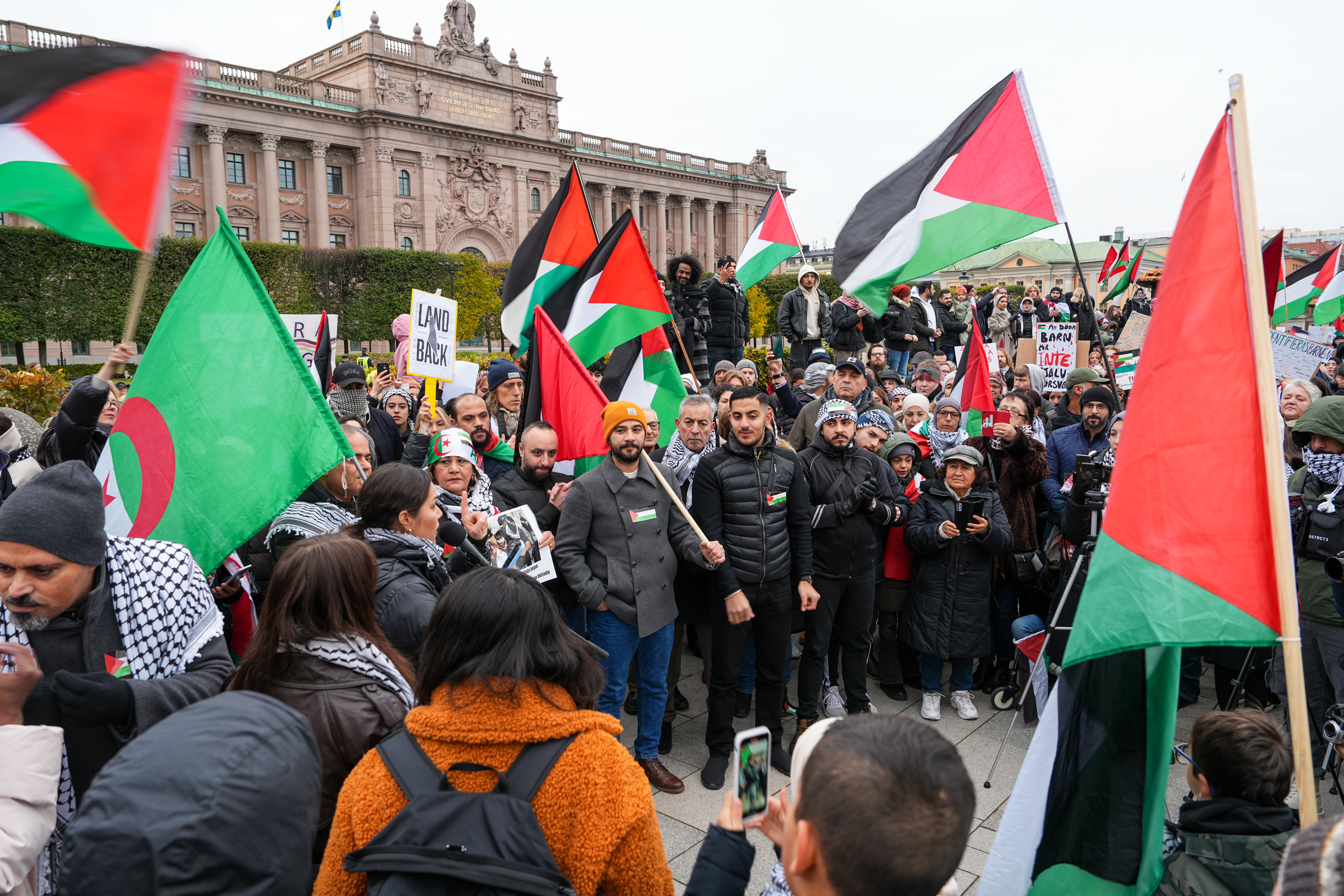




 דיויד סטברו