In recent months, Greenland has found itself under a treacherous bullying attack by The United States which decided to break the rules and resort to threats, pressure, and blackmail. President Trump adopted the geopolitical logic of his Russian counterpart and threatened to annex the island regardless of the will of its inhabitants. Will this actually happen and what does it mean for Israel?
STOCKHOLM – It's hard to think of two countries more different from each other than Greenland and Israel. Greenland actually isn't even a country; it's an autonomous area on its way to independence from Denmark. It's also a giant island almost empty of inhabitants, with no intercity roads and no traffic jams. Israel, as we all know, is crowded, hot, small and tense.
These differences could create the illusion that what is happening now to Greenland couldn't happen to Israel. But that isn't so. In recent months, Greenland has come under a thuggish, traitorous attack. The United States, which for decades was its partner and friend, decided to break the rules and threaten, pressure and extort the island.
U.S. President Donald Trump adopted the geopolitical logic of his Russian counterpart and threatened to annex Greenland regardless of its inhabitants' wishes. To prove that it was serious, the administration sent Vice President JD Vance to visit the island in defiance of its government's wishes and at a sensitive political time.
Two weeks ago, Greenland held a general election that ended with the incumbent's ouster. Vance's visit was thus slated to take place while the coalition negotiations to form a new government were being held, and also just days before the local elections. Political sources described this as foreign intervention in the elections. The outgoing prime minister termed the visit "highly aggressive."
The visit took place last Friday. Washington tried to market it as a defense-oriented visit to the U.S. space force base there. Before that, it had been marketed as a cultural tour by Vance's wife, without her husband (she joined her husband on the visit in its new incarnation).
Having the Vances visit the base was a sophisticated move. Ostensibly, it was a de-escalation, because the Americans wouldn't interact with angry residents and would focus on the base. Yet in another sense, it was an escalation, because the visitor was the vice president of the United States – the highest-level American official to ever visit Greenland. But either way, Greenlanders rightly view the visit as an act of extortion.
Contrary to the Trump administration's claims, there is no demand in Greenland for American intervention. "We – all party leaders – cannot accept the repeated statements about annexation and control of Greenland," the leaders of all five of the island's parties said in a joint statement. "We as party leaders find this behavior unacceptable towards friends and allies in a defense alliance."
Denmark's prime minister termed the American move "unacceptable pressure." And throughout the island, demonstrations were held against Trump's threats, with slogans like "Make America Go Away." Two months ago, a poll found that 85 percent of the island's residents oppose becoming part of the United States (and only 6 percent support it). But the Americans haven't been deterred.
The example of Greenland, like the United States' abandonment of Ukraine, shows a worrying side of the Trump administration. The U.S. could always have continued protecting its national security by stationing systems there to defend and control sea lanes. It could also have cooperated with Greenland's government and its residents in finding, mining, and producing valuable minerals.
Instead, Washington chose to signal to the world that there's a new sheriff in town who's willing to ride roughshod over anyone who stands in his way.
Should other countries also be worried by this new America, which abandons its partners, changes its loyalties and fires in every direction? Israelis don't appear to be particularly worried. Their enthusiasm for Trump has only grown, and his intervention to get the hostages released and his lifting of restraints on Israeli military action are obviously reasons for that. But people are also making deeper arguments for this blind faith in the Trump administration.
One argument is that in contrast to Greenland, President Trump feels an emotional connection to Israel. His confidants and his Jewish relatives nurtured a deep connection to the Jewish people in him, so he won't betray Israel like he has betrayed America's partners in Europe, Mexico and Canada.
Another argument is realpolitik. In the new global order, the American global cop is giving way to a multipolar world in which Russia and China also have spheres of influence. Israel can, therefore, count on the Americans even if they are opportunistic thugs because it's part of an American-Saudi-Egyptian-Emirati axis against the Iranian enemy. Consequently, Washington will protect it in any case – if not because of Trump's warm feelings for the Jews, then out of political and economic interests.
But vast blindness and indifference are needed to depend on these arguments. The first one relies on the existence of a stable, normative emotional base of empathy, responsibility and altruistic feelings of belonging in someone who has none of those traits. The second one relies on America having permanent, unchanging interests in a world characterized by changing alliances, dissolving coalitions, and unforeseen dramatic developments.
Even if America gives up on Greenland and moves on to its next adventure, we have to remember that political processes always have more than one side. Even people who have lost their moral spine and become enthusiastic over the idea of population transfer for the Palestinians must remember that if transfer is part of the diplomatic toolbox, it could be applied in any direction. If the U.S. administration can "clear out Gaza," why shouldn't it decide to clear out the Negev?
Similarly, even people who celebrated Washington's green light to flatten the Gaza Strip should remember that a lack of international rules and laws can be used against them in the future as well. And even if American nihilism and opportunism are working to the benefit of a local, temporary Israeli interest, we must keep in mind that we won't be immune forever.
Swedish school curriculum and school laws require factual accuracy, objectivity, and scientific basis from all teachers. Nevertheless, more than once or twice, Swedish teachers who are also political activists use tax-funded schools for spreding their political propaganda.
It was an ordinary Friday in January at an ordinary high school in Stockholm. At the end of a religious studies lesson, which was dedicated to self-study in preparation for a test, the teacher asked the students to direct their attention to a film.
The film showed a speech lasting about 20 minutes. Although it was supposed to be a lesson about Judaism, the film strangely wasn't about Jewish theology, Jewish traditions, Jewish texts, Jewish holidays, or Jewish history. Instead, it showed a radical political speech given in France in May 2024. It was about 'Israel's genocide, ethnic cleansing, and war crimes in Gaza' and Zionism as a murderous ideology that specializes in killing women and infants. The speaker also claimed that the USA, the UK, and France are 'fascists, neo-Nazis, and Israel’s best friends' and that 'there is no freedom of speech in Europe.'
The speaker, a self-declared 'anti-Zionist Jew' from the UK, referred to Hamas terrorists as 'real freedom fighters.' About Israelis, he said, 'they are not only not Jewish, they are also not human,' adding that 'a nation like Israel has no right to exist.'
Of course, the speaker did not mention the genocidal-like Hamas attack on October 7, 2023, nothing about the women, children, and elderly taken hostage, nothing about the lack of democracy and human rights in the Palestinian autonomous areas, or about Islamist terrorism and antisemitism, which have been characteristics of the Palestinian national movement since the 1930s.
Given all this, it is clear that the film did not belong in a religious studies lesson. However, according to a student who was there, the film was shown without context, without discussion, without questions, and without any explanation (except for the claim that it showed 'not all Jews are Zionists').
Moreover, the teacher's deep involvement in the issue and the teacher's personal views became clear as the students watched the video. It included sections with standing ovations from the audience. Belive it or not, one of the people seen cheering in the film was the Swedish teacher, making it clear where the teacher stands politically. When asked about it, the teacher confirmed this.
The incident appears to be yet another case of political activism in a Swedish school, which harms individual students and involves the misuse of the taxpayer-funded school system to spread extreme ideologies. In this case, the teacher is also a union representative and one of the organizers of a discussion evening about Gaza, held in Stockholm last May. As one of 'the union’s internationally responsible officers,' the teacher gave the other teachers an introduction and explained the history of the Israeli-Palestinian conflict.
The teacher, who has also expressed extremely radical views in other contexts, is clearly not suitable to present a balanced view of the conflict. Yet, the teacher was allowed to do so for other teachers. This may be one of the reasons for other cases where extremist political views have been part of teaching in Stockholm's schools.
Since the beginning of the war in Gaza, Swedish schools have seen many such cases. Last May, SvD published an article about preschool teachers who imposed their political activism on 4- and 5-year-olds. At one preschool in Stockholm, for example, the children made jewelry with paint and beads in the colors of the Palestinian flag and handprints, which they placed on white sheets of paper with the heading 'Support Palestine.' According to a post on social media, the preschool was also involved in collecting money for Palestinian groups. In Jönköping, a couple of preschool teachers had children draw watermelons to 'show love and solidarity with Palestine.'
Older students in 39 Swedish schools were given their share of political propaganda from another direction. According to another article in SvD, these schools are 'partner schools' of Amnesty, an organization deeply involved in political activism focusing on the Israeli-Palestinian conflict and far from impartial. These schools use the 'Amnesty model' for teacher training, themed days, reading materials, and lectures. They even participate in global campaigns. Amnesty is known as an organization that disproportionately criticizes Israel, supports boycott campaigns against Israel, almost completely ignores attacks on Israeli civilians, uses information from Hamas propaganda, and some of its overseas partners have connections to terrorist organizations and Islamist movements.
A student at a high school in Stockholm shared that since the lessons on the Israel-Palestine conflict started, they feel 'I have to go to school to defend Israel. It's not that the teacher is lying, but it is very one-sided. For example, we had two lessons on the Palestinian Nakba and only half a slide about the expulsion of Jews from Arab countries.' When students were given texts on the subject, they received study questions like: 'What support is there to describe Israel as an apartheid state?' 'It’s uncomfortable,' says the student, who is concerned about their classmates. 'I feel like I need to present the other side. The others in the class don’t know the full picture.'
A mother of another student shared that her son had lost motivation for his social studies because of how the war was presented. The teacher continuously referred to all of Israel as occupied land and presented Hamas as one of what seemed to be two reasonable alternatives: a terrorist organization or an anti-colonial liberation movement.
Sometimes, Swedish teachers have not spoken about the topic at all but failed to protect students from politically motivated attacks. A few weeks after the war began, classmates of a Jewish boy in a primary school in southern Sweden asked him who he supported in the war. The 10-year-old boy replied that he supported Israel. The two others drew a crossed-out Israeli flag, crumpled it up, and threw it at him while saying, 'We hate Israel.' The teacher present in the classroom did nothing until the student’s mother contacted them.
The mother of a 16-year-old boy from a Jewish family attending a high school in western Sweden shared another disturbing story. She says a girl stood up in class and screamed, 'Slaughter, rape, and torture all Jews' at her son. The teacher did not react, did not stop the girl, or report her to the principal. The other students were also silent
Returning back to the Stockholm case from January, the school refused to disclose what sanction, if any, was taken against the teacher who used a high school classroom to spread extreme propaganda against Israel. The school’s principal says that the school does not comment on potential actions regarding individual staff matters. But it was confirmed that the teacher is still teaching at the school.Thus other teachers, students and parents will have to keep guessing – they know that the teacher exploited authority, a power position, taxpayer money and school infrastructure to advocate for political views that have nothing to do with the subject matter of the teaching. They also know that school curriculum and school laws require all teachers to be factual, objective, and based on scientific foundations. Still, we'll all have to stay in the dark when it comes to the implications of not doing so.
It is important to emphasize that the problem here is not discussing sensitive topics or censoring anyone. Different opinions are welcome, discussions in schools are important, and teachers, like everyone else, have the right to their political beliefs. The problem is the abuse of Swedish schools for pure political propaganda at the expence of the students and Swedish society.
One of the students who took part in the lesson in January has a Jewish background. She is now being taught by another teacher in religious studies. Since the school in this case reacted by separating the teacher from the student, even though it is clear that the problem lies with the teacher and not with the student, one must ask: would propaganda in teaching go unchallenged or without consequences if it concerned something other than Israel and Jews?
Israel's government has boycotted the Sweden Democrats since the party's founding by neo-Nazis in 1988. The political repercussions of the Gaza war have led to a new Israeli directive calling for exploratory talks, but the Swedish Jewish community still refuses all contact with the far-right party
STOCKHOLM – Foreign Minister Gideon Sa'ar's instruction for Israeli diplomats to launch discreet talks with the far-right Sweden Democrats has made waves in the Swedish media. It marks a drastic change for Israel's foreign policy, which was previously characterized by a long-standing boycott against far-right parties associated with antisemitism, Holocaust revisionism and neo-Nazi activists.
Sa'ar has ordered these exploratory talks with far-right parties in France, Spain and Sweden, Axios' Barak Ravid reported Monday. The Sweden Democrats' foreign policy spokesman, Aron Emilsson, who heads the parliamentary Foreign Affairs Committee, told the daily Expressen that Israel's decision was "extremely positive."
"We've been working for a long time to improve relations," he said, adding that "the ties are also important in security matters, particularly regarding Iran."
The Sweden Democrats have been boycotted by the Israeli government since the party's inception in 1988, but two unofficial visits by the party's leaders to Israel in 2023 and early 2024, as well as a series of unpublicized talks with Prime Minister Benjamin Netanyahu's Likud party and the Foreign Ministry triggered a policy change.
Ziv Nevo Kulman, Israel's ambassador in Stockholm, told the daily Dagens Nyheter in 2021 that his country had no ties with the Sweden Democrats and had no intention of establishing any. "This is a moral position about far-right parties with roots in Nazism," he said, two months into his term.
He told Haaretz last May: "We are aware of the positive statements by the Sweden Democrats about Israel. But at the same time, the party continues to adhere to extremist positions regarding a ban on brit milah [Jewish ritual circumcision] and the importing of kosher meat, and it has yet to seriously grapple with its neo-Nazi past and with the antisemitism among its members." He said the party's alleged support for Israel was "questionable."
Despite this earlier skepticism, the Israeli Embassy said Tuesday: "As part of a broader review of parties in Europe with which we have not previously had contact, the embassy has held talks with the Sweden Democrats. The initial contacts have largely focused on how the party handles its history and its stance on issues affecting Jewish life in Sweden."
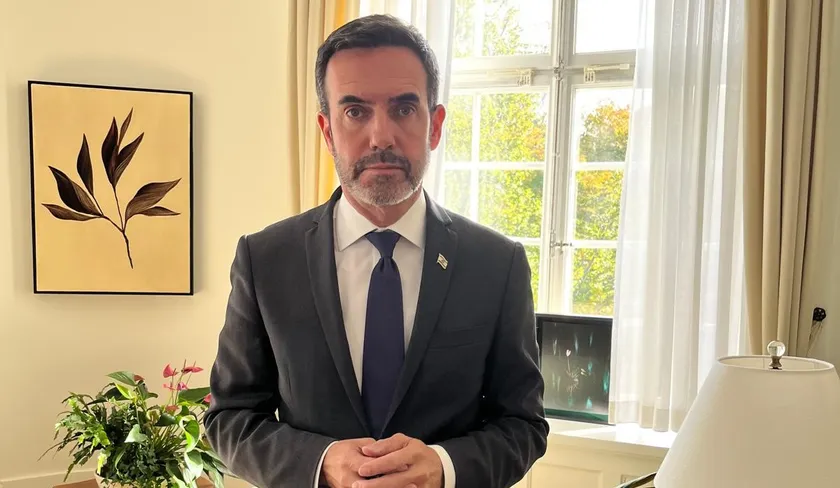
Ziv Nevo Kulman, Photo: Israel's Embassy to Sweden
According to sources familiar with Israeli-Swedish relations, this change of tack was not only the work of Israel. Since the beginning of the war in Gaza, Sweden's center-left has been increasingly hostile toward Israel, and these parties' ties with Jerusalem have significantly weakened. Israel has become a wedge issue between Sweden's center-right coalition and the centrist and left-wing opposition.
According to the sources, the opposition's approach is pushing Israel into the arms of the Swedish populist right. As a result, the Sweden Democrats are increasingly seen as a legitimate party in both Israel and the Jewish world, a major win for the party.
For Sweden's Jewish community, the Sweden Democrats are still considered off-limits, at least officially. The party is not in touch with the community and is not welcome at community events.
In a letter to Israel's foreign minister a year ago, the European Jewish Congress and the Council of Swedish Jewish Communities expressed concerns about a meeting between Israeli ministers and Sweden Democrats visiting Jerusalem. The president of the European Jewish Congress, Ariel Muzicant, and the chairman of the Council of Swedish Jewish Communities, Aron Verständig, wrote that they were "gravely concerned" and referred to the party's "neo-Nazi roots."
Muzicant and Verständig added that the Sweden Democrats' "ideology is still inherently xenophobic even though its representatives claim to be our allies, making an exception for the Jews as a national minority, albeit claiming that Jews cannot be Swedes." They said the party regularly submitted bills to ban "non-medical circumcision," as opponents call it, and the importing of kosher meat.
When asked Tuesday about Israel's apparent policy shift, Verständig told Haaretz that he was notified a few days ago that Israel's Foreign Ministry had instructed the Stockholm embassy to forge contacts with the Sweden Democrats.
"However, we don't have contacts with the Sweden Democrats," Verständig said. "The issue of the Sweden Democrats is one that we discuss regularly, but we haven't changed our position and we still don't have ties with the party."roots
The Sweden Democrats party was founded in 1988 by members of Swedish neo-Nazi and far-right movements. A key figure in the organization was Gustav Ekström, a member of Germany's Waffen-SS, the SS' military arm, during World War II and an activist in the NSAP, the Swedish Nazi party that disbanded in 1950. Other founders were members of white supremacist parties, neofascist and neo-Nazi movements, the Swedish skinhead movement and criminal organizations.
But the neo-Nazi past wasn't the only reason for the Israeli boycott. In recent years party members have spread conspiracy theories and racist, antisemitic and Islamophobic propaganda. In 2021 the Swedish daily Aftonbladet revealed that Jörgen Fogelklou, the party's leader in Sweden's second-largest city, Gothenburg, spread antisemitic and racist statements on social media such as "It is clear that Jews are the root of all evil in the world."
A few years ago, another local party leader in southern Sweden, Jonas Lingvärn, took part in performances by rock bands supporting white supremacy and used the slogan "Skinhead 88" – 88 is shorthand for HH, meaning "Heil Hitler."
The party first entered Sweden's parliament in 2010, and in the 2022 elections it won more than 20 percent of the vote, making it the country's second largest party. Until just a few years ago, the Sweden Democrats were boycotted by parties across the political spectrum.
But after a shift in approach by two center-right parties, the Sweden Democrats became an integral part of the right-wing bloc after elections, without which a center-right government could not be formed. In parliament, the party heads the Foreign Affairs Committee, the Justice Committee and the Industry and Commerce Committee.
Some places, the ones where we send our young children, the places where we treat our pain, and those where we invest our shared resources, should be free from polarizing content. Schools, hospitals, and clinics, and yes, if it’s public and taxpayer-funded – even Kulturhuset – have no place for Quran burnings, no place for NMR marches, and absolutely no place for polarizing political propaganda. Not even if 15-year-olds created it.
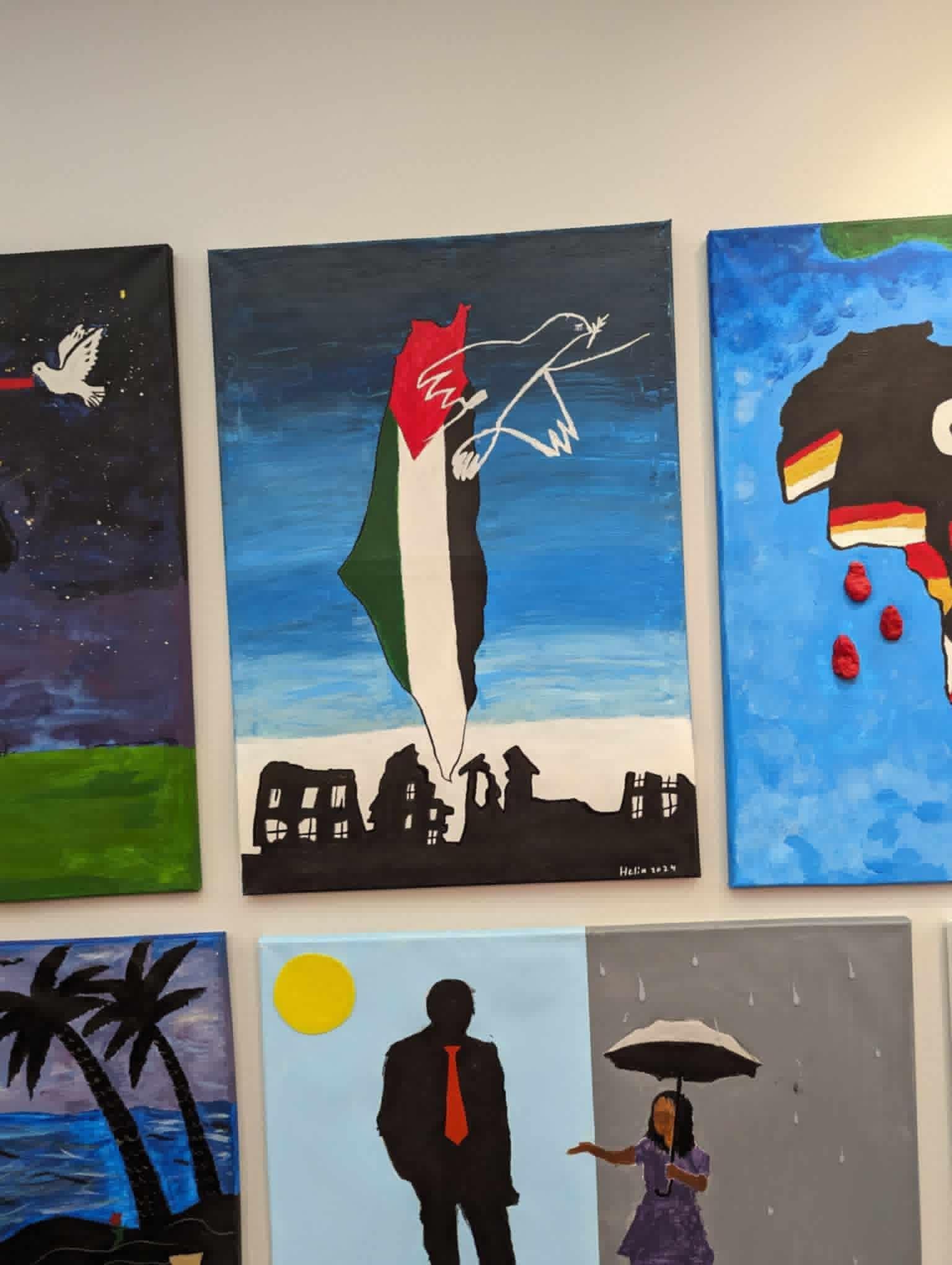
An article from Kvartal (January 22) tells of an incident in the Stockholm suburb of Husby last spring. High school students from a local school exhibited paintings they created in the foyer of Kulturhuset, which is owned by the City of Stockholm and shares premises with Husby’s public culture school. The paintings were the result of lessons on post-colonial theories and art at the students' school. A few hours after they were displayed, the paintings were taken down. Kulturhuset stated that the paintings were “strongly anti-Israeli” and “bloody, political, and violent.”
Reactions were swift. The school's principal defended the students' right to express their opinions, and the art teachers felt that the decision was a form of censorship. Lars Nittve, former director of Stockholm’s Modern Art Museum and London’s Tate Modern, wondered how “scary” drawings and paintings could be, and Makode Linde criticized concerns over art that distanced itself from the “ongoing genocide in Gaza and the occupation of Palestine.”
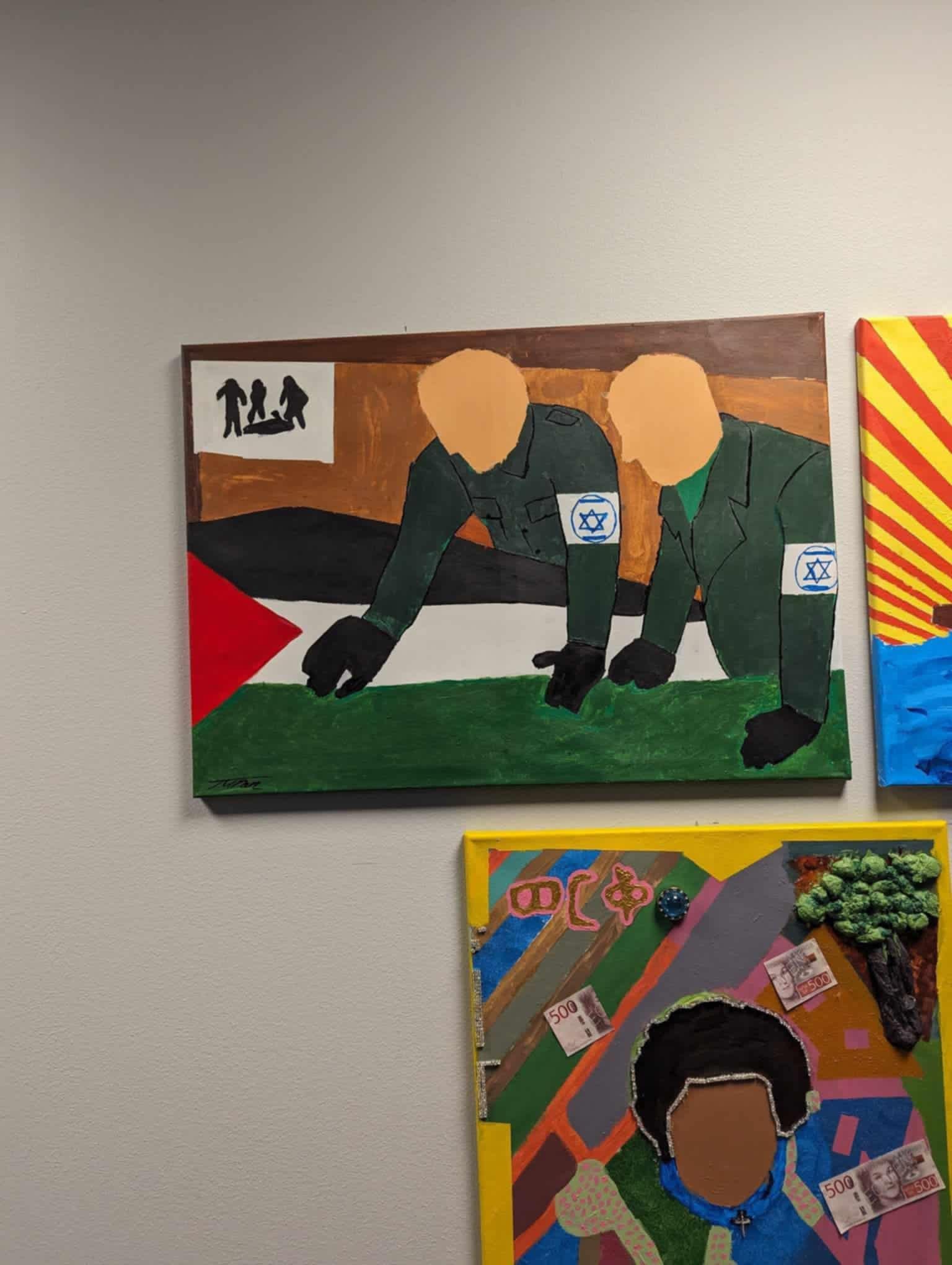
Some of the paintings that provoked reactions were published in the media: a Palestinian flag over a map of Israel, and images depicting slavery and colonialism in Africa. One painting was not mentioned. This painting depicts one image of three men standing over a fourth man who is lying down, and another of two faceless soldiers leaning on a Palestinian flag. It’s unclear whether the flag is covering anything, but it is obvious who the soldiers are – they have armbands, similar to the ones Nazi soldiers wore with swastikas. On the armbands, there is an Israeli flag.
According to the Kvartal article, there is no documented evidence from Kulturhuset that anyone was upset by the exhibition.
However, it wasn’t hard to find such a person. “I came to Kulturhuset and saw that paintings were being hung on the wall. When I looked at them, my heart ached, I felt cold, and I started trembling with shock over seeing the hatred,” said a person with Jewish background who was at Kulturhuset when the paintings were hung up and chose to remain anonymous because he is worried about his safety.
For those who are not familiar with Middle Eastern politics, it might seem strange, but a map of Israel covered by a Palestinian map is as loaded and shocking as a map of Poland covered by a Nazi flag or a map of Ukraine covered by with a Russian flag. It symbolizes ethnic cleansing for Israelis. Paintings depicting Israeli soldiers as murderers support the narrative that Israel is the aggressor and the Palestinians are the victims, while ignoring the October 7 massacre, Israeli hostages, and rocket attacks on Israel. The context of post-colonialism challenges Israel's legitimacy as a state and its right to exist.
It doesn’t matter if these claims are true or whether such opinions should be allowed to be expressed. This is not about censorship or freedom of speech. Yes, students should be encouraged to think critically and creatively. Yes, we must encourage an open public debate. But the issue here is a different one – the relationship between publicly funded institutions and controversial political content.
Kulturhuset manager, Malin Dahlberg, pointed out that there is a responsibility to create a safe and comfortable environment in public spaces. According to her, removing only the most problematic paintings would be insulting to those who created them, which is why all the paintings were taken down. Leaving them up could also expose the students to a media storm that no 15-year-old could handle.
Dahlberg is right.
Sweden is a polarized country where people have strong opinions and personal connections to the conflict in Gaza. People are bombarded with extreme views on social media. Some believe it is an Israeli genocide, while others see it as an Islamist holy war of extermination against Israel. Many have relatives affected by the violence. Many are angry and scared.
These people have something in common. They all need healthcare, education, and welfare. We must be able to offer safe spaces for this. There are many places for political activism – squares for demonstrations, galleries for political art, youth movements for youth activism, organizations for humanitarian work, and media for political debates.
Some places, the ones where we send our young children, the places where we treat our pain, and those where we invest our shared resources, should be free from polarizing content. Schools, hospitals, and clinics, and yes, if it’s public and taxpayer-funded – even Kulturhuset – have no place for Quran burnings, no place for NMR marches, and absolutely no place for polarizing political propaganda. Not even if 15-year-olds created it.
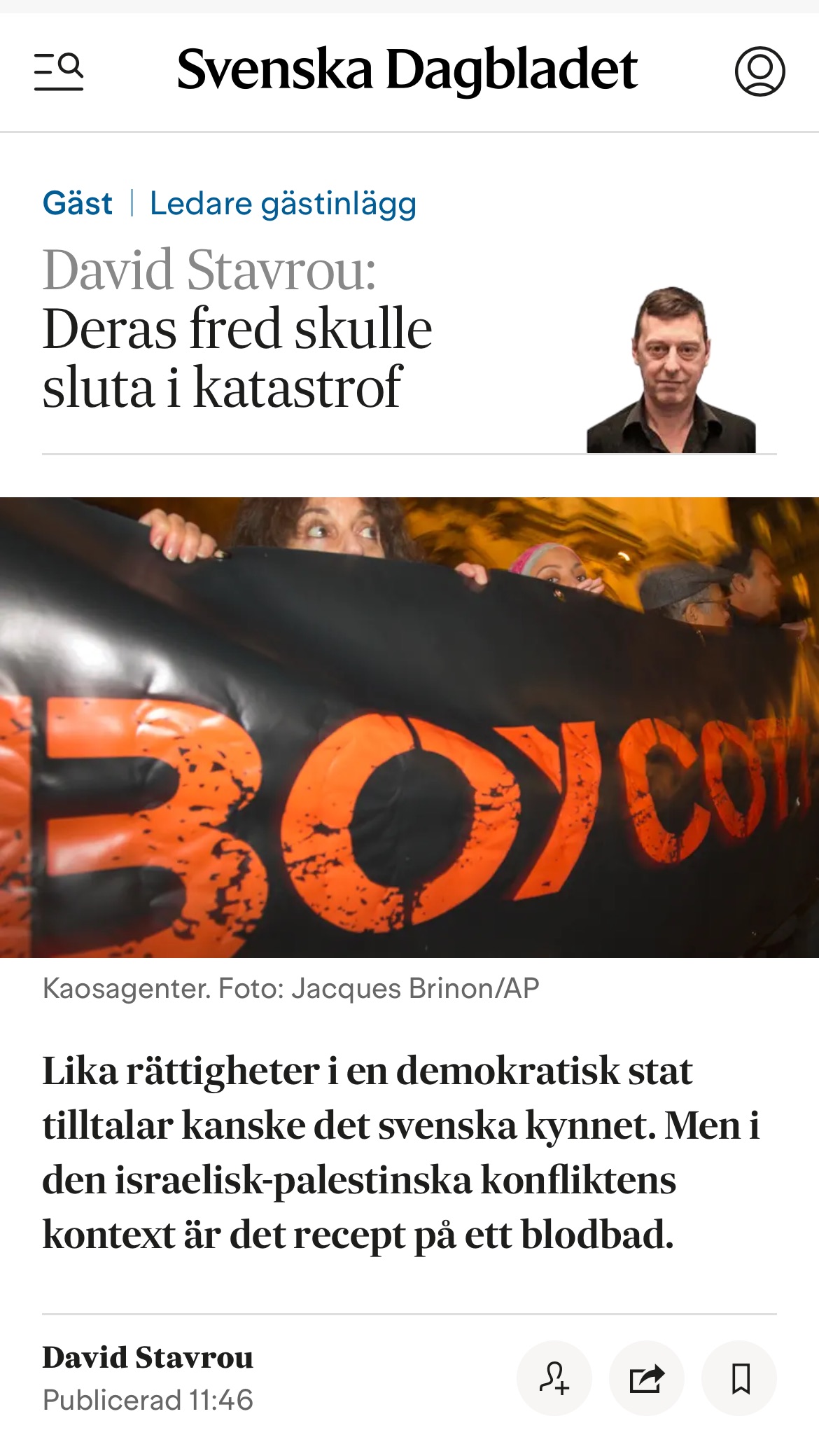
Equal rights in a one state solution may appeal to Swedish sensetivities. But in the context of the Israeli-Palestinian conflict, it is a recipe for bloodshed.
Israeli politics can be confusing for those who are used to a system which rewards accountability. One example is that even though Hamas' brutal attack in October 2023 was the biggest tragedy in Israel's history and part of a momentous failure of Israel's leadership, the government is still in place and seems to be stable enough to survive the crises. It's even confident enough to continue its controversial judicial overhaul which many claim is a direct assault against Israel's democracy. When it comes to the conflict with the Palestinians, Netanyahu's government is using the catastrophe as a pretext for going further to the right, perhaps even as an excuse for a future annexation of the West Bank which would be a tragedy for both Palestinians and Israelis who support peace, democracy and freedom.
This is why Standing Together, a grassroot movement of both Jewish and Palestinian Israelis who join hands in working for peace, equality, and social justice is so important. These are exactly the kind of people who can provide hope for Israel's declining peace movement. They can also be excellent partners for actors in the global community who are concerned about developments in the region and want to support positive change. And indeed, two of the movement's leaders are coming to Sweden. When I spoke to one of them, Alon-Lee Green, one of the movement's national coordinators, he told me that the visit's purpose is "to gather support for the fight to end the war, to end the occupation and to achieve Israeli-Palestinian peace".
But it seems not everybody wants to listen. Instead of encouraging Israel's brave opposition, some activists are horrified by the mere thought of Israeli peace fighters. One commentator on social media wrote: " I think it's important that as a movement we keep track of which groups we choose to collaborate with. Standing Together is boycotted". As a self-appointed moral compass, the activist then quotes a text by The Palestinian Campaign for the Academic and Cultural Boycott of Israel claiming that Standing Together is "serving a key role in Israel’s international propaganda strategy". One of the commentators who thanked the writer even added: "we don't recognize Isnotreal!".
Since October 7th the BDS campaign has been gaining support in Sweden. Professors, researchers and students call on their university to cut all ties with Israel, Amnesty cooperates with BDS-Sweden and lists of companies "profiting from the genocide" are all over social media leading to demonstrations and smear campaigns. All this shows what at least part of Sweden's left is all about. The BDS movement claims that Standing Together is serving "Israel’s 75-year-old regime of settler-colonialism and apartheid". Nothing could be clearer – the BDS movement isn't against specific Israeli policies, it isn't against a specific government or a specific war. BDS activists' real problem is the very existence of Israel. When they talk about 75 years of settler colonialism, they're not talking about the 1967 occupation of the West Bank and Gaza, they're talking about the 1948 UN decision to found a Jewish state, and an Arab state, in Palestine. The people who don't want to listen to Israeli peace fighters are doing it simply because they are against peace between Israelis and Arabs. According to them Israelis are the original colonialist sin and they should just disappear.
Do these attitudes belong only to a handful of extremists or are they spreading to Sweden's left as a whole. A good indication is the debate about the so-called two-state solution. Those who still support it, even though it seems almost impossible to achieve, are promoting a solution which includes a compromise between two legitimate national movements. Lately, however, the idea of a one-state solution is becoming popular. Swedish academics are writing texts about one state based on "one citizen-one vote", in the Swedish Left Party congress last May many party members promoted changing the party's position to supporting a one-state solution and further to the left, Fi (the Swedish Feminist Initiative) and the new "Solidarity" party, already took the step. Fi even claims that "Zionism is an imperialist and racist ideology". Anyone who witnessed a pro-Palestinian demonstration during the last few months knows this isn't a minority. The most popular slogan doesn't leave room for doubt – "From the river to the sea Palestine will be free", Not "Palestinians will be free". Palestine means a state – one state, not two, from the river to the sea.
In Sweden's radical left there are those who take it even further. There's a at least one youth movement (RKU) which supports the October 7th "historic offensive in which the Palestinian resistance broke open the prison bars". Another "solidarity movement" (Samidoun) supports the PFLP, an organization which took part in the massacre. In addition, there are plenty left wing-oriented publications which continue to support the narrative which sees Hamas as an anti-imperialist decolonization force. All these movements support a one state solution. Just like Hamas and the most radical Jewish extremists.
One state with an equal vote and equal rights may sound appealing to Swedish sensibilities. Indeed, why not have nothing to kill or die for and no religion too? The only problem is that in the context of the Israeli-Palestinian conflict one state is a receipt for a blood bath. Most Palestinians who support a one state solution mean a Palestinian state. Most Jews who support it mean a Jewish one. The result of such an experiment will either be apartheid or some version of ethnic cleansing or genocide. The only question will be who's killing who.
When I talked to Standing Together's National Coordinator he said that the movement doesn't support a specific model of solution. "We support an Israeli-Palestinian peace", he said, "one that will enable everyone to live in freedom, equality and independence". When it comes to the boycott movement Green says that Standing Together is the largest Israeli movement fighting for peace and against occupation. "We've been protesting all over Israel for 15 months, we arrange aid for Gaza, our activists are fighting settlers who attacked humanitarian aid convoys and we demand an end to the killing", he says, "if anybody wants to argue with us about words that we say or don't say, they can write an essay and perhaps we can discuss it in some lecture in the world of academia. But in the world of politics and actions, the one that we focus on, the BDS statement about us has no influence where we live. It wasn't even translated to Arabic".
The BDS movement leaves no room for Standing Together. It only accepts Israelis who think that their country shouldn't exist. But the men and women of Standing Together are different. They love Israel and they're fighting to make it better. They realize that both Jews and Arabs are there to stay and they promote pragmatic compromises rather than holly wars and abstract ideologies. This is why the Olof Palme Center, the Robert Weil fund and Kulturhuset made the right choice when they invited them to Sweden. Naturally, those who are against Standing Together have the right to protest, but we shouldn’t call them peace activist, we should call them what they really are – dogmatic chaos agents who, if they get what they want, will lead both Israelis and Palestinians to a catastrophic disaster.
STOCKHOLM – Years before the Nazis rose to power, Hugo Valentin, a prominent member of Stockholm's Jewish community, recognized the dangers of Nazi ideology. A historian and scholar, he warned against the "wild psychosis of hatred" as far back as 1930, and even before the outbreak of World War II, he cautioned against the "total eradication of German Jewry." When the Third Reich began implementing the Final Solution, he was among the first to inform the Swedish public that the Jews of Europe were being annihilated. Already in 1942, he wrote in a Swedish daily newspaper that 700,000 Polish Jews had been murdered, and he continued to report about the mass killings of Jews around Europe over the next few years for the Swedish Jewish Chronicle.
Until his death in 1963, Valentin was considered a leading authority on antisemitism. He connected ancient, medieval, and modern antisemitism and argued that "it is not the Jews who are hated, but an imaginary image of them." A pioneer of Swedish-Jewish studies, Valetin was also a vocal supporter of Zionism and of the young state of Israel. In 2009, nearly half a century after his death, Uppsala University – Sweden's oldest institute of higher education and one of its most prestigious – merged its Center for Multiethnic Studies with the Program for Holocaust and Genocide studies. Since Valentin had been a distinguished scholar of the history of the local Jewish community and antisemitism, as well as Nazism and genocide, it seemed only natural to name the center after him.
And so, the Hugo Valentin Center was established – the only academic center in Sweden named after a Jew. Late last year, the university announced that a decision had been taken to change its name: As of January 1 this year, it would be called the Uppsala Center for Holocaust and Genocide Studies.
Hugo Valentin apparently got cancelled.
"The removal of Valentin's name is part of a dangerous trend of taking antisemitism out of the Holocaust," said Aron Verständig, chairman of the Council of Jewish Communities in Sweden. Speaking with Haaretz, he described the deceased historian as "the foremost writer of Jewish history in Sweden and one of the first to write about the Holocaust."
Pontus Rudberg, an associate professor of history at Uppsala University who was previously affiliated with the center, was also concerned. "It's disgraceful," he said. "It supports the trend that removes Jewish perspectives and Jewish history from Holocaust and genocide studies. It's also disgraceful because you don't remove the name of the person your institution is named after unless he's done something wrong."
Rudberg said he was surprised by the decision-making process. "I was asked by the director of the center for my opinion in a vague way during an informal meeting a week or two before the decision was made," he told Haaretz. "I said I was against it, but I didn't realize it was an actual process, and I found out about the decision, which was made with no informed and open debate, only when it was published just before the Christmas holidays."
In a protest letter addressed to Anders Hagfeldt, vice chancellor of the university, Professor Emeritus Harald Runblom, another Uppsala historian, wrote that "erasing a name in this context is like tearing down a statue, and it raises legitimate questions. Has he become persona non grata? Is there political opportunism behind this?"
Another letter addressed to the vice chancellor, signed by 93 international scholars, warned that erasing Valentin's name could set in motion "a broader trend of distancing Holocaust and genocide studies from Jewish history" and described the move as "an affront to Hugo Valentin's legacy and a diminution of his remarkable contributions." Among those signed on this letter were the distinguished Holocaust historians Christopher Browning and Jan Grabowski.
Weighing in on the controversy, journalist Nathan Shachar recently penned an op-ed in Dagens Nyheter, a leading Swedish daily, titled "Uppsala University embarrasses itself – does not dare to be linked to Sweden's most famous Zionist." "In the difficult reality since October 7, the center wants to tone down its Jewish affiliation for populist reasons of convenience and avoid being associated with the most famous of Swedish Zionists," he wrote.
Rudberg offered a somewhat different explanation for Valentin's erasure. "It's ignorance, rather than bad intentions," he said, "The people who made the decision don't know much about Valentin. They think he was mostly involved in Jewish history and antisemitism studies. They don't understand he was also a pioneer in Holocaust and Genocide studies."
Still, the decision seems to be in line with the current zeitgeist on campus. In November, a group of 131 university members published a letter in the Swedish daily Aftonbladet demanding that the university cuts all ties with Israeli universities "complicit in the genocide."
The letter was the latest in a series of calls at Uppsala to boycott Israel, and although the university's leaders have refused to bow to such demands from student groups, the fact that many professors and researchers support such sanctions against Israel has many Jews on campus feeling uneasy. Since October 7, the Uppsala campus has emerged as a hotbed of the Swedish pro-Palestinian protest movement. On a number of occasions during the past year, students disrupted university activities and the administration made the decision to summon police over what it perceived as threatening disruptions to campus life.
Several Jewish students, who agreed to speak with Haaretz on condition of anonymity, said they felt protests against Israel have crossed the line into antisemitism. They said that posters sighted at demonstrations and encampments on campus over the past year have supported violent resistance and denied Israel's right to exist.
Asked for comment, Elsa Bådagård from Uppsala University's office for Humanities and Social Sciences, issued the following statement: "Uppsala Center for Holocaust and Genocide Studies is a center within the Faculty of Arts, and the decision regarding its name has been made by the faculty board upon request from the board of the Hugo Valentin Center in December 2024.
The different reactions to the name change have been received and noted by the Faculty of Arts. However, since the request originated with the center, the faculty will not overturn its collegial decision on the basis of these opinions. Furthermore, the proposition to change the name has the support of the current employees at the center."
Bådagård insisted that the reason for the name change was that the board wanted it to reflect the primary field of research of the center, which is Holocaust and Genocide Studies. "It was not part of any political agenda, and the name change will not lead to any change regarding the focus of the various activities at the Center," she said, adding that "this is a purely organizational decision, and should not be read as a wish for the Faculty of Arts to distance itself from Hugo Valentin and his work."
Defendants face prison and community service, while court acknowledges claim that Maccabi Tel Aviv fans were involved in violence but condemns attacks on Israeli soccer fans.
An Amsterdam court on Tuesday sentenced five individuals for their involvement in an attack on Maccabi Tel Aviv fans last month, following the team's Europa League match against Ajax.The sentences ranged from community service to six months in prison, although the prosecution had sought much harsher penalties. For instance, a defendant who received a six-month sentence had initially faced a prosecution request for two years in prison.
The court acknowledged the claim that the Israeli fans were involved in violence and considered the context, but stated it "sees no justification for violence against Maccabi fans." Defense lawyers argued that the evidence used against the defendants was unlawfully obtained, claiming it involved privacy violations through phone hacking. However, the court rejected these arguments, as well as accusations that the events had been exploited for political gain by local politicians. Both sides have 14 days to appeal the sentences.
The defendents are:
Sefa Ö., 32, a Turkish barber, was filmed attacking Israeli fans in Amsterdam's Dam Square and was sentenced to six months in prison for assault.
Umutcan A., 24, a Turkish-born resident of The Hague, was filmed striking a fan and stealing his scarf. He was sentenced to one month in prison.
Rachid A., 26, from Utrecht, was convicted of sharing information and participating in the violence. He received a 10-week prison sentence.
Lucas D., 19, from outside Amsterdam, was accused of throwing stones at police and attempting to breach their defensive line. He was sentenced to 100 hours of community service.
Karavan S., 26, a night-shift hotel worker in Amsterdam, was found guilty of inciting violence and sharing the location of the fans. He was sentenced to one month in prison.
In November, Israeli fans were attacked by locals who waited for them as they returned from the stadium on the outskirts of Amsterdam.
Five fans required hospitalization. Dozens of suspects were arrested in the days following the attack, which was widely documented and triggered a diplomatic dispute.
The five defendants and two others are the only ones to have been charged so far.
Jewish communities worldwide are reeling from a year of hostility from neighbors. But probably nothing matches what the tiny community in Norway has endured.
OSLO – Yael Nilsen has lived in Norway for years, but a year ago, on October 7, she was glued to television broadcasts from her native Israel. So, it was only recently that she discovered how the events of that day were presented to viewers of Norwegian media.
That was when she came across a recording of the main evening news show of NRK, the Norwegian public broadcaster, from October 7. "I watched it," Nilsen relates. "The top headline [on the NRK website] that evening was: 'Strong reactions to Hamas' attacks on Israel; main goal is liberation of Palestinian prisoners, says Hamas spokesman.'" The Israelis who were abducted and killed by Palestinians were mentioned in passing, she notes.
That was the line followed by many of the country's media outlets, both public and commercial. A week after the massacres of Simhat Torah, the official representative of the Palestinian Authority in Oslo (who became an ambassador when Norway officially recognized a Palestinian state in May), said that she wasn't familiar with videos showing people being murdered in their homes. "That is Israeli propaganda, intended to get [the country] a free pass from the international community to attack as it wants," she told a Christian newspaper in an interview that then widely shared on social media.
The Norwegian government, for its part, saw to it that King Harald V, the country's official head of state, did not express condolences to Israel after October 7, because, according to the foreign ministry, it's a "political conflict." Contrary to the other countries of Europe, Norway does not categorize Hamas as a terrorist organization; many in the country view it as a legitimate political player. In an interview with TheMarker, Haaretz's business newspaper, Norway's foreign minister noted that his country maintains relations with both that group and Hezbollah.
Pro-Palestinian demonstrations and rising anti-Israeli sentiment have been widespread during the past year worldwide. But in Norway things appear to have gone somewhat further. Hamas' narrative took hold in broad circles in the country, extending far beyond the radical left and pro-Palestinian activists. What sprang from an anti-Israeli point of departure quickly snowballed in a way that was out of proportion with what other Jewish communities in Europe experienced. Criticism of Israel swiftly took the form of hatred on the street and on social media, and was also directed at Jews in general. Members of the Jewish community say they feel this trend effectively enjoys an institutional tailwind.
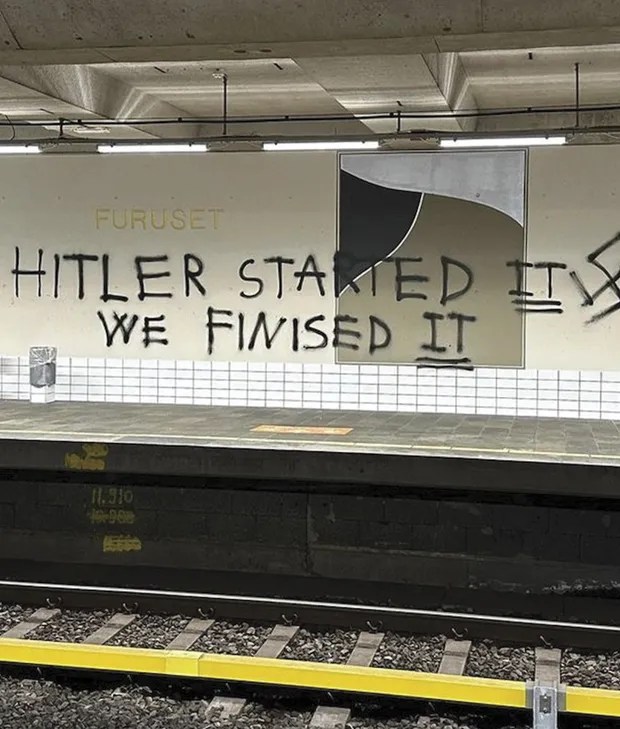
Norway's Jews started to report instances of harassment and threats. Graffiti and artworks likening Israel to Nazi Germany cropped up in the public space across the country. A wall drawing in the city of Bergen depicted Anne Frank in a keffiyeh, and openly antisemitic messages soon followed: From the inscription "All Jews out' spray-painted on walls, to an ominous message (in English) in an Oslo Metro station – "Hitler started it. We finis[h]ed it" – accompanied by a swastika.
Graffiti depicting Anne Frank in a Keffiyeh, in Bergen. Töddel / JTA
Norway's tiny Jewish community is badly rattled by what it's experiencing as a lethal blow to its feelings of belonging and security. A visit to Oslo, and conversations with Jews living elsewhere in Norway as well, reveal that the tiny community, which numbers only 1,500, truly feels threatened. Some of those interviewed asked not to have their names published. "The community is isolated because the government is not looking after it and is not condemning the violence it's experiencing," a source who's involved in the Jewish community tells Haaretz, adding, "The government is effectively affirming the discourse of hatred."
The case of A., a Jewish Norwegian woman, illustrates how far things have gone. One of A.'s daughters lives in Israel and serves as an officer in the Israel Defense Forces. At the end of last year, someone found an online video of her daughter, in uniform and speaking Norwegian, and re-posted it on Instagram. Overnight, the life of both daughter and mother became hell.
"Immediately, all [our] social media accounts were flooded with messages, curses, hatred and threats," A. relates. "An influencer and model of Muslim origin posted the video and added the name of my workplace along with pictures of me and my daughter." The threats did not come solely from Palestinians. The account information associated with those who sent the messages, and the messages themselves, suggested that many were not of Muslim or Arab origin.
"Waiting for you to land in Norway, then I'll show you what I and my friends from Hamas will do to you," someone wrote. And there was also: "She's a dirty genocide supporter. I hope she sinks into the sand stained with the blood of Gaza and returns to Norway without arms or legs." As well as a third reading, "Zionist whore, I hope you get a bullet from Hamas."
There was even an initiative to have the authorities place her daughter on trial, like Europeans who fought for ISIS. Separate from that, the Norwegian branch of Save the Children issued a demand that every returning Norwegian who has been in wartime Gaza Strip be questioned by the authorities, in keeping with Norway's "international commitment to prevent genocide."
What did you do?
A.: "I went to the police. In the end, they decided it wasn't criminal and closed the case. I was given an emergency-call button for a certain period, and suggested that I move to different accommodations. To this day I live 'underground.' Still, now everyone knows where I work, and everyone knows my daughter is in the Israeli army. Besides, my daughter lost all her friends in Norway and can't come to visit for fear of her life. I am Norwegian, I love my country, but I am very disappointed. No one can protect me."
A tube station in Oslo
Did you encounter that attitude before October 7, or is it completely new?
"Even if it's worse now, it's not new. My children have had to account for everything Israel has done since they were in first grade." She adds that one of her children was forbidden by a teacher in her school to talk about a family vacation in Israel, so as to avoid "offending other children," and in other instances, teachers told her children that it's alright to be Jewish, but not to talk about Israel.
Others in the Jewish community put forward similar accounts. Rami, for example, has lived in Norway since 2007. Russian-born, he immigrated to Israel in the 1990s and then moved to Norway in the wake of his wife. The couple's daughter and two sons were born in Norway; the family lives not far from Oslo. "Until not long ago, we didn't hide the fact that we are Jews," he says, "but lately we feel the antisemitism, via our children."
The children don't speak Hebrew, he notes, and have never lived in Israel. Nevertheless, his 5-year-old daughter said that children from her kindergarten asked her why she was murdering Palestinian children. "My 13-year-old son is suffering even more," Rami adds. "Children say he's a Jew and harass him. Some of them called out 'Heil Hitler' at him."
A swastika replaces the Star of David on a corrupted Israeli flag flying in Oslo. Credit: Ronen Bahar
History plays an important role here. The Jews, who are today have the status of an official minority in Norway, began to arrive only in the mid-19th century. Until then, Jews were forbidden by law from stepping foot in the country. Immigration, mostly from Eastern Europe, led to the establishment of Jewish communities in Oslo and Trondheim. They suffered a great deal in World War II, when the country was ruled by the fascist Quisling regime, which collaborated with the Nazis. A third of Norway's 2,100 Jews were murdered. They included more than 500 members of the community who were seized by police officers, soldiers and Norwegian volunteers and expelled via ship, then transported by train to Auschwitz. Others perished in camps in Norway and Germany. The survivors were those who fled to Sweden and Britain.
One of the most painful aspects of the situation for the Jewish community is the feeling they have that even the persecution they endured eight decades ago is now being turned against them. Prof. Torkel Brekke, a historian from MF University of Theology, Religion and Society, in Oslo, recalls last year's memorial ceremony for Kristallnacht, held in the capital.
"Norway's Jews felt that the event had been hijacked from them," he relates. "A Norwegian anti-racism organization turned the event into a pro-Palestinian one." Instead of dealing with Nazism, the Holocaust and antisemitism, the event focused on a discussion of the Middle East and political radicalization. The organization of the event was coopted by left-wing groups who were part of the anti-Israeli wave of protests – Israeli flags and Jewish symbols were banned from the ceremony. The Jewish community therefore decided not to participate in the event and held one event of its own, in a synagogue
There's also anger among community members with the Norwegian Center for Holocaust and Minority Studies. Established at the state's initiative with funds belonging to Jews who were murdered in the Holocaust, the center's mission is to map and battle antisemitism in the country. However, in a letter sent recently to the institution, Norwegian Holocaust survivors and their descendants accused it of failing in its duty, maintaining that instead of fighting antisemitism it was positioning itself as a "critic of Israel's policies and military tactics." Moreover, the center is manifesting "bias in its choice of experts, supporting a narrative that is negative toward Israel as a Jewish state."
To which the center's director, Prof. Jan Heiret, stated in response to a query from Haaretz, "Since October 7, we have observed a disturbing increase in antisemitic attitudes and incidents in Norway. This deeply concerns us. The center works daily to fulfill our mandate, which is to conduct research and disseminate knowledge about the Holocaust, antisemitism, genocide and related human-rights violations, as well as the conditions of minorities in Norway."
"We were promised certain things as Jews and as citizens of Norway who have a specific history," says Leif Knutsen, a Jewish-Norwegian activist and professional media monitor. "All of this collapsed within hours on October 7." Knutsen talks about the disparity between the expectations from Norwegian society – with its democratic and liberal values – and the situation as it is being experienced by the country's Jews in practice.
There were in fact portents, he notes, including threats, disturbances and antisemitic remarks in periods of earlier Israeli military operations in the Gaza Strip and Lebanon. "Despite these events, there was still a sense of safety," Knutsen points out. "But on October 7 we realized that the social contract we had as a minority in Norway would not be honored. This is a harsh reality because we are barely holding on as it is. The community's institutions are run by volunteers, it's hard to fill all the roles, the pressure is immense, and the task of maintaining all the institutions is really hard," even in normal times.
There are indications of a community in trauma, Knutsen believes, as Jews cope with extremely hostile media, intolerable remarks, provocations and harassment. "After October 7," he continues, "I conducted a survey among Norwegian Jews and received responses from about 150 people. Half the respondents said they were considering leaving the country, and more than 90 percent said the Norwegian authorities don't understand what antisemitism is. "If the Jewish community disappears from Norway, it would be a tragedy," says Knutsen. "It would be just one sad episode among many in Jewish history, but it would be a catastrophe for Norway. This is why I am mostly concerned – not necessarily as a Jew, but as a Norwegian patriot," he concludes.
Prof. Brekke concurs. "Something broke on October 7. Norwegian Jews today feel vulnerable and betrayed by society. They are constantly told what they should think about the [Palestinian] conflict. If they do not condemn Israel, they are told they are 'Jews in the wrong way.' There are public figures and politicians who support Hamas, and far-right extremists and neo-Nazis who supported the October 7 massacre. It's not surprising, then, that the country's Jews are questioning their place in Norwegian society."
The sources of Norwegian hostility toward Israel go back to the late 1960s and early 1970s, Brekke explains. "After World War II and Israel's establishment, Norway's clear stance was opposition to antisemitism and support for the young Jewish state," he says. "However, pro-Palestinian attitudes began to gain momentum after the Six-Day War, and pro-Palestinian leftist movements, including Marxist and Maoist groups, tried to push the more moderate social-democratic left in that direction. Although similar trends occurred in other countries, there are unique elements in Norway that led to the entire Norwegian left adopting this stance.
"From the late 1970s, for 20 years, Norway sent over 20,000 soldiers to serve in UNIFIL (United Nations peacekeeping forces), in Lebanon. As a result, that generation had a feeling that Norway possessed special knowledge of the region. I see this as Norwegian arrogance. You can also add Norway's involvement in the Oslo Accords. When the accords collapsed, the anti-Zionist movement simply spiraled out of control."
The most distinctive factor in Norway, says Brekke, is the impact of trade unions on the shaping of the country's foreign policy. "More than one million Norwegians, about a fifth of the population, are members of unions. In recent decades, these unions have cultivated a grassroots culture that is strongly anti-Israel and anti-Zionist. This movement is deeply tied to the [ruling] Norwegian Labor Party, both organizationally and ideologically, which gives the unions considerable influence over Norway's foreign policy." This anti-Zionism, Brekke argues, has turned into a type of antisemitism.
According to Dr. Cathrine Thorleifsson, from the social anthropology department of the University of Oslo, a genuine problem exists in Norway when it comes to understanding the new antisemitism, which is Israel-related. Norway's Jews, explains Thorleifsson – who has lived in Israel and speaks Hebrew – are in a vulnerable position and encounter antisemitism in various milieus: conventional media, social media and the public space. In the course of her research into the life of Norway's Jews in the 21st century, Thorleifsson has uncovered much prejudicial thinking about the community and about Israel. In one survey she conducted, half the respondents expressed the belief that Israel's attitude toward treatment of the Palestinians is no better than the way the Jews were treated in the Holocaust.
In Thorleifsson's view, the country's political discourse plays a crucial role in this regard. "Norway is a small country," she observes, "and its political discourse is still evolving. There is conformity, a lack of diverse voices expressing different experiences, and insufficient democratic tools to protect minorities." Norwegian politics espouses "a very pro-Palestinian attitude," she adds. "In certain activist circles, Hamas' attack is considered legitimate resistance, and the word 'terrorism' is not used where it should be. Norwegian conformity hides the antisemitism linked to Israel, as well as the misinformation and political violence that fuel it."
Cathrine Thorleifsson, Photo: University of Oslo
Israeli-born Ilan Sharoni, who lives in Stavanger, a city in the country's southwest, has been in the country since 1988. "I live here, my children and grandchildren live here, and I am very worried," he says. The chief culprit is the media, he avers. "Day after day on television, for decades now. Whoever doesn't condemn Israel is condemned as a supporter of genocide. Everything just blew up after October 7. The anti-Israeli approach, which was always part of domestic politics, has now become fatal."
To which Yaniv, a resident of Oslo who works and teaches in the field of art, adds, "When I speak to people who discover that I am from Israel, they stop talking or even choke. Afterward, they sometimes return to apologize." Yet, he says he has heard on more than one occasion the view that Israel is a criminal country that should not exist.
Ahead of the events marking the first anniversary of October 7, security around Jewish institutions in the country was beefed up by authorities. Pro-Palestinian demonstrations were held opposite the community memorial assemblies in Oslo and Bergen. In Oslo, models of Hamas' Qassam rockets, painted green, white and red, were raised. In a demonstration held in Bergen under the slogan "A Year since the Al-Aqsa Flood" (as Hamas called the attack on Israel), demonstrators burned Israeli flags. The police asked participants in rallies of support for Israel not to go home in groups because it would be "difficult to protect them."
Many in the Jewish community understand where the criticism of Israel is coming from. But even so, on March 8 this year, International Women's Day, a group of Jews, women and men, hoped they would be able to demonstrate in solidarity with women around the world in a large event that was set to take place in Oslo.
Yael Nilsen, the longtime Norway resident who has taken part in the international effort for the return of the Gaza hostages, contacted the organizers and asked to join the event. Together with her friends, she requested that the acts of rape that were perpetrated on October 7 and the condition of the abducted Israelis be brought to public awareness.
International Women's Day event in Oslo during which Jewish activists were met with hostility.Credit: Pål Holden
"Those issues are barely discussed in the Norwegian media," says Nilsen. "We thought that by joining the large-scale event of International Women's Day, we would be able to introduce the subject of the sexual violence and the awful condition of the abducted Israelis into the Norwegian discourse."
Initially, it didn't look like there would be a problem. One of the slogans that had been decided on for the demonstration dealt with the weaponizing of rape, so there was compatibility between the content of the demonstration and the goals of Nilsen's group. "And the fact is that when I contacted the organizers, they said that the program was already set, but that we would be able to join the group that would march under the slogan 'Fighting rape as a weapon.' To be certain, I made sure that the organizers knew that we would be carrying photographs of the abducted women, and I also asked them to confirm that the security arrangements would ensure that we would be safe with our Jewish symbols. Everything looked to be in order."
The group consisted of 40 to 50 people, most of them local Jews, Israelis and a few supporters. Nilsen made sure that no one would be carrying an Israeli flag and that everyone was clear about the message. "It was important for us to focus on the sexual violence, so we dispensed with Israeli flags. But to identify the women as Israelis, we had a blue-and-white banner with the inscription '#MeToo Unless you're a Jew,' together with graphics of a Star of David made out of women's undergarments and a triangle of blood, which was also used internationally in similar demonstrations."
The group knew they might encounter hostility. "Our symbols often generate hatred and aggression in Norway," Nilsen notes. "There is a large Muslim community here, and during that period there were demonstrations against Israel every day. Some of them crossed the thin line between anti-Israel views and antisemitism. So we were worried, but we got confirmation from the organizers, and because we didn't represent Israel, and the demonstration was supposed to deal with something that all of Norway could agree on – opposition to the use of violence against women as a weapon – we hoped for the best."
The hostile reaction manifested almost immediately. Initially, the group was refused entry to the event and had to prove that they had the organizers' authorization to participate. "One of the organizers went on shouting and cursing, and then took one of our signs and threw it on the ground," Nilsen recalls. "After the police made sure he couldn't get close to us, more and more organizers told us that our message conflicted with the messages of the event.
"They looked at us with hatred and disgust, and started to shout that we were Zionists and fascists. Then the crowd joined in with slogans and rhythmic chanting that we were already used to, like 'Murderers,' 'No to Zionists in our streets' and 'From the river to the sea, Palestine shall be free.'"
They avoided getting into a direct confrontation, Nilsen relates, "and we instructed our group not to scatter and not to respond. But when the atmosphere heated up, some of the other demonstrators – Norwegian men and women of my age – approached the members of the group very closely, and whispered into their ear things like 'child murderer' and skadedyr' ['parasites' in Norwegian]. "I've had anti-Israeli calls shouted at me in the past," Nilsen continues. "But this time it was very different. The hatred came from people I thought we shared basic values with. The feeling was that we were being canceled as human beings. We weren't women and men – we were the embodiment of evil."
The question of whether the attack on Israelis in Amsterdam last month was an isolated incident or the beginning of a trend is critical to Israel's relationship with the rest of the world and the future of Europe's Jews. And according to several Israeli media outlets, two days after the incident in Amsterdam, a similar incident occurred in another European capital.
The online news site Mako reported that Jews were attacked "in Stockholm, the capital of Sweden, during a ceremony commemorating the Kristallnacht pogrom." It said anti-Israel demonstrators yelled derogatory names at the ceremony's participants, snatched their Israeli flags, tore them up and threw them into the river.
The report was accompanied by a video titled "the difficult footage from Sweden." It shows police officers chasing a woman and arresting her. Channel 14 News added analysis and superlatives. "Antisemitism is having a feast day," it reported. "Pro-Palestinians brutally attacked Jews who gathered to mark the anniversary of Kristallnacht in Stockholm." The same news item, with some variations, appeared in other media outlets and was widely circulated on social media.
Meanwhile, in the real world, what happened in Stockholm is indeed troubling, but for different reasons. First, no ceremony commemorating Kristallnacht took place there. Second, no Jews were attacked. Third, this false information was disseminated by people who counted on the media to spread the lie, thereby providing them with free political propaganda. And they were right. The Swedish media refused to buy the goods, but the Israeli media sure did (I might add, for the benefit of Mako's investigative reporters, that Stockholm doesn't have a river).
What actually happened in Stockholm that night was revealed by Swedish investigative reporter Jonathan Leman in Expo magazine (which defines itself as fighting "racist ideas, myths and conspiracy theories"). On the evening of November 9, a pro-Palestinian march took place in central Stockholm. Such demonstrations have been happening in Sweden for more than a year now. The marchers chant slogans that some people (myself included) see as antisemitic, and they are filled with hatred for Israel. But usually, they are completely nonviolent.
This demonstration was the same, aside from one difference – the protest march was joined by a guest riding a bike, who was widely filmed by videographers broadcasting from the scene. One of them is known to work with media outlets identified with the Sweden Democrats, a populist right-wing party that has a neo-Nazi past.
The demonstrators immediately realized that the bike rider wasn't one of theirs. She was an older woman who spoke with the videographers and attracted attention because she had an Israeli flag attached to her bike (as well as the Finnish flag and Iran's flag from before the Islamic Revolution). She also had a loudspeaker through which she played Hebrew songs like "Am Yisrael Chai" and a megaphone via which she proclaimed that "Hamas murdered all the homosexuals in Gaza" and "Hamas planned to annihilate all the Jews."
At first glance, she appeared to be a courageous warrior who supports Israel. And that is indeed how she was depicted in reports from the videographers who were there. But this isn't true. As Expo discovered, the woman is actually a far-right activist. On social media, she spreads a mixture of antisemitism, Holocaust denial and conspiracy theories about the coronavirus, an Islamic takeover of Europe and the destructive power of Sweden's Jews, who "want to destroy the Nordic peoples" and constitute "a metastasizing cancer."
So why was she demonstrating against the Palestinians and seemingly supporting Israel? Anyone who tries to impose order on this eccentric activist's political theories will discover that her support for Israel stems from her hatred of Jews and Muslims in Europe. Despite her ideological hatred of Zionism, she wants the Nordic states to be free of Muslims and Jews, so she supports their expulsion. This isn't love of Zion, but radical racism and antisemitism.
The bike rider's appearance at the demonstration had the potential to cause an outbreak of rioting. But that didn't happen. Granted, there was some anger, but the organizers worked to calm it. At the end of the demonstration, one demonstrator grabbed the woman's Israeli flag, threw it off a bridge and was arrested on the spot. The headline the right-wing media gave this incident was "On the day we remember Kristallnacht, a Palestinian activist stole an Israeli flag and threw it into the water." What happened next is fascinating. People posting on numerous X, Instagram and Facebook accounts in several countries began adding details, limited only by their imaginations.
A ceremony that never took place was invented, groups of Jews who were attacked were created ex nihilo, one flag became many flags, and on some accounts, it was no longer flags that thrown into the freezing water of the Baltic Sea, but Jews. Anger boiled over, and there were thousands of shares and comments in groups with hundreds of thousands of members. When all this reached the Israeli media, the makeover was complete – the inventions became news. Even their rejection of the original videographer's false information didn't change anything.
Two conclusions can be drawn from the incident in Stockholm. First, the support Israel's government has found in Europe's far right is a broken reed. Beneath the hatred of Arabs and the nationalist fervor that the government likes so much lies a thick layer of antisemitism that cannot be mistaken. Second, the battle that honest politicians on all sides must join is the battle against the agents of chaos who create a world in which instead of truth and lies, there are only narratives.
The worship of likes and internet traffic, media outlets that dispense with checking facts and operators of trolls and bots aren't a threat to the opposition or the governing coalition. Rather, they are threat to the very existence of a free society.
The question of whether last month's attack on Israelis in Amsterdam was an isolated incident or the beginning of a trend remains critical. Yet anyone who reports on imaginary pogroms is not only undermining the media's credibility, but also creating a situation in which nobody will believe in or deal with the real ones.
More than physical violence, antisemitism against European Jews now reveals itself through incidents such as school bullying and ostracism at the workplace. Israeli expat communities on the continent could become a bridge between Israeli and European societies.
STOCKHOLM – The rioting that followed the soccer match between Maccabi Tel Aviv and the Dutch team Ajax in Amsterdam at the beginning of the month engendered mixed reactions in Israel. Initially, there was shock over its blatant antisemitic character and lamentations over "the Islamization of Europe." That was followed by claims that the violence was prompted by the conduct of Maccabi Tel Aviv fans and that comparisons to Kristallnacht trivialized the Holocaust.
Such arguments merit discussion, but, to delve more deeply, it's worth considering the European perspective in addition to the Israeli one. First of all, when Maccabi Tel Aviv fans faced physical violence, they were facing a very extreme expression of anti-Israelism and antisemitism. However, for Jews who live in Europe, it's just one manifestation of antisemitism, albeit perhaps the most frightening one, but certainly not the most common.
Other manifestations are less photogenic, but they impose a heavy burden on the lives of European Jews: pestering at school, aggressive campaigns on social media, cultural and academic boycotts, hurtful comments, and tension and ostracism in the workplace. Physical violence is rather rare.
Secondly, antisemitism is much more than an individual case of racism. In European public discourse, there is a nascent recognition that it's a kind of conspiracy theory. Those falling into its net and spreading it might be people who have never met a Jew, and perceive themselves as liberals who "have nothing against the Jewish people." They don't even need to use the word "Jewish." The conflict in the Middle East and the so-called gray area between what is antisemitic and what is anti-Israel has made it possible to use code words such as "globalists", references to George Soros – and, of course, Zionists.
It's not a new phenomenon, but it involves a world of new concepts. Instead of old-style antisemitism in which the Jews were considered Christ's killers, or more modern antisemitism accusing the Jews of controlling the world through the banking system, revolutionary movements and secret societies, there are contemporary allegations that prove confusing even to those who don't hold clearly racist views. The most popular ones claim Jews spread COVID-19 to profit from vaccines, are behind the war in Ukraine, and are breaking up nation-states. In addition, the well-known conspiracies about Jewish control of the media and the financial markets are still going around.
The Israeli left has also sometimes fallen into the trap. Since it rightly opposes continued Israeli control of the West Bank and the war crimes in Gaza, it finds European partners for its worldview. Sometimes they're serious and honest partners, however, other times, they're actors spreading allegations of genocide who support Islamist terrorist groups and propaganda advocating Israel's destruction.
Just as the Israeli far-right finds neo-Nazi partners as a result of their campaign against Muslims, some on the left find antisemitic partners because they oppose the occupation – even if its opposition is to Israel's 1949 armistice borders rather than to those post-1967.
Third, real-life antisemites, unlike those portrayed in the media, aren't two-dimensional figures. The coverage of what happened in Amsterdam focused on scenes of masked men of Middle Eastern origin looking for blood. In the real world, antisemitism has been hiding behind more familiar faces with other characteristics, other backgrounds and motives: young Europeans who read Trotskyite literature, high school students using antisemitism as a means of abusing classmates, and university lecturers attempting to attract attention to themselves.
Not all immigrants are antisemitic. Not all antisemites are immigrants, and the antisemitic incidents in Europe aren't necessarily spontaneous outbursts of hate or protest. They're also a product of campaigns financed by actors such as Qatar, Turkey and Russia. Just as most rapists don't look like monsters and don't lurk behind bushes in dark parks, the antisemitic monster sometimes lives within ordinary and seemingly unthreatening figures.
When soccer fans come to Europe and witness demonstrators spreading hate against Israel under the banner of the Palestinian flag, they experience it as a physical threat. When European Jews witness the same demonstration, more than violence, they fear that the hostile crowd includes their children's kindergarten teacher, their bank clerk or their nurse at the local clinic.
And one last point. We're used to identifying the victims of antisemitism in Europe with members of local Jewish communities. In Amsterdam, the victims were Israeli tourists who experienced it for the moment and then returned home. But among those two distinct groups, there's another. In recent years, groups of Israeli expats in Europe have established communities engaged in education, culture and social initiatives; the Hebrew language and secular Israeli identity are flourishing there.
These communities experience and deal with antisemitism differently, constituting both an opportunity and a risk in that regard. On the one hand, they're liable to constitute an attractive target for violent attacks and antisemites. On the other hand, their members might build a bridge for dialogue between Israeli and European societies that could help to deal with the sickness of antisemitism that the continent has been suffering from for centuries.




 דיויד סטברו