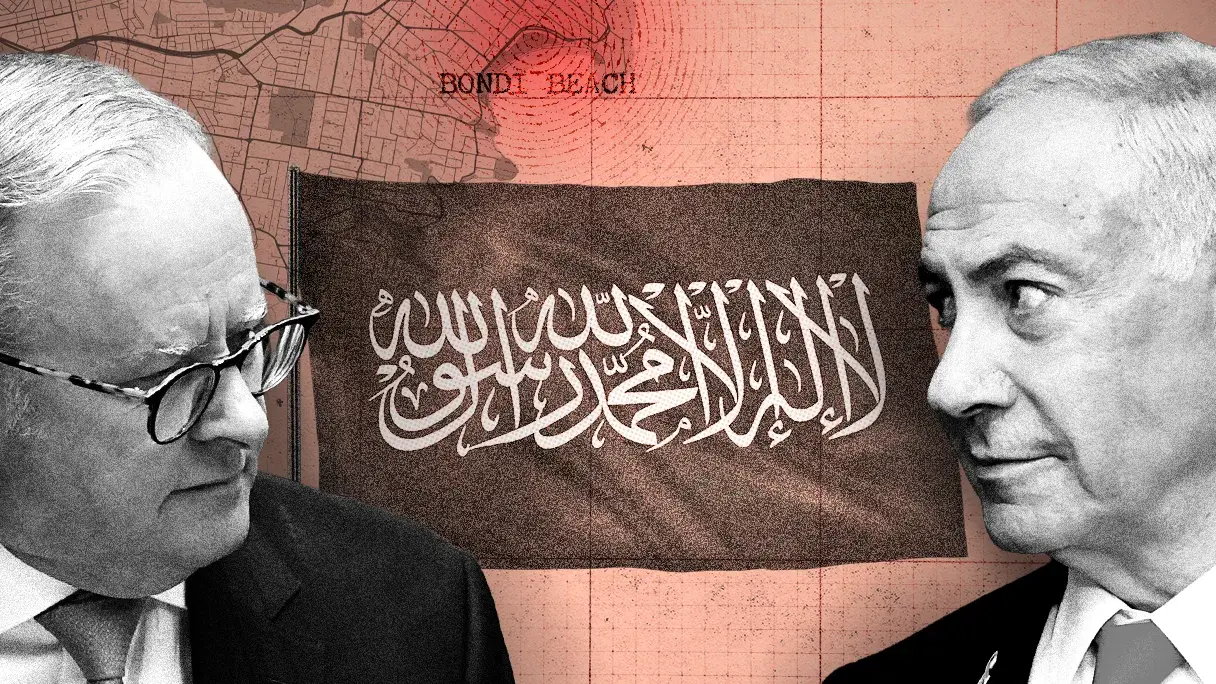
Reactions to the terrorist attack at Bondi Beach have largely focused on the hateful rhetoric believed to have contributed to the violent extremism that claimed 15 lives – the deadliest attack on Jews since October 7. That focus is understandable after two years of global demonstrations under slogans such as “globalize the intifada.”
At the same time, the attack is rooted in more than a toxic debate climate. It also involves a geopolitical and security dimension that has primarily been raised by Israeli officials.
According to Israeli intelligence assessments, links had already existed for several months between Australian pro-Palestinian activists and groups such as the Islamic State, al-Qaeda, and Iran’s Revolutionary Guard. Against this backdrop, Israeli Prime Minister Benjamin Netanyahu accused Australia’s prime minister of betraying the country’s Jews. After the attack, Netanyahu stated that he had already warned in August that recognizing Palestine would, in his words, “pour fuel on the antisemitic fire, reward Hamas terrorists, and encourage threats against Australia’s Jews.”
This raises a number of questions. Does Australia really need Israeli intelligence to identify threats against its Jewish population? And more importantly: is Netanyahu truly the right person to lecture others about being unprepared for Islamist terrorism, when his own government bears responsibility for Israel’s worst catastrophe in decades?
But Netanyahu is not the central issue. What matters is that the warnings proved correct. A massacre of Jews took place in Australia, carried out by men who had ISIS flags in their car. Australian authorities knew that one of the perpetrators had ties to ISIS and that his father, the other perpetrator, legally owned at least six weapons. Despite this, no warning flags were raised, and the Jewish event lacked police protection when the attack occurred.
Islamists operate freely in Sweden
Against this background, Europe should ask itself a clear question. If Australia’s policies over the past two years resemble those pursued in many European countries, could what happened at Bondi Beach happen here?
Both domestic and foreign policy must be scrutinized. Domestically, this concerns insufficient resources to protect Jewish sites, an inability to counter conspiracy theories, and complacency toward Islamist actors. These challenges affect all European countries, including Sweden. Swedish journalists have recently exposed how Islamists operate freely in Sweden, how Iranian actors direct terrorist activity via Swedish organized crime, and what links Swedish activists have to terrorist movements such as the PFLP.
“Jews in countries that do not take Islamist terrorism seriously end up paying the price, regardless of whether government passivity stems from fear, incompetence, or indifference.”
Sweden is not alone. According to a recent Europol report, jihadist terrorism remains a central security challenge for the EU, with groups such as al-Qaeda and the Islamic State exploiting the conflict in Gaza. Added to this is Hamas, which, according to Israel’s Mossad and European intelligence services, has planned attacks against Jews in Europe since 2023. The causal link is clear: Jews in countries that do not take Islamist terrorism seriously pay the price.
Kvartal
Why foreign policy matters
How, then, does foreign policy factor in? Can recognition of Palestine or harsh criticism of Israel encourage terrorism? Countries such as Spain, Norway, and Ireland pursue a clear line against Israel. Like Australia, they have recently recognized Palestine; they voice strong opposition to Israel in international forums and serve as comfortable host countries for movements that not only oppose Israeli policy but view the state itself as an illegitimate colonial project.
Australia’s prime minister firmly rejected Netanyahu’s claim that the country’s foreign policy had any connection to the attack. He may be right – such accusations require evidence. But that does not mean foreign policy is irrelevant to the climate surrounding antisemitic hate crimes.
First, governments – unlike individuals – must understand the unique situation Jews face. Demonstrations are marked by hatred, aggression, Nazi comparisons, terrorist symbols, and boycotts. Of course, protests are legitimate in a democracy, and no one seriously claims that all participants are violent antisemites. But at the political level, it is unclear whether countries such as Norway fully grasp what their Jewish populations are forced to endure. The situation is worsened by the fact that no other conflict in the world is covered as intensely – and, according to many, as one-sidedly – in Norwegian media. This has an enormous impact on Norway’s small Jewish community.
Second, does the tax-funded public sphere remain neutral, or does it contribute to an unsafe environment for Jews? What do teachers say? What do libraries display? How do healthcare professionals behave? This is a matter of public safety, not freedom of speech. In February, a video went viral showing two nurses at Bankstown Hospital in Sydney boasting about refusing care to – or even killing – Israeli patients. In Ireland, an official report found that school textbooks contain serious distortions of the Holocaust and Jewish history, which Jews in the country say fuel antisemitism. In Spain, Jewish organizations similarly warn that some teachers use classrooms for anti-Israel activism.
“Zero tolerance” is no longer enough
We can continue debating the limits of protest, but we must also scrutinize institutions. The state must protect freedom of expression, but it must also guarantee safety. That requires schools, hospitals, and libraries free from political propaganda and symbolic acts intended to influence public opinion.
Finally, it is a fact that jihadist terrorists in Europe are often exposed with the help of Israeli intelligence. Can Jews in Spain and Ireland truly trust that their governments will cooperate with the Mossad to save lives, when those same governments cannot even tolerate Israel’s participation in Eurovision?
After Bondi Beach, Europe’s governments must decide where they place their resources and political capital. If they are serious about protecting their Jewish populations, “zero tolerance” and symbolic gestures of solidarity are no longer sufficient. Political action is required – and it's required urgently.
Students stay home from class or attend and suffer abuse, protesters call for Israel’s erasure, and radical Islamist groups operate unfettered. Sweden’s Jewish community fears for its safety against the backdrop of the war and mass killings in Gaza.
STOCKHOLM – It’s unclear whether Swedes are aware of what the country’s Jewish community has been facing – their neighbors, coworkers, customers, and teachers. The community has been in a state of anxiety since the Hamas terrorist attack on October 7 and the start of Israeli strikes in the Gaza Strip. Swedish Jews fear for their safety, and it seems the authorities aren’t grasping the urgency of the situation.
October 13. Threats by Hamas political leader Khaled Meshal to spark an international “day of rage” circulated through social media. Parents, many of them in mourning and worried about family and friends in Israel, wrote in private WhatsApp groups that the school’s regular security was inadequate. Some volunteered to watch the surroundings outside the school, and the local police stationed a patrol car nearby for a few hours.
Nonetheless, conversations with parents indicate that in some classes, at least half the students stayed home from school on October 13. Those who attended were strongly advised to avoid displaying Jewish symbols and refrain from speaking Hebrew.
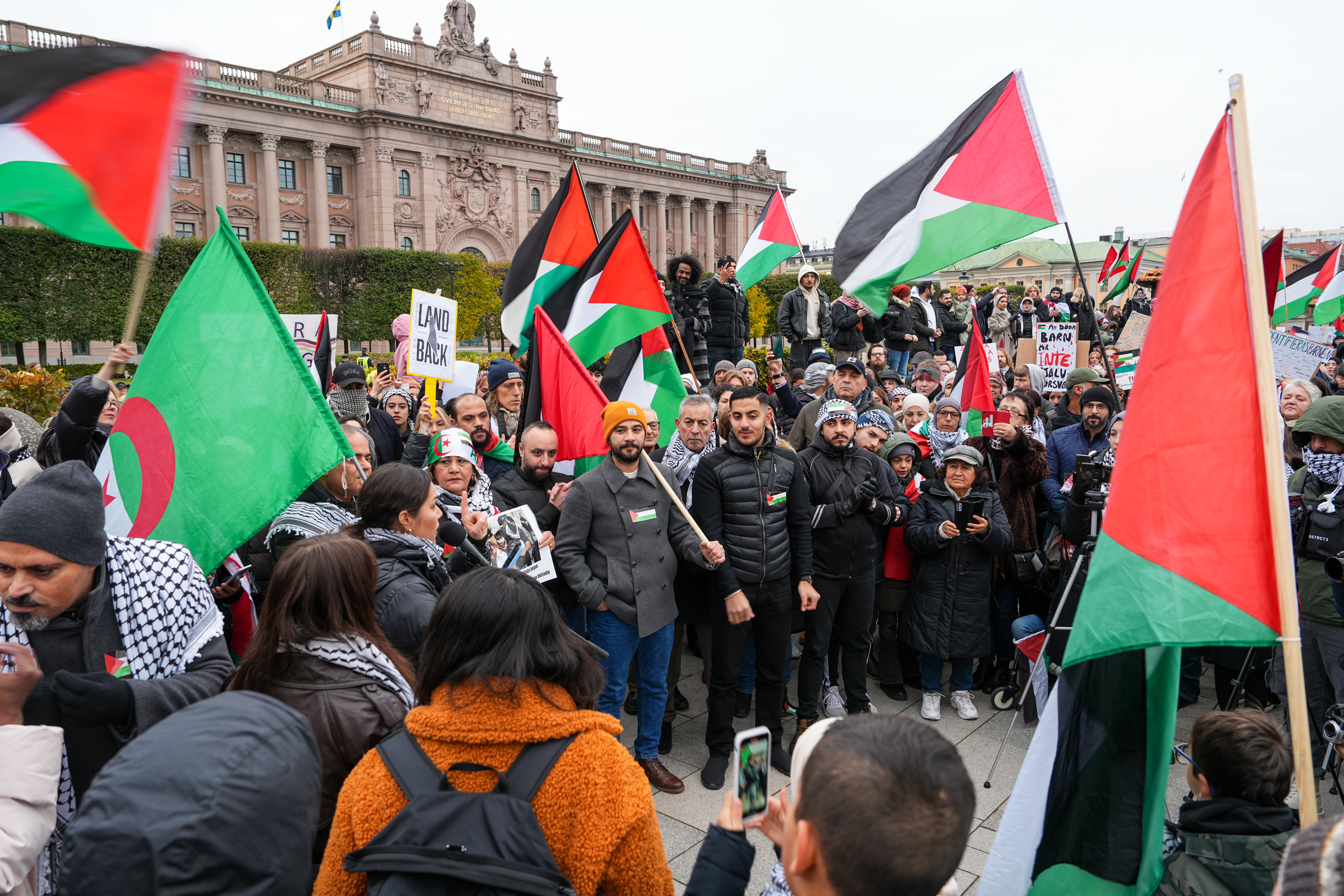
A pro-Palestinian demonstration in front of the Swedish Parliament, October 2023. Photo: Hugh Gordon
A., a former Israeli who lives in Sweden, kept his shop closed on the same Friday, feeling he can’t protect himself and his customers. Another Israeli living in the country encountered violence on the Stockholm Metro after speaking Hebrew on his phone.
Another incident occurred to a man from southern Sweden whose mother is Jewish but who is not religious and does not display Jewish symbols. He describes receiving seven calls from an unknown number this week. A voice told him, “We know where you live. You should watch behind you when leaving home.” It added that he “should no longer live in the city.”
When he contacted the police, he was met with disappointment. They told him that there was nothing they could do because the call came from an unknown number. The police would only intervene if he could provide the caller’s name, an impossible demand for someone receiving an anonymous threat.
Multiple reports have also emerged of students receiving harassment over the Gaza war. The mother of a 16-year-old boy from a Jewish family who goes to a large high school in Goteborg gave one disturbing account. She says a girl stood up in class and shouted, “Slaughter, rape, and torture all the Jews” at her son. The teacher did not react, stop the girl, or report her to the principal, the mother says. The other students also stayed silent. She said they're now considering a transfer to another school.
Two classmates asked a Jewish boy in an elementary school in southern Sweden who he supported in the war. The boy, aged 10, replied that he supported Israel. The two others drew a crossed-out Israeli flag, crumpled it up, and threw it at him, saying, “We hate Israel.” The teacher present in the classroom did nothing until the student’s mother contacted him.
Such attacks and threats have been seen throughout Sweden, with the common denominator being that the victims were Jewish or Israeli.
Swedish academics have also been targeted. A renowned scholar in western Sweden was emailed threats after daring to publicly condemn the October 7 attacks. The head of one department at Uppsala University wrote a social media post stating, “Hamas gave Netanyahu and his radical right partners what they wanted.” Elsewhere, he wrote: “In 1940 and 1941, Hitler developed a plan to systematically starve 30 million Ukrainians, Russians, and Slavs. In 2023, Netanyahu is executing his ‘starvation plan’ in Gaza!”
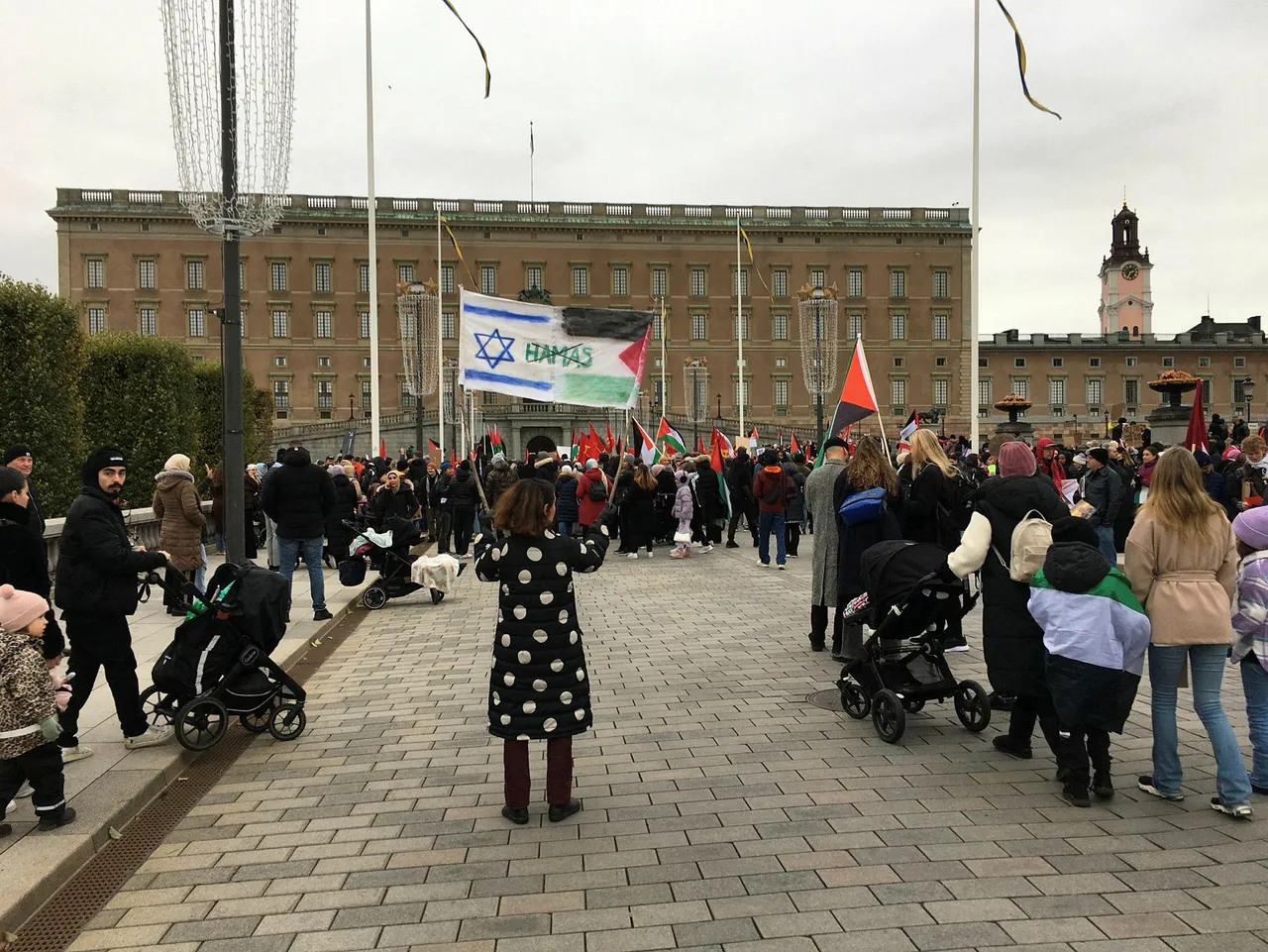
A Jewish protester, Joanna Istner Byman, at a pro-Palestinian demonstration in Stockholm, this week.Credit: David Stavrou
The cultural world has also been rife with tension. Seven hundred cultural figures published a petition urging an end to the “brutal violence in Gaza” and the end of “military, political, and financial support for Israel.” The petition did not mention Hamas’ terrorist attack, its victims, or the Israeli hostages in Gaza. Well-known Swedish environmental activist Greta Thunberg has taken several opportunities to express support for the Palestinians in recent days, omitting any mention of the Palestinian acts of terrorism last month or the Israeli victims.
The war between Israel and Hamas has reverberated throughout the public sphere in Sweden. Numerous demonstrations have been held since the war began, both pro-Palestinian and pro-Israeli. On the evening of October 7, hours after Hamas went door-to-door to brutalize and kill Israelis, thousands of people, including women and children, participated in rallies across the country. These featured music, dancing, and convoys of cars honking their horns to show support for the Hamas attack.
Even larger and fiercer demonstrations have been held in the subsequent three weeks. At these pro-Palestinian demonstrations, Israel is accused of genocide and ethnic cleansing in the Gaza Strip and there are calls to erase Israel from the map. “From the river to the sea, Palestine will be free,” cried the demonstrators in Sweden. The protests have also seen increasingly widespread calls for an “intifada.”
One of the pro-Palestinian demonstrations was organized by Hizb ut-Tahrir, a radical Islamic group advocating for the creation of a caliphate ruled by Sharia law, which has a small branch in Sweden. It received permission for the demonstration despite being banned in several countries. Demonstrators called for a caliphate stretching from Uzbekistan to Morocco, a war between Islam and the non-Muslim world, and the liberation of “all of Palestine” through military force.
Most of the demonstrations held in Sweden since the war began have been organized by local organizations backing the Palestinians. One weekend in Stockholm's central Sergel Square saw three different organizations demonstrating separately, but with similar slogans. Beside the Palestinian organization, the neo-Nazi Nordic Resistance Movement, which has a few hundred members, was one of them, the Revolutionary Communist Youth, which argues that Palestinians have a right “to fight with every means against the occupying power to liberate their lands" was another. The latter described the October 7 attacks as an act of liberation that “caught the Zionists in their beds.”
The two organizations, one neo-Nazi and the other Marxist-Leninist, both endorse the Palestinian cry to “crush Zionism.” Another demonstration held in Stockholm’s main square a week later drew more than 5,000 people. Speeches by Palestinians and Swedish leftists called for “an intifada until victory” as they waved Palestinian flags, horrifying images from Gaza, and signs condemning the government’s support for Israel. None of the speakers at the pro-Palestinian demonstrations mentioned the Hamas attacks.
A demonstration in solidarity with Palestinians in the Gaza Strip, in Stockholm, Sweden, October 2023.Credit: Hugh Gordon
Mikail Yuksel, leader of the Nuance Party, which defines itself as the representative of Sweden’s minorities, with an emphasis on immigrants, posted on X (formerly Twitter) that he had participated in a pro-Palestinian demonstration in Stockholm. Yuksel, born in Turkey and now a Stockholm resident, was once a member of Sweden’s Center Party. He was expelled for his ties with the Grey Wolves radical Islamic movement.
On October 7, Yuksel called for the removal of Hamas from the list of terrorist organizations. When Haaretz asked him about this, he replied, “If Hamas is considered a terrorist organization, it is impossible to hold a dialogue with it and reach an arrangement. So long as they are considered terrorists, we isolate and radicalize them. We are in favor of talking with them to reach a settlement.”
He added, “It’s no secret that we are a pro-Palestinian party. Israel is recognized by the UN as an occupying power, which commits war crimes and is an apartheid state. Israel must be stopped, and Netanyahu should be brought to trial at the International Criminal Court.”
Asked about the crimes committed by Hamas, Yuksel replied, “An occupied people have the right to use military force. Violence against civilians is not permitted to any of the sides. Everyone must lay down their arms and not point them against civilians to solve the dispute.”
While speaking with Haaretz, Yuksel condemned the attacks on civilians on October 7 as well as the “continuous Israeli attacks on Gaza.” His position is notable, as no Muslim organization in Sweden has condemned the attacks, including entities that previously cooperated with Sweden’s Jewish community and groups.
One pro-Palestinian demonstrator, prominent Muslim leader Rashid Musa, went as far as writing a sarcastic article mocking demands for condemnation in the national tabloid Expressen. “I, Rashid Musa, as a spokesman for 1.3 billion people worldwide, condemn the Hamas, condemn hummus, condemn Hassan, and [Swedish football club] Hammarby.”
Magnus Ranstorp, a prominent Swedish researcher on domestic Salafi-jihadism, terrorism, and radical groups, is concerned about more than just antisemitic slogans at the demonstrations and incidents at schools and workplaces. He says this could escalate to physical threats against Jewish and Israeli targets. A lecturer and strategic advisor at the Swedish Defense University, Ranstorp says two parallel crises are affecting Sweden’s security.
“The first is related to the burning of Koran books and a false campaign regarding the alleged kidnapping of Muslim children by Swedish welfare services,” he says. “This crisis has put Sweden in the crosshairs of organizations such as al-Qaeda, ISIS, and al-Shabab.
“The second crisis is the conflict between Israel and Hamas,” he continues. He says that according to the Swedish Security Service, there were about 2,000 Salafi-jihadists in various Swedish cities in 2017 who had a definite potential for violent activity.
In the cities of Malmö and Helsingborg, large Palestinian communities include families with members previously convicted of terrorist activities in Germany. Malmö is home to Scandinavia’s largest mosque, built recently with the help of millions of euros from Qatar. It is also home to civil society organizations like Group 194. Despite receiving municipal funding, the Swedish Palestinian group endorses terrorism, spreads antisemitism, and has connections to the Popular Front for the Liberation of Palestine, which was involved in the October 7 attacks.
It also recently emerged that the Left Party had used taxpayer money to support a project related to the PFLP through an organization run by its Danish counterpart. Meanwhile, in May, a large Palestinian European conference was held in Malmö with the participation of Amin Abu Rashid, a Dutch Palestinian leader linked to Hamas.
Although the Left Party canceled its participation in the conference when it learned that Abu Rashid would be present, a member of the Social Democratic Party, Jamal el-Haj, ignored a prohibition by party leaders and participated. El-Haj is a member of parliament, and some say he was saved from being kicked out of the party because of his substantial political base.
Ranstorp notes the case of Die Wahre Religion (“The True Religion”), an organization outlawed in Germany. It was banned in part because some of the people connected to it volunteered and joined the ranks of ISIS. Nevertheless, it operated freely as a legitimate Swedish organization that promoted an educational project on Koran reading.
In another case, a Swedish activist named Ahmad Qadan raised money for ISIS and Tahrir al-Sham (formerly Jabhat-al-Nusra) and was sentenced to a few months in jail. It seems that his imprisonment didn’t change much. On October 7, he posted a video on social media of Israelis fleeing Hamas gunmen together with a quote from the Koran, “I will fill the hearts of the unbelievers with fear.”
The international organization Islamic Relief, founded in the U.K. in the 1980s, also has an official Swedish branch. The organization enjoys considerable financial support from the Swedish government and engages in humanitarian activities. Various governments, including the Israeli one, say it’s associated with the Muslim Brotherhood, however. According to Ranstorp, Sweden is an important European center for Islamic Relief and, therefore, the Muslim Brotherhood in Europe.
Ranstorp and others have spoken of this for years. Although politicians’ approach has changed somewhat, some say Swedish authorities and public opinion still don’t appreciate how grave things are. Swedish money ends up financing terrorism, and Middle Eastern money is invested in organizations that pose a risk to Sweden. The law allows public activities that threaten the country’s stability and security bodies.
In response to a query by Haaretz, the security service refused to estimate of current number of jihadi activists and organizations in Sweden. Asked about specific organizations, a spokesperson replied: “The Swedish Security Service does not go into details describing our operational activities. We follow violent extremists and assess the threat to prevent terrorist acts and other security threatening activities. We follow individuals and do not target organizations.”
Regarding the protection of Jewish institutions in Stockholm, the police said, “What security measures we implement, if and when we implement them, and in what way, is something we do not publicize.”
Despite several requests, Swedish Justice Minister Gunnar Strommer, who oversees the police, prosecutions, and the courts, declined to grant an interview to Haaretz.
Hizb ut-Tahrir in Sweden and the Palestine Solidarity Association of Sweden (Palestinagrupperna) did not respond to Haaretz's requests for comment. Greta Thunberg also showed no enthusiasm for speaking with Haaretz about the subject. When she was offered an interview in which she could clarify her position, a spokesman said, “Greta is not holding interviews at this time.”
in a global context, the demonstrations in Israel are not only about the reasonableness standard, the standing of the attorney general, or legal advisers in government ministries. They’re an eruption triggered by the actual grave dangers: ignorance, racism, ultranationalism, and unfettered governmental power. They’re about liberalism and solidarity, education and culture, and the Israeli Declaration of Independence’s “freedom, justice and peace” and “complete equality of social and political rights to all its inhabitants.”
Over the past several months, numerous essays comparing Israel with other countries have appeared in this newspaper. It started with the obvious comparison to the illiberal democracies in Europe, voicing fears that the country is turning into Hungary or Poland. The comparisons then moved on to Turkey; some interesting exegeses followed about similarities to Afghanistan, Tunisia, the United Arab Emirates, and even Margaret Atwood’s fictional Republic of Gilead. Comparing Israel to other countries always leads to criticism because there is not – and cannot be – absolute congruity. It is a valuable thought experiment, however. Even if Israel doesn’t become a dictatorship, looking outward broadens and expands the debate.
I’ve written in recent years about human rights violations, murderous dictatorships, and ethnic cleansing contain good examples of countries for comparison. They illustrate what can happen in countries without a separation of powers, freedom of the press, and independent courts. I had one conversation with Sviatlana Tsikhanouskaya, who challenged Belarusian President Alexander Lukashenko in the country’s last election. Our talk showed that the mere existence of elections does not guarantee democracy.
Although Lukashenko officially defeated her, the world knew the election was fraudulent. After Tsikhanouskaya filed a complaint with the country’s central election commission, the authorities detained her for several hours. She told me the security services then escorted her to the Lithuanian border. After she crossed it, footage reminiscent of a hostage video was released, in which she asked Belarusians to stop demonstrating and accept Lukashenko’s victory.
The stories of three demonstrators who managed to leave reflect what happened to those who defied the request. Valery was viciously beaten, his wrists restrained so tightly he couldn’t feel his hands. Vyacheslav was stripped to his underwear, stuffed into a holding cell with dozens of people, and starved for four days until his trial, which lasted six minutes. Alexey saw people with broken ribs and guards beating a man to death. None of the three men was a political activist. They were a software engineer, an art professor, and the owner of a technology company. They never imagined that they would end up in this kind of situation.
The brutality of the Belarusian police is one example of what happens when the criminal justice system is not answerable to an independent civil authority committed to protecting human rights. There are some citizens in China whom its government wants to eliminate. A network of “psychiatric prisons” has been established for this purpose, where people without mental illness are forcibly admitted after being abducted and having their phones confiscated.
They’re locked in rooms with mentally ill patients, where they’re given psychiatric drugs and electroshock “therapy” while fully conscious. If they resist, they’re tied to a bed, sometimes for an entire night. This is nothing compared to what’s happening in the remote northwestern Xinjiang region, where various ethnic minorities live. Reeducation camps established there combine indoctrination, torture, and medical experiments.
I haven’t mentioned these examples because of any similarity to Israel. I’ve mentioned them because conversations with people who survived and escaped these hells reveal a notable point: how quickly things turned upside down. The survivors were once teachers, physicians, and civil servants who lived entirely everyday lives. Then began the riots, terror attacks, and “lack of governance” – and with them, accusations of extremism, factionalism, and terrorism. Next came the arrival of someone who could “create order,” and order was indeed created.
First, the textbooks were replaced, and newspapers were closed. Afterward came the checkpoints, the facial recognition cameras, and restrictions on technology. Finally, passports were seized, and the borders were closed. The camps appeared then, too. Solely for reeducation, of course. It’s unlikely that Israel would act with such determination and efficiency even against the Palestinians, but this is an important lesson about a government with no oversight – and how quickly the water heats around unaware frogs.
There’s another element that must be considered: dehumanization. Last year, a young Yazidi woman named Leila told me about how she was bought and sold several times by members of ISIS, who abused her for months. She was just one victim of the trafficking of women and organized rape that became a feature of the Syrian Civil War. A few months before that, a young Kurdish man named Bejan told me about a Turkish attack on civilians in northern Syria, the product of decades of dehumanizing the Kurds.
He said he saw many dead and wounded, most full of shrapnel or missing limbs. “The thing that’s hardest to forget,” he said, “was a girl, about 8 years old, who was sitting by her dead brother, trying to wake him up.” Testimonies from Ethiopia’s Tigray Province and the mass slaughter of the Rohingya in Myanmar show to what depths it’s possible to descend: gang rape, execution by gunfire or machete, drowning babies, setting villages on fire along with their inhabitants. These occurred in the second decade of the 21st century. Nothing even close is happening in Israel, but the processes of dehumanization begin long before the overt violence in those countries.
Horrifically enough, the murderers in Myanmar, Ethiopia, and Syria don’t see themselves as grim reapers. On the contrary: in many cases, they’re ordinary people who have convinced themselves they’re the victims. Society disintegrated and descended into violent chaos with the help of racist and ultranationalist ideologies, narratives based on political interests, and social media algorithms.
Some will argue that these are examples from countries that lack a democratic tradition, and no comparison can be made – but the truth is that Israel also lacks a centuries-old parliament or generations of a democratic culture. While it’s neither a Soviet republic nor a failed state in Africa, it’s a young and vulnerable democracy possessing a formidable military, a significant minority population, and the occupation of another nation. These are not starting conditions that provide strong resilience.
That’s why, when looking at the demonstrations in Israel in a global context, you can see that they’re not about the reasonableness standard, the standing of the attorney general, or legal advisers in government ministries. They’re an eruption triggered by the actual grave dangers: ignorance, racism, ultranationalism, and unfettered governmental power. They’re about liberalism and solidarity, education and culture, and the Israeli Declaration of Independence’s “freedom, justice and peace” and “complete equality of social and political rights to all its inhabitants.” The demonstrations are against a choice to break from the enlightened world and walk with eyes wide shut toward countries to which only Israel is willing to sell arms, cyber technology, and “security consulting.” If Israel doesn’t come to its senses, it could follow in their footsteps very soon.
A Swedish website claims that filmmaker Hogir Hirori faked key scenes and concealed information, and that the protagonist separated Yazidi women from their children. But Hirori says that everything in his film is true.
STOCKHOLM – The documentary “Sabaya” by Swedish-Kurdish director Hogir Hirori racked up a raft of prestigious awards last year; the topic was surely compelling: Yazidi women and girls held as sex slaves by the Islamic State and then sold – before their rescue by Yazidi activists in Syria. Now those activists have been accused by a Swedish website of deceiving the victims and taking their children from them.
One reason the film won so many awards, including best documentary at the Swedish International Film Festival and a World Cinema Award at Sundance, is that Hirori did the filming all by himself. You get the feeling you're with him at al-Hawl, the camp in northeastern Syria where the victims received refuge.
At al-Hawl, the filmmakers followed activists from the group Yazidi Home Center in Syria, in particular a man named Mahmud Resho. The women and girls lived there since the Islamic State's defeat in 2019.
The camp – which Hirori has said is plagued by stabbings and shootings – hosts tens of thousands of refugees, most of them women and children, and also thousands of Islamic State supporters. After rescuing the women and girls, the activists took them to Resho’s family home, which the film depicts as a kind of shelter.
One rescue shows Resho and his partners freeing a Yazidi girl named Leila from a tent in the camp; they were armed with a handgun, a cellphone and intelligence from Yazidi women who infiltrated the camp at great risk. Later, a drive from the camp to Resho’s home morphs into a car chase in which ISIS fighters fire at the Yazidis.
Kvartal, the respected Swedish website making the allegations, claims that Hirori faked key scenes, concealed information about the main characters' dark sides and lied to the media that reported extensively on the film.
According to Kvartal, some of the women and girls who bore children as a result of serial rapes by ISIS fighters didn't want to leave the camp because they knew that their children might be taken from them and handed to an orphanage. The conservative Yazidi community wouldn't accept a half-Muslim child.
Resho and his people took the women and girls out of the camp; they promised that any child taken away temporarily would be returned.
But Kvartal says the children weren't returned, and mothers who refused to give them up were held at Resho’s home under a kind of house arrest. The site also reports that Resho proposed to the Islamic State to buy the children so he could sell them on, but this was only a ruse to gain information from ISIS.
“They tricked us, they took us to their homes, and then they took our children from us,” one of the women told Kvartal. Another says about the film: “People will think Mahmud brings Yazidi girls back, and that’s true, but Mahmud treated them worse than ISIS did.”
Kvartal also alleges that Hirori fabricated key scenes and falsely presented key aspects; for example, it reports that Leila was actually rescued from al-Hawl before Hirori came to Syria.
The site says that Leila's rescue and the dramatic chase were either staged with an actress or involved another girl; the girl’s face is covered by a burqa so she can't be identified – and Hirori admits that this indeed was another girl's rescue. Kvartal also alleges that armed Kurdish guards were the ones who removed the girls from the tents and handed them over to Resho and a man named Ziyad, who waited in safety at the camp's offices.
“It’s a real shame if the taxpayers who pay for productions of this type are being misled by the filmmakers,” says Ludde Hellberg, who wrote the Kvartal article.
“In Sweden, millions of krona from public funds are invested in documentaries of this type every year. It turns out there is no oversight mechanism to ensure the authenticity of such films,” he says, adding that his report was based on a wide variety of sources.
“We quote one of the women taken out of al-Hawl by the hero of the film,” Hellberg says, adding that his sources included the former U.S. ambassador to the region, Peter Galbraith, who helped reunite mothers with their children. The sources also included a veteran international journalist in the region, and an interpreter who worked with Canada's CBC television and The Guardian.
“We were very careful, as always, when it came to the credibility of our sources,” Hellberg says. “Every fact that appears in our report is supported by a number of independent sources. Months of work went into the investigation, and fact-checking was done by two experienced editors.”
Hirori says Kvartal's article is misleading and takes things out of context. “Ever since 2014 when ISIS attacked the Yazidis in Iraq, I've been documenting the fate of the Yazidis. The situation with the children born to Yazidi mothers as a result of rapes by ISIS men is extremely tragic and also very complex,” he says.
“I've tried to show this in my documentary; for example, in a scene when one of the rescued women has to give up her baby. Unfortunately, it's impossible for the rescued Yazidi women to keep their children that have Muslim fathers if they want to return to their Yazidi families.
“This is because, according to Iraqi law, a Yazidi woman isn't allowed to have a child by a Muslim man, unless she converts to Islam, whereby she will no longer be welcomed into Yazidi society. Another problem is that the Yazidi religious leaders have given amnesty to the rescued Yazidi women to return to Yazidi society, but not to their children born in captivity, who are still seen as ‘children of the enemy.’
“It has never been a secret that the children are placed in an orphanage waiting for a solution if the women decide to return to Yazidi society, nor is it something I've tried to conceal by any means, as Kvartal claims I have.
“The situation is also clearly explained to the women when they face the decision to return to their families, and they're well aware of the circumstances. It wasn't possible for me to fit all these explanations … into the documentary, as my story was about the rescue of the women, not the fate of the children, which would need a whole documentary on its own.”
Regarding the allegations about staged scenes, Hirori says Leila was one of the girls who agreed to talk about her nightmare in captivity – as a way to get the girls' story out to the world.
Hirori admits he first met Leila several days after her liberation, and the scene depicting her rescue was shot when Resho and Ziyad freed another girl (who wasn't willing to be interviewed or show her face). Hirori admits he erred by presenting this scene as Leila’s rescue.
But he adds: “All the events portrayed in 'Sabaya' and all the parts of the story I tell in my documentary happened exactly as they're shown, and all the footage was recorded live with my camera as it happened. Leila was held captive by ISIS. She was rescued by Mahmud and the Yazidi Home Center from the al-Hawl camp.
“The main rescue scene in 'Sabaya' is a real rescue of a Yazidi woman being taken from the al-Hawl camp. It's by no means staged or faked. I'm in the car with my camera, and the ensuing car chase and us being shot at is completely real. Everything I share in the documentary of Leila’s story is also 100 percent true.”
Hirori’s statements are backed up by an interview on another topic that I conducted with Leila before the Kvartal article came out. There, Leila's recount of her rescue supports Hirori’s assertion that the rescue he filmed was similar to hers.
“Uncle Mahmud took me from there,” Leila said. “When I think about this trip, it feels unreal; my thoughts were all over the place. I was very frightened and didn’t speak with anyone. And then the shooting started. I can still hardly believe that I got out of there.”
Hirori also stresses that documentaries aren't the same as newspaper or magazine articles. "Documentary filmmaking isn't a neutral, objective narrative method. In Sweden especially, the genre has reached an expressive and artistic level through a long tradition of the craft," he says.
"Thanks to support from public service institutions such as the Swedish Film Institute and Swedish television, [the genre] has become an established form of narration that encourages a personal view and creative artistic expression, allowing independent filmmakers to express their own unique view of events. This is different from genres such as journalism and reporting that, rightly so, have strict requirements of neutrality and objectivity.”
While thousands of enslaved Yazidi women and girls are still missing, director Hogir Hirori traveled to Syria in order to document both victims and the women fighting to free them. 'Everybody thought I was crazy,' he tells Haaretz.
As a documentary film about war, “Sabaya” is quite exceptional. It has no talking heads, no explanations about the politics of the conflict, no maps with directional arrows, no timelines, and no dramatic music. No narrator is walking around the battlefield and talking to the camera amid the whistle of bullets. There are not even any interviews, at least not in the usual sense of the word.
All it has are fragments of unfiltered reality, with no cheap thrills or any complex cinematic wrapping. Yet, it won last week the award for the best documentary of 2021 at the Golden Bug Film Awards, the Swedish Oscars. It has also won several prestigious awards for its director Hogir Hirori at film festivals worldwide, including Israel’s Docaviv, and the prestigious Sundance Film Festival.
The film describes one of our day’s greatest tragedies – the fate of Yazidi women abducted by Islamic State forces in Iraq and Syria. It does so by focusing on a small group of Yazidi activists who endeavor to rescue women held by ISIS as sabaya – slaves who can be raped and sold based on religious ideology and theological justifications. ISIS claims these Yazidi women and girls are daughters of an infidel, devil-worshiping religion that rejects Islam and therefore Muslims are commanded to make them sabaya.
This reality still persists; over 2,000 Yazidi women and girls are still missing. Perhaps that is why Hirori says his film’s success at Western festivals is not the important thing. “What I saw on the ground, what I shot, is what I show in this film, without interviews or explanations,” he told Haaretz. “The idea is for viewers to feel reality itself, and for Yazidis to have documentation they can use. Obviously, it was important to make a good film that people would appreciate, but documenting was the most important thing.”
Hirori’s personal story led him to take an interest in the war and its consequences. Born in 1980 in Iraqi Kurdistan, he came to Sweden as a refugee when he was 19 after an arduous three-month journey. “Like everyone of my age in the region, I saw the consequences of the war in Iraqi Kurdistan in the 1990s. I fled in 1991 as an 11-year-old. I was lost and without my parents for weeks. My father was a Peshmerga warrior in the mountains. My mother and grandmother moved us around because the Iraqi regime was after my family.”
But Hirori’s childhood wasn’t just about war. He attended music school, playing classical music and dreaming of a career as a cellist in Europe. He discovered in Sweden that things aren’t so simple. He had to learn the language, establish himself, and study. Eventually, encouraged by his partner who he met in Sweden, he started studying communications and began working in TV.
Director Hogir Hirori. Photo: Dogwoof
“Sabaya” is the third part of a trilogy that Hirori began working on in 2014, when ISIS attacked Sinjar in Iraq. They killed thousands of Yazidi men and raped and kidnapped thousands of women. Hundreds of thousands fled, seeking refuge on Mount Sinjar. “I was shocked that nobody was reporting on what was happening,” Hirori recalled. “I felt a disaster approaching, but nobody wanted to report about it. So I packed my bags, my camera and my equipment, and traveled without knowing exactly what I would do there. My wife was in late pregnancy with our first son. I thought that if I started reporting from there, perhaps other journalists would come, and then politicians would begin taking action. It was early in the war when people started fleeing their homes, and ISIS started publishing its propaganda pictures of decapitation in the streets.”
Only nine people showed up for his flight, which should have been full, because only those who really had to fly made the journey. “There was a silence and a feeling on the plane that we were flying towards death,” he recalled. “Everybody thought I was crazy. When I arrived, I realized I couldn’t stop the war with my camera. The possibilities were limited. The photos I sent over social media reached my friends and a few Swedish media outlets, but their impact was only partial. “
A few days later, other journalists arrived. Hirori began filming what would be the first film in the trilogy, “The Girl who Saved My Life” (2014). “The Deminer” (2018) followed. The process of making the two films repeatedly brought him back to his country of birth and to suppressed childhood memories – the bombings, the battles he had fled and the people who remained behind. “When I completed the second film, I decided again, just as I did after the first, that I’d never return,” he said. “I already had a child, I felt good with the films, and I thought there was no reason to endanger myself again.”
It was Hirori’s wife Lorin, a journalist herself, who suggested he make a third film to tell the abducted Yazidi women’s story. They originally planned to go together to Syria along with a big film crew. But the situation on the ground made that impossible. They decided Hirori would go alone, so as not to put others in danger. He followed the operations of the Yazidi Home Center, which rescues Yazidi girls from their captors. Hirori visited Syria six times to complete the film. Each time, he was director, photographer, producer and sound man. Working alone wasn’t just a technicality. The work completely consumed him.
Hirori grew up in a Muslim majority town, but he had childhood friends, neighbors, and schoolmates who were Yazidis. After making his first film, he understood better what the Yazidis had been through as a religious minority. He said he gained a deep understanding of the need to talk about racial and religious hatred and discrimination. In the film, Hirori takes his viewers deep into two places near each other but profoundly different. The first is the al-Hawl camp in northeastern Syria, close to the border with Iraq. The camp, run by the Syrian Democratic Forces, is home to 73,000 refugees, most of them women and children, including thousands of ISIS supporters and members.
The second place is the home of Mahmud, a Yazidi Home Center volunteer. It serves as a shelter for Yazidi women and girls who Mahmud and his fellow volunteers have rescued at huge risk from al-Hawl. Viewers see Mahmoud’s family, especially his mother, wife and young son. “Al-Hawl is a huge camp, like a whole town. It’s hard to control,” Hirori said. “It’s divided into seven sections, one of which is designated for foreigners from around the world. Women living in the camp wear the niqab, but sometimes men don a niqab to infiltrate the camp. Anything can happen there: weapons smuggling, bomb making, stabbings and shootings. You have to be ready for anything. The camp’s economic situation is unstable. Everything is chaotic, and even though ISIS has been defeated militarily, it is still recruiting and strengthening from day to day.”
The film shows the rescue from the camp of Yazidi girls abducted by ISIS. Mahmud and Ziad, another center activist, drag the girls out of tents. They are armed with pistols, mobile phones, and intelligence they have received from Yazidi infiltrators, many of whom are girls who previously escaped ISIS captivity and agreed to return to the inferno.
The film depicts Mahmud’s home as an island of mutual aid, empathy and solidarity. “I lived there while I was filming the documentary,” Hirori said. “They were like family to me. They shared the little they had with me and the ‘guests’ – Yazidi girls rescued from al-Hawl. Mahmud’s mother called me ‘son.’ It is so typical of the Middle East. It reminded me of my childhood. The hospitality where a guest receives food even before the children, and the women help each other even in the most difficult situations.”
The story of the women themselves is at the film’s core. They are not interviewed in the standard sense of the word, but there are conversations. “I hate this world. Everything is dark,” says one of them. “I was in captivity for five years and now I’m here alone.” Another girl asks: “Why? How did God let this happen?” Another tells her story: “I was kidnapped. I was abducted and taken to Mosul. They forced me there to get married for the first time. Me and 61 other girls, just young girls. Then they took us from Mosul to al-Raqqa in Syria, where they gave us to different men. They believe that the Yazidi religion is an infidel religion and so Yazidi girls must be sabaya who clean their houses and are their sex slaves. Abdul Rahman chose me in al-Raqqa. He forced me to marry him. After a year, he died in the war. So, I was moved to a house with ISIS women to be sold to another man. They guarded me the whole time. They controlled my whole life, ever since I was a young girl. My heart is completely broken.”
One of the girls, seven-year-old Mitra, was abducted from Sinjar when she was just a year old. Her parents are still missing. She speaks only Arabic, not Kurdish because she has spent almost all of her short life in captivity. Another of the rescued Yazidi describes what ISIS fighters did to her. “I was sold to 15 different men,” she recalls. The first ISIS fighter to take me was a Swede. He beat me and made a hole in my head. Then I was put in prison and sold to someone in Syria, and later to a Tunisian. He broke my teeth.” After all she had been through, the woman decided to infiltrate back into al-Hawl after her release.
“I was shocked when I first met the Yazidi women infiltrating the camp,” Hirori said. “I had heard about them before, but I was shocked that there are people with such courage. Women who are willing to risk their lives after having been saved. When I asked them if they really wanted to do it, if they weren’t scared, they got annoyed and said of course they wanted to. They said they have nothing to fear, nothing to lose anymore, that it is important for them to help other women.”
Hirori’s trilogy is about the war that has devastated Iraq and Syria. “This war is not just about bombs falling on towns in the Middle East and causing people to flee for Europe,” he said. “We are all responsible for this war in one way or another. Modern Western countries manufacture the weapons. Some fight for oil or fight for influence because of their interests in the region. As a result, countries in the region have been at war for ages, so many years that generation after generation is born and dies without even receiving any education, without having the opportunity to serve food without the fear of being bombed.”
Hirori speaks of long-term solutions to end the cycles of violence, but events in this blood-soaked strip of land in northeastern Syria that have transpired since his film was made do not bode well. On the one hand, ISIS forces are strengthening and again attacking prisons in the region. On the other, Mahmud, the film’s hero, died of a heart attack, and Ziad has been forced to escape Syria after ISIS targeted him and tried to kill him several times.
Some Yazidi women have returned to their homes and families, but others have no one to return to. The Yazidi Home Center has saved over 200 women and girls, but this story isn’t over yet. Herein perhaps lies the bottom line of “Sabaya”: We are now in 2022 and over 2,000 Yazidi women are still missing, still being held as sex slaves and passed from hand to hand, sold as a commodity.


 דיויד סטברו