How the Gaza War Broke Israel's Taboo on Contact With the Far-right Sweden Democrats

Israel's government has boycotted the Sweden Democrats since the party's founding by neo-Nazis in 1988. The political repercussions of the Gaza war have led to a new Israeli directive calling for exploratory talks, but the Swedish Jewish community still refuses all contact with the far-right party

Published in Haaretz: https://www.haaretz.com/israel-news/2025-02-26/ty-article-magazine/.premium/how-the-gaza-war-broke-israels-taboo-on-contact-with-the-far-right-sweden-democrats/00000195-4266-d852-a5df-efefdcb90000

STOCKHOLM – Foreign Minister Gideon Sa'ar's instruction for Israeli diplomats to launch discreet talks with the far-right Sweden Democrats has made waves in the Swedish media. It marks a drastic change for Israel's foreign policy, which was previously characterized by a long-standing boycott against far-right parties associated with antisemitism, Holocaust revisionism and neo-Nazi activists.

Sa'ar has ordered these exploratory talks with far-right parties in France, Spain and Sweden, Axios' Barak Ravid reported Monday. The Sweden Democrats' foreign policy spokesman, Aron Emilsson, who heads the parliamentary Foreign Affairs Committee, told the daily Expressen that Israel's decision was "extremely positive."

"We've been working for a long time to improve relations," he said, adding that "the ties are also important in security matters, particularly regarding Iran."

The Sweden Democrats have been boycotted by the Israeli government since the party's inception in 1988, but two unofficial visits by the party's leaders to Israel in 2023 and early 2024, as well as a series of unpublicized talks with Prime Minister Benjamin Netanyahu's Likud party and the Foreign Ministry triggered a policy change.

Ziv Nevo Kulman, Israel's ambassador in Stockholm, told the daily Dagens Nyheter in 2021 that his country had no ties with the Sweden Democrats and had no intention of establishing any. "This is a moral position about far-right parties with roots in Nazism," he said, two months into his term.

He told Haaretz last May: "We are aware of the positive statements by the Sweden Democrats about Israel. But at the same time, the party continues to adhere to extremist positions regarding a ban on brit milah [Jewish ritual circumcision] and the importing of kosher meat, and it has yet to seriously grapple with its neo-Nazi past and with the antisemitism among its members." He said the party's alleged support for Israel was "questionable."

Despite this earlier skepticism, the Israeli Embassy said Tuesday: "As part of a broader review of parties in Europe with which we have not previously had contact, the embassy has held talks with the Sweden Democrats. The initial contacts have largely focused on how the party handles its history and its stance on issues affecting Jewish life in Sweden."

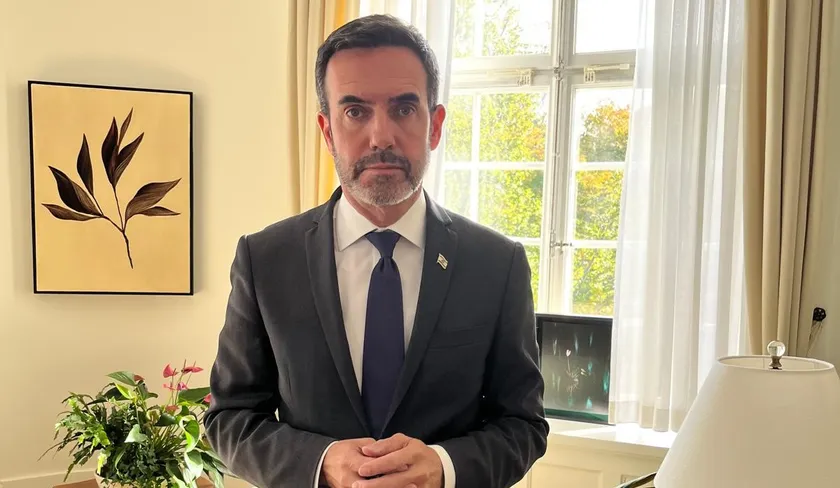
Ziv Nevo Kulman, Photo: Israel's Embassy to Sweden

According to sources familiar with Israeli-Swedish relations, this change of tack was not only the work of Israel. Since the beginning of the war in Gaza, Sweden's center-left has been increasingly hostile toward Israel, and these parties' ties with Jerusalem have significantly weakened. Israel has become a wedge issue between Sweden's center-right coalition and the centrist and left-wing opposition.

According to the sources, the opposition's approach is pushing Israel into the arms of the Swedish populist right. As a result, the Sweden Democrats are increasingly seen as a legitimate party in both Israel and the Jewish world, a major win for the party.

For Sweden's Jewish community, the Sweden Democrats are still considered off-limits, at least officially. The party is not in touch with the community and is not welcome at community events.

In a letter to Israel's foreign minister a year ago, the European Jewish Congress and the Council of Swedish Jewish Communities expressed concerns about a meeting between Israeli ministers and Sweden Democrats visiting Jerusalem. The president of the European Jewish Congress, Ariel Muzicant, and the chairman of the Council of Swedish Jewish Communities, Aron Verständig, wrote that they were "gravely concerned" and referred to the party's "neo-Nazi roots."

Muzicant and Verständig added that the Sweden Democrats' "ideology is still inherently xenophobic even though its representatives claim to be our allies, making an exception for the Jews as a national minority, albeit claiming that Jews cannot be Swedes." They said the party regularly submitted bills to ban "non-medical circumcision," as opponents call it, and the importing of kosher meat.

When asked Tuesday about Israel's apparent policy shift, Verständig told Haaretz that he was notified a few days ago that Israel's Foreign Ministry had instructed the Stockholm embassy to forge contacts with the Sweden Democrats.

"However, we don't have contacts with the Sweden Democrats," Verständig said. "The issue of the Sweden Democrats is one that we discuss regularly, but we haven't changed our position and we still don't have ties with the party."roots

The Sweden Democrats party was founded in 1988 by members of Swedish neo-Nazi and far-right movements. A key figure in the organization was Gustav Ekström, a member of Germany's Waffen-SS, the SS' military arm, during World War II and an activist in the NSAP, the Swedish Nazi party that disbanded in 1950. Other founders were members of white supremacist parties, neofascist and neo-Nazi movements, the Swedish skinhead movement and criminal organizations.

But the neo-Nazi past wasn't the only reason for the Israeli boycott. In recent years party members have spread conspiracy theories and racist, antisemitic and Islamophobic propaganda. In 2021 the Swedish daily Aftonbladet revealed that Jörgen Fogelklou, the party's leader in Sweden's second-largest city, Gothenburg, spread antisemitic and racist statements on social media such as "It is clear that Jews are the root of all evil in the world."

A few years ago, another local party leader in southern Sweden, Jonas Lingvärn, took part in performances by rock bands supporting white supremacy and used the slogan "Skinhead 88" – 88 is shorthand for HH, meaning "Heil Hitler."

The party first entered Sweden's parliament in 2010, and in the 2022 elections it won more than 20 percent of the vote, making it the country's second largest party. Until just a few years ago, the Sweden Democrats were boycotted by parties across the political spectrum.

But after a shift in approach by two center-right parties, the Sweden Democrats became an integral part of the right-wing bloc after elections, without which a center-right government could not be formed. In parliament, the party heads the Foreign Affairs Committee, the Justice Committee and the Industry and Commerce Committee.

The Far-right Activist Who Sparked an Imaginary Pogrom in Stockholm

The question of whether the attack on Israelis in Amsterdam last month was an isolated incident or the beginning of a trend is critical to Israel's relationship with the rest of the world and the future of Europe's Jews. And according to several Israeli media outlets, two days after the incident in Amsterdam, a similar incident occurred in another European capital.

Published in Haaretz: https://www.haaretz.com/opinion/2024-12-12/ty-article-opinion/.premium/the-far-right-activist-who-sparked-an-imaginary-pogrom-in-stockholm/00000193-b770-dd53-a3f3-f77b2ee60000

The online news site Mako reported that Jews were attacked "in Stockholm, the capital of Sweden, during a ceremony commemorating the Kristallnacht pogrom." It said anti-Israel demonstrators yelled derogatory names at the ceremony's participants, snatched their Israeli flags, tore them up and threw them into the river.

The report was accompanied by a video titled "the difficult footage from Sweden." It shows police officers chasing a woman and arresting her. Channel 14 News added analysis and superlatives. "Antisemitism is having a feast day," it reported. "Pro-Palestinians brutally attacked Jews who gathered to mark the anniversary of Kristallnacht in Stockholm." The same news item, with some variations, appeared in other media outlets and was widely circulated on social media.

Meanwhile, in the real world, what happened in Stockholm is indeed troubling, but for different reasons. First, no ceremony commemorating Kristallnacht took place there. Second, no Jews were attacked. Third, this false information was disseminated by people who counted on the media to spread the lie, thereby providing them with free political propaganda. And they were right. The Swedish media refused to buy the goods, but the Israeli media sure did (I might add, for the benefit of Mako's investigative reporters, that Stockholm doesn't have a river).

What actually happened in Stockholm that night was revealed by Swedish investigative reporter Jonathan Leman in Expo magazine (which defines itself as fighting "racist ideas, myths and conspiracy theories"). On the evening of November 9, a pro-Palestinian march took place in central Stockholm. Such demonstrations have been happening in Sweden for more than a year now. The marchers chant slogans that some people (myself included) see as antisemitic, and they are filled with hatred for Israel. But usually, they are completely nonviolent.

This demonstration was the same, aside from one difference – the protest march was joined by a guest riding a bike, who was widely filmed by videographers broadcasting from the scene. One of them is known to work with media outlets identified with the Sweden Democrats, a populist right-wing party that has a neo-Nazi past.

The demonstrators immediately realized that the bike rider wasn't one of theirs. She was an older woman who spoke with the videographers and attracted attention because she had an Israeli flag attached to her bike (as well as the Finnish flag and Iran's flag from before the Islamic Revolution). She also had a loudspeaker through which she played Hebrew songs like "Am Yisrael Chai" and a megaphone via which she proclaimed that "Hamas murdered all the homosexuals in Gaza" and "Hamas planned to annihilate all the Jews."

At first glance, she appeared to be a courageous warrior who supports Israel. And that is indeed how she was depicted in reports from the videographers who were there. But this isn't true. As Expo discovered, the woman is actually a far-right activist. On social media, she spreads a mixture of antisemitism, Holocaust denial and conspiracy theories about the coronavirus, an Islamic takeover of Europe and the destructive power of Sweden's Jews, who "want to destroy the Nordic peoples" and constitute "a metastasizing cancer."

So why was she demonstrating against the Palestinians and seemingly supporting Israel? Anyone who tries to impose order on this eccentric activist's political theories will discover that her support for Israel stems from her hatred of Jews and Muslims in Europe. Despite her ideological hatred of Zionism, she wants the Nordic states to be free of Muslims and Jews, so she supports their expulsion. This isn't love of Zion, but radical racism and antisemitism.

The bike rider's appearance at the demonstration had the potential to cause an outbreak of rioting. But that didn't happen. Granted, there was some anger, but the organizers worked to calm it. At the end of the demonstration, one demonstrator grabbed the woman's Israeli flag, threw it off a bridge and was arrested on the spot. The headline the right-wing media gave this incident was "On the day we remember Kristallnacht, a Palestinian activist stole an Israeli flag and threw it into the water." What happened next is fascinating. People posting on numerous X, Instagram and Facebook accounts in several countries began adding details, limited only by their imaginations.

A ceremony that never took place was invented, groups of Jews who were attacked were created ex nihilo, one flag became many flags, and on some accounts, it was no longer flags that thrown into the freezing water of the Baltic Sea, but Jews. Anger boiled over, and there were thousands of shares and comments in groups with hundreds of thousands of members. When all this reached the Israeli media, the makeover was complete – the inventions became news. Even their rejection of the original videographer's false information didn't change anything.

Two conclusions can be drawn from the incident in Stockholm. First, the support Israel's government has found in Europe's far right is a broken reed. Beneath the hatred of Arabs and the nationalist fervor that the government likes so much lies a thick layer of antisemitism that cannot be mistaken. Second, the battle that honest politicians on all sides must join is the battle against the agents of chaos who create a world in which instead of truth and lies, there are only narratives.

The worship of likes and internet traffic, media outlets that dispense with checking facts and operators of trolls and bots aren't a threat to the opposition or the governing coalition. Rather, they are threat to the very existence of a free society.

The question of whether last month's attack on Israelis in Amsterdam was an isolated incident or the beginning of a trend remains critical. Yet anyone who reports on imaginary pogroms is not only undermining the media's credibility, but also creating a situation in which nobody will believe in or deal with the real ones.

For Europe's Jews, Antisemitism Is Felt in Everyday Interactions

More than physical violence, antisemitism against European Jews now reveals itself through incidents such as school bullying and ostracism at the workplace. Israeli expat communities on the continent could become a bridge between Israeli and European societies.

Published in Haaretz: https://www.haaretz.com/opinion/2024-11-19/ty-article-opinion/.premium/for-europes-jews-antisemitism-is-felt-in-everyday-interactions/00000193-447d-dd32-a9df-7e7d4c000000

STOCKHOLM – The rioting that followed the soccer match between Maccabi Tel Aviv and the Dutch team Ajax in Amsterdam at the beginning of the month engendered mixed reactions in Israel. Initially, there was shock over its blatant antisemitic character and lamentations over "the Islamization of Europe." That was followed by claims that the violence was prompted by the conduct of Maccabi Tel Aviv fans and that comparisons to Kristallnacht trivialized the Holocaust.

Such arguments merit discussion, but, to delve more deeply, it's worth considering the European perspective in addition to the Israeli one. First of all, when Maccabi Tel Aviv fans faced physical violence, they were facing a very extreme expression of anti-Israelism and antisemitism. However, for Jews who live in Europe, it's just one manifestation of antisemitism, albeit perhaps the most frightening one, but certainly not the most common.

Other manifestations are less photogenic, but they impose a heavy burden on the lives of European Jews: pestering at school, aggressive campaigns on social media, cultural and academic boycotts, hurtful comments, and tension and ostracism in the workplace. Physical violence is rather rare.

Secondly, antisemitism is much more than an individual case of racism. In European public discourse, there is a nascent recognition that it's a kind of conspiracy theory. Those falling into its net and spreading it might be people who have never met a Jew, and perceive themselves as liberals who "have nothing against the Jewish people." They don't even need to use the word "Jewish." The conflict in the Middle East and the so-called gray area between what is antisemitic and what is anti-Israel has made it possible to use code words such as "globalists", references to George Soros – and, of course, Zionists.

It's not a new phenomenon, but it involves a world of new concepts. Instead of old-style antisemitism in which the Jews were considered Christ's killers, or more modern antisemitism accusing the Jews of controlling the world through the banking system, revolutionary movements and secret societies, there are contemporary allegations that prove confusing even to those who don't hold clearly racist views. The most popular ones claim Jews spread COVID-19 to profit from vaccines, are behind the war in Ukraine, and are breaking up nation-states. In addition, the well-known conspiracies about Jewish control of the media and the financial markets are still going around.

The Israeli left has also sometimes fallen into the trap. Since it rightly opposes continued Israeli control of the West Bank and the war crimes in Gaza, it finds European partners for its worldview. Sometimes they're serious and honest partners, however, other times, they're actors spreading allegations of genocide who support Islamist terrorist groups and propaganda advocating Israel's destruction.

Just as the Israeli far-right finds neo-Nazi partners as a result of their campaign against Muslims, some on the left find antisemitic partners because they oppose the occupation – even if its opposition is to Israel's 1949 armistice borders rather than to those post-1967.

Third, real-life antisemites, unlike those portrayed in the media, aren't two-dimensional figures. The coverage of what happened in Amsterdam focused on scenes of masked men of Middle Eastern origin looking for blood. In the real world, antisemitism has been hiding behind more familiar faces with other characteristics, other backgrounds and motives: young Europeans who read Trotskyite literature, high school students using antisemitism as a means of abusing classmates, and university lecturers attempting to attract attention to themselves.

Not all immigrants are antisemitic. Not all antisemites are immigrants, and the antisemitic incidents in Europe aren't necessarily spontaneous outbursts of hate or protest. They're also a product of campaigns financed by actors such as Qatar, Turkey and Russia. Just as most rapists don't look like monsters and don't lurk behind bushes in dark parks, the antisemitic monster sometimes lives within ordinary and seemingly unthreatening figures.

When soccer fans come to Europe and witness demonstrators spreading hate against Israel under the banner of the Palestinian flag, they experience it as a physical threat. When European Jews witness the same demonstration, more than violence, they fear that the hostile crowd includes their children's kindergarten teacher, their bank clerk or their nurse at the local clinic.

And one last point. We're used to identifying the victims of antisemitism in Europe with members of local Jewish communities. In Amsterdam, the victims were Israeli tourists who experienced it for the moment and then returned home. But among those two distinct groups, there's another. In recent years, groups of Israeli expats in Europe have established communities engaged in education, culture and social initiatives; the Hebrew language and secular Israeli identity are flourishing there.

These communities experience and deal with antisemitism differently, constituting both an opportunity and a risk in that regard. On the one hand, they're liable to constitute an attractive target for violent attacks and antisemites. On the other hand, their members might build a bridge for dialogue between Israeli and European societies that could help to deal with the sickness of antisemitism that the continent has been suffering from for centuries.

Israel's Ambassador to Sweden Remains Optimistic Under Constant Threats

Ziv Nevo Kulman took office in 2021, at the tail end of one of the most difficult crises in the history of Israeli-Swedish relations. October 7 brought other voices to the fore. 'Suddenly, we see that on the core issues there is agreement,' he says in an interview with Haaretz

Published in "Haaretz": https://www.haaretz.com/israel-news/2024-05-21/ty-article/.premium/israels-ambassador-to-sweden-remains-optimistic-while-working-under-constant-threats/0000018f-9a6c-dce9-a1cf-feecb91f0000

While singer Eden Golan was on the Eurovision stage in Malmö, one person in the audience was accompanied by at least the same amount of security guards as the Israeli delegation. Ziv Nevo Kulman, the Israeli Ambassador to Sweden and longtime Eurovision fan, insisted on coming to the event to support Golan and her team, despite likely being one of the most heavily guarded people in the Scandinavian country at the time.

"There was an illustrative moment in the Israeli performance in the semi-final," he says. "The performance began with boos before Eden even opened her mouth. In response, there were also cheers from the audience, and a kind of duel started up between them. And then, because the performance was so good and Eden wasn't affected at all by the boos, most of the audience cheered for her. They were impressed by a 20-year-old singer who was put in a difficult situation and rose to the occasion with great honor."

Nevo Kulman says the hostility and calls for a boycott of Israel were met with a clear and supportive reaction from the public. "That was also the moment when she leapt up in the odds," the ambassador says. "As someone who has really been following the boycott calls in Sweden recently, I can say that the Swedes are in favor of dialogue, in favor of listening and in favor of freedom of expression. My impression is that the Swedes are not advocates for BDS."

Ambassador Ziv Nevo Kulman, photo credit: Embassy of Israel in Sweden

The conversation with Nevo Kulman took place in a discreet location in Stockholm, with four security guards, both Swedes and Israelis, sitting in the next room. He says that after Eurovision ended, just before the delegation returned to Israel, he met with Golan. "It was one of the most thrilling and moving moments in my career," he says. "What we had here was a concerted effort by an incredible delegation with an incredible singer and an incredible song, and we [at the embassy] also helped to provide the right umbrella."

This umbrella, Nevo Kulman says, included his local media appearances in which he sought to provide a counterweight to the large anti-Israel protests in Malmö over Eurovision weekend. In an interview with the Swedish daily Dagens Nyheter, the ambassador was pictured wearing an ABBA T-shirt adorned with a yellow ribbon, as well as a necklace with the Chai symbol.

Nevo Kulman says that, normally, Eurovision to him is a time for celebration. If things were normal, he would probably have been going around Malmö with other ABBA fans, simply enjoying the fun and colorful event. But because of the current situation, this year none of that is possible.

"The shirt is like a wink," he explains. "I speak with a wide audience through the media interviews and I see more Swedes who are sympathetic to Israel. I hear from people who tell me – Don't get the wrong idea, don't be confused. Just because there are loud people in the streets, in protests, doesn't mean that's what the Swedes think. Our messages are getting through to a lot of readers and listeners and viewers."

Nevo Kulman wanted to stress that, while the protesters are entitled to freedom of expression, as a member of the European Broadcasting Union, Israel also has the right to participate in Eurovision without being harassed. "We also deserve the right to speak, and the competition showed that the conception that everyone in Europe hates us is incorrect," he says.

Unlike the professional juries, the voters from the general public are anonymous, and a large portion of them awarded Israel the coveted 12 points. "Including people from countries you wouldn't expect," the ambassador says.

Nevo Kulman cites the LGBT community as an example of a group that is partly hostile to Israel, despite the country's historic role in the contest. "We were supposed to be the country that carries this banner in the Eurovision, but this is a generation that doesn't know who Dana International was." Nevo Kulman, who is gay himself, says, "Now they're into being Queers for Palestine. It's not enough for them anymore to just be gay or trans, and this is concerning. We need to find a way to talk with these publics."

Things have been particularly tense at the Israeli Embassy in Sweden lately. This past Friday, the police detained several people suspected of firing guns near the embassy. In January, a grenade was thrown at the building, but did not explode. The incident took place a few days after reports came out that Hamas planned to attack the Israeli Embassy and other sites in the country.

Police outside the Israeli embassy in Stockholm, in January.Credit: David Stavrou

"Of course, it affects the work," Nevo Kulman says. "In Sweden, unfortunately, consular services are only provided online. But the embassy is working, we're here and we're operating." He says the threats definitely have an impact on his regular agenda as ambassador: "There are things I did in the past that I can't do now. I can't stand in a public square and give a speech, and therefore I have to miss certain events, and it breaks my heart."

Nevo Kulman has been in the Israeli foreign service for 28 years. He served as cultural attache at the embassy in Tokyo, as Deputy Ambassador to the Czech Republic, as cultural affairs advisor at the embassy in Paris, as general consul in Montreal, and as head of the cultural diplomacy division at the Foreign Ministry in Jerusalem. The position in Sweden is his first as an ambassador. Despite the nation's tranquil image, his tenure in Stockholm has been quite tumultuous.

He is well-liked by Swedish politicians and the Swedish media, maintains extensive ties with the country's Jewish community, and does not hesitate to express an opinion in different areas. For example, he firmly denounced the practice of far-right political provocateurs burning copies of the Koran. He fought for Israeli culture to be included in the Book Fair in Gothenburg. One of his more controversial moves was to declare that Israel would not maintain ties with the populist far-right Swedish Democrats party.

"We are aware of the positive statements by the Swedish Democrats about Israel," he says. "But at the same time, the party continues to adhere to extremist positions regarding a ban on brit milah [Jewish religious circumcision] and the importing of kosher meat, and it has yet to seriously grapple with its neo-Nazi past and with the antisemitism among its members." He adds that the party has not expressed any remorse for its many years of mistreatment of Holocaust survivors, which makes its supposed support for Israel questionable.

Nevo Kulman took over the position in Sweden in the summer of 2021, when Israeli Swedish relations had been languishing after a long and difficult state of crisis. The two countries were attempting to mend the rift that began in 2014, when Sweden officially recognized a Palestinian state and was followed by years of harsh statements, recalls of ambassadors and a halt to state visits.

"It was a lengthy process," Nevo Kulman says. "The Swedes understood that they had gone too far with the recognition of a Palestinian state. The move didn't change anything on the ground and didn't contribute to the Swedish interest of being perceived as a fair partner acceptable to both sides."

But the process of rehabilitating relations was jolted again in the aftermath of October 7. "Now it's impossible to promote an agenda beyond the conflict," says the ambassador, although he also sees an optimistic angle here. "Suddenly, we see that on the core issues there is agreement: the attitude toward Hamas, Israel's right to defend itself, returning the hostages, the fight against the accusations of genocide, and other issues."

Nevo Kulman explains that Israel and Sweden have similar positions on many matters. "Swedish official statements consistently cite Israel's right to defend itself and call for the immediate release of all the hostages." He adds that the Swedish foreign minister has said that he will soon visit the region. "Naturally, this will enable a direct and fruitful dialogue about all the issues on the agenda," the ambassador says.

Top Members of Far-right Swedish Party With neo-Nazi Roots Meet Israeli Minister in Knesset

Israel has so far refrained from engaging with the Swedish Democrats amid antisemitic and Islamophobic sentiments expressed by members. Party members told Haaretz that they met with several ministers during their visit but refused to disclose their names.

Published in Haaretz (with Jonathan Lis and Noa Shpigel): https://www.haaretz.com/israel-news/2024-01-29/ty-article/.premium/top-members-of-far-right-swedish-party-with-neo-nazi-roots-meet-israeli-minister/0000018d-564e-d0fc-a9bd-5e5f9ff00000

A delegation of senior members from the far-right party in Sweden, the Swedish Democrats, arrived in Israel on an unofficial visit and met on Monday with Israeli Diaspora Affairs Minister Amichai Chikli in the Knesset.

The party, currently the second-largest in the Swedish parliament, has roots in neo-Nazi and antisemitic ideologies. It is one of several European parties with which Israel has refrained from establishing official ties.

The delegation has visited Yad Vashem, one of the crossings connecting Israel to the West Bank, and the Old City in Jerusalem. Yad Vashem Museum has emphasized that the delegation members registered for a regular guided tour at the site, like any other tourists, and did not have an official visit within the compound.

Officials in Sweden following the party suggest that the visit is part of its attempt to whitewash its antisemitic and racist positions by presenting itself as a friend of Israel. In a post on the social media platform X (formerly Twitter), the party leader, Jimmie Akesson, wrote: "It is clear that our parties and our nations share common values," accompanied by a photo of himself with Minister Chikli.

Party members told Haaretz that they met with several ministers during their visit but refused to disclose their names.

Israel has so far refrained from engaging with the Swedish Democrats not only due to their neo-Nazi roots but also because members of the party have disseminated conspiracy theories and expressed racist, antisemitic, and Islamophobic sentiments in recent years.

Israel's Ambassador to Stockholm, Ziv Nevo Kulman, even declared that Israel does not maintain and will not establish future relations with the party. The Israeli foreign ministry, which was not involved in coordinating the visit, clarified on Monday that "there is no change in policy towards the party."

Among the delegation members who visited the Knesset were party leader Akesson, the chairman of the Swedish parliament's foreign affairs committee, Aron Emilsson, the head of the party's parliamentary group, Linda Lindberg, and the head of the party's group in the European Parliament, Charlie Weimers.

Weimers is one of the party's top members who already visited Israel in May of last year. During the previous visit, it was reported that party leaders met with Knesset member Amit Halevi from Likud and former Knesset member Michael Kleiner, who now serves as the president of the Likud's court.

Though part of the Swedish political establishment today, the Sweden Democrats do indeed have roots in Nazism. Some of the party's founders were known Nazis, such as its first auditor, Gustaf Ekström, who was a Waffen-SS veteran.

The party's first spokesperson Leif Ericsson and its first chairman Anders Klarström were both active in various neo-Nazi and extremist right-wing parties, and the chairman of the party's youth organization, Robert Vesterlund, was also a known neo-Nazi. During the 80's and 90's, the party was a marginal force in Swedish politics, and it began distancing itself from extremism and aligning itself closer to mainstream politics in the mid 90's.

The party entered the Swedish parliament for the first time in 2010, and in the elections held a year and a half ago, it received over 20% of the votes. Until a few years ago, the party was ostracized by parties across the political spectrum in Sweden and was not considered for inclusion in any coalition.

However, due to a change in approach by two traditional right-wing parties, the Swedish Democrats became an integral part of the right-wing bloc after the elections, with the government in Stockholm entirely dependent on their support. Party members wield significant influence over the government's policies and hold key positions in parliamentary committees, including foreign affairs, justice, and industry and trade.

In recent months, the party has been attempting to position itself as "the most pro-Israel party in Sweden" and distance itself from its antiemetic and neo-Nazi past. However, in 2021, the Swedish newspaper Aftonbladet revealed that the party leader in the second-largest city council in Sweden, Gothenburg, Jörgen Fogelklou, had posted antisemitic and racist statements on social media, such as "It is clear that the Jews are the root of all evil in the world."

Two years ago, it was exposed that some party members had connections with neo-Nazi movements even in recent years. For instance, one party member in southern Sweden, Jonas Lingren, publicly supported rock bands advocating for "white supremacy" and used the slogan "Skinhead 88" (88 is a known code for Heil Hitler, i.e., HH).

'Gravely Concerned': Jewish Leaders Send Letter to Israeli FM Decrying Ministers' Meeting With Far-right Swedish Party

In a letter to Israel's foreign minister, leaders of the European Jewish Congress and the Council of Swedish Jewish Communities warned against allying with the Sweden Democrats who, according to the letter, 'claim to be our allies' while advocating that 'Jews cannot be Swedes.' The party has roots in neo-Nazi and antisemitic ideologies

Published in "Haaretz": https://www.haaretz.com/world-news/europe/2024-02-14/ty-article/.premium/gravely-concerned-jewish-leaders-decry-ministers-meeting-with-far-right-swedish-party/0000018d-a35c-d42f-adcd-ebfcbac60000

STOCKHOLM – In a letter to Israel's foreign minister sent Monday by the presidents of the European Jewish Congress and the Council of Swedish Jewish Communities, the two leaders expressed concern over a recent meeting between Israeli ministers and a delegation from the far-right Sweden Democrats party, which violated Israeli policy.

EJC President Ariel Muzicant and Jewish community leader Aron Verstandig wrote that they were "gravely concerned by the implications and long-term consequences of this meeting" which also ran "counter to the Israeli foreign policy vis-à-vis the Sweden Democrats as being non-welcome, with reference to their Neo-Nazi roots."

On January 29, a delegation of senior members from the Sweden Democrats arrived in Israel and met with Diaspora Affairs Minister Amichai Chikli and Culture and Sports Minister Miki Zohar. The group included the party's leader, Jimmie Akesson, chairman of the Swedish parliament's foreign affairs committee, Aron Emilsson, head of the party's parliamentary group, Linda Lindberg, and the head of the party's group in the European Parliament, Charlie Weimers.

The Sweden Democrats, currently the second-largest party in the Swedish parliament, has roots in neo-Nazi and antisemitic ideologies. It is one of several European parties with which Israel has refrained from establishing official ties. For that reason the recent visit to Israel was not an official one and was not arranged by Israel's Foreign Ministry.

Last year, two members of the Sweden Democrats visited Israel and met with Knesset member Amit Halevi from Netanyahu's Likud party and with former Knesset member Michael Kleiner, who serves as the president of Likud's court. There were no meetings with government ministers.

"With right wing populism and extremism on the rise throughout Europe, Jewish communities easily become exploited in narratives targeting other minorities," Verstandig and Muzicant wrote to Foreign Minister Israel Katz, "these populist parties and movements are often keen to establish alliances with Jewish communities and Israel, acting on the presumption that Jews and Jewish institutions, often being targeted by extremists of Middle Eastern and/or Muslim descent, would (and should) be interested in uniting over the notion of a 'common enemy.'"

In their letter Verstandig and Muzicant also explained that "the [Sweden Democrats] party's ideology is still inherently xenophobic even though its representatives claim to be our allies, making an exception for the Jews as a national minority, albeit claiming that Jews cannot be Swedes." They added that the party regularly submit bills in the Swedish Parliament to ban circumcision and the import of kosher meat.

In this context, the January meeting with Chikli, whose role includes fostering connection between world Jewry and Israel as well as combating antisemitism, is particularly notable. In May, Chikli also caused diplomatic embarrassment for Israel when he delivered a keynote speech at the controversial evangelical Canada Christian College. The school's president, Dr. Charles McVety, is an activist and leader of Canada's Christian far right.

Sweden Democrats leader Akesson took to X after the meeting, writing, "It is clear that our parties and our nations share common values." In response, Chikli tweeted: "We deeply appreciate your support and your passion for our mutual fight for the future of Western civilization."

Asked by Haaretz what he expects as a reply to his letter, Verstandig said he hoped Katz would confirm that the policy of not allying with extremist parties still applies.

A Foreign Ministry source replied to Haaretz's query on the subject, saying there is no change in the ministry's policy toward the Sweden Democrats. The source did not say whether the ministers would face disciplinary action over the meeting.

!Say it: Yes, I condemn Hamas

The discourse within the Swedish and European left is important even if you're not part of it and the insane embrace of Hamas by so-called left-wing radicals, climate change fighters, human rights activists and western intellectuals and academics must be challenged.

Originally published in Swedish in Parabol: https://www.parabol.press/andreas-malm-har-fel-om-hamas/

Imagine this powerful image: in a country which is slowly being taken over by right-wing nationalists, it's becoming harder to speak truth to power and to speak up for the underdog and the repressed. But then, from the trenches of the opposition, rises a fearless figure. He knows he'll be arrested and tortured if he's caught crying out, and so he does what intellectuals from resistance movements allways do under tyrannical regimes. He uses sarcasm, he sharpens his pencil and cleverly plays with words to produce a text which is radical and subversive, but at the same time meticulously designed not to be flagged down by the authorities. That way the avant-garde academic doesn’t get in trouble with the all-powerful secret service henchmen who are hunting down traitors.

Sweden 2024. While a war is going on in Gaza and in Israel, the whole political elite is powerfully supporting Israel. It's blue and white from left to right and it's not allowed to speak up for the Palestinians. And then, a single voice of a brave dissident rings out. He wrote a text. It's called "I Condemn Hamas" and it's brilliantly designed by a rhetorical trick – the title is mainstream and boring, everyone condemns Hamas. The content seems to be the same, but under the surface lies the explosive message – it's the exact opposite of condemning Hamas, it's actually supporting it (Malm, Anders, Jag Fördömer Hamas, Parabol, 01/11-23). At last the opposition has a voice – Andreas Malm has weighed in. It's a powerful text and a powerful image. The only problem is that none of it is true.

Malm's claim is clear – everyone's condemning Hamas, mainstream media, politicians and public discourse in general. He, on the other hand, thinks this is false. Hamas may have killed civilians, kidnapped children and burned down residential buildings on October 7th, but according to him this isn't unique. It's all been done before by Israel. Malm doesn't claim this directly. He does it by sarcasm. The same kind of sarcasm is pointed at the Swedish discourse. "In Sweden there are strikingly few who have condemned Hamas in the past few days. Those who have done it have only done it once, so that we now wonder if it was really meant honestly", he writes creating an illusion which is the exact opposite of the truth. In fact, Sweden is one of the countries in which the Hamas did surprisingly well. At least for an organization which is internationally recognized as a terror organization.

Hamas supporters have spoken openly in conferences and seminars in Sweden, money has been raised for Hamas freely in Sweden; just in the last few months there have been dozens of pro-Palestinian demonstrations with speeches supporting Hamas or at least not condemning them including demonstrations celebrating the events of October 7th on the day they happened. Unlike other countries, these demonstrations are not only legal, they're supported by some of the political elite and many in the media, in the cultural world and in civil society. Malm's style implies that Swedish publicists have to condemn Hamas or they'll be cancelled. Nothing could be further from the truth. In fact, Malm himself is a writer who has supported Hamas publicly in several newspapers, magazines and publications. As far as I know, he's yet to be arrested, censored or fired. In Sweden it’s allowed to burn the Koran, join parties which support North-Korea and have Neo-Nazi marches on Yom-Kippur. No one's preventing anyone from supporting Hamas. Indeed, I recently met Hamas supporters in Sergels Torg. They were members of two perfectly legal Swedish movements, RKU, the revolutionary communist youth movement and NMR, the friendly neighborhood neo-Nazis. Who knows, perhaps Andreas Malm himself was there supporting them both.

However, the Swedish context is only the beginning of Malm's mistake. The claim that the massacre on October 7th was more of the same, that it was Palestinians retaliating with the same kind of violence Israel uses, is worth studying. "What happened on Black Saturday, October 7th was something new in the history of the Israeli-Palestinian conflict", Malm writes using his smug self-satisfied irony, "it redraws the political and moral map of the Middle East for good. Gunmen stormed into communities and shot children to death with rifles. They did not care at all about the age of the victims. Hundreds of civilians were killed – people with no connection to any military activity, murdered simply because of their identity. Entire families disappeared". If this wasn't so true, it would be real cutting-edge political satire. But Malm's satire, is in fact the sad truth. Nothing like October 7th ever happened before in this conflict. Israelis and Palestinians never killed so many people in one attack or in one day. Not in Kafar Qasim (1956), not in Deir Yassin and Tantura (1948), not in Hebron (1996) and not in the bombings of Gaza in previous years. There were never so many acts of torture and violence against civilians, never so many people kidnaped and never such brutality. And yes, October 7th did redraw the political and moral map of the Middle-East for good. I couldn't have said it better myself.

Israel made many mistakes in the last few decades; like any other army it has committed war crimes during conflict, some of its civilians, especially in the West-Bank are violent extremists and its occupation of the West-Bank continues to be a hindrance to peace in the Middle-East. But October 7th was unique. It's not only about the brutality or the number of victims. The really scary number is the number of the people who committed the crimes. Unlike 9/11 which was executed by a small Jihadist vanguard of 19 Al-Quade operatives, and unlike Utøya which was the work of one (Andreas Malm cracks a little clever joke making the comparison), October 7th was carried out by about 3,000 people. Many of were sipplied with written instructions about how to murder, torture and kidnap civilians, some were also provided with drugs and with body cameras. This wasn’t a spontaneous, heat of the moment action. It was a planned strategy. On October 7th the world saw a society capable of drafting 3,000 people who were 100 percent committed to murder.

Andreas Malm perhaps hasn't heard the story told by David Tahar, father of Adir Tahar, an Israeli soldier who was killed on October 7th. Tahar told Israeli Chanel 14 that before the funeral he insisted on seeing his son's body even though army officials advised against it. The reason was that apparently after he was killed Hamas fighters decapitated Adir and took his head back home to Gaza. A few weeks later, after receiving intelligence from captured terrorists, an Israeli military unit retrieved the head. It was hidden in a bag with some tennis balls and a few documents inside an ice-cream shop freezer in Gaza. Apparently the head was up for sale. The price was 10,000 US Dollars. I know there are many who don't believe Israeli media and think that Zionists fathers are so perverted that they can make up this kind of story for propaganda purposes. So here's another one. This time from the New York Times.

Sapir, a 24-year-old accountant who attended the rave party near Kibbutz Reim on October 7th gave a testimony which was reliable enough for the NYT which told the story of what she saw from her hiding place (Gettleman, Schwartz and Sella, "Screams Without Words": How Hamas Weaponized Sexual Violence on Oct. 7", The New York Times, 28/12-23). Sapir says she saw "a young woman, blood running down her back, pants pushed down to her knees. One man pulled her by the hair and made her bend over. Another penetrated her. Every time she flinched, he plunged a knife into her back. Sapir said she watched another woman "shredded into pieces". While one terrorist raped her another pulled out a box cutter and sliced off her breast. "One continues to rape her", she said, "the other throws her breast to someone else, and they play with it, throw it, and it falls on the road". She said the men sliced her face and then the woman fell out of view. Around the same time, she said, she saw three other women raped and terrorists carrying the severed heads of three more women.

These are just two testimonies from October 7th. There are thousands more. One could always claim, as Malm does in earlier texts, that all this violence should be seen in context. But this kind of violence has no context. If it was really about freedom, or fighting the occupation there would be no need for mass rape, kidnapping babies and removing body parts. The atrocities, the rockets, the tunnels and the complete subordination of Gazans to Hamas militants are all far darker and more sinister than Malm's theories. It's not the price paid for Israel's colonialism. If for no other reason, because this isn't colonialism. Israel isn't Algeria.

According to Malm, the conflict between Israel and the Palestinians isn't a war between two indigenous peoples which have a legitimate claim to the same territory and therefore are engaged in a violent conflict. Instead, there is one legitimate native nation and for over a century it has been fighting an occupation by invaders who came from other countries as colonizers. The invaders are supported by imperialist powers and they are now committing genocide. This kind of aggression according to Malm must be, should be and always has been resisted with violence. In fact, Malm's latest text is one of many in Parabol making the same claim.

These texts rarely even mention the events of October 7th which I would suggest is a sign of total moral bankruptcy. But that's me and I may be biased. The problem here is different, it's about intellectual honesty. The description of the Israeli-Palestinian conflict as a story of a colonial power murdering the natives is incredibly shallow and misleading. It's perfectly ok to oppose Israel's policies (as I do myself most of the time), it's perfectly ok to name-drop Edward Said and Franz Fanon, make comparisons to Apartheid South-Africa and quote Israeli officials making outrageous genocidal statements which can then be quoted at the ICJ in the Hague. But people who have studied the region, as I guess Malm has, know very well that Jews, not only Palestinians are natives to it. And no, I'm not referring to Jesus and Abraham. Biblical stories cannot be a base for international geo-politics. I'm referring to facts completely ignored by the whole post-colonial discourse.

Take Gaza, for example, in the place where Rimal, the political center of Gaza City used to stand, a synagogue was built in the year 508 AD. We know that the figure in the center of the ancient mosaic which was found there is King David. How do we know this? Because his name is written there. In Hebrew. Gaza has a long bloody history – Romans, Christian Crusaders, Arab armies, the Egyptians, Napolean's army, the Ottomans and the British Mandate all controlled Gaza. During this history, Jews lived in Gaza, they didn't arrive in ships in the 1940s. They were there during the time of the Romans, 2,000 years ago, they were there in the Middle-Ages and during the time of Islamic rule, then again in the 14th and 15th century and under the rule of the Ottoman empire. Some were still there even after WW 2.

As in many other areas in the region, for thousands of years, Jews thrived and declined in Gaza, they were expelled and fled, they killed and were killed, built and destroyed, returned, immigrated and emigrated. Arabs in the region have a similar, though somewhat shorter, story (I'm referring to them as Arabs, because the name Palestinians wasn't used in the way that we use it today until after WW2). The story of the region being a land inhabited by indigenous Palestinians who were attacked by American, European and Russian Jews arriving from abroad after the Holocaust and kicking out the natives is a fairytale. Concepts like colonialism and indigenous peoples aren't abstract. Unfashionable as it may seem, these things have actual meanings beyond TikTok clips made by demonstrators wearing fashionable red, white and green scarfs. They can be discussed in terms of archeological findings, origin and descent, historical continuity of settlements, language and culture, collective ancestral ties to a territory and to natural resources, self-identification, experiences of subjugation and discrimination and so on. It may be frustrating, but when it comes to Israel, to the West-Bank and to Gaza, both Jews and Palestinians are natives. They're all a combination of immigrants and people who are decedents of families who haven't left for generations. And they've all suffered from violence, massacres, displacement and trauma.

And there's another similarity between the Jewish national movement (aka Zionism) and the Palestinian one. They both have a genocidal wing. These are the people on both sides who don't accept the idea of territorial compromise in order to achieve peace. The people who are willing to go as far as killing or expelling the other group in its entirety. They're usually religious fanatics, they're extremely violent, they totally oppose democracy and human rights, they're willing to kill and die for the cause and they've always been around. On the Jewish side, they began to become a serious threat after Israel's 1967 victory with the rise of the settler movement in the occupied West-Bank. These days they're becoming stronger, they're getting closer to government circles, but they're still far from being anywhere near a majority in Israeli society.

On the Palestinian side, things seem to be worse. If on the Zionist side there was a right-wing revisionist leader, Zeev Jabotinsky, who had a connection with Mussolini in the 30s, the leader of the Arab nationalists in Palestine at the time, Haj Amin al-Husseini, spent WW2 in Berlin and in Rome, he collaborated with the Nazis and the Fascists, he personally met Hitler, Himmler and Mussolini and was a supporter of the "Final Solution of the Jewish Problem". Al-Husseini was just the beginning. The Palestinian National movement has always had an active and extremely popular genocidal side to it. It's not because of Israel, because it started many years before Israel even existed. And it's not unimportant because what we saw on October 7th was a direct result of the same kind of ideology.

That's what's really amazing about Andreas Malm's text. Hamas is the genocidal wing of the Palestinian national movement and its ideological roots go all the way back to Nazi Germany. Although it was seen as a traditional grassroot, social and religious movement when it was founded in the 80s, it's now a modern, extreme right-wing movement combining Jihadism, high-tech disinformation campaigns, a financial empire of global investments, leaders who live a life of luxury outside the region, modern weapon systems and powerful alliances with the world's most tyrannical regimes. Anyone imagining the Hamas as a young David standing up to the Israeli Goliath is living in a naïve lullaby.

But Andreas Malm isn't naïve. He knows very well that the geo-political realities show that Hamas and indeed the Palestinian national movement is far more complicated than just a victim of western colonialism. He knows about the Israeli disengagement from Gaza in 2005 which means there was no occupation of Gaza for almost two decades. He knows that the blockade on Gaza is just as much an Egyptian policy as it is an Israeli one and that many Arab countries want Israel to destroy Hamas. He knows that the Hamas charter is an antisemitic and fundamentalist text. He knows that Hamas has crushed the secular Palestinian national movement in Gaza and that it sees the Palestinian Fatah movement as an enemy which is almost as bad as Israel. He knows about Hamas' brutal war against the Palestinian Authority and he knows about the unprecedented Hamas military buildup and take-over of civil society in Gaza.

The reason that I know that Malm knows all this is because of other texts that he wrote. Reading them one learns a lot about his way of seeing the world, though I must admit, it's sometimes a confusing task. Although he seems well versed in Middle-Eastern politics, when it comes to moral statements and political conclusions, his considerations are so complicated, it's hard to keep track. Although Israel is always wrong (that's the constant) when it comes to Palestinians, Arab states and Islamic super powers, the target is painted around the dart after it's been thrown.

In a text he wrote a few years ago (Malm, Andreas, "Därför Hamas", Expressen, 15/01-09) he claims one can have two thoughts at the same time, like the Palestinian left which allies itself tactically with Hamas but at the same time supports the opposition in Iran while the opposition in Iran is fighting the Iranian regime at the same time the Iranian regime is funding Hamas. It's ok if you need to read the last sentence again.

Malm's reasoning is not that unique. He supports Hamas and its fight against what he called the "corrupt Fatah politicians" and Mahmoud Abbas, who's an Israeli and American "marionet". If this sounds familiar it's because this is exactly the same logic used by Israeli PM Netanyahu who for years has been undermining the Fatah controlled Palestinian Authority by allowing Hamas to stay in power in Gaza so that he wouldn't have to take real steps towards a two-state solution. Surprisingly enough, Malm and Netanyahu are on the same side. They'll both do anything to avoid compromise and consolidation.

In another text from 2009 Malm referred to Hamas as a liberation movement which is "forced to resort to every possible form of resistance" (Malm, Andreas, "Vi bör följa Iran och stödja Hamas i kampen mot Israels folkmordspolitik", Newsmill, 04/01-09). In the same text he quoted Nir Rosen, who claimed that "Attacking civilians is the last, most desperate and basic method of resistance when confronting overwhelming odds and imminent eradication" (Rosen, Nir, "Gaza: the logic of colonial power", The Guardian, 29/12-08). Malm is entitled to write these kind of statements even if they encourage violence and are fascist in nature. I only hope that most Swedes, including those who support the Palestinians, can see beyond this tragic war mongering, since it's clear to anyone what this means politically. Hamas will continue murdering Israelis; Israel will have to retaliate and will do so forcefully – and more Palestinians will be killed. If there's anything that hasn't changed in the last few decades it's this dynamic.

Hamas is not the only problem. In another text Malm openly supported Hezbollah (Malm, Andreas, "Därför Ska Vi Stödja Hezbollah", 11/08-2006), an Islamic movement funded, trained and inspired by the Iranian Ayatollahs and their Islamic Revolutionary Guard Corps, which was involved in suicide attacks, political assassinations, bombing of civilians and hijackings in Lebanon and other countries. I don't know how Malm manages to pull off being a left wing radical and supporting two of the most conservative, fascist, chauvinist, fundamentalist, hierarchical, anti-democratic, homophobic and xenophobic movements in the history of the known universe, but I know that explanations along the lines of "I can't be expected to condemn actions taken by the weak and oppressed” can't work anymore after the massacre of October 7th which was a tectonic, world-changing event. Not condemning it, or in Malm's case, condemning it sarcastically, means supporting it.

This period isn't easy for the global political left. Just like in the 1950s when left-wing activists, politicians and intellectuals had to decide whether to stay faithful to the Stalinist flagship even after it was exposed as a sadistic killing machine of gulags and mock trials, today's left must decide if its alliance with the dictators, Jihadists and militants from Gaza, Teheran, Beirut and Doha is more important than its ideals. Those who have the courage to choose their ideals and abandon their old murderous  allies will not have Andreas Malm's problem. They will be able to proudly say "yes, I condemn Hamas".
Burning of the Koran: Should Sweden Limit Its Absolute Freedom of Speech

The actions of far-right politician Rasmus Paludan anger many in the Muslim world, and raise the question: is it time for Sweden to restrict the freedom to say and do anything you want in the public arena?

Published in "Haaretz": https://www.haaretz.com/opinion/2023-02-06/ty-article-opinion/.premium/burning-the-koran-and-the-torah-challenges-swedens-absolute-freedom-of-speech/00000186-2666-d442-a18f-afef5bac0000

Officially, Rasmus Paludan is the leader of a far-right party active in Sweden and Denmark, but to call him a “leader” is misleading. Paludan, a 41-year-old lawyer with dual Swedish and Danish citizenship, has hardly any supporters – at least not in Sweden. Still, he's very famous there because of an unusual political tactic he developed: Burning the Koran.

A handful of supporters burned the Koran in Malmö in southern Sweden in 2020, and since then Paludan has repeated the act a number of times. In April 2022, he achieved exactly what he wanted. In response to his one-man show in a number of Swedish cities, criminal elements took advantage of the opportunity and set off riots, burned cars and attacked police. They gave Paludan and his pyromaniacal hobby impressive impact.

In January, Paludan returned to Sweden after he received a permit to burn a Koran in front of the Turkish Embassy in Stockholm. Not that he needed it, but this time he found a geopolitical excuse for his demonstration. For many months, Turkey has been using its power to prevent Sweden from joining NATO, supposedly because Sweden supports “Kurdish terrorists.”

Paludan exploited Sweden's justified anger and planned to score some points – or at the very least attract attention as another point of tension between the two countries. And that's what happened: Turkey and Muslims around the world aimed their arrows to the north. Boycotts were imposed on Swedish companies, protests were held in Muslim countries and Sweden’s entry into NATO looks more distant than ever. All this happened even though the vast majority of Swedes have reservations about Paludan, if they're not totally disgusted by him and his provocations.

So why have the Swedish authorities let Paludan harm their political interests and damage the social fabric? Because freedom of speech is absolute in Sweden. Some say that it's almost sacred and that civil rights such as freedom of speech and the right to protest and form unions have become in many ways the replacement for religion in one of the most secular societies in the world.

In Sweden, events like neo-Nazi marches and Koran burnings can cause riots and split society by stirring up emotions. This is how neo-Nazi movements can hold marches next to synagogues on Yom Kippur, supporters of dictators from around the world can demonstrate, and a person like Rasmus Paludan – who has almost no means in addition to his minuscule support – can undermine Sweden's national interests, cause riots and split society by stirring up emotions.

But the Swedes have another option. In recent years, some have argued that now is the time to restrict, if just a little, the freedom to say and do anything you want in the public arena. Despite the country's tranquil image, a prime minister and a foreign minister have been murdered in Sweden, which also has neo-Nazi movements, volunteers for the Islamic State, and harsh problems of integration and political violence – both above and below the surface.

The situation may still be better than in most countries, but Sweden is definitely not immune to the religious wars, social instability and political extremism spreading throughout the world in the third decade of the 21st century. Unsurprisingly, among those who understand the severity of the situation are Sweden's Jewish organizations. The Jewish community council there and the group Amanah, which promotes Jewish-Muslim dialogue, released a statement immediately after the Koran burning, saying: “Racists and extremists are once again allowed to burn the Koran, abusing democracy and freedom of speech to normalize hatred against one of Sweden’s religious minorities.”

Amanah mentions the “tragic history of Europe” and quotes Heinrich Heine’s famous words: “Those who burn books will in the end burn people.” In a democratic society, every person has the right to feel safe and respected, Amanah said, expressing its support for Sweden's Muslim minority and making clear that every act of discrimination and hate is unacceptable.

Proof of the need for this statement arrived quickly. In two separate cases late last month, Swedes of Egyptian origin tried to prove the “Swedish hypocrisy” by burning a Torah – in one case in front of the Israeli Embassy in Stockholm. It seems they thought that if they didn't receive a permit it would be proof of discrimination against Muslims. If they did receive one, it would add more fuel to the fire of hateful anger.

Even though the Israeli Foreign Ministry tried to take credit for intervening with the Swedes and preventing the burning of the Torah, it was others who prevented – or at least postponed – the incident. It was the Muslim community in Sweden, including people who cooperate with the Jewish community, who made the right calls and applied the right pressure to prevent the burning – at least for now.

True, dialogue alone won't solve the political, cultural and social problems today in Sweden – and outside it. Legislation, education, investment and sometimes even a little force are needed too. But dialogue is necessary; only it can set both limits and the rules of the game, because in the real world it's impossible to have rights without restrictions – and no one is better suited than Muslims and Jews to take responsibility together to set these limits.

Breaking news and