The Swedish discourse on the war in Iran has been dominated by the question of its legality. In recent weeks, international law scholars, academics, politicians, and columnists have explained why the American and Israeli attack is “illegal under international law.” There is much to say about this reasoning, but a reasonable question is what the point really is. In the real world, the legality of war matters very little, because international law, in general, has hardly had any real significance over the past decades.
The main reason is simply that it doesn't work. International law has been used by some of the world’s worst despots, from Gaddafi to Assad, to delay international action against their crimes, and when it was finally used for intervention—in many cases, it made the situation even worse and led to more violence and failed states.
International law has also given legitimacy to regimes such as Qatar and Somalia, which have gained seats on the UN Human Rights Council despite their total lack of such rights. Terrorist organizations have used it in their propaganda to avoid the consequences of their actions, and China’s and Russia’s veto rights in the UN Security Council ensure that aggressive dictators go unpunished.
“If the U.S. illegally invades other countries, Russia will do the same” is a common argument against the American offensive. But the truth is rather the opposite: Russia did not wait for the Americans to attack Georgia or Ukraine, and—like Turkey in Syria, Azerbaijan in Armenia, and Eritrea in Ethiopia—has ignored international law for decades. No country is waiting for Israel or the U.S. to legitimize their actions according to the “law of the jungle”.
For a country that has not been at war since 1814, the question of the legality of military interventions may seem like the most important one. Theoretically, even a superpower like the U.S. should be concerned with issues of limiting its global power. But for a country like Israel, which is constantly threatened by real enemies who want to annihilate it and kill its population, this question appears fairly academic.
There is, however, another question that from an Israeli perspective is extremely important. It is simple but crucial, and it should concern other countries as well—it is not whether the war is legal, but whether it is effective. Or more broadly: can military power by itself solve Israel’s problems with Iran and other enemies?
“When all you have is a hammer,” as the well-known saying goes, “every problem looks like a nail.” Israel undoubtedly has a powerful hammer. Could it be that the country has become accustomed to solving all its problems with it? Previously, Israel used many forms of power to strengthen its security and international standing. Diplomats engaged in creating complex alliances, its soft power included outstanding achievements in culture, art, agriculture, science, and technology, and governments were willing to participate in peace negotiations and consider compromises.
The Hamas massacre on October 7 and Iran’s persistence in combining nuclear ambitions with threats to wipe Israel off the map changed all of this. The Israeli foreign service has been marginalized; the country’s artists and scientists are boycotted around the world, and its enemies are blown to pieces rather than invited to ceremonies on the White House lawn. Considering that many of Israel’s enemies are ruthless killers, this is hardly surprising. Anyone who sees value in human life should not shed tears for people like Hassan Nasrallah, Yahya Sinwar, and Ali Khamenei. But do military operations improve reality if they are not accompanied by other measures such as diplomacy, economic development, and new creative political alliances? This is not only an Israeli question. A new world order is taking shape before our eyes, and if we are not heading toward total anarchy, the question of limiting military power and understanding what it can and cannot achieve is crucial.
One indication is the situation in Gaza. After more than two years of extensive military force and enormous destruction, the reality is that Hamas not only still exists, it is armed and controls many state functions. In Lebanon, Israel may have achieved significant military successes against Hezbollah, but the Israeli are still spending far too much time in bomb shelters, and despite everything, Hezbollah is still alive and kicking. Both militarily and politically.
Israelis are once again deprived of basic necessities—schools are closed, workplaces shut down, flights canceled, thousands have lost relatives, been forced from their homes, and suffered injuries and trauma. Not to mention that Israel is deeply divided on issues concerning its democracy, which can only be resolved when the shooting stops. Meanwhile, Israel has also, without justification, become the punching bag of the international community. All the world’s power seems to be of little use in solving this.
And then there is Iran. Now that the war has begun, it should, for the sake of both Iranians and Israelis, end with a regime change—and no regime change is possible without the use of force. The Iranian people themselves, who ultimately must liberate themselves, have asked for foreign intervention, and giving it to them is the right thing to do. But what then?
“From the moment we decided that only here, in the land of Israel, could the Jewish state arise, we accepted that more than a hundred million people from the Arab world, from the Arab nations, and from the Palestinians would be our neighbors,” said Israel’s former prime minister Yitzhak Rabin a few years before he was assassinated in 1995. “There are now only two possibilities: either a serious and determined effort is made to achieve peace—peace and security—or the sword will always rule.” In the 1990s, Rabin chose the first option, but since then, leaders across the region, including Israeli leaders, have developed a dependence on using force. Perhaps even an adiction.
When the war in Iran is over, Israel will face a choice. Previously, the country combined pragmatic diplomacy, careful alliance-building, and visionary openings toward the Arab world. In a region like the Middle East, this is risky. Israel will always need to keep a sword ready, but with security guarantees and economic support instead of anachronistic laws and self-righteous moralism from other countries, peace may once again become an option.
In recent months, Greenland has found itself under a treacherous bullying attack by The United States which decided to break the rules and resort to threats, pressure, and blackmail. President Trump adopted the geopolitical logic of his Russian counterpart and threatened to annex the island regardless of the will of its inhabitants. Will this actually happen and what does it mean for Israel?
STOCKHOLM – It's hard to think of two countries more different from each other than Greenland and Israel. Greenland actually isn't even a country; it's an autonomous area on its way to independence from Denmark. It's also a giant island almost empty of inhabitants, with no intercity roads and no traffic jams. Israel, as we all know, is crowded, hot, small and tense.
These differences could create the illusion that what is happening now to Greenland couldn't happen to Israel. But that isn't so. In recent months, Greenland has come under a thuggish, traitorous attack. The United States, which for decades was its partner and friend, decided to break the rules and threaten, pressure and extort the island.
U.S. President Donald Trump adopted the geopolitical logic of his Russian counterpart and threatened to annex Greenland regardless of its inhabitants' wishes. To prove that it was serious, the administration sent Vice President JD Vance to visit the island in defiance of its government's wishes and at a sensitive political time.
Two weeks ago, Greenland held a general election that ended with the incumbent's ouster. Vance's visit was thus slated to take place while the coalition negotiations to form a new government were being held, and also just days before the local elections. Political sources described this as foreign intervention in the elections. The outgoing prime minister termed the visit "highly aggressive."
The visit took place last Friday. Washington tried to market it as a defense-oriented visit to the U.S. space force base there. Before that, it had been marketed as a cultural tour by Vance's wife, without her husband (she joined her husband on the visit in its new incarnation).
Having the Vances visit the base was a sophisticated move. Ostensibly, it was a de-escalation, because the Americans wouldn't interact with angry residents and would focus on the base. Yet in another sense, it was an escalation, because the visitor was the vice president of the United States – the highest-level American official to ever visit Greenland. But either way, Greenlanders rightly view the visit as an act of extortion.
Contrary to the Trump administration's claims, there is no demand in Greenland for American intervention. "We – all party leaders – cannot accept the repeated statements about annexation and control of Greenland," the leaders of all five of the island's parties said in a joint statement. "We as party leaders find this behavior unacceptable towards friends and allies in a defense alliance."
Denmark's prime minister termed the American move "unacceptable pressure." And throughout the island, demonstrations were held against Trump's threats, with slogans like "Make America Go Away." Two months ago, a poll found that 85 percent of the island's residents oppose becoming part of the United States (and only 6 percent support it). But the Americans haven't been deterred.
The example of Greenland, like the United States' abandonment of Ukraine, shows a worrying side of the Trump administration. The U.S. could always have continued protecting its national security by stationing systems there to defend and control sea lanes. It could also have cooperated with Greenland's government and its residents in finding, mining, and producing valuable minerals.
Instead, Washington chose to signal to the world that there's a new sheriff in town who's willing to ride roughshod over anyone who stands in his way.
Should other countries also be worried by this new America, which abandons its partners, changes its loyalties and fires in every direction? Israelis don't appear to be particularly worried. Their enthusiasm for Trump has only grown, and his intervention to get the hostages released and his lifting of restraints on Israeli military action are obviously reasons for that. But people are also making deeper arguments for this blind faith in the Trump administration.
One argument is that in contrast to Greenland, President Trump feels an emotional connection to Israel. His confidants and his Jewish relatives nurtured a deep connection to the Jewish people in him, so he won't betray Israel like he has betrayed America's partners in Europe, Mexico and Canada.
Another argument is realpolitik. In the new global order, the American global cop is giving way to a multipolar world in which Russia and China also have spheres of influence. Israel can, therefore, count on the Americans even if they are opportunistic thugs because it's part of an American-Saudi-Egyptian-Emirati axis against the Iranian enemy. Consequently, Washington will protect it in any case – if not because of Trump's warm feelings for the Jews, then out of political and economic interests.
But vast blindness and indifference are needed to depend on these arguments. The first one relies on the existence of a stable, normative emotional base of empathy, responsibility and altruistic feelings of belonging in someone who has none of those traits. The second one relies on America having permanent, unchanging interests in a world characterized by changing alliances, dissolving coalitions, and unforeseen dramatic developments.
Even if America gives up on Greenland and moves on to its next adventure, we have to remember that political processes always have more than one side. Even people who have lost their moral spine and become enthusiastic over the idea of population transfer for the Palestinians must remember that if transfer is part of the diplomatic toolbox, it could be applied in any direction. If the U.S. administration can "clear out Gaza," why shouldn't it decide to clear out the Negev?
Similarly, even people who celebrated Washington's green light to flatten the Gaza Strip should remember that a lack of international rules and laws can be used against them in the future as well. And even if American nihilism and opportunism are working to the benefit of a local, temporary Israeli interest, we must keep in mind that we won't be immune forever.
Norway is seen by many as one of the most hostile European countries toward Israel. But the government in Oslo is veering between demands that it toughen its line against Israel and its actions in Gaza – and the fact that Norway is a major arms exporter
In recent months, some Israelis have declared Norway the European country most hostile to Israel. This theory is largely based on the policy of Norwegian Foreign Minister Espen Barth Eide, whose term began only a few days after the October 7 Hamas attacks. Barth Eide, a member of the Labour Party, is doing his second stint as foreign minister for the second time, having served in the role in 2012 and 2013. He has also briefly served as defense minister and climate and environment minister.
The list of Israeli grievances against him and his government is long. First came a report that Barth Eide's ministry had prevented King Harald V from sending a condolence letter to Israel after October 7 – because in Norway, the king isn't authorized to make declarations concerning "victims of a political conflict."
This was followed by a condemnation of Israel two weeks later at an international conference in Cairo. Norway's decision not to recognize Hamas as a terror organization also drew anger. In addition, Norway insisted on continuing to transfer money to the United Nations Relief and Works Agency, the UN agency assisting Palestinian refugees, while several other countries halted their support in response to reports that some of its employees had been involved in the October 7 attacks.
Norway not only continued to transfer money but initiated a campaign to defend UNRWA in other countries. Meanwhile, Norway has been active in the lawsuit against Israel in the International Court of Justice over the occupation of the West Bank and East Jerusalem, which is separate from the South African suit accusing Israel of genocide.
Espen Barth Eide on a Stockholm visit, June 2024, photo: David Stavrou
"We are friends of Israel," says the foreign minister, clarifying his position in an interview. "We always have been and we will continue to be. Sometimes good friends need to give good advice, but we are in no way hostile to Israel. We have always tried to help Israel live in peace and security." When asked to explain why Norway is nevertheless seen by many in Israel as hostile, he says that despite the friendship, his country can disagree with the Israeli government.
"We condemned the attack by Hamas on October 7 and we recognize Israel's right to defend itself against terrorism," he says, "but we also said that, like any other country, Israel must obey the laws of war within the international humanitarian laws of the Geneva Convention. Our criticism was that some of the military tactics that Israel used, and the de facto partial blockade on the Gaza Strip that prevented food, electricity, and necessary means of life from the Gaza population, were very problematic. This is not hostility towards Israel; it's criticism towards certain elements of the government's policy."
Among the issues Barth Eide mentions are statements by Israeli cabinet ministers who "gave the impression, which is probably wrong, that Israel wants to expel the Palestinians from Gaza. There have been such statements in Israel and they are very problematic when they come from government ministers."
Although several countries stopped transferring funds to UNRWA, Norway continued to transfer funds and demanded that other countries do so too. Do you not believe the Israeli authorities who reported that UNRWA employees were involved in the October 7 attack, or do you think this is not a sufficient reason to stop funding the organization?
"Our decision is not based on a lack of trust in the Israeli claim. Although we haven't seen evidence, that's not the point, because it may indeed be true. It may be that amongst 13,000 employed in Gaza, there were some who were involved with Hamas and even in the terrorist attack. This is terrible, unacceptable and it requires an investigation, we said this to the UN Secretary-General Guterres and to [UNRWA Commissioner-General Philippe] Lazzarini.
"But we did not agree that if this is true, all funding should be cut," he says. "This is not how to react to transgressions or crimes inside organizations. You don't close the organization, you look for the criminals. If someone in the Oslo police force is arrested on suspicion of murder, I will not shut down the police but arrest the suspect. We are happy to see that there are now countries that have changed their position on this – Australia, Denmark, Sweden, and Canada, for example, as well as the European Commission. It's not that we don't believe Israel, but we don't think that all Palestinians should be punished because of it."
Regarding UNRWA as a whole, Barth Eide does not accept claims that the organization is problematic and that aid for Palestinians should flow through other organizations instead. "A vast majority of the other international organizations operating in the region say that it's not possible to replace UNRWA in the short term," he says, "because they are the backbone for all humanitarian activities in Gaza, so all organizations are coordinating with them."
In November you declared, "We were clear in stating that Hamas should be seen as a terror organization." Is this, as opposed to the past, now Norway's official policy, including when it comes to enforcing the law, economic sanctions, etc.?
"The terrorist attack on October 7 was clearly a terrorist attack and it was carried out by Hamas, so in this context they carried out a very grave terrorist act. However, we have a standing position that maintains some kind of contact with all the relevant groups. This does not mean that we accept their goals or their policies, but we think that if we are trying to contribute to a cease-fire between the Israeli army and Hamas, someone has to talk to Hamas. This is not an endorsement of Hamas, but only an acknowledgment that they exist.
"The way to weaken Hamas is to develop an alternative path to a Palestinian statehood. People who contributed to the division of Palestinian society served Hamas and those who did not want progress. We do not want a Palestine under the control of Hamas, but a Palestine who recognizes Israel under the control of other Palestinians who recognize Israel and its right to life and security."
So are you in contact with Hamas?
"Yes, we are in contact with Hamas, as we are in contact with Hezbollah, with the Houthis, and everybody else in the neighborhood. And that is why we didn't impose the same sanctions that other countries imposed –but this should not be understood as endorsement of their goals and policies." Barth Eide adds, without specifying exactly to whom he is referring, that "There are people in the world who criticize us for this in public, but are actually happy that this is the case, because someone has to maintain these contacts".
What is your current position regarding the South African lawsuit in The Hague and its results?
"I commended the fact that Israel decided to respond to the lawsuit. We did not respond to the initiative itself, but given that the lawsuit exists, it's good that Israel responded, it's good that it recognizes the authority of the court and it's clearly its right to defend itself against the accusations. The court did not conclude that there is a genocide here, but that there are sufficient elements that may constitute a violation of the Convention on the Prevention of Genocide, and Israel should respond and inform the court what steps it is taking to comply with the limitations applicable to a country at war. It isn't illegal to go to war in self-defense, but there are laws on how to do it.
"There is of course another ICJ case dealing with the Israeli occupation. Unlike the genocide case, in the occupation case, we have actually intervened." Indeed, Norway was one of 50 countries that testified before the court on the matter in late February. "Norway clearly distances itself from Israeli settlers' displacement of and violence against Palestinians on occupied land," Barth Eide says. "The settlements are illegal according to international law… the injustice the Palestinians are being subjected to must stop."
Retail policy
Norway's policy toward Israel also has an economic aspect. Its Foreign Ministry recently issued a warning to Norwegian companies "not to engage in business cooperation or trade that serves to perpetuate the illegal Israeli settlements." Regarding this topic, Barth Eide was quoted in the statement as saying "Norway has long maintained that Israel's settlement policy in the West Bank, including East Jerusalem, is in violation of international law, including international humanitarian law and human rights, and undermines the prospects of achieving a future Palestinian state and a peaceful resolution of the conflict."
The statement said the recommendation to Norwegian companies was issued against the backdrop of swelling settlement expansion, as well as "increased settlement violence against the Palestinians."
The minister said in the statement that the "Norwegian business community has sought advisory guidelines from the Norwegian authorities. This recommendation makes it clear that Norwegian companies should be alert to the fact that engaging in any economic or financial activity in the illegal Israeli settlements could put them at risk of contributing to violations of international humanitarian law and human rights."
This policy has already had practical consequences. "A week ago, Norway's foreign minister sent an 'information letter' to the Norwegian Confederation of Business and made it clear that doing anything that would benefit organizations that contribute to the illegal occupation in Israel is not in keeping with Norwegian policy," says Leif Knutsen, the media coordinator for Norway's Jewish community. "He also sent this letter to Vinmonopolet, Norway's government-owned alcoholic beverage retailer monopoly. Vinmonopolet then immediately called for an emergency board meeting, which decided to take all wines from the West Bank and the Golan Heights off the shelves."
Knutsen says that this step may be illegal in the context of European Union or World Trade Organization rules, especially in the case of the Golan Heights. "It's a policy change that Barth Eide dictated from his own desk, not via the cabinet or the parliament, as foreign policy conducted via retail," says Knutsen. "One of the results of this is that in practice, Jews in Norway who want wine [that] is kosher for Pesach will find it hard to get hold of it."
Barth Eide clarifies that "Vinmonopolet can import other Israeli wines if it chooses to," and adds: "We have economic relations with Israel and we want to continue to maintain them. But we have been arguing for years that our economic relations with Israel should be with the Israel within the 1967 borders. This is not new. Now, we are strengthening our advice to Norwegian businesses – feel free to buy and sell in Israel, but not in what fuels the occupation, which I think everyone, except the Israeli government, recognizes is illegal.
"This is not a very radical policy," he says. "But [it exists] to be consistent with our own policy of not financially contributing to human rights violations and violations of international law. We do not go into the specifics, we give general advice. So it was the board of Vinmonopolet who made this decision."
In spite of all that, it seems that the Norwegian economy isn't paying a particularly high price for the government's moral stance. Trade relations with Israel haven't slowed dramatically, and the calls for a boycott of Israel are more symbolic than concrete.
According to Mette Johanne Follestad, president of the Norwegian-Israeli Chamber of Commerce, "For decades, Norway's main export to Israel [has been] fish. More than 80 percent of all imported salmon to Israel is from Norway. To a much smaller extent, Norway also exports metals and paper. Israel's main export to Norway is agricultural products – i.e., fruits and vegetables. Israel also exports to Norway technological products such as computer items. Those two sectors cover most of the Israeli imports to Norway."
She adds that despite political tensions, Norwegian fish exports to Israel have continued to grow in recent years. Exports from other industries have not increased for some time, however. "The political climate in Norway regarding Israel is not helpful for the promotion of business and especially for initiating new lines of trade. It seems that the anti-Israel sentiment has created a reluctance to develop new business relations with Israel.
"Even so, some trade continues to grow. In 2022-2023, Israeli imports to Norway increased from 1.649 billion kroner (570 million shekels) to 1.801 billion, reaching record figures in both years. Norwegian exports to Israel were also at a record level in 2022 at 2.644 billion krone. Unfortunately, Norwegian exports to Israel decreased to 2.313 billion kroner in 2023."
In addition to the recommendation of the Norwegian government to boycott Israeli products from the West Bank, Follestad also notes that universities in Norway are calling for an academic boycott against Israel, although the Norwegian government is against it. Knutsen adds that Norway has seen many calls for various types of boycotts against Israel. In Norwegian academia, for example, some universities have severed ties with academic institutions from Israel. One example is Oslo Metropolitan University, commonly known as OsloMet, which decided not to continue a student exchange program with the University of Haifa. "This is a case where the institution's board of directors made the decision," says Knutsen. "They claim that it's not a boycott but a decision not to continue a program, but this is a game of semantics."
Knutsen sees the decision as a clear violation of fundamental academic freedom that was meant to appease activists wishing to silence anyone disagreeing with them. According to reports, OsloMet is not alone, with the University of South-East Norway deciding to end its academic and research collaborations with the Hadassah College of Technology in Jerusalem over the war in Gaza.
The boycotting isn't limited to academia. Knutsen says there has been a flood of calls for boycotts of Israeli products in recent months. Some trade unions and local municipalities, including Oslo, have called for boycotts or announced them. "They're very careful to say that they're not boycotting Israel, they're only boycotting organizations and cooperation that contribute to the settlements, particularly in the West Bank," she says. "However, it's not always clear what exactly that means and what it is that they're not buying. It seems like virtue signaling for a domestic audience."
When it comes to big money, however, Norway is in no rush to cut off every investment that could somehow be connected to the occupation and the settlements. On this subject, it's interesting to consider Norway's Oil Fund, which invests the surplus revenue from the country's oil sector in what has become the largest sovereign wealth fund in the world. The fund, which holds about $1.5 trillion, has previously withdrawn investments in Israeli companies. However, according to various reports, it still has investments in some 70 Israeli companies totaling billions of dollars. Now it's examining whether to withdraw investments from companies connected to the occupation and settlements, mainly entities like Israeli banks and financial institutions.
"This is discussed widely here," says Barth Eide. "Our recommendations are also relevant to investments in the Oil Fund. The ethical committee of the fund is looking into the matter. It's complicated, because, for example, when there is ownership in a bank, the bank may have activities both in Israel and in the occupied territories, so it's complicated, it's a question of to what grade, and the government doesn't go into the details of every portfolio. The fund has a board of directors and it also has a wider management and an ethics committee. They are the ones who decide."
Sell and forget
In spite of the many steps aimed at pressuring Israel, there are voices in Norway arguing that the government isn't doing enough to oppose Israel and support the Palestinians. Pro-Palestinian organizations say the Norwegian arms industry, a large part of which is government-owned, has found ways of bypassing the prohibition against selling weapons to countries at war. Could Norway be trying to enjoy the best of both worlds, portraying itself as the enthusiastic defender of the Palestinians while avoiding missing out on the profits made from its relationship with Israel?
"There is a clear definition of what a Norwegian weapon is," says Barth Eide. "It's a weapon that is manufactured in Norway or at least the main component is manufactured in Norway. This is an international definition. In this sense, it's forbidden to export Norwegian weapons to countries that are at war like Israel and we have no reason to believe that there has been violation of this." However, the foreign minister clarifies that since Norway has a large arms industry, Norwegian companies also own companies abroad –and here, the government's control is more limited. The same is true of other countries.
"Besides, there are also joint projects in which we produce parts for weapons made by other countries," says Barth Eide. "For example, we manufacture some minor parts for F-35 aircraft. Norwegian laws do not apply here because it would simply create a situation where international defense cooperation would be impossible." Barth Eide says Norway doesn't sell weapons to Israel and that he has called on other countries to follow its example to ensure there is no indirect complicity in what potentially may constitute genocide.
However, some say that Norwegian companies, including at least one that is half-owned by the government, are bypassing this government policy. The online daily magazine Verdens Gang reported in November that Norwegian-produced components may be used in missiles that Israel is firing in Gaza. The publication reported that since Norway allows the exportation of weapons components to NATO countries like the U.S., the parts could be used to assemble weapons exported to Israel according to American regulations.
That's how, according to the newspaper, Chemring Nobel is one of the manufacturers of rocket fuel for Hellfire missiles, which the U.S. supplies to Israel for use in the war in Gaza. Reports that this company produces rocket fuel and explosives for missiles used by the Israel Defense Forces aren't new and have appeared in various Norwegian media outlets in the past.
In response to the Verdens Gang report, Chemring Nobel's CEO said he couldn't rule out the possibility that Norwegian components are included in the weapons systems used in Gaza, Ukraine, or other places. This is because several of Norway's allies permit the export of defense products to Israel, in contradiction with Norwegian export policy.
The Nordic Ammunition Company (aka Nammo), another Norwegian company, has also been accused of selling weapons to Israel. Ownership of Nammo is divided between the Norwegian government and a Finnish company named Patria, itself half-owned by a Norwegian company whose largest stockholder is the government. In December, the Norwegian public broadcaster reported that pro-Palestinian activists had blocked the entrance to the company's factory in Raufoss, saying that "Nammo's weapons are helping to kill Palestinians in Gaza." According to the demonstrators, M141 shoulder-fired missiles exported by Nammos' factory in Arizona to Israel are being used in Gaza. The company denied the claims, saying the weapons were sold to the U.S. military up until 10 years ago, which was the extent of its involvement.
In response to a request for comment, a Nammo spokesperson wrote: "We have also seen media reports about U.S.-made Nammo products in Israel. Given that sales of these products took place several years ago and were made to U.S. authorities, we're not in a position to confirm reports of later transfer from the US to Israel, nor are we privy to knowledge about which weapons or materiel the Israeli military uses."
Asked whether there is oversight over the use of the weapons parts the company exports to other countries (such as by means of an End-User Certificate), the spokesperson wrote: "Nammo is subject to export control laws in the countries where we have operations, including Norway, which does not permit exports of Norwegian-produced products to Israel. For export license requests to countries where exports from Norway are permitted, end-user documentation or certificates are normally part of the list of required documents."
Chemring Nobel declined to respond to a request for comment.
Mediation and boycott
"Trends in International Arms Transfers, 2023," the latest edition of the annual report by the respected independent watchdog Stockholm International Peace Research Institute provides context regarding Norway's arms industry. The think tank is dedicated to research into conflicts, armaments, arms control, and disarmament. Its publications are considered highly reliable sources on the global arms trade, although the institute acknowledges that complete information on deals in the field is hard to obtain. In the 2023 report, Norway is 19th on its list of the 25 largest exporters of major arms – all the more notable because of the country's small population of 5.5 million. According to the report, imports of major arms by European countries increased by 94 percent – nearly double – in 2014-18 and 2019-23.
More than half of European arms imports in 2019-23, 55 percent, were from the U.S., up from 35 percent in 2014-18. Arms imports to countries in Asia, Oceania, and the Middle East also increased significantly in 2019-23. The top arms importers in this period were India, Saudi Arabia, Qatar, Ukraine, Pakistan, Japan, Egypt, Australia, South Korea, and China. Israel was 15th on the list. Almost 70 percent of its arms imports were from the United States – the world's top arms exporter, whose total arms exports rose 17 percent. Russia's exports, in contrast, fell 53 percent, losing its spot as the second-largest arms exporter to France and dropping to third place. The U.S., France, and Russia were followed by China, Germany, Italy, Britain, Spain, and Israel (in ninth place).
Countries in the Middle East accounted for 30 percent of arms imports in 2019-23. Saudi Arabia, the world's second-largest arms importer, received 8.4 percent of global arms imports during this period. With a global share of 7.6 percent, arms imports by Qatar increased 396 percent during that timeframe. The United States is the region's arms supplier, accounting for 52 percent of Middle East arms imports; following it are France (12 percent), Italy (10 percent,) and Germany (7.1 percent).
Norway shouldn't be on the list at all, since its regulations prohibit arms exports to countries in a state of war. Therefore, the countries leading the list of imports from Norwegian companies in this field are the United States, Ukraine, and Lithuania. After Russia's invasion of Ukraine and given Norway's special interest in helping to repel it, the Norwegian government passed a resolution allowing direct arms sales to Ukraine. Also, Norwegian law allows the provision of military aid to countries at war, as opposed to the sale of weapons for commercial purposes.
"The defense and weapons market in Norway is highly regulated," Nicholas Marsh, a senior researcher at the Oslo Peace Research Institute, says. "The Ministry of Foreign Affairs issues export permits and customs checks the products that cross the border. The trading partners in this area are mainly NATO countries and [other] developed and democratic countries, such as Australia. The main principle according to which export licenses are granted was already formulated in the late 1950s, in the declaration of the Norwegian Parliament according to which it is forbidden to sell weapons or ammunition to areas that are at war, under threat of war, or in civil war. Beyond that, Norway is also subject to the International Arms Trade Control Treaty and EU guidelines." Although Norway is not an EU member, it has accepted the EU's guidelines in this field.
"Norway's defense and weapons industry doesn't have a huge effect on the national economy. Obviously, it's much less important than oil and gas in terms of Norway's gross domestic product. However," Marsh adds, "Norway doesn't produce much. For example, unlike Sweden, we don't have a large high-tech industry, so in terms of production and employment, [the defense] sector is important. There are two major companies, Nammo and Kongsberg, both partly owned by the Norwegian government."
What about Norwegian companies with subsidiaries in other countries? Are they subject to Norwegian law, or to the laws of the countries in which they manufacture the arms?
"When it comes to subsidiaries, things get complicated. Hypothetically, if a Norwegian company buys a company abroad, Norwegian regulations don't apply to it. It only applies to products that leave Norway. However, Norwegian export regulations can be applied if a product that is manufactured in, say, the United States, uses parts that were made in Norway or even uses software or technical plans [that] are Norwegian intellectual property."
When Norway exports arms, is it considered standard to demand an end-user certificate?
"Like other countries, Norway also uses end-user certificates, but more important are the conditions of sale documents. This is how companies define, among other things, who they allow their products to be sold to. It is not only a matter of maintaining human rights, it is also a commercial matter. But in the case of NATO countries, Norway has repeatedly made it clear that it does not request end-user certificates. This is a political statement and it has been repeated over the years.
"Thus, since Norway can sell to France, the United States, and the United Kingdom, for example, and since it does not require an end-user certificate from these countries that export to countries like Saudi Arabia, the situation is that the government can claim that there are no weapons in countries at war that have 'Made in Norway' on them, but It's certainly possible that there are weapons that have Norwegian parts or are produced by subsidiaries of Norwegian companies. It should be remembered that the arms industry is partially owned by the government, which has both an economic and a political interest here, so there is a balance between principled considerations and practical consideration," Marsh says.
"This has characterized Norway for a long time," Marsh adds, summing up what he calls Norway's dualistic nature. "The Nobel Peace Prize is awarded here and there is political emphasis on peace talks, diplomatic efforts, solidarity, and humanitarian activity. But on the other hand, Norway has been a NATO member from the very beginning, and since World War II it has a strong military which is part of a military alliance that opposes Russia. As a small country, its interest is to promote peace, but it has never been a pacifist country."
When Barth Eide is asked about the future of Israel-Norway relations, he says that although there are ups and downs, his country still formally has a central role in the region because it's the chair of the Ad Hoc Liaison Committee, the body that coordinates international economic aid to the Palestinian Authority. Established in 1993, it has 16 members, led by Norway and sponsored by the United States and the European Union.
"After a cease-fire, this will again be the key body for discussing the coordination of donations to build the Palestinian Authority," Barth Eide says. "That is why we worked with the Israeli government to find a solution to the problem of the clearance revenues collected by Israel on behalf of the Palestinian Authority. This shows that we can still work with Israel and with Ramallah to solve problems." This is a reference to the temporary arrangement facilitated by Norway between Israel and the Palestinian Authority, in which Norway serves as an intermediary for the portion of tax and customs revenues that Israel has withheld since October 7.
In a broader context, Barth Eide still holds to the policy he held in the past. "I believe and have believed for many years that the best path to peace is an agreement with the Palestinians," he says, "not with Hamas, of course, but with the Palestinian Authority, with Fatah and the PLO. Israel will be more successful in its attempt to be both a state for Jews and a democratic state if it has a Palestinian state by its side. Everything we do on this issue is intended to end suffering but also to establish a Palestinian state that is run by a legitimate authority after an agreement. This is a goal that is good for both the Israelis and the Palestinians."
Follestad, the president of the Norwegian Israeli Chamber of Commerce, stresses that any boycott, including one only on Israeli products from the West Bank, would be primarily damaging to Norway's position as an honest broker. "Ever since the Oslo Accords were negotiated in our country, Norway has tried to be a mediator and bring the sides closer to peace," she says. "By boycotting Israeli products from the West Bank, which according to the Oslo Accords is still legally under Israeli jurisdiction, the Norwegian government, by not respecting the signed agreements, is itself violating the spirit of the Oslo Accords. Accordingly, Norway's opinion may no longer be respected by Israel, and Norway may become irrelevant as a mediator in the conflict."
The pre-show announcement in Roger Water's latest tour is rather unconventional. After the regular, please "turn off your cell phones", comes a slightly more provocative announcement "if you’re one of those ‘I love Pink Floyd, but I can’t stand Roger’s politics’ people, you might do well to fuck off to the bar right now". This sets the tone since the show's main theme is a mix of current affairs, political science and global politics and Waters is anything but mainstream in these aspects. In fact, many would say he's a hard core radical. This, combined with the fact that Waters is one his generation's biggest rock stars and he attracts tens of thousands of people to his concerts, makes his tour an important cultural phenomenon which provokes many reactions and heated debates. Waters granted "Haaretz" an interview during this controversial tour and I spoke to him at his hotel, a couple of days prior to his Stockholm show, after he completed the American part of the tour and 14 of its 40 European dates.
So as not to start the conversation with the confrontational opener, we talk first about the music, rather than the politics. This is after all a rock concert, not an election campaign. Waters, who will be 80 in September has an enormous body of work to choose from when he goes on the road. He realizes, of course, that it wouldn't be right to go on stage without playing any of the classics he created together with Pink Floyd, the band he co-founded in 1965 with by Syd Barrett, Nick Mason and Rick Wright and left in the mid-eighties. And indeed, the show includes the whole second part of The Dark Side of the Moon, Pink Floyd's 1973 album as well as material from Wish You Were Here (1975), Animals (1977), The Wall (1979) and The Final Cut (1983). "If I followed only my heart and not my head, I'd probably do what I used to do with Pink Floyd", Waters says, "I led Pink Floyd for many years, and when I did, at least during the last few years, when we toured, we only played the current record and the last record. If I would do that now I would have played only my latest solo albums and I might have also added Us and Them (from The Dark Side of the Moon), which is a genuine co-write with Rick Wright (Pink Floyd's keyboard player)".
Waters points out that he has just finished re-recording the whole of The Dark Side of the Moon which was released exactly fifty years ago. The new version will be released this July. Waters believes it's still extremely relevant and that's why so much of it is on his current show. "Nothing I've done recently is more political than Us and Them", he says and quotes the lyrics, "with, without, and who'll deny that's what the fighting's all about". "It's a truism and part of the reason I re-made the album", he explains, "people haven't noticed in the last fifty years what it's actually about". Waters adds that he enjoys playing this part of the show as much as the newer songs, because it's very visual. "There's an enormous LED crucifix hanging over the stage", he explains, "and the images that we show, particularly during Us and Them move people very deeply because it's so anti-war".
So, as it is, are you pleased with the set list you're playing on the tour even though it includes more than just your current and previous albums?
"Yes, I'm content with the way the set lives, it's full of new things and old things, and in consequence sometimes people are a bit puzzled". Waters mentions, as an example, a new song called The Bar which he says is "extremely important philosophically and emotionally, because it's my plea for conversation and communication between us human beings, in support of, and in defense of humanity, and how we need to learn to cooperate with one another, rather than killing one another".
When it comes to the visual side, don't you feel that the sophisticated video work, the images on the enormous screens and the setup of flying pigs and flying sheep is all a bit grandiose and makes your connection with the audience less intimate?
Waters doesn't approve of the word grandiose. "It either is, or it is not good theatre", he says, "I've spent the last sixty years trying to create theatre which is appropriate for rock'n'roll in arenas and outdoor venues and to play for anything from 15 to 100 thousand people. You can't do intimate theatre, much as I adore intimate theater and sometimes regret that I haven't been able to work in small theaters". Waters adds that there are plans "in the pipeline" to do one or two smaller shows of the new version of The Dark Side of the Moon as well as a theatrical version of The Wall in an intimate space. With these projects and others, it doesn't seem at all as if he's ready to retire.
The Show is called This is Not a Drill – The First Farwell Tour, it also includes biographical texts explaining various parts of you career. Is this your attempt to start wrapping things up, is this you shaping the narrative one last time?
"No, whenever I do a tour, I have to decide what it's going to look like, what the story's going to be, what the narrative is, what it is I hope to achieve and how much of the old Pink Floyd stuff I need to do in order to satisfy the hunger. One thing that's really good is the age demographic of the people who are coming to the shows. Many of them are 20-year-olds. That's fantastic and that doesn’t happen with many of the old bands. Obviously when I put out adds saying "his first final farewell tour" it's a joke. Because so many of the others do farewell tour after farewell tour for years and years".
Speaking of other bands, you said in an interview a few years ago that you don't listen much to music and you're not very interested in what's going on in the so-called music industry. Since your show is part of this industry, aren't you interested in what else is going around?
"What else is going around? You tell me, if you are interested. I'm really not interested. Life is too short". Waters explains that no artist has time for that. "You get on with your work", he says, "Michelangelo didn’t say 'well, I think I'll get on a donkey, go round Italy and see what the others are doing. He said – 'I want that bit of Carrara marble, now let's see how I can get it down the hill without killing a hundred people'". At this point Waters quotes his 1972 song, Free Four, "Life is a short warm moment, and death is a long cold rest, You get your chance to try, In the twinkling of an eye, Eighty years with luck or even less, So all aboard for the American tour, And maybe you'll make it to the top, But mind how you go, And I can tell you 'cos I know You may find it hard to get off. But you are the angel of death, And I am the dead man's son, He was buried like a mole in a fox-hole, And everyone's still on the run".
These are important sentences in the Waters universe. He was born in South East England in 1943 and has lived in the United States for twenty years ("because of the weather more than anything else. It never stops raining in England"). His father, Eric Fletcher Waters, who was a schoolteacher and a member of the communist party, was killed in the WW2 in the battle of Anzio in Italy when Waters was just five months old. His grandfather, George Henry Waters, was also a war casualty. He died while fighting in France during WW1. Considering this, it's not much of a surprise that the cruelty and meaninglessness of war have always been an important part of Waters' work and in the current show these themes are more apparent than ever. It is in this context one should see the opener asking those who don't approve with Waters' politics to "fuck off to the bar", it's just his way of saying he's not forgetting and he has no interested in toning it down.
Roger Waters on the cover of Haaretz' weekend culture magazine, photo: Kate Izor
Apart from being a unique opener, there's also a serious issue here. If someone comes to your show because he or she loves your music, but that someone happens to also be a supporter of Trump, Bolsonaro, Boris Johnson or Netanyahu, do you really not want them there?
"I don't give a fuck if they're there or not. I'm not proselytizing. You know, you're writing this for Haaretz and people are always trying to persuade me to go to Israel, do gigs in Tel-Aviv and talk to people, proselytize and try to get them to change their policies and work from within. And I say, fuck off, there's a picket line here and I'm not crossing it because I believe in human rights. Those people, people who voted for Trump, they would get up and leave when I played tracks from Animals (Pink Floyd's 1977 album based on George Orwell's Animal Farm). I couldn't care less. Leave! I don't want you to come. This isn't an attempt to affect you because you're lost. The people who I'm trying to encourage are the young people who want to resist the dreadful destruction of our home planet by the ruling class. I'm interested in communicating with them. I don't care about people who vote for Netanyahu or Trump or Bolsonaro".
Here's another way of putting it. It seems like from decade to decade your work becomes more specific and less abstract and universal. If, in the 70s you dealt with the way we see the humanity in others, and existential and abstract concepts like time, death alienation and loneliness and later with general political ideas like dystopian societies and fascism, since the 80s, you're writing about specific events like the wars in Afghanistan or Iraq and you clearly mark your villains like Thatcher and Trump and your heroes like Juliane Assange. This isn’t something everyone can sympathize with.
"I couldn’t agree more. I think it's a function of age. We all live within the context of our personal histories. Those of us who can actually read, and there are fewer and fewer of us, we read history and take notice of what happened in the past, but as our lives unfold, we recognize the folly of repeating the same mistakes over and over again, and the engine which drives those mistakes, is by an large greed. Greed for money or power. And so, yes, I'm less concerned about becoming irrelevant because I'm writing about specific things or specific periods of time. The context of the passage of time is very important, maybe because I'm 79 years old, the idea of rejoining the great oneness of everything as ashes and dust, possibly as a memory but maybe not even that, becomes closer and also behooves us more and more to grapple with the big questions, which is required of all art which means anything".
Speaking of great works of art which you quote in your show – George Orwell's 1984 and Animal Farm and Aldus Huxley's Brave New World, you refer to the dystopian future they talk about and to the real-life leaders who are making their visions into a reality, mostly American presidents – the pictures of all presidents from Reagan to Biden are on the screens in you show presented as war criminals. I wonder if Chines president Xi, Russia's Putin and Belarus's Lukashenko are not on the screen because you think that they are not war criminals, or is there some other reason?
"My history is full of those American presidents; they have been denominating geo-political events since the Second World War when I was born. The 'evil empire' since WW2 is the USA and it continues to be. And right now, the US with Joe Biden at the helm is driving us towards World War 3 as fast as it can. And there seems to be two potential drivers – one is profit, the value of the war industries has gone up vastly since the Ukraine war started. The other is what's considered to be their manifested destiny – to rule the world. So, they decide who is and who isn’t democratic. What makes anybody think the US is a democracy is absolutely beggar's belief, because it is not, and anybody with an IQ above room temperature knows it's not. It's driven by money and power and the people have no say in the matter".
Waters also mentions he knows he's making an extreme statement, but since he lives in America, and does not live in Russia or speak Russian, some issues he can't really comment on. He doesn't trust the American media, he quotes presidents Eisenhower's warnings against the so-called "military-industrial complex" and, in his show, the screens are full of examples and images which make clear where he thinks the real problem lies – victims of state violence against civilians, victims of the so-called "war on terror", victims of drone attacks, American foreign policies in South America and domestic policies against native Americans.
In a CNN interview you reacted to a question about Chinese violence towards their own people by saying it was "bollocks, absolute nonsense". Do you not believe, for example, the news about the atrocities being committed in Xinjiang against ethnic minorities or do you just think it's not your place to comment about that? To me, what's happening there is the closest thing to 1984 in the real world.
"Depends what story you read. I do not believe the western narrative about the Uyghurs. I don't believe it. I don't believe there are millions and millions of people locked up in concentration camps being slowly murdered and tortured to death and that the women are being raped by the Chinese government. I don't believe it. Is there a problem in that part of China? Possibly. Probably. Are the Muslim's all being re-educated in camps? Almost certainly not. Are some of them? Quite possibly, if they're members of ISIS for instance. If I was in China and spoke Chinese I could answer these questions, I cannot relay on the western mainstream media to tell me what's going on there and I don't believe them any more than I believe this Russiagate nonsense and any of this phobia against other countries going on all day every day, drumming up a third world war. In my show I say "you can't rule the world. Nobody can. The world is there to be respected, nurtured, loved protected and shared. That's the text I wrote, you can call it corny, I don't give a fuck, but this is the problem with the whole geo-political situation, the US wants to rule China, they want to rule Russia, they want to rule the world, they declared it, it's in all their political manifestos and it's destroying the world".
According to Waters the war in Ukraine is a result of the same American policies. Even though he denounced the Russian invasion, he doesn't see the war as the fault of the Russians alone. He also strongly condemns continued military support to Ukraine. "It's them (the US) advancing NATO further and further east since the end of the cold war", he says, "are they going to beat Russia? Not without a nuclear war they won't. So, why are they doing it? Well, it's because they've got morons like (American National Security Advisor) Jake Sullivan and (Secretary of State) Antony Blinken chattering in the ear of a really really old bloke with Alzheimers who doesn’t understand any of it and never will" (incidentally, President Biden is less than a year older than Waters).
Last September Waters wrote a couple of letters to Olena Zelenska, Ukrainian president Zelenskyy's wife, in order to try to get her to convince her husband that it's time for a compromise with the Russians. When she replied on Twitter and wrote that he was writing to the wrong president, Waters wrote to President Putin too. Putin is yet to answer. Although Waters made clear that he's horrified by the invasion's results, he claims that a different Ukrainian policy in the Donbas and less American intervention would have led to a peaceful solution. This attitude led to strong reactions in the west and it seems Waters is once again paying a price for his politics.
Just after the Zelenska letter was published, the Polish city of Krakow cancelled Waters' shows in the city. The reason was that the city, which owns the arena, would not tolerate it being used by an artist spreading ideas objectionable to most people in Poland, referring to Waters' stance on the war in Ukraine. "I wrote a letter to the councilor who orchestrated all that", Waters says, "but they didn’t take any notice of it". The gig was indeed cancelled and that was not the only Ukraine related controversy Waters was involved in. A few months earlier, Waters' ex bandmates from Pink Floyd, guitarist David Gilmour and drummer Nick Mason, recorded a song called "Hey, Hey, Rise up!", supporting Ukraine and featuring vocals in Ukrainian by the Ukrainian musician Andriy Khlyvnyuk. Waters talked about the song in an interview to Berliner Zeitung a couple of months ago. "I have seen the video and I am not surprised", he said, "but I find it really, really sad. It’s so alien to me, this action is so lacking in humanity. It encourages the continuation of the war. Pink Floyd is a name I used to be associated with. That was a huge time in my life, a very big deal. To associate that name now with something like this. Proxy war makes me sad. I mean, they haven’t made the point of demanding, “Stop the war, stop the slaughter, bring our leaders together to talk!” It’s just this content-less waving of the blue and yellow flag. I wrote in one of my letters to the Ukrainian teenager Alina: I will not raise a flag in this conflict, not a Ukrainian flag, not a Russian flag, not a US flag".
This was probably the background for one of the most extreme public comments against Waters made by Polly Samson, a novelist, lyricist and journalist who is married to Gilmour and has written the lyrics to many of his songs. "Sadly, you are antisemitic to your rotten core", Samson wrote, "also a Putin apologist and a lying, thieving, hypocritical, tax-avoiding, lip-synching, misogynistic, sick-with-envy, megalomaniac. Enough of your nonsense".
Would you care to comment on what Samson wrote?
"No", Waters smiles, "I think I'll rise above that. Thank you for the offer".
But Samson isn't the only one opposing Waters. His latest tour is being threatened from another direction. One that Waters has encountered before. In Germany, he's being accused of antisemitism and therefore some cities have tried to cancel his shows. Waters claims the people behind this are "the Israeli lobby and people who believe that I'm an antisemite because they've read all the lies and believe this ridiculous story". As always, he denies the allegations. "I'm not an antisemite, never have been and never will be", he says, "I have nothing against Jews, I criticize the Israeli government and I'm part of the BDS movement. So, they're trying to cancel me in Frankfurt and in Munich and in Cologne. Munich has now backed off, Cologne seems to be backing off". This means the shows there are supposed to take place and so is the performance in Frankfurt at the end of the month, due to a court ruling forbidding the authorities to cancel it. "In Frankfurt I've taken out an injunction reminding them it's illegal even though the council and state own the venue", Waters explains, "in their attack on me they were trotting out stories about Kristallnacht, sort of accusing me of somehow being responsible for the deaths of 3,000 Jews who were rounded up by their Frankfurt police and sent off to be killed" (the venue Waters was supposed to play was the place where 3,000 Jewish men were arrested after Kristallnacht and from where they were sent to concentration camps).
According to Waters this is far from the first time he is being attacked on this background. "When I finished The Wall movie (2014), we had a world premiere in Canada at Toronto International Film Festival", he recalls, "that night a representative from Netflix came to see my management and said 'I adore the movie, we want it, let's make a deal tomorrow', he could not have been more effusive. The next morning there's a phone call saying 'we're not sure it's quite right for Netflix'. That's just a board meeting with the Israeli lobby raising its voice saying 'you cannot have anything to do with this man, Waters, he's an antisemite, anti-Israeli and anti-Zionist, we are going to crush him. And they've tried. Trust me. I have the bruises. But they have failed".
There are many stories regarding the accusations claiming Waters is an antisemite and they've all been told in length. The flying pig which appeared in his concerts with a star of David symbol on it (along many other symbols including a cross and a crescent), the events surrounding the replacement of Waters' show in Tel-Aviv with a show in Neve Shalom in 2006 and comparisons Waters made between Israel and Nazi Germany and Apartheid South Africa. Essentially, however, it seems like the main long-lasting reason he attracts this particular criticism is his support of the BDS movement.
You are a supporter of the BDS movement and many wonder about the way the BDS campaign is focused only on Israel. Considering everything you say about the US, for example, why are you still playing concerts in America? Isn't it time to start boycotting the US?
"Should one turn one's back on any problem anywhere simply because you can't solve all the problems everywhere? My view is – no. And my view is that it was correct to join the anti-apartheid movement in South Africa, even though we may never know what effect that had on the downfall of that supremacist white racist regime. In my view, what really did it was when we stopped playing rugby and cricket with south Africa, that's what tipped it over the edge. They couldn't bare it".
And you think the BDS will have the same effect on the occupation?
"I'm certain it will. We're coming close to it now. You can see what happened with Indonesia which refused to host the U20 world cup because they wouldn't entertain an Israeli team. The point was made. The power is shifting. It's about the Human Rights Declaration of Paris, 1948 – you cannot cherry pick. You're either in or you're out. You either believe in human rights or you don't. and most governments don't. so, you say, why don't I boycott America. Because I can't! I can't boycott America and the UK and France and Germany. Well, I could, I could go and live on a fucking island and do nothing for the rest of my life. But I think because Israel is so extreme and it gets more and more extreme as the minutes go by, we may win this and get human rights for the people of Palestine".
When you say human rights for Palestinians, It's not clear if you're talking about 1948 or 1967. If the problem is the occupation of the West Bank, it could theoretically be solved by a two-state solution. But if the problem is not only the occupation of 1967, does your success mean the disappearance of the Jewish state? What exactly is your solution?
The solution is a state that is democratic and that every citizen and every person who lives within the territory has equal civil, political and religious rights. If that means the end of the Jewish state, so be it. It would be like having a Christian state. If America would become a Christian only state, I would say, you can't do that. I would say – get rid of America because you cannot have a Christian supremacist state where only Christians have rights. That's anti-human, anti-democratic and against everything I believe in. so is the Jewish state of Israel, because people who are not Jewish do not have rights. There's no getting round it. Maybe it's the nomenclature that is the problem, because (the Jewish state) is expressed in the behavior of these disgusting thugs, the settlers, like the ones from Hawara. Doesn't that make your blood boil? We've all met these kinds of people. They don't have to be Jewish. Their religion is irrelevant. It's the attachment to the religion that they think gives them the permission to be a fascist.
So, no two-state solution then?
Please! Go back to the 67 borders, get the settlers out, allow the Palestinians a separate and sovereign state, and you can do it tomorrow. It's not rocket science. But we've all known, right from the beginning that there was never ever going to be any possibility for any of that. A lot of people believed in all the shenanigans of pretending that. They never had any intention of there being a Palestinian state because they've read their bible, they want Jorden and the whole fucking lot and they want it to be a Jewish supremacist apartheid state. Well, you can't have it because the rest of global civil society will not stand for it. And the people who've looked after you for all these years, the US, are discovering that they can't support it either, and the Jewish community in North America are changing their stance faster than you can imagine, because many of them are really wonderful humane people who follow their religion, who've read the Talmud and who actually aspire to a lot of the great things that are in it.
What about the hundreds of thousands of people within Israel who are against the government and demonstrating these last months?
What are they demonstrating about?
Democracy and freedom.
Well, no they're not. You mean democracy and freedom for them, in their little supremacist Jewish bubble. That's not democracy and freedom.
Well, even if the Israeli peace movement is small, aren't you worried about the BDS making its attempts for dialogue even harder, there have been claims that the BDS shuts down initiatives for dialogue by informing on them to Hamas.
"So, it's Hamas' fault again. What a surprise! But that's bullshit". Waters denies the theory of the BDS being an obstacle for peace and he's very clear about his support for the BDS movement. He speaks of the "picket line" that his Palestinian brothers and sisters asked him not to break, he speaks of the Balfour declaration that says that the National Jewish home does not "infringe in any way on the religious or civil rights of any of the indigenous people" and he insists that the only democratic solution is one of equal rights to all between the river and the sea. In his show there are images of the Israeli West Bank barrier, of Palestinian victims and a slogan that couldn't be clearer "you can't have occupation and human rights".
What if a one state solution doesn't mean a democratic country in reality, but instead it's the beginning of ethnic cleansing? Whether it will be Jews killing Arabs or Arabs killing Jews, decades of hatred on both sides, including the Palestinian leadership, may lead to a bloodbath, rather than peace and harmony.
"I'm trying to work out if this is a question or not", Waters says, "this is the story they're being fed all their lives, but you can't say 'we do not want equal human rights because it might turn into a blood bath', that is the new Hitler. 'If I control everything, then we'll live in an ordered society'. If you really believe in freedom and democracy, you have to tear up all the papers that Ben Gurion wrote all those years ago and you have to say 'we got this completely wrong. This is not what we want. We do not want a supremacist apartheid state. We want to live in a lovely country where we can live safely, but where everybody else can live safely too. It's no good for the burden of being the oppressor just to be switched from the Germans to us. We don't want to be the oppressors. We want everybody to be free. That's what we want if we're going to have a homeland'".
In a way, the first sentence of Waters' new show, the one sending those who are not fans of his politics to the bar, is a reasonable warning. Waters' opinions are far from mainstream politics and some of them may seem offensive to many. The last part of the show, however, is somewhat different. Waters has a drink with the musicians he shares the stage with, talks about his wife (his fifth) as a rock he leans on and about his older brother, John, who died last year. He then goes back to the new song, "The Bar", which is about his family, about memory and empathy. The song's accompanied by an old black and white family picture which appears on the screen. There are four people on it – his mother, his father, his brother and himself, just a couple of months old. He's now the only one on that picture who is still alive. After a song describing a nuclear holocaust and the end of life on earth, this is a surprising private, non-political moment which is both touching and honest. Waters would probably disagree and claim that everything is political, but perhaps the words he uses to describe the loss of his old friend and bandmate, Syd Barret, explain the uniqueness and importance of the human experience, the fragility of life and the importance of human connection at this moment at the end of the show. "When you lose someone you love", he says, "it does serve to remind you. This is not a drill".
The public is not allowed to know which products can be marketed without a license and to whom, but they are also sold to countries that perpetrate horrific acts with them
The raid on MonTaing Pin began at 6 A.M. About 150 soldiers entered the village from the west, firing in all directions. Many of the residents fled, others found shelter in the local monastery. What happened afterwards was described by witnesses who told their story to Radio Free Asia (RFA). The soldiers arrived at the monastery, found the villagers who had hidden there and sat them in rows, men and women separately. The women were taken to one of the rooms and locked inside. The men were tied up and their valuables taken. Later they were stripped, interrogated and tortured by knife stabbings and beatings.
In the evening they were locked into one of the rooms without food, water or access to a toilet. The next morning 10 of them were forced to carry looted property to the riverbank. When they finished the work, they were executed with machetes. Their bodies were burned. In the afternoon most of the remaining men were taken to the village, with their hands bound and their faces covered. They were executed with guns and machetes, and their bodies were dragged into the houses.
Some were cut into three or four parts before the houses were torched. Afterwards the soldiers left. A few hours later, the few captives who had remained in the monastery and survived returned to the village and found puddles of blood outside the ruins of the houses, and body parts, some of which were eaten by feral dogs.
The village where the massacre was perpetrated in May is located in the Sagaing district of northern Myanmar – a region identified with opponents of the junta that ousted the semi-civilian government of Aung San Su Chi in February 2021 and took over the country. There is evidence that recently in this region there were acts of slaughter and torching of additional villages.
This is a tumultuous period in Myanmar because many forces are fighting one another, while harming the civilian population. The conflict in the state of Rakhine in the west of the country continues even after it had already turned into genocide against the members of the Rohingya minority. Protesters against the regime are killed in demonstrations in the major cities, and at the same time there are clashes with organizations of ethnic minorities. We know nothing about many of the incidents due to restrictions on freedom of the press.
The reason why the massacre in Mon Taing Pin reached the media is interesting and unusual: One of the soldiers involved in it forgot or lost his cell phone. The phone was found, and its contents sent to RFA, a Washington based American funded media organization.
The photos and film clips discovered on the phone are a smoking gun. There is a picture of men who are seated, tied up, in a row outside the monastery. Another picture, dated a day later, shows the bodies of five of those men, with three soldiers standing over them: One is smoking a cigarette, a second is staring at the bodies and holding a gun, the third is photographing the bodies with his cell phone. Other pictures show a young man, on his knees, his hands bound, being tortured by knife stabbings. And there is also a film clip of the owner of the phone and two of his friends boasting about the executions they carried out. Their faces and the symbols and numbers of the army units are exposed.
This is horrifying evidence for anyone to absorb, but there is an aspect that is likely to be of particular concern to Israeli readers. It is known that in the past, Israel had extensive ties with the regime in Myanmar, and weapons, cyber systems, vehicles and drones of Israeli manufacture were and are used by the army. These are not only historical connections, but also business deals dating from the middle of the previous decade, when the hands of the Myanmar army were deeply mired in the blood of the genocide of the Rohingya.
As far as is known, Israeli defense exports to Myanmar ended about five years ago, but is it possible that Israeli weapons are still being used by the Myanmar army? Is it possible that the horrors in the village of Mon Taing Pin also have an Israeli connection? As a journalist who writes about genocide, ethnic cleansing and human rights violations, I asked the RFA for the original photos and film clips, and when I received them I was pleased to discover than they contain no evidence of weapons and equipment originating in Israel. Presumably, this is reason for a sigh of relief.
But only presumably. Israel is one of the world’s largest arms exporters. In spite of that, it did not ratify the Arms Trade Treaty – a multilateral pact that regulates the international trade in conventional arms – as did most Western democracies. Israel is also refraining from setting regulations to monitor the activity of intermediaries, especially former senior defense establishment officials, in military transactions and arms sales.
In addition, a few weeks ago the Defense Ministry’s Defense Export Control Agency published a proposal for new regulations that ease the sale of unclassified products. The list of unclassified products that can be sold without a license was expanded, as was the list of countries to which they can be sold. At the same time, the public is not permitted to know precisely which products can be sold, or to which countries. Yet it is known that crimes and horrific acts that are likely to be committed are not a consideration in determining the list of countries, and the government can in any case bypass the list by means of secret diplomatic agreements.
It is true that no evidence of Israeli weapons was found in Mon Taing Pin, but in the broader picture Israeli citizens have no way of knowing that their country, or companies operating in their country, are not involved in the marketing, sale or mediation in transactions with countries that massacre civilians, like Myanmar; countries where there is ethnic cleansing, like Ethiopia or South Sudan; or dictatorships that keep ethnic minorities in concentration camps and attack their neighbors, like Russia and China.
Transparency and adding an ethical dimension to considerations in this field would not harm Israeli security and are unrelated to political parties. Yanshuf, an NGO that does important work in this area, recently turned to all the parties to get their official position on the issue. Only one of them, Meretz, bothered to reply. And even if someone lost money from tougher regulation, all of Israeli society would benefit from the removal of its contribution to the major atrocities of our time, and enjoy an international reputation as the nation of startups, drip agriculture and Copaxone, rather that as a nation of “masters of war.”
STOCKHOLM – Until a few months ago, nobody would have bet on Finland and Sweden joining NATO at all, much less doing so at lightning speed. Public opinion opposed the idea, as did both countries’ political establishments; neither country’s political system was built for rapid decisions on defense affairs; and most importantly, both countries had a decades-old tradition of avoiding military alliances. In Sweden’s case, this was an ideological approach. The last time Sweden was involved in a war was in 1814. Throughout the 20th century, it tried to position itself as a humanitarian superpower that, instead of taking sides in wars, tried to mediate between the parties, while also supporting international institutions, mediating conflicts and taking in refugees. Thus, it ostensibly remained neutral in World War II and nonaligned during the Cold War.
In Finland’s case, its neutrality stemmed from fear of the superpower next door. Finland shares a border with Russia that is more than 1,300 kilometers long. It was once part of the Russian Empire, fought against the Soviet Union during World War II and was threatened by Moscow during the Cold War. The last thing it wanted after the Soviet Union fell apart was to get involved in a new conflict with the Russians. But then Russia invaded Ukraine, and both countries’ unalignment policies melted away.
Finland and Sweden were always completely Western in their orientation. And practically speaking, it’s an open secret that they have been cooperating with NATO for years. But Russia’s invasion of Ukraine revealed a flaw – if Ukraine could be ruthlessly attacked by Russia while the world settled for economic sanctions and condemnations, who would protect Sweden and Finland? After all, just like Ukraine, they are independent countries that aren’t under the protection of the NATO alliance, and particularly the treaty’s Article 5 which states that an attack against one NATO country is considered as an attack against them all.
Consequently, the invasion of Ukraine produced a turnaround in Finnish and Swedish public opinion. Immediately after the invasion began, polls published in both countries showed that for the first time in history, there was widespread public support for joining NATO.
In Finland, 50,000 people signed a petition to join the alliance, and parliament began feverish discussions that culminated with Prime Minister Sanna Marin and President Sauli Niinisto saying in a joint statement that “Finland must apply for NATO membership without delay.” To enable the implementation of this decision, parliament will hold a vote on the issue in the coming days.
Sweden isn’t lagging far behind. Defense Minister Peter Hultqvist, who asserted in the past that “As long as I’m defense minister, I can promise that we won’t join” NATO, told Sweden’s national broadcaster last week that “Nordic mutual defense will be strengthened if Sweden and Finland join.” Explaining why he changed his position, he said, “There’s before February 24 and after February 24,” referring to the date when Russia invaded Ukraine.
Over the weekend, a parliamentary committee submitted a report about the worsening of Sweden’s security situation following the invasion of Ukraine. Many saw this as further support for those who advocate joining NATO. The ruling Social Democratic Party announced on Sunday that it had changed its position and would support joining NATO, and took the formal decision to apply on Monday after a debate in parliament.
“In Finland, the question of joining NATO was always a practical one, but in Sweden, it’s a more sensitive subject,” says Hans Wallmark, a veteran Swedish parliamentarian from the center-right Moderate Party who has supported joining NATO for years. “For part of the left, not being a member of NATO was almost a religious position, so for some politicians, supporting joining NATO is like converting to another religion. Therefore, it’s difficult and painful.
“When Russia invaded Ukraine and the Finns began their joining process, the Swedish Social Democratic Party was more or less pushed into the process,” adds Wallmark, who is deputy chairman of parliament’s Committee on Foreign Affairs. Nevertheless, he said, Sweden shouldn’t join NATO just because it’s forced into it, but because it’s the right thing to do.
“There are three reasons why Sweden should join NATO,” he continues. “First of all, there’s Article 5 of NATO’s treaty, with its principle of ‘one for all and all for one.’ Second, there’s a need for joint defense planning with other countries in the region, and third, this is an issue of solidarity with European and North American countries.”
Deterrent power against Russia
On the other side of the Baltic Sea, Jouni Ovaska, a member of Finland’s parliament representing the Center Party since 2019, made many of the same points as his Swedish colleague. As a member of his parliament’s Foreign Affairs Committee, he is also involved in the parliamentary proceedings to enable Finland’s membership bid. “Membership in NATO will guarantee Finland’s security, because of the alliance’s substantial deterrent power,” he says. “And of course, the most important thing is Article 5 of the treaty. ”Nevertheless, he says, Finland must continue investing in its own military and training its soldiers, just as it has until now, and continue cultivating its other international partnerships.
“The European Union is our main partner, and most European countries are NATO members,” he notes. “I hope joining will strengthen European countries so that they can take care of defense on their own. Sweden is our closest partner, and if it, like all the Nordic countries, becomes a NATO member, this will provide greater security for the entire region.” Ovaska says the Finns have moved very swiftly to join NATO. “February 24 changed everything,” he says. “We have cooperated with Russia in the past, but the invasion of Ukraine showed that we can’t trust it. That’s why we rethought the situation. Public opinion changed very quickly, more quickly than change happened among elected officials.” He says the change in public opinion stemmed directly from the war in Ukraine: “What was done to Ukraine dredged up memories from the past. It’s not like something from the 21st century, it reminds us of atrocities from many years ago, and we have to make a change.”
However, there are some who oppose joining the military alliance. The Swedish Green Party, for example, argues that Sweden should be an independent power that promotes democracy and peace in the world, not part of a military alliance that possesses and bases its power on nuclear weapons. According to the Left Party, Sweden will defend itself better if it adheres to the policy of refraining from military alliances, which it says has served the country well for many generations.
The two parties that oppose joining NATO have a total of just over 40 seats out of 349 in the Swedish parliament. In Finland, opposition to the move is even smaller, and at this point is heard only on the fringes. Therefore, it seems that Sweden and Finland’s rush into NATO is inevitable, although the process itself is not short. “After the official request is submitted to Jen Stoltenberg, the NATO secretary general, in Brussels, Sweden and Finland will enter what is called the Membership Action Plan,” Prof. Ann-Sofie Dahl explains.
Dahl, who lives in Denmark and serves as a senior fellow in the Atlantic Council in Washington, D.C., has written extensively about the NATO alliance. “Usually this is a process that takes a long time, but Sweden and Finland are very close to NATO, so that this time it will be just a formal process that will probably take only a day or two,” she says, explaining that the initial process will be followed by the ratification process.
“They will also try to accelerate this step, but because there is a need for the approval of the parliaments of the 30 member countries, it will probably take at least four to six months until the formal membership of the two countries goes into effect,” Dahl says. Naturally, in both Sweden and Finland there is some concern regarding the interim period between their decision and the validity of membership. Dahl note the guarantees of security that have been obtained in recent months. “British Prime Minister Boris Johnson visited Sweden and Finland this month and declared that the United Kingdom will guarantee the security of the two countries,” Dahl says. “
That is a very important declaration, because Britain is an important player as well as a nuclear power,” she notes, adding that there is apparently a less official, and less overt, commitment from the White House. It is known that the Finnish president has met in Washington with President Joe Biden, and the Swedish foreign minister recently also held meetings in the U.S. capital. In addition, Swedish Prime Minister Magdalena Andersson and Finnish Prime Minister Sanna Marin visited Berlin and received a promise from Chancellor Olaf Scholz that their countries “can rely on German support if they submit a request for NATO membership.”
“I think that after the decision to join NATO – and certainly from the moment the candidacy is submitted – we’ll see a lot of ‘Russian noise,’ but not a military assault,” says Dahl. “We may see things such as a cyberattack or an attack of disinformation, but Moscow is busy in Ukraine and probably, as happened during the previous NATO expansion process, Russia will make a lot of noise – but will then continue as usual.”
Wallmark, the deputy chairman of the Swedish parliament’s Foreign Affairs Committee, is also aware of the anticipated saber-rattling by Moscow. However, he anticipates that “the Kremlin will bark, but nothing more than that.” His Finnish colleague, Ovaska, finds it difficult to say what the Russian reaction will be. “We’re ready to make decisions and we’re ready for anything that happens because of them,” he says. “But it’s important to remember that even when we’re part of NATO, Russia will remain our neighbor. It’s important that in future, in some way, we find a way to cooperate with them.”
The brutal Russian invasion of Ukraine shocked the world and rightly so. But what about Ethiopia, China, Yemen, Syria and Myanmar, countries in which atrocities which are no less serious are being committed? Why is the world not holding its breath, opening its heart and swiftly reacting for them too?
STOCKHOLM — Last week U.S. Secretary of State, Anthony Blinken, declared that the United States recognizes that the Myanmar military has committed genocide and crimes against humanity against the country’s Rohingya minority. The murder of thousands and deportation of hundreds of thousands was mostly committed in 2016-2017, but according to Blinken, the troubling situation in Myanmar continues to this day, after the military seized power in 2021. Blinken spoke of “widespread and systematic” attacks and atrocities committed with the clear intent to annihilate.
This is the eighth case since the Holocaust in which the United States recognizes a genocide. The previous were the Armenian genocide during World War I, the murder of Kurds in Iraq, the genocides in Bosnia, in Rwanda, and in Darfur, the murder of the Yazidis and other minorities by the Islamic State, and the genocide in Xinjiang, China, against Uyghurs and other minorities. In his speech, Blinken described the process preceding the murders – discrimination, stripping of rights and citizenship, incitement, imprisonment and deportation. He further went on to detail some of the atrocities – rape, executions, destruction of villages, children burned alive or trampled underfoot by soldiers, and boats sunk with families aboard.
Despite the importance of the U.S. declaration, it is not a necessarily a call for sanctions, nor does it come with an automatic international alignment against the regime in Myanmar. All this stands in sharp contrast to the U.S. attitude toward Russia following its attack on Ukraine. It may be hard to admit, but Ukraine gets a lot more attention than countries where the suffering, devastation and death toll are no smaller. Those imprisoned and tortured in camps in Xinjiang, the ethnic groups slaughtering each other in Ethiopia, and those doing the same even closer to Israel’s border – none of these affairs have made the world hold its breath, open its heart, or change its agenda.
Why, then, does the Myanmar genocide fail to produce headlines and reactions as strong as those sparked by the brutal invasion of Ukraine? It’s not because it it's over. The regime in Myanmar continues to oppress its people and imprison its critics. It is also hard to explain the indifference by geo-political considerations. While the effects of the Ukraine war could be disastrous, what’s happening in Myanmar isn’t a small, localized conflict either. The Russians sell weapons to the regime. The Chinese, who do so as well, share a border with Myanmar, and have massive investments there. Not far from the border, in Bangladesh, hundreds of thousands of Rohingya populate the world’s largest refugee camp. International institutions, organizations, and courts are also involved in the conflict. Myanmar may not have nuclear weapons, but it is a larger and more populous country than Ukraine, located in a strategic area between India and China. One would have to be blind or disingenuous not to recognize the simple truth behind the world’s silence and indifference.
After all, it's quite natural. The Rohingya, the Uighurs, and the Tigrayans are not like us. They are distant, alien, and most of us know very little about them. Unlike the Ukrainian refugees on the news, they carry colorful wheeled suitcases with them, not rag bundles. They sit en-route to the border in Mazdas and Toyotas, not on donkeys or in rickety boats. They’re the ones wearing H&M clothes, not those manufacturing them. They are the people for whom Hungary and Poland throw their gates open, not those for whom these countries erect barbed-wire fences and station armed soldiers. It’s very human, and therefore we can, and should, admit: The Ukrainians resemble Europeans, and that's at least one reason that Europeans have opened their hearts. Nor is moral preaching called for. Human empathy is differential. Our emotional connection to our family, our tribe, and our people is an integral part of our civilization. It is a survival tool and a source of beauty and cultural richness, not just an excuse for indifference.
Yet there is also no need to make an ideology of it. We are allowed, are able, and should do for those who are different from us, for those who are foreign and distant, and this is no mere slogan. Here are two examples:
Blinken chose to recognize the genocide in Myanmar at the Holocaust Museum in Washington, of all places, because denial is an integral part of any genocide. The purpose of the denial is not just concealment of the crime, but also denial of the very existence of the annihilated group. That is why recognizing a genocide is not only necessary to rescue or punishment – it is an act of redemption and of struggle against the murderers.
-The book “The Voice of Thy Brother’s Blood” (Dror Lanefesh Press), an anthology of poetry by victims of genocide, including those in Myanmar, was recently published in Hebrew. The book, which also includes “The Poem of the Murdered Jewish People” by Yitzhak Katzenelson, shows that even when our sympathy is turned first to Jews and Israelis, we can also hear the poetry of others, teach it in schools, read it at ceremonies, and thus aid the victims and fight the murderers by, in a way, bringing the dead back to existence.
No less important: Decent people must ask themselves what part their country plays in the misfortune of others. In the case of Israel and Myanmar, the answer is clear. The Myanmar military is equipped, among others, by Israeli weapons, which it continued purchasing until at least 2018. Because it's so obvious, it may be unnecessary to mention the tragic aspect of the Jewish state exporting arms that assist in a genocide. But it is, however, necessary to fight this phenomenon. Israeli NGO "YANSHUF – Arms Exports: Transparency and Oversight" does just that, promoting legislation against weapons exports to homicidal regimes. Israel is one of the world’s largest weapons exporters. It is not a signatory on the Arms Trade Treaty, and it sells weapons to murderous regimes as well. We should support YANSHUF’s struggle to promote legislation on the subject and by this help prevent the next genocide.
Since the invasion of Ukraine, even traditionally dovish Social Democrats are beginning to change their minds, as seen in historic polls showing that about half of Swedes and Finns want their country to join the alliance
STOCKHOLM – NATO membership has been a controversial issue in Sweden and Finland since the alliance’s founding in 1949, but the two countries’ traditions of nonalignment are so strong that they’re staying out for now, despite Russia’s invasion of Ukraine.
The end of the Cold War saw 14 new members join NATO, bringing the roster to 30, but without these two Nordic countries.For Sweden, the main reason for staying out has been its long-standing policy of nonalignment and neutrality. For Finland, it has largely been concern about the way its Russian neighbor would interpret such a step.Thus, while the other Nordic countries – Denmark, Norway and Iceland – are full NATO members, Sweden and Finland have been cooperating with the alliance for years without actually joining. But then came Russia’s onslaught on Ukraine.
According to surveys conducted after the invasion, about half of Swedes are in favor of joining NATO – a record for the country, and up from 37 percent last summer and 32 percent in 2017. Other studies show that more and more Swedes are concerned about a possible Russian attack. In Finland, a petition signed by over 50,000 people calls for a referendum on NATO membership, a subject discussed in parliament last week. A poll by Finland’s public broadcaster early in Russia’s invasion showed that a record 53 percent of Finns support full NATO membership. In 2017 this number was only 19 percent.
In Helsinki last weekend, Swedish Prime Minister Magdalena Andersson and her Finnish counterpart, Sanna Marin, discussed defense policy and cooperation while keeping the NATO issue vague. Marin said that it’s “very understandable that the mindset of our citizens is changing due to Russia’s attack against Ukraine,” adding that Finland’s political parties would now be delving into the issue. Andersson agreed and added that “the security situation has altered in a dramatic way, and of course this will be discussed both in Finland and in Sweden.” In the current crisis, officials from both countries have spoken with U.S. President Joe Biden on their close cooperation with the United States.
“Historically, in both countries, nonalignment has been a long tradition, especially in Sweden, which was ‘neutral’ during World War II, though it was of course helping the Germans,” says Ann-Sofie Dahl, an associate professor in international relations and a nonresident senior fellow at the Atlantic Council in Washington. “Sweden clung to nonalignment during the Cold War as mostly a political and ideological tool for the ruling Social Democrats, who have a romantic view of Sweden playing a role in global politics as a neutral country,” Dahl says. “But this was a two-sided doctrine because it was combined with top secret cooperation with NATO during the Cold War.”
Getting closer
In the Finnish case it’s more of a security matter. “Finland has a very long border with Russia and they’ve also been part of the Russian Empire, which puts them in Putin’s sphere of interest. The Finns have also fought against the Russians [during World War II], which means that the Russians respect them. So, although Sweden and Finland both have nonalignment security doctrines, they have very different historical backgrounds.”
In 1994, Sweden and Finland were among the first to join the Partnership for Peace, NATO’s nonmember partnership program. But unlike Poland, Hungary and the Baltic states, they have not joined NATO. In 2014, with the first Russian invasion of Ukraine, Sweden and Finland became part of the Enhanced Opportunity Partnership, a small group of the alliance’s closest partners that now includes Ukraine.
“This means Sweden and Finland are part of NATO military exercises and various forms of communications and training. Now, because of the war, Sweden and Finland are even closer to NATO, and they’re participating in its discussions on the Ukraine crisis,” Dahl says. “This is a historic moment; we have never seen discussions like this before. Domestically in both countries, some center-right parties have supported joining NATO for years, others have recently joined, but now even some Social Democratic voices are moving towards accepting the idea of NATO membership. In Sweden this means a possible ideological U-turn for traditional supporters of nonalignment, while in Finland, the Social Democrats seem to be one step ahead because of a more pragmatic approach in these matters.”
Exposed and vulnerable
Swedes and Finns who are now changing their minds about NATO membership have a clear understanding of its benefits. It’s all about Article 5 of the North Atlantic Treaty. That clause, sometimes called the “Three Musketeer article,” commits each NATO member to consider an attack on another member an attack on it. As in the Alexandre Dumas novel, it’s “all for one and one for all.” “People in Sweden and Finland are afraid of what’s happening in Ukraine, which isn’t very far from them. They realize that they’re outside NATO, which means that like Ukraine, they’re exposed and vulnerable, particularly Sweden, which still has a very weak military and is seen as the most vulnerable part of the Baltic,” Dahl says. “We have a president in Moscow who is obviously unstable and ready to invade a neighboring country. Russia has been provoking Sweden with fighter jets entering its airspace. People are aware of this and of course they’re scared.”
Still, on Tuesday, Prime Minister Andersson said that a Swedish application for NATO membership was not on the table at the moment, adding that such a move would further destabilize the situation in Europe. Sweden prefers to strengthen its ties with Finland and the United States, cooperate with NATO as a nonmember partner and work within the EU framework to support Ukraine. Finland doesn’t seem like it will be joining NATO in the immediate future either. “The Finnish position is that we are at the beginning of a process,” says Maimo Henriksson, a senior Foreign Ministry official who headed the Eastern department and is now ambassador to Sweden. “The security situation has changed in our neighborhood, which means there are more reasons to analyze and discuss the situation and its implications. Joining NATO is one option, but it’s not self-evident that we’ll land there.”
Henriksson says a political debate has been launched in Finland that includes policy papers, parliamentary debates and discussions among the parties. “It’s an open issue, it should be handled efficiently but with care, and it’s not clear what the end result will be,” she says, adding that Finland has constantly been talking with the Russians throughout the years, but not over the last few weeks. The Finnish people, shocked like so many people around the world, have shown strong support for Ukraine. Regarding Sweden, Henriksson says that “both countries wish to go hand in hand when it comes to the decision about NATO. But of course, there are no guarantees since both countries have their individual national processes, and decisions will be made on the basis of national interest.”
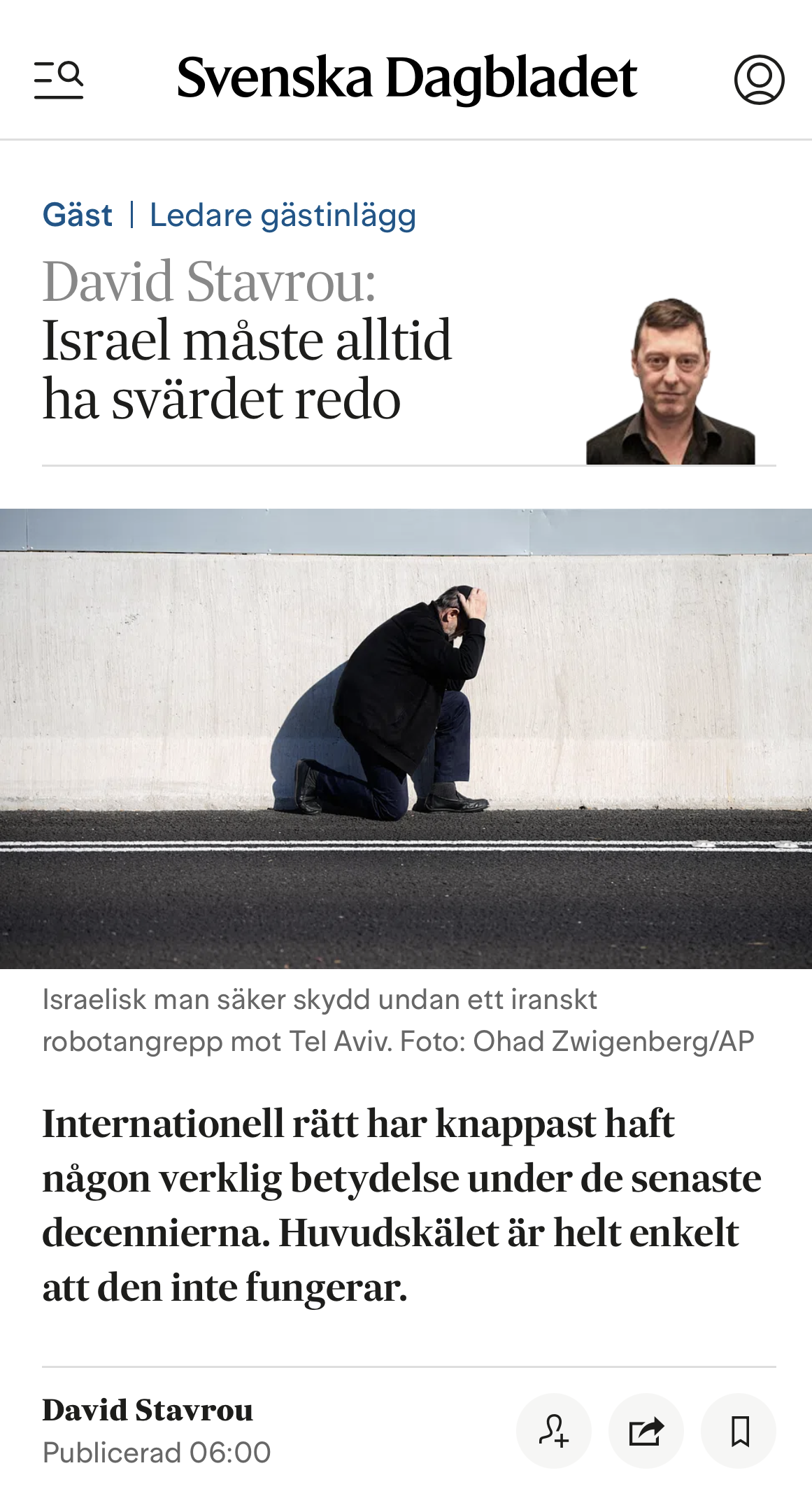

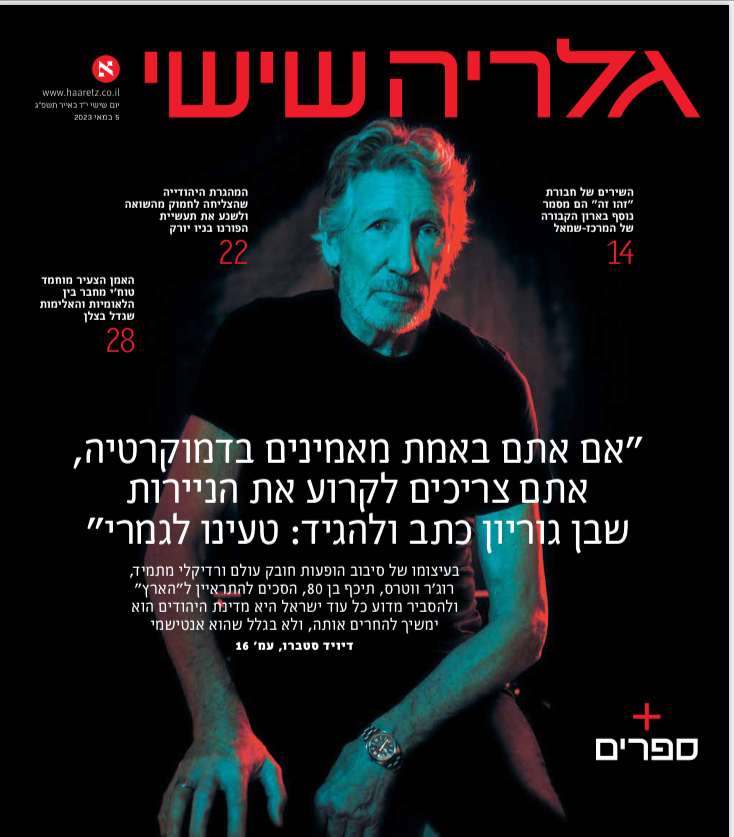
 דיויד סטברו