Why a Yiddish Renaissance Is Underway in Sweden, of All Places

Yiddish as an official minority language? A government agency that promotes Yiddish? Translations into that language of 'Harry Potter' and 'The Lord of the Rings' – and all this in Sweden?? Vos? Yo, yo!

Published in "Haaretz": https://www.haaretz.com/world-news/2024-02-23/ty-article-magazine/.highlight/why-a-yiddish-renaissance-is-underway-in-sweden-of-all-places/0000018d-d36b-d5f7-a3ff-d3ffea4f0000

STOCKHOLM – It was less than two weeks after October 7. The Stockholm Jazz Festival was taking place as scheduled, but for some of the visitors nothing was "as scheduled." The performance by renowned Israeli bassist Avishai Cohen, touted as one of the festival's highlights, was canceled because of the war, and for many Jews in Sweden and for the Israelis who live there as well, that was a portent of a very fraught period.

But the evening of October 18 was different. In Faschig, one of the most important jazz venues in Sweden, 13 musicians performed before a full house. Musically, the Georg Riedels Yiddishland performance, it was spectacular. The pieces sounded like a mash-up of Frank Zappa and Swedish folk tunes, combined with American jazz and zemirot – traditional Jewish songs sung on Shabbat – from some East European shtetl. The traditional songs in particular constituted a very unusual occurrence for a Nordic jazz festival. All the lyrics in the songs performed that evening were in Yiddish.

The music was composed by Georg Riedel, one of the biggest names in Swedish jazz. But it turns out that when it comes to a fondness for Yiddish, Riedel is actually not alone. In recent years, the language has been flourishing in Sweden. One reasons for this is that Yiddish has a special status here: It is officially recognized as a non-territorial, minority language. As such, it joins the languages of other minorities in Sweden: Finnish, Sami, Romany (the language of the Roma) and Meänkieli (a Finnish language spoken in the Torne Valley of far-north Sweden). In practice, the government in Stockholm is obligated to promote and preserve Yiddish.

"Because Yiddish is an official language here, there's a government agency to promote Yiddish," says Sarah Schulman, a local writer and publisher of books in Yiddish. "Swedes have a right to study Yiddish at school as a mother tongue, even if it's not their mother tongue. Public radio has several Yiddish programs and there are television shows in Yiddish – all part of a quota that the public broadcasting service has to meet."

Schulman is a member of the Yiddish Society of Stockholm, which she describes as a "very active" community. Some 20,000 Jews live in her country, the vast majority of whom do not speak Yiddish. "For example, through Judisk Kultur I Sverige – the Jewish Culture in Sweden organization – we brought a Yiddish-language production of Beckett's 'Waiting for Godot' to the Royal Dramatic Theatre, Sweden's most important theater. We just held a huge, two-day symposium about the Singer family [Isaac Bashevis, his brother Israel Joshua Singer and their sister Esther Kreitman, all accomplished Yiddish writers] with experts from all over the world. We have a Yiddish faculty at Lund University [in southern Sweden], and there are several Yiddish-related courses at [a college called] Paideia – The European Institute for Jewish Studies in Sweden. There is an annual seminar of worldwide scope about Yiddish. There has been a Yiddish theater in Stockholm for 120 years, we have a Yiddish choir, and there are several publishing houses that put out Yiddish books. My publishing house is one of them, but there are also poetry publishers and more."

Schulman was also the driving force behind Riedel's recent jazz concert. Riedel, who celebrated his 90th birthday in January, was born to a Jewish mother and a Sudeten-German father, who had fled to Sweden from the former Czech Republic four years before that. During his long career – he is also an accomplished double bass player – he has composed music rife with multiple influences, but it was only in recent years that he was inspired by his Jewish roots and began composing music with Yiddish lyrics, and approached Schulman.

"I love Yiddish songs and I have always sung traditional songs, but for my children I wanted newer songs," says Schulman, 40. "When Riedel contacted me and said he wanted to put Yiddish texts to music, I put him in touch with the Swedish Yiddish writer Salomon Schulman [no relation to Sarah] and together with me and with the poet Hanna Riedel, Georg's daughter, we wrote the new songs that were finally compiled into a beautiful book, two music albums and a theater show for children in Yiddish.

Publisher Sarah Schulman. "For me it was 'go big, or go home.' I wanted to show people that the Yiddish world has something unique to offer."

Sarah Schulman, photo: Hugh Gordon

"This is a fascinating project," she continues, "because it offers a bridge between Yiddish culture, Jewish culture and Swedish culture. Since every Swedish child knows Georg's music [not least because Riedel composed the songs for a series of films about the iconic children's book heroine Pippi Longstocking], we have also translated some of Georg's better-known Swedish songs into Yiddish. This is one of the most important projects we have ever done to revive the language and attract a new audience to the Yiddish world. For me it was like 'go big, or go home,' so I made sure the project reached the biggest stages. I wanted to show people – including also Jews in Sweden – that the Yiddish world has something unique and different to offer. This year a Georg Riedels Yiddishland album was also been nominated for one of the most prestigious music awards in Sweden."

Schulman grew up in a Yiddish-speaking family. "My Yiddish-speaking grandparents, who survived the Holocaust, came to Sweden from Poland with the White Boats [a humanitarian operation that transported thousands of survivors to Sweden from German concentration camps after World War II]. My father is the head of the Yiddish Society in Stockholm, so Yiddish is a large part of my Jewish identity. I grew up with Yiddish literature, with Isaac Bashevis Singer, I. L. Peretz and Itzik Manger. Yiddish stories were my favorites when I was young. I was surrounded by Yiddish music, idiomatic expressions and jokes."

She went on to study Yiddish at Columbia University in New York. "As a young woman in New York, I realized how important Yiddish was for me, so when I returned to Sweden I became very active in the local Yiddish community. In 2015 I wrote my first children's book in Yiddish. I was looking for books in Yiddish for my sister's children, and because I couldn't find any that were secular and modern, I wrote one myself. A few years later, in 2019, I founded my own publishing house, Dos Nisele (the Little Nut), because the comments I got from readers were so positive. They wanted more."

Does the Swedish audience accept Yiddish naturally? Is there no resistance to a relatively unknown language identified with the Jewish past in Europe?

"It's been a slow process, but Swedish society is gradually getting interested in what we're doing. Yiddishists tend to have pretty radical dreams, and in the last 20 years, and especially since the Georg Riedel project, we've been getting a lot of attention. We've been on radio and television and in the newspapers. The project is doing very well, probably because Riedel's music is part of the core of Swedish culture and we are taking this core and adding something to it, using Yiddish."

Nikolaj Olniansky also heads a Yiddish publishing house in the city of Lund, in southern Sweden, which is known worldwide. Its recent publications include Yiddish translations of some of the "Harry Potter" books and "The Lord of the Rings," typically purchased by secular Yiddish lovers and also as collectibles by non-speakers.

"We started Olniansky Tekst back in 2010," the publisher says. "My wife, Ida, and I had just taken Yiddish at Lund University and wanted an outlet to use the language afterward. Together with a friend from Yiddish studies, Linda Gordon, we decided to put out a magazine. While in university, we noticed that a lot of material published in Yiddish was also about Yiddish [itself]. We wanted to do something different: to write in Yiddish about things that interested us, like movies, video games, books, music, etc. Much of the content had absolutely nothing to do with Yiddish and/or Jewish culture. The result was a small periodical called Dos Bletele [the Small Page].' We did everything ourselves: articles, editing, graphics, distribution – the works. Although we had some subscribers, it was really a project designed for ourselves as a way to practice our language skills, and when we felt ready we decided to take the publishing house to the next level."

In time, Ida and Nikolaj continued on their own,and began to focus on children's literature in Yiddish. With a grant from the Swedish Arts Council, they published four books. "This was – and is – pure activism," he says. "The feeling that Yiddish was about to fade away was hard to bear, and we knew that a lot of families outside the Hasidic world felt the same way. So our mission became to help keep Yiddish alive in the secular world by creating modern, high-quality literature. So when Yiddishists became parents, there would be point-and-learn books for their children, when a Jewish teenager searched for their roots they would have juvenile fiction to enjoy, and when Yiddish writers created prose and poetry there would be a publishing house available for them. So far we have published about 30 books and 21 issues of an ambitious literary quarterly."

What books have you published lately, and how many copies have you sold?

"We've published classic Yiddish writers like Bashevis Singer and [the poet] Kadya Molodowsky, big international writers like J.K. Rowling, Erich Kästner and J.R.R. Tolkien; award-winning graphic novels, poetry and prose from the best contemporary writers, new children's books and more. A standard print run for us is 500 to 1,000 copies, but there are exceptions. 'Harry Potter' reaches a lot of target groups, because many see it as a collector's item, a cool book to have on the bookshelf, or a fun gift to give – we've printed 5,000 copies so far."

How do you explain the fact that a country with a population of 10 million and a small Jewish community has become a Yiddish superpower?

Yiddish has been a part of the Swedish-Jewish cultural scene for a long time. However, as in the rest of the world, Yiddish basically skipped a generation and became a language of the past and a reminder of terrible pain and suffering.Nikolaj Olniansky

"First of all, one has to remember that although the Jewish community in Sweden is small in numbers, there have been several immigration waves that have kept Yiddish alive within the community – from the Jews who came from czarist Russia to those who came from Poland in the 1960s. Yiddish has been a part of the Swedish-Jewish cultural scene for a long time. However, as in the rest of the world, Yiddish basically skipped a generation and became a language of the past and a reminder of terrible pain and suffering, whereas Hebrew became the language of a new dawn, of victory and prosperity.

"The fact that Yiddish became an official minority language in Sweden in 2000 is what brought about the current situation," he observes, "but that would not have happened if Yiddish hadn't been a central part of many Swedish Jews' lives. It was also partly a matter of timing. Sweden's governments were then investing in minority languages just as some people who thought it was important were putting their heart and soul into creating a new wave of Yiddish literature.

"And it's not just in Sweden. Take [American-born translators including] Arun Viswanath, for example, who wanted his kids to be able to read Harry Potter in Yiddish and set out to translate the book without knowing whether it would ever see the light of day; or [former computer programmer-turned-translator] Barry Goldstein, who wanted something to do after retiring and decided that translating Tolkien's works into Yiddish was a good project; or Israeli writers Michael (Mikhel) Felsenbaum, Velvl Chernin and Emil Kalin, who also write in Yiddish. I'm very happy to be a small part of this group of people who live and breathe Yiddish and carry the language into the 21st century."

The Yiddish translation of "Harry Potter and the Philosopher's Stone."Credit: Art: Jonny Duddle/OLNIANSKY TE

Schulman, too, sees Swedish history as a central factor behind the present revival of Yiddish in the country. "Because Sweden was not involved in World War II, it became the only country in Europe [besides Albania] that had more Jews after the Holocaust than before. After the war, Sweden was also one of the wealthiest countries in Europe because it had stayed out of the war. The Jews who came here brought [with them] the stars of the Yiddish theater, the Yiddish music scene and Yiddish films. All the great names performed here; we had more Yiddish culture here than existed almost anywhere else."

How important is Yiddish to the local Jewish community?

"Most Swedish Jews come from Yiddish-speaking families. The events organized by the Yiddish Society of Stockholm always attract a full house and there's obviously much interest in the language. So, we bring value to the Jewish community and add to Jewish life in Sweden. Aaron Isaac, the first Jew to come to Sweden, 250 years ago, spoke Yiddish, and I think that even today it's the right of every Jewish child in Sweden to have access to the Yiddish culture and language. More and more Jewish families today ask for Yiddish teachers, and we don't have enough."

But for Schulman, the language's importance is not just historical. "There's something in the Yiddish world that doesn't only give me meaning and purpose," she says. "It's also something I want to create for my children. Yiddish is driven by tolerance, curiosity and courage. It's a platter of ideas, and these values are embedded in the Yiddish world – it's an alternative to a world that's gotten increasingly polarized."

Isn't there tension between Yiddish and Hebrew? Is it convenient for the Swedes to support Yiddish because it helps distinguish the Jews of Sweden from the State of Israel, where Hebrew is spoken?

"It doesn't come from the need to protect the Jewish minority – that's something else – but from the need to protect Yiddish as an endangered language. Hebrew is a different story altogether … it doesn't qualify as an official minority language.

"Jews have always been multilingual, and there's no reason to choose one Jewish language over another. We don't think about what some perceive as tension between Yiddish and Hebrew. If we can create quality Yiddish culture for Jews and non-Jews in Sweden as well as for Yiddishists around the world, we're happy to do it. We've received recognition in Sweden, and we are really going to use the opportunities we get. I want my children and the generations to come to have access to the beautiful Yiddish culture that I knew as a child, and which has brought me so much joy and happiness."

Israel's New Swedish Friends Are the Wrong Crowd

As Israelis are caught up in domestic politics, Likud activists are making far-right friends and changing the country’s foreign policy.

Published in "Haaretz": https://www.haaretz.com/opinion/2023-09-24/ty-article-opinion/.premium/israels-new-swedish-friends-are-the-wrong-crowd/0000018a-c651-da14-a1eb-de5be0620000

STOCKHOLM – Instead of triggering a historic normalization with yet another Arab country, Israel’s announcement of Foreign Minister Eli Cohen’s meeting with his Libyan counterpart led to political embarrassment in Jerusalem, riots in Tripoli and the Libyan minister fleeing the country for her life. Some people claim that this was the result of opportunistic and amateurish behavior.

But if we divert our gaze from North Africa to Europe, we get suspicious that the problem lies not with the Foreign Ministry’s errors (if this indeed was an error) but with its successes.

Three months before Cohen met with the Libyan minister, he visited Stockholm. This wasn't a routine visit either. Cohen became the first Israeli foreign minister to visit Sweden in over 20 years. The trip lasted only 24 hours and included just a handful of meetings that were kept on a very low profile. Not that anyone expected a red carpet and marching bands, but the two countries held no public events, ceremonies or receptions, and the meeting between Cohen and his Swedish counterpart, Tobias Billström, was kept secret until it was over.

One reason for the uncharacteristic restraint is that the two governments are in an unprecedented situation. Jerusalem is advancing processes that are filling the streets with protesters, not only in Israel but anywhere in the world where a cabinet member visits. The Swedish government, meanwhile, is dependent on the Sweden Democrats party, which started out as a neo-Nazi party that up to 30 years ago was led by skinheads. Now this outfit defines itself as “nationalist and social-conservative,” and on the back of an agreement with parties such as Billström’s Moderate Party, it sets the country’s agenda.

Israel’s traditional policy is to refrain from any contact with such parties, not just because of their Nazi roots but because in recent years leaders and members of the Sweden Democrats and its counterparts across Europe have been disseminating conspiracy theories as well as racist, antisemitic and Islamophobic propaganda. Several of them have been implicated in violent incidents, not exactly the kind of thing Israel wants to be associated with.

But it's not so simple. If, as Cohen claims, he and his Swedish counterpart discussed the strengthening of political, economic and military ties, how could this happen when key positions in Sweden, including the leadership of parliament's foreign affairs and labor market committees, are held by a party that Israel is boycotting? Israel’s Foreign Ministry said that ties with the Sweden Democrats weren't addressed at the meetings in Stockholm. This may be true, but not because the issue is unimportant but because Israel seems to be well on its way to changing its policy in this area. Ties with Italy’s prime minister, despite her neofascist past, are stronger than ever, Hungary is considered an important ally, and Cohen recently instructed Israel’s ambassador in Romania to meet with the far-right AUR party, hitherto boycotted by Israel due to its antisemitic comments and Holocaust denial.

All this has been done to win support for Israel's settlements in the West Bank. Is there a connection between all these events? The answer can be found in another diplomatic visit. A few days after Cohen’s return from Stockholm, two senior members of the Sweden Democrats, Charlie Weimers and Richard Jomshof, landed in Israel. The visit was supposed to remain under the radar, but word got out that these Swedish far-rightists had met with Israeli lawmakers.

The daily Israel Hayom revealed that among them was Likud MK Amit Halevi, who spoke with his guests about suspending Israel’s boycott of their party. They even handed him a document that was passed higher up. Three months later, Halevi helped change Israel’s policy toward the Romanian AUR party. Another Likud member, former lawmaker Michael Kleiner, also met with the two Swedish legislators. Not surprisingly, Kleiner was a guest of the AUR in Bucharest last November.

All this is confusing: While Israel is officially boycotting the Sweden Democrats, politicians from the party are secretly meeting with members of Israel’s ruling party and undermining its official policy. Of course, the policy on Europe's far right should be weighed carefully, and it may be time to change it, but the impression is that what happened in Romania and is happening in Sweden isn't a result of deliberations by Foreign Ministry professionals but is a snap political move.

And so, it seems that as Israelis are caught up in domestic politics, a small number of Likud activists are changing Israel’s foreign policy. Israel’s democratic and liberal allies are being replaced with nationalist movements, including populist and racist ones, in a move that's a European parallel to what Finance Minister Bezalel Smotrich is doing with Israeli-U.S relations. His statements about America’s “preaching” may not have been off the cuff but a reflection of a new policy: exchanging America's traditional bipartisan support and the backing of mainstream forces in Europe for the support of the populist-evangelical camp in the United States and the nationalist-xenophobic wing in Europe.

Beyond the ideological considerations, political and business interests are at play here. In contrast to leaders such as U.S. President Joe Biden and German Chancellor Olaf Scholz, who openly protested Israel's judicial overhaul, Swedish Foreign Minister Billström had nothing to say about it. A country that used to see itself as a “humanitarian superpower” and global peacemaker is remaining silent when it comes to Israel’s democracy. This was probably refreshing for Cohen.

Meanwhile, sales of Israeli weapons to Sweden have spiked during the war in Ukraine and the entry of Sweden and Finland into NATO. The governments in Stockholm and Helsinki, both supported by far-right parties, are much more interested in drones, rocket launchers and cyberwarfare than human rights, settlements and judicial overhauls. Even if parts of the Israeli left don't consider this a problem, we should recognize a corollary of this new approach: Israel’s new partners won't save Israel from itself. They are part of governments that are morally blind, deaf and mute.

Maybe the Libyan incident was no mistake. Instead of pursuing a policy of building bridges to Arab states – a way of avoiding the Palestinian issue – Israel is adopting a new international stance and seeking support based on arms deals, natural gas and its cyber prowess, not shared values. This seems logical, because what common values are there anyway? Human rights? Peace? Social justice? That stuff is so '90s.

It’s still not clear if and when Billström will visit Israel, but when this happens, we can be sure that the Israeli-Palestinian conflict and the dangers to Israeli (and Swedish) democracy won't be on the agenda. Instead, when the ministers finish talking business, they can always talk about the weather, the Eurovision Song Contest and the pros and cons in the battle of Swedish meatballs vs. falafel.

Haaretz Reports on Quran burning, threats to burn Bibles and New Testaments and heightened terror threat in Sweden – July/August 2023

https://www.haaretz.com/world-news/europe/2023-07-14/ty-article/swedish-police-approve-hebrew-bible-burning-event-near-israeli-embassy-in-stockholm/00000189-53ab-d3c1-a199-dfbb7ae40000

https://www.haaretz.com/world-news/europe/2023-07-15/ty-article/man-who-planned-hebrew-bible-burning-event-in-stockholm-speaks-against-act-instead/00000189-59ad-d481-afbd-5bbfd2e30001

https://www.haaretz.com/world-news/europe/2023-07-16/ty-article-magazine/.premium/the-torah-wasnt-burned-this-time-but-whats-next/00000189-5eb0-d471-a7cd-5fb719310000

https://www.haaretz.com/world-news/europe/2023-08-21/ty-article/.premium/quran-burning-in-sweden-even-israel-asks-citizens-to-stay-vigilant/0000018a-135a-de1e-a39b-935b3eb80000

Swedish Police Approve Hebrew Bible-burning Event Near Israeli Embassy in Stockholm

According to reports in Swedish media, local police will allow the event to take place on Saturday, during which the attendees are expected to burn a Hebrew and Christian bible in an attempt to expose Swedish hyprocisy

July 14th

Police in Sweden have approved a request to burn both a Hebrew and a Christian Bible during a protest expected to take place Saturday in front of the Israeli embassy in Stockholm, police in the Swedish capital have confirmed. The request was made by a 32-year-old Swede who claims that his action is a protest against recent events of burning the Quran, which were approved by Swedish authorities and took place in the last few months.

In a statement released on Friday, Israeli Prime Minister Benjamin Netanyahu said that he condemns “in the strongest terms the authorities’ decision in Sweden to permit the burning of a Jewish Bible in front of the Israeli Embassy.” Netanyahu added that “this deeply shameful act undermines the sacredness of the Jewish people’s holiest scriptures.” Israel’s ambassador to Sweden, Ziv Nevo Kulman, condemned the burning of holy books from any religion, saying it’s “an act of hate and disrespect, that has nothing to do with freedom of expression.”

Israeli President Isaac Herzog said he “unequivocally condemn[s] the permission granted in Sweden to burn holy books,” and that he is “heartbroken that the same fate awaits a Jewish Bible.” Herzog added that “permitting the defacement of sacred texts is not an exercise in freedom of expression, it is blatant incitement and an act of pure hate.”

Israeli Foreign Minister Eli Cohen also stated on Friday that “burning a Torah scroll is a hate crime, provocation, and a severe attack on the Jewish people and Jewish tradition,” urging Swedish authorities to “prevent this disgraceful event and not allow the burning of a Torah scroll.” On Friday, the European Jewish Congress (EJC) also issued a condemnation, saying the Swedish authorities shouldn’t allow the event to take place. “Provocative, racist, antisemitic and sickening acts such as these have no place in any civilized society,” EJC president Dr. Ariel Muzicant said.

The Official Council of Swedish Jewish Communities published a statement claiming that “our tragic European history links the burning of Jewish books with pogroms, expulsions, inquisitions and the Holocaust.” The council added that it condemns the abuse of freedom of expression that takes place with the aim of sowing hatred in society. “Burning holy books, be it the Quran, the Torah or the New Testament,” it concluded, “are hateful acts that we perceive as direct threats to the societies that value them. Following the Quran burnings, we support the Muslim community in Sweden, express our gratitude for their strong stance and condemnation, and sincerely hope that this and all other burnings of holy books will stop.”

In a meeting with representatives of religious communities in Sweden, Swedish Prime Minister Ulf Kristersson said: “Sweden is and must be a country where people of different faiths – or no faith – can live together side by side in mutual respect. Let us together fight the hatred in society, which drives people to burn the Quran, the Bible or the Torah, and in places and times that are most offensive. Instead, let’s show each other respect.”

The practice of burning holy books in Sweden started a few years ago as a result of a Danish far right provocateur and politician named Rasmus Paludan. A few of Paludan’s supporters burned the Quran in the southern city of Malmö in 2020, and he himself repeated the act a number of times since then.

Rasmus Paludan in Stockholm, August 2022, photo: David Stavrou

In April 2022, Paludan managed to provoke a violent reaction when criminal elements took advantage of the local communities’ outrage and used the opportunity to set off riots which included setting cars on fire and attacking police in several Swedish towns. In January, Paludan returned to Sweden after he received a permit to burn a Quran in front of the Turkish Embassy in Stockholm. This time the reaction had geopolitical implications. Turkey used the Quran burning in Stockholm as a pretext to continue blocking Sweden’s decision to join NATO.

Things got even worse in June when an Iraqi Christian immigrant burned a Quran just outside a Stockholm Mosque during Eid al-Adha. This led to anti-Sweden protests all over the Arab world. In recent weeks there have been more applications sent to the police requesting approval to hold demonstrations which include burning of holy books. The current case of burning of Jewish and Christian holy scripture is intended as a way of exposing Swedish hypocrisy, claiming the authorities allow burning the Quran in the name of freedom of expression too easily, but many claim the result is that a handful of extremists have managed to drag Sweden down a path which is becoming both dangerous and internationally embracing.

Some Swedes have had enough of this, including some government officials. Jonas Trolle, the head of the Swedish Center for Preventing Violent Extremism, for example, said that it’s time for Sweden to consider certain legal changes. “Sweden needs to be equipped in a turbulent time in Europe,” he wrote in “Expressen” one of Sweden’s daily newspapers, “Today it’s Quran burnings, tomorrow it will be something else. Without a legal change, Sweden risks becoming vulnerable. It’s unreasonable that our laws concerning public order are out of step with our basic laws [concerning freedom of speech]. We must protect both our freedom of expression and our national security.” Trolle also claimed in recent interviews to the Swedish press that Sweden needs a “reality check” in these matters and it can learn from countries like Germany, France and the UK which have managed to legally forbid these kinds of events and still remain democratic.

Earlier this month, a man who identified himself in Swedish media as a refugee from Iraq burned a Quran outside a mosque in central Stockholm – resulting in strong condemnation from several countries. Shortly after, reports surfaced about another individual who had applied for a police permit to burn the Torah outside the Israeli embassy. “I am shocked and horrified by the prospect of the burning of more books in Sweden, be it the Koran [sic], the Torah or any other holy book,” Ambassador Nevo Kulman tweeted in early July.

Man Who Planned Hebrew Bible-burning Event in Stockholm Delivers Speech Against Act Instead

The 32-year-old Swedish citizen, who is Muslim, says his intention was to 'show how wrong it is that people don't respect other religions'

July 15th

STOCKHOLM — A 32-year-old Swede named Ahmad Alush who announced that he intended to burn a Hebrew and Christian Bible on Saturday in front of the Israeli embassy in Stockholm surprised those present and instead gave a speech against the burning of religious books. When he arrived in front of the Israeli embassy in Stockholm at noon holding a large lighter in his hand, he made it clear that he did not intend to use it. "I'm Muslim, we don't burn [books]," he said, adding "I wanted to show how wrong it is that people don't respect other religions."

The man, who lives in the south of Sweden, explained on Friday that he intends to burn a Bible as a protest against an event about three weeks ago in which a Quran was burned before a mosque in Stockholm with police permission. "It deeply saddens me and many others in Sweden and the world who allow the Quran to be burned," he explained. "I know that the Swedes are very good people and that they want to prevent the burning of the Quran and that there is a legal obstacle to doing that."

Ahmad Alush, the man who said he'd burn a Torah book outside the Israeli embassy in Stockholm, photo: David Stavrou

After the Swedish police approved the man's request to burn the Bibles, Israeli Foreign Minister Eli Cohen instructed Israel’s ambassador to Sweden, Ziv Nevo Kulman, "to act in every way in order to prevent this shameful incident." It was also reported that the ministry's political director Aliza Bin Noun spoke with Kulman in Israel "and made clear to him the seriousness with which Israel views the police's approval of damage to the sacred sites of Judaism."

The decision to permit burning of the Bible was met with harsh criticism in Israel, with Prime Minister Benjamin Netanyahu saying he condemns “in the strongest terms the authorities’ decision in Sweden to permit the burning of a Jewish Bible in front of the Israeli Embassy.” Netanyahu added that “this deeply shameful act undermines the sacredness of the Jewish people’s holiest scriptures.” Kulman earlier condemned the burning of holy books from any religion, saying it’s “an act of hate and disrespect, that has nothing to do with freedom of expression.”

Israeli President Isaac Herzog said he “unequivocally condemn[s] the permission granted in Sweden to burn holy books,” and that he is “heartbroken that the same fate awaits a Jewish Bible.” Herzog added that “permitting the defacement of sacred texts is not an exercise in freedom of expression, it is blatant incitement and an act of pure hate.” On Friday, the European Jewish Congress (EJC) also issued a condemnation, saying the Swedish authorities shouldn’t allow the event to take place. “Provocative, racist, antisemitic and sickening acts such as these have no place in any civilized society,” EJC president Dr. Ariel Muzicant said.

In a meeting with representatives of religious communities in Sweden, Swedish Prime Minister Ulf Kristersson said: “Sweden is and must be a country where people of different faiths – or no faith – can live together side by side in mutual respect. Let us together fight the hatred in society, which drives people to burn the Quran, the Bible or the Torah, and in places and times that are most offensive. Instead, let’s show each other respect.”

The practice of burning holy books in Sweden started a few years ago as a result of a Danish far right provocateur and politician named Rasmus Paludan. A few of Paludan’s supporters burned the Quran in the southern city of Malmö in 2020, and he himself repeated the act a number of times since then. In January, Paludan returned to Sweden after he received a permit to burn a Quran in front of the Turkish Embassy in Stockholm. This time the reaction had geopolitical implications. Turkey used the Quran burning in Stockholm as a pretext to continue blocking Sweden’s decision to join NATO.

When an Iraqi Christian immigrant burned a Quran just outside a Stockholm Mosque during Eid al-Adha in June, anti-Sweden protests broke out all over the Arab world. In recent weeks there have been more applications sent to the police requesting approval to hold demonstrations which include burning of holy books. Earlier this month, a man who identified himself in Swedish media as a refugee from Iraq burned a Quran outside a mosque in central Stockholm – resulting in strong condemnation from several countries. Shortly after, reports surfaced about another individual who had applied for a police permit to burn the Torah outside the Israeli embassy. “I am shocked and horrified by the prospect of the burning of more books in Sweden, be it the Koran [sic], the Torah or any other holy book,” Ambassador Nevo Kulman tweeted in early July.

The Torah Wasn’t Burned This Time. But What’s Next?

Are public burnings of the Quran and other holy books inevitable in a country that values free speech? No, according to the co-head of a Jewish-Muslim organization in Sweden, Rabbi Moshe David Hacohen. 'These events are an opportunity for cooperation, because the threat to Muslims and Jews is real,' he says

July 16th

STOCKHOLM – The Swedish capital found itself in the world news this weekend when a Muslim man who had pledged to burn copies of the Torah and Bible in front of the Israeli Embassy instead discarded his lighter and sought to send a message about respecting other religions. The Swede, who was named in the media as Ahmad Alush, went on to explain that he and many other Muslims were saddened by the burning of the Quran in Sweden and that the right to freedom of expression can’t excuse such hate crimes.

The practice of the Quran being publicly burned in Sweden started a few years ago because of a far-right Danish politician called Rasmus Paludan. A few of his supporters burned the sacred book of Islam in the southern city of Malmö in 2020, and he himself has subsequently repeated the act a number of times. In April 2022, he managed to provoke a violent reaction when criminal elements took advantage of the local outrage and started riots, including setting cars alight and attacking police forces in several Swedish towns.

Last January, Paludan returned to Sweden after receiving a permit to burn a Quran in front of the Turkish Embassy in Stockholm. This time, the reaction had geopolitical implications: Turkey used the incident as a pretext to continue blocking Sweden’s efforts to join NATO. Things got even worse last month when an Iraqi Christian immigrant burned a Quran just outside a Stockholm mosque during the Eid al-Adha festival. This prompted not only more Turkish reaction, but also anti-Sweden protests all over the Arab world. And more applications requesting approval to hold public demonstrations to burn the holy books of three major religions (Judaism, Islam and Christianity) were sent to the police in recent weeks.

On Saturday, Alush said he wanted to expose Swedish hypocrisy that permits the Quran to be burned in the name of freedom of expression, but ended up making a wider statement by saying the practice of burning holy books must end.

Dismantling the fear

This point has been made by others, including some Swedish officials. Jonas Trolle, who heads the Swedish Center for Preventing Violent Extremism, has said it’s time for Sweden to consider certain legal changes. He said in recent media interviews that Sweden needs a “reality check” in such matters and that it can learn from countries such as Germany, France and Britain, which have managed to legally ban these kinds of events yet still remain democratic.

Civil society has also joined the discourse over the burning of holy books. The Amanah organization, founded by Imam Salahuddin Barakat and Rabbi Moshe David Hacohen, for instance, has prevented Torah burnings in the past. The group focuses on creating a trusting society while working to combat discrimination, antisemitism and Islamophobia.

“Jewish history is useful in this debate,” Hacohen said in an interview. “It’s clear that the purpose of burning holy books is not to demonstrate an objection to the content of the books; it’s about creating the Other in society – like Nazi propaganda in the 1930s. Burning books is a way of showing certain people that they are not welcome in society, and this leads to legitimizing murder.”

Asked what Amanah does when it learns that someone intends to burn a holy book, Hacohen explained that “the first thing we do is join forces. These events are a good opportunity for real cooperation, because the threat to both Muslims and Jews is real. We try to bring in forces from the Jewish world, the Muslim world, the leaderships of all communities in Sweden, the Nordic countries and Europe, and we try to send a unified message.

“On a more local and practical level, we exert our influence wherever we can behind the scenes – not only in order to prevent the burning of books, but also to prevent antisemitic incidents and Islamophobic behavior such as hate speech online. We work on dismantling the fear and building bridges in various ways. We created a digital project for Swedish schools, funded by the Swedish government, which helps young people understand what it’s like to be a Muslim or a Jew in Sweden. We also created a Jewish-Muslim madrassa [school] for adults, in order to deepen the knowledge about the two religions, understand the similarities, and see beyond the black and white way of seeing reality.” Hacohen noted that the imam of Stockholm's main mosque spoke on Friday against the burning of all holy books, and added that Muslims should not act against Jews who are their partners in the struggle against Quran burnings.

Sweden's unique interface

As for why Sweden has seemingly become an epicenter of book-burning controversies, Hacohen believes it is because the country has a unique interface where religion and social freedom meet. “The limits of democracy are stretched as they meet different cultural and religious values such as those brought by immigrants who arrive to a very different culture than they came from,” he said. “This friction triggers a debate about limits on freedom of speech and limits on behavior in the public arena when it comes to hate and racism. In Sweden, freedom of expression is a value above almost all others, and limiting it because of the danger of hate crimes is seen by many Swedes as a threat to their basic values.”

Hacohen referred to Jewish tradition when asked if Swedish exaltation of freedom of expression makes such incidents inevitable. “Amanah was invited to a panel discussion at the law faculty in Lund University. The participants were a law professor, the archbishop of the Church of Sweden and us, Imam Barakat and myself. When asked about the freedom of expression in Judaism, I replied that the notion of freedom is very personal, it’s about how one relates to choices. But when it comes to social laws and the relationship to others, the word ‘responsibility’ is used. We have rules regarding responsibility to others and the society we live in. It’s about responsibility rather than freedom. Perhaps this distinction can help direct us toward a true cohesive society where we care for one another and have a trusted shared space.”

The rabbi also highlighted recent comments by the Vatican and the World Jewish Congress. Pope Francis told United Arab Emirates daily Al-Ittihad that any book considered sacred by its people must be respected out of respect for its believers. “Freedom of expression must never be used as an excuse to despise others, and allowing this must be rejected and condemned,” the pope was quoted as saying.

WJC President Ronald Lauder, meanwhile, reacted to the recent incidents in Sweden by calling the burning of the Quran a “heinous act,” expressing solidarity with “our Muslim brothers and sisters.” On Friday, he said that “the burning of our sacred texts ostracizes and hurts the Swedish Jewish community as well as all those who value pluralism and multiculturalism. Books should be read and cherished, not set ablaze.”

Quran Burnings and Terror Threats: Israel Warns Citizens to Avoid Crowds – in Sweden

As Sweden raises its terrorism alert to its second-highest level, Prime Minister Ulf Kristersson warns of potential revenge attacks for recent public burnings of the Quran – from Lebanon's Hezbollah, Al-Shabab in Somalia and Al-Qaida

August 21st

STOCKHOLM – The Swedish Security Service on Thursday raised the country's terrorist-threat level to its second-highest rung, a step last taken in 2016 when Europe was wracked by terror attacks. The move follows a spate of Quran burnings by protesters in Sweden, angering the Muslim world and triggering assaults on Swedish consulates and embassies in Baghdad, Beirut and Izmir, Turkey. The threat level will now be a 4 in a five-rung scale.

“There are also several examples of terrorist groups that have urged their sympathizers around the world to take revenge for the Quran burnings that have taken place in Sweden. Among them are Hezbollah in Lebanon, al-Shabab in Somalia and Al-Qaida,” Prime Minister Ulf Kristersson told a press conference Wednesday.

At the news conference, officials said the authorities had thwarted terrorist attempts and made arrests. Sweden's security agencies were cooperating with each other and their foreign counterparts, Kristersson added. Meanwhile, Britain and the United States have warned their citizens to stay vigilant in public places and tourist sites in Sweden. Even the National Security Council in Jerusalem has asked Israelis to “try their best to avoid crowded places and public institutions at the present time.” British officials have said there is a chance that terrorists will attempt to strike in Sweden, adding that the Swedish security agencies had already prevented attacks on Swedish citizens.

Burning holy books as a political provocation is nothing new to this Scandinavian country. For years now, far-right Danish politician Rasmus Paludan has been burning Qurans to express opposition to immigration to Sweden and neighboring Denmark, and in a bid to goad immigrant communities. In April 2022, provoked by Paludan, criminal elements took advantage of Muslim citizens' wrath and sparked riots in Swedish cities that included the torching of cars and attacks on the police. In January this year, Paludan returned to Sweden after receiving permission to burn a Quran in front of the Turkish Embassy in Stockholm. This time there were geopolitical repercussions: Turkey used the event as one of its reasons to block Sweden's entry into NATO.

The situation worsened in June when Salwan Momika, an Iraqi Christian, burned a Quran outside a mosque in Stockholm during the Eid al-Adha holiday. This time, the Turkish protests were joined by anti-Swedish demonstrations around the world. This wasn't the only Quran-burning by Momika, an anti-Muslim activist and asylum seeker who has been in Sweden since 2018. He has burned a Quran outside parliament, and on Friday, a day after the raising of the threat level, he burned the book outside the Iranian Embassy. Similar incidents have occurred in Denmark. In recent weeks, further requests for approval to burn holy books have been submitted to the Swedish police, with torchings of the New Testament and the Hebrew Bible also being prepared.

Sweden has absolute freedom of speech; it has no law preventing the burning of holy books. Meanwhile, the country’s legislation on hate crimes and public disturbances doesn’t allow the police to prevent book burnings, except in extraordinary circumstances. But many in Sweden argue that the country is paying too high a price for this policy. The freedom to burn holy books is letting a handful of extremists – whose views or actions are very unpopular around the country – drag Sweden into severe international crises while worsening the security situation.

At the press conference, Justice Minister Gunnar Strömmer said that new legislation to fight terror groups is now in place while new policies have been crafted to prevent terrorists from entering the country in the first place. Sweden's police chiefs added that the security services were following suspects' online activities, gathering intelligence on radicals and preparing the rescue and security services for a rapid response to all scenarios. The head of the Swedish Security Service, Charlotte von Essen, added that the threat to Sweden may carry on for a long time.

She said the threat stems largely from Islamic extremists, while the spread of fake news, disinformation and rumors about Sweden – mainly portraying it as an anti-Muslim country – worsens the situation. The authorities are also monitoring intimidation from the far right and security threats in the entire region, against the backdrop of Russia's war on Ukraine and the Swedes' subsequent request to join NATO.

The threats in Sweden cast a shadow over Stockholm’s annual end-of-summer culture festival, which ended Sunday. For many Swedes, the mid-August event marks the last week of the summer vacation, after which it's back to work and school.

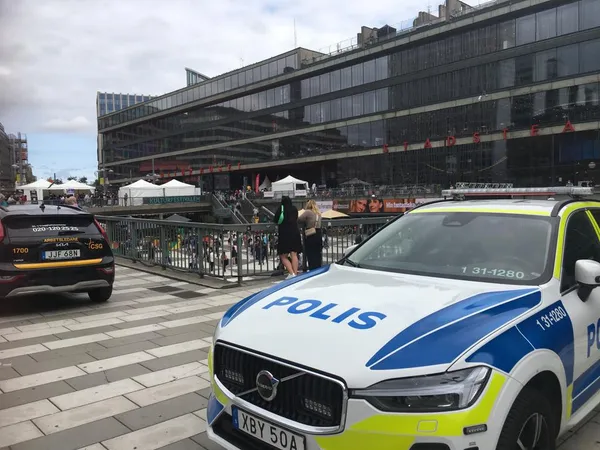
A police Car at Stockholm's Culture Festival. Photo: David Stavrou

Since its inception nearly two decades ago, the festival has been a huge attraction both for Stockholmers and tourists. For five days, stages throughout the city center host dance, music, circus and theater performances, all for free. Long lines stretch around dozens of food and drink stands, and more than a million visitors and hundreds of workers fill central Stockholm's streets, squares and bridges.

This year's installment went by without incident. Despite the warnings, there were no metal detectors, no one checking bags at the entrance, and no tense atmosphere at all. Maybe the reason is that instead of the rainy weather of the first half of August, the sun shined on Stockholm. Maybe it's just that the Swedish approach to terror threats, at least for now, is the same as the Swedish approach in general: faith in the authorities and security forces – and a cautious pragmatism. “We must live our lives as normal,” Kristersson said. “We stand behind our democratic values. We are defending ourselves, but we still stand behind our way of life.”

Israeli Food Tech Is Flavor of the Month at This Forward-thinking Cuisine Confab

Chefs and experts at the Big Meet conference in Stockholm were all in agreement that in order to save the planet, we need to start having a serious conversation about food. ‘The future is going to look a lot more like a table in Israel than a table in 18th-century France,’ says Mitchell Davis of Asif culinary center in Tel Aviv.

Published in "Haaretz": https://www.haaretz.com/israel-news/2023-06-15/ty-article-magazine/.premium/israeli-food-tech-is-flavor-of-the-month-at-this-cuisine-confab/00000188-bab3-d481-a7a9-baff81580000

A global food-technology conference is a natural fit for Sweden, where it’s not uncommon to hear locals discussing climate change, workers’ rights and environmental issues as part of their decision-making process. It is also no surprise to find young Israelis here attracting interest for their heap of new ideas, technologies and techniques.

According to the organizers of Big Meet, current food systems don’t allow consumers to understand what they’re eating and how it affects their health and the planet. Given the escalating problems of overpopulation and climate change, they say, the need for sustainable solutions to feed future generations is ever more urgent. And anyone visiting the two-day conference near Stockholm’s northern harbor on June 1-2 could experience what food-tech companies are hoping could be part of the solution.

There was a chef from New Zealand who offered a vegan “cod” fillet based on wheat, starch, algae and proteins. Near him was a Swedish businesswoman who specializes in plant-based, gluten-free vegan burgers made from mung beans. Another Swedish company showcased a pizza that replaces dough with cabbage. There were shakes from hemp seeds, vegetarian tacos and even a new kind of flavored sparkling water that, with the help of a combination of minerals and amino acids, combats post-meal fatigue and drowsiness.

Based on their presence at the event, it seems Israeli food tech is a leading player in the field. Gitit Lahav and her business partner Shimrit Lev, for instance, founded Sweet Victory – a company that has developed a chewing gum that stops sugar cravings by blocking sugar receptors. “By doing this,” Lahav explained to her audience on stage, “those who chew the gum get the power to take back control.”

Another Israeli company, Vanilla Vida, is revolutionizing the world of vanilla production by maximizing the potential of vanilla crops. It uses technological, agricultural and industrial expertise to achieve a stable supply of quality vanilla that is grown in climate-controlled greenhouses. The company says this allows it to achieve the highest vanillin concentration vanilla bean on the market, getting more flavor from less vanilla. A third company, the Mediterranean Food Lab, aims to bring together scientists, food technologists and chefs to create flavor for various food products by solid state fermentation instead of by using meat as flavoring.

Hundreds of attendees were working the room, spreading the word and talking to potential clients, colleagues and investors. Even though these are all business ventures, the language nearly always involved environmental buzz words like “sustainability,” “ethical trade” and “zero emissions.” Some of the participants – Israelis and non-Israelis alike – also paid a visit to the residence of Israel’s ambassador to Sweden, Ziv Nevo Kulman, who arranged a culinary event to showcase the Israeli entrepreneurs’ efforts.

The biggest Israeli delegation at Big Meet was a group of young chefs who succeeded in creating a very long food line, waiting to taste their wares in the conference’s test kitchen. Shirel Berger, 33, head chef and co-owner of Tel Aviv’s Opa restaurant, together with Raz Rahav, 31, head chef and owner of Tel Aviv’s OCD Restaurant and his head of R&D, Shalom Simcha Elbert, 29, created quite the stir when they served their wolffish baked in coffee flour dough with a vanilla beurre blanc, ramson (aka wild garlic) oil and chili oil, accompanied by a fresh strawberry-based dessert.

The three chefs are part of an Israeli culinary institution called Asif, a nonprofit that is endeavoring to make Israeli food culture – not just Israeli food – an important part of the global food scene. “Asif was founded in 2021 by Israeli New Yorker Naama Shefi, who’s the founder and executive director of New York’s Jewish Food Society – a nonprofit that works to preserve, celebrate and revitalize Jewish culinary heritage from around the world,” explains Michal Levit, Asif’s director of programs and innovation. Shefi joined forces with Tel Aviv’s Start-Up Nation Central and created Asif, which is dedicated to cultivating and nurturing Israel’s diverse and creative food culture.

Asif strategy consultant Mitchell Davis, who has been a leading voice on the global culinary scene for the past three decades, is an important member of this delegation. He lives in New York and has a PhD in food studies from New York University (a program he helped create 25 years ago), has written five cookbooks, worked with numerous restaurants, foundations and NGOs, and, more importantly, believes we should be taking food much more seriously.

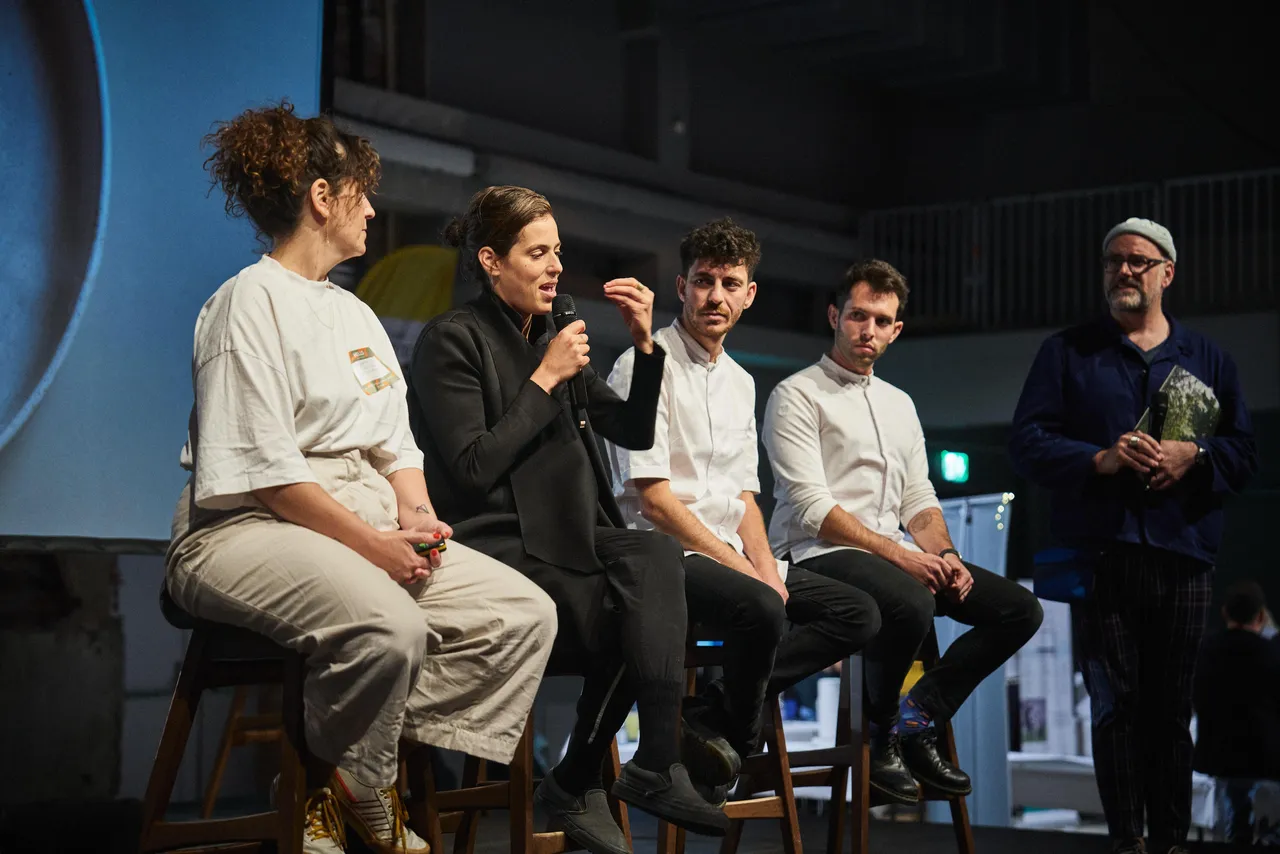
Michal Levit, left, Shirel Berger, Shalom Sincha Elbert and Raz Rahav on stage at the Big Meet food-tech conference in Stockholm earlier this month.Credit: Miki Anagrius

This view is shared by many in the Nordic countries, who Davis sees as the ones pushing for what he calls “the food system agenda” internationally. He cites Stockholm’s EAT Forum, which works toward “a fair and sustainable global food system for healthy people and a healthy planet.” That forum was founded by Norwegian physician and environmental advocate Dr. Gunhild Stordalen, who also supports the “chef manifesto” that deals with issues of hunger, nutrition and sustainable agriculture in connection with the UN’s Sustainable Development Goals blueprint.

Davis also mentions Danish chef René Redzepi’s Nordic Food Lab, Sweden’s many research institutes and another of his collaborators, Johan Jörgensen, the Swedish founder of the Big Meet conference. “Food culture is an amorphous area,” says Davis. “Everybody’s a food expert, but not everybody fully appreciates the cultural value of food. The transactions of eating in a restaurant and buying groceries are only two elements – but we’re looking to infuse that with a deeper meaning. It’s about value. When you think of classical music or dance or art, there’s an accepted appreciation of both the literal and figurative value; people spend a lot of money on them and there’s an effort to understand their meaning. But food is one of those things that are so pervasive and mundane that people haven’t paid attention to it,” he says.

“This isn’t new, but in my view a better-informed consumer public makes better decisions for itself, for its communities and for the planet. So, I’ve come to learn that Israel is perfectly situated for the food moment we need now because of the casualness of the way people eat, the variety of vegetables, the freshness, the entrepreneurial spirit and the technology. It’s a cliché and funny to even say it, but making the desert bloom is what everyone’s going to have to do not that far into the future.

“I have no proof of this,” he continues, “but you can see that Israeli restaurants are opening all over the world. I don’t think fine dining is over, but in the future it is going to look a lot more like a table in Israel than a table in 18th-century France – which it has looked like for a very long time.”

“The French created the idea of a national cuisine,” Davis says. “They codified it and then everybody else thought they had to do the same in response. But that’s the French way. Asif’s mission is not to define what Israeli cuisine is, because it’s a constantly changing and dynamic thing. But there is a clear distinction between Israeli cuisine and Jewish food. To use a French idea after all, there’s the notion of terroir – the combination of geography, history and culture.

“The evolution of what’s being cooked in Israel is a product of the people, the land, the climate and history of the country, whereas Jewish food is much more similar to what’s eaten in places Jews have lived than it is to food eaten by other Jews around the world. Jewish food is obviously a huge part of Israeli cuisine, but you can see that elements of different communities are finding their way into a common table: there’s the Bukharan dishes, there’s the new, amazing Druze restaurant Naifa, which I visited recently; there’s the prevalence of salads; the spreads; the sharing of plates; and all these second- and third-generation kids who now have restaurants and are referring back to their grandparents.”

“The three things I think are most important these days in food are a dynamic and diverse culture, a recognition of the impact our food decisions have on the environment, climate change and sustainability issues. And then there’s this idea of innovation and technology, which we all know we’re going to need.

Continues: https://www.haaretz.com/israel-news/2023-06-15/ty-article-magazine/.premium/israeli-food-tech-is-flavor-of-the-month-at-this-cuisine-confab/00000188-bab3-d481-a7a9-baff81580000

Burning of the Koran: Should Sweden Limit Its Absolute Freedom of Speech

The actions of far-right politician Rasmus Paludan anger many in the Muslim world, and raise the question: is it time for Sweden to restrict the freedom to say and do anything you want in the public arena?

Published in "Haaretz": https://www.haaretz.com/opinion/2023-02-06/ty-article-opinion/.premium/burning-the-koran-and-the-torah-challenges-swedens-absolute-freedom-of-speech/00000186-2666-d442-a18f-afef5bac0000

Officially, Rasmus Paludan is the leader of a far-right party active in Sweden and Denmark, but to call him a “leader” is misleading. Paludan, a 41-year-old lawyer with dual Swedish and Danish citizenship, has hardly any supporters – at least not in Sweden. Still, he's very famous there because of an unusual political tactic he developed: Burning the Koran.

A handful of supporters burned the Koran in Malmö in southern Sweden in 2020, and since then Paludan has repeated the act a number of times. In April 2022, he achieved exactly what he wanted. In response to his one-man show in a number of Swedish cities, criminal elements took advantage of the opportunity and set off riots, burned cars and attacked police. They gave Paludan and his pyromaniacal hobby impressive impact.

In January, Paludan returned to Sweden after he received a permit to burn a Koran in front of the Turkish Embassy in Stockholm. Not that he needed it, but this time he found a geopolitical excuse for his demonstration. For many months, Turkey has been using its power to prevent Sweden from joining NATO, supposedly because Sweden supports “Kurdish terrorists.”

Paludan exploited Sweden's justified anger and planned to score some points – or at the very least attract attention as another point of tension between the two countries. And that's what happened: Turkey and Muslims around the world aimed their arrows to the north. Boycotts were imposed on Swedish companies, protests were held in Muslim countries and Sweden’s entry into NATO looks more distant than ever. All this happened even though the vast majority of Swedes have reservations about Paludan, if they're not totally disgusted by him and his provocations.

So why have the Swedish authorities let Paludan harm their political interests and damage the social fabric? Because freedom of speech is absolute in Sweden. Some say that it's almost sacred and that civil rights such as freedom of speech and the right to protest and form unions have become in many ways the replacement for religion in one of the most secular societies in the world.

In Sweden, events like neo-Nazi marches and Koran burnings can cause riots and split society by stirring up emotions. This is how neo-Nazi movements can hold marches next to synagogues on Yom Kippur, supporters of dictators from around the world can demonstrate, and a person like Rasmus Paludan – who has almost no means in addition to his minuscule support – can undermine Sweden's national interests, cause riots and split society by stirring up emotions.

But the Swedes have another option. In recent years, some have argued that now is the time to restrict, if just a little, the freedom to say and do anything you want in the public arena. Despite the country's tranquil image, a prime minister and a foreign minister have been murdered in Sweden, which also has neo-Nazi movements, volunteers for the Islamic State, and harsh problems of integration and political violence – both above and below the surface.

The situation may still be better than in most countries, but Sweden is definitely not immune to the religious wars, social instability and political extremism spreading throughout the world in the third decade of the 21st century. Unsurprisingly, among those who understand the severity of the situation are Sweden's Jewish organizations. The Jewish community council there and the group Amanah, which promotes Jewish-Muslim dialogue, released a statement immediately after the Koran burning, saying: “Racists and extremists are once again allowed to burn the Koran, abusing democracy and freedom of speech to normalize hatred against one of Sweden’s religious minorities.”

Amanah mentions the “tragic history of Europe” and quotes Heinrich Heine’s famous words: “Those who burn books will in the end burn people.” In a democratic society, every person has the right to feel safe and respected, Amanah said, expressing its support for Sweden's Muslim minority and making clear that every act of discrimination and hate is unacceptable.

Proof of the need for this statement arrived quickly. In two separate cases late last month, Swedes of Egyptian origin tried to prove the “Swedish hypocrisy” by burning a Torah – in one case in front of the Israeli Embassy in Stockholm. It seems they thought that if they didn't receive a permit it would be proof of discrimination against Muslims. If they did receive one, it would add more fuel to the fire of hateful anger.

Even though the Israeli Foreign Ministry tried to take credit for intervening with the Swedes and preventing the burning of the Torah, it was others who prevented – or at least postponed – the incident. It was the Muslim community in Sweden, including people who cooperate with the Jewish community, who made the right calls and applied the right pressure to prevent the burning – at least for now.

True, dialogue alone won't solve the political, cultural and social problems today in Sweden – and outside it. Legislation, education, investment and sometimes even a little force are needed too. But dialogue is necessary; only it can set both limits and the rules of the game, because in the real world it's impossible to have rights without restrictions – and no one is better suited than Muslims and Jews to take responsibility together to set these limits.

Breaking news and 

Israeli Elections, October 2022

Published in Swedish daily newspaper Svenska Dagbladet (please note: this is an unoficial and unedited English translation)…

Israel is sometimes called the "only democracy in the Middle East", and in many ways it is. But Israeli democracy is very different from the Swedish one, even though theoretically both have similar parliamentary systems and the same kind of general elections. The differences are more about dynamics than technicalities. One important difference is that governments in Israel very rarely last an entire term, which is why Israelis will be going to the polls again on November 1st in what may seem like a déjà vu.  This is the fifth election campaign in the last four years and the 11th since 2001. In the same period Sweden had only six.

Even though recent years have been unusually unstable in Swedish politics, with weak minority governments and changing political alliances, this is nothing compared to the instability of Israeli politics. This instability combined with unique historical and cultural differences, make the coming up elections very difficult to understand for those who are not locals. Here are a few things to keep in mind if you're following the political drama in the land of milk and honey.

There's probably only one global household name in current Israeli politics – the name of Benjamin Netanyahu. Since Netanyahu first became Prime Minister in 1996, he has held the job for 15 years, even more than David Ben-Gurion who's considered to be Israel's founding father. Netanyahu is head of the "Likud" party and currently leads the opposition even though he's standing trial for bribe and fraud charges. But Netanyahu is more than just a candidate. He's the key issue of these elections. He's not a man leading an agenda. He is the agenda itself. In these elections, many Israelis won't be voting because they want to promote their ideology or influence concrete issues, they'll be voting because they love or hate Netanyahu. 

This leads to a misconception of Israeli politics. Since all recent elections ended in a tie between rival blocks, some assume this is a tie in the European style, meaning between left and right. But nothing could be further from the truth. In a European sense the Israeli left makes up 10 to 15 percent of the electorate on a good day. That is if left means socialist or social-democratic ideology combined with progressive values like secularism, civil rights, feminism, LGBT rights and multiculturalism. In Israel the blocks have nothing to do with all that. It's not socialists against capitalists or conservatives against liberals. It's all about Netanyahu. One block supports him, the other wants to get rid of him.

On Netanyahu's side, things are pretty clear – together with Netanyahu's "Likud" party, there's a coalition of Jewish ultra-orthodox parties, nationalist parties and representatives of West-Bank settlers. The other side, however, has no common values, ideas or interests with the exception of one – the idea of replacing Netanyahu. Led by centrist current Prime Minister Yair Lapid, it's a bizarre coalition based on middle class secular Jews supported by left-wing liberals, a variety of Israeli Palestinians (some Islamist, others secular, some nationalists, others old-school communist) and right-wing conservatives who for some reason or another are in conflict with Netanyahu. This is the main reason why the last Israeli government stayed in power for only a year and even during this short period it had to have two heads of government in rotation. If in Swedish politics, the old left-right spectrum became more complicated in recent years and developed into the so-called GAL-TAN spectrum, in Israel the opposite happened, things became simpler – the whole spectrum is reduced to one man.

But where exactly is Netanyahu on a left-right scale? That should be a simple question to answer since Netanyahu is and always has been a self-proclaimed right-wing leader. He's been called an Israeli Trump, an Israeli Orbán and even an Israeli Erdoğan (although they should be called American, Hungarian and Turkish Netanyahus since he assumed office before them). But context is king, and in an Israeli one, Netanyahu may be hated by the left, but that doesn't mean he's as right as it gets. In a social-economic perspective, Netanyahu used to be a Thatcherist, pushing for privatisations, tax cuts and restraining government spending, but it's been years since he spent his political capital on those kinds of issues. Today he leaves the economy in the hands of others. Though he's certainly a hawk and a sceptic when it comes to relations with the Palestinians, he's always been careful with the use of military power and he never went all the way towards Israel's hard core right which supports the annexation of the West Bank and putting an end to the so-called two state solution. In recent years Netanyahu has been mostly concerned with staying in power and avoiding prison. Unlike his potential successors, he's secular, he was raised in the US and has a western education and world view and he's an intellectual. In Israel this means that in many ways he's actually a centrist.

Just for the sake of perspective, the rising star of these elections is the 46-year-old leader of the "Jewish Strength" party, Itamar Ben Gvir, a man who first came to public attention when he threatened the life of Prime Minister Yitzhak Rabin a few weeks before he was assassinated in 1995. Ben Gvir also supported Baruch Goldstein an American Jew who massacred 29 Muslims in Hebron in 1994. The party Ben Gvir is currently part of has the support of 10 percent of the electorate in the latest polls. When it comes to ideology, Netanyahu is a middle of the road pragmatist compared to Ben Gvir and other Israeli nationalist and religious fanatics. The stark opposition he faces is more about his alleged corruption, opportunism and his relentless populist crusade against Israel's judicial system and law enforcement officials.

One of the reasons that Netanyahu's party is supported by over 25% of the voters according to polls is that in Israel many people don't vote according to their opinions. Rather, they vote according to their identity. It's not about what you think, it's about who you are. Arabs vote for Arab parties, religious people vote for religious parties, traditional Jews with an Eastern background vote for the Likud and secular Jews from a western background vote for one of the liberal centrist parties, usually led by ex-Army generals or former media celebrities. These include the Labour Party led by former TV and radio anchor, Merav Michaeli, and the National Unity Party led by Benny Gantz, former army Chief of Staff. To put it in a Swedish context – no one in Israel needs a "Val Kompas", many parties don't even have a party platform. a strong sectorial identity is much mor useful. The comparison may not be entirely fair, but in this aspect, Israeli parties are not very different from "Nyans".

Finally, Swedes may be surprised to know that the Palestinian issue is no longer an important part of the Israeli discourse. Back in the 80s and 90s, the lines of Israeli politics were drawn according to policies towards the Palestinians. The left promoted the two-state solution, the right argued against a Palestinian state. These days, the two-state solution is probably discussed more in Sweden's Foreign Ministry at Gustav Adolfs Torg, than it is in Jerusalem. It seems like both Israelis and Palestinians have lost faith in concepts like negotiations, compromise and peace agreements and a reality of a never ending low-intensity conflict is accepted on both sides. As a result, Israelis will not be voting to stop or to continue the occupation of the West Bank, they'll also not be voting about the threat from Iran, social issues or the economy. Instead, it's a mix of identity politics combined with anger about an eclectic collection of issues which happened to appear in yesterday's papers or social media feeds. When it comes to art and culture, entrepreneurship and industry, history and science, Israel is a beautiful country full of promise and potential. Its political establishment, on the other hand, has lost its way and is deeply divided. The only democracy in the Middle East is stuck in an endless spiral of election campaigns. The result of this fifth round is still unknown, but it may very well simply be nothing more than round number six.

Sweden's New FM Says 2014 Palestine Recognition Was 'Premature and Unfortunate’

Sweden’s new foreign minister, Tobias Billström, talks to Haaretz about recalibrating foreign policy, the importance of ties with Israel and the new government's far-right partners

published in "Haaretz": https://www.haaretz.com/world-news/europe/2022-11-22/ty-article/.premium/swedens-new-fm-calls-2014-palestine-recognition-premature-and-unfortunate/00000184-9f0a-d40d-a9ce-bf7f31f60000

STOCKHOLM – Swedish foreign policy has been unique for many years in Europe. The Scandinavian nation hasn’t joined military alliances since it was a military power in the 17th and 18th centuries, and hasn’t been involved in a war for over 200 years (with the exception of occasional peacekeeping missions far away from its borders). In the second half of the 20th century, its policy of avoiding alliances and maintaining wartime neutrality created a foreign policy that in many ways wasn’t about serving Swedish national interests. Instead, it was about becoming a “humanitarian superpower” and endeavoring to make the world a better place.

Naturally, there were those both at home and abroad who criticized this policy. Some saw Sweden’s attempts to position itself on the right side of history as self-serving, opportunistic and hypocritical. Others claimed its private sector’s thriving arms industry was incompatible with a government preaching peace, love and understanding. Another problematic aspect was Sweden’s close ties with a host of dictators and oppressive regimes.

Still, for decades, Swedish diplomats were crucial in bringing wars to a close. Swedish policymakers were generous when it came to humanitarian aid, and vocal when it came to issues like the struggles against apartheid and the Cold War arms race.

This tradition was maintained in recent years as well. As well as being the only Western European country to recognize a Palestinian state, Sweden did its best to export progressive ideas like “feminist foreign policy,” taking radical steps against climate change and building stronger international institutions.

But change is on the horizon. Sweden has taken its first steps to join the NATO military alliance and is building up its military capabilities in a way it hasn’t done for decades due to recent Russian aggression. After voting out the left-wing Social Democrats and electing a center-right government led by the Moderate Party and supported by the far-right Sweden Democrats, what is the future of neutral Sweden?

“Since I took office, I’ve been very clear that we need a recalibration of Swedish foreign policy,” says Sweden’s new foreign minister, Tobias Billström. “We need to make some very clear statements about our priorities. One priority, above anything else, is the NATO accession. With that we also have to think about our neighborhood – the Nordic states, the Baltic states and the countries surrounding the Baltic Sea. This is where we’re putting our emphasis. It’s not a choice between being active in the international arena and being focused on our neighborhood. You can do both. What you can’t do is be everywhere all the time and be active in all aspects. We’ll have to prioritize.”

This may be a seismic change on the national level but it’s not for Billström, who notes that his party “has supported joining NATO for years. And I believe that the question of neutrality ended in 1995 when Sweden became a member of the European Union.”

No Jerusalem embassy yet

Billström, 48, is an experienced politician despite his relatively young age. He has been a parliamentarian for 20 years, serving as migration and asylum policy minister from 2006 to 2014, and was a local politician before that. The role he now holds is one of his country’s most important considering current regional instabilities. He meets Haaretz at his Stockholm office, which is located in a beautiful 18th-century palace facing the Royal Opera House on one side and the Royal Palace and Parliament House on the other. He has just accompanied the king and queen of Sweden on a state visit to Jordan, one of his first on the job. He says he’d like to visit Israel one day and thinks that Sweden’s relationship with Israel is “excellent following the establishment of dialogue in 2021.” Still, no official visit has as yet been planned.

Eight years ago, one of the first steps of the previous government was to recognize a Palestinian state. What is your government’s position on the issue?

“The decision to recognize Palestine in 2014 was premature and unfortunate. However, the decision has been taken and this government doesn’t plan to revoke it.”

But it wasn’t just about recognition. The previous government was very active in this field: it appointed a special envoy to the Israeli-Palestinian conflict; it actively opposed Israeli settlements in the West Bank; and it supported the Palestinian Authority and the two-state solution. Is Sweden’s new government still committed to these policies?

“On the Israeli-Palestinian conflict, the government stands firmly behind the EU policy. We want to see a negotiated two-state solution based on international law. That decision will remain. As for being active, we will continue to criticize the parties when called for, when violations of international law are committed and when human rights are abused. We’ll do that in the same way we criticize other states when it’s justified. This is in no way contrary to having excellent relations with Israel or Palestine. The government will at all times stand up for Israel’s legitimate security needs.”

Would Sweden consider moving its embassy from Tel Aviv to the capital, Jerusalem?

“Like the EU, the government will continue to respect the broad consensus of the international community and relevant UN Security Council resolutions and regard Jerusalem as a final-status issue. Pending a peace agreement, Sweden’s embassy will not be moved.”

Your government plans to cut foreign aid drastically in the next couple of years – will this affect Swedish aid to the Palestinians, and could this lead to a problem with Sweden’s Palestinian partners?

“Sweden’s development cooperation with Palestine, just like the EU’s, ultimately aims to build the conditions and promote a two-state solution in line with international law. This goal will remain. As we review our overall development cooperation, we will also recess our Palestine strategy, which applies to the period of 2020 to 2024.”

What about aid to the Palestinian organizations that the Israeli government claims are terror groups? Or aid to the UN Relief and Works Agency for Palestine Refugees, which allegedly publishes schoolbooks containing antisemitic incitement?

“The government takes terrorist accusations very seriously and several of these civil society organizations – which were listed by Israel as terror groups in October 2021 – receive support from the EU, the United Nations, Sweden and other donors. Together, the donors within the EU followed up thoroughly on the allegations and concluded that no substantial evidence was provided. The donors will therefore continue to support Palestinian civil society. We believe that a free and strong civil society is indispensable for promoting democratic values and the two-state solution. Needless to say, if Israel makes convincing evidence available that would justify a review in the policy toward these organizations, we would act accordingly.

“When it comes to antisemitism, it is of course unacceptable and it’s very important that the PA ensures that its textbooks fully meet UNESCO standards, and that the EU continues to be clear in its dialogue with the Palestinians to ensure that this is the case.”

Israel’s new government will be led by former Prime Minister Benjamin Netanyahu. Are you confident that Israeli-Swedish relations, which have recently improved under another government, won’t deteriorate again under the new one?

“As Sweden’s foreign minister, I would like to see a good dialogue with countries we think we can maintain good relations with. The question of relations between Sweden and Israel is exactly about that: to have a dialogue on issues that we might disagree on – but we think it’s still a good thing to sit and talk about them.

“It’s not up to me as foreign minister of Sweden to say anything about Israel’s domestic policy. The people of Israel have a right to elect their government, just as the Swedish people have a right to elect our government. The important thing is to understand that in Sweden we cherish dialogue and would like to see it maintained.”

Just over a year ago, Israel’s ambassador to Sweden said Israel will not have any contacts with the populist Sweden Democrats party. Since then, it has become the closest and most important political supporter of your government. Will it influence Sweden’s foreign policy? And do you think Israel should have ties with it?

“It’s up to the Israeli government through its ambassador here in Sweden to choose with whom it wants to talk. As foreign minister, the case is very clear: the Swedish constitution says that foreign policy is shaped by the government, which keeps parliament informed. This means that since the Sweden Democrats are not part of the government, their influence is limited to exactly that – namely, parliamentary control, just like all the other parties represented in the Swedish parliament.”

A personal Holocaust story

As well as relations with Israel and the Israeli-Palestinian conflict, another Swedish policy to draw attention during the previous government’s term was the one concerning antisemitism and Holocaust remembrance.

For over 20 years, since a Swedish initiative started the International Holocaust Remembrance Alliance in 1998, Sweden has been considered a world leader in this field. Last year, the government organized a major international conference in Malmö dedicated to Holocaust remembrance and combating antisemitism. It also decided to open a new Holocaust Museum and accept the IHRA definition of antisemitism and its examples (which some have slammed for equating criticism of Israel with antisemitism).

When asked if his government is just as committed to combating antisemitism and preserving the memory of the Holocaust, Billström says: “Certainly! Combating antisemitism is very important and the new government is fully committed to doing so.”

Since Sweden is still struggling with many instances of antisemitism in schools, in some Muslim environments and in far-right circles, Billström knows the problem is still unresolved. “I will always be a very strong advocate against antisemitism,” he says. “We are working very closely with Israel on this. I appreciate the very fruitful cooperation with Israel during the IHRA presidency, and we’re looking forward to continuing the cooperation during Israel’s presidency in 2025.

“I would also like to make a personal remark on this,” he adds. “My grandparents in Malmö took in a Jewish family that escaped from Denmark across the Öresund strait, during the period in 1943 when the Gestapo tried to round up the Jews. I grew up with this story. I have this very nice diploma that says two trees were planted in their memory in Tzippori [in northern Israel] as thanks from this family. My grandmother and my mother, who remembers playing with the kids of this family, told me this story, and it has left a deep mark on me leading to my understanding of what the Jews and what Denmark went through.

“I’ve always believed that antisemitism is a horrible thing. When the Jewish burial chapel in Malmö was attacked during my time as migration minister [in 2009], I went there for the inauguration of the restored chapel and talked about my family’s story in my speech. For me, it’s obvious that there are examples of antisemitism in Swedish society that should be condemned, and it’s obvious there are people in our society who have not laid off the horrible idea that there are grounds for antisemitic persecution of people of Jewish origin in our society. That should always be combated – in schools, at workplaces, wherever we find it. As foreign minister of Sweden, this is something I have a very firm conviction about.”

What about the Sweden Democrats? Besides their past as a neo-Nazi party and many extremely problematic antisemitic opinions voiced by some of their leaders, the biggest party supporting your government supports various laws that could be problematic for Sweden’s Jewish community – such as forbidding circumcision and banning the importation of kosher meat. Are you sure your partnership with them won’t be part of the problem rather than part of the solution?

“I have to say that although there is certainly room for political debate concerning those aspects, as foreign minister it’s clear that the constitution limits their parliamentary influence. As to other issues you mentioned, they belong to areas under the influence of other ministers and I think that, again, under the limits of the constitution I shouldn’t be addressing them.”

One issue Billström is willing to address is Swedish-Iranian relations, which have been tense lately. A Swedish court recently sentenced an Iranian official, Hamid Nouri, to life in prison for war crimes committed in Iran in 1988. There are also two Iranian-born Swedes standing trial in Stockholm after allegedly spying for Russia, while Swedish nationals are also being held in Iran. The recent domestic demonstrations against the Iranian regime make it even harder for Sweden to maintain business as usual with the Islamic republic.

When asked if these events will bring about a change of Swedish policy toward Iran, Billström makes the Swedish position clear. He says that since Sweden has an independent judiciary, there is no government influence on verdicts in Swedish courts. This may be seen as a signal to Tehran about the government’s policy concerning the complicated court cases in both countries.

However, when it comes to the political arena, things are easier to act upon. “As we see it, there is no movement on the Iran nuclear deal,” Billström says. “But the developments in Iran are a source of great worry for Sweden, which also has a considerable Iranian diaspora. The violence directed against peaceful demonstrators is horrible. I had direct communication with the foreign minister of Iran a few days ago, and I was very frank about the way the Swedish government feels about this – we believe people shouldn’t be persecuted and that the use of the death penalty is absolutely unacceptable in every regard. However, we still feel there’s room for dialogue with the Iranian government on this – and the only way to influence them is by dialogue.

“We are also very clear that individuals who have participated in the persecution of demonstrators, and also those who have been involved in the sale of drones to Russia to be used in the war in Ukraine, should face sanctions. It’s very worrying that Iran is turning in this direction.”

Another Middle Eastern leader Billström’s government is dealing with is Turkish President Recep Tayyip Erdogan. Swedish Prime Minister Ulf Kristersson met him in Ankara earlier this month, in a bid to get Turkey to ease its objections to Sweden’s NATO accession.

“There is a trilateral memorandum signed by Sweden, Finland and Turkey,” says Billström, explaining the current state of affairs. “The memorandum has conditions that have to be fulfilled and will pave the way for the Turkish parliament to ratify Sweden and Finland’s accession to NATO. The visit to Ankara was good; I think it was a fruitful dialogue.”

It seems there are items on the Turkish president’s agenda – some domestic, others foreign – that are still causing him to block Sweden’s NATO ambitions. Billström thinks it is now time for the “relevant authorities in all three countries” to get to work, but doesn’t specify what the problematic issues are or when he thinks the process will be completed. “Because there are certain issues that have to be dealt with,” he concludes, “I don’t want to set a time frame. Because it’s not helpful to do that.”

Far Right Rising, Russia, Electricity Prices and Climate Change: What to Know About Today's Swedish Election

With 1.3 million voters under the age of 30, these are the new leaders of the younger generation in Swedish politics

Published in "Haaretz": https://www.haaretz.com/world-news/europe/2022-09-11/ty-article-magazine/.highlight/far-right-rising-russia-and-greta-what-to-know-about-todays-swedish-election/00000183-2b80-d7b2-abdf-abf7add50000

As the Swedish general election approaches, two issues are coming into focus. One is how difficult it will be to form a stable government after the election. Since the early summer, polls have been indicating that the two blocs representing the two possible government alternatives are having difficulty mobilizing a clear majority. They are alternating in the polls once every few weeks, unable to consolidate a clear advantage over one another and they are finding it hard to formulate a coherent message within the blocs themselves.

This is nothing new – after the previous election in 2018, the Social Democratic Party took 129 days to form a government and even after it was formed, it had trouble obtaining a parliamentary majority on the critical votes.

The second issue is the expected increase in the influence of the Sweden Democrats, the right-wing party that is considered by many to be populist and extremist (although it considers itself nationalist and conservative). In the past, the party was boycotted by the entire political spectrum and was not a candidate to join any coalition. This time, due to a change in approach by two of the traditional right-wing parties, it has become an integral part of the right-wing bloc.Open gallery view

The latest polls show that the Sweden Democrats is the country’s second-largest party, with over 20 percent of voters supporting it, at the expense of the Moderate Party, which has traditionally been considered the right-wing alternative for governing Sweden. According to the surveys, the largest party – with about 30 percent supporting it – remains the Social Democratic Party, headed by Magdalena Andersson, the current prime minster.

The composition of the two political blocs has changed in recent years, and has consolidated largely surrounding the attitude toward the Sweden Democrats. On the right a coalition is forming led by the Moderate Party and the Christian Democrats, with the support of the small Liberal Party and the Sweden Democrats, which despite its size is not seen as a ruling party but rather as an outside supporter.

On the left the Social Democratic Party is leading a very unstable coalition that is supported by the Green Party, the right wing-liberal Center Party and the Left Party, formerly the Communist Party. The election will be held on Sunday, September 11, and the expectation is that over 80 percent of the 7,772,120 Swedes with the right to vote will participate. About 1.3 million of them are under the age of 30, and almost 440,000 of them will be voting for the first time – more than in any other election campaign in Swedish history.

Romina Pourmokhtari, 26, Photo: Hamid Ershad Sarabi

Where did you grow up? Where do you live now?
“I grew up in Sundbyberg outside of Stockholm and still live there but in another part of the town."
What’s your family background?
“My parents immigrated to Sweden from Iran before I was born. My father got a degree in engineering and my mother in dentistry.”
How old were you when you entered politics?
“I joined Liberal Youth of Sweden in 2013 when I was 17 years old.”
What are your main political fields of interest?
“Education, combating climate change and feminism are my main fields of interest in politics. I strive to create a freer world where personal freedom is defended and expanded, and I believe that these subjects are important for achieving this.”
How far do you aim in your political career? what’s your political dream job?
“Right now I am a candidate for Parliament in Sweden. If I get elected on September 11th, I will have reached a big goal of mine. I want to continue my work there and a dream job would be a minister of education or culture.”
Who are your political idols and influences?
“I am very inspired by former LUF president as well as former minister of EU and democracy Birgitta Ohlsson. Her work for feminism and world-wide equality is inspiring to follow.”
What are your hobbies?
“Politics is a 24/7 business, especially during an election. But the few hours I am free I frequently visit soccer games for my favorite team (AIK), read books and walk my dog.”
What’s your living situation?

“I live with my dog Laban and my boyfriend Fredrik".

Like the young voters, some of the candidates for parliament are in their 20s. The younger generation in Swedish politics has recently been attracting attention outside of the country because Sweden traditionally plays a larger role in European politics than its relative size (a population of about 10 million). It is one of the most important countries in European Union institutions, it is expected to join NATO after 200 years of avoiding military alliances, it is one of the only European countries that still maintains the character of a social-democratic welfare state and it is accustomed to starring in international headlines in connection to many issues, from its policy of absorbing asylum seekers to its unique handling of the COVID-19 crisis.

Romina Pourmokhtari is the chairwoman of the Liberal Party’s youth league and a candidate for Parliament. One of the country’s most popular daily newspapers recently chose her as the most influential Swede under the age of 30. “Crime in Sweden is at the center of the public debate in this election campaign, as well as integration issues and the energy crisis that is causing a large increase in electricity prices,” she tells Haaretz at the offices of the youth league in Stockholm. “If we were to set the agenda, we would want to talk more about education and schools.” Pourmokhtari claims that there is a difference between the agenda of younger and older voters. “Young people are interested in questions concerning their lives – the climate crisis, rights of the LGBT community, issues related to the body such as the right to abortion, and of course also economic questions such as taxes, work and unemployment.”

The distinction between issues that interest older voters and those that interest younger ones is very clear in the election campaign. In recent years there has been a rise in violent crime by organized crime gangs, particularly in areas suffering from unemployment, poverty and segregation. The number of serious shooting incidents where innocent bystanders were also hurt have made the issue central to the campaign. Because of the war in Ukraine, electricity costs has become a main issue as well.

Meanwhile, the issue of climate change seems to have taken a back seat. Last Friday, the world's best-known climate activist, Greta Thunberg, took part in a "Fridays for Future" protest in Stockholm. She was quoted as saying: "The climate crisis has been more or less ignored in this election campaign. At best it’s been reduced to an issue about energy. So we have a lot to do."

“The problem of organized crime and the terrible shooting incidents we’re seeing now are causing a kind of doomsday feeling in the public debate and in the media,' says Pourmokhtari. 'The other issues on the agenda are wallet issues – the increase in electricity and fuel prices as a result of the energy crisis. These are questions that look like domestic issues, but they are international issues too,” says Christopher Lindvall, 26, one of the leaders of the Social Democratic Party’s youth league, the head of its international committee and a candidate for Parliament.

“Many questions that the younger generation is interested in are now filtered through the main issues that the parties are dealing with. For example, many young people are now in favor of nuclear power because they think that’s the way to get energy and move away from fossil fuels.

Christopher Lindvall. Photo: Emil Nordfjell, SSU


Where did you grow up? Where do you live now?
“Järfälla, northwest of Stockholm.”
What’s your family background?
“I’m from a working-class background; my father works in a storage factory and my mother retired early.”
How old were you when you entered politics?
“I joined the Swedish Social Democratic Youth League in 2013, and have been a member of the Järfälla municipality parliament since 2018.”
What are your main political fields of interest?
“My main political fields of interest are international issues, defence issues and welfare.”
How far do you aim in your political career? what’s your political dream job?
“I am running for Parliament now, so that is my aim.”
Who are your political idols and influences?
“Former foreign ministers Anna Lindh and Margot Wallström.”
What are your hobbies?
“Being out and about in the nature! I also like to read whenever I do have the time.”
What’s your living situation?
“I live with my girlfriend".

“As far as the general sense of security is concerned, this is of interest to both the older and the younger voters. I myself felt it last week when I came back home from a meeting in the city center late at night – there were shootings right outside my window two nights in a row. These are problems that can happen everywhere to almost everyone, and they’re related to segregation and a class society that has become much more present in recent years. This happened because the government in Sweden has recently withdrawn from many areas and left them to the private sector,” he says. As a result of various reforms in Sweden, the authorities still fund universal healthcare and education, but in some cases, private companies are the ones providing the services.

“Both in the case of health care and education, we waste a lot of our tax money by funding private schools and clinics,” Lindvall continues. “Now the schools in many areas lack funding and professional teachers. Education is the best way to achieve social mobility. I myself come from a working-class family, and with a good education I got the opportunity to go to university. There is also a clear link between crime and poor school results. Segregation in housing is also important. The wealthier local authorities do not build cheap housing for rent, so immigrants are forced to live in segregated areas.”

Lindvall is well aware of the fact that his party has been in power for the past eight years and that it will be hard to convince voters that it is not largely responsible for the situation he describes. When we meet in the cafe of one of the Swedish labor movement’s educational centers, he explains that the Social Democratic Party was forced to be pragmatists and to compromise on many issues. According to Lindvall, the situation would be worse if the right were in power. He hopes that his party will be able to govern in Sweden even after the election, with the support of various parties, on the right and the left, each of which will support legislation on various issues.

There is, however, one party he’s not willing to cooperate with. “My red line is the Swedish Democrats. This is an immature party that has proven time and time again that they have neo-Nazi members and people who praise [Russian President] Vladimir Putin. For me, they are off limits.”

‘Unjustified prejudice’

Tobias Andersson, also 26, is a member of the Swedish Democrats and the Chairman of the Young Swedes SDU since 2015. He is used to hearing things of this nature about his party and is familiar with the argument that many of those who started it in the late 1980s were right-wing extremists, racists with fascistic tendencies, and he is used to hearing that his party has Nazi roots. “Some of my opponents tried to put the weight of the past on me,” he says in a conversation the Parliament building. “But I was born in 1996 and joined the party in 2012. I have no opinion about what the founders of the party did before they founded it in 1988. From what I’ve read, many of those people were terrible people, but when it comes to our policy, almost from the start there were almost no such issues. There are things that I’m glad we changed, but in general, our policy is far less extreme than the way it is portrayed. Occasionally we still find extremists in our party, we have a responsibility to keep them out and I’m proud that we’re doing so.”Open gallery view

Andersson has been a member of Parliament since the previous elections. He is a member of the party leadership and heads its youth league. He claims that the prejudice against the Swedish Democrats is unjustified. “If a racist sits in the basement of his parents’ home and hears from the media, from his friends and from his teacher that we’re a racist party, it seems to me a rational decision to join us. I’m not saying we’re not at all to blame, but maybe the need of our opponents to portray us as racists doesn’t help us to keep the racists out of the party.”

Regardless of the question of racism among Swedish Democrats members, there are certain aspects of the party’s activities that are more characteristic of a centrist party and could explain its increased strength in the polls. Andersson claims that when it comes to welfare issues, they are in the center of the political map, somewhat more to the left when it comes to the job market and somewhat more to the right regarding financial issues such as lowering taxes. He believes that he problem is that the system is falling apart. “We pay some of the highest taxes in the world, but many people feel that their children have to register for a private school in order to provide them with a good education. With all those taxes, we still spend little on the police and the crime level is high. How did we get to this situation?”

Tobias Andersson

Where did you grow up? Where do you live now?
“Outside of Skövde in the countryside. I now own an apartment in Skövde and in Stockholm I stay at an apartment provided by the Parliament.”
What’s your family background?
“Working class from rural areas.”
How old were you when you entered politics?
“16 years old.”
What are your main political fields of interest?
“Judicial policies and civil society issues.”
How far do you aim in your political career? what’s your political dream job?
“I aim to help strengthen my party and do my best to make Sweden a better country, where that leads the future will tell.”
Who are your political idols and influences?
“Never truly had any, I’m not driven in that way.”
What are your hobbies?
“Training, hunting, cooking, eating and drinking.”
What’s your living situation?
“I am officially single at the moment, so I can focus on the election campaign 100 percent".

For Andersson, crime in Sweden is related to the economy, but also to the immigration policy. He thinks that immigration has created cultural clashes: “We warned that that’s what would happen. If people from a certain part of the world were unable to live in peace for 1,400 years, they won’t start to do so when they arrive in Sweden either. These are conflicts that were imported into Sweden. There’s also the socioeconomic component that has worsened due to mass immigration. There are about 700,000 people who come from immigrant families, who are incapable of supporting themselves and live at society’s expense. That has contributed to a poor socioeconomic situation in certain areas, which leads to crime.”

‘A different Sweden’

As opposed to Andersson, for whom issues of law and order are at the top of the agenda, Aida Badeli, 26, head of the Green Party’s youth league and a candidate for Parliament, claims that nothing is currently more important than the climate issue. “We’re emphasizing the reduction of carbon emissions, but also issues of social justice, economic justice and a war against racism. The conservatives in Sweden have taken control of the agenda, but we have to show the young Swedes and the rest of the country that we believe in a different Sweden, one in which there are equal rights for all and a responsibility to reduce the emissions here in Sweden as well, not only in other countries.”

Aida Bedeli

Where did you grow up? Where do you live now?
“Gothenburg, now I live in Stockholm.”
What’s your family background?
“I was raised by a single mother.”
How old were you when you entered politics?
“15 years old.”
What are your main political fields of interest?
“Human rights.”
How far do you aim in your political career? what’s your political dream job?
“I live in the moment. I have no aim in my political career, I just want to make the world a better place.”
Who are your political idols and influences?
“My uncle and Olaf Palme.”
What are your hobbies?
“Netflix and hanging out with friends.”
What’s your living situation?
“I live with my boyfriend".

Like most of those running in the Swedish election, Badeli believes in the Swedish welfare model even though her party focuses on the climate crisis. “I’m trying to push my party leftward so we’ll talk more about social justice,” she says. “We see that in Sweden, the social disparities are growing. Many young people don’t finish school, the health care system is not longer good enough, and young Swedes, mainly young men, are murdering one another due to poverty and lack of justice.

“There are children who don’t have enough food at home. Although it’s not poverty like in Africa, it’s poverty that we haven’t seen here for a long time. The welfare state must be stronger, I don’t believe that the free market will take care of the needy. The government must do that and increase the budgets that haven’t increased since the 1990s.”

Badeli proposes higher taxes for the top 1% of the wealthy in order to pay for the increase in budgets and finance the cost of joining NATO. Although she and her party were initially opposed to joining NATO, almost nobody in the election campaign is discussing the topic, which only a few weeks ago was the most talked-about issue in the country. Foreign policy, as important as it may be, is simply not on the agenda.

However, the young candidates certainly have something to say on the subject. Pourmokhtari, of the Liberal Party, is opposed to Swedish neutrality, which came to an end with the decision to join NATO, and is proud of the fact that her party has been advocating this change for over 20 years. “There’s good and bad in the world,” she say. “Joining NATO is part of international solidarity and Swedish values – it’s our responsibility as a free democracy.”

Lindvall, of the Social Democratic Party, says that the war in Ukraine was a decisive factor in his party’s position on NATO. “There is now a general trend of return of authoritarian governments that are more aggressive, expansionist and nationalist, such as Russia and China. And when democracy is threatened, it is important that democracies work together. I wasn’t happy with the decision to join NATO [which was the result of a radical policy change by the leadership of the Social Democratic Party in the face of internal opposition], but now that it’s done, it’s important that we work within it and be a clear voice for disarmament together with other Nordic countries,” he says.

The Sweden Democrats were also opposed to joining NATO at the start, but changed their position after Russia’s invasion of Ukraine. Andersson says that their position was always nationalist, in favor of sovereignty and rejecting intervention by groups such as the European Union. With the situation that has been created with the war in Ukraine, he says, it was natural for them to examine public opinion. After listening to it, they tended to favor joining.

Badeli, leader of the Green Party’s youth league, is aware that for most of the voters, this election will be decided based on issues such as the prices of energy, fuel and food. In spite of that, she sees a bigger picture. “The most important thing is planet Earth,” she says. “We must have a place to live, it’s a question of survival. But it’s also important for us to have social justice. We care about the planet but no less than that, we care about the human beings living on it.”

Over 100 Murders: The Iranian Standing Trial for War Crimes in Sweden

Hamid Nouri is charged with being involved in over 100 murders and war crimes during the bloody Iranian massacre of July 1988. In a unique legal case, Stockholm District Court may sentence him to life in prison

Published in "Haaretz": https://www.haaretz.com/world-news/europe/2022-06-21/ty-article-magazine/.premium/over-100-murders-the-iranian-standing-trial-for-war-crimes-in-sweden/00000181-853d-ddb4-a3ab-d5fd84520000

STOCKHOLM – At the time, Manoochehr Eshaghi didn’t really understand why he was taken out of the line. Leaving Tehran’s Evin Prison courtroom, after a collective legal proceeding lasting only a few minutes, he and the others in his group were blindfolded and ordered to walk toward a bus, each holding the shoulder of the man in front. When the bus dropped them off, Eshaghi was told to wait by a wall. From under the blindfold, he could see the others. Joined by prisoners from other buses arriving on the scene, they were divided into groups of four. These were their last moments, and Eshaghi, the lone survivor, can’t forget them.

They stood with their backs to their executioners. A few words were said to announce the verdict and some of them shouted out last words. Then came the shots. “Nobody begged or showed any weakness,” Eshaghi says some 40 years on, in an interview in a Stockholm café not far from his home. “Some shouted ‘Long live freedom!’ Others shouted ‘Death to Khomeini!’ After a first round of shots, the commander checked the bodies and shot them again in the head. I just sat there and cried.”

The apparent reason Eshaghi was spared was because he had yet to reach puberty. Today, aged 55, he remembers the demonstration that caused his arrest in 1981. He says he was there to support his uncle, who was a supporter of the People’s Mujahedin of Iran (aka Mujahedin-e-Khalq, or MEK), a student movement that in those days combined a modernist version of Islam, Marxist influences and opposition to Ayatollah Ruhollah Khomeini’s Islamic clergy.

Eshaghi was sentenced to 10 years in prison, during which time he saw many of his prison mates executed. Sometimes he and others were made to carry the bodies and load them onto trucks. He says prisoners were raped by guards; many, including himself, were tortured and placed in solitary confinement. When he was transferred to another prison – Gohardasht in Karaj, west of Tehran – things only got worse. Violence there was part of the daily routine. One form of torture Eshaghi remembers is being beaten by the guards and then stuffed into a small unventilated room together with other prisoners until they almost suffocated to death. They called it the “gas chamber.”

Eshaghi was at Gohardasht during the summer of 1988, when thousands of political prisoners were executed by hanging. He remembers many of his cellmates being taken to a committee and asked about their political beliefs. Some agreed to show remorse, condemn the Mujahedin movement and ask for mercy. Others refused, not knowing in those early days that rejecting the terms meant being sent to the gallows.

Thirty-four years have passed but Eshaghi hasn’t forgotten his cellmates who were murdered, or the men in charge of the killings. One of them, a deputy to the assistant prosecutor, was a man he knew as Hamid Abbasi. In an unexpected turn of events, Abbasi, whose real name is Hamid Nouri, is now standing trial for the 1988 Gohardasht and Evin killings not far from the Stockholm café where Eshaghi told me his story.

A protester outside Stockholm District Court during the trial of Hamid Nouri last month. David Stavrou

According to the prosecutors, in the space of just a few weeks, Nouri and his colleagues rounded up thousands of prisoners, gave them staged trials and handed down death sentences. Most of them were People’s Mujahedin of Iran supporters, others were members of left-wing movements. It was all done secretly, hastily and deceitfully. At last, Manoochehr Eshaghi, who was asked to testify at the trial, got to face one of his torturers. “I’m 100 percent sure it’s him,” he says, “and he knows exactly who I am too. Me and my two brothers, who were also imprisoned in Gohardasht, were targets for him. When I first saw him in court, I was frightened. But then I calmed down. When I testified, it felt good. Finally, he had to answer questions and take responsibility.”

Nouri, who is 61, is charged with more than 100 murders and war crimes. The verdict will be announced on July 14 and, if convicted on both charges, he may spend the rest of his life in a Swedish prison.

***

The trial in Stockholm District Court began last August, almost two years after Nouri was dramatically detained at Stockholm’s international airport. According to the prosecution, back in 1988 Nouri was one of those who took the prisoners to the so-called death committee and then to the execution chambers. He was also involved in the torture, the hangings and the secret burial of the victims, they say.

Nouri projected an air of confidence during the trial. He was always well-dressed and looked elegant when his handcuffs were removed and he took his place at the defendant’s table. His behavior during the proceedings was eye-catching: he exchanged intense looks with witnesses and members of the public attending the court sessions. He occasionally mumbled a few words or expressed his opinion using body language. He followed every word (translated into Persian for him from Swedish, and vice versa), read the material presented to the court and exchanged remarks with the judge, lawyers and law enforcement officers.

On the days when he presented his side of the story, it sometimes felt like he was lecturing the court with a mix of self-praise, political theories and theatrics. He claimed he wasn’t a violent man, never hurt anyone and that everybody loves him. He also praised Iran and its regime, which has to face the “terrible lies” it’s accused of and made harsh allegations against the Mujahedin movement, which he refused to call by name – referring to it instead as “the little group” that “murdered thousands of Iranians in a way that makes ISIS look like innocent children.”

It was as if Nouri was certain he’d soon be back home and wanted to avoid being seen as a man who turned his back on his previous ideals and comrades. At times, it seemed as if Nouri’s testimony had very little to do with a coherent legal defense or the advice of his Swedish lawyers. He claimed that although he used the alias Hamid Abbasi and worked at Evin Prison, he was not the only Hamid Abbasi there and he wasn’t employed at Gohardasht at all.

He also claimed that because his wife had just given birth, he was on leave on the dates when the supposed executions took place – but according to him there were no mass executions at all. Even so, the Swedish court, the plaintiff’s lawyers and prosecutors put an enormous amount of work and resources into this unique trial, which is based on the international legal principle of universal jurisdiction. This allows for crimes that are deemed a threat to the whole of humanity to be prosecuted by national courts regardless of where they were committed.

The trial even relocated to Albania for a few weeks in November, in order to hear from witnesses who are still Mujahedin supporters and are based there. But it wasn’t the tireless work of Swedish authorities that first brought Nouri to Sweden on November 9, 2019. Rather, it was the determination of one man: a former Iranian Mujahedin supporter called Iraj Mesdaghi.

***

Mesdaghi is another survivor of the 1988 massacre who lives in Sweden. He was born in Tehran and educated in the United States. Although he is today a harsh critic of the Mujahedin movement, he was a supporter back in 1981 when he started a 10-year prison sentence, during which he was subjected to violence and torture.

In 2019, decades after arriving in Sweden, Mesdaghi received information that one of his torturers – the man he knew as Hamid Abbasi – was traveling to Stockholm for a private visit. It turned out that one of his stepdaughters used to be married to a Swede and was involved in a custody dispute over their 2-year-old child. When Mesdaghi heard of this, he put a complex international legal plot into action.

“With the help of one of Nouri’s Swedish acquaintances, who secretly assisted me, I got Nouri tickets for a cruise and booked hotels for him in order to tempt him to start his trip in Stockholm, meet the family here and then go on vacation,” he recounts in an interview outside the courtroom.

Iraj Mesdaghi

“After making these arrangements, I traveled to London and met with British lawyers and legal advisers to start preparing the case. Later, they contacted a Swedish lawyer, who got in touch with the Swedish prosecutor.” Mesdaghi was initially concerned about the Swedish government being reluctant to get involved. “I know the European system,” he says. “There’s a difference between foreign affairs, intelligence services and the justice system. Everyone does their job. Intelligence services are concerned about keeping the country safe, they don’t care about justice. But I created the scenario and I knew we could get him here.”

The plan worked. Nouri was arrested upon arrival in Stockholm and charges were filed against him. When the trial finally began some 21 months later, it was only natural that Mesdaghi would be the first witness. He told the court about how he was taken from his cell in Gohardasht and stood in line, blindfolded, with other prisoners awaiting trial. When the procedure began, he was not officially warned that the next few minutes could seal his fate. However, he understood that his answers could send him straight to the executioners who were waiting on the other side of what would be known as the “death corridor.”

Mesdaghi was therefore willing to promise that he would not carry out political activities upon his release. In the following days, he met the committee again, signed various written statements, was tortured by prison guards and witnessed many of his fellow inmates being taken to their deaths as his own fate was hanging in the balance. After his eventual release and escape from Iran in 1994, Mesdaghi wrote extensively about the events leading up to the summer of 1988. He claims there was a power struggle within the Iranian political elite as the Iran-Iraq War was coming to an end, Khomeini’s health was deteriorating and the question of political prisoners was dividing his assumed successors.

Hussein-Ali Montazeri, the designated successor, was opposed to the massacre, while other senior officials such as Akbar Hashemi Rafsanjani and Ali Khamenei were supporters. Mesdaghi experienced the results of this geopolitical drama in solitary confinement, when he heard the guards speaking of a fatwa soon to be issued by the supreme leader. Toward the end of July 1988, it was obvious something was going on: prison visits were canceled, prisoners were being moved between wings, and access to newspapers and television was denied.

The fatwa, which was issued on July 28, sanctioned the execution of political prisoners who were still loyal to the Mujahedin. Later, Khomeini allegedly issued a second fatwa targeting left-wing prisoners. Mesdaghi explains that when Montazeri objected to the massacre, he was removed from his senior positions by Khomeini, who also set up the so-called death commissions. In the Tehran area, the commission that arrived at Gohardasht on July 30 included Sharia Judge Hossein Ali Nayyeri and Tehran prosecutor Gen. Morteza Eshraghi. When Mesdaghi faced the committee on August 6, he recognized the two as well as the man who he knew as Naserian – now known as Mohammad Moghiseh, a judge in Tehran’s Revolutionary Court. Naserian’s deputy was Hamid Abbasi, who Mesdaghi recognizes as Hamid Nouri. The committee included several others who would become extremely important figures. One was Mostafa Pourmohammadi, an intelligence official who later served as a minister under presidents Mahmoud Ahmadinejad and Hassan Rohani. The other would become even more significant. His name was Ebrahim Raisi.

***

In Iran, the president is second only to the supreme religious leader in the chain of command. The fact that Raisi was a key player in the 1988 massacre, and then became Iran’s president in June 2021, makes the Nouri trial even more momentous. One of the prisoners who clearly remembers Raisi is Fereydoun Najafi (62) who now lives in Australia and was one of the witnesses in Nouri’s trial. “When taken to the committee I told Raisi that I didn’t do anything. I said 'I’m not against you, I don’t care about the Mujahedin’. Raisi then told me to go and wait outside, and I was returned to my cell. After that I was transferred back to Evin where I spent three more years”. Unlike other prisoners, Najafi answered the committee members this way, because he already had information about the proceedings and their possible results thanks to two other prisoners who managed to contact him before their executions and explained the situation by morse code. "Other prisoners didn’t know and they just asked to be left alone", says Najafi, "which meant that they are still Mujahidin supporters”.

Najafi, who was arrested because his brother and sister were Mujahedin supporters, was beaten and tortured, sent to Evin and given a harsh sentence of 15 years with no real grounds. He was later transferred to Gohardasht where he spent three years in solitary confinement. When he was called in to face the Death Committee, he was asked a couple of questions. He recognized Eshraghi, Nayyeri, Naserian and Raisi who he said received his file from Hamid Abbasi who he’s now completely sure is Hamid Nouri. “Even if you forget everything”, he says, “you never forget your enemy. This guy is a torturer. I’ll never forget him”.

“The trial of Hamid Nouri is one of the most significant events during the rule of the Islamic regime,” says Mehdi Aslani, another trial witness. He is a writer and activist who is now based in Germany and was a member of the left-wing Fadaiyan-e-Khalq (FKO) in the 1980s. “Up until recently, arrests of Islamic regime operatives were predominantly linked to their activities outside of Iran. Whereas now, for the first time, someone is facing justice outside Iran for involvement in crimes against political prisoners in Iran.”

Mesdaghi (left) and Aslani leaving the Stockholm courtroom. David Stavrou

For Aslani, it’s not just about politics. He says that when he stared Nouri in the eye during the trial, he remembered friends who perished in their youth and shed a tear for the victims of the 1988 “thought inquisition and slaughter of intellect.” “Khomeini’s second fatwa is even more sinister and outrageous than the first one against the Mujahedin,” says Ervand Abrahamian, a U.S.-based historian of modern Iran. “The first fatwa tried to get the prisoners to deny the Mujahedin and rat against their colleagues. The second fatwa is medieval. It’s against apostates, the members of the left-wing groups. They were asked other questions such as did they pray? Or did they believe the Koran is the word of God? According to strict Islamic law, apostates can be executed. This is a case of medieval law in 20th-century Iran.

“There are two different stories here,” he continues. “The first one, the war on political opponents, is brutal but it’s normal in 20th-century politics. The second, the execution of prisoners because they were nonbelievers, is like the [Spanish] Inquisition.” Abrahamian estimates the number of executed members of the Mujahedin at between 2,500 and 7,000, while the number of left-wing activists who were killed was smaller (probably several hundred). The Mujahedin victims may include prisoners of war who were executed after Operation Mersad – an invasion of Iran in July 1988 in which Iraqi forces and Mujahedin fighters cooperated. Whatever the real number, the American-Iranian historian says the regime “wanted to keep a lid on the information and never admitted anything.”

But the massacre didn’t remain a secret. Members of the Iranian diaspora have been talking about it for decades; there are books and reports on it; and international organizations have been demanding justice for years, including Amnesty International. Many of these organizations have been present at the Stockholm trial, which is currently in recess ahead of the verdict next month, and it is clear that although they are united against the Iranian regime and Nouri as its representative, they are sometimes strongly opposed to each other as well. Under the surface, there are many accusations and deep animosity between Mujahedin supporters, former Marxists, human right activists and different Iranian diaspora groups.

Inside Iran, however, the regime seems to be united in a new strategy toward the West. Former presidents “Khatami, Rohani and Rafsanjani were interested in foreign relations and the image of Iran in Western Europe,” Abrahamian says. “Raisi couldn’t care less. I think they’re not worried about the West anymore; they’re isolationists, and they’re counting on Russia and China.

Ervand Abrahamian Photo: Emma Nolan-Abrahamian

A prime example of the way Iran is behaving toward Europe nowadays was offered in May. In what was widely seen as an attempt to affect the Stockholm court, Tehran is threatening to execute Iranian-Swedish doctor Ahmadreza Reza Djalali, who was convicted of espionage in 2017 in what human rights groups regard as a highly dubious trial. The Islamic republic, it seems, is trying to get Nouri back and is certainly not accepting any blame for the 1988 massacre.

Nouri himself continues to deny a massacre ever happened, praises Iran’s leaders and threatens his opponents. In this sense, he can be seen as a warning. If he is the face of the current Iranian regime, negotiations over the new nuclear deal, oil sales and sanctions may be different than in the past. “Concerning the nuclear discussions in Vienna,” historian Abrahamian says, “the premise in the West is that Iran wants an agreement with the world powers, including the United States. But that may not be true now that the right-wing, die-hard extremists are in charge.”

If he is right, Hamid Nouri’s trial may be just the beginning of a whole new chapter in Iran’s relations with the West.

Sweden and Finland to join NATO due to Russian Threat

This is how the debate in Sweden changed, leading to the announcement Monday the country will join Finland in seeking NATO membership

Published in Haaretz: https://www.haaretz.com/world-news/europe/2022-05-16/ty-article-magazine/.premium/fear-won-in-swedens-battle-between-neutrality-and-the-russian-threat/00000180-e9f4-d189-af82-f9fd10820000

STOCKHOLM – Until a few months ago, nobody would have bet on Finland and Sweden joining NATO at all, much less doing so at lightning speed. Public opinion opposed the idea, as did both countries’ political establishments; neither country’s political system was built for rapid decisions on defense affairs; and most importantly, both countries had a decades-old tradition of avoiding military alliances. In Sweden’s case, this was an ideological approach. The last time Sweden was involved in a war was in 1814. Throughout the 20th century, it tried to position itself as a humanitarian superpower that, instead of taking sides in wars, tried to mediate between the parties, while also supporting international institutions, mediating conflicts and taking in refugees. Thus, it ostensibly remained neutral in World War II and nonaligned during the Cold War.

In Finland’s case, its neutrality stemmed from fear of the superpower next door. Finland shares a border with Russia that is more than 1,300 kilometers long. It was once part of the Russian Empire, fought against the Soviet Union during World War II and was threatened by Moscow during the Cold War. The last thing it wanted after the Soviet Union fell apart was to get involved in a new conflict with the Russians. But then Russia invaded Ukraine, and both countries’ unalignment policies melted away.

Finland and Sweden were always completely Western in their orientation. And practically speaking, it’s an open secret that they have been cooperating with NATO for years. But Russia’s invasion of Ukraine revealed a flaw – if Ukraine could be ruthlessly attacked by Russia while the world settled for economic sanctions and condemnations, who would protect Sweden and Finland? After all, just like Ukraine, they are independent countries that aren’t under the protection of the NATO alliance, and particularly the treaty’s Article 5 which states that an attack against one NATO country is considered as an attack against them all.

Consequently, the invasion of Ukraine produced a turnaround in Finnish and Swedish public opinion. Immediately after the invasion began, polls published in both countries showed that for the first time in history, there was widespread public support for joining NATO.

In Finland, 50,000 people signed a petition to join the alliance, and parliament began feverish discussions that culminated with Prime Minister Sanna Marin and President Sauli Niinisto saying in a joint statement that “Finland must apply for NATO membership without delay.” To enable the implementation of this decision, parliament will hold a vote on the issue in the coming days.

Sweden isn’t lagging far behind. Defense Minister Peter Hultqvist, who asserted in the past that “As long as I’m defense minister, I can promise that we won’t join” NATO, told Sweden’s national broadcaster last week that “Nordic mutual defense will be strengthened if Sweden and Finland join.” Explaining why he changed his position, he said, “There’s before February 24 and after February 24,” referring to the date when Russia invaded Ukraine.

Over the weekend, a parliamentary committee submitted a report about the worsening of Sweden’s security situation following the invasion of Ukraine. Many saw this as further support for those who advocate joining NATO. The ruling Social Democratic Party announced on Sunday that it had changed its position and would support joining NATO, and took the formal decision to apply on Monday after a debate in parliament.

“In Finland, the question of joining NATO was always a practical one, but in Sweden, it’s a more sensitive subject,” says Hans Wallmark, a veteran Swedish parliamentarian from the center-right Moderate Party who has supported joining NATO for years. “For part of the left, not being a member of NATO was almost a religious position, so for some politicians, supporting joining NATO is like converting to another religion. Therefore, it’s difficult and painful.

“When Russia invaded Ukraine and the Finns began their joining process, the Swedish Social Democratic Party was more or less pushed into the process,” adds Wallmark, who is deputy chairman of parliament’s Committee on Foreign Affairs. Nevertheless, he said, Sweden shouldn’t join NATO just because it’s forced into it, but because it’s the right thing to do.

“There are three reasons why Sweden should join NATO,” he continues. “First of all, there’s Article 5 of NATO’s treaty, with its principle of ‘one for all and all for one.’ Second, there’s a need for joint defense planning with other countries in the region, and third, this is an issue of solidarity with European and North American countries.”

Deterrent power against Russia

On the other side of the Baltic Sea, Jouni Ovaska, a member of Finland’s parliament representing the Center Party since 2019, made many of the same points as his Swedish colleague. As a member of his parliament’s Foreign Affairs Committee, he is also involved in the parliamentary proceedings to enable Finland’s membership bid. “Membership in NATO will guarantee Finland’s security, because of the alliance’s substantial deterrent power,” he says. “And of course, the most important thing is Article 5 of the treaty. ”Nevertheless, he says, Finland must continue investing in its own military and training its soldiers, just as it has until now, and continue cultivating its other international partnerships.

“The European Union is our main partner, and most European countries are NATO members,” he notes. “I hope joining will strengthen European countries so that they can take care of defense on their own. Sweden is our closest partner, and if it, like all the Nordic countries, becomes a NATO member, this will provide greater security for the entire region.” Ovaska says the Finns have moved very swiftly to join NATO. “February 24 changed everything,” he says. “We have cooperated with Russia in the past, but the invasion of Ukraine showed that we can’t trust it. That’s why we rethought the situation. Public opinion changed very quickly, more quickly than change happened among elected officials.” He says the change in public opinion stemmed directly from the war in Ukraine: “What was done to Ukraine dredged up memories from the past. It’s not like something from the 21st century, it reminds us of atrocities from many years ago, and we have to make a change.”

However, there are some who oppose joining the military alliance. The Swedish Green Party, for example, argues that Sweden should be an independent power that promotes democracy and peace in the world, not part of a military alliance that possesses and bases its power on nuclear weapons. According to the Left Party, Sweden will defend itself better if it adheres to the policy of refraining from military alliances, which it says has served the country well for many generations.

The two parties that oppose joining NATO have a total of just over 40 seats out of 349 in the Swedish parliament. In Finland, opposition to the move is even smaller, and at this point is heard only on the fringes. Therefore, it seems that Sweden and Finland’s rush into NATO is inevitable, although the process itself is not short. “After the official request is submitted to Jen Stoltenberg, the NATO secretary general, in Brussels, Sweden and Finland will enter what is called the Membership Action Plan,” Prof. Ann-Sofie Dahl explains.

Dahl, who lives in Denmark and serves as a senior fellow in the Atlantic Council in Washington, D.C., has written extensively about the NATO alliance. “Usually this is a process that takes a long time, but Sweden and Finland are very close to NATO, so that this time it will be just a formal process that will probably take only a day or two,” she says, explaining that the initial process will be followed by the ratification process.

“They will also try to accelerate this step, but because there is a need for the approval of the parliaments of the 30 member countries, it will probably take at least four to six months until the formal membership of the two countries goes into effect,” Dahl says. Naturally, in both Sweden and Finland there is some concern regarding the interim period between their decision and the validity of membership. Dahl note the guarantees of security that have been obtained in recent months. “British Prime Minister Boris Johnson visited Sweden and Finland this month and declared that the United Kingdom will guarantee the security of the two countries,” Dahl says. “

That is a very important declaration, because Britain is an important player as well as a nuclear power,” she notes, adding that there is apparently a less official, and less overt, commitment from the White House. It is known that the Finnish president has met in Washington with President Joe Biden, and the Swedish foreign minister recently also held meetings in the U.S. capital. In addition, Swedish Prime Minister Magdalena Andersson and Finnish Prime Minister Sanna Marin visited Berlin and received a promise from Chancellor Olaf Scholz that their countries “can rely on German support if they submit a request for NATO membership.”

“I think that after the decision to join NATO – and certainly from the moment the candidacy is submitted – we’ll see a lot of ‘Russian noise,’ but not a military assault,” says Dahl. “We may see things such as a cyberattack or an attack of disinformation, but Moscow is busy in Ukraine and probably, as happened during the previous NATO expansion process, Russia will make a lot of noise – but will then continue as usual.”

Wallmark, the deputy chairman of the Swedish parliament’s Foreign Affairs Committee, is also aware of the anticipated saber-rattling by Moscow. However, he anticipates that “the Kremlin will bark, but nothing more than that.” His Finnish colleague, Ovaska, finds it difficult to say what the Russian reaction will be. “We’re ready to make decisions and we’re ready for anything that happens because of them,” he says. “But it’s important to remember that even when we’re part of NATO, Russia will remain our neighbor. It’s important that in future, in some way, we find a way to cooperate with them.”