The ceasefire which has been in effect in Gaza for several months has given Israelis and Palestinians an opportunity to reflect on their next steps, and to begin rebuilding and recovering after two of the most difficult years in the region’s history. Although Israel is slowly disappearing from the international headlines, it remains important to examine what is actually taking place in its political arena. If there's anything to learn from recent history it's that what happens there will influence global politics for many years to come.
One of the war’s results is that Prime Minister Benjamin Netanyahu, who is currently on trial for corruption, is doing everything he can to control the historical narrative of the war and avoid taking responsibility for Israel’s failure on October 7. Instead, he places the blame on the security services and his political opponents. He refuses to establish an independent official inquiry commission and is doing his utmost to replace Israel’s military and legal elite with loyal officials. These changes may help Netanyahu evade accountability for the charges against him. But for his coalition partners—far-right, fundamentalist, and ultranationalist parties—they are a means to a broader goal: undermining Israel’s liberal democracy.
For example, the Knesset, Israel’s parliament, is discussing a bill that would expand state control over the media. The proposal would replace existing regulatory bodies with a new authority whose members are appointed by the government—effectively enabling political control over broadcast content. The bill has drawn criticism from the government’s legal adviser, who warned that it threatens freedom of the press. It is hardly surprising that the same attorney general is among those the government is attempting to remove.
Screenshot
Because Israel is a democratic country, many Israelis are demonstrating against these proposals and other government measures. In recent months, however, many protesters have claimed that the police are acting in ways they did not previously. They report arbitrary arrests and increased use of force, including stun grenades and mounted riot police.
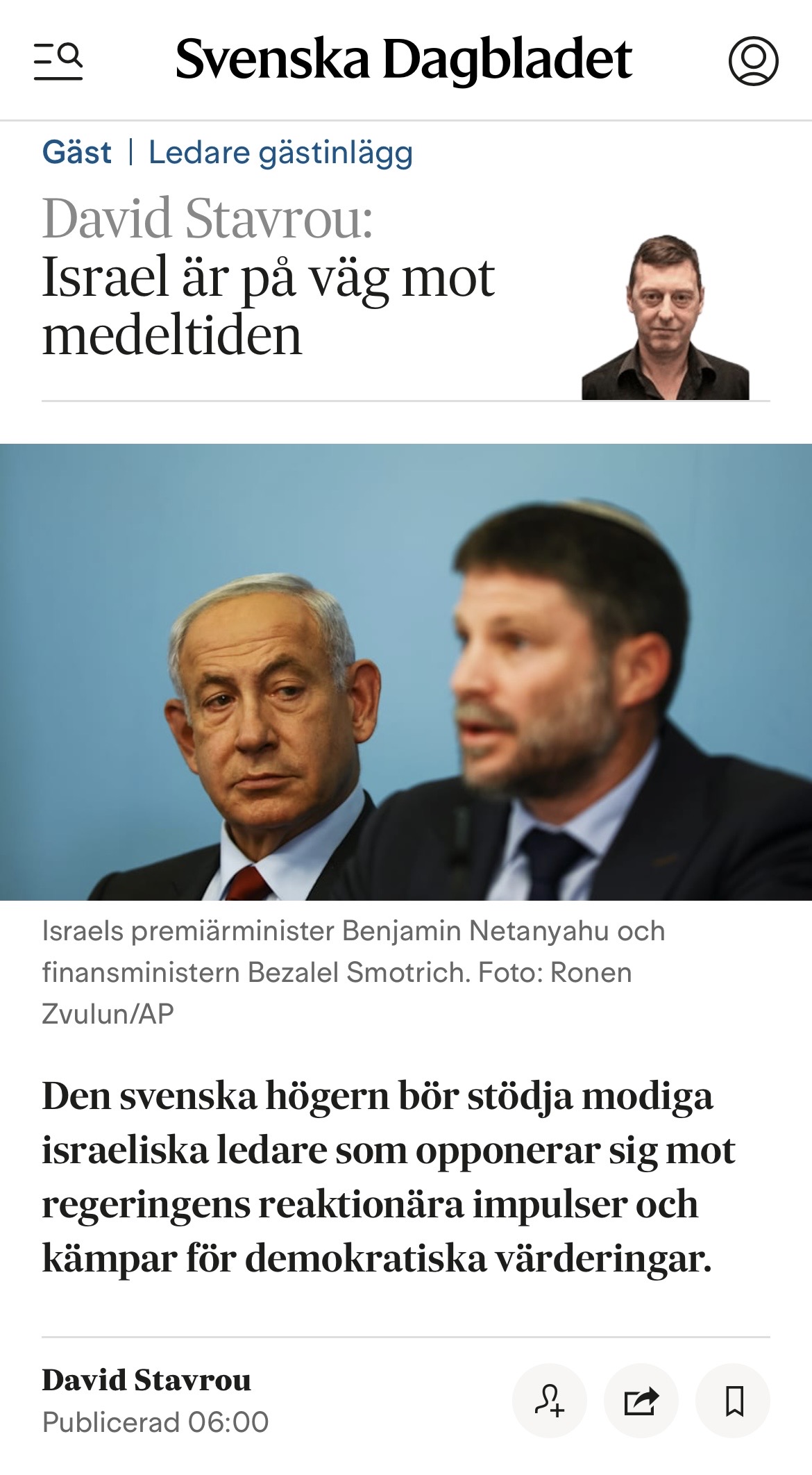
The minister responsible for this is Itamar Ben-Gvir, a far-right politician previously convicted of incitement and support for terrorism. While he is busy consolidating control over the police within Israel, another minister, Bezalel Smotrich, is consolidating control over the West Bank. Smotrich is laying the groundwork for potential annexation and is taking no action against the growing violence perpetrated by extremist settlers.
Netanyahu himself has recently reaffirmed his intention to continue pursuing the so-called judicial reform which many in Israel describe as a judicial overhaul, as it threatens the fundamental principles of the rule of law and the separation of powers, weakens the independence of the courts, and risks undermining democracy. The issue has now returned to the parliamentary agenda and in addition, efforts to limit the powers of the attorney general and the Supreme Court are being resumed. Another bill currently under discussion would introduce the death penalty for terrorist offenses—formally to prevent Hamas and other groups from taking Israelis hostage in order to exchange them for convicted terrorists, but there are also those motivated simply by revenge.
If the death penalty does not sound like a sufficiently reactionary reform, the Knesset has even discussed the conservative Jewish concept of shmirat negiah—the obligation for a man and a woman who are not married to each other to refrain from physical contact. It is not an official legislative proposal, at least not yet. But the mere fact that it is being discussed alarms liberal and secular Israelis—and rightly so.
Swedes have always had a deep interest in Israel. This can have both positive and negative effects. To understand whether Sweden’s voice can contribute something meaningful in this context, we should examine the country’s current discourse on Israel.
The political left in Sweden has unfortunately totaly lost its bearings. Many of its supporters have embraced Hamas’ narrative of the Israeli–Palestinian conflict. This does not necessarily mean they support terrorism, but the view of Israel as a settler-colonial project that should be boycotted and opposed regardless of its policies or leadership has spread from a radical minority into mainstream politics. Even established political parties have begun discussing the dangerous idea of a one-state solution.
A one-state solution would either mean the end of the Jewish state—which even the Swedish left previously supported—or plunge the entire region into an even worse bloodbath than what we have witnessed over the past two years.
Equally dangerous is the stance of Sweden’s populist right. Supporting Israel because its current leaders appear to use methods similar to those of authoritarian, illiberal regimes, or because they see Israel as a symbol of a struggle against Islam, is both misguided and harmful. It is also a betrayal of the Israelis who are fighting for a democratic, liberal, and peaceful future.
This year, both Swedes and Israelis are heading to the polls. If Sweden still wishes to exert a positive influence on Israel (and on the Palestinians, for that matter), Swedish supporters of the left should cooperate with Israeli artists, entrepreneurs, researchers, and academics who are independent and often in opposition to the government, rather than the easy and intellectually lazy solution of boycotting and margenelizing them.
The Swedish right should support courageous Israeli leaders who oppose the government’s reactionary impulses and fight for democratic values, rather than backing corrupt leaders and extremist parties that are dragging Israel back toward the Middle Ages. Any other approach amounts to rewarding both Hamas and Jewish extremists and for those who live in the region, it is yet another step on the road to hell.
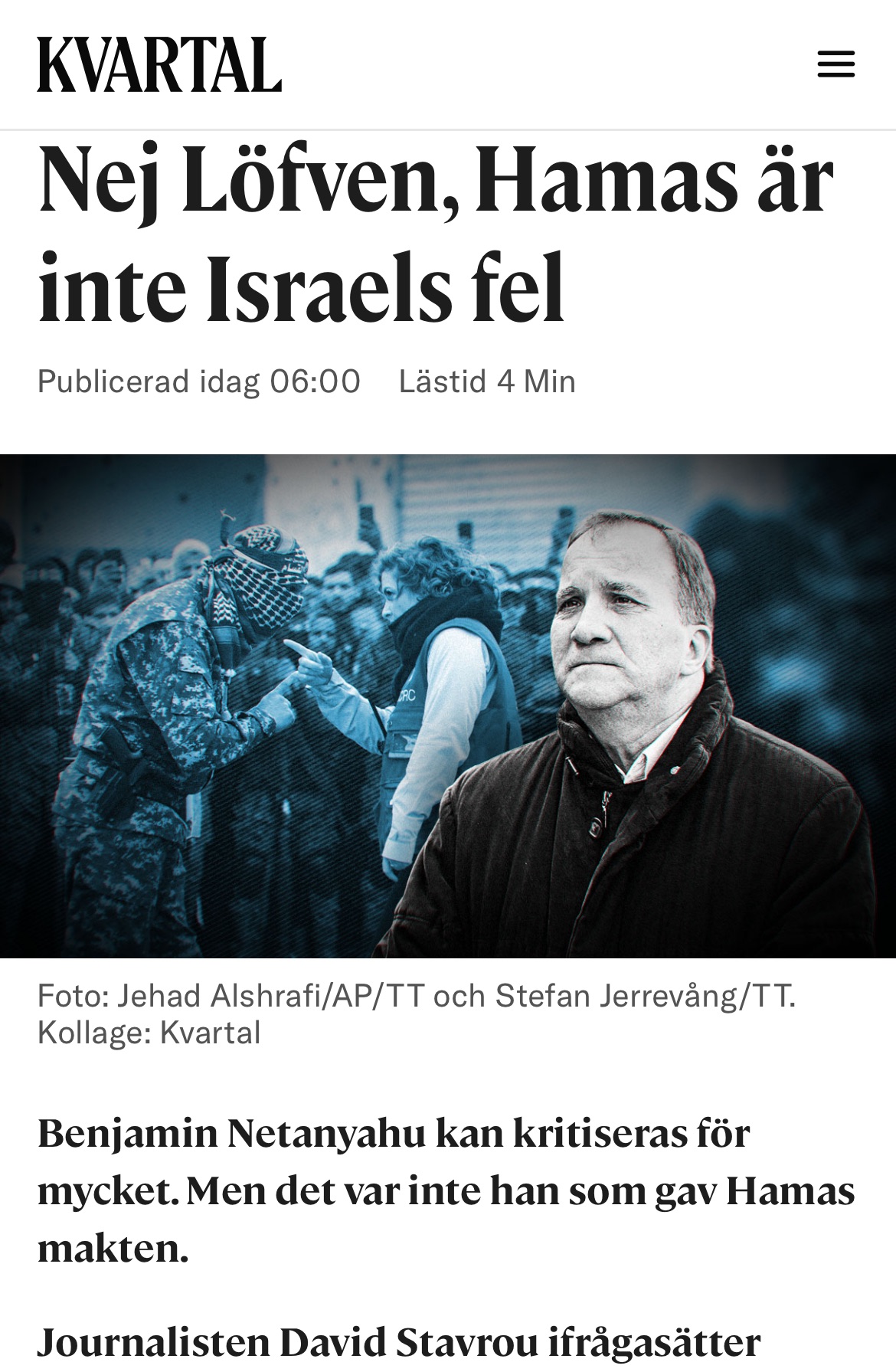
A popular proverb says that a half-truth is a whole lie. The latest episode of SVT’s Utrikesbyrån about Hamas was a good example of that. That does not mean it wasn’t interesting. It was. Nor is there any doubt that the three participants — former Prime Minister Stefan Löfven, political scientist Marco Nilsson and Middle East analyst Bitte Hammargren — knew what they were talking about. But when it came to the analysis of Hamas, we were given only a half-truth.
The questions the presenter Rebecca Randhawa asked were: what is left of Hamas, will they lay down their arms, and who will govern Gaza. The first and the third questions are almost impossible to answer. Even Israeli intelligence does not know what remains of Hamas’s military capability, and Gaza’s future governance depends on a complicated geopolitical process. The second question, however, can be answered based on a deep understanding of what Hamas is, the choices it has made in the past, and what its ideological and political DNA is.
According to Löfven, Hamas’s power is the result of a paradox. Despite being one of Israel’s greatest enemies, its power originated with Israel’s political leadership. “Such an organization receives support (from Qatar, for example) simply because Israel wants to avoid the Palestinian Authority (PA) gaining any power.” Hammargren agreed and said that Hamas was a political asset for Israel. “Netanyahu’s line was that by letting Hamas grow in Gaza we don’t have to hear about a Palestinian statehood,” she said. This is a common analysis and it is partly true. Netanyahu and other Israeli leaders do indeed oppose a two-state solution. Because of this, his strategy was to weaken the PA, and many argue that one of the ways he did this was by allowing Hamas to grow. But this is only half the truth.
The other half, and the real reason Hamas rose to power and was able to retain it, is much simpler. The source of Hamas’s power is support from large parts of the Palestinian people. Even now, after two years of destruction and death that are a direct consequence of Hamas’s decision to massacre Israeli civilians on October 7, 2023, Hamas is still supported by many Palestinians. The international support from Qatar and Iran that Löfven and Hammargren mentioned is also not hard to understand. Iran’s regime has a long-term goal of eliminating “the Zionist entity,” and Qatar built its international position on supporting its ideological Muslim Brotherhood allies. Sure, Netanyahu miscalculated Hamas’s capacity and misread its intentions, but it was not he who made Hamas’s ideology popular, and it was not he who turned Qatar and Iran into dangerous regional destabilizing powers.
But where is Hamas heading? Utrikesbyrån’s two-and-a-half-minute clip tried to provide background. According to the clip, “Hamas removed the demand that Israel be destroyed, but still does not recognize the state of Israel.” This is not even a half-truth. Hamas is absolutely committed to the destruction of Israel. Yes, it created a new charter for foreign audiences, because the old document contained antisemitic propaganda that was not particularly popular on university campuses and in some Western circles. But even the new charter demands “all of Palestine” from the river to the sea, it does not accept the Oslo Accords or the two-state solution, and it still endorses “armed resistance,” which has been a decisive part of Hamas’s nature long before October 7. That includes blowing up buses and restaurants full of civilians as well as kidnapping, torturing and murdering Jews of all ages, genders and backgrounds. One interesting thing Utrikesbyrån did not mention is that Hamas activists have on several occasions been arrested in Europe for planning attacks on “Jewish targets.” Worth mentioning if anyone took the “new charter” seriously.
Despite (or perhaps because of) the violence, Hamas won the Palestinian elections in 2006 in both the West Bank and Gaza. Palestinians are not blind or politically incapable — they knew exactly what they were voting for. According to Utrikesbyrån’s experts, Netanyahu could have fought Hamas by strengthening the PA. It’s an interesting theory. Only problem is that it’s not true. Not during the years when Hamas was building its reign of terror, anyway. The reasons are that Netanyahu was not Israel’s prime minister at that time. Between 1999 and 2009 the prime ministers of Israel were Ehud Barak, Ariel Sharon and Ehud Olmert. The first was an outspoken advocate for a two-state solution, the second ended the occupation of Gaza, and the third was probably the one who offered the PA the most generous territorial compromise. Hamas was not impressed. It continued to build the fundamentalist, jihadist, genocidal faction within the Palestinian nationalist movement. Hamas did not need Netanyahu for this. It was fully capable of doing it on its own, while many Israelis were still considering peace and reconciliation.
Utrikesbyrån downplayed all of this. In the program there were no blown-up buses, no tunnels, rockets, high-tech international propaganda campaigns or brutal executions of Palestinian “collaborators.” October 7 was only mentioned in passing, as another point on the timeline. No hostages, no burned neighborhoods, no executed families. This is not a complaint that they “forgot October 7,” but a critique of incomplete analysis. How can one answer the question about Hamas’s intentions without taking into account that the organization recruited thousands of people who were willing not only to kill but also to commit gang rapes and sexualized torture in the name of Allah?
Netanyahu can and should be criticized for many things, but not for this. Sure, he did not destroy Hamas before October 7, and through his incompetence and corruption he may have contributed to the opposite. Israelis should hold him accountable for that. But this is far from the cause of the catastrophe. Hamas began building its advanced military capability long before Netanyahu, it remains standing, and many Palestinians still support it. Let us imagine that Netanyahu had decided to wipe out Hamas back in 2014. Now that we know that not even the destruction of Gaza did the job, would Stefan Löfven have supported an Israeli offensive on that scale? Would the Obama administration have allowed it? Would the UN have accepted it? Of course not. Everyone can complain about Netanyahu and everyone can criticize Hamas, but in the end — whose responsibility is it to eliminate Hamas, and who will support such an effort?
It is obvious that Stefan Löfven in no way supports Hamas. In Utrikesbyrån he spoke very clearly about the necessity of a political process with a reformed Palestinian Authority moving toward a two-state solution. But putting the blame for the situation on the Israeli government while ignoring Hamas’s inherently genocidal nature is a classic half-truth. It leads people to believe in conspiracy theories about secret Israeli involvement in the massacre of its own citizens, and more importantly — it shifts the focus to the wrong side. To reach a lasting ceasefire it would be wiser to focus on the “de‑Hamasification” of Gaza and support moderate forces on both sides that can help their communities recover from this two-year trauma and build a future together.
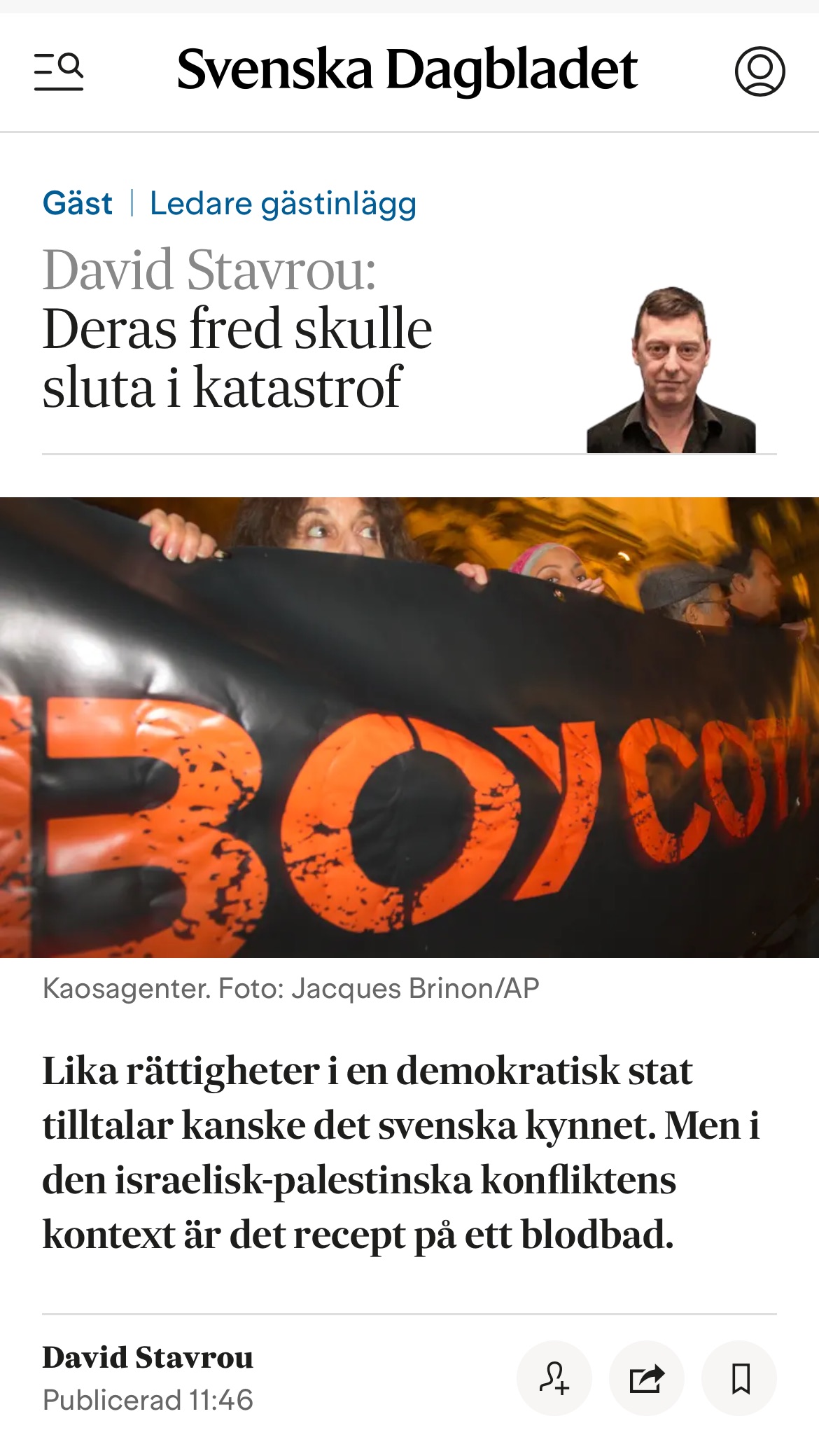
Equal rights in a one state solution may appeal to Swedish sensetivities. But in the context of the Israeli-Palestinian conflict, it is a recipe for bloodshed.
Israeli politics can be confusing for those who are used to a system which rewards accountability. One example is that even though Hamas' brutal attack in October 2023 was the biggest tragedy in Israel's history and part of a momentous failure of Israel's leadership, the government is still in place and seems to be stable enough to survive the crises. It's even confident enough to continue its controversial judicial overhaul which many claim is a direct assault against Israel's democracy. When it comes to the conflict with the Palestinians, Netanyahu's government is using the catastrophe as a pretext for going further to the right, perhaps even as an excuse for a future annexation of the West Bank which would be a tragedy for both Palestinians and Israelis who support peace, democracy and freedom.
This is why Standing Together, a grassroot movement of both Jewish and Palestinian Israelis who join hands in working for peace, equality, and social justice is so important. These are exactly the kind of people who can provide hope for Israel's declining peace movement. They can also be excellent partners for actors in the global community who are concerned about developments in the region and want to support positive change. And indeed, two of the movement's leaders are coming to Sweden. When I spoke to one of them, Alon-Lee Green, one of the movement's national coordinators, he told me that the visit's purpose is "to gather support for the fight to end the war, to end the occupation and to achieve Israeli-Palestinian peace".
But it seems not everybody wants to listen. Instead of encouraging Israel's brave opposition, some activists are horrified by the mere thought of Israeli peace fighters. One commentator on social media wrote: " I think it's important that as a movement we keep track of which groups we choose to collaborate with. Standing Together is boycotted". As a self-appointed moral compass, the activist then quotes a text by The Palestinian Campaign for the Academic and Cultural Boycott of Israel claiming that Standing Together is "serving a key role in Israel’s international propaganda strategy". One of the commentators who thanked the writer even added: "we don't recognize Isnotreal!".
Since October 7th the BDS campaign has been gaining support in Sweden. Professors, researchers and students call on their university to cut all ties with Israel, Amnesty cooperates with BDS-Sweden and lists of companies "profiting from the genocide" are all over social media leading to demonstrations and smear campaigns. All this shows what at least part of Sweden's left is all about. The BDS movement claims that Standing Together is serving "Israel’s 75-year-old regime of settler-colonialism and apartheid". Nothing could be clearer – the BDS movement isn't against specific Israeli policies, it isn't against a specific government or a specific war. BDS activists' real problem is the very existence of Israel. When they talk about 75 years of settler colonialism, they're not talking about the 1967 occupation of the West Bank and Gaza, they're talking about the 1948 UN decision to found a Jewish state, and an Arab state, in Palestine. The people who don't want to listen to Israeli peace fighters are doing it simply because they are against peace between Israelis and Arabs. According to them Israelis are the original colonialist sin and they should just disappear.
Do these attitudes belong only to a handful of extremists or are they spreading to Sweden's left as a whole. A good indication is the debate about the so-called two-state solution. Those who still support it, even though it seems almost impossible to achieve, are promoting a solution which includes a compromise between two legitimate national movements. Lately, however, the idea of a one-state solution is becoming popular. Swedish academics are writing texts about one state based on "one citizen-one vote", in the Swedish Left Party congress last May many party members promoted changing the party's position to supporting a one-state solution and further to the left, Fi (the Swedish Feminist Initiative) and the new "Solidarity" party, already took the step. Fi even claims that "Zionism is an imperialist and racist ideology". Anyone who witnessed a pro-Palestinian demonstration during the last few months knows this isn't a minority. The most popular slogan doesn't leave room for doubt – "From the river to the sea Palestine will be free", Not "Palestinians will be free". Palestine means a state – one state, not two, from the river to the sea.
In Sweden's radical left there are those who take it even further. There's a at least one youth movement (RKU) which supports the October 7th "historic offensive in which the Palestinian resistance broke open the prison bars". Another "solidarity movement" (Samidoun) supports the PFLP, an organization which took part in the massacre. In addition, there are plenty left wing-oriented publications which continue to support the narrative which sees Hamas as an anti-imperialist decolonization force. All these movements support a one state solution. Just like Hamas and the most radical Jewish extremists.
One state with an equal vote and equal rights may sound appealing to Swedish sensibilities. Indeed, why not have nothing to kill or die for and no religion too? The only problem is that in the context of the Israeli-Palestinian conflict one state is a receipt for a blood bath. Most Palestinians who support a one state solution mean a Palestinian state. Most Jews who support it mean a Jewish one. The result of such an experiment will either be apartheid or some version of ethnic cleansing or genocide. The only question will be who's killing who.
When I talked to Standing Together's National Coordinator he said that the movement doesn't support a specific model of solution. "We support an Israeli-Palestinian peace", he said, "one that will enable everyone to live in freedom, equality and independence". When it comes to the boycott movement Green says that Standing Together is the largest Israeli movement fighting for peace and against occupation. "We've been protesting all over Israel for 15 months, we arrange aid for Gaza, our activists are fighting settlers who attacked humanitarian aid convoys and we demand an end to the killing", he says, "if anybody wants to argue with us about words that we say or don't say, they can write an essay and perhaps we can discuss it in some lecture in the world of academia. But in the world of politics and actions, the one that we focus on, the BDS statement about us has no influence where we live. It wasn't even translated to Arabic".
The BDS movement leaves no room for Standing Together. It only accepts Israelis who think that their country shouldn't exist. But the men and women of Standing Together are different. They love Israel and they're fighting to make it better. They realize that both Jews and Arabs are there to stay and they promote pragmatic compromises rather than holly wars and abstract ideologies. This is why the Olof Palme Center, the Robert Weil fund and Kulturhuset made the right choice when they invited them to Sweden. Naturally, those who are against Standing Together have the right to protest, but we shouldn’t call them peace activist, we should call them what they really are – dogmatic chaos agents who, if they get what they want, will lead both Israelis and Palestinians to a catastrophic disaster.
The pre-show announcement in Roger Water's latest tour is rather unconventional. After the regular, please "turn off your cell phones", comes a slightly more provocative announcement "if you’re one of those ‘I love Pink Floyd, but I can’t stand Roger’s politics’ people, you might do well to fuck off to the bar right now". This sets the tone since the show's main theme is a mix of current affairs, political science and global politics and Waters is anything but mainstream in these aspects. In fact, many would say he's a hard core radical. This, combined with the fact that Waters is one his generation's biggest rock stars and he attracts tens of thousands of people to his concerts, makes his tour an important cultural phenomenon which provokes many reactions and heated debates. Waters granted "Haaretz" an interview during this controversial tour and I spoke to him at his hotel, a couple of days prior to his Stockholm show, after he completed the American part of the tour and 14 of its 40 European dates.
So as not to start the conversation with the confrontational opener, we talk first about the music, rather than the politics. This is after all a rock concert, not an election campaign. Waters, who will be 80 in September has an enormous body of work to choose from when he goes on the road. He realizes, of course, that it wouldn't be right to go on stage without playing any of the classics he created together with Pink Floyd, the band he co-founded in 1965 with by Syd Barrett, Nick Mason and Rick Wright and left in the mid-eighties. And indeed, the show includes the whole second part of The Dark Side of the Moon, Pink Floyd's 1973 album as well as material from Wish You Were Here (1975), Animals (1977), The Wall (1979) and The Final Cut (1983). "If I followed only my heart and not my head, I'd probably do what I used to do with Pink Floyd", Waters says, "I led Pink Floyd for many years, and when I did, at least during the last few years, when we toured, we only played the current record and the last record. If I would do that now I would have played only my latest solo albums and I might have also added Us and Them (from The Dark Side of the Moon), which is a genuine co-write with Rick Wright (Pink Floyd's keyboard player)".
Waters points out that he has just finished re-recording the whole of The Dark Side of the Moon which was released exactly fifty years ago. The new version will be released this July. Waters believes it's still extremely relevant and that's why so much of it is on his current show. "Nothing I've done recently is more political than Us and Them", he says and quotes the lyrics, "with, without, and who'll deny that's what the fighting's all about". "It's a truism and part of the reason I re-made the album", he explains, "people haven't noticed in the last fifty years what it's actually about". Waters adds that he enjoys playing this part of the show as much as the newer songs, because it's very visual. "There's an enormous LED crucifix hanging over the stage", he explains, "and the images that we show, particularly during Us and Them move people very deeply because it's so anti-war".
So, as it is, are you pleased with the set list you're playing on the tour even though it includes more than just your current and previous albums?
"Yes, I'm content with the way the set lives, it's full of new things and old things, and in consequence sometimes people are a bit puzzled". Waters mentions, as an example, a new song called The Bar which he says is "extremely important philosophically and emotionally, because it's my plea for conversation and communication between us human beings, in support of, and in defense of humanity, and how we need to learn to cooperate with one another, rather than killing one another".
When it comes to the visual side, don't you feel that the sophisticated video work, the images on the enormous screens and the setup of flying pigs and flying sheep is all a bit grandiose and makes your connection with the audience less intimate?
Waters doesn't approve of the word grandiose. "It either is, or it is not good theatre", he says, "I've spent the last sixty years trying to create theatre which is appropriate for rock'n'roll in arenas and outdoor venues and to play for anything from 15 to 100 thousand people. You can't do intimate theatre, much as I adore intimate theater and sometimes regret that I haven't been able to work in small theaters". Waters adds that there are plans "in the pipeline" to do one or two smaller shows of the new version of The Dark Side of the Moon as well as a theatrical version of The Wall in an intimate space. With these projects and others, it doesn't seem at all as if he's ready to retire.
The Show is called This is Not a Drill – The First Farwell Tour, it also includes biographical texts explaining various parts of you career. Is this your attempt to start wrapping things up, is this you shaping the narrative one last time?
"No, whenever I do a tour, I have to decide what it's going to look like, what the story's going to be, what the narrative is, what it is I hope to achieve and how much of the old Pink Floyd stuff I need to do in order to satisfy the hunger. One thing that's really good is the age demographic of the people who are coming to the shows. Many of them are 20-year-olds. That's fantastic and that doesn’t happen with many of the old bands. Obviously when I put out adds saying "his first final farewell tour" it's a joke. Because so many of the others do farewell tour after farewell tour for years and years".
Speaking of other bands, you said in an interview a few years ago that you don't listen much to music and you're not very interested in what's going on in the so-called music industry. Since your show is part of this industry, aren't you interested in what else is going around?
"What else is going around? You tell me, if you are interested. I'm really not interested. Life is too short". Waters explains that no artist has time for that. "You get on with your work", he says, "Michelangelo didn’t say 'well, I think I'll get on a donkey, go round Italy and see what the others are doing. He said – 'I want that bit of Carrara marble, now let's see how I can get it down the hill without killing a hundred people'". At this point Waters quotes his 1972 song, Free Four, "Life is a short warm moment, and death is a long cold rest, You get your chance to try, In the twinkling of an eye, Eighty years with luck or even less, So all aboard for the American tour, And maybe you'll make it to the top, But mind how you go, And I can tell you 'cos I know You may find it hard to get off. But you are the angel of death, And I am the dead man's son, He was buried like a mole in a fox-hole, And everyone's still on the run".
These are important sentences in the Waters universe. He was born in South East England in 1943 and has lived in the United States for twenty years ("because of the weather more than anything else. It never stops raining in England"). His father, Eric Fletcher Waters, who was a schoolteacher and a member of the communist party, was killed in the WW2 in the battle of Anzio in Italy when Waters was just five months old. His grandfather, George Henry Waters, was also a war casualty. He died while fighting in France during WW1. Considering this, it's not much of a surprise that the cruelty and meaninglessness of war have always been an important part of Waters' work and in the current show these themes are more apparent than ever. It is in this context one should see the opener asking those who don't approve with Waters' politics to "fuck off to the bar", it's just his way of saying he's not forgetting and he has no interested in toning it down.
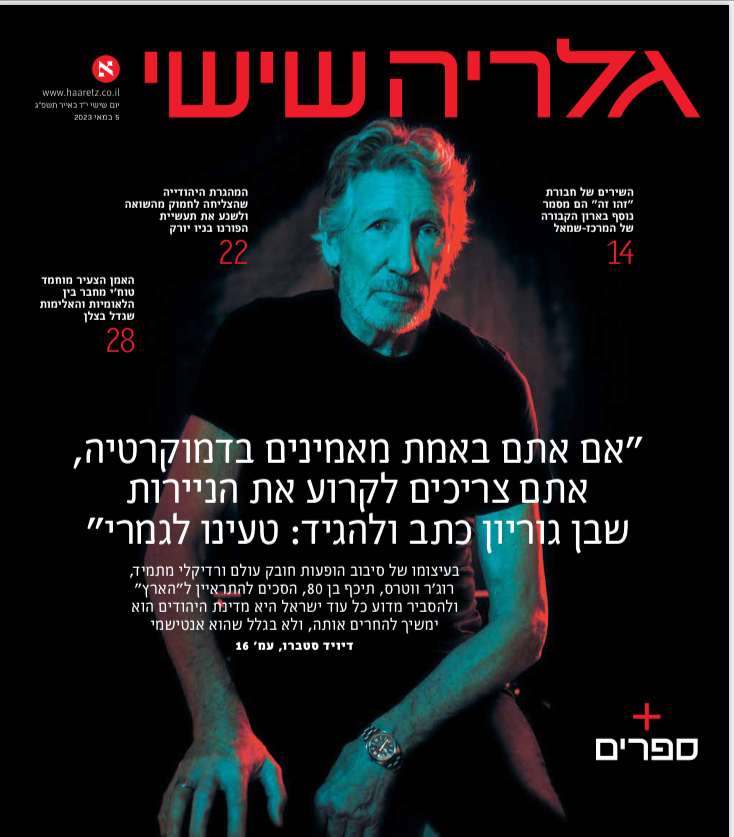
Roger Waters on the cover of Haaretz' weekend culture magazine, photo: Kate Izor
Apart from being a unique opener, there's also a serious issue here. If someone comes to your show because he or she loves your music, but that someone happens to also be a supporter of Trump, Bolsonaro, Boris Johnson or Netanyahu, do you really not want them there?
"I don't give a fuck if they're there or not. I'm not proselytizing. You know, you're writing this for Haaretz and people are always trying to persuade me to go to Israel, do gigs in Tel-Aviv and talk to people, proselytize and try to get them to change their policies and work from within. And I say, fuck off, there's a picket line here and I'm not crossing it because I believe in human rights. Those people, people who voted for Trump, they would get up and leave when I played tracks from Animals (Pink Floyd's 1977 album based on George Orwell's Animal Farm). I couldn't care less. Leave! I don't want you to come. This isn't an attempt to affect you because you're lost. The people who I'm trying to encourage are the young people who want to resist the dreadful destruction of our home planet by the ruling class. I'm interested in communicating with them. I don't care about people who vote for Netanyahu or Trump or Bolsonaro".
Here's another way of putting it. It seems like from decade to decade your work becomes more specific and less abstract and universal. If, in the 70s you dealt with the way we see the humanity in others, and existential and abstract concepts like time, death alienation and loneliness and later with general political ideas like dystopian societies and fascism, since the 80s, you're writing about specific events like the wars in Afghanistan or Iraq and you clearly mark your villains like Thatcher and Trump and your heroes like Juliane Assange. This isn’t something everyone can sympathize with.
"I couldn’t agree more. I think it's a function of age. We all live within the context of our personal histories. Those of us who can actually read, and there are fewer and fewer of us, we read history and take notice of what happened in the past, but as our lives unfold, we recognize the folly of repeating the same mistakes over and over again, and the engine which drives those mistakes, is by an large greed. Greed for money or power. And so, yes, I'm less concerned about becoming irrelevant because I'm writing about specific things or specific periods of time. The context of the passage of time is very important, maybe because I'm 79 years old, the idea of rejoining the great oneness of everything as ashes and dust, possibly as a memory but maybe not even that, becomes closer and also behooves us more and more to grapple with the big questions, which is required of all art which means anything".
Speaking of great works of art which you quote in your show – George Orwell's 1984 and Animal Farm and Aldus Huxley's Brave New World, you refer to the dystopian future they talk about and to the real-life leaders who are making their visions into a reality, mostly American presidents – the pictures of all presidents from Reagan to Biden are on the screens in you show presented as war criminals. I wonder if Chines president Xi, Russia's Putin and Belarus's Lukashenko are not on the screen because you think that they are not war criminals, or is there some other reason?
"My history is full of those American presidents; they have been denominating geo-political events since the Second World War when I was born. The 'evil empire' since WW2 is the USA and it continues to be. And right now, the US with Joe Biden at the helm is driving us towards World War 3 as fast as it can. And there seems to be two potential drivers – one is profit, the value of the war industries has gone up vastly since the Ukraine war started. The other is what's considered to be their manifested destiny – to rule the world. So, they decide who is and who isn’t democratic. What makes anybody think the US is a democracy is absolutely beggar's belief, because it is not, and anybody with an IQ above room temperature knows it's not. It's driven by money and power and the people have no say in the matter".
Waters also mentions he knows he's making an extreme statement, but since he lives in America, and does not live in Russia or speak Russian, some issues he can't really comment on. He doesn't trust the American media, he quotes presidents Eisenhower's warnings against the so-called "military-industrial complex" and, in his show, the screens are full of examples and images which make clear where he thinks the real problem lies – victims of state violence against civilians, victims of the so-called "war on terror", victims of drone attacks, American foreign policies in South America and domestic policies against native Americans.
In a CNN interview you reacted to a question about Chinese violence towards their own people by saying it was "bollocks, absolute nonsense". Do you not believe, for example, the news about the atrocities being committed in Xinjiang against ethnic minorities or do you just think it's not your place to comment about that? To me, what's happening there is the closest thing to 1984 in the real world.
"Depends what story you read. I do not believe the western narrative about the Uyghurs. I don't believe it. I don't believe there are millions and millions of people locked up in concentration camps being slowly murdered and tortured to death and that the women are being raped by the Chinese government. I don't believe it. Is there a problem in that part of China? Possibly. Probably. Are the Muslim's all being re-educated in camps? Almost certainly not. Are some of them? Quite possibly, if they're members of ISIS for instance. If I was in China and spoke Chinese I could answer these questions, I cannot relay on the western mainstream media to tell me what's going on there and I don't believe them any more than I believe this Russiagate nonsense and any of this phobia against other countries going on all day every day, drumming up a third world war. In my show I say "you can't rule the world. Nobody can. The world is there to be respected, nurtured, loved protected and shared. That's the text I wrote, you can call it corny, I don't give a fuck, but this is the problem with the whole geo-political situation, the US wants to rule China, they want to rule Russia, they want to rule the world, they declared it, it's in all their political manifestos and it's destroying the world".
According to Waters the war in Ukraine is a result of the same American policies. Even though he denounced the Russian invasion, he doesn't see the war as the fault of the Russians alone. He also strongly condemns continued military support to Ukraine. "It's them (the US) advancing NATO further and further east since the end of the cold war", he says, "are they going to beat Russia? Not without a nuclear war they won't. So, why are they doing it? Well, it's because they've got morons like (American National Security Advisor) Jake Sullivan and (Secretary of State) Antony Blinken chattering in the ear of a really really old bloke with Alzheimers who doesn’t understand any of it and never will" (incidentally, President Biden is less than a year older than Waters).
Last September Waters wrote a couple of letters to Olena Zelenska, Ukrainian president Zelenskyy's wife, in order to try to get her to convince her husband that it's time for a compromise with the Russians. When she replied on Twitter and wrote that he was writing to the wrong president, Waters wrote to President Putin too. Putin is yet to answer. Although Waters made clear that he's horrified by the invasion's results, he claims that a different Ukrainian policy in the Donbas and less American intervention would have led to a peaceful solution. This attitude led to strong reactions in the west and it seems Waters is once again paying a price for his politics.
Just after the Zelenska letter was published, the Polish city of Krakow cancelled Waters' shows in the city. The reason was that the city, which owns the arena, would not tolerate it being used by an artist spreading ideas objectionable to most people in Poland, referring to Waters' stance on the war in Ukraine. "I wrote a letter to the councilor who orchestrated all that", Waters says, "but they didn’t take any notice of it". The gig was indeed cancelled and that was not the only Ukraine related controversy Waters was involved in. A few months earlier, Waters' ex bandmates from Pink Floyd, guitarist David Gilmour and drummer Nick Mason, recorded a song called "Hey, Hey, Rise up!", supporting Ukraine and featuring vocals in Ukrainian by the Ukrainian musician Andriy Khlyvnyuk. Waters talked about the song in an interview to Berliner Zeitung a couple of months ago. "I have seen the video and I am not surprised", he said, "but I find it really, really sad. It’s so alien to me, this action is so lacking in humanity. It encourages the continuation of the war. Pink Floyd is a name I used to be associated with. That was a huge time in my life, a very big deal. To associate that name now with something like this. Proxy war makes me sad. I mean, they haven’t made the point of demanding, “Stop the war, stop the slaughter, bring our leaders together to talk!” It’s just this content-less waving of the blue and yellow flag. I wrote in one of my letters to the Ukrainian teenager Alina: I will not raise a flag in this conflict, not a Ukrainian flag, not a Russian flag, not a US flag".
This was probably the background for one of the most extreme public comments against Waters made by Polly Samson, a novelist, lyricist and journalist who is married to Gilmour and has written the lyrics to many of his songs. "Sadly, you are antisemitic to your rotten core", Samson wrote, "also a Putin apologist and a lying, thieving, hypocritical, tax-avoiding, lip-synching, misogynistic, sick-with-envy, megalomaniac. Enough of your nonsense".
Would you care to comment on what Samson wrote?
"No", Waters smiles, "I think I'll rise above that. Thank you for the offer".
But Samson isn't the only one opposing Waters. His latest tour is being threatened from another direction. One that Waters has encountered before. In Germany, he's being accused of antisemitism and therefore some cities have tried to cancel his shows. Waters claims the people behind this are "the Israeli lobby and people who believe that I'm an antisemite because they've read all the lies and believe this ridiculous story". As always, he denies the allegations. "I'm not an antisemite, never have been and never will be", he says, "I have nothing against Jews, I criticize the Israeli government and I'm part of the BDS movement. So, they're trying to cancel me in Frankfurt and in Munich and in Cologne. Munich has now backed off, Cologne seems to be backing off". This means the shows there are supposed to take place and so is the performance in Frankfurt at the end of the month, due to a court ruling forbidding the authorities to cancel it. "In Frankfurt I've taken out an injunction reminding them it's illegal even though the council and state own the venue", Waters explains, "in their attack on me they were trotting out stories about Kristallnacht, sort of accusing me of somehow being responsible for the deaths of 3,000 Jews who were rounded up by their Frankfurt police and sent off to be killed" (the venue Waters was supposed to play was the place where 3,000 Jewish men were arrested after Kristallnacht and from where they were sent to concentration camps).
According to Waters this is far from the first time he is being attacked on this background. "When I finished The Wall movie (2014), we had a world premiere in Canada at Toronto International Film Festival", he recalls, "that night a representative from Netflix came to see my management and said 'I adore the movie, we want it, let's make a deal tomorrow', he could not have been more effusive. The next morning there's a phone call saying 'we're not sure it's quite right for Netflix'. That's just a board meeting with the Israeli lobby raising its voice saying 'you cannot have anything to do with this man, Waters, he's an antisemite, anti-Israeli and anti-Zionist, we are going to crush him. And they've tried. Trust me. I have the bruises. But they have failed".
There are many stories regarding the accusations claiming Waters is an antisemite and they've all been told in length. The flying pig which appeared in his concerts with a star of David symbol on it (along many other symbols including a cross and a crescent), the events surrounding the replacement of Waters' show in Tel-Aviv with a show in Neve Shalom in 2006 and comparisons Waters made between Israel and Nazi Germany and Apartheid South Africa. Essentially, however, it seems like the main long-lasting reason he attracts this particular criticism is his support of the BDS movement.
You are a supporter of the BDS movement and many wonder about the way the BDS campaign is focused only on Israel. Considering everything you say about the US, for example, why are you still playing concerts in America? Isn't it time to start boycotting the US?
"Should one turn one's back on any problem anywhere simply because you can't solve all the problems everywhere? My view is – no. And my view is that it was correct to join the anti-apartheid movement in South Africa, even though we may never know what effect that had on the downfall of that supremacist white racist regime. In my view, what really did it was when we stopped playing rugby and cricket with south Africa, that's what tipped it over the edge. They couldn't bare it".
And you think the BDS will have the same effect on the occupation?
"I'm certain it will. We're coming close to it now. You can see what happened with Indonesia which refused to host the U20 world cup because they wouldn't entertain an Israeli team. The point was made. The power is shifting. It's about the Human Rights Declaration of Paris, 1948 – you cannot cherry pick. You're either in or you're out. You either believe in human rights or you don't. and most governments don't. so, you say, why don't I boycott America. Because I can't! I can't boycott America and the UK and France and Germany. Well, I could, I could go and live on a fucking island and do nothing for the rest of my life. But I think because Israel is so extreme and it gets more and more extreme as the minutes go by, we may win this and get human rights for the people of Palestine".
When you say human rights for Palestinians, It's not clear if you're talking about 1948 or 1967. If the problem is the occupation of the West Bank, it could theoretically be solved by a two-state solution. But if the problem is not only the occupation of 1967, does your success mean the disappearance of the Jewish state? What exactly is your solution?
The solution is a state that is democratic and that every citizen and every person who lives within the territory has equal civil, political and religious rights. If that means the end of the Jewish state, so be it. It would be like having a Christian state. If America would become a Christian only state, I would say, you can't do that. I would say – get rid of America because you cannot have a Christian supremacist state where only Christians have rights. That's anti-human, anti-democratic and against everything I believe in. so is the Jewish state of Israel, because people who are not Jewish do not have rights. There's no getting round it. Maybe it's the nomenclature that is the problem, because (the Jewish state) is expressed in the behavior of these disgusting thugs, the settlers, like the ones from Hawara. Doesn't that make your blood boil? We've all met these kinds of people. They don't have to be Jewish. Their religion is irrelevant. It's the attachment to the religion that they think gives them the permission to be a fascist.
So, no two-state solution then?
Please! Go back to the 67 borders, get the settlers out, allow the Palestinians a separate and sovereign state, and you can do it tomorrow. It's not rocket science. But we've all known, right from the beginning that there was never ever going to be any possibility for any of that. A lot of people believed in all the shenanigans of pretending that. They never had any intention of there being a Palestinian state because they've read their bible, they want Jorden and the whole fucking lot and they want it to be a Jewish supremacist apartheid state. Well, you can't have it because the rest of global civil society will not stand for it. And the people who've looked after you for all these years, the US, are discovering that they can't support it either, and the Jewish community in North America are changing their stance faster than you can imagine, because many of them are really wonderful humane people who follow their religion, who've read the Talmud and who actually aspire to a lot of the great things that are in it.
What about the hundreds of thousands of people within Israel who are against the government and demonstrating these last months?
What are they demonstrating about?
Democracy and freedom.
Well, no they're not. You mean democracy and freedom for them, in their little supremacist Jewish bubble. That's not democracy and freedom.
Well, even if the Israeli peace movement is small, aren't you worried about the BDS making its attempts for dialogue even harder, there have been claims that the BDS shuts down initiatives for dialogue by informing on them to Hamas.
"So, it's Hamas' fault again. What a surprise! But that's bullshit". Waters denies the theory of the BDS being an obstacle for peace and he's very clear about his support for the BDS movement. He speaks of the "picket line" that his Palestinian brothers and sisters asked him not to break, he speaks of the Balfour declaration that says that the National Jewish home does not "infringe in any way on the religious or civil rights of any of the indigenous people" and he insists that the only democratic solution is one of equal rights to all between the river and the sea. In his show there are images of the Israeli West Bank barrier, of Palestinian victims and a slogan that couldn't be clearer "you can't have occupation and human rights".
What if a one state solution doesn't mean a democratic country in reality, but instead it's the beginning of ethnic cleansing? Whether it will be Jews killing Arabs or Arabs killing Jews, decades of hatred on both sides, including the Palestinian leadership, may lead to a bloodbath, rather than peace and harmony.
"I'm trying to work out if this is a question or not", Waters says, "this is the story they're being fed all their lives, but you can't say 'we do not want equal human rights because it might turn into a blood bath', that is the new Hitler. 'If I control everything, then we'll live in an ordered society'. If you really believe in freedom and democracy, you have to tear up all the papers that Ben Gurion wrote all those years ago and you have to say 'we got this completely wrong. This is not what we want. We do not want a supremacist apartheid state. We want to live in a lovely country where we can live safely, but where everybody else can live safely too. It's no good for the burden of being the oppressor just to be switched from the Germans to us. We don't want to be the oppressors. We want everybody to be free. That's what we want if we're going to have a homeland'".
In a way, the first sentence of Waters' new show, the one sending those who are not fans of his politics to the bar, is a reasonable warning. Waters' opinions are far from mainstream politics and some of them may seem offensive to many. The last part of the show, however, is somewhat different. Waters has a drink with the musicians he shares the stage with, talks about his wife (his fifth) as a rock he leans on and about his older brother, John, who died last year. He then goes back to the new song, "The Bar", which is about his family, about memory and empathy. The song's accompanied by an old black and white family picture which appears on the screen. There are four people on it – his mother, his father, his brother and himself, just a couple of months old. He's now the only one on that picture who is still alive. After a song describing a nuclear holocaust and the end of life on earth, this is a surprising private, non-political moment which is both touching and honest. Waters would probably disagree and claim that everything is political, but perhaps the words he uses to describe the loss of his old friend and bandmate, Syd Barret, explain the uniqueness and importance of the human experience, the fragility of life and the importance of human connection at this moment at the end of the show. "When you lose someone you love", he says, "it does serve to remind you. This is not a drill".
Published in Swedish daily newspaper Svenska Dagbladet (please note: this is an unoficial and unedited English translation)…
Israel is sometimes called the "only democracy in the Middle East", and in many ways it is. But Israeli democracy is very different from the Swedish one, even though theoretically both have similar parliamentary systems and the same kind of general elections. The differences are more about dynamics than technicalities. One important difference is that governments in Israel very rarely last an entire term, which is why Israelis will be going to the polls again on November 1st in what may seem like a déjà vu. This is the fifth election campaign in the last four years and the 11th since 2001. In the same period Sweden had only six.
Even though recent years have been unusually unstable in Swedish politics, with weak minority governments and changing political alliances, this is nothing compared to the instability of Israeli politics. This instability combined with unique historical and cultural differences, make the coming up elections very difficult to understand for those who are not locals. Here are a few things to keep in mind if you're following the political drama in the land of milk and honey.
There's probably only one global household name in current Israeli politics – the name of Benjamin Netanyahu. Since Netanyahu first became Prime Minister in 1996, he has held the job for 15 years, even more than David Ben-Gurion who's considered to be Israel's founding father. Netanyahu is head of the "Likud" party and currently leads the opposition even though he's standing trial for bribe and fraud charges. But Netanyahu is more than just a candidate. He's the key issue of these elections. He's not a man leading an agenda. He is the agenda itself. In these elections, many Israelis won't be voting because they want to promote their ideology or influence concrete issues, they'll be voting because they love or hate Netanyahu.
This leads to a misconception of Israeli politics. Since all recent elections ended in a tie between rival blocks, some assume this is a tie in the European style, meaning between left and right. But nothing could be further from the truth. In a European sense the Israeli left makes up 10 to 15 percent of the electorate on a good day. That is if left means socialist or social-democratic ideology combined with progressive values like secularism, civil rights, feminism, LGBT rights and multiculturalism. In Israel the blocks have nothing to do with all that. It's not socialists against capitalists or conservatives against liberals. It's all about Netanyahu. One block supports him, the other wants to get rid of him.
On Netanyahu's side, things are pretty clear – together with Netanyahu's "Likud" party, there's a coalition of Jewish ultra-orthodox parties, nationalist parties and representatives of West-Bank settlers. The other side, however, has no common values, ideas or interests with the exception of one – the idea of replacing Netanyahu. Led by centrist current Prime Minister Yair Lapid, it's a bizarre coalition based on middle class secular Jews supported by left-wing liberals, a variety of Israeli Palestinians (some Islamist, others secular, some nationalists, others old-school communist) and right-wing conservatives who for some reason or another are in conflict with Netanyahu. This is the main reason why the last Israeli government stayed in power for only a year and even during this short period it had to have two heads of government in rotation. If in Swedish politics, the old left-right spectrum became more complicated in recent years and developed into the so-called GAL-TAN spectrum, in Israel the opposite happened, things became simpler – the whole spectrum is reduced to one man.
But where exactly is Netanyahu on a left-right scale? That should be a simple question to answer since Netanyahu is and always has been a self-proclaimed right-wing leader. He's been called an Israeli Trump, an Israeli Orbán and even an Israeli Erdoğan (although they should be called American, Hungarian and Turkish Netanyahus since he assumed office before them). But context is king, and in an Israeli one, Netanyahu may be hated by the left, but that doesn't mean he's as right as it gets. In a social-economic perspective, Netanyahu used to be a Thatcherist, pushing for privatisations, tax cuts and restraining government spending, but it's been years since he spent his political capital on those kinds of issues. Today he leaves the economy in the hands of others. Though he's certainly a hawk and a sceptic when it comes to relations with the Palestinians, he's always been careful with the use of military power and he never went all the way towards Israel's hard core right which supports the annexation of the West Bank and putting an end to the so-called two state solution. In recent years Netanyahu has been mostly concerned with staying in power and avoiding prison. Unlike his potential successors, he's secular, he was raised in the US and has a western education and world view and he's an intellectual. In Israel this means that in many ways he's actually a centrist.
Just for the sake of perspective, the rising star of these elections is the 46-year-old leader of the "Jewish Strength" party, Itamar Ben Gvir, a man who first came to public attention when he threatened the life of Prime Minister Yitzhak Rabin a few weeks before he was assassinated in 1995. Ben Gvir also supported Baruch Goldstein an American Jew who massacred 29 Muslims in Hebron in 1994. The party Ben Gvir is currently part of has the support of 10 percent of the electorate in the latest polls. When it comes to ideology, Netanyahu is a middle of the road pragmatist compared to Ben Gvir and other Israeli nationalist and religious fanatics. The stark opposition he faces is more about his alleged corruption, opportunism and his relentless populist crusade against Israel's judicial system and law enforcement officials.
One of the reasons that Netanyahu's party is supported by over 25% of the voters according to polls is that in Israel many people don't vote according to their opinions. Rather, they vote according to their identity. It's not about what you think, it's about who you are. Arabs vote for Arab parties, religious people vote for religious parties, traditional Jews with an Eastern background vote for the Likud and secular Jews from a western background vote for one of the liberal centrist parties, usually led by ex-Army generals or former media celebrities. These include the Labour Party led by former TV and radio anchor, Merav Michaeli, and the National Unity Party led by Benny Gantz, former army Chief of Staff. To put it in a Swedish context – no one in Israel needs a "Val Kompas", many parties don't even have a party platform. a strong sectorial identity is much mor useful. The comparison may not be entirely fair, but in this aspect, Israeli parties are not very different from "Nyans".
Finally, Swedes may be surprised to know that the Palestinian issue is no longer an important part of the Israeli discourse. Back in the 80s and 90s, the lines of Israeli politics were drawn according to policies towards the Palestinians. The left promoted the two-state solution, the right argued against a Palestinian state. These days, the two-state solution is probably discussed more in Sweden's Foreign Ministry at Gustav Adolfs Torg, than it is in Jerusalem. It seems like both Israelis and Palestinians have lost faith in concepts like negotiations, compromise and peace agreements and a reality of a never ending low-intensity conflict is accepted on both sides. As a result, Israelis will not be voting to stop or to continue the occupation of the West Bank, they'll also not be voting about the threat from Iran, social issues or the economy. Instead, it's a mix of identity politics combined with anger about an eclectic collection of issues which happened to appear in yesterday's papers or social media feeds. When it comes to art and culture, entrepreneurship and industry, history and science, Israel is a beautiful country full of promise and potential. Its political establishment, on the other hand, has lost its way and is deeply divided. The only democracy in the Middle East is stuck in an endless spiral of election campaigns. The result of this fifth round is still unknown, but it may very well simply be nothing more than round number six.
Sweden’s new foreign minister, Tobias Billström, talks to Haaretz about recalibrating foreign policy, the importance of ties with Israel and the new government's far-right partners
STOCKHOLM – Swedish foreign policy has been unique for many years in Europe. The Scandinavian nation hasn’t joined military alliances since it was a military power in the 17th and 18th centuries, and hasn’t been involved in a war for over 200 years (with the exception of occasional peacekeeping missions far away from its borders). In the second half of the 20th century, its policy of avoiding alliances and maintaining wartime neutrality created a foreign policy that in many ways wasn’t about serving Swedish national interests. Instead, it was about becoming a “humanitarian superpower” and endeavoring to make the world a better place.
Naturally, there were those both at home and abroad who criticized this policy. Some saw Sweden’s attempts to position itself on the right side of history as self-serving, opportunistic and hypocritical. Others claimed its private sector’s thriving arms industry was incompatible with a government preaching peace, love and understanding. Another problematic aspect was Sweden’s close ties with a host of dictators and oppressive regimes.
Still, for decades, Swedish diplomats were crucial in bringing wars to a close. Swedish policymakers were generous when it came to humanitarian aid, and vocal when it came to issues like the struggles against apartheid and the Cold War arms race.
This tradition was maintained in recent years as well. As well as being the only Western European country to recognize a Palestinian state, Sweden did its best to export progressive ideas like “feminist foreign policy,” taking radical steps against climate change and building stronger international institutions.
“Since I took office, I’ve been very clear that we need a recalibration of Swedish foreign policy,” says Sweden’s new foreign minister, Tobias Billström. “We need to make some very clear statements about our priorities. One priority, above anything else, is the NATO accession. With that we also have to think about our neighborhood – the Nordic states, the Baltic states and the countries surrounding the Baltic Sea. This is where we’re putting our emphasis. It’s not a choice between being active in the international arena and being focused on our neighborhood. You can do both. What you can’t do is be everywhere all the time and be active in all aspects. We’ll have to prioritize.”
This may be a seismic change on the national level but it’s not for Billström, who notes that his party “has supported joining NATO for years. And I believe that the question of neutrality ended in 1995 when Sweden became a member of the European Union.”
No Jerusalem embassy yet
Billström, 48, is an experienced politician despite his relatively young age. He has been a parliamentarian for 20 years, serving as migration and asylum policy minister from 2006 to 2014, and was a local politician before that. The role he now holds is one of his country’s most important considering current regional instabilities. He meets Haaretz at his Stockholm office, which is located in a beautiful 18th-century palace facing the Royal Opera House on one side and the Royal Palace and Parliament House on the other. He has just accompanied the king and queen of Sweden on a state visit to Jordan, one of his first on the job. He says he’d like to visit Israel one day and thinks that Sweden’s relationship with Israel is “excellent following the establishment of dialogue in 2021.” Still, no official visit has as yet been planned.
Eight years ago, one of the first steps of the previous government was to recognize a Palestinian state. What is your government’s position on the issue?
“The decision to recognize Palestine in 2014 was premature and unfortunate. However, the decision has been taken and this government doesn’t plan to revoke it.”
But it wasn’t just about recognition. The previous government was very active in this field: it appointed a special envoy to the Israeli-Palestinian conflict; it actively opposed Israeli settlements in the West Bank; and it supported the Palestinian Authority and the two-state solution. Is Sweden’s new government still committed to these policies?
“On the Israeli-Palestinian conflict, the government stands firmly behind the EU policy. We want to see a negotiated two-state solution based on international law. That decision will remain. As for being active, we will continue to criticize the parties when called for, when violations of international law are committed and when human rights are abused. We’ll do that in the same way we criticize other states when it’s justified. This is in no way contrary to having excellent relations with Israel or Palestine. The government will at all times stand up for Israel’s legitimate security needs.”
Would Sweden consider moving its embassy from Tel Aviv to the capital, Jerusalem?
“Like the EU, the government will continue to respect the broad consensus of the international community and relevant UN Security Council resolutions and regard Jerusalem as a final-status issue. Pending a peace agreement, Sweden’s embassy will not be moved.”
Your government plans to cut foreign aid drastically in the next couple of years – will this affect Swedish aid to the Palestinians, and could this lead to a problem with Sweden’s Palestinian partners?
“Sweden’s development cooperation with Palestine, just like the EU’s, ultimately aims to build the conditions and promote a two-state solution in line with international law. This goal will remain. As we review our overall development cooperation, we will also recess our Palestine strategy, which applies to the period of 2020 to 2024.”
“The government takes terrorist accusations very seriously and several of these civil society organizations – which were listed by Israel as terror groups in October 2021 – receive support from the EU, the United Nations, Sweden and other donors. Together, the donors within the EU followed up thoroughly on the allegations and concluded that no substantial evidence was provided. The donors will therefore continue to support Palestinian civil society. We believe that a free and strong civil society is indispensable for promoting democratic values and the two-state solution. Needless to say, if Israel makes convincing evidence available that would justify a review in the policy toward these organizations, we would act accordingly.
“When it comes to antisemitism, it is of course unacceptable and it’s very important that the PA ensures that its textbooks fully meet UNESCO standards, and that the EU continues to be clear in its dialogue with the Palestinians to ensure that this is the case.”
Israel’s new government will be led by former Prime Minister Benjamin Netanyahu. Are you confident that Israeli-Swedish relations, which have recently improved under another government, won’t deteriorate again under the new one?
“As Sweden’s foreign minister, I would like to see a good dialogue with countries we think we can maintain good relations with. The question of relations between Sweden and Israel is exactly about that: to have a dialogue on issues that we might disagree on – but we think it’s still a good thing to sit and talk about them.
“It’s not up to me as foreign minister of Sweden to say anything about Israel’s domestic policy. The people of Israel have a right to elect their government, just as the Swedish people have a right to elect our government. The important thing is to understand that in Sweden we cherish dialogue and would like to see it maintained.”
“It’s up to the Israeli government through its ambassador here in Sweden to choose with whom it wants to talk. As foreign minister, the case is very clear: the Swedish constitution says that foreign policy is shaped by the government, which keeps parliament informed. This means that since the Sweden Democrats are not part of the government, their influence is limited to exactly that – namely, parliamentary control, just like all the other parties represented in the Swedish parliament.”
A personal Holocaust story
As well as relations with Israel and the Israeli-Palestinian conflict, another Swedish policy to draw attention during the previous government’s term was the one concerning antisemitism and Holocaust remembrance.
For over 20 years, since a Swedish initiative started the International Holocaust Remembrance Alliance in 1998, Sweden has been considered a world leader in this field. Last year, the government organized a major international conference in Malmö dedicated to Holocaust remembrance and combating antisemitism. It also decided to open a new Holocaust Museum and accept the IHRA definition of antisemitism and its examples (which some have slammed for equating criticism of Israel with antisemitism).
When asked if his government is just as committed to combating antisemitism and preserving the memory of the Holocaust, Billström says: “Certainly! Combating antisemitism is very important and the new government is fully committed to doing so.”
Since Sweden is still struggling with many instances of antisemitism in schools, in some Muslim environments and in far-right circles, Billström knows the problem is still unresolved. “I will always be a very strong advocate against antisemitism,” he says. “We are working very closely with Israel on this. I appreciate the very fruitful cooperation with Israel during the IHRA presidency, and we’re looking forward to continuing the cooperation during Israel’s presidency in 2025.
“I would also like to make a personal remark on this,” he adds. “My grandparents in Malmö took in a Jewish family that escaped from Denmark across the Öresund strait, during the period in 1943 when the Gestapo tried to round up the Jews. I grew up with this story. I have this very nice diploma that says two trees were planted in their memory in Tzippori [in northern Israel] as thanks from this family. My grandmother and my mother, who remembers playing with the kids of this family, told me this story, and it has left a deep mark on me leading to my understanding of what the Jews and what Denmark went through.
“I’ve always believed that antisemitism is a horrible thing. When the Jewish burial chapel in Malmö was attacked during my time as migration minister [in 2009], I went there for the inauguration of the restored chapel and talked about my family’s story in my speech. For me, it’s obvious that there are examples of antisemitism in Swedish society that should be condemned, and it’s obvious there are people in our society who have not laid off the horrible idea that there are grounds for antisemitic persecution of people of Jewish origin in our society. That should always be combated – in schools, at workplaces, wherever we find it. As foreign minister of Sweden, this is something I have a very firm conviction about.”
What about the Sweden Democrats? Besides their past as a neo-Nazi party and many extremely problematic antisemitic opinions voiced by some of their leaders, the biggest party supporting your government supports various laws that could be problematic for Sweden’s Jewish community – such as forbidding circumcision and banning the importation of kosher meat. Are you sure your partnership with them won’t be part of the problem rather than part of the solution?
“I have to say that although there is certainly room for political debate concerning those aspects, as foreign minister it’s clear that the constitution limits their parliamentary influence. As to other issues you mentioned, they belong to areas under the influence of other ministers and I think that, again, under the limits of the constitution I shouldn’t be addressing them.”
One issue Billström is willing to address is Swedish-Iranian relations, which have been tense lately. A Swedish court recently sentenced an Iranian official, Hamid Nouri, to life in prison for war crimes committed in Iran in 1988. There are also two Iranian-born Swedes standing trial in Stockholm after allegedly spying for Russia, while Swedish nationals are also being held in Iran. The recent domestic demonstrations against the Iranian regime make it even harder for Sweden to maintain business as usual with the Islamic republic.
When asked if these events will bring about a change of Swedish policy toward Iran, Billström makes the Swedish position clear. He says that since Sweden has an independent judiciary, there is no government influence on verdicts in Swedish courts. This may be seen as a signal to Tehran about the government’s policy concerning the complicated court cases in both countries.
However, when it comes to the political arena, things are easier to act upon. “As we see it, there is no movement on the Iran nuclear deal,” Billström says. “But the developments in Iran are a source of great worry for Sweden, which also has a considerable Iranian diaspora. The violence directed against peaceful demonstrators is horrible. I had direct communication with the foreign minister of Iran a few days ago, and I was very frank about the way the Swedish government feels about this – we believe people shouldn’t be persecuted and that the use of the death penalty is absolutely unacceptable in every regard. However, we still feel there’s room for dialogue with the Iranian government on this – and the only way to influence them is by dialogue.
“We are also very clear that individuals who have participated in the persecution of demonstrators, and also those who have been involved in the sale of drones to Russia to be used in the war in Ukraine, should face sanctions. It’s very worrying that Iran is turning in this direction.”
Another Middle Eastern leader Billström’s government is dealing with is Turkish President Recep Tayyip Erdogan. Swedish Prime Minister Ulf Kristersson met him in Ankara earlier this month, in a bid to get Turkey to ease its objections to Sweden’s NATO accession.
“There is a trilateral memorandum signed by Sweden, Finland and Turkey,” says Billström, explaining the current state of affairs. “The memorandum has conditions that have to be fulfilled and will pave the way for the Turkish parliament to ratify Sweden and Finland’s accession to NATO. The visit to Ankara was good; I think it was a fruitful dialogue.”
It seems there are items on the Turkish president’s agenda – some domestic, others foreign – that are still causing him to block Sweden’s NATO ambitions. Billström thinks it is now time for the “relevant authorities in all three countries” to get to work, but doesn’t specify what the problematic issues are or when he thinks the process will be completed. “Because there are certain issues that have to be dealt with,” he concludes, “I don’t want to set a time frame. Because it’s not helpful to do that.”
 דיויד סטברו