The ceasefire which has been in effect in Gaza for several months has given Israelis and Palestinians an opportunity to reflect on their next steps, and to begin rebuilding and recovering after two of the most difficult years in the region’s history. Although Israel is slowly disappearing from the international headlines, it remains important to examine what is actually taking place in its political arena. If there's anything to learn from recent history it's that what happens there will influence global politics for many years to come.
One of the war’s results is that Prime Minister Benjamin Netanyahu, who is currently on trial for corruption, is doing everything he can to control the historical narrative of the war and avoid taking responsibility for Israel’s failure on October 7. Instead, he places the blame on the security services and his political opponents. He refuses to establish an independent official inquiry commission and is doing his utmost to replace Israel’s military and legal elite with loyal officials. These changes may help Netanyahu evade accountability for the charges against him. But for his coalition partners—far-right, fundamentalist, and ultranationalist parties—they are a means to a broader goal: undermining Israel’s liberal democracy.
For example, the Knesset, Israel’s parliament, is discussing a bill that would expand state control over the media. The proposal would replace existing regulatory bodies with a new authority whose members are appointed by the government—effectively enabling political control over broadcast content. The bill has drawn criticism from the government’s legal adviser, who warned that it threatens freedom of the press. It is hardly surprising that the same attorney general is among those the government is attempting to remove.
Screenshot
Because Israel is a democratic country, many Israelis are demonstrating against these proposals and other government measures. In recent months, however, many protesters have claimed that the police are acting in ways they did not previously. They report arbitrary arrests and increased use of force, including stun grenades and mounted riot police.
The minister responsible for this is Itamar Ben-Gvir, a far-right politician previously convicted of incitement and support for terrorism. While he is busy consolidating control over the police within Israel, another minister, Bezalel Smotrich, is consolidating control over the West Bank. Smotrich is laying the groundwork for potential annexation and is taking no action against the growing violence perpetrated by extremist settlers.
Netanyahu himself has recently reaffirmed his intention to continue pursuing the so-called judicial reform which many in Israel describe as a judicial overhaul, as it threatens the fundamental principles of the rule of law and the separation of powers, weakens the independence of the courts, and risks undermining democracy. The issue has now returned to the parliamentary agenda and in addition, efforts to limit the powers of the attorney general and the Supreme Court are being resumed. Another bill currently under discussion would introduce the death penalty for terrorist offenses—formally to prevent Hamas and other groups from taking Israelis hostage in order to exchange them for convicted terrorists, but there are also those motivated simply by revenge.
If the death penalty does not sound like a sufficiently reactionary reform, the Knesset has even discussed the conservative Jewish concept of shmirat negiah—the obligation for a man and a woman who are not married to each other to refrain from physical contact. It is not an official legislative proposal, at least not yet. But the mere fact that it is being discussed alarms liberal and secular Israelis—and rightly so.
Swedes have always had a deep interest in Israel. This can have both positive and negative effects. To understand whether Sweden’s voice can contribute something meaningful in this context, we should examine the country’s current discourse on Israel.
The political left in Sweden has unfortunately totaly lost its bearings. Many of its supporters have embraced Hamas’ narrative of the Israeli–Palestinian conflict. This does not necessarily mean they support terrorism, but the view of Israel as a settler-colonial project that should be boycotted and opposed regardless of its policies or leadership has spread from a radical minority into mainstream politics. Even established political parties have begun discussing the dangerous idea of a one-state solution.
A one-state solution would either mean the end of the Jewish state—which even the Swedish left previously supported—or plunge the entire region into an even worse bloodbath than what we have witnessed over the past two years.
Equally dangerous is the stance of Sweden’s populist right. Supporting Israel because its current leaders appear to use methods similar to those of authoritarian, illiberal regimes, or because they see Israel as a symbol of a struggle against Islam, is both misguided and harmful. It is also a betrayal of the Israelis who are fighting for a democratic, liberal, and peaceful future.
This year, both Swedes and Israelis are heading to the polls. If Sweden still wishes to exert a positive influence on Israel (and on the Palestinians, for that matter), Swedish supporters of the left should cooperate with Israeli artists, entrepreneurs, researchers, and academics who are independent and often in opposition to the government, rather than the easy and intellectually lazy solution of boycotting and margenelizing them.
The Swedish right should support courageous Israeli leaders who oppose the government’s reactionary impulses and fight for democratic values, rather than backing corrupt leaders and extremist parties that are dragging Israel back toward the Middle Ages. Any other approach amounts to rewarding both Hamas and Jewish extremists and for those who live in the region, it is yet another step on the road to hell.
When it comes to the past, Medelhavsmuseet (The Swedish Museum of Mediterranean and Near Eastern Antiquities) largely ignores Israel, but when it comes to the present the museum presents only different shades of the same narrative, one that excludes a balanced, mainstream Israeli perspective. This in itself is not necessarily a problem. However, since public funds are being used and this is all payed for by tax-payers money, why not invest in presenting all sides of the story? Are Israelis so dehumanized that their pain, loss, and sacrifice are not considered worthy of being told?
The lecture hall at Medelhavsmuseet was full on September 4th. The evening seminar which took place there was called "Repair, Return and Reconstruction for Palestine’s Decolonized Future", and in case the message wasn’t clear enough from the name, during most of the evening there was a photograph of Gaza and a slogan in Arabic and English projected on the screen behind the panel members. The slogan read: “Glory to Gaza”.
The seminar itself wasn’t exactly intellectually challenging and the message was pretty straight forward. When Israel was mentioned by all speakers it was associated with very specific words. Genocide, occupation, oppression, destruction, starvation, ethnic cleansing, collective punishment and settler-colonialism were some of the favourites. There was also a consensus about the Palestinian reaction to the Israeli aggression. Here the popular words were: education, culture, conservation, de-colonization, renovation and restoration. Listening to the panel members it sounded like Palestinian resistance is all about Mahmoud Darwish poems, architecture podcasts and a struggle for free press.
In an hour and a half of debate there was nothing about Palestinian terror or violence, there were no suicide bombings or rockets, Hamas wasn’t mentioned and October 7th was just the date when the current Israeli offensive started. Since all panel members were engaged in architecture and restoration and apparently very well acquainted with Gaza, it was interesting that the immense military underground tunnel infrastructure, a remarkable architectural achievement in itself, was not mentioned. There was also no mention of another kind of physical destruction – the one of Israeli communities. No destroyed and abandoned kibbutzim, no apartments demolished by Qassam rockets and no homes burned to the ground with entire families still inside. There were no hostages, no executions and no organized rape and sexual violence. The whole event felt like a motivational inspirational gathering for activists, where all the speakers clearly presented a Palestinian narrative, and many in the audience were members of the so-called "pro-Palestinian" movement. Some wore kaffiyehs, a couple of them even had red triangles (a Hamas symbol) on them.
In itself, all this is completely legitimate. In a democracy, people are free to organize whatever seminar they wish. What is, however, somewhat troubling is that Medelhavsmuseet is part of a government agency (Statens museer för världskultur) funded by taxpayers, with tens of millions of Swedish Crowns each year. When Rani Kasapi, Head of Content and Learning at Världskulturmuseerna, opened the seminar, she also mentioned that other institutions were also involved in organizing it: the Swedish Institute of International Affairs (UI), the Swedish Research Institute in Istanbul (SRII), and the Swedish Arts Grants Committee. All of these are also fully or partially funded by Swedish taxpayers, raising the question – why should funds that could be spent on education and culture for the benefit of all be used for a one-sided, highly political event based on foreign policy propaganda?
Perhaps, the idea was to have another event to balance the message and show another side and a different narrative. And indeed, on October 7th, a very symbolic and politically charged date, another event was planned by the museum. This time the title was: What’s Happening in Israel Now? (Vad händer i Israel nu?). In a perfect world, this could have been the the missing piece, the event that shows that the situation is more complex than just propaganda. But the world isn’t perfect. According to publications, the event had only one speaker – Göran Rosenberg. The same Rosenberg who only a few months earlier described Israel as a "morally dead project" and questioned its future existents in its current form. It’s as if the museum invited an anti-vaxer to lecture about the importance of vaccinations. Was it really so hard to find another voice to describe the situation in Israel? One who at least believes in its future? Medelhavsmuseet has hosted more events about the region in the last couple of years — for example, there was a book talk with Cecilia Uddén, one of Swedish media’s most critical voices when it comes to Israel. There was also a UI event featuring several Israeli left-wing activists. But the bigger picture is that, aside from rare exceptions, Medelhavsmuseet largely presents different shades of the same narrative, one that excludes a balanced, mainstream Israeli perspective. This in itself is not necessarily a problem. However, if public funds are being used, why not invest in presenting all sides of the story? Are Israelis so dehumanized that their pain, loss, and sacrifice are not considered worthy of being told?
Looking a bit deeper, it’s obvious that Medelhavsmusset doesn’t ignore the Israeli perspective only when it comes to the current conflict. For some reason, it ignores Israel’s existence all together (apart from occasionally mentioning it as a colonial bully destructing the fascinating, authentic and noble people of the orient). Israel as a modern state and the ancient Jewish entities in the Eastern Mediterranean like the Kingdoms of Jehuda and The Northern Kingdom of Israel are a treasure of history, archaeology and ancient culture. They’re the origin story of Christianity and Western civilization and a fascinating story of cultural, social and linguistic revival. Still, in the last twenty years of exhibitions, it seems like Medelhavsmuseet hasn’t had a single exhibition presenting Israeli or Jewish culture and history. I spoke with two historians who have studied this in detail. One of them said that “ancient Jewish history is almost completely erased from the museum’s portrayal of the ancient Mediterranean region”. The other said that for historical reasons, the museum focuses on Egypt and Cyprus, which is fine, but even when those cultures had strong connections to Jews in the region, those connections are usually not mentioned, and even on the rare occasions that they are the name Israel never is.
And they're right. Medelhavsmuseet has presented many exhibitions about Egypt, Greece, Rome, Syria, Cyprus, Turkey – and even non-Mediterranean countries such as Iraq. In fact, the only recent exhibition that touched on Israel was “Nakba,” which according to the Jewish Central Council was highly one-sided and sparked debate over whether the museum was pursuing a political agenda. The museum responded that “it is not a historical exhibition, but a small audio exhibition with stories”. When representatives from the Jewish Central Council met with the superintendent of Statens museer för världskultur regarding this, their concerns were not taken seriously.
There’s no doubt that the story of the Nakba should be told. It’s an important part of the region’s history. But if this was only a “small audio exhibition with stories”, where is the next audio exhibition with the other stories from the same war – for example, those about Holocaust survivors who were killed in the battle field after being freed from Auschwitz, or those about massacres of Jews that took place during the same time, or the ones about the Jordanians expelling the Jews from Jerusalem’s old town or the Egyptians illegally occupying Gaza?
During the debate with the Jewish Central Council, the museum mentioned one exhibition – Egypt’s Jews (Egyptens judar), perhaps as one with a more “Jewish narrative”. But the truth is that even when the exhibition explains how Egyptian Jews were attacked, harassed, arrested and expelled in the 1950s and 60s, it’s clear that the message is that this is a direct result of Zionism. The exhibition explains how for 3,000 years Jews were “totally integrated in the surrounding society” (helt integrerade i det omgivande samhället) and only when the UN decided to “divide Palestine” and the 1948 war broke out, Egyptians started “anti-Zionists riots” and resisted “foreign influence”. These texts are a wonderful example of verbal acrobatics. There’s no Egyptian antisemitism, no Muslim Brotherhood (the mother movement of Hamas) promoting genocidal racism against Jews, just an unfortunate mixing up (ihopblandning) of “Jews” and “Zionists”. This makes sense since one of the exhibition’s production partners was Magda Haroun, Head of the Jewish Community Council in Egypt and a vocal opponent of Israel who claims that Zionism is a racist movement. Interestingly, the exhibition which mentions the wars between Israel and Egypt, doesn’t discuss Egyptian President Saadat’s historic recognition of Israel and the resulting Israel-Egypt peace agreement. One can only assume that the reason is that if the museum tells its visitors about Egypt recognizing Israel, this may lead to a demand that Medelhavsmuseet does the same.
A popular proverb says that a half-truth is a whole lie. The latest episode of SVT’s Utrikesbyrån about Hamas was a good example of that. That does not mean it wasn’t interesting. It was. Nor is there any doubt that the three participants — former Prime Minister Stefan Löfven, political scientist Marco Nilsson and Middle East analyst Bitte Hammargren — knew what they were talking about. But when it came to the analysis of Hamas, we were given only a half-truth.
The questions the presenter Rebecca Randhawa asked were: what is left of Hamas, will they lay down their arms, and who will govern Gaza. The first and the third questions are almost impossible to answer. Even Israeli intelligence does not know what remains of Hamas’s military capability, and Gaza’s future governance depends on a complicated geopolitical process. The second question, however, can be answered based on a deep understanding of what Hamas is, the choices it has made in the past, and what its ideological and political DNA is.
According to Löfven, Hamas’s power is the result of a paradox. Despite being one of Israel’s greatest enemies, its power originated with Israel’s political leadership. “Such an organization receives support (from Qatar, for example) simply because Israel wants to avoid the Palestinian Authority (PA) gaining any power.” Hammargren agreed and said that Hamas was a political asset for Israel. “Netanyahu’s line was that by letting Hamas grow in Gaza we don’t have to hear about a Palestinian statehood,” she said. This is a common analysis and it is partly true. Netanyahu and other Israeli leaders do indeed oppose a two-state solution. Because of this, his strategy was to weaken the PA, and many argue that one of the ways he did this was by allowing Hamas to grow. But this is only half the truth.
The other half, and the real reason Hamas rose to power and was able to retain it, is much simpler. The source of Hamas’s power is support from large parts of the Palestinian people. Even now, after two years of destruction and death that are a direct consequence of Hamas’s decision to massacre Israeli civilians on October 7, 2023, Hamas is still supported by many Palestinians. The international support from Qatar and Iran that Löfven and Hammargren mentioned is also not hard to understand. Iran’s regime has a long-term goal of eliminating “the Zionist entity,” and Qatar built its international position on supporting its ideological Muslim Brotherhood allies. Sure, Netanyahu miscalculated Hamas’s capacity and misread its intentions, but it was not he who made Hamas’s ideology popular, and it was not he who turned Qatar and Iran into dangerous regional destabilizing powers.
But where is Hamas heading? Utrikesbyrån’s two-and-a-half-minute clip tried to provide background. According to the clip, “Hamas removed the demand that Israel be destroyed, but still does not recognize the state of Israel.” This is not even a half-truth. Hamas is absolutely committed to the destruction of Israel. Yes, it created a new charter for foreign audiences, because the old document contained antisemitic propaganda that was not particularly popular on university campuses and in some Western circles. But even the new charter demands “all of Palestine” from the river to the sea, it does not accept the Oslo Accords or the two-state solution, and it still endorses “armed resistance,” which has been a decisive part of Hamas’s nature long before October 7. That includes blowing up buses and restaurants full of civilians as well as kidnapping, torturing and murdering Jews of all ages, genders and backgrounds. One interesting thing Utrikesbyrån did not mention is that Hamas activists have on several occasions been arrested in Europe for planning attacks on “Jewish targets.” Worth mentioning if anyone took the “new charter” seriously.
Despite (or perhaps because of) the violence, Hamas won the Palestinian elections in 2006 in both the West Bank and Gaza. Palestinians are not blind or politically incapable — they knew exactly what they were voting for. According to Utrikesbyrån’s experts, Netanyahu could have fought Hamas by strengthening the PA. It’s an interesting theory. Only problem is that it’s not true. Not during the years when Hamas was building its reign of terror, anyway. The reasons are that Netanyahu was not Israel’s prime minister at that time. Between 1999 and 2009 the prime ministers of Israel were Ehud Barak, Ariel Sharon and Ehud Olmert. The first was an outspoken advocate for a two-state solution, the second ended the occupation of Gaza, and the third was probably the one who offered the PA the most generous territorial compromise. Hamas was not impressed. It continued to build the fundamentalist, jihadist, genocidal faction within the Palestinian nationalist movement. Hamas did not need Netanyahu for this. It was fully capable of doing it on its own, while many Israelis were still considering peace and reconciliation.
Utrikesbyrån downplayed all of this. In the program there were no blown-up buses, no tunnels, rockets, high-tech international propaganda campaigns or brutal executions of Palestinian “collaborators.” October 7 was only mentioned in passing, as another point on the timeline. No hostages, no burned neighborhoods, no executed families. This is not a complaint that they “forgot October 7,” but a critique of incomplete analysis. How can one answer the question about Hamas’s intentions without taking into account that the organization recruited thousands of people who were willing not only to kill but also to commit gang rapes and sexualized torture in the name of Allah?
Netanyahu can and should be criticized for many things, but not for this. Sure, he did not destroy Hamas before October 7, and through his incompetence and corruption he may have contributed to the opposite. Israelis should hold him accountable for that. But this is far from the cause of the catastrophe. Hamas began building its advanced military capability long before Netanyahu, it remains standing, and many Palestinians still support it. Let us imagine that Netanyahu had decided to wipe out Hamas back in 2014. Now that we know that not even the destruction of Gaza did the job, would Stefan Löfven have supported an Israeli offensive on that scale? Would the Obama administration have allowed it? Would the UN have accepted it? Of course not. Everyone can complain about Netanyahu and everyone can criticize Hamas, but in the end — whose responsibility is it to eliminate Hamas, and who will support such an effort?
It is obvious that Stefan Löfven in no way supports Hamas. In Utrikesbyrån he spoke very clearly about the necessity of a political process with a reformed Palestinian Authority moving toward a two-state solution. But putting the blame for the situation on the Israeli government while ignoring Hamas’s inherently genocidal nature is a classic half-truth. It leads people to believe in conspiracy theories about secret Israeli involvement in the massacre of its own citizens, and more importantly — it shifts the focus to the wrong side. To reach a lasting ceasefire it would be wiser to focus on the “de‑Hamasification” of Gaza and support moderate forces on both sides that can help their communities recover from this two-year trauma and build a future together.
In an article in SvD this week, Göran Rosenberg shared his concerns about the Jewish world. Many, myself included, share some of his worries — for example, concern over Israel’s extremist settler movement and the situation in Gaza. But several of his claims are dangerous and misleading.
"The Israel project is morally dead," writes Rosenberg. The project, not the country. That’s an extremely important nuance. If Israel is a project, then it can either succeed or fail, in which case, like any other failed project, it loses its right to exist. But Israel is not a project; it is a country. A country with a political right and left, babies and pensioners, gangsters and hipsters, programmers and midwives, people sitting in traffic jams and people demonstrating against the government. That is the entire point of Zionism — Jews have the right to be like any other people and have an unconditional right to self-determination. Israel should not be the only country in the world whose existence is conditional, and the right to self-determination of its people can't be dependent on their ability to meet Rosenberg’s moral standards.
What are Israelis supposed to do now that "the project has failed"? Pack their bags and leave? Vanish into thin air? Go up in smoke? That’s exactly the propaganda Hamas spreads through Western protest movements — if Israeli Jews are so morally bankrupt, then it’s not about regime change or electing a new government, as it is with Russians or Iranians. Instead, the Jews must disappear. Or die.
It's no coincidence that Israel's worst enemies — those who want to wipe it off the face of the earth — refuse to acknowledge it as a state among states. The Iranian regime calls Israel 'the Zionist regime' or 'the occupying regime of Jerusalem'. Hamas speaks of 'the Zionist entity' or 'the occupation', and the Houthis in Yemen refer to 'the Zionist enemy'. Always an abstract creature — an entity, a project — never a state. Even Nazi Germany and Stalinist Russia were allowed to be states. But not Israel.
Rosenberg writes that Israel’s “genocide in Gaza” is now putting Jews in other countries into an “existential crisis” and that voices like his are being silenced. Besides the fact that he regularly writes in one of Sweden's main daily newspapers and is far from being silenced, there's a much more important falsehood in his claim. In fact, in a broader context, the opposite of what he writes is true — Israel, with all its sins, is the answer, not the problem (and the problem can be explained in one word – Auschwitz). Historically, there have been Jewish non-Zionist movements, but the reason most of them disappeared has nothing to do with silencing voices. It has to do with the fact that Zionism understood antisemitism better and offered a concrete answer based on international law. The other solutions vanished in the Holocaust. What alternative does Rosenberg propose? Another socialist utopia? Or should we return to the pogroms on European streets?
Then there’s the conflict with the Palestinians. Rosenberg is right that Israel has oppressed the Palestinians for decades and made every conceivable mistake. But the Palestinians have too. They are not the eternal victims Rosenberg sees them as, and their violence is not a natural "expression against oppression". The violence started long before Israel was founded — before the occupation, before the oppression — and much of it is imported. Just as Israel receives American support, the Palestinians received support from the Nazis in the 1940s, from Egypt’s Muslim Brotherhood and the Soviet Union in the 1970s and 1980s, and more recently from dictators and jihadists in Qatar, Iran, and Yemen — countries that have no territorial conflict with Israel, but still support fascist, chauvinistic, and corrupt Palestinian movements.
We can all enjoy philosophical discussions about the Jewish intellectual world, but the bigger problem right now is those who persistently blame Jews and Israelis for all the world’s problems. Some even build nuclear weapons to "wipe out the Zionist entity". It’s true that polarization within the Jewish world and anti-democratic tendencies in Israel are serious, but most Jews are more concerned about genocide-prone regimes that are after Jewish blood. Even if Rosenberg finds it uncomfortable or unpleasant, Israelis still have the right to face these challenges and build themselves a future.
Amanah was one of the most important Jewish-Muslim cooperation projects to exist in Europe before October 7. Founded eight years ago in the Swedish city of Malmö by Moshe David HaCohen, then the city's rabbi, and Salahuddin Barakat, a local imam, it aimed to build trust between the city's Jews and Muslims and to counter discrimination. This specific name for the organization was chosen because in Hebrew and Arabic, Amanah refers to the principles of faith and trust.
When it was still active, Amanah ran school programs and developed digital tools to combat racism and monitor social media, addressing many of the challenges for which Malmö had gained notoriety: Holocaust denial in schools, rising incidents of antisemitism every time violence broke out in the Middle East; and escalating Islamophobia culminating in the burning of Qurans by right-wing extremists on multiple occasions.
Amanah's activities were put on hold immediately after October 7, initially because of a statement posted on Facebook by Barakat's Islamic Academy that was deemed highly offensive to the Jewish community. "As Muslims, we stand with our oppressed brothers and sisters in their right to fight against these injustices for freedom, justice, and peace," read the post, which was written when the October massacre was still ongoing. While the post was later updated to offer condolences "to all the innocent victims of violence," the damage had been done. Although dialogue between HaCohen and several Muslim leaders continued and even helped prevent violence during the Eurovision Song Contest in Malmö last May, Amanah officially disbanded in December 2024.
Moshe David HaCohen, Photo: Herald Nilsson
HaCohen is now launching a new organization named B.R.I.T – an acronym for Building Resilience Identity and Trust, and a reference to the Hebrew word for "covenant." He says the organization will work to foster relations between Jews and Muslims in several European countries, based on the premise that security and safety "can't only be based on fear, guards and security cameras – it needs a deeper understanding and working together to overcome the problems."
Jewish-Muslim bridge-building initiatives have been tested in other Scandinavian countries as well over the past year and a half. Before October 7, Jews and Muslims in Oslo regularly held dialogue meetings under the auspices of the Council for Religious and Life Stance Communities (the umbrella organization for Norwegian religious organizations).
"After October 7, cooperation became a serious challenge to both sides," says Rabbi Joav Melchior, the leader of Oslo's Jewish community. "For members of the Jewish community, it was a challenge to deal with Muslim leaders who claimed Israel was committing genocide and spread anti-Israeli conspiracy theories," he adds. "Muslim leaders, on the other hand, saw the support of Zionism as a challenge and expected their Jewish counterparts to denounce it."
Although no major interfaith events have been held in the city over the past year-and-a-half, Melchior says Jewish and Muslim clergy continue to meet and share their thoughts in more intimate gatherings organized through the umbrella organization. "There is a will to improve relations, even though it won't be like it was before October 7," says Melchior, stressing the importance of continuing to talk.
Salaam Shalom was a Danish initiative launched a decade ago that aimed to facilitate dialogue between Middle Eastern communities based in Copenhagen. Inspired by a similar program in Berlin and partially funded by the European Union, the program, which ran for four years, was started by Tali Padan, an Israeli who grew up in the United States and now lives in the Danish capital.
After October 7, Padan wanted to arrange a get-together of some of the former activists and proposed holding a Hanukkah candle-lighting event. The response was not especially encouraging.
"In that first meeting we had only one Muslim, about 20-to-30 Israeli and Danish Jews, and some non-Jewish Danes," she recalls. "The atmosphere was heavy, but there were group activities. We talked, and we lit candles despite it all."
Padan was pleasantly surprised not long thereafter when one of her former Muslim partners, of Lebanese origin, suggested reviving the program. "I was shocked by his initiative because some of his family members were killed in an Israeli air-strike," she says. "Still, we went ahead and the first event took place this January. This time, the room was full. About 50 people, Danish Jews and Muslims, talked about activism and building bridges with a new energy."
Tali Padan, Photo: Thomas Busk
In contrast to the past, she says, in this latest iteration of her Jewish-Muslim partnership organization, the feel-good experience is not the main point. "This time it feels like people are making a powerful choice to commit to unity and peace," says Padan. "They know it's the only way forward."
As Sweden is marking 250 years of Jewish life, the reactions to the October 7th massacre, the war in Gaza and the tone of the rhetoric in the public debate are reasons to be concerned about Swedish antisemitism. But what is the true extent of this scourge, what is its impact on Sweden’s Jewish community, and how is it being addressed by the authorities? By placing these issues in a broader historical context, David Stavrou’s investigation, which we are publishing as part of our partnership with the DILCRAH, seeks to answer these questions.
In 1973 a young Moroccan army officer named Ahmed Rami arrived in Sweden asking for political asylum. He said he needed protection because he was part of an unsuccessful coup d’état in his homeland the previous summer. More than a decade later, after obtaining asylum in Sweden, Rami started broadcasting Radio Islam, a radio program which subsequently turned into a newspaper and later, a web-site. The focus of these enterprises became clear right at the beginning – it was not about Islam; it was about Jews. The radio program and the website featured some of antisemitism’s greatest hits; conspiracy theories about how Jews and Zionists control the world, Holocaust denial, Nazi propaganda, lists of influential Swedish Jews and Israel bashing. During the last three decades, Rami has been investigated, charged, convicted and fined for hate speech and hate crimes and his radio station was shut down by the authorities more than once. Still, now aged 78, Rami’s legacy lives on. He has published books, voiced support for Hezbollah and neo-Nazi groups, his website is still very much alive and the internet allows his work to continue.
Radio Islam is an important landmark in the history of Swedish antisemitism for several reasons. One of them is that the precedential trial which sent Rami to prison for six months also gave a small and relatively unknown Swedish organization called The Swedish Committee Against Antisemitism (SCAA, or SKMA in Swedish) an important role in the Swedish public arena. “SCAA is a religiously and politically unaffiliated NGO which was founded in 1983”, says Mathan Shastin Ravid, the organization’s office manager, “it was founded by a group of activists who wanted to raise awareness about antisemitism. It was a period with a clear wave of antisemitism in Sweden and other European countries during and after the Lebanon War in 1982. Antisemitism was not a new phenomenon in Sweden back then, but this was on a new scale, there were all these accusations with motives and images that targeted not only Israel, but Jews as a group. When the Radio Islam broadcasts started in the end of the eighties, it was clear to us that the radio station was a megaphone for anti-Jewish hatred and propaganda. On the basis of SCAA´s report to Sweden’s Chancellor of Justice, Rami was convicted of hate speech. But it was clear that in those days we stood pretty much alone. Not many people understood the problem, people did not want to talk about it and there were many known figures who came to Rami’s defence saying it was only criticism of Israel, not antisemitism”.
A lot has changed in Sweden since then and SCAA probably has an important part in the change. Shastin Ravid says that since the nineties, the organization has become more than just an activist watchdog. It now also focuses on education. “These days we stand on two legs”, he explains, “one of them is monitoring, information and advocacy, as we try to follow what is happening in Sweden and the world and follow the Swedish and international debate regarding antisemitism. We then react when we see antisemitism in different forms. The other leg is education. We have educational programs for different target groups such as teachers and pupils in Swedish schools, journalists and politicians. We also work with some governmental authorities like the police, which often lack a deeper knowledge of contemporary antisemitism and how it spreads. It is my understanding that there is more awareness in this area today than there was ten years ago and that positive things are happening as part of a higher level of knowledge and consciousness in general in Swedish society today when it comes to antisemitism. But there is still much work to do..”
When Shastin Ravid is asked for an up-to-date description of antisemitism in Sweden, he starts by saying that more research is needed to get a better understanding of the problem. That said, it is clear that in many ways Sweden is not different from other countries. “The development in Sweden is connected to global developments”, he says, “antisemitic conspiracy theories have been spread and legitimized by important political actors in recent years. In Europe we have for example seen it in countries like Hungary and Poland amongst right-wing nationalist parties and governments, but we have also seen it in other countries including the US where amongst others Donald Trump, Elon Musk and the MAGA movement have legitimized and spread antisemitic propaganda. This global phenomenon has affected Sweden too and has sparked hate speech and hate crimes. And then there is, of course, the strong global wave of antisemitism after Hamas’ attack in Israel on the 7th of October 2023 and the war in Gaza. It is not the first time an escalation of the Israel-Palestinian conflict triggers antisemitism in Sweden and other countries, but the level of propaganda, hate, threats and attacks against Jews has been unusually high.”
“Studies show that antisemitism in the form of negative beliefs and attitudes towards Jews exists, in varying degrees, in all Swedish society, in many different groups and milieus. Within Swedish mainstream politics, the problem has long been visible in the right-wing nationalist Sweden Democrats party. For years, the party has tried to portray itself as a party which opposes antisemitism and is pro-Israel, but antisemitism continues to be a problem in the party. We often find high- and low-level representatives of the party spreading antisemitic propaganda and we see many connections between the party and right-wing and even Nazi extremists. In addition, the Sweden-Democrats do not deal with antisemitism within their ranks unless they are exposed by the media, and even then, there are many cases of people within the party who have kept their jobs after they were exposed”. The party’s proclaimed “Zero Tolerance” policy towards racism and extremism, including antisemitism, Shastin Ravid says, is “a joke”.
“But the nationalist and populist right is just part of the problem. Antisemitism does, for example, also regularly appear within the pro-Palestine movement and parts of the Swedish left, where it is often related to Israel and the Israel-Palestinian conflict. In these circles there is sometimes a denial or an unwillingness to see the problem of antisemitism, sometimes rooted in the misperception that Jews are “white” and therefore cannot be victims of racism. In the last year, there has been a big debate in Sweden about the fact that several representatives of the Swedish Left Party have spread antisemitic propaganda, many times on social media. And when criticized, those party representatives have been backed by many others within and around the party who have denied that the propaganda is antisemitic. The SCAA and many others have strongly criticized all of this, and the fact that the party leadership many times has been slow to act and condemn the spread of such anti-Jewish racism and those party members who defend and excuse it.”
“And of course, movements linked to radical Islamism must also be taken into account”, Shastin Ravid adds. According to him, antisemitism is most virulent within those movements and Nazi and other right-wing extremist movements. “For all of them, antisemitism is an ideological foundation, a “worldview,” a way of understanding and describing events both locally and globally. Jews are constantly portrayed as conspirators and blamed for all the world’s ills”. Furthermore, Shastin Ravid adds, “antisemitism has long been a weapon of regimes in the Middle East, where it is deeply rooted, openly expressed, and legitimized. The spread of this type of propaganda via the internet by regimes such as Iran has contributed to the globalization of this hatred. Recently, it was revealed that the Iranian regime is suspected of having planned to murder Swedish Jews, among them Aron Verständig, the chair of the Official Council of Swedish Jewish Communities (Judiska Centralrådet). According to the Swedish Security Services (Säpo), Iran has also recruited Swedish criminal networks to carry out attacks against Israeli and Jewish targets. The Swedish National Centre for Terrorist Threat Assessment (NCT) has reported that the biggest terror threats in Sweden come from violent Islamists and right-wing extremists, which both have Jews and Jewish institutions as some of their primary targets”.
Even without physical violence, Swedish antisemitism is present in the public sphere and one of its main outlets are the numerous demonstrations in support of the Palestinians and denouncing the “genocide” in Gaza. The days right after October 7th, and before the Israeli ground attack on Gaza began, were a good example. While the massacre in southern Israel was still ongoing, there were a couple of spontaneous demonstrations in southern Sweden which included music, dancing and convoys of cars honking their horns in support of the Hamas attack. Right after that, in the course of one weekend in Stockholm, three different organizations demonstrated separately but with similar slogans. A part from the mainstream Pro-Palestinian movements, there were more radical organizations on the streets. One was Hizb ut-Tahrir, a radical Islamic group advocating the creation of a caliphate governed by Sharia law from Uzbekistan to Morocco, with a small branch in Sweden. It was granted permission to demonstrate despite being banned in several countries. Next came the Nordic Resistance Movement, a neo-Nazi group with a few hundred members who demonstrated in support of the Hamas attack. They were followed by the Revolutionary Communist Youth, which claims that Palestinians have the right to “fight by all means against the occupying power to liberate their land.” The latter described the October 7 attacks as an act of liberation that “caught the Zionists in their beds.” Both organizations, one neo-Nazi and the other Marxist-Leninist, support the Palestinian slogan calling for “crushing Zionism.”
Since then, there have been numerous demonstrations in Sweden, many of them on a weekly basis. These demonstrations are legal, the organizers deny that they feature antisemitic content and they are seen by many Swedes as legitimate opposition to Israel and solidarity with Palestinians. However, they often include slogans which are considered antisemitic by many such as supporting a “global intifada” and “crushing Zionism”, promoting antisemitic conspiracy theories and calling for a “Free Palestine from the River to the Sea”.
Still, demonstrations are not the main concern when it comes to current Swedish antisemitism. There have been numerous reports of activists who have used school classes, universities and even pre-schools to spread radical anti-Israeli political propaganda which is seen by many as antisemitic, the culture world has been full of calls for boycotting Israel and ending cooperation with Israeli artists, the BDS movement which was hardly present in Sweden before the war has been publicly active in promoting boycotts against companies which they claim are complicit with Israel’s “illegal occupation and apartheid politics” and parts of Swedish academia have become hostile to Jewish and Israeli students. In Gothenburg University, for example, activists were allowed to take over the premises of the university’s art and design school and they distributed Hamas propaganda. In Stockholm, Lund and Uppsala there have been reports in Swedish media of pro-Palestinian encampments and so-called “liberated zones” which together with harsh rhetoric from members of senior university staff who are also political activists made students hide their Jewish identity and caused concerns about their safety and well-being.
Demonstration in Stockholm, June 2025
How prevalent are antisemitic crimes?
“Many Jews in Sweden have experienced antisemitism in one way or another”, Shastin Ravid says, “we need more research, but studies have indicated that many Swedish Jews have been targeted by antisemitism and many of them have not reported these incidents. This is also true for other hate crimes, most of them are probably never reported to the police”. Some of the studies Shastin Ravid is referring to were made by the Swedish National Council for Crime Prevention (Brottsförebyggande rådet, Brå). They show that there is a small and inconsistent increase in the number of reported antisemitic hate crimes over the years, but some years there is a sharp rise. “These are often the years when the conflict between Israel and the Palestinians has escalated, like the last war in Gaza. According to a study from Brå, there was a sharp rise in reported antisemitic hate crimes during the last part of 2023, almost 5 times as many as during the same period the year before”.
But other global events may also have been important in this respect. “The pandemic, for example, brought at least two kinds of antisemitic effects”, Shastin Ravid says, “First, there were accusations against the Jews, who were blamed for starting the pandemic and for profiting from it. Then, there were parts of the anti-vaccination movement which instrumentalized and diminished the Holocaust, claiming that they are treated the same way as the Jews in Nazi Germany. The war in Ukraine also triggers antisemitism on a global scale as do the discussion about Quran burnings and the debate about migration and refugees which fuels the antisemitic so-called replacement theory. These days antisemitic propaganda is often spread online with code words replacing the word Jews. Instead, it is Zionists or Globalist or specific names like Soros or Rothschild. These words are used globally as symbols of a big Jewish conspiracy, and they are widely spread in Sweden too”.
Another study Shastin Ravid speaks of was made by a government agency called The Living History Forum (Forum för Levande historia), which was founded in the beginning of the 2000s to “work for democracy and equality between all people, using lessons learned from the Holocaust”. According to Shastin Ravid, the study from 2020, showed that there had been a decline in antisemitic attitudes and notions over a period of 15 years, but that antisemitism still exists within different parts of the population. “I think that this is an important point to make”, he says, “the study showed that around 5 % of the respondents displayed antisemitic attitudes with a stronger intensity, which is a rather low figure compared to many other countries. However, if you broaden it and look at the group of people who agreed with one or more of the study’s antisemitic statements, the number is 34 %. This does not mean that 34 % can be said to be antisemitic, but it indicates that antisemitic ideas exist among a bigger part of the population than many think. We should not only focus on the most extreme groups. According to the study, higher levels of antisemitic beliefs correlated among other things with, and were more common amongst people who are: older, have lower levels of education and have a low trust in public institutions. Antisemitic beliefs were also more common among people who have sexist and anti-immigrant attitudes, people who sympathize with the Sweden Democrats party, people who were born outside Sweden or Europe, and people with a Muslim religious affiliation. Another interesting factor is that traditional and Holocaust related antisemitic beliefs tended to be slightly more common among men, and Israel-related antisemitic attitudes and notions tended to be slightly more common among women”. However, Shastin Ravid points out, the study is now a few years old, and many things have happened since that could affect the results of the next study, which is supposed to be published in 2026.
One group which is particularly exposed to antisemitic hatred is the group of school pupils and teachers who in many cases are scared to be open with their Jewish identity. “We have studies from among other places Malmö and Stockholm which show that there are serious problems with antisemitism in some Swedish schools. Sometimes it is related to the Israeli-Palestinian conflict, sometimes the word Jew is used as a curse and sometimes we see antisemitic conspiracy theories which fascinate youngsters. We also see jokes about the Holocaust, swastikas on benches or lockers, and Nazi salutes. Jewish pupils often feel that their teachers and schools do not take the matter of antisemitism seriously, and they say that there is a lack of knowledge and support. This is something that many Swedish youngsters have told us at the SCAA through the years”.
Sweden is home to the largest Jewish community in Scandinavia. It’s estimated that about 15,000 Jews live in the country which has a population of just over ten million. That said, there are probably many more Swedes who have a Jewish background, as Jewish immigration to Sweden dates back to the 18th and 19th centuries and many have married into Swedish families. The largest community in the country is the one in the capital Stockholm which has three synagogues, including the conservative Great Synagogue adjacent to the Raoul Wallenberg and Holocaust monuments and an office building which houses various Jewish organizations. A few minutes’ walk away, there’s a relatively new cultural centre called “Bajit” which houses a Jewish primary school, a Jewish kindergarten and a variety of Jewish activities for all ages, as well as a Kosher shop and a café. Smaller Jewish communities and associations exist in Malmö, Gothenburg and a couple of other smaller towns. Sweden’s Jewish communities are united under an umbrella organization, the Official Council of Swedish Jewish Communities (Judiska Centralrådet) which usually takes part in national discussions concerning Jewish life in the Swedish Parliament, Government and other authorities.
Since the problem of antisemitism isn’t new to Swedish society, it’s no surprise that in recent years the Swedish government has made many attempts to address it. After decades of ignoring the problem, dismissing and repressing it, recent Swedish governments have put it on their agenda and have tried many different approaches. Petra Kahn Nord who served as the World Jewish Congress’ representative in the Nordic countries, says that the current Swedish government appointed a special inter-ministerial task force in order to combat antisemitism and improve the conditions for Jewish life in Sweden. “This government task force was set up to be a ‘one point of contact’ authority, which is something we’ve suggested before”, she says, “it was founded in January 2023 and the first issue that it focused on was government funding for security for Jewish institutions like synagogues and schools. The second issue was, and still is, addressing antisemitism”. Kahn Nord explains that the previous government had the political will to secure security funding, but the budget mechanism didn’t really work. The current government, however, addressed the issue, increased funding and gave additional funding after October 7th. But protection against violent antisemitic incidents isn’t all that’s needed.
In 2021 Sweden hosted The Malmö International Forum on Holocaust Remembrance and Combating Antisemitism. The conference, hosted by then-Prime-Minister, Social-Democrat Stefan Löfven, asked the participating countries and organization to make concrete pledges that would strengthen Holocaust remembrance and tackle Holocaust distortion, Holocaust denial and contemporary antisemitism. The Malmö forum was seen by many as a natural continuation to the steps another Social-Democratic Prime-Minister, Göran Persson, made twenty years earlier. Persson founded what is now called the International Holocaust Remembrance Alliance (IHRA) and initiated the Stockholm International Forum on the Holocaust which brought together political leaders, state officials, religious leaders, survivors, educators, and historians from around the globe. When Löfven initiated the 2021 events, one of Sweden’s pledges was to form an inquiry on strengthening Jewish life in the country. The idea was that fighting antisemites is one thing, but making Jewish life flourish was another subject. One that has been neglected for many years.
This indeed happened and various issues which Jews in Sweden were concerned about were discussed seriously. These included the threats of illegalizing Jewish circumcision and banning the import of Kosher meat which were supported by some political parties. Another important issue was the status of Jewish schools in Sweden which doesn’t have almost any real private schools. There are so-called independent schools, including a couple of Jewish ones, within a charter system, but because of reports of radicalization in some of Sweden’s independent Muslim schools, new legislation was put in place which affected Jewish schools too. The new legislation imposed the definition of “denominational schools”, and with-it necessary restrictions, on existing Jewish schools. Another concern was an initiative to limit the establishment of new denominational schools. These were all concerns in the Swedish-Jewish pre-October 7th reality. Community leaders were saying then that “Swedish Jews may be able to survive a terror attack, but not legislation forbidding Brit Mila or Jewish schools”.
Today, after October 7th, it’s clear that the majority of political parties, and certainly the ones which are part of the Swedish Government, are committed to addressing these Jewish concerns. Antisemitism, however, is not necessarily a problem which the government can easily address since its origins are well-rooted and widespread in many parts of Swedish society. All recent Swedish governments have therefore realized that combating antisemitism is as complicated as it’s important. And it’s a work in progress. Petra Kahn Nord mentions two major shifts in the last few years. “First, before 2015 it was not acceptable to talk about antisemitism which came from immigrant groups from the Middle-East. This made members of the Jewish community feel abandoned. Sweden has now changed and it’s now possible to talk about it and deal with the problem”, Kahn Nord says, “the second shift has to do with the fact that the populist right-wing Sweden-Democrats party is supporting the government. So far, however, the party hasn’t caused any policy shifts aimed at the Jewish minority. But October 7th created a new reality. We’ve seen an increase in the number of antisemitic incidents in schools and universities, we’ve seen politicians, especially in the Swedish Left, who spread antisemitic propaganda and we’ve seen support for Hamas in demonstrations and online”. Kahn Nord says that schools and social media are a particular concern. “The problem in these arenas is serious”, she claims, “and it can’t be dealt with by using old “action plans” that previous governments suggested. Many of these plans, including pledges made in Malmö four years ago, focused on Holocaust education and educational strategies against racism in general, as opposed to antisemitism as a specific phenomenon. The Malmö Pledges, for example, included the pledge to establish a new Holocaust Museum in Stockholm (which has indeed been opened since then) and another to contribute 5.5 million SEK to the Auschwitz-Birkenau Foundation. “There’s a Swedish tendency to focus on dead Jews”, Petra Kahn Nord says, “perhaps now, especially after October 7th, it’s time to focus on the living ones”.
And indeed, when it comes to living Jews and real concrete Jewish communities, combating antisemitism and taking measures to improve Jewish depends on strong support and clear stands by governments.
In Sweden, the subject of antisemitism has been on the agenda for decades and different governments have handled it in different ways. Today, the government minister who holds the relevant portfolio is Parisa Liljestrand, a forty-two-year-old minister from the center-right Moderate party. Liljestrand, immigrated to Sweden as a young child from Iran and worked as a teacher and school head-master before getting involved in local politics. In 2022 she received her first post on the national political scene and became Sweden’s Minister of Culture. In an interview conducted in her Stockholm office she explains that one of her responsibilities is addressing issues connected with Sweden’s five national minorities. The minorities and their languages, which are considered official minority languages in Sweden, were recognized in the year 2000 and they include Jews and Yiddish; Roma and Romani Chib; the Sami and the Sami language; the Swedish Finns and Finnish and the Tornedalers and their Meänkieli language.
“Our government was appointed in October 2022 and the Prime Minister made it clear, as early as his first government statement, that strengthening Jewish life and working against antisemitism would be one of our priorities”, she says, “When we started our work, we decided that we need to understand what’s been done in Sweden today and to listen to the Jewish organizations which are active in Sweden. We wanted to understand what they think is needed. What we found out was that a lot of important work is being done, but there are things which still don’t work and there are things which are lacking. Sweden ranks well in global measurements of antisemitism, but there’s still widespread antisemitism in Sweden which we need to actively fight. This became even more evident after Hamas’s horrific attack on October 7, 2023. As in many other countries, we have seen the threat perception towards Swedish Jews increase, as has open antisemitism. The government takes this very seriously.
But it is not enough to work against antisemitism. We need to strengthen the possibility to live a free Jewish life, both in terms of Jewish culture and in terms of Jewish religious life. This is why we need to gather the work that’s done by different government ministries and by Jewish organizations. When we talked to the organizations, we found that it was sometimes hard to understand who’s responsible for what issue and it was important to make sure that things don’t end up in the wrong place. That’s why we founded the Government Task Force for Jewish Life as an inter-governmental work group which, beside the Prime Minister’s office, has eight more government offices represented in it”.
When asked if the fact that her government is supported by a party with roots in neo-Nazism doesn’t affect her attempts to fight antisemitism, Liljestrand tells a story of one of her meetings. “I met a Jewish father who told me about his son who went shopping while he was wearing a necklace with a Star of David. The father said that when the boy came to the cashier, the person who was working there told him that he was not welcome in the shop. This story really hurts. This can’t be our reality. This isn’t Sweden. We have a clear mission – making Sweden a free country to live in and supporting those groups who cannot live a de-facto free life here. So, I don’t feel the Sweden-Democrats are stopping me from doing this. I understand that there’s a concern, but I’m clear, and the government is clear in its message. One must remember that antisemitism is about gathering and capitalizing violence from various directions. That’s what makes it different from regular racism”.
Parisa Liljestrand, Photo by Ninni Andersson Regeringskansliet
Part of the violence Liljestrand is talking about is online and much of it is aimed at young people who have to grow up with it. “It’s extremely serious when antisemitism becomes a natural part of day-to-day life and it isn’t limited to the physical space and instead it’s spread digitally”, Liljestrand says, “it’s worrying and we need to fight it and work towards the goal of not having another generation which is exposed to the same kind of difficulties living a Jewish life or the same kind of antisemitic hate which previous generations were exposed to”.
Liljestrand seems to be serious about this particular aspect of her job. “I myself, with my background, know exactly what it’s like to live in a society which treats you differently if you have a different skin color or if you have a different culture”, she says, “I know what it’s like to fight your way into society and have the will to be part of it while still keeping a part of your culture and heritage”.
When it comes to antisemitism and the struggle against it, Sweden is indeed an interesting case. For much of its post war history, antisemitism wasn’t taken very seriously. Neo-Nazi movements operated freely while the close ties to Nazi Germany were ignored. This came together with a widespread ignorance about the Holocaust, antisemitic attitudes within the Swedish elite and free import of antisemitism with large waves of immigration from other countries. Then, in the last couple of decades, all that changed. Sweden became a world leader of Holocaust education and combating antisemitism. At least that’s what it presents itself as being. But are the museums, task forces, international conferences, research projects and educational initiatives really working?
On the one hand, it is clear that Sweden is much more aware of the problem and much better equipped to combat it than it has ever been. But any honest assessment of the situation must admit that, in many cases, Swedish schools and universities remain hostile dangerous places for Jewish students and teachers, who continue to suffer from harassment, social pressure and occasionally also violence, while teachers and principals avoid confronting the aggressors. It has been reported that in some schools, Shoah survivors haven’t been invited to share their stories because of the disrespect shown by some students.
Outside the education system, other problems remain unresolved. Although physical violence against Jewish targets is not common in Sweden, it has occurred and, according to police and the press, it remains possible. Molotov cocktails have been thrown at Jewish cemeteries, funeral homes, and synagogues, the Israeki embassy has been attacked and other cases of physical and verbal assaults against Jews have been documented.
The resurgence of pro-Palestinian demonstrations since October 7—where strongly antisemitic slogans, signs, and rhetoric have been documented—is also a cause for concern. The scale of the protests against singer Eden Golan’s participation in the Eurovision 2024 final in Malmö made international headlines, but the truth is that although those demonstrations may have been the biggest, they weren’t the most aggressive.
For many Jews who live in Sweden it’s not about the size of the demonstration and not about the legitimate right to demonstrate. Anyone who’s uncomfortable with these demonstrations can just avoid them. The problem is that when Sweden’s Jews see thousands of people who are collectively calling Israel, which is an important part of their identity, the worse things in the world and promoting a very high level of hate, they know that in that crowd there may be familiar faces – perhaps their children’s pre-school teacher or their local clinic’s nurse or doctor. And it’s not only that. The separation that some of the demonstrators try to make between criticizing Israel and attacking Jews doesn’t always work. When demonstrators wanted to burn an Israeli flag in Malmö in November 2023, they didn’t get on a train and go to Israel’s embassy in Stockholm. They did it outside the local synagogue. A couple of months later protesters from a group called ”Together for Palestine” chanted anti-Israeli slogans at people who were entering Stockholm’s Great synagogue for a Holocaust Remembrance Day ceremony. Some of the people who encountered this were Holocaust survivors. The demonstrators demanded that Sweden’s Jews will denounce Israel and its war in Gaza. These events send a message that 250 years after Jews were officially allowed to live and create a community in Sweden, their legitimacy is now conditional. If they speak out against their historic homeland and its government, they are tolerated. If not, all hell may to break loose.
A look at the Radio Islam website is a thought-provoking experience. It features lengthy texts about subjects like how Jews have controlled Sweden for centuries, how they “instrumentalize the Holocaust” and how racism, hatred and cruelty are the driving forces of the Torah and the Talmud. In a way this brings us full circle. Sweden has gone a long way fighting antisemitism since Radio Islam was persecuted back in the eighties. Since then, Swedish governments, Jewish organizations and civil society organizations have turned Sweden into a country known for its rigorous combat against antisemitism. However, with populist and racist political movements on the rise, with Islamist propaganda on and off-line, with an increasingly aggressive discourse against Israel and Zionism, demonstrations, boycotts, and burnings of flags and books on a weekly basis, it’s now clearer than ever that the fight against antisemitism still has a long way to go.
Swedish school curriculum and school laws require factual accuracy, objectivity, and scientific basis from all teachers. Nevertheless, more than once or twice, Swedish teachers who are also political activists use tax-funded schools for spreding their political propaganda.
It was an ordinary Friday in January at an ordinary high school in Stockholm. At the end of a religious studies lesson, which was dedicated to self-study in preparation for a test, the teacher asked the students to direct their attention to a film.
The film showed a speech lasting about 20 minutes. Although it was supposed to be a lesson about Judaism, the film strangely wasn't about Jewish theology, Jewish traditions, Jewish texts, Jewish holidays, or Jewish history. Instead, it showed a radical political speech given in France in May 2024. It was about 'Israel's genocide, ethnic cleansing, and war crimes in Gaza' and Zionism as a murderous ideology that specializes in killing women and infants. The speaker also claimed that the USA, the UK, and France are 'fascists, neo-Nazis, and Israel’s best friends' and that 'there is no freedom of speech in Europe.'
The speaker, a self-declared 'anti-Zionist Jew' from the UK, referred to Hamas terrorists as 'real freedom fighters.' About Israelis, he said, 'they are not only not Jewish, they are also not human,' adding that 'a nation like Israel has no right to exist.'
Of course, the speaker did not mention the genocidal-like Hamas attack on October 7, 2023, nothing about the women, children, and elderly taken hostage, nothing about the lack of democracy and human rights in the Palestinian autonomous areas, or about Islamist terrorism and antisemitism, which have been characteristics of the Palestinian national movement since the 1930s.
Given all this, it is clear that the film did not belong in a religious studies lesson. However, according to a student who was there, the film was shown without context, without discussion, without questions, and without any explanation (except for the claim that it showed 'not all Jews are Zionists').
Moreover, the teacher's deep involvement in the issue and the teacher's personal views became clear as the students watched the video. It included sections with standing ovations from the audience. Belive it or not, one of the people seen cheering in the film was the Swedish teacher, making it clear where the teacher stands politically. When asked about it, the teacher confirmed this.
The incident appears to be yet another case of political activism in a Swedish school, which harms individual students and involves the misuse of the taxpayer-funded school system to spread extreme ideologies. In this case, the teacher is also a union representative and one of the organizers of a discussion evening about Gaza, held in Stockholm last May. As one of 'the union’s internationally responsible officers,' the teacher gave the other teachers an introduction and explained the history of the Israeli-Palestinian conflict.
The teacher, who has also expressed extremely radical views in other contexts, is clearly not suitable to present a balanced view of the conflict. Yet, the teacher was allowed to do so for other teachers. This may be one of the reasons for other cases where extremist political views have been part of teaching in Stockholm's schools.
Since the beginning of the war in Gaza, Swedish schools have seen many such cases. Last May, SvD published an article about preschool teachers who imposed their political activism on 4- and 5-year-olds. At one preschool in Stockholm, for example, the children made jewelry with paint and beads in the colors of the Palestinian flag and handprints, which they placed on white sheets of paper with the heading 'Support Palestine.' According to a post on social media, the preschool was also involved in collecting money for Palestinian groups. In Jönköping, a couple of preschool teachers had children draw watermelons to 'show love and solidarity with Palestine.'
Older students in 39 Swedish schools were given their share of political propaganda from another direction. According to another article in SvD, these schools are 'partner schools' of Amnesty, an organization deeply involved in political activism focusing on the Israeli-Palestinian conflict and far from impartial. These schools use the 'Amnesty model' for teacher training, themed days, reading materials, and lectures. They even participate in global campaigns. Amnesty is known as an organization that disproportionately criticizes Israel, supports boycott campaigns against Israel, almost completely ignores attacks on Israeli civilians, uses information from Hamas propaganda, and some of its overseas partners have connections to terrorist organizations and Islamist movements.
A student at a high school in Stockholm shared that since the lessons on the Israel-Palestine conflict started, they feel 'I have to go to school to defend Israel. It's not that the teacher is lying, but it is very one-sided. For example, we had two lessons on the Palestinian Nakba and only half a slide about the expulsion of Jews from Arab countries.' When students were given texts on the subject, they received study questions like: 'What support is there to describe Israel as an apartheid state?' 'It’s uncomfortable,' says the student, who is concerned about their classmates. 'I feel like I need to present the other side. The others in the class don’t know the full picture.'
A mother of another student shared that her son had lost motivation for his social studies because of how the war was presented. The teacher continuously referred to all of Israel as occupied land and presented Hamas as one of what seemed to be two reasonable alternatives: a terrorist organization or an anti-colonial liberation movement.
Sometimes, Swedish teachers have not spoken about the topic at all but failed to protect students from politically motivated attacks. A few weeks after the war began, classmates of a Jewish boy in a primary school in southern Sweden asked him who he supported in the war. The 10-year-old boy replied that he supported Israel. The two others drew a crossed-out Israeli flag, crumpled it up, and threw it at him while saying, 'We hate Israel.' The teacher present in the classroom did nothing until the student’s mother contacted them.
The mother of a 16-year-old boy from a Jewish family attending a high school in western Sweden shared another disturbing story. She says a girl stood up in class and screamed, 'Slaughter, rape, and torture all Jews' at her son. The teacher did not react, did not stop the girl, or report her to the principal. The other students were also silent
Returning back to the Stockholm case from January, the school refused to disclose what sanction, if any, was taken against the teacher who used a high school classroom to spread extreme propaganda against Israel. The school’s principal says that the school does not comment on potential actions regarding individual staff matters. But it was confirmed that the teacher is still teaching at the school.Thus other teachers, students and parents will have to keep guessing – they know that the teacher exploited authority, a power position, taxpayer money and school infrastructure to advocate for political views that have nothing to do with the subject matter of the teaching. They also know that school curriculum and school laws require all teachers to be factual, objective, and based on scientific foundations. Still, we'll all have to stay in the dark when it comes to the implications of not doing so.
It is important to emphasize that the problem here is not discussing sensitive topics or censoring anyone. Different opinions are welcome, discussions in schools are important, and teachers, like everyone else, have the right to their political beliefs. The problem is the abuse of Swedish schools for pure political propaganda at the expence of the students and Swedish society.
One of the students who took part in the lesson in January has a Jewish background. She is now being taught by another teacher in religious studies. Since the school in this case reacted by separating the teacher from the student, even though it is clear that the problem lies with the teacher and not with the student, one must ask: would propaganda in teaching go unchallenged or without consequences if it concerned something other than Israel and Jews?
Equal rights in a one state solution may appeal to Swedish sensetivities. But in the context of the Israeli-Palestinian conflict, it is a recipe for bloodshed.
Israeli politics can be confusing for those who are used to a system which rewards accountability. One example is that even though Hamas' brutal attack in October 2023 was the biggest tragedy in Israel's history and part of a momentous failure of Israel's leadership, the government is still in place and seems to be stable enough to survive the crises. It's even confident enough to continue its controversial judicial overhaul which many claim is a direct assault against Israel's democracy. When it comes to the conflict with the Palestinians, Netanyahu's government is using the catastrophe as a pretext for going further to the right, perhaps even as an excuse for a future annexation of the West Bank which would be a tragedy for both Palestinians and Israelis who support peace, democracy and freedom.
This is why Standing Together, a grassroot movement of both Jewish and Palestinian Israelis who join hands in working for peace, equality, and social justice is so important. These are exactly the kind of people who can provide hope for Israel's declining peace movement. They can also be excellent partners for actors in the global community who are concerned about developments in the region and want to support positive change. And indeed, two of the movement's leaders are coming to Sweden. When I spoke to one of them, Alon-Lee Green, one of the movement's national coordinators, he told me that the visit's purpose is "to gather support for the fight to end the war, to end the occupation and to achieve Israeli-Palestinian peace".
But it seems not everybody wants to listen. Instead of encouraging Israel's brave opposition, some activists are horrified by the mere thought of Israeli peace fighters. One commentator on social media wrote: " I think it's important that as a movement we keep track of which groups we choose to collaborate with. Standing Together is boycotted". As a self-appointed moral compass, the activist then quotes a text by The Palestinian Campaign for the Academic and Cultural Boycott of Israel claiming that Standing Together is "serving a key role in Israel’s international propaganda strategy". One of the commentators who thanked the writer even added: "we don't recognize Isnotreal!".
Since October 7th the BDS campaign has been gaining support in Sweden. Professors, researchers and students call on their university to cut all ties with Israel, Amnesty cooperates with BDS-Sweden and lists of companies "profiting from the genocide" are all over social media leading to demonstrations and smear campaigns. All this shows what at least part of Sweden's left is all about. The BDS movement claims that Standing Together is serving "Israel’s 75-year-old regime of settler-colonialism and apartheid". Nothing could be clearer – the BDS movement isn't against specific Israeli policies, it isn't against a specific government or a specific war. BDS activists' real problem is the very existence of Israel. When they talk about 75 years of settler colonialism, they're not talking about the 1967 occupation of the West Bank and Gaza, they're talking about the 1948 UN decision to found a Jewish state, and an Arab state, in Palestine. The people who don't want to listen to Israeli peace fighters are doing it simply because they are against peace between Israelis and Arabs. According to them Israelis are the original colonialist sin and they should just disappear.
Do these attitudes belong only to a handful of extremists or are they spreading to Sweden's left as a whole. A good indication is the debate about the so-called two-state solution. Those who still support it, even though it seems almost impossible to achieve, are promoting a solution which includes a compromise between two legitimate national movements. Lately, however, the idea of a one-state solution is becoming popular. Swedish academics are writing texts about one state based on "one citizen-one vote", in the Swedish Left Party congress last May many party members promoted changing the party's position to supporting a one-state solution and further to the left, Fi (the Swedish Feminist Initiative) and the new "Solidarity" party, already took the step. Fi even claims that "Zionism is an imperialist and racist ideology". Anyone who witnessed a pro-Palestinian demonstration during the last few months knows this isn't a minority. The most popular slogan doesn't leave room for doubt – "From the river to the sea Palestine will be free", Not "Palestinians will be free". Palestine means a state – one state, not two, from the river to the sea.
In Sweden's radical left there are those who take it even further. There's a at least one youth movement (RKU) which supports the October 7th "historic offensive in which the Palestinian resistance broke open the prison bars". Another "solidarity movement" (Samidoun) supports the PFLP, an organization which took part in the massacre. In addition, there are plenty left wing-oriented publications which continue to support the narrative which sees Hamas as an anti-imperialist decolonization force. All these movements support a one state solution. Just like Hamas and the most radical Jewish extremists.
One state with an equal vote and equal rights may sound appealing to Swedish sensibilities. Indeed, why not have nothing to kill or die for and no religion too? The only problem is that in the context of the Israeli-Palestinian conflict one state is a receipt for a blood bath. Most Palestinians who support a one state solution mean a Palestinian state. Most Jews who support it mean a Jewish one. The result of such an experiment will either be apartheid or some version of ethnic cleansing or genocide. The only question will be who's killing who.
When I talked to Standing Together's National Coordinator he said that the movement doesn't support a specific model of solution. "We support an Israeli-Palestinian peace", he said, "one that will enable everyone to live in freedom, equality and independence". When it comes to the boycott movement Green says that Standing Together is the largest Israeli movement fighting for peace and against occupation. "We've been protesting all over Israel for 15 months, we arrange aid for Gaza, our activists are fighting settlers who attacked humanitarian aid convoys and we demand an end to the killing", he says, "if anybody wants to argue with us about words that we say or don't say, they can write an essay and perhaps we can discuss it in some lecture in the world of academia. But in the world of politics and actions, the one that we focus on, the BDS statement about us has no influence where we live. It wasn't even translated to Arabic".
The BDS movement leaves no room for Standing Together. It only accepts Israelis who think that their country shouldn't exist. But the men and women of Standing Together are different. They love Israel and they're fighting to make it better. They realize that both Jews and Arabs are there to stay and they promote pragmatic compromises rather than holly wars and abstract ideologies. This is why the Olof Palme Center, the Robert Weil fund and Kulturhuset made the right choice when they invited them to Sweden. Naturally, those who are against Standing Together have the right to protest, but we shouldn’t call them peace activist, we should call them what they really are – dogmatic chaos agents who, if they get what they want, will lead both Israelis and Palestinians to a catastrophic disaster.
STOCKHOLM – Years before the Nazis rose to power, Hugo Valentin, a prominent member of Stockholm's Jewish community, recognized the dangers of Nazi ideology. A historian and scholar, he warned against the "wild psychosis of hatred" as far back as 1930, and even before the outbreak of World War II, he cautioned against the "total eradication of German Jewry." When the Third Reich began implementing the Final Solution, he was among the first to inform the Swedish public that the Jews of Europe were being annihilated. Already in 1942, he wrote in a Swedish daily newspaper that 700,000 Polish Jews had been murdered, and he continued to report about the mass killings of Jews around Europe over the next few years for the Swedish Jewish Chronicle.
Until his death in 1963, Valentin was considered a leading authority on antisemitism. He connected ancient, medieval, and modern antisemitism and argued that "it is not the Jews who are hated, but an imaginary image of them." A pioneer of Swedish-Jewish studies, Valetin was also a vocal supporter of Zionism and of the young state of Israel. In 2009, nearly half a century after his death, Uppsala University – Sweden's oldest institute of higher education and one of its most prestigious – merged its Center for Multiethnic Studies with the Program for Holocaust and Genocide studies. Since Valentin had been a distinguished scholar of the history of the local Jewish community and antisemitism, as well as Nazism and genocide, it seemed only natural to name the center after him.
And so, the Hugo Valentin Center was established – the only academic center in Sweden named after a Jew. Late last year, the university announced that a decision had been taken to change its name: As of January 1 this year, it would be called the Uppsala Center for Holocaust and Genocide Studies.
Hugo Valentin apparently got cancelled.
"The removal of Valentin's name is part of a dangerous trend of taking antisemitism out of the Holocaust," said Aron Verständig, chairman of the Council of Jewish Communities in Sweden. Speaking with Haaretz, he described the deceased historian as "the foremost writer of Jewish history in Sweden and one of the first to write about the Holocaust."
Pontus Rudberg, an associate professor of history at Uppsala University who was previously affiliated with the center, was also concerned. "It's disgraceful," he said. "It supports the trend that removes Jewish perspectives and Jewish history from Holocaust and genocide studies. It's also disgraceful because you don't remove the name of the person your institution is named after unless he's done something wrong."
Rudberg said he was surprised by the decision-making process. "I was asked by the director of the center for my opinion in a vague way during an informal meeting a week or two before the decision was made," he told Haaretz. "I said I was against it, but I didn't realize it was an actual process, and I found out about the decision, which was made with no informed and open debate, only when it was published just before the Christmas holidays."
In a protest letter addressed to Anders Hagfeldt, vice chancellor of the university, Professor Emeritus Harald Runblom, another Uppsala historian, wrote that "erasing a name in this context is like tearing down a statue, and it raises legitimate questions. Has he become persona non grata? Is there political opportunism behind this?"
Another letter addressed to the vice chancellor, signed by 93 international scholars, warned that erasing Valentin's name could set in motion "a broader trend of distancing Holocaust and genocide studies from Jewish history" and described the move as "an affront to Hugo Valentin's legacy and a diminution of his remarkable contributions." Among those signed on this letter were the distinguished Holocaust historians Christopher Browning and Jan Grabowski.
Weighing in on the controversy, journalist Nathan Shachar recently penned an op-ed in Dagens Nyheter, a leading Swedish daily, titled "Uppsala University embarrasses itself – does not dare to be linked to Sweden's most famous Zionist." "In the difficult reality since October 7, the center wants to tone down its Jewish affiliation for populist reasons of convenience and avoid being associated with the most famous of Swedish Zionists," he wrote.
Rudberg offered a somewhat different explanation for Valentin's erasure. "It's ignorance, rather than bad intentions," he said, "The people who made the decision don't know much about Valentin. They think he was mostly involved in Jewish history and antisemitism studies. They don't understand he was also a pioneer in Holocaust and Genocide studies."
Still, the decision seems to be in line with the current zeitgeist on campus. In November, a group of 131 university members published a letter in the Swedish daily Aftonbladet demanding that the university cuts all ties with Israeli universities "complicit in the genocide."
The letter was the latest in a series of calls at Uppsala to boycott Israel, and although the university's leaders have refused to bow to such demands from student groups, the fact that many professors and researchers support such sanctions against Israel has many Jews on campus feeling uneasy. Since October 7, the Uppsala campus has emerged as a hotbed of the Swedish pro-Palestinian protest movement. On a number of occasions during the past year, students disrupted university activities and the administration made the decision to summon police over what it perceived as threatening disruptions to campus life.
Several Jewish students, who agreed to speak with Haaretz on condition of anonymity, said they felt protests against Israel have crossed the line into antisemitism. They said that posters sighted at demonstrations and encampments on campus over the past year have supported violent resistance and denied Israel's right to exist.
Asked for comment, Elsa Bådagård from Uppsala University's office for Humanities and Social Sciences, issued the following statement: "Uppsala Center for Holocaust and Genocide Studies is a center within the Faculty of Arts, and the decision regarding its name has been made by the faculty board upon request from the board of the Hugo Valentin Center in December 2024.
The different reactions to the name change have been received and noted by the Faculty of Arts. However, since the request originated with the center, the faculty will not overturn its collegial decision on the basis of these opinions. Furthermore, the proposition to change the name has the support of the current employees at the center."
Bådagård insisted that the reason for the name change was that the board wanted it to reflect the primary field of research of the center, which is Holocaust and Genocide Studies. "It was not part of any political agenda, and the name change will not lead to any change regarding the focus of the various activities at the Center," she said, adding that "this is a purely organizational decision, and should not be read as a wish for the Faculty of Arts to distance itself from Hugo Valentin and his work."
However, it can improve life for Jews, Israelis, Palestinians and Palestinian activists here in Sweden.
For almost a year, so-called pro-Palestinian demonstrations in Sweden have raised opposing reactions. According to some, they're a powerful sign of international solidarity. Others criticized them saying that they support terrorism and spread antisemitic propaganda. The common reply to this claim uses the term "smutskasta"(literally – throw dirt), meaning that calling the demonstrators antisemitic is a smear campaign design to de-legitimize them.
This started early on. A popular slogan of the global pro-Palestinien demonstrations is "From the River to the Sea, Palestine Will be Free". Despite it's appealing and harmless sound, some claim that it's antisemitic since it implies that the Jewish state of Israel, which is currently between the (Jordan) river and the (Mediterranean) sea, will be violently annihilated. The answer was made by, amongst others, Shora Esmailian in Aftonbladet (November 2023) who said that this accusation is either ignorant or "a smear campaign against people and their quest for freedom and now also survival ".
Those who were persuaded that "From the River to the Sea" is a call for peace and harmony, may have been surprised when Sydsvenskan's Inas Hamdan and Jonas Nyren revealed what some of the demonstrators were shouting in Arabic. It turned out that it wasn't exactly calls for a cease fire and human rights. Instead, it was support for recognized terrorists and commitment to a violent struggle against any kind of compromise.
This time too, the comeback was accusing the accusers. " Sydsvenskan is now trying to discredit the organizers by insinuating their support for terrorism and speaking with double messages", Salahuddin Barakat, a famous Malmö immam, wrote claiming this is a result of islamofobia. Other Swedish pro-Palestinians went even further. In April Samidoun, an international "Palestinian prisoner solidarity network" which is active in Sweden and supports Hamas, claimed that authorities are aiming to " silence the movement promoting the legitimacy of the Palestinian resistance, especially the armed resistance". According to Samidoun, supporting armed resistance, which is a synonym for the massacre of Jews, is a natural right and preventing it is, once again, a silencing technique.
A pro-Palestinian demonstration in Malmö, May 2024
There are many more examples. A group of over 70 Swedish writers accused Swedish media of portraying Israel as a democracy fighting terrorist, while portraying Swedish protesters as "troublemakers or, in the worst case, anti-Semites" (Journalisten, August 2024). Another group, this time of 50 Lund academics, pointed the blame at Swedish politicians who instead of praising pro-Palestinian demonstrators as champions of democracy, call them "undemocratic, uncivilized and destructive", which is a "step in the development towards fascism" (Sydsvenskan, April 2024).
It's important to point out that this Swedish debate doesn’t really matter when it comes to the actual war in Gaza. The days when Swedish politicians, NGOs and diplomats could affect Middle-East affairs are over. In fact, they never really existed. Swedish demonstrators won't stop the war, bring Israeli leaders to the ICC or open the gates for humanitarian help in Rafah. But that doesn't mean they don't have an effect. They do. But it's not on foreign affairs – it's domestic.
This debate is a manifestation of everything wrong with Swedish discourse today – it's polarizing, it's full of fake news and conspiracy theories and lacks depth and complexity. and it's clear who the victims are. Demonstrations, boycotts, walk-outs, open letters and manifestations are affecting the sense of belonging and security of Jewish students and teachers in Swedish schools, they're effecting the debate climate on social media and work relations in the Swedish culture world, public sector and academia. This isn't a made-up problem; many Swedish Jews and Israelis are experiencing alienation from large parts of Swedish society.
But does the entire Swedish pro-Palestinian movement agree to dismiss criticism as "smutskastning", or will at least some of the thousands of demonstrators agree to enter a serious dialogue on this? Now, almost a year after the war started, it's time to reach some sort of understanding about what's considered antisemitic, undemocratic, uncivilized, and destructive. This will do absolutely nothing for the people of Israel and Gaza, but it may contribute a lot to Jews, Israelis, Palestinians and pro-Palestinian activists here in Sweden.
Just to get the debate started, here are three initial thoughts to be considered.
First, the idea that Israel is a colonizer state which shouldn't really exist and should be wiped of the map is antisemitic. One can quote Edward Said and Franz Fanon and make comparisons to Algeria or South-Africa, but it won't change the fact that Jews are natives to the land between the river and the sea and have been so since biblical times, many centuries before the Palestinians even existed. Despite post-colonial theories, the land of Israel is part of Jewish identity, history and culture and therefore the idea that "I don't have a problem with Jews, I only have a problem with Israel" is a fantasy based on a false idea about Jews (just like most other forms of antisemitism).
Second, the fact that there are some ultra-orthodox and some Marxist anti-Zionist Jews, doesn't mean that Zionism is an extremist or unauthentic manifestation of Judaism. In other words, Noam Chomsky represents Jews today in the same way that NMR represents Sweden. It's true that 150 years ago, the Zionist movement was a minority within European Jewry since most Jews though they could continue living in Europe. But then came Auschwitz. After that, Zionism became more or less a consensus. There are many kinds of Zionism – religious, secular, socialist, revisionist and populist, but the base is clear – Jews, like any other people, have a right to self-definition in a state of their own. Claiming you "don't have a problem with Jews, but you won't allow Zionist on your streets" is claiming that every people in the world have rights that jews don't have. If that's not antisemitism, what is?
And finally, Hamas is the new version of the genocidal wing of the Palestinian national movement which historically had a close ties with Nazi Germany. These days it's a modern movement, combining a conservative, fascist, chauvinist, fundamentalist, anti-democratic, homophobic and xenophobic ideology with Jihadism, high-tech disinformation campaigns, a financial empire of global investments, modern weapon systems and powerful alliances with the world's most tyrannical regimes. Many parts of the pro-Palestinian movements in Sweden support Hamas actively and spread its propaganda, while for Jews in this country, Hamas are today's Nazis. This would be a good thing to remember next time people with megaphones in a "peaceful demonstration" shout "Hela världen står med Hamas. Allahu Akbar".
Pro-Palestinian protesters, Stockholm, December, 2023
If there are people who march in "solidarity with Palestine" who don't support these ideas and are willing to make themselves heard and renounce their extremist partners, they may find surprising allies. These may include Jews and Israelis who are willing to denounce Netanyahu's government, to oppose the occupation of the West-Bank, investigate allegations of war crimes and support a peaceful two-state solution. All that is needed is a show of good will: oppose Israel's policy but not it's right to exist, oppose Israel's violent racist nationalist parties, but not the entire national movement of the Jewish people, keep Swedish tax-financed public sector out of the conflict and, for god's sake, don't impose the conflict on Jewish school children, university students and work colleagues. Sadly, the war in the Middle-East will continue whatever we do here, but if we can agree on this, at least we can end its Swedish extension.
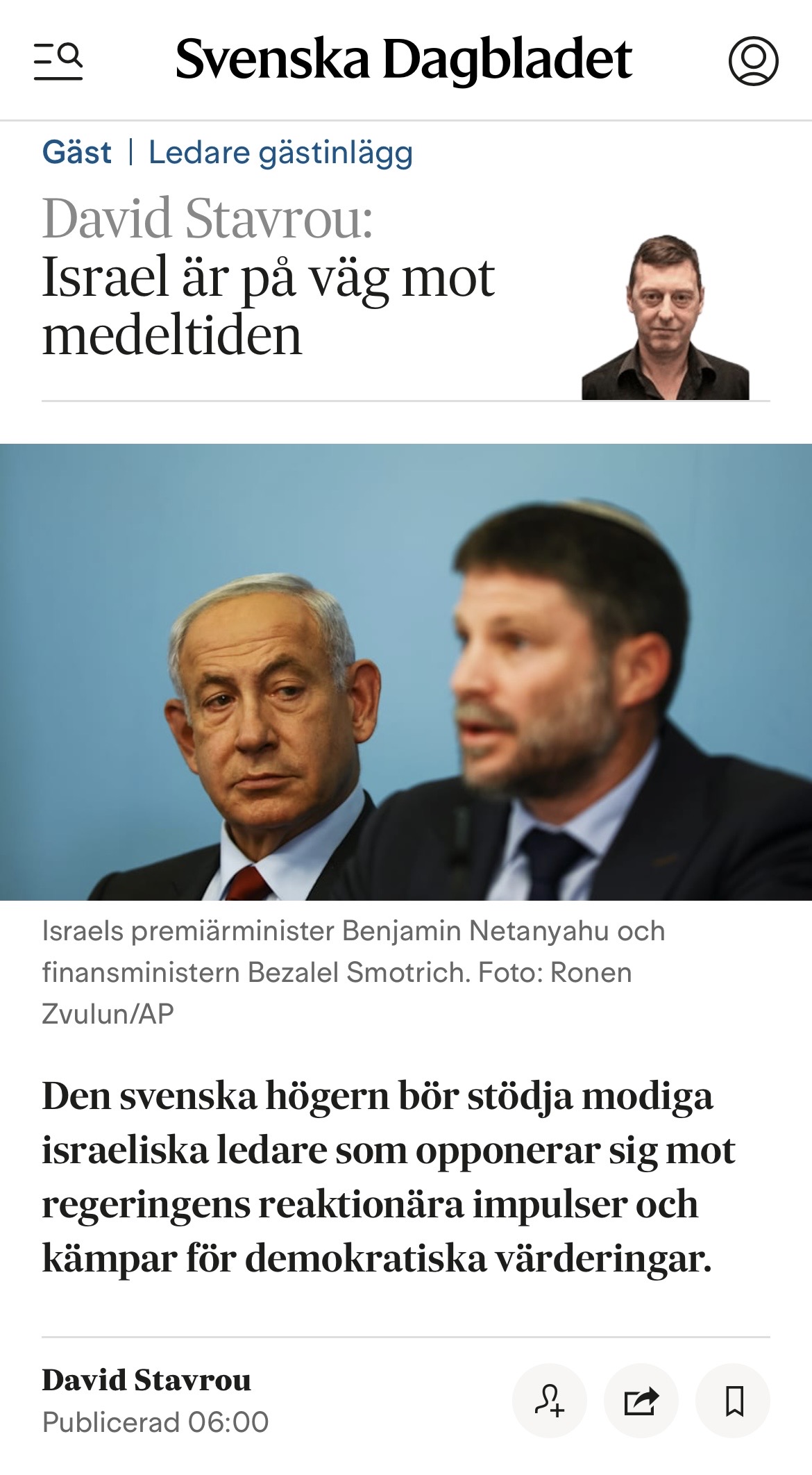
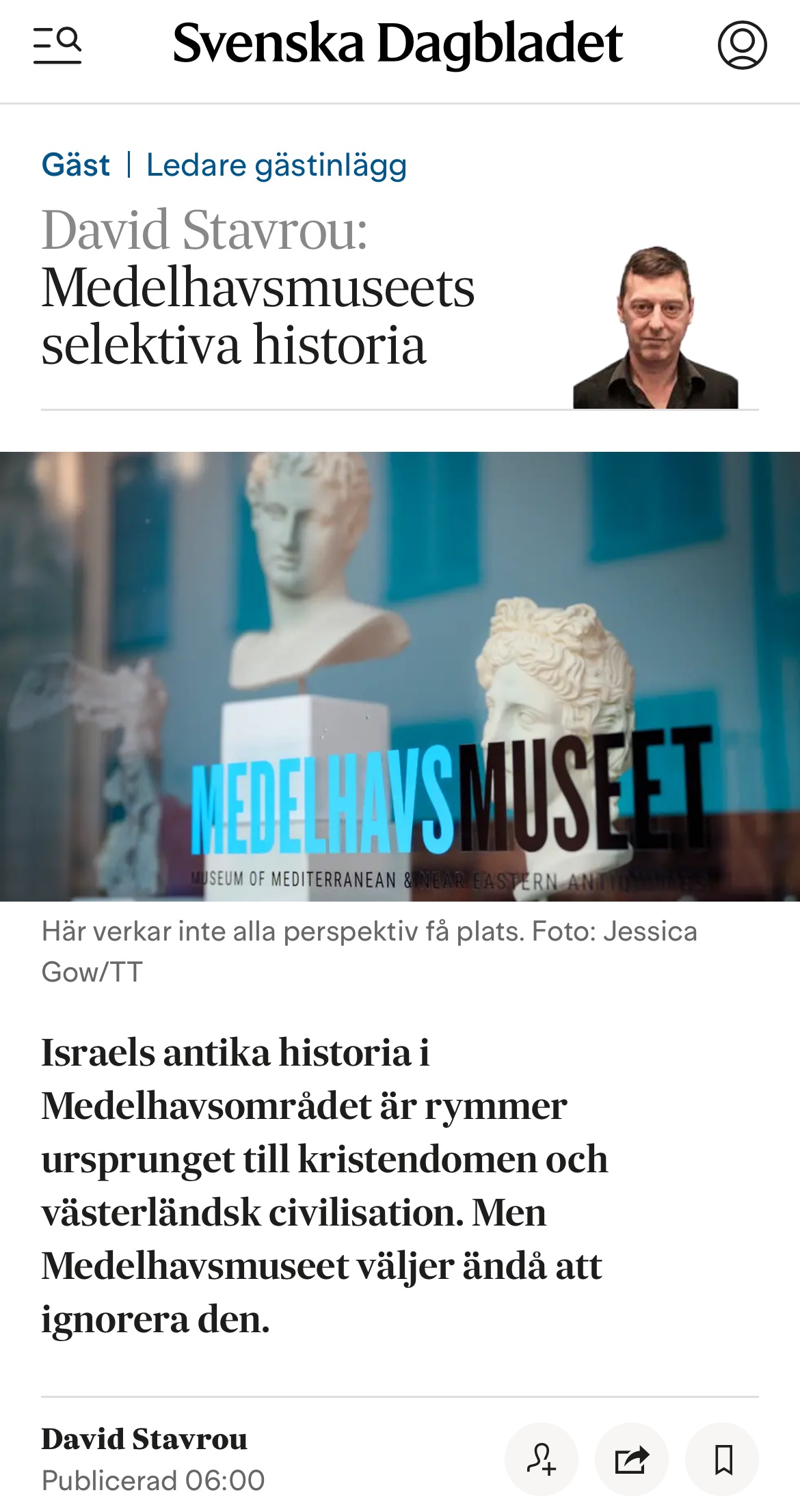
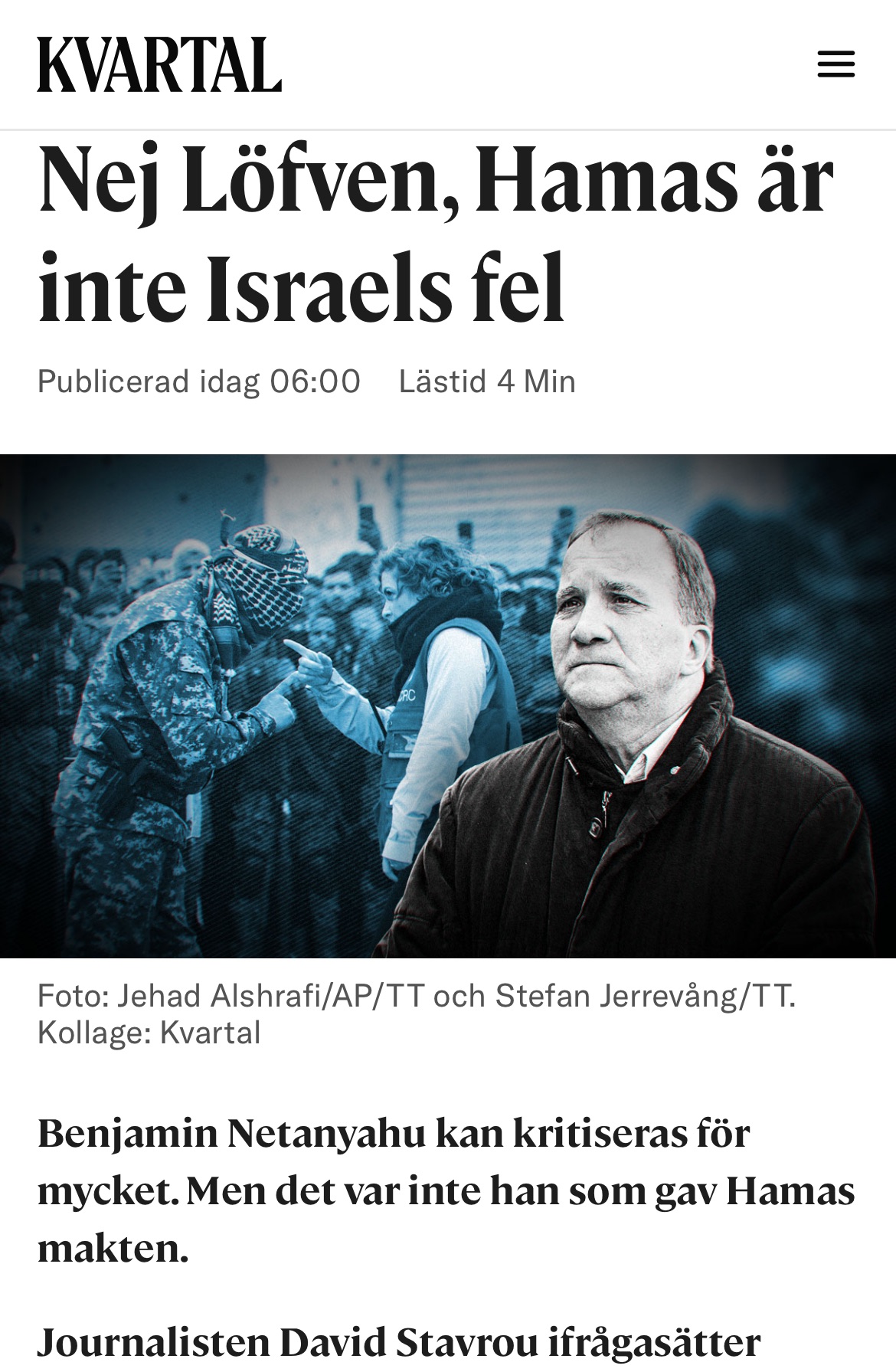




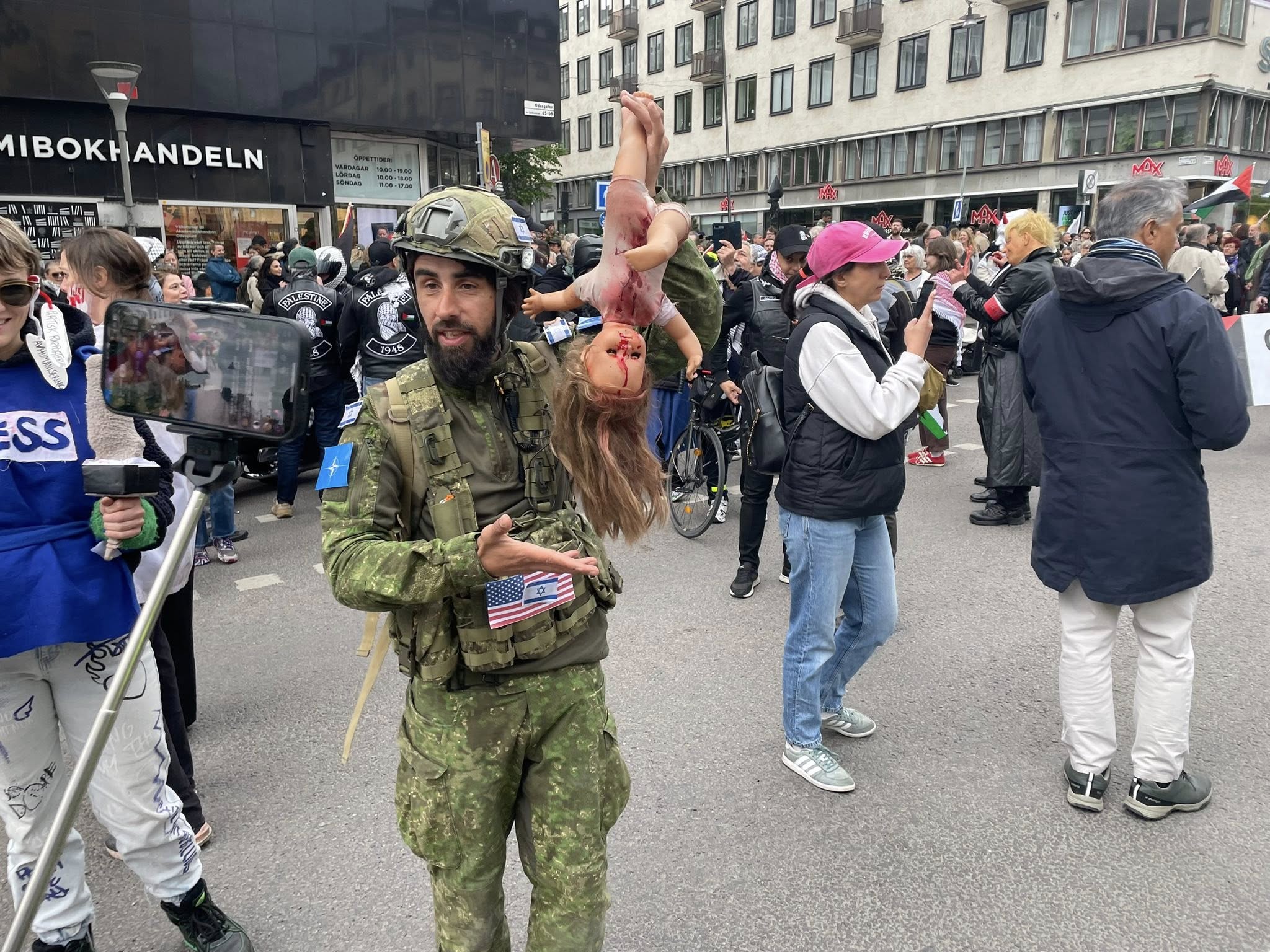

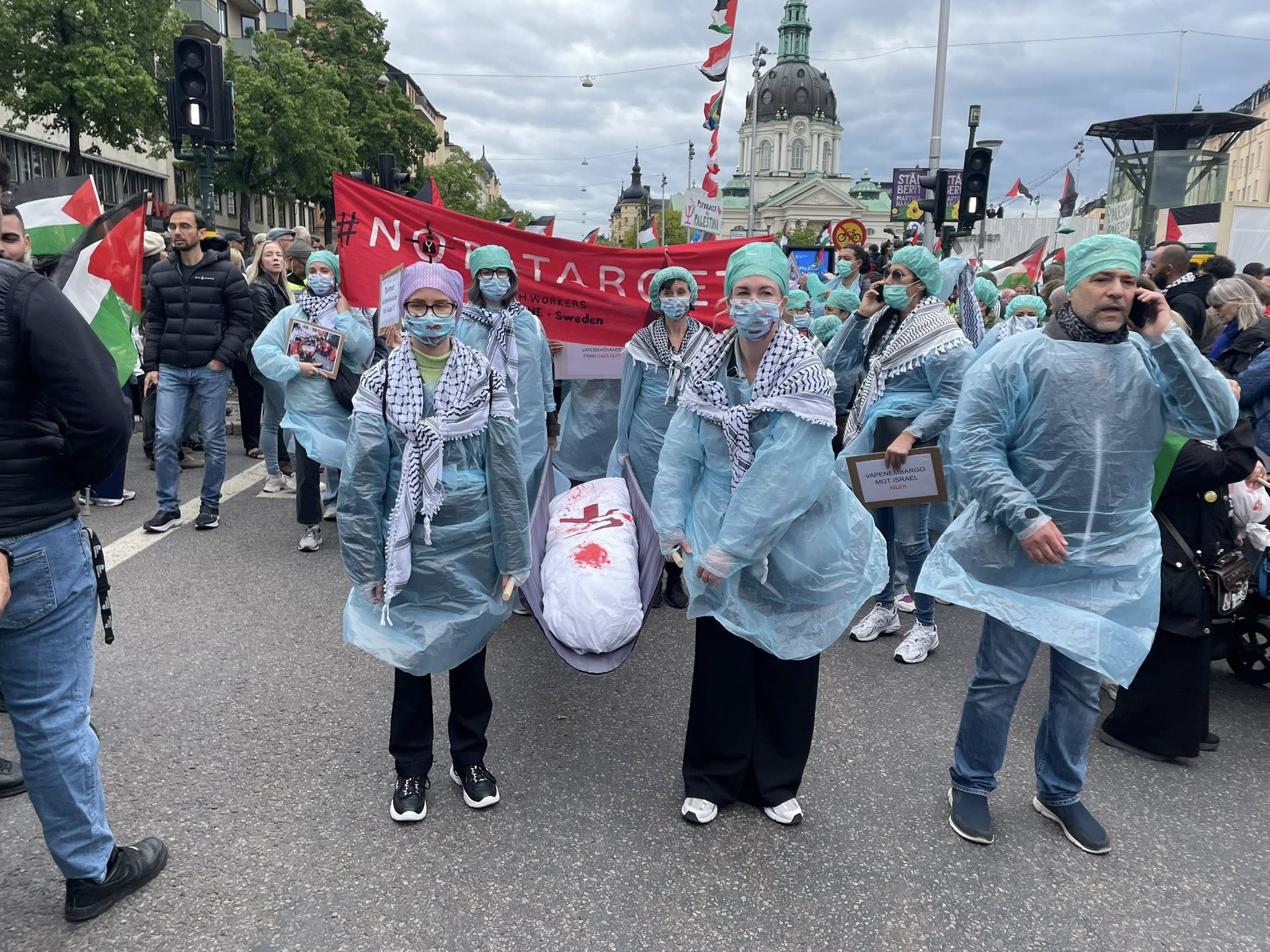
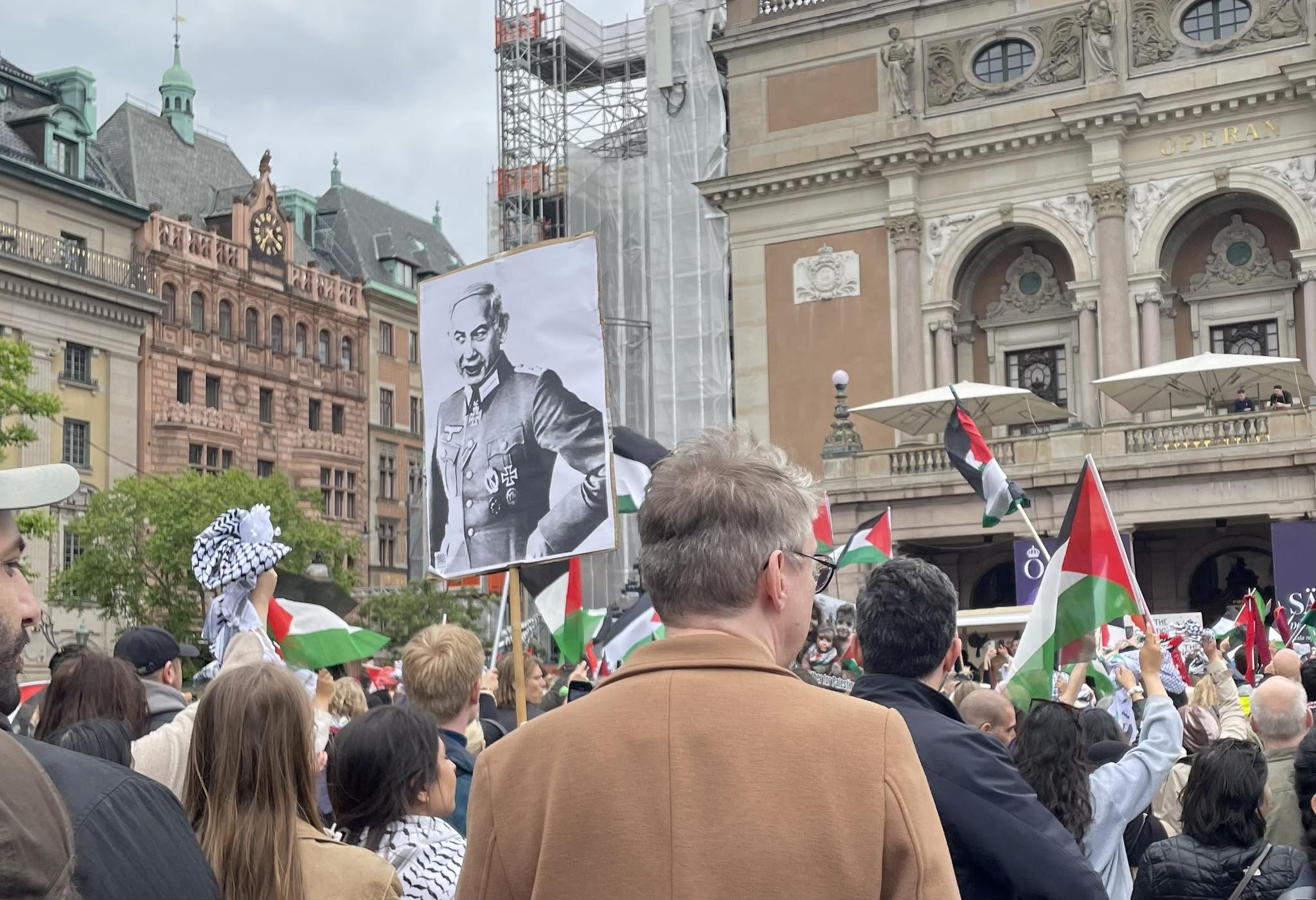
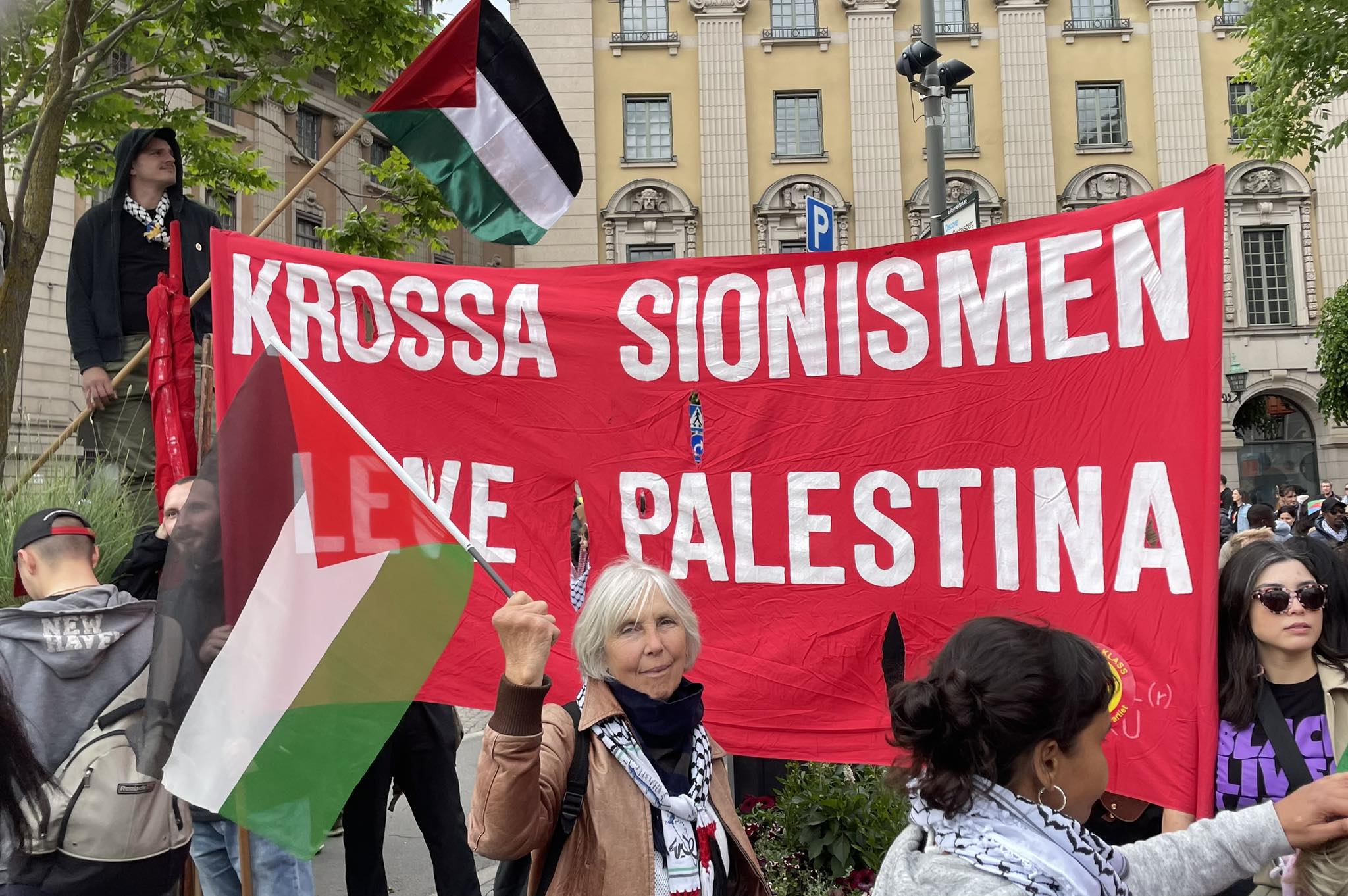
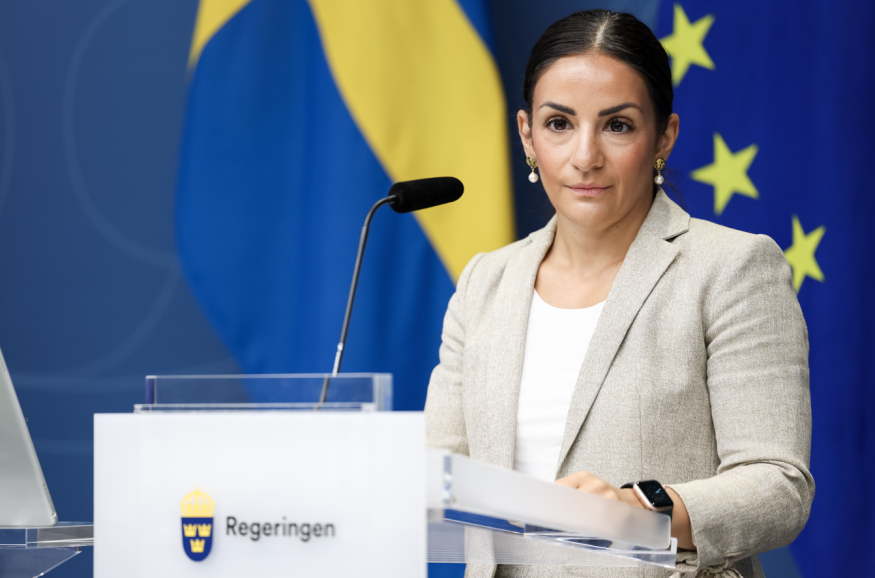
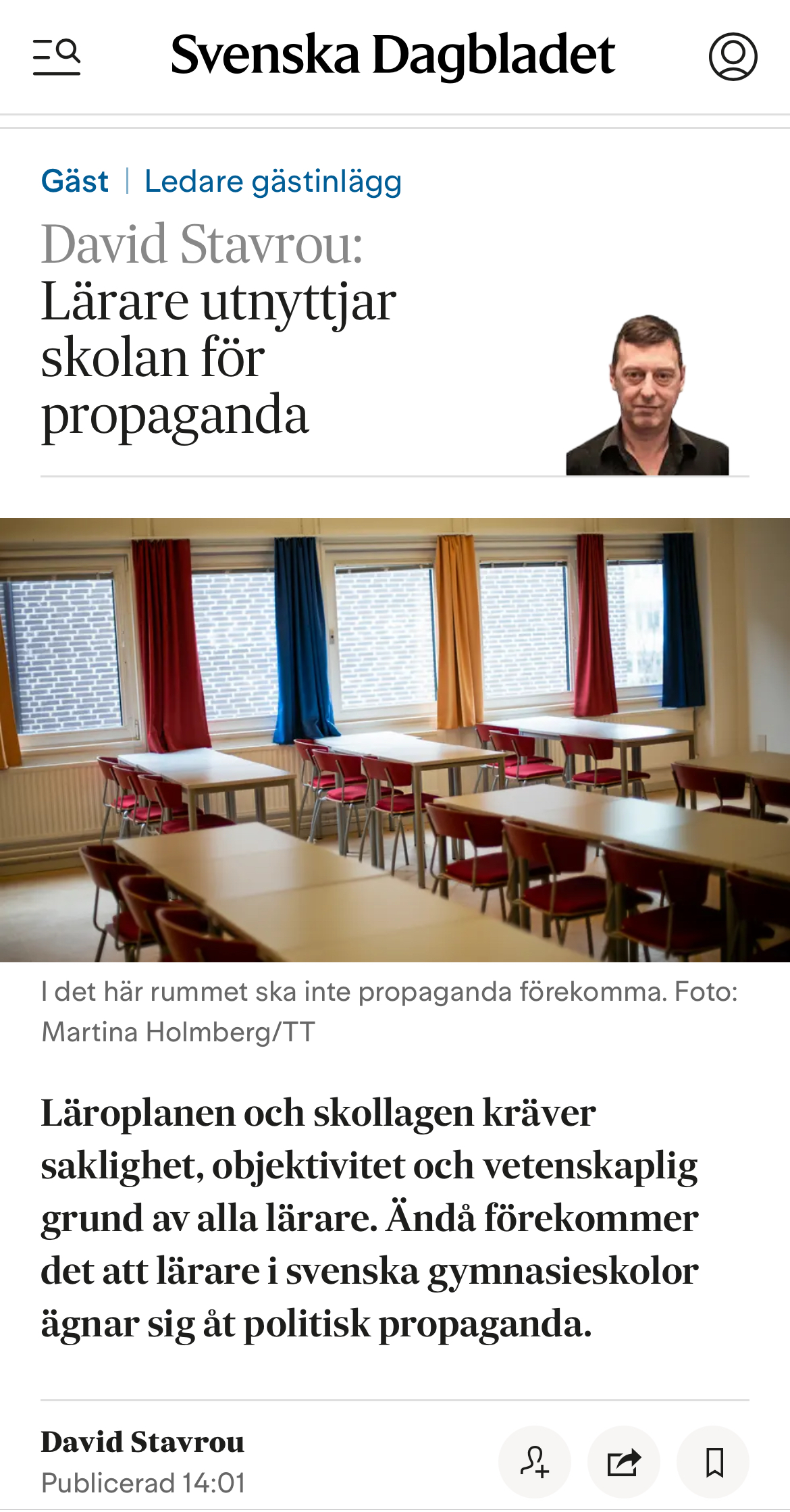
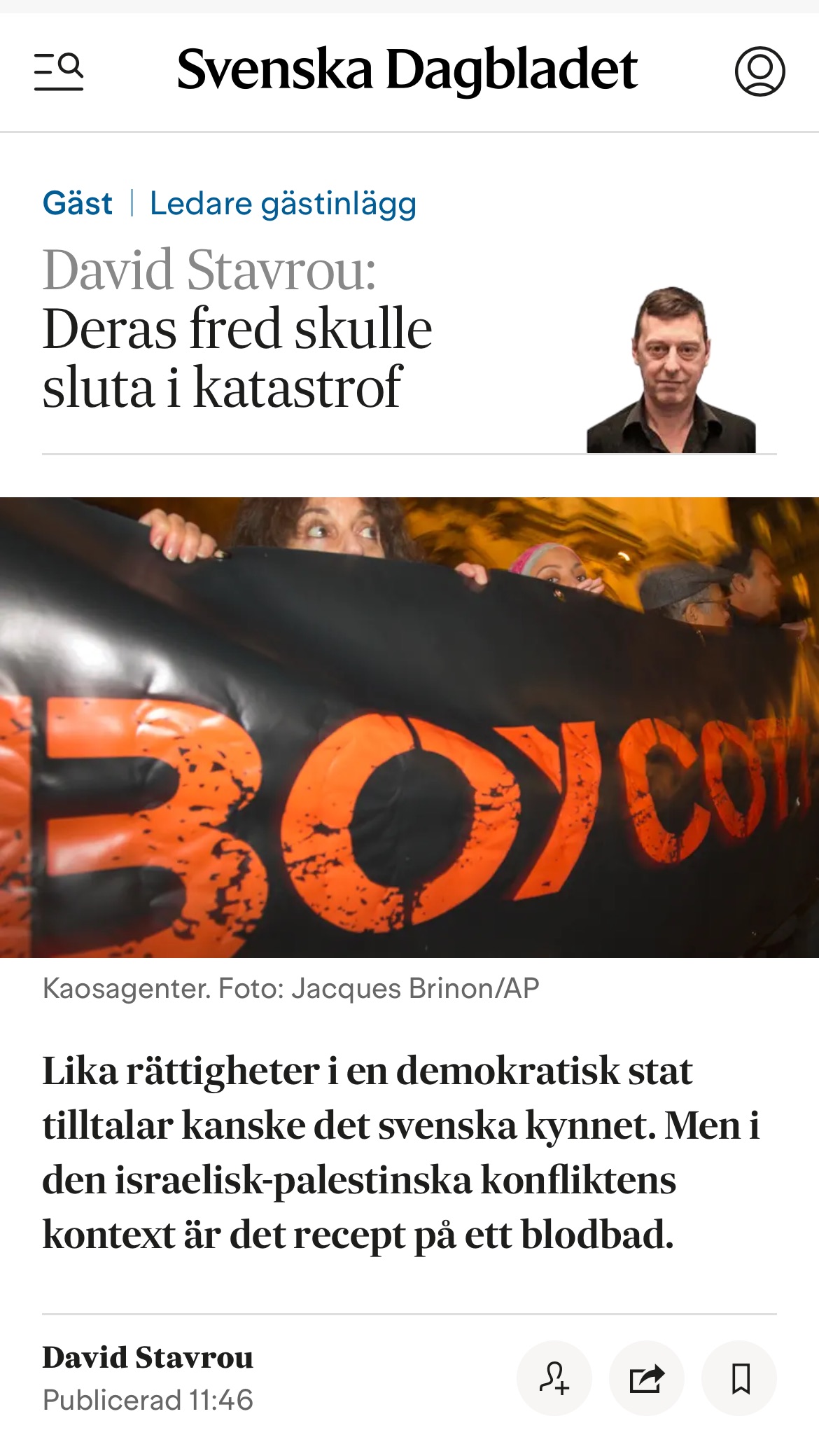


 דיויד סטברו