'For Israelis, It's Clear Jews Can Be Religious, Secular, Asian or Black. Not for Swedes'

From Annie Leibovitz to Amy Winehouse and Ofra Haza: New book on Jewish heroines, created by three feminist Swedish Jewish women, offers an answer to antisemitism

Published: https://www.haaretz.com/jewish/2024-08-05/ty-article-magazine/.premium/for-israelis-its-clear-jews-can-be-religious-secular-asian-or-black-not-for-swedes/00000191-22ac-d4fa-a7d7-e7ef96a70000

What do Amy Winehouse, Anne Frank, Estée Lauder, Rosa Luxemburg, Ofra Haza and Marilyn Monroe have in common? They were all Jewish (Marilyn converted), they were all heroines, and now, all six are among the 120 Jewish women in the new Swedish-language book "Jewish Heroines." The book, which targets both young readers and adults, not only tells the heroines' stories but also uses them to pose questions that have become more urgent in the post-October 7 world.

"Jewish Heroines" is the work of three Jewish Swedish women. The text was written by Anneli Rådestad, the editor of the Jewish-Swedish culture magazine Judisk Krönika, and Karin Brygger, a poet and author who also writes for the Swedish media. The heroines were illustrated by Joanna Rubin Dranger, a graphic artist and also an illustration professor at the University of Arts, Crafts and Design in Stockholm. She's also a winner of the Nordic Council's Literature Prize for her latest graphic novel.

Anneli Radestad
Anneli Rådestad.Credit: Hugh Gordon

"The three of us come from very strong feminist backgrounds," says Rådestad, who's also a former journalist for Swedish public radio. She notes that Rubin Dranger has been working with feminist issues since the '90s, while Brygger has being studying women's history and literature for around 25 years. Rådestad is the editor of Judisk Krönika, which launched a series of articles about Jewish women, "partly because the magazine has been male dominated since its founding in 1932. Through these articles, we tried to contribute to a correction of Jewish-Swedish history by bringing women out of the shadows."

The idea to turn the project into a book came during the pandemic, while Rådestad was reading to her daughter, who was 5 at the time. "The book I was reading was the Swedish version of 'Good Night Stories for Rebel Girls' [by Elena Favilli and Francesca Cavallo], and I thought it would be great if there was a book dedicated to Jewish heroines. Jews are a small minority in Sweden, and the stories of Jewish women … have left very little mark." Rådestad says that when she told Rubin Dranger about the idea, "she was enthusiastic and very surprised that a book like this didn't already exist."

איורים - book_ Joanna Rubin Dranger
The book cover.Credit: Joanna Rubin Dranger / Natur & Kultur

I spoke with the three authors in Stockholm's Old Town after the book's launch party at a local bookstore. They say that when they checked if there was already a book on Jewish heroines, they found a few in English, but on a smaller scale. And they discovered the Jewish Women's Archive in the United States – a great source, but it's not a book. Rubin Dranger notes that they aimed to rise above the local context. "I wanted to make a book that would not only be for the Jewish community in Sweden but would suit everyone, including people in other countries," she says.

Brygger adds that "Jewish Heroines" could also play a role in academic debates. "It can be part of women's history and women's literary history studies. I've been involved in women's studies for a long time and I've been writing life stories and texts that give women a voice," she says. "These stories are missing in the academic world. In fact, a large part of the ability to do this now exists thanks to women like those we wrote about in the book, such as Gloria Steinem, Betty Friedan and Susan Faludi."

These last three are among a long line of American women in "Jewish Heroines," including Supreme Court Justice Ruth Bader Ginsburg, thinkers such as Susan SontagJudith Butler and Masha Gessen, and artists of various stripes such as Barbra StreisandBette Midler and Annie Leibovitz. The book also portrays women from totally different backgrounds – Nobel-winning scientists such as Israeli Ada Yonath and Italian Rita Levi-Montalcini – as well as actresses, dancers, heroines from Middle Eastern history and even biblical figures such as Esther, Ruth and the Four Matriarchs: Sarah, Rebecca, Leah and Rachel. "Jewish Heroines" weaves them into a tapestry of inspiring women from different eras all over the world.

Your book features a wide variety of countries of origin, eras and ethnic groups, but some are more widely represented than others. For example, there are many women from Sweden and the United States and only a few from Israel including Golda MeirOfra Haza, Ada Yonath, Ester Rada and Robi Damelin of the Parents Circle – Families Forum. How did you make your choices?

Joanna Rubin Dranger
Joanna Rubin Dranger.Credit: Hugh Gordon

Brygger: "When we found women we wanted to have in the book, we made presentations for the others … and the others took some time to think and learn, and we made a decision. The three of us had an equal part in 'finding' the women." Then came the greater work of research, writing and illustrating. "This ongoing conversation was the most fabulous part of working on the book," Brygger says. "We were in constant contact, sending messages, photos and articles to each other in a flow of creative desire to write and portray as many great women as we could."

Rubin Dranger adds about the women they chose: "For Israelis, it's quite clear that Jews can be anything – religious or secular, Asian, white or Black – but for Swedes it's not so clear. Many people have never met a Jew but they have an image of Jews. Often, they think of a Jew as a religious man with a hat and payes [sidelocks]. They don't always realize that this is a flexible identity."

According to Rubin Dranger, this is why the book also features a Black American rabbi, writers, journalists and spiritual women from Algeria, New Zealand, Egypt and Cuba, not to mention a Mexican poet and actresses from India. Rådestad adds: "In a way, this book is a response to things like the report published in 2021 about antisemitism in schools in Malmö, a city that has become notorious in this context. The report showed the way students and teachers understand the word 'Jew': an Orthodox religious white man or a figure in the Israeli-Palestinian conflict."

Karin Brygger.
Karin Brygger.Credit: Hugh Gordon

Brygger notes that the world of the past – and unfortunately still the present – is filled with prejudices. So the book "not only offers a wonderful possibility of finding a character who is similar to you, who can give you strength or inspire you. It's also a tool for breaking down stereotypes and fighting antisemitism."

Brygger, who lives in Gothenburg, adds that she received warm responses when she presented the book at cultural institutions in the city. "They said, 'We don't need more reports, we already know that there is antisemitism here. We need tools to deal with the problem.' They were enthusiastic about the book and wanted to use it as an educational tool."

And the issue of Jewish diversity isn't taken for granted in the Jewish community.

"Today, when you look, for example, at the school photo of the Jewish school in Stockholm, you can find the whole world in them," Rådestad says. "People get married in all kinds of ways, and it's important to represent everyone."

In Brygger's opinion, the book's diversity of Jewish identities includes "a way to deal with prejudices and racism that exist even in the Jewish community." Rubin Dranger adds: "But it's not just the representation. It's not just pointing out the fact that there is someone in the book who is adopted or someone who is Ethiopian. It's a presence that's truly broad, not an example or two who are chosen just to serve as an alibi."

Beyond the choice of specific characters, the creators stress the significance of the content being available in a physical book, sold nationwide, rather than just being information in an internet archive or a Jewish publication. "In a country where the Jewish minority is tiny, we shouldn't underestimate the fact that a large non-Jewish publisher released the book in Swedish," Rådestad says. "This makes a statement that this book is for everyone – Jews and non-Jews, young and old, library visitors and school students."

She and her two co-authors are aware that the book is being published in stormy times globally for both women and Jews. The book links these two identities. Many of the profiles are of women who stood – or are still standing – at the forefront of such troubles, from Russian-American anarchist Emma Goldman, through Hannah Szenes and women fighters in WWII ghettos, to young Ethiopian-American activist Naomi Wadler. The impression is that, beyond its heroines' scientific and artistic achievements, the book celebrates the struggle against tyranny, racism and the patriarchy.

Illustrations of Ruth Bader Ginsburg, from the book.
Illustrations of Ruth Bader Ginsburg and Ofra Haza, from the book.Credit: Joanna Rubin Dranger

"We have seen and continue to see a retreat in women's rights in the world," Brygger says. "It keeps returning. In the book, we connect Jewish history with women's history." Rådestad continues: "We are connecting in many ways with other struggles, like that of the LGBTQ community. The Jewish feminist movement and the Jewish LGBTQ movement walked hand in hand. "Take Steven Greenberg, for example, the first openly homosexual Orthodox rabbi. His interpretation of the Biblical verse forbidding male intercourse is that it is a prohibition against degrading another man. Doing so lowers him to the status of a woman, which in biblical times was seen as inferior. Greenberg's interpretation connects the two struggles – striving for equality in both male-male relationships and male-female relationships. It's a common struggle."

The authors acknowledge that the book's significance has changed somewhat since October 7. Work on the book was finished before the Hamas attack. However, says Rådestad, quite a few more Jewish female heroines have emerged since then. "Take, for example, Rachel Edri from Ofakim, who saved her own life and that of her husband," she says. "She became famous for giving cookies and coffee to the terrorists, thus preventing them from murdering more people. Another example came after the terrible Eurovision week in Malmö. I think that Eden Golan not only carried Israel on her shoulders but also Sweden's Jewish minority. A young woman stood high when so many older people around her went so low. She really showed great strength, while many Jews around the world felt pressure and fear. Her character gave me strength, too."

"We couldn't have imagined these circumstances when we wrote the book. We presented it, on the eve of its publication, at the Gothenburg International Book Fair the week before October 7," Rådestad recalls, referring to the largest cultural event in Scandinavia and one of Europe's largest book fairs. "The transition from being on an important international cultural stage to October 7 was very stark. It was a terrible fall. It shook the ground beneath the feet of Israelis and Palestinians – and Jews worldwide.

"I realized a few months later that the meaning of some of the book's heroines had changed for me. For example, Dona Gracia. When I wrote about her, I saw her as a powerful historical figure who faced the Inquisition 500 years ago. Today, I understand that there are still many who live as crypto-Jews – I have friends worried because they gave their children Jewish names. Now, they don't know what effect this will have.

איורים 5 Joanna Rubin Dranger

Illustration of Golda Meir, from the book.
Illustrations of Golda Meir and Esther Rada from the book.Illustration: Joanna Rubin Dranger/Natur & Kultur

In the reality of cultural and educational boycotts, a Jewish name can lead to serious consequences. At the same time, I feel that the resistance, the strength and the resilience of Jews are an important part of this book. As a people, we've been through this many times for hundreds of years. Some of the heroines here withstood the test. They gave what they created to themselves, to their families, to their people and to the world."

Rådestad mentions a common sentiment among Jews around the world today: "Israelis have become more Jewish and Jews have become more Israeli since Since October 7. The pogromist terror of October 7 evoked something that previously only happened in the Diaspora and that Israel was supposed to prevent. The security of independence and having agency was shaken. Israelis got a taste of what it was like to be a minority in Russia a couple of hundred years ago in the most terrible and terrifying way."

She observes that many Jews worldwide are suffering for the same reason Israelis are suffering. She says they see erstwhile friends and partners, such as the international cultural communities and feminist movement, being silent and turning their backs. "It's become very important for some Jews to stand up for Israel and Israelis in a world where haters are targeting Jews and Israelis alike," she says. "So when Israel is framed as a pariah state and a controversial country, the women we profiled provide strength that children and teenagers need."

"It's not just children," Brygger adds. "When I look through the book, I'm inspired and feel strength and joy. Already when we were writing it, when we discovered women we didn't know about, it made us happy. But now the joy is different. In the past, it was the euphoria of discovering something new – like the Jewish actresses who starred in Bollywood. But today, under the shadow of October 7, the book also gives us the strength we need."

Another layer to the book is the flexible definition of Jewish identity. Some figures were not born Jewish and converted (like Marilyn Monroe, who underwent a Reform conversion to Judaism ahead of her marriage to playwright Arthur Miller, and called herself "a Jewish atheist"). Some had a Jewish father and a non-Jewish mother. Some weren't born Jewish but were adopted by Jews. Some of the heroines didn't identify as Jewish growing up, but as adults were foced by others to grapple with their Jewish identity.

By way of example, Brygger points out Marianne Cohn, a member of the French Resistance during World War II. She saved many Jewish children by smuggling them over the Swiss border. She had no active Jewish identity whatsoever during her childhood in Germany. It only developed upon emigrating to France with her parents. Rubin Dranger talks about Lotte Laserstein, a German painter whose family had converted to Christianity. But the Nazis considered her Jewish and forbade her to work as an artist. She found refuge in Sweden. "In a way, her story connects to my own experience," she says. "I grew up assimilated and only embraced my Jewish identity after a priest in my Christian confirmation process made me feel singled out and attacked me because of my Jewish heritage. I know that many today share this experience. After October 7, many people are rediscovering their Jewish identity and they start searching for a community they may have already forgotten."

"In the current global climate, words like "minyan" and "shtetel" may take on a new meaning," Rådestad observes. "In progressive Judaism, at least, you can find a women's minyan. The term shtetel may represent a safe place." This is needed because there are already American publishing houses who say "No to sexism, no to racism and no to Zionism." Says Rådestad, "Jews may once again be forced to publish their books alone, until the world rediscovers them."

What sets a Jewish heroine apart from general heroism, and what is the uniqueness of women's heroism?

Brygger: "It's about persecution. The heroism in our book is related to the strength of coping with and resisting persecution, antisemitism and exclusion. In general society, there is a struggle against patriarchy and glass ceilings of all kinds. Here we need to add another struggle – the struggle that Jewish women have had to wage throughout history."

Rubin Dranger: "Part of it is that many Jewish women fought for the rights of other minorities, like African Americans or indigenous peoples in the United States. They weren't content with fighting for their own interests."

Rådestad: "It's part of Jewish values and Jewish tradition. Telling truth to power is part of what Jews do. So is the attempt to make the world a better place, tikkun olam. Although this characterizes American Judaism, it's not only in the United States. We wrote, for example, about the Iraqi-born philanthropist Flora Sassoon. She funded and promoted the use of vaccines against terrible diseases in India and fought against deprivation and discrimination."

Given the chance, who'd you like to meet from among the heroines you profiled?

Rubin Dranger: "The American cryptanalyst Elizebeth Smith Friedman, who cracked the Nazi codes. Code cracking and intelligence defense fascinates me, and the fact that Friedman's work wasn't known until quite recently. For many decades, her files were kept confidential and were lost to history. Elizebeth wasn't Jewish by birth but married a Jewish man, a U.S. Army cryptographer." It is important to talk about this type of Jewishness, exactly because not everybody considers them Jewish, she says.

Rådestad has a hard time choosing. She starts with Shifra and Puah, the biblical midwives who disobeyed Pharaoh's order to kill Hebrew children. Then she moves on to the young Jewish women who were part of the anti-Nazi resistance movements and the Warsaw Ghetto Uprising fighters. She finally chooses Asenath Barzani, a rabbinical scholar who was active in 17th century Kurdistan. Barzani's father was a yeshiva head in Mosul. She became a yeshiva head herself. "Barzani's story changed my view about how progress happens," she explains. "It gives perspective on what the West used to be and what Iraq used to be."

Brygger also mentions several women. She says her encounter with Susan Sontag "not only shaped my academic life, but also my personal life since I was a teenager." She also recalls the story of Charlotte Salomon, the Jewish-German artist who was murdered in Auschwitz. "It's a story with a lot of pain," she says. "Salomon sent her works to a friend with instructions to 'keep this safe, it's my whole life.' Salomon reminds us how important it is to write and document our lives even today, how important it is to leave traces and testimonies."

"I hope that if a young person feels alone or lost, they'll be able to find what I found in these women that changed my life so radically," she adds. "I hope our book will give them role models in these turbulent and terrible times. Perhaps they'll even find a soulmate, even if it's someone who's no longer alive or someone who's far away. It's so hard to find and mold your identity. I'd never have made it through my teenage years without these women who made me a reading and writing person, with a life goal. As usual, I went all in and really tried to learn everything about many of them. Some of them are much closer to me than 'real people.' The world opens up to you when you relate to texts and books. These writers and artists also give you a hand to hold throughout life."

Jewish Youth From Around Europe Write About Their Lives. Now, and 85 Years Ago

The Kaleidoscope project revives an initiative that was interrupted by the Holocaust: an autobiographical writing competition for Jewish youth from all over Europe

Published in "Haaretz": https://www.haaretz.com/jewish/2024-07-15/ty-article-magazine/.premium/jewish-youth-from-around-europe-write-about-their-lives-now-and-85-years-ago/00000190-a26f-da1a-adf0-a6ff4cb40000

"My father spoke with me as a friend. He touched offhandedly on the question of whether I was in love with a boy. The question has opened a new page for me … I've always tried to banish the subject from my heart," wrote a 17-year-old Jewish girl calling herself Hansi in Vilna in 1934. Later, she wrote that the boys in her class ignored her, that she saw herself as "unattractive to the eye" and that the indifference of the boys made her sit on the sidelines and sink into thought while the other girls sat together and shared anecdotes.

"That specific situation made it so I didn't love a single boy," she wrote. "At a time when I couldn't stop my feelings, I felt love for boys in general, as the opposite sex, as a group and not as individuals."

Hansi's text is only one testament out of hundreds that unfurl over thousands of pages written by young Jews who lived in Poland and several of its neighbors in the 1930s. They were collected by the Yiddish Scientific Institute, which worked in Eastern Europe in the lead-up to World War II with the mission of researching and preserving the region's Jewish life and Yiddish culture.

The organization was established in 1925 in Vilna (then in Poland, now the capital of Lithuania and known as Vilnius) and had branches in Warsaw, Berlin and New York. World War II forced the organization to move its operations to New York, which is the home to its modern incarnation's headquarters to this day.

The collection of these autobiographical accounts is fascinating in the personal glimpse it gives into prewar Jewish life. Many of the teenagers who wrote them died in the Holocaust, their words now serving as a memorial to the complex, diverse lives that were lost. They wrote about music, literature, ice skating and a myriad of other subjects. Some were politically aware and were Zionists, socialists or members of the Bund movement. There were the religious and the secular, the poor and the rich, the city folk and the rural folk. There were young people in love, the newly married and the divorced. Some dreamed of emigrating to the New World; some were excited about the future, and others were afraid of it.

The beginning of the Hebrew-language entry for the competition written by Hansi, a girl from Vilna, in 1934.
The beginning of the Hebrew-language entry for the competition written by Hansi, a girl from Vilna, in 1934.Credit: YIVO Institute for Jewish Research

"In the 1930s, the YIVO institute in Vilna wanted to know what was going on in the minds of young people in Yiddish-speaking countries," says Daniela Greiber, the Jewish Communal Life grants program manager at Rothschild Foundation Hanadiv Europe. "They organized a competition for autobiographical writing, and over the course of several rounds, between 1934 and 1939, they received 627 manuscripts. Most were handwritten and dozens of pages long. Most of the writers were boys, but there were girls too, and although the prevalent language was Yiddish, there were also some – including Hansi – who wrote in both Hebrew and Polish.

"The idea wasn't to publish the manuscripts, but to preserve them so they would serve as raw material for social research," continues Greiber. "The background for the project was the "Yiddishist" worldview, which believed in the need to develop a sense of belonging and meaning in Jewish life in countries where Yiddish was spoken.

There was also a belief among many that there was a future for Jews in Europe that would involve a socialist revolution. This was a time when people studied ethnography and were involved in the discipline of autobiographical writing. Someone had the ingenious idea of asking young people to write their biographies, and to make the manuscripts truthful, it was proposed to do it with anonymity."

The request was publicized in the press; to increase motivation, a competition with prizes was announced. Each year, several writers won 150 zlotys each. However, the winners in the final round never found out about their accomplishment. The date set for announcing the winner was September 1, 1939, the very day World War II broke out. It's likely that many of the participants didn't survive the following years.

The Jewish autobiographical competition was abruptly forced to end because of the war, but 85 years later, the Rothschild Foundation has begun to revive the project. It named the new project Kaleidoscope, and it seems almost like the twin of the original one. Once more, young Jews from all over Europe are writing about their lives. This time, the works aren't only being preserved and collected, but are also being published (in their original language and the English translation) on the project's website.

Dennis Grossman, one of the first participants in the project, is a young Jewish man from Budapest who grew up participating in Hungarian Jewish schools and summer camps. "I'm 21 years old and I still go to summer camps – now as a counselor," he wrote. "It is very hard to stay involved in the Jewish community after somebody reaches adulthood. Before that, you can go to camps, Jewish school and youth movements. But you grow out of these when you become 18 years old.

"That is why – if you want to stay involved – people usually go work at [camps] as a counselor or get jobs in Jewish organizations," he continued. "My girlfriend and I started hosting Shabbat dinners for our Jewish friends every other Friday as a way to keep our little community together. We usually say blessings for the wine and challah, sometimes we say kiddush. After that we eat, drink, have conversations and play board games. 

"Most of the people who come are our friends from […] camp, but we also try to invite anybody who has somewhat of a connection to Judaism and is looking for a way into the community," he added. "There are lots of young Jews in Hungary who either find out about their being Jewish too late or have some other reason for not getting involved in the community early on. These people get locked out because most of the programs and communities for young adults are just like our Shabbat dinners. Small, because my home can only fit so many, and somewhat closed because we only know the people in our social bubble.

Dennis Grossman enjoys some hasábburgonya. 'It is very hard to stay involved in the Jewish community after somebody reaches adulthood.'
Denis Grossman

"I am truly frustrated by this dynamic and I'm always looking for ways to get more people involved," he wrote. "My philosophy is that people should relate to their Jewish identities through experiences they have. These experiences can be anywhere from going to the synagogue to attending a Shabbat dinner or a bar mitzvah. These can overwrite the fact that a lot of people relate to Judaism through the Holocaust or through our history."

Dennis is the son of an American father and a Hungarian mother who divorced when he was a baby. Most of his mother's family died in Auschwitz, and those who survived avoided their Jewish identity after the war. His mother started to show renewed interest in her 20s. "My mother always put more emphasis on making these experiences fun and digestible for us rather than following the strict rules," he wrote. "Because of this, for example, my concept of Shabbat is about having everyone around the table and my mom kissing my head, blessing me, and having peace around us. It is very far from the concept that we aren't allowed to do certain things…"

Dennis understands the significance of the manuscripts that were written so many decades ago and of the renewal of the project. "It's trying to understand the period we live in and the significance of being a Hungarian Jew in this time period," he says. "In my text, I tried to explain the situation so that people understand it. But besides the historical aspect, I also like to express myself in writing, and it feels good to be a part of something like this and to share my Jewish identity with the world. "

In addition to the positive aspects of Jewish identity, are there also more challenging aspects?

"For me, it's not a big challenge to be Jewish. If I wasn't an active Jew, that would be a greater concession. There's a fear of antisemitism, of estrangement, of discrimination, of the fact that people don't understand us or think we're strange, but if we don't expose ourselves and aren't active, people will understand us even less. I believe in being a full part of society in general, and I feel that through me, people will understand what Judaism is.

Continues:

https://www.haaretz.com/jewish/2024-07-15/ty-article-magazine/.premium/jewish-youth-from-around-europe-write-about-their-lives-now-and-85-years-ago/00000190-a26f-da1a-adf0-a6ff4cb40000

פרויקט מופלא לתיעוד חיי הנוער היהודי באירופה נקטע ב-1939. עכשיו הוא קם מחדש

פרויקט "קלידוסקופ" מחייה יוזמה שנקטעה ערב השואה: תחרויות כתיבה אוטוביוגרפית של נערים ונערות יהודיים מרחבי אירופה.

פורסם ב"הארץ": https://www.haaretz.co.il/gallery/galleryfriday/2024-07-04/ty-article-magazine/.highlight/00000190-777b-d705-a7f5-fffb44090000

"אבא שוחח איתי כחבר. הוא נגע דרך אגב בשאלה אם אני אוהבת בחור. השאלה הזו הוסיפה לי דף חדש… השתדלתי תמיד למחוק מהלב את העניין הזה", כך כתבה צעירה יהודייה בת 17, שכינתה את עצמה האנזי, בווילנה ב-1934. בהמשך היא מספרת ליומנה כי הנערים בכיתה מתעלמים ממנה, שהיא תופסת את עצמה כ"מכוערת בשביל העין" ושאדישותם של הבנים גורמת לה לשבת בצד ולשקוע במחשבות בזמן שהנערות האחרות יושבות יחד ומספרות אנקדוטות זו לזו. "מצב ספציפי זה גרם שלא אהבתי בחור אחד", היא מסכמת, "ובשעה שלא יכולתי לעצור ברגשי הלב, חשתי אהבה לבחורים בכלל, באשר הם מין שני, בתור קיבוץ ולא בתור פרט".

רשימתה של האנזי היא רק עדות אחת מתוך מאות עדויות הנפרשות על פני אלפי עמודים שכתבו צעירים יהודים שחיו בפולין וכמה משכנותיה בשנות ה-30 של המאה הקודמת. הן נאספו על ידי מכון יהודי בשם ייִוואָ (YIVO, ראשי תיבות ביידיש של המכון המדעי היהודי), שפעל במזרח אירופה בשנים שקדמו למלחמת העולם השנייה וקיבל עליו לחקור ולשמר את אורח החיים היהודי במזרח אירופה ואת תרבות היידיש. הארגון הוקם ב-1925 בווילנה (אז בפולין, היום בליטא) והיו לו סניפים בוורשה, ברלין וניו יורק; לעיר זו עברה פעילות הארגון בעקבות מלחמת העולם השנייה ובה נמצא המטה של גלגולו המודרני עד היום.

הרשימות שלוקטו במסגרת איסוף העדויות האוטוביוגרפיות מרתקות. רבים מבני הנוער שכתבו אותן נספו בשואה והטקסטים שלהם משמשים מעין מצבה המזכירה את החיים המגוונים והעשירים שאבדו. הם כתבו בין השאר על מוזיקה, ספרות וגלישה על קרח; חלקם היו מודעים פוליטית – ציונים, סוציאליסטים או אנשי תנועת הבונד; היו ביניהם דתיים וחילונים, עניים ועשירים, כפריים ועירונים; הם כללו נערים מאוהבים, נשואים טריים וגם גרושים; חלקם חלמו להגר לעולם החדש, חלקם התרגשו לקראת העתיד ואחרים דווקא חששו ממנו.

"בשנות ה-30 המכון בווילנה ביקש לדעת מה קורה במוחם של צעירים בארצות דוברות היידיש", מספרת דניאלה גרייבר, מנהלת תוכניות מענקים בקרן רוטשילד "הנדיב" אירופה. "הם אירגנו תחרות כתיבת אוטוביוגרפיות ובמשך כמה סבבים, בין 1934 ל-1939, הם קיבלו 627 טקסטים. רובם היו כתובים בכתב יד והיו בני עשרות עמודים. מרבית הכותבים היו בנים, אך היו גם בנות, ואף שהשפה השלטת היתה יידיש, היו גם כאלה ובהם האנזי שכתבו בעברית ובפולנית. הרעיון לא היה לפרסם את הטקסטים, אלא לשמור אותם כך שיהיו חומר גלם למחקר חברתי. הרקע לפרויקט היה השקפת העולם הבונדיסטית, שהאמינה בצורך לפתח שייכות ומשמעות לחיים היהודיים במדינות דוברות היידיש. היתה גם אמונה שיש עתיד יהודי באירופה שתעבור מהפכה סוציאליסטית. מכיוון שזו היתה תקופה שבה אנשים למדו אתנוגרפיה ועסקו בדיסציפלינה של כתיבת אוטוביוגרפיות, מישהו חשב על הרעיון המבריק לבקש מאנשים צעירים לכתוב ביוגרפיות, וכדי שהטקסטים יהיו כנים, ההצעה היתה לעשות זאת באופן אנונימי".

הבקשה הופצה בעיתונות וכדי להגביר את המוטיבציה אף הוכרזה תחרות נושאת פרסים. בכל שנה זכו כמה כותבים ב-150 זלוטי כל אחד. עם זאת, הזוכים בסיבוב האחרון מעולם לא קיבלו הודעה על זכייתם: המועד המתוכנן להכרזת הזוכים היה 1 בספטמבר 1939, היום שבו פרצה מלחמת העולם השנייה. ככל הנראה, רבים מהכותבים לא שרדו בשנים הבאות.

תחילת רשימתה של האנזי, נערה מווילנה ב-1934, במסגרת תחרות העדויות של מכון ייווא. טקסטים ספורים בעברית
תחילת רשימתה של האנזי, נערה מווילנה ב-1934, במסגרת תחרות העדויות של מכון ייווא. טקסטים ספורים בעברית צילום: YIVO Institute for Jewish Research

תחרות האוטוביוגרפיות היהודיות המקורית אמנם נקטעה באחת בסוף שנות ה-30, אבל קרן רוטשילד מצאה דרך לחדש את הפרויקט כעבור 85 שנים. לפרויקט החדש הם החליטו לקרוא "קלידוסקופ" והוא מעין תמונת מראה של הפרויקט המקורי – גם בו צעירים יהודים מרחבי אירופה כותבים על חייהם כיום, והפעם הטקסטים לא רק נשמרים ונאספים אלא גם מתפרסמים בפומבי (בשפות המקור ובתרגום לאנגלית), באתר האינטרנט של הפרויקט.

דניס גרוסמן, אחד המשתתפים הראשונים בפרויקט, הוא צעיר יהודי מבודפשט שהתבגר במסגרות יהודיות-הונגריות. "אני בן 21 ועדיין הולך למחנה הקיץ", הוא כותב בטקסט שלו, "אבל עכשיו בתור מדריך. קשה מאוד להישאר מעורב בקהילה היהודית אחרי שמגיעים לבגרות. לפני כן אפשר ללכת למחנות קיץ, לבית ספר יהודי או לתנועת נוער, אבל כשמגיעים לגיל 18 עוברים הלאה. מי שרוצה להישאר מעורב הולך לעבוד במחנה בתור מדריך או בארגונים יהודיים. אני וחברתי התחלנו לארח ארוחות שבת עבור חברינו היהודים, פעם בשבועיים בערבי שישי, כדרך לשמור על הקהילה הקטנה שלנו. בדרך כלל אנחנו מברכים על היין והחלה, לפעמים אומרים קידוש. אחרי זה אנחנו אוכלים, שותים, מנהלים שיחות ומשחקים משחקי קופסה. רוב מי שמגיעים הם חברים שלנו ממחנה הקיץ. אבל אנחנו גם מנסים להזמין כל מי שיש לו קצת קשר ליהדות ומחפש דרך להיכנס לקהילה.

"הרבה יהודים צעירים בהונגריה מגלים על היותם יהודים מאוחר מדי, או שיש להם סיבה אחרת לא להתערב בקהילה בשלב מוקדם", הוא ממשיך. "האנשים האלה מוצאים את עצמם בחוץ כי רוב התוכניות לצעירים הן קטנות וסגורות ואנחנו מכירים רק את האנשים בבועה החברתית שלנו. אני באמת מתוסכל מהדינמיקה הזאת ואני תמיד מחפש דרכים לגרום לאנשים נוספים להיות מעורבים. הפילוסופיה שלי היא שאנשים צריכים להתייחס לזהותם היהודית באמצעות חוויות שיכולות להיות בכל מקום, מהליכה לבית הכנסת ועד להשתתפות בארוחת שבת או בר מצווה. זה יכול להחליף את ההתייחסות ליהדות רק דרך השואה או ההיסטוריה שלנו".

דניס הוא בן לאב אמריקאי ואם הונגרייה, שהתגרשו כשהיה תינוק. רוב בני משפחתה של האם נספו באושוויץ ואלה ששרדו נמנעו מעיסוק בזהותם היהודית אחרי המלחמה. אמו החלה לגלות בה עניין מחודש בשנות ה-20 שלה. "אמי תמיד שמה יותר דגש על הפיכת החוויות היהודיות למהנות וקלות לעיכול עבורנו, ופחות על כללים נוקשים", הוא כותב. "בגלל זה תפיסת השבת שלי היא שכולם יושבים סביב השולחן ואמא שלי מנשקת לי את הראש ומברכת אותי. זה רחוק מאוד מהרעיון שמשמעות השבת היא שאסור לעשות דברים מסוימים".

דניס מודע לחשיבות הטקסטים שנכתבו לפני עשרות שנים ולמשמעות חידושו של פרויקט התיעוד. "זו התמודדות עם הבנת הזמן שאנו חיים בו ועם המשמעות של להיות יהודי-הונגרי בזמן הזה", הוא אומר. "בטקסט שלי ניסיתי להבהיר את המציאות הזאת כדי שאנשים יבינו אותה. אבל מעבר לעניין ההיסטורי, אני גם אוהב לבטא את עצמי בכתיבה, וזו הרגשה טובה להיות חלק מדבר כזה ולשתף את העולם בזהות היהודית שלי".

האם מעבר לצדדים החיוביים של הזהות היהודית יש לה גם צדדים מאתגרים יותר?

"בשבילי, זה לא אתגר גדול להיות יהודי. אם לא הייתי יהודי פעיל, זה היה ויתור גדול יותר. יש פחד מאנטישמיות, מקיפוח, מאפליה, מכך שלא מבינים אותנו או שחושבים שאנחנו מוזרים, אבל אם לא ניחשף ולא נהיה פעילים, אנשים לא יבינו אותנו עוד יותר. אני מאמין בלהיות חלק מלא מהחברה הכללית ואני מרגיש שאנשים יבינו מה זו יהדות דרכי. אני מסביר להם וכך יוצר מודעות. זה אולי מפחיד להסתובב ברחוב עם כיפה, אבל כשאני בדרך לבית הכנסת אני חובש אותה אף שבדרך כלל אני לא חובש כיפה. אני עושה את זה כי זו ההזדמנות שלי להיות אדם יהודי ברחוב, ולא סתם אדם ברחוב. כשיראו 100 כיפות, יקבלו את זה ויבינו מה זה".

דניס גרוסמן
דניס גרוסמן, צילום פרטי.

הוא מציין כי צעירים יהודים רבים בהונגריה חשים מנותקים ממורשתם, ו"זו הסיבה שהקמתי עם עוד כמה שותפים את 'קרן הקשר הונגריה' (The Kesher Hungary Foundationn) שנועדה לעזור לבנות מחדש את העולם היהודי שאיבדנו במאה ה-20. המשימה שלנו היא לספק לצעירים יהודים תחושת שייכות דתית וקהילתית באמצעות תוכניות ואירועים חינוכיים".

בהתחשב במה שקורה כיום במזרח התיכון ובאופי השלטון בהונגריה, האם יש בפעילות כזאת גם פחד?

"אני מרגיש את הפחד עוד לפני 7 באוקטובר, אבל אני בוחר להתגבר עליו. לכן כשאני עושה את זה או כשאני חובש כיפה, אני מרגיש גאווה. זה לא רק כדי להראות לאנשים, יש לזה גם משמעות דתית ולכן יש לי סיבה לגיטימית, כלומר יש כאן מכשול ואפשר וצריך להתגבר עליו. יש פחד בקרב צעירים יהודים לחשוף את עצמם כיהודים, חלקם מתגברים עליו וחלקם לא".

גם ליזה ג'מל, צעירה בת 25 שנולדה בטורקיה וחיה בהיידלברג שבגרמניה, מנסה להבין את משמעות הזהות היהודית כיום. "הבחירה להיות יהודייה באופן אקטיבי השתנתה אצלי במשך השנים", היא מספרת. "פגשתי אנשים והייתי מעורבת בתוכניות חברתיות ואחר כך גם בתוכניות אקדמיות, שסייעו לי להבין את הערכים היהודיים שאני מאמינה בהם. למדתי עברית ולימודים יהודיים וזה חלק חשוב בחיים שלי. אני גם אוהבת זיכרונות ומסורות המסופרות בעל פה וחשוב לי לדעת את ההיסטוריה המשפחתית שלי". ליזה פתחה את הטקסט שלה ב"קלידוסקופ" בציטוט מהמשנה – "אם אין אני לי, מי לי" – והסבירה שהוא מעודד ניסיון להבין מי אנחנו באמת. "אני גאה להיות חלק ממשהו שיישמר לעתיד", היא אומרת על השתתפותה בפרויקט.

ליזה נולדה באנטקיה בדרום טורקיה, כילדה עברה עם משפחתה לאיסטנבול ובגיל 17 נסעה ללמוד באיטליה. אחר כך המשיכה לגרמניה, שם השתתפה בפרויקט לימודים יהודיים שחשף אותה ליהודים ממדינות רבות נוספות. "אפשר למצוא בכל מקום חבר יהודי ולהתחבר על בסיס התמודדויות וחוויות משותפות", כתבה בטקסט שלה. ליזה מדברת על יצירת קשרים וגשרים ועל הימנעות מיצירת נרטיב של "אנחנו" ו"הם": "אנחנו זוכרים שלכל קהילה עשוי להיות סיפור ייחודי, מהיכן הם מגיעים וכיצד הם מצטלבים עם אחרים. באופן דומה, רבים מחברי הקהילה חלוקים בעמדותיהם על נושאים רבים, אך ההיסטוריה והתרבות המשותפת מחברות אותנו מחדש".

ליזה, צילום פרטי

בסיפור השורשים שלה חלה התפתחות קשה: רעידת האדמה שפקדה את טורקיה וסוריה בפברואר 2023 והחריבה את עיר הולדתה תפסה אותה בזמן שערכה ספר ובו תרגומים לאנגלית של טקסטים על זהות יהודית, שכתבה בפרסומים שונים בטורקיה. "בדיוק ברגע שאני מתעניינת יותר ויותר בשורשים שלי, הבנתי שלא נותרה שם קהילה. אנחנו נאחזים בזיכרונות, בסיפורים, בשירים, בשפות, באוכל, במשפחה ובמסורת", היא אומרת ומספרת שהקדישה את הספר לשתי סבותיה ולראש הקהילה היהודית הקטנטנה באנטקיה, שאיבדו את חייהם ברעידת האדמה.

דניאלה גרייבר, צילום: Rothschild Foundation Hanadiv Europe

גרייבר, שיזמה את הפרויקט החדש, מציינת כי רוב הסיפורים בפרויקט המקורי הם עצובים: "הכותבים ניסו לצאת מהמקום שבו הם נמצאו באמצעות הכתיבה. יש סיפורים קשים – 'אבא שלנו עזב אותנו' או 'היינו 13 ילדים ושרדו רק שמונה'". היא מוסיפה שקרן רוטשילד עוסקת תמיד בתיעוד ההיסטוריה היהודית, אבל הפעם חיפשה משהו שיקשר את העבר אל ההווה דרך הכלים שהיא עוסקת בהם – ספריות, מוזיאונים וארכיונים. "כאן יש משהו שיכול להיות כלי להבנת העבר", היא אומרת, "אבל גם השראה לצעירים וסיוע לקהילות האירופיות של היום".

לדבריה, "בהתחלה אמרו לי שאני חייבת לעשות ביוגרפיות בווידיאו, שאף אחד לא יכתוב טקסטים ושאין טעם לבקש. אבל חשבתי שאין טעם בווידיאו – כי רציתי ש'קלידוסקופ' יהיה מראה של הפרויקט המקורי אבל גם כי רציתי לתת לכותבים הזדמנות לעשות משהו מעמיק יותר. זה מיועד לאנשים שהכתיבה באה להם יותר בקלות ומוכנים להיות חשופים וכנים, וזה לא קל למצוא אנשים כאלה". הקושי טמון לא רק בכתיבת הטקסטים. "אנשים צעירים מתקשים למצוא את עצמם היום בקהילה היהודית המאורגנת", אומרת גרייבר. "זה לא דבר חדש. כבר 2,000 שנה שמבוגרים אומרים שהצעירים לא מחויבים מספיק. אבל יש היום מספיק אנשים שמתנדבים ובוחרים להיות פעילים במעגלים יהודיים ושיש להם זהות יהודית חיובית, לא רק כזאת שנובעת מפחד ומלחמה באנטישמיות. הם משקיעים שעות רבות מזמנם החופשי כדי להתנדב בתנועת נוער, בבית ספר ובאירועי תרבות".

איך את רואה את המשך הפרויקט?

"המטרה כרגע היא לקבל תמונת מצב של 2024 כי זו שנה משמעותית מבחינה היסטורית. כל סיפור שנקבל ייתן עוד חלק בפאזל שלה".

גרייבר מתייחסת להשפעת אירועי 7 באוקטובר והמלחמה שהחלה בעקבותיהם. אלה מרעידים עדיין את הקרקע תחת רגליהם של יהודים בתפוצות, הנדרשים להתמודד לא רק עם הפגנות, חרמות ועוינות פוליטית, אלא במקרים רבים גם עם איבוד חברים, בדידות, ניכור חברתי ושינויים דרמטיים בשיח הציבורי כלפיהם. "התחלנו לפתח את 'קלידוסקופ' בחורף 2022", אומרת גרייבר. "הסיפורים הראשונים נכתבו ופורסמו בספטמבר 2023, אך רוב הסיפורים חוברו ופורסמו בסוף 2023 ו-2024. לא יכולנו לחזות שהתזמון שלנו עומד להיות כה משמעותי בתיעוד תגובה אירופית על רגע מרכזי בהיסטוריה היהודית בזמן אמת. תחושת הזהות, החיבור והשייכות היהודית של יהודי התפוצות והישראלים התערערה עמוקות, כפי שמשתקף בסיפורים".

ציפורה
ציפי, צילום פרטי

צעירה נוספת שמשתתפת ב"קלידוסקופ" היא ציפי, תיכוניסטית מהעיר גטבורג בשוודיה (שכמו חלק מהמרואיינים בכתבה זו, העדיפה להזדהות בשמה הפרטי בלבד, כפי שהיא מוצגת בפרויקט). "בדרך כלל אני אומרת שאני איטלקייה, שוודית ואמריקאית", היא מספרת, "אני גם חצי אשכנזייה וחצי ספרדייה". אביה נולד בשטוקהולם להורים אמריקאים שמשפחותיהם היגרו מפולין, רוסיה וגרמניה. מצד אמה, לציפי יש שורשים איראניים ואיטלקיים. היא למדה בבית ספר יהודי, השתתפה במחנות קיץ יהודיים ולקחה חלק בפעילויות קהילתיות, אך הקהילה לדבריה לא תמיד סיפקה לה תחושת שייכות. "הקהילה ובית הספר היהודי בגטבורג הם קטנים מאוד. גדלים שם עם אותם אנשים והיה לי קשה למצוא חברים חדשים. כילדה הייתי ביישנית ורגישה, הרבה פעמים הרגשתי פגועה ומודרת מהילדים האחרים. מעולם לא הרגשתי שאני מסוגלת ליצור חברויות ארוכות טווח בתוך הקהילה היהודית, אבל לא היה קל למצוא חברים מחוץ לקהילה. מאוחר יותר, כשלמדתי בבית ספר רגיל, הייתי קצת אאוטסיידרית, היו לי תחומי עניין וסגנון לבוש שונים, והזהות היהודית החזקה שלי לא הקלה את ההשתלבות. הרגשתי בודדה במשך שנים רבות".

בהמשך, היא מספרת, דברים השתפרו. היום היא בת 17, לומדת בתיכון ומרגישה שמצאה סביבה חברתית בוגרת ופתוחה יותר. היא מתייחסת ברצינות לזהותה היהודית אך עוסקת גם בדברים אחרים – רוק, ציור וכן תת-התרבות הגותית. היא מספרת שהתקופה האחרונה לא הקלה את ההתמודדות: "אחרי המתקפה של 7 באוקטובר חשבתי שאני צריכה להוריד את מגן הדוד מהצוואר שלי, אבל אחרי כשבוע הרגשתי ריקנות בלעדיו ועכשיו אני מרגישה שאני צריכה לענוד אותו שוב. אני מרגישה חזקה וגאה יותר ויש תחושה טובה להיות חלק ממשהו גדול יותר".

גם רחל, צעירה בת 20 מהעיר ליברץ בצ'כיה המשתתפת בפרויקט, מכירה במשקלו ההיסטורי. "כשכתבתי את הסיפור שלי חשבתי על כך שיהיה נהדר אם יהיה אוסף כזה עבור קוראים עתידיים. אולי הם יוכלו למצוא בו כוח ותחושת שייכות כשיהיה גל נוסף של אנטישמיות בעתיד", היא אומרת. רחל גם הפכה את זהותה היהודית לשליחות – היא לומדת להיות רבה בבית המדרש על שם אברהם גייגר בפוטסדאם שבגרמניה, המזוהה עם הזרם הרפורמי. היא מספרת כי אמה, בדומה לאירופים רבים בדורה, לא היתה יכולה לחיות את יהדותה באופן מלא מפני שגדלה בצ'כוסלובקיה הקומוניסטית (אביה של רחל אינו יהודי): "דור ההורים שלי לא קיבל את האפשרות לחיות כיהודים. לדור שלנו יש יתרון – יש אצלנו תופעה של חזרה לשורשים. אנחנו מוקירים את הזהות היהודית שלנו, מזינים אותה ומעמיקים עוד יותר את מה שדור הסבים שלנו עשה".

את ההכשרה שלה לרבנות רחל מתארת בטקסט שלה כהקלה: "הרגשתי שאני יכולה סוף סוף לנשום. כבר לא הייתי צריכה להרגיש מוזרה כשהרגשתי חיבור לאלוהים, דבר נדיר בצ'כיה האתיאיסטית, או כשחיפשתי משמעות גדולה יותר לחיים. אני מסתובבת בין בני העם שלי, לא צריכה להסביר מה הם כיפה או בית כנסת ולמה אני הולכת לשם בכל יום שישי. אלה דברים שחברי הלא יהודים לא יכולים להבין עד הסוף כי הם לא חיים את אורח החיים הזה, אף שאני מעריכה את הסובלנות שלהם לתרבות שלי".

כשאני שואל אותה על האתגרים החדשים בימינו, היא משיבה: "זה נכון שיהודים לא פופולריים במיוחד היום. אבל זה היה כך גם בעבר והיום יש יותר אנשים שמתקרבים ליהדות ומתעניינים בה. יש תחושה של קהילה שמתחברת, וזה נותן לאנשים כוח ותחושה שמבינים אותם".

רחל, צילום פרטי

הפרויקט החדש גם מקים לתחייה את רעיונותיה של תנועת הבונד, שדגלה בטיפוח חיי התרבות היהודיים באירופה ותפיסתה עמדה מאחורי הפרויקט המקורי. אף שהיא קרסה אחרי השואה, במובנים מסוימים יש להשקפותיה רלוונטיות חדשה עבור צעירים שחיים באירופה כיום, אומרת גרייבר. "העולם היהודי אינו רק בישראל ובארה"ב – יש באירופה חיים יהודיים, יש מספיק יהודים שרואים בה בית ויש בה גם קהילות עתיקות". לדעתה, הפרויקט החדש אינו "בונדיסטי" במובן של מאבק בהגירה מאירופה או דבקות באידיאולוגיה סוציאליסטית, אך הוא מבטא התמודדות עם זהות יהודית-אירופית חיובית החורגת מעבר למלחמה באנטישמיות ולמאבק על עצם האפשרות לקיים זהות יהודית.

ארבעת הצעירים שהתראיינו לכתבה זו אינם דתיים במובן הישראלי של המילה אך הם קשורים לערכים, למסורת ולתרבות היהודיים. הם נבדלים זה מזה ביחסם לישראל אך ברור שהיא חלק חשוב בזהותם, גם אם לא המרכיב היחיד או החשוב ביותר בה. דניס, לדוגמה, אומר שהוא מושקע בשגשוגה העתידי של ישראל כי עצם קיומה, כמדינה יהודית שתתקיים גם אם הקהילה שלו תיעלם, תורם לביטחונו. עם זאת, את התפקיד שלו הוא רואה בתפוצות. "ככל שיותר אנשים יעזבו לישראל, כך תהיה כאן פחות קהילה", הוא אומר. "הקהילה היהודית ההונגרית חשובה. אני צריך להישאר כאן, לתמוך בה ולחזק אותה".

גם ליזה אוהבת את ישראל ותומכת בה. היא יכולה לדמיין את עצמה חיה בישראל אבל כרגע היא "אוהבת מאוד את חייה כיהודייה באירופה". לדבריה, "ישראל צריכה להתקיים, על ערכיה המבוססים על הגינות, מגוון אנושי והבטחת שלום ואחדות בין קהילות שונות וביטחון ליהודים בסכנה". ציפי אומרת שמעבר לתחושת הביטחון שישראל מקנה לה, היא גם מעניקה השראה לאמנות שלה. היא מגדירה את עצמה כציונית אבל לא רואה את עצמה חיה בישראל. "אני מאמינה בעתיד של ישראל", היא אומרת, "אבל מודאגת מהמצב שבו היא נמצאת כרגע ומקווה שהיא תמשיך להתקיים ולשגשג בעתיד בהיר ושליו יותר". רחל מסתייגת מהקונוטציות השליליות והקיצוניות שהמילה "ציוני" קיבלה לאחרונה, וברור לה שקיומה של מדינה יהודית הוא חשוב. היא גם לא שוללת אפשרות שיום אחד תחיה בה. "לא ביליתי בה הרבה זמן", היא אומרת, "אבל הרגשתי שם כמו בבית. היה החיבור העמוק הזה שגורם לי לחשוב יותר לאן אני, כיהודייה, באמת שייכת".

למרות דברי התמיכה שלהם, זו תהיה טעות לבחון את הצעירים היהודים באירופה רק לפי יחסם לישראל. הם חלק ממכלול רחב יותר והם לוקחים חלק בבנייה מחודשת של מסורת עתיקה שנגדעה ושבעבר נטען כי אין לה עתיד. נותר להמתין ולראות אם בני הדור הצעיר הזה יצליחו להעמיד אלטרנטיבה לזהויות היהודיות הישראליות והאמריקאיות, אם יפתחו קשרים עם מהגרים מישראל ואולי אפילו עם מיעוטים אחרים באירופה כמו המיעוט המוסלמי, ואם, למרות המשקל ההיסטורי, הם יצליחו להקים מעפר תרבות יהודית שפרחה ונקטעה לפני כ-90 שנה.

October 7th and the new Jewish Year

October 7th becomes a new Memorial Day in the Jewish calendar as we are reminded where we come from, where we're headed and to whom we're destines to give account.

Published in Swedish daily Expressen: https://www.expressen.se/kultur/judiska-barn-sags-ansvariga-for-folkmord/

Last week, Jews all over the world welcomed a new Jewish year. According to Jewish tradition, the Jewish New Year isn't just a celebration. It's a memorial day – the day when God remembers his creations and grants them new life for the coming year. Or perhaps the day when we remind ourselves where we come from, where we are going, and to whom we are destined to give account.

This isn't unique. The Jewish calendar is all about memory – on Pesach, we remember the exodus from slavery in Egypt. On Tisha Be'Av, we remember the destruction of the temple in Jerusalem. These are events that happened thousands of years ago, and yet they are recounted in detail, with almost holy precision, so that the lessons are never forgotten. "In every generation, one must see oneself as if one had personally experienced the exodus from Egypt," says the text Jews have read on the same date for over a thousand years. And that's exactly what we do.

But this year, Israeli Jews faced different challenges on the New Year. Just after 7 p.m., two Hamas terrorists began shooting and stabbing civilians on a light rail train in Jaffa. After killing four people, they got off the train and killed three more. One of the victims was Inbar Segev Vigder, who was carrying her 9-month-old baby. Inbar is dead. The baby survived. Half an hour later, the Islamic Republic of Iran fired 180 ballistic missiles at Israel. This was followed by missiles and rockets launched by Lebanese Hezbollah. All of this happened within 24 hours.

And now, just a few days later, the Jewish calendar has a new catastrophe commemorate. The brutality, horror, and despair that were supposed to be over after the Holocaust, the pogroms, and exiles due to the birth of the Jewish state have returned. Now, after the terrorists from Gaza succeeded in dragging the whole region into a new spiral of violence, we have a new memorial day – October 7th, a day that has become almost biblical in nature sue to the existential drama and the enormous human cost. It has already become a cliché – the day when the most Jews were murdered since the Holocaust.

At this point, some may bring up the issue of context. These are only Israel’s victims. Where are the stories of the Palestinians and the Lebanese who are dying in their thousands?

Yes, everything has context. Even Hitler. And Christian the II. And Genghis Khan. And everyone has their own context. For the Palestinians, October 7th is seen within the context of the 1948 Nakba and the 1967 occupation of the West Bank. For the Israelis, it’s about the Holocaust and violent attacks throughout history – the exploding buses, the hijacked planes, the massacres, the wars and the bombings. But human beings are not neutral creatures. They see their story before others and mourn their own first. The loss of life is not abstract. I am a Jew and I am a Zionist – I’m not a representative of Sweden’s Jews, but I’m sure I’m not alone in seeing Israel as an important part of my identity and its story, its people, and its safety come first for me.

But October 7th is not about context. It’s not about revenge, and it’s not about a future peace either. Like other days in the Jewish calendar, it’s about remembering. It’s about remembering those who were on the front line – the young, beautiful people who were slaughtered at a rave in the desert, the women who were raped and mutilated, the elderly who were brutally dragged from their homes to suffocate in underground tunnels in Gaza, the civilians who were shot to death while embracing each other, and the children who were murdered alongside their siblings and parents before they even had a chance to live.

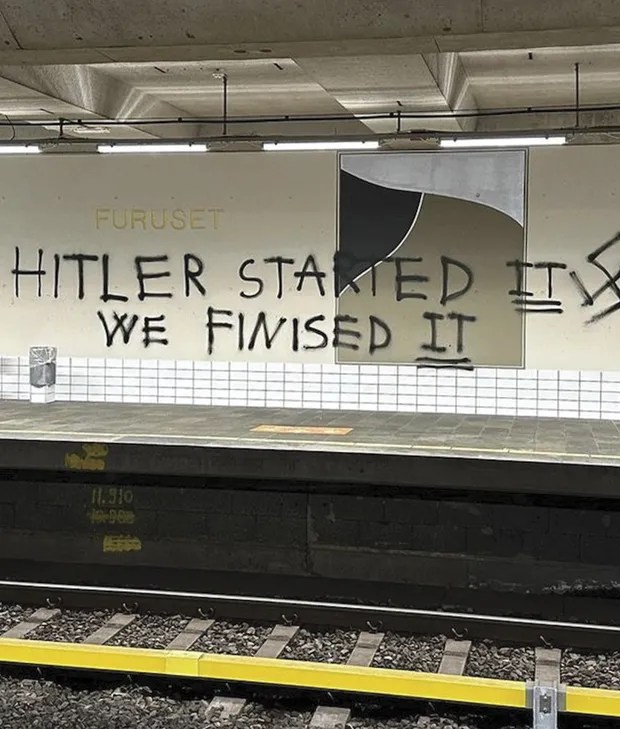
October 7th is about remembering them, but it’s also about remembering ourselves – where we were, how we were affected, and what we learned about our place in the world, in an ever-widening circle that even reached Sweden. It’s about the Jewish children who were blamed for genocide and were too scared to go to school, the demonstrations filled with antisemitic slogans, the endless boycotts, walkouts, open letters, and slander on social media, explaining that Hamas has the right to resist. It’s about remembering the mass psychosis that made grown men and women boo a 20-year-old girl who came to sing in Sweden, shout at Holocaust survivors attending a ceremony in a synagogue, burn the Israeli flag in Malmö, and shoot at the Israeli embassy in Stockholm.

We have to remember all of this to recall where we came from, where we are headed, and before whom we are destined to give account. Whoever that may be, it is certainly not those who explain to us that we are allowed to be Jews but not Zionists, or that we can be Swedish Jews only if we denounce Israel. This is our first October 7th memorial day, and we’re not really ready for it to become one of our regular memorial days yet. Today, while 101 Israelis are still held hostage in Gaza, while the violence continues, and while we are still counting our dead, for many Jews, this is just another day in the longest month in history – today is the 365th of October.

!Say it: Yes, I condemn Hamas

The discourse within the Swedish and European left is important even if you're not part of it and the insane embrace of Hamas by so-called left-wing radicals, climate change fighters, human rights activists and western intellectuals and academics must be challenged.

Originally published in Swedish in Parabol: https://www.parabol.press/andreas-malm-har-fel-om-hamas/

Imagine this powerful image: in a country which is slowly being taken over by right-wing nationalists, it's becoming harder to speak truth to power and to speak up for the underdog and the repressed. But then, from the trenches of the opposition, rises a fearless figure. He knows he'll be arrested and tortured if he's caught crying out, and so he does what intellectuals from resistance movements allways do under tyrannical regimes. He uses sarcasm, he sharpens his pencil and cleverly plays with words to produce a text which is radical and subversive, but at the same time meticulously designed not to be flagged down by the authorities. That way the avant-garde academic doesn’t get in trouble with the all-powerful secret service henchmen who are hunting down traitors.

Sweden 2024. While a war is going on in Gaza and in Israel, the whole political elite is powerfully supporting Israel. It's blue and white from left to right and it's not allowed to speak up for the Palestinians. And then, a single voice of a brave dissident rings out. He wrote a text. It's called "I Condemn Hamas" and it's brilliantly designed by a rhetorical trick – the title is mainstream and boring, everyone condemns Hamas. The content seems to be the same, but under the surface lies the explosive message – it's the exact opposite of condemning Hamas, it's actually supporting it (Malm, Anders, Jag Fördömer Hamas, Parabol, 01/11-23). At last the opposition has a voice – Andreas Malm has weighed in. It's a powerful text and a powerful image. The only problem is that none of it is true.

Malm's claim is clear – everyone's condemning Hamas, mainstream media, politicians and public discourse in general. He, on the other hand, thinks this is false. Hamas may have killed civilians, kidnapped children and burned down residential buildings on October 7th, but according to him this isn't unique. It's all been done before by Israel. Malm doesn't claim this directly. He does it by sarcasm. The same kind of sarcasm is pointed at the Swedish discourse. "In Sweden there are strikingly few who have condemned Hamas in the past few days. Those who have done it have only done it once, so that we now wonder if it was really meant honestly", he writes creating an illusion which is the exact opposite of the truth. In fact, Sweden is one of the countries in which the Hamas did surprisingly well. At least for an organization which is internationally recognized as a terror organization.

Hamas supporters have spoken openly in conferences and seminars in Sweden, money has been raised for Hamas freely in Sweden; just in the last few months there have been dozens of pro-Palestinian demonstrations with speeches supporting Hamas or at least not condemning them including demonstrations celebrating the events of October 7th on the day they happened. Unlike other countries, these demonstrations are not only legal, they're supported by some of the political elite and many in the media, in the cultural world and in civil society. Malm's style implies that Swedish publicists have to condemn Hamas or they'll be cancelled. Nothing could be further from the truth. In fact, Malm himself is a writer who has supported Hamas publicly in several newspapers, magazines and publications. As far as I know, he's yet to be arrested, censored or fired. In Sweden it’s allowed to burn the Koran, join parties which support North-Korea and have Neo-Nazi marches on Yom-Kippur. No one's preventing anyone from supporting Hamas. Indeed, I recently met Hamas supporters in Sergels Torg. They were members of two perfectly legal Swedish movements, RKU, the revolutionary communist youth movement and NMR, the friendly neighborhood neo-Nazis. Who knows, perhaps Andreas Malm himself was there supporting them both.

However, the Swedish context is only the beginning of Malm's mistake. The claim that the massacre on October 7th was more of the same, that it was Palestinians retaliating with the same kind of violence Israel uses, is worth studying. "What happened on Black Saturday, October 7th was something new in the history of the Israeli-Palestinian conflict", Malm writes using his smug self-satisfied irony, "it redraws the political and moral map of the Middle East for good. Gunmen stormed into communities and shot children to death with rifles. They did not care at all about the age of the victims. Hundreds of civilians were killed – people with no connection to any military activity, murdered simply because of their identity. Entire families disappeared". If this wasn't so true, it would be real cutting-edge political satire. But Malm's satire, is in fact the sad truth. Nothing like October 7th ever happened before in this conflict. Israelis and Palestinians never killed so many people in one attack or in one day. Not in Kafar Qasim (1956), not in Deir Yassin and Tantura (1948), not in Hebron (1996) and not in the bombings of Gaza in previous years. There were never so many acts of torture and violence against civilians, never so many people kidnaped and never such brutality. And yes, October 7th did redraw the political and moral map of the Middle-East for good. I couldn't have said it better myself.

Israel made many mistakes in the last few decades; like any other army it has committed war crimes during conflict, some of its civilians, especially in the West-Bank are violent extremists and its occupation of the West-Bank continues to be a hindrance to peace in the Middle-East. But October 7th was unique. It's not only about the brutality or the number of victims. The really scary number is the number of the people who committed the crimes. Unlike 9/11 which was executed by a small Jihadist vanguard of 19 Al-Quade operatives, and unlike Utøya which was the work of one (Andreas Malm cracks a little clever joke making the comparison), October 7th was carried out by about 3,000 people. Many of were sipplied with written instructions about how to murder, torture and kidnap civilians, some were also provided with drugs and with body cameras. This wasn’t a spontaneous, heat of the moment action. It was a planned strategy. On October 7th the world saw a society capable of drafting 3,000 people who were 100 percent committed to murder.

Andreas Malm perhaps hasn't heard the story told by David Tahar, father of Adir Tahar, an Israeli soldier who was killed on October 7th. Tahar told Israeli Chanel 14 that before the funeral he insisted on seeing his son's body even though army officials advised against it. The reason was that apparently after he was killed Hamas fighters decapitated Adir and took his head back home to Gaza. A few weeks later, after receiving intelligence from captured terrorists, an Israeli military unit retrieved the head. It was hidden in a bag with some tennis balls and a few documents inside an ice-cream shop freezer in Gaza. Apparently the head was up for sale. The price was 10,000 US Dollars. I know there are many who don't believe Israeli media and think that Zionists fathers are so perverted that they can make up this kind of story for propaganda purposes. So here's another one. This time from the New York Times.

Sapir, a 24-year-old accountant who attended the rave party near Kibbutz Reim on October 7th gave a testimony which was reliable enough for the NYT which told the story of what she saw from her hiding place (Gettleman, Schwartz and Sella, "Screams Without Words": How Hamas Weaponized Sexual Violence on Oct. 7", The New York Times, 28/12-23). Sapir says she saw "a young woman, blood running down her back, pants pushed down to her knees. One man pulled her by the hair and made her bend over. Another penetrated her. Every time she flinched, he plunged a knife into her back. Sapir said she watched another woman "shredded into pieces". While one terrorist raped her another pulled out a box cutter and sliced off her breast. "One continues to rape her", she said, "the other throws her breast to someone else, and they play with it, throw it, and it falls on the road". She said the men sliced her face and then the woman fell out of view. Around the same time, she said, she saw three other women raped and terrorists carrying the severed heads of three more women.

These are just two testimonies from October 7th. There are thousands more. One could always claim, as Malm does in earlier texts, that all this violence should be seen in context. But this kind of violence has no context. If it was really about freedom, or fighting the occupation there would be no need for mass rape, kidnapping babies and removing body parts. The atrocities, the rockets, the tunnels and the complete subordination of Gazans to Hamas militants are all far darker and more sinister than Malm's theories. It's not the price paid for Israel's colonialism. If for no other reason, because this isn't colonialism. Israel isn't Algeria.

According to Malm, the conflict between Israel and the Palestinians isn't a war between two indigenous peoples which have a legitimate claim to the same territory and therefore are engaged in a violent conflict. Instead, there is one legitimate native nation and for over a century it has been fighting an occupation by invaders who came from other countries as colonizers. The invaders are supported by imperialist powers and they are now committing genocide. This kind of aggression according to Malm must be, should be and always has been resisted with violence. In fact, Malm's latest text is one of many in Parabol making the same claim.

These texts rarely even mention the events of October 7th which I would suggest is a sign of total moral bankruptcy. But that's me and I may be biased. The problem here is different, it's about intellectual honesty. The description of the Israeli-Palestinian conflict as a story of a colonial power murdering the natives is incredibly shallow and misleading. It's perfectly ok to oppose Israel's policies (as I do myself most of the time), it's perfectly ok to name-drop Edward Said and Franz Fanon, make comparisons to Apartheid South-Africa and quote Israeli officials making outrageous genocidal statements which can then be quoted at the ICJ in the Hague. But people who have studied the region, as I guess Malm has, know very well that Jews, not only Palestinians are natives to it. And no, I'm not referring to Jesus and Abraham. Biblical stories cannot be a base for international geo-politics. I'm referring to facts completely ignored by the whole post-colonial discourse.

Take Gaza, for example, in the place where Rimal, the political center of Gaza City used to stand, a synagogue was built in the year 508 AD. We know that the figure in the center of the ancient mosaic which was found there is King David. How do we know this? Because his name is written there. In Hebrew. Gaza has a long bloody history – Romans, Christian Crusaders, Arab armies, the Egyptians, Napolean's army, the Ottomans and the British Mandate all controlled Gaza. During this history, Jews lived in Gaza, they didn't arrive in ships in the 1940s. They were there during the time of the Romans, 2,000 years ago, they were there in the Middle-Ages and during the time of Islamic rule, then again in the 14th and 15th century and under the rule of the Ottoman empire. Some were still there even after WW 2.

As in many other areas in the region, for thousands of years, Jews thrived and declined in Gaza, they were expelled and fled, they killed and were killed, built and destroyed, returned, immigrated and emigrated. Arabs in the region have a similar, though somewhat shorter, story (I'm referring to them as Arabs, because the name Palestinians wasn't used in the way that we use it today until after WW2). The story of the region being a land inhabited by indigenous Palestinians who were attacked by American, European and Russian Jews arriving from abroad after the Holocaust and kicking out the natives is a fairytale. Concepts like colonialism and indigenous peoples aren't abstract. Unfashionable as it may seem, these things have actual meanings beyond TikTok clips made by demonstrators wearing fashionable red, white and green scarfs. They can be discussed in terms of archeological findings, origin and descent, historical continuity of settlements, language and culture, collective ancestral ties to a territory and to natural resources, self-identification, experiences of subjugation and discrimination and so on. It may be frustrating, but when it comes to Israel, to the West-Bank and to Gaza, both Jews and Palestinians are natives. They're all a combination of immigrants and people who are decedents of families who haven't left for generations. And they've all suffered from violence, massacres, displacement and trauma.

And there's another similarity between the Jewish national movement (aka Zionism) and the Palestinian one. They both have a genocidal wing. These are the people on both sides who don't accept the idea of territorial compromise in order to achieve peace. The people who are willing to go as far as killing or expelling the other group in its entirety. They're usually religious fanatics, they're extremely violent, they totally oppose democracy and human rights, they're willing to kill and die for the cause and they've always been around. On the Jewish side, they began to become a serious threat after Israel's 1967 victory with the rise of the settler movement in the occupied West-Bank. These days they're becoming stronger, they're getting closer to government circles, but they're still far from being anywhere near a majority in Israeli society.

On the Palestinian side, things seem to be worse. If on the Zionist side there was a right-wing revisionist leader, Zeev Jabotinsky, who had a connection with Mussolini in the 30s, the leader of the Arab nationalists in Palestine at the time, Haj Amin al-Husseini, spent WW2 in Berlin and in Rome, he collaborated with the Nazis and the Fascists, he personally met Hitler, Himmler and Mussolini and was a supporter of the "Final Solution of the Jewish Problem". Al-Husseini was just the beginning. The Palestinian National movement has always had an active and extremely popular genocidal side to it. It's not because of Israel, because it started many years before Israel even existed. And it's not unimportant because what we saw on October 7th was a direct result of the same kind of ideology.

That's what's really amazing about Andreas Malm's text. Hamas is the genocidal wing of the Palestinian national movement and its ideological roots go all the way back to Nazi Germany. Although it was seen as a traditional grassroot, social and religious movement when it was founded in the 80s, it's now a modern, extreme right-wing movement combining Jihadism, high-tech disinformation campaigns, a financial empire of global investments, leaders who live a life of luxury outside the region, modern weapon systems and powerful alliances with the world's most tyrannical regimes. Anyone imagining the Hamas as a young David standing up to the Israeli Goliath is living in a naïve lullaby.

But Andreas Malm isn't naïve. He knows very well that the geo-political realities show that Hamas and indeed the Palestinian national movement is far more complicated than just a victim of western colonialism. He knows about the Israeli disengagement from Gaza in 2005 which means there was no occupation of Gaza for almost two decades. He knows that the blockade on Gaza is just as much an Egyptian policy as it is an Israeli one and that many Arab countries want Israel to destroy Hamas. He knows that the Hamas charter is an antisemitic and fundamentalist text. He knows that Hamas has crushed the secular Palestinian national movement in Gaza and that it sees the Palestinian Fatah movement as an enemy which is almost as bad as Israel. He knows about Hamas' brutal war against the Palestinian Authority and he knows about the unprecedented Hamas military buildup and take-over of civil society in Gaza.

The reason that I know that Malm knows all this is because of other texts that he wrote. Reading them one learns a lot about his way of seeing the world, though I must admit, it's sometimes a confusing task. Although he seems well versed in Middle-Eastern politics, when it comes to moral statements and political conclusions, his considerations are so complicated, it's hard to keep track. Although Israel is always wrong (that's the constant) when it comes to Palestinians, Arab states and Islamic super powers, the target is painted around the dart after it's been thrown.

In a text he wrote a few years ago (Malm, Andreas, "Därför Hamas", Expressen, 15/01-09) he claims one can have two thoughts at the same time, like the Palestinian left which allies itself tactically with Hamas but at the same time supports the opposition in Iran while the opposition in Iran is fighting the Iranian regime at the same time the Iranian regime is funding Hamas. It's ok if you need to read the last sentence again.

Malm's reasoning is not that unique. He supports Hamas and its fight against what he called the "corrupt Fatah politicians" and Mahmoud Abbas, who's an Israeli and American "marionet". If this sounds familiar it's because this is exactly the same logic used by Israeli PM Netanyahu who for years has been undermining the Fatah controlled Palestinian Authority by allowing Hamas to stay in power in Gaza so that he wouldn't have to take real steps towards a two-state solution. Surprisingly enough, Malm and Netanyahu are on the same side. They'll both do anything to avoid compromise and consolidation.

In another text from 2009 Malm referred to Hamas as a liberation movement which is "forced to resort to every possible form of resistance" (Malm, Andreas, "Vi bör följa Iran och stödja Hamas i kampen mot Israels folkmordspolitik", Newsmill, 04/01-09). In the same text he quoted Nir Rosen, who claimed that "Attacking civilians is the last, most desperate and basic method of resistance when confronting overwhelming odds and imminent eradication" (Rosen, Nir, "Gaza: the logic of colonial power", The Guardian, 29/12-08). Malm is entitled to write these kind of statements even if they encourage violence and are fascist in nature. I only hope that most Swedes, including those who support the Palestinians, can see beyond this tragic war mongering, since it's clear to anyone what this means politically. Hamas will continue murdering Israelis; Israel will have to retaliate and will do so forcefully – and more Palestinians will be killed. If there's anything that hasn't changed in the last few decades it's this dynamic.

Hamas is not the only problem. In another text Malm openly supported Hezbollah (Malm, Andreas, "Därför Ska Vi Stödja Hezbollah", 11/08-2006), an Islamic movement funded, trained and inspired by the Iranian Ayatollahs and their Islamic Revolutionary Guard Corps, which was involved in suicide attacks, political assassinations, bombing of civilians and hijackings in Lebanon and other countries. I don't know how Malm manages to pull off being a left wing radical and supporting two of the most conservative, fascist, chauvinist, fundamentalist, hierarchical, anti-democratic, homophobic and xenophobic movements in the history of the known universe, but I know that explanations along the lines of "I can't be expected to condemn actions taken by the weak and oppressed” can't work anymore after the massacre of October 7th which was a tectonic, world-changing event. Not condemning it, or in Malm's case, condemning it sarcastically, means supporting it.

This period isn't easy for the global political left. Just like in the 1950s when left-wing activists, politicians and intellectuals had to decide whether to stay faithful to the Stalinist flagship even after it was exposed as a sadistic killing machine of gulags and mock trials, today's left must decide if its alliance with the dictators, Jihadists and militants from Gaza, Teheran, Beirut and Doha is more important than its ideals. Those who have the courage to choose their ideals and abandon their old murderous  allies will not have Andreas Malm's problem. They will be able to proudly say "yes, I condemn Hamas".

Why Don't You Recognize October 7th – A letter to a Burmese friend (and a genocide researcher)

This is a tectonic and world-changing event, carried out by thousands of people supported by hundreds of thousands of people, as well as by movements, states and regimes. Not condemning it is supporting it. And the results are inevitable. Because of the horror that these people have inflicted on the world, an even darker night is to come before we will see the light. 

Published in "Davar": https://en.davar1.co.il/462536/

A is my friend. He is a Burmese expatriate from Myanmar living in Europe. He is an academic, an educated and friendly person, and a veteran human rights activist. As a journalist who writes, among other things, about countries where acts of genocide, ethnic cleansing and human rights violations take place, I consult with various experts. A is one of them. This is the letter I sent him last week.

Hello, A. I am writing in response to your letter regarding the “colonial character and genocidal policy of Israel.” As you can imagine, I am quite busy these days, and as someone who is far away from his family in Israel, I am distracted. I am responding to you despite all this, mainly because your words opened with a reference to Auschwitz, a place where many of my family members were murdered about 80 years ago.

According to you, Israel is using the Holocaust as a “blank check” to justify the imprisonment, bombing and starvation of 2.3 million Palestinians in Gaza, almost half of whom are children. "In these circumstances, 'never again' is a hollow phrase," you write. “It becomes a call for uncontrolled violence, battle cries and a campaign of revenge and extermination." In the past and under different circumstances, I must admit that I might have agreed with you.

A, you must remember that we got to know each other after several occasions when you very generously shared with me your expertise, knowledge and experience regarding Myanmar. When I first contacted you, I wrote that as a journalist working in a free country, I felt obliged to tell the story of the victims of atrocities there – amongst others, the Rohingya people other minorities who have been suffering from genocidal policies for years since the military coup in 2021. 

Since I am not an expert myself, I reached out to you, just as I reached out to many other experts, witnesses and human rights activists who could shed light on other places I wrote about, such as China, Ethiopia, Syria, Iran, Mexico, Belarus and Iraq.

This is an important point. As you know, there are complicated conflicts in many of these places about which there are different opinions. Still, my feeling was that we shared a real commitment to expose and fight certain types of acts which cannot be excused under any circumstances, regardless of the different narratives that explain the conflict. I mean the kind of actions that cannot be permitted even if there is no agreement on the history of the conflict or even on the identity of those responsible for it.

These actions include those that took place in Rakhine province in Myanmar, which I wrote about with your kind help. The barbaric murder, torture and rape of innocents that happened in your country is inexcusable. Political, ethnic, religious or demographic claims simply cannot justify throwing babies into fire, torturing children to death in front of their parents, and the mass rape of women before their execution. I thought we agreed on that.

This week, I received a long email from you, Dr. A. Extremely long. Long enough to clarify your words or even to add something along the lines of: "despite all this, of course I condemn [Hamas’ actions],” or even "despite the absolute truth of the Palestinian claims and genocidal policy of Israel, I do not justify killing civilians."

But there was none of that. Somehow, your post references 100 years of conflict prior to October 7 (including explanations using maps, cartoons, pictures, and quotes). And there is a reference to the days after October 7.

But the day itself, when over a thousand people, most of them civilians, were brutally murdered and over 200 people, again most of them civilians, were kidnapped, was completely absent. And it's strange given the fact that, as I recall, we share an interest in cases of throwing babies into fire, torturing children to death in front of their parents, and the mass rape of women before their execution. Yes, to make the point clear to a person from your background, for one historical moment, Israel's Gaza envelope region became Myanmar's Rakhine. 

A, since I received your message, I have been trying to understand why you do not recognize October 7th. I understand your opinion about the essence of Zionism and the essence of Israel. I don't agree with it, but I understand your point. Still, there's that little matter of “under all circumstances.” Perhaps there is a certain type of fascist, fundamentalist, racist, and violent organization that, against your usual leftist positions, you actually do support.

But if so, what are the criteria? Is it because they are jihadists? Is it a matter of religion? Or that according to the accepted code of the post-colonialist discourse, the "natives" have certain Jew-killing privileges because of the many years of oppression they have endured? Oppression, which, as you know, I have never denied. 

And maybe you are one of those who do not believe the photos, the direct testimonies of survivors, the explicit confessions of the attackers and the unwatchable and undeniable videos. Do all these not meet your strict standards? Strange, because we never applied such strict standards when I wrote about Myanmar.

Do you think it's all a conspiracy of Western governments spreading fake news? Is it all the settlers’ lies, supported by American imperialists? Are you really not affected by the testimonies of Israeli women, children and elders, many of whom, by the way, are peace activists who built their homes in socialist communes that are not in any way located in the West Bank or in any way disputed. Unless the very existence of Israel is disputed, a position I assume you hold since you treat Israel as a settler and colonialist entity.

And maybe I didn't understand what you meant. In this case, perhaps in the future, we can discuss the true nature of Israel. As you know from our previous correspondence, I never supported Netanyahu, I have always believed in compromise with the Palestinians and I am absolutely against any kind of war crime, including against civilians in Gaza. You also know that I am a social democrat and a person who is aware of the climate crisis and the hardships of the "global south.”  But wait, here I am, once again falling into this trap. If I were not all of these things, if I were a Netanyahu supporter or a settler in the West Bank, would my massacre and that of my family members be justified?

Again, there's that "under all circumstances" nuisance. Even if the Jews were like the French in Algiers, and they are not, deliberate murder of innocents is always evil and mass murder is absolute evil. Among us Jews, even complete secularists like me sometimes recite from the ancient texts: “I have set before you today the heavens and the earth, life and death; I have set before you the blessing and the curse. Choose life, for your lives and for your descendants,” as it is written in the book that you call the Old Testament. Do you understand A? You chose life – without “buts” and without “maybes.” This is why I always opposed my own people murdering other innocent people. And you know what, I'm angry at myself for not resisting enough.

***

And so for the record, I want to mention that I believe that Jews, not just Palestinians, also have rights in the place where I was born. They have personal, social and national rights and they also have responsibilities that are well described in the Declaration of Independence of their country, our country, which was founded 75 years ago. You don't acknowledge that, which is probably the real reason you didn't mention October 7th in your message. If "Palestine will be free from the river to the sea," as they are now shouting in the streets near my house in Europe, the events of October 7th are probably not an accident in your eyes. They are the first step in the plan.

"Free from the river to the sea” means without the people who are living there now. This is not the two-state solution, nor a partition plan, nor a federation. I think with your education, you know exactly what it means. But in case it's not clear enough, I'll say it explicitly: Hamas is the genocidal wing of the Palestinian national movement, and it turns out that it has quite a few supporters. My friends say that such views stem from antisemitism, but I don't know what is hidden in a person's heart. How much darkness, how much hatred.

I also don't know what is hidden in your heart. But I know that October 7th was not another attack, another battle, another chapter in the bloody history of the Middle East. It cannot be solved with sentences like "I cannot be expected to condemn every action taken by the weak and oppressed.” This is a tectonic and world-changing event, carried out by thousands of people supported by hundreds of thousands of people, as well as by movements, states and regimes. Not condemning it is supporting it. And the results are inevitable. Because of the horror that these people have inflicted on the world, an even darker night is to come before we will see the light. 

***

And so, as a wise man wrote during the World War II, you and I now stand on two sides. "My opinion is clear about your motives,” he wrote, “and you would do well to speculate on my motives.” And he added: "I have one more thing left to say to you, and let it be the last. I want to tell you how in the past we were so similar and today we are enemies. How could I have stood by your side, and and why everything between us is over now.” 

And that's the thing. In Xinjiang and Syria, in Tigray and Iran, in Myanmar and Israel, acts like those committed by Hamas are not only the absolute lowest of what the human race is capable of. They also redefine the lines. If they do not fill a person's heart with unconditional anger and disgust, they place him outside the legitimate discussion of civilized people. If you can only find room in your heart for the pain of one side, that's your problem. But with your permission, I think I'll find myself a different expert on Myanmar.

Before I finish, I will ask just one last thing. Do me a favor – next time, please refrain from referring to Auschwitz. Not because I have a monopoly on the memory of the Holocaust or the memory of the victims. But because when it comes to the 1940s, those people on whose behalf you are currently campaigning, they tend to be something different than you imagine. When you remove the appearances of European leftist movements, those people tend to be supporters of the side that built Auschwitz, not of those led there to their deaths.

מכתב לידיד (וחוקר רצח-עם) בורמזי – מדוע אינך מכיר ב-7 באוקטובר?

חשבתי שהסכמנו שיש מעשים שאי אפשר להתיר בשום נסיבות. אבל אולי יש סוג מסוים של ארגונים פשיסטיים, פונדמנטליסטיים, גזעניים ואלימים שבניגוד לעמדותיך השמאליות הרגילות, אתה דווקא תומך בהם?

פורסם ב"דבר": https://www.davar1.co.il/462084/

א' הוא ידיד שלי. גולה בורמזי ממיאנמר המתגורר באירופה. הוא אקדמאי, אדם משכיל וחביב, ופעיל זכויות-אדם ותיק. כעיתונאי שכותב, בין השאר, על מדינות שבהן מתקיימים מעשי רצח-עם, טיהורים אתניים והפרות זכויות-אדם, אני מתייעץ עם מומחים שונים. א' הוא אחד מהם. זה המכתב ששלחתי לו בשבוע שעבר.

א' שלום. אני כותב בתגובה להודעתך בעניין "האופי הקולוניאליסטי ומדיניות רצח-העם של ישראל". כפי שאתה יכול לתאר לעצמך, אני עסוק למדי בימים אלו, ובהיותי אדם הנמצא רחוק ממשפחתו שבישראל, דעתי מוסחת. אני עונה לך למרות כל זאת, בעיקר מפני שהודעתך נפתחה בהתייחסות לאושוויץ, מקום בו נרצחו רבים מבני משפחתי לפני כ-80 שנה.

לדבריך, ישראל משתמשת בשואה כ'צ'ק פתוח' לכליאה, להפגזה ולהרעבה של 2.3 מיליון פלסטינים בעזה, כמעט מחציתם ילדים. "בנסיבות אלו, 'לעולם לא עוד' הוא ביטוי חלול", אתה כותב, "הוא הופך לקריאה לאלימות בלתי מבוקרת, לזעקות מלחמה ומסע תגמול וחיסול". בעבר ובנסיבות אחרות, אני חייב להודות, ייתכן שהייתי מסכים איתך.

א', אתה בטח זוכר, אנחנו מכירים כי במספר הזדמנויות חלקת איתי, בנדיבות רבה, את המומחיות, את הידע ואת הניסיון שלך לגבי מיאנמר. כשפניתי אליך לראשונה, כתבתי שכעיתונאי שעובד במדינה חופשית, אני מרגיש מחויב לספר את סיפורם של קורבנות הזוועות, בין השאר, את סיפורם של תושבי ארצך, בין אם אלו בני הרוהינגה או מיעוטים אחרים שנפלו קורבן לאירועים מחרידים שהתרחשו ברחבי המדינה מאז ההפיכה הצבאית ב-2021. מכיוון שאני לא מומחה בעצמי, הגעתי אליך, ממש כפי שהגעתי לאחרים, מומחים, עדים ופעילי זכויות-אדם שיכלו לשפוך אור על מקומות נוספים שכתבתי עליהם דוגמת סין, אתיופיה, סוריה, איראן, מקסיקו, בלארוס ועיראק.

והי נקודה חשובה. כפי שאתה יודע, ברבים ממקומות אלו ישנם קונפליקטים מסובכים שיש עליהם דעות שונות. ובכל זאת, תחושתי היתה שאנחנו חולקים מחויבות אמיתית לחשוף ולהילחם בסוג מסוים של מעשים בכל תנאי מזג-אוויר, וללא קשר לנרטיבים השונים המסבירים את הסכסוך. אני מתכוון למעשים שאי אפשר להתיר בשום נסיבות, גם אם אין הסכמה על ההיסטוריה של הסכסוך, ואפילו על זהות האחראים עליו. מעשים כמו אלו שהתרחשו במחוז ראקין במיאנמר שכתבתי עליהם בעזרתך האדיבה. הרצח, העינויים והאונס הברבריים של חפים מפשע שאירעו במדינתך לא ניתנים לתירוץ. טענות פוליטיות, אתניות, דתיות או דמוגרפיות פשוט לא יכולות להצדיק זריקת תינוקות לאש, עינויים למוות של ילדים מול הוריהם ואונס המוני של נשים לפני הוצאתן להורג. חשבתי שהסכמנו על זה.

השבוע, קיבלתי ממך מייל ארוך, ד"ר א'. אפילו ארוך מאוד. מספיק ארוך כדי להבהיר את דבריך ולהוסיף לדוגמא משהו כמו "למרות כל זאת, ברור שאני מגנה"… או אפילו "למרות האמת המוחלטת של הטענות הפלסטיניות ומדיניות רצח-העם של ישראל, אינני מצדיק"…

אבל לא מיני ולא מקצתי. איכשהו, בהודעתך יש התייחסות ל-100 שנים של סכסוך לפני 7 באוקטובר (כולל הסברים באמצעות מפות, קריקטורות, תמונות וציטוטים). ויש התייחסות לימים שאחרי 7 באוקטובר. אבל היום עצמו, היום שבו נרצחו באכזריות למעלה מאלף בני-אדם, רובם אזרחים ומעל 200 אנשים, שוב רובם אזרחים, נחטפו, נעדר לחלוטין. וזה מוזר, בהתחשב בעובדה שכזכור, אנחנו חולקים עניין במקרים של זריקת תינוקות לאש, עינויים למוות של ילדים מול הוריהם ואונס המוני של נשים לפני הוצאתן להורג. כן, כדי להבהיר את הנקודה לאדם מהרקע שלך, לרגע היסטורי אחד, חבל עוטף עזה מהמקום שלי היה לחבל ראקין מהמקום שלך.

א', מאז שקיבלתי את הודעתך, אני מנסה להבין מדוע אתה לא מכיר ב-7 באוקטובר. אני מבין את דעתך על מהות הציונות ועל מהותה של ישראל. אני לא מסכים איתה, אבל מבין את כוונתך. ובכל זאת, יש את העניין הפעוט הזה של "בכל תנאי מזג-אוויר". אולי יש סוג מסוים של ארגונים פשיסטיים, פונדמנטליסטיים, גזעניים, ואלימים שבניגוד לעמדותיך השמאליות הרגילות, אתה דווקא תומך בהם. אבל אם כך, מהם הקריטריונים? זה בגלל שהם ג'יהאדיסטים? זה עניין של דת? או שעל פי הקוד המקובל של השיח הפוסט-קולוניאליסטי, יש ל"ילידים" זכויות מסוימות של הרג יהודים בגלל דיכוים רב השנים? (דיכוי, שכפי שאתה יודע, מעולם לא הכחשתי).

ואולי אתה בכלל אחד מאלו שלא מאמינים לתמונות, לעדויות ישירות של ניצולים, להודאות המפורשות של התוקפים ולסרטונים שלא ניתן לצפות בהם ושאי אפשר להכחישם. האם כל אלו לא עונים לסטנדרטים המחמירים שלך? מוזר, כי מעולם לא יישמנו סטנדרטים מחמירים כל כך כשכתבתי על מיאנמר. האם לדעתך הכל קונספירציה של ממשלות מערביות המפיצות חדשות כזב? האם הכול שקרים של המתיישבים הנתמכים על ידי האימפריאליסטים מאמריקה? האם אתה באמת לא מתרשם מעדויות של ילדים, נשים וזקנים ישראלים, רבים מהם, אגב, פעילי שלום שבנו בתים בקהילות סוציאליסטיות שאינן, בשום אופן, בגדה המערבית או בשטחים שנויים במחלוקת? (אלא אם עצם קיומה של ישראל שנויה במחלוקת, עמדה שאני מניח שאתה אוחז בה שכן אתה מתייחס לישראל כישות מתנחלת וקולוניאליסטית).

ואולי לא הבנתי את כוונתך. במקרה זה, אולי בעתיד, נוכל לדון בטבעה האמיתי של ישראל. כפי שאתה יודע מהתכתבויות קודמות, מעולם לא תמכתי בנתניהו, תמיד האמנתי בפשרה עם הפלסטינים ואני בהחלט נגד כל סוג של פשע מלחמה, גם כלפי אזרחים בעזה. אתה יודע גם שאני סוציאל-דמוקרט ואדם בעל מודעות למשבר האקלים ולתלאות ה"דרום הגלובלי". אבל רגע, הנה אני שוב נופל במלכודת הזו. ואם לא הייתי כל הדברים האלו, אם הייתי תומך בנתניהו או מתנחל בגדה המערבית, האם טבח בי ובבני משפחתי היה מוצדק?

שוב, יש את המטרד הזה של "בכל תנאי מזג אוויר". גם אם היהודים היו כמו הצרפתים באלג'יר, והם לא, רצח מכוון של חפים מפשע הוא תמיד רוע, ורצח המוני הוא רוע מוחלט. אצלנו היהודים, אפילו חילונים גמורים כמוני מדקלמים לפעמים מהמקורות. "הַעִידֹתִי בָכֶם הַיּוֹם אֶת הַשָּׁמַיִם וְאֶת הָאָרֶץ, הַחַיִּים וְהַמָּוֶת נָתַתִּי לְפָנֶיךָ הַבְּרָכָה וְהַקְּלָלָה", ככה כתוב בספר שאתה קורא לו הברית הישנה, "וּבָחַרְתָּ בַּחַיִּים לְמַעַן תִּחְיֶה אַתָּה וְזַרְעֶךָ". אתה מבין א'? בחרת בחיים – בלי אבל ובלי אולי. זאת הסיבה שהתנגדתי תמיד לבני עמי שרצחו חפים מפשע. ואתה יודע מה, אני כועס על עצמי שלא התנגדתי מספיק.

ולכן, למען הפרוטוקול, אזכיר שאני מאמין שיהודים, לא רק פלסטינים, הם בעלי זכויות במקום שנולדתי בו. יש להם זכויות אישיות, חברתיות ולאומיות, ויש להם גם חובות המתוארות היטב במגילת העצמאות של מדינתם, מדינתנו, שנוסדה לפני 75 שנה. אתה אינך מכיר בכך, וזו כנראה הסיבה האמיתית שלא הזכרת בהודעתך את 7 באוקטובר. אם "פלסטין תהיה חופשית מהים ועד הנהר" כפי שצועקים כעת בכיכרות ליד ביתי באירופה, כנראה שאירועי 7 באוקטובר בעבורך אינם תאונה. הם שלב ראשון בתכנית.

"חופשית מהים עד הנהר", משמע ללא אלו היושבים שם עכשיו. זו לא תכנית שתי המדינות, לא תכנית החלוקה ולא פדרציה. נדמה לי שעם ההשכלה שלך, אתה יודע בדיוק מה זה אומר. אבל למקרה שאתה מתקשה אכתוב זאת בפרוש – החמאס הוא האגף הג'נוסיידיאלי של התנועה הלאומית הפלסטינית, ומסתבר שיש לו לא מעט תומכים. חברים שלי אומרים שדעות כאלו נובעות מאנטישמיות, אבל אני לא יודע מה מסתתר בליבו של אדם. איזה חושך, איזו שנאה.

אני גם לא יודע מה מסתתר בליבך. אבל אני יודע ש-7 באוקטובר לא היה עוד פיגוע, עוד קרב, עוד שורה בטיימליין המדמם של המזה"ת. אי אפשר לפתור אותו במשפטים כמו "אי אפשר לצפות שאני אגנה כל פעולה שהצד החלש מבצע". מדובר באירוע טקטוני ומשנה עולם, שבוצע על ידי אלפי בני-אדם שנתמכים על ידי מאות אלפי בני-אדם, וגם על ידי תנועות, מדינות ומשטרים. אי גינויו הוא תמיכה בו. והתוצאות הן בלתי נמנעות. בגלל הזוועה שאנשים אלו הטילו על העולם, צפוי לילה אפל עוד יותר לפני שיעלה האור.

וכך, כמו שכתב אדם חכם בזמן המלחמה הגדולה באירופה, אני ואתה עומדים כעת בשני צדדים. "דעתי ברורה לגבי מניעיך", הוא כתב, "ואתה מיטיב לשער את מניעי". והוא הוסיף: "עוד דבר אחד נותר לי לומר לך, שיהיה גם האחרון. מבקש אני לומר לך כיצד בעבר היינו כה דומים ואילו היום אנו אויבים, כיצד יכולתי לעמוד לצידך ומדוע כיום נגמר הכל בינינו".

וזה העניין – בשינג'יאנג ובסוריה, בטיגראי ובאיראן, במיאנמר ובישראל, מעשים כמו אלו שביצע החמאס אינם רק התחתית המוחלטת של מה שהמין האנושי מסוגל לו. הם גם מגדירים את הקווים מחדש. אם הם אינם ממלאים את ליבו של אדם בזעם ובגועל שאינו מותנה בדבר, הם מציבים אותו מחוץ לדיון הלגיטימי של בני תרבות. אם אתה מוצא מקום בליבך רק לכאב של צד אחד, זו בעיה שלך. אבל ברשותך, אני חושב שאמצא לי מומחה אחר למיאנמר.

לפני סיום אבקש רק דבר אחד אחרון. עשה לי טובה א', בפעם הבאה, הימנע בבקשה מההתייחסות לאושוויץ. לא כי יש לי מונופול על זיכרון השואה או על זכר הקורבנות, אלא כי כשמדובר בשנות הארבעים של המאה הקודמת, האנשים שאתה שולח כעת הודעות בשמם, אלו שאתה מנהל בעבורם קמפיין, נוטים להיות משהו אחר ממה שאתה מדמיין. כשמסירים מהם את החזות המהוגנת של תנועות השמאל האירופי, הם נוטים להיות תומכיו של הצד שבנה את אושוויץ, לא של הצד שהובל שם למותו.

גואו אסתר יאן נחטפה במפתיע. סיפורה לא מבשר טובות לקהילה היהודית בסין.

זה קרה בחודש שעבר: גואו יאן, מצאצאי הקהילה, נחטפה ונעלמה לחמישה ימים. סיפורה הוא פרק חדש בקורותיה של קהילה קטנטנה שחיה כבר אלף שנה מתחת לרדאר. אלא שכשמדובר בשלטון הנוכחי, אף אחד לא נשאר מתחת לרדאר.

פורסם ב"הארץ": https://www.haaretz.co.il/magazine/2023-05-17/ty-article-magazine/.highlight/00000188-29c9-db37-afec-bdf9800f0000

באמצע החודש שעבר הגיע לידי נעם אורבך מכתב מדאיג. "אני גואו יאן, צאצאית של יהודי קאיפנג", נכתב בפתח הדברים. "לפני כמה ימים, ב–7 באפריל 2023 בשעות הערב, נחטפתי על ידי כמה גברים כשהלכתי ברחוב והוכנסתי למכונית שבה ישבו גברים לבושים בבגדים אזרחיים שלא הציגו מסמכי זיהוי. הם טענו שהם עובדי ממשלה. לאחר נסיעה של כמה שעות הרחק מהעיר, הכניסו אותי לחדר מלון תחת שמירה. מכיוון שלא נשאתי איתי את הטלפון הנייד שלי כשנחטפתי, ביקשתי להשתמש בטלפון כדי לדווח למשפחתי, על מנת שההיעלמות הפתאומית שלי לא תגרום להם לחרדה, אך הם לא איפשרו לי. לאחר חמישה ימים הסיעו אותי בחזרה לקאיפנג, הוכנסתי לחדר ריק שם נחקרתי על ידי ארבעה אנשים. אחד מהם לבש מדי משטרה וטען שהוא שוטר. כל החקירה הוקלטה על ידם. בשום שלב הם לא ציינו את הסיבה לחטיפתי ולא טענו כי הפרתי חוק או תקנה כלשהי. לאחר החקירה שוחררתי".

אורבך, חוקר סין שעוסק כבר שנים רבות בתולדות יהודי סין, הבחין שהמכתב לא היה מיועד רק אליו. הוא נשלח לקבוצה של פעילים יהודים שקשורים למכון הסיני־יהודי, שמנהל קשרים עם צאצאי הקהילה היהודית ההיסטורית בקאיפנג. העיר, שנמצאת במחוז חנאן שבמרכז סין ומאכלסת כיום כמעט חמישה מיליון תושבים, שימשה בעבר בירת סין. היא גם ידועה כמקום היחיד שבו התקיימה קהילה יהודית פעילה בסין העתיקה.

מדוע העלימו את גואו לחמישה ימים? מדוע הסתובבו אנשי ממשל רבים בסביבת ביתה בימים שבהם נעדרה? החוטפים לא הסבירו, אבל לגואו, שמכנה עצמה גם בשם העברי אסתר, יש הסבר. מתברר שהימים שבהם הורחקה מביתה היו ימים שבהם שגריר פולין בסין ביקר בעיר. גואו משוכנעת שיש קשר בין הדברים. לדבריה, היא הורחקה על ידי השלטונות כצעד מנע, כדי לבלום אפשרות שהשגריר ירצה לפגוש אותה ואת צאצאי יהודי העיר. "הוחזקתי כשבויה לא בגלל משהו שעשיתי", היא כתבה, "אלא מפני שמישהו רצה לפגוש אותי".

טיעון כזה עשוי להישמע קונספירטיבי למי שלא מכיר את הרקע. בשנים האחרונות נוקט הממשל הסיני יד קשה כלפי מיעוטים אתניים ודתיים ברחבי המדינה. מהבודהיסטים בטיבט, דרך המיעוטים המוסלמים בשינג'יאנג ועד הנוצרים במזרח המדינה, הממשל מתנגד לכל ביטוי של דת שאינו מפוקח על ידי השלטון. אלא שהרדיפה הזאת הגיעה גם לפתחה של הקהילה היהודית הקטנטנה של קאיפנג. אורבך מכנה זאת מדיניות של "טוטליטריות טוטלית" שכוללת ירידה לרזולוציות הקטנות ביותר — רדיפה אחר כל ביטוי של דתיות, עד הרמה הקטנה והמקומית ביותר.

גואו, במידה רבה, מייצגת את הרמה הקטנה והמקומית הזאת. מדובר בדמות משמעותית בקרב צאצאי יהודי קאיפנג, שאורבך אף כתב על פעילותה במחקרו האקדמי. "היא בלטה במיוחד בזכות עמדתה הייחודית", מספר אורבך. "במקום התמקדות בתקוות להגר לישראל או לארה"ב, היא דגלה בשחזור היהדות הסינית הייחודית שהיתה בקאיפנג".

בית משפחתה של גואו צמוד לאתר בית הכנסת ההיסטורי של יהודי קאיפנג. אף שהמבנה העתיק נהרס עוד במאה ה–19, בני המשפחה שימרו במשך שנים ממצאים המזוהים עם הקהילה היהודית, וכיום גואו מקיימת במקום מוזיאון פרטי ולא רשמי שמוקדש למורשת ההיסטורית של יהודי העיר. כחלק מהתנגדותם להצגה פומבית של כל סממן יהודי, השלטונות הסיניים מתנגדים לשימוש בבית כאתר היסטורי ודתי.

גואו חוששת לגורלה, אך כבר אינה חוששת להיחשף. הרי השלטונות כבר ממילא מכירים אותה, ואולי חשיפה בינלאומית דווקא תקשה עליהם לרדוף אותה. בשיחה עם מוסף "הארץ" בשבוע שעבר היא הסכימה לדבר על הפרשה. את השיחה ביקשה לקיים במייל, מכיוון שלדבריה, השלטונות עוקבים אחרי הטלפון הנייד שלה. "נולדתי ב–1980. אמי היא צאצאית של יהודי קאיפנג שאביה נולד לאב יהודי", כותבת גואו. היא מצרפת למייל צילום מ–1906 של סבא של סבא שלה, כשהוא עומד ליד לוח אבן משנת 1679. האבן הוצבה בעבר ליד ביתה וככל הנראה מוחזקת כיום במוזיאון של העיר קאיפנג. "בשנה שבה נולדתי היתה רפורמה שאיפשרה לזרים להיכנס לסין. הופעתם של זרים מרחבי העולם, בהם יהודים, הביאה אותי להסיק מדברי הוריי, שכניי והמבקרים, שאני יהודייה".

גואו מקדישה את חייה לתיעוד ההיסטוריה והתרבות היהודית בקאיפנג. "אם יש מבקרים שרוצים ללמוד על התרבות או ההיסטוריה של יהודי קאיפנג, הם מוזמנים לפנות אליי". לדבריה, היא אינה קשורה לשום ארגון או דת, אינה משתפת פעולה עם ארגונים ופעילים בסין או מחוצה לה ומוסיפה כי אין שום מרכיב של קיצוניות בעבודתה, כפי שעלולים לטעון השלטונות. "אני רק מספרת על ההיסטוריה", היא אומרת. "הפרשנות, קיצונית או לא קיצונית, תלויה באלו שמביטים בה".

אסתר באולם התצוגה שלה בקאיפנג לפני כעשר שנים

התקרית האחרונה אמנם היתה חריגה, אך לדבריה, זו אינה הפעם הראשונה שהשלטונות מטרידים אותה. "אני מוטרדת לעתים קרובות", היא אומרת. "לעתים הסירו והשחיתו שלטי מידע מחוץ לביתי שפירסמו את פעילות המחקר שלי ואת דרכי ההתקשרות איתי. במקרה אחד, כשעשיתי קבלת פנים בדירה שלי, הופיעו מצלמות ופקחים בתחתית הבניין. כשאמי באה לבקר אותי, עוכבתי ושאלו אותי את מי היא מחפשת". גואו מוסיפה שאנשים שהזדהו כאנשי ממשל דפקו על דלתה פעמים רבות וביקשו לדבר איתה וכי הם יידעו אותה על כך שהטלפון שלה נמצא תחת מעקב.

את מצפה לעזרה כלשהי ממדינת ישראל או מהקהילה היהודית העולמית?

"לא, אני לא מצפה לעזרה, כי צאצאי יהודי קאיפנג לא מוכרים כישראלים (או כיהודים) על ידי ממשלת ישראל או ממשלת סין. יש לי רק תעודת זהות סינית. מה שעברתי הוא תוצאה של התפיסה של הממשלה הסינית שהיסטוריה ותרבות יהודית אינן נושא שמתאים שצאצאי היהודים יספרו עליו למבקרים זרים".

שקלת לעזוב את סין?

"אני רוצה ללמוד את התפתחות התרבות היהודית בקאיפנג. משמעות עזיבת קאיפנג תהיה ויתור על העבודה הזאת. אי־אפשר פשוט לעזוב את העבודה בגלל סכנה. הם אולי מקווים שאוותר ואעזוב, אבל אני לא רוצה לעזוב, לפחות לא בשלב זה".

ואכן, הקהילה היהודית בעיר היא פיסת היסטוריה מרתקת ויוצאת דופן. "זו למעשה הקהילה היהודית היחידה שתועדה בסין", מסביר אורבך. "יש אמנם קהילות מודרניות, כמו היהודים הבגדדים בשנגחאי, היהודים הרוסים בחרבין ובהמשך גם יקים ופליטי שואה, אבל זה נושא אחר לגמרי. אין קשר בין צאצאי יהודי קאיפנג לבין קהילות של יהודים זרים שחיים בסין. למעשה, לקהילות הזרים אסור לשתף פעולה בפעילות יהודית עם אזרחים סינים — כולל צאצאי יהודי קאיפנג — מכיוון שהיהדות אינה מוכרת באופן רשמי בסין והיא לגיטימית בפועל רק עבור זרים".

מומחים מעריכים כי חבריה הראשונים היו סוחרים דוברי פרסית, שהגיעו ככל הנראה מדרך המשי בין המאה ה–10 למאה ה–12 לספירה. לפי לוח האבן הקדום ביותר שנמצא משנת 1489, בית הכנסת — היחידי הידוע בסין — נחנך לראשונה בשנת 1163, כך שסביר שאז התגבשו הסוחרים לכדי קהילה. כשהתבססו במקום, אומר אורבך, בני הקהילה עברו סיניפיקציה. "הם יצרו מין היתוך של יסודות יהודיים — כמו השימוש בשפה העברית, לפחות בכתובים — בשילוב עם השפה הסינית. למשל, ישנם לוחות אבן שהטקסט הסיני החרות עליהם מתאר במעורפל את הסיפור התנכי, החל מסיפורי נח ואברהם ועד משה רבנו ואפילו עזרא, אך הוא מעורבב עם דמויות מיתולוגיות סיניות והשיח בעל מאפיינים קונפוציאניים מובהקים. היו גם ריטואלים שהיו ייחודיים ליהודי קאיפנג. בית הכנסת התנהל במידה רבה כמו מקדש קונפוציאני וכלל גם פולחן אבות".

קיומה של הקהילה התגלה לעולם המערבי רק כעבור מאות שנים. "הקהילה התגלתה במקרה בשנת 1605, על ידי הישועי מטאו ריצ'י, הידוע כמיסיונר הראשון בסין", מספר אורבך. "הישועים הגיעו לכמה ביקורים בקאיפנג, תיעדו את מה שידעו על הקהילה ושלחו את המידע בחזרה לאירופה. זו היסטוריה מרתקת, ובעיקר מרגשת עבור הרבה מאוד אנשים, נוצרים ויהודים כאחד, מאז ועד היום. עבור לא מעט סינולוגים יהודים, סין היא לכאורה תחום לימוד זר ומרוחק, ופתאום מתגלה להם קשר יהודי". גם עבור אורבך עצמו המפגש עם קהילת קאיפנג היה משמעותי. "ב–1999 חייתי בקאיפנג כסטודנט במשך חצי שנה", הוא מספר, "כשחייתי שם לא מצאתי קהילה יהודית מתפקדת, אבל גיליתי את החשיבות העצומה של סיפור יהודי קאיפנג עבור העיר, וגם את המתח והרגישות סביב עצם שאלת קיומה. מאז חזרתי כמה פעמים לבקר שם, לאחרונה ב–2018".

אורבך כותב בימים אלה את הדוקטורט שלו בנושא השפעות נוצריות על הקהילה. הוא בילה שנתיים כחוקר ומורה לעברית ותלמוד במרכז ראשון מסוגו לחקר היהדות באוניברסיטת שאנדונג שבמזרח סין. במשך יותר מעשור לימד סינית באוניברסיטאות בארץ והוביל פרויקטים של תרגום תכנים לסינית מטעם יד ושם. במקביל למחקר האקדמי בנושא, הוא גם אסף חומרים לסרט דוקומנטרי בנושא. אלא שמחשש למצבם של צאצאי יהודי קאיפנג שלקחו חלק בצילומים, העדיף לגנוז את הפרויקט.

חוקרים מעריכים שהקהילה הגיעה לשיא גודלה בתחילת המאה ה–17, בשלהי שושלת מינג, אז היא כללה אלפים בודדים של בני אדם. חברי הקהילה לא דיברו עברית, אך יש עדויות לכך שלפחות חכמי הקהילה ידעו לקרוא בתורה בעברית. לדברי אורבך, לא ידוע הרבה על שמירת החגים בקרב הקהילה. "מעריכים שהם קיימו ברית מילה, אך המנהג לא נשתמר מעבר לתחילת המאה ה–19", הוא אומר. "הם גם שמרו שבת באופן כלשהו וקיימו תפילות".

במהלך התפילה נהגו חברי הקהילה ללבוש מצנפות דמויות טליתות. אחד הנזירים הישועים שביקר את הקהילה סיפר כי כיפה כחולה הבדילה בינם לבין שכניהם המוסלמים־סינים שחבשו כיפות לבנות, ועל כן הם זכו לכינוי "מוסלמים כחולי כובע". כינוי נוסף שיוחס לקהילה בעבר היה "כת תולשי הגידים". הדבר מעיד כנראה על הקפדה על איסור אכילת גיד הנשה, באופן שייחד את מנהגי הכשרות שלהם מאלו של שכניהם המוסלמים.

אם נדלג קדימה בזמן, במאה ה–19 כבר לא היתה קהילה של ממש בקאיפנג.

"נכון, לפי תיעוד של הבריטים שהגיעו ב–1850, הם מצאו את בית הכנסת עם הספרים והכתבים, אבל הקהילה היתה מדולדלת וחסרת חיות. שליחי הבריטים הצליחו לרכוש חלק מהדברים שהיו בבית הכנסת, כולל ספרי תורה וגם ספר אילן יוחסין שתיעד את כל הנפטרים בקהילה במשך תקופה מסוימת במאה ה–17. זה הספר היחיד שמשלב עברית וסינית ומעיד על קיום דתי שהתקיים תוך שילוב שתי השפות". אורבך מספר כי בתחילת המאה ה–20 ניסה בישוף אנגליקני שחי בעיר לאגד את חברי הקהילה יחד, אך הדבר לא נחל הצלחה. למרות זאת, היתה תמיד מודעות לכך שבעיר חיים צאצאים של יהודים. לדבריו, "במאה ה–20 הם כבר ידעו שהם חלק מקהילה עולמית מוכרת שנקראת 'יואוטאי' — יהודים".

אחרי המהפכה ב–1949 התקיים תהליך של רישום המיעוטים הרשמיים בסין. היהודים הוכרו על ידי הרשויות כמיעוט אתני?

"יש תיעוד לכך שהממשל המקומי בקאיפנג שלח נציגים של צאצאי היהודים לבייג'ין כדי לקבל הכרה כמיעוט רשמי, כנראה מתוך הבנה שיש קהילה יהודית עולמית, ויש מדינה יהודית, ומכיוון שגם כאן יש צאצאים של קהילה כזו כדאי להכיר בה. המשלחת נפגשה עם ראש הממשלה אבל הוחלט שלא להכיר בהם כמיעוט. עם זאת, רשום שיש לשמור על הזכויות שלהם ולא להפלות כנגדם. זו פשוט היתה קבוצה קטנה וגם לא ממש קיימת כקהילה".

כשסין נפתחה לעולם, אחרי מותו של מאו דזה דונג, התרחשו כמה תהליכים במקביל. "היתה התלהבות מגילוי צאצאי הקהילה, אפילו התלהבות רומנטית, גם מצד יהודים במערב וגם מצד נוצרים", אומר אורבך. "היתה סקרנות שהובילה לביקורים של יחידים וקבוצות שהגיעו לקאיפנג כדי לגלות את היהודים הסינים. הרשויות בעיר הגיבו להתעניינות שהגיעה מבחוץ. זה התפתח לתוכניות להחיות מחדש איזו נוכחות פיזית של ההיסטוריה היהודית בקאיפנג. אחרי הקמת השגרירות הישראלית בבייג'ין ב–1992, התחושה בממשל המקומי היתה כאילו ניתן אור ירוק להנכחת המורשת היהודית בקאיפנג. במהרה אושרה תוכנית להקמת בית הכנסת באתר המקורי ותוך שחזור צורתו ההיסטורית, הפעם כמוזיאון להיסטוריה של יהודי קאיפנג ולא כבית כנסת מתפקד. בנוסף, הוקמה אגודה מחקרית של יהדות סין בקאיפנג וצאצאי הקהילה היהודית הוכרו כיהודים באופן מקומי סמי־רשמי, גם אם לא ברמה הארצית. התפתחויות אלו גם עוררו תקוות להחייאתה של הקהילה. במקביל התעוררו גם תקוות בקרב חלק מהצאצאים שתתאפשר עלייה לישראל".

אלא שבאמצע שנות ה–90 התוכניות הללו נעצרו בפתאומיות. האגודה המחקרית נסגרה, כך גם המשרד שהופקד על הקמת המוזיאון, ורישום התושבים כיהודים נמחק. "כנראה שהממשל המרכזי הבין שקורה משהו בקאיפנג שעלול להצמיח סנטימנט של תחייה דתית", אומר אורבך. "הם החליטו שחייבים למנוע את זה".

הממשל התביית אז על מי שנתפס כמנהיג צאצאי היהודים — פרופסור מבייג'ין שעמד בראש האגודה לחקר ההיסטוריה והתרבות היהודית בקאיפנג ואף ביקר בישראל. האיש, שהפך לדמות ייצוגית של הקהילה, הורחק מקאיפנג, הוצא לפנסיה מוקדמת מהאקדמיה הלאומית למדעי החברה, הושתק ונמנע ממנו לבוא בקהל. "הוא הוכנס למעצר בית ובמידה מסוימת הוא למעשה יושב במעצר בית עד היום", אומר אורבך. "אני ביקרתי אותו בביתו ומצאתי אדם מובס ומפוחד".

אורבך מספר כי באותה התקופה לא היתה קהילה יהודית פעילה בקאיפנג, אך באופן פוטנציאלי, מאות או אלפי צאצאים עשויים היו להזדהות כיהודים. בעוד מרביתם לא עסקו בזהותם היהודית באופן אקטיבי, היו תמיד כמה עשרות אקטיביסטים שעסקו בנושא. הם באו במגע עם המבקרים הזרים, ביקשו תמיכה כלכלית מהרשויות ומגורמים בחו"ל והיו שהביעו רצון לעלות לארץ. בסוף שנות ה–90 אכן החלה עלייה קטנה לישראל, ובתחילת שנות האלפיים שוב התרחשה התעוררות יהודית מסוימת שהשלטונות בחרו להעלים עין ממנה. "החלה התארגנות של ציון שבתות וחגים באופן קהילתי", אומר אורבך, "ונפתחו שני מרכזי לימוד לא רשמיים עם מורים זרים במימון זר בדירות שכורות".

צילום: נעם אורבך

מי עמד מאחורי כל זה?

"המכון הסינו־יהודי בארצות הברית (SJI) וארגון 'שבי ישראל' בירושלים. מדובר בארגון שירש את "עמישב" (ארגון המקיים קשר עם קבוצות הקשורות לעם היהודי שאינן מטופלות על ידי הסוכנות היהודית, דוגמת בני המנשה בהודו וצאצאי האנוסים, ד.ס). היתה גם תמיכה של גורמים נוצריים.

מה המקום של מדינת ישראל בהתרחשויות האלו?

"ההתייחסות לזה בישראל, לפחות בהקשר הדיפלומטי, היתה כסמל היסטורי לידידות בין העמים. גם בסין היה עניין בקידום המסר הזה — קהילה יהודית עתיקה, בת אלף שנים, שמעולם לא סבלה מאנטישמיות. זו סיסמה ששני הצדדים, ובמיוחד הסינים, אהבו מאוד והם אוהבים אותה עד היום". אורבך גם מספק דוגמה ליחס המורכב בין ישראל לבין צאצאי קהילת קאיפנג, שאינם נחשבים יהודים על פי ההלכה. "השגריר הראשון של ישראל בבייג'ין, זאב סופות, החליט שהביקור הרשמי הראשון שלו כשגריר מחוץ לבירה יהיה לקאיפנג, וזה מה שהוא אכן עשה. הוא בא להציג מחווה היסטורית של הממשלה הישראלית כלפי הסינים, ודווקא המארחים הסינים הפגישו אותו עם צאצאי הקהילה. בראיון שקיימתי איתו במסגרת המחקר שלי הוא אמר לי שהיה לו ברור שצאצאי היהודים שהוצגו בפניו 'הם יהודים כמו שאני סיני'".

השלב האחרון בסיפורה של קהילת קאיפנג החל עם עלייתו לשלטון של נשיא סין הנוכחי, שי ג'ינפינג, שנוקט יד קשה כלפי מיעוטים אתניים ודתיים במדינה. "באמצע העשור הקודם היה שינוי ברור לרעה ביחס לצאצאי יהודי קאיפנג", מספר אורבך. "השינוי קשור למדיניות הסינית שמתנגדת לכל ביטוי של דתיות שהיא מחוץ לארגונים הרשמיים שמפוקחים על ידי המפלגה הקומוניסטית. אולם לדעתי מדובר גם בחשש ספציפי מייבוא סכסוך יהודי־מוסלמי לסין, שכן בקאיפנג העתיקה ישנה גם אוכלוסייה מוסלמית־סינית משמעותית".

"זה התחיל דווקא מדיווח אופטימי ב'ניו יורק טיימס', אולי אופטימי מדי, על סדר פסח שהתקיים בקאיפנג ב–2015", מספר אורבך. "הכתבה עוררה תשומת לב בבייג'ין והכעיסה את השלטונות. אחר כך נסגרו שני מרכזי הלימוד היהודיים. אחת ממשפחות הצאצאים הגיעה לניו יורק, וביקשה מקלט מדיני על רקע רדיפה דתית. בקשתה ככל הנראה התקבלה. אירוע זה החמיר את עמדת השלטונות, שהחלו לאסור על כל ביטוי חיצוני פיזי של קיום יהודי היסטורי בקאיפנג. מצבת אבן שניצבה מחוץ לבית הכנסת ההיסטורי — והוצבה כמה שנים קודם לכן על ידי השלטונות עצמם — הוסרה לפתע. המוזיאון העירוני, שהיה בו אגף שלם שהוקדש להיסטוריה היהודית של העיר, נסגר לשם בניית מוזיאון חדש. כשהמוסד החדש נחנך ב–2018, כבר לא היה זכר לאגף היהודי. שום אזכור לעבר היהודי. הם פשוט מחקו את ההיסטוריה היהודית. במקום להתגאות בלוחות האבן ההיסטוריים, הם מסתירים אותם".

לדברי אנסון לייטנר, נשיא המכון הסינו־יהודי (SJI), באותה שנה אסרו הרשויות התכנסויות של הקהילה היהודית וגירשו מורה שלימד בקאיפנג מטעם המכון. "הרשויות מנסות למחוק את עקבות החיים היהודיים בקאיפנג, בהווה ובעבר", אמר לייטנר למוסף "הארץ". "הן לא עושות זאת כתוצאה מאנטישמיות, אלא כחלק מהקמפיין הממשלתי נגד הדתות הבלתי־מורשות. למרות היסטוריה של 1,000 שנים בסין, היהדות איננה דת מורשית והיהודים אינם מיעוט אתני מוכר". לייטנר מוסיף שיהיה לעזר אם ישראל תביע בפני הממשל בסין "את דאגתה בצורה ידידותית ולא מתעמתת. ייתכן שסין תמצא פתרון פנימי ל'בעיה היהודית' שלה על ידי שיחה עם צאצאיהם של יהודי קאיפנג". בינתיים אורבך מזהה זהירות יתרה גם בקרב אקדמאים סינים שחוששים לעסוק בנושא. הוא מספר, למשל, על מחקר של אנתרופולוגית סינית שחקרה את צאצאי היהודים מקאיפנג שהתגיירו ועלו לארץ, וניתחה את זהותם המורכבת. בניגוד מוחלט לנוהג בעולם האקדמי, מאמרה, שפורסם בכתב־עת מדעי בספטמבר האחרון, הופיע תחת פסבדונים. "מבירור שעשינו ידוע לנו כמעט בוודאות מי הכותבת האמיתית", אומר אורבך. "מדובר בתלמידת מחקר סינית שלמדה עברית בבייג'ין וערכה את המחקר במסגרת לימודיה לתואר שני באוניברסיטה יוקרתית באנגליה. אבל היא חזרה מאז לסין וכנראה הובהר לה שפרסום המחקר עלול לפגוע בה".

התקווה היתה שבתקופה הזאת, שבה סין נפתחת מחדש לאחר הקורונה, הממשל יפגין פתיחות מחודשת ליהודי קאיפנג או לפחות יעלים עין מפעילות הקהילה כפי שעשה בעבר. "אבל אירועים כמו החטיפה והפרסום בעילום שם מהווים אינדיקציה ברורה שהמגמה הפוכה", אומר אורבך.

בינתיים גואו אומרת שתמשיך בעבודתה, אך מבטאת חשש אמיתי לביטחונה. "מה יקרה בפעם הבאה שמבקר זר בקאיפנג ירצה לדבר איתי על הקהילה היהודית?" היא תוהה במכתב ששלחה בחודש שעבר. "פתאום יחטפו אותי שוב. ואם אפעיל התנגדות עזה, אולי החוטפים יחליטו פשוט לפתור את הבעיה אחת ולתמיד. זה יכול להיות, למשל, נהג שיכור שנוהג במשאית שידרוס אותי בפעם הבאה שאצא לרחוב. לכן, עכשיו, בזמן שעדיין יש לי את היכולת להשמיע את קולי, אני כותבת את הדברים ומנסה לשלוח לכם".

המכתב מסתיים באזהרה לקוראים שלא לתקשר איתה במכשיר הנייד, כי הוא נמצא תחת מעקב ממשלתי. "תשובתך רק תביא לך צרות מיותרות", היא מסכמת, "אני שולחת את ההודעות האלו לא כדי לבקש עזרה או תגובה מאף אחד, אלא פשוט כדי להשלים את העבודה שלי — לתעד ולספר את ההיסטוריה".

משגרירות סין לא נמסרה תגובה.

Guo Esther Yan Was Abducted. Her Tale Does Not Bode Well for China’s Kaifeng Jews

The kidnapping last month of Guo Yan, a descendant of the ancient Jewish community in Kaifeng, is a disturbing new chapter in the annals of a tiny community that existed under the radar for a thousand years – until now

Published in "Haaretz": https://www.haaretz.com/magazine/2023-05-24/ty-article-magazine/.premium/guo-esther-yan-was-abducted-her-tale-does-not-bode-well-for-chinas-kaifeng-jews/00000188-4ea7-df79-a19d-febfe4240000

In mid-April, Noam Urbach received a worrying letter by email. “I am Guo Yan, a descendant of the Jews of Kaifeng,” the letter began. “Seven days ago, on April 7, 2023, in the evening, I was abducted by a number of men as I was walking in the street, and was forced into a car in which there were two men wearing civilian clothes who did not present identification documents. They claimed they were government employees. After driving several hours far from the city, I was taken to a hotel room under guard. Not having my mobile phone with me when I was kidnapped, I asked to use a phone in order to inform my family, so that my sudden disappearance would not make then anxious, but they wouldn’t let me.

“After five days, I was driven back to Kaifeng and taken to an empty room, where I was interrogated by four men. One of them was wearing a police uniform and claimed he was a police officer. They recorded the entire conversation. At no stage did they state the reason for abducting me or claim that I had violated any law or regulation. I was released after the interrogation.”

Urbach, a China scholar and commentator on Chinese affairs who has spent many years studying the history of China’s Jews, was only one of the people who saw the letter – which was sent to a group of Jewish activists who are connected with the U.S.-based Sino-Judaic Institute, which maintains ties with the descendants of the historic Jewish community in Kaifeng. The city, which is in Henan Province in central China and has a population of about 5 million, was in the past the country’s capital. It’s also known as the only place where an active Jewish community existed in imperial China.

Why was Guo disappeared for five days? Why did a large number of government agents wander about the vicinity of the building where she lives while she was gone? The abductors didn’t explain, but Guo, who also uses the Hebrew name Esther, has a theory. On the days she was absent, the Polish ambassador to China visited Kaifeng. Guo is certain that the two events are connected: that the authorities removed her from the city as a preventive measure, so that she would not be there should the ambassador request to meet her or other descendants of the Jews of Kaifeng. “I was held as a captive not because of something I did,” she wrote, “but because someone wanted to meet with me.”

That might sound paranoid to those unfamiliar with the background. In the past few years, the Chinese government has taken a hard line against ethnic and religious minorities across the country. From the Buddhists in Tibet to the Muslim minorities in Xinjiang and the Christians in the east of the country, the authorities object to every manifestation of religion that is not authorized by the government. This persecution has also affected the tiny Jewish community of Kaifeng. Urbach terms this a policy of “total totalitarianism,” which reaches down to the lowest resolution: persecution of every expression of religious life, however small and local.

Guo, who is in her early 40s, can be said to represent that small, local level. She is a significant figure among the descendants of Kaifeng’s Jews – indeed, Urbach has written about her activity in his academic work and she has spoken to Western journalists in the past. “She stood out especially because of her unique stance,” Urbach says. “Instead of focusing on hopes of immigrating to Israel or the United States, she advocated the reconstruction of the unique Jewishness that existed in Kaifeng.”

Guo’s home is adjacent to the site where the historic synagogue in Kaifeng once stood. The ancient structure was demolished in the 19th century, but the family preserved objects associated with the Jewish community. Today, Guo maintains a private, unofficial museum at the site that is devoted to the city’s Jewish heritage. These days, the authorities prohibit the public display of anything identified with Jewishness, and as such they are opposed to the use of the venue as a historical or religious site.

Although Guo is fearful for her fate, she is no longer reluctant to go public. After all, the authorities know who she is, and international exposure might make it more difficult for them to persecute her. In an interview with Haaretz earlier this month, she agreed to talk about the abduction. She requested that we communicate by email, as her mobile phone is under surveillance by the powers that be, she says. She responded to questions in English with answers in Chinese, which have been translated here.

“I was born in 1980,” she wrote, by way of background. “My mother is a descendant of the Kaifeng Jews; her father was born to a Jewish father.” She attached a photograph from 1906 of her great-great grandfather standing next to a stone tablet from the year 1679. In the past the stone stood next to her house, near the synagogue site, but it is now apparently in the possession of the municipal museum of Kaifeng and is not on display. “In the year of my birth there was a reform that allowed foreigners to enter China,” she adds. “The appearance of foreigners from all over the world in Kaifeng, among them Jews, led me to infer from what my parents, my neighbors and visitors said, that I am Jewish.”

Guo is devoting her life to documenting Jewish history and culture in Kaifeng. “If there are visitors who want to learn about the culture or history of Kaifeng’s Jews, they are invited to contact me.” She says she is not connected to any organization or religion, does not cooperate with organizations and activists in China or elsewhere, nor, she adds, is there any element of extremism in her work, as the authorities are liable to allege. “I am only telling about history,” she says. “The interpretation – extreme or not extreme – is in the eyes of the beholder.”

The recent incident was unusual, she says, but it wasn’t the first time she was harassed. “I am frequently harassed,” she notes. “In some cases they removed and wrecked informative signs outside my home that advertised my research activity and ways to contact me. In one case, when I held a reception in my apartment, cameras and inspectors showed up below the building. When my mother came to visit me, I was detained and asked what she wanted.” She adds that people who identified themselves as government officials have knocked on her door many times and said they wanted to talk to her. They also informed her that her telephone was being monitored.

Do you expect help of any sort from Israel or from the world Jewish community?

“No, I don’t expect help, because the descendants of the Kaifeng Jews are not recognized as Israelis (or Jews) by the government of Israel or the government of China. I have only a Chinese ID card. What I went through is the result of the Chinese government’s conception that Jewish history and culture are not an appropriate subject for the Jewish descendants to tell foreign visitors about.”

Have you considered leaving China?

“I want to learn about the development of Jewish culture in Kaifeng. Leaving Kaifeng would mean giving up that work. I can’t just give up the work because of danger. They might hope that I will give up and leave, but I do not want to leave, at least not at this stage.”

Esther in her showroom, ca 2010

Indeed, the city’s Jewish community is a riveting and extraordinary slice of history. “It’s actually the only Jewish community that is documented in China,” Urbach says. “There are modern communities, like the Baghdadi Jews in Shanghai, the Russian Jews in Harbin, and afterward also Yekkes [German-speaking Jews] and other Holocaust refugees, but that is a completely different subject. There is no connection between the descendants of the Kaifeng Jews and communities of foreign Jews who live in China. In fact, the foreign communities are forbidden to take part in Jewish activities with Chinese citizens – including the descendants of the Kaifeng Jews – because Judaism is not officially recognized in China and is effectively legitimate only for foreigners.”

Students of the subject think that the community’s first members were Persian-speaking merchants who apparently arrived via the Silk Route between the 10th and 12th centuries C.E. According to the earliest stone tablet that has been found, from 1489, a synagogue – the only one known ever to have existed in China – was inaugurated in the year 1163, so it’s likely that this was when the merchants coalesced into a community. Once established there, Urbach notes, they also underwent a process of Sinicization.

“They created a kind of syncretism of Jewish elements – such as the use of Hebrew, at least in writing – with the Chinese language. For example, there are stone tablets on which a Chinese text has been engraved that vaguely tells the biblical story, from Noah and Abraham to Moshe and even Ezra, but it’s mixed with Chinese mythological figures and the discourse bears distinctly Confucian features. There were also rituals that were unique to the Kaifeng Jews. The synagogue was managed in large measure like a Confucian temple and included ancestor worship.”

The community’s existence became known to the Western world only hundreds of years later. “The community was discovered by chance in 1605 by the Jesuit Matteo Ricci, who is known as the first missionary in China,” Urbach relates. “The Jesuits visited Kaifeng several times, documented what they knew about the community and sent the information to Europe. It’s a fascinating history, and it has moved a great many people, Jews and Christians alike, from that time to the present. For no few Jewish Sinologists, China is ostensibly a foreign and remote area of study, yet suddenly a Jewish connection is revealed.”

The encounter with the Kaifeng community was meaningful for Urbach, too. “In 1999, I was in Kaifeng as a student for half a year,” he says. “I didn’t find a functioning Jewish community when I was there, but I discovered the immense importance of the story of the local Jewish community for the city, as well as the tension and sensitivity around the question of its existence. I’ve been back to visit a few times, the last was in 2018.”

Urbach is currently writing his doctoral dissertation on the subject of Christian influences on the Kaifeng Jewish community. He spent two years as a researcher and a teacher of Hebrew and Talmud at what was the first center of its kind in China for the study of Judaism at Shandong University in eastern China. For more than a decade Urbach taught Chinese at universities in Israel and helped Yad Vashem in Jerusalem in translation of texts, films and other Holocaust related material into Chinese for Yad Vashem – The World Holocaust Remembrance Center. Parallel to his academic research, he also collected material for a documentary film about the Jewish community in Kaifeng. However, fearing for the consequences for the descendants of the Kaifeng Jews who took part in the filming, he decided to shelve the project for the time being.

Urbach says that research estimates that the community reached its peak size at the beginning of the 17th century, toward the end of the Ming Dynasty, totaling a few thousand individuals. The members of the community didn’t speak Hebrew, but there are testimonies to the effect that at least the elders of the community could read the Torah in Hebrew. According to Urbach, not much is known about the community’s observance of the Jewish festivals. “It’s thought that they practiced circumcision, but the custom wasn’t preserved beyond the beginning of the nineteenth century,” he says. “They also observed Shabbat in some way and held prayers.”

During prayer service, the male congregants customarily wore a tallit-like headdress. One of the Jesuit priests who visited the community related that a blue kippa set them apart from their Muslim-Chinese neighbors, who wore white head coverings, and so the Jews were known as “blue-capped Muslims.” In the past the community was also known as the “sinew-plucking sect” – an apparent reference to the ban on eating the “gid hanasheh” (the sciatic nerve) of animals, thereby differentiating their laws of kashrut from the dietary laws of their Muslim neighbors.

If we leap ahead in time, in the 19th century, there was no longer a real community in Kaifeng.

“True, according to documentation by the British, who arrived in 1850, they found the synagogue with the books and some inscriptions intact, but the community was sparse, and lacking in vitality. The British envoys succeeded in buying some of the objects in the synagogue, including Torah scrolls and also a genealogical book that documented all the deceased of the community over a certain period in the 17th century. It’s the only document anywhere that combines Hebrew and Chinese, and it attests to a religious existence that combined the two languages.”

At the beginning of the 20th century, Urbach relates, an Anglican bishop who lived in the city tried to bring together the community’s members, but to no avail. Despite this, there was always an awareness that there were descendants of Jews living in the city. “By the 20th century,” he says, “they already knew that they were part of a well-known community called ‘Yuotai’ – Jews.”

After the 1949 revolution, there was a process of registering China’s official minorities. Were the Jews recognized by the authorities as an ethnic minority?

“There is documentation to the effect that the local government in Kaifeng sent representatives of the descendants of the Jews to Beijing in order to be recognized as an official minority, apparently out of the understanding that there was a world Jewish community and a Jewish state, and because there are descendants of such a community here, too, it should be given recognition. The delegation met with the prime minister, but it was decided not to recognize them as a minority. At the same time, it’s recorded by government officials that their rights should be preserved and they should not be subjects of discrimination. It was simply a small group and didn’t really exist as a [functioning] community.”

After the death of Mao Zedong, when China began opening up to the world, a number of processes took place concurrently. “There was enthusiasm at the discovery of the community’s descendants, but it was a romantic enthusiasm, both on the part of Jews in the West and on the part of Christians as well,” Urbach relates. “There was curiosity that led to visits by individuals and groups that came to Kaifeng in order to discover the Chinese Jews. City authorities responded to that interest from outside. That led to a program to revive a physical presence of Jewish history in Kaifeng.

“Following the opening of the Israeli embassy in Beijing, in 1992, the feeling in the local government was that the preservation of Kaifeng’s Jewish heritage had been given the go-ahead. A plan to rebuild the synagogue at the original site and in its historic form was quickly approved, this time as a museum of the history of the local Jews and rather than a functioning house of worship. In addition, a society for the research of Chinese Jewry was established in Kaifeng, and local authorities recognized the descendants of the Jewish community as Jews on a semi-official basis. These developments also stirred hopes among both local descendants and enthusiasts from abroad for the community’s revival. At the same time, some of the descendants also harbored the hope that immigration to Israel would be possible.

But in the mid-1990s, all these plans came to an abrupt halt. The research society was shut down, as was the office that was in charge of establishing the museum, and the registration of any local residents as Jews was erased. Urbach says: “Apparently the central government realized that something was happening in Kaifeng that was liable to give rise to a sentiment of religious revival. They decided that it must be nipped in the bud.”

The government homed in on the person who was perceived as the leader of the Jews’ descendants, a professor from Beijing who headed the society for the study of Jewish history and culture in Kaifeng and who had also visited Israel. “Having become a representative figure of the community, he was forced to leave Kaifeng, was pensioned off early from the National Academy of Social Sciences and was silenced. He was placed under house arrest, and to a certain degree remains under house arrest to this day,” Urbach says. “I visited him in his home and found a cowed, defeated man.”

Photo: Noam Urbach

According to Urbach, at the time there was no active Jewish community in Kaifeng, but there were potentially hundreds or even thousands of descendants who might identify themselves as Jews given the right conditions. Most of them were not actively engaged with questions of their Jewish identity, but there were always a few dozen activists who did deal with the subject. They were in contact with the foreign visitors, requested support from the authorities and from abroad, and some said they wanted to immigrate to Israel.

At the end of the 1990s there was in fact a small aliya (after official conversion), and during the 2000s there was something of another Jewish awakening, which the authorities chose to ignore. “People organized to mark Shabbat and Jewish festivals at a community level,” Urbach says, “and two unofficial study centers were opened in rented apartments with foreign teachers and foreign financing.”

Who was behind all that?

“The Sino-Judaic Institute in the United States and the Jerusalem-based Shavei Israel organization, which succeeded Amishav [an organization that maintained ties with groups connected with the Jewish people that were not under the purview of the Jewish Agency, such as the Bnei Menashe in India and the descendants of the anusim, who were forced to abandon Judaism]. There was also support from Christian groups.”

What is Israel’s position in this?

“The approach in Israel, at least in the diplomatic context, was to see it as an historic symbol of friendship between the nations. China too had an interest in promoting this message: an ancient Jewish community, a thousand years old, that had never suffered antisemitism. It’s a slogan that both sides, and especially the Chinese, liked, and still do.”

Urbach also offers an illustration of the complex relations between Israel and the descendants of the Kaifeng community, who are not considered Jews by the Chief Rabbinate. “Israel’s first ambassador to Beijing, Zev Sufott, decided that his initial official visit as ambassador outside the capital would be to Kaifeng. He sought to carry out a historic gesture by the government of Israel toward China, and it was actually his Chinese hosts who introduced him to the community’s descendants. I interviewed him for my research, and he told me that it was plain to him that the descendants of the Jews whom he met ‘are Jews like I am Chinese.’”

The final stage in the story of the Kaifeng community began with the rise to power of the current president of China, Xi Jinping, a hardliner when it comes to ethnic and religious minorities. “In the middle of the past decade, there was a clear change for the worse in the attitude toward the descendants of the Kaifeng Jews,” Urbach notes. “The change is related to the Chinese policy that opposes any manifestation of religion that goes outside the official organizations which are supervised by the Communist Party. However, in my opinion there is also a specific apprehension about importing a Jewish-Muslim conflict into China, given that in the old part of Kaifeng there is also a significant Muslim-Chinese population.”

According to Urbach, “It actually started with an optimistic report in The New York Times, possibly too optimistic, about a Passover seder held in Kaifeng in 2015. The report drew attention in Beijing and angered the authorities. Afterward the two Jewish study centers were shut down. One of the families of the descendants arrived in New York and requested political asylum on the grounds of religious persecution. The request was apparently granted.

“After that event, the authorities began cracking down, and prohibited any public manifestation of Jewish historic existence in Kaifeng. A stone monument that had been installed outside the historic synagogue a few years earlier by the authorities themselves was suddenly removed. The municipal museum, which had an entire wing devoted to the city’s Jewish history, was shut down in order to construct a new building. When the new museum opened, in 2018, there was no longer a trace of the Jewish wing and no mention whatsoever of the Jewish past. They simply erased the Jewish history that was unique to the city. Instead of taking pride in the historic stone tablets, they are hiding them.”

In the same year, according to Anson Laytner, the president of the Sino-Judaic Institute, Jewish communal gatherings were barred and an SJI teacher was expelled from Kaifeng. The national authorities, he tells Haaretz, “are attempting to obliterate all traces of Jewish life in Kaifeng, present and past, not as a result of antisemitism, but as an extension or consequence of the government’s campaign against non-unauthorized religions. Judaism,” he explains, “despite a 1,000-year history in China, is not an authorized religion, nor are Jews a recognized ethnic minority.”

Laytner adds, “If Israel were to express its concern in a non-confrontational, friendly way, China might be inclined to find an internal resolution to its ‘Jewish problem’ by talking with the Kaifeng Jewish descendants.”

In the meantime, Urbach discerns extreme caution also among Chinese academics, who are afraid to address the subject of Chinese Jews. A case in point, he says, is a study by a Chinese anthropologist who investigated the story of the two dozen or so Jewish descendants from Kaifeng who underwent conversion to Judaism and immigrated to Israel. Her study included an analysis of their complex identity. But in complete contrast to academic custom, her article, which was published in English in a scientific journal last September, appeared under a pseudonym.

“After looking into the subject, we know almost for certain who wrote the article,” Urbach says. “She is a Chinese research student who learned Hebrew in Beijing and did the research within the framework of M.A. studies at a prestigious university in England. But she has since returned to China, and it was apparently made clear to her that publishing the article in her own name was liable to be harmful to her.”

There was hope that in this period, with China reopening after Covid, the government would show renewed acceptance of Kaifeng Jews or at least ignore the community’s barely noticeable activity, as it had in the past. “But events such as the abduction [of Guo] and the publication of an article under a false name are a clear indication that things are moving in the opposite direction,” Urbach says.

Guo, for her part, says she will continue with her work, but that she is genuinely concerned for her safety. “What will happen the next time a foreign visitor wants to talk with me about the Jewish community?” she wrote in last month’s letter. “Suddenly, I will be abducted again. And if I resist strongly, maybe the abductors will decide simply to solve the problem once and for all. It might be, say, that a drunk truck driver will run me over the next time I’m out in the street. Therefore, while I am still able to speak out, I am writing this and trying to send it to you.”

The letter ends by cautioning the letter’s readers not to call her, because, she says, her cell phone is under government surveillance. “Your reply will only bring you unnecessary troubles,” she notes, and sums up: “I am sending you [this information] not to ask for help or a response from anyone, but simply to complete my work: to document and tell the history.”

"הייתי ילדה שייצרה טי-שירטים לילדים במערב. כל הבגדים האלה מיוצרים מסבל"

נאסרין שייק גדלה בתנאי עבדות: מגיל תשע היא נכלאה-למעשה ועבדה ללא תמורה שבעה ימים בשבוע. בראיון ל"הארץ" היא מספרת שרק כשהגיעה לקניון בארצות הברית הבינה לאן הגיעו הבגדים שתפרה בחדר המעופש בנפאל. דו"ח חדש על עבדות מודרנית מגלה שזו נמצאת בעלייה בשנים האחרונות, ובתעשיית האופנה יש מי שמתחילים להתעורר.

פורסם ב"הארץ": https://www.haaretz.co.il/gallery/galleryfriday/2023-06-01/ty-article-magazine/.highlight/00000188-6c4f-de23-ad8d-fdcfd32e0000

נאסרין שייק אפילו לא יודעת בדיוק בת כמה היא. בכפר ההודי הקטן שהיא נולדה בו איש לא רשם את הלידות ואת הפטירות ובזמן שהיתה ילדה, המדינה לא התערבה בו, לא השקיעה בו ולא פיקחה עליו. כמו חייהם של ילדים וילדות אחרים בכפר, גם חייה של שייק היו אמורים להיות חיי עוני של עבודה קשה ונישואים בגיל צעיר מאוד. היום, כשהיא בשנות השלושים המוקדמות שלה ולאחר שנחלצה מחיים אלו וחיה בארצות-הברית, היא מספרת על מה שנאלצה לעבור כילדה ועל מה שמיליוני ילדים אחרים עדיין עוברים.

"נולדתי בכפר בשם רג'ורה במדינת ביהאר בפריפריה של הודו, קרוב לגבול נפאל", מספרת שייק ל"הארץ", "בתקופה שנולדתי בה זה היה כפר לא מוכר. בכפרים מהסוג הזה ישנם ילדים וגם מבוגרים רבים שנאלצים לעבוד בעבודת כפייה. זה לא מרצונם החופשי, הרבה מזה הוא תוצאה של אמונות דתיות ושל עוני. כשחייתי בכפר לא היה שם חשמל, לא  היו מכוניות ולא היתה גישה לבתי-חולים. עבודות כפייה מחוץ לכפר היו דרך הכרחית להתקיים. זו גם חברה שנשלטת על ידי גברים. כשהייתי ילדה צעירה מאוד ראיתי את כל הנערות נישאות בכפייה בגיל 12 עד 16 ומיד אחרי הנישואין הן ילדו שישה או שבעה ילדים. ראיתי גם אלימות כנגד נשים. יש לי שלוש אחיות ואחותי הבכורה נישאה כבר בגיל 12. כשזה קרה החלטתי שאני חייבת לעזוב את הכפר. כך הגעתי לסווטשופ בקטמנדו שבנפאל. אני חושבת שהייתי בת תשע או עשר כשהגעתי לשם".

איך הצלחת לעזוב את הכפר בגיל צעיר כל כך?

"לא עזבתי לבד. היה לי בן-דוד שעבד כילד במפעל נורות בקטמנדו שהיה גם הוא סווטשופ. בן-הדוד הזה חלה באסטמה ועבר לסווטשופ בתעשיית הבגדים. ביקשתי ממנו לקחת אותי ולאחר כמה חודשים הוא לקח אותי לשם והתחלתי לעבוד".

איך היו החיים בסווטשופ?

"זה לא היה ממש מפעל. זה היה רק חדר קטן שבו אני וחמישה אנשים נוספים חיינו בו, ישנו ואכלנו בו. היה בחדר חלון קטנטן שהיה מכוסה כל הזמן. לא יכולנו לראות החוצה. היו שתי דלתות. דלת ראשית שתמיד היתה נעולה ועוד דלת לכיוון שאר החדרים שגם היתה נעולה רוב הזמן. היו חדרים אחרים ובכל חדר עשו חלק אחר של העבודה, היו חדרים שתפרו חלק אחד של הבגד ובחדרים אחרים תפרו חלק אחר. לחדרים השונים היו שירותים משותפים. ההיגיינה היתה גרועה מאוד וגם חליתי כתוצאה מזה. בחדר שאני הייתי בו היו בדים, היו הרבה טי-שרטים, היו חצאיות מיני ועשינו רק חלק אחד שלהם. בד"כ היתה מכסה של 500 חתיכות שהיינו צריכים להספיק לעבוד עליהם בשבוע אחד. אם לא סיימנו בשבוע לא היו משלמים לנו בכלל. לכן, כדי לעמוד בקצב, היינו חייבים בסוף השבוע לקום בארבע בבוקר ולעבוד עד חצות. הסוכן שהיה אחראי עלינו היה בלחץ ורץ הלוך חזור כדי ללחוץ עלינו לעבוד מהר יותר כשהוא מאיים עלינו שאם לא נספיק, הוא לא ישלם לנו ולא נקבל עוד עבודה".

מה היו תנאי השינה בחדר? איך היו הארוחות?

"לא היו מיטות בסווטשופ. בלילה שמנו את מכונות התפירה בצד וישנו על הבגדים שעשינו. הפכנו אותם לכריות ומזרנים. בפינת החדר היה תנור קטן שעבד על נפט. לא היה גז. האוכל היה מלא אבק וחוטים מהבדים. הייתי בתת-תזונה נוראית. אכלנו רק אורז ועדשים. האורז היה ישן שהתוקף שלו כבר עבר והיו בו חרקים קטנים. מדי פעם היו נותנים לנו גם ענבים רקובים. הנפט מהתנור גם שימש אותנו לנקות ידיים כי לא היה סבון ולכן לידיים היה ריח לא טוב כשאכלנו. גם המים היו מוגבלים והיינו יכולים להתקלח מקסימום שלוש פעמים בחודש".

מי היו האנשים האחרים שעבדת איתם בחדר?

"הייתה ילדה אחת אפילו יותר צעירה ממני. אני זוכרת שהיתה תאונה והיא תפרה לעצמה את היד. בגלל שלא היתה לנו ערכת עזרה ראשונה, היא דיממה ונאלצנו לעצור את הדימום עם חול. היא אפילו לא בכתה אבל אני לא שוכחת את הפנים שלה ואת הדם שכיסה את הבדים. העובדים הנוספים בסווטשופ היו ילדים, ילדות וגברים צעירים בני 18 עד 25 לפעמים התחלפו האנשים והיו כאלו שעברו לעבוד במקומות דומים אחרים".

כמה שילמו לכם?

"פחות משני דולר ביום וזה בערך הסכום שהיינו צריכים לשלם לסוכן בשביל האוכל שלנו. כשעמדו לסגור את הסווטשופ, עבדנו חודשיים וכל הזמן הבטיחו שיתנו לנו את הכסף למחרת ובסופו של דבר, המקום נסגר, הם פשוט נעלמו בלי לשלם ולא חזרו".

האם היו ימים חופשיים?

"לא. בשבתות היה קצת יותר קל כי הדד-ליין של השלמת המכסה היה בימי שישי, כך שבימי שבת התחלנו לעבוד על משלוח חדש ולכן היה פחות לחץ. לא היו חופשות וגם לא ממש יצאנו".

מי היו הבוסים או הסוכנים שניהלו את העבודה, בעבור מי עבדתם?

"אני לא יודעת בדיוק מי הם היו, לא היו על הבגדים שייצרנו תגיות של חברות כי זה היה בשלבים הראשונים של הייצור שלהם ולא דיברו על שמות של חברות. בזמנו גם לא ידעתי כלום על העולם. הייתי בהלם תרבות כי באתי מכפר קטן לעיר גדולה ואז נכלאתי בחדר קטן. הסוכן שהיה אחראי עלינו היה גבר בין גיל 45 ל-50. היום אני יודעת שחברות גדולות מתחום האופנה המהירה השתמשו בבדים כמו אלו שאנחנו עבדנו עליהם. אבל הבדים שעבדנו עליהם בנפאל נשלחו קודם לתאילנד ורק משם הם נשלחו לעולם המערבי. אני לא ידעתי אז כלום אבל בדיעבד אני מבינה שאני הייתי ילדה שייצרה טי-שרטים לילדים במדינות המערב".

על פי שייק, הסוכנים שניהלו את העבודה בסווטשופ שעבדה בו, קיבלו מכסות עבודה ממפעלים במדינות אחרות ומפעלים אלו, בתורם, העבירו את הסחורה לאחר שלב נוסף בייצור לחברות במערב. כך הפכו נאסרין ועובדים ועובדות אחרים במצבה לחלק החבוי בשרשרת ייצור ארוכה. לדוגמא, מפעלים בארה"ב היו מקבלים סחורה שיוצרה במפעלים בהודו או בסין שקיבלו את הסחורה הגולמית מסווטשופים בנפאל. "אנחנו היינו החדר הקטן והלא חוקי שהיה השלב הראשון בתהליך הייצור של הבגד", אומר שייק, "החברות המערביות הגדולות לא עושות עסקים עם המקומות האלו, הן עושות עסקים עם המפעלים הגדולים בחלק המסודר והחוקי יותר של שרשרת הייצור. אבל צריך לדבר על שקיפות בשרשראות הייצור. הרבה חברות מסתירות את האמת. הן מפרסמות רק את סוף השרשרת אבל לא את ההתחלה שלה. המקומות שבהם גדלה הכותנה, המקומות שבהם היא נקצרת, המקומות שבהם היא נטווית, המקומות שמיוצרים בהם הבדים הגולמיים. צריך לדרוש שקיפות של כל זה. כל החברות הגדולות מסתירות עבדות בתחתית שרשרת הייצור וצרכנים יכולים להיות חלק בפתרון אם הם רק ישאלו את השאלות".

נאסרין שייק. צילום: Local Women's Handicrafts

ואכן, בשנים האחרונות יש ברחבי העולם כאלו המתחילים לשאול את השאלות וישנם אפילו מעצבי אופנה שמתחילים לקחת בחשבון את שרשראות הייצור המסתירות עבודות כפייה ועבודת ילדים. אחת מהן היא לואיז שין, מעצבת צעירה ומבטיחה ששמעה את סיפורה של נאסרין שייק וסיפורים דומים והחליטה לעשות מעשה. שין, ילידת סין שעברה עם אמה לשוודיה כשהיתה ילדה וחיה כיום בפאריז, החליטה שהקריירה שלה בתחום האופנה תהיה חלק מהפתרון ולא חלק מהבעיה ולכן פיתחה מותג לא קונבנציונלי – זהו המותג הראשון בסקנדינביה שייצר אופנה עילית שהיא להשכרה בלבד ולא למכירה. שין חיפשה לדבריה לא רק דרך שונה וחדשה לייצר ולמכור בגדים, ובמיוחד אופנה עילית, אלא גם דרך חדשה לצרוך אותם, לא רק כמודל עסקי חדשני, אלא גם כביטוי של השקפת עולם.  "אופנה מהירה מלמדת אותנו משהו על סדרי העדיפויות והערכים החברתיים שלנו", אומרת שין בראיון ל"הארץ", "יש לנו הרי גם מזון מהיר ומערכות יחסים מהירות. קל יותר ומהיר יותר לזרוק משהו כשהוא נשבר, מאשר לתקן אותו. במיוחד אם זה משהו שאין לו ערך גדול בעבורנו. צריכה המונית מובילה לייצור המוני, מה שגורם לייצור הזול ביותר האפשרי על מנת לשמור על רווחים ומה יכול להיות יותר זול מעובדים שנעולים במקומות כמו מחנות ריכוז באזורים בהם חיים האויגורים בסין. ייצור בצורה זו גם גורם להתחממות כדור הארץ ולכל הנזקים הקשורים בו מהם סובלים בעיקר אלו שיש להם הכי פחות במקומות כמו ניגריה ופקיסטן".

שין מספרת שהכל התחיל כשהיתה תקועה במשך שישה חודשים ביפן בזמן מגפת הקורונה. בזמן הזה היא למדה מקריאה ומצריכת חדשות על גורלם של המיעוטים האתניים בסין, על עבודות כפייה ועל תוצאות משבר האקלים במדינות שונות. כתגובה, היא החלה לייצר שמלות מחומרים ממוחזרים כמו ווילונות ובגדים ישנים שיצאו משימוש. כשחזרה לשוודיה, היא יצרה קשר עם משפחות של אויגורים ושורדי עבדות מודרנית והחלה לעצב שמלות כמעין יצירות אומנות שיהוו קול לאנשים איתם שוחחה. במקביל חשבה שין שעבודותיה יהוו מעין תשובה לחוסר האתיות של עולם האופנה והשפעתו השלילית על העולם ועל רווחת בני-האדם החיים בו. היא ייצרה עשר שמלות בחודש וחצי, גייסה דוגמניות וצלמים שרבים מהם היו מרקע של מהגרים שהגיעו ממדינות בהן יש הפרות של זכויות-אדם, ויחד הם ייצרו אירוע שהיה חצי תצוגת אופנה וחצי הפגנה. הדוגמניות צעדו בחצר בניין עיריית סטוקהולם כשהן לבושות בשמלות ששין יצרה מחומרים ממוחזרים ומחזיקות שלטים על עוולות כל העולם – "שחררו את האויגורים", "מזדהים עם אפגניסטן", "עומדים עם טיגראי" וכן, גם "עצרו את המלחמה בעזה".

"בחלומות הכי פרועים שלי לא האמנתי שאהפוך לפעילת זכויות-אדם", מספרת שין, "בסוף אוגוסט 2021 פרסמתי ווידאו של תצוגת האופנה שלי באינסטגרם. חמש דקות אחר-כך הבנתי שהכל השתנה. לא היה לנו תקציב או צוות שיווק, אבל זה הפך לוויראלי. היום נפגשת שין עם שורדי עבדות, מקבלי החלטות ופורומים פוליטיים. היא מרצה, מתראיינת וכמובן, ממשיכה לייצר שמלות. לאחרונה, כאחת מ"עמיתות סחרוב" (תכנית הכשרה של הפרלמנט האירופי לפעילי זכויות אדם צעירים), היא קיימה תצוגת אופנה בשיתוף פעולה עם הפרלמנט האירופי בתחילתו של אחד מדיוניו בבריסל".

מוקדם יותר החלו הפרלמנט האירופי ומועצת האיחוד האירופי בהליכי חקיקה שתגביל ייבוא וייצוא של סחורות שנוצרו בעבודות כפייה ועבודת ילדים. "אם אנחנו רוצים לשנות את העולם, אנחנו חייבים להתחיל בעצמנו", אומרת שין כשהיא מתייחסת להליכי חקיקה אלו, "אנחנו חייבים להיות מודעים יותר לאופן ההתנהגות שלנו, לאופן בו אנחנו עובדים וליכולת שלנו לקחת אחריות". נאסרין שייק, אגב, הגיעה גם היא לדיון בבריסל ופגשה את שין ופעילי זכויות אדם נוספים שהשתתפו בדיון. הבעיה, גם אם עוד לא נפתרה, לפחות הועלתה לשולחן הדיונים.

תצוגת האופנה של לואיז שין בסטוקהולם. צילום: Emma Grann

אבל על מנת לפתור בעיה כמו בעיית העבדות המודרנית יש קודם כל להבין את ההיקף שלה. ארגון Walk Free שהוקם ב-2010 עושה בדיוק את זה. הארגון, שמרכזו באוסטרליה, מפרסם ביחד עם ארגון העבודה הבינלאומי (ILO) ועם ארגון ההגירה הבינלאומי (IOM), שניהם קשורים לאו"ם, דו"חות על היקף עבודות הכפייה והנישואים בכפייה ברחבי העולם. ב-2013 פרסם הארגון את אינדקס העבדות הראשון שלו והשבוע פורסם האינדקס החמישי. דו"ח זה, שנאסרין שייק תרמה לו מניסיונה וסיפור חייה, הוא מטריד במיוחד לא רק בגלל שהוא מגלה שישנם כחמישים מיליון בני-אדם בעולם בכל רגע נתון הנמצאים במצב של עבדות מודרנית, אלא גם מפני שהמספר הזה רק הולך וגדל.

"הדו"ח שלנו מראה בבירור שהיקף התופעה של עבדות מודרנית גדל", אומרת קת'רין בריינט האחראית על תוכניות ומדיניות בארגון Walk Free ואחת ממחברות הדו"ח, "הרקע לגידול הזה הוא מגפת הקורונה, שינוי האקלים וקונפליקטים צבאיים ברחבי העולם. מה שראינו בארבע השנים האחרונות הוא גידול של כעשרה מיליון במספר האנשים הנמצאים בעבדות מודרנית".

כיצד אתם מגדירים עבדות מודרנית?

"כשאנחנו מדברים על עבדות מודרנית אנחנו מתכוונים לעבודות כפייה ולנישואים בכפייה. יש כ-28 מיליון בני אדם בעבודות כפייה וכ-22 מיליון בנישואים כפויים. עבודות כפייה כוללות עבודות שבהן אנשים עובדים בכדי לשלם חוב, למשל חוב לאנשים שהובילו אותם למדינה אחרת ולכן הם עובדים למעשה ללא שכר או בעבור שכר זעום. זה כולל גם בני אדם העובדים בעבודות כפייה בעבור מדינות שונות למשל בגיוס חובה, בעבודות לפיתוח כלכלי או בעבודות של אסירים בבתי-סוהר. אנחנו גם יודעים שיש תעשיות ברחבי העולם שהן בסיכון גבוהה של שימוש בעבודות כפייה ותעשיית האופנה היא אחת מהן. זו אחת התעשיות הנצלניות והמזיקות ביותר בעולם גם מבחינת הפרות זכויות-אדם וגם מבחינת ההשפעה הסביבתית שלה, בעיקר בגלל שרשראות הייצור הארוכות והמורכבות שלה. כלומר כשאנחנו, כצרכנים, קונים בגדים, סביר מאוד להניח שהבגדים שאנו קונים עברו מאות זוגות ידיים שחלק גדול מהן נוצלו בעבודות כפייה – אלו שקטפו את הכותנה, אלו שטוו את החוטים, אלו שיצרו את הטקסטיל ואלו שתפרו את הבגדים".

הדו"ח של Walk Free מראה היכן הבעיה היא חמורה ביותר. בהודו, סין ורוסיה יש 11 מיליון, 5.8 מיליון ו-1.9 מיליון בני-אדם בעבדות מודרנית בהתאמה. קוריאה הצפונית, אריתריאה, מאוריטניה, ערב-הסעודית ותורכיה מובילות במדד בני-האדם הנמצאים בעבדות מודרנית לנפש. חשוב לציין שכאשר מתייחסים לכל סוגי העבדות המודרנית כולל נישואים בכפייה, קורבנות סחר בבני-אדם ועבודה בתנאים ירודים ושכר זעום כתוצאה של שעבוד לחוב, הונאה וניצול מיני, אין כמעט מדינה שאין בה עבדות. הדו"ח גם מספר אילו מדינות נוקטות בצעדים המשמעותיים ביותר להילחם בבעיה, בראש עומדות בריטניה, אוסטרליה והולנד ואחריהן עוד מספר מדינות אירופאיות וארה"ב. המדינות שהתמודדותן עם הבעיה היא הגרועה ביותר בנוסף לקוריאה הצפונית ואריתריאה הן איראן, לוב וסומליה.

ברור מה הן המדינות שבהן נפוצות עבודות כפייה, אך מה לגבי צריכת התוצרת שלה? עד כמה הסחורות שאנו מייבאים במדינות המפותחות הן כאלו שנעשה בהן שימוש בעבדות מודרנית?

"ערך הסחורות שלגביהן אפשר לומר שיש סיכון גבוהה שעבודות כפייה היו חלק משרשראות הייצור שלהן שיובאו למדינות ה-G20 (20 הכלכלות הגדולות בעולם, ד.ס) הוא 468 מיליארד דולר. כ-148 מיליארד מתוך סכום זה הם סחורות מתחום הביגוד והאופנה, וכ-13 מיליארד דולר הם סחורות טקסטיל אחרות. אלו סחורות שחלק מהעובדים המייצרים אותן מנוצלים, החל בעובדים המקבלים שכר זעום ותנאי עבודה גרועים מאוד ועד לאלו שעובדים בצורות הקיצוניות ביותר של עבודות כפייה. אנשים כמו נאסרין מייצגים אלפים רבים של גברים, נשים וילדים המנוצלים על מנת שיהיו לנו בגדים זולים שאפשר לקנות ולזרוק".

הדו"ח של Walk Free גם מפרט אילו מדינות צורכות סחורות הנגועות בעבדות. ארה"ב, לדוגמא, צורכת כ-170 מיליארד דולר של סחורות שהנמצאות בסיכון גבוהה שעבדות מודרנית היתה חלק מתהליך הייצור שלהן, יפן כ-53 מיליארד, גרמניה כ-44 מיליארד ובריטניה כ-26 מיליארד. כלומר, גם מדינות שעושות מאמץ להילחם בתופעה עדיין תורמות לה. אחרי הכל, מול כל הרגולציה והחקיקה, יש גם שופינג.

כשמדובר בעבדות בחסות המדינה, כמו ניצול המיעוטים האתניים בעבודות כפייה במחוז שינג'יאנג שבסין, ישנם חוקרים שהצליחו לגלות מי הן החברות המערביות שעשו שימוש בעבודות כפייה. מדוע אתם לא מציינים בדו"ח מי הן החברות המערביות שעשו שימוש במוצרים מהסווטשופס בנפאל או במדינות דומות?

"אנחנו לא יודעים אילו חברות עושות שימוש בניצול העובדים בנפאל, אבל אנחנו מברכים על כל בדיקה מעמיקה של שרשראות הייצור האלו בנפאל ובמדינות נוספות. היינו מאוד רוצים שהתקשורת והרשויות היו מפעילות את אותה התמקדות במדינות אחרות כפי שהן עשו והצליחו להביא לתשובות במקרה של שינג'יאנג".

בדו"ח שלכם יש גם סקירה של תגובות המדינות השונות לבעיה העבדות המודרנית ואתם מדרגים למעשה את האופן שבו הן מנסות להתמודד עם הבעיה. מה בעצם מצופה ממדינה לעשות כדי לפתור את הבעיה?

"יש ממדים שונים שמרכיבים תגובה חזקה לבעיית העבדות המודרנית. מצד אחד יש את מה שמדינות עושות על מנת לזהות את הקורבנות ולתמוך בהם, יש את מה שהן עושות במונחים של פעילות נגד עבדות במישור הפלילי וגם, מצד שני, יש את מה שנעשה על מנת להימנע מצריכה של סחורות שעבדות היתה חלק משרשרת הייצור שלהן – זיהוי מרכיבי סיכון לסחורות כאלו ופעולה מול המגזר העסקי. זו מערכת מורכבת, אנחנו מתבססים על כ-141 אינדיקטורים ומכסים 176 מדינות באינדקס שלנו. זה נותן לנו מפת דרכים שמדינות יכולות להיעזר בה כדי להילחם בתופעה".

כשמדובר בישראל, באינדקס שלכם ישראל נמצאת במקום לא טוב, גם כי יש בה, על פי הדו"ח כ-33,000 אנשים הנמצאים במצב של עבדות מודרנית וגם כי המדינה נמצאת במקום נמוך בדירוג הטיפול שלה בנושא. כל זה בלי שהדו"ח כולל בכלל את השטחים הפלסטיניים. תוכלי לפרט על כך?

"מהגרי עבודה הם קבוצה פגיעה במיוחד. זה כולל פלסטינים בעלי היתרי עבודה ומהגרים מדרום ודרום מזרח אסיה, רפובליקות סובייטיות לשעבר ומזרח אירופה וממדינות שכנות באזור. מבקשי מקלט אריתראים וסודנים פגיעים גם הם בשל חוסר יכולת למצוא עבודה באופן רשמי בזמן שהם ממתינים לבירור בקשת המקלט שלהם. ההמלצה שלנו היא לדאוג להגנות לעובדים זרים – אנחנו מכירים מצבים של עובדים הקשורים למעסיקים ספציפיים דרך היתרי העבודה שלהם והמספר של אנשים בעבדות כולל גם נשים, נערות וטרנסג'נדרים הנמצאים בסכנת ניצול מיני כפוי ונשים ונערות שהן קורבנות של נישואים בכפייה. מעבר לכך, לישראל יש ציון אפס בהתמודדות עם שרשראות האספקה ואנחנו ממליצים מאוד שהממשלה הישראלית תחוקק חוקים שיכריחו חברות לדווח על מה שהן עושות על מנת לחקור את שרשראות הייצור שלהן, או אפילו טוב יותר, לחייב חברות לעשות גילוי נאות ולחפש עדויות של עבודות כפייה. גם לצרכנים יש כוח כאן. הם יכולים לשאול את החברות המוכרות בגדים שאלות כמו 'מי עשה הבגדים האלו?' או 'האם שרשרת הייצור שלכם שקופה'".

ממשרד המשפטים נמסר בתגובה: "מדינת ישראל מחויבת לקידום המאבק בסחר בבני אדם ובעבדות מודרנית. החלטה על תוכנית חומש ליישום התוכנית הלאומית למאבק בסחר בבני אדם התקבלה בספטמבר 2022 והיא כוללת פעילות ב-14 משרדי ממשלה. כחלק מתוכנית זו, החל מחקר מקיף שימדוד את היקפי הסחר בישראל ובמקביל נערך שינוי במנגנון ההכרה בקורבנות, ואף הוקם מודל חדש לזיהוי קורבנות בנתב"ג. יחידת התאום הממשלתית למאבק בסחר בבני אדם פועלת להגנה על זכויות אוכלוסיות פגיעות, בהן עובדים פלסטינים, עובדים זרים, מבקשי מקלט, קטינים ועוד, ושורה של מנגנונים פותחו במיוחד כדי למנוע סחר ועבדות של אוכלוסיות אלה. כמו כן, תחת החלטת הממשלה הוקם צוות בין-מגזרי לבחון את קידום נושא מניעת סחר בשרשראות אספקה בישראל, והצוות אמור למסור את המלצותיו עד לסוף שנה זו. ישראל הצטרפה לאמנת האו"ם בנושא סחר בבני אדם משנת 2000, והיא עומדת באופן מלא על יישום הוראותיו. בנוסף, ישראל הצטרפה בשנת 2021 לאמנת מועצת אירופה בדבר פעולה נגד סחר בבני אדם (אמנת ורשה), הנחשבת למתקדמת בעולם".

קת'רין בריינט. צילום: Walk Free

כמו קת'רין ברייאנט ולואיז שין, נאסרין שייק היא כיום חלק מרשת רחבה של פעילי זכויות-אדם המנסים לשנות את האופן שאנו מייצרים, מוכרים וקונים בגדים. שייק, שיש לה ניסיון אישי כואב מתחתית שרשרת הייצור הבינה כבר כילדה צעירה מאוד שהיא חלק ממערכת אכזרית ונצלנית, אך בעבורה ובעבור אלו שעבדו איתה זו פשוט היתה מציאות שקשה לדמיין אחרת במקומה. "האנשים שעבדו איתי פשוט הרגישו שזו חוויה נורמלית", היא מספרת, "חשבנו שאלה החיים".

האם השאירו אתכם שם בכוח? היו כאלו שניסו להתנגד, לברוח או פשוט לעזוב?

"האנשים שעבדו איתי פשוט הרגישו שזו חוויה נורמלית. חשבנו שאלו החיים. כמו שאמא שלי לימדה אותי שחתונה בגיל 12 זה בסדר. בקהילה שלנו לא חשבו שעבודת ילדים ועבודות כפייה הן הפרה של זכויות-אדם. בנפאל רואים אפילו היום אימהות שמוכרות את הילדים שלהם. יש עוני קיצוני, חוסר קיצוני בזכויות-אדם וחוסר מודעות, כל אלו יוצרים את המצב הזה. רבים מאלו שעבדו בסווטשופ עבדו שם כילדים והמשיכו לעבוד כך גם כמבוגרים. אנשים חיו, עבדו ומתו בסווטשופ. אחד הדודים שלי, למשל, התחיל לעבוד בגיל תשע או עשר ועבד 15 שעות ביום במשך שנים ארוכות. בגיל 25 הוא התעוור בגלל שעבד כל כך הרבה, במקום סגור ואכל רק אורז כל השנים האלו. שנתיים או שלוש אחר כך הוא מת. אנשים חיים ומתים בתנאים האלה וחושבים שאלו חיים נורמליים".

זה עדיין המצב בנפאל?

"כן. היום בנפאל יש על פי דו"ח של האו"ם יותר ממיליון ילדים עובדים. הם בחקלאות, במפעלי לבנים ובטקסטיל. יש מיליוני אנשים שאינם רשומים בכלל בשום מקום. לא מדובר באנשים מהערים הגדולות, אלא באנשים מהפריפריה. ויש סיבה לכך שהם לא רשומים. אם הם לא רשומים, איש לא שולח אותם לבית-ספר, אין להם אפשרות להתלונן במשטרה, אין להם לאן לברוח".

איך הצלחת לצאת משם בסוף?

"אחרי שנתיים בסווטשופ ואחרי שלא שילמו לנו על החודשיים האחרונים, נאלצנו ללכת לחפש עבודה אחרת והפכתי לילדת רחוב. יש המון ילדות במצב הזה וחלק מהן הופכות קורבנות לסחר בבני-אדם. אז פגשתי אדם אחד שטייל עם הכלב שלו. הכלב ניגש אלי כשהייתי ברחוב והתחלתי לדבר איתו. האיש הזה, לזלי ג'ון, יהודי אמריקאי שלמד הודית ונפאלית והפך לנזיר בנפאל, הפך למורה ומנטור שלי ואחר כך למעין אבא בשבילי. הייתי איתו 15 שנה, נסענו יחד לארה"ב והיינו שם עד שהוא מת. הוא הציל את חיי. הוא הנס של החיים שלי, איש אחד ששינה את הכל".

שייק מספרת כיצד לפני המעבר לארה"ב ג'ון דאג שתיכנס להליך של קבלת תעודת זהות שלקח שנים. במקביל הוא לימד אותה כיצד לבקש הלוואה והיא קנתה מכונת תפירה, התחילה לייצר מוצרים משלה ואפילו פתחה בית-מלאכה משלה בקטמנדו שעבדו בו נשים נוספות שעזרו אחת לשנייה והפכו אותו למרכז של אקטיביזם, תמיכה ולמידה. "אפילו בתקופה זו לא הבנתי עדיין את כל האמת על עבודת כפייה והמשפחה שלי עדיין ניסתה לגרום לי להתחתן. אז גם הכרתי קבוצה של אמריקאים שהגיעה לנפאל כדי לתמוך ביוזמה החברתית שלנו. הם עזרו לי לצאת מזה ואנחנו עדיין עובדים ביחד בארה"ב כדי לעורר מודעות ולסיים את העבדות המודרנית", אומרת שייק, "ההתעוררות האמיתית שלי הגיעה רק כשהגעתי לאמריקה, נכנסתי לקניון וראיתי ילדים שהיו בטוחים ומוגנים. רק אז הבנתי. כל הבגדים האלו מיוצרים מסבל. זה מה שאני הייתי עושה. לקח לי ארבע או חמש שנים להבין את הכל. להבין עד כמה הצרכנות מנותקת ובנויה על עבדות. אני זוכרת שהסתכלתי על הבגדים בקניון הזה ובכיתי כל היום".